All courts grapple with the tension between law and politics (Shapiro Reference Shapiro1981). Because they depend on other actors to comply with or enforce their judgments, courts must be attuned to their social, political, and institutional contexts. For international courts, that context includes the governments of member states plus various domestic compliance constituencies (Alter Reference Alter2014). International human rights courts must therefore walk a sometimes narrow path. The mission of such courts is to solidify and extend the reach of human rights norms, but ruling assertively to expand rights risks losing the support of the governments that must implement adverse judgments.
The analysis in this article focuses on the Inter-American Human Rights System (composed of a Commission and a Court) and its handling of cases involving national amnesty laws. Amnesty laws challenge a regional human rights system because they create impunity for serious violations. At the same time, amnesty laws are often sensitive domestic political bargains forged in times of transition from authoritarian rule or internal conflict. Amnesty laws therefore represent an acute challenge to the Inter-American System: they undermine the core mission of the regime—advancing rights accountability—but they also constitute a domain in which the case for deference to domestic political choices could be strong. This study argues that the Inter-American System takes into account local circumstances in ways that have not been fully recognized.
We show that in the amnesty cases, the Inter-American System has developed methods for advancing the regional human rights regime while also taking into account national political and legal conditions. The analysis focuses on two dimensions of the handling of amnesty cases in the Inter-American System: (1) the timing of Commission submissions to the Court and (2) the Court’s capacity to distinguish jurisprudentially among types of amnesties. We show that the Commission refers amnesty cases to the Court after—rather than before—key events that would indicate greater domestic receptiveness to accountability. The Court, for its part, has shown a willingness to treat amnesties enacted as part of a civil war settlement differently from amnesties established during transitions from authoritarian rule. Both findings are consistent with our argument that the Commission and the Court take into account domestic contexts in their handling of amnesty cases.
The article proceeds as follows. The next section summarizes criticism of the Court (more formally, the Inter-American Court of Human Rights, or IACtHR) as being insufficiently attuned to domestic contexts. The second section explains the challenge that amnesty laws pose to the Inter-American System: they establish impunity and thereby render ineffective the effort to enhance rights through accountability. We briefly summarize the core of the Court’s amnesty jurisprudence. The third section presents evidence that the timing of Commission referral of amnesty cases to the Court is consistent with our expectations. The fourth section closely examines the Court’s jurisprudence to show that it takes into account a key distinction among domestic contexts, namely, between amnesties created in the wake of repressive regimes and those established at the conclusion of civil wars. In addition to the five cases in which the Court has ruled directly on an amnesty law, we also evaluate the Court’s judgments in a series of cases from Colombia. A brief conclusion highlights key implications.
I. The Inter-American System, Context, and Deference
Both the Commission and the Court have come under criticism for being too assertive in finding state violations of the American Convention and insufficiently deferential to states and their internal circumstances. Mexico has withheld funds from the Commission, while Ecuador and Bolivia pushed in 2011–13 to reduce the Commission’s funding and trim its powers (BBC 2012; Nuño Reference Nuño2013). Backlash against the Court has also come from national courts (Huneeus Reference Huneeus2011) and governments. After years of intense criticism of the IACtHR and a refusal to implement its judgments, Venezuela renounced the American Convention and the jurisdiction of the IACtHR in 2012 (Serbin and Serbin Pont Reference Serbin and Serbin Pont2013, 241–42; Huneeus Reference Huneeus2016, 199–200).
Legal scholars have also criticized the Inter-American Court for being too assertive and paying too little attention to national social, political, and legal realities (Verdugo and García Reference Verdugo and Francisco García2012; Paúl Reference Paúl2014). A similar critique is that the IACtHR has been too “activist” (Malarino Reference Malarino2012; Verdugo and García Reference Verdugo and Francisco García2012, 195–96). Neuman (Reference Neuman2008, 102) warns that the Court’s tendency to rule expansively “distorts the Court’s elaboration of human rights norms, and risks damage to the effectiveness of the regional human rights system.” Even supporters of the Court express similar concerns. For instance, Cavallaro and Brewer (Reference Cavallaro and Erin Brewer2008, 817) argue that “pushing the legal boundaries of human rights … is potentially misplaced” when the jurisprudence moves too far ahead of what could be favorably received in societies that are subject to it, given their social and political realities. “In this climate,” Cavallaro and Brewer suggest, “the Court should be less concerned with expanding understandings of human rights than with maximizing the relevance and implementability of its jurisprudence” (817).
For critics of the Inter-American Court—and even for some of its supporters—the doctrine of “conventionality control” is the final exhibit in the case that the IACtHR pays too little attention to domestic contexts. The doctrine of conventionality control has provoked a vast quantity of commentary and criticism, too much to review here.Footnote 1 Conventionality control holds that the American Convention on Human Rights is part of domestic law for all states parties, that the Convention is superior to all domestic laws including the constitution, and that domestic judges must review national laws and practices for their compatibility with the Convention as it has been interpreted by the Inter-American Court (Dulitzky Reference Dulitzky2015a, 100; Reference Dulitzky2015b, 46). Dulitzky, a sympathetic observer, also expresses concern that the IACtHR has moved away from its original principle of subsidiarity, which held that “States have the primary responsibility to protect the rights of individuals” and that the Inter-American Court would exercise a complementary role, vindicating convention rights when domestic actors failed to do so (Dulitzky Reference Dulitzky2015a, 100). Dulitzky (Reference Dulitzky2015b, 48) fears that the Court has expounded an alternative to subsidiarity, “conventionality control,” without developing “an alternative justification and framework.” Binder (Reference Binder2011) has also been skeptical of conventionality control, which “may be incompatible with a state’s internal normative hierarchy,” and she argues that the Court too often seeks to determine how states should implement the American Convention domestically (1216).
In contrast with its European counterpart, the Inter-American Court has not established a doctrine of deference. The European Court (ECtHR) in its earlier phase applied a “margin of appreciation,” acknowledging that states have some leeway in applying regional rights in their specific social, cultural, and political settings (Benvenisti Reference Benvenisti1998–99; Arai-Takahashi Reference Arai-Takahashi, Føllesdal, Peters and Ulfstein2013). The margin of appreciation is wider to the extent that no European consensus exists with respect to the right in question.Footnote 2 Conversely, where the ECtHR finds that a European consensus has developed, the margin of appreciation is narrow, as the Court ruled, for example, with respect to the criminalization of homosexuality (Dudgeon v. The United Kingdom [1983], Judgment [Merits], European Court of Human Rights, App. No. 7525/76, decided October 22, 1981). The margin of appreciation doctrine, along with the concept of European consensus, has allowed the ECtHR both to defer to states and to establish limits to deference (Dzehtsiarou Reference Dzehtsiarou2011; Contreras Reference Contreras2012; Arai-Takahashi Reference Arai-Takahashi, Føllesdal, Peters and Ulfstein2013; Letsas Reference Letsas, Føllesdal, Peters and Ulfstein2013). The Inter-American Court has barely referred to a margin of appreciation, having done so in three judgments, first in a 1984 advisory opinion, then in contentious cases in 2004 and 2009.Footnote 3
In short, as compared to the ECtHR, the Inter-American Court is less willing to grant states latitude in interpreting American Convention rights and less willing to rely on regional consensus as a standard for applying rights. Of course, the IACtHR’s history partly explains its reluctance to defer to states or to invoke regional consensus. For much of its existence, in the 1980s and 1990s, many of the Court’s member states were governed by fiercely repressive regimes. The Court’s caseload dealt overwhelmingly with violations of nonderogable rights—torture, forced disappearance, extrajudicial killing—that could never be subject to justifiable state restrictions (Neuman Reference Neuman2008; Contreras Reference Contreras2012). But it does not follow that because the IACtHR has allowed little scope for deference to states, the Inter-American System is entirely inattentive to domestic circumstances.
II. Amnesties and the Inter-American System
Before assessing the actions of the Commission and the Court in amnesty cases, we briefly review the history of amnesties in Latin America and explain why they pose a particularly acute challenge to the Inter-American System.
In a series of decisions starting in 2001, the IACtHR has ruled that national laws that provide amnesty for serious human rights violations (namely, those that violate nonderogable international norms, e.g., torture, disappearance, extrajudicial killing) are incompatible with the American Convention on Human Rights and lack legal effect. Amnesties are government acts designed to terminate or preclude legal accountability for conduct that would otherwise incur it. They are “deployed by governments to prevent criminal prosecutions and/or civil suits for specific offenses or against specific individuals” (Mallinder and McEvoy Reference Mallinder and McEvoy2011, 111; see also Freeman Reference Freeman2009, 13). Amnesties do not alter the legal status of the conduct in question; they replace “the standing imperative to discover and bring charges against the person responsible with a contrary imperative … not to investigate and not to bring charges” (Poole Reference Poole2009, 152). The typical setting for modern amnesties is the period following severe, violent domestic repression or civil war (Roht-Arriaza and Gibson Reference Roht-Arriaza and Gibson1998, 846).
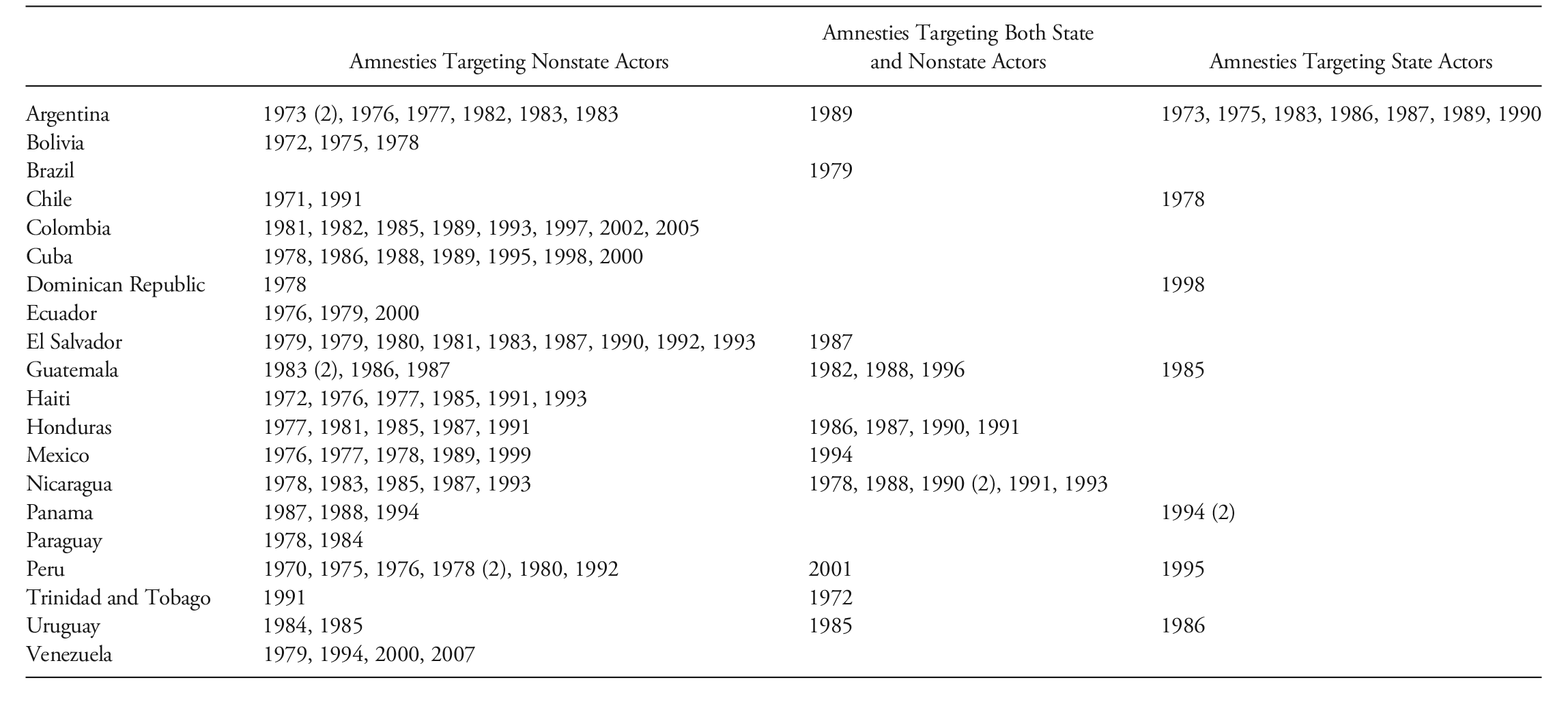
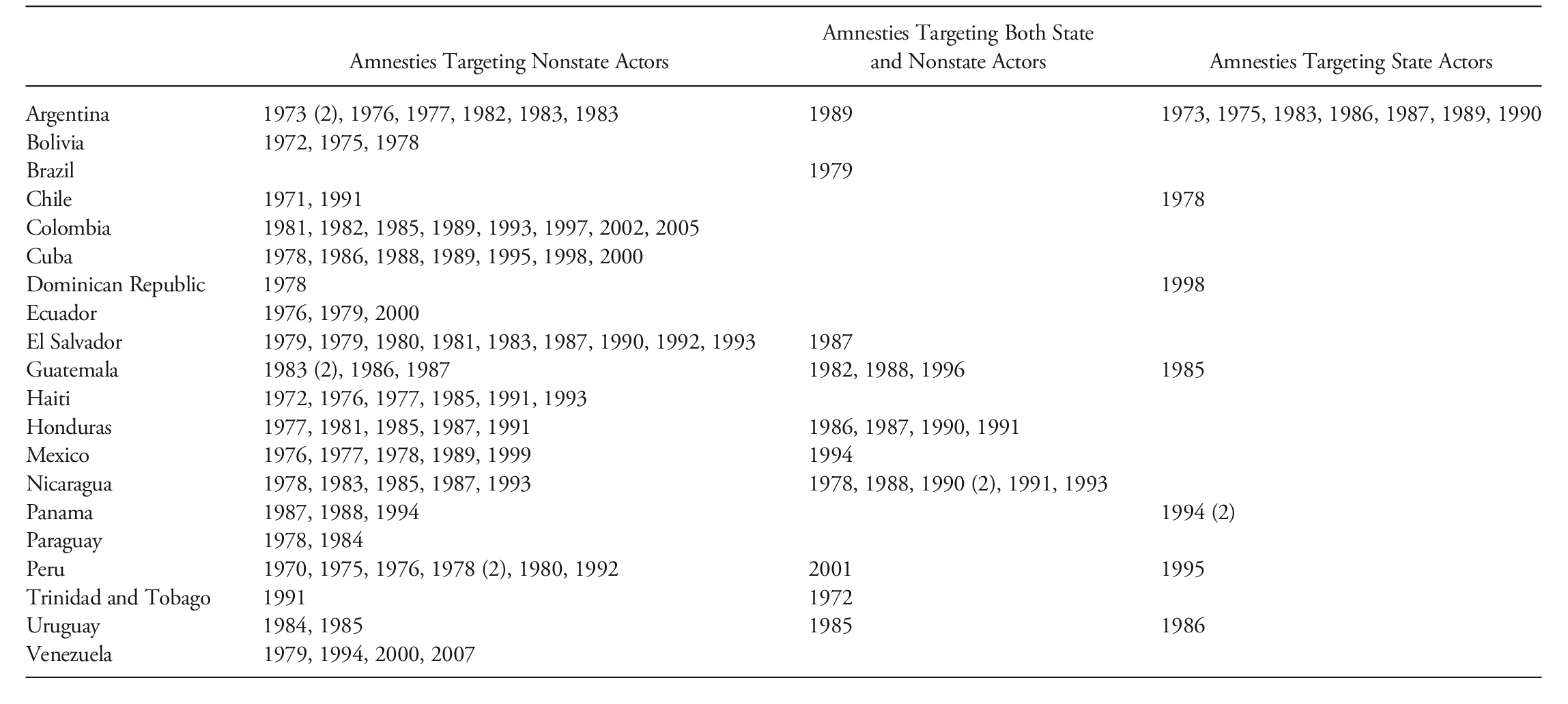
As Latin America emerged from an era of brutal dictatorships and civil wars in the 1980s and 1990s, the transitions frequently included amnesty laws. Some such laws were aimed at nonstate actors, generally regime opponents (e.g., members of guerrilla and rebel groups), to encourage them to disarm, or to release them from prison, or to allow them to return from exile. Other amnesty laws were created to shield state actors from prosecution and punishment, and still others covered both state and nonstate actors. Table 1 lists amnesties in Latin America from the 1970s forward, as identified in the Transitional Justice Database. Most of the cases in which the IACtHR addressed amnesty laws were brought by individuals alleging violations by agents of the state (typically members of the military, security, or police forces). The main exceptions are a set of cases from Colombia in which the Court considered state responsibility regarding atrocities committed by paramilitary groups.
Amnesties in Latin America
A. The Challenge of Amnesties
In its first judgment regarding an amnesty law, the IACtHR declared that “self-amnesty laws lead to the defenselessness of victims and perpetuate impunity; therefore, they are manifestly incompatible with the aims and spirit of the Convention” (para. 43 of Barrios Altos v. Peru [2001], Inter-American Court of Human Rights, Concurring Opinion of Judge Sergio García Ramírez, Series C, No. 75, decided March 14, 2001). The Court later extended that conclusion to all amnesties (not just “self-amnesties”): “In accordance with the obligations undertaken by the States pursuant to the Convention, no domestic legal provision or institution, including extinguishment, can oppose compliance with the judgments of the Court regarding investigation and punishment of those responsible for human rights violations. If that were not the case, the rights enshrined in the American Convention would be devoid of effective protection” (para. 117 of Bulacio v. Argentina [2003], Inter-American Court of Human Rights, Merits, Reparations and Costs, Series C, No. 100, decided February 28, 2003; emphasis added). And in paragraph 167 of Moiwana v. Suriname (2005, Inter-American Court of Human Rights, Preliminary Objections, Merits, Reparations and Costs, Series C, No. 124, decided June 15, 2005), the Court declared that if amnesties were able to impede the investigation and prosecution of perpetrators of human rights violations, “the rights found in the American Convention would be deprived of effective protection.” In other words, amnesties undermine the fundamental purpose of the regional human rights system. The Court has repeated that warning in virtually identical language in other cases (e.g., para. 151 of Gómez-Paquiyauri Brothers v. Peru [2004], Inter-American Court of Human Rights, Merits, Reparations and Costs, Series C, No. 110, decided July 8, 2004).
At the same time, amnesty laws are often key parts of sensitive domestic political bargains forged in moments of transition toward greater rule of law and respect for rights. Even in cases in which amnesty laws were enacted under dictatorships, well in advance of democratic transitions (e.g., Brazil in 1979 and Chile in 1978), the amnesty laws were created in anticipation of eventual transitions and, for the military regimes in power, were essential preconditions for them. Amnesty laws are therefore of high salience both in terms of the Court’s mission and in terms of domestic politics.
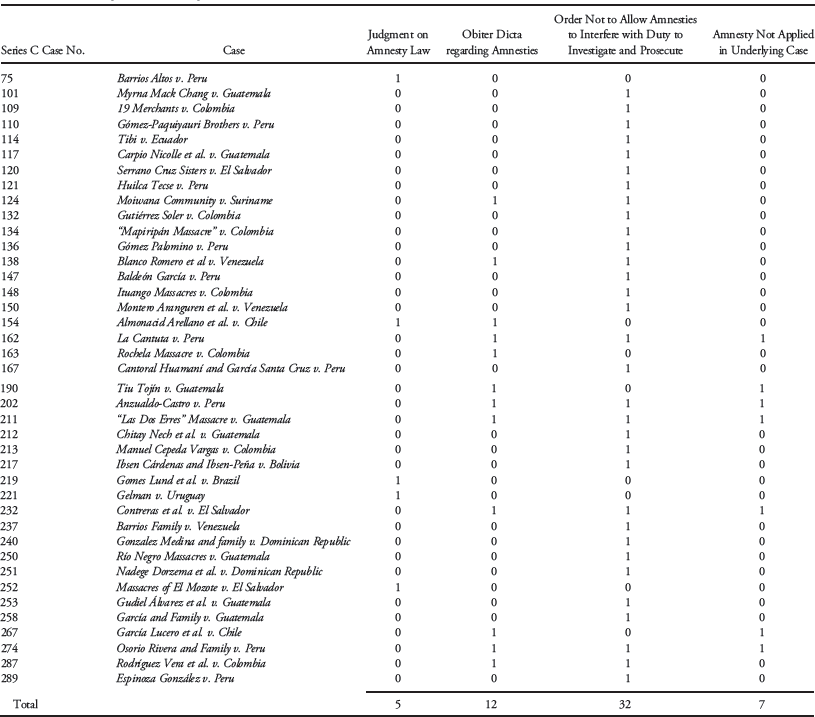
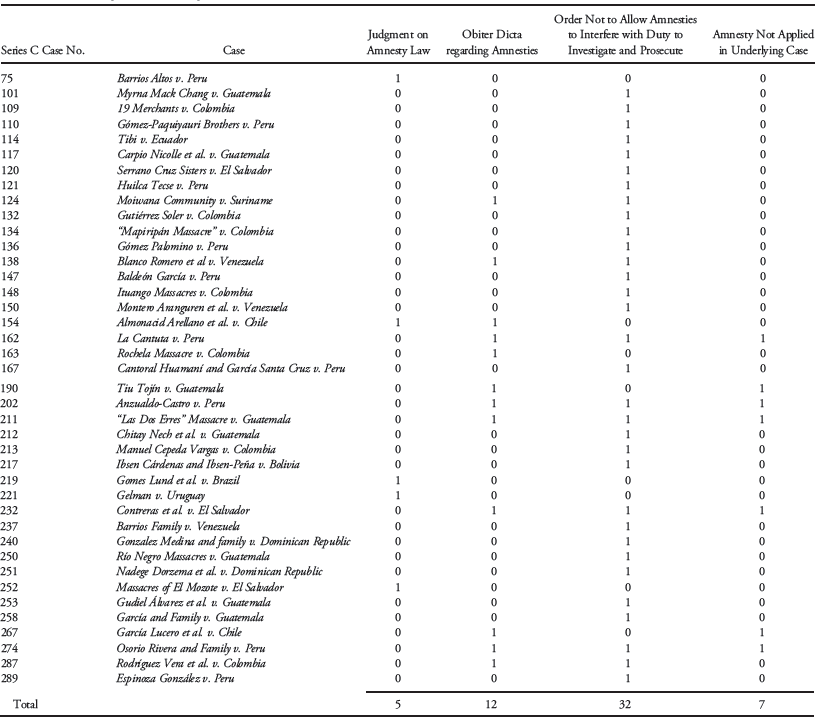
Through 2016, a total of 40 IACtHR judgments mentioned amnesties in some way.Footnote 4 These 40 cases represent nearly a fifth of the 214 merits decisions issued by the court in that period, a proportion that highlights the importance of amnesties in the Court’s overall jurisprudence. Of the 40 cases, the Court rules directly on the compatibility of an amnesty law with the American Convention in five.Footnote 5 Those five cases are at the heart of the more detailed analyses below. In 12 judgments, the Court issued obiter dicta with regard to amnesties, usually recalling its conclusions in one of the five judgments involving decisions on the amnesty laws themselves. In 32 judgments (in addition to the five amnesty judgments), the Court ordered the state not to allow amnesties to interfere with the investigation, prosecution, and punishment of those responsible for the rights violations. Finally, in seven judgments, the IACtHR noted that, although there was an amnesty law in place in the respondent country, it had not been applied in the underlying case.
B. The Core of the Court’s Anti-amnesty Jurisprudence
The Court’s amnesty jurisprudence rests on its interpretation of a core set of American Convention rights. First, the Court has constructed the right of victims and their families to justice, including clarification of the facts,Footnote 6 punishment of perpetrators, and reparation. The right to justice is grounded in Article 8 (“fair trial” or “judicial guarantees”) and Article 25 (“judicial protection,” or access to effective recourse). Article 8 defines the right of every person “to a hearing, with due guarantees and within a reasonable time, by a competent, independent, and impartial tribunal … for the determination of his rights.”Footnote 7 The failure to investigate, prosecute, and punish perpetrators denies the victims access to due process in determining their rights.Footnote 8 Indeed, shortly before its first amnesty judgment in Barrios Altos v. Peru, the Court clarified those rights: “Moreover, it is evident from Article 8 of the Convention that the victims of human rights violations or their next of kin should have substantial possibilities of being heard and acting in the respective proceedings, both in order to clarify the facts and punish those responsible, and to seek due reparation” (para. 227 of Villagrán Morales et al. [“Street Children”] v. Guatemala [1999], Inter-American Court of Human Rights, Merits, Series C, No. 63, decided November 19, 1999).
Article 25 enunciates “the right [of a person] to simple and prompt recourse, or any other effective recourse, to a competent court or tribunal for protection against acts that violate his fundamental rights.”Footnote 9 The Court has interpreted Article 25—together with Article 8—as establishing the right of victims (or their kin) to have the rights violations committed against them investigated, prosecuted, and punished in courts of law (Seibert-Fohr Reference Seibert-Fohr2009, 66–68). The Court affirmed this interpretation shortly before Barrios Altos: “Article 8(1) of the American Convention, in connection with Article 25(1) thereof, confers to victims’ relatives the right to investigate their disappearance and death by State authorities, to carry out a process against the liable parties of unlawful acts, to impose the corresponding sanctions, and to compensate damages suffered by their relatives” (para. 130 of Durand and Ugarte v. Peru [2000], Inter-American Court of Human Rights, Merits, Series C, No. 68, decided August 16, 2000). Without an effective judicial process regarding violations, ascertaining the facts and providing reparation are impossible.
The flip side of victims’ multidimensional right to justice is the obligation of states to make it effective. In its first judgment in a contentious case, Velásquez Rodríguez, the IACtHR declared that “the State has a legal duty to take reasonable steps to prevent human rights violations and to use the means at its disposal to carry out a serious investigation of violations committed within its jurisdiction, to identify those responsible, to impose the appropriate punishment and to ensure the victim adequate compensation” (para. 174 of Velásquez Rodríguez v. Honduras [1988], Inter-American Court of Human Rights, Merits, Series C, No. 4, decided July 29, 1988). The Court finds the duty to investigate, prosecute, and punish violations in Convention Articles 1 and 2. Article 1, “Obligation to Respect Rights,” requires states to “respect the rights and freedoms recognized herein and to ensure to all persons subject to their jurisdiction the free and full exercise of those rights and freedoms.”Footnote 10 Article 2 obligates states “to adopt … such legislative or other measures as may be necessary to give effect to those rights and freedoms” not already ensured by national provisions.Footnote 11 In the Court’s interpretation, Article 1 requires states to ensure fulfillment of rights of victims or their families to clarification of the facts and to prosecution and punishment of violators. Where national laws do not provide for fulfillment of the right to justice, states must, under Article 2, take whatever measures are necessary—legislative, judicial, executive—to fill that gap (Burgorgue-Larsen and Úbeda de Torres Reference Burgorgue-Larsen and de Torres2011, chap. 11).
Amnesty laws, by their nature, preclude the prosecution of those responsible for serious rights violations. Such laws therefore violate the right of the victims and their families to justice and the duty of the state to ensure fulfillment of that right through judicial mechanisms. This reasoning undergirds, with minor variations, all of the Court’s decisions regarding national amnesty laws.
C. Expanding Rights While Recognizing Domestic Contexts
International courts have an underlying preference to uphold, and where possible to extend the reach of, the norms of the legal regime for which they are trustees. As Alter (Reference Alter2014, 23) puts it, “ICs enforcing international economic rules will tend to promote market openness. ICs enforcing human rights rules will tend to promote a human rights agenda. International war crimes tribunals will tend to condemn state practices that harm noncombatants.” But international courts also desire to see their judgments accepted and implemented, in order to build their legitimacy. The latter goal creates an incentive for ICs to be attuned to domestic politico-legal contexts. Indeed, research shows that supranational courts will be more effective when they take into account domestic audiences and constituencies (Helfer and Slaughter Reference Helfer and Slaughter1997; Cavallaro and Brewer Reference Cavallaro and Erin Brewer2008, 770; Alter and Helfer Reference Alter and Helfer2010, 565).
The Inter-American Commission’s mission and activities extend well beyond referring cases to the Court. The Commission monitors rights practices in OAS countries, makes site visits to specific countries, issues country reports, designates rapporteurs on specific topics, issues reports on specific rights, holds conferences and seminars to expand understanding of human rights, and alerts the Organization of American States (of which the Commission is an autonomous organ) to urgent problems (Organization of American States 2019). Although its role differs from that of the Court, we assume that the Commission shares the same underlying commitments as the Court: (1) to expand the reach of regional human rights norms while (2) taking into account diverse national contexts.
III. The Commission and Timing
In this section we explore empirically the role of the Commission in referring amnesty cases to the Court. We show that the Commission’s behavior in the amnesty referrals has been consistent with the proposition that it takes into account domestic developments.
The Commission receives petitions from persons or groups alleging state violations of rights protected by the American Convention on Human Rights (ACHR). Once a petition is submitted to the Commission, the Commission studies it and reaches a decision on admissibility. If the petition is deemed admissible, the Commission can request additional information from the petitioner and the state, and it can schedule meetings with the parties. The Commission then seeks to bring the parties to agreement on a friendly settlement. If that proves impossible, the Commission refers the case to the Court.Footnote 12 The petition process at the Commission typically lasts for years. But there is significant variation (as we show below), and the Commission has considerable discretion as to how quickly a petition moves through the process. Does it use that discretion differently in amnesty cases as compared with other kinds of cases?
We expect that Commission referrals to the Court in amnesty cases will follow—rather than precede—key events that would indicate greater domestic receptiveness to accountability.
A. Timing: The Broad Picture
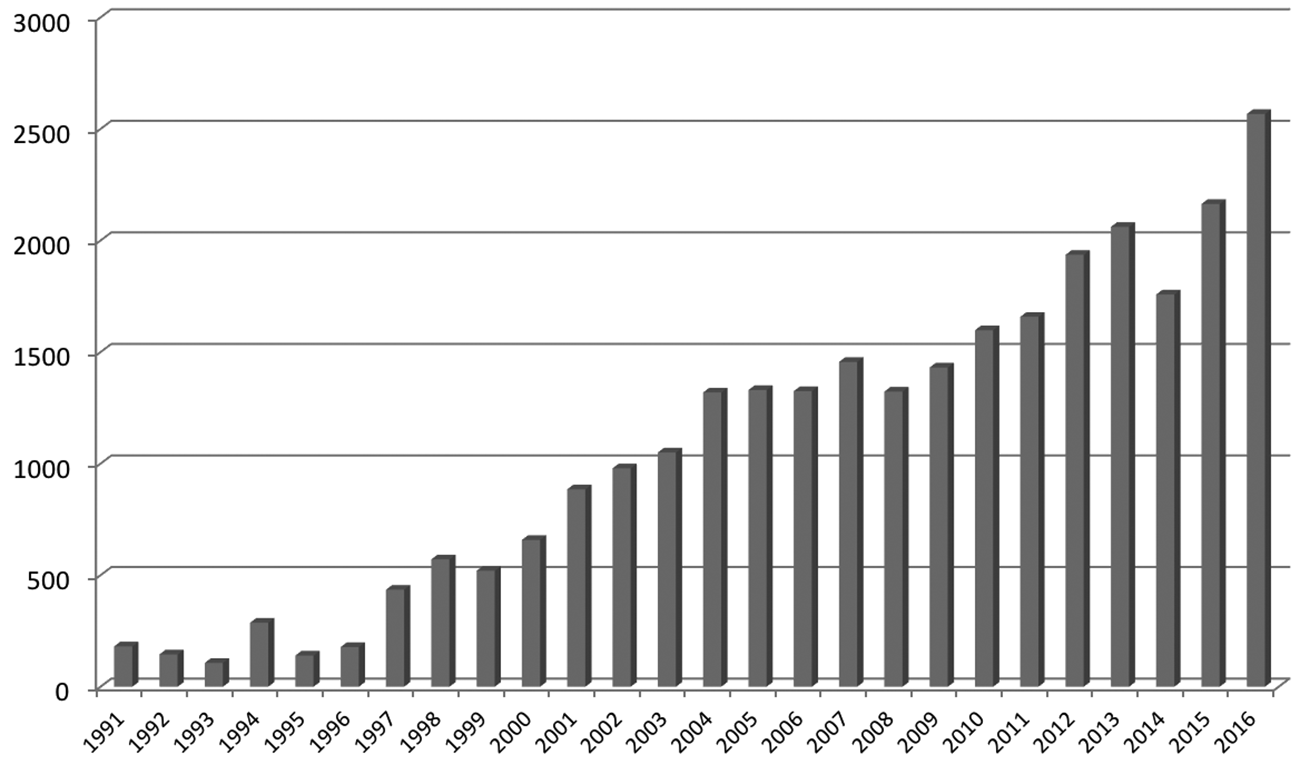
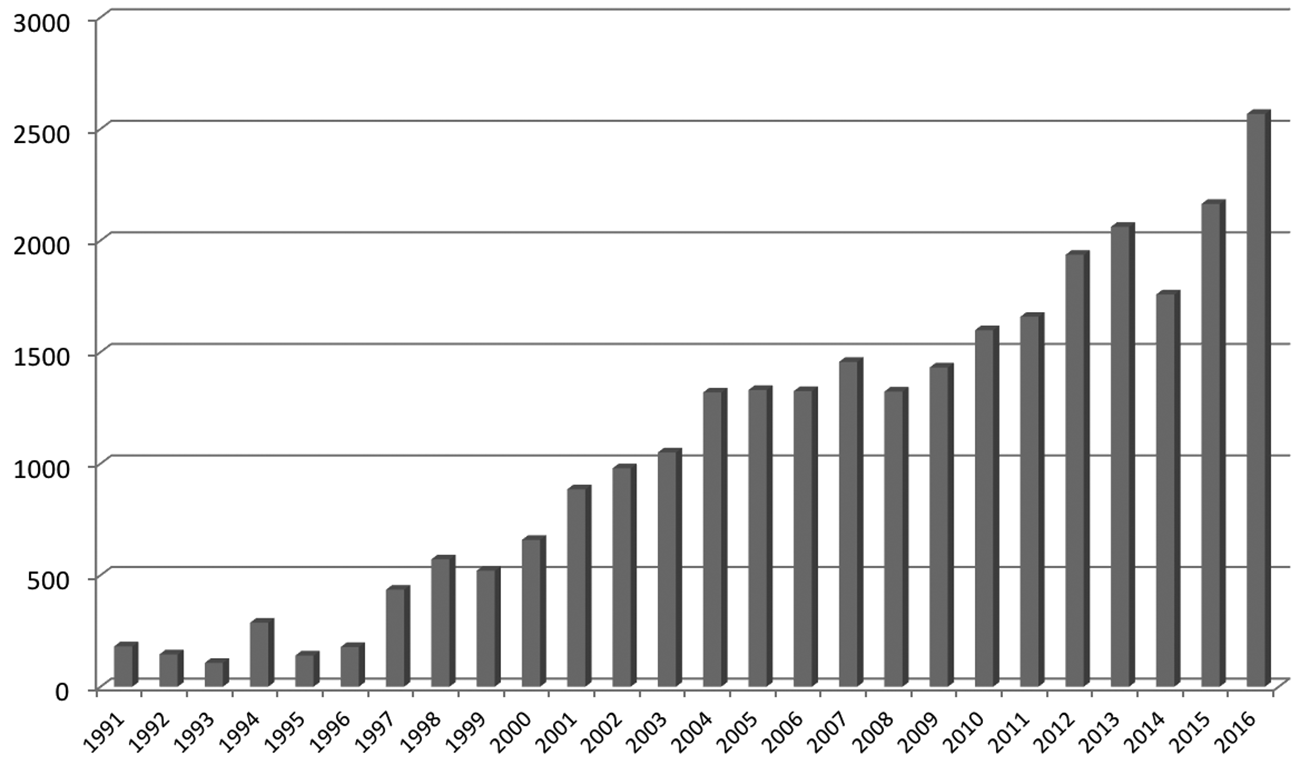
Figure 1 shows the steady increase in the number of petitions the Commission receives. Once the processing of a petition has begun, multiple kinds of delays are inevitable, from multiple sources. The parties (the petitioner and the state) can be slow to provide requested information. Negotiating a friendly settlement can require multiple iterations, each with potential delays. Finally, the Commission has discretion as to how quickly a petition moves through the process; it can prioritize some cases and place others further down the queue. The time from receipt of the petition to submission of a case to the Court varies considerably, and the variation is not random.
Petitions received by the commission
In particular, the Commission can delay submitting a case to the Court if the domestic context in the respondent state does not appear favorable to accepting and complying with a judgment. Other scholars have shown that the Commission does engage in such calculations. Cavallaro and Brewer (Reference Cavallaro and Erin Brewer2008, 819) note that over its 50-year existence, “the Inter-American Commission has carefully considered the domestic political conditions in the countries in which it has acted.” They also point to instances, in various legal domains, in which the Commission took into account domestic politico-legal contexts as it exercised discretion over which cases to submit to the Court (819). With respect to amnesty laws in particular, in the early 1990s the Commission examined the amnesty laws in place in Argentina and Uruguay. It determined that the amnesties contravened the American Convention. But the Commission decided not to submit the cases to the Inter-American Court, judging that referring them would run the risk of “undesired consequences for human rights … or for the legitimacy of the Court” (819).
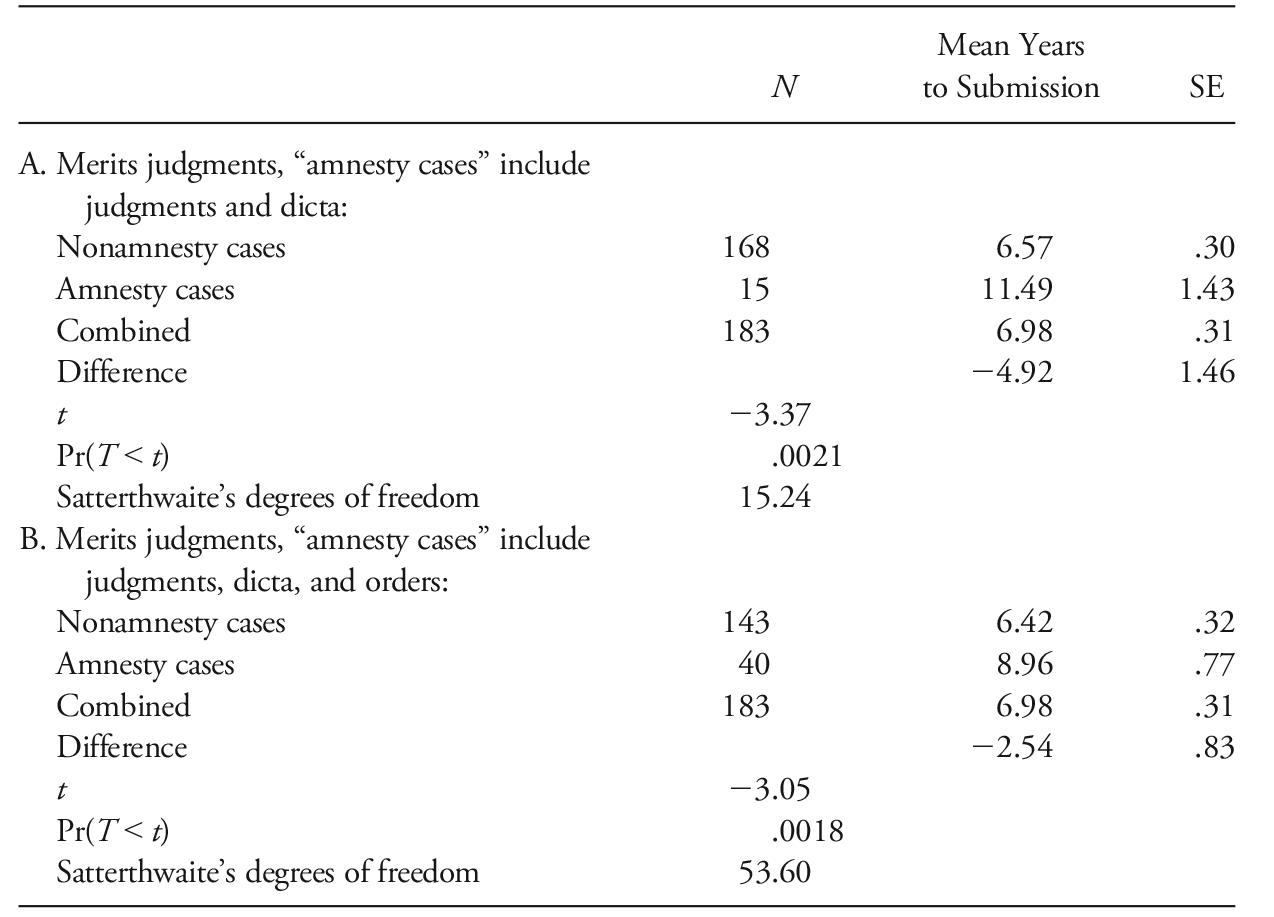
Given the political sensitivity of amnesty laws, we would expect that amnesty cases will be delayed longer than other types of cases before being sent to the IACtHR, as the Commission awaits favorable domestic developments in the state concerned. We check that claim against data on the time elapsed from Commission receipt of a petition to submission of a case to the Court, for all cases that have resulted in a judgment on the merits through 2014. In table 2, we classify “amnesty cases” in two different ways. In panel A, we include those cases in which the Court either made a judgment regarding the amnesty law or included obiter dicta reiterating its amnesty jurisprudence. In panel B, we include the cases in panel A, plus those in which the Court issues an order regarding nonapplication of amnesties. In both tables, the time to Court submission is longer for amnesty cases than for others (nearly 5 years longer in A and 2.5 years longer in B), and the differences are significant. This is consistent with our expectation that the Commission would wait to submit amnesty cases until domestic circumstances had become more favorable.
Timing of Commission Submissions to the Court
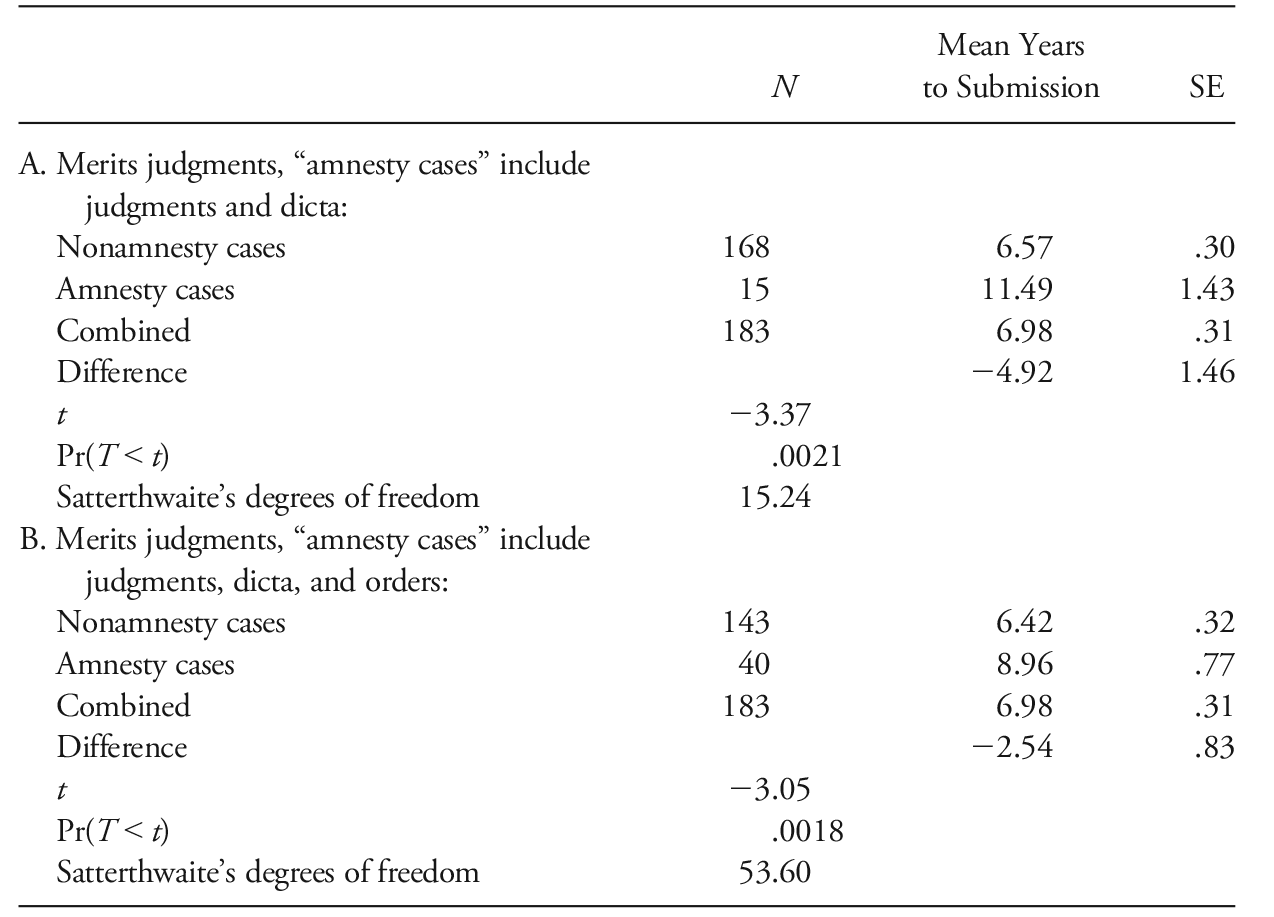
Note.— H(0): difference = 0; H(a): difference < 0.
B. The Timing of Commission Referrals: A Closer Look
We assume that the Commission will prefer a Court decision that has the best chance of being implemented by the respondent state, that is, when the domestic context appears propitious.Footnote 13 What would a favorable domestic context look like? Regarding amnesty cases, three types of events would indicate the presence of more receptive domestic circumstances.
-
1 The end of the crisis that produced the large-scale human rights violations, where “crisis” can refer to either a repressive authoritarian regime or a civil war. This is a minimum condition, based on the assumption that as long as the repression is ongoing, the state will not accept a Court decision against amnesty.
-
2 An alternance in power, meaning that opposition parties have replaced those in office when the human rights violations occurred.
-
3 The creation of domestic transitional justice mechanisms, like truth commissions and prosecutions.
Both alternance in power and transitional justice mechanisms indicate that a domestic transition has been consolidated to some degree and therefore that an Inter-American ruling on the amnesty law would be less likely to revive political conflicts or endanger a fragile transition. The presence of one or more indicators of favorable domestic context should increase the chances that a Court decision will be supported by domestic compliance constituencies (Alter Reference Alter2014; Hillebrecht Reference Hillebrecht2014). This reasoning leads to the following observable implications.
-
1 The Commission is likely to submit an application to the Court after the end of the crisis that produced the human rights violations, meaning either a political transition from authoritarian rule or the conclusion of a civil war.
-
2 The Commission is more likely to submit an application to the Court if there are indications that the domestic political transition has been consolidated, specifically, if (a) an alternance in power has occurred or (b) domestic transitional justice mechanisms have been created.
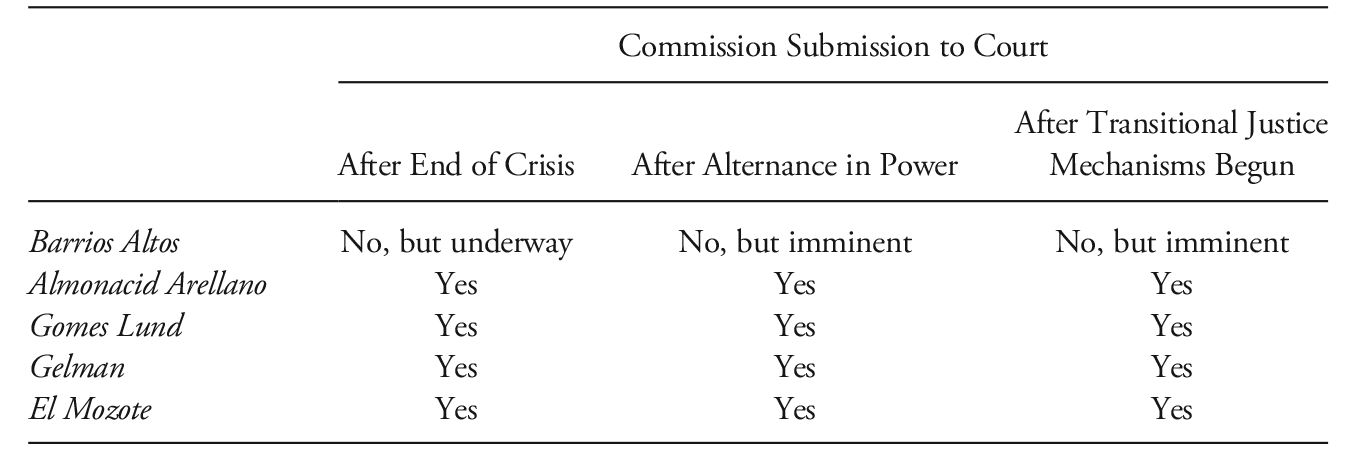
Table 3 summarizes, for the five cases in which the Court ruled on the legality of a national amnesty law, the timing of their submission by the Commission to the Court. Although the Barrios Altos case offers some nuances, the pattern is consistent with our propositions.
Timing of Commission Submissions to the Court in Five Key Amnesty Cases
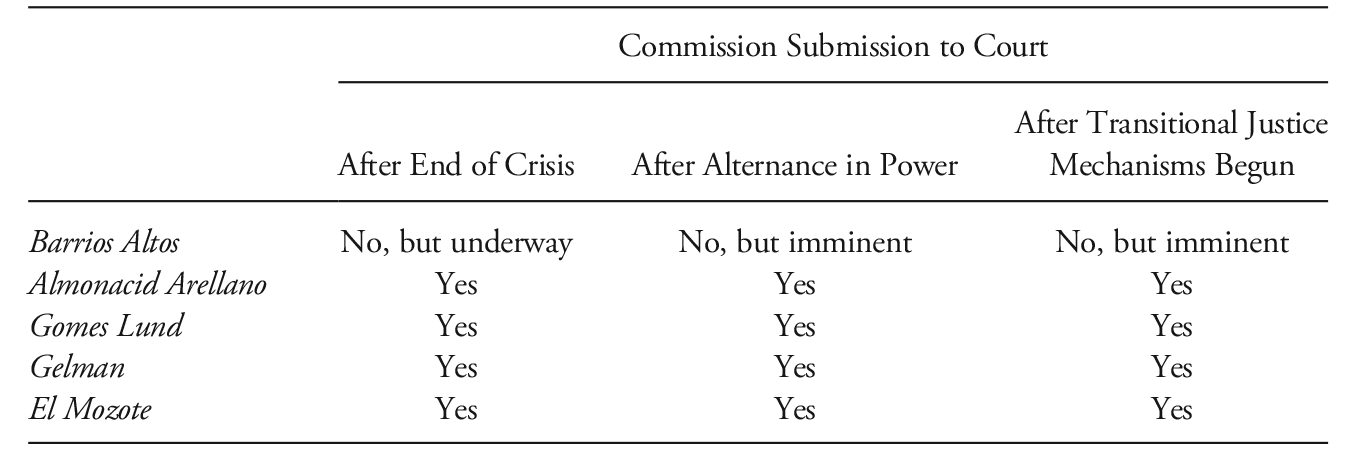
The Commission submitted these cases to the Court after the countries involved had experienced—or, in Barrios Altos, were currently undergoing—all three indicators of a favorable shift in the domestic politico-legal context: the end of the crisis, an alternance in power, and the creation of a transitional justice mechanism. Each of these events indicates a domestic political context that is likely to be more favorable to an IACtHR judgment against amnesties. The only partial exception is Barrios Altos, and even there Fujimori’s regime was clearly tottering, and within months of the Commission submission both an alternance in power and the creation of a transitional justice mechanism had occurred.
IV. The Court’s Amnesty Judgments
In this section we provide evidence that the Court modulates its judgments regarding amnesty laws with a view to the domestic politico-legal context in the respondent state, after first discussing the role of precedent. For more detail on each of the amnesty cases discussed below, see the online-only appendix.
A. Precedent and Differentiation
Although there is no rule of stare decisis in international courts, judges favor consistency. They are therefore motivated to provide precedent-based reasons for their decisions (Shapiro Reference Shapiro1972, Reference Shapiro1981). Indeed, the development of precedent in international courts is inevitable (Venzke Reference Venzke2012, chap. 2; von Bogdandy and Venzke Reference von Bogdandy, Venzke, Romano, Alter and Avgerou2013; Pelc Reference Pelc2014). As Stone Sweet and Keller (Reference Stone Sweet, Keller, Keller and Stone Sweet2008, 8) argue, no court can have an influence on its legal and political context without (among other characteristics) a “minimally robust conception of precedent.” The ECtHR, for instance, “relies on precedent-based rationales” in order to guide the arguments of claimants and states, to provide rationales for its rulings, and to encourage state compliance with decisions (14). The IACtHR has sought to expand the reach of regional human rights norms by developing a vigorous case law, routinely citing its own judgments.Footnote 14
In its first four judgments on national amnesty laws, the Court set a seemingly demanding precedent: amnesty laws violated the American Convention. But in a separate opinion in Barrios Altos, Judge Sergio García Ramírez suggested that, under certain conditions, an amnesty enacted in terminating a civil war would not necessarily violate the Convention. Thus, if the Court were to take into account domestic politico-legal contexts in judging national amnesty laws, it could treat civil-war-ending amnesties differently from other types of amnesties.
B. The Amnesty Cases
The case studies that follow highlight two key points. First, in each instance in which the IACtHR nullified a national amnesty law, the government in power was a posttransition government. Moreover, the current governments had taken some positive steps to render the amnesty law ineffective in practice, to uncover and publicize the truth about past human rights violations, and to compensate victims or their families. In other words, the Court faced respondent states that were already beginning to address impunity and that could therefore be receptive to Court rulings that invalidated the amnesty laws. Second, the cases emphasize the distinctions drawn by the Court, or dismissed by the Court, among amnesties established under differing domestic conditions.
1. Barrios Altos v. Peru (2001)
The judgment in Barrios Altos marked the first time that the IACtHR ruled directly on a national amnesty law. The ruling established a strict standard, holding that amnesty laws (with some nuances to be explored below) were in themselves incompatible with the American Convention. In addition, for the first time, the Court held a national law to be devoid of legal effect.
By the time the Court held its hearing on the case in March 2001, President Alberto Fujimori had fled Peru (November 2000) and a transition government was in place in Lima. The transition government had affirmed its acceptance of IACtHR jurisdiction (which Fujimori had attempted to revoke) and had accepted international responsibility for the rights violations identified by the Commission (Burt Reference Burt2009). The presence of a receptive government in Lima may have suggested to the Court that the time was right for a dramatic ruling on amnesties. The Court provided one:
The Court considers that it should be emphasized that, in the light of the general obligations established in Articles 1(1) and 2 of the American Convention, the States Parties are obliged to take all measures to ensure that no one is deprived of judicial protection and the exercise of the right to a simple and effective recourse, in the terms of Articles 8 and 25 of the Convention. Consequently, States Parties to the Convention which adopt laws that have the opposite effect, such as self-amnesty laws, violate Articles 8 and 25, in relation to Articles 1(1) and 2 of the Convention. Self-amnesty laws lead to the defenselessness of victims and perpetuate impunity; therefore, they are manifestly incompatible with the aims and spirit of the Convention.
(Barrios Altos v. Peru, para. 43)Crucially, the Court unanimously decided “to find that Amnesty Laws No. 26479 and No. 26492 are incompatible with the American Convention on Human Rights and, consequently, lack legal effect” (para. 51).
The judgment subsequently referred to “the manifest incompatibility of self-amnesty laws and the American Convention on Human Rights” (Barrios Altos v. Peru, paras. 42–44), a conclusion also advanced in the separate opinions of Judge A. A. Cançado Trindade and Judge Sergio García Ramírez (para. 5ff., para. 1ff.). The concurring opinion of Judge García Ramírez addressed a second means of distinguishing among types of amnesties, that between self-amnesties and amnesties “that are the result of a peace process.” Amnesties that are part of a peace process can “contribute to re-establishing peace and opening new constructive stages in the life of a nation.” Peace-process amnesties, García Ramírez argued, can be permissible if they exclude “the most severe human rights violations,” including extrajudicial killing, forced disappearance, genocide, torture, and certain crimes against humanity (paras. 10–15). The Court would later return to the subject of peace-process amnesties.
2. Almonacid Arellano et al. v. Chile (2006)
In Almonacid Arellano, Chile sought to avoid a direct ruling on its amnesty law, pointing out that the government and the Chilean courts had nullified any practical effects of the amnesty law and arguing that their efforts were part of the country’s democratic transition, with which the Court should not tinker. Nevertheless, the Court declared Chile’s amnesty law void: “Therefore, the Court … declares unanimously that … insofar as it was intended to grant amnesty to those responsible for crimes against humanity, Decree Law No. 2.191 is incompatible with the American Convention and, therefore, it has no legal effects” (Almonacid Arellano et al. v. Chile, para. 171).
The judgment in Almonacid ignored one distinction and dismissed another. The Court found amnesties in general, not just self-amnesties, incompatible with the American Convention because of their effects: amnesty laws “perpetuate impunity for crimes against humanity” (Almonacid Arellano et al. v. Chile, para. 119). In so ruling, the Court also dismissed as a consideration the domestic legality or political origins of amnesty laws. The Court declared that “rather than the process of adoption and the authority issuing Decree Law No. 2.191,” what mattered was the purpose of the law: “granting an amnesty for the serious criminal acts contrary to international law that were committed” (para. 120).
3. Gomes Lund v. Brazil (2010)
As had Peru and Chile, Brazil had already taken steps to undo at least some of the effects of its amnesty laws when the case was submitted to the Court. The IACtHR decision in Gomes Lund aimed to remove the legal basis for impunity. The judgment cited the same legal basis (Arts. 1, 2, 8, and 25) as the previous amnesty cases. It also reached the same unanimous judgment: “The provisions of the Brazilian Amnesty Law that prevent the investigation and punishment of serious human rights violations are not compatible with the American Convention [and] lack legal effect” (Gomes Lund et al. v. Brazil, para. 325). The judgment also reaffirmed that not just self-amnesties but all “amnesties of serious human rights violations” violated the American Convention. The domestic legality or political basis of amnesty laws is not the question but rather their intended effects: “The non-compatibility of the amnesty laws with the American Convention in cases of gross violations of human rights does not stem from a formal question, such as its origin, but rather from the material aspect as they breach … the Convention” (para. 175).Footnote 15
4. Gelman v. Uruguay (2011)
The amnesty at issue in Gelman v. Uruguay (the Expiry Law) was part of an internally negotiated political transition. Moreover, the Expiry Law had been approved by voters in a referendum, not once but twice, in 1989 and 2009. The amnesty thus enjoyed some degree of political legitimacy. Uruguay had also created a truth commission and taken steps to prosecute perpetrators.
When the IACtHR received the Commission’s application in Gelman (January 2010), it had three strong precedents for nullifying the amnesty law. Accordingly, the IACtHR declared that “given its express incompatibility with the American Convention, the provisions of the Expiry Law that impede the investigation and punishment of serious violations of human rights have no legal effect and, therefore, can not continue to obstruct the investigation of the facts of this case and the identification and punishment of those responsible, nor can they have the same or similar impact on other cases of serious violations of human rights enshrined in the American Convention that may have occurred in Uruguay” (Gelman v. Uruguay, para. 232).Footnote 16 The judgment explicitly reinforced two key principles. First, the Court underscored that the incompatibility of amnesty laws was “not limited to those which are denominated, ‘self-amnesties’” (para. 229). Second, it emphasized that “the fact that the Expiry Law of the State has been approved in a democratic regime and yet ratified or supported by the public, on two occasions, namely, through the exercise of direct democracy, does not automatically or by itself grant legitimacy under International Law” (para. 238). The political basis of amnesties was not the issue but rather their purpose, which was “to leave unpunished serious violations” of human rights (para. 229).
5. Massacres of El Mozote v. El Salvador (2012)
El Mozote allowed the Court explicitly to recognize an important distinction: “Contrary to the cases examined previously by this Court, the instant case deals with a general amnesty law that relates to acts committed in the context of an internal armed conflict” (Massacres of El Mozote v. El Salvador, para. 284). To be sure, the Court had already decided cases from countries in which a civil war peace process involved an amnesty. But in these previous cases, from Colombia, El Salvador, and Guatemala,Footnote 17 the amnesty laws were not alleged to have hindered the investigation, prosecution, and punishment of those responsible for the specific rights violations that were the subject of the petitions. Consequently, in those judgments the Court did not rule directly on the amnesty laws themselves, although it did sometimes reiterate its general amnesty jurisprudence in obiter dicta, and it did stipulate that amnesties must not pose any obstacle to pursuing the investigation, prosecution, and punishment of the underlying crimes.
The law that the IACtHR found incompatible with the American Convention in El Mozote was the 1993 “Law of General Amnesty for the Consolidation of the Peace.” The Court then ruled that the 1993 amnesty contradicted both the peace accords, which provided for an end to impunity, and the 1992 amnesty law, which excluded those who had participated in serious human rights violations (Massacres of El Mozote v. El Salvador, para. 292). The provisions of the Law of General Amnesty that fostered impunity were without legal effect.
The Court’s judgment in El Mozote also explicitly noted that, unlike the previous cases, El Mozote involved an amnesty law related to acts committed in an internal armed conflict (Massacres of El Mozote v. El Salvador, para. 284). Thus the Court declared that it is pertinent to analyze “the compatibility of the Law of General Amnesty for the Consolidation of Peace with the international obligations arising from the American Convention … in light of the provisions of Protocol II Additional to the 1949 Geneva Conventions” (para. 284). Protocol II Additional to the 1949 Geneva Conventions explicitly allows for “the enactment of amnesty laws on the conclusion of hostilities in non-international armed conflicts” as a way to “pave the way to a return to peace” (para. 285). However, the Protocol II allowance for amnesties is not open-ended because, under international humanitarian law, “States also have an obligation to investigate and prosecute war crimes.” The amnesties envisioned in Geneva Protocol II thus cannot “involve facts, such as those of the instant case, that can be categorized as war crimes, and even crimes against humanity” (para. 286).
In a separate opinion, Judge Diego García-Sayán further explored the potential legality of peace-process amnesties. Significantly, four other judges joined García-Sayán’s opinion, meaning that five out of the seven IACtHR judges who heard the El Mozote case endorsed García-Sayán’s conclusions. Judge García-Sayán affirmed that, “in this judgment, the Court has indicated that, even though amnesties may be permitted as a component of the ending of a non-international armed conflict, they have a limit which is in relation to war crimes and crimes against humanity, so that these crimes cannot remain unpunished or be forgotten” (Massacres of El Mozote v. El Salvador, para. 18). He recognized that peace is also a human right and that the multiple goals of a peace-making process may require that rights and obligations “be weighed in such a way that the satisfaction of some does not affect the exercise of the others disproportionately” (paras. 36–38). He further suggested that the most serious cases of rights violations could be handled differently from the “less serious” ones and that “reduction of sentences” and “alternative punishments” could also be considered (paras. 29, 31). In other words, under certain conditions, peace-process amnesties could be compatible with the American Convention.
C. Colombia: Amnesty and Ending Civil War
The Colombian civil war, which lasted from the early 1960s until 2016, initially pitted leftist guerrilla forces like the FARC (Fuerzas Armadas Revolucionarias de Colombia, the largest group) and the ENL (Ejército Nacional de Liberación) against the Colombian armed forces. The war later grew more complicated, involving anti-FARC paramilitary groups as well as drug trafficking organizations. Every side committed atrocities, including extrajudicial killings, forced disappearances, torture, and mass displacement. More than 300,000 people lost their lives, as many as 50,000 disappeared, and millions were forced from their lands and villages (Laplante and Theidon Reference Laplante and Theidon2006, 53–57; Alvira Reference Alvira2013, 119).
Since Colombia accepted the contentious jurisdiction of the Inter-American Court in 1985, the Court has issued 17 merits judgments in cases arising out of Colombia; 13 of those cases dealt with atrocities connected to the ongoing civil war. Throughout that period, a succession of amnesty laws has been in place, eight of them since 1980.Footnote 18 The amnesties have generally offered immunity from prosecution or reduced punishments to guerrillas and, in later instances, paramilitaries who demobilized and returned to civilian life (Laplante and Theidon Reference Laplante and Theidon2006, 59–69). Law 975/05 (Ley de Justicia y Paz), signed by President Álvaro Uribe in July 2005, was a major departure compared to earlier Colombian amnesties. The LJP was the first Colombian amnesty to incorporate international norms and principles of transitional justice, which conditioned reduced punishment on perpetrators’ participation in truth telling, cooperation with criminal justice processes, reparations to victims, and active reintegration in society (Laplante and Theidon Reference Laplante and Theidon2006, 80).
Despite Colombia’s numerous amnesty laws and despite having received numerous cases involving Colombia, the IACtHR has yet to rule directly on a Colombian amnesty law. Some of the Court’s decisions, however, do address the 2005 Ley de Justicia y Paz (LJP). In the case of “Mapiripán Massacre” v. Colombia, both the victims’ representatives and the Commission asked the Court to rule on the compatibility of the LJP with the American Convention. The Court avoided a judgment on that question but reiterated that no domestic law could interfere with a state’s “obligation to investigate and punish those responsible for human rights violations” in the case (“Mapiripán Massacre” v. Colombia, para. 304). In Rochela Massacre v. Colombia, the victims’ representatives similarly invoked the LJP as an obstacle to realizing their rights to the truth, justice, and reparations, arguing that it was “a concealed amnesty or pardon of the penalty” (Rochela Massacre v. Colombia, paras. 180, 185). The Court did not pronounce directly on the LJP but instead affirmed the state’s duty to investigate, prosecute, and punish the perpetrators of the violations at Rochela, and to do so promptly and without hindrances (paras. 193–98).
Along the same lines, in Afro-descendant Communities v. Colombia, the IACtHR discussed the LJP. The Court noted that the Colombian Supreme Court of Justice had ruled that persons accused of atrocities could not benefit from the reduced penalties available under the LJP unless their confessions had been certified as truthful and complete (para. 74 of Afro-descendant Communities v. Colombia ([2013], Inter-American Court of Human Rights, Preliminary Objections, Merits, Reparations and Costs, Series C, No. 328, decided November 20, 2013). The Court also ordered the state to “use all necessary means” to investigate, prosecute, and punish those responsible for violations and to “remove any obstacles de facto or de jure that could maintain impunity” in the case (para. 440).
In still other cases, the IACtHR has not discussed the LJP explicitly but has reminded the state that it must not deploy amnesty laws or any other domestic mechanism that inhibits the prompt investigation, prosecution, and punishment of those responsible for rights violations. The Court included that admonition, for example, in Ituango Massacres v. Colombia (para. 402) and Manuel Cepeda Vargas v. Colombia (para. 216(d)). In short, the Court has avoided ruling on the compatibility of Colombia’s LJP with the American Convention on Human Rights. That the Court has declined to rule directly on Colombia’s amnesty laws—when given ample opportunity to do so—suggests that it views amnesties that help to end civil wars as requiring a different approach.
D. The 2016 Peace Accord and the IACtHR’s Amnesty Jurisprudence
The peace accord between the Colombian government and the FARC, approved by the Colombian Congress in December 2016, appears to have resolved the central conflict. The accord includes a complex amnesty for former fighters, contingent—like the 2005 LJP—on the participation of demobilizing fighters in truth and justice processes. The 2016 accord is less punitive than previous laws. It foresees varying levels of criminal responsibility and punishment for atrocities. Demobilized fighters not accused of serious human rights violations who participate in truth telling, cooperate with investigators, and help with reparations can avoid prison time. For those guilty of atrocity crimes who are sentenced to prison, 8 years is the maximum sentence. The accord makes it clear that international crimes will be investigated and prosecuted. However, “exactly what the sentence is will be shaped by the defendant’s level of cooperation with trial and reparatory measures” (Hillebrecht, Huneeus, and Borda Reference Hillebrecht, Huneeus and Borda2018, 320–24).
The 2016 peace accord explicitly addresses the IACtHR’s amnesty jurisprudence, raising important questions (Hillebrecht, Huneeus, and Borda Reference Hillebrecht, Huneeus and Borda2018). It quotes “at length” Judge García-Sayán’s separate opinion in El Mozote (Hillebrecht, Huneeus, and Borda Reference Hillebrecht, Huneeus and Borda2018, 319). In fact, El Mozote is the only judicial decision specifically mentioned in the peace accord (Hillebrecht, Huneeus, and Borda Reference Hillebrecht, Huneeus and Borda2018, 300). Participants in the peace process have clearly taken note of the Court’s reasoning in El Mozote and in the accompanying separate opinion by Judge Diego García-Sayán, indicating that it is prepared to treat peace-process amnesties differently from amnesties enacted in other kinds of domestic contexts (transitions from authoritarian rule). This distinction could prove crucial to the Court if it is at some point called on to decide a petition from victims of civil war atrocities. It is not difficult to imagine victims claiming that the reduced punishment provisions of the 2016 Colombian peace accord amount to an amnesty, in violation of the Court’s announced prohibition of amnesties for atrocity crimes. Rather than ruling against a key provision of the peace accord, the Court could determine that peace is also a right and that its attainment could, at times, qualify the prohibition of amnesties for atrocities.
V. Conclusion
All courts necessarily walk a narrow path between advancing the reach of the norms they are charged with applying and paying pragmatic attention to the needs and goals of litigants and other constituencies (Shapiro Reference Shapiro1981). The analysis presented here illustrates the point that international courts are constantly weighing both their duty to uphold international norms and their need to take into account domestic contexts. Critics depict the Inter-American System as pursuing an expansive vision of human rights norms, heedless of politico-legal conditions in the states subject to its decisions. Our analysis suggests that the Commission and the Court do seek to extend the reach of human rights norms, but that they also take into account key features of the domestic context.
We showed that although the Commission and the Court have staked out a strong stance against amnesties, they have also modulated their actions in ways that indicate attention to domestic circumstances. Specifically, the Commission’s submissions to the Court in the five amnesty cases have consistently followed a pattern: those submissions have occurred after the crisis that produced the violations has ended, after an alternance in power has occurred, and after domestic transitional justice mechanisms have been created (with Barrios Altos as a partial exception). These key domestic developments indicate a more favorable context for a judgment on an amnesty law. For its part, the Court has signaled—particularly in its judgment in El Mozote—that it is prepared to take into account differences in domestic context by treating amnesties that conclude civil wars differently from other types of amnesties.
To be clear, we cannot present direct evidence that the Commission and the Court made decisions based on their assessment of domestic legal and political contexts. That evidence exists only in the minds of the Commissioners and judges involved. Even retrospective accounts by those participants would not provide accurate evidence of the considerations and reasoning that entered into those decisions at the time, as memories are imperfect and the retelling is shaped by an actor’s current ideas, purposes, and goals. Rather, we proposed a number of observable features that should be present in the amnesty cases if our arguments were valid. The evidence was congruent with our expectations. Extending our analysis of the Inter-American System’s treatment of amnesties to other rights domains and to other courts could expand our understanding of the diverse ways in which international human rights courts balance the expansion of rights with sensitivity to domestic contexts.
Appendix
IACtHR Judgments Mentioning Amnesties