There is a lengthy history of debate within the fields of psychology and human development concerning the degree to which early interpersonal experiences influence developmental adaptation across the life span. Some scholars have suggested that few, if any, effects on adaptation are ultimately attributable to early experiences (Clarke & Clarke, Reference Clarke and Clarke1976, Reference Clarke and Clarke2000; Kagan, Reference Kagan1996; Kagan & Moss, Reference Kagan and Moss1962; Lamb, Thompson, Gardner, Charnov, & Estes, Reference Lamb, Thompson, Gardner, Charnov and Estes1984; Lewis, Reference Lewis1997), whereas others have provided evidence that early interpersonal experiences persist in their influence on subsequent adaptation (Sroufe, Egeland, & Kreutzer, Reference Sroufe, Egeland and Kreutzer1990; Vandell et al., Reference Vandell, Belsky, Burchinal, Steinberg and Vandergrift2010), even after accounting for current circumstances (Fraley, Roisman, & Haltigan, Reference Fraley, Roisman and Haltigan2012; Roisman, Collins, Sroufe, & Egeland, Reference Roisman, Collins, Sroufe and Egeland2005; Sroufe, Egeland, Carlson, & Collins, Reference Sroufe, Egeland, Carlson and Collins2005). These opposing premises have given direction to the empirical study of human psychological development (Clarke & Clarke, Reference Clarke and Clarke1976, Reference Clarke and Clarke2000) and have figured prominently in research within the field of developmental psychopathology (Sroufe & Rutter, Reference Sroufe and Rutter1984), in which scholars have long grappled with the role that early interpersonal experiences play in the development and maintenance of childhood behavioral problems generally and the two broadband dimensions of internalizing and externalizing symptomatology in particular.
Within developmental psychopathology, attachment theory (Bowlby, Reference Bowlby1969, Reference Bowlby1973, Reference Bowlby1980) has provided a useful framework within which to explore the idea that early interpersonal experiences contribute in a unique and enduring manner to the development and persistence of childhood and adolescent psychopathology. Bowlby's seminal study of 44 juvenile thieves was guided by the premise that early interpersonal experiences with caregivers contribute to the development of externalizing behaviors (Bowlby, Reference Bowlby1944). Bowlby's theory of attachment offers a conceptual framework for developing testable hypotheses about causal influences, developmental processes, and expected long-term consequences of attachment for human development (Bretherton, Reference Bretherton1997). In particular, the notion that the quality and organization of attachment behavior in early infancy or childhood might have implications for later socioemotional development and mental health is arguably one of attachment theory's most well-known and most often contested predictions (Lamb et al., Reference Lamb, Thompson, Gardner, Charnov and Estes1984; Main, Reference Main1996; Rutter, Reference Rutter1995).
Early Experience and Psychopathology: Meta-Analytic and Long-Term Evidence
Two recent meta-analyses have explored the contribution of the quality of early attachment relationships to the development of externalizing (Fearon, Bakermans-Kranenburg, van IJzendoorn, Lapsley, & Roisman, Reference Fearon, Bakermans-Kranenburg, van IJzendoorn, Lapsley and Roisman2010) and internalizing (Groh, Roisman, van IJzendoorn, Bakermans-Kranenburg, & Fearon, Reference Groh, Roisman, van IJzendoorn, Bakermans-Kranenburg and Fearon2012) symptomatology. These meta-analyses are important in that they have taken stock of the relatively large quantity of empirical research in this area and found evidence consistent with the perspective that attachment insecurity modestly increases the risk for both externalizing and internalizing problems and, moreover, that such predictive effects do not decrease in magnitude as a function of the age at which externalizing and internalizing problems are assessed (i.e., they are enduring over time). It is also of note that these companion quantitative reviews have provided evidence that the meta-analytic magnitude of the association identified in the literature between attachment insecurity and externalizing problems (r = .15; Fearon et al., Reference Fearon, Bakermans-Kranenburg, van IJzendoorn, Lapsley and Roisman2010) is significantly larger than the effect of insecurity on internalizing symptomatology (r = .08; Groh et al., Reference Groh, Roisman, van IJzendoorn, Bakermans-Kranenburg and Fearon2012).
Although the meta-analyses by Fearon et al. (Reference Fearon, Bakermans-Kranenburg, van IJzendoorn, Lapsley and Roisman2010) and Groh et al. (Reference Groh, Roisman, van IJzendoorn, Bakermans-Kranenburg and Fearon2012) represent significant advancements in our understanding of how early experiences in interpersonal relationships are associated over time with the development of both externalizing and internalizing psychopathology, like most quantitative reviews they focus on (a) estimating bivariate effects of predictor on outcome and then (b) examining study-level moderators that explain variability in such associations across independent samples. Such an analytic approach is constrained by the kinds of data available in the literature that can be readily compared across studies. It is rarely the case, for example, that meta-analytic reviews can examine associations between predictor and outcome while taking into account autoregression (i.e., stability) in either the independent or dependent variables or their initial covariation. Similarly, meta-analyses of nonexperimental literatures often cannot examine “third” variables that may account for effects of early experience on outcomes such as externalizing and internalizing symptomatology given the different ways in which studies control (or fail to control) for relevant confounds (for discussions of these issues, see Fearon et al., Reference Fearon, Bakermans-Kranenburg, van IJzendoorn, Lapsley and Roisman2010; and Groh et al., Reference Groh, Roisman, van IJzendoorn, Bakermans-Kranenburg and Fearon2012).
In addition, the Fearon et al. (Reference Fearon, Bakermans-Kranenburg, van IJzendoorn, Lapsley and Roisman2010) and Groh et al. (Reference Groh, Roisman, van IJzendoorn, Bakermans-Kranenburg and Fearon2012) meta-analyses are limited by their focus on attachment insecurity as the barometer for early interpersonal experience. Although substantial evidence suggests that infant attachment security partly reflects a caregiver's sensitive responsiveness to the infant across the first year of life (De Wolff & van IJzendoorn, Reference De Wolff and van IJzendoorn1997), it is unwise to reach broad conclusions about the nature of early interpersonal experience based solely on the security or insecurity of a given attachment relationship at a particular point in development. That is, the quality of early interpersonal experiences can only be inferred when attachment security is considered a proxy for early caregiving experiences; early parental caregiving and attachment security are neither conceptually nor operationally isomorphic (Feinman, Reference Feinman1984).
To our knowledge, only one published study (Lorber & Egeland, Reference Lorber and Egeland2009) has examined how parenting of children in the first few years of life, operationalized broadly in terms of maternal sensitivity, is prospectively associated with symptoms of psychopathology over a fairly expansive period of development. The Lorber and Egeland (Reference Lorber and Egeland2009) study is particularly relevant to the current investigation for two reasons. First, they examined the longitudinal association between parenting in early infancy and later externalizing symptomatology across multiple time points (e.g., kindergarten, first grade, 16 years, 23 years, and 26 years), finding that the association between early parenting and externalizing symptomatology was somewhat variable and significant in early childhood and again in adulthood, but not in adolescence (i.e., age 16). Second, in interpreting their findings, the authors argue that their findings provide evidence that associations between parenting in infancy and later externalizing problems change with time not because of a “decaying relation”; rather they are best characterized by a “developmental period” explanation that views associations between early parenting and externalizing problems to be more tightly coupled during developmental periods when persistent externalizing problems are most deviant (i.e., early childhood and adulthood).
The current study extends the Lorber and Egeland (Reference Lorber and Egeland2009) and meta-analytic work reviewed above as well as prior work with the National Institute of Child Health and Human Development (NICHD) Study of Early Child Care and Youth Development (SECCYD) cohort that has examined longitudinal associations between parental sensitivity, attachment security, and later behavioral and psychobiological adaptation (e.g., Belsky & Fearon, Reference Belsky and Fearon2002a; Campbell et al., Reference Campbell, Brownell, Hungerford, Spieker, Mohan and Blessing2004, Reference Campbell, Spieker, Vandergrift, Belsky and Burchinal2010; Leerkes, Blankson, & O'Brien, Reference Leerkes, Blankson and O'Brien2009; NICHD Early Child Care Research Network [ECCRN], 2006; Roisman et al., Reference Roisman, Susman, Barnett-Walker, Booth-LaForce, Owen and Belsky2009, Reference Roisman, Monahan, Campbell, Steinberg and Cauffman2010). Although such studies share a common longitudinal focus with the analyses presented here, our work departs from prior studies based on the NICHD SECCYD in that we formalize some of the insights of the Lorber and Egeland (Reference Lorber and Egeland2009) paper by presenting and implementing a structural equation modeling approach to determine whether observed effects are best characterized as persisting in their influence on (mal)adaptation over time or decaying to an inconsequential influence in the asymptotic limit (Fraley et al., Reference Fraley, Roisman and Haltigan2012). It is important that our framework utilizes the most expansive time window available on the NICHD SECCYD cohort in relation to the effects of early experiences on behavioral maladaptation, with a data range from early infancy (6 months) through midadolescence (age 15).
A Structural Modeling Framework for Evaluating Enduring Versus Transient Influences
Fraley et al. (Reference Fraley, Roisman and Haltigan2012) introduced a structural modeling approach to examining the predictive significance of early experience that provides a novel analytic framework from which to explore the enduring versus transient impact of early experiences on later developmental adaptation. Fundamentally, this approach is based on the premise, which was supported by relevant simulation evidence, that the effects of early experiences on various outcomes should approach different asymptotic values across time, given alternative assumptions about the developmental significance of early experience. Revisionist (or contextual) models (Lamb et al., Reference Lamb, Thompson, Gardner, Charnov and Estes1984; Lewis, Reference Lewis1997) of development, when formalized, predict that the effects of early experience on developmental adaptation will get smaller and smaller over time, approaching zero in the asymptotic limit. The enduring effects (or prototype) perspective (Sroufe et al., Reference Sroufe, Egeland, Carlson and Collins2005) predicts, in contrast, that the effects of early experience, whether large or small, will be relatively constant over time and will not approach zero in the asymptotic limit. We believe our approach (described in detail below) is a noteworthy methodological advancement because it provides a flexible analytic platform from which to test competing models of development, allowing the researcher to determine to what degree a variable measured earlier in development exerts an influence on a later outcome and whether it does so in a enduring or transient manner (i.e., whether predictive effects are asymptotically nonzero in the limit). Moreover, this approach allows for the estimation of associations between observed independent and dependent variables over time while accounting for crucial developmental phenomena, including stability in both independent and dependent variables over time.
Having demonstrated elsewhere with our structural modeling approach that early sensitive caregiving is associated in enduring ways with both social competence and cognitive functioning through age 15 in the NICHD SECCYD (Fraley et al., Reference Fraley, Roisman and Haltigan2012), we used this analytic method in the current investigation with data available from the NICHD SECCYD to address the question of whether early interpersonal experiences, quantified broadly by repeated measurements of maternal sensitivity, are associated with later maladaptation in an enduring or transient manner. That is, we asked whether associations of early interpersonal experience and later maladaptation persist over time, controlling for stability in problem behaviors, or diminish to a predictive effect of zero, suggesting transient effects of early caregiving experiences.
Because of the nonexperimental nature of our data, we also examine the temporal specificity of any apparently enduring effects of early experience by controlling for subsequent maternal sensitivity in our models and further determine whether observed findings are altered after statistically adjusting for sociocontextual factors likely to affect the display of maternal sensitivity (i.e., in order to address the construct specificity of any apparently enduring effects). Finally, we also examine whether associations differ by informant (teacher vs. maternal reports of total behavior problems). It is important that we chose to analyze total behavior problems as it represents a broad and inclusive array of symptoms of psychopathology and behavioral maladaptation that includes both externalizing and internalizing symptomatology, symptoms that often co-occur.Footnote 1
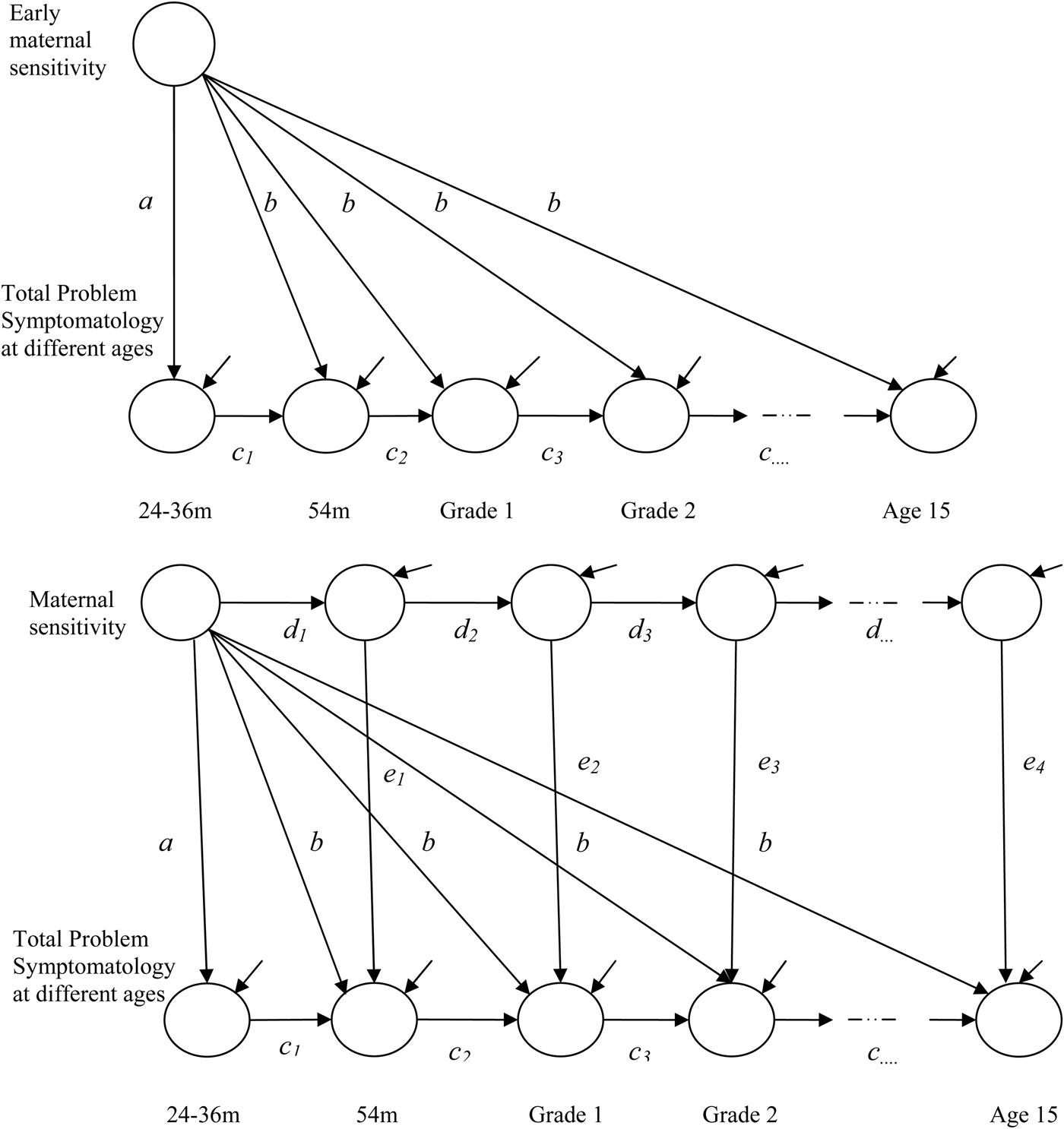
Relations between early maternal sensitivity and total behavior problems can be modeled in diverse ways. For the purposes of this paper, we utilized the modeling approach developed by Fraley et al. (Reference Fraley, Roisman and Haltigan2012). This approach is designed to distill the core distinctions of interest while retaining relevance to many different content domains. The first set of models is designed to capture the most basic dynamics of interest: the statistical implications of assuming enduring effects versus revisionist processes. The structure of the most basic model is illustrated in the top panel of Figure 1. According to this figure, early experiences have effects on symptoms of psychopathology at each measurement occasion (paths a and b). Moreover, symptoms of psychopathology exhibit some degree of stability over time (paths labeled c), while also being influenced by other factors that are independent of the earlier experiences (denoted by the residual arrows). The revisionist model is nested within the more inclusive enduring effects model. By fixing the paths from the early experience to the later outcome variables to 0.00 (paths labeled b; see Figure 1), the revisionist model captures the notion that early experience directly shapes the outcome of interest early in life but not thereafter: all subsequent effects are indirect and by definition in this model are routed through stability in total symptomatology itself.Footnote 2
The core structural relations among variables according to revisionist and enduring effects perspectives. The upper panel illustrates a simplified model that represents the most basic distinction between the revisionist and enduring effects perspectives. The lower panel illustrates a model that represents the distinction, but it also includes the stability and concurrent effects of sensitivity.

Although this modeling approach is compatible with data drawn from either experimental (e.g., intervention) or nonexperimental (e.g., prospective, natural history) investigations, as noted earlier causal inferences are necessarily constrained by the research design that generates the data under examination. Thus, it becomes especially important when nonexperimental data are examined, as is the case here, to address potential threats to the validity of causal claims. Nothing inherent in the modeling we advocate allows one to sidestep such interpretative challenges. Below we discuss two especially relevant issues in the current study.
Controlling the Stability of Maternal Sensitivity Over Time
Some scholars (e.g., Lamb et al., Reference Lamb, Thompson, Gardner, Charnov and Estes1984; Lewis, Reference Lewis1997) have argued that, to the degree to which investigators find correlations between early experiences, such as maternal sensitivity, and later outcomes, one potential explanation for those associations is the stability of maternal experiences over time. According to this view, initially articulated by Lamb et al. (Reference Lamb, Thompson, Gardner, Charnov and Estes1984), there is no unique effect of early experience on later outcomes per se, but such associations may appear to persist because maternal sensitivity itself is relatively stable and can have ongoing, concurrent influences on the outcomes of interest.
To model this possibility, we included measures of maternal sensitivity across different ages, focusing only on the subset of assessments for which the NICHD SECCYD had concurrent measures for both maternal sensitivity and the outcome of interest (see bottom panel of Figure 1; for an alternative approach to integrating later assessments of sensitivity into these models, see also Fraley et al., Reference Fraley, Roisman and Haltigan2012). Moreover, we assumed that maternal sensitivity at each age had an influence on the outcome of interest, also assessed at that same age (the e paths in Figure 1). For the purpose of these analyses, we assumed that the caregiving environment had a direct effect on total problem psychopathology at each age. This assumption was made for the sake of simplicity; we could just as well have made the assumption that children's total problem behaviors influence the caregiving environment as well or that both pathways are relevant. It is important to note that the core results do not depend on this particular assumption, nor do they hinge on whether those paths are modeled concurrently or in a lagged fashion.
As mentioned above, the revisionist model is nested within this more inclusive enduring effects model. By fixing the paths from the early experience to the later outcome variables to 0.00 (paths labeled b, lower panel of Figure 1), the model captures the notion that early experience shapes the outcome of interest early in life but does not shape outcomes directly thereafter. Again, we compared the fit of the enduring effects model and the revisionist model. We also compared versions of the enduring effects model in which each of the enduring paths were freely estimated with ones in which the enduring effects (the paths labeled b in Figure 1) were constrained to be equal over time. Although this final test is not formally a requirement of the enduring effects model (i.e., the enduring effects model can accommodate increasing unique effects over time [potential sleeper effects; although see Clarke & Clarke, Reference Clarke and Clarke1981], short-term dips and increases over time, and any predictive effects nonzero at the asymptote that are not entirely routed through stability in the dependent measure), we reasoned that a prototypical enduring effects model is one in which the unique predictive significance of early experience is relatively homogeneous in magnitude over time.
Controlling Early Contextual Risk Factors
It has been repeatedly demonstrated that social and contextual risk (e.g., poverty, lack of social support, maternal depression) exerts both direct and indirect negative influences on the ability to competently provide optimal parenting, as well as on child outcomes in a variety of social and behavioral domains (Belsky & Fearon, Reference Belsky and Fearon2002b; McLoyd, Reference McLoyd1998; Raikes & Thompson, Reference Raikes and Thompson2005). Highlighting this influence, scholars such as Lamb et al. (Reference Lamb, Thompson, Gardner, Charnov and Estes1984) and Lewis (Reference Lewis1997) have suggested that the effects of early interpersonal experience are difficult to distill from the contextual milieu in which those experiential events take place. We address this concern by statistically controlling for the effects of early contextual risk on maternal sensitivity in the first 3 years of life. To do so, we used a composite measure of contextual risk developed by Belsky and Fearon (Reference Belsky and Fearon2002b), which consists of key contextual risk variables such as income/needs, social support, and maternal depression, and regressed it on the early maternal sensitivity composite, thus creating an early maternal sensitivity composite net of early contextual risk. That is, the residuals of the maternal sensitivity composite, purged of the ecological confounds noted above, were used in the specified analyses that follow as our measure of early interpersonal experience (for an alternative approach involving modeling potential confounders, see Fraley et al., Reference Fraley, Roisman and Haltigan2012).
Method
Participants
Families were recruited for the NICHD SECCYD in 1991 from hospitals located in or near Little Rock, Arkansas; Orange County, California; Lawrence, Kansas; Boston, Massachusetts; Pittsburgh, Pennsylvania; Philadelphia, Pennsylvania; Charlottesville, Virginia; Seattle, Washington; Morganton, North Carolina; and Madison, Wisconsin. During selected 24-hr sampling periods, 8,986 women who gave birth were screened, 5,416 of whom met the eligibility criteria for the study. Families were excluded if (a) the mother was younger than 18 years of age, (b) the family planned to move, (c) there was a multiple birth, (d) the infant had a known disability or remained in the hospital more than 7 days, (e) the mother acknowledged substance abuse, (f) the mother did not speak English, or (g) the mother lived more than an hour from the laboratory site or in an extremely unsafe neighborhood as determined by local police. From that group, 1,364 families became study participants upon completing a home interview when their infants were 1 month old. Additional details about recruitment and selection procedures are available in prior publications from the study (see NICHD ECCRN, 2005) and from the study website (http://secc.rti.org). Note that, although large, demographically diverse, and methodologically rich, the NICHD SECCYD was not designed to be a nationally representative study.
Analytic sample
The analytic sample for this study included the 1,306 children (52% males) for whom any observational data were collected at ages 6, 15, 24, and/or 36 months focused on the quality of the maternal caregiving they experienced in the first 3 years of life. In terms of race/ethnicity, 77% of the children from the analysis sample for this study were white. To address missing data all modeling analyses described below were fit to raw case-level data using full-information maximum likelihood estimation, which produces less biased and more efficient and consistent parameter estimates than techniques such as pairwise or listwise deletion for missing data (Little & Rubin, Reference Little and Rubin1987).
Measures
Measures are presented in four sets corresponding to their function in the analytic plan, as follows: (a) variables used to create a composite measure of the observed quality of participants' experience with caregivers in the first 3 years of life; (b) later assessments of maternal sensitivity assessed concurrently with the dependent variables (i.e., maternal and teacher reports of total problem behavior); and (c) reports of total problem behavior, as assessed by primary caregivers and teachers from the first through the latest assessment for which these data were available (mother: age 15; teacher: Grade 6). In all cases we selected variables that were measured multiple times by multiple reporters using standard assessment tools.
Early maternal sensitivity
Mother–child interactions were videotaped during 15-min semistructured tasks at 6, 15, 24, and 36 months. At 6 months, mothers and children were instructed to play together, first with toys available in the home (or none at all) and then with a standard set of toys. At 15, 24, and 36 months, mothers were asked to show their children age-appropriate toys in three containers in a set order. As in prior studies of this sample (e.g., NICHD ECCRN, 2001), observations of maternal sensitivity from the first 3 years of life (6, 15, 24, and 36 months) were standardized and averaged to create a composite of the observed early sensitivity. At 6, 15, and 24 months, the a priori maternal sensitivity compositesFootnote 3 were constructed by summing ratings for sensitivity to nondistress, positive regard, and intrusiveness (reversed). At 36 months, the supportive presence, respect for autonomy, and hostility (reversed) scales were composited (as reported in NICHD ECCRN, 2001, internal consistencies of composites were .75, .70, .79, and .78 for the 6, 15, 24, and 36 month composites, respectively, and intercoder reliabilities on scales >.80). Within age composites showed stability over time (rs = .30–.48; standardized α for composite measure = 0.73).
Later measures of maternal sensitivity
Subsequent to the four assessments of maternal sensitivity through 36 months, a total of six additional observations of sensitivity were acquired by the NICHD ECCRN: at age 54 months, during Grades 1, 3, and 5, and most recently at age 15. As with the early sensitivity composite, in each of these assessments participants and their primary caregivers were videotaped while target participants engaged tasks just beyond their capacity to successfully complete while primary caregivers provided aid. For example, the 54-month and Grade 1 assessments involved the child completing a set of three activities, including using an Etch-a-Sketch maze to traverse a maze (54 months) and reproduce a simple picture (Grade 1). Tasks were updated to be developmentally appropriate: during Grades 3 and 5, primary caregivers and target participants completed both activities and engaged in discussion tasks (e.g., an errand planning task in Grade 3, discussing and attempting to resolve areas of disagreement in Grade 6). Finally, at age 15, maternal sensitivity was assessed exclusively in the context of an 8-min home discussion of one or two areas of disagreement between the adolescent and mother (e.g., chores, homework, money), selected by the adolescent.
Sensitivity was operationalized at 54 months and Grades 1, 3, and 5 using scales measuring supportive presence, respect for autonomy, and hostility (reversed), which were composited (internal consistencies of composites were 0.84, 0.82, 0.80, and 0.85, respectively; interrater reliabilities [intraclass correlations] = 0.88, 0.91, 0.84, and 0.85, respectively). At age 15, 7-point rating scales of the interaction were used (Owen et al., Reference Owen, Klausli, Aultman, Brown, Little and Milling2006), based on adaptations of the more microanalytic coding systems of Allen and his colleagues (Allen et al., Reference Allen, Hall, Insabella, Land, Marsh and Porter2003; Allen, Hauser, Bell, McElhaney, & Tate, Reference Allen, Hauser, Bell, McElhaney and Tate1996) and coding systems used at earlier ages in the NICHD SECCYD (e.g., Owen, Klausli, & Murrey, Reference Owen, Klausli and Murrey2000). The age 15 maternal sensitivity composite constituted the sum of the mother's ratings for validation (enthusiastic, positive reactions to and agreement with the teen's expressed points of view), engagement (expressed interest in listening to the teen's thoughts and feelings), inhibiting relatedness (reversed; cutting off and devaluing the teen's point of view), hostility/devaluing (reversed; expressions of anger, discounting or rejection of the teen or the teen's ideas), respect for autonomy (encouragement of and respect for the teen's own ideas and points of view), and valuing/warmth (expressions of positive regard, warmth, and affection). The internal consistency of the age 15 measure was moderately high, with a Cronbach α value of 0.81 (interrater reliability [intraclass correlation] = 0.86).
Total problem symptomatology
Symptoms of psychopathology from childhood to adolescence were assessed with the total problem scale of the Child Behavior Checklist (CBCL) obtained using the parent (CBCL) and Teacher Report Form versions (Achenbach, Reference Achenbach1991; Achenbach & Edelbrock, Reference Achenbach and Edelbrock1986; Achenbach, Edelbrock, & Howell, Reference Achenbach, Edelbrock and Howell1987). We used T scores. In the current study, maternal reports on the CBCL were used from the following assessment points: a mean composite of the 24- and 36-month CBCL (r = .73, p < .01); 54 months; kindergarten; Grades 1, 3, 4, 5, and 6; and age 15. Teacher reports were used from the following assessment points: kindergarten and Grades 1, 2, 3, 4, 5, and 6. The total problem behavior scale showed adequate reliability across time and had a coefficient α averaging 0.93 for maternal reports and 0.96 for teacher reports across all assessments.
Cumulative contextual risk
Nine variables indicative of contextual risk were standardized and summed to create an index of cumulative contextual risk. These variables include socioeconomic variables (income/needs ratio, maternal education), psychosocial risk variables (i.e., maternal depression, parenting stress, social support, marital quality, maternal psychological adjustment), and sociocultural risk variables (frequency of single-parent status, minority status). This index is identical to the one reported by Belsky and Fearon (Reference Belsky and Fearon2002b), with the exception of updated (revised) income/needs variables. Moreover, the composite of cumulative contextual risk factors correlated –.40 with the composite of early maternal sensitivity, indicating that mothers who tended to have a greater number of contextual risk facors were (as expected) less likely to exhibit sensitivity toward their children.
Results
We present our analyses in two major sections corresponding to primary and secondary ways in which the teacher and mother reports of total problem behavior were modeled. In the first section we analyze the most basic form of the revisionist and enduring effects models (see top panel of Figure 1) with respect to teacher- and mother-reported total problem behavior across childhood and adolescence. Given the nonexperimental nature of our data, we felt a series of secondary analyses were necessary to demonstrate whether our basic model results were robust to a variety of potentially relevant model specifications. In this set of analyses, we expand upon the basic analyses of principal interest to address the more complex ways we modeled the data in order to control for both later maternal sensitivity (see bottom panel of Figure 1) and early contextual risk. The model controlling for later maternal sensitivity allowed us to examine the possibility that early experiences might appear to have enduring effects on various outcomes not because they continue to impact development in direct ways, but because the quality of the caregiving environment itself remains relatively stable over time (Lamb et al., Reference Lamb, Thompson, Gardner, Charnov and Estes1984; Lewis, Reference Lewis1997). The model controlling for early contextual risk permitted us to address the question of whether maternal sensitivity might demonstrate enduring influences on subsequent maladaptation even after controlling for factors that might compromise the quality of maternal sensitivity itself. Finally, we show how using a set of theoretically driven model building strategies for both teacher and mother reports of total problem behavior allowed us to improve the absolute fit of the most basic models and that such improvements to absolute model fit did not alter our substantive findings. All models were tested with Mplus version 6.0 (Múthen & Múthen, Reference Múthen and Múthen1998–Reference Múthen and Múthen2010).
We highlight two caveats from the outset. First, our primary goal was not to model the data as completely as possible. In other words, absolute fit of the models was not our main concern as we were working deliberately with oversimplified models in order to highlight a fundamental distinction between two ways of thinking about the predictive significance of early experience. As such, we did not expect these models to explain the data with a high degree of fidelity. What is of primary interest to us instead is the relative fit of the two models, the extent to which one model is able to explain the data better than the other. Nevertheless, we also report a set of analyses in which we address the most basic model's substantive results in the context of additional specifications to the models that improved their absolute fit to meet conventional criteria.
Second, another caveat is that, although there can be some value in controlling for variables that might potentially explain the association between maternal sensitivity and developmental outcomes, there can be some risk in statistically adjusting for what are likely to be the proximal causal antecedents of the phenomenon of interest, or adjusting for subsequent experiences, such as later maternal sensitivity, that are presumably themselves shaped by prior adaptation. For example, it is well established that depressed, less well educated, and poorer parents tend to interact less sensitively with their children than do parents who are not depressed, are better educated, and have more financial resources. In particular, controlling for early contextual risk by residualizing such variance from early sensitivity offers a conservative test of the enduring effects model, but it does so at the potential cost of removing the variance that is relevant to understanding variation in early maternal sensitivity in the first place.
Primary analyses
Teacher report
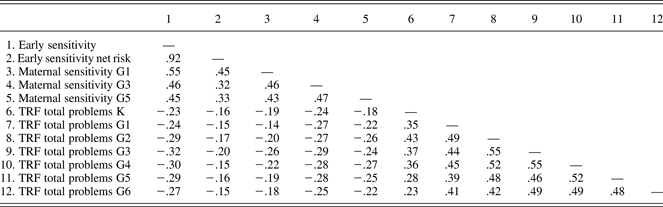
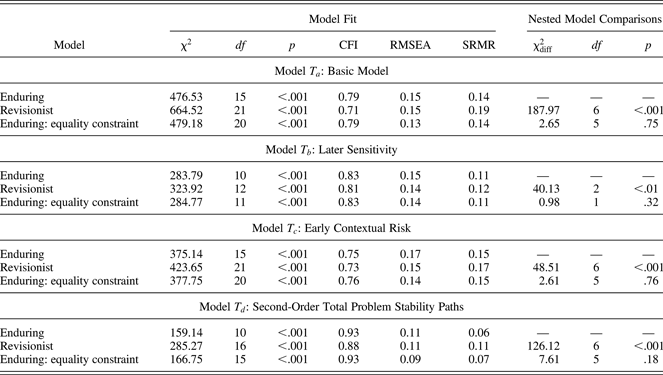
The correlations among early sensitivity, early sensitivity net contextual risk, subsequent maternal sensitivity, and teacher-report total problem data are reported in Table 1. It is of note that the correlations between early maternal sensitivity and teacher reports of total problem behavior at each age were fairly constant (around –.27) and exhibit no evidence of approaching zero in the limit. As is depicted in Table 2, in our most basic modeling framework (Model T a) the enduring effects model fit the data more adequately than did the revisionist model (enduring effects [b] paths range = –0.19 to –0.14; M = –0.16). When the revisionist model was estimated by fixing the enduring effects [b] paths to 0.00, there was a significant and relatively substantial decrement in fit. Moreover, when the enduring effects paths were constrained to be equivalent over time, there was no decrement in fit. In this model, the estimated effect of early experiences on teacher ratings of total problem symptomatology was –0.16, a small, yet persistent, effect.
Correlations between early maternal sensitivity composite, early maternal sensitivity composite residualized of contextual risk, later maternal sensitivity, and teacher reports of total problem behavior over time
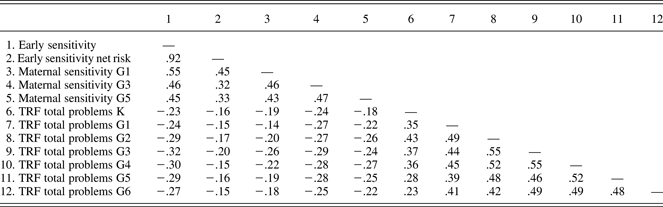
Note: All modeling analyses were fit to raw case-level data using full-information maximum likelihood estimation. n = 656–1,008. All p < .05. Early sensitivity net risk, early maternal sensitivity composite residualized of contextual risk; G1–G6, Grades 1–6; TRF, Teacher Report Form; K, kindergarten.
Estimates of the influence of early experience on teacher-report total problem symptomatology across childhood and adolescence

Note: CFI, comparative fit index; RMSEA, root mean square error of approximation; SRMR, standardized root mean square residual.
Mother report
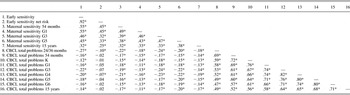
The correlations among early sensitivity, early sensitivity net contextual risk, subsequent maternal sensitivity, and mother-report total problem data are reported in Table 3. Again, in the most basic modeling framework (Model M a) the enduring effects model fit the data better than did the revisionist model (see Table 4). When the revisionist model was estimated by fixing the enduring effects [b] paths to 0.00, there was a decrement in fit. When the enduring effects [b] paths were constrained to be equal, the model's fit was, however, worse than it was when those paths were freely estimated, indicating that an enduring effects model with nonequivalent paths provided a better fit to the data. In examining the pattern of effects across time in this model, we found some evidence for attenuation in associations of early maternal sensitivity with later reports of maternal total problem behavior. Estimates ranged from –0.26 in early childhood (i.e., 24/36 months) to zero at Grade 5, rebounding trivially to –0.01 at age 15 (M = –0.05). The value of the enduring effects [b] paths, when constrained, was a trivial –0.03.
Correlations among early maternal sensitivity composite, early maternal sensitivity composite residualized of contextual risk, later maternal sensitivity, and maternal reports of total problem behavior over time

Note: All modeling analyses were fit to raw case-level data using full-information maximum likelihood estimation. n = 697–1,061. Early sensitivity net risk, early maternal sensitivity composite residualized of contextual risk. G1–G6, Grades 1–6; CBCL, Child Behavior Checklist; K, kindergarten. *p = .05.
Secondary analyses
As noted above, in our secondary set of analyses we examined whether the results from the most basic model would persist after modeling the data in more complex ways that took into account both subsequent maternal caregiving experiences and the influence of early contextual risk on maternal sensitivity itself. In addition, we wanted to determine whether, using theoretically driven modeling assumptions, we could improve the absolute fit of the most basic model and, if so, whether such improvements affected the substantive findings found in the most basic model. In this section, we present the results of each more complex modeling strategy (i.e., later sensitivity, early contextual risk, absolute fit) by informant (i.e., teacher and then mother reports of symptomatology).
Estimates of the influence of early experience on mother-report total problem symptomatology across childhood and adolescence
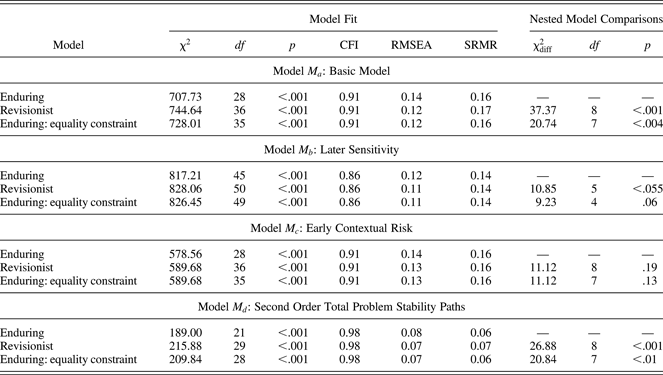
Note: CFI, comparative fit index; RMSEA, root mean square error of approximation; SRMR, standardized root mean square residual.
Teacher report
For teacher-report data (see Table 2), the results of the analyses controlling for subsequent maternal sensitivity (Model T b) again indicated that the enduring effects model fit the data better than did a revisionist account of the data (enduring effects [b] paths range = –0.17 to –0.12; M = –0.15). When the enduring effects [b] paths were constrained to be equivalent, there was no decrement in fit compared to the model in which those paths were freely estimated. In the constrained model, the estimated effect of early experiences on teacher ratings of total problem symptomatology was –0.15 (p < .01). Similarly, in the model controlling for early contextual risk factors (e.g., depression, income/needs; Model T c) that might affect the expression of maternal sensitivity in early childhood the results indicated that the enduring effects model fit the data more adequately than did the revisionist model (enduring effects [b] paths range = –0.12 to –0.06; M = –0.09). When the revisionist model was estimated by fixing the enduring effects [b] paths to 0.00, there was a significant and relatively substantial decrement in fit. Moreover, when the enduring effects paths were constrained to be equivalent over time, there was no decrement in fit. In this model, the estimated effect of early experiences on teacher ratings of total problem symptomatology was –0.09, a small, yet persistent, effect.
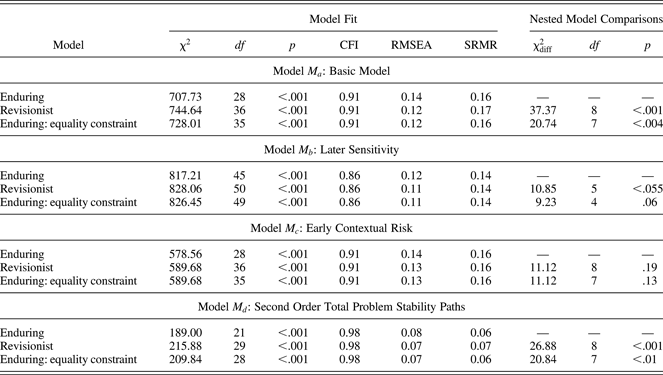
Finally, to determine whether we could improve the overall absolute fit of the most basic model for teacher-report data, second-order stability (i.e., autoregressive) paths were added between total problem assessment points (e.g., K → G2, G2 → G4, G4 → G6; Model T d; note that second-order stability paths also serve to simulate transactional processes; for additional details, see Fraley et al., Reference Fraley, Roisman and Haltigan2012). It is important to point out that integrating additional second-order autoregressive paths into our basic model for teacher-report data represents a more stringent test of the enduring effects hypothesis given that less unexplained variance in outcome is available for association with early sensitivity (i.e., the likelihood increases that predictive effects are routed through stability in teacher-reported total problem symptomatology). Nonetheless, yet again (see Table 2), the enduring effects model fit the data more adequately than did the revisionist model (enduring effects [b] paths range = –0.18 to –0.08; M = –0.13). Moreover, when the enduring effects [b] paths were constrained to be equivalent over time in this model, there was no decrement. In this model, the estimated effect of early experiences on teacher ratings of total behavior problems was –0.13, again a small, yet persistent, effect.
Of note, the absolute fit indices of the models in which second-order stability paths are included are more favorable than those in which they are not (Table 2), improving our root mean square error of approximation (RMSEA), comparative fit index (CFI), and standardized root mean square residual (SRMR) fit indices from our most basic model, suggesting a better absolute fit to the data. While our RMSEA values remained slightly greater (0.09–0.11) than those suggesting reasonable error of approximation (0.05–0.08; Browne & Cudeck, Reference Browne, Cudeck, Bollen and Long1993) the range of our CFI values across all three of our models (0.88–0.93) suggested reasonably good absolute fit (values >0.90 often indicate reasonably good fit; Hu & Bentler, Reference Hu and Bentler1999), as did the range of our SRMR values (0.06–0.11), where values less than 0.10 are generally considered favorable (Kline, Reference Kline2005). It is crucial that the substantive results suggesting that the enduring effects model fit the data better than a revisionist model were consistent whether or not these additional second-order stability paths were modeled.
Mother report
For mother-report data, the results of the analyses controlling for later maternal sensitivity again (Model M b; see Table 4) indicated that the enduring effects model fit the data somewhat better than did the revisionist model in that, when the revisionist model was estimated by fixing the enduring effects [b] paths to 0.00, there was a marginally significant decrement in fit (see Table 4). Thus, the difference between the fit of the models was relatively small. Moreover, when the enduring effects [b] paths were constrained to be equivalent over time, the model's fit was somewhat worse than it was when those paths were freely estimated, indicating that an enduring effects model with nonequivalent paths provided a better fit to the data. Examining the patterning of the effects over time, we found evidence for attenuation in associations of early maternal sensitivity with later reports of total problem behavior decreasing in absolute magnitude of association from –0.26 at 24/36 months to zero at age 15; M = –0.05. Within the constraints of this model, the estimated effect (i.e., fixed effect of the enduring effects [b] paths) of early sensitivity on maternal ratings of total problem behaviors was –0.01, again consistent with a revisionist model. Similarly, in the model controlling for early contextual risk (Model M c), there was no relative difference in model fit between the enduring effects (enduring effects [b] paths range = –0.04 to 0.05; M = 0.001) and the revisionist models (see Table 4). There was also no decrement in fit when the enduring effects [b] paths were constrained to be equal. In this specific model, the estimated effect of early experiences on mother reports of total problem behavior symptomatology was zero, also consistent with the revisionist model.
Finally, as with teacher-report data, we attempted to improve the absolute fit of the basic mother-report model using the prior approach of adding second-order stability paths (autoregressive paths) across total problem behavior assessments (i.e., 24/36 month composite → K, 54 months → G1, K → G3, G1 → G4, G3 → G5, G4 → G6, G5 → Age 15; Model M d). Similar to teacher-report data, adding in second-order stability paths to the model represents a more conservative test of the enduring effects proposal given that adding such paths increases the likelihood that early effects might be routed through stability in the dependent variable (rather than as an enduring “direct” impact of early experience; see Table 4 for model fit indices). Again, we found evidence for attenuation in associations of early maternal sensitivity with later reports of maternal total problem behavior. Estimates ranged from –0.26 in early childhood (i.e., 24/36 month composite) to 0.01 at Grade 5, to essentially zero (–0.003) at age 15; M = –0.04. The value of the enduring effects [b] paths, when constrained, was –0.02. As with the teacher-report models, we improved the RMSEA, CFI, and SRMR values for overall model fit, suggesting a better absolute model fit to the data. More specifically, these model fit indices were well within the range of the fit-statistic values noted earlier, which are thought to reflect favorable overall absolute model fit (see Table 4 for model fit indices).
Discussion
One of the focal areas of concern that distinguishes developmental psychopathology from other disciplines is that it seeks to understand continuity and change in patterns of adaptation across time rather than simply establishing links between pathology and earlier or later behavior (Sroufe & Rutter, Reference Sroufe and Rutter1984). Unfortunately, most empirical research in developmental psychopathology to date has focused on two-wave test–retest analyses, with an emphasis on understanding the magnitude of effects. Heeding the point made by Sroufe and Rutter (Reference Sroufe and Rutter1984) more than 25 years ago and the recent empirical evidence from Lorber and Egeland (Reference Lorber and Egeland2009) drawn from the Minnesota Longitudinal Study of Risk and Adaptation, we have examined the pattern of associations over time between early interpersonal experience and later behavioral maladaptation. This study also extends prior meta-analytic work examining the influences of attachment security on later externalizing and internalizing psychopathology, but with a more direct focus on maternal caregiving using repeated measurements of maternal sensitivity over the first 3 years of life. In so doing, our study provides evidence that early interpersonal experiences might have modest enduring influences on later symptoms of psychopathology, although such effects appear to be moderated by informant. Below we discuss these findings in the context of both enduring and revisionist perspectives. We then conclude with potential explanations for observed differences in associations by informant and offer thoughts regarding the future role of the current modeling framework in developmental psychopathology.
When teacher reports of total problem behavior were considered as the outcome in our modeling analyses, we observed small, yet persistent, effects of early maternal sensitivity above and beyond those attributable to revisionist processes. That is, an enduring effects model fit the data better than did a (purely) revisionist model, suggesting that early experiences persist in their influence on later total problem behavior, rather than decaying to inconsequential effects over time (e.g., Lamb et al., Reference Lamb, Thompson, Gardner, Charnov and Estes1984; Lewis, Reference Lewis1997). When mothers reported participants' levels of total problem symptomatology, the effect of early caregiving experiences on later behavioral maladaptation was more consistent with a revisionist account in which the magnitude of the effects of early sensitivity on subsequent behavioral maladaptation was variable over time, with values distributed around zero.Footnote 4 Perhaps even more noteworthy is that when we controlled for both early contextual risk and later maternal sensitivity, the enduring associations of early maternal sensitivity on teacher-reported total problem behavior were still evident. Taken together, these findings present evidence for persistent effects of early interpersonal experience on later behavioral maladaptation.Footnote 5
It nonetheless remains an open question as to exactly how early interpersonal experiences exert influence on later behavioral maladaptation in a lasting manner.
Informant as a moderator
Given the disparity in our findings regarding the enduring influence of early experience on subsequent teacher and mother reports of children's behavioral maladaptation, the question arises as to why our findings were conditioned by informant (i.e., teacher vs. mother).Footnote 6 We believe one potential explanation may lie in the contextual opportunity for the behaviors of interest to be observed. That is, children in the school setting are faced with negotiating the social and emotional challenges of interpersonal relationships that are more likely to be observed in real time than is the case when the child is observed at home, outside the highly socially and emotionally charged school context. For example, the intrapersonal and interpersonal negotiation of peer-group relationships, bullying, and social status is likely to be more salient in the schoolroom than at home. In turn, these social presses are likely to bring subtle variations in tendencies toward problem behavior to the surface, particularly in a normative sample such as the SECCYD, where absolute levels of maladaptation are not highly elevated.
Limitations and future directions
It is important to note that although the NICHD SECCYD is a large national study, its sample is not nationally representative. Particularly relevant to the current study, although high-risk families were explicitly targeted for recruitment, screening criteria (i.e., families were excluded if they lived in a neighborhood deemed dangerous by the police) made it less likely that youths with highly elevated levels of contextual risk and total problem symptomatology were included in the sample. Thus, the results of the current modeling are specific to normative, nonclinical populations and we do not know how generalizable such results might be to more high-risk or clinical populations where contextual risk and total problem symptomatology might be expectedly more pronounced.
In considering the results documented here, we note that answering the question of whether the effects of a given experience are enduring in their influence on later behavioral maladaptation does not mean that the important research in developmental psychopathology is by any means finished. Instead, doing so is simply a first step in a more complex and extensive enterprise. If the data are most compatible with a revisionist perspective, then the next logical research steps should involve understanding how various factors serve to contribute to change in the outcome in question. In contrast, if the data are compatible with an enduring effects perspective, then a logical next step in a research program is to come to better understand exactly how those experiences are represented by the individual and the pathways by which they continue to exert an influence on developmental outcomes over time or whether, in fact, such predictive effects are genetically mediated (see Roisman & Fraley, Reference Roisman and Fraley2012).Footnote 7 These systematic steps for further understanding how enduring and revisionist processes operate over time represent the fundamental research agenda in developmental psychopathology (Rutter & Sroufe, Reference Rutter and Sroufe2000; Sroufe, Reference Sroufe1997).
Equally important is applying well-known statistical tools for studying statistical moderation (Baron & Kenny, Reference Baron and Kenny1986) to the basic model described here and in Fraley et al. (Reference Fraley, Roisman and Haltigan2012). Moderator analyses can be used to determine whether it is possible to identify subsamples of children for whom early experiences are especially significant, an important enterprise in light of the fact that a set of genetic polymorphisms is beginning to emerge that appear to accentuate the impact of familial experiences (e.g., Bakermans-Kranenburg & van IJzendoorn, Reference Bakermans-Kranenburg and van IJzendoorn2006; Caspi et al., Reference Caspi, Sugden, Moffitt, Mill, Taylor and Craig2003). For example, one recent study demonstrated that children carrying the 7-repeat variant of the dopamine D4 receptor polymorphism were at greater risk to behave aggressively toward their peers if they experienced parental insensitivity (Bakermans-Kranenburg & van IJzendoorn, Reference Bakermans-Kranenburg and van IJzendoorn2006). Other research has demonstrated the role of monoamine oxidase A and serotonin transporter polymorphisms in moderating familial impacts on the genesis of aggression and social withdrawal, respectively (Caspi et al., Reference Caspi, Sugden, Moffitt, Mill, Taylor and Craig2003). These kinds of findings, as well as evidence that the effects of early experiences might be amplified under conditions of contextual risk (Belsky & Fearon, Reference Belsky and Fearon2002b), suggest that the impact of early experiences on subsequent functioning might be stronger for some individuals than others.
In summary, we have implemented the modeling technique introduced by Fraley et al. (Reference Fraley, Roisman and Haltigan2012) to understand whether early interpersonal experiences persist in their influence on developmental maladaptation. Our results suggest that they do in the NICHD SECCYD but that this enduring effect is uncovered primarily when teachers are the informants of children's total problem symptomatology. It is our hope that scholars in developmental psychopathology will consider implementing this approach in their future research. Such work has the potential to refine our understanding of the legacy of early experience, whether enduring or transient.