Over 1.25 million children per year suffer from abuse and neglect, costing the US economy over $220 million a day (Prevent Child Abuse America; Gelles & Perlman, Reference Gelles and Perlman2012). Child maltreatment is considered one of the most detrimental environmental pathogens, increasing the risk for disruptions to biological and psychological processes and physical health across time (Cicchetti & Toth, Reference Cicchetti, Toth, Lamb and Garcia Coll2015). Deprived of the crucial experience of positive parenting, maltreated children tend to follow a cascading developmental path of compromised adaptive behaviors (Cicchetti, Reference Cicchetti2013; Widom, Reference Widom2014). Children lacking quality parental care are often subject to extremely disruptive parent–child interactions, inadequate coregulation of behavioral and emotional responses, and unpredictable parent behavior, which can damage key biological systems (Egeland, Yates, Appleyard, & Van Dulmen, Reference Egeland, Yates, Appleyard and Van Dulmen2002; Pollak, Cicchetti, Hornung, & Reed, Reference Pollak, Cicchetti, Hornung and Reed2000; Rogosch, Cicchetti, Shields, & Toth, Reference Rogosch, Cicchetti, Shields, Toth and Bornstein1995; Rogosch, Dackis, & Cicchetti, Reference Rogosch, Dackis and Cicchetti2011).
One of the most consistent findings in the literature is the association between child maltreatment and antisocial behavior, consisting of aggressive tendencies, ineffective and disruptive peer relations, social information processing deficits, and delinquent acts (e.g., Cicchetti & Rogosch, Reference Cicchetti and Rogosch2001; Cicchetti, Rogosch, & Thibodeau, Reference Cicchetti, Rogosch and Thibodeau2012; Hong, Espelage, Grogan-Kaylor, & Allen-Meares, Reference Hong, Espelage, Grogan-Kaylor and Allen-Meares2012; Jaffee, Caspi, Moffitt, & Taylor, Reference Jaffee, Caspi, Moffitt and Taylor2004; McCrory, De Brito, & Viding, Reference McCrory, De Brito and Viding2012; Teisl & Cicchetti, Reference Teisl and Cicchetti2008). Using innovative twin-study designs, researchers have demonstrated that the effect of child abuse on antisocial behavior is partially environmentally mediated, despite shared genes (Jaffee et al., Reference Jaffee, Caspi, Moffitt and Taylor2004; Moffitt, Reference Moffitt2005). Antisocial behaviors impinge on the salubrious functioning of individuals, relationships, and the community at large; determining the precise manner by which these attributes arise in contexts of familial adversity has proven to be a difficult challenge for researchers (Jaffee, Strait, & Odgers, Reference Jaffee, Strait and Odgers2012).
One avenue in which antisocial tendencies may emerge in children with a history of maltreatment is through disruptions to a child's behavioral control systems, namely, increased impulsivity. Impulsivity broadly refers to (a) a failure to adaptively inhibit prepotent behaviors and urges, (b) a tendency to underweigh loss in the face of reward, and (c) a lack of foresight and judgment while emphasizing quick and shortsighted behaviors. Inadequate impulse control may contribute to antisociality in a number of ways, such as a diminished regard for the consequences of negative social behavior, difficulty regulating behavior in emotionally taxing circumstances, heightened responses to external threat, and failure to delay gratification when it would otherwise promote adaptive social functioning. Impulsivity is a known risk factor for antisociality (Derefinko, DeWall, Metze, Walsh, & Lynam, Reference Derefinko, DeWall, Metze, Walsh and Lynam2011; Lesch & Merschdorf, Reference Lesch and Merschdorf2000; Loeber et al., Reference Loeber, Menting, Lynam, Moffitt, Stouthamer-Loeber and Stallings2012; Luengo, Carrillo-De-La-Pena, Otero, & Romero, Reference Luengo, Carrillo-De-La-Pena, Otero and Romero1994; Neumann, Barker, Koot, & Maughan, Reference Neumann, Barker, Koot and Maughan2010). Some forms of proactive aggression and deviancy are the result not of impulsivity per se, but of very deliberate acts often associated with callous–unemotional traits (Frick & White, Reference Frick and White2008). However, maltreated children, especially those who are physically abused, are particularly prone to reactive forms of aggression, which are more closely related to impulsivity (Raine et al., Reference Raine, Dodge, Loeber, Gatzke-Kopp, Lynam and Reynolds2006; Shields & Cicchetti, Reference Shields and Cicchetti1998).
Numerous studies demonstrate that abused and neglected children tend to display more impulsive-like behaviors than nonmaltreated children (e.g., Manly, Kim, Rogosch, & Cicchetti, Reference Manly, Kim, Rogosch and Cicchetti2001; Oshri, Rogosch, Burnette, & Cicchetti, Reference Oshri, Rogosch, Burnette and Cicchetti2011; Oshri, Sutton, Clay-Warner, & Miller, Reference Oshri, Sutton, Clay-Warner and Miller2015; Sujan, Humphreys, Ray, & Lee, Reference Sujan, Humphreys, Ray and Lee2014; Wanklyn, Day, Hart, & Girard, Reference Wanklyn, Day, Hart and Girard2012). Parents in maltreating families are less likely to scaffold and construct strategies for their children's regulation of behaviors and emotions during times of distress, which may contribute to deficits in impulse control (Kim, Cicchetti, Rogosch, & Manly, Reference Kim, Cicchetti, Rogosch and Manly2009). Moreover, children in maltreating circumstances tend to have heightened reactivity to anger and threat, a possible adaptive response in circumstances of abuse, but which nevertheless may have carryover effects and contribute to impulsivity in nonthreatening situations (Pollak et al., Reference Pollak, Cicchetti, Hornung and Reed2000; Shields & Cicchetti, Reference Shields and Cicchetti1998). Additional deficits in higher-order cognitive processes observed in maltreated children, such as executive function and executive control networks, may also contribute to difficulties in regulating behavioral impulses (Cowell, Cicchetti, Rogosch, & Toth, Reference Cowell, Cicchetti, Rogosch and Toth2015; Rogosch & Cicchetti, Reference Rogosch and Cicchetti2005).
Given the relations among child maltreatment, impulsivity, and antisocial behavior, it is not surprising that researchers have modeled all variables together. In a sample of 361 emerging adults, Oshri et al. (Reference Oshri, Sutton, Clay-Warner and Miller2015) found that the strongest indirect link between child abuse/neglect and risk taking behaviors, including antisocial behavior, was impulsivity. Brodsky et al. (Reference Brodsky, Oquendo, Ellis, Haas, Malone and Mann2001) revealed in a study of adults with depression that child maltreatment was strongly related to impulse control deficits, antisocial behavior, and suicide. Furthermore, consistent mediation effects have arisen using the specific concept of ego control as measured by a Q card-sorting paradigm (Block & Block, Reference Block and Block1988, Reference Block and Block2006). Ego control is a personality-based, dimensional measure of impulse control behaviors, ranging from inhibited and constrained, or ego overcontrolled, to impulsive, unconstrained, and without delay of gratification, or ego undercontrolled. The dimension of ego undercontrol is described as an explicit indicator of impulsivity (Block, Gjerde, & Block, Reference Block, Gjerde and Block1986). Moreover, a factor analysis by White et al. (Reference White, Moffitt, Caspi, Bartusch, Needles and Stouthamer-Loeber1994) reported ego undercontrol to load highly onto a latent variable of behavioral impulsivity, which subseqently predicted delinquency. With a longitudinal, person-centered design, Oshri, Rogosch, and Cicchetti (Reference Oshri, Rogosch and Cicchetti2013) found that profiles of ego undercontrol mediated the relations between child maltreatment and externalizing problem behaviors. Using ego undercontrol, among other measures, to index behavioral dysregulation/impulsivity, Egeland et al. (Reference Egeland, Yates, Appleyard and Van Dulmen2002) found it partially mediated the longitudinal relations between child abuse and antisocial behavior. Relations among maltreatment, ego control, and antisociality may have cascading affects, compromising adaption in many areas of life. To support this concept, Oshri and colleagues (Reference Oshri, Rogosch, Burnette and Cicchetti2011) demonstrated that ego undercontrol directs the effect of maltreatment on antisocial behavior, which in turn potentiates the use and abuse of illicit substances in adolescence. These studies have revealed that antisocial behavior observed in maltreated children may be partly due to increased levels of impulsivity, especially when indexed by ego control.
Child maltreatment is a complex phenomenon with dimensions including when in development maltreatment occurred, how often maltreatment is perpetrated, and the severity of and the specific type(s) of abuse/neglect. Experiencing multiple subtypes of maltreatment is a typical finding in maltreated populations (Bolger, Patterson, & Kupersmidt, Reference Bolger, Patterson and Kupersmidt1998; Manly, Cicchetti, & Barnett, Reference Manly, Cicchetti and Barnett1994; Manly, Kim, Rogosch, & Cicchetti, Reference Manly, Kim, Rogosch and Cicchetti2001) and is known to be especially deleterious to development. An increasing number of maltreatment subtypes experienced has been shown to be related to heightened impulsive-like traits such as inappropriate affect, liability/negativity, and reduced emotion regulation (Shields & Cicchetti, Reference Shields and Cicchetti1998). Diminished emotion regulation has also been shown to mediate the relations between the number of maltreatment subtypes experienced and externalizing behaviors (Kim & Cicchetti, Reference Kim and Cicchetti2010). Finally, children who have experienced more subtypes of maltreatment are less likely to demonstrate resilient functioning (Cicchetti & Rogosch, Reference Cicchetti and Rogosch2012). Given related findings, a greater number of subtypes experienced may be particularly damaging to ego control and adaptive social behavior.
The precise biological manner by which abuse and neglect contribute to impulsive-like traits and antisociality has yet to be studied in detail. Adverse and stressful experiences such as maladaptive parenting may overload the allostatic stress response system, impacting a range of neurobehavioral functioning important for the regulation of impulses. Chronic overactivation of limbic regions such as the amygdala, during times of stress, in conjunction with deficiencies in the orbitofrontal cortex may undermine key impulse regulatory processes (Dackis, Rogosch, Oshri, & Cicchetti, Reference Dackis, Rogosch, Oshri and Cicchetti2012; De Brito et al., Reference De Brito, Viding, Sebastian, Kelly, Mechelli and Maris2013; Lupien, McEwen, Gunnar, & Heim, Reference Lupien, McEwen, Gunnar and Heim2009). In addition to corticolimbic pathways, child maltreatment has been shown to disrupt cortisol functioning, a major stress hormone implicated in the hypothalamus–adrenal–pituitary (HPA) axis (Cicchetti & Rogosch, Reference Cicchetti and Rogosch2001; Hart, Gunnar, & Cicchetti, Reference Hart, Gunnar and Cicchetti1996; Murray-Close, Han, Cicchetti, Crick, & Rogosch, Reference Murray-Close, Han, Cicchetti, Crick and Rogosch2008; Ouellet-Morin et al., Reference Ouellet-Morin, Odgers, Danese, Bowes, Shakoor and Papadopoulos2011; Tarullo & Gunnar, Reference Tarullo and Gunnar2006; Trickett, Noll, Susman, Shenk, & Putnam, Reference Trickett, Noll, Susman, Shenk and Putnam2010). Atypical variability in cortisol levels has been associated with both increased impulsivity and aggression (e.g., Alink, Cicchetti, Kim, & Rogosch, Reference Alink, Cicchetti, Kim and Rogosch2012; Lovallo, Reference Lovallo2013). One particular neurotransmitter system affected by stress-induced alterations to the HPA axis is that of dopaminergic functioning; dopamine functioning is closely tied to variation in impulsivity. Cortisol secretion during times of acute stress stimulates the release of dopamine in the nucleus accumbens; however, with chronic stress, this feedback loop can be slowed as a result of dampened cortisol reactivity. This dampening of the HPA axis results in a deficiency of dopamine at the nucleus accumbens and is thought to result in impulsive behavior and diminished feeling of reward (Lovallo, Reference Lovallo2013). Understanding individual differences within these biological systems may be crucial for understanding patterns of risk and resilience in maltreated children.
A central tenant of developmental psychopathology is the basic but powerful concept of multifinality (Cicchetti & Rogosch, Reference Cicchetti and Rogosch1996), wherein individuals with similar risk exposures traverse divergent developmental pathways, leading to variation in adaptation and maladaptation. The use of molecular genetic markers in understanding this developmental heterogeneity has been a fast-moving, provocative, and informative direction. Several frameworks of understanding the role of genetics in moderating behavioral outcomes in the face of adversity have emerged (e.g., Ellis, Boyce, Belsky, Bakermans-Kranenburg, & van IJzendoorn, Reference Ellis, Boyce, Belsky, Bakermans-Kranenburg and van IJzendoorn2011; Rosenthal, Reference Rosenthal1970; van Goozen, Fairchild, Snoek, & Harold, Reference van Goozen, Fairchild, Snoek and Harold2007). Van Goozen et al. (Reference van Goozen, Fairchild, Snoek and Harold2007) outline a model whereby the effect of early childhood adversity on antisocial behavior problems is mediated by disinhibited behavior, driven by neurobiological deficits, and moderated throughout by variation in genotype. Given the role of dopamine dysregulation in impulsivity, genetic predisposition to inefficient dopaminergic functioning may increase children's vulnerability to the effects of maltreatment on impulse control. Specifically, genotypes conferring particular inefficiencies in the release, reuptake transportation, and reception of dopamine may index a heightened sensitivity or susceptibility to the environment (Bakermans-Kranenburg & van IJzendoorn, Reference Bakermans-Kranenburg and van IJzendoorn2011). Belsky and Beaver (Reference Belsky and Beaver2011) found that cumulative genetic sensitivity, including the presence of multiple dopamine-inefficient genotypes, predicted greater levels of adolescent behavioral dysregulation in the context of unsupportive parenting. In many cases, these interactions can have clinical implications for disorders in which impulsivity is a core feature. Maltreated girls homozygous for the 10-repeat allele of the dopamine transporter gene (dopamine active transporter 1 [DAT1]) have been found to have more attention-deficit/hyperactivity disorder (ADHD) symptoms and to be 2.5 times more likely to be diagnosed with the combined type of ADHD (hyperactive and inattentive), as compared to those not homozygous (Li & Lee, Reference Li and Lee2012). Moreover, Bakermans-Kranenburg and van IJzendoorn (Reference Bakermans-Kranenburg and van IJzendoorn2011) conducted a meta-analysis and found robust evidence that genotypes conferring dopamine inefficiency increased susceptibility to the environment. Finally, in a very relevant example of moderated mediation, Davies, Cicchetti, and Hentges (2014) found that carriers of two DAT1 variants increased children's risk for uninhibited temperament and subsequent behavior problems at age 2 in families with high maternal unresponsiveness.
Growing evidence suggests that child maltreatment poses a severe threat to impulse control systems and subsequently the development of antisocial behavior. Children with more genotypes that confer dysfunction of the dopamine system may be particularly vulnerable to the effects of maltreatment on heightened ego undercontrol (impulsivity). A large, developmental model, which examines these relationships collectively, with multiple genes, multiple informants, a prospective measure of maltreatment, and appropriate covariate control (see Keller, Reference Keller2014) is lacking in the literature. This study aims to address this research gap, and address criticisms of Gene × Environment (G × E) methodology more generally. We aim to examine the effect of an increasing number of maltreatment subtypes on antisocial behavior as mediated by ego control (impulsivity). Furthermore, we aim to derive a polygenic index of dopaminergic genotypes and test the moderating role this index has on the association between maltreatment subtypes experienced and impulsivity. Given a paucity of research in this area with African American populations coupled with the need to study genetic effects with homogenous ancestral samples, we will utilize an all African American sample.
Based on an extensive literature review, seven variants across four dopamineric genes were chosen for further analysis and were used to form a polygenic index of differentiating genotypes. These variants were selected for the following two primary reasons: their relationship to dopamine inefficiency and their reliable interaction with maltreatment, or child adversity more generally, to predict impulsive-like behaviors. Two variants in the dopamine receptor D4 gene (DRD4) were chosen. The first is a well-studied, 48 base pair, variable number tandem repeats (VNTR). Functional studies have shown that the seven-repeat allele is related to twofold less efficient receptor function of inhibiting forskolin-stimulated cyclic AMP levels (Asghari et al., Reference Asghari, Sanyal, Buchwaldt, Paterson, Jovanovic and Van Tol1995). This variant has been shown, in a dominant manner, to interact with maltreatment to predict greater levels of impulsive-like traits such as externalizing behavior and poor self-regulation (Bakermans-Kranenburg & van IJzendoorn, Reference Bakermans-Kranenburg and van IJzendoorn2011; Belsky & Beaver, Reference Belsky and Beaver2011). In addition, this was one variant included in the Bakermans-Kranenburg and van IJzendoorn (Reference Bakermans-Kranenburg and van IJzendoorn2011) meta-analysis, demonstrating reliable sensitivity effects. The second variant is a single nucleotide polymorphism (SNP), rs1800955, referred to as DRD4 –521 C/T. The T allele has been related to 40% less transcriptional activity of DRD4 (Okuyama, Ishiguro, Toru, & Arinami, Reference Okuyama, Ishiguro, Toru and Arinami1999); however, mixed expression results exist (see Simpson, Vetuz, Wilson, Brookes, & Kent, Reference Simpson, Vetuz, Wilson, Brookes and Kent2010). Nevertheless, differences in resilient functioning among children with a varying number of maltreatment subtypes experienced appear to be greatest for those carrying the TT genotype, suggestive of enhanced sensitivity and differentiation (Cicchetti & Rogosch, Reference Cicchetti and Rogosch2012).
Next, two dopamine receptor D2 (DRD2) variants were selected. The first is Taq1A, rs1800497, which is actually part of a gene cluster close to the Ankyrin repeat and kinase domain containing one gene. The T (A1) allele has been associated with reduced expression of the D2 receptor in the striatum (Thompson et al., Reference Thompson, Thomas, Singleton, Piggot, Lloyd and Perry1997). Carrying at least one copy of the T allele is a reliable measure of differential susceptibility to the environment (Bakermans-Kranenburg & van IJzendoorn, Reference Bakermans-Kranenburg and van IJzendoorn2011). Familial adversity has been shown to interact with this SNP to predict irritability, stress deregulation, executive control, and ADHD (Bakermans-Kranenburg & van IJzendoorn, Reference Bakermans-Kranenburg and van IJzendoorn2011; Waldman, Reference Waldman2007; Wiebe et al., Reference Wiebe, Espy, Stopp, Respass, Stewart and Jameson2009); in addition, the T allele associates directly with impulsivity (White, Morris, Lawford, & Young, Reference White, Morris, Lawford and Young2008). The second DRD2 variant is rs1799732 (–141C ins/del). The deletion (del) allele has been associated with decreased protein expression (Arinami, Gao, Hamaguchi, & Toru, Reference Arinami, Gao, Hamaguchi and Toru1997) and appears to be additive in effect (see Ghosh, Pradhan, & Mittal, Reference Ghosh, Pradhan and Mittal2013; Sáiz et al., Reference Sáiz, García-Portilla, Arango, Morales, Arias and Corcoran2010) despite a number of studies using dominant models (e.g., Davis & Loxton, Reference Davis and Loxton2013). Presence of the del allele has been associated with addictive personality traits, including impulsivity (Davis & Loxton, Reference Davis and Loxton2013), and the del/del genotype has been particularly associated with ADHD + oppositional defiant disorder (Maitra et al., Reference Maitra, Sarkar, Ghosh, Karmakar, Bhattacharjee and Sinha2014).
Two variants were selected from the DAT1 gene. The dopamine transporter clears the synapse of dopamine via dopamine reuptake into the presynaptic neuron. The first variant is rs40184; the C/C genotype is thought to confer risk for ADHD-like symptoms, including impulsivity (Caylak, Reference Caylak2012; Rommelse, Reference Rommelse, Altink, Arias-Vásquez, Buschgens, Fliers and Faraone2008). This SNP was one of two DAT1 variants used in a similar design by Davies et al. (2014), wherein this variant and rs27072 moderated the mediation of maternal unresponsiveness on problem behaviors though increased uninhibited temperament. Next, we chose a 40 base pair VNTR of DAT1 containing a 10-repeat (10R) allele known to confer sensitivity to the environment when homozygous (Bakermans-Kranenburg & van IJzendoorn, Reference Bakermans-Kranenburg and van IJzendoorn2011). Children of maltreating families, and children of maternally insensitive mothers, carrying the 10R/10R genotype tend to show greater levels of ADHD symptoms and lower levels of self-control (Li & Lee, Reference Li and Lee2012; Wright, Schnupp, Beaver, Delisi, & Vaughn, Reference Wright, Schnupp, Beaver, Delisi and Vaughn2012). Carriers of the 10R/10R genotype have also been shown to be more vulnerable to deficits in attention, planning, and cognitive flexibility, processes closely tied to impulse control (Cornish et al., Reference Cornish, Manly, Savage, Swanson, Morisano and Butler2005).
Finally, an SNP (rs4680, val158met) of the catechol-O-methyltransferase (COMT) gene was selected. COMT breaks down catecholamine neurotransmitters, such as dopamine, and the valine allele is 40% more effective in doing so (Chen et al., Reference Chen, Lipska, Halim, Ma, Matsumoto and Melhem2004; Kim & Lee, Reference Kim and Lee2011). Downregulated dopamine levels are strongly associated with impulsivity (Lovallo, Reference Lovallo2013), in addition to conferring sensitivity to the environment (Bakermans-Kranenburg & van IJzendoorn, Reference Bakermans-Kranenburg and van IJzendoorn2011). Perroud et al. (Reference Perroud, Jaussent, Guillaume, Bellivier, Baud and Jollant2010) found that, in the presence of sexual abuse, those with the greatest levels of anger traits tended to carry the valine/valine (val/val) genotype of COMT; Wagner et al. (Reference Wagner, Baskaya, Anicker, Dahmen, Lieb and Tadić2010) found similar genotypic effects on impulsive aggression for sexually abused females with borderline personality disorder. In other forms of early adversity, such as low socioeconomic status, val/val carriers appear to be at most risk for symptoms of ADHD, including impulsivity (Nobile et al., Reference Nobile, Rusconi, Bellina, Marino, Giorda and Carlet2010).
The Current Study
The contribution of dopaminergic genetic variation in modulating the relations between cumulative child maltreatment, impulsivity, and early signs of antisocial behavior demands further attention and rigorous methodological approaches. To date, no research has examined the relations among all of these variables in a developmental sample. In this study, we attempt to build on previous G × E research by addressing many of the extant criticisms of this body of literature, including small sample size, improper control of covariates, weak environmental measurement, single-gene focus, and one level of analysis. Furthermore, we continue to build on research that focuses solely on African American populations, still underrepresented in psychological literature. Through a multiple-indicator, multiple-informant approach, our study aims to examine the effects of a greater number of maltreatment subtypes experienced on antisocial behavior as mediated by the personality construct of ego undercontrol (impulsivity). In addition, we aim to understand multifinality by examining the moderating influence of cumulative dopaminergic–genetic sensitivity on the association between maltreatment subtypes experienced and impulsivity. This research framework is guided by three primary hypotheses:
-
1. A greater number of maltreatment subtypes experienced will be associated with an increase in antisocial behavior, above and beyond all covariate influence including genetic main effects and G × E effects.
-
2. Impulsivity will partially or fully mediate the association between maltreatment subtypes experienced and antisocial behavior. Specifically, a greater number of subtypes will be related to increased ego undercontrol, which will in turn relate to increased antisociality.
-
3. The number of maltreatment subtypes will interact with a cumulative genetic index of differentiating genotypes to predict impulsivity (“a” path). Specifically, those with more differentiating dopaminergic genotypes will be most susceptible to the effects of a greater number of maltreatment subtypes on ego undercontrol, and this G × E will remain significant with the inclusion of all covariate, covariate by maltreatment, and covariate by polygenic index terms.
Method
Participants
In this study children 6 to 13 years of age (N = 1,012; M age = 10.07, SD = 1.60) were recruited to participate in a research-based, summer camp program developed for low-income, school-aged youth. Maltreated (n = 493) and nonmaltreated children (n = 519) comprised the complete sample of participants. Among the child participants, 500 were girls and 512 were boys. The sample was entirely African American as indexed by the Add Health system for coding race and ethnicity (http://www.cpc.unc.edu/projects/addhealth/data/code/race; DeYoung et al., Reference DeYoung, Cicchetti, Rogosch, Gray, Eastman and Grigorenko2011). To verify an accurate degree of homogeneous ancestry, a SNP panel of 106 ancestral informative genetic markers was utilized to classify individuals into African, European, and Native American descent (Lai et al., Reference Lai, Tucker, Choudhry, Parnell, Mattei and Garcia-Bailo2009; Yaeger et al., Reference Yaeger, Alvial-Bront, Abdul, Nolan, Grann and Birchette2008). This sample had a mean proportion of African American ancestry of 0.93, corroborating genetic homogeneity; 16 samples were unable to be processed (1.6% of sample).
Recruitment procedures
Informed consent was obtained from all parents of all maltreated and nonmaltreated children; furthermore, consent was given for examination of any Department of Human Services (DHS) records pertaining to the families. Maltreated children were identified by the county DHS as having experienced child abuse and/or neglect and were representative of youth receiving DHS services. To recruit maltreating families, a recruitment liaison from DHS contacted a random sample of eligible families and explained the study; if parents were interested, then they signed a release to have their names provided to the project team. Families were free to choose whether or not to participate in this study, as well as free to withdraw at any time. Detailed maltreatment information was obtained through comprehensive searches of DHS records and coded using operational criteria from maltreatment nosology specified by the Maltreatment Classification System (MCS; Barnett, Manly, & Cicchetti, Reference Barnett, Manly, Cicchetti, Cicchetti and Toth1993).
Maltreated children were largely from low socioeconomic status backgrounds, a finding consistent with the demographics of maltreating families nationwide (National Incidence Study; Sedlak et al., Reference Sedlak, Mettenburg, Basena, Petta, McPherson and Greene2010). Nonmaltreated children from sociodemographically comparable backgrounds were recruited from families receiving Temporary Assistance for Needy Families. In a similar manner, a DHS recruitment liaison reached eligible nonmaltreating families, described the research project, and if parents were interested, their names were provided to the project team for recruitment. Highly trained research assistants interviewed mothers of nonmaltreated children to ensure of a lack of DHS involvement and any prior maltreatment experiences by utilizing the Maternal Maltreatment Classification Interview (Cicchetti, Toth, & Manly, Reference Cicchetti, Toth and Manly2003). In addition, DHS records were searched a year following camp attendance to confirm available information on maltreatment. Only children from families in which no history of documented neglect or abuse were retained in the nonmaltreatment group. Finally, families who received DHS preventive services due to concerns of risk for maltreatment were excluded, thereby minimizing any possible unidentified child abuse/neglect.
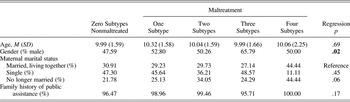
A series of regressions were conducted to examine whether participant characteristics were associated with the number of maltreatment subtypes experienced (the maltreatment variable of interest to this study), ranging from zero subtypes (nonmaltreated) to four subtypes experienced. Males were slightly more likely than females to experience increased subtypes (p = .02); all other associations were nonsignificant, indicating characteristic comparability across the maltreatment variable (see Table 1).
Child characteristics across number of maltreatment subtypes

Maltreatment classification
The MCS (Barnett et al., Reference Barnett, Manly, Cicchetti, Cicchetti and Toth1993) has been shown to be an extremely reliable and valid measure for classifying child maltreatment typology (Bolger et al., Reference Bolger, Patterson and Kupersmidt1998; English et al., Reference English, Upadhyaya, Litrownik, Marshall, Runyan and Graham2005; Manly, Reference Manly2005) that utilizes DHS records, specifying investigations and findings involving maltreatment in identified families over time. Rather than relying on case dispositions and official designations, the MCS codes all available information from DHS records, making independent determinations of maltreating environments. On the basis of operationalized criteria, the MCS designates all subtypes of experienced child maltreatment (i.e., emotional maltreatment, neglect, physical abuse, and sexual abuse). DHS record coding was completed by trained research assistants, doctoral students, and clinical psychologists; coders were required to meet strict reliabilities with criterion standards prior to coding actual records for the study. Coders demonstrated acceptable reliability with the criterion (weighted κs = 0.86–0.98). Reliabilities (κs) for the presence versus absence of maltreatment subtypes ranged from 0.90 to 1.00.
With regard to subtypes of maltreatment, neglect encompasses failure to provide for the child's basic physical needs for adequate food, clothing, shelter, and medical treatment. In addition to inadequate attention to physical needs, forms of this subtype include lack of supervision, moral–legal neglect, and education neglect. Emotional maltreatment involves extreme thwarting of children's basic emotional needs for psychological safety and security, acceptance and self-esteem, and age-appropriate autonomy. Examples of emotional maltreatment of increasing severity include belittling and ridiculing the child, extreme negativity and hostility, exposure to severe marital violence, abandoning the child, and suicidal or homicidal threats. Physical abuse involves the nonaccidental infliction of physical injury on the child (e.g., bruises, welts, burns, choking, or broken bones). Injuries range from minor and temporary to permanently disfiguring. Finally, sexual abuse involves attempted or actual sexual contact between the child and caregiver for purposes of the caregiver's sexual satisfaction and/or financial benefit. Events range from exposure to pornography or adult sexual activity, to sexual touching and fondling, to forced intercourse with the child.
Children in the maltreatment group all had documented histories of abuse and/or neglect occurring in their families according to DHS records. However, DHS record information was not complete enough to code maltreatment subtype information for 1 (0.1%) of the maltreated children. Among the remaining maltreated children, 81.7% had experienced neglect, 56.4% had experienced emotional maltreatment, 30.8% had experienced physical abuse, and 7.1% had experienced sexual abuse. In addition, 56.6% of the maltreated children had experienced two or more maltreatment subtypes.
As a continuous variable of abuse and/or neglect, children were scored on the number of maltreatment subtypes experienced (Table 2), ranging from 0 (nonmaltreated) to 4 (having documented experience of all forms of child maltreatment at least once in their childhood).
Pearson correlation between modeled variables

**p < .01.
Procedure
Maltreated and nonmaltreated children attended a weeklong day camp and participated in research assessments. At the camp, children were assigned to groups of eight children of the same age and sex; half of the children assigned to each group were maltreated. Three trained camp counselors conducted each group and were unaware of the maltreatment status of the children as well as the hypotheses of the study. The camp lasted 7 hr/day for 5 days, providing 35 hr of child–counselor and child–peer interactions. After assent, in addition to recreational activities, children participated in a variety of research assessments (see Cicchetti & Manly, Reference Cicchetti, Manly, Brody and Sigel1990, for detailed descriptions of camp procedures) and provided salivary DNA samples. In addition, trained research assistants, unaware of study hypotheses and maltreatment status, conducted individual research assessments with children, wherein questionnaires and other research measures were administered. Clinical consultation and intervention was provided if any concerns over danger to self or others emerged during the research sessions. All children completed sociometric ratings of their peers at the end of the week. The counselors, who had been trained extensively for 2 weeks prior to the camp, also completed assessment measures on individual children. These were based on their observations and interactions with children in their respective camp groups.
Measures
The measures described below comprise only a subset of assessments conducted during the research camp. The context of the camp and measurement battery used provided a multiple-informant, multiple-perspective evaluation of child functioning including indicators of impulsivity and early signs of antisocial behavior. Antisocial measures include peer evaluations and counselor-report assessments of individual children; impulsivity was measured using Q-Set methodology.
Indicators of antisocial behaviors
Peer ratings
After interacting with their peers during the week of summer camp, children evaluated the characteristics of their camp group peers via a sociometric peer-ratings method on the last day of camp (cf. Bukowski, Sippola, Hoza, & Newcomb, Reference Bukowski, Sippola, Hoza, Newcomb, Cillessen and Bukowski2000; Coie & Dodge, Reference Coie and Dodge1983). Counselors guided the sociometric assessment with individual children. For each peer in the camp group, children were given six behavioral descriptors characterizing different types of social behavior. Children were asked to rate each peer on how characteristic the behavioral descriptor was for that peer on a 3-point scale. In the current study, ratings from peers for physically aggressive behavior and disruptiveness were used. All ratings from peers on each child for each of the two social behavioral descriptors were averaged. The correlation between the descriptors was 0.78.
Teacher Report Form (TRF)
Behavioral symptomatology was evaluated at the end of each week by counselors' completion of the TRF (Achenbach, Reference Achenbach1991). The TRF is a validated, reliable, and widely used instrument to assess behavioral functioning from the perspective of teachers, and the measure was used in the present study because camp counselors are able to observe children in a similar manner as teachers. The TRF contains 118 items rated for frequency, assesses two broadband dimensions of child symptomatology, externalizing and internalizing, as well as total behavior problems. In the present study, we examined the rule-breaking or delinquent behavior problems subscale and the aggressive behavior problem subscale; the counselors' scores for each child were averaged to obtain individual child scores for the two subscales. Interrater reliability was estimated for the dimensions of externalizing and internalizing based on average intraclass correlations among pairs of raters ranged from 0.78 to 0.88 (M = 0.83) for externalizing and from 0.56 to 0.84 (M = 0.68) for internalizing.
Assessment of impulsivity
California Child Q-Set (CCQ)
As an index of variation in impulsivity as a personality construct, the ego control criterion-sort of the CCQ was utilized (Block & Block, Reference Block and Block1988). At the end of each camp week, two counselors completed the CCQ independently on the children in their group. The CCQ is composed of 100 varied items of social, cognitive, and personality characteristics. Camp counselors rated each child's behavioral profiles by sorting the individual items printed on cards into nine piles with a fixed distribution ranging from least characteristic (scored 1) to most characteristic (scored 9). Scores were averaged across raters to derive one Q-Set per child. This Q-Set methodology has numerous psychometric strengths, including observer evaluations as opposed to self-reporting, continuous form as opposed to dichotomous data, and finally, the use of fixed distributions reduces intra- and interjudge differences (Block, Reference Block1961).
The CCQ has been used to derive a number of Q-criterion sorts to assess a wide range of specific psychological constructs, in which prototypical Q-Sets developed from expert raters are correlated to individual child's sort profile to derive criterion score correlations ranging from –1 to 1. One such Q-criterion sort utilized in this study measures Block's dynamic construct of ego control, defined by Funder and Block (Reference Funder and Block1989) as “the individual's generalized disposition or capacity to modulate and contain impulses, feelings, and desires; to inhibit action; and to be insulated from environmental distractions.” The ego control dimension ranges from high ego undercontrol (with scores closer to 1) to high ego overcontrol (with scores closer to –1). Children with profiles characteristic of ego undercontrol (more positive ego control congruence scores) are described as spontaneous, often unable to delay gratification, rebellious, and unpredictable; such traits are consistent with current conceptualizations of, and factor analyses of, impulsivity (Letzring, Block, & Funder, Reference Letzring, Block and Funder2005; Niv, Tuvblad, Raine, Wang, & Baker, Reference Niv, Tuvblad, Raine, Wang and Baker2012; White et al., Reference White, Moffitt, Caspi, Bartusch, Needles and Stouthamer-Loeber1994). Thus, the ego control Q-criterion scores derived from each child's averaged Q-sort profile were utilized to assess variation in impulsivity. Average intraclass correlations for the ego control dimension was 0.80.
DNA collection, extraction, and genotyping
Trained research assistants obtained DNA samples from participants by collecting buccal cells using the Epicentre Catch-All Collection Swabs or by collecting saliva using the Oragene DNA Self-Collection kits. For buccal cells, DNA was extracted and prepared for polymerase chain reaction amplification using the Epicentre BuccalAmp DNA Extraction Kit (Epicentre, Cat. No. BQ090155C). For saliva samples, DNA was purified from 0.5 ml of Oragene-DNA solution using the DNAgenotek protocol for manual sample purification using prepIT-L2P. Sample concentrations were determined using the Quant-iT PicoGreen dsDNA Assay Kit (P7589, Invitrogen). Genotyping was preformed following previously published protocols. DNA was whole-genome amplified using the Repli-g kit (Qiagen, Catalog No. 150043) per the kit instructions to preserve the availability of data over the long term for this valuable sample. Then, amplified samples were diluted to a working concentration.
The DRD4 exon 3 VNTR length was determined by polymerase chain reaction amplifying DNA with primers DRD4 F3 (5′CGGCCTGCAGCGCTGGGA3′) and DRD4 R2 D4 (5′CCTGCGGGTCTGCGGTGGAGT3′) on a MasterCycler Gradient (Eppendorf, Inc). Using a CEQ8000 (Beckman Coulter, Inc.), the resulting products were analyzed for length. The DAT1 VNTR was genotyped using the previously reported primers TGTGGTGTAGGGAACGGCCTGAG and CTTCCTGGAGGTCACGGCTCAAGG (Barr et al., Reference Barr, Xu, Kroft, Feng, Wigg and Zai2001; Vandenbergh et al., Reference Vandenbergh, Persico, Hawkins, Griffin, Li and Jabs1992); the fragments were then analyzed on a 3130xl Genetic Analyzer (Applied Biosystems). The DRD4 –521C/T polymorphism (rs1800955) was analyzed using a Taq Man SNP assay from Applied Biosystems. Allelic determinations were made using Taq Man Genotyping Master Mix (Applied Biosystems, Catalog No. 4371357) with amplification on an ABI 9700 thermal cycler and analyzing the endpoint fluorescence using a Tecan M200 with JMP 8.0 (SAS, Inc.). The genotyping procedures for DAT1 rs40184, DRD2 rs1800497, DRD2 rs1799732, and COMT rs4680 were similar to those of rs1800955.
For any genotype that could not be determined after the first run, the assay was repeated up to four times, and if the null result endured, then a genotype was not assigned to that individual and was treated as missing. DNA samples were genotyped in duplicate for quality control; furthermore, human DNA from cell lines was purchased from Coriell Cell Repositories for all representative genotypes in duplicate and genotypes confirmed by sequencing using DTC chemistry on an ABI 3130x1. These and a negative template control were run alongside study samples representing 9% of the total data output. Any samples that were not able to be genotyped to a 95% or greater confidence level were repeated under the same conditions.
Results
Hardy–Weinberg and gene–environment correlation tests
All genotypes of interest were tested for Hardy–Weinberg equilibrium (HWE) using the statistical software R version 2.15.2, with package “genetics” version 1.3.8 (R Core Team, 2013; Warnes, Gorjanc, Leisch, & Man, Reference Warnes, Gorjanc, Leisch and Man2012). In addition, before inclusion in the modeling process, each individual genetic variant and the polygenic index of differentiating genotypes were stringently tested for any evidence of confounding gene–environment correlations (rGE). First, a series of chi-square tests was performed to test for associations between each genotype of interest and maltreatment status. Second, a series of linear regressions was run to test associations between each genotype and the number of maltreatment subtypes experienced. Any genotypes that failed either of the two rGE tests were excluded from the final index of differentiating genotypes. Third, to rule out that the final index of differentiating genotypes did not associate with either maltreatment status or the number of maltreatment subtypes experienced, two series of two regression analyses were run. The first was a logistic regression of maltreatment status regressed onto the gene index, and the second was a linear regression with the number of maltreatment subtypes experienced regressed onto the gene index. If the gene index passed these final tests, then it was deemed acceptable for inclusion into the primary modeling process.
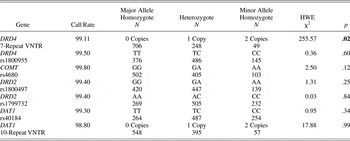
Genotype distributions for six of the seven polymorphisms did not differ significantly from HWE (see Table 3), DAT1 VNTR, χ2 (9, N = 1,003) = 17.88, p = .99; rs40184, χ2 (1, N = 1,003) = 0.95, p = .34; rs1800955, χ2 (1, N = 1,003) = 0.36, p = .60; rs4680, χ2 (1, N = 1,003) = 2.50, p = .12; rs1799732, χ2 (1, N = 1,003) = 0.03, p = .84; rs1800497, χ2 (1, N = 1,003) = 1.31, p = .25, except for the DRD4 VNTR variant, χ2 (44, N = 1,003) = 255.57, p = .02. Given the large number of repeat alleles (nine), with 45 possible genotypes, a departure from HWE with a large sample size is not unusual. Deviation from HWE can result from the violation of HWE principles such as nonrandom mating, migration, selection, and mutation or genotyping errors (Xu, Turner, Little, Bleecker, & Meyers, Reference Xu, Turner, Little, Bleecker and Meyers2002). Deviation from HWE is acceptable for our analysis as long as genotyping error is not a contributing factor. Genotyping error is very unlikely given our strict quality controls, and thus, we did not exclude DRD4 from our polygenic index.
Genotype frequencies, call rate, and Hardy–Weinberg equilibrium (HWE) for selected genetic variants

Using chi-square tests for each of the seven polymorphisms, only the DRD2 rs1800497 variant slightly associated with maltreatment status, χ2 (1, N = 1,006) = 3.94, p = .047. All other variants did not show significant associations: DAT1 VNTR, χ2 (1, N = 1,006) = 0.002, p = .96; DRD4 VNTR, χ2 (1, N = 1,006) = 1.32, p = .25; rs40184, χ2 (1, N = 1,006) = 1.49, p = .22; rs1800955, χ2 (1, N = 1,006) = 0.001, p = .99; rs4680, χ2 (1, N = 1,006) = 0.07, p = .80; rs1799732, χ2 (1, N = 1,006) = 0.55, p = .46. Because of a possible rGE confound, we excluded DRD2 rs1800497 from our polygenic index. With the remaining six polymorphisms, we conducted linear regressions between each genotype and number of maltreatment subtypes. Only the DAT1 rs40184 variant predicted the number of maltreatment subtypes, β = 0.074, t (1,003) = 2.36, p = .019; all other linear relationships were nonsignificant (data not presented). We also excluded DAT1 rs40184 from our final polygenic index over concerns of a rGE confound. The remaining five variants were combined to form one polygenic index indicating the total number of differentiating genotypes present. We tested whether this polygenic index predicted either maltreatment status or the number of maltreatment subtypes via logistic regression and linear regression, respectively. Both tests were nonsignificant (data not presented), and a final genetic index of five variants was retained for modeling. Each individual was scored according to the (a) presence of at least one 7-repeat copy of the DRD4 VNTR allele, (b) presence of the 10-repeat homozygote genotype of DAT1 VNTR, (c) presence of T/T genotype of DRD4 −521C/T rs1800955, (d) presence of G/G (Val/Val) of COMT rs4680, and (e) presence of del/del genotype of DRD2 rs1799732, for a total score ranging from 0 to 5.
Data analytic strategy
Structural equation modeling was conducted in Mplus version 7.2 data analysis package (Muthén & Muthén, Reference Muthén and Muthén1998–2012). Rates of missingness averaged 0.4% for the antisocial behavior indicators, 0.3% for the ego control index of impulsivity, and 2% for the polygenic index of differentiating genotypes. These data were assumed to be at least missing at random; however, this could not be explicitly tested because of a lack of longitudinal data. Furthermore, descriptive data suggested that the four antisocial indicators were skewed. To address issues of both missingingness and skew, a robust maximum likelihood estimator was utilized, which by default models data under the missing data theory using all available data via full information maximum likelihood (Muthén & Muthén, Reference Muthén and Muthén1998–2012). Any missing data from exogenous data was modeled by explicitly bringing the respective covariates into the model by estimating their variances.
The primary structural equation model (Model 1) comprised one latent factor referred to as antisocial behavior with four indicators; one observed mediator of impulsivity indexed by ego control; nine covariate predictors, including age, gender, number of maltreatment subtypes experienced, polygenic index of differentiating genotypes (Wray et al., Reference Wray, Lee, Mehta, Vinkhuyzen, Dudbridge and Middeldorp2014); and five interaction terms. Following the recommendations of Cohen, Cohen, West, and Aiken (Reference Cohen, Cohen, West and Aiken2003), age, number of maltreatment subtypes, and the polygenic index were grand-mean centered because of their inclusion as interaction terms as continuous variables. Five interaction terms were created including the primary term of interest: Polygenic Index × Number of Maltreatment Subtypes along with Polygenic Index × Gender, Polygenic Index × Age, Number of Maltreatment Subtypes × Gender, and Number of Maltreatment Subtypes × Age. The inclusion of all covariate by environment and covariate by gene interaction terms is in line with the recommendations of Keller (Reference Keller2014), ensuring proper control for possible multiplicative, confounding effects.
For the measurement component of Model 1, the antisocial latent factor was loaded onto the four antisocial indicators of rule breaking, delinquent behavior, physical aggression, and disruptive behavior as measured by the TRF and sociometric ratings, respectively. Residual covariances were estimated between the two TRF indictors and the two sociometric ratings; because the scales came from the same respective measures and reporters, their errors were not assumed to be independent. For identification purposes, at least one predictor had to be modeled in order to obtain fit indices for the measurement model. The measurement model with one predictor had good absolute and incremental fit: χ2 (3, N = 1,012) = 32.00, p < .000; comparative fit index (CFI) = 0.987, Tucker–Lewis index (TLI) = 0.956, root mean square error of approximation (RMSEA) = 0.098, and standardized root mean square residual (SRMR) = 0.017. With good initial, approximate fit, this measurement model was included in a larger structural model. Specifically, impulsivity was regressed onto the nine covariate predictors. Furthermore, the antisocial latent factor was also regressed onto the nine covariate predictors, in line with a full-partial use of covariates.
For purposes of interpreting the Polygenic Index × Number of Maltreatment Subtypes effect, three additional structural equation modeling models were run that varied from Model 1 in terms of where the polygenic index variable was centered (Models 2–4). Total, direct, and mediation (indirect) effects of the number of maltreatment subtypes on antisocial behavior via impulsivity were estimated for each of these three secondary models. These estimates illustrate the manner by which the total and mediation effects vary as a function of differing polygenic index levels. Confidence intervals for the mediation effects were estimated in four alternative ways using the statistical software R version 2.15.2, with the RMediation version 1.1.3 package (R Core Team, 2012; Tofighi & MacKinnon, Reference Tofighi and MacKinnon2011). Specifically, two distribution of product approaches (PRODCLIN; MacKinnon et al., Reference MacKinnon, Fritz, Williams and Lockwood2007; and RDOP; Tofighi & MacKinnon, Reference Tofighi and MacKinnon2011), the Monte Carlo method (Tofighi & MacKinnon, Reference Tofighi and MacKinnon2011), and the asymptotic normal distribution approach (Tofighi & MacKinnon, Reference Tofighi and MacKinnon2011) were estimated.
Bivariate correlation analyses
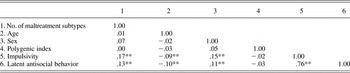
Table 2 summarizes the Pearson bivariate correlations for the variables included in the structural equation modeling. These results demonstrate statistically significant relations among the number of maltreatment subtypes, impulsivity, and the latent construct of antisocial behavior. Age and sex were associated with impulsivity and antisocial behavior but not number of maltreatment subtypes. Finally, the polygenic index of differentiating alleles did not show any significant associations with any variables.
Primary structural equation model
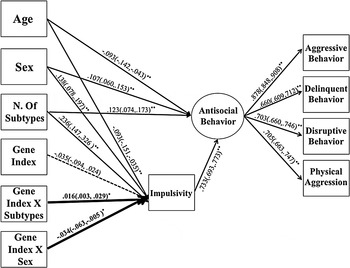
The primary moderated mediation model (Model 1) tested whether impulsivity mediated the association between the number of maltreatment subtypes and antisocial behavior, as moderated by a polygenic index of differentiating genotypes with all relevant main effect and interactive covariates controlled for in a full-partial fashion. This initial model had good absolute and incremental fit: χ2 (30, N = 1,012) = 87.006, p < .000; CFI = 0.981, TLI = 0.966, RMSEA = 0.044, and SRMR = 0.016. Although the chi-square test of model fit was significant, this was expected given such a large sample size. The number of maltreatment subtypes was significantly, positively related to both impulsivity and antisocial behavior (β = 0.237, one-tailed p < .000, β = 0.091, one-tailed p = .004, respectively). As hypothesized, the interaction between the number of maltreatment subtypes and the polygenic index predicting impulsivity was significant (“a” path moderation) and in the expected direction (β = 0.016, p = .013); all other interactions with the polygenic gene index were nonsignificant. This primary G × E effect remained significant even when correcting for the false discovery rate (Benjamini & Hochberg, Reference Benjamini and Hochberg1995) of five covariate interaction terms predicting impulsivity (p = .040). In addition, all Number of Maltreatment Subtypes × Covariate interactions were nonsignificant except Maltreatment Subtype × Sex predicting impulsivity (β = −0.034, p = .020).
For lack of specific hypotheses and rationale (absence of correlations among respective variables) to include all Covariate × Maltreatment and Covariate × Gene Index interaction terms and because most were found to be nonsignificant predictors in the preliminary model, we trimmed all nonsignificant interaction terms from Model 1. This trimmed model generally had better absolute and incremental fit than the full model: χ2 (32, N = 1,012) = 86.511, p < .000; CFI = 0.982, TLI = 0.977, RMSEA = 0.041, and SRMR = 0.022. Furthermore, the coefficient and significance level of the number of Maltreatment Subtypes × Polygenic Index predicting the impulsivity effect remained the same. To insure this nested model (H0) fit the data as well or better than the full model (H1), a scaled chi-square difference test was performed (Satorra, Reference Satorra, Heijmans, Pollock and Satorra2000). The results from this test found the nested model to not fit significantly better or worse than the full model, χ2 (9, N = 1,012) = 11.11, p = .268. Thus, because the trimmed model fit as well as the full model and is more parsimonious, it was chosen as our final model (Model 1). Model 1 results are depicted in Figure 1. The predictors and covariates explain 64.2% of the variance in antisocial behavior.
Model 1 number of maltreatment subtypes on antisocial behavior as mediated by impulsivity and moderated by dopaminergic genes. Standardized estimates and standardized confidence intervals are reported for main effects, and unstandardized interaction effects are in bold. The nonsignificant path is dashed. *p < .05. **p < .01.

Mediation effects differ across polygenic index levels
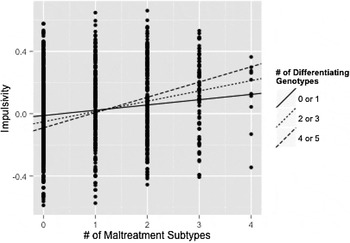
Three secondary models were performed in order to interpret the effect of the Polygenic Index × Number of Maltreatment Subtypes interaction on the overall partial mediation of the number of maltreatment subtypes on antisocial behavior via impulsivity. Each subsequent model was identical to Model 1 (with all covariate control); however, the polygenic index variable was collapsed into a smaller continuous variable and centered specifically at zero or one genotype present, two or three genotypes present, and four or five genotypes present for Model 2, Model 3, and Model 4, respectively. By collapsing and centering the polygenic variable in this manner, there was a more equitable distribution of participants at each level of the polygenic index variable, and it is straightforward to examine how the mediation effect varies depending on genotypes carried. Table 4 summarizes the total, mediation (indirect) effects, and alternative confidence intervals from each secondary model. Across the three models, the direct effect of maltreatment subtypes on antisocial behavior remained the same (β = 0.123, p < .001), as expected. In each model there was a significant, partial mediation. However, the mediation effect increased as the number of maltreatment subtypes increased. Consequently, the effect of the number of maltreatment subtypes experienced on antisocial behavior as mediated by impulsivity is more apparent in youth who carry more differentiating genotypes. The Polygenic Index × Number of Maltreatment Subtypes interaction is depicted in Figure 2, with three simple slopes corresponding to each varying effect of maltreatment on impulsivity.
Polygenic Index × Number of Maltreatment Subtypes interaction predicting impulsivity. Simple slopes corrected for all covariate effects.

Summaries of secondary model effects

*p < .05. **p < .01.
Discussion
Consistent evidence demonstrates that maltreated children are disproportionally at risk for developing antisocial behaviors such as aggression, delinquency, and conflictual peer relations (see Cicchetti & Rogosch, Reference Cicchetti and Rogosch2001; Cicchetti et al., Reference Cicchetti, Rogosch and Thibodeau2012; Hong, Espelage, Grogan-Kaylor, & Allen-Meares, Reference Hong, Espelage, Grogan-Kaylor and Allen-Meares2012; Jaffee, Caspi, Moffitt, & Taylor, Reference Jaffee, Caspi, Moffitt and Taylor2004). Moreover, early adversity can lead to uninhibited behavior, a desire for more immediate rewards, and a lack of thoughtful planning, indicative of diminished dopamine functioning (Lovallo, Reference Lovallo2013). Such difficulties in adequately controlling impulses may partly explain the prevalence of antisociality in maltreated children (see Egeland, Yates, Appleyard, & Van Dulmen, Reference Egeland, Yates, Appleyard and Van Dulmen2002; Oshri et al., Reference Oshri, Sutton, Clay-Warner and Miller2015). Nevertheless, development is extraordinarily heterogeneous, and not all maltreated children exhibit deficiencies in social behavior; individual differences in genetic variation may shed light on divergent paths of functioning (Cicchetti et al., Reference Cicchetti, Rogosch and Thibodeau2012). Maltreated children who carry more genotypes that confer inefficiencies in the dopamine system may be particularly sensitive or vulnerable to developing impulse control deficits, and consequently antisocial behavior.
It was hypothesized that an increasing number of maltreatment subtypes would predict early signs of antisocial behavior and that higher levels of ego undercontrol, an index of impulsivity, would partially or fully mediate this effect. In addition, we postulated that the number of maltreatment subtypes experienced would interact with a polygenic index of differentiating, dopaminergic genotypes. Specifically, carriers of more differentiating genotypes would show a larger increase in ego undercontrol as the number of maltreatment subtypes increased. However, we expected that the main effect of maltreatment on antisocial behavior would remain even in the context of a G × E interaction. After controlling for nine covariate effects including a Covariate × Gene index and Covariate × Maltreatment terms, the effect of maltreatment subtypes on antisocial behavior remained significant (β = 0.123, p < .001). Ego undercontrol did partially mediate this association, and the mediation was informed by a G × E effect. Carriers of more differentiating genotypes appeared to be more sensitive to the effects of a greater number of maltreatment subtypes on ego undercontrol. That is, the effect of maltreatment on impulsivity increased as the number of differentiating genotypes carried increased. Likewise, the mediation (indirect) effect of maltreatment subtypes on antisocial behavior via impulsivity increased as the number of differentiating genotypes carried increased.
This is the first study to test such a moderated mediation effect, bringing together genetic, social, personality, and family levels of analysis into one model. The findings presented here closely resemble the data of previous studies. Davies et al. (2014) formed a polygenic index from two dopaminergic genes and found that index to moderate a similar mediation among maternal unresponsiveness, uninhibited temperament, and child behavior problems. Using three of the same dopamine genetic variants as this study, Belsky and Beaver (Reference Belsky and Beaver2011) demonstrated greater effects of unsupportive parenting on adolescent self-regulation for those with more differentiating genotypes. Although at first glance the interaction plot in Figure 2 may appear to depict differential susceptibility effects (Belsky & Pluess, Reference Belsky and Pluess2009), this cannot be definitively tested. Although statistical tests exist that differentiate interaction effects such as differential susceptibility, diathesis–stress, and vantage sensitivity (see Roisman et al., Reference Roisman, Newman, Fraley, Haltigan, Groh and Haydon2012; Widaman et al., Reference Widaman, Helm, Castro-Schilo, Pluess, Stallings and Belsky2012), the environmental range in this study is too limited to do so. Differential susceptibility theory suggests that some children are disproportionally sensitive to both positive and negative environments, for better or for worse (Belsky & Pluess, Reference Belsky and Pluess2009). In this study, our environmental range is constrained to the negative end of the spectrum, because both maltreated and nonmaltreated children come from disadvantaged, socioeconomic backgrounds. Without a comparison group residing in a more promotive family environment, inferences regarding differential susceptibility effects are speculative at best. Furthermore, we made no specific hypotheses regarding particular environmental sensitivity effects (Pluess, Reference Pluess2015), other than carriers of more differentiating genotypes would show the largest effects of maltreatment on impulsivity.
There were no specific hypotheses pertaining to whether the polygenic index of differentiating genotypes would have a main effect on impulsivity or antisocial behavior. There were no main effects of the polygenic index on either outcome when controlling for all covariate influence, including the G × E. A number of studies have shown main effects of the genes comprising the polygenic index on impulsivity-like traits (e.g., Cornish et al., Reference Cornish, Manly, Savage, Swanson, Morisano and Butler2005; Gizer, & Waldman, Reference Gizer and Waldman2012; White et al., Reference White, Morris, Lawford and Young2008). These discrepant findings could result for a number of reasons. This study used an all African American sample; most genetic association studies with these particular dopaminergic variants have focused on primarily Caucasian or mixed-race samples. At least for African American children aged 6–13, an increase in the number of genotypes conferring dopamine inefficiency may not directly predict ego undercontrol or antisocial behavior. Moreover, these variants were chosen specifically because of their moderating influences rather than their direct influences on behavior. Instead of conferring risk per se, it may be more appropriate to consider these variants as conferring sensitivity or plasticity (Belsky et al., Reference Belsky, Jonassaint, Pluess, Stanton, Brummett and Williams2009). That is, the risk imposed by the cumulative effect of dopaminergic, inefficient genotypes on developing impulsivity depends entirely on how many maltreatment subtypes were experienced.
The G × E interaction effect was relatively small (β = 0.016, p = .013); however, this is to be expected because genetic moderation effects tend to be small (Duncan & Keller, Reference Duncan and Keller2011). Futhermore, this interaction effect contributed to nontrivial increases in the mediation of maltreatment subtypes on antisocial behavior via impulsivity (see Table 4). The reporting of possibly biased or unsubstantiated G × E effects has been criticized (see Duncan & Keller, Reference Duncan and Keller2011; Keller, Reference Keller2014) based on underpowered analyses, improper use of covariates, publication bias, and inadequate measurement of the environment among other reasons. Addressing these extant criticisms is a major strength of this study. A large sample size (N = 1,012) with homogenous ancestry is unique among G × E interaction studies, ensuring proper control for possible ancestral confounds. Multiple informants provided measurement of multiple, related forms of antisocial behavior, ensuring a more solid latent construct. A multigenic approach was utilized as opposed to a one-gene/one-variant methodology. By examining multiple genes across distinctive dopaminergic functions (reuptake transportation, metabolism, etc.), a more complete cumulative index of dopamine inefficiency is generated. Maltreatment, as an environmental variable, was measured prospectively and objectively using the MCS (Barnett et al., Reference Barnett, Manly, Cicchetti, Cicchetti and Toth1993). Finally, each Covariate × Maltreatment, and Covariate × Gene index interaction term was added to the model, a practice recommended by Keller (Reference Keller2014). Covariates that correlate with the environmental variable and/or the genetic variable may have confounding multiplicative effects in addition to any confounding main effects. We only found evidence of a confounding interaction between maltreatment subtypes experienced and sex in the prediction of impulsivity. Given the lack of specific hypotheses on covariate interaction effects and for reasons of parsimony, we trimmed all nonsignificant interaction term paths. This nested model fit the data as well as the full model, thereby ensuring that trimming did not negatively impact on model fit, χ2 (9, N = 1,012) = 11.11, p = .268).
Another major strength of this investigation was a focus on dopamine genetic moderation. Most G × E studies on antisocial behavior examine only serotoninergic genotypes (e.g., Caspi et al., Reference Caspi, McClay, Moffitt, Mill, Martin and Craig2002; Cicchetti et al., Reference Cicchetti, Rogosch and Thibodeau2012; Li & Lee, Reference Li and Lee2010; Weder et al., Reference Weder, Yang, Douglas-Palumberi, Massey, Krystal and Gelernter2009). Despite the literature focus on serotonergic processes, dopamine is no less important of a contributing factor in the development of antisocial behavior (Lovallo, Reference Lovallo2013). Impulse control appears to be particularly linked with individual differences in dopaminergic functioning (Buckholtz et al., Reference Buckholtz, Treadway, Cowan, Woodward, Li and Ansari2010), more so than serotonin. However, more work needs to be done to elucidate the various independent or dependent ways in which both dopamine and serotonin genes modulate the effects of child maltreatment on antisociality, because they are interrelated neurotransmitter systems (Seo, Patrick, & Kennealy, Reference Seo, Patrick and Kennealy2008).
Despite the strengths of this investigation, some limitations do exist. This is a cross-sectional, correlational design. In order to demonstrate true mediation, the order of effects and causality need to be determined (MacKinnon & Fairchild, Reference MacKinnon and Fairchild2009), requiring longitudinal data and an experimental design. It is possible that antisocial behavior and impulsivity are developing concurrently, rather than impulsivity arising first and subsequently influencing antisocial traits. However, previous longitudinal studies using ego control as a mediator between maltreatment and antisocial behavior corroborate the flow of our model design (see Egeland et al., Reference Egeland, Yates, Appleyard and Van Dulmen2002; Oshri et al., Reference Oshri, Rogosch and Cicchetti2013). In addition, as expected, the G × E term predicted impulsivity but not antisocial behavior. If impulsivity were the mediator (closer along the causal chain to the genotype), then the strength of the G × E effects should be stronger for impulsivity than for the distal outcomes of antisocial behavior. It is also possible that impulsivity and antisocial behavior are the result of shared genes between parents and children; however, this is unlikely given twin-study designs demonstrating substantial environmental mediation above and beyond the influence of shared genes (see Jaffee et al., Reference Jaffee, Caspi, Moffitt and Taylor2004; Moffitt, Reference Moffitt2005). Only one measure of impulsivity was utilized, and antisocial behavior was treated as one large construct; both constructs are broad and multifaceted. Although this study aimed to understand basic associations among these variables, more work should be done to examine precise subtypes of antisocial behavior and impulsivity. For example, impulsivity may better predict reactive and physical forms of antisocial behavior as opposed to proactive and covert forms. Finally, this study may have benefited by the inclusion of biological endophenotypes (Gottesman & Gould, Reference Gottesman and Gould2003; Lenzenweger, Reference Lenzenweger2013). Although genotypic data are available in our sample, underlying disruptions to neurobiology in these maltreated children are undetermined. A model that incorporates neuroimaging and epigenetic analyses may be able to better elucidate the precise manner by which child maltreatment, dopamine genotypes, and impulsivity influence the development of antisocial behavior.
In summary, the results of this current investigation emphasize the need for more comprehensive efforts to reduce the occurrence of child maltreatment and mitigate its sequelae. Antisocial behavior is extremely costly to individuals, families, and society at large; early identification and intervention is key to preventing a life-course persistent trajectory (Moffitt, Reference Moffitt, Cicchetti and Cohen2006). The finding that more subtypes of maltreatment experienced predicts increasing impulsivity and antisocial behavior is cause for concern, given the fact that 56.6% of maltreated children in this study experienced multiple subtypes. Such cumulative abuse and neglect is likely to overwhelm the body's efforts to maintain healthy homeostasis in critical biological systems (allostatic overload). As these data suggest, maltreated individuals may be at greatest risk for social maladaptation when they are prone to inefficient dopaminergic functioning. Identifying genetic markers of differential sensitivity to child maltreatment has a number of crucial implications. Genetic information is merely a proxy for the underlying structure and function of biological systems; as such, G × E effects may shed light on critical neurobiological processes important for influencing divergent paths of development (Cicchetti, Reference Cicchetti2013). Based on the findings herein, genotypes conferring more efficient dopaminergic functioning may be prime candidates in the search for factors important for resilient functioning. It is unlikely that dopaminergic genotypes alone will contribute to multidomain competence; however, when they are coupled with a host of other neurobiological, familial, and social factors, they may have an appreciable impact on resilient functioning (Cicchetti, Reference Cicchetti2013; Luthar, Cicchetti, & Becker, Reference Luthar, Cicchetti and Becker2000; Masten, Reference Masten2001; Rutter, Reference Rutter2012). Nevertheless, the findings from this study reveal that children residing in similar maltreating families exhibit differential paths of adaptation, some of which can be explained by a greater number of dopaminergic genotypes conferring sensitivity to the environment.