Introduction
Recent studies based on psychotropic drug use give rise to growing concern about the trend towards psychotropic and antipsychotic polypharmacy, contrary to treatment recommendations drawn up in international guidelines. An increase in the number of psychotropic medications prescribed over the course of years has been noted in all psychiatric settings: in office-based psychiatric practices (Mojtabai & Olfson, Reference Mojtabai and Olfson2010), in hospitals (McCue, Waheed & Urcuyo, Reference McCue, Waheed and Urcuyo2004; Barbui et al. Reference Barbui, Ciuna, Nosè, Levi, Andretta, Patten, Amaddeo and Tansella2005; Centorrino et al. Reference Centorrino, Cincotta, Talamo, Fogarty, Guzzetta, Saadeh, Salvatore and Baldessarini2008) and in residential facilities (Tomasi et al. Reference Tomasi, de Girolamo, Santone, Picardi, Micciolo, Semisa and Fava2006; Schorr et al. Reference Schorr, Loonen, Brouwers and Taxis2008).
The increase in antipsychotic polypharmacy (Centorrino et al. Reference Centorrino, Eakin, Bahk, Kelleher, Goren, Salvatore, Egli and Baldessarini2002; Ganguly et al. Reference Ganguly, Kotzan, Miller, Kennedy and Martin2004), and of the chlorpromazine equivalent (CPZ eq) total daily dose of antipsychotic agents (Tempier & Pawliuk, Reference Tempier and Pawliuk2003; Centorrino et al. Reference Centorrino, Goren, Hennen, Salvatore, Kelleher and Baldessarini2004; Mauri et al. Reference Mauri, Regispani, Beraldo, Volonteri, Ferrari, Fiorentini and Invernizzi2005), persisting despite repeated recommendations to the contrary (Ranceva, Ashraf & Odelola, Reference Ranceva, Ashraf and Odelola2010), seems particularly disturbing.
The rate of antipsychotic polypharmacy varies from 13% (Tapp et al. Reference Tapp, Wood, Secrest, Erdmann, Cubberley and Kilzieh2003) to about 50% (Paton et al. Reference Paton, Lelliott, Harrington, Okocha, Sensky and Duffett2003; Sim, Su & Fujii, Reference Sim, Su and Fujii2004) depending on studies, and has shown an increasing trend towards such prescription patterns in recent years. This is proven in reports that point out a 20-fold increase in patients subject to prescribed polypharmacy with a corresponding 46% increase in the CPZ eq total daily dose of antipsychotics between 1989 and 1998 (Centorrino et al. Reference Centorrino, Eakin, Bahk, Kelleher, Goren, Salvatore, Egli and Baldessarini2002) and a 227% increase in the total annual number of antipsychotics prescriptions between 1996 and 2006 (Alessi-Severini et al. Reference Alessi-Severini, Biscontri, Collins, Kozyrskyj, Sareen and Enns2008).
Prescribed antipsychotic polypharmacy has been associated with higher healthcare costs (Loosbrock et al. Reference Loosbrock, Zhao, Johnstone and Morris2003; Alessi-Severini et al. Reference Alessi-Severini, Biscontri, Collins, Kozyrskyj, Sareen and Enns2008), increased anticholinergic drug prescriptions (Johnsen, Svingen & Jorgensen, Reference Johnsen, Svingen and Jorgensen2004; Kreyenbuhl et al. Reference Kreyenbuhl, Valenstein, McCarthy, Ganoczy and Blow2007), young patient age (Centorrino et al Reference Centorrino, Eakin, Bahk, Kelleher, Goren, Salvatore, Egli and Baldessarini2002; Lelliott et al. Reference Lelliott, Paton, Harrington, Okocha, Sensky and Duffett2002), longer periods of hospitalisation (Diaz & de Leon, Reference Diaz and de Leon2002; Centorrino et al. Reference Centorrino, Goren, Hennen, Salvatore, Kelleher and Baldessarini2004), increased use of depot injection (Walkup et al. Reference Walkup, McAlpine, Olfson, Labay, Boyer and Hansell2000), above average body weight (Centorrino et al. Reference Centorrino, Cincotta, Talamo, Fogarty, Guzzetta, Saadeh, Salvatore and Baldessarini2008) and is considered the strongest predictor of high levels of antipsychotic dosage (Lelliott et al. Reference Lelliott, Paton, Harrington, Okocha, Sensky and Duffett2002; Centorrino et al. Reference Centorrino, Goren, Hennen, Salvatore, Kelleher and Baldessarini2004, Reference Centorrino, Cincotta, Talamo, Fogarty, Guzzetta, Saadeh, Salvatore and Baldessarini2008).
Most studies on antipsychotics' prescription patterns have been carried out using administrative databases or onsite in acute psychiatric wards. Data related to prescribing practices for patients living in psychiatric residential facilities which, in Italy, have completely replaced mental hospitals for the care of long-term patients, are instead minimal.
To our knowledge only two recent studies have been conducted, both of them in 2004 (Tomasi et al. Reference Tomasi, de Girolamo, Santone, Picardi, Micciolo, Semisa and Fava2006; Schorr et al. Reference Schorr, Loonen, Brouwers and Taxis2008), the results of which show a psychotropic polypharmacy rate of 50% (Tomasi et al. Reference Tomasi, de Girolamo, Santone, Picardi, Micciolo, Semisa and Fava2006) and an antipsychotic polypharmacy rate of 25% (Schorr et al. Reference Schorr, Loonen, Brouwers and Taxis2008) and 39% (Tomasi et al. Reference Tomasi, de Girolamo, Santone, Picardi, Micciolo, Semisa and Fava2006), respectively.
Both these studies did not collect data on the prescribed antipsychotic dosage or on antipsychotic prescription changes during a patient's stay within the facilities.
The primary aim of our investigation was to evaluate antipsychotic drug use and to estimate the frequency of antipsychotic polypharmacy in residential facilities in order to document current trends compared to earlier studies in the same environment. Unlike earlier studies we also collected data both on the antipsychotic dose and the variation of antipsychotic patterns over the period of stay within the given facility. In addition to this, we investigated any possible relation between the aforementioned and prescribed psychotropic drugs, anticholinergics, high antipsychotic dosage as well as patients' characteristics.
Furthermore, we aimed at highlighting possible differences in antipsychotic prescribing patterns between long-term facilities and other psychiatric settings by comparing our findings on antipsychotic polypharmacy and high antipsychotic doses with that of earlier studies in acute inpatients' facilities and outpatients' settings.
Methods
In this study, 15 residential facilities were included. The facilities involved in our investigation included both public and private (seven public and eight private) post-acute, intermediate and long-term facilities. These facilities were located across the entire region of Liguria, Italy. By incorporating the above aspects (public and private institutions, differing geographical locations and differing levels of assistance), we considered our selection to be an apt representative of the residential psychiatric care provided in the said region.
We expected to find few or no differences at all in prescribing practices between private and public facilities because both types of facilities are required to provide the same level of care by the Regional Healthcare Administration and a patient's admission is only based on availability.
These facilities were 39.4% of the 38 long-term psychiatric residential facilities in the region.
The data were collected through a chart review during a one-day census. The census took place on a different day for each facility between May and June 2008. Information relating to all patients (362) staying in the facilities was collected.
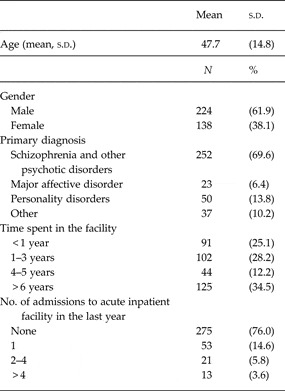
The demographic and clinical characteristics of patients are provided in Table 1. Primary diagnosis was assigned by the treating physician, according to DSM-IV TR criteria and was then categorised as: Schizophrenia and Other Psychotic Disorders, Major Affective Disorder (including Bipolar Disorder, Major Depression and Mood Disorder not otherwise specified), Personality Disorders and Other Disorders (including Substance-Related Disorders, Eating Disorders, Dementia and Mental Retardation).
Clinical and socio-demographic characteristics (n = 362)

Psychotropic drug prescribing patterns were collected both upon admission and on the given census day. Drug name, class, formulation and daily dose of antipsychotics (ATC codes from N05AA01 to N05AX12) were collected. In addition, the drug name was collected for the following class of psychotropic drugs: antidepressants (ADs; ATC codes from N06AA01 to N06AX21 and from N06CA to N06CA01), benzodiazepines (BDZs; ATC codes from N05BA to N05CX), mood stabilisers (MSs; ATC codes N03AF01, N03AF02, N03AG01, N03AG02, N03AX09, N03AX11, N03AX12 and N03AX16) and anticholinergics (ATC codes N04AA02 and N04AB02).
At the time of the survey all typical antipsychotics and the following atypical antipsychotics were available in Italy: Aripiprazole, Clozapine, Olanzapine Quetiapine and Risperidone.
The antipsychotic daily doses, including depot antipsychotics, were converted to CPZ eqs (mg/day), using published guidelines (Woods, Reference Woods2003; Taylor, Paton & Kerwin. Reference Taylor, Paton and Kerwin2007). In the case of antipsychotic polypharmacy, the total daily dose was calculated adding up the different CPZ eqs and the antipsychotic with the highest CPZ eq was considered the main antipsychotic.
The data on BDZ, AD, MS, anticholinergics and PRN drugs were collected. The prescription of non-psychotropic drugs was also investigated.
Psychotropic polypharmacy was defined as the prescription of at least three different compounds.
Antipsychotic polypharmacy was defined as the prescription of at least two different antipsychotics.
All of the patients' medical prescriptions (for the census day and on admission into the facility) are presented and described in our report.
Changes in prescriptions from admission to the given census day are presented and analysed according to a patient's length of stay within the facility.
Italian psychiatric inpatients facilities provide a wide range of non-pharmacological interventions such as individual and group psychotherapy, recreational therapy and psycho-educational interventions. These treatments, however, are heterogeneous and were not routinely reported in the patient records we examined, therefore we decided not to include such data in our analysis.
Statistical analysis
Age and antipsychotic doses were described by their means and standard deviations. All the other variables are described by frequency and percentages.
The Wilcoxon test was used to analyse the change in dosage of antipsychotics as well as in the number of medications prescribed from admission to the census day.
The McNemar test was used to analyse the change in the proportion of subjects receiving psychotropic polypharmacy, antipsychotic polypharmacy and depot medication on admission and on the census day.
The Spearman correlation coefficient was used to analyse the relationship between the number of antipsychotics and the total dosage of the said antipsychotics.
The Chi-square test was used to analyse the relationship between time spent in the facility and changes to the prescription of the main antipsychotic, the relationship between diagnosis and high antipsychotic dosage and the relationship between antipsychotic polypharmacy and admission to acute inpatient facilities.
The Mann–Whitney test was used to analyse the relationship between antipsychotic dose and anticholinergic use.
The Student t test was used to analyse the relationship between age and antipsychotic polypharmacy.
All statistical analyses were carried out using SPSS version 16.0.
Results
Socio-demographic characteristics
The study includes 362 patients with an average age of 47.7 years, 61.9% males. The most common diagnosis was schizophrenia (69.6%) followed by personality disorders (13.8%) and major affective disorder (6.4%). Other disorders accounted for 10.2%.
Overall, 46.7% had spent at least 4 years in the given facility and 76.0% had no admission to an acute inpatient facility in the previous year (see Table 1).
Psychopharmacological treatment on the census day
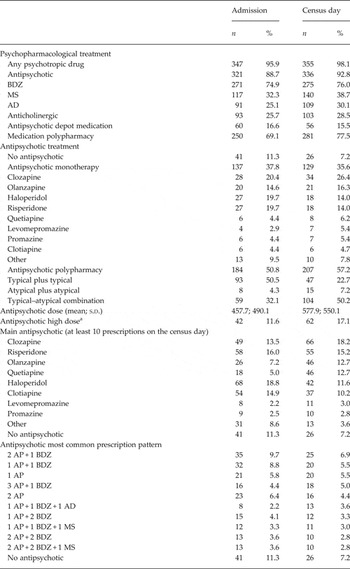
Almost all patients were treated with a psychotropic drug (98.1%) and 92.8% of patients had been prescribed at least one antipsychotic (see Table 2). A high proportion of patients (76.0%) received at least one BDZ. The proportion of patients receiving psychotropic polypharmacy was 77.5% with an average number of 3.7 drugs prescribed. Five or more psychotropic drugs were prescribed to 32.8% of all patients. Overall 62 different drugs were prescribed. Moreover, a PRN medication was prescribed to 25.0% of patients and at least one drug for medical comorbid conditions to 37.0% of patients. The most commonly prescribed PRN medication was delorazepam and overall 66.7% of PRN medications were BDZ. However, PRN prescriptions were not routinely reported in patient records, and so these data will not be used in any further analysis.
Psychopharmacological treatment and antipsychotic prescription pattern at admission to the residential facility and on the census day (n = 362)

a>1000 mg CPZ equivalents.
AP, antipsychotic; BDZ, benzodiazepine; AD, antidepressant; MS, mood stabiliser.
The most common associations between drug classes are indicated in Table 2, showing a parcelling out of prescription patterns, all of which are below 7% in frequency. It is remarkable that among the first five most common combinations, three include some form of antipsychotic polypharmacy.
No differences emerged from the comparison between private and public facilities or between the different types of facility.
Antipsychotic treatment on the census day
Clozapine, risperidone, olanzapine and quetiapine were the most commonly prescribed antipsychotics on the given census day. Atypical prescription increased compared to the admission where haloperidol was the most commonly prescribed antipsychotic. The variations in prescribing patterns are confirmed by the changes to the typical:atypical ratio from admission to the census day (2.02:1 v. 1.35:1).
There were 35.6% of patients taking antipsychotic monotherapy, while the amount of patients receiving antipsychotic polypharmacy was 57.2%. More than three different antipsychotics were prescribed to 22.9% of patients. The most common antipsychotics combinations included one atypical and one (or more) typical drug(s), but no antipsychotics combination appeared to be prevalent.
Antipsychotic total daily dose (in CPZ eqs) was 577.9 mg/day. Overall, 22.9% of patients were receiving a dose lower than 200 mg/day, 31.5% a dose between 201 mg and 500 mg/day, 18.2% a dose between 501 and 800 mg/day and 27.3% a dose higher than 800 mg/day. There were 62 (17.1%) of patients receiving a dose higher than the suggested maximum dose (1000 mg/day).
Patients with a diagnosis of schizophrenia or other psychotic disorders were most likely to be prescribed a dose of antipsychotic higher than 800 mg/day (Chi square = 12.43; p < 0.001; OR = 3.04, CI = 1.61–15.77).
As expected, there was a significant association between the total daily dose and the number of antipsychotics prescribed (Spearman r = 0.74, p < 0.01).
Antipsychotic polypharmacy was unrelated to the number of admissions to an acute general hospital psychiatric ward in the previous 12 months (Chi Square = 2.41, p = 0.12) and to a patient's age (Student t = −0.39, p = 0.70).
Of patients taking an antipsychotic 70.1% were also receiving a BDZ, 35.4% an MS and 27.0% an AD.
The prescription of anticholinergic medication was related both to the antipsychotics total dose and the number of prescribed antipsychotics. Patients taking anticholinergic drugs were in fact prescribed 789.7 mg/day of CPZ eqs, while patients not taking anticholinergic drugs were prescribed 504.6 mg/day (Mann–Whitney, p < 0.0001). Of patients treated with antipsychotic monotherapy 13.2% were also receiving anticholinergic drugs, but this proportion increased to 29.8% when two antipsychotics were administered.
No differences emerged from the comparison between private and public facilities or between the different types of facility.
Changes in prescribing patterns over the length of stay in a facility
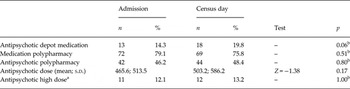
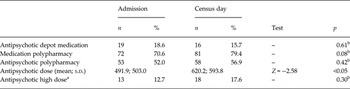
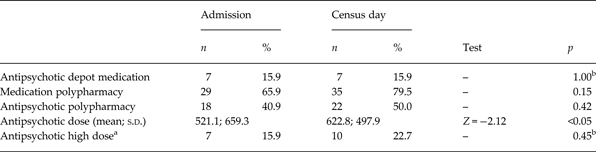
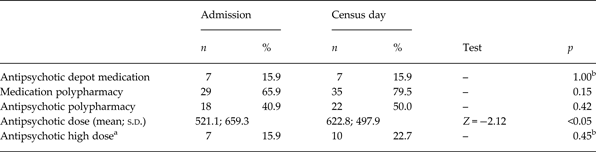
Prescription changes from admission to the census day were analysed, taking into account time spent in the facility, in order to provide a comparable timeframe for all the patients in each of the four control groups. This comparison focused on antipsychotic and psychotropic polypharmacy, depot medications and antipsychotic dosage. For the first group of patients (those whose length of stay was less than 1-year) (n = 91; see Table 3) no statistically significant changes were noted, although there was an increase in the frequency of prescribing antipsychotic polypharmacy, in the mean antipsychotic dose and in the use of depot medications. The second group of patients (those whose length of stay was between 1 and 3 years) (n = 102; see Table 4) showed a statistically significant increase in the average dose of antipsychotics from 491.9 to 620.2 CPZ eqs. A similar significant increase (from 521.1 to 622.8 CPZ eq) was observed in the third group of patients (those staying between 4 and 5 years) (n = 44; see Table 5).
Changes in antipsychotic and psychopharmacological prescriptions from admission to census day for patients staying less than 1-year (n = 91)

a>1000 mg CPZ equivalents.
bbinomial distribution used.
Changes in antipsychotic and psychopharmacological prescriptions from admission to census day for patients staying 1–3 years (n = 102)

a>1000 mg CPZ equivalents.
bbinomial distribution used.
Changes in antipsychotic and psychopharmacological prescriptions from admission to census day for patients staying 4–5 years (n = 44)
a>1000 mg CPZ equivalents.
bbinomial distribution used.
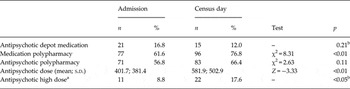
Long-term patients (those staying more than 6 years) made up the largest group (n = 125; see Table 6) and showed a statistically significant increase in medication polypharmacy (from 61.6 to 76.8%), in antipsychotic average dose (from 401.7 to 581.9 CPZ eqs) and in the amount of patients receiving more than 1000 mg/day of CPZ eqs (from 8.8 to 17.6%). A slight yet insignificant decrease in depot medications was noted.
Changes in antipsychotic and psychopharmacological prescriptions from admission to census day for patients staying more than 6 years (n = 125)

a > 1000 mg CPZ equivalents.
bBinomial distribution used.
Overall changes in prescribing patterns seem to be related to time spent in the facility: few changes occur to those of short-term patients, while more significant changes occur to those of longer-term patients.
A trend towards an increase in antipsychotic and psychotropic polypharmacy and higher doses of antipsychotics over the period of stay within the facilities was nonetheless present in each group.
The length of stay in facilities was the only variable related to the prescription changes after we had checked our comparisons between different types of facilities.
Analysis conducted on the complete sample confirm the role a patient's length of stay plays in changes to his/her prescription: the switch to a different main antipsychotic (antipsychotic with the highest CPZ eq) was related to the duration of stay within the facility (Chi square = 17.9, p < 0.0001); in particular, patients who had spent at least 3 years had a 2.48 OR (CI = 1.62–3.79) of being administered a different main antipsychotic.
Treatment augmentation was also related to the duration of stay within the facility: patients placed in monotherapy at admission who then went on to spend at least 3 years in the facility had an OR = 2.04 (CI = 1.17–3.58) of receiving antipsychotic polypharmacy.
Discussion and Conclusions
To the best of our knowledge, this is the fourth study of drug-utilisation to be carried out in long-term adult psychiatric residential facilities and the only one that takes into account psychotropic prescription and antipsychotic dosage changes over the length of stay within the facility.
Limitations of the study include the limited data related to the clinical context of treatment in terms of the phase of the illness, a patient's treatment history, his/her response to the said treatment and the non-random selection of facilities.
Principal findings are, however, related to the psychopharmacological prescribing patterns and how they compare to international recommendations and earlier studies. These findings are based on the assumption (on the basis of Italian mental health system) that all the facilities involved in the census hosted chronically ill patients with a long medical history including psychopharmacological treatment.
Compared to earlier studies in the same clinical environment (Tomasi et al. Reference Tomasi, de Girolamo, Santone, Picardi, Micciolo, Semisa and Fava2006; Schorr et al. Reference Schorr, Loonen, Brouwers and Taxis2008), a significant increase in the use of psychotropic polypharmacy and antipsychotic polypharmacy was observed. According to our results, patients receiving antipsychotic polypharmacy were 77.5% v. 53% (Tomasi et al. Reference Tomasi, de Girolamo, Santone, Picardi, Micciolo, Semisa and Fava2006) and those receiving antipsychotic polypharmacy were 57.2% v. 23% (Schorr et al. Reference Schorr, Loonen, Brouwers and Taxis2008) and 39.3% (Tomasi et al. Reference Tomasi, de Girolamo, Santone, Picardi, Micciolo, Semisa and Fava2006).
Our sample was similar to those of the aforementioned studies in terms of diagnosis, average patient age and sex. However, differences lie in the patients' length of stay (our sample being composed of double the amount of patients staying more than 6 years in a given facility compared to the Tomasi study) and for the level of assistance provided by the facilities included (both earlier studies having also recruited patients from group homes and sheltered housing facilities.).
Taking into account our data (which demonstrates that the increase in medication polypharmacy is related to time spent in the facilities and not to different types of facility), we can hypothesise that the variable of time represents a possible explanation for differences compared to earlier studies as well as being a possible risk factor for polypharmacy. The longer the patient's term the higher the risk of prescribed polypharmacy.
Similar results were found in acute inpatient facilities where polypharmacy has been associated with long-term hospitalisation (Diaz & de Leon, Reference Diaz and de Leon2002; Centorrino et al. Reference Centorrino, Cincotta, Talamo, Fogarty, Guzzetta, Saadeh, Salvatore and Baldessarini2008).
In a residential setting, this finding could be related to the severity of illness and treatment resistance or may be a reaction on the part of the prescribers to the chronicity of the patients' illness.
Our findings denote increased odds for longer-term patients of a switch from antipsychotic monotherapy to polypharmacy and of a switch to a different main antipsychotic. These results could also indicate that chronic treatments may lose their effectiveness over the course of time.
Long-term facilities certainly host a significant proportion of seriously ill patients (as the high percentage of clozapine use seems to confirm) that could partially justify the use of polypharmacy, despite the lack of research-based evidence demonstrating its superior effectiveness. Nevertheless, some studies did not identify psychopathology as a predictor of polypharmacy (Barbui et al. Reference Barbui, Nosè, Mazzi, Thornicroft, Schene, Becker, Bindman, Leese, Helm, Koeter, Weinmann and Tansella2006) and have shown that a switch from antipsychotic polypharmacy to monotherapy has been beneficially linked to the patients' overall clinical status (Centorrino et al. Reference Centorrino, Goren, Hennen, Salvatore, Kelleher and Baldessarini2004; Suzuki et al. Reference Suzuki, Uchida, Tanaka, Nomura, Takano, Tanabe, Watanabe, Yagi and Kashima2004). Furthermore, the increased risk of adverse effects related to polypharmacy should be cautionary to clinicians, especially when treating patients over a period of years (Waddington, Youssef & Kinsella, Reference Waddington, Youssef and Kinsella1998) as is the case with the majority of patients being hosted in long-term facilities.
This is especially true if we take into account our findings depicting a general tendency towards increasing prescriptions of all classes of psychotropic drugs during patient's stay in the facility and an increased use (compared to Tomasi's study) of antipsychotic polypharmacy among more common combination prescriptions.
These findings are consistent with earlier reports that show a growing trend over the last 10 years for the administration of psychotropic polypharmacy in every setting (Centorrino et al. Reference Centorrino, Eakin, Bahk, Kelleher, Goren, Salvatore, Egli and Baldessarini2002; Alessi-Severini et al. Reference Alessi-Severini, Biscontri, Collins, Kozyrskyj, Sareen and Enns2008; Mojtabai & Olfson, Reference Mojtabai and Olfson2010). It is remarkable that in our study this practice is more widespread than that of acute inpatient facilities (Mauri et al. Reference Mauri, Regispani, Beraldo, Volonteri, Ferrari, Fiorentini and Invernizzi2005; Preti et al. Reference Preti, Rucci, Gigantesco, Santone, Picardi, Miglio and de Girolamo2009), where, by definition, patients are treated in the more severe phase of their illness.
As we pointed out antipsychotic polypharmacy is the strongest predictor of high dose and prescriptions above the maximum recommended dosage.
Compared to other studies conducted in Italy (only done with hospitalised patients or outpatients) and reporting antipsychotic doses, our study showed a particularly high-frequency of high-dose prescriptions (Tibaldi et al. Reference Tibaldi, Munizza, Bollini, Pirfo, Punzo and Gramaglia1997; Mauri et al. Reference Mauri, Regispani, Beraldo, Volonteri, Ferrari, Fiorentini and Invernizzi2005). As for polypharmacy the tendency to increase the mean dose of antipsychotic over the patients' length of stay seems to be related to the duration of time spent in the investigated facilities.
The highest doses prescribed were usually a consequence of prescribing medium doses of two or more drugs, rather than that of prescribing high doses of a single drug. A possible explanation for this practice is that the prescriber is not always aware of exceeding, along with polypharmacy, the maximum recommended dose and maybe through the administration of multiple medium doses the prescriber unconsciously overrode this concern. This hypothesis seems to be consistent with a recent survey denoting clinicians' reasoning behind antipsychotics polypharmacy which underlines, among other reasons, the intent to avoid high doses of a single drug (Sernyak & Rosenheck, Reference Sernyak and Rosenheck2004).
Another hypothesis is that with chronically ill psychotic patients who are typically limited when it comes to receiving benefits from treatment, antipsychotic polypharmacy and high doses might reflect hopes for greater effectiveness of treatment and this prescribing habit could be read as a reaction of the prescribers to the chronicity. However, this strategy lacks compelling evidence for the superior effectiveness of the aforementioned polypharmacy and high dosage and may increase the cost of healthcare and the risk of possible side effects. This is confirmed by our findings of a twofold increase in anticholinergic prescriptions when a second antipsychotic is added.
This prescribers' factor could therefore influence the prescription patterns regardless of the severity of the illness (Veronese et al. Reference Veronese, Vivenza, Nosè, Cipriani, Tansella and Barbui2008). The absence in our results of a more frequent and specific antipsychotic combination and the high variability of overall prescriptions is consistent with this hypothesis. This observation should be further investigated, but it is interesting to note that, in our study, patient-related factors such as young age and admission to a general hospital's acute psychiatric ward in the previous 12 months were not associated with antipsychotic polypharmacy contrary to the evidence of previous studies (Lelliott et al. Reference Lelliott, Paton, Harrington, Okocha, Sensky and Duffett2002; Tomasi et al. Reference Tomasi, de Girolamo, Santone, Picardi, Micciolo, Semisa and Fava2006).
In conclusion, our study demonstrates large variations in prescribing patterns, a high rate of polypharmacy and a trend towards increasing antipsychotic polypharmacy and dosage over the length of stay within the facilities.
Drug utilisation studies are necessary in order to improve prescribing practice (Verdoux Tournier & Begaud, Reference Verdoux, Tournier and Begaud2009) and, as our data suggests, increase awareness of the need for more effective strategies for spreading evidence-based knowledge in order to turn scientific results into everyday practices.
For this reason, we plan to offer a specific training course on psychotropic drug rationale use to all the facilities involved in our study. A second phase of our study will be a follow-up in order to document possible improvements in prescribing practice.
Acknowledgements
The authors thank the research group. The research group include: Lisa Attolini, Giuseppe Berruti, Nicoletta Fogato, Gaetano Fornaio, Fornaro Gualtiero Guerrini, Marco Massa, Mara Manetti, Francesca Pompei and Elisa Zanelli.
Declaration of interests
None.