INTRODUCTION
Essential tremor (ET) is among the most common movement disorders, with a prevalence of 4% among adults age ≥ 40 years (Dogu et al., Reference Dogu, Sevim, Camdeviren, Sasmaz, Bugdayci, Aral and Louis2003; Louis, Ottman, & Hauser, Reference Louis, Ottman and Hauser1998). It is characterized primarily by kinetic tremor (Louis, Reference Louis2009). Risk factors include older age and family history. The underlying pathophysiology is not completely understood, although the tremor is thought to involve an aberration in a cerebello-thalamo-cortical loop (Louis, Reference Louis2014a). Recent literature indicates that ET is a complex syndrome with heterogeneous motor and non-motor features. Among the latter are cognitive impairments (Benito-Leon & Louis, Reference Benito-León and Louis2013; Janicki, Cosentino, & Louis, Reference Janicki, Cosentino and Louis2013; Louis, Reference Louis2010; Louis & Rao, Reference Louis and Rao2014b; Mameli et al., Reference Mameli, Tomasini, Scelzo, Fumagalli, Ferrucci, Bertolasi and Priori2013; Sinoff & Badarny, Reference Sinoff and Badarny2014), such as reductions in attention, executive function, visuospatial processing, and memory (Gasparini et al., Reference Gasparini, Bonifati, Fabrizio, Fabbrini, Brusa, Lenzi and Meco2001; Janicki et al., Reference Janicki, Cosentino and Louis2013; Kim et al., Reference Kim, Song, Shim, Park, Yoo, Kim and Lee2009; Lombardi, Woolston, Roberts, & Gross, Reference Lombardi, Woolston, Roberts and Gross2001; Tröster et al., Reference Tröster, Woods, Fields, Lyons, Pahwa, Higginson and Koller2002); and increased risk of mild cognitive impairment (MCI) and dementia (Benito-León, Louis, Bermejo-Pareja, & NEDICES Study Group, Reference Benito-León, Louis and Bermejo-Pareja2006a, Reference Benito-León, Louis and Bermejo-Pareja2006b; Benito-León, Louis, Mitchell, & Bermejo-Pareja, Reference Benito-León, Louis, Mitchell and Bermejo-Pareja2011; Bermejo-Pareja, Louis, Benito-León, & NEDICES Study Group, Reference Bermejo-Pareja, Louis and Benito-León2007; Louis, Benito-León, Vega-Quiroga, Bermejo-Pareja, & NEDICES Study Group, Reference Louis, Benito-León, Vega-Quiroga and Bermejo-Pareja2010; Thawani, Schupf, & Louis, Reference Thawani, Schupf and Louis2009), deficits which are reflected in functional imaging studies, with abberant network connectivity observed to be associated with tremor features and cognitive dysfuncton (Benito-León et al., Reference Benito-León, Louis, Romero, Hernández-Tamames, Manzanedo, Álvarez-Linera and Rocon2015). Cognitive dysfunction that occurs in ET, even when mild, is accompanied by a range of functional consequences (Louis et al., Reference Louis, Benito-León, Vega-Quiroga and Bermejo-Pareja2010, Reference Louis, Collins, Rohl, Morgan, Robakis, Huey and Cosentino2016, Reference Louis, Kellner, Morgan, Collins, Rohl, Huey and Cosentino2017; Rao, Gillman, & Louis, Reference Rao, Gillman and Louis2014; Rao, Uddin, Gillman, & Louis, Reference Rao, Uddin, Gillman and Louis2013), thereby highlighting its importance.
MCI is defined as cognitive decline that is not explained by an individual’s age or education but does not interfere with activities of daily life (Gauthier et al., Reference Gauthier, Reisberg, Zaudig, Peterson, Ritchie, Broich and Hampel2006). Much of the work developing the concept and assessment of MCI has been performed in studies that assess conversion of MCI to Alzheimer’s disease (AD) (Aretouli, Okonkwo, Samek, & Brandt, Reference Aretouli, Okonkwo, Samek and Brandt2011; Clark et al., Reference Clark, Kapur, Geldmacher, Brockington, Harrell, DeRamus and Marson2014; Ganguli et al., Reference Ganguli, Bilt, Lee, Snitz, Chang, Loewenstein and Saxton2010; Josephs et al., Reference Josephs, Whitwell, Weigand, Senjem, Boeve, Knopman and Petersen2011), yet MCI occurs more broadly in neurodegenerative conditions. An optimal battery for diagnosing MCI in Parkinson’s disease (PD) was recently described by Goldman et al. (Reference Goldman, Holden, Ouyang, Bernard, Goetz and Stebbins2015), but to our knowledge, no guidelines have been proposed for ET. The unique pathological substrates of ET, in conjunction with an increased risk of dementia and the challenge of assessing cognition independently of motor functioning, raise the question as to how MCI should be assessed in ET patients. Our study seeks to determine a short panel of neuropsychological tests that could be reliably used in a clinical setting to evaluate mild decline in cognitive functioning that would be consistent with the degree of impairment seen in MCI.
As a gold standard for mild changes in cognition, we use the Clinical Dementia Rating scale (CDR). This semi-structured interview with the participant and an informant (friend or family member) is used to evaluate changes in cognition across six domains of functioning (memory, orientation, judgment and problem solving, community affairs, home and hobbies, and personal care) and generates a global score between 0 and 3 (0=No Impairment, 0.5=Questionable Impairment, 1=Mild Dementia, 2=Moderate Dementia, and 3=Severe Dementia; some scales also include a score of 4 in terminal illness) (Morris, Reference Morris1997).
In conjunction with impaired performance on objective neuropsychological testing, the CDR score informs clinical diagnoses of normal cognition, MCI, or dementia (Aretouli et al., Reference Aretouli, Okonkwo, Samek and Brandt2011; Clark et al., Reference Clark, Kapur, Geldmacher, Brockington, Harrell, DeRamus and Marson2014; Ganguli et al., Reference Ganguli, Bilt, Lee, Snitz, Chang, Loewenstein and Saxton2010; Josephs et al., Reference Josephs, Whitwell, Weigand, Senjem, Boeve, Knopman and Petersen2011). A score of 0.5 on Memory (“Consistent slight forgetfulness; partial recollection of events; ‘benign’ forgetfulness”) automatically results in a global CDR of 0.5 or higher, but impairment in at least two other categories (such as Orientation, Judgment & Problem Solving, Community Affairs, Home & Hobbies, and Personal Care) can also lead to a CDR of 0.5 (Morris, Reference Morris1993), which is generally associated with a clinical diagnosis of MCI (Abner et al., Reference Abner, Kryscio, Schmitt, Fardo, Moga, Ighodaro and Nelson2017; Peterson, Reference Peterson1999).
In this study, we administered an extensive, 4-hr motor-free protocol of 19 neuropsychological tests to a population of older adults with ET. Using regression analysis, we first identified the best two tests per domain for predicting MCI, per the Movement Disorders Society (MDS) Task Force Criteria on assessing PD-MCI (Litvan et al., Reference Litvan, Goldman, Tröster, Schmand, Weintraub, Petersen and Emre2012), which outline the need for neuropsychological testing that includes at least two tests in each of the five cognitive domains. To determine the optimal method for detecting mild changes in cognition, however, we ran additional regression models to identify the subset of tests and the most relevant cognitive domains (regardless of number of tests per domain) for best predicting mild impairment in cognition as defined by CDR 0.5. Based on our results, we discuss the nature of cognitive dysfunction in ET, contrast it with what is understood about cognitive dysfunction in PD, and provide guidance for development of a brief neuropsychological protocol that we believe would inform the assessment and detection of MCI in ET.
METHODS
Study Design, Assessments, and Assignment of Diagnoses
Subjects were enrolled in a prospective, longitudinal study of cognitive function in ET (Clinical-Pathological Study of Cognitive Impairment in Essential Tremor [COGNET], NINDS R01NS086736) beginning July 2014. The study aims to clinically characterize a cohort of ET subjects across three assessments (baseline, 18 months, and 36 months). For these analyses, only baseline data (collected July 2014 – July 2016) were included. Subjects were recruited through advertisements on a study website and other websites (International Essential Tremor Foundation) that listed the following eligibility criteria: (1) diagnosis of ET, (2) ≥ 55 years old, (3) no deep brain stimulation surgery for ET, (4) willingness to perform study measures and be a brain donor. Yale University and Columbia University Internal Review Boards approved study procedures, and signed informed consent was obtained upon enrollment. Demographic and clinical data on age, gender, ethnicity, and education were collected at baseline. Medications with cognition-enhancing, cognition-decreasing, and mood-modulating effects were noted.
The cognitive test battery, designed by a neuropsychologist (S.C.) specifically for this study, purposefully minimizes any tests involving motor abilities that could disadvantage ET subjects with moderate or severe tremors. In addition to the Mini-Mental State Examination [MMSE (Folstein, Folstein, & McHugh, Reference Folstein, Folstein and McHugh1975)], the Montreal Cognitive Assessment [MoCA (Nasreddine et al., Reference Nasreddine, Phillips, Bedirian, Charbonneau, Whitehead, Collin and Chertkow2005)], the Wechsler Test of Adult Reading [WTAR (Wechsler, Reference Wechsler2001)], the NEO Personality Inventory (McCrae & Costa, Reference McCrae and Costa2010), and the Geriatric Depression Scale [GDS (Yesavage et al., Reference Yesavage, Poon, Crook, Davis, Eisdorfer, Gurland and Thompson1986)], the test battery included assessments across five domains: Attention [Oral Symbol-Digit Modalities Test (SDMT) (Smith, Reference Smith1982)], Digit Span Forward (Wechsler, Reference Wechsler1997)]; Executive Function [Digit Span Backward (Wechsler, Reference Wechsler1997), Delis-Kaplan Executive Function System (D-KEFS), Verbal Fluency Test (VFT), Color-Word Interference (CW), Sorting, and 20-Questions (Delis, Kaplan, & Kramer, Reference Delis, Kaplan and Kramer2001)]; Visuospatial Abilities [Benton Judgment of Line Orientation (JLO) (Benton, Sivan, des Hamsher, Varney, & Spreen, Reference Benton, Sivan, des Hamsher, Varney and Spreen1994), Benton Facial Recognition Test (BFRT) (Benton & Van Allen, Reference Benton and Van Allen1968), Wechsler Adult Intelligence Scale IV (WAIS-IV), Visual Puzzles (Wechsler, Reference Wechsler1997)]; Language [Multilingual Aphasia Examination (MAE), Token Test (Benton, des Hamsher, Rey, & Sivan, Reference Benton, des Hamsher, Rey and Sivan1994), Boston Naming Test (BNT) (Kaplan, Goodglass, & Weintraub, Reference Kaplan, Goodglass and Weintraub1983)]; and Memory [California Verbal Learning Test (CVLT-II) (Delis, Kramer, Kaplan, & Ober, Reference Delis, Kramer, Kaplan and Ober2000), Wechsler Memory Scale Revised (WMS-R), Logical Memory (LM) (Wechsler, Reference Wechsler1987) and Verbal Paired Associates (VPA) (Wechsler, Reference Wechsler2008)].
In-person assessments at subjects’ homes were conducted by trained personnel and consisted of a clinical questionnaire; 19 neuropsychological tests; questionnaires evaluating mood, sleep, tremor experience, and physical activity; and a videotaped neurological examination. Using published normative data, participant raw scores were converted to Z-scores according to age, gender, and/or education.
The videotaped neurological examination was reviewed by a movement disorders neurologist (E.D.L., D.R.). Videotaped kinetic or postural tremor were rated (0–3) on 12 items, and total tremor score (range 0–36) was calculated. Additionally, ET diagnosis was confirmed using the Washington Heights-Inwood Genetic Study of ET (WHIGET) diagnostic criteria [moderate or greater amplitude kinetic tremor (tremor rating ≥ 2) during three or more tests or head tremor, in the absence of PD, dystonia, or another cause (Louis et al., Reference Louis, Ottman, Ford, Pullman, Martinez, Fahn and Hauser1997)] which are reliable (Louis, Ford, & Bismuth, Reference Louis, Ford and Bismuth1998) and valid (Louis et al., Reference Louis, Wendt, Albert, Pullman, Yu and Andrews1999).
Designated informants were queried by means of telephone regarding the participant’s level of functioning in the six CDR domains (Morris, Reference Morris1997) and completed the Neuropsychiatric Inventory (Cummings et al., Reference Cummings, Mega, Gray, Rosenberg-Thompson, Carusi and Gornbein1994), Frontal Behavioral Inventory (Kertesz, Davidson, & Fox, Reference Kertesz, Davidson and Fox1983), and Lawton Instrumental Activities of Daily Living Scale (Lawton & Brody, Reference Lawton and Brody1969). Considerations of tremor disability were not included in CDR calculations. If an informant was not available, CDR was determined through participant self-report and examiner impression. CDR was confirmed and a cognitive diagnosis was determined during diagnostic case conference with trained experts (E.D.H., S.C.).
Three primary cognitive diagnoses were assigned using clinical judgment and diagnostic specifications: (1) Normal Cognition; (2) MCI (CDR 0.5 and impairment on 2 MCI-designated tests); and (3) Dementia (CDR ≥ 1 and impairment in multiple domains). Impairment on a single test was defined as a Z-score ≤ -1.5. Normal cognition included: No impairment (CDR 0, no impairment on any test); Impairment of unlikely clinical significance (CDR 0, impairment on 1 test); Impairment of possible clinical significance (CDR 0 or 0.5, impairment in ≥ 1 test but not meeting operational criteria for MCI); Questionable or Isolated Functional Impairment (CDR 0.5, no impairment on any neuropsychological test).
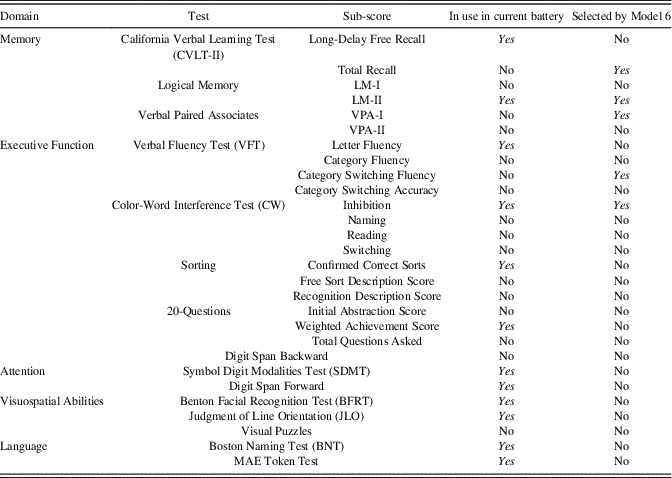
Regarding diagnosis of MCI, individuals were classified as single or multi-domain and amnestic (a-MCI) or non-amnestic (na-MCI). As described by Collins et al. (Reference Collins, Rohl, Morgan, Huey, Louis and Cosentino2017), specific tests in each domain were a priori selected for diagnosis of MCI (Table 1) based on: (1) relative purity of measurement for the construct under evaluation (e.g., in the spatial domain, JLO, given its lesser demand on executive functioning than Visual Puzzles); (2) demonstrated utility of measures in previous studies; and (3) general availability of the measure to researchers who wish to replicate findings. Selecting specific tests in each domain also prevented over-sampling of domains with more sub-scores generated from a single test (e.g., immediate and delayed memory from a memory test as compared to a single score from a naming test).
Cognitive tests currently in use for diagnosing MCI

Exclusion Criteria and Statistical Analysis
Exclusion criteria for these analyses included: (1) diagnosis of dementia (CDR ≥ 1; n=20), (2) diagnosis of cognitive impairment related to substance use (n=3), (3) diagnosis of PD or dystonia based upon videotaped neurological examination (n=13). Demographics for remaining participants (CDR 0 or CDR 0.5; n=196) were assessed for normality (Kolmogorov-Smirnov test) and analyzed with appropriate statistical tests (Chi-Square, Fisher exact test, Mann-Whitney U test, or t test). Speed-based tests with potential for voice tremor-interference (VFT, CW, SDMT) were compared. Analyses were completed using SPSS24, SAS 9.4, or R Software.
Predictive Model Analyses
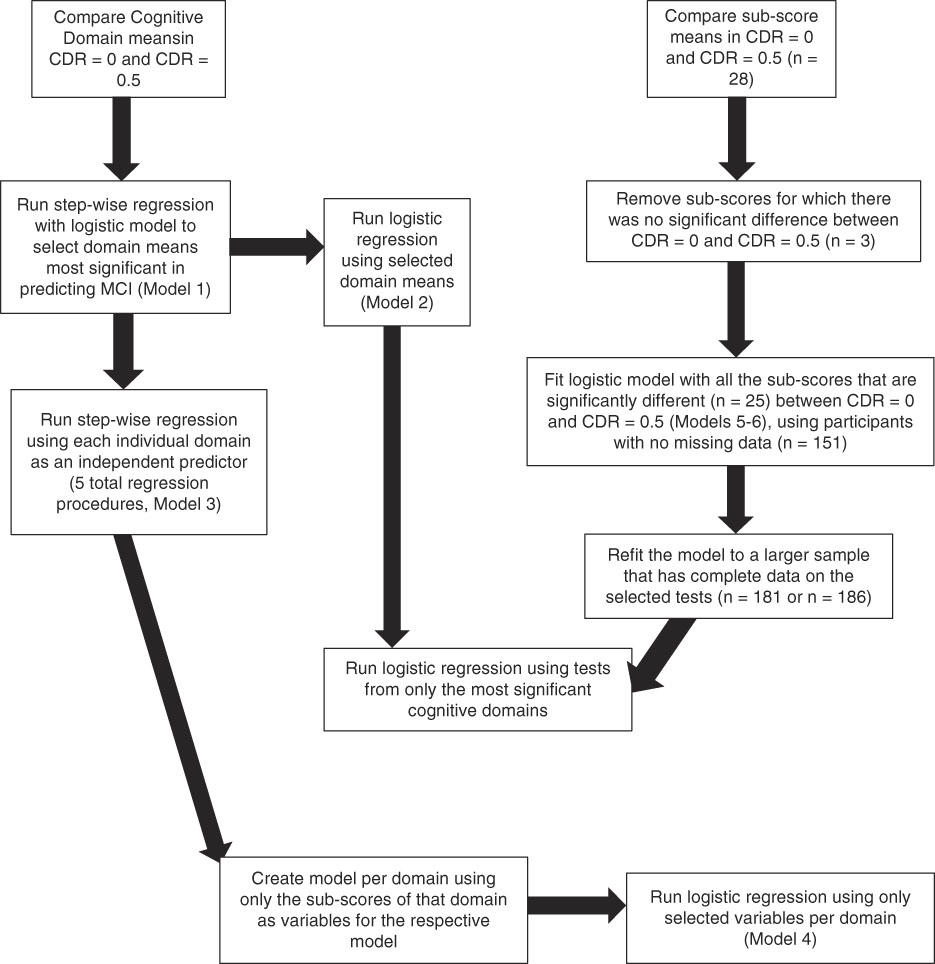
Logistic models with single test predictors examined associations between group membership (CDR 0 and CDR 0.5) and each predictor individually, while logistic models with multiple predictors assessed simultaneous effect of predictors. To describe the goodness-of-fit of models, classification accuracy [area under receiver operating characteristics (ROC) curve, AUC] and generalized R-squared for predictability of individual outcome were calculated for all models. A schematic of this process is shown in Figure 1.
Predictive model analysis method. Procedure for model-based selection procedure to select five variables and assess significance of cognitive domains in the model.

Cognitive domain selection
Neuropsychological tests were grouped by cognitive domain (Table 1). Aggregate scores for each domain were calculated by averaging individual test Z-scores within each domain, tested for normality, and compared using two-tailed t test or Mann-Whitney U Test.
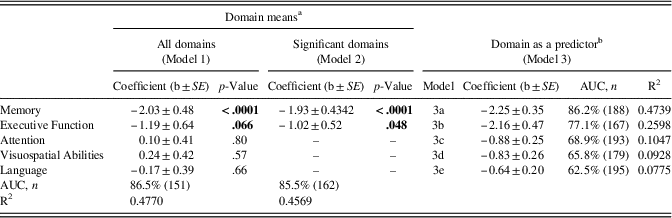
A logistic forward step-wise regression procedure was conducted on a sample of participants with complete data on all test variables (n=151). The procedure selected test variables based on a preset Wald test significance level (e.g., α=0.15) for a variable being added into or kept in the model. Domain mean scores (n=151) were fit to a model (Model 1), from which significant domains were used as variables in an additional model (Model 2). Each domain mean was also isolated and fit to a logistic model to determine its strength as an independent predictor of CDR 0.5 (Model 3).
Individual domain models
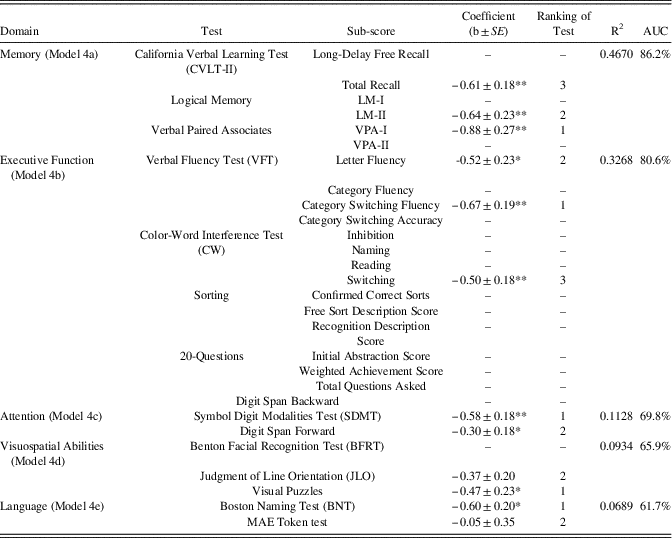
Logistic models were created for each domain individually with domain sub-scores as variables, in alignment with MDS Task Force Criteria. All sub-scores were included such that there were at least 2 tests per domain, including tests for which there was no significant difference between CDR groups. Importance of sub-scores was ranked by magnitude of estimated coefficient standardized by standard error. Significant sub-scores were fit as variables to domain-specific models (Model 4).
Test selection
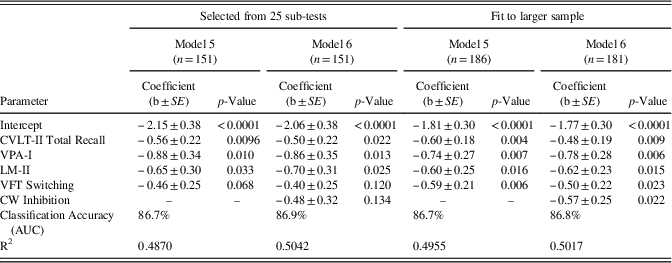
Means for each of the 28 sub-scores (from different aspects of 19 tests) were calculated and compared using Mann-Whitney U Tests. Scores for which there was no significant difference (p < .05) between CDR groups were excluded as candidates from subsequent model-based variable selection. All significant sub-scores were fit to a model to predict CDR 0.5 (Models 5–6). The model of selected variables, fit using a sub-sample with complete data on the candidate tests (n=151), was applied to a larger sample that had complete data on the selected variables.
Using Model to Predict Subtle Diagnostic Categories
Finally, the model of combined test scores with highest AUC was applied within each level of function (CDR 0 and 0.5) to evaluate the extent to which it could distinguish between subtle diagnostic classifications. Participant test-scores, weighted according to model coefficients, were fit to the logistic regression equation, yielding estimated probability of predicting impairment, which was compared using Spearman’s correlation test (probability vs. diagnostic category severity) and t tests (mean probability).
RESULTS
Sample Characteristics
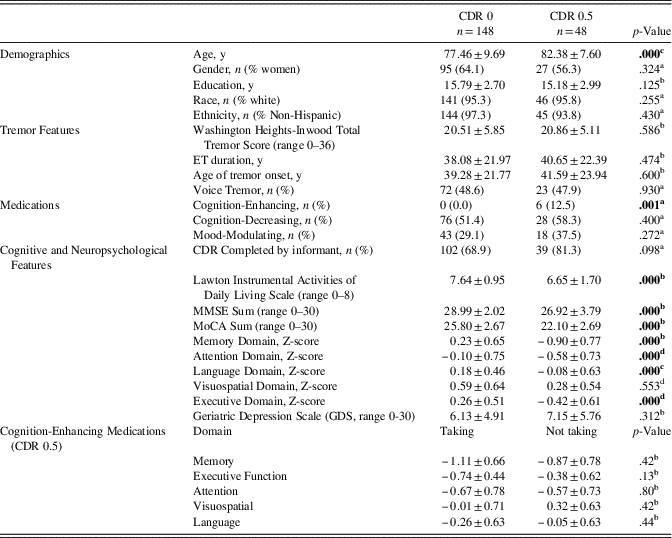
Table 2 demonstrates sample characteristics (n=196). CDR 0 (n=148) and CDR 0.5 (n=48) groups did not significantly differ by gender, education, race, ethnicity, tremor score, ET duration, age of tremor onset, presence of voice tremor, number using cognition-decreasing or mood-modulating medications, or GDS (p > .05). The groups differed by age and number taking cognition-enhancing medications (Table 2); those taking cognition-enhancing medications (CDR 0.5) did not differ in domain means compared to those who do not.
Clinical and cognitive characteristics of sample

Note. All values are mean±SD or number (percentage). Significant values are bold.
n=number, y=years.
a Chi square test.
b Mann-Whitney U test.
c Two-sample t- test with unequal variances (Levene’s test for equality of variances p < .05).
d Two-sample t- test with equal variances (Levene’s test for equality of variances p > .05).
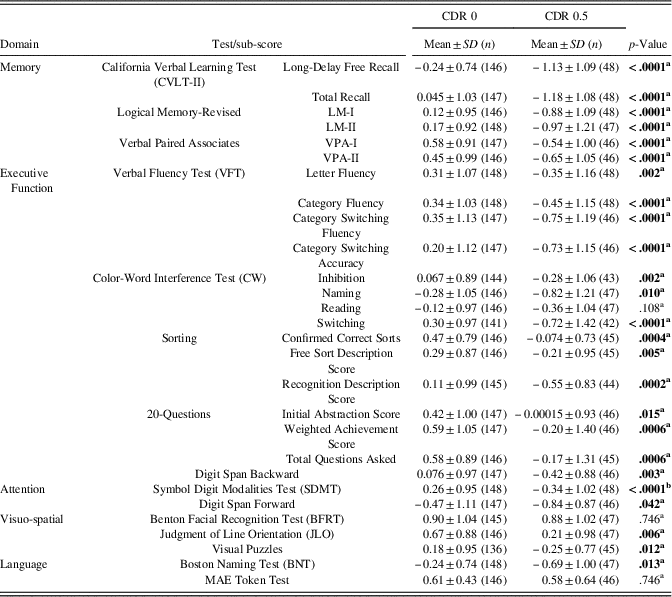
Among the 28 neurological sub-scores (Table 3), 24 had incomplete data, with 181–195 participants per test, resulting in 48 subjects with missing data on at least one test. To reduce the impact of missing data, CW Reading, BFRT, and MAE Token Test were excluded from variable selection because they did not significantly differ between CDR groups (p > .10). The 25 remaining scores had complete data from 151 participants (123 NC, 28 MCI). There was no significant difference in scores on the CDR or speed based tasks as a function of voice tremor (p > .05, data not shown). An exception was the SDMT for which those with voice tremor appeared to perform better than those without. This effect is, therefore, unlikely to be due to presence or absence of voice tremor.
Neuropsychological tests by domain

Note. Values are mean±SD (n). Significant values are bold.
a Mann-Whitney U-test.
b Two-tailed t-test.
Cognitive Domain Selection
All cognitive domain scores were significantly different (p < .05) between CDR groups, except for the visuospatial domain (p=.553). Table 4 details results of the domain selection procedure; domain means for Memory and Executive Function were determined to be significantly different across groups (Model 1). These variables were then applied to an additional model (Model 2; AUC=85.5%; R2=0.4569). Only memory was seen to have a good fit as a domain independently predicting CDR 0.5 (Model 3; AUC=86.2%; R2=0.4739).
Cognitive Domain selection

Note. Coefficients (b±SE) are standard parameter estimate±Wald error. Significant values are in bold (based on α=0.10).
AUC=area under ROC curve for classification accuracy.
a 1 Domain model fit with all five domains as variables.
b Individual domain models fit with each domain as a variable for the respective Model 3a-e.
Individual Domain Models
Results for individual domain models with two significant tests per domain (α=0.1) are found in Table 5 (Model 4). Two tests were selected per domain for Attention, Visuospatial, and Language, and three were chosen per domain for Memory and Executive Function. High AUC was seen in only Memory (86.2%) and Executive Function (80.6%).
Individual domain models (Model 4)

Note. Selection criteria α=0.10. Coefficients (b±SE) are standard parameter estimate±Wald error.
* p < .05, ** p < .01. Ranking is by |b|/Wald error.
Test Selection
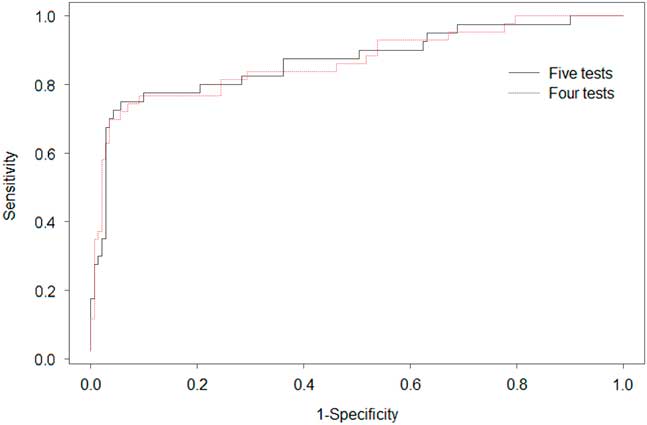
Applying the logistic model-based stepwise selection procedure to the 151 subject sub-set, four tests (Model 5) were selected at α=0.10: CVLT-II Total Recall, LM-II, VPA-I, VFT Switching (AUC=86.7%; R2=0.487). Five tests (Model 6) were selected at α=0.15: CVLT-II Total Recall, LM-II, VPA-I, VFT Switching, CW Inhibition (AUC=86.9%; R2=0.504) (Table 6; Figure 2).
ROC curves based on the logistic models (Models 5–6) with predictors selected by different thresholds from all 25 sub-scores that were individually different between CDR=0 and CDR=0.5 (n=151).

Test selection

Note. Coefficients (b±SE) are standard parameter estimate±Wald Error
Model 1: α=0.10, four parameters.
Model 2: α=0.15, five parameters.
When combining information from all domain analyses and individual test models, choosing only tests from the most significant domains (Memory and Executive Function) as variables for selection, the same five tests were chosen at α=0.2 as were chosen at α=0.15: CVLT-II Total Recall, LM-II, VPA-I, VFT Switching, and CW Inhibition (AUC=86.8%; R2=0.502; n=181). At α=0.1, four tests were chosen: CVLT-II Total Recall, LM-II, VPA-I, and CW Inhibition (AUC=86.7%; R2=0.487; n=183).
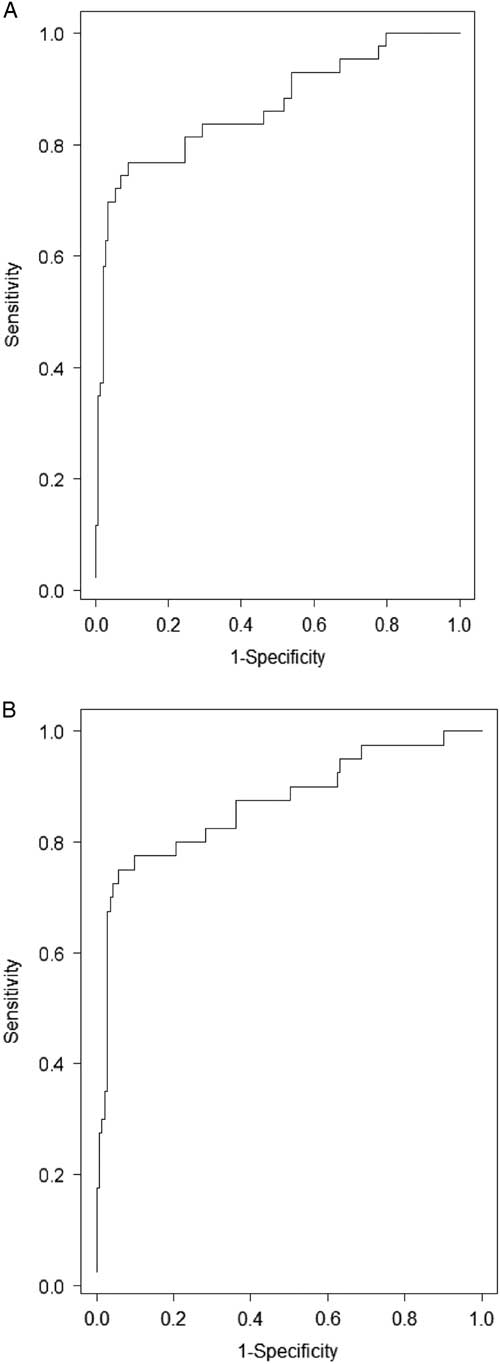
When applying the models to all participants with complete data on selected tests (Figure 3), the model with four selected tests (Model 5) remained a good fit (AUC=86.7%; R2=0.495; n=186), as did the model with five selected tests (Model 6; AUC=86.8%; R2=0.502; n=181).
ROC curves based on the logistic models (Models 5–6) with predictors selected by different threshold, which fit to a larger sample with complete data on the selected tests: (a) four variables selected, n=168; (b) five variables selected, n=181.

In all models, increased odds of CDR 0.5 were associated with lower scores.
Using Model to Predict Cognitive Categories within CDR Level
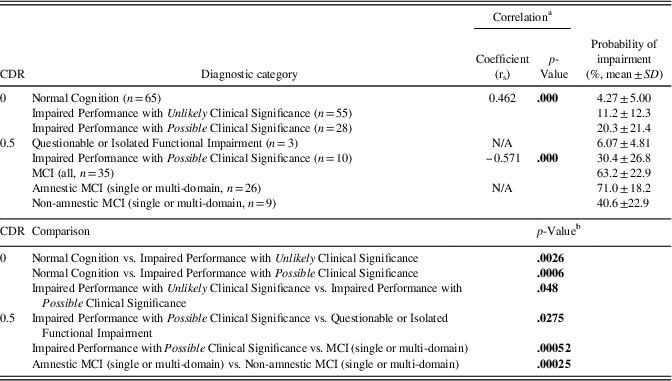
Model 6 (α=0.15; five tests: CVLT-II Total Recall, LM-II, VPA-I, VFT Switching, CW Inhibition), with the highest AUC, was used for calculating probability of predicting cognitive categories within CDR 0 and CDR 0.5 (Table 7). Within CDR group, the model detected probability differences between cognitive categories, and within CDR 0, probability of impairment positively correlated with diagnostic category severity. Within CDR 0, the model distinguished impairment of possible clinical significance, from no impairment and impairment of unlikely clinical significance. Within CDR 0.5, the model distinguished between impairment of possible clinical significance versus questionable or isolated functional impairment and a-MCI versus na-MCI.
Model as a predictor of cognitive impairment

Note. Significant values (p < .05) are in bold.
SD=standard deviation.
a Spearman’s correlation test between probability of impairment and diagnostic category severity for those with linear severity: all categories within CDR 0 and between impaired performance with possible clinical significance and MCI within CDR 0.5.
b Two-sample t-test comparing mean probability between the respective group.
DISCUSSION
Overview
Our study identifies five neuropsychological tests that are sensitive to mild cognitive problems in ET, defined by CDR 0.5. Results inform procedures for detecting cognitive impairment in ET and provide evidence for a targeted test battery. Although we identified two tests within each of the five cognitive domains in our individual domain models to predict CDR 0.5 (Model 4), which complies with the MDS Task Force Criteria for diagnosing PD-MCI (Litvan et al., Reference Litvan, Goldman, Tröster, Schmand, Weintraub, Petersen and Emre2012), our domain-based models (Models 1–3) were most accurate in identifying those with CDR 0.5 when using tests within Memory and Executive Function domains. In a separate test-based model (Model 6), the selection process identified five test scores, again within Memory and Executive Function domains, that were most accurate in identifying those with CDR 0.5: VPA-I (Immediate), CVLT-II Total Recall, LM-II (Delayed), VFT Category Switching, and CW Inhibition.
Neuropsychological and Neuropathological Significance
The selection process identified performance in Memory and Executive Function domains as most sensitive to CDR 0.5, which is consistent with previous studies regarding cognitive dysfunction in ET (Benito-Leon & Louis, 2006; Gasparini et al., Reference Gasparini, Bonifati, Fabrizio, Fabbrini, Brusa, Lenzi and Meco2001; Higginson et al., Reference Higginson, Wheelock, Levine, King, Pappas and Sigvardt2008; Sahin et al., Reference Sahin, Terzi, Ucak, Yapici, Basoglu and Onar2006). Executive Function has been identified as an area of impairment in ET (Frisina, Tse, Halbig, & Libow, Reference Frisina, Tse, Halbig and Libow2009; Gasparini et al., Reference Gasparini, Bonifati, Fabrizio, Fabbrini, Brusa, Lenzi and Meco2001; Higginson et al., Reference Higginson, Wheelock, Levine, King, Pappas and Sigvardt2008; Kim et al., Reference Kim, Song, Shim, Park, Yoo, Kim and Lee2009; Lombardi et al., Reference Lombardi, Woolston, Roberts and Gross2001; Passamonti et al., Reference Passamonti, Novellino, Cerasa, Chiriaco, Rocca, Matina and Quattrone2011; Sahin et al., Reference Sahin, Terzi, Ucak, Yapici, Basoglu and Onar2006), although not necessarily the most common (Collins et al., Reference Collins, Rohl, Morgan, Huey, Louis and Cosentino2017; Higginson et al., Reference Higginson, Wheelock, Levine, King, Pappas and Sigvardt2008; Sinoff & Badarny, Reference Sinoff and Badarny2014; Tröster et al., Reference Tröster, Woods, Fields, Lyons, Pahwa, Higginson and Koller2002). Executive deficit in ET is presumed to reflect the cerebello-thalamo-cortical basis of ET (Deuschl, Wenzelburger, Loffler, Raethjen, & Stolze, Reference Deuschl, Wenzelburger, Loffler, Raethjen and Stolze2000; Middleton & Strick, Reference Middleton and Strick2000a, Reference Middleton and Strick2000b, Reference Middleton and Strick2001; Montgomery, Baker, Lyons, & Koller, Reference Montgomery, Baker, Lyons and Koller2000) as is seen in cerebellar cognitive affective syndrome (Janicki et al., Reference Janicki, Cosentino and Louis2013).
Test scores selected by this analysis are consistent with observations of impairment on both memory and executive measures in ET. Two of the selected memory scores were immediate recall measures from VPA (Wechsler, Reference Wechsler2008) and CVLT-II (Delis et al., Reference Delis, Kramer, Kaplan and Ober2000). It has been suggested that CVLT-II can substitute for VPA, but Holster, Corsun-Ascher, Olivier, and Golden (Reference Holster, Corsun-Ascher, Olivier and Golden2012) and others suggest that this substitution be made cautiously, as there is significant discrepancy between original VPA scores and CVLT-II converted VPA scores. Inclusion of both scores in this model may reflect the different processes tapped when recalling individual words (implicit free-recall) versus words stored as pairs (explicit associative learning) (Miller et al., Reference Miller, Axelrod, Rapport, Hanks, Bashem and Schutte2012; Thiruselvam, Vogt, & Hoelzle, Reference Thiruselvam, Vogt and Hoelzle2015).
The third memory measure selected, the LM subtest (Wechsler, Reference Wechsler1987), measures narrative episodic memory and aligns with the Unified Data Set (UDS) 2.0, implemented nation-wide by the National Alzheimer’s Coordinating Center in Alzheimer’s Disease Research Centers (Chapman et al., Reference Chapman, Bing-Canar, Alosco, Steinberg, Martin, Chaisson and Stern2016). Unlike CVLT-II and VPA-I measures selected by the model, the portion of LM was selected was delayed memory. As such, while inclusion of various verbal memory measures may appear to be redundant, the combination of these tests yields important information about clinical status likely reflecting relative differences in specific memory systems tapped by each test.
In the executive function domain, scores from VFT and CW tests (Delis et al., Reference Delis, Kaplan and Kramer2001) provide information regarding discrimination of individuals with CDR 0 versus 0.5. The specific VFT score chosen by the model, Category Switching, is a measure of the degree to which subjects can efficiently switch back and forth between naming objects from different categories (e.g., “fruits” and “furniture”). Subjects with frontal lobe impairment or damage exhibit disproportionate impairment on Switching relative to Category Fluency (Delis et al., Reference Delis, Kaplan and Kramer2001), and because this task requires additional cognitive switching capabilities, discrepancies between this measure and standard measures of category fluency can indicate difficulties in cognitive flexibility.
The CW inhibition score reflects the subject’s ability to inhibit the prepotent response of word reading in favor of the less automatic response, naming the ink color in which the word is printed. Poor performance on this measure is also considered to be an indicator of prefrontal (Vendrell et al., Reference Vendrell, Junqué, Pujol, Jurado, Molet and Grafman1995) or frontostriatal (Koziol & Budding, Reference Koziol and Budding2009) dysfunction (Delis et al., Reference Delis, Kaplan and Kramer2001). Inclusion of this test, despite the small increment of significance it provides to models 5 and 6, makes the models more heterogenous as this is the only test which incorporates visual stimuli and does not require significant verbal ability.
It has been suggested that altered cerebellar-cortical pathways in ET are specifically involved in the executive control circuit that mediates focused attention in suppressing task irrelevant thoughts (Passamonti et al., Reference Passamonti, Novellino, Cerasa, Chiriaco, Rocca, Matina and Quattrone2011), which may underlie not only the executive tests selected, but selection of memory tests that have heavy attentional demands (Lombardi et al., Reference Lombardi, Woolston, Roberts and Gross2001). Indeed, there is evidence of frontal-executive dysfunction in ET for memory tests that are not inherently organized (Lafo et al., Reference Lafo, Jones, Okun, Bauer, Price and Bowers2015), and the immediate recall component of list learning tests such as CVLT-II and VPA appear to be particularly associated with executive dysfunction given their demands on organized and efficient retrieval of information (Tremont, Halpert, Javorsky, & Stern, Reference Tremont, Halpert, Javorsky and Stern2000). However, formal tests of attention were not influential tests for detection of CDR 0.5, suggesting that deficits in attention alone cannot explain reduced performance on memory measures. Taken together, use of tests that combine both memory and executive function may be particularly vital for diagnosing cognitive impairment in ET.
Model as a Diagnostic Guideline
Of the five tests selected by the model, only two were used a priori to diagnose MCI: CW Inhibition and LM-II (Table 1). Model 6 was used to examine whether models could distinguish subtle gradations in diagnostic categories within CDR levels. Among those with CDR 0.5, the model differentiated between those who had no observable cognitive impairment despite their CDR rating and those whose cognitive profiles were considered to be possibly clinically significant (some signs of cognitive dysfunction but not meeting MCI criteria).
Additionally, the model distinguished between those whose cognitive profiles were considered to be possibly clinically significant and those diagnosed with MCI. This result, in conjunction with the fact that several of the tests selected by the model were not tests used to diagnose MCI, indicate that individuals with MCI performed worse on “non-MCI” tests as well. Although not tested directly, this finding lends support to the idea that tests selected a priori to diagnose MCI represent overall cognitive functioning. Lastly, among those with CDR 0.5, the model distinguished between a-MCI and na-MCI, showing that performance on the measures in this model is more sensitive to a-MCI cases. This result is unsurprising given that three of five tests in this model were memory tests and likely reflects the fact that most MCI cases (74.3%) were amnestic.
Finally, the model was sensitive to subtle differences in diagnostic classifications within CDR 0. Specifically, the model was sensitive to impairment of possible clinical significance compared to those with strictly normal cognition and those with impairment considered to be of unlikely clinical significance. The model’s ability to distinguish between subtle cognitive categories among individuals with no evidence of difficulty provides further evidence for the utility of these tests in characterizing cognitive functioning in individuals with ET. The model may, therefore, provide information to clinicians regarding the potential development of cognitive impairment in the future in the absence of daily functional difficulty.
ET-MCI versus PD-MCI
In PD-MCI, impairment has been noted in all domains, with emphasis on executive function, attention, and visuospatial function (Goldman & Litvan, Reference Goldman and Litvan2012). Goldman et al. (Reference Goldman, Holden, Ouyang, Bernard, Goetz and Stebbins2015) created a framework for an optimal PD-MCI battery based on impairment, defined by a cutoff score of 2 standard deviations (SD) below norms (Marras et al., Reference Marras, Armstrong, Meaney, Fox, Rothberg, Reginold and Duff-Canning2013). They identified a neuropsychological test battery with 10 tests (2 per domain) that predicted PD-MCI with sensitivity of 81.3% and specificity of 85.7%. The tests chosen were (1) Attention: SDMT and Trail Making Test-A (TMT-A) (Reitan & Wolfson, Reference Reitan and Wolfson1993); (2) Executive Function: Clock Drawing (Goodglass & Kaplan, Reference Goodglass and Kaplan1983) and Trail-Making Test-B (TMT-B) (Reitan & Wolfson, Reference Reitan and Wolfson1993)]; (3) Language: BNT and VFT Category Fluency, Animal Naming; (4) Memory: Free and Cued Selective Reminding Test (Grober & Buschke, Reference Grober and Buschke2009) and Figural Memory Learning and Delayed Recall (Wilson, Gilley, Bennett, Beckett, & Evans, Reference Wilson, Gilley, Bennett, Beckett and Evans2000); (5) Visuospatial Abilities: JLO and MMSE Intersecting Pentagons (Bourke, Castleden, Stephen, & Dennis, Reference Bourke, Castleden, Stephen and Dennis1995). While no tests directly overlap with those chosen by the ET-MCI model, identical batteries have yet to be given to both groups.
ET and PD have similar deficits in neuropsychological functioning relating to fronto-cerebellar circuits (basal ganglia circuit in PD and cerebello-thalamic-cortico loop in ET), which are implicated in attention, executive function, memory, and naming. However, there is disagreement regarding the extent to which the cognitive profiles of the two movement disorders differ (Puertas-Martin et al., Reference Puertas-Martin, Villarejo-Galende, Fernandez-Guinea, Romero, Louis and Benito-Leon2016). Overall, PD groups show poorer performance in visuospatial tasks compared to ET groups (Gasparini et al., Reference Gasparini, Bonifati, Fabrizio, Fabbrini, Brusa, Lenzi and Meco2001; Higginson et al., Reference Higginson, Wheelock, Levine, King, Pappas and Sigvardt2008; Lombardi et al., Reference Lombardi, Woolston, Roberts and Gross2001; Sanchez-Ferraro et al., Reference Sanchez-Ferraro, Benito-Leon, Louis, Cantador, Hernandez-Gallego, Puertas-Martin and Bermejo-Pareja2017). Discrepancy in visuospatial impairment is reflected in high probability of detecting impairment using a single visuospatial test in PD (19.7–38.2%) in contrast to lack of significant difference in ET visuospatial domain scores between CDR 0 and CDR 0.5 (p=.553), as opposed to other domains. Visuospatial impairment is present in PD (Watson & Leverenz, Reference Watson and Leverenz2010), likely caused by compromised functional basal ganglia loops that include the posterior parietal cortex (Middleton & Strick, Reference Middleton and Strick2000b).
These data suggest that the cognitive profiles of ET-MCI and PD-MCI indeed differ in the domains that are affected. Both manifest as impairment in executive function and attention domains, but in ET-MCI, impairment is emphasized in the memory domain, while in PD-MCI, impairment is emphasized in the visuospatial domain. Therefore, an optimal test battery for ET-MCI is likely different than one suited for PD-MCI.
Limitations
It is necessary to consider the speed of motor and verbal output required for neuropsychological tests when studying cognition in ET. While our battery was designed to reduce the reliance on rapid manual responses, there are several tests that required rapid verbal responses. However, it does not appear that performance on the latter tests was influenced by voice tremor.
Our analysis had several limitations inherent to diagnosis of cognitive impairment in ET. Although previous studies have identified CDR as stable over long periods of time (Williams, Roe, & Morris, Reference Williams, Roe and Morris2009), CDR is less stable across intervals 1 year apart, especially for those with milder disease at baseline, older age, more underlying conditions contributing to cognitive decline, different informant, and different evaluators (Koepsell, Gill, & Chen, Reference Koepsell, Gill and Chen2013). It is often the case that cognitive compromise is seen on formal neuropsychological testing before the CDR. However, the goal of the current study was to identify tests that are indicative of decrements in cognition, and the CDR is widely used to capture early changes that occur in the context of MCI.
Interview with the participant and the informant is necessary to understand the extent to which the participant is experiencing difficulty, and CDR is one of the few, if any, objective assessments of this. It is a subjective measure that may be susceptible to underestimations or overestimations by either informant or participant; such bias could be lessened by excluding self-CDR from analyses. It is worth noting that the model derived by comparing CDR 0 to CDR 0.5 was able to distinguish between cognitive classifications even among those with a CDR score of 0.
Participants in this study contacted us on their own volition. It is possible that participants who were concerned about developing cognitive impairment or had subjective cognitive complaints responded to advertisements, although in a study of unbiased ET cases ascertained directly from the population, cases were observed to perform more poorly compared to case-matched controls on neuropsychological evaluations (Benito-León, Louis, Bermejo-Pareja, & NEDICES Study Group, 2006). Since more individuals with CDR 0.5 were taking cognition-enhancing medications than those with CDR 0, it is possible that taking cognition-enhancing medication could confound our results; however, we observed that these individuals did not differ in neuropsychological performance compared to those with CDR 0.5 not taking cognition-enhancing medications.
There is disagreement regarding a distinction between ET-MCI and AD- (prodromal) MCI, but the tests chosen by the model suggest that there may be different aspects of memory affected. In ET, immediate memory measures (CVLT-II Total Recall, VPA-I) are implicated in MCI, whereas delayed memory measures are the best predictors of conversion from MCI to AD (Gainotti, Quaranta, & Vita, Reference Gainotti, Quaranta and Vita2014). However, the profiles appear to share impairment in cognitive flexibility within executive function (Traykov, Rigaud, Cesaro, & Boller, Reference Traykov, Rigaud, Cesaro and Boller2007). Future analyses should include control, PD, and AD subjects as to further determine the extent to which cognitive profiles in ET are similar or dissimilar to those observed in these diseases.
Conclusion
We used a logistic regression selection procedure to select the best tests for predicting mild impairment in cognition, defined as CDR 0.5, with accuracy of 86.9%. This model is sensitive to mild changes in cognition and to subtle gradations in performance on neuropsychological testing within CDR level, as judged in the context of clinical consensus conference. Future analyses will include new models for predicting non-amnestic subtypes of ET-MCI (na-MCI) and models distinguishing ET-MCI and PD-MCI using the same neuropsychological battery. Once further data are collected for second and third intervals, we will be able to confirm this model with stable CDR. Future analyses of neuropathological data will address the neuropathological basis of cognitive heterogeneity in ET.
The neuropsychological assessment suggested by current analyses, in conjunction with independent CDR, can be performed by a neurologist, neuropsychologist, or trained associate. The inclusion of verbal-only tests raises the question of task-interference among these tests; however, evidence suggests that verbal tasks are not more susceptible to interference than non-verbal tasks (Williams, Sullivan, Morra, Williams, & Donovick, Reference Williams, Sullivan, Morra, Williams and Donovick2014; Williams & Donovick, Reference Williams and Donovick2008). Such an assessment lasts approximately 40 min (compared to 4 hr), but if time is limited, VPA-I, with the highest predictability, could be administered in 10 min. Optimally, administration would involve the following sequence: (1) immediate portions of CVLT-II and VPA, (2) LM immediate, (3) VFT and CW, and (4) LM delayed.
ACKNOWLEDGMENTS
This work was supported by the National Institutes of Health (grant number NINDSR01NS086736). This funding body played no role in the design of the study, the collection, analysis, and interpretation of data, or the writing of the manuscript. No authors have conflicts of interest or competing financial interests.