Cardiovascular disease (CVD) prevention is based on comprehensive risk management of relevant risk factors (14;19). Nowadays four therapies constitute the cornerstone of CVD risk management in populations without previous CVD or diabetes: cholesterol modification, blood pressure (BP) lowering, anti–platelet aggregation therapy, and smoking cessation. Evidence of the benefit of these interventions exists for almost all populations independent of risk factors levels, but proportional to pretreatment levels of absolute risk of coronary heart disease (CHD) (19). Smoking cessation is naturally an exception, being limited to smokers. This means that a large range of populations might benefit from these risk-lowering treatments. However, treating large populations asks for large investments and priority setting is mandatory (6). Currently cutoff levels of pretreatment absolute risk have been used to target healthy persons eligible for risk-lowering treatment (4). However, head to head comparisons of efficiency of various options in cardiovascular disease risk management are scarce: aspirin is cheap, but less effective; statins are more effective but costly (8;22). This study compares the cost-effectiveness of four treatments\break (aspirin, antihypertensives, statins, and smoking cessation) in the primary prevention of CVD in men at different ages and different levels of risk.
METHODS
Using data from the Framingham Heart Study (FHS) and the Framingham Offspring Study (FOS), we built multistate life tables (MSLTs) to model the cost-effectiveness of the selected interventions in men free of CVD (at baseline). We modeled two synthetic age cohorts over 10 years: from 45 to 55 years and from 55 to 65 years.
Data Sources
The original FHS cohort consisted of 5,209 respondents 28 through 62 years of age residing in Framingham, Massachusetts, between 1948 and 1951. Examination of participants has taken place biannually, and the cohort has been followed up for 46 years in the data made available to us. The FOS cohort consisted of the offspring and their spouses of the original FHS and was sampled in 1971. This cohort consisted of 5,214 participants, 5 through 70 years of age at baseline. Examination of this cohort has taken place at intervals of 4 to 8 years. Because the study design and measurement instruments used in FHS and FOS are similar, we pooled both data sets. Further description of the FHS and the FOS can be found elsewhere (5;15). To obtain recent estimates for 10-year CVD incidence (and mortality), we used follow-up from 1968 onward. We used, therefore, data from participants that attended exams 11 (calendar years 1968–71), 15 (1977–79), and 20 (1987–89) of the FHS and exams 1 (1971–75) and 2 (1979–82) from FOS. Follow-up started at the date of the chosen baseline exam. In total there were 3,742 men for the analysis.
Baseline Assessment
At baseline participants were classified by age group and by level of absolute risk of CHD estimated with the Anderson risk equation (1). This equation includes age, sex, systolic blood pressure (SBP), smoking status, diabetes, the ratio of total cholesterol/high density lipoprotein (HDL) cholesterol, and left ventricular hypertrophy (presence on electrocardiogram [ECG]). The ratio for total cholesterol/HDL cholesterol was missing for 812 participants and was imputed based on the other variables of the formula. Enough data on the variables required for the calculation of risk was available in 3,332 participants. Subjects were categorized into three groups based on their level of 10-year absolute risk of CHD: low risk, <10 percent (2,396 participants); moderate risk, 10 to <20 percent (714 participants); and high risk, ≥20 percent (222 participants). There were too few participants with very high risk (≥30 percent) to enable the calculation of life tables.
Effectiveness
Benefits of the interventions were calculated as number of deaths prevented, years of life saved (YLS), and disease-free years of life saved within a 10-year time horizon in the two MSLT cohorts. Effects occurring after 10 years were not taken into consideration. Effectiveness and cost-effectiveness were calculated within the same total population. Treatment with aspirin or statins was given to all, antihypertensives were limited to participants with SBP>140 mm Hg, and smoking cessation therapy to smokers. In the case of statin therapy, a lag time of 6 months was considered before the full risk reduction effect was assumed, as reported by clinical trials on primary prevention populations (27). No lag times were included for the other therapies.
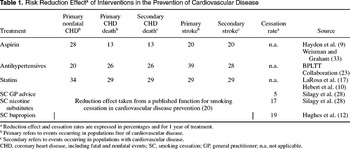
Reduction rates of CVD were taken from recent meta-analyses (9;10;12;17;20;23;28;33). In the case of smoking cessation strategies, we estimated the success rates of cessation therapy after 1 year of follow-up. Relapse rates were set at 0 percent, 20 percent, and 40 percent in sensitivity analysis. The CVD risk modification after smoking cessation was based on a mathematical function derived from a meta-analysis of observational studies comparing quitters and continuing smokers (Table 1) (20).

We used the FHS and FOS data to estimate transition rates for incident nonfatal CHD, fatal primary CHD, secondary fatal CHD, stroke, and death, using Poisson regression with a Gomperz distribution for the total population and for each risk category separately. We calculated two cohorts of 45- and 55-year-old men, followed up for 10 years, with and without risk lowering. Comparisons between populations with and without risk lowering yield YLS, YLS free of CHD, and number of deaths prevented over a 10-year period.
Costs
Direct medical only costs were calculated based on current Dutch guidelines of treatment (2;3;7) In the Netherlands, a visit to the general practitioner (GP) costs €26.29, a telephonic consultation €13.14, a blood sample test €12.19, a prescription renewal €13.14, and each pharmacist's fee €6.68 (2). Aspirin treatment includes per year, one GP visit plus the cost of aspirin 100 mg/day (€27.97) for a total of €54.26. Medication costs of antihypertensives, statins, and nicotine substitutes were calculated using a market share approach based on data from the Rotterdam Study (11) and using a basket including all medications of its kind available for prescription in The Netherlands (further description on the market share approach is in Appendix 1). Yearly treatment with antihypertensives includes two GP visits, two prescription renewals, four pharmacist's fees, one blood analysis, and the medication costs (€122.78), leading to a total annual cost of €240.55. Statin therapy includes two GP visits, two prescription renewals, four pharmacist's fees, one blood analysis, and medication costs (€484.92) for an annual total of €602.69.
Three different strategies were considered for smoking cessation: GP advice, nicotine replacement, and bupropion. General practitioner's advice included only one GP visit and no additional costs, for a one-time cost of €26.29. Because nicotine substitutes can be obtained over the counter without a medical prescription and without prescription renewals, we included only medication costs for 3 months of treatment for a total cost of €117.79 in the first year of nicotine replacement therapy. For smoking cessation using bupropion, the annual costs included one GP visit, one telephonic consultation, two pharmacist's fees, and the medication cost for 3 months of treatment (€135.85) for a total cost of €188.64 in the first year.
The costs of events were taken from the literature and were restricted to direct medical costs (31). Costs per event were for nonfatal myocardial infarction (MI) €6,972, fatal MI €1,602, nonfatal stroke €11,870, and fatal stroke prevented €3,851. All costs were standardized for calendar year 2003 correcting for inflation (when necessary) and currency (€) adjusting for exchange rates.
Cost-Effectiveness
We used a third party payer perspective and discounted future net costs and benefits at a nominal discount rate of 4 percent per year (as recommended in the Netherlands), to take into account time preference (26). This suggests that effects and costs occurring in the future are weighted less that those occurring in the present (13).
We calculated average costs per YLS, costs per YLS free of CHD saved, and costs per deaths prevented for each risk-lowering intervention per categories of risk and age groups. The time horizon used for costs and effects was 10 years. The cost-effectiveness ratio (CER) was the ratio of the medical care costs to the increase in years saved.
Sensitivity analyses test the robustness of our results. As sources of uncertainty, we included different discount rates, different annual relapse rates for the smoking cessation strategies, a lower drug cost for statin therapy (due to the appearance of generic replacements), adverse effects for aspirin treatment, different proportions of smokers, different proportions of populations with suboptimal BP, and giving antihypertensives to all participants with moderate/high level of absolute CHD risk irrespective of BP level. To calculate the impact of adverse effects caused by aspirin treatment, we considered an approximate 1 percent incidence rate of major bleedings among participants receiving aspirin over 10 years of treatment (9). Cost for a major bleeding event ($5,300) were taken from the literature (16). All survival analyses were performed using STATA version 8.2 for windows (Stata Corporation, College Station, TX). MSLTs were made using Excel spreadsheets. Spreadsheets are available upon request.
Incremental Cost-Effectiveness
The incremental cost-effectiveness ratio (ICER) is the additional cost of a specific strategy divided by its additional benefit. Based on incremental cost-effectiveness analysis, we constructed a league table in which we ranked the interventions based on their ICERs. In some cases, a more expensive intervention was dominated by the less expensive if there was no incremental benefit in terms of YLS (negative value). In other words, the dominant strategy is better in all aspects. The strategy with the largest effectiveness and with an ICER below a threshold value of €20,000 per YLS was considered the most cost-effective.
RESULTS
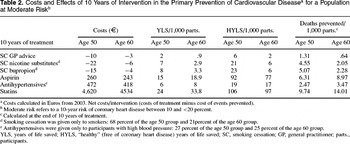
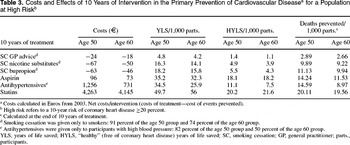
Statin therapy is the most effective strategy for all risk and age groups, but it also is the most expensive (Tables 2 and 3). Antihypertensive therapy costs are lower compared with statins but higher compared with the other therapies. For all levels of risk and age, aspirin treatment costs less than statins and antihypertensives and had effects (on a population level) superior to antihypertensives but below statins. The three smoking cessation therapies had, on a population level, lower effects than the other three treatments. However, unlike the other treatments, they were always cost saving.


Cost-Effectiveness
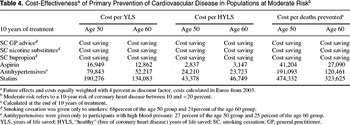
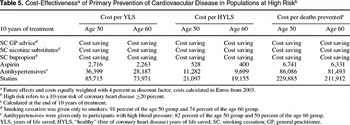
The most cost-effective treatment is smoking cessation therapy, representing savings in all situations (Tables 4 and 5; Figure 1). Statin therapy is the least cost-effective treatment (ranging from €73,971 to €19,027 per YLS). Aspirin was the second most cost-effective intervention (ranging from €2,263 to €16,949 per YLS) followed by antihypertensive treatment (ranging from €28,187 to €79,843 per YLS). These rankings were maintained for all age group/risk group categories analyzed.


Labeling CERs under €20,000 per YLS as “cheap,” over €40,000 per YLS as “expensive,” and in between as “moderate” (18), smoking cessation therapy (the three options) and aspirin therapy were cheap in all situations. Antihypertensive treatment was an expensive option for participants at moderate levels of risk (irrespective of age) and a moderately expensive option for participants at high levels of risk (irrespective of age). Statin therapy was expensive in all situations.
Incremental Cost-Effectiveness and League Table
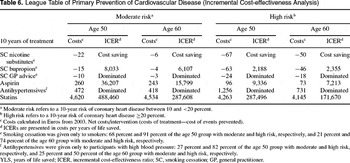
A cutoff value for the ICER of €20,000 per YLS is chosen. The league table starts with the therapy that represented the lowest costs, which in this case is smoking cessation using nicotine substitutes.
Smoking cessation with nicotine substitutes and bupropion are very cost-effective interventions; in fact they are cost saving (Table 6). Smoking cessation with GP advice is dominated by smoking cessation with bupropion (higher costs, lower effects). Compared with smoking cessation, aspirin is cost-effective for moderate risk populations in the 60 years age group and for high-risk populations irrespective of age. At a population level, antihypertensives are dominated by aspirin treatment. Statins have very high ICERs and appear last in our cost-effectiveness league. However, as they have very high effectiveness, they are never dominated by the other treatments.

Sensitivity Analysis
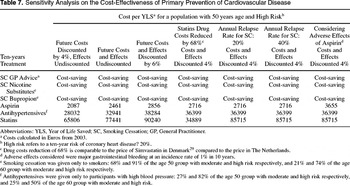
The order in the CERs presented in Tables 4 and 5 was not sensitive to changing discount factors for either costs or effects (Table 7). Using no discounting for effects and costs resulted in lower CERs, and using higher discount factors resulted in higher CERs. When we used 4 percent to discount future costs and left effects undiscounted, CERs were lower. We choose to present these different combinations of discounting considering the existing controversies and lack of standardization in time preference analysis (30).

The order of our results was not altered when different annual relapse rates (20 percent and 40 percent) were considered for the three smoking cessation strategies, or when costs of adverse events were taken into account for aspirin treatment.
When a lower medication cost of statin therapy was included, similar to an off-patent cost of simvastatin, the resulting CER of statin therapy was comparable to the CER of antihypertensive treatment. This lower cost of statin therapy represented a reduction of 68 percent in the current cost of statins in The Netherlands and was taken from the current price of generic simvastatin in Denmark (29). However, in an incremental cost-effectiveness analysis, the cheapest statins still cannot compete with smoking cessation or aspirin.
Changing the proportion of smokers and participants with SBP ≥ 140 mm Hg or giving antihypertensives by level of absolute risk irrespective of level of SBP changed the CERs mildly, but not their order nor the order of the league table (not presented).
DISCUSSION
This study confirms that, apart from smoking cessation in smokers, aspirin treatment remains the first pharmacological option in population level primary prevention of CVD. Antihypertensive treatment for moderate hypertension is moderately efficient, but statins will have to be much less expensive to compete with aspirin in the primary prevention of CVD.
Although smoking cessation therapies represented savings in all situations, the absolute benefits obtained with this treatment were consistently lower compared with the other three alternatives. Also, this therapy can obviously only be offered to a particular population (smokers), which further limits the potential benefits at the population level. For nonsmokers, aspirin remains the most cost-effective option, with large levels of effects and relatively low cost for its benefits. Statins in contrast showed very good results in terms of YLS, YLS free of CHD, and number of deaths prevented, but the cost of treatment is still too high to offer this therapy to everybody who may benefit, even when statins off-patent were considered. Larger reductions in the price of statins are needed before they can be given to populations at levels of 10-year CHD risk below 30 percent. An important limitation of this study is that prevalence of higher risks than 30 percent was too small in the Framingham study populations to be able to estimate life tables, the estimate above which treatment was advocated in most guidelines. Although we cannot judge if use of statins in primary prevention at risks above 30 percent is efficient, below 30 percent it is not. Antihypertensives showed lower costs and better efficiency than statins but also lower effectivity. Another limitation of our study is that we do not present cost-effectiveness estimates for women. We decided to include only men due to the scarcity of evidence for women that did not allow us to find published estimates for all the transition rates required in our analyses.
We did not include savings in terms of CVD interventions (coronary artery bypass grafting or percutaneous transluminal coronary angioplasty) secondary to treatment. The reason behind this decision is the constant change in CVD treatment, which makes current populations not comparable with populations from the 1970s and 1980s, in terms of invasive treatments of CHD. Additionally, due to the unavailability of echocardiographic measures, left ventricular hypertrophy was defined in the Framingham populations based on ECG measurements. However, we expect that this would only introduce into our analysis a nondifferential misclassification of the risk levels of the population studied.
We selected a 10-year time horizon and considered no effects (or costs) beyond. The main reason is that cost-effectiveness ratios over longer time horizons are heavily determined by the highest levels of risk at older ages, and require arguable assumptions about health effects of treatment over long periods and at old ages. Additionally, there is no evidence on the benefits of statins for periods of time beyond 6 years. We did not value saved lives after 10 years of treatment, but mentioned this apart as costs per averted death. Nevertheless in terms of cost-effectiveness, our ratios are comparable to the existing CERs in the literature. In the case of statin therapy, our CERs fall within the estimated range for primary prevention of CVD published by Pharoah and Hollingworth (25), using also a life table approach and a 10-year time horizon. If we transform the saved lives into YLS by using the residual population life expectancy at age 55 and 65, the CER are comparable to studies using a lifetime time horizon (data not shown). The main strength of this study is the comparative analysis, using the same methods and showing the same rankings. The ratios of the other therapies fall within the ranges of their correspondent literature (21;22;24).
We decided to use a market share approach and select a single estimate for each strategy because using every potential combination of estimates and specific drugs is beyond the scope of this study. We used only costs based on current Dutch standards, which limits the generalizability of our results.
Except for aspirin, no adverse effects were taken into account in our analysis for the strategies considered, because no evidence of serious complications exists at low or normal dosages. In general, in this study, we have considered compliance of the different therapies selected by using the relative risks results of intention-to-treat randomized controlled trials, which incorporate the trial compliance.
Perhaps in the future, with the advent of a low-cost Polypill (32), the situation may change in the primary prevention of CVD and all the beneficial interventions could be offered to everyone that requires them, without exhausting our budgets. However, in the meantime, we have to deal with our current options and design an effective and realistic strategy.
In conclusion, we found that, for cost-effective pharmacological population prevention of CHD, the first line of intervention should be smoking cessation therapy for smokers and aspirin for all levels of risk. Antihypertensive therapy is efficient over a wide range of risk but not the cheapest option. Statin therapy is an expensive option and should not represent a first-choice in primary prevention; guidelines on primary prevention of CVD should not advise treatment with statins for populations at levels of 10-year CHD risk below 30 percent.
POLICY IMPLICATIONS
For cost-effective pharmacological population prevention of CHD, the first line of intervention should be smoking cessation therapy for smokers and aspirin for all levels of risk. Statin therapy is an expensive option and should not represent a first choice in the primary prevention of cardiovascular disease.
CONTACT INFORMATION
Oscar H. Franco, MD, DSc, PhD (oscar.franco@unilever.com), Scientific Researcher, Department of Public Health, Erasmus MC, University Medical Center, 50 Dr. Molewaterplein, 3000 CA Rotterdam, Zuid-Holland; Senior Epidemiologist, Unilever Corporate Research, Colworth Park, Sharnbrook, Bedfordshire MK441LQ, UK
Arno J. der Kinderen, MSc (a.d.kinderen@rijnland.nl), Scientific Researcher, Department of Public Health, Erasmus MC, University Medical Center, 50 Dr. Molewaterplein, 3000 CA Rotterdam, Zuid-Holland; Advisor Business Economics, Department of Business Economics, St. Alatus, 1 Simon Smitweg, 2353 GA Leiderdorp, Zuid-Holland
Chris De Laet, MD, PhD (chris.delaet@kenniscentrum.fgov.be), Senior Expert, Belgian Health Care Knowledge Center, Wetstraat 62, 1040 Brussels, Belgium
Anna Peeters, PhD (anna.peeters@med.monash.edu.au), Senior Scientific Researcher, Department of Epidemiology and Preventive Medicine, Monash University Central and Eastern Clinical School, Alfred Hospital, Commercial Road, Melbourne, Victoria 3004, Australia
Luc Bonneux, MD, PhD, (Bonneux@nidi.nl), Senior Researcher, Department of Prognoses and Migration, Netherlands Interdisciplinary Demographic Institute, Lange Houtstraat 19, Den Haag 2511 CV, The Netherlands
This manuscript has been presented before in an oral presentation in the 2004 Congress of the European Society of Cardiology (Munich, Germany, August 28, 2004), in an oral presentation during the American Heart Sessions 2004 (New Orleans, Louisiana, USA, November 9, 2004), therefore, it has been published as an abstract in the abstract supplement of Circulation for the American Heart Sessions, and in the conference of Health Technology Assessment International (Rome, June 20/2005). Oscar H. Franco as guarantor of this paper accepts full responsibility for the integrity of the data and the accuracy of the data analysis, had full access to all the data in the study, and controlled the decision to publish. This study was supported by a grant from the Netherlands Heart Foundation (Grant no. 98.138) and the Netherlands Organization for Scientific Research (Grants no. 904-66-093 and no. 2200.0126). O.H.F., Ad.K., Cd.L., A.P., and L.B. were partly funded by the Netherlands Heart Foundation (Grant no. 98.138) and the Netherlands Organization for Scientific Research (Grants no. 904-66-093 and no. 2200.0126). A.P. was also partly funded by VicHealth (Fellowship Grant no. 2002-0191). These funding organizations did not participate in the design and conduct of the study; the collection, management, analysis, and interpretation of the data; or preparation, review, or approval of the manuscript. Ethical approval was not required as this was a secondary data analysis. We thank the Framingham Heart coordinators for access to the original data set. The Framingham Study is conducted and supported by the National Heart, Lung and Blood Institute (NHLBI) in collaboration with the Framingham Heart Study Investigators. This manuscript has been reviewed by NHLBI for scientific content and consistency of data interpretation with previous Framingham Heart Study publications and significant comments have been incorporated prior submission for publication.