Introduction
Chirp waveform has high Doppler tolerance. This makes it attractive to be used in radar systems. But different types of deceptive jammers for example interrupted sampling repeater jammer (ISRJ), digital radio frequency memory (DRFM), frequency shifting jammer, and active echo cancelation (AEC) jammer can jam chirp radars and generate false targets or suppress the true target echo [Reference Baher Safa Hanbali1, Reference Baher Safa Hanbali and Kastantin2]. DRFM is commonly used in electronic countermeasure because it can intercept, store, and retransmit jamming signal that are coherent with the radar signal. This makes DRFM jammer benefits from the processing gain of pulse compression and coherent integration. Therefore, DRFM jammer needs low transmitting power to form false targets in the victim radar. DRFM jammers work in two modes [Reference Greco, Gini and Farina3–Reference Li, Su, Gu, Ma and Chen7], i.e. full pulse repeating mode and interrupted sampling repeating mode. When DRFM jammer works in full pulse repeating mode, it intercepts, stores, and retransmits the complete radar pulse. But, the jammer pulse lags behind the true target pulse. Therefore, orthogonal waveforms technique can be used to counter DRFM jammer easily [Reference Baher Safa Hanbali and Kastantin2]. While in interrupted sampling repeating mode, the jammer samples and stores segments of the radar pulse during the radar pulse itself and retransmits them toward the victim radar. This means that the ISRJ signal can be generated in the current radar pulse repetition period, which makes countering techniques such as phase perturbation [Reference Soumekh8], modifying the chirp rate [Reference Feng and Xu9], and pulse diversity [Reference Akhtar10–Reference Zhang, Zhu and Wang13] fail. ISRJ can work under a relatively low transmitting power because it obtains partial processing gain from pulse compression and coherent integration. Therefore, ISRJ generates multiple false targets while the amplitudes of the high-order false targets decrease quickly [Reference Wang, Liu, Zhang, Fu, Liu and Xie6]. The power and the distribution of the false targets can be changed by adjusting the jamming parameters easily. Therefore, ISRJ is superior to other jamming methods. Under certain conditions including the repeater power, delayed time, and repeater frequency, the false target will coincide with the true target for partial echo cancellation [Reference Feng, Xu, Wang and Yang14, Reference Wu, Zhao, Wang, Liu and Xiao15]. In [Reference Baher Safa Hanbali and Kastantin16, Reference Baher Safa Hanbali17] anti-jamming techniques are presented to eliminate the effect of this kind of AEC.
There is only limited public research literature on electronic counter countermeasure schemes against ISRJ. In [Reference Gong, Wei and Li18–Reference Xiong, Zhang and Liu21], different methods are proposed to counter ISRJ based on the time-frequency (TF) analysis, where it was found that the TF characteristics of the ISRJ signal are discontinuous. Therefore, a band-pass filter (BPF) can be designed to retain the true target signal and suppress the ISRJ signal. In [Reference Wang, Li, Yu, Luo and Yu22], ISRJ suppression issue is addressed by using TF analysis and target sparse reconstruction. In [Reference Zhou, Liu and Chen23], TF analysis result is used to estimate the jamming parameters of slice number and forwarding times to perform jamming suppression. In general, short-time Fourier transform (STFT) is applied to perform the TF analysis. Therefore, the previous methods in [Reference Gong, Wei and Li18–Reference Zhou, Liu and Chen23] are only effective under high signal to noise ratio (SNR). In [Reference Wang, Li, Pang, Li, Li and Wang24] an anti-jamming method based on designing complementary sequences and receiving filters is proposed. Although that method reduces the influence of the ISRJ on radar detection, but it requires complex optimization design. In [Reference Zhou, Liu and Liu25], an adaptive transmitting scheme based on the jamming parameter estimation is used for ISRJ suppression. But, the jamming suppression performance depends on the accuracy of jamming parameters estimation. In [Reference Liua, Shu and Chen26], the radar return filtering is achieved by transforming it into the fractional domain and designing a narrow BPF to suppress jamming signal. The center of the BPF can be set according to the true target peak position in the fractional domain. But the performance of this method is affected by the bandwidth of the BPF. In addition, the true target peak position in the fractional domain cannot be easily calculated because the true target is masked by false targets in the time domain.
Based on the previous discussion, countering ISRJ jamming requires more research in order to overcome the limitations of the mentioned anti-jamming methods. In this paper, we propose a new anti-jamming method for countering ISRJ effectively. The proposed method used fractional Fourier transform (FrFT) to compress and separate overlapping the true target echo and the jamming pulses in the fractional domain. Then, the resulting compressed pulses are transformed to the time domain to compare the pulses’ arriving time, the leading pulse will be considered as the true target echo because jamming pulses always lag behind the true target echo by the jammer's delay.
The article is organized as follows. Section “Overview of ISRJ” presents a short overview of ISRJ. In the Section “Chirp pulse compression using FrFT,” the chirp pulse compression using FrFT is given. In the Section “The proposed anti-jamming technique,” the proposed anti-jamming technique is introduced. Finally, Matlab simulation results are demonstrated in the Section “Simulation and results.”
Overview of ISRJ
The authors in [Reference Wang, Liu, Zhang, Fu, Liu and Xie6] proposed interrupted sampling technique which samples segments of radar pulse and retransmits them using a time-sharing single receive–transmit antenna toward the victim radar. In this way, the ISRJ generates a main false target that always lags behind the true target by a jammer's delay τ d, and multiple false targets that are located around the main false target. ISRJ has many advantages because it used a single time-sharing antenna that has easy implementation and therefore it can be carried by a missile. In addition, ISRJ generates multiple false targets without sampling and retransmitting the whole radar pulse.
Let x(t) be the complex representation of the transmitted radar chirp:

where μ = B/T is the frequency modulation slope, T is the chirp duration, and B is the sweep bandwidth.
The sampling function p(t) is a rectangular pulse train with a pulse duration τ and pulse repeat interval T s. p(t) can be written as:

where rect(t/τ) represents a rectangular pulse of width τ. The sampled jamming signal is [Reference Wang, Liu, Zhang, Fu, Liu and Xie6]:

The spectrum of the sampled jamming signal is [Reference Wang, Liu, Zhang, Fu, Liu and Xie6]:

where ${a_n} = \tau {f_s}{\mathop {\rm sinc}\nolimits } ( \pi n{f_s}\tau )$ , f s = 1/T s is the sampling frequency of ISRJ, and τ is the sampling period of ISRJ. Clearly, X s(f) is a superposition of the shifted replicas of X(f) scaled by a n. The output of the radar-matched filter is given as [Reference Wang, Liu, Zhang, Fu, Liu and Xie6]:


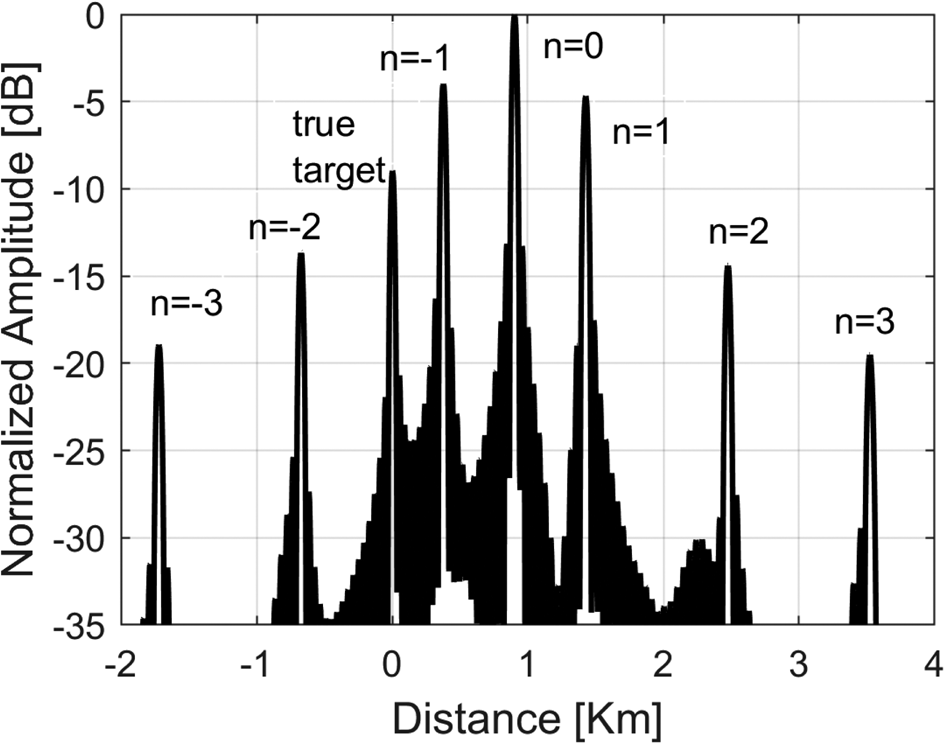
where n = 0, ± 1, ± 2, ± 3… Based on equations (5) and (6), the output of the radar-matched filter composed of multiple false targets u n(t), each one has a frequency shift nf s and a scale factor a n. The relative distance between each two adjacent false targets equals cf s/2μ, where c is the propagation speed of light. When the value of n increases, the amplitudes of false targets decrease quickly. Therefore, the ISRJ technique generates about five effective false targets as shown in Fig. 1.
Simulation result of ISRJ.

Chirp pulse compression using FrFT
FrFT has been used in sonar and radar signal processing. In [Reference Elgamel and Soraghan27], a radar-matched filter based on FrFT is implemented for a chirp radar. In [Reference Cowell and Freear28], the detection and separation of overlapping chirp acoustic signals is achieved by FrFT-based receiver. In [Reference Baher Safa Hanbali and Kastantin29], an anti-jamming method against frequency shifting jamming is proposed, where FrFT resolves the overlapping jamming pulses and true target echo. Then, the resulting signals are returned to the frequency domain where their spectra are compared with that of the transmitted radar chirp after Doppler compensation. The signal that has less differences of the center frequency is considered as the true target. But, that anti-jamming method cannot counter ISRJ because both the true target and the main false target have the same frequency shift, and therefore the true target cannot be distinguished from the main false one. In [Reference Baher Safa Hanbali30], FrFT is used for countering smeared spectrum jamming, where the anti-jamming method benefits from the fact that the jamming pulses have a different frequency modulation slope from that of the transmitted radar chirp. Therefore, the jamming pulses can be suppressed in the fractional domain, and then the true target can be distinguished easily. But, that technique is inefficient in the case of ISRJ because both the true target echo and the jamming pulses have the same frequency modulation slope.
FrFT is a general form of the Fourier transform (FT) that transforms a function into an intermediate domain between frequency and time by rotating the TF plane. If F α denotes the operator corresponding to the FrFT of angle α, then F π/2 = F: rotation by π/2 gives FT [Reference Almeida31, Reference Ashok Narayanana and Prabhub32]. In the same way that has been done for standard FT, a sampling theorem for FrFT is proposed in [Reference Torres, Pellat-Finet and Torres Moreno33]. Compared with FT, the FrFT of optimal angle, α opt, applied to a chirp pulse, concentrates its energy distribution in the fractional domain. This presents the use of the FrFT for pulse compression of chirp pulse [Reference Elgamel and Soraghan27–Reference Baher Safa Hanbali30, Reference H-B, G-S, Gu and W-M34–Reference Capus and Brown37]. The continuous FrFT of a signal x(t) is given by [Reference Almeida31, Reference Ashok Narayanana and Prabhub32]:

where ${K_\alpha }( t,\; \, u)$ is the transform kernel and when α ≠ nπ it equals [Reference Almeida31, Reference Ashok Narayanana and Prabhub32]:

where $\cot \alpha = 1/\tan \alpha$ and $\csc \alpha = 1/\sin \alpha$
 . Hence:

Applying the FrFT to the chirp pulse given by equation (1) gives:

where ${A_\alpha } = \sqrt {1 - j\cot \alpha } {\rm {\; }} {e^{j\pi {u^2}\cot \alpha }}$ . The integral in this equation involves an error function. But when:

Then

A condition considered in [Reference Capus and Brown37] as being optimal and denoted by α opt, then equation (10) is rewritten as:

Usually, μ ≫ 1, so equation (12) gives $\csc {\alpha _{opt}} = \mu$ . Consequently, $\vert {A_\alpha }\vert = \left \vert {\sqrt {1 - j\cot {\alpha _{opt}}} } \right \vert = \sqrt \mu$
 . Hence [Reference Baher Safa Hanbali and Kastantin29]:

This equation is equivalent to that of the matched filter for chirp pulse. This means that the FrFT compresses chirp pulse like matched filter does [Reference Elgamel and Soraghan27–Reference Baher Safa Hanbali30, Reference H-B, G-S, Gu and W-M34–Reference Capus and Brown37]. But, the matched filter is superior to FrFT by 3 dB [Reference Liu, Liu and Wang36].
The proposed anti-jamming technique
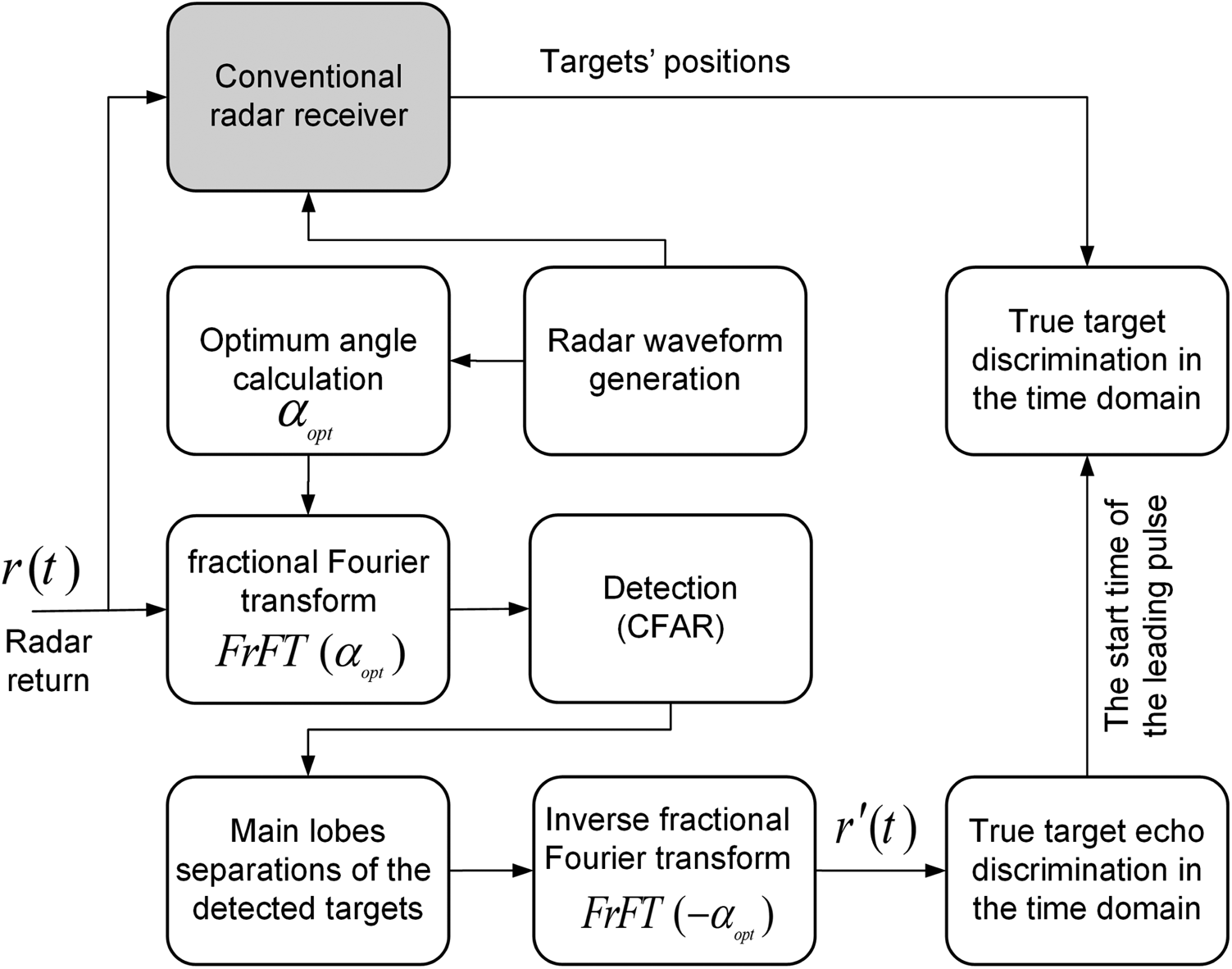
Figure 2 shows the block diagram of the proposed anti-jamming receiver. The jamming signal is a delayed superposition of the shifted replicas of the spectrum of the true target. Consequently, we can discriminate the false targets if we can separate each received pulse in the fractional domain and then return each separated compressed pulse to the time domain to find the leading pulse that will be considered as the true target echo because the jamming pulses lag behind the true target echo by jammer's delay τ d. After discriminating the true target echo at the output of anti-jamming receiver, the true target can be recognized at the output of the conventional radar receiver based on the start time of the leading pulse. As shown in Fig. 2, r(t) is the baseband received signal that is composed of the sum of the true target echo x(t − t 0), the sampled jamming signal x j(t − (t 0 + τ d)), and the noise signal n(t):

where t 0 is the true target delay. Now, applying the FrFT to the received signal r(t) given by equation (15) gives:

where w = 2πnf s, u 0 = t 0cosα, u 1 = (t 0 + τ d)cosα, and F α(x s(t)e jwt) = C nX j,α(u − wsinα). These equations are respectively derived from the delay property and the modulation property of FrFT, where C n is [Reference Almeida31, Reference Ashok Narayanana and Prabhub32]:

At the optimum value of α given in equation (12) [Reference Capus and Brown37], the energy distribution of both the jamming signal and the true target echo concentrate well because these signals have the same frequency modulation slope. Therefore, we get

Equation (18) shows that, apart from the noise component ${N_\alpha }( u)$ , the output of the FrFT is composed of sinc functions separated in the fractional domain. After constant false alarm rate (CFAR) detection, the peak position sample and the adjacent samples are kept for each main lobe and the remaining samples are put to zero. This is because most of the energy of each jamming pulse is concentrated in its main lobe. As a result, the true target echo and the jamming components are separated and filtered from noise in the fractional domain simultaneously. Then by applying the inverse FrFT, for each main lobe, at −α opt, we get

Equation (19) shows that the output of the inverse FrFT is composed of true target echo and jamming pulses that are delayed replicas of the true target echo and these pulses are separated in the time domain. Now, the true target is discriminated at the output of the conventional radar receiver based on the start time of the leading pulse at the output of the proposed anti-jamming receiver as shown in Fig. 2.
Block diagram of the proposed anti-jamming receiver against ISRJ.

It worth mentioning that α opt is calculated in the discrete domain using equation (20) [Reference Elgamel and Soraghan27, Reference Cowell and Freear28]:

where L is the number of samples in the time received window.
The computation complexity of the proposed technique depends on the implementation of FrFT. Since the FrFT can be implemented using FFT, its computational complexity is O(Nlog N) [Reference Ozaktas, Zalevsky and Kutay38–Reference Cooley and Tukey40]. As we mentioned above FrFT behaves like a matched filter. In contrast, FrFT requires higher sampling rate than Nyquist frequency [Reference Sejdic, Djurovic and Stankovi41]. But, this is attainable very easily on current field programmable gate arrays. As a result, the proposed technique is appropriate for practical application.
Simulation and results
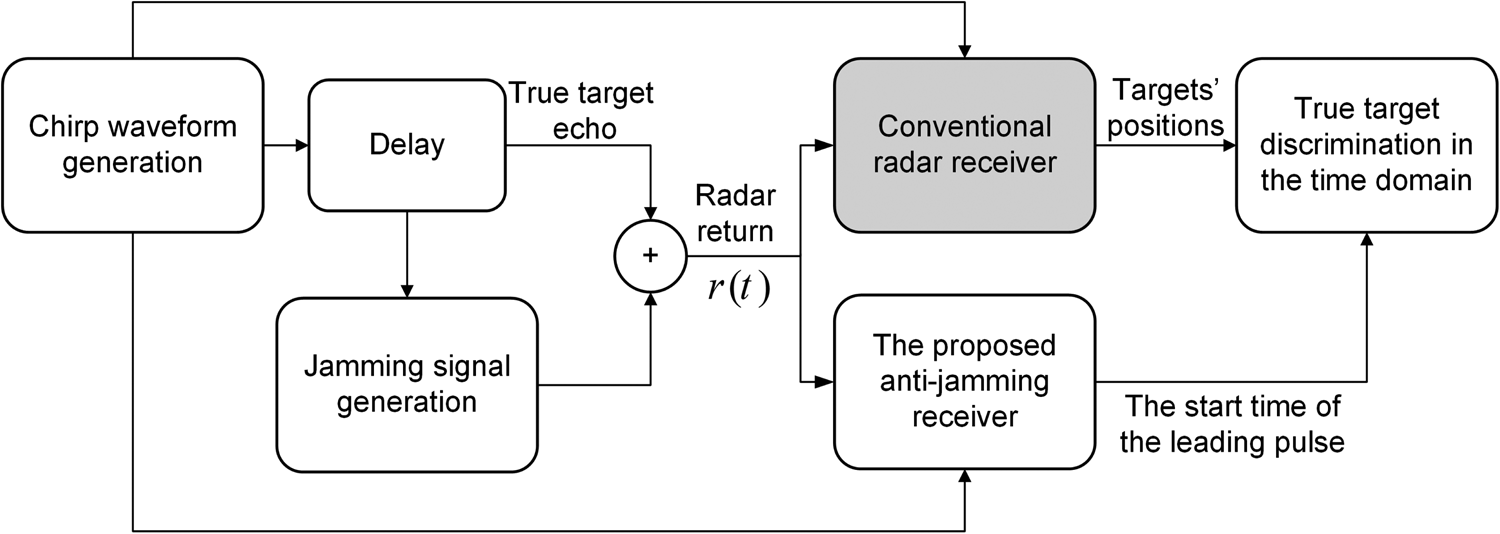
Figure 3 shows the assumed simulation scenario for countering self-protection ISRJ, which generates jamming signal from the transmitted radar pulse. In this case, the radar return is the sum of the true target echo and the jamming signal. Then, radar return is received by both the conventional radar receiver and the proposed anti-jamming receiver at the same time. The proposed anti-jamming technique estimates the start time of the true target echo, which leads all jamming pulses in the time domain. Finally, the true target is discriminated by comparing the targets’ positions, at the output of the conventional radar receiver, and the start time of the leading pulse at the output of the proposed anti-jamming receiver.
Simulation scenario for countering self-protection ISRJ.

We assume these parameters: B = 4 MHz, T = 100 μs, sampling frequency, F s = 20 MHz, L = 14 000, and α opt = −0.6202 after calculation using equation (20). The true target's delay is 466 μs. The jammer parameters are given as follows: τ = 2 μs, f s = 140 kHz, τ d = 6 μs, and jamming to signal ratio (JSR) = 16 dB. For simplicity, we assume that the main false target (component of n = 0), the false target (component of n = −1, the first false target preceding the main false target), the −2nd false target (component of n = −2, the second false target preceding the main false target), the +1st false target (component of n = +1, the first false target lagging behind the main false target), and the +2nd false target (component of n = +2, the second false target lagging behind the main false target) are detectable, and the other false targets are below the radar detection threshold.
Countering jamming mode a
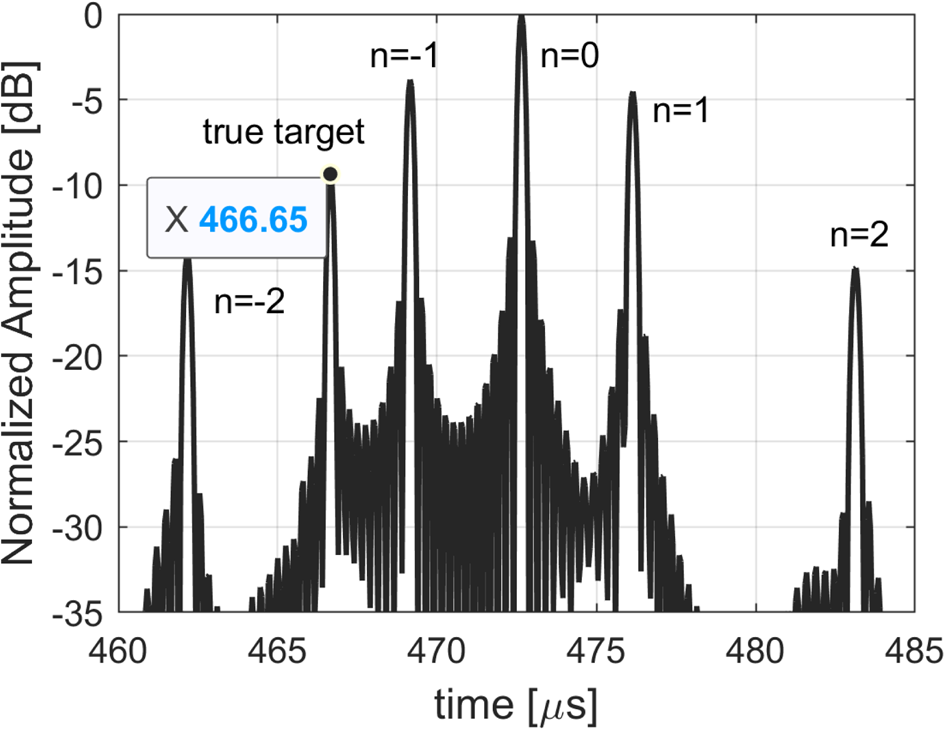
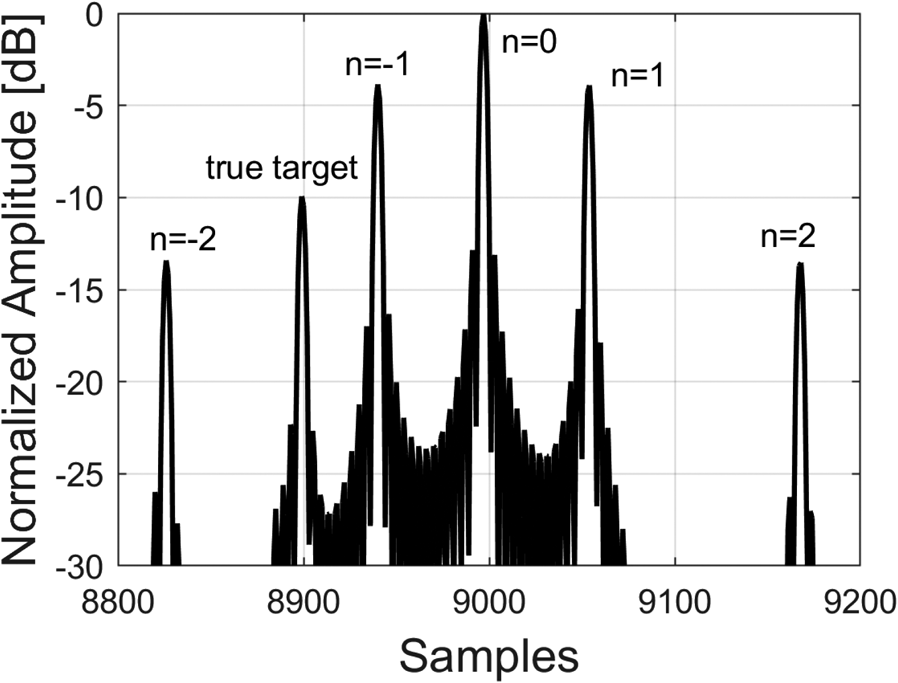
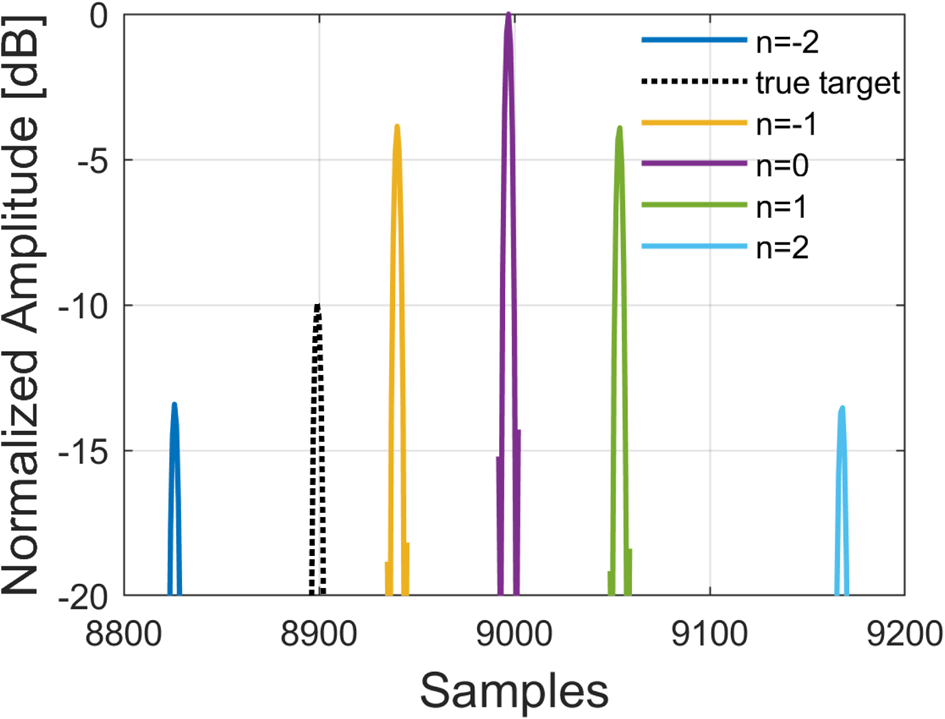
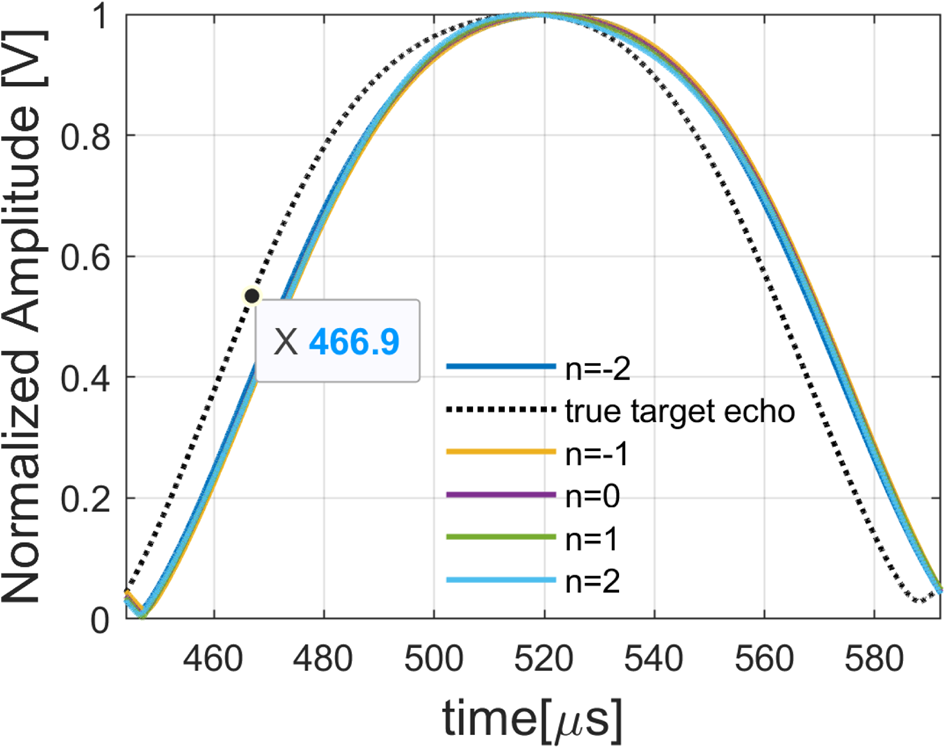
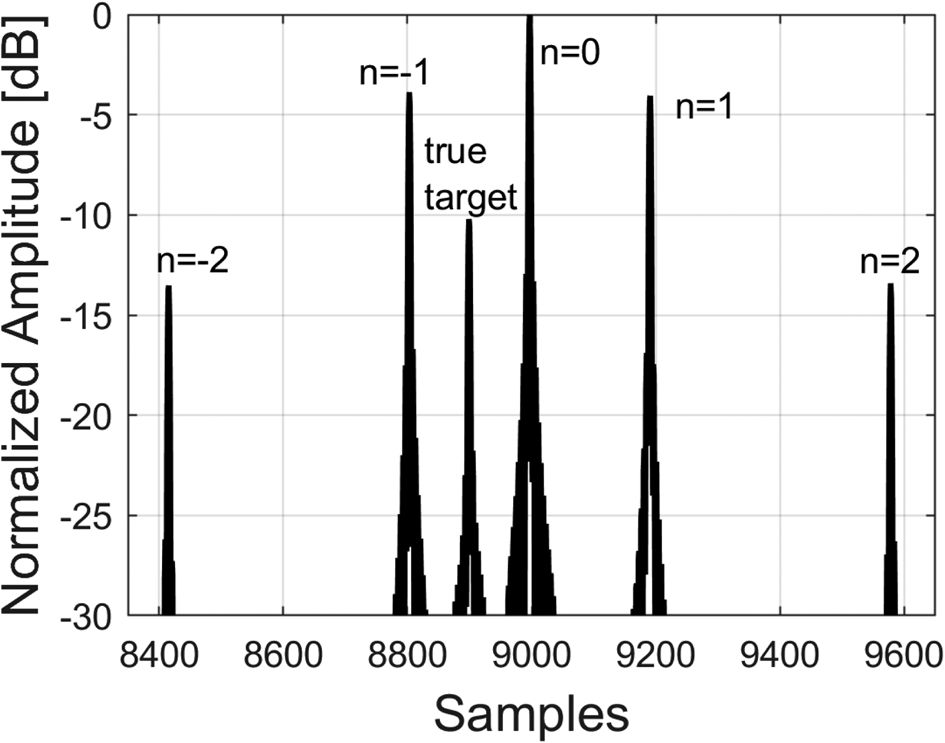
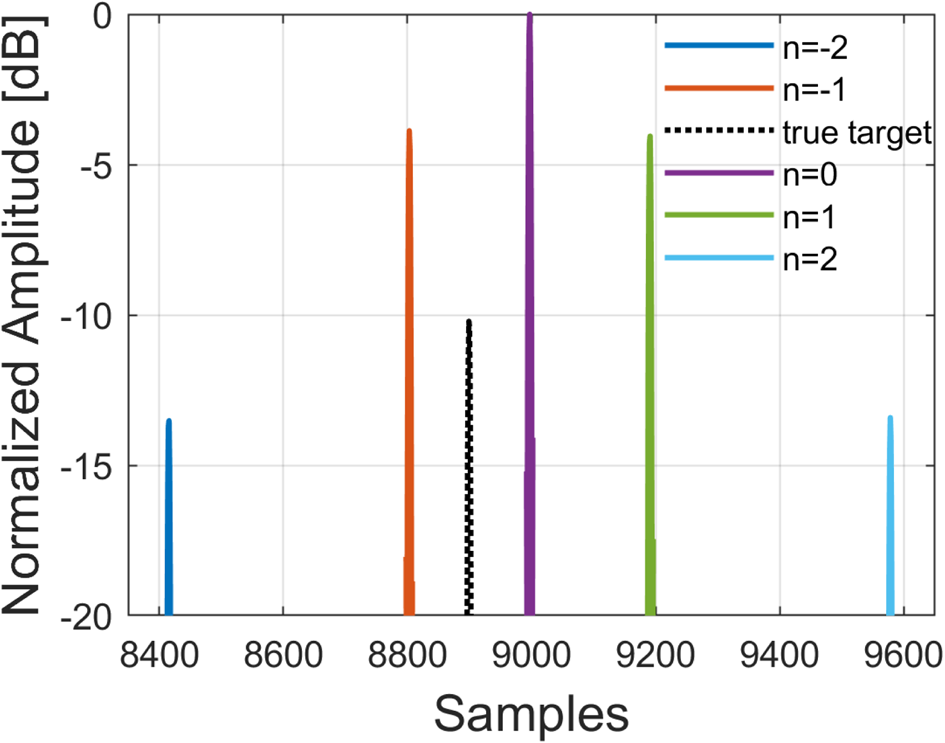
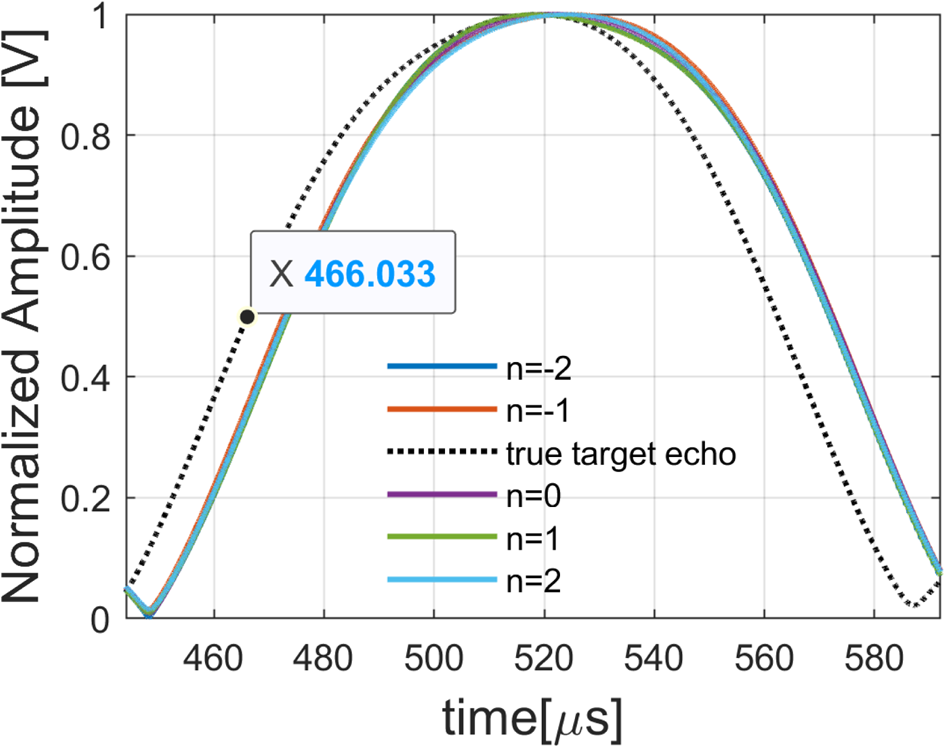
In this case, the true target leads the −1st order false target and the main false target lags behind the true target, by τ d = 6 μs as shown in Fig. 4. The true target echo and jamming pulses can be separated and isolated easily in different compressed pulses at the output of FrFT as shown in Figs 5 and 6 respectively. Then these compressed pulses are now returned to the time domain to give the independent pluses as shown in Fig. 7, the second pulse leads the other pulses by τ d. Therefore, the dotted curve belongs to the true target echo and the overlapping solid curves belong to the jamming pulses. Consequently, the second target, at the output of radar-matched filter, represents the true target that has a delay of 466 μs as shown in Fig. 4.
Matched filter output in the case of ISRJ.

FrFT of the received signal in the case of ISRJ.

Separation of main lobes in the fractional domain in the case of ISRJ.

Resulting pulses after returning to the time domain in the case of ISRJ.

Countering jamming mode b
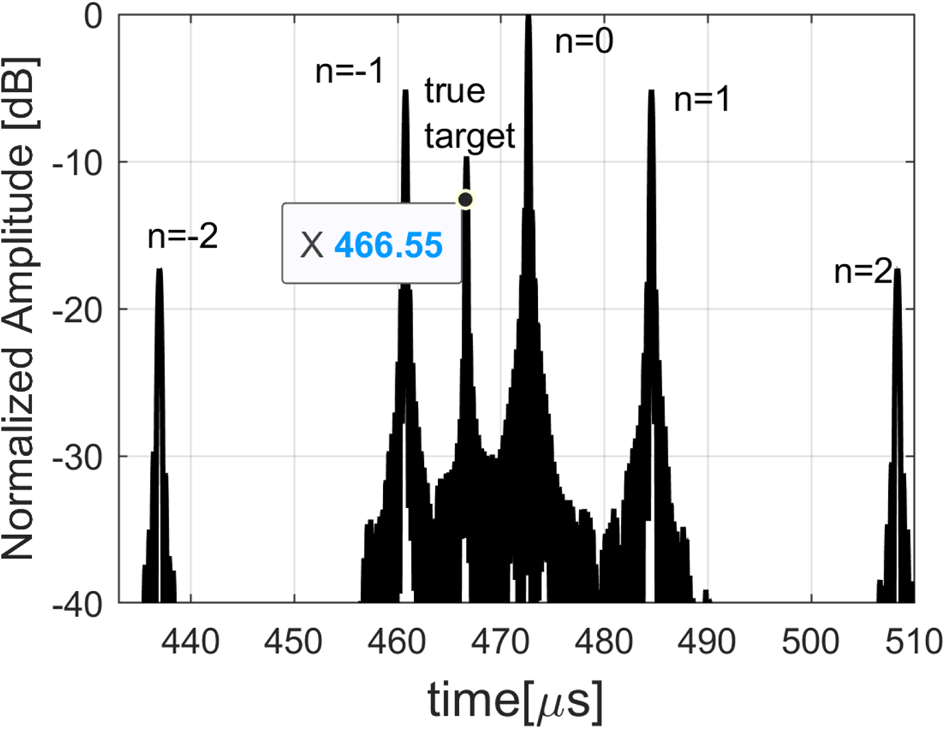
To confuse the radar well, the −1st order false target leads the true target when ${f_s} > \sqrt {{B}/{T}}$ , e.g. f s = 480 kHz, as shown in Fig. 8. At the output of FrFT, the jamming pulses and the true target can be separated and isolated easily in different compressed pulses as shown in Figs 9 and 10 respectively. Then these compressed pulses are now returned to the time domain to give the independent pulses shown in Fig. 11, the third pulse leads the other pulses by τ d. Therefore, the dotted curve belongs to the true target echo and the overlapping solid curves belong to the jamming pulses. Consequently, the third target, at the output of the radar-matched filter, represents the true target that has a delay of 466 μs as shown in Fig. 8.
Matched filter output when the first-order false target leads the true target.

FrFT of the received signal when the first-order false target leads the true target.

Separation of main lobes in the fractional domain when the first-order false target leads the true target.

Resulting pulses after returning to the time domain when the first-order false target leads the true target.

The performance of the proposed method
Now, we will simulate the probability of detection (P d) as a function of SNR when the probability of false alarm (P fa = 10−6). As shown in Fig. 12, the FrFT is inferior to the matched filter by 3 dB in terms of SNR, but it is superior to STFT. Therefore, the anti-jamming techniques based on STFT require high SNR to be effective [Reference Gong, Wei and Li18–Reference Zhou, Liu and Chen23]. However, the proposed method works well under low SNR. This is because FrFT benefits from pulse compression gain. Despite the fact that FrFT requires high sampling rate, the proposed method is superior to other methods.
Performance of FrFT versus matched filter and STFT.

It is well known that conventional CFAR masks the weaker of the two closely spaced targets. Therefore, radar systems used modified CFAR such as the censored (CS) CFAR, order statistics (OS) CFAR, and smallest-of cell-averaging (SOCA) CFAR, which are designed to overcome mutual target masking [Reference Richards42]. It worth mentioning that self-protection ISRJ does not transmit high power to avoid hostile anti-radiation missile attack [Reference Adamy43]. When high JSR is used, a mutual target masking occurs. Therefore, the proposed anti-jamming receiver used modified CFAR. Consequently, as long as the true target is detected by modified CFAR, the proposed method works well.
Conclusion
Chirp radars are vulnerable to many types of deceptive jammers e.g. ISRJ that generates multiple false targets and makes the radar system unable to discriminate the true target. We proposed a new anti-jamming technique based on FrFT to counter ISRJ jamming, where the true target echo and jamming pulses are compressed and separated in the fractional domain. Then, these separated pulses are returned to the time domain to discriminate the true target echo that leads the jamming pulses by the jammer's delay. Despite the fact that the proposed method is inferior to the matched filter and it requires high sampling rate, it is suitable for practical application. Because, it works better than other anti-jamming techniques that require high SNR or high computational cost or the knowledge of the jamming parameters. This makes it attractive to be incorporated into existing radar systems.
Acknowledgements
I would like to thank the anonymous reviewers of the International Journal of Microwave and Wireless Technologies for their valuable comments on this article. I also want to thank my fantastic colleague Hatem Najdi for his continuous support.
 Samer Baher Safa Hanbali earned his B.Sc. in electronic engineering from Damascus University, Syria, in 2000; his M.Sc. in advanced electronic engineering from FH Joanneum University, Austria, in 2011; and his Ph.D. in telecommunications from the Higher Institute for Applied Sciences and Technology (HIAST), Damascus, Syria, in 2017. He is a researcher in the Department of Communication Engineering, HIAST, Damascus, Syria.