Background
Frontotemporal lobar degeneration (FTLD) is a relatively rare type of dementia with an estimated overall prevalence of 2.7–17.6/100,000 inhabitants (Rosso et al., Reference Rosso2003; Borroni et al., Reference Borroni2010). Compared to Alzheimer's disease (AD), FTLD commences earlier, with a mean age of onset of about 58 years (Johnson et al., Reference Johnson2005). In adults aged less than 65 years, FTLD shows incidence and prevalence rates similar to those of early-onset AD (Ratnavalli et al., Reference Ratnavalli, Brayne, Dawson and Hodges2002; Mercy et al., Reference Mercy, Hodges, Dawson, Barker and Brayne2008).
Frontotemporal lobar degeneration is a clinically and pathologically heterogeneous syndrome, characterized by progressive decline in behavior and/or language associated with degeneration of the frontal and anterior temporal lobes of the brain (Rabinovici and Miller, Reference Rabinovici and Miller2010). Current consensus criteria divide FTLD into three major clinical subtypes that can be distinguished based on early and predominant symptoms (Rascovsky et al., Reference Rascovsky2011). Behavioral variant frontotemporal degeneration (bvFTD) represents the most common clinical phenotype and is characterized by early decline in social behavior and personal conduct, emotional blunting, and loss of insight. Semantic dementia (SD) is defined as a disorder of language, semantic and recognition. Although semantic deficits dominate the clinical picture, behavioral alterations also occur. Progressive non-fluent aphasia (PNFA) is characterized by a progressive disorder of language expression and motor speech with agrammatism and effortful speech, sparing other cognitive domains in the early stages of the disease.
Frontotemporal lobar degeneration is a progressive disorder associated with reduced life expectancy. Patients lose the ability to care for themselves and become dependent on their caregivers. Behavioral disturbances provoke difficulties in caring for a patient with FTLD and cause high burden to caregivers who are mostly spouses or close relatives (Riedijk et al., Reference Riedijk2006; Boutoleau-Bretonniere et al., Reference Boutoleau-Bretonniere, Vercelletto, Volteau, Renou and Lamy2008). Caring for a loved-one who loses the ability to be empathetic and to connect emotionally can easily lead to frustration and hurt. The caregivers of FTLD patients feel less satisfied with the patient as a care recipient and with themselves as caregivers, and are more stressed and burdened than caregivers of patients with AD (de Vugt et al., Reference de Vugt, Riedijk, Aalten, Tibben, van Swieten and Verhey2006).
Most services available for dementia patients and their caregivers are tailored to AD. A German study found that 89% of the families with FTLD are referred from gerontology departments of psychiatric hospitals to the local Alzheimer's Associations (Ibach et al., Reference Ibach, Koch, Koller, Hajak and Putzhammer2004). Because of huge differences between AD and FTLD, these services are not prepared to meet the specific needs of FTLD patients and their caregivers. Most nursing homes are also tailored to older clients and unable to cope with the problems associated with FTLD. Sometimes admission of these patients to long-term care facilities has been declined due to behavioral disturbances (Diehl-Schmid et al., Reference Diehl-Schmid, Last, Schuster, Förstl, Schneider-Schelte and Kurz2011). Caregivers of FTLD patients feel alone in their major life crises and are dissatisfied with professional counseling and the information and help that are provided (Rosness et al., Reference Rosness, Haugen and Engedal2008). Clearly, there is a need to enlarge the supply of services to FTLD patients and their caregivers, including caregiver support interventions. In Germany, except in a few large cities (Berlin, Göttingen, Hamburg, and Munich), caregiver support groups are not available.
Caregiver burden refers to the individual's emotional response to changes and demands associated with the caregiving experience. However, only little is known about concrete contributions to caregiver burden in FTLD. Clinical experience suggests that the problems and needs of FTLD caregivers are different from those of AD caregivers. The knowledge about these specific problems and the resulting needs – especially those needs that can be met by external support strategies – is crucial for the development of helpful and effective caregiver interventions.
The aim of this study was to systematically review studies analyzing (1) burden, problems, and needs of caregivers of FTLD patients, and (2) the feasibility and efficacy of caregiver interventions in FTLD.
Methods
A systematic review was performed assessing the burden, problems, needs, and interventions for caregivers of FTLD patients.
In order to obtain a comprehensive overview of caregiving in FTLD, all study designs were included (randomized controlled trials, observational studies, case series, and case reports). Electronic databases were searched using the terms “frontotemporal or FT(L)D” and “caregiver or carer.” We searched medical (Medline, Cinahl, Embase, and Cochrane Library: Cochrane Dementia and Cognitive Improvement Group), psychological (Psyndex and PsycINFO), and social sciences databases (SocINDEX, SOWIPORT, WISO, Social Sciences Citation Index, and Periodicals Index Online) upto May 2011. The conference abstracts of the 6th (2008) and 7th (2010) International Conferences on Frontotemporal Dementias and the reference lists from relevant primary studies and review papers were searched for additional primary studies. Literature in English and German was considered. Inclusion criteria were determined with regard to the content. The titles and abstracts of retrieved reports were screened for eligibility by two independent reviewers. These papers dealing with burden, stress, distress, depression and other problems of FTLD caregivers, needs of FTLD caregivers, and any kind of support interventions for FTLD caregivers were rated as relevant and eligible. Quality assessment of eligible studies was conducted according to design, subjects, outcomes, and statistics. Disagreement between reviewers was resolved by consensus.
Data were extracted from full text papers and scheduled in data extraction tables with regard to design, population, aim, outcomes, and results. Data were summarized and reviewed in the results section. Because of the lack of suitable data on interventions, a statistical meta-analysis could not be performed.
Results
Burden, problems, and needs of FTLD caregivers
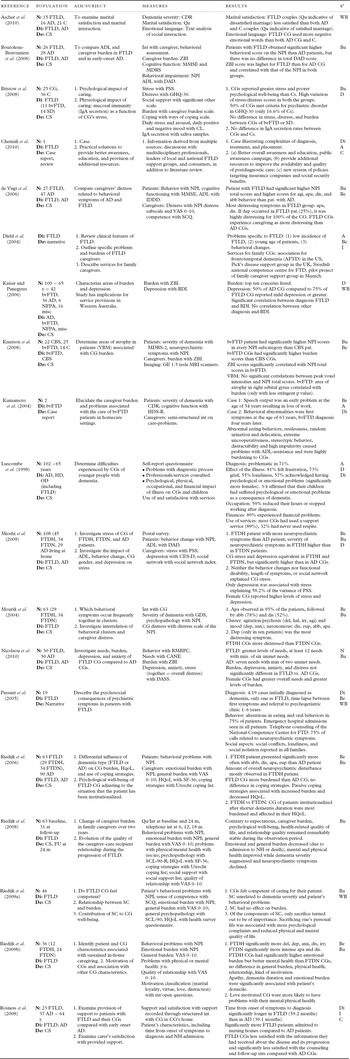
We found 19 papers dealing with burden, problems, or needs of FTLD caregivers. The papers have been alphabetically listed in Table 1. Because most papers are relevant for more than one issue concerning this topic, the last column of the table indicates the section in which the paper was cited.
Literature on burden, problems and needs of FTLD caregivers

*Column X refers to the area of relevance for the review: A = age; Be = behavior; Bu = burden; C = care facilities; Di = delayed diagnosis; D = depression; I = information; N = Needs; WB = caregiver's well-being; AD = Alzheimer's disease; ADL = activities of daily living; BDI = Beck depression index; bvFTD = behavioral variant FTLD; C = non-carer control; CANE = Camberwell Assessment of Needs in the Elderly; CBS = cortico-basal syndrome; CDR = clinical dementia rating; CES-D = Center for Epidemiological Studies Depression Scale; CL = checklist; CG = caregiver; CS = cross-sectional; DAD = disability assessment for dementia; DASS = depression, anxiety, and stress scale; De = design; Di = diagnosis; FTLD = frontotemporal lobar degeneration; FTDH = FTLD patient living at home; FTDN = FTLD patient living in a nursing home; FU = follow-up; GDS = global deterioration scale; GHQ-30 = general health questionnaire; HD = Huntington's disease; HDS-R = Hasegawa's Dementia Scale, equivalent to the Mini-Mental State Examination, widely used in Japan; HQoL = health-related quality of life; IDDD = interview for deterioration in daily living activities in dementia; Int = interview; M = months; MDRS = Mattis Dementia Rating Scale; MMSE = Mini-Mental State Examination; NFPA = non-fluent progressive aphasia; NH = nursing home; NPI = Neuropsychiatric Inventory Measuring 10 Domains of Neuropsychiatric Disturbance: delusions (del), hallucinations (hal), agitation (agi), depression (dep), anxiety (anx), euphoria (eup), apathy (apa), disinhibition (dis), irritability (irr), aberrant motor behavior (abb)); OD = other dementia; Prosp = prospective; PSS = perceived stress scale; Qu = questionnaire; RMBPC = revised memory and behavior problems checklist; SC = sense of competence; SCL-90 = symptom checklist-90; SCQ = sense of competence questionnaire; SD = semantic dementia; SF-36 = short form 36 health survey questionnaire; VAS = visual analogue scale; VBM = voxel-based morphometry; ZBI = Zarit-burden inventory.
Burden of ftld caregivers
Ten studies were found focusing on the burden of FTLD caregivers. They used different scales to measure the impact of informal caregiving. Very often the distress subscale of the neuropsychiatric inventory (NPI) was applied. The NPI evaluates ten possible neuropsychiatric disturbances in the patient: delusions, hallucinations, agitation, depression, anxiety, euphoria, apathy, disinhibition, irritability, and aberrant motor behavior. In the distress subscale the caregiver is asked to rate the distress experienced in response to neuropsychiatric symptoms of the patient on a six-point scale.
To measure general burden, a visual analogue scale (VAS) was used ranging from 1 to 10, rating the question, “How is taking care of the patient burdening you?
The Zarit Burden Interview (ZBI) consists of 22 items evaluating disease impact on caregiver's quality of life, psychological suffering, financial difficulties, shame, guilt, and difficulties in social and family relationships.
The caregiver burden scale measures three types of burdens: objective burden (the carer's perception of changes to their daily life), subjective demand burden (the extent to which the carer perceives caring to be overly burdensome), and subjective stress burden (emotional impact of caring). Further scales used to measure depression, stress, distress, quality of life, mental, and physical health are indicated in Table 1.
Six studies compared the level of burden for caregivers of FTLD patients as well as patients with other dementias. Overall, burden and stress rates are higher for caregivers of FTLD patients than other dementias, and correlated with the neuropsychiatric symptoms of care recipients (de Vugt et al., Reference de Vugt, Riedijk, Aalten, Tibben, van Swieten and Verhey2006; Riedijk et al., Reference Riedijk2006; Boutoleau-Bretonniere et al., Reference Boutoleau-Bretonniere, Vercelletto, Volteau, Renou and Lamy2008; Knutson et al., Reference Knutson, Zamboni, Tierney and Grafman2008; Mioshi et al., Reference Mioshi, Bristow, Cook and Hodges2009). Only one study that dealt with the needs of FTLD caregivers and is reviewed below in the section “Needs of FTLD Caregivers” has found equal levels of burden (ZBI), depression, anxiety, and distress for FTLD and AD caregivers (Nicolaou et al., Reference Nicolaou, Egan, Gasson and Kane2010).
Boutoleau-Bretonniere et al. (Reference Boutoleau-Bretonniere, Vercelletto, Volteau, Renou and Lamy2008) compared activities of daily living (ADL), behavioral impairment, and caregiver burden (ZBI) in FTLD and early-onset AD. Similar levels of functional disability were found in both patient groups; however, behavioral scores were significantly higher for patients with FTLD than AD patients. Caregiver burden scores were higher for those of FTLD patients than for AD, and correlated with behavioral impairment scores in both the groups.
Two further studies compared burden of FTLD and AD caregivers (de Vugt et al., Reference de Vugt, Riedijk, Aalten, Tibben, van Swieten and Verhey2006; Riedijk et al., Reference Riedijk2006). They used the NPI distress subscale and a VAS, and both found that FTLD caregivers were more heavily burdened than AD caregivers. Additionally, Riedijk et al. (Reference Riedijk2006) reported that there was no difference in the use of coping strategies in the two groups but passive coping strategies were associated with increased burden and a decreased health quality of life for all caregivers.
Riedijk et al. (Reference Riedijk, Duivenvoorden, van Swieten, Niermeijer and Tibben2009a) also investigated the relationship between burden (NPI distress subscale and VAS) and sense of competence among 46 FTLD caregivers. Caregivers of the study population felt competent in caring for the care recipient. Sense of competence was not related to severity of dementia and had no effect on burden. From the 28-item sense of competence questionnaire, three components were extracted: “emotions” (toward the patient), “attributions” (of patient's behavior), and “sacrifice” (losses suffered in caregiver's privacy). Only “sacrifice” turned out to be important in terms of caregiver's well-being, as it was associated with more psychological complaints and worse physical and mental qualities of life.
Bristow et al. (Reference Bristow, Cook, Erzinclioglu and Hodges2008) investigated the psychological and physiological impact (mucosal IgA secretion) of caring in 25 FTLD caregivers (11 bvFTD and 14 SD) and 36 non-carer controls. Greater stress and poorer psychological well-being were likewise found for caregivers of bvFTD and semantic dementia patients compared with non-carer controls. Stress and distress were significantly correlated with burden (caregiver burden scale). A high variation in stress and distress scores was seen in both groups with some carers having lower scores than non-carers. Contrary to their hypothesis of suppressed immunity in case of stress, there was no difference in IgA secretion rates between carers and controls, and an unexpected positive correlation between IgA secretion and stress in the carer group.
One study used voxel-based morphometry (VBM) to determine areas of atrophy in the patient's brain associated with caregiver burden (ZBI) in case of FTLD, cortico-basal syndrome (CBS), and a non-carer control condition (Knutson et al., Reference Knutson, Zamboni, Tierney and Grafman2008). FTLD patients had significantly more neuropsychiatric symptoms than CBS patients. FTLD caregivers had significantly higher burden than CBS caregivers and burden scores were significantly correlated with behavioral disturbances (NPI) in the case of FTLD caregivers. In the VBM section of the paper, no significant correlations between peak voxel intensities and NPI total scores could be determined. In FTLD patients an area of atrophy in the right orbital gyrus was correlated with caregiver burden, but only if a less stringent p-value was used.
There are five papers focusing on nursing home admission and caregiver burden in FTLD. The data of a cohort of 63 FTLD caregivers were analyzed repeatedly by Mourik et al. (Reference Mourik, Rosso, Niermeijer, Duivenvoorden, van Swieten and Tibben2004) and Riedijk et al. (Reference Riedijk2006; Reference Riedijk, Duivenvoorden, Rosso, Swieten, Niermeijer and Tibben2008; Reference Riedijk, Duivenvoorden, van Swieten, Niermeijer and Tibben2009a; Reference Riedijk2009b) with different foci. Mourik et al. (Reference Mourik, Rosso, Niermeijer, Duivenvoorden, van Swieten and Tibben2004) found that caregivers caring for a patient at home (FTDH) were more distressed (NPI distress subscale) than those having a loved-one admitted to a nursing home (FTDN). An analysis by Riedijk et al. (Reference Riedijk2006) revealed that caregivers of patients institutionalized after relatively short dementia duration were the most burdened (NPI distress subscale) and affected in their health quality of life out of all FTDH and FTDN caregivers. In a different analysis by Riedijk et al. (Reference Riedijk2009b) only highly affected patients with a score of ≥6 on the global deterioration scale (GDS) were taken into account because below the severity score of 6 all caregivers were providing in-home care. The study revealed that FTDH caregivers had higher emotional burden (NPI distress subscale) but better mental health, and that there was no difference in general burden (VAS), physical health, and quality of relationship. Follow-up analysis of this caregiver group revealed that caregiver burden (VAS) decreased significantly over two years (Riedijk et al., Reference Riedijk, Duivenvoorden, Rosso, Swieten, Niermeijer and Tibben2008). Comparing the levels of burden after 24 months in FTDH and FTDN caregivers and caregivers of deceased patients, there was a tendency of declined burden due to nursing home admission and significantly reduced burden among caregivers of deceased patients. Psychological complaints, health-related quality of life, and relationship quality remained stable during the observation period. In a different study, in a population consisting of 45 FTDH and 34 FTDN caregivers, equivalent levels of stress and depression were found in both groups (Mioshi et al., Reference Mioshi, Bristow, Cook and Hodges2009).
Problems of ftld caregivers
Sixteen papers were found that dealt with the problems of FTLD caregivers. None of the studies systematically identified and quantified the problems of FTLD caregivers. Thus, the following survey outlines and summarizes the problems that are referred to in the cited papers.
Delayed diagnosis: Frontotemporal degeneration is frequently misdiagnosed leading to delayed diagnosis. Changes in behavior and personality are often attributed to depression, bipolar-affective disorder, schizophrenia, cerebrovascular disease, or functional disorders because of midlife concerns or marital conflict (Passant et al., Reference Passant, Elfgren, Englund and Gustafson2005; Merrilees and Ketelle, Reference Merrilees and Ketelle2010). Passant et al. (Reference Passant, Elfgren, Englund and Gustafson2005) report that out of 19 patients with FTLD, only four were initially diagnosed with dementia and of these only one with FTLD. Chemali et al. (Reference Chemali, Withall and Daffner2010) criticize the high rate of misdiagnosis among younger people with dementia and argue for more awareness about the prevalence and symptoms of younger onset dementia. Similarly, Luscombe et al. (Reference Luscombe, Brodaty and Freeth1998) have found that in early-onset dementia obtaining a diagnosis was problematic in 71% of the cases, most of them due to lack of knowledge on part of the service provider or professional, or misdiagnosis.
The time from the onset of symptoms to diagnosis is significantly longer in FTLD patients than in AD (Rosness et al., Reference Rosness, Haugen and Engedal2008): 4.9 years were reported by Rosness et al. (Reference Rosness, Haugen and Engedal2008) (compared to 3.6 years in early-onset AD) and 1–6 years were reported by Passant et al. (Reference Passant, Elfgren, Englund and Gustafson2005). A different epidemiological paper on healthcare utilization in FTLD reports a mean diagnostic latency of 3.2 years (Diehl-Schmid et al., Reference Diehl-Schmid, Last, Schuster, Förstl, Schneider-Schelte and Kurz2011).
Family members often experience frustration and hopelessness during this period because behavioral and personality changes cannot be understood as the manifestation of a neurological disease, and they cannot seek appropriate support prior to FTLD diagnosis (Kumamoto et al., Reference Kumamoto, Arai, Hashimoto, Ikeda, Mizuno and Washio2004; Passant et al., Reference Passant, Elfgren, Englund and Gustafson2005; Chemali et al., Reference Chemali, Withall and Daffner2010).
Young age of patients at onset of symptoms: Frontotemporal lobar degeneration typically presents in the sixth decade of life (Johnson et al., Reference Johnson2005; Rabinovici and Miller, Reference Rabinovici and Miller2010) when patients and their spouses are mostly still working. First symptoms often occur at work, sometimes leading to job loss very early in the course of the disease (Kumamoto et al., Reference Kumamoto, Arai, Hashimoto, Ikeda, Mizuno and Washio2004; Chemali et al., Reference Chemali, Withall and Daffner2010). Diehl et al. (Reference Diehl, Förstl, Jansen and Kurz2004) emphasize that the young age of patients, resulting in financial problems because of loss of work, represents one of the cardinal problems for families with FTLD. Loss or decrease in earnings of the spouse because of his/her caring responsibilities also often occurs. In early-onset dementia, 59% of the caregivers reduced their hours or stopped working after diagnosis (Luscombe et al., Reference Luscombe, Brodaty and Freeth1998), and 89% experienced financial problems most frequently because of fall in income (70%) and patient's loss of employment (50%). The same study points out the impact of early-onset dementia on children living in the family. Three-quarters of carers affirmed that their children had suffered psychological or emotional problems as a consequence of dementia.
Patients' behavioral disturbances: Behavioral manifestations are much more common in FTLD than in other dementias (de Vugt et al., Reference de Vugt, Riedijk, Aalten, Tibben, van Swieten and Verhey2006; Riedijk et al., Reference Riedijk2006; Boutoleau-Bretonniere et al., Reference Boutoleau-Bretonniere, Vercelletto, Volteau, Renou and Lamy2008; Knutson et al., Reference Knutson, Zamboni, Tierney and Grafman2008; Mioshi et al., Reference Mioshi, Bristow, Cook and Hodges2009).
In one study (de Vugt et al., Reference de Vugt, Riedijk, Aalten, Tibben, van Swieten and Verhey2006) caregiver distress (NPI distress subscale) related to behavioral symptoms (NPI) was compared in AD and FTLD. Patients with FTLD had significantly higher NPI total scores and significantly higher levels of agitation, apathy, disinhibition, and aberrant motor behavior than patients with AD. Apathy was present in 89% of FTLD patients. Agitation and apathy were most often rated as moderately distressing (46.2% and 54.2%, respectively), disinhibition was most often rated as highly distressing (50%), and aberrant motor behavior was most often rated as slightly distressing (59.1%). Depression occurred less frequently in FTLD patients, with about one-quarter of patients suffering from it. But if depression occurred, it was described as highly distressing for 100% of caregivers. A paper by Mourik et al. (Reference Mourik, Rosso, Niermeijer, Duivenvoorden, van Swieten and Tibben2004) affirmed that depression was the most distressing symptom of the NPI; it was, however, observed in only 10 out of 63 patients. Mourik et al. (Reference Mourik, Rosso, Niermeijer, Duivenvoorden, van Swieten and Tibben2004) and de Vugt et al. (Reference de Vugt, Riedijk, Aalten, Tibben, van Swieten and Verhey2006) presumably – at least partly – analyzed the same cohort of caregivers.
Kumamoto et al. (Reference Kumamoto, Arai, Hashimoto, Ikeda, Mizuno and Washio2004) report two cases and Passant et al. (Reference Passant, Elfgren, Englund and Gustafson2005) 19 cases of FTLD. These case-series offer very concrete descriptions of behavioral disturbances exhibited in FTLD. Extreme uncooperativeness, eating disorders, random urination and defecation, endless repetition of demands, unpredictable behavior, physical outbursts, shoplifting, financial extravagancies and their consequences, traffic incidents, hospital admissions, and police interventions, and their impact on caregivers are described. Passant et al. (Reference Passant, Elfgren, Englund and Gustafson2005) quote the Swedish National Competence Center for FTLD that has been providing telephone counseling since 1999: 75% of the calls are related to neuropsychiatric symptoms, especially behavioral disturbances.
Diehl et al. (Reference Diehl, Förstl, Jansen and Kurz2004) highlight disinhibition, aggression, emotional blunting, and apathy as the most characteristic behavioral symptoms of FTLD caregivers.
Apathy is a hallmark of FTLD patients. Riedijk et al. (Reference Riedijk2009b) identified patient and caregiver characteristics associated with sustained in-home caregiving. FTLD patients living at home had more neuropsychiatric symptoms than those living in nursing homes, who in contrast experienced more intense apathy. Apathy of patients, dementia duration, and emotional burden of caregivers were significantly associated with the patient's domicile.
Caregivers' depression: Depression is a cardinal symptom of FTLD caregivers. This has been shown in several studies: FTLD caregivers were significantly more depressed than AD caregivers, and depression was associated with stress (Mioshi et al., Reference Mioshi, Bristow, Cook and Hodges2009). According to the evaluation of the general health questionnaire among 25 FTLD caregivers and 36 controls, 50% of FTLD caregivers met criteria for psychiatric disorders compared to only 16.6% of non-carer controls (Bristow et al., Reference Bristow, Cook, Erzinclioglu and Hodges2008). Depression and anxiety were the most frequent problems.
According to Kaiser and Panegyres (Reference Kaiser and Panegyres2006), 50% of caregivers of patients suffering from AD compared to 75% of caregivers of patients suffering from FTLD reported mild depression or greater according to a research project analyzing the questionnaires of 100 caregivers of dementia patients younger than 65 years of whom 42 had FTLD.
Female caregivers experienced higher levels of depression (Kaiser and Panegyres, Reference Kaiser and Panegyres2006; Mioshi et al., Reference Mioshi, Bristow, Cook and Hodges2009) and more often reported psychological and emotional effects and grief (Luscombe et al., Reference Luscombe, Brodaty and Freeth1998).
Lack of information: Caregivers of FTLD patients report that too little information is available on FTLD. They are less satisfied with the counseling and the information they receive about the disease compared to caregivers of AD patients (Rosness et al., Reference Rosness, Haugen and Engedal2008), and their need for information is higher (Nicolaou et al., Reference Nicolaou, Egan, Gasson and Kane2010). Diehl et al. (Reference Diehl, Förstl, Jansen and Kurz2004) criticized the lack of information material (such as flyers about the disease, professional help, support services, legal amends, and safety issues), as well as the lack of talks for lay audiences and the absence of websites and books (in German) as a result of the low incidence of FTLD.
Lack of suitable care facilities: Significantly more FTLD patients were admitted to nursing homes for either a long-term or short-term stay compared to AD patients (Rosness et al., Reference Rosness, Haugen and Engedal2008). Unfortunately, suitable nursing homes or day-care centers meeting the needs of FTLD patients and caregivers are very hard to find. In a very recent study on healthcare use in FTLD, 124 caregivers of FTLD patients were interviewed (Diehl-Schmid et al., Reference Diehl-Schmid, Last, Schuster, Förstl, Schneider-Schelte and Kurz2011). In 16 cases nursing homes declined admission to the patient, or patients were discharged at least once because the staff were overwhelmed with behavioral disturbances.
The age difference between FTLD patients and other patients of nursing homes also presents a problem. Chemali et al. (Reference Chemali, Withall and Daffner2010) described the case of a 39-year-old woman who had no family member willing to take care of her and who had to live in a long-term placement facility with only one other resident under the age of 65.
Reduced caregiver well-being due to neglect of personal needs and social isolation: Combining continuing care and maintaining a self-determined life is an outstanding challenge for all dementia caregivers. Nevertheless, in case of FTLD, it seems to be a special problem.
First, the loss of a loved person due to early personality changes in FTLD patients can cause loneliness among caregivers. Ascher et al. (Reference Ascher, Sturm, Seider, Holley, Miller and Levenson2010) examined marital relationships among FTLD, AD, and non-carer control couples and found out that maintaining a healthy marital bond in couples with FTLD is particularly difficult, presumably due to the patient's offending behavior and loss of empathy.
Second, the young age of affected caregivers being charged with several responsibilities like children, work, etc. and the rarity of FTLD might be other factors contributing to reduced caregiver well-being because of neglect of personal needs and social isolation. Kaiser and Panegyres (Reference Kaiser and Panegyres2006) examined areas of burden and depression of 100 caregivers of patients with early-onset dementia, 42 of whom had FTLD. “Feeling stressed between caring for their spouse and trying to meet other responsibilities for their family or work” was the third most common concern out of the 22 items of the ZBI, and “feeling that their social life has suffered because of caring for their spouse” was the sixth. A Swedish study of 19 FTLD cases reported social conflicts, loneliness, and social isolation in all families (Passant et al., Reference Passant, Elfgren, Englund and Gustafson2005). Riedijk et al. (Reference Riedijk, Duivenvoorden, van Swieten, Niermeijer and Tibben2009a) emphasized that self-care is a difficult aspect of FTLD caregiving. They found evidence that sacrificing one's personal life was associated with more psychological complaints and reduced physical and mental quality of life.
Needs of ftld caregivers
Only one study explicitly surveyed the needs of caregivers of FTLD patients (Nicolaou et al., Reference Nicolaou, Egan, Gasson and Kane2010). It was conducted in Australia, and the study population consisted of 30 FTLD and 30 AD pairs. Needs were assessed with the Camberwell Assessment of Need for the Elderly (CANE). In the case of FTLD patients there were greater levels of needs, at least 12 needs with a minimum of six unmet needs (out of 24 patient- and two carer-related domains), compared to AD having at least seven needs with a minimum of two unmet needs. Needs were significantly greater and unmet in FTLD in the domain of household activities, food, self-care, day-time activities, communication, continence, psychological symptoms, information, deliberate and accidental self-harm, abuse, behavior, social company, money, information for caregivers, and caregiver distress. Similar concerns in AD and FTLD occurred with accommodation, memory changes, supervising medication, mobility, managing delusions/hallucinations, physical health, desire for intimacy, alcohol intake, and access to carer benefits.
Interventions for caregivers of FTLD patients
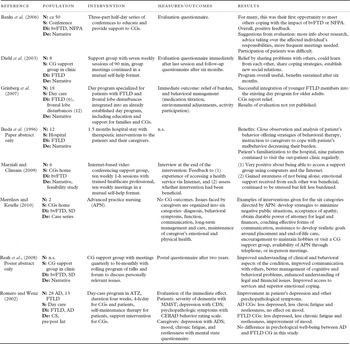
Literature dealing with the interventions for FTLD caregivers is very rare. The systematic literature search did not reveal any published randomized controlled trials. Seven papers and one poster abstract were found on this topic, all of which represented either observational studies or narrative reports. Studies are alphabetically listed in Table 2.
Literature on caregiver interventions in FTLD

AD = Alzheimer's disease; ADS = Allgemeine Depressions-Skala general depression scale; APN = advanced practice nursing; ATZ = Alzheimer Therapie Zentrum, Alzheimer's therapy center; bvFTD = behavioral-variant FTLD; CDS = Cornell Depression Scale; CERAD = Consortium to Establish a Registry for Alzheimer's Disease; CG = caregiver; CS = cross-sectional; De = design; Di = diagnosis; FTLD = frontotemporal lobar degeneration; MMSE = Mini Mental State Examination; n.s. = not specified; NFPA = non-fluent progressive aphasia; S = setting; SD = semantic dementia.
Four studies reported on caregiver support groups (Diehl et al., Reference Diehl, Mayer, Förstl and Kurz2003; Banks et al., Reference Banks, Rogalski, Medina, Skoglund and Morhardt2006; Reah et al., Reference Reah, Julien, Stopford and Thompson2008; Marziali and Climans, Reference Marziali and Climans2009).
In a pilot project, Diehl et al. (Reference Diehl, Mayer, Förstl and Kurz2003) conducted an FTLD caregiver support group with eight participants in seven weekly physician-moderated sessions of 90 minutes. Topics comprised both educational (information on medical, legal, financial, and insurance issues, and information on resources and services) and therapeutic elements (exchange of personal experience, encouragement of mutual support, facilitation of expressed emotion, and development of coping strategies regarding management of behavioral symptoms). The program was evaluated immediately after the last session and after six months. Caregivers felt relieved by sharing problems with others, as they could learn from each other, shared coping strategies, and established new social relations. The program was evaluated in terms of overall usefulness and in benefits sustained after six months. Only three participants reported regarding their own needs more positively as a result of the intervention, even though this issue had been strongly emphasized in the group sessions. Group meetings continued as a self-help group with monthly meetings.
Another support group for carers of SD and bvFTD patients was introduced in a poster presentation (Reah et al., Reference Reah, Julien, Stopford and Thompson2008). Group meetings were held quarterly to bi-monthly with a rolling program of talks covering medical, legal, and financial issues, management of behavioral symptoms and access to support services, and a forum to discuss personally relevant issues. The postal questionnaire to evaluate group meetings after two years showed improved skills in all topics, better communication with others, and superior emotional coping.
Banks et al. (Reference Banks, Rogalski, Medina, Skoglund and Morhardt2006) report on a three-part series of conferences over the course of one year that aimed to educate and provide support to bvFTD and NFPA caregivers. Sessions were of half-day duration starting with one hour of educational lectures and time to ask questions. Topics covered were an introduction to the disorders in session 1, drug treatment and communication in session 2, and caring for the caregiver in session 3. Participants then attended a 90-minute support group comprising 10–15 participants and two facilitators. In a semi-structured setting, participants could get to know each other and shared common coping strategies and practical tips. If crisis situations were identified among the participants, caregivers were referred to an appropriate clinician. During a joint lunch, participants could consolidate acquaintances and interact with clinicians and researchers. The overall feedback was very positive. According to the evaluation questionnaires, caregivers desired more access to research on FTLD and advice about taking over the affected individual's responsibilities (e.g. driving, financial affairs, use of potential dangerous tools, etc.). Participants further acknowledged that there was not enough time to address the needs of everyone and suggested more frequent meetings, i.e. monthly support groups. One difficult issue was the attendance of patients themselves. The presence of individuals with severe impairment was unfortunately upsetting to some patients who were in the earlier stages of the disease. Therefore, when there was a lack of appropriate respite, social care workers helped families with local resources, allowing caregivers to attend the conference.
Computer- and internet-based technology was used to develop a video-conferencing support group (Marziali and Climans, Reference Marziali and Climans2009). Six caregivers of patients with bvFTD attended weekly meetings for ten weeks that were facilitated by a trained healthcare professional. The structured group meetings were followed by ten weekly meetings in a self-help format. All caregivers were very positive about being able to access a support group using computers and the internet. Because of the demands of working full-time, managing household tasks, responding to children's needs, and managing the care of a spouse with bvFTD, using the internet was the only possible option to receive services of a healthcare agency. They gained most through awareness that they were not alone in facing the demands of caring of a spouse with bvFTLD. The emotional support they received from each other was beneficial. Nevertheless, they continued to be stressed, but felt less burdened.
Two studies dealt with day programs for patients and their caregivers (Romero and Wenz, Reference Romero and Wenz2002; Grinberg et al., Reference Grinberg, Lagunoff, Phillips, Stern, Goodman and Chow2007). Grinberg et al. (Reference Grinberg, Lagunoff, Phillips, Stern, Goodman and Chow2007 and Grinberg and Phillips (Reference Grinberg and Phillips2009) introduced a day program especially for patients with frontal lobe disturbances and integrated it into an already established day program for seniors, and evaluated immediate outcome for patients and caregivers. The team initially surveyed caregivers for interest in a new caregiver support group, but then learned that FTLD caregivers prioritized day program services ahead of support groups. The program was integrated into the existing program but extended with the opportunity of more activity. Multidisciplinary staff were specifically educated for FTLD. The program enabled respite for caregivers and also educated them on the disease process, ADL, behavioral management, wandering, home safety, activation at home, and long-term planning. Evaluation of the program has not yet been published.
In a short-term (4 weeks, 4 hours/day) treatment program for FTLD and AD patients and their caregivers, Romero and Wenz (Reference Romero and Wenz2002) evaluated the immediate outcome in a pre-treatment post-treatment design. The program consisted of intensive rehabilitation for patients based on the concept of self-maintenance therapy and an intervention program for caregivers, including relaxation exercises, art therapy, psychotherapeutic conversation, counseling on medical, social, and care issues, and psycho-educative groups. Patients' depression and other psychopathological symptoms improved. Both FTLD and AD caregivers were found to be less depressed, less fatigued, and more restful. FTLD caregivers also experienced improvement in mood.
One study investigated the efficacy of short-term hospitalization on family care for patients with FTLD (Ikeda et al., Reference Ikeda1996). Twelve patients with FTLD and their caregivers were hospitalized for 1.5 months while receiving therapeutic interventions. Close observation and analysis of patients' behavior offered strategies of behavioral therapy, adequate instruction to caregivers, and patients' familiarization to the hospital. The intervention helped to maintain regular visits and to utilize other medical and social resources.
The concept of advanced nursing practice in the caregiving for FTLD patients was applied in a case series of two patients by Merrilees and Ketelle (Reference Merrilees and Ketelle2010). Salient aspects of caregiving are illustrated with corresponding examples of interventions directed by advanced practice nurses. Nurses helped to develop strategies to manage socially unacceptable behaviors. Examples were a letter from the doctor or small business-type cards to be handed out in difficult situations in public. Caregivers were encouraged to accept certain behaviors like apathy but were provided with strategies to offer various choices to an apathetic patient. Advanced practice nurses connected families with appropriate resources, e.g. attorneys. Together with the caregiver, they developed communication styles, emphasizing matter-of-fact responses, distraction, or non-response to repetitive or obsessive conversation topics. They assisted in generating realistic goals around placement and end-of-life care. Caregivers were encouraged to maintain hobbies or visit a support group. Furthermore, the advanced practice nurse was available by telephone or in-person meetings to offer one-to-one support and advice during crisis situations or when care needs shifted. Thus, caregivers could be provided with practical solutions to their unique problems.
Discussion
Burden, problems, and needs of FTLD caregivers
There is no doubt that FTLD caregivers are highly stressed and burdened. Various studies have found a correlation between burden and neuropsychiatric symptoms. Two of them used the NPI and the NPI distress subscale to measure neuropsychiatric symptoms and burden, respectively (de Vugt et al., Reference de Vugt, Riedijk, Aalten, Tibben, van Swieten and Verhey2006; Riedijk et al., Reference Riedijk2006). Since burden was determined to be a function of certain symptoms, the observed correlation could potentially be spurious. However, other studies based on independent burden scales (ZBI or scales for stress and depression) found a correlation of neuropsychiatric symptoms and burden as well (Boutoleau-Bretonniere et al., Reference Boutoleau-Bretonniere, Vercelletto, Volteau, Renou and Lamy2008; Knutson et al., Reference Knutson, Zamboni, Tierney and Grafman2008; Mioshi et al., Reference Mioshi, Bristow, Cook and Hodges2009). So it can be assumed that neuropsychiatric symptoms are one of the sources contributing to the level of burden, as also shown in the literature on burden of dementia caregivers in general (Pinquart and Sörensen, Reference Pinquart and Sörensen2003). But even after hospitalization of the FTLD patient, caregivers were still at high levels of burden and stress although they are no longer confronted with behavioral disturbances in everyday life. There must be other factors possibly concerning the personality and coping ability of the caregiver that play an important role in terms of caregiver burden in FTLD.
The burden of dementia caregivers has been more extensively studied in the case of AD. Characteristics of caregivers, like gender, ethnic background, self-efficacy, use of coping strategies, and attitude toward caring, as well as the patient's characteristics, like changes in behavior and personality and functional dependency, account for individual level of burden. In addition to the availability of formal help and social support, the quality of relationships before the disease, family conflicts, and limitations in social life have been reviewed as important factors contributing to burden (Etters et al., Reference Etters, Goodall and Harrison2008).
Specific problems and needs of FTLD caregivers are likely to contribute to their level of burden. In this paper problems were identified based on the available literature. Systematic analyses of problems do not exist, and there is hardly any literature on the needs of FTLD caregivers. To some extent, identified problems implicate potential needs that will be discussed in the following section.
The problem of delayed diagnosis implies the need for timely diagnosis. This might be addressed by raising awareness of FTLD among primary care physicians, psychiatrists, and neurologists. The development of an integrated care pathway has been proposed to achieve early referral to neurologists/psychiatrists having special interest in dementia/cognitive disorders (Davies and Larner, Reference Davies and Larner2010). Specialists are also able to provide patients and caregivers with specific information about the disease. Families concerned with FTLD need services that are tailored for relatively younger persons. The patients need day-care services and nursing homes that are able to cope with FTLD. Most nursing homes are designed for a much older population of clients and FTLD patients have been declined or discharged because of behavioral disturbances (Diehl-Schmid et al., Reference Diehl-Schmid, Last, Schuster, Förstl, Schneider-Schelte and Kurz2011). The caregivers need self-help groups or interventions for working caregivers that run in the evening. The opportunity to meet others facing similar family situations might help to overcome social isolation and feelings of loneliness and hopelessness. One subject of supporting interventions for caregivers should address the need to learn how to manage behavioral disturbances and cope with passive behaviors such as apathy and depression. Moreover, there are therapeutic needs, including management of negative feelings, negative attitude, and emotional support to reduce burden, stress, and depression, a frequent problem especially among female caregivers.
Furthermore, special support for non-adult children of FTLD patients is required. Better overall awareness that dementia is not exclusively an illness of old age – and associated education programs – could be helpful for the persons concerned.
Because of the lack of data, it is not possible to determine how frequent these needs are and to what extent they are met. The only paper examining the needs of FTLD patients and caregivers (Nicolaou et al., Reference Nicolaou, Egan, Gasson and Kane2010) was conducted in Australia, which used the Camberwell Assessment of Needs in the Elderly (CANE). The CANE consists of 24 patient- and two carer-related domains. “Need for information” and “psychological distress” are the only two carer-related items. More information is needed in order to understand and analyze caregiver needs in more detail. The semi-structured interview, Carer's Needs Assessment for Dementia (CNA-D), was shown to be a valid and reliable instrument to comprehensively study the needs of dementia caregivers (Wancata et al., Reference Wancata2005). Furthermore, a detailed questionnaire was developed by the Netherlands Institute for Health Care Services Research focusing on informal dementia caregivers' problems and support needs. It represents a reliable instrument that has been demonstrated to be comprehensible and applicable to informal caregivers (Peeters et al., Reference Peeters, Beek, Meerveld, Spreeuwenberg and Francke2010).
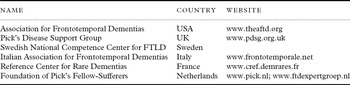
Much more research is necessary to understand the construct of burden among FTLD caregivers, and to quantify their problems and needs. Major limitations of the reviewed papers were the overall small sample sizes of single studies and the recruitment of participants mainly from specialty clinics. Therefore, the generalization of results to the population of FTLD caregivers is limited. Carers' needs might be highly dependent on available services in each country. Regional research projects appear to be necessary in this field. The national associations for FTLD that already exist in a few countries promote the needs of FTLD caregivers and might be possible partners of such projects (see Table 3). The systematic assessment of problems and needs of FTLD caregivers in larger samples of caregivers will reveal unmet needs that can be targeted by service provisions, including caregiver interventions.
International resources for FTLD

Interventions for caregivers of FTLD patients
Clinical research on effective help for caregivers of FTLD patients is scarce. We did not expect to find so few published data on FTLD caregiver interventions, an area that has been extensively studied in the case of AD. One reason might be that FTLD research only receives 10% of the funding that AD research does, and that out of the funds procured for FTLD research worldwide ($432 million), only $1 million have been directed to grants specific to “Disease Management” in the past decade. The majority of funding went toward “Basic and Disease Research” (Walentas et al., Reference Walentas, Shineman, Horton, Boeve and Fillit2011).
No randomized controlled trials on FTLD caregiver interventions exist. We could identify only eight papers describing caregiver interventions in FTLD. Overall, caregivers seem to be mostly satisfied with the various interventions, but structured evaluations are mostly missing or remain very superficial. Long-term effects on depression, burden, and psychological well-being have not been examined. Control conditions are also missing.
Interventions for the caregivers of patients with AD and other dementias were reviewed in a large meta-analysis of 127 studies by Pinquart and Sörensen (Reference Pinquart and Sörensen2006). They classified interventions into six groups. Only psychotherapeutic interventions (applying techniques from cognitive-behavioral therapy) and care management (provided by an individual care manager) turned out to be effective in reducing caregiver symptoms. The significant effect of psychotherapeutic interventions on depression of caregivers was large and the effect on burden was small to moderate. Care management had significant and moderately sized effects on burden. The other types of interventions (psycho-educational interventions, general support, respite care, multi-modal interventions, and training of the care recipient) had very limited, if any, impact on caregiver burden and depression.
A systematic review of psychological interventions for caregivers of AD patients found strong evidence for the efficacy of six or more sessions of individual behavioral management therapy in lessening depression in caregivers immediately and up to 32 months afterwords. Group behavioral management techniques and interventions with fewer than six sessions were not effective (Selwood et al., Reference Selwood, Johnston, Katona, Lyketsos and Livingston2007).
Most of the interventions for FTLD caregivers reviewed in the present paper either represented structured caregiver support groups, including educational and therapeutic elements (Diehl et al., Reference Diehl, Mayer, Förstl and Kurz2003; Banks et al., Reference Banks, Rogalski, Medina, Skoglund and Morhardt2006; Reah et al., Reference Reah, Julien, Stopford and Thompson2008; Marziali and Climans, Reference Marziali and Climans2009) or respite care in combination with caregiver education and support intervention (Ikeda et al., Reference Ikeda1996; Romero and Wenz, Reference Romero and Wenz2002; Grinberg et al., Reference Grinberg, Lagunoff, Phillips, Stern, Goodman and Chow2007). According to Pinquart and Sörensen (Reference Pinquart and Sörensen2006), these types of interventions are not among those found to be effective in AD caregiving in terms of reducing stress, burden, and depression of caregivers. Nevertheless, although quantitative analyses are missing, there are some interesting aspects of FTLD caregiver interventions: First, support groups were reported by caregivers to be a great help, especially if held at least monthly, and, it is possible that caregivers prioritize day care, integrating caregiver support ahead of plain support groups. Second, caregivers are interested in basic research on FTLD. Third the internet is a good alternative vehicle for support groups and for some the only feasible option to attend such a group.
The concept of advanced practice nursing in the case of FTLD is described in one of the eight interventions reviewed here (Merrilees and Ketelle, Reference Merrilees and Ketelle2010) and can be classified as the intervention-type care management with advanced practice nurses functioning as care managers. Unfortunately, no caregiver outcomes are described in the above paper, but advanced practice nursing offers a promising tool individually and effectively to help caregivers of FTLD patients because care management has been shown to have significant and moderately sized effects to relieve the burdens of dementia caregivers (Pinquart and Sörensen, Reference Pinquart and Sörensen2006).
For future interventions for FTLD caregivers, individualized approaches like individualized psychotherapeutic elements and care management elements seem to be the most promising according to the AD literature (Pinquart and Sorensen, Reference Pinquart and Sörensen2006; Selwood et al., Reference Selwood, Johnston, Katona, Lyketsos and Livingston2007). Furthermore, there is evidence that interventions expanding the focus from the caregiver as a person to home environment assessment and involvement of other family members are even more effective (Connor et al., Reference Connor2008).
The management of disturbing behaviors should be a part of a successful FTLD caregiver intervention in every case. Merrilees et al. (Reference Merrilees, Klapper, Murphy, Lomen-Hoerth and Miller2010) suggest behavioral and environmental strategies and strategies internal to the caregiver in order to cope with situations that arise from behavioral and personality symptoms exhibited in FTLD. The benefits of such strategies have not been shown yet.
Computer- and internet-based technology has been shown to be an effective vehicle to deliver interventions to caregivers of dementia patients (Eisdorfer et al., Reference Eisdorfer2003). It can facilitate linkage among caregivers or their families or with supportive resources outside of the home. Helplines can also be offered with this technology providing timely one-to-one advice. Since FTLD is relatively uncommon, caregivers cannot be expected to live in geographical proximity and attend face-to-face counseling and group meetings. Therefore, modern communication technology might play a more prominent role in interventions for FTLD than for AD caregivers. For example, telephone- or internet-based educational and behavior management components could be integrated with onsite individual case management provided by community services.
The papers reviewed in the first part of the present paper have focused on burden, problems, and needs of FTLD caregivers, but have also made suggestions for interventions based on the results of their studies. It has been noted that most caregiver training programs mainly target the patient's behavioral excesses and do not focus on apathy or depression. Since apathy and depression in FTLD patients cause high stress in caregivers, interventions should also incorporate strategies on how to deal with apathy and depression to reduce caregiver distress (de Vugt et al., Reference de Vugt, Riedijk, Aalten, Tibben, van Swieten and Verhey2006). Riedijk et al. (Reference Riedijk2006) suggest that interventions should target passive coping strategies because such strategies are associated with increased burden and decreased health quality of life. In another paper, Riedijk et al. (Reference Riedijk2009b) state that all caregivers – irrespective of the patient's domicile – might benefit from psychological support because even after institutionalization caregivers still had high levels of stress and burden. Kaiser and Panegyres (Reference Kaiser and Panegyres2006) mention that many caregivers highlighted concern about their financial status, and that any intervention has to consider this aspect also.
Future interventions should be conducted in randomized controlled trials of large samples of participants. More funding is clearly needed to develop, conduct, and evaluate potentially helpful interventions. Knowledge about efficient interventions for FTLD caregivers might not only reduce consequential costs of mental health problems of caregivers and early institutionalization of patients but would also provide an ethical and social basis for determining the funding required to assist this highly burdened group of caregivers.
Conflict of interest
None.
Description of authors' roles
Sabine Nunnemann performed the systematic literature search and wrote the paper. Janine Diehl-Schmid designed the study, supervised the systematic literature search, and assisted with writing the paper. Alexander Kurz planned the project and assisted with its writing. Stefan Leucht gave advice and supervised the methodological aspects of the review.
Acknowledgments
The present study was undertaken with the support of a grant provided by the Deutsche Alzheimer Gesellschaft (Alzheimer Association, Germany). The authors wish to thank Antonia Santina Conti for proofreading.