‘General Tudor's Black and Tans’ is no doubt a convenient way of describing this force for controversial purposes … [But] it is worth putting on record that there has been no disturbance of any kind in Palestine since the British Gendarmerie arrived.Footnote 1
The British Section of the Palestine Gendarmerie is one of the most curious episodes in the history of imperial policing. A 760-strong striking force and riot squad, it was raised in early 1922 at the instigation of the secretary of state for the colonies, Winston Churchill, to reinforce the locally recruited police forces of Britain's recently acquired mandated territory which were experiencing difficulties maintaining public order at the time. The original draft of this British Gendarmerie which departed Plymouth for Palestine in mid-April was, through the agency of the Irish police chief and Churchill's close friend, General Hugh Tudor, almost entirely drawn from amongst the Royal Irish Constabulary (RIC) and its auxiliaries, then in the process of disbandment as part of the recent Anglo-Irish settlement.Footnote 2 Given the then international notoriety of the Black and Tans, this caused serious concern and, indeed, by the time the force was disbanded in April 1926, it had itself acquired a reputation for Black and Tan-type behaviour which endures today. Its prospective interest to historians of Ireland, the Middle East, and the British empire notwithstanding, the British Gendarmerie has received little attention in terms of research, meriting no separate studies and, at most, a few pages in histories of the policing of Palestine and the empire.Footnote 3 This perhaps in part derives from the paucity of obvious archival sources: the force's administrative and service records were destroyed when it was disbanded in April 1926 while what records survive at the British National Archives are spread across departments and not yet fully indexed online. This article, based on a range of official and private papers including Colonial Office correspondence, RIC registers of service, British military records, the papers of the principals involved with the force, and documentary material in the possession of the families of individual gendarmes, has a threefold focus. First, it provides the first detailed description of the British Gendarmerie's raising and recruitment and the first accurate analysis of its composition over the course of its four-year career. Secondly, it explores attempts by British officials to obscure the fact that the force was controversially recruited from RIC sources and examines the extent to which its own ignoble reputation was deserved. Finally, it assesses the significance of the British Gendarmerie episode for some wider aspects of Irish and imperial history, particularly our understanding of police behaviour in revolutionary Ireland and the Palestine Mandate.
I
The British Gendarmerie emerged out of Winston Churchill's attempts to solve three interrelated problems presented him by Palestine. Two of these concerned its 7,000-strong British army garrison. First, there was the issue of its expense. The formidable cost of the garrisons of the newly acquired Mesopotamia and Palestine Mandates had begun exercising Churchill during his final months as secretary of state for war and he set its reduction as his overriding objective when he moved to the Colonial Office in February 1921. To this end, he made the establishment within the Colonial Office of a separate Middle East Department (MED) to which he intended to transfer full civil and military responsibility for these territories from the shared control of the Foreign, India and War Offices, a precondition of accepting the seals. With the cost of Mesopotamia's garrison running at over eight times that of Palestine's, the MED first concentrated its attention there, formulating plans to cut British troop levels by two-thirds and replace them with locally raised forces supported by the more cost-efficient RAF. And while Churchill insisted that a similar scheme was required for Palestine, the situation there was, he conceded, problematical as growing opposition to Britain's pro-Zionist policy meant that, ‘so far from this garrison being reduced I am more likely to be confronted with demands for increasing it’.Footnote 4
Secondly, there was the question of the British army's relationship with the civil administration of Palestine's high commissioner, Sir Herbert Samuel. This had by mid-1921 become strained, the result of a gradual breakdown of trust over the army's increasingly unconcealed opposition to the Zionist project. This opposition culminated in a circular issued in October by the general officer commanding the troops (GOC) in Palestine, General Walter Congreve, which, whilst acknowledging that the army was officially apolitical, argued that in Palestine's case, its sympathies were ‘rather obviously with the Arabs’ as the ‘victims of an unjust policy forced upon them by the British Government’.Footnote 5 In Churchill's opinion, ‘any officials, whether civil or military, who are publicly and confessedly opposed to the declared policy of His Majesty's Government should be replaced’ and this, by his own reckoning, included almost 90 per cent of army personnel in Palestine.Footnote 6 Therefore, the army's presence would have to be not just reduced but ultimately removed.
Churchill realized, however, that the army's removal was impossible without reform of Palestine's policing, its unsatisfactory state being the third problem that he confronted. British efforts, ongoing since 1918, to mould the existing Palestine Police force into an efficient unit had ultimately foundered on the rock of the force's overwhelmingly Arab ethnic make-up and the partisanship to which, in a racially polarized society, this inevitably gave rise. That it could not be trusted to police intercommunal conflicts had become evident during serious rioting in April 1920 and May 1921 when Arab police deployed to restore order sided with the rioters and began themselves attacking Jews, leaving Palestine's director of public security, Lt.-Col. Percy Bramley, with no option but to withdraw, disarm, and confine them to barracks. The Haycraft commission of enquiry into the 1921 disturbances believed that inadequate training was the root cause of the problem and remained convinced that an effective civil policing force could be forged in Palestine if this issue was addressed. That there was some basis for this belief was demonstrated by the Palestine Gendarmerie, a locally recruited force officered by British which was raised in the summer of 1921 to assist the police; although composed of both Arabs and Jews it appeared, according to the MED's military adviser, Col. Richard Meinertzhagen, to be ‘animated by an esprit de corps which has successfully stifled religious and racial differences’.Footnote 7 However, Samuel's government quickly decided that this gendarmerie could best support the police by relieving them of the burden of securing the country's frontiers against smuggling and cross-border raids, thereby enabling them to concentrate on regular policing duties. Consequently, the Palestine Gendarmerie was assigned increasing responsibility for border patrols and by the winter of 1921, 90 per cent of its men were engaged in such work. In the meantime, it fell to the British army (notwithstanding its serious misgivings about assuming a policing role) to maintain public order and manage intercommunal conflict. Another policing force of similar reliability to the Palestine Gendarmerie would, therefore, have to be formed if the army was to be removed.
This issue preoccupied Churchill throughout the summer of 1921. In late August, he held a series of meetings with the assistant secretary at the MED, Hubert Young, to work out a scheme for preserving the peace in the British army's absence. Given the promising start being made by the new Palestine Gendarmerie, they first tentatively decided on another such force, a locally raised British-officered gendarmerie to be supported by Indian infantry and cavalry battalions (Indian troop units being considerably less expensive than their British equivalents) and paid for out of Palestine government coffers. Churchill submitted his proposals to the prime minister, David Lloyd George, on 3 September 1921 explaining them solely in terms of economy. The crux of the matter was, he argued, that ‘Palestine simply cannot afford to pay for troops on a War Office scale … [when] what is wanted … is primarily an operation of police.’ He therefore recommended that the army be replaced by a British-officered gendarmerie and police force backed up by two battalions of Indian troops which would be ‘less in number than the present garrison and far cheaper’. In fact, for the current £500 annual cost of one ‘ordinary private soldier … you could easily get … the highest class gendarmerie, like the Cape Mounted Rifles or the Canadian Police’. As in Mesopotamia, such a wide-ranging reorganization of the Palestine garrison could only be achieved through the transfer of military control from the War Office to the MED and Churchill asked Lloyd George for his support in steering this measure through cabinet.Footnote 8
Lloyd George agreed and Churchill asked the MED to formulate detailed proposals for implementing his scheme. However, he had by now begun to think in terms of a purely British gendarmerie rather than one that was merely British-led. This change in thinking was facilitated by developments in Ireland where the relative success of the truce of July 1921 between the Irish Republican Army (IRA) and crown forces raised the possibility of the disbandment of the Black and Tans and Auxiliaries. Churchill hit on the idea of forming the new gendarmerie from their remnants, telling the MED that he would consider taking to Palestine ‘several companies of the Auxiliary Division’ if an Irish settlement was achieved.Footnote 9 In this way, he sought, in the words of MED official Gerard Clauson,
to kill two birds with the one stone, to create a small police force of high individual efficiency which would do the work of a much larger number of troops and be entirely self-contained, getting on without the host of auxiliaries which are so striking a feature of all military budgets, and at the same time to afford employment to a number of demobilized members of the RIC and Auxiliary Division.Footnote 10
According to the deputy secretary to the cabinet, Thomas Jones, Churchill also ‘hoped the Holy Land would afford shelter for the Auxiliaries’ from the IRA, factions of which were conducting a score-settling campaign against RIC personnel in the post-truce period.Footnote 11 Some of these attacks were carried out by so-called ‘Trucileers’, men who joined the IRA after the truce took effect and felt they had something to prove: but most resulted from a general breakdown in IRA discipline in what its director of publicity, Piaras Béaslaí, subsequently described as ‘a country steadily drifting into a state of anarchy’.Footnote 12 Although some policemen were targeted for real or perceived wartime misdeeds, this campaign was largely indiscriminate, RIC membership alone generally constituting sufficient cause for attacks and, in some cases, murder. Indeed, two policemen were killed in the week following Churchill's remark.
Churchill asked that Meinertzhagen contact General Tudor and ‘ascertain from him privately what sort of arrangement would enable us, in the event of an Irish peace, to take over a couple of Black and Tan companies’. But Tudor's advice had evidently already been sought, for when Churchill was informed by MED officials that his proposed arrangement for garrisoning Palestine was too large, as it stood, to represent a cost saving, he suggested that one battalion of Indian infantry be substituted by ‘two companies of auxiliaries on the scale proposed by General Tudor subject to such alterations as climatic conditions may require, these being offset against the present exceptional conditions prevailing in Ireland’.Footnote 13 Meinertzhagen met with Tudor who told him that he could raise a force of 2,000 men complete with officers, transportation, and equipment, all at a reasonable cost. However, Churchill said that he had never contemplated a force of this size; ‘six or seven hundred would be quite sufficient in the first instance, and we can keep another couple of Indian battalions going for the time being till we see where we are’.Footnote 14
With plans for the army's replacement now at an advanced stage, Churchill was ready to press for the transfer of military control of Palestine to the MED. On 12 November, he informed Samuel of his scheme for the garrison's reorganization, explaining that it would enable him to appoint a new pro-Zionist commander and replace most army units with ‘a smaller number of high class white [i.e. British] gendarmerie’ which would ‘be better and far cheaper than British troops with their enormous impediments and administrative services’. In fact, Churchill estimated that these changes would save between £1 and £1·2 million over the subsequent financial year. Samuel declared himself entirely in agreement, although he cautioned that the new gendarmerie should be composed of men ‘of good stamp and well disciplined’. Two weeks later, Churchill finally informed the War Office of his intention to assume military control of Palestine and appoint the RAF as his military agents effective from 1 April 1922 and submitted his scheme to cabinet, including the formation of ‘a Palestine gendarmerie of British nationality of a high individual status, aggregating about 700 men’.Footnote 15
These proposals were discussed at a meeting with the chief of the imperial general staff (CIGS), Sir Henry Wilson, and the secretaries of state of the departments involved on 19 December 1921. Wilson was himself adamantly opposed to Churchill's schemes to remove the military garrisons of the mandated territories which were, he believed, similar to past failed military experiments which had cost Britain ‘hundreds of millions, thousands of lives and the loss, not only of territory, but of prestige’.Footnote 16 Churchill's idea of governing Palestine with ‘hot-air, aeroplanes and Jews with a stiffening of Black and Tans’ (whom Wilson described in his diary as a ‘crowd of wild devils … [and] a gang of murderers’) would doubtless, he wrote Congreve sarcastically, lead to ‘profound peace in that somewhat uncertain country’.Footnote 17 Congreve was equally disparaging: ‘the whole thing is a gigantic swindle by Winston Churchill to get his own way and be free of the War Office and camouflage expense by showing it under several headings’.Footnote 18
Wilson claimed that Churchill openly admitted during the meeting that these schemes were gambles. But according to Meinertzhagen who was present, the CIGS ‘cut a poor figure’ and his arguments were ‘unconvincing and confused’ whereas Churchill was ‘head and shoulders above the rest in ability and his superior intellect dominated the conference’.Footnote 19 Consequently, Churchill's proposals were agreed in principle and approved by the cabinet two days later. The MED met the following day, 22 December, to discuss the raising and maintenance of the British Gendarmerie. Tudor was invited to attend and was formally charged with the creation and administration of the force until its embarkation for Palestine.Footnote 20 He said that he had already made a rough classification of the men likely to be available for recruitment from among the Black and Tans and the Auxiliary Division of the Royal Irish Constabulary (ADRIC) and ‘in what he might call Class A, he could provide between 700 and 800 absolutely reliable men’, adding that many of the best officers and men of the ‘old RIC’ would be available as well. He also outlined his proposals regarding the force's terms and conditions, which he was asked to incorporate into a draft contract of employment.Footnote 21 Tudor submitted detailed estimates of establishment and costs for the British Gendarmerie, including the draft contract, to the Colonial Office on 4 January 1922. The establishment was set at 700 men, divided into a headquarters and sixteen platoons. Enlistment was to be for a one-year fixed term with the option of yearly extensions and pay linked to that of the London Metropolitan Police. Leave accrued at the rate of one month per year and pensions were payable after ten years of service. Tudor's proposals were largely approved at a meeting of the MED one week later and a contract incorporating them was subsequently drawn up.
A British Gendarmerie office headed by a newly appointed temporary adjutant, Captain A. Tyrell Blackett, was opened in the air ministry headquarters, Adastral House on Kingsway, London, to administer the recruitment process. On 10 January, permission was given to the crown agents for the colonies to make arrangements with Blackett for the printing of material relating to recruitment and Tudor was told to proceed with enlistment four days later. Consequently, on 25 January, Dublin Castle sent a confidential circular to all RIC county inspectors (excluding those in Northern Ireland) informing them of the proposal to recruit urgently ‘a limited number of young district inspectors and constables’ for police service in Palestine. Candidates should be ‘unmarried and under thirty years of age, of superior education and first class records. Head Constables and Sergeants up to thirty-five years of age would also be considered’.Footnote 22 Interested parties were first required to submit a one-page application detailing previous army and policing experience, decorations and awards, together with references. Those favourably considered were called for personal assessment and, if successful, sent for medical examination.Footnote 23
Auxiliaries were recruited directly by Blackett's office. Some applied there themselves requesting an interview (for example, John Jeans, a former ADRIC B Company cadet, sent a ‘feeler letter’ to Adastral House requesting an interview which was quickly granted) but most were approached individually by post.Footnote 24 William Crewe, an ADRIC intelligence officer, recorded that he received a letter from Blackett asking him if he would like to enlist as orderly room sergeant. He accepted and was assigned to Adastral House where he was given the task of going through service records of Auxiliary cadets and writing to those he thought suitable to gauge their interest in joining the new force.Footnote 25 Douglas Duff (who, while not a cadet, worked in the ADRIC veterans and drivers’ division) told a similar story, writing that ‘a letter arrived offering me service in the new force … and asking me what rank I would be willing to accept’. He indicated ‘Major’ and three days later received a further letter offering him the position of British Gendarmerie section leader.Footnote 26
II
However, the notorious reputation of the Black and Tans and Auxiliaries meant that the re-employment of ex-Irish policemen was a controversial issue in 1922. Kent Fedorowich has documented how the fear of being associated with these forces led to reluctance on the part of the constabularies of Britain and the dominions to employ disbanded members: ‘the sheer nature of the violence and the role played by the Black and Tans … conjured up scenes of barbarity and brutality’ with which none wanted to be linked.Footnote 27 Similar concerns were expressed regarding the British Gendarmerie, first by Meinertzhagen and later and more anxiously by Samuel, who told Churchill that while he had no objection to the recruitment of ex-Irish policemen into the new gendarmerie provided those selected were of good character, it would be
most desirable, if it could be avoided, that no public announcement should be made connecting the Black and Tans with our Gendarmerie. Their reputation, as a Corps, had not been savoury and if any idea was created in the public mind in England or here that the Black and Tans, or any part of them, were being transferred as a body to Palestine, the new Gendarmerie might be discredited from the outset.Footnote 28
Churchill did not reply until mid-January 1922 when he assured Samuel that, while recruits would largely be drawn from disbanded Black and Tans and Auxiliaries, there was ‘no question of taking over Irish units as such’ and he promised that the ‘connection of [the] new force with Irish auxiliaries will be given as little prominence as possible’.Footnote 29 But cognizance was immediately taken of Samuel's concerns and efforts made to downplay the extent to which the new force would be recruited from RIC/ADRIC ranks. The issue was raised at the MED meeting of 22 December 1921 when it was decided that ‘recruitment and organisation be conducted with a view to eliminating as far as possible the moral connection between the new force and the Irish Auxiliary Division and of disposing of the inevitable idea that we are importing into Palestine the traditions of recent Irish politics’.Footnote 30 According to MED head, Sir John Shuckburgh, ‘it was a matter of political importance that the force should not be transferred as a unit to Palestine. The men should nominally be disbanded as an Irish and re-enlisted as a Palestine force.’ However, realising the impossibility of recruiting large numbers of RIC/ADRIC in secret, he sought a clear ruling from Churchill on the matter.Footnote 31 Churchill told Shuckburgh that the public announcement of the British Gendarmerie's formation was to be made ‘without connection to the Auxiliary Division in Ireland’ and instructed that it be issued from London, not Dublin, so as not to create the impression that the force was to ‘be formed in Ireland out of the elements on the spot’.Footnote 32 The official press communiqué issued on 17 January 1922 therefore made no mention of the RIC, stating simply that the new force would be recruited by special arrangement ‘from existing units to be disbanded during the current year’. However, the Central News Agency in London reported the same day that this referred to the Irish police, leading the government to issue an official denial that it was ‘considering the practicability of employing officers and men of the Auxiliary Division of the Royal Irish Constabulary for police duty in Palestine’.Footnote 33
Dublin Castle was complicit in these attempts to downplay the British Gendarmerie's Irish associations by adopting a selective and semi-secretive approach to its recruitment. It was reported at the time that ‘on disbandment or discharge each [RIC] member … receives a circular stating the conditions of service [in Palestine] … and inviting him to offer for enrolment’.Footnote 34 In fact, C. A. Walsh explicitly instructed that information was not to be generally circulated but that those considered suitable should be individually approached. He sought to conceal the force's Irish origins by stipulating that no actual recruitment take place in Ireland: rather, the details of those that could be personally recommended and were willing to serve should be submitted to Blackett in London. Tudor too was instructed that all enlistment had to take place outside Ireland and, in a further attempt to obscure the British Gendarmerie's RIC/ADRIC roots, his proposed nomenclature for certain of its ranks such as ‘under-officer’ and ‘cadet’ was vetoed by Churchill who argued that they would ‘unnecessarily emphasize the connection between this force and the Irish Auxiliary Division, which for various reasons is undesirable’ and stipulated that they be replaced with ‘sergeant’ and ‘constable’ instead.Footnote 35
On 11 February, Tudor advised the Colonial Office that a commandant would have to be appointed and the selection process opened immediately if the British Gendarmerie was to be ready for the deadline of 1 April. He strongly recommended the director of Irish intelligence and his own deputy chief of police, Brigadier-General Ormonde de l'Épée Winter, for the post, telling Churchill ‘there is no one would do the job better’. Winter had the added advantage of knowing the material from which the force was to be drawn and would ‘be able to avoid taking men who are best left out’.Footnote 36 However, Meinertzhagen told Shuckburgh that Winter would be entirely unsuitable and claimed that the War Office agreed. Meinertzhagen would not commit his criticisms of Winter to paper but they probably derived from his unorthodox style and controversial record which had divided opinion in Dublin.Footnote 37 He proposed instead Col. Angus McNeill, a forty-seven-year-old Boer War and First World War veteran whom he described as, not only well acquainted with Palestine, but ‘devoted to the country and a great believer in its future’. In fact, Meinertzhagen had informally approached McNeill the previous day to gauge his interest and had received a positive response. He was subsequently appointed by Churchill on 17 February. McNeill was not, however, their first choice for the post. Meinertzhagen had drawn up a shortlist of six others, of whom four turned it down and two were unavailable, while Churchill had recommended Colonel Bernard Freyberg VC who also declined.Footnote 38
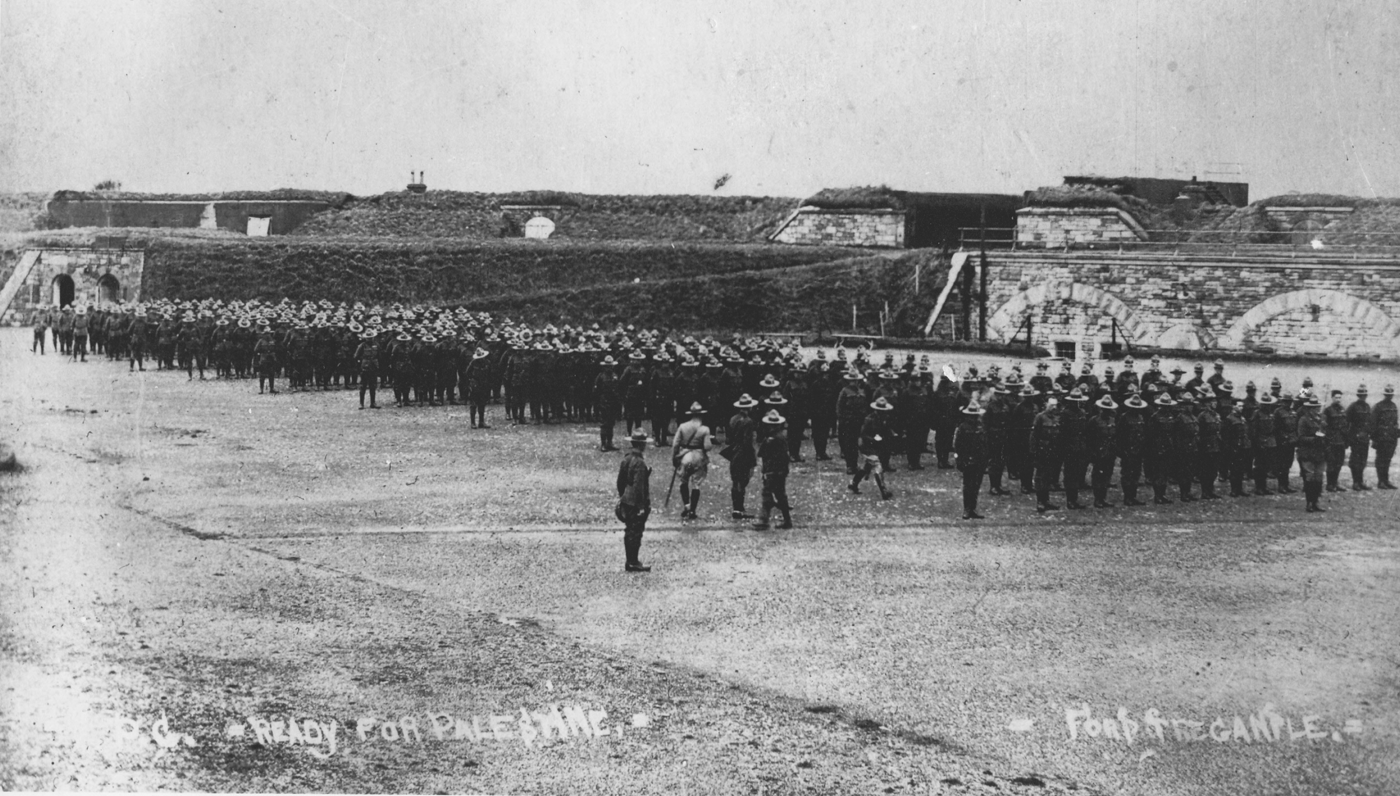
Operating initially out of Adastral House, McNeill immediately began processing applications for the force for which over 900 had already been received, 400 from the ADRIC and more than 500 from the regular RIC. In conjunction with the ministry of labour, he himself took charge of the recruitment of men already disbanded and living in Britain, calling those deemed promising for interview in London. Despite the terms of Walsh's circular and the instructions given to Tudor, interviews were, in the event, also conducted in Ireland, facilitated by McNeill's appointment as his second-in-command of Major Gerald Foley, the recently disbanded RIC county inspector for Mayo. Based at Dublin Castle, Foley immediately began to recruit serving members of the RIC for the British Gendarmerie's other ranks (i.e. non-commissioned officers and constables) and assisting Tudor in interviewing applicants for commissions, all of whom were serving regular RIC officers.Footnote 39 According to one Limerick-based recruit, Walter Harrison, ‘word came round the canteen by word of mouth, and later by notices … Enquiries were made in Dublin and Gerald Foley took the best that came forward’ and sent them to London for a medical examination.Footnote 40 Those successful signed a one-year contract and were given a railway warrant to Plymouth and one pound for expenses and ordered to report to Fort Tregantle, an army encampment near Devonport to await transportation to Palestine (Figure 1).
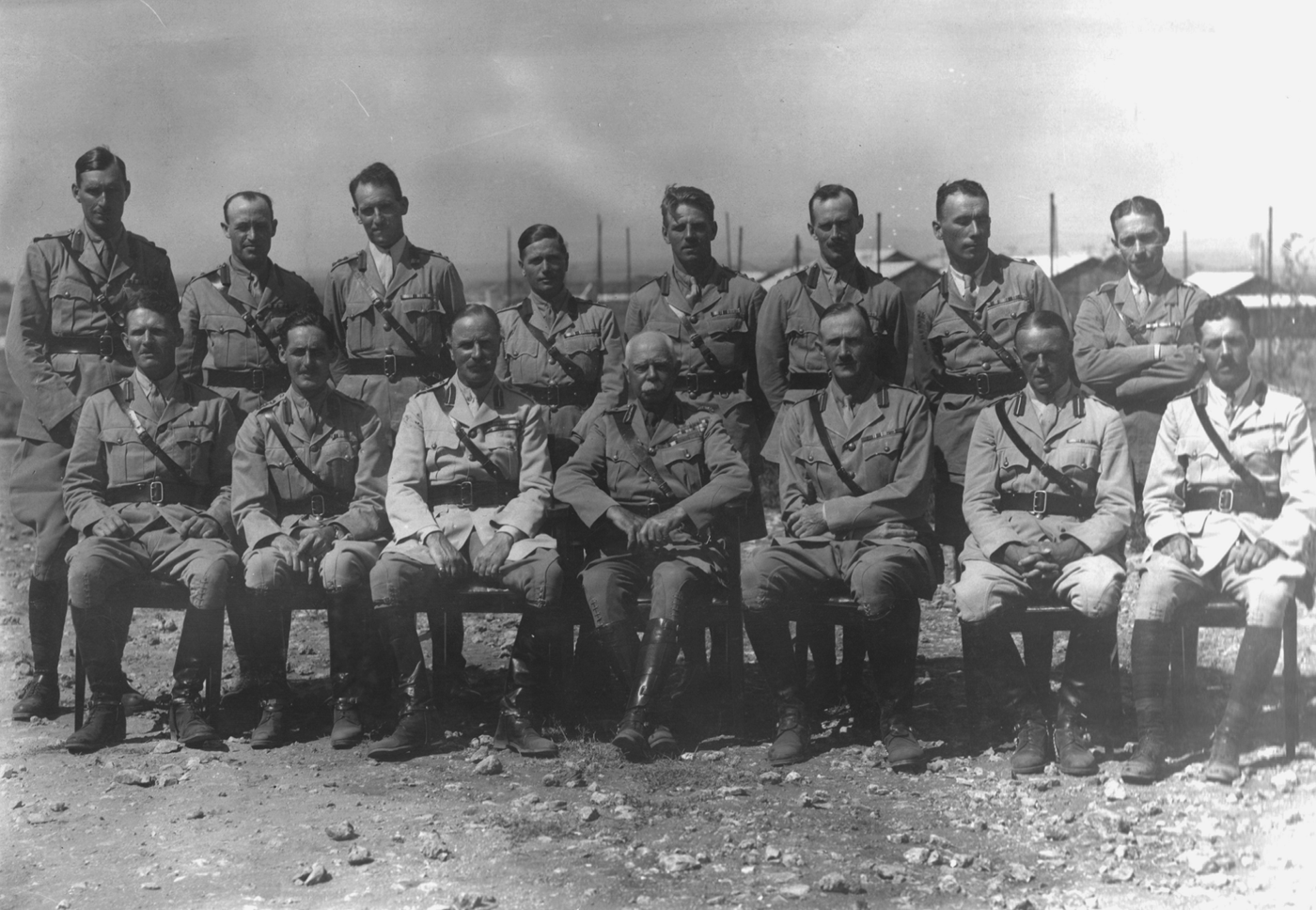
British Gendarmerie officers with Lord Plumer. Copyright D. Blockett.

The original draft of British Gendarmerie recruits was, as intended, overwhelmingly composed of former members of the Irish police, with only what Meinertzhagen called ‘a small sprinkling’ of ‘non-Irish’ applications being ultimately successful.Footnote 41 There has been some confusion over the numbers recruited as part of the original draft. The 1922 Report on Palestine Administration stated that 38 officers and 724 other ranks were recruited, figures repeated in other official publications, while according to a nominal roll of this draft forwarded to Churchill by Samuel in July 1922, it consisted of 41 officers and 719 other ranks.Footnote 42 In fact 42 officers were initially taken on, the nominal roll excluding McNeill's adjutant, Major William Martinson, who resigned from the British Gendarmerie in May 1922, ostensibly on medical grounds, but in reality due to the breakdown of his relationship with McNeill.Footnote 43 And while the nominal roll contains numerous inaccuracies, an examination of the allocation of British Gendarmerie force numbers (which were assigned in numerical sequence in order of enlistment to rankers and were not re-issued when those to whom they were allocated left the force) indicates that its figure of 719 rankers is most likely correct. Certainly, the figure of 724 cited in official publications cannot be accurate as force numbers 723 and 724 were allocated to Constables Robert Croy and George Heal respectively, recruited in November 1922 as replacements for gendarmes that had departed the force by that time.
According to the July 1922 nominal roll, 25 British Gendarmerie officers were recruited directly from the Irish police (16 from the regular RIC and 9 from the ADRIC) as were 690 of the rankers (565 from the regular RIC and 125 from the ADRIC). However, an analysis of the RIC and ADRIC registers of service reveals that these breakdowns too are inaccurate. Of the 42 officers, at least 35 (or 83 per cent) actually came from the Irish police, 21 from the ADRIC and just 9 from the regular RIC. A further 4, Captain Blackett, Major John Kershaw, Major Hallowell Carew, and Lt. John Bockett, were recruited from RIC intelligence, while the force quartermaster, Major Norman Songest, was assistant secretary to Tudor in Dublin Castle. Of the 718 British Gendarmerie other ranks whose prior service it has been possible to establish, 693 were recruited from the Irish police services, 553 of these from the regular RIC and 139 from the ADRIC, while one, Frank Swayne, was working as a clerk in the RIC maintenance office in Dublin Castle.Footnote 44 Of the remaining 25 other ranks, 23 were recruited directly from the British army and 1 each from the Royal Navy and the London Metropolitan Police. Therefore, 95 per cent of the British Gendarmerie's initial intake of recruits had worked with the Irish police.
Unsurprisingly, then, efforts to obscure the British Gendarmerie's Irish associations came to nothing. Indeed, the government's denial that the force was to be recruited from RIC sources was from the start treated as risible. As the London correspondent of the Freeman's Journal pointed out, the phrase ‘existing units to be disbanded during the current year’ used in the press communiqué could only refer to the Irish police while the official denial ‘recalled the late Lord Salisbury's cynical dictum that one should never believe a report about a split in the British Cabinet till it was “officially” denied’.Footnote 45 The day after this denial was issued, the Palestine Weekly briefly reported the fact that the new gendarmerie would be recruited from the RIC/ADRIC and other newspapers followed suit over time.Footnote 46 This was also acknowledged in parliament.Footnote 47
Widespread unease about recent police conduct in Ireland meant that attention focused on the British Gendarmerie's Black and Tans to the extent that the force quickly came to be defined by their presence. For example, in March 1922 the London correspondent of the Freeman's Journal, under the heading ‘Poor Palestine’, stated that the force was composed of ‘some 700 Black and Tans’ as did too the New York Times, while among the questions put to General Congreve at a House of Commons committee meeting in December was ‘how are General Tudor and his Black and Tans getting on in Palestine?’Footnote 48 The same was true in Palestine itself and, by October 1922, Tudor was telling Churchill that the British Gendarmerie had ‘inherited the [Black and Tan] name here’.Footnote 49 Shuckburgh indignantly dismissed the Black and Tan label as ‘a convenient way of describing this force for controversial purposes’, his irritation deriving from the fact that he applied the term ‘Black and Tan’ to the ADRIC alone and therefore considered the British Gendarmerie's Black and Tan contingent to comprise less than 20 per cent of the force.Footnote 50 However, the RIC registers of service illustrate the extent to which its reputation as a Black and Tan force was, in terms of composition, actually deserved. Of the 553 rankers recruited from the regular RIC, 473 were former Black and Tans, thereby accounting for two-thirds of the total initial intake of other ranks. The force's Black and Tan character was underscored by the presence of the 139 ex-ADRIC which were generally conflated in the public mind with the Black and Tans. Taken together then, former members of the Black and Tans and the ADRIC accounted for 85 per cent of the force's initial intake of rankers.
The perception of the British Gendarmerie as a Black and Tan force was further underscored by Churchill's appointment of Tudor to overall command. In light of their long-standing friendship, this appointment has been criticized as one which ‘typified that time-honoured expression, “jobs for the boys”’.Footnote 51 This is, however, unfair. Despite Bramley's not inconsiderable success as director of public security, he was neither liked nor admired in official circles in Palestine. According to Hubert Young, who visited the country in late 1921, he was a man ‘for whom no one that I met … had a good word to say officially’ and he reported having ‘heard on all sides’ of continual friction between him and various district governors and certain of his own subordinates. Bramley also had a fractious relationship with Jerusalem's Government House which was, he believed, overrun with Zionist ‘partisans and idealists … both British and Jew’ who made difficult his department's ‘endeavours to maintain a strictly impartial line of conduct in the non-partisan performance of [its] duties’.Footnote 52 Young therefore deemed it essential that he be replaced by someone who commanded more confidence and respect prior to the British Gendarmerie's arrival and there was near consensus that Tudor was the ideal candidate. Churchill was actually considering Tudor for the post of GOC at the time. But as primary responsibility for public order in Palestine was to be devolved from the army on to the Palestine Police and gendarmeries, Young argued that Tudor (whom he described as ‘a really capable and experienced soldier who knows all about police work’) should be appointed director of the department of public security instead. Meinertzhagen agreed, advising Churchill that Tudor's police and military experience and his knowledge of Arabic, coupled with the fact that he was ‘familiar with the new gendarmerie, [that] they are practically his own child and they know and understand him’, made him eminently suitable for the post.Footnote 53 Churchill ultimately decided to amalgamate Bramley's post with that of GOC and offer it to Tudor. He accepted and assumed command of all civil and military forces in Palestine four months later.
III
Perturbation in Palestine about the recruitment of the British Gendarmerie from RIC sources went beyond the fear that it would be unfairly discredited in consequence. Given the country's volatile state, Samuel held genuine concerns about the importation of large numbers of men of notorious repute, and Churchill found himself repeatedly reassuring him ‘that great care [was] being taken to confine the selection to men of the highest character and record’.Footnote 54 Nonetheless, by the time the British Gendarmerie docked in Haifa in late April 1922, propaganda against the force was, as McNeill subsequently complained, already ‘rife and the smallest incident was ridiculously magnified’, not least by the Palestine administration itself which, according to Douglas Duff, spread ‘a great deal of judicious propaganda’ playing up the force's Black and Tan associations to daunt prospective trouble-makers.Footnote 55 Indeed, Duff recounted being ‘tremblingly’ asked by an Arab brothel-keeper whether he belonged to ‘the new Police which she had heard had been sent to Palestine because of the murders we had committed in some land from which the English had been driven because of our brutalities’.Footnote 56 However, the British Gendarmerie never fulfilled expectations with regard to Black and Tan behaviour in Palestine. Far from ‘going berserk’ as Richard Cahill has recently suggested, its status as a riot squad meant that it spent much of its time at base awaiting emergencies which required its deployment, its stated purpose being to quell public disturbances ‘in the early stages before the situation had become sufficiently serious to call in the assistance of the purely military forces’.Footnote 57 As one Colonial Office official colourfully put it, McNeill and his men appeared to be ‘waiting expectantly for the veil of the Temple to be rent in twain’ while, in the meantime, doing ‘nothing in particular’.Footnote 58 Moreover, so fearsome was the force's prior reputation that when it was deployed, its mere presence, coupled with what Meinertzhagen called ‘the moral effect’ of the appearance of these men of ‘exceptional physique’ on horseback or in armoured cars, was frequently sufficient to maintain or restore public order.Footnote 59 The robustness of the British Gendarmerie's approach on the rare occasions when it was required to ‘get physical’ (which consisted of charging the crowd, usually mounted, and savagely beating it back with rifle-butts and batons) served only to enhance its reputation for what Duff termed ‘prowess and bloodthirstiness’ which enhanced its deterrent capabilities in turn.Footnote 60 Indeed, after one such show of force in Nablus in October 1922, the chief secretary to the Palestine government, Wyndham Deedes, told McNeill that news of the incident ‘had had a very good effect all over Palestine’ and McNeill himself attributed the fact that there was little public disturbance on the anniversary of the Balfour Declaration two weeks later (which had been marked by intercommunal rioting the previous year) and just one other serious incident during the force's four years of service to the strong impression his ‘band of toughs’ had quickly produced.Footnote 61
Fears that the British Gendarmerie would prove as indisciplined as its Irish ‘parent’ forces also proved unfounded. Disciplinary problems, largely deriving from drunkenness, did arise at Fort Tregantle and, despite efforts to ensure that, as one staff sergeant put it, ‘the Irish way of things was not going to enter into the picture at all’, they did persist in Palestine itself.Footnote 62 Within two weeks of the force's arrival, the wife of the attorney-general in Jerusalem, Helen Bentwich, was describing ‘a rough-looking lot’ who were ‘already … painting Jaffa red’ and who (the Bentwichs being idealistic Zionists) did not ‘fit in with the scheme for a moral Utopia which we were rather aiming at here’.Footnote 63 An exasperated McNeill (‘why the dunce can't they behave themselves instead of carrying on like undergraduates at a boat race night?’) sought to curb such behaviour by imposing severe fines on those involved and temporarily placing Jaffa and surrounding villages out of bounds.Footnote 64 A small number of the worst offenders were eventually dismissed. McNeill had considerable success and by December 1922 Meinertzhagen could tell the Colonial Office that ‘their standard of discipline and efficiency is high’, a view shared by Samuel, Tudor, and McNeill.Footnote 65
Yet, the British Gendarmerie continued to be viewed in England through the prism of its origins rather than its actions and, as late as December 1922, the colonial under-secretary, William Ormsby-Gore, could still note ‘the wide feeling in all [British political] parties about the Black and Tans in the Holy Land’.Footnote 66 This feeling was only gradually assuaged by positive appraisals of the force's performance by Palestine's civil and military authorities, including Samuel who remarked that his was ‘certainly given without any prejudice in favour of Black and Tans!’.Footnote 67 By January 1923, Tudor was reporting that the British Gendarmerie had ‘quite outlived “Shinner” propaganda out here anyway’ while, two months later, Meinertzhagen told Shuckburgh that ‘the Black and Tan stigma originally attaching to it [had] vanished completely’ in Palestine.Footnote 68
This process was facilitated by the dilution of the British Gendarmerie's ‘Black and Tan’ character over the course of its career, the result of changes in personnel which saw the proportion of former Irish policemen diminish with each passing year. Georgina Sinclair states (on the basis of a single document concerning RIC pensions) that 151 former RIC of all ranks were still serving in the British Gendarmerie in 1926.Footnote 69 However, an analysis of surviving force nominal rolls and other sources provides a more accurate picture.Footnote 70 This indicates that 251 of the 761 members of the original 1922 draft of British Gendarmerie officers and men were still serving in 1926, 234 of whom had been recruited from the Irish police services. Of the 719 rankers, 229 were still serving in 1926, 217 of whom had been recruited from the Irish police (156 from the Black and Tans, 51 from the ADRIC, and 10 from the ‘old RIC’).
Of the 476 rankers recruited from among the Irish police services who departed the force during its four years in Palestine, 32 did so in 1922 when 21 resigned, 9 were dismissed, and 2 deserted. A further 5 were invalided out in January 1923 while another 14 died during the 1922–5 period. The majority of the remainder left at the expiration of their initial one-year contract in April 1923. Edward Horne claims that McNeill used this as an opportunity to weed out ‘certain undesirable elements’ thereby discharging one quarter of the force. And although, as already noted, McNeill had largely resolved disciplinary problems by this time, he did acknowledge using contract non-renewal to remove a few remaining ‘bad hats’.Footnote 71 However, most of the gendarmes who exited the force in 1923 (and that approximately 340 new gendarmes were recruited as replacements indicates that in fact up to half of the original draft of rankers left at this time) did so of their own volition, mainly on account of their unhappiness with life in the force. Indeed, the Irish Times's ‘police expert’ column noted in July that ‘numbers of the men returning from Palestine … were not over-pleased with their experiences’.Footnote 72
Many disliked the British Gendarmerie's paramilitary character and ethos (the military-style discipline and daily drill particularly rankled), objecting in principle to being treated like troops and not the civil policemen they believed themselves to be. Some were bored by their riot squad role which saw them, as one Colonial Office official subsequently put it, spending long periods ‘marking time between successive emergencies’ while others, like John Fails, found the climate of Palestine oppressive.Footnote 73 But, in most cases, disaffection crystallized around certain of the British Gendarmerie contract's conditions. The first was its one-year fixed term, the uncertainty of which, Meinertzhagen argued ‘prevents the men from entertaining any idea of permanent employment’.Footnote 74 McNeill agreed, telling the head of the Zionist Commission, Col. Frederick Kisch, in February that over 200 gendarmes had announced their intention to resign on the issue and he was still citing the absence of an extended contract as the primary cause of the exodus eighteen months later, arguing that ‘a man naturally jumps at a job at home rather than stop on in the Force with the chance of being axed at the end of a year's service’.Footnote 75 The second was its stipulation that the payment of RIC pensions be suspended for the duration of British Gendarmerie service. Samuel believed up to one third of the force might resign on this issue and Tudor agreed, telling the RAF chief, Sir Hugh Trenchard, that ‘we are losing about 230 of the best’ on its account and warning of further losses if rumours that the Egyptian government was setting up a gendarmerie-style force transpired to be true.Footnote 76 While the suspension of existing police pensions was the norm for those accepting employment in other pensionable British forces, the men agreed with Meinertzhagen that the British Gendarmerie, being ‘raised on a yearly contract with no guarantee of continuance’, could not properly be deemed a pensionable force and the non-payment of RIC pensions was therefore unfair.Footnote 77 The Colonial Office refused to address either issue; the result was mass resignations, almost all of them ex-Irish police. The absence of listings of those resigning or relevant nominal rolls precludes a detailed breakdown of the approximately 130 RIC/ADRIC departures which took place in the 1924–5 period.
The recruitment of replacements for rankers exiting the British Gendarmerie did not arrest the decline of its ‘Irish’ contingent. Between September 1922 and January 1924, approximately 370 men were taken on for this purpose, only a handful of whom were ex-RIC/ADRIC. With the exception of twelve transport specialists, no further enlistments took place after this point as plans to wind the force down as part of yet another reorganization of the Palestine garrison gained pace. In the spring of 1925, force strength was reduced to 453 and there it remained until disbandment one year later. Given this reduction in numbers, former Irish policemen still accounted for about 50 per cent of those serving at the end. Unlike the rankers, the British Gendarmerie's officer class retained its ‘Irish’ cast. Although just eighteen of the thirty-five officers recruited from the Irish police services in 1922 were still serving in 1926 (some five from the regular RIC, nine from the ADRIC, and four from the administrative and intelligence services), the facts that the authorized establishment strength of the officer corps had been reduced to thirty-three, and that replacement officers had been recruited from the British Gendarmerie's other ranks (nine of the eleven men commissioned during the force's four years were promoted from the ranks, eight of whom were ex-ADRIC and one ex-‘old RIC’) meant that the percentage of ‘Irish’ officers remained largely unchanged at about 83 per cent. Most of those departing simply resigned although at least four were effectively dismissed under the cover of contract non-renewal (Figure 2).
British Gendarmerie at Fort Tregantle. Copyright R. Porter.
The British Gendarmerie's Black and Tan complexion further paled with the removal of Tudor from its helm in April 1924. Ostensibly, this was due to the abolition of the combined civil/military command but this was itself the direct result of his refusal properly to manage the role. For, despite having been instructed by Churchill to keep his military and civil functions ‘entirely separate … and discharged through separate channels’, Tudor actively blurred them entirely.Footnote 78 This was particularly pronounced in the case of the British Gendarmerie which, while paramilitary in character, formed part of Palestine's civil forces. Yet, Tudor insisted on using his GOC staff to administer the force and addressing all correspondence on its affairs to the air ministry instead of the Colonial Office. One month after Tudor's arrival in Palestine, Trenchard wrote asking him to desist from this practice, even enclosing transcripts of minutes by air ministry officials expressing bafflement as to why Tudor was referring British Gendarmerie business to them instead of their Colonial Office counterparts. Yet, Tudor persisted to the fury of both departments.Footnote 79
According to Clauson, Tudor's behaviour stemmed from his sheer inability, as a life-long soldier, to think along civil lines, arguing that while his appointment as police chief in Ireland had been technically a civil one, it was in essence a military position in that Ireland was a war-zone and the RIC a military force during the period of his command. Tudor was, as a consequence, entirely ignorant of the manner in which an ordinary police force was administered and had therefore run the British Gendarmerie ‘on the same lines as the Auxiliary Division in Ireland, that is on military lines’.Footnote 80 Orders given by Palestine's civil authorities were treated ‘with disrespect whenever it [suited] him to do so’ and he was ‘constantly adopting an attitude of independence’ towards Government House in Jerusalem, angering Samuel who actually shared his view of the British Gendarmerie as, primarily, a military force.Footnote 81 According to McNeill, Samuel had little time for Tudor on a personal level either, being particularly exercised by his effective abandonment of his wife and children, the details of which were being publicly aired in the summer of 1923.Footnote 82 And while Trenchard thanked Tudor on his retirement ‘for making our task here as easy as possible in running a new responsibility’, he had created so many problems for air ministry officials that, according to Clauson, they were firmly convinced that he had a fixed policy of obeying orders only when it suited him to do so.Footnote 83 McNeill also found Tudor impossible, describing him as ‘quite the worst commander I had ever served under’ – dictatorial, capricious, and completely lacking in communication skills. Writing in his diary the day Tudor departed, he wrote: ‘I never wish again to serve under such a man. He has been no use to us officially or socially since he dropped out of the clouds … 21 months ago.’Footnote 84
Nevertheless, the British Gendarmerie was generally considered a success by those on the ground in Palestine. Two years after its arrival in Haifa, Meinertzhagen was describing it as ‘the backbone of the defence and security of Palestine’ and Samuel agreed, telling McNeill that ‘he depended on [it] entirely … for political peace’.Footnote 85 Therefore, the announcement of its disbandment in spring 1926 was met with dismay, at least among Britons and Jews. Describing it as ‘a disagreeable surprise’, the Palestine Weekly said the force had become an institution and that the sense of security felt by its inhabitants during times of trouble ‘was associated with the close proximity of a company of British gendarmes to a number of centres in the country’ while the semi-official organ of the Anglican church in Palestine, Lines of Communication, also lamented the loss of this ‘very efficient body of men’. Churchill, now chancellor of the exchequer, was also despondent: ‘how foolish the colonial office have been to deprive themselves of this admirable instrument just as it has been brought to a high standard of efficiency’.Footnote 86 Writing in the late 1930s, Charles Gywnn went so far as to state that the British Gendarmerie ‘brought about its own dissolution by the very effectiveness with which it had maintained order’ in Palestine.Footnote 87 While this may be an overstatement, the fact that the force's period of service was the quietest of the entire Mandate era was undoubtedly due, in large part, to its presence.
IV
The view that the British Gendarmerie ‘went berserk’ in Palestine is, therefore, based on assumption rather than evidence and the ‘notorious reputation for ruthlessness’ that Fedorowich claims it established derived more from preconceptions and prejudice about its composition than its actual conduct.Footnote 88 Although the loss of its records precludes a comprehensive analysis of force discipline, the available evidence does not support claims of a problem on an ‘Irish’ scale. For example, copies of force orders covering a four-week period in autumn 1924 sent to the Colonial Office to aid its investigation of one such claim record a weekly average of just twelve gendarmes punished for disciplinary offences in a force then about 600-strong while the offences themselves were, without exception, of a trivial nature, the vast majority concerning unauthorized absences.Footnote 89 Surviving files on British Gendarmerie dismissals indicate that the number of very serious offences was also relatively small.Footnote 90 The dismissal rate for the force was just 2 per cent over the course of its first two years which compared very favourably with the rate among the Black and Tans and Auxiliaries in Ireland, which W. J. Lowe estimated at 4.7 per cent of the total, a figure rising to almost 7 per cent if one includes those recorded under what he termed ‘the ambiguous category discharged’.Footnote 91 And indeed almost 8 per cent of the sample of Black and Tans analysed by D. M. Leeson was dismissed.Footnote 92
Nor can the British Gendarmerie's approach to policing be equated with those of its ‘parent’ forces in Ireland. First, while its method of quelling civil unrest was occasionally aggressive, the violence it involved was non-lethal and both limited in intensity and targeted in scope, unlike the extreme, indiscriminate and often deadly violence used against non-combatants in Ireland. Indeed, Samuel lauded the gendarmes’ ability to ‘dispose of an unruly crowd at the cost of a few bruises when a company of [troops] would probably find themselves obliged to fire’.Footnote 93 Secondly, there was no parallel in Palestine with the policy of reprisals sanctioned by Tudor against Irish Republicans and their communities for attacks on the RIC. Retaliation for attacks on the British Gendarmerie confined itself to hunting down the perpetrators alone: even in cases where gendarmes were killed, the force did not wreak revenge on the wider Arab community. In fact, the collective punishment that came to define the Irish reprisals’ policy was reminiscent of the ‘Turkish methods’ the British Gendarmerie deliberately eschewed, this despite the fact its failure to apply such methods was, according to Tudor's deputy at the department of police and prisons, Arthur Mavrogordato, ‘interpreted as a sign of weakness’.Footnote 94
This reappraisal of the British Gendarmerie's reputation has important implications for an understanding of police behaviour during the Irish revolution. That a force originally drawn from the freshly disbanded Black and Tans and Auxiliaries did not behave with similar licence lends support to Leeson's thesis that historians have tended to overvalue character-based or dispositional explanations at the expense of circumstance-based or situational assessments when analysing police conduct in Ireland; that the savagery the Black and Tans and Auxiliaries there displayed derived, not from their low moral character or their brutalization during the Great War, but from the situation into which they were thrust – a vicious guerrilla insurgency against which they formed an inadequate front line: ‘terrorised by the guerrillas, and shunned by the people: enraged by the deaths of their comrades, and inflamed by drink; incited by their officers, and encouraged by faint official censure – the police took to reprisals as a form of rough justice’.Footnote 95 According to Leeson, ‘even ordinary men would have committed atrocities under circumstances like these’.Footnote 96 But these men operated in a very different environment in Palestine. Despite the persistence of the Arab–Jewish antagonisms that had given rise to the bloody clashes of 1920–1, the country was largely peaceable when they arrived in April 1922 and remained so during their four years of service. Moreover, and perhaps more importantly, they were not a target for violence during this time: what outbreaks did occur in the 1922–6 period were inter or intracommunal and not directed against the British administration or its security forces. Therefore, the stresses and strains under which they had laboured during the Irish revolution were entirely absent in Palestine and indeed Tudor himself described the country as ‘a rest cure after Ireland’.Footnote 97 That the British Gendarmerie would have behaved in a very different way had it found itself the focus of an IRA-style insurgency was indicated by McNeill's proposals for tackling the 1936–9 Arab Revolt in Palestine: ‘I should try to spread terror in the land … you would only have to be really brutal and bloodthirsty for about a month and [the Arabs] would be eating out of your hand.’Footnote 98
This reassessment of the British Gendarmerie's record also calls into question prevailing views of police brutality during the rest of the Mandate period. Building on the belief that, predisposed towards violence because of its RIC roots, the force ‘went berserk’ in Palestine, historians have provided dispositional explanations for the frequently savage response of its successor, the British Section of the Palestine Police (BSPP), to the Arab and Jewish revolts against British rule. Charles Townshend, for example, attributes it to that fact that the BSPP was, through the British Gendarmerie, ‘directly descended from the Black and Tans’ while Anne Dolan interprets BSPP brutality as the ‘immediate legacy’ of the Black and Tans.Footnote 99 Nick Kardahji agrees, describing the influence of former Black and Tans on the BSPP as ‘pervasive and pernicious’ while Charles Smith goes so far as to claim that the manner in which he believes former Black and Tans shaped the force led directly to the ‘special squads’ and the Farran affair which he describes as ‘a logical extension of what had been created in the earliest days of the Mandate’.Footnote 100 In fact, police brutality during the Arab and Jewish insurgencies derived largely from circumstance, highlighting the wider applicability of Leeson's thesis about the primacy of situational factors. During the Arab Revolt, the BSPP found itself, like the RIC before it, forming the front line against a guerrilla campaign which its recent ‘civilianization’ under its inspector-general, Roy Spicer, had rendered it utterly incapable of handling.Footnote 101 This inevitably resulted in what has been described as a ‘systematic, systemic, officially sanctioned policy of destruction, punishment, reprisal and brutality’ by the British military and police which was immediately compared to that which had prevailed in Ireland fifteen years earlier.Footnote 102 Just two months into the revolt, the Anglican archdeacon for Palestine, Rev. Weston Stewart, declared himself ‘seriously troubled at the “Black and Tan” methods of the police, of which I have overwhelming evidence’. By September 1938, Palestine's high commissioner, Sir Harold MacMichael, was acknowledging ‘occasional … black and tan tendencies’ among the police while in November, the military governor of Jerusalem, Major-General Richard O'Connor, was also referring to their ‘black and tan methods’.Footnote 103 Despite being even more untrained for and unsuited to counter-terrorism than it had been in the 1930s, the BSPP once again found itself forming ‘the first line of defence’ against the Jewish Revolt of 1944–8 and ‘supposedly the chief means of rooting it out’, and the strain under which this placed the force led to an occasional collapse of discipline and morale and the emergence of ‘Black and Tan’ tendencies.Footnote 104
Historians have, in any event, over-estimated the extent to which the BSPP was actually descended from the Black and Tans. It has generally been assumed that the BSPP's original establishment of 5 officers and 212 other ranks (comprising 21 non-commissioned officers and 191 constables) was recruited from the disbanded British Gendarmerie but this was not the case.Footnote 105 While all vacancies for officers and non-commissioned officers were indeed filled from the force, those for constables were undersubscribed. Only 116 of the 351 serving British Gendarmerie constables applied, of whom just 89 were accepted. Over half of this number eventually turned down the offer, leaving just 43 initially desirous of a transfer.Footnote 106 The disappointing level of interest was attributed to the fact that the ‘terms offered on disbandment appear prima facie better then terms of entry to the [BSPP]’ and favourable revision of the latter led to a small number of late applications or reconsiderations.Footnote 107 Nevertheless, the total number of British Gendarmerie constables that transferred was still less than 60, necessitating fresh recruitment in Britain. Thus the overall figure for British Gendarmerie-BSPP transfers (both officers and rankers) was actually under 100, and just 72 were ex-RIC. The presence of ex-RIC was further diluted over the course of the 1930s and 1940s, the result of natural wastage and dramatic increases in the strength of the BSPP. Government of Palestine civil service lists, general service medal rolls, and other disparate sources indicate that only 43 former Irish policemen were still serving in the BSPP during the Arab Revolt which saw a threefold increase in its strength to over 2,800 and that just twenty-five remained during the Jewish insurgency when the force was, on average, 3,000 men strong.Footnote 108 (Figure 3).
British gendarmes in Jerusalem, c. July 1922: John Fails second from right. Copyright R. Fails.
Moreover, while some former Black and Tans and Auxiliaries did hold senior positions in the BSPP during the Arab and Jewish revolts, there is little evidence that they ‘shaped’ the force's approach to policing. Certainly, the drastic developments in BSPP counterinsurgency were instituted by non-‘RIC’ officers or outsiders. The foundations of the harsh response to the Arab Revolt were laid by Roy Spicer who quickly approved the use of what he acknowledged were ‘terrorist methods’, without which, he said, ‘the situation would never be got in hand‘Footnote 109 while the most notorious innovation of this period, the Arab Investigation Centres, in which suspected rebels were interrogated under a variety of Turkish-style tortures, were established by Sir Charles Tegart, the former Bengal police chief and counter-terrorism expert drafted in to reorganize the beleaguered BSPP in October 1937. The Police Mobile Force (P.M. F.), a fully militarized anti-terrorist striking force formed in 1944 as a response to the Jewish Revolt, was the brainchild of Palestine's high commissioner, Sir Harold MacMichael; was approved and established by the inspector-general of the Palestine Police, John Rymer-Jones, a long-serving former army officer and chief constable of the London Metropolitan Police; and commanded by Col. Robin Stable who was seconded from the army for this purpose.Footnote 110 Similarly with ‘special squads’, possibly the most controversial initiative of the entire Mandate era: essentially covert commando-style hit squads, they were established at the behest of Rymer-Jones's successor, William Nicol Gray, the former commander of 45 Commando Royal Marines; were organized and operated by Lt.-Col. Bernard Fergusson who was seconded from the army for the job; and commanded by two former SAS officers, Roy Farran and Alastair McGregor, and worked independently of the BSPP. Even with regard to non-operational matters, the ‘shaping’ influence of the RIC has been overstated, claims concerning the preservation of ‘Irish’-style training under former RIC officers being a case in point.Footnote 111
In terms of Ireland's participation in the imperial administration, the British Gendarmerie episode constituted its official swansong. However, the force did play a part in sustaining Irish involvement with the British empire in the post-independence era. Kevin Kenny has focused on the role of religious missionaries in arguing that ‘Irish activity within the empire, from dying out, entered a new and vibrant phase’ in 1922 but the colonial police service was also important in this regard.Footnote 112 The fact that the RIC was what Sinclair terms the ‘focal point’ for colonial police training meant that Irishmen had always been a feature of these forces: 325 RIC rankers and 24 officers transferred overseas between 1860 and 1922.Footnote 113 But the British Gendarmerie began a new chapter in Irish involvement. Of the 1922 draft of rankers, 38 per cent was Irish-born, all but a handful ex-RIC. Half of these men emigrated to the colonies or the dominions post-Palestine where several remained in policing while twenty-four transferred to the Palestine Police, laying the foundations for an Irish association which lasted until the end of the Mandate: Irishmen accounted for 10 per cent of total BSPP enlistments between 1926 and 1948, several hundreds of whom transferred to other colonial or Commonwealth police forces or obtained other employment in these countries when their service in Palestine expired.
Yet, the impact of British Gendarmerie in this regard could have been greater. By the time recruitment for the force opened in January 1922, Churchill was well aware that great swathes of the ‘old RIC’ and Irish-born Black and Tans and Auxiliaries were in fear for their personal safety on account of the continuing IRA campaign against them, fears shared by General Tudor, who reported that ‘conditions in Ireland are now proving that in a great many parts it would be extremely unsafe for [disbanded] members … to live’.Footnote 114 General proclamations warning them to leave the country on pain of death were being circulated in certain areas while expulsion orders were personally delivered to individual policemen or their families in others. These were not empty threats: at least thirty RIC men were murdered between January and April 1922 as the British Gendarmerie was being raised and recruited, with a further eleven killed in the following two months. More than thirty members of the Ulster special constabularies were also killed during this period.Footnote 115 As noted above, Churchill had expressed the hope in December 1921 that the British Gendarmerie would provide a haven for harassed ex-RIC, and numerous personal testimonies by Irish gendarmes and/or their descendants collected by this author clearly indicate that the force was used for this purpose.Footnote 116 Churchill's restriction of its establishment of rankers to just 700 on grounds of economy calls the sincerity of his solicitude for such men into question, particularly in light of press reports that several thousand applications for the force were received (the overwhelming majority from ex-RIC) and given that the Colonial Office was, at the same time, actively encouraging other overseas police forces to recruit ex-RIC opting for exile with markedly little success.Footnote 117 But as he told Shuckburgh in November 1921 as plans for the British Gendarmerie were being drawn up, ‘everything else that happens in the Middle East is secondary to the reductions in expense’.Footnote 118 Ultimately, this included RIC welfare as well.
Nonetheless, the British Gendarmerie constituted the main conduit for the transfer of ex-RIC personnel from Ireland to the police forces of the empire after 1922: approximately 120 gendarmes recruited from RIC sources transferred to other colonial and Commonwealth services post-Palestine, where several had highly successful careers. In this sense, the British Gendarmerie episode is critical for the coherence of the view, widely held, that the RIC influenced the development of colonial policing in the twentieth century. Building on Charles Jeffries's thesis that the RIC was ‘the really effective influence’ upon its development during latter half of the nineteenth century, it is argued that the transfer of RIC officers and men to the colonial police services in the aftermath of the force's disbandment led to the concurrent transmission of an ‘Irish’ ethos with regard to policing procedure and practice, particularly in relation to counterinsurgency.Footnote 119 According to Anderson and Killingray, ‘while it is not suggested that the same individual officers followed a chain of transfers from Ireland to [a given police force] … it is clear that individuals and ideas passed along the line on a significant scale’ and that ‘the movement of individual [RIC] officers, even of junior rank, may have had more direct influence upon policing practise than any accumulated process of learning achieved by senior commanders and applied to colonial policing as a matter of policy’.Footnote 120 This is an interesting and attractive hypothesis but it demands grounds more relative than the evidence can presently provide: whether approaches to police counterinsurgency in places such as Malaya, Kenya, and Cyprus were informed by the experience of Ireland requires a good deal of further research. What is clear, however, is that, although Anderson and Killingray consider the Palestine Mandate the ‘most notable’ and ‘perhaps the most notorious’ example in this regard, the extent to which the BSPP had an ‘Irish’ ethos has been overplayed. In the final analysis, the ‘Black and Tan methods’ occasionally employed by BSPP officers and men both in Palestine itself and beyond were more likely to have been informed by the experience of Palestine than Ireland.Footnote 121