Time is a fundamental concept in human cognition, and its expression constitutes a crucial element of human language and communication. However, the linguistic device employed for time expression varies across languages (Qiu & Zhou, Reference Qiu and Zhou2012). English, for instance, uses verbal inflections (e.g., suffix -ed, representing past tense) to indicate different tenses, whereas Chinese does not utilise such morphological markers on verbs to locate events on the timeline (Lin, Reference Lin2003b; Slabakova, Reference Slabakova2015). Instead, the Chinese language (CL) uses other linguistic structures (e.g., temporal adverbials, aspectual markers, and speech context) to express temporality, among which the temporal adverbs have essential roles to play (Lin, Reference Lin2003a). Chinese temporal adverbs must be used appropriately, semantically and syntactically, in daily communication to specify the temporal relationships; thus its acquisition is a real challenge to preschoolers. Few studies, however, have comprehensively examined children's acquisition of Chinese temporal adverbs. Therefore, as part of a larger research project investigating Chinese preschoolers’ time expression, the present study is dedicated to examining the developmental trends of temporal adverbs denoting three basic time concepts: past, present, and future.
Time expression in early child language
Typically developing humans are capable of perceiving events in the past, present, and future by locating these happenings on the points along a mental timeline that stretches out from the present in both directions (Hudson & Mayhew, Reference Hudson and Mayhew2011). Considerable empirical evidence has indicated that children can talk about events of the past and the future before they turn two years old (e.g., Ames, Reference Ames1946; Fivush, Gray, & Fromhoff, Reference Fivush, Gray and Fromhoff1987; Nelson, Reference Nelson1989). This time-expressing ability and the associated temporal understanding would mature across the subsequent years of early childhood (Grant & Suddendorf, Reference Grant and Suddendorf2011), as a consequence of the joint effects of the biological, educational, and experiential influences including “brain maturation, experience of the temporal regularities of events, or the emergence of conscious awareness of the passing of time” (Droit-Volet, Reference Droit-Volet2016, p.102).
Weist and his colleagues conducted a series of important cross-linguistic studies to explore the different stages that children undergo in the early acquisition of the temporal system in their first languages (L1) (e.g., Pawlak, Oehlrich, & Weist, Reference Pawlak, Oehlrich and Weist2006; Weist & Buczowska, Reference Weist and Buczowska1987; Weist, Lyytinen, Wysocka, & Atanassova, Reference Weist, Lyytinen, Wysocka and Atanassova1997; Weist, Pawlak, & Carapella, Reference Weist, Pawlak and Carapella2004). This development, according to Weist (Reference Weist2014a), involves the integration of three concepts: the speech time (ST), the event time (ET), and the reference time (RT). In the first stage (12–18 months), although children may have shown their ability to talk about future or past events spontaneously, they do not rely on morphosyntactic structures to do so. This initial phase is thus termed the “Speech Time (ST) System” (Weist, Reference Weist, Fletcher and Garman1986). In the following stage, which is labelled as the “Event Time System” (ET) (Weist, Reference Weist, Fletcher and Garman1986), children (18–24 months) start utilising morphosyntactic structures in their languages to express the temporal relations between the primary events and the speech time. In the third year, as demonstrated by Pawlak et al.’s (Reference Pawlak, Oehlrich and Weist2006) study, young children start entering the stage of the “Reference Time (RT) System”, which is characterised by children's expression of the complex temporal relations among ST, ET, and RT. In the advanced stage of the RT system, which is labelled as “Free RT system” by Weist (Reference Weist, Fletcher and Garman1986), children (36–52 months) gain the ability to introduce a different referential temporal location away from ST and ET and relate the focal event to this newly established time interval. The relocation of children's temporal deictic centre from ST and ET to RT reflects a process of ‘temporal decentering’ (McCormack & Hoerl, Reference McCormack and Hoerl2008), which can be characterised by children's flexible and appropriate use of temporal adverbs (e.g., Kiedyś ‘some time ago’, in Polish) or temporal adverbial clauses (e.g., past when-sentence) (Weist & Buczowska, Reference Weist and Buczowska1987; Weist & Zevenbergen, Reference Weist and Zevenbergen2008). Therefore, investigating children's use of temporal adverbs can deepen our understanding of the development of the linguistic temporal system in the early years.
Temporal adverbs in the Chinese language
Temporal adverbs constitute a large portion of Chinese adverbs (Ma, Reference Ma2010) and play a significant role in time expression. However, Chinese linguists have not yet reached a consensus regarding their definition and categorisation. Li (Reference Li1956) was the first Chinese scholar who used the term ‘temporal adverb’ in his book initially published in 1924, but he failed to provide a clear definition of what exactly they are. In fact, he included a number of temporal nouns in his study.
Contemporary Chinese linguists defined temporal adverbs from the semantic perspective by listing all possible cases (e.g., Lv, Reference Lv1980; Qian, Reference Qian1990). For example, Lu and Ma (Reference Lu and Ma1985) proposed that there are about 130 temporal adverbs in Modern Chinese, whereas Li (Reference Li and Hu1996a) stated that the total number of Chinese temporal adverbs amounts to 116. This discrepancy in the size of the repertoire of temporal adverbs could be caused by linguists’ different subjective understandings and personal judgements. For instance, an important and common classification divides temporal adverbs into three subtypes expressing events happening in three broad time spans: past time, present time, and future time (Bi & Peng, Reference Bi and Peng2002, Reference Bi and Peng2004; Li & Shirai, Reference Li and Shirai2000). Alternatively, temporal adverbs could be classified according to the duration of time they imply (short-term, long-term, and continued) (Zhang, Reference Zhang2002), while in Zhang's (Reference Zhang2004) viewpoint, temporal adverbs are categorised into three subgroups: those indicating the time-point, frequency, and sequence.
In the present study, we took a semantic perspective to analyse Chinese temporal adverbs. This is mainly because the participants of this study are preschoolers, who are in their early stage of developing the cognitive and language ability needed to understand and express temporal notions. They are unlikely to possess a diverse range of temporal words and use them the way adults do. Thus, we define temporal adverbs as adverbs that express the temporality of events, actions, or states. They primarily function as modifiers of verbs or adjectives (Ma, Reference Ma2010; Wang, Reference Wang2017). As Ma (Reference Ma2010) suggested, the temporality conveyed by temporal adverbs includes the following time concepts: past, present, future, duration, sequence, and frequency. This definition is an extension of that given by Zhang (Reference Zhang2006), who did not include the collection of adverbs for sequence and duration. One study conducted by Tse, Li, and Leung (Reference Tse, Li and Leung2012) suggested that this classification of temporal adverbs fits the natural utterances of children who spoke Cantonese, a major variety of the Chinese language. It should be noted that this typology of temporal adverbs does not include temporal nouns such as 今天 jin-tian ‘today’, 上午 shang-wu ‘morning’, or 星期一 xing-qi-yi ‘Monday’.
Acquisition of Chinese temporal adverbs
Recently a couple of scholars have empirically explored how Mandarin-speaking children acquire temporal adverbs. Research evidence has been converging on two major topics: children's production and comprehension of temporal adverbs. Regarding the production aspect, Erbaugh (Reference Erbaugh and Slobin1992) proposed a three-stage model: the proto-temporal stage, the early temporal stage, and the sequenced temporal relations stage. In the first stage, children could only use a few connectives. In the second stage, they begin to produce temporal adverbs, while in the third stage, they start uttering multiple events in a sequenced manner. Chang (Reference Chang1998, Reference Chang2004) found that older Mandarin-speaking children used more temporal devices, including connectives, aspectual expressions, and temporal adverbs, than younger children to make narratives. This age-related increasing pattern was also reported by Fu (Reference Fu2002), who found that the first temporal adverb produced by children was 在 zai ‘in the process of’ (2;0), followed by 就 jiu ‘already’ or ‘right away’, depending on the context, 然后 ran-hou ‘then’, 先 xian ‘firstly’, 马上 ma-shang ‘immediately’, 才 cai ‘just’, 后来 hou-lai ‘afterwards’, and 已经 yi-jing ‘already’ before they turned three. When they reached age four, they began to use 正 zheng ‘in the process of’, 刚刚 gang-gang ‘just’, 忽然 hu-ran ‘suddenly’, and 一直 yi-zhi ‘always’, despite the fact that these adverbs were rarely used. He also found that children's acquisition sequence of temporal adverbs was present time >future time> past time. According to the linguistic evidence provided by him, it is likely that children acquired the early use of the present time adverb 在 zai ‘in the process of’ owing to its frequent use as an indicator of the speech time events. However, this speculation cannot be confirmed due to rather limited evidence provided by the researchers. This acquisition pattern was later verified by Zhou (Reference Zhou2004), who suggested that such a sequence indicates that temporal adverbs denoting the time close to the utterance time and in the near future pose less difficulty for children to acquire than the temporal adverbs relating to things that happened far back in the timeline. However, in Zhou's study, despite the fact that the past-time temporal adverbs occurred later than the other two subtypes, children as young as 1.5 years old have gained the ability to use the perfective marker 了 -le to denote the completeness or termination of an event that happened prior to the speech time. Thus, children's relatively late acquisition of past-time temporal adverbs in these studies does not necessarily mean they are unable to talk about the past event; they might do so via the use of perfective markers instead. Concerning the late acquisition of past time temporal adverbs, Fu (Reference Fu2002) proposed two explanations. First, it may have something to do with the pragmatic features of these adverbs. Usually, children use present and future temporal adverbs to make requests and state their upcoming actions, while they are less interested in making narrations about what they have done in the past. Second, as past-time temporal adverbs are usually combined with aspect markers such as 了 -le (indicating the completion of an event or action) and 过 -guo (indicating an experienced event or situation), in practice it may pose some challenges for young children to acquire them early in life. In general, these studies demonstrated that before Mandarin-speaking children enter primary school, they are capable of producing temporal adverbs featuring various temporal properties. Moreover, temporal adverbs indicating the present time and the future time appear earlier in their language than temporal adverbs relating to past events. This study will further examine these findings with the data elicited from a Chinese corpus.
Regarding the comprehension of temporal adverbs, many Chinese scholars have conducted experiments to explore the patterns and trends. Zhu, Wu, Ying, Zhu, and Zhuang (Reference Zhu, Wu, Ying, Zhu and Zhuang1982) found that, by five years of age, children were able to comprehend temporal words denoting a part of the day such as morning and afternoon. Researchers also drew the order of comprehension as present time >past time >future time. This order gained further support from later studies (i.e., Bi & Peng, Reference Bi and Peng2002, Reference Bi and Peng2004; Zhen & Chen, Reference Zhen and Chen1995). For instance, Zhen and Chen (Reference Zhen and Chen1995) suggested that children showed better understanding of present and past temporal adverbs because these words are associated with tangible experiences that are happening in the moment of speech or relating to events that are still stored in children's memory, whereas temporal adverbs indicating the future are generally linked to a sense of uncertainty.
Interestingly, such a sequence differs from the one mentioned in the previous section. This difference reflected the different experimental designs, subjects’ age groups, and also the potential different developmental trajectory of children's comprehension and production of temporal words. In addition, Zhen and Chen (Reference Zhen and Chen1995) reported that the six-year-olds performed significantly better than the five-year-olds in their comprehension of temporal adverbs denoting the present and the past but not the ones denoting the future, which indicated a partial but noticeable age effect. However, Bi and Peng (Reference Bi and Peng2002, Reference Bi and Peng2004) reported that, among children aged four to six, older children did not demonstrate a significantly better understanding of all temporal adverbs (past, present, and future) than younger children did. Instead, it was during the age period of seven to eight that children made significant progress in their comprehension of all temporal adverb forms. Maturation and education were speculated as the driving forces of this advancement.
In general, the above literature review yields a couple of unresolved issues that inspired the present study. First, there is a shortage of corpus-based research examining Mandarin-speaking preschoolers’ acquisition of temporal adverbs. Although there are a few Chinese studies investigating children's production of temporal adverbs, the sample sizes of these studies were unclear (e.g., Fu, Reference Fu2002; Zhou, Reference Zhou2004), leaving the representativeness of the results of these studies in doubt. Second, children's speaking samples of the previous studies were mostly elicited under contrived experimental conditions, and it is necessary to collect authentic language materials from children's natural utterances in order to understand the natural occurrence of temporal adverbs in their language. Third, as mentioned earlier, previous studies differed in their findings of the developmental pattern of temporal adverbs; thus further study is needed to examine which acquisition pattern children show in their production of temporal adverbs. This study is dedicated to filling these research gaps using the data elicited from the Early Childhood Mandarin Corpus (ECMC; Li & Tse, Reference Li and Tse2011). Accordingly, the following research questions guided the present study:
1. What are the repertoires of temporal adverbs indicating past time, present time, and future time in early childhood Mandarin?
2. What developmental pattern could be observed in Mandarin-speaking children's acquisition of temporal adverbs during early childhood?
3. Are there any cases of misusing temporal adverbs in children's utterance?
Method
The corpus
The Early Childhood Mandarin Corpus (Li & Tse, Reference Li and Tse2011) used in the present study is a comprehensive and inclusive corpus that contains Mandarin-speaking children's natural utterances during 30-minute free-play sessions. In total, 168 preschool children were randomly sampled from eight preschools located in the four major districts of Beijing: Chaoyang district, Dongcheng district, Xicheng district, and Haidian district. The sample represented children from four age groups (ages 2;6, 3;6, 4;6, 5;6) with 21 boys and 21 girls in each age group. All children spoke Mandarin as their native language, and their parents and teachers were also native speakers of Mandarin Chinese at home and in preschool, respectively.
The communication task and transcription of data
Participants of the same age were randomly paired (boy/boy, girl/girl, or boy/girl). They were allowed to play freely in a separate room where a set of toys were provided, which included cooking materials, fruits and faux foods, vehicles, furniture and electrical appliances and hospital materials. Only one dyad of participants was allowed to play in this area at one time. They were encouraged to talk to each other while playing with the toys. Children's natural conversations were videotaped using a digital camera while a trained research assistant observed their activities during the 30-minute free play sessions without making any interventions.
In the transcription stage, we followed the transcription conventions set up in Tse et al.’s (Reference Tse, Li and Leung2012) work. Children's conversations were transcribed by research assistants to a level of detail that captured all words and word fragments (including overlapping speech) audible to the ear, with non-lexical fillers (e.g., ‘uh’) and other vocalisations (e.g., laughter) also included in the corpus. Next, other researchers proofread the transcripts independently against the taped audio clips to ensure the accuracy of the transcription. After that, the final Chinese script was segmented into individual utterances to be coded in the subsequent step.
Coding of Mandarin temporal adverbs
As mentioned previously, temporal adverbs broadly include six temporal concepts: past, present, future, frequency, duration, and sequence. This typology of temporal adverbs has been confirmed by Tse et al.’s (Reference Tse, Li and Leung2012) research. In this study, we focused on the first three subtypes (i.e., past, present, future) when developing the coding book for Mandarin temporal adverbs for two significant reasons. First, these three broad temporal constructs together constitute the most fundamental human perception of the passing of time, stretching from the present to either end of the timeline. Second, a rich body of research has revealed that children as young as two years old have started talking about events happening at the present, past, and future (Fivush et al., Reference Fivush, Gray and Fromhoff1987; Nelson, Reference Nelson1989), and their ability to articulate and understand these basic temporal notions continue to mature as they get older. Therefore, we took the following steps to construct the coding scheme: initially, we identified the temporal adverbs that have been acquired by Mandarin-speaking children according to a number of previous studies conducted by Chinese researchers (e.g., Bi & Peng, Reference Bi and Peng2002, Reference Bi and Peng2004; Fu, Reference Fu2002; Huang & Huang, Reference Huang and Huang2011; Mi, Reference Mi2014; Zhou, Reference Zhou2004). We then expanded our search to studies taking a broader linguistic perspective (e.g., Li, Reference Li1996b; Lu & Ma, Reference Lu and Ma1985; Zhang, Reference Zhang2000; Zhang, Reference Zhang2006). Although these studies varied from each other in their counting of temporal adverbs owing to the researchers’ different inclusion criteria, they provided abundant sources from which we could select the temporal adverbs that might be present in children's natural utterances. In the final step, temporal nouns such as 今天 jin-tian ‘today’, 下午 xia-wu ‘afternoon’, and 星期一 xing-qi-yi ‘Monday’ were excluded from the coding system.
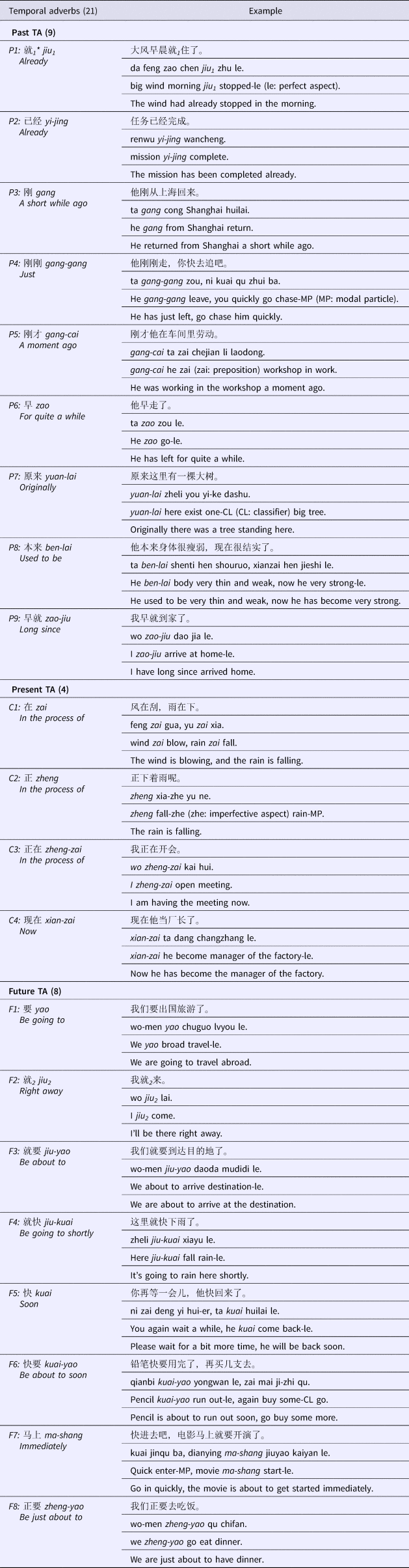
The first draft of the coding book consists of 31 temporal adverbs. One author of this study applied the preliminary coding book to the corpus to extract participants’ natural utterances that contained these target temporal adverbs. In the process of extraction, some cases of temporal adverbs in the coding book generated no outcome from the corpus, indicating that no participants produced these temporal adverbs. Thus, these temporal adverbs were removed from the original coding book. Meanwhile, a few cases of temporal adverbs were added to the coding book as they appeared in children's speeches. The final coding book comprises 21 temporal adverbs altogether (see Table 1). In addition, as some temporal adverbs convey multiple meanings other than the concept of time, and may not function as temporal adverbs (e.g., verbs, nouns, adjectives), we manually excluded them from the dataset. Two authors of the study carefully examined all extracted utterances to ensure that only words used as temporal adverbs were included.
Inventory of temporal adverbs (TA) in Mandarin Chinese

Note.* As 就 jiu can be used as a temporal adverb indicating either past and future, it is distinguished in this inventory by adding a subscript (jiu 1 and jiu 2) to it.
Results
Altogether 813 temporal adverbs were elicited from the corpus, and they were produced by 134 (79.8%) children out of all the participants. Among the 813 instances of temporal adverbs, 760 (93.5%) occurred in full sentences while the rest were found in speeches with missing or unrecognisable segments. Therefore, we focused the analyses on the 760 cases of temporal adverbs. On average, each participant produced 5.7 temporal adverbs during the half-hour free-play session.
The repertoire of Chinese temporal adverbs
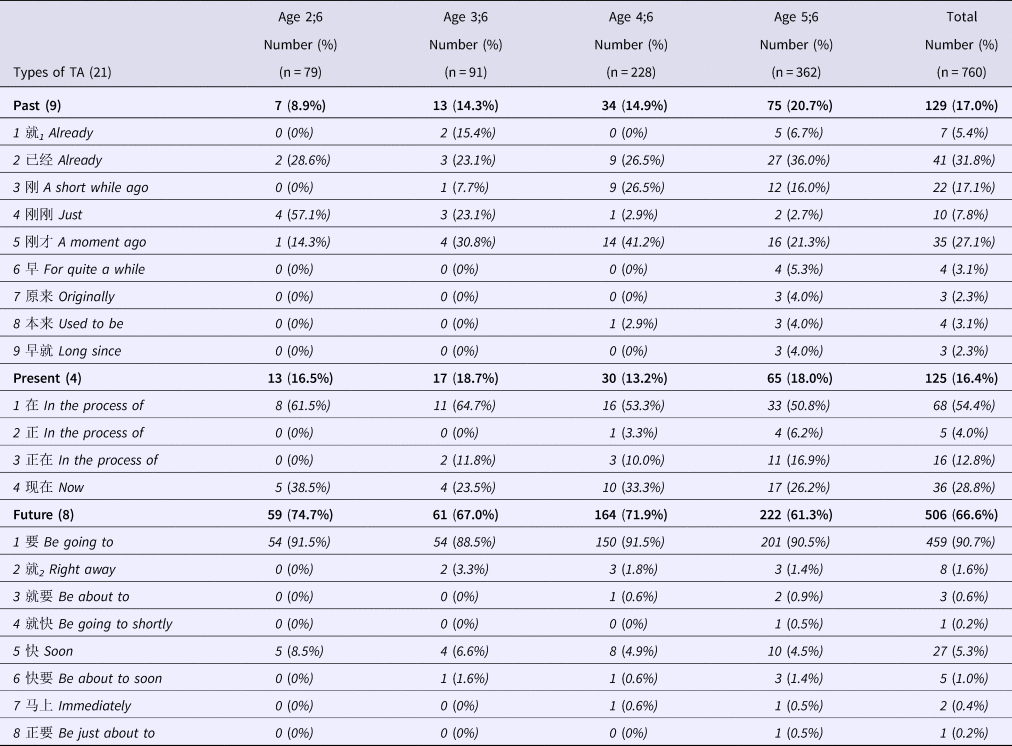
Descriptive analysis was executed to examine all the occurrence of temporal adverbs. Overall, 21 different types of temporal adverbs (see Table 2) were identified from the free speech of children, with those indicating the past and the future representing the richest forms (9 and 8, respectively), and those expressing the present the least (4). As shown in Table 2, temporal adverbs expressing the future were used nearly twice as much (506) as those indicating the past and the present combined (129 and 125, respectively). In particular, the most frequently used temporal adverb was 要 yao ‘be going to’ (459), which constituted 60.4% of all temporal adverbs in this corpus. It was followed by 在 zai ‘in the process of’ (8.9%). The least used temporal adverbs were 就快 jiu-kuai ‘be going to shortly’ and 正要 zheng-yao ‘be just about to’, with each representing only 0.1% of all occurrences.
The distribution of temporal adverbs (TA) across different age groups

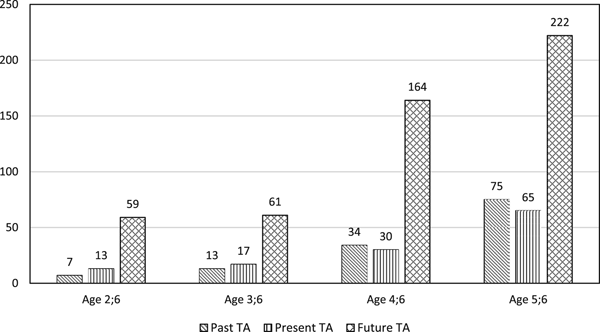
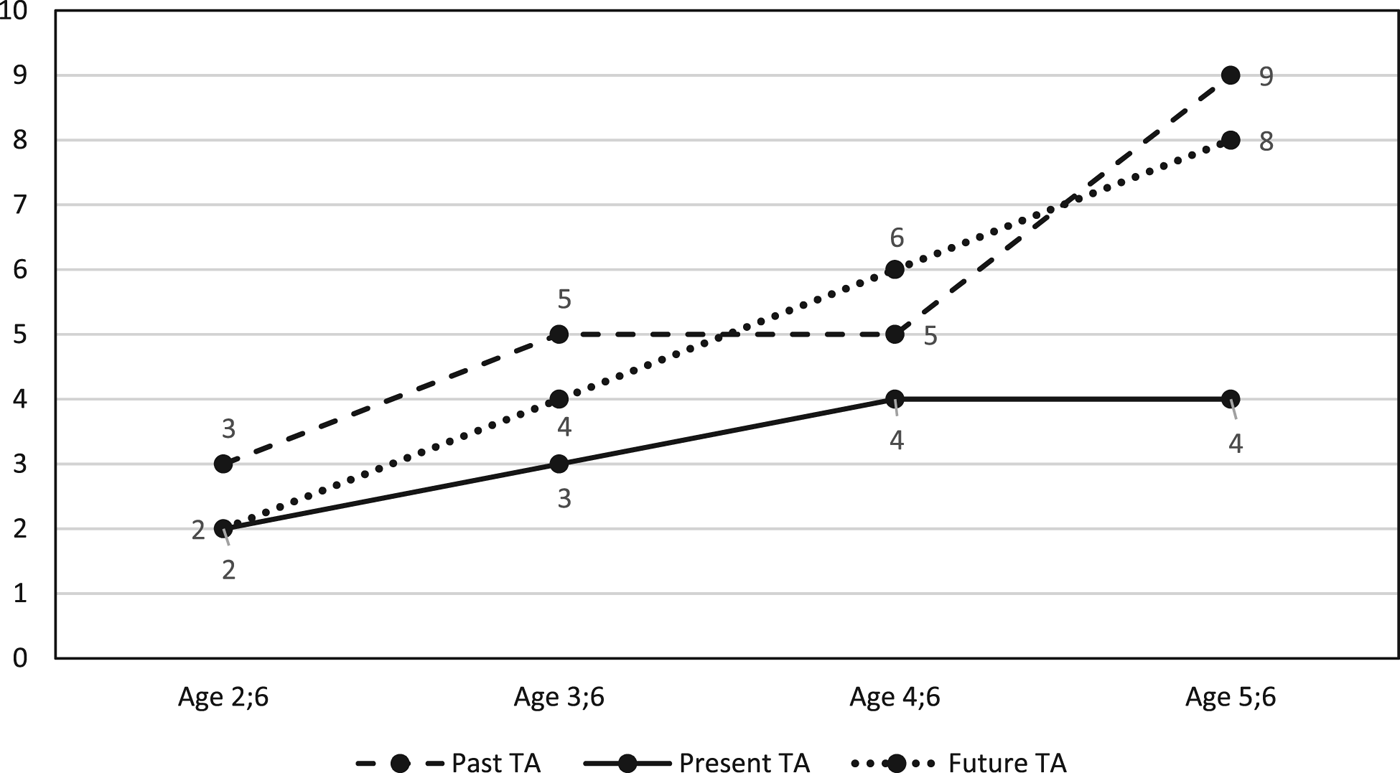
Table 2 shows that, overall, children in the four age groups produced 79, 91, 228, and 362 cases of temporal adverbs, respectively, and this age-related developmental trend applied to their use of each subtype of temporal adverbs (as Figure 1 shows). In addition, Figure 2 illustrates that the repertoire size for each subtype of temporal adverbs increased with children's age. Children in the youngest age group (2;6) produced only seven types of temporal adverbs altogether, whereas children in the 5;6 group made use of all cases of temporal adverbs listed in this study. It should be noted that, although children in the 2;6 group had a relatively small repertoire size, they were capable of using temporal adverbs in their speech to locate the target events on various points of the timeline, including the past, present, and future.
Production of Chinese temporal adverbs (TA) across different age groups.

Repertoire of temporal adverbs (TA) across different age groups.

The developmental pattern of Chinese temporal adverbs
Given the naturalistic, free-play data of the present study, a chi-square test was conducted to investigate the association between children's production of temporal adverbs and their ages. This analytical technique was considered appropriate because the frequency data (i.e., headcount) were available for the different subtypes of temporal adverbs produced by children in all age groups. As such, both variables (the subtypes of temporal adverbs and the age groups) were categorical in nature. In addition, the sample size of the present study ensured that no cell in the contingency table had expected frequencies that were less than five. Therefore, the assumptions for performing a chi-square test were met.
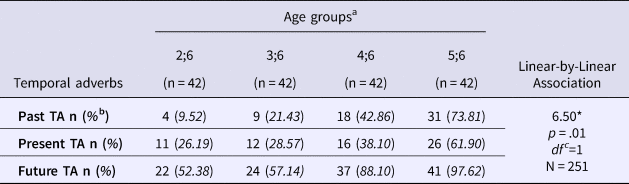
First, a chi-square test was conducted on the number of children who uttered the three subtypes of temporal adverbs (i.e., past, present, and future) across the four age groups. As can be observed in Table 3, the ‘Linear-by-Linear Association’ test for trend yielded a significant outcome [Linear-by-Linear Association (1, N = 251) = 6.50, p = .01], indicating that the number of children producing each subtype of temporal adverbs tended to rise with growing age. For instance, 52.38% of children in the 2;6 age group uttered future temporal adverbs, with this figure rising to 57.14% in the 3;6 age group, and this ascending trend continued to the 5;6 age group, in which 97.62% of children did so. Such a pattern could also be found in the other two temporal adverb subtypes.
Number of children in all age groups producing the three subtypes of temporal adverbs (TA)

Notes. aThere are in total 168 children in our corpus, with each age group including 42 of them. But in our actual counting, as some children produced more than one type of temporal adverb, they were counted two or three times, making the N = 251 exceed the sample size of our corpus. bThe percentages in the brackets were calculated by dividing the frequency by the size of each age group (42). cThe degree of freedom for the linear-by-linear association test. *<.05.
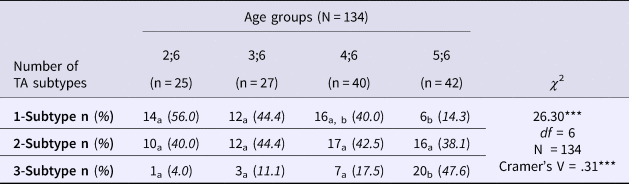
Based on the above analysis, we went on to explore another relevant issue: Does age relate to children's ability to produce various subtypes of temporal adverbs? Specifically, frequency count was performed on two variables: age groups on the one hand, and how many subtypes of temporal adverbs the child produced (i.e., whether it was 1-subtype, 2-subtypes, or 3-subtypes) on the other. Table 4 illustrates the frequency and the chi-square test result. As the output shows, there was a significant relationship between children's age and how many subtypes of temporal adverbs they could produce [χ 2 (6, N = 134) = 26.30, p < .001], and this association represented a moderate size of effect [Cramers’ V = .31, p < .001] based on Cohen's (Reference Cohen1988) effect size guidelines.
Number of temporal adverb (TA) subtypes produced by children in four age groups

Notes. The percentages in brackets were calculated just for each age group. Columns with different subscripts (a, b, or a, b) have significantly different column proportions at the .05 significance level. ***<.001
In addition, the subscripts with each column in Table 4 provide us with more insights into the differences among column proportions at the .05 significance level. First, it is noticeable that in the third row of Table 4, the percentage 47.6% differed significantly from those of the other three columns (4.0%, 11.1%, and 17.5%), indicating that the proportion of children who produced all three temporal adverb (TA) subtypes in the 5;6 age group was significantly higher than the percentages of whom did so in the other three younger age groups. Second, on the row headed ‘1-Subtype’, the percentage 14.3% differed significantly from those of the other three columns (56%, 44.4%, and 40%), indicating the proportion of children who used only one TA subtype in the 5;6 age group was significantly lower than the percentages of whom did so in the other three younger age groups. On the same row, the percentage 40% also significantly differed from 56% and 44.4%, demonstrating that the proportion of children who uttered one subtype of TA in the 4;6 age group was significantly lower than the percentages of those who did so in the two younger age groups (i.e., 2;6 and 3;6). In terms of the proportion of children who uttered two subtypes of TA, the result showed that the percentages did not differ significantly across the four age groups.
Cases of misusing Chinese temporal adverbs
As the third research question indicates, we paid special attention to any occurrence of children's incorrect use of temporal adverbs. First, we expected to discover some cases of misuse in this corpus, particularly given the young age of the target children. Second, although Huang and Huang's (Reference Huang and Huang2011) study detected one case of misuse of temporal adverbs, namely, redundant temporal adverbs, which was also found in our corpus (see ‘Child B’ below), they did not delve deeper to investigate the potential causes or what it may imply. Thus, for any mistakes found in the present corpus, we tried to break it down and see exactly where and how it ‘went wrong’, as we believe that grammatical errors made by children offer unique perspectives to gain further understanding of their emerging language capacity in a range of aspects (e.g., syntax, semantics). In total, there were three cases of misusing temporal adverbs identified in the corpus, made by children in the 3;6, 4;6, and 5;6 age group, respectively. These cases are presented and analysed as follows:
A: repeated temporal adverbs
Child A (female, 3;6 group):
马上很快过去了。
ma-shang (immediately) hen-kuai (very quickly) guo qu le
Immediately very quickly passed by
‘(it) passed by very quickly soon’
Correct form:
马上过去了/很快过去了。
ma-shang (immediately) guo qu le /hen-kuai (very quickly) guo qu le
(it) will go over soon / (it) went by very quickly
Child A produced two temporal adverbs relating to future time – 马上 ma-shang ‘immediately’ and 很快 hen-kuai ‘very quickly’ – in one sentence. It is speculated that in Chinese, as 马上 ma-shang ‘immediately’ expresses a notion that an event or action will occur in a short moment, Child A might have equated it to the word 很快 hen-kuai ‘very quickly’ and tried to combine the two terms to emphasise that the event happened swiftly. In this case, the meaning of the word 很快 ‘very quickly’ overlapped with the word 马上 ‘immediately’.
B: redundant temporal adverbs
Child B (male, 4;6 group):
我们要来做饭吧。
wo men yao (be going to) lai zuo fan ba
We are going to shall cook.
‘We shall cook.’
Correct form:
我们来做饭吧。
wo men lai zuo fan ba
‘Let's cook.’
Child B uttered a superfluous 要 yao ‘be going to’ in a suggestive sentence to invite his friend to join him in action. He might have known that the semantic feature of 要 yao ‘be going to’ indicates future events, but it appeared that he lacked the practical knowledge that this word is not needed in such cases as making a suggestion or extending invitations.
C: inappropriate temporal adverbs
Child C (female, 5;6 group):
他正在坐椅子。
ta zheng-zai (in the process of) zuo yizi
he is sitting the chair
‘He is sitting down the chair.’
Correct form:
他正坐在椅子上。
ta zheng (in the process of) zuo zai yizi shang.
‘He is sitting on the chair.’
Child C combined a continuous temporal adverb 正在 zheng-zai ‘in the process of’ with a verb (坐) describing an action that happens momentarily (sitting down), which rendered this sentence syntactically incorrect. As 坐 ‘sit’ is an intransitive verb that cannot be used directly in front of the object 椅子 ‘chair’, the usage of 正在 zheng-zai ‘in the process of’ needs to be adapted to fit the sentence structure. However, it seemed that this girl had not acquired such a complex knowledge of grammar, which might have led to her mistake in using the term 正在 zheng-zai ‘in the process of’ in this utterance.
Cases of the irregular usage of Chinese temporal adverbs
We identified two broad categories of the irregular usage of Chinese temporal adverbs in the current corpus: post-positioned temporal adverbs and the co-occurrence of temporal adverbs.
A: post-positioned temporal adverbs
Seven instances of post-positioned temporal adverbs were found in the corpus. In these instances, temporal adverbs did not take the pre-position of the predicates as they usually do. Instead, they were placed at the end of the sentence, for example:
Child D (male, 3;6 age group):
又一个小孩来了,刚才。
you yi ge xiao hai lai le, gang-cai (a moment ago)
another child came, a moment ago
‘Another child came a moment ago.’
Regular order:
刚才又一个小孩来了。
gang-cai you yi ge xiao hai lai le
a moment ago another child came
‘Another child came a moment ago.’
Children in the 3;6, 4;6; and 5;6 age groups produced 1, 2, and 4 instances of post-positioned temporal adverbs, respectively. This finding seems to indicate that older children were more likely to end their sentences with temporal adverbs.
B: co-occurrence of temporal adverbs
In total there were 17 children who uttered more than one temporal adverb in a single sentence; examples are presented as follows:
Child E (female, 3;6 age group):
马上时间就要到啦!
ma-shang (immediately) shijian jiu-yao (be about to soon) dao la
immediately the time is about to arrive soon
‘The time is about to arrive soon.’
Child F (male, 5;6 age group):
你刚才已经关了。
ni gang-cai (a moment ago) yi-jing (already) guan le
you a moment ago already closed it
‘You had closed it already a moment ago.’
While only one child from the 2;6 age group produced multiple temporal adverbs in her speech, there were 4, 5, and 7 children who did so in the 3;6, 4;6, and 5;6 age groups, respectively. Among the 17 instances of co-occurrence of temporal adverbs, the majority of them (10 cases) were used for expressing the action or events that were about to happen, while 5 and 2 cases referred to events in the past and at present, respectively. One interesting finding was that two children from the 5;6 age group produced co-occurrence of temporal adverbs to express a more complex tense: past perfect (see the example of ‘Child F’), whereas no younger children did so.
Discussion
As the first corpus-based developmental research project on preschool children's expression of temporality, this study utilised a rich Mandarin Chinese corpus to investigate children's use of temporal adverbs. We focused the analyses on exploring the repertoires of temporal adverbs that indicate the past, present, and future in early Mandarin Chinese. Descriptive analyses and chi-square tests were performed to examine if there were any developmental patterns in children's acquisition of temporal adverbs. Also, we investigated whether young children demonstrated any incorrect use of temporal adverbs in their natural utterances. This section discusses our findings in more detail.
The repertoire of early child temporal adverbs
The present study revealed that children in the corpus produced altogether 21 types of temporal adverbs, which is less than the totality in the original coding book we developed. This could be partly due to the fact that some temporal adverbs in the coding book were extracted from studies taking a broader linguistic perspective with written forms (e.g., novels, news report) or adults’ utterances as the sources of material (i.e., Li, Reference Li and Hu1996a; Zhang, Reference Zhang2006). Thus, young children might not have acquired, or been unable to use these more complex forms in the target language (i.e., Mandarin Chinese). Despite that, among all the temporal adverbs we identified, 9, 8, and 4 were used for expressing the past, future, and present, respectively. This finding is to some extent consistent with that of Tse et al.’s (Reference Tse, Li and Leung2012) investigation, in which they found that the present temporal adverbs produced by Cantonese-speaking children represented the least number of forms. However, it should be noted that, in our study, although the repertoire size of children's past temporal adverbs (9) exceeded those of the other subtypes, future temporal adverbs constituted a subtype that is almost equally variant in form (8). This finding indicates that the Mandarin-speaking children in our corpus have gained the cognitive capacity for mentally constructing past situations and have also acquired a variety of linguistic constructs in expressing future events. Similarly, Tse et al.’s investigation showed that Cantonese-speaking children have the most variant forms (24) of future temporal adverbs. However, it was partly due to the fact that, in Cantonese, the future adverbial phrase dang2 (A) jat1 (B) zen6 (C) gaan1 (D) sin1 (E) can be used interchangeably in a set of colloquial variations such as ABC, AC, ABCD, and so forth, whereas in our study of Mandarin temporal adverbs, there is no such case.
Not only do the future temporal adverbs constitute a variant subtype, our study also found that, across all age groups, children uttered substantially more future temporal adverbs than the other two subtypes. The least frequently used temporal adverbs are the present time adverbs (comprising 16.4% of all cases), despite a couple of prior investigations (e.g., Bi & Peng, Reference Bi and Peng2002, Reference Bi and Peng2004; Fu, Reference Fu2002) which have reported that they are acquired by children earlier than the other two subtypes. We consider that such notably unequal use of each subtype of temporal adverbs relates to their pragmatic features; as Fu (Reference Fu2002) suggested, children tend to use future temporal adverbs more frequently to state their subsequent actions and desires. Therefore, children who were left to play freely for thirty minutes in the current study were more likely to produce utterances with future temporal adverbs. In our corpus, this was most conspicuously exemplified by children's extensive use of 要 yao ‘be going to’ in announcing what they were going to do, such as:
我要报警。
wo yao (be going to) bao jing
I am going to call police
‘I am going to call the police.’
我要吃这个。
wo yao (be going to) chi zhe ge
I am going to eat this
‘I am going to eat this.’
The developmental patterns of early Mandarin temporal adverbs
The present study found that children from the youngest age group in the corpus (2;6) produced temporal adverbs of all three subtypes. This result allows for no inference to be made concerning children's acquisition order of temporal adverbs, so we were unable to confirm the pattern of ‘present time >future time >past time’ proposed by Fu (Reference Fu2002). Nevertheless, this finding provides cross-linguistic support for a large body of research indicating that children of Indo-European language backgrounds have gained the ability to talk about past and future events around or before two years old (e.g., Ames, Reference Ames1946; Fivush et al., Reference Fivush, Gray and Fromhoff1987; Nelson, Reference Nelson1989). In a previous study adopting the same communication task involving Cantonese-speaking preschool children, Tse et al. (Reference Tse, Li and Leung2012) reported that three-year-old children produced temporal adverbs relating to past, future, and present events. Compared to our finding, it seems that Mandarin-speaking children acquire the ability to express different temporal concepts earlier than young Cantonese speakers. A comparative study with children from the same age groups should be conducted to investigate whether or not such a cross-language difference truly exists. Our investigation has also revealed that children in the older age groups possessed a larger repertoire of temporal adverbs compared to younger children, and those in the 5;6 age group produced all temporal adverbs included in the study. This finding substantiates Chang's work (Reference Chang1998, Reference Chang2004), in which the scholar found that older Mandarin-speaking children used more diversified temporal devices than younger children when making narratives.
In addition, we conducted a chi-square test to examine the association between children's age and their ability to produce different types of temporal adverbs. First, we were interested to see if children's age related to their production of the three TA subtypes. Our analysis revealed a significant linear relationship between these two factors. In other words, there was a significant trend that, with increasing age, children become more capable of making use of all three subtypes of temporal adverbs. Such a salient age effect provides further empirical evidence to support the notion that, across the preschool years, children gradually attain the linguistic maturity that allows them to express various temporal relations (Grant & Suddendorf, Reference Grant and Suddendorf2011). Second, with a further step, we investigated whether the number of TA subtypes produced by children related to their age. The chi-square test yielded a significant association between these two variables and suggested a general pattern that: (1) as children get older, more of them become competent in using all three TA subtypes. In particular, those in the 5;6 age group were more likely to do so than the younger children; and (2) conversely, those who can only use one TA subtype saw a decreasing trend in its number. From age 4;6 onwards, significantly fewer children produced utterances with only one subtype of temporal adverbs. These findings not only strengthened the age effect we have identified earlier but also corroborate previous studies concerning children's temporal system acquisition process. For example, Weist (Reference Weist, Fletcher and Garman1986) posited that children's acquisition of temporal system transfer from the ‘Event Time system’ to the ‘Reference Time system” around three years old, and, a little over four years (52 months), they enter the ‘Free RT system’, during which time they gain the ability to relocate the temporal deictic centre from the speech time to a newly established time interval. Thus, it is possible that, upon fully entering this phase, for instance, aged 4;6 and beyond as our findings suggested, children begin to make more flexible use of temporal adverbs to describe temporal relationships in their daily experiences (Weist & Buczowska, Reference Weist and Buczowska1987). Therefore, it comes as less of a surprise that, as more children produced all three TA subtypes, a decreasing number of them made use of only one TA subtype in their natural utterances.
Irregular use and misuse of temporal adverbs
There were two broad types of irregular use of temporal adverbs identified in our corpus, both of which demonstrate mature pragmatics of temporal adverbs and occur rather commonly in adults’ speech. First, the relocation of temporal adverbs from the pre-position of the predicate to the sentence-final position occurred early (3;6) and became more frequent as children got older. According to Zhang (Reference Zhang2006), in the colloquial form of Mandarin Chinese, temporal adverbs can sometimes be moved to the end of the sentence without altering the semantic features of the original sentence. In such cases, these adverbs are not pronounced with stress, and the sentence is only slightly changed in its pragmatic function. For example, the new utterance may imply a sense of urging. However, this is not what we observed in our data; the post-positioned temporal adverbs did not convey the explicit meaning of urging the other child to act. This was in part due to the nature of the communication task of this study, in which children tended to engage in playing with toys instead of making extensive conversation with each other, even though they were encouraged to do so. Therefore, it was unlikely that the post-positioned temporal adverbs primarily served the function of prompting their peers to act quickly. Instead, they were more likely to be used as temporal modifiers to highlight the temporal frame in which the event took place. This is in line with Syrett, Arunachalam, and Waxman's (Reference Syrett, Arunachalam and Waxman2014) finding that adverbial modifiers such as temporal adverbs can provide additional semantic content that proves to be useful for young language learners. In Mandarin Chinese, temporal adverbs, among other forms of adverbs (e.g., adverbs of degree, manner, scope), typically function as sentence modifiers. When they are placed in sentence-final position, they contribute additional information to the preceding utterances (Wang, Reference Wang2012). According to Zhang (Reference Zhang2006), such movement of temporal adverbs without altering the semantic structure of the sentence can be viewed as a change of ‘pragmatical word order’.
Second, we found that children in the current corpus were able to produce utterances with multiple temporal adverbs from two years old, and this ability demonstrated an age-related developmental trend. This finding appears to suggest that, from an early age, children can emphasise the temporal information of the situation described by using more than one temporal adverbs in their utterance. According to Na (Reference Na2017) and Zhang (Reference Zhang2000), such a structure allows speakers’ subjective perspective on how events unfold on the timeline to be more saliently presented. Zhang also pointed out that, in Mandarin Chinese, the co-occurrence of temporal adverbs can take two syntactic structures: the left-to-right and the right-to-left. In the former, the first temporal adverb modifies the following one, before they jointly modify the subsequent predicate, while in the second situation, the order is reversed, with the latter temporal adverb modifying the preceding one before they work as a whole to describe the predicate. In our data, all the instances of co-occurrence of temporal adverbs took the form of a left-to-right structure. This was in line with Zhang's suggestion that the left-to-right structure requires the co-existing temporal adverbs to be under the same classification (e.g., both temporal adverbs express the temporal positions on the timeline). In our study, all temporal adverbs met this criterion as they placed events at various locations on the timeline.
Furthermore, it was found that, among all the instances of co-occurring temporal adverbs, a major portion of them related to actions or events that were going to happen soon, followed by those indicating that events happened in the past, among which most referred to situations close to the utterance time. This result is partly congruent with previous studies indicating that young children's temporal references primarily rely on the situational context and background knowledge, which enable them to make past references that are relative to the ‘here-and-now’ (Huang, Reference Huang2003). Noticeably, there were two children in the 5;6 age group who correctly produced co-occurring temporal adverbs to indicate a more complex tense, the past perfect tense, whereas there was no such case identified in the younger children's utterances. Although the cross-sectional nature of the present investigation and a limited number of instances prevent us from drawing inferences from this observation, we speculate that such complex use of temporal adverbs in part reflects the developmental stage termed by Weist (Reference Weist, Fletcher and Garman1986) as the ‘Free RT system’ (36–52 months), during which period children gradually gain the ability to mentally locate themselves at a certain time interval different from the ‘speech time’ and the ‘event time’ when they make references to a target event. In the case we presented (see ‘Child F’), the child showed his ability to mentally place himself at an indefinite time-point (刚才 gang-cai ‘a moment ago’) prior to the moment of speech but away from the event time to describe a finished action (关 guan ‘close’).
In terms of the incorrect use of temporal adverbs, we found that children aged between 3;6 and 5;6 made a few mistakes when using temporal adverbs in their natural utterances. Similar cases of misuse have been recorded by previous researchers (e.g., Huang & Huang, Reference Huang and Huang2011; Tse et al., Reference Tse, Li and Leung2012). Collectively, these mistakes can be summarised as the mismatch between temporal adverbs and the predicates of the sentences. We suggest that such misuse of temporal adverbs partly reflected that children under six years old lack a comprehensive understanding of the semantic or pragmatic features of temporal adverbs; as Bi and Peng's (Reference Bi and Peng2002, Reference Bi and Peng2004) studies suggested, it is between ages seven and eight that Mandarin-speaking children start to make significant progress in their comprehension of a wide variety of temporal adverbs.
In general, the findings of the present study have implications for the growing research field concerning children's early acquisition of temporal terms and how their linguistic capacity reflects their cognitive development. In particular, our findings suggest that Mandarin-speaking children are capable of making present, past, and future reference from an early age by using appropriate linguistic means (i.e., temporal adverbs) in the target language. It is reasonable to conjecture that children have gained a certain level of cognitive maturity by approximately two years old that allows them to mentally construct past and upcoming events, as they are unlikely to talk about temporal relationships that they are incapable of thinking about (Weist, Reference Weist, De Brabanter, Kissine and Sharifzadeh2014b). Also, in accordance with Weist's view that children's ability to re-experience past events opens the possibility for pre-experiencing future events, we found that children in our corpus produced extensive future references, mostly communicating the desires or actions they were going to perform. This not only demonstrates that children in their preschool years are capable of involving themselves in future events (Atance & O'Neil, Reference Atance and O'Neill2005), it also shows that children's future references mostly relate to their subsequent actions with some degree of commitment (Gee & Savasir, Reference Gee and Savasir1985). In this regard, our finding provides cross-linguistic evidence to Swift's (Reference Swift2004) investigation, in which the researcher found that young speakers (under age 3;6) of Inuktitut, a language with tense morphology that specifies past and future into different degrees of remoteness from the deictic centre, made early and frequent use of the future suffix -si- ‘about to, going to’ to express an event or action that is going to take place shortly in the future. However, a few errors have also been detected, showing that the emergence of the RT system is gradual progress during which children could, as other researchers (e.g., Pawlak et al., Reference Pawlak, Oehlrich and Weist2006) have noted, make mistakes in their efforts to construct sentences and concepts of temporal relationships. Such deficits in early language competency are likely owing to cognitive, linguistic, and brain-developmental restrictions, or a combination of these factors, which calls for further investigations.
Conclusion
In conclusion, this is a corpus-based study on Mandarin-speaking preschoolers’ development of temporal adverbs. By eliciting children's natural utterances from a corpus established in Beijing, we were able to offer a descriptive account of children's repertoires of temporal adverbs and their developmental patterns across different age groups. In summary, we found that: (1) Mandarin-speaking children in our corpus produced a repertoire of 21 temporal adverbs, and those from the youngest age group (2;6) were capable of producing temporal adverbs indicating the past, present, and future; (2) children of all age groups uttered temporal adverbs indicating the future time more frequently than those denoting the past and present time; (3) there was a significant age effect such that, with increasing age, more children in each age group were capable of producing all subtypes of temporal adverbs; (4) there was a significant association between children's age and the number of subtypes of temporal adverbs they could use; and (5) children's production of temporal adverbs demonstrated some irregular patterns and instances of errors, which were speculated to be relative to multiple factors including linguistic features of the Chinese language, children's cognitive developmental stage, and their comprehension of the temporal adverbs.
Limitation and future research
The present study has some limitations. First, this study collected children's utterances from their naturalistic conversations, and the final dataset may have only documented a particular portion of all the linguistic evidence we expected to gather. In other words, the absence of specific forms of temporal adverbs in our corpus does not in and of itself indicate children's lack of knowledge of them. Expanding the sample size may mitigate this problem to some extent, but it cannot be eliminated. Second, as participants of the study attended a 30-minute free-play session, in which they were accompanied only by toys and a peer, they might not have produced as much target language material as they would be in a more relaxed and everyday context. Third, despite this being a corpus-based study, the cross-sectional nature of the data we collected limited us from making consolidated conclusions about children's acquisition trajectory of temporal adverbs. Future studies may consider adopting a longitudinal design to map out an in-depth picture of how children progress through different stages of acquiring temporal adverbs, and what developmental characteristics they demonstrate. In terms of our findings of misuse and irregular use of temporal adverbs, it should be noted that, since such cases comprised only a small proportion of all children's utterances, the developmental pattern which appears to be suggested by our data (for example, older children seem to use more combined temporal adverbs to express temporality) cannot be generalized to the broader population, and future research may investigate these patterns in more depth by collecting a larger sample of misuse and/or irregular use of temporal adverbs. Last but not least, despite the present study's focus on examining the development of temporal adverbs, it should not be neglected that Mandarin Chinese also employs other linguistic structures for establishing temporal references, among which the aspectual system has a critical role to play. In the linguistic literature, the Mandarin aspectual system has been extensively discussed in regard to two broad domains: grammatical aspect and lexical aspect, with the former describing the speaker's viewpoint of the contour of the situation under discussion (Li & Bowerman, Reference Li and Bowerman1998), and the latter relating to the lexical content conveyed by the verb (Li, Reference Li2012). According to Erbaugh's (Reference Erbaugh1982, also see Erbaugh, Reference Erbaugh and Slobin1992) longitudinal study involving four Taiwanese children aged from 1;9 to 3;9, children made substantial and frequent use of the perfective aspect marker 了-le before they reach 2;4 (the general boundedness stage), with 96% of them marking immediate past. Huang's (Reference Huang2003) study supports the finding that, compared to adults, young children under 3;3 relied more heavily on aspect markers in establishing past references. In terms of the imperfective aspect marker 在-zai, Li and Bowerman's (Reference Li and Bowerman1998, also see Li & Shirai, Reference Li and Shirai2000) experimental study suggests that utterances of children in the youngest age group (three-year-old) demonstrated a strong association between lexical and grammatical aspects. In particular, the imperfective marker 在-zai was associated almost exclusively with atelic verbs indicating the process of the given situation. Such biases in children's production were also documented by Stephany (Reference Stephany, Dale and Ingram1981), who proposed that it related closely to the parental language input, which also featured strong links between present/imperfective markers and non-resultative verbs. Interestingly, concerning children's production of future reference, Erbaugh (Reference Erbaugh and Slobin1992) reported that, in the early stage of temporal adverb acquisition (before 2;4), children produced time adverbs to describe their desires and fantasies in the immediate future for 80% of the time. Thus, the abovementioned studies leave us with two unanswered questions: first, there seems to be a pattern that children tend to make future references using temporal adverbs and resort to aspectual markers for past and present references during the early developmental period. How does this pattern hold with the empirical data? Second, what is the relationship between temporal adverbs and the aspectual system in early Mandarin acquisition? These matters will be further investigated in our subsequent research.
Author ORCIDs
Lu Yao LIANG, 0000-0001-7386-4756.