INTRODUCTION
Understanding species interactions is a key objective of ecology. Plant-pollinator relationships have long fascinated naturalists (Darwin Reference DARWIN1862, Sprengel Reference SPRENGEL1793), yet in spite of over two centuries of research, much of this field remains unexplored given the enormous diversity of pollination interactions found in nature (Faegri & van der Pijl Reference FAEGRI and VAN DER PIJL1966, Willmer Reference WILLMER2011). Consequently, ecologists have devised means of classifying and organizing these diverse interactions to better understand them. Pollinators, for example, can be classified into functional groups based on the similar selective pressures they exert on plant species, and independent of their relatedness to one another, as a way of describing their interactions with flowers (Fenster et al. Reference FENSTER, ARMBRUSTER, WILSON, DUDASH and THOMSON2004). Insect taxa are commonly classified into different functional groups at the family or genus level (e.g. pollen-collecting bees and oil-collecting bees), but vertebrate pollinators have received less attention and are more often grouped at the level of order, or even class, as is common with nectarivorous birds and bats (Faegri & van der Pijl Reference FAEGRI and VAN DER PIJL1966, Muchhala & Thomson Reference MUCHHALA and THOMSON2010).
While flower-visiting bats have typically been categorized into a single functional group (Faegri & van der Pijl Reference FAEGRI and VAN DER PIJL1966, Muchhala & Thomson Reference MUCHHALA and THOMSON2010), recent studies by Tschapka (Reference TSCHAPKA2003) and Frick et al. (Reference FRICK, PRICE, HEADY and KAY2013) have investigated the possibility that pollinating bat species differentially affect plant reproductive success, and thus comprise more than one functional group. These studies showed that a plant's reproductive success can vary greatly depending on whether it is pollinated by a nectar-specialist or an opportunistic visitor from another feeding guild. Furthermore, both studies proposed that the mechanism responsible for these differences was nectaring posture, with perching species delivering more pollen (Frick et al. Reference FRICK, PRICE, HEADY and KAY2013) or setting more fruit (Tschapka Reference TSCHAPKA2003) than hovering species. While there are no similar studies comparing the feeding guilds of pollinating bats in the Palaeotropics, we expected different findings from these Neotropical studies since Old World pollinating bats (family Pteropodidae) nearly always land on flowers rather than hover, even nectar-specialist pteropodids (Bumrungsri et al. Reference BUMRUNGSRI, HARBIT, BENZIE, CARMOUCHE, SRIDITH and RACEY2008, Fleming et al. Reference FLEMING, GEISELMAN and KRESS2009, Marshall Reference MARSHALL1983).
Instead, we wanted to compare the foraging times of pteropodid feeding guilds, since floral visitation time is another mechanism through which pollinators can influence plant reproductive success. Floral visitation time is important since flowers often have a peak receptivity for gamete transfer, so animal species visiting at different times of the night may result in seed set that differ quantitatively and/or qualitatively (Groman & Pellmyr Reference GROMAN and PELLMYR1999, Howell & Roth Reference HOWELL and ROTH1981). Several studies have documented temporal partitioning in nectarivorous bats (Fischer Reference FISCHER1992, Singaravelan & Marimuthu Reference SINGARAVELAN and MARIMUTHU2004, Thomas & Fenton Reference THOMAS and FENTON1978), and even slight differences in visitation time can have large impacts, particularly since most bat-pollinated flowers in the Palaeotropics are only open for one night (Bumrungsri et al. Reference BUMRUNGSRI, HARBIT, BENZIE, CARMOUCHE, SRIDITH and RACEY2008, Reference BUMRUNGSRI, SRIPAORAYA, CHONGSIRI, SRIDITH and RACEY2009; Faegri & van der Pijl Reference FAEGRI and VAN DER PIJL1966, Sritongchuay et al. Reference SRITONGCHUAY, BUMRUNGSRI and SRIPAORAYA2008, Willmer Reference WILLMER2011). Yet previous studies of foraging times have only compared the visits of two or three bat species at just one plant species, providing a limited view of this complex system (Bumrungsri et al. Reference BUMRUNGSRI, LANG, HARROWER, SRIPAORAYA, KITPIPIT and RACEY2013, Marshall Reference MARSHALL1985).
To better understand real-world processes, we sampled the Old World bat community at bat-visited plant species in southern Thailand. Our objective was to examine the nightly foraging times of nectar-specialist bats and frugi-nectarivorous bats to compare temporal variation in their interactions with common bat-visited plant species. We hypothesized that these two groups would forage at different times during the night, given that they rely primarily on different food resources. Consistent differences between the foraging times of nectarivorous and frugi-nectarivorous bat species could indicate that these two feeding guilds are acting as distinct functional groups.
STUDY SITE
This work was conducted in southern Thailand across four provinces (Phatthalung, Satun, Songkhla and Trang) during July–August 2011. The region consists predominantly of lowland tropical rain forest interspersed with urban and agricultural areas. Bat-visited plant species are found in all habitat types. Bats were caught from a representative sample of lowland tropical rain forest, mangrove forest, rubber plantations and mixed fruit orchards. Average temperature, humidity and annual rainfall across southern Thailand are in the range 26.3–28.3°C, 76–84% and 1716–2725 mm, respectively (Thai Meteorological Department, www.tmd.go.th/en).
STUDY SPECIES
Many pteropodid bat species are abundant and important pollinators in southern Thailand (Bumrungsri et al. Reference BUMRUNGSRI, HARBIT, BENZIE, CARMOUCHE, SRIDITH and RACEY2008, Reference BUMRUNGSRI, SRIPAORAYA, CHONGSIRI, SRIDITH and RACEY2009; Sritongchuay et al. Reference SRITONGCHUAY, BUMRUNGSRI and SRIPAORAYA2008). Common bat species include Cynopterus brachyotis (Muller), C. horsfieldi (Gray), C. sphinx (Vahl), Eonycteris spelaea (Dobson), Macroglossus minimus (Geoffroy), M. sobrinus (Andersen) and Megaerops ecaudatus (Temminck). Species can be categorized into two feeding guilds, nectarivorous and frugi-nectarivorous. Nectar-specialist Eonycteris and Macroglossus species have the elongated rostrums and tongues characteristic of nectarivores, and feed almost exclusively on floral resources. In contrast, the remaining species have relatively robust rostrums, short tongues, and consume both floral and fruit resources (Bumrungsri et al. Reference BUMRUNGSRI, LEELAPAIBUL and RACEY2007, Reference BUMRUNGSRI, LANG, HARROWER, SRIPAORAYA, KITPIPIT and RACEY2013; Francis Reference FRANCIS2008, Hodgkison et al. Reference HODGKISON, BALDING, ZUBAID and KUNZ2004a, Marshall Reference MARSHALL1983, Reference MARSHALL1985). Most of the pteropodid species in this study predominantly roost in foliage, either solitarily or in small groups (Balasingh et al. Reference BALASINGH, KOILRAJ and KUNZ1995, Campbell et al. Reference CAMPBELL, REID, ZUBAID, ADNAN and KUNZ2006, Kunz & Fenton Reference KUNZ and FENTON2003), but E. spelaea roosts colonially in limestone karst caves (Bumrungsri et al. Reference BUMRUNGSRI, SRIPAORAYA, CHONGSIRI, SRIDITH and RACEY2009, Suyanto & Struebig Reference SUYANTO and STRUEBIG2007).
A number of common local plant species are known to be pollinated by pteropodid bats and exhibit an array of reproductive flowering strategies throughout the year. With respect to the food resources they provide, they all exhibit the following important floral traits: copious nectar production that peaks early in the evening as well as pollen dehiscence early in the evening (Bumrungsri et al. Reference BUMRUNGSRI, SRIPAORAYA, CHONGSIRI, SRIDITH and RACEY2009, Sripaoraya Reference SRIPAORAYA2005). Self-incompatible, bat-pollinated plant species in this study include Durio zibethinus, a big-bang species that can produce over 1000 flowers per tree per night (Bumrungsri et al. Reference BUMRUNGSRI, SRIPAORAYA, CHONGSIRI, SRIDITH and RACEY2009, Gould Reference GOULD1978); Oroxylum indicum (Bignoniaceae), which flowers year-round in southern Thailand (Sritongchuay et al. Reference SRITONGCHUAY, BUMRUNGSRI, MEESAWAT and MAZER2010); Parkia speciosa (Fabaceae), which exhibits a cornucopia phenology, flowering from April to October; and four Sonneratia species (Lythraceae; Bureau of Mangrove Resources Conservation 2009): S. alba and S. ovata have a multiple bang phenology, S. caseolaris flowers year-round and S. griffithii is currently under study by the authors (Start Reference START1974; A. Stewart, pers. obs.). Finally, Musa acuminata (Musaceae), the only self-compatible species (Andersson Reference ANDERSSON and Kubitzki1998) investigated here, also flowers continuously throughout the year (Gould Reference GOULD1978, Pillay & Tenkouano Reference PILLAY and TENKOUANO2011, Sripaoraya Reference SRIPAORAYA2005).
Bat-dispersed plant taxa bearing ripe fruit during the period of data collection included Ficus species (Moraceae), Lansium domesticum (Meliaceae), Manilkara zapota (Sapotaceae), Nephelium lappaceum (Sapindaceae), Sandoricum koetjape (Meliaceae) and Syzygium cumini (Myrtaceae) (Marshall Reference MARSHALL1985). Ficus fruits are a steady-state resource; while individual plants mass fruit, fruiting is not synchronous within or among species, such that fruits are available year-round. All other focal fruiting species are big bang resources. In southern Thailand, Ficus and S. cumini are not cultivated, S. koetjape is both wild and cultivated, while L. domesticum, M. zapota and N. lappaceum fruits are cultivated.
METHODS
Assessing foraging times
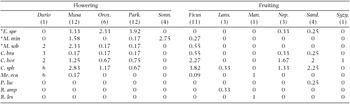
We captured bats from 24 locations in southern Thailand (6°32′–7°46′N, 99°47′–100°16′E), which were all at least 1 km apart. Mist nets (polyester, 38-mm mesh; Avinet Inc., Dryden, NY) were placed near flowering and fruiting individuals of the aforementioned plant species to catch foraging bats. Sampling effort varied between 1–12 nights per plant species (Table 1), depending on availability; because sample sizes were small for several species, we grouped them into two categories (flowering versus fruiting resources) for analysis. Nets were open from 18h00 (sunset occurred around 18h40) until approximately 03h00 for a total of 33 nights between 1 July and 10 August 2011. Since previous work has demonstrated vertical stratification among fruit bats (Hodgkison et al. Reference HODGKISON, BALDING, ZUBAID and KUNZ2004b), we placed nets at a range of heights to obtain a representative sampling of foraging bats (N ≥ 6 nights per height interval of 3 m, up to 12 m). Nets were positioned as close as possible to the flowers of bat-pollinated plants or to the fruits of bat-dispersed plants. Thus, any individuals caught were assumed to have been foraging at the plant species where they were netted. Additionally, placing mist nets close to vegetation made the nets less visible, allowing for relatively high capture success rates.
Cumulative capture frequency (total number individuals netted/total number nights sampled) at bat-visited plant species in southern Thailand for each pteropodid species included in the analyses. Plant species listed along top (with number of nights in parentheses), from left to right: Durio zibethinus, Musa acuminata, Oroxylum indicum, Parkia speciosa, Ficus species, Lansium domesticum, Manilkara zapota, Nephelium lappaceum, Sandoricum koetjape and Syzygium cumini. Bat species listed along left side, from top to bottom: Eonycteris spelaea, Macroglossus minimus, M. sobrinus, Cynopterus brachyotis, C. horsfieldi, C. sphinx, Megaerops ecaudatus, Penthetor lucasi, Rousettus amplexicaudatus, R. leschenaulti. Asterisks denote nectarivorous species, all others are frugi-nectarivorous.

Nets were checked for bats at least every 30 min. For each netted individual, we recorded species, sex, reproductive status, time of capture, geographic coordinates, habitat type and the plant species at which the bat was netted. Individual bats were identified to species following Francis (Reference FRANCIS2008). We then determined the bat's feeding guild (nectarivore or frugi-nectarivore) based on literature (Bumrungsri et al. Reference BUMRUNGSRI, LEELAPAIBUL and RACEY2007, Reference BUMRUNGSRI, LANG, HARROWER, SRIPAORAYA, KITPIPIT and RACEY2013; Francis Reference FRANCIS2008, Hodgkison et al. Reference HODGKISON, BALDING, ZUBAID and KUNZ2004a, Marshall Reference MARSHALL1983, Reference MARSHALL1985) corroborated with personal observation of foraging choices made in the field (A. Stewart). Male reproductive classes consisted of juvenile and adult (determined from examination of phalangeal epiphyses); female reproductive classes consisted of juvenile, lactating, pregnant and non-reproductive (all following Kunz & Parsons Reference KUNZ and PARSONS2009).
Statistical analysis
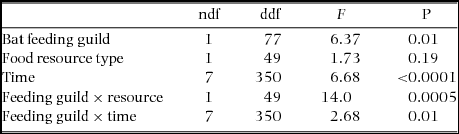
To assess whether bat feeding guild (nectarivore versus frugi-nectarivore), food resource type (floral versus fruit), or time influenced pollinator foraging behaviour, we used the GLIMMIX procedure in SAS 9.2 (SAS Institute Inc.) to perform a general linear model with mixed effects. In the mixed model, the dependent variable was capture rate (bats per mist-net h), with 1 mist-net h (mnh) defined as one net open for 1 h. The independent variables in the model were bat feeding guild, food resource type, time of night (specified as a class variable) as a random effect within feeding guild estimated using an autoregressive covariance matrix (AR1), and all two-way interactions. Degrees of freedom for all tests were estimated using the Kenward-Roger option. Additional covariates (species within feeding guild, sex, reproductive class) were initially incorporated but subsequently removed due to a lack of model convergence. As two-sample Kolmogorov–Smirnov tests revealed no significant differences in foraging time distributions for these variables, data across species within feeding guild, sex and reproductive class were pooled for all subsequent analyses. The distribution was assumed Poisson with a log link and statistical significance was assumed if P < 0.05. Model fit was assessed by examining the raw and Pearson's residuals as well as DFBETA plots. The variability in the foraging periods of nectarivorous and frugi-nectarivorous bats were compared with F-tests using R 2.15.2 (R Development Core Team).
RESULTS
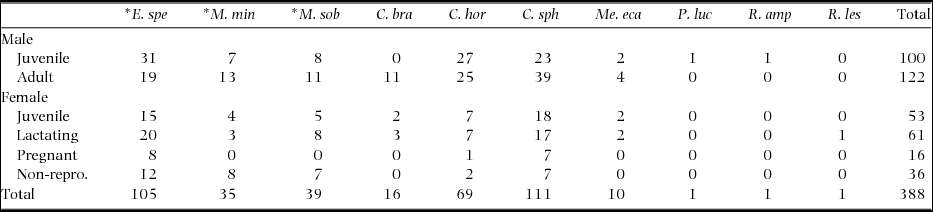
We netted a total of 388 pteropodid bats of ten species (Table 1; Appendix 1) over 367 total mnh; 229 mnh at flowering plants (N = 35 sites), 138 mnh at fruiting plants (N = 23 sites). The mixed model found that bat feeding guild, time, the feeding guild by resource interaction and the feeding guild by time interaction all significantly influenced bat capture rate (Table 2). While food resource type was not significant (P = 0.19), it was kept in the model since it was part of a significant two-way interaction. We found no evidence for a resource by time interaction (P = 0.84), so this term was removed from the model.
A general linear model with mixed effects (GLIMMIX, SAS 9.2) demonstrates the effects of bat feeding guild (nectarivore or frugi-nectarivore), food resource type (floral or fruit) and time on pteropodid bat capture rates in southern Thailand. ndf, numerator degrees of freedom; ddf, denominator degrees of freedom.

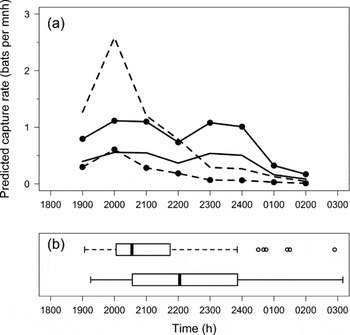
Frugi-nectarivorous bats had significantly higher overall visitation rates to all pooled food resources than nectarivorous bats (P = 0.01), but the significant feeding guild by resource interaction (P = 0.0005) revealed that visitation rate is dependent on food resource type (Figure 1a; Table 2). Specifically, nectarivorous bats strongly preferred flowering plants, visiting flowering plants (mean ± SD, 0.68 ± 0.48 bats per mnh) over six times more frequently on average than fruiting plants (0.10 ± 0.15 bats per mnh), and frugi-nectarivorous bats preferred fruiting plants (0.78 ± 1.21 bats per mnh) over flowering plants (0.43 ± 0.57 bats per mnh), as expected.
Foraging times of pteropodid bat feeding guilds at bat-visited plant species in southern Thailand throughout the night. Bat capture rates of nectarivores (dashed lines) and frugi-nectarivores (solid lines) at flowering (unmarked) and fruiting (circles embedded within lines) resources predicted from the generalized linear mixed model (a). Boxplots of observed nectarivorous (dashed line, N = 179) and frugi-nectarivorous (solid line, N = 211) bat nettings in southern Thailand, depicting the quartiles and outliers as defined based on 1.5 times the interquartile range (b).

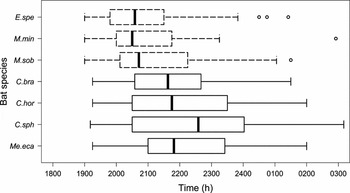
As a whole, pteropodid bats did not have a constant foraging rate between 18h00 and 03h00 (P < 0.0001); instead, their foraging activity rose until 20h00 and then decreased until 03h00 (Figure 1a). This preference for early foraging was significantly stronger in nectarivorous bats than in frugi-nectarivorous bats (P = 0.01; Figure 1b); the median foraging time was 20h30 for nectarivorous bats (N = 178) and 22h00 for frugi-nectarivorous bats (N = 211). Foraging by nectarivorous bats also occurred over a significantly narrower period of time than foraging by frugi-nectarivorous bats (interquartile range, IQR = 1.73 h and 3.33 h, respectively; F-test, P < 0.0001; Figure 1b). Comparing the distribution of foraging time by bat species revealed that these results were not driven by any one species alone; all nectarivorous species had earlier and less variable foraging times than the frugi-nectarivorous species (Figure 2).
Boxplots displaying foraging time distributions of the most commonly netted nectarivorous (dashed lines) and frugi-nectarivorous (solid lines) bat species encountered in this study (southern Thailand). Species (with number of bats netted in parentheses), top to bottom: Eonycteris spelaea, E.spe (105); Macroglossus minimus, M.min (35); M. sobrinus, M.sob (39); Cynopterus brachyotis, C.bra (16); C. horsfieldi, C.hor (69); C. sphinx, C.sph (111); Megaerops ecaudatus, Me.eca (10).

DISCUSSION
This study compared differences in the foraging times of Old World nectarivorous versus frugi-nectarivorous bats to examine their interactions with plants that depend on them for pollination and/or seed dispersal. We found that nectarivorous bats foraged significantly earlier in the evening, and over a significantly shorter time period, than frugi-nectarivorous bats. Similar findings have been reported in the Neotropics; a number of studies have shown that frugivorous bat activity occurs throughout most of the night (Aguiar & Marinho-Filho Reference AGUIAR and MARINHO-FILHO2004, Castro-Arellano et al. Reference CASTRO-ARELLANO, PRESLEY, WILLIG, WUNDERLE and SALDANHA2009, Pedro & Taddei Reference PEDRO and TADDEI2002, Presley et al. Reference PRESLEY, WILLIG, CASTRO-ARELLANO and WEAVER2009; but see Mancina & Castro-Arellano Reference MANCINA and CASTRO-ARELLANO2013), and La Val (Reference LA VAL1970) showed that early foraging activity is especially pronounced among nectarivorous bats. These differences between nectarivorous and frugi-nectarivorous bats may result from a number of causes that are not mutually exclusive, including commuting distance between roost and foraging ground, meeting daily energetic requirements, interspecific competition, and/or the temporal resource constraints imposed by the plant species they prefer to visit.
If commuting distance were an important predictor of capture time, we would expect later capture times for bats commuting from rare, patchily distributed roosts (such as caves) than from abundant, uniformly distributed roosts (such as in foliage); cave roosts, on average, are farther from a randomly selected netting site than foliage roosts, and therefore require longer commute times, as was observed by Thomas & Fenton (Reference THOMAS and FENTON1978). We would also expect greater variation in the capture times of bats commuting from cave roosts since the closest cave roost may be very near (short commute time) or very far (long commute time) from a randomly selected netting site, whereas the distance to the closest foliage roost is much less variable. Since nearly 60% of the nectarivorous bats in this study were cave-roosting E. spelaea and 94% of frugi-nectarivorous bats in this study belonged to foliage-roosting Cynopterus spp., we would thus expect nectarivorous bats to exhibit later and more variable capture times than frugi-nectarivorous bats. We would particularly expect to see early capture times for frugi-nectarivorous bats since previous work has shown that Cynopterus individuals typically forage within 500 m of their night roost (Funakoshi & Akbar Reference FUNAKOSHI and AKBAR1997, Marimuthu et al. Reference MARIMUTHU, RAJAN, KOILRAJ, ISAAC and BALASINGH1998) and several Cynopterus roosts were observed within the study area. Contrary to these expectations, capture times of nectarivorous bats were earlier and less variable than those of frugi-nectarivorous bats, indicating that commuting distance is not a main predictor of arrival time at fruiting and flowering resources.
Several previous studies have suggested that phytophagous bats must begin foraging early in order to meet high daily energetic requirements, particularly since fruit and nectar are relatively poor food resources and flight is energetically costly (Mancina & Castro-Arellano Reference MANCINA and CASTRO-ARELLANO2013, Presley et al. Reference PRESLEY, WILLIG, CASTRO-ARELLANO and WEAVER2009). Yet these requirements apply to both nectarivorous and frugi-nectarivorous bat species, which does not directly explain why nectarivorous bat species forage earlier than frugi-nectarivorous bat species. It is possible that differences in the nutrient composition of fruit versus floral resources (which include both pollen and nectar), and/or different nutrient requirements of the two feeding guilds, contribute to the observed foraging differences between nectarivorous and frugi-nectarivorous bat species. Thus, the relationship between pteropodid diet composition, their dietary requirements, and the nutrient content of their food resources should be examined before making any conclusive statements.
Another possible explanation for the observed difference in frugi-nectarivorous and nectarivorous bat capture times is that species forage during different times in order to reduce interspecific competition at shared resources. Previous studies showing temporal partitioning between pairs of pteropodid species have, in fact, suggested that interspecific competition is a driving factor (Fischer Reference FISCHER1992, Singaravelan & Marimuthu Reference SINGARAVELAN and MARIMUTHU2004), and it likely contributes to the differences in foraging times seen in this study. However, interspecific competition alone does not explain why nectarivorous bats foraged earlier than frugi-nectarivorous bats, rather than the reverse trend. Indeed, if interspecific competition were the main cause, we would expect to see temporal partitioning among nectarivorous species throughout the night, rather than observing concentrated nectarivorous-bat activity early in the evening. Thus, we propose that differences in the foraging times of frugi-nectarivorous and nectarivorous bat species are explained in large part by the resource constraints imposed by the plant species they visit.
Many plant species have overcome the challenges of immobility by relying on the services of animals to disperse their gametes (pollen) and offspring (seeds) (Barrett & Harder Reference BARRETT and HARDER1996), however, pollination and seed dispersal are precise processes that must occur within specific periods of time. A fruit that is removed from the plant too early will not be fully developed, while an uneaten fruit that drops to the ground beneath its parent plant faces limited dispersal and greater competition with its parent and siblings (Howe & Smallwood Reference HOWE and SMALLWOOD1982). Likewise, there is an optimal timeframe for pollination; fertilization can only occur when pollen is mature and stigmas are receptive (Faegri & van der Pijl Reference FAEGRI and VAN DER PIJL1966). Thus, most animal-assisted plant species have adaptations that encourage pollinators and seed dispersers to perform their services within the optimal time period. For example, unripe fruits often contain secondary compounds that make them unpalatable (Cipollini & Levey Reference CIPOLLINI and LEVEY1997), and flowers typically produce the most nectar when they are receptive to pollination (Cruden et al. Reference CRUDEN, HERMANN, PETERSON, Bentley and Elias1983, Martén-Rodríguez et al. Reference MARTÉN-RODRÍGUEZ, ALMARALES-CASTRO and FENSTER2009, Reynolds et al. Reference REYNOLDS, WESTBROOK, ROHDE, CRIDLAND, FENSTER and DUDASH2009). This temporal variability in resource quality imposes selective pressures on the foraging times of pollinators and seed-dispersers; animals that forage when nectar and fruit are most palatable and abundant receive the greatest energetic benefits.
However, the temporal constraints that plants impose on pollinators are often more restrictive than those imposed on seed dispersers. This is particularly true among plant species visited by bats. While mature, bat-dispersed fruits are accessible for days, most bat-pollinated flowers are only open for a few hours (Bumrungsri et al. Reference BUMRUNGSRI, SRIPAORAYA, CHONGSIRI, SRIDITH and RACEY2009, Faegri & van der Pijl Reference FAEGRI and VAN DER PIJL1966), providing a much narrower window of opportunity for their visitors. For example, Oroxylum indicum flowers begin opening around 19h00 and the corollas drop by 02h00 (Sritongchuay et al. Reference SRITONGCHUAY, BUMRUNGSRI and SRIPAORAYA2008). Additionally, nectar production and sugar concentration typically decline over the course of a night (Elangovan et al. Reference ELANGOVAN, MARIMUTHU and KUNZ2000, Elmqvist et al. Reference ELMQVIST, COX, RAINEY and PIERSON1992, Sripaoraya Reference SRIPAORAYA2005, Vikas et al. Reference VIKAS, GAUTAM, TANDON and RAM2009; A. Stewart, unpubl. data), placing even stronger selection on early foraging. Aguiar & Marinho-Filho (Reference AGUIAR and MARINHO-FILHO2004) observed that Neotropical phytophagous bat species foraged early in the evening and also suggested declining nectar production throughout the night as a possible explanation. Since the nectar of a given flower is only available for a few hours, in contrast to a fruit which can be available for days, we might expect the foraging times of nectarivorous bats to be less variable than those of frugi-nectarivorous bats.
Indeed, our data reveal that nightly foraging by nectarivorous bats does occur within a narrower time range than that of frugi-nectarivorous bats. Furthermore, the interquartile range of nectarivorous-bat foraging activity occurs between 20h00 and 21h44, which coincides with peak nectar production times of bat-pollinated plant species reported in other studies (20h00–22h00; Bumrungsri et al. Reference BUMRUNGSRI, HARBIT, BENZIE, CARMOUCHE, SRIDITH and RACEY2008, Elmqvist et al. Reference ELMQVIST, COX, RAINEY and PIERSON1992, Sritongchuay et al. Reference SRITONGCHUAY, BUMRUNGSRI and SRIPAORAYA2008, Vikas et al. Reference VIKAS, GAUTAM, TANDON and RAM2009; A. Stewart, unpubl. data). The interquartile range of all frugi-nectarivorous bat foraging activity (20h30–23h50) is not only broader, it is also later in the evening when nectar production has declined for many flowering plant species, which reflects their non-obligate reliance on floral resources.
Our results demonstrate that nectarivorous and frugi-nectarivorous bats appear to be acting as two distinct functional groups that are likely to impose different selective pressures on the plant species they visit. We propose that pteropodid bats utilize different foraging strategies that are shaped by the plant species they visit. However, confirming this hypothesis requires observation of bat-visited plant species throughout the year to verify that the results we observed are consistent across all months of the year, since flowering and fruiting seasons vary by plant species. Furthermore, future work should compare the relative contributions of different pteropodid species to the pollination success of the plant species they visit, as differences in floral foraging times by pollinating bats may translate into important differences in a plant's reproductive success. Given that the timing and duration of anthesis varies among different plant species, the outcomes will likely span a continuum from plant species that are greatly affected by foraging time differences, to species that are barely influenced. By studying the interactions of nectarivorous and frugi-nectarivorous bat species with the plants they visit, we can better understand plant-animal interactions and how these important visitors promote the reproductive success and genetic diversity of many agricultural and native plant species.
ACKNOWLEDGEMENTS
We are extremely grateful to S. Bumrungsri for offering intellectual and logistical assistance in Thailand. We would like to thank the Bumrungsri lab members, whose help made everything run smoothly, and the Dudash and Fenster lab members for their input throughout this project. Puy, A, Bird and numerous park officials provided invaluable assistance during fieldwork. We also thank G. Carter, C. Fenster, G. Wilkinson and anonymous reviewers for comments on earlier versions of this manuscript. Research was conducted with permission from Thailand's Department of National Parks and the National Research Council of Thailand. This work was funded by an NSF Graduate Research Fellowship, fellowships from the University of Maryland, and support from the UMD BEES (Behavior, Ecology, Evolution & Systematics) Graduate Program to A. Stewart.
Number of bats (per species, sex, and reproductive class) caught foraging at bat-associated plant species in southern Thailand. Bat species, left to right: Eonycteris spelaea, Macroglossus minimus, M. sobrinus, Cynopterus brachyotis, C. horsfieldi, C. sphinx, Megaerops ecaudatus, Penthetor lucasi, Rousettus amplexicaudatus, R. leschenaulti. Asterisks denote nectarivorous species, all others are frugi-nectarivorous. Non-repro. = non-reproductive.