1 Introduction: word-final phonology and utterance-final phonetics
Phonological patterns often make reference to word edges. For example, both voiced and voiceless obstruents occur in Russian, but at the end of a word only the voiceless ones occur, as illustrated by the alternations in (1) (Padgett Reference Padgett2012 and references therein).
-
(1)


Final devoicing is a widespread phonological pattern, variants of which occur in German, Dutch, Russian, Sanskrit, Walloon, Turkish, Hausa and other languages (Blevins Reference Blevins2006, Myers Reference Myers2012).Footnote 1
Scholars have long related this restriction on voicing categories to the breakdown in voicing that occurs at the end of an utterance (Sievers Reference Sievers1901: 289–290, Jespersen Reference Jespersen1904: 102–103, Bloomfield Reference Bloomfield1933: 373, Lightner Reference Lightner1972: 332–333, Lindblom Reference Lindblom and MacNeilage1983: 237, Ingram Reference Ingram1989: 35). The vocal folds in non-speech breathing are spread wide apart to facilitate air passage, and speakers begin spreading the vocal folds in anticipation of this posture as they approach the end of the utterance (Sweet Reference Sweet1877: 65, Lisker et al. Reference Lisker, Abramson, Cooper and Schvey1969: 1545, Klatt & Klatt Reference Klatt and Klatt1990: 821, Shadle Reference Shadle, Hardcastle and Laver1997: 42, Jessen Reference Jessen1998, Slifka Reference Slifka2006). At the same time, the subglottal pressure that is necessary to drive vocal fold vibration declines over the course of the utterance and hits its low point at the end (Westbury & Keating Reference Westbury and Keating1986: 156). The result is a deterioration in voicing as the speaker approaches pause, often passing through non-modal voicing before a final voiceless interval. Such utterance-final devoicing has been found in instrumental acoustic studies in English (Haggard Reference Haggard1978, Docherty Reference Docherty1992, Smith Reference Smith1997), French (Smith Reference Smith, Ohala, Hasegawa, Ohala, Granville and Bailey1999, Reference Smith2003), Finnish (Lehtonen Reference Lehtonen1970: 45, Myers & Hansen Reference Myers and Hansen2007) and Kinyarwanda (Myers Reference Myers2005), and has been noted as well in many transcription-based studies (Hansen & Hansen Reference Hansen and Hansen1969: 162–163).
Utterance-final devoicing affects listeners' identification of voicing categories. Myers (Reference Myers2012) had English speakers identify words contrasting in the voicing of a final fricative (e.g. leaf/leave), which had been excised from final or medial position in recorded utterances. The participants were significantly more likely to misidentify the voiced-final word (e.g. leave) as the voiceless-final word (e.g. leaf) when that word had been taken from utterance-final position than when it had been excised from utterance-medial position. This suggests that the coarticulatory effects of utterance-final position are great enough to influence voicing identification even for experienced speakers.
Such a tendency to misidentify final voiced obstruents as voiceless could lead a language learner to conclude that all utterance-final obstruents are voiceless. In making such a generalisation, the learner would be adopting a pattern of phonological final devoicing, reanalysing a gradient pattern in phonetic realisation as a phonological restriction on speech categories (Hyman Reference Hyman and Juilland1976, Reference Hyman and Yu2013). This occurs if the language learner fails to learn to compensate in perception for the effects of coarticulation, interpreting the partially devoiced final variants of voiced obstruents as intended voiceless obstruents (Ohala Reference Ohala and Jones1993).
This account of the diachronic origins of phonological final devoicing provides an explanation of some basic properties of the pattern. Voiced obstruents are subject to change in prepausal position because they are less voiced there than in phrase-medial position, due to anticipation of the laryngeal posture during pause. Voiced obstruents change to voiceless obstruents in this position because that is what a partially devoiced obstruent tends to be mistaken for. The pattern is restricted to obstruents, because a devoiced sonorant is so low in intensity that it tends to be mistaken for silence rather than for a voiceless segment (Myers & Hansen Reference Myers and Hansen2007).
There is, however, a basic challenge for such a diachronic scenario. The phonetic devoicing effect is limited to utterance-final pre-pausal position, while the phonological pattern is most often a restriction on word-final position. Consider the contexts exemplified in (2).Footnote 2
-
(2)
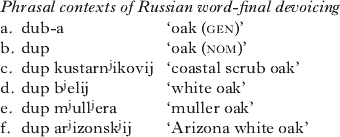
Word-final /b/ is realised as voiceless [p] in phrase-medial position as well as phrase-final position, though only the latter is phonetically a context for devoicing.
A standard historical account of this mismatch has been to posit a process of analogical generalisation from utterance-final to word-final position (Ewert Reference Ewert1943: 75, Wackernagel Reference Wackernagel1957: 301–309, Vennemann Reference Vennemann, Bruck, Fox and Galy1974: 364, Hyman Reference Hyman, Greenberg, Ferguson and Moravcsik1978b: 452, Westbury & Keating Reference Westbury and Keating1986: 161, Hock Reference Hock1991: 239). Any obstruent in utterance-final position is necessarily also at the end of a word, so extension of the pattern to word-final position could be understood as a generalisation from one subset of words (the utterance-final ones) to all words (see the discussion in §3). The process can be seen underway in Polish, where some dialects maintain utterance-final devoicing and others have innovated word-final devoicing (Jassem & Richter Reference Jassem and Richter1989: 317). We refer to this diachronic process as domain generalisation: a shift in the domain of a distribution pattern from a longer, more inclusive prosodic domain (e.g. the utterance) to a shorter, less inclusive one (e.g. the word). Hyman (Reference Hyman, Greenberg, Ferguson and Moravcsik1978b: 452–453) refers to this process as boundary narrowing, since the boundaries referred to in word-final devoicing are closer together than the utterance boundaries that the phonetic pattern refers to.
Domain generalisation plays a role not only in final devoicing, but also in the evolution of other restrictions on word-final elements that have their phonetic origin in utterance-final position. For example, high tone is in many languages avoided in word-final position, either through lowering of final high tones or retraction of such tones to non-final position (Hyman Reference Hyman and Fromkin1978a: 265, Myers Reference Myers1999: 216). This seems clearly related to phrase-final F0 lowering, which is the tendency for high-tone targets at the end of a phrase to have lower F0 values than comparable tones in non-final position (Liberman & Pierrehumbert Reference Liberman, Pierrehumbert, Aronoff and Oehrle1984, Pierrehumbert & Beckman Reference Pierrehumbert and Beckman1988, Herman Reference Herman1996). The avoidance of final high F0 peaks is also reflected in the tendency for a high tone in phrase-final position to occur earlier in the syllable than in phrase-medial position (Silverman & Pierrehumbert Reference Silverman, Pierrehumbert, Kingston and Beckman1990, Prieto et al. Reference Prieto, Santen and Hirschberg1995, Myers Reference Myers1999). Becker (Reference Becker1977, Reference Becker1979) argues for domain generalisation as a historical process in the history of final tone retraction in Serbo-Croatian, with different dialects representing different steps in the progression of domain generalisation.
Myers & Hansen (Reference Myers and Hansen2007) discuss a widely distributed phonological pattern in which a word-final vowel must be short (for example in Kinyarwanda). They relate this to utterance-final phonetic devoicing, since devoicing of the final portion of a vowel greatly reduces the intensity of that portion. They provide evidence that this can affect vowel-length perception from two experiments in which Finnish speakers identified partially devoiced long vowels as short, with the likelihood of identification as a long vowel depending on the duration of the voiced portion of the vowel. This tendency could explain why utterance-final long vowels might be reanalysed diachronically as short, since it is those vowels that are subject to partial devoicing, but the extension of the pattern to word-final position requires a process of domain generalisation.
Hualde (Reference Hualde2013) shows that domain generalisation can also have the effect of restricting the application of a process. He argues that intervocalic lenition in western Romance (e.g. spirantisation of voiced stops and voicing of voiceless obstruents) was an optional gradient phonetic process that applied freely across word boundaries, as in V#CV. When the process was phonologised, however, as in Istanbul Judeo-Spanish, with the lenited form becoming the phonological target, the domain of the phonological process became the word. Where *b was between two vowels within a word, it changed to v, as in saber>saver ‘to know’, while word-initial *b was preserved even when intervocalic, as in la boka ‘the mouth’, due to the influence of the word in non-leniting contexts (e.g. utterance-initial boka ‘mouth’).
The mismatch between utterance-final devoicing (the phonetically motivated pattern) and word-final devoicing (the most commonly observed phonological pattern) also presents a challenge to phonological accounts of devoicing that appeal to phonetic bases. According to Steriade's (Reference Steriade1997) licensing-by-cue hypothesis, for example, a contrast is favoured where the cues to that contrast are richly present. The ideal position for a voicing contrast in obstruents is before a sonorant, because the cues to the contrast are better in that position, and final devoicing results when the constraints that enforce that restriction outrank general laryngeal faithfulness.Footnote 3
The challenge for such an account is the same as for the diachronic account. In forms such as (2e, f) there is devoicing of word-final obstruents in Russian even though the following sound is a sonorant. Steriade (Reference Steriade1997: 55–58) suggests a solution via ‘paradigm uniformity’. According to this approach, /dub/ is realised as [dup] in [dup arʲizonskʲij] (and in other phrasal contexts) to preserve identity with [dup] in ‘citation form’ or utterance-final position. Output–output faithfulness (Benua Reference Benua1995) would be one way to formalise this idea (see also Steriade Reference Steriade, Broe and Pierrehumbert2000, McCarthy Reference McCarthy, Downing, Hall and Raffelsiefen2005). However, such an appeal to the influence of related utterance-final or citation forms cannot be the whole story behind domain generalisation, since speakers of languages like Russian apply word-final devoicing to forms they have never encountered. Our approach shares with Steriade's the assumption that word-final devoicing is phonetically motivated in utterance-final position, not word-final position, and that it extends to all words by a process of generalisation. In the conclusion we consider how this domain generalisation might work.
Domain generalisation is a plausible way of relating restrictions on corresponding positions in different domains (cf. Wackernagel Reference Wackernagel1957: 301–309, Chafe Reference Chafe1959: 486, Flack Reference Flack2009). But while it seems plausible that language learners might generalise in this way, there is no direct empirical evidence that they actually do so. In contrast to the extensive experimental literature on the phonetic conditions in utterance-final position, and the extensive documentation of word-final phonological patterns in the phonological literature, the discussion of an analogical generalisation connecting the two patterns remains purely speculative. The present study is designed to provide evidence on this issue.
2 Experiments
2.1 Artificial language learning experiments
Since our goal is to investigate how language learners generalise about distributional restrictions from a speech sample, we would like an experimental set-up that allows us to control the structure of the language material that the participant is exposed to and to gauge learning that occurs. In an artificial language learning (also known as artificial grammar learning or miniature grammar learning) paradigm, the participant is exposed to expressions of a constructed language during a familiarisation or learning phase. Then the knowledge she has acquired through familiarisation is measured in a test phase (e.g. by having her judge whether a novel item belongs to the language she has just been exposed to).
Such studies have been used to investigate what kinds of syntactic patterns learners can acquire (Miller Reference Miller1958, Morgan et al. Reference Morgan, Meier and Newport1987), as well as what kinds of phonological patterns learners acquire most easily (Schane et al. Reference Schane, Tranel and Lane1974/75, Pycha et al. Reference Pycha, Nowak, Shin and Shosted2003, Wilson Reference Wilson2003, Reference Wilson2006, Seidl & Buckley Reference Seidl and Buckley2005, Peperkamp et al. Reference Peperkamp, Skoruppa, Dupoux, Bamman, Magnitskaia and Zaller2006, Pycha et al. Reference Pycha, Shin and Shosted2006, Moreton Reference Moreton2008, Carpenter Reference Carpenter2010, Tessier Reference Tessier2012). An insightful review and synthesis of artificial language learning work in phonology is provided by Moreton & Pater (Reference Moreton and Pater2012a, Reference Moreton and Paterb).
The particular question at issue in our study is whether language learners generalise from the more restricted case of utterance-final consonants to the more general case of word-final consonants. The poverty of stimulus method in artificial language learning experiments provides a way to investigate how learners generalise from a limited speech sample (Wilson Reference Wilson2003, Reference Wilson2006, Finley & Badecker Reference Finley and Badecker2009, White Reference White2013). In a poverty of stimulus learning experiment, there are classes of items included in the test phase of the experiment that were not included in the learning stage, but are related to items that were included there. Finley & Badecker, for example, exposed participants to pseudo-words with an alternating final syllable which was [mi] when the preceding vowels were front, and [mu] when the preceding vowels were back (a back harmony pattern). In one condition, called ‘Mid Hold-Out’, the conditioning vowels in the learning phase included low and high vowels but not mid vowels. In the ‘Low Hold-Out’ condition, on the other hand, the conditioning vowels included mid and high vowels, but no low vowels. In the test phase, all three vowel heights were included as conditioning vowels. The researchers found that participants generalised the harmonic pattern to mid vowels in the Mid Hold-Out condition, but not to low vowels in the Low Hold-Out condition. Participants assumed that a generalisation that held of low and high vowels would hold of all vowels, while a generalisation that held of mid and high vowels could be limited to just the non-low vowels.
The poverty of stimulus method is an effective way of testing how learners generalise from incomplete data, and under what conditions they are willing to go beyond the data they have. Learners of a language with prepausal phonetic devoicing have evidence about voicing in prepausal position, but the claim is that they generalise beyond that evidence when they extend the voicing restriction to the ends of words. In the experiments to be reported here, participants were exposed to a familiarisation sample in which obstruents contrasted in voicing except in utterance-final position, with no instances of word-final obstruents except in utterance-final position. They were asked to judge whether novel test items belonged to the same language as they had heard in the familiarisation phase. The items in the test set included final voiced and voiceless obstruents, in both utterance-final and non-final positions. The hypothesis is that participants will generalise the pattern that they learned on the basis of utterance-final words to new words that are utterance-medial.
2.2 Experiment 1
2.2.1 Methods
2.2.1.1 Participants
48 undergraduate students at the University of California, Santa Cruz participated in this experiment. They were all taking an introduction to linguistics course, and they received course credit for participating.
All participants were native speakers of English, with the latest initial exposure to the language being at seven years. 23 of the participants had also spoken another language besides English as children, but these were all languages without a final voicing neutralisation pattern (e.g. Spanish, Hebrew). Data from three participants was excluded from the analysis because they were speakers of a language with final voicing neutralisation (Russian, Thai and German respectively).
Two of the participants turned out to have taken a course in phonology which covered phonological patterns such as final devoicing. Their data was also excluded from the analysis.
2.2.1.2 Materials
The stimuli for the study were nonsense utterances consisting of CV(C) syllables, in which C belonged to the set [p t s z m n] and V belonged to the set [i e a o u]. Each utterance had one of the two frames in (3).
-
(3)

The underline in (3) was the position of the target word, which was the only item that varied in the utterances. The target words were nonce words of the form ˈCVC(V(C(V))), where codas occurred only at the end of the target word, and were restricted to the set [s z m n]. The target words for the learning stage of the experiment are given in (4a), and those for the testing stage in (4b).
-
(4)
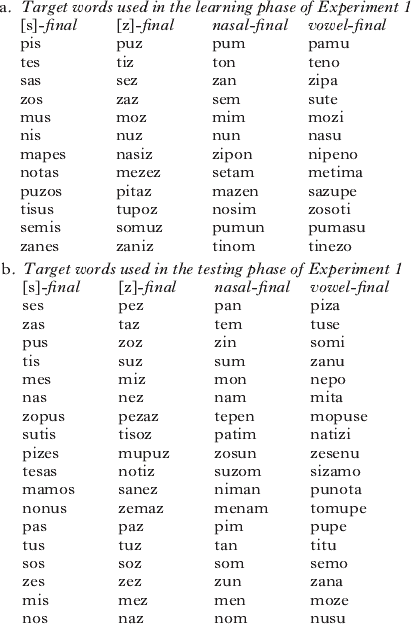
Each of the consonants had the same frequency of occurrence in non-final position in each of the two target word inventories in (4). Each inventory also included equal numbers of items ending in the four different classes of final segment: [s], [z], a nasal or a vowel.
Each target word in (4) was recorded in each of the utterance frames in (3) by one of the authors, with a declarative intonation and no pauses between words. The pronunciation was as in western varieties of American English, except for the presence of the low central vowel [a]. Stress was located on the first syllable of each nonsense word.
Two learning sets were created from the recordings of the utterances with the items in (4a). Both sets included all the nasal-final and vowel-final items in (4a) in both the final and the non-final utterance frames. The final devoicing learning set also included all the utterances with an [s]-final word in the utterance-final frame in (3a). This learning set therefore had obstruents only in syllable-onset position, except for twelve utterances with [s] in utterance-final position. Thus the final devoicing set included [s]-final utterances such as [ˈsanta ˈpis], but no [z]-final utterances like [ˈsanta ˈpuz], or utterances with medial obstruent codas such as [ˈsanta ˈpis ˈmizupu]. In this set of utterances, both [s] and [z] occurred prevocalically, but [s] was the only obstruent that occurred in utterance-final position.
The final voicing learning set was the same, except each [s]-final utterance in the final devoicing set was replaced with a [z]-final utterance, consisting of one of the [z]-final words in (4a) in the utterance-final frame in (3a). This set thus included [z]-final utterances such as [ˈsanta ˈpuz], but no [s]-final utterances such as [ˈsanta ˈpis] or utterances with medial obstruent codas. In this set of utterances, both [s] and [z] occurred prevocalically, but [z] was the only obstruent that occurred in utterance-final position.
Each learning set consisted of 60 utterances, with twelve utterances in each of five conditions (sonorant-, vowel- and obstruent-final words in the utterance-final frame (3a), and sonorant- and vowel-final words in the non-final frame in (3b)).
There was one testing set, consisting of 144 utterances: the 72 items in (4b) in each of the two utterance frames in (3).
2.2.1.3 Procedure
The materials were presented to participants through headphones in a sound-attenuated booth in the UC Santa Cruz Phonetics Laboratory, using Superlab experiment presentation software (Cedrus, Version 4.5) with a response pad, two buttons of which were used for recorded responses.
In the learning phase of the experiment, participants were told that they would be listening to utterances of a ‘made-up language’. They were instructed to listen carefully to each utterance, repeat it aloud, and then press any button on the response pad to proceed to the next utterance. Utterances were presented in blocks by frame type, with utterance-final target words (3a) in the first block and utterance-medial test words (3b) in the second block. These blocks were repeated in this order twice more, with the utterances presented in a different randomised order within the block in each repetition. Participants were given the opportunity to rest between blocks. The total number of trials in the learning phase was 180 (three presentations of the 60-utterance learning set).
The participants were divided into two groups. The final devoicing learning group were presented with the utterances of the final devoicing learning set during the learning phase, while the final voicing learning group heard only the utterances of the final voicing learning set.
After a participant finished the learning phase of the experiment, he or she entered the testing phase. In this phase, participants from both learning groups heard the utterances of the testing set: novel utterances with novel target words (4b), none of which had been encountered in the learning phase by either learning group.
The participants were instructed to listen to each utterance and press a blue button on the right of the button box if they thought the utterance belonged to the language they had learned, and a red button on the left if they thought it did not belong to that language. The presentation of the stimuli was self-paced in both the learning phase and the testing phase. The participant could hear the stimulus only once in a given trial, and the next stimulus was presented only when they pressed a button.
As in the learning phase, the utterances in the testing phase were presented in blocks by utterance frame, with the utterances with utterance-final test words as in (3a) presented in the first block, and those with utterance-medial test words as in (3b) presented in the second block. This was done in order to encourage participants to compare utterances only within a given frame. Utterances of the form (3b) with medial test words were less frequent in each learning set than utterances of the form (3a), since the latter included all four classes of test word in (4a), while the former only included the nasal- and vowel-final test words. The presentation in blocks was intended to discourage participants from treating utterances of the form (3b) as less well-formed than those of form (3a) purely on the basis of relative frequency.
After the experiment, participants were given a debriefing questionnaire, which asked them what they based their responses on during the experiment. Most had nothing concrete to offer, suggesting that any learning was relatively implicit. None mentioned any kind of restriction on [s] or [z], though three noticed that whether a target word contained [s] or [z] mattered.
2.2.1.4 Hypotheses
The experiment tested the following three hypotheses.
Hypothesis 1 (learning). If the participants were learning the pattern they were exposed to in the learning set, then they were expected to accept more forms consistent with that pattern than forms that were inconsistent with it. It was expected that participants in the final devoicing condition (where utterance-final obstruents were always [s]) would accept utterances with utterance-final [s] more often than those with utterance-final [z], and that participants in the final voicing condition would display the opposite tendency. Such a response pattern would be evidence of an effect of the learning set on the participants' responses in the test phase.
Hypothesis 2 (domain generalisation). If learners generalise as expected, participants who learned the utterance-final pattern as shown by their responses in the first test phase would follow the same pattern of responses for utterance-medial words in the second test phase. Thus participants in the final devoicing condition would accept word-final [s] more often than word-final [z] in utterance-medial as well as utterance-final position. Participants in the final voicing condition would accept word-final [z] in both utterance contexts more often than word-final [s]. Such a pattern of responses would support the claim that learners generalise the domain of such patterns, as presupposed in the analogical generalisation account.
Hypothesis 3 (naturalness). Participants in the final devoicing learning group had the task of learning a phonetically natural pattern, which has a robust phonetic precursor and is widely attested, while the participants in the final voicing learning group had to learn an equally simple pattern of final voicing, which has no phonetic basis and is barely attested (Yu Reference Yu2004). If the latter kind of pattern is harder for people to learn, then we would expect the participants in the final devoicing learning group to have a higher proportion of ‘correct’ responses (corresponding to the distribution in their learning set) than the participants in the final voicing learning group.
Some studies have found evidence that particular ‘natural’ patterns were more successfully learned than comparable ‘unnatural’ patterns (Schane et al. Reference Schane, Tranel and Lane1974/75, Wilson Reference Wilson2003, Reference Wilson2006, Peperkamp et al. Reference Peperkamp, Skoruppa, Dupoux, Bamman, Magnitskaia and Zaller2006, Moreton Reference Moreton and Parker2009, Carpenter Reference Carpenter2010). However, other studies have found no difference in learnability between the two kinds of patterns (Pycha et al. Reference Pycha, Nowak, Shin and Shosted2003, Pycha et al. Reference Pycha, Shin and Shosted2006). Moreton & Pater (Reference Moreton and Pater2012a, Reference Moreton and Paterb) distinguish between cases in which the two patterns differ in their formal complexity and those in which they differ in phonetic grounding. In their review of the literature, they find ample evidence of greater learning success for formally simpler patterns (analytic bias), but no convincing evidence of greater learning success for patterns with a stronger phonetic motivation (channel bias). The two patterns to be learned in this experiment do not differ in formal complexity, since they differ only in which of two classes of obstruents is allowed in utterance-final position, so if there is a difference in learning performance between the two learning groups that might provide evidence for a role of phonetic grounding in learnability.
2.2.2 Results
Each participant responded to 144 test sentences in the testing phase, of which 72 had obstruent-final target words. Only the sentences with obstruent-final target words were included in the analysis, since the hypotheses are all about the responses to voicing in word-final obstruents.
One participant in the final voicing learning set accepted every stimulus, and one participant in the final devoicing learning set accepted all but two. These participants were evidently not responding to the stimuli for some reason, so their responses were excluded from the analysis. This left 41 participants, 19 belonging to the final devoicing group and 22 to the final voicing group.
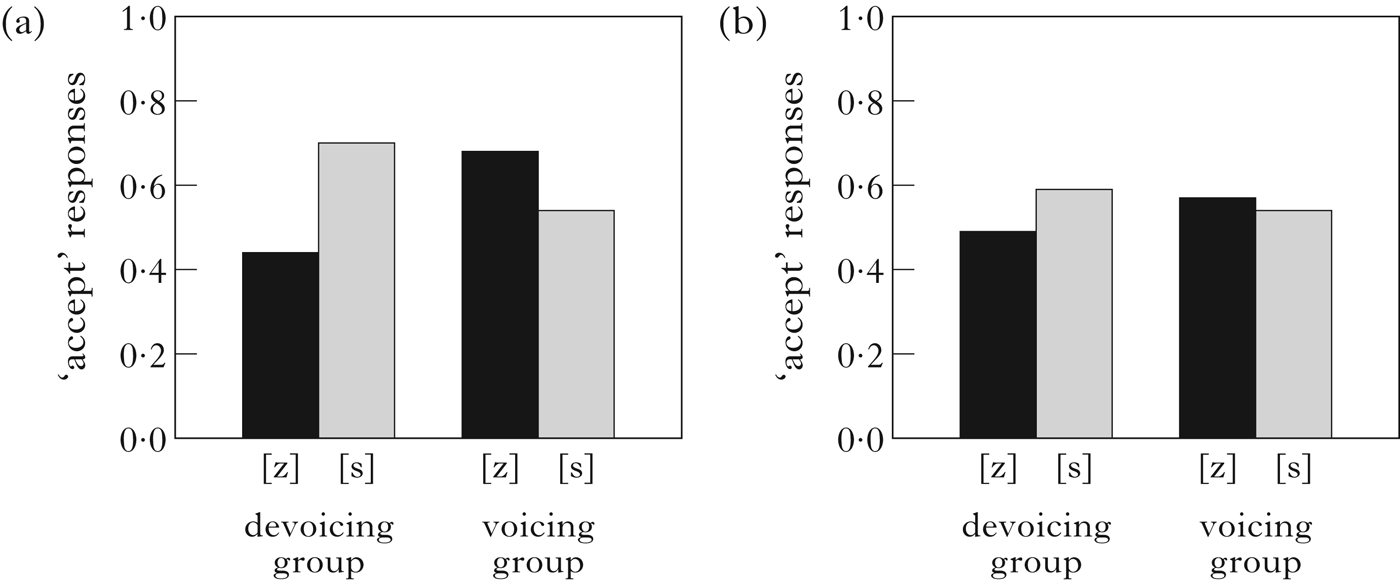
The proportion of ‘accept’ responses for utterances with obstruent-final target words is presented in Fig. 1, by word-final segment class, learning group and the position of the target word in the utterance. Figure 1a summarises responses to stimuli in which the target word was in utterance-final position. It can be seen that participants in the final devoicing group accepted utterances with utterance-final [s] more often than they accepted utterances with utterance-final [z], while participants in the final voicing group had the opposite pattern.
Proportion of ‘accept’ responses by word-final voicing category and learning group: (a) utterance-final position; (b) utterance-medial position.

Figure 1b presents the responses to stimuli in which the target word was non-final in the utterance. There were no obstruent-final words in this position in either learning set, but it can still be seen that the participants in the final devoicing group accepted more utterances with [s] at the end of the test word than utterances with [z] in that position, while participants in the final voicing group showed the opposite pattern. However, the difference in response between [s] and [z] is smaller in the non-final cases in Fig. 1b than it is in the final cases in Fig. 1a.
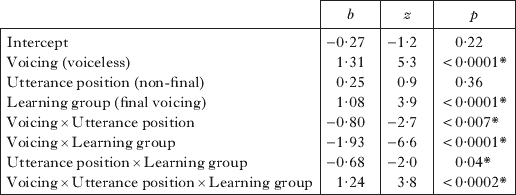
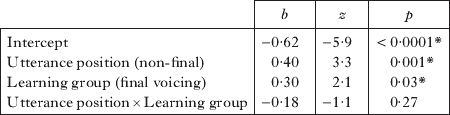
The data were modelled by means of a mixed model logistic regression analysis, employing the lme4 package in R (Baayen et al. Reference Baayen, Davidson and Bates2008, Bates et al. Reference Bates, Maechler and Bolker2012, Barr et al. Reference Barr, Levy, Scheepers and Tily2013). The dependent variable was the response – ‘no’ or ‘yes’ – to the question of whether the stimulus belonged to the language the participant had heard in the learning set. ‘Yes’ was treated as the marked value of the response variable (coded as 1), and ‘no’ as the default (coded as 0). The random effects were the participants and the items (the utterances). The fixed effects were the word-final segment Voicing category (voiced or voiceless), the Utterance position of the test word (final or non-final) and the Learning group (final devoicing or final voicing). In each of these factors, the first level was treated as the default value, and the second as the marked value, indicated by italicisation. Intercepts were included in the model for both random effects, as well as slopes for each participant for Voicing and Utterance position. Alternative models differing in the random effects structure (e.g. those lacking either intercept or either slope) were found to be less well fitting in ANOVA comparisons based on log likelihood (Baayen et al. Reference Baayen, Davidson and Bates2008). The results for the fixed effects are given in Table I.
Fixed effects in a logistic regression model of responses (Experiment 1). Significant values (p<0·05) are indicated by *.

There were significant main effects of Voicing and Learning group, reflecting an overall greater proportion of ‘yes’ responses for voiceless-final test words and for the final voicing learning group. All of the interactions were also significant.
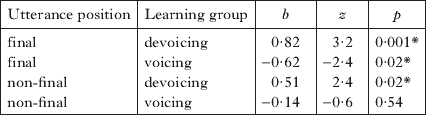
To explore these interactions, the data set was broken down into subsets according to Utterance position and Learning group. Table II gives the results for four tests, with the same random effects structure as in the previous analysis, and the single fixed effect of Voicing.
Effects of voicing in data subsets defined by Utterance position and Learning group.

It can be seen from the utterance-final cases in Table II that voicing had a significant effect on responses for both learning groups. In the devoicing learning group, an utterance with a final voiceless obstruent was significantly more likely to be accepted than an utterance with a final voiced obstruent, while the opposite was the case in the voicing learning group. This pattern of responses reflects the distribution of obstruents in the respective learning sets, and indicates that some learning of the distribution pattern did occur.
Turning to the non-final cases in Table II, voicing had a significant effect on responses for the devoicing learning group but not for the voicing learning group. The significant effect in the former case supports the hypothesis that the learners applied the final devoicing pattern in these cases, for which there was no model in their learning set. The lack of a significant effect in the voicing learning group means that the null hypothesis cannot be rejected in this case, the null hypothesis being that the voicing pattern of the learning set is not applied.
A reviewer notes that the effect of learning group could reflect a simple preference for [s] or [z], due to the fact that there were 24 more instances of [s] than [z] in the devoicing learning set, and the reverse in the voicing learning set. To test whether this difference in segment frequency led to a preference for a given voicing independent of word position, we tested the effect on responses of non-final [s] and [z] in test words, as an extra factor added to the models in Table II. For the devoicing learning group, in which final [z] was excluded, a factor was included encoding whether the word included a non-final [z], and for the voicing learning group a factor was included encoding whether the word included a non-final [s]. If subjects were responding to the frequency of these two sounds, regardless of that sound's position in the word, then it would be expected that these non-final instances would affect the responses. But this factor had no significant effect in any of the four data subsets treated in Table II. We can conclude that the sensitivity to voicing between the learning groups was specifically sensitivity to the voicing of the word-final obstruent.
To test whether one of the two learning set patterns was more successfully learned than the other, the responses were recoded in terms of correctness, where a response was treated as ‘correct’ if it corresponded to the learning set pattern, and incorrect otherwise. For the devoicing learning group, it was correct to reject an utterance with a [z]-final test word, or to accept an utterance with any other sort of test word. For the voicing learning group, it was correct to reject an utterance with an [s]-final test word, or to accept an utterance with any other sort of test word. Other responses were incorrect.
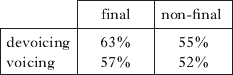
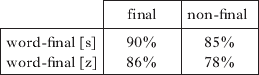
As can be seen in Table III, there was a higher percentage of correct responses for the utterance-final cases than the non-final cases, and a higher percentage of correct responses for the devoicing learning group than for the voicing group. 74% of the devoicing group gave correct responses to over half the stimuli in both final and non-final positions, while 26% met that criterion in the final condition but not the non-final condition. In the voicing group, 41% gave correct responses to over half the stimuli in both conditions, 23% achieved that only for the final condition, and 32% did not reach that for either condition. One subject in the voicing condition had 36% correct in the final condition, and 53% correct in the non-final condition.
Percentage of correct responses by Learning group and Utterance position.

The effects of both Learning group and Utterance position were found to be significant in a mixed model regression analysis with the correctness of the response as the dependent variable. Random effects intercepts were included in the model for both participant and utterance, with a slope factor for voicing within participant. The fixed effects were Learning group and Utterance position. Both had significant main effects, and their interaction was not significant, as can be seen in the summary in Table IV.
Fixed effects in a logistic regression model of response correctness (Experiment 1).

There were significantly more incorrect responses in non-final than final position, indicating that participants learned the distribution pattern more successfully in the position where they had direct evidence of the pattern in their learning sets. The fact that there were significantly more incorrect responses for the final voicing group than for the final devoicing group supports the hypothesis that the final devoicing pattern is more easily learned than the final voicing pattern.
A reviewer suggests that the difference between the final and non-final cases could be due to the order of presentation, since the block of utterances with final test words was always presented before the non-final block. Thus the difference in correctness between final and non-final could be due to fatigue increasing as the experiment progressed, to forgetting the training generalisations or to the effect of exposure to pattern-incongruent utterances during the testing phase. The only direct response to this would be to run the experiment with the blocks in the opposite order, which we were unable to do. However, we did examine the order of presentation of the stimuli within the blocks (which varied randomly across participants). The position (1–72) of each test stimulus in the within-block order of presentation was included as an additional factor in a model otherwise identical to that in Table IV. It did not prove to be a significant effect (b=0·002, z=0·9, p=0·39). The test thus provided no evidence for the interpretation of the difference between the final and non-final cases as a gradual order of presentation effect.
2.2.3 Discussion of Experiment 1
The results of the first experiment show that the participants learned the patterns of distribution in their learning sets on relatively brief exposure (60 utterances repeated three times), as evidenced by their responses to novel items. None of the participants completely mastered the patterns of distribution in the learning sets (the highest proportion of correct responses for any condition being just 78%), but they showed a significant tendency to accept pattern-congruent items more often than pattern-violating items.
Given only evidence of a restriction in utterance-final position in the learning phase, the participants' responses in the test phase clearly showed that they had extended the pattern to utterance-medial word-final position, at least in the case of the final devoicing pattern. The experiment thus demonstrates that domain generalisation is a significant tendency among language learners. The lack of evidence of such generalisation in the case of the voicing group might just reflect the weaker performance in both the voicing group (compared to the devoicing group) and the non-final utterances (as compared to the final ones) combining to make the effect too small to be significant.
The participants' responses reflected the distributional pattern in the learning set both for utterance-final targets and utterance-medial ones, but the strength of this effect was significantly weaker in the utterance-medial case. There are several possible explanations for this fact. Participants had direct evidence in their learning sets about the utterance-final case, but they had no direct evidence about the distribution of voicing in utterance-medial cases. The utterance-medial cases required an extrapolation from their learning experience which was not required in the utterance-final cases. Alternatively, trials with utterance-medial target words may have been harder because they were longer, or because participants had to locate the target word between non-target words.
It was also found in this experiment that participants learned final devoicing more successfully than final voicing. This then represents a case in which a widely attested, phonetically natural pattern proved more learnable than an equally simple pattern that is barely attested and has no phonetic basis. There are several possible interpretations of this finding. First, the greater learnability of the final devoicing pattern could be due to channel bias (Moreton Reference Moreton2008, Moreton & Pater Reference Moreton and Pater2012a, Reference Moreton and Paterb) in the experiment. The normal partial devoicing of utterance-final voiced obstruents could have affected our stimuli, leading to a tendency for experiment participants to misidentify final voiced obstruents as voiceless (Myers Reference Myers2012). Such a tendency would tend to undermine the final voicing pattern for those participants, since some of the final voiced obstruents would be misidentified as voiceless. There is no corresponding tendency for utterance-final voiceless obstruents to be voiced or misidentified as voiced, so the final devoicing pattern would not be undermined in the same way. If this was the case, the less natural pattern was not harder to learn as a pattern (reflecting a substantive learning bias; see below), but was merely subject to more phonetic ambiguity in category identification than the more natural pattern.
To test this interpretation, we submitted all the obstruent-final stimuli to 17 native speakers of American English, who were asked to identify the final consonant of the varying test word as either s or z. Materials were presented in the same way as for Experiment 1. The stimuli were presented in blocks by the position of the varying test item (final/non-final); half the participants were given the utterance-final block first and the other half had the blocks in the opposite order. Data were excluded from two bilingual speakers who had less than 75% correct overall.
The proportion of correct identification responses for each final consonant and each utterance position are given in Table V.
Percentage of correct responses by final consonant and Utterance position (stimulus identification test).

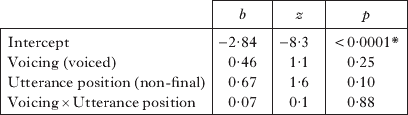
It can be seen that the word-final voiceless obstruents were correctly identified more often than the voiced ones, in both final and non-final utterance position. Unexpectedly, the obstruents in final position were identified correctly more often than in non-final position. The data were submitted to a mixed model logistic regression analysis, with random effect intercepts for participant and item, and slopes within participant for both Voicing and Utterance position. The dependent variable was the accuracy of the response (correct/incorrect), with correct treated as the default.
The results are given in Table VI.
Fixed effects in a logistic regression analysis of stimulus identification responses for Experiment 1 stimuli.

There was no effect either of the voicing of the test consonant or of the position of the test word in the sentence. The test therefore provided no evidence for the channel bias account of the learning group effect.
Alternatively, the more successful learning of final devoicing compared to final voicing could reflect a substantive learning bias (Wilson Reference Wilson2006). This need not be understood as an innate or universal bias in favour of a phonetically natural pattern, however. Second-language patterns (such as the ones in our experiment) might be more learnable to the extent they coincide with the phonetic, phonological or lexical tendencies in a speaker's first language. For example, English allows both voiced and voiceless obstruents in word- and utterance-final positions (e.g. maze/mace), but there is a strong tendency toward partial devoicing of utterance-final obstruents (as noted in §1.1). It could be that the participants in our study, who all were speakers of English, had a preference for a categorical pattern corresponding to that phonetic tendency over a categorical pattern that runs opposite to the phonetic tendency in their first language. Alternatively, a bias due to lexical frequency could exist, due to the greater number of English words ending in [s] compared to [z]. Yet a count of all [s]- and [z]-final word forms in the WebCelex lexical database shows that the opposite is true: there are 12,770 ending in [s] and 22,023 ending in [z], an [s]-to-[z] ratio of 0·58.Footnote 4 If we restrict the search to words ending in [s] or [z] preceded by a vowel, since these words better resemble our experimental stimuli, the counts are 4,385 and 12,587 respectively, a ratio of 0·35. Final [z] outnumbers final [s] because of the great number of plural noun and 3rd person singular verb forms ending in [z].Footnote 5
We refer to the target items in the experiment as words, but one might wonder whether participants in our experiments really understood experimental stimuli such as [ˈsanta pis ˈmizupu] (where [pis] is the target word) as three words contained within an utterance, as opposed to something else, e.g. morphemes contained within a word, words within words (compounds) or various combinations of these things. What we have called target words are the varying sequences set in the invariant frames: [ˈsanta__] and [ˈsanta__ˈmizupu]. Participants were thus encouraged to treat [ˈsanta], [ˈmizupu] and the target words as units smaller than the utterance. The context units [ˈsanta] and [ˈmizupu] occurred in all of the utterances, while the target words belonged to a broader inventory of 36 sequences, each of which occurred four to eight times in the learning set. Within the target words, there were no recurring sequences that could be interpreted as smaller units. So the target words of the experiment were sequences smaller than the utterance, which could not be broken down into smaller recurring units. This is what makes them the terminal units of this very simple grammar, and so analogous to words in natural languages. Whether the participants thought of them as words or not, they did treat them as units smaller than the utterance that was the domain of a generalisation about the distribution of voicing.Footnote 6
2.3 Experiment 2
The patterns that participants learned in Experiment 1 were reflected in distributional generalisations, but not in any phonological alternations among differing versions of the same item. Such alternation patterns are clearly an important aspect of phonological knowledge, so Experiment 2 is designed to test whether domain generalisation also occurs when the distributional pattern is reflected in alternations. Experiment 2 also differs from Experiment 1 in testing learning and domain generalisation across the consonant stops [p t k] vs. [b d g], rather than over [s] and [z] only. A finding of domain generalisation in this second experiment would heighten our confidence that the result is robust.
2.3.1 Methods
2.3.1.1 Participants
There were 25 participants in Experiment 2, who were all undergraduate students at the University of California, Santa Cruz. 17 of them were taking an introduction to linguistics course, and received course credit for participating. The rest had taken no linguistics courses and were volunteers.
All participants were English speakers who had acquired English as children. Many had experience with a language other than English, but none with a language with a final laryngeal neutralisation pattern.
Unlike in Experiment 1, all participants in Experiment 2 were presented with the same learning set. There were thus no participant groups, and all comparisons were within-subject.
2.3.1.2 Materials
The stimuli in both the learning and testing phase were utterances belonging to one of the two frames in (5), where the blank is the position of the test word, the only varying item in the utterance. The utterances consisted of CV(C) syllables, where C belonged to the set [m n p t k b d g], and V to the set [i e a o u].
-
(5)

The varying target words for this experiment consisted of pairs of items in which one had the form [ˈCVC] (the singular form), and the other [ˈCVCi] (the plural form). In non-alternating pairs, such as [pet]–[peti], the initial CVC (the stem) was identical in the singular and plural. In alternating pairs, such as [git]–[gidi], the initial CVC differed just in the voicing of the final consonant.
The target word pairs in the learning phase were of three types: (i) non-alternating pairs in which the stem-final C was nasal (‘nasal non-alternating’, e.g. [min]–[mini]), (ii) non-alternating pairs in which the stem-final C was a voiceless stop [p t k] (‘voiceless non-alternating’, e.g. [kip]–[kipi]) and (iii) alternating pairs in which the singular ended in a voiceless stop and the plural had a corresponding voiced stop (‘voiceless–voiced alternating’, e.g. [git]–[gidi]). The full set of target words used in the learning phase is given in (6). There were ten word pairs in each of the three types, for a total of 30 word pairs in the learning set.
-
(6)
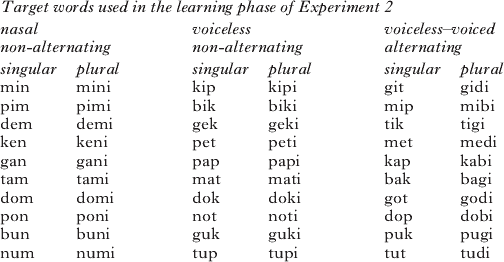
The utterances of the learning set included all of the nasal-final items in (6) in both contexts (5a) and (b), but the obstruent-final items (voiceless non-alternating and alternating) only in the utterance-final context (5a). Thus, as in Experiment 1, there were no coda obstruents in the learning set except in utterance-final position. There were 40 singular–plural utterance pairs in the learning set: 30 in the utterance-final frame (5a), and 10 (all with nasal-final target-word stems) in the utterance-medial frame (5b).
The utterances of the testing stage consisted of the same two sentence frames in (5), with the target words listed in (7). They included voiceless non-alternating and voiceless–voiced alternating pairs of novel test words, as in the learning set, but also ‘voiced non-alternating’ pairs such as [teb]–[tebi], and ‘voiced–voiceless’ alternating pairs such as [teb]–[tepi].
-
(7)

There were 14 word pairs in each of the four classes in (7), giving a total of 56 word pairs in the test set. Each of the 56 word pairs in (7) occurred in each of the two contexts in (5), giving a total of 112 stimulus sentence pairs.
The utterances were produced by a phonetically trained speaker with a Canadian English pronunciation (e.g. aspiration of syllable-initial voiceless stops), a declarative intonation and no internal pauses.
2.3.1.3 Procedure
Experiment 2 was carried out using the same equipment as in Experiment 1.
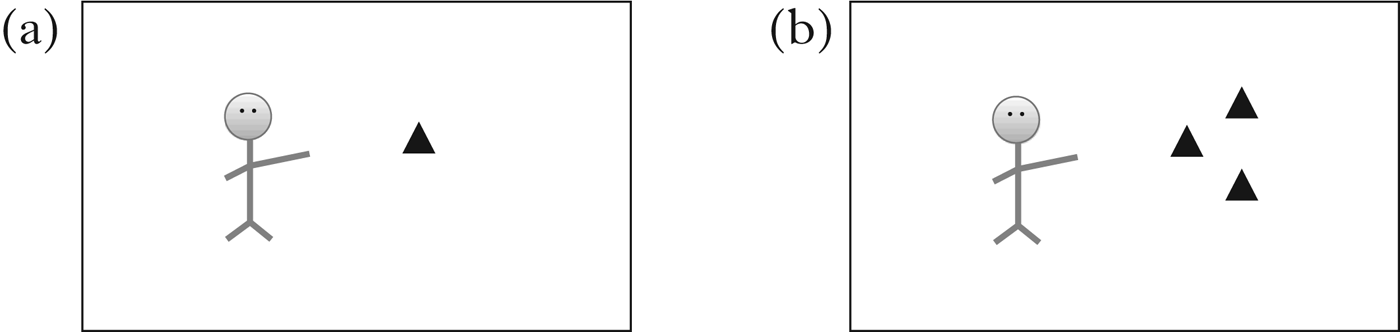
In both the learning phase and the testing phase, utterances were presented in pairs in which the two utterances were identical except that one had the singular member of a test-word pair, and the other the corresponding plural member, e.g. [bitomi min]–[bitomi mini]. The utterance pairs were accompanied by schematic drawings, as in Fig. 2. The utterances with singular forms ([CVC]) were accompanied by a simple drawing of a stick figure pointing at a single triangle (as in Fig. 2a), while during the utterances with plural forms ([CVCi]), the same figure pointed at three triangles (as in Fig. 2b). The triangles in the diagrams were black in the utterance-final condition and yellow in the utterance-medial condition. The pictures were meant to suggest schematic meanings for the [-i] (‘plural’) and for [nama] (‘yellow’).
Images accompanying utterances with forms in final position: (a) singular; (b) plural.

At the beginning of the learning stage, participants were told that they would be hearing pairs of utterances of a ‘made-up language’– the first utterance with the singular form of a word, and the second utterance with the plural form of that word. In the first run-through of the learning stage, the participants were instructed to repeat aloud each utterance that they heard. The utterance pairs were presented in blocks by utterance frame: the subjects heard all the utterance pairs in the learning set that had the utterance-final frame (5a), followed by all the utterance pairs in the learning set that had the utterance-medial frame (5b). The utterance pairs within a block were presented in randomised order, different for each participant.
Having heard and repeated all the utterance pairs in the learning set, participants then entered a feedback phase of the learning stage. In this phase, they first heard the utterance with the plural form. They were instructed to listen to this utterance, and then speak aloud the corresponding second utterance in the pair – the one with the corresponding singular form. After saying this utterance aloud, they were instructed to press any response button, at which point they heard the utterance with the correct singular form. As in the first phase, all the utterances with the final frame (5a) were presented, followed by all the utterances with the non-final frame (5b). The feedback phase was repeated three times. Thus a participant encountered each of the 40 singular–plural utterance pairs in the learning set four times: once in the initial listening-and-repeating phase, and three times in the feedback phase.
When they completed the learning phase, participants entered the test phase. During this phase, participants heard an utterance containing a plural form from (7), followed by a utterance with the corresponding singular. The target items were novel, in that none of them had occurred in the learning stage. When they heard the second utterance, participants were instructed to press the blue, right-hand button on the response pad if they judged that the pair of utterances belonged to the language they had heard during the learning stage, and otherwise to press the red, left-hand button. As in the learning stage, each utterance was accompanied by the corresponding schematic drawing. The drawing for the singular form was labelled with a prompt question ‘Belongs to the language?’, together with the two possible answers: ‘No’ (in red at the left edge of the window) and ‘Yes’ (in blue at the right edge of the window).
There were two blocks in the testing phase: all the utterances with the utterance-final frame (5a), followed by all the utterances with the utterance-medial frame (5b). Participants heard all pairs of forms given in (7), in both utterance positions in (5). They therefore encountered 112 trials in total during the test phase: the 56 target word-pairs in (7) in the two utterance frames in (5).
After the test phase was completed, participants completed a debriefing questionnaire, which asked them how they had distinguished utterances that belonged to the language from those that did not. Many noticed that the basis of the difference lay in the way the singular differed from the plural, and some noticed that the crucial pattern had to do with pairs of consonants such as t and d. None succeeded in verbalising the actual pattern of distribution of voiced and voiceless obstruents in the learning set.
2.3.1.4 Hypotheses
Experiment 2 tested the following three hypotheses.
Hypothesis 1 (learning). It was expected that the participants' responses would be affected by the pattern of distribution in the learning set. Thus participants would accept utterance pairs with utterance-final voiceless obstruents more often than those with utterance-final voiced obstruents.
Hypothesis 2 (domain generalisation). It was expected that participants would generalise the pattern of distribution from utterance-final to word-final position. This would be reflected in the participants accepting utterance pairs with word-final voiceless obstruents more often than those with word-final voiced ones in utterance-medial position as well as utterance-final position. Utterance-final position was the only position in which they had experienced coda obstruents during the learning set, so such a pattern of response would show an extension of the pattern beyond the context for which they had direct evidence.
Hypothesis 3 (alternation resistance). It was expected that participants would accept more non-alternating pairs than alternating pairs, regardless of whether they conformed to the pattern of sound distribution in the learning set. Tessier (Reference Tessier2012) found avoidance of alternation in an artificial language learning experiment testing the learning of a voicing pattern with 4-year-old English learners. Kerkhoff (Reference Kerkhoff, van Kempen and Baauw2004) found that Dutch-speaking children as old as 7;8 were still making voicing errors in a task of producing the plural corresponding to a given singular form, and that these errors were generally in the direction of preserving the same voicing in the plural as in the singular (e.g. giving incorrect non-alternating *[bɛtən] as the plural of [bɛt] ‘bed’, instead of the correct alternating form [bɛdən]).
2.3.2 Results
Of the 25 participants, one responded ‘yes’ to every single stimulus, and another responded ‘yes’ to all but two. These participants did not seem to be responding to the stimuli, so their responses were excluded from the analysis. That left 23 participants, each responding to 112 utterance pairs in the testing stage. One participant twice pressed a key other than the two labelled ones, so those two responses were excluded as uninterpretable, leaving a total of 2,574 responses in the analysis.
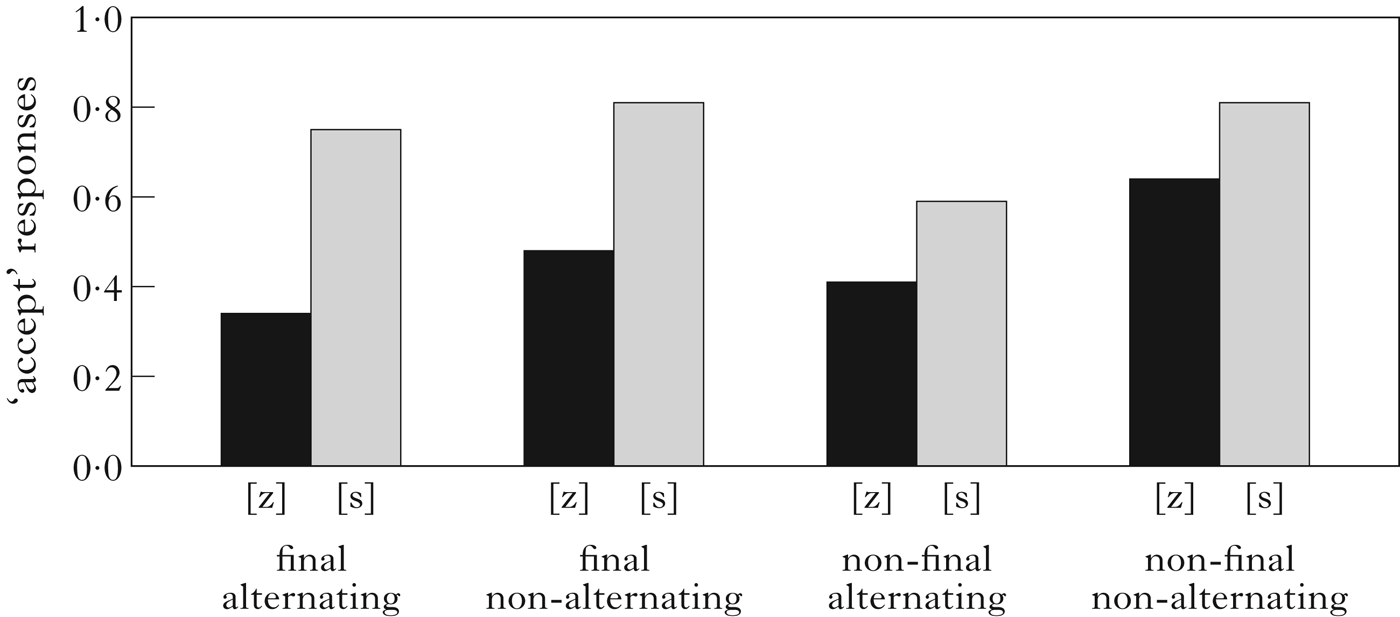
The acceptance rates for stimuli by condition are presented in Fig. 3. It can be seen that utterance pairs with voiceless-final stems were accepted more often than those with voiced-final stems. Within the same position class (final/non-final), non-alternating pairs were accepted more often than alternating ones.
Proportion of ‘accept’ responses by stem-final voicing category, utterance position and alternation status.

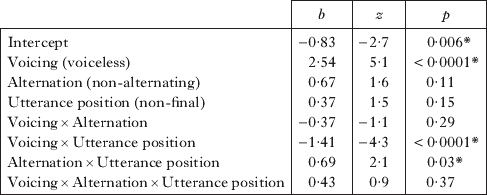
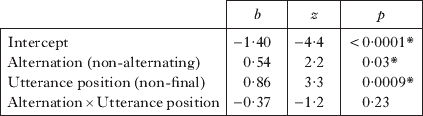
The hypotheses were tested in a mixed model logistic regression analysis, as in Experiment 1. The dependent variable was the response, with ‘yes’ coded as the marked value. The random effects were participant and item (utterance pair). The fixed factors were Voicing (voiced/voiceless), Utterance position (final/medial) and Alternation (alternating/non-alternating). In each pair of levels within a factor, the first was default (coded 0) and the second was marked (coded 1). The model included intercepts for both random effects (participant and item), as well as slopes within participant for all three fixed effects. ANOVA comparison with respect to log likelihood showed that any model with any simpler random effects structure was significantly less well-fitting than this maximal model. The results of the statistical test are given in Table VII.
Fixed effects in a logistic regression model of responses (Experiment 2).

There was a significant main effect of Voicing, with the likelihood of a ‘yes’ response significantly greater with a voiceless-final test words than with test words ending in a voiced obstruent. The main effects of Alternation and Utterance position were not significant, but there were significant interactions of Voicing and Alternation with Utterance position.
The results provide only qualified support for the hypothesis of a bias against alternating utterance pairs. There was not a significant tendency to accept non-alternating over alternating utterance pairs in general, though the significant interaction between Alternation and Utterance position indicates that there was such a tendency for utterance pairs with test words in non-final utterance position.
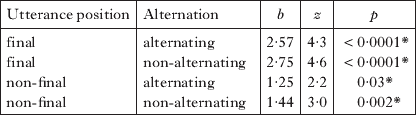
To explore the interactions, the data were divided into subsets according to Alternation and Utterance position. Mixed-model logistic regression analyses were run to test whether voicing had a significant effect on responses in each of these subsets. Response (no/yes) was the dependent variable, with yes as the marked value. Random effects were subject and utterance pair. An intercept was included in the model for each random effect, as well as a slope variable within subject for voicing. The only fixed effect was Voicing (voiced/voiceless). The results are given in Table VIII.
Effects of voicing in data subsets defined by Utterance position and Alternation.

Utterance pairs with word-final voiceless obstruents were significantly more likely to be accepted than pairs including test words with final voiced obstruents, whether the pair was alternating or not, and whether the test word was utterance-final or not. This supports the hypothesis that the pattern of final devoicing was generalised beyond utterance-final position to include utterance-medial word-final position.
As in the case of Experiment 1, it would be possible that the participants had a preference for voiceless obstruents over voiced obstruents, regardless of position, due to the greater frequency of occurrence of voiceless obstruents in the learning set. To test for this possibility, the model presented in Table VII was augmented by two additional fixed effects: the presence of a non-final [p t k] in the test word (present/absent), and the presence of a non-final [b d g] in the test word (present/absent). In each case, absence was the default value and presence the marked value. Neither factor had a significant effect: non-final [p t k] (b=0·04, z=0·2, p=0·82); non-final [b d g] (b=0·29, z=1·9, p=0·06). Note that the effect of a non-final [b d g] just misses significance (α=0·05), but the effect is in the wrong direction for the hypothesis, since the presence of a non-final [b d g] weakly favoured acceptance of the utterance, rather than rejection. These results thus fail to provide evidence for a general preference for [p t k] over [b d g], regardless of the consonant's position in the word.
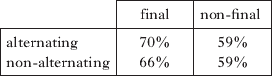
To test the hypotheses about the effects of position and alternation on the correctness (pattern congruence) of the responses, responses were classified as ‘correct’ if they corresponded to the pattern in the learning set, and ‘incorrect’ otherwise. Thus a ‘yes’ response was correct if the utterance pair belonged to the voiceless set, and a ‘no’ response was correct otherwise. The proportion of correct responses for each alternation and position subset is given in Table IX.
Percentage of correct responses by Alternation group and Utterance position.

For final alternating pairs, 80% of the participants gave correct responses in over half the cases, compared to 76% of the participants for final non-alternating pairs. For non-final alternating pairs, on the other hand, only 48% of the participants had correct responses more than half the time, and 52% achieved that level for non-alternating pairs.
A mixed model logistic regression analysis was performed, with correctness of each response as the dependent variable and incorrect the marked value of that variable. The random effects were participant and item (utterance pair), with intercepts for both of those factors and slopes for Voicing, Alternation group and Utterance position within participant. The fixed effects were Utterance position and Alternation. The results of the test for the fixed effects are given in Table X.
Fixed effects in a logistic regression model of response correctness (Experiment 2).

There were main effects for Alternation and Utterance position, and no significant interaction between the two. There were thus significantly more correct responses in alternating and final utterance pairs.
Since the final utterance pairs were presented in a block before the non-final ones, the greater number of errors in non-final position could be due to fatigue over the course of the testing stage, or exposure to pattern-incongruent items in the test phase. To test for this possibility, a model was constructed that was identical to that presented in Table X, except for the addition of one factor: the within-block position of each stimulus item in the presentation for that subject. This factor had no significant effect (b=−0·002, z=−0·7, p=0·48). The test thus provides no support for the interpretation of the difference between the final and non-final blocks as an effect of the time elapsed from the presentation of the learning set.
2.3.3 Discussion of Experiment 2
The results of Experiment 2 support the first two hypotheses. Participants learned the utterance-final pattern, distinguishing voiced-final from voiceless-final items (learning), and they generalised this learning to word-final, utterance-medial position (domain generalisation). These results show that domain generalisation occurs whether the generalised pattern is reflected in alternations or not, and they replicate the results of Experiment 1 for the more representative set of consonants [p t k b d g].
It is possible that the participants, in preferring words ending in voiceless obstruents over those ending in voiced ones, were influenced by their previous experience with English, as well as by their experience with the learning set. For example, this could be due to differences in the type frequency of final [p t k] vs. [b d g] in the English lexicon. There are 31,721 word forms in the WebCelex lexical database ending in any of [p t k], compared to 30,046 ending in [b d g], a voiceless-to-voiced ratio of 1·06. If we restrict the searches to word forms in which the final consonant is preceded by a vowel (so that they are more similar to the experimental stimuli), the counts are 19,510 vs. 17,803 respectively, a ratio of 1·10. These are not large differences. However, the differences increase if we restrict the search to word forms having a COBUILD spoken frequency greater than or equal to 25 occurrences per million words: 559 vs. 286 (all words; ratio=1·95), and 312 vs. 179 (words with a vowel preceding the final consonant; ratio=1·74). In addition, words ending in [p t k] have an average spoken frequency of 28·9, compared to 15·1 for those ending in [b d g] (ignoring words with a listed frequency of 0). For words in which the final consonant is preceded by a vowel, those frequencies are 39·4 and 9·7 respectively. It is therefore conceivable that our experimental participants were influenced by English lexical statistics. Against this interpretation, though, we note that the occurrence of [p t k] vs. [b d g] elsewhere in a stimulus word had no effect on participant judgements, as discussed above, and that the English-speaking participants in Experiment 1 in the final voicing condition preferred final voiced obstruents over final voiceless ones. Subjects seem to be more affected by asymmetries in the experimental learning set than by native lexical statistics.
The results provide weak evidence for the hypothesis that learners have a bias against accepting more than one form for a given item, as argued by Kerkhoff (Reference Kerkhoff, van Kempen and Baauw2004) and Tessier (Reference Tessier2012) . Such a bias was found in non-final utterance position, but not in final position. Resistance to alternations is an important aspect of phonology. It is reflected in the faithfulness family of constraints in Optimality Theory (Prince & Smolensky Reference Prince and Smolensky1993, McCarthy & Prince Reference McCarthy and Prince1995). In rule-based models, it is reflected in the fact that phonological rules only apply when their structural description is satisfied, so that the default is no change.
Finally, it is interesting that there was a small but significant increase in accuracy for the alternating condition, suggesting that the presence of alternating forms may assist in learning a pattern like final devoicing. Learners may resist accepting more than one form for a given item, but once they have done so, the alternation is informative to them, as it is to phonologists.
3 General discussion and conclusion
Historical accounts that relate word-final phonological restrictions to the phonetic properties of utterance-final position crucially posit generalisation from utterance-final to word-final position. The two experiments in this paper provide the first direct empirical evidence that learners do tend to generalise in this way, and thus provide support for the traditional view that domain generalisation is a natural diachronic process.
Why do language learners generalise in this way from utterance-final position? Why didn't the participants in the experiments make the conservative assumption that the restriction on voicing only applied to utterance-final position, since that was the only position for which they had evidence of a restriction?
We might posit that domain generalisation is a kind of ‘cyclic’ or ‘paradigm uniformity’ effect, reflecting a preference that the utterance-medial variant of a word have the same form as the devoiced utterance-final variant of the same word (Steriade Reference Steriade1997). But in the experiments described above, participants were responding to novel forms, so there was no established utterance-final form of a particular lexical item that could be extended to an utterance-medial form of the same item. This is analogous to the way in which a Russian speaker applies final devoicing to previously unfamiliar words despite the lack of any utterance-final model, as discussed in §1. The effect of the learning set on the test responses must be interpreted as a generalisation about the distribution of sounds, not about the form of individual lexical items.
For a learner who encounters utterance-final words with final obstruent devoicing, there is inherent ambiguity about the domain of devoicing – such data are consistent with utterance-final devoicing or with word-final devoicing. Suppose that learners have both interpretations equally available to them. For example, in the context of Optimality Theory, Flack (Reference Flack2009) argues that the existence of a constraint applying word-finally, such as *D]Wd (prohibiting voiced obstruents), necessarily implies the existence of an analogous constraint applying utterance-finally, i.e. *D]Utt. A reviewer points out that, given a learning model such as the Gradual Learning Algorithm in Stochastic Optimality Theory (Boersma Reference Boersma1997, Boersma & Hayes Reference Boersma and Hayes2001) or other algorithms that similarly gradually ‘promote’ constraints based on relevant input encountered, any evidence that leads to the promotion of *D]Utt will necessarily lead to the promotion of *D]Wd as well, while the reverse is not true. This state of affairs will cause *D]Wd to be promoted higher than *D]Utt, assuming the presence of any input, in non-utterance-final position, that causes *D]Wd to be promoted. This might happen if a language happens to have more forms with word-final voiceless obstruents than forms with voiced ones. Alternatively, ‘paradigm uniformity’ based on utterance-final forms (see above) could act as a bridge.Footnote 7 In this way utterance-final devoicing might be generalised to all words. However, in the context of our experiments it is not obvious what input would give the advantage to *D]Wd, since participants only ever encountered word-final obstruents in utterance-final position. Note also that this approach predicts domain generalisation to every other phonological domain, since constraints such as *D]Phr and *D]σ, for example, also exist (Flack Reference Flack2009). Given the implicational logic entertained above, utterance-final devoicing might be expected to generalise to syllable-final devoicing. Whether this is a good prediction we leave as an open question.
We suspect that the tendency toward domain generalisation is a manifestation of a more general bias toward word-based phonology. There are certainly cases of phrase-level phonology, but the environments of most of the restrictions on the distribution of sounds are limited to within words. The word is, for example, the most common domain for patterns of stress (Hayes Reference Hayes1995), and vowel harmony almost never extends beyond a single word (a striking rare exception being Somali; Andrzejewski Reference Andrzejewski1955). Alternations are typically reflected within words in word paradigms, which is why phonologists usually begin a phonological inquiry with such paradigms (Kenstowicz & Kisseberth Reference Kenstowicz and Kisseberth1979). Again, however, if there is a general bias toward word-based phonology, where does it come from?
Assuming a model of acquisition in which phonotactic generalisations are built from a store of lexical representations (Pierrehumbert Reference Pierrehumbert, Bod, Hay and Jannedy2003, Edwards et al. Reference Edwards, Beckman and Munson2004), learners are more likely to induce generalisations over words than over larger units like phrases or utterances, because they have more stored words than stored phrases over which to induce generalisations. This is because we encounter many more words than utterances (since words make up utterances). Words may also be more successfully stored, because they tend to be shorter than utterances, and because a given word is reinforced in memory more often by repeated exposure than a given utterance. In this view, domain generalisation is simply the consequence of inferring the generalisations that are most robustly supported.
If it is correct that domain generalisation happens because learners make generalisations over their mental lexicon, then we would not expect generalisation from utterance-final position to domain-final position in domains that are larger than the word, such as phonological phrases. Since phrases consist of words, just like utterances, the logic described above will still favour generalisation to word-final position. As far as we know, there are no established cases of such generalisation, but this should be investigated further. This account also does not imply that generalisation should lead to syllable-final devoicing, since stored words with final devoicing do not by themselves provide any evidence about syllables. (We do not assume, as in the account above, a theory that forces learners to entertain a constraint like *D]σ simply because they entertain *D]Wd.) These are predictions that can be tested in further experiments.
A question which any account of domain generalisation must address concerns the existence of direct counterevidence to domain generalisation. In our experiments, learners had no evidence about word-final obstruent voicing in utterance-medial position. In real life, if a language has utterance-final devoicing, then the learner's input contains word-final voiced obstruents in non-utterance-final position. Why does domain generalisation occur despite such counterevidence?Footnote 8
There is reason to believe that utterance-final words, including words produced in isolation, have a special status for language learners. Infants learn to segment words from phrases at utterance edges before they can do so utterance-medially (Seidl & Johnson Reference Seidl and Johnson2006, Johnson et al. Reference Johnson, Seidl and Tyler2014). Johnson et al. refer to utterance edges as ‘anchors of reliability’ for infants trying to segment speech. Brent & Siskind (Reference Brent and Siskind2001) show (for English speakers around nine months of age) that infants' likelihood of producing specific words depends on the frequency with which their care-givers uttered the same words earlier – but only when they uttered them in isolation. Sundara et al. (Reference Sundara, Demuth and Kuhl2011) demonstrate that infants (at around two years of age) both perceive and produce the English 3rd person singular suffix -s better in utterance-final than in utterance-medial position, and they further argue that the production difference must be at least partly explained by the perceptual difference. Sundara et al. suggest three reasons why utterance-final forms may be better perceived. First, the added length of sounds in final position due to final lengthening may render these sounds more perceptible. Second, sounds followed immediately by more sounds can be masked. Third, sounds in utterance-final position are recalled more accurately and often. (Sundara et al. note that there is also much evidence in the literature for the salience of utterance-initial words.) The relevance of these findings here is that they imply that utterance-final word variants could figure more prominently in early lexicons because they are more accurately perceived and more frequently experienced (because they can be segmented from utterances).
Finally, we mention a few other implications of the domain-generalisation idea. If domain generalisation is driven by a general bias for word-based generalisations over sound categories, then we do not expect it to be limited to word-final devoicing. We predict that other cases of domain generalisation will work the same way, so that, for example, if learners were to be exposed to an utterance-final restriction on tone or vowel length, these too would be generalised to word-final position (see the discussion in §1). Moreover, if the basis of domain generalisation is a general preference for word domains, then we expect it to apply if the restriction to be learned is on sounds at the onset of the utterance, rather than the offset. That is, domain generalisation should be equally relevant to word-initial generalisations, as argued for by Hualde (Reference Hualde2013) . More generally, a restriction on the distribution of sounds within words (e.g. one conditioned by affixes) should be more easily learned, all else being equal, than an equivalent restriction on the distribution of sounds within phrases (e.g. one conditioned by a neighbouring word). It would require further experiments to determine whether these expectations are supported.