Introduction
The commonly accepted narrative holds that, following the Second World War, the USA as the pre-eminent power in the agricultural sciences sought to exploit that advantage to feed a world with a rapidly growing population, and at the same time use its scientific capacity as a weapon in a quickly escalating Cold War.Footnote 1 This narrative then nearly always turns to the leadership role of the Rockefeller Foundation in applying science to food production, starting in Mexico in 1943, which eventually resulted in the green revolution in rice and wheat in Asia in the mid 1960s.Footnote 2
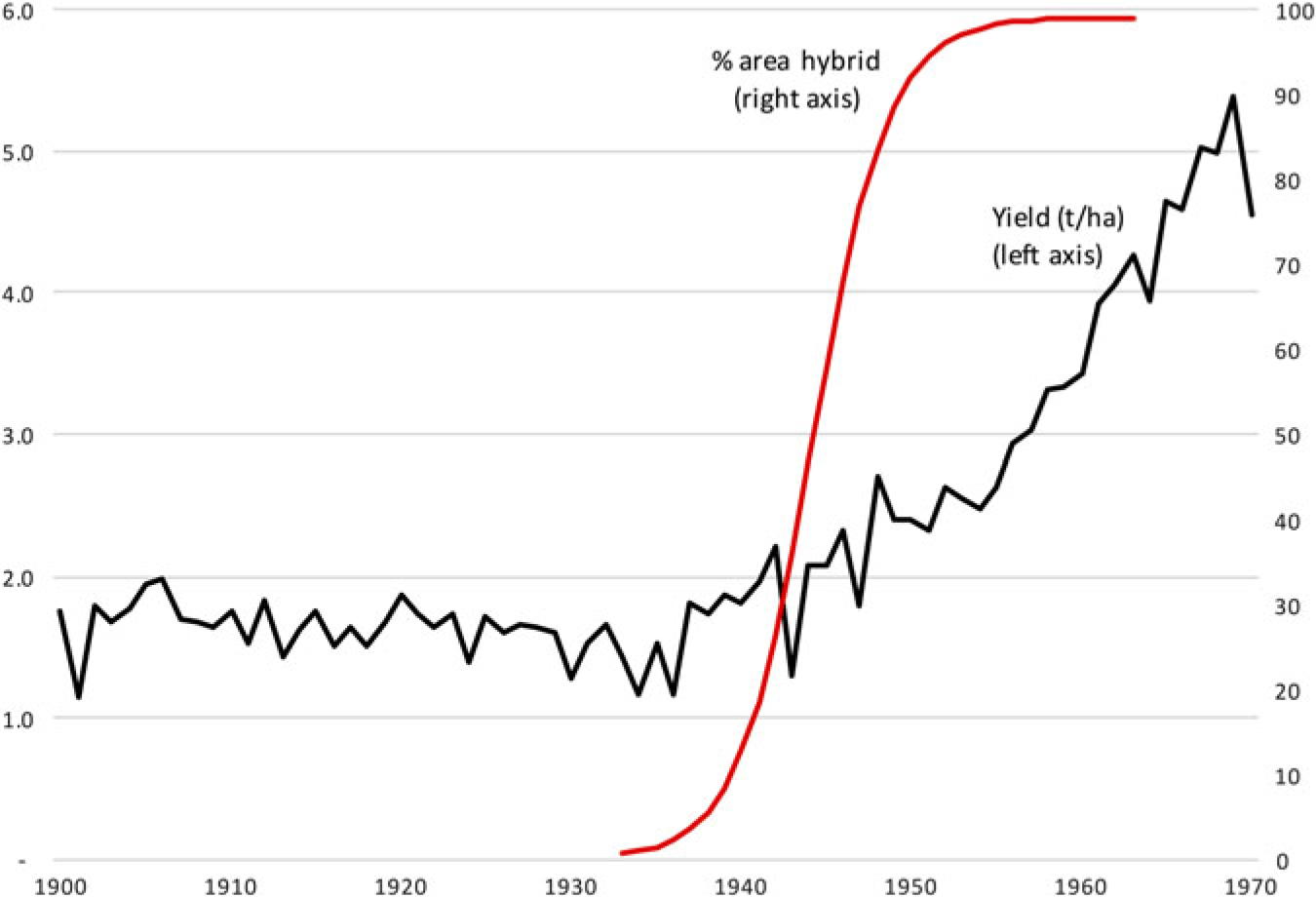
This article questions the standard narrative in three ways. First, I argue that efforts to transfer US agricultural technology started with maize (Zea mays) well before the Second World War, and that the transfer of hybrid maize technology was a dominant theme in US scientific exchanges, training of foreign students, foreign assistance programmes, and private overseas investment in agriculture in the immediate post-war period. Adoption of hybrid maize had taken off rapidly, beginning in Iowa in 1933 after nearly two decades of research, and US maize yields more than doubled from the early 1930s to 1955 (figure 1). The perception at the time was that hybrid maize had stimulated a revolution in US agriculture, and not surprisingly, many argued that it was the most important technological breakthrough of the century, offering other countries a quick way to feed a rapidly growing world population.Footnote 3
Yield of maize (tons per hectare) and percentage area sown to hybrid seed, USA, 1900–70. Source: United States Department of Agriculture (USDA), Agricultural statistics, Washington, DC: Government Printing Office (annual issues), https://usda.library.cornell.edu/concern/publications/j3860694x?locale=en (consulted 2 September 2019).

Second, I argue that many actors participated in the transfer of hybrid maize. The Rockefeller Foundation certainly played a role, but generally after others had paved the way. The pioneers were national scientists of the adopting countries, many of whom had been trained in maize genetics and hybrid breeding in US universities from the 1920s. With the beginning of foreign assistance programmes after the Second World War, US technical assistance became an important vehicle for transferring hybrid seed, breeding methods, and building capacity in local universities. Furthermore, nascent private seed companies, the United States Department of Agriculture (USDA), and global actors, notably the newly created Food and Agricultural Organization of the United Nations (FAO), were important players in extending hybrid maize technology to many countries. Last but not least, indigenous farmers in the Americas contributed highly diverse sources of germplasm and associated knowledge which they had evolved over millennia to suite their specific ecological niches and food preferences.
Third, I argue that the scale of the transfer of hybrid maize technology beyond the USA rivalled that of the highly publicized green revolution in wheat. Indeed, hybrid technology was one factor enabling maize production today to expand nearly tenfold over its pre-war level, and become the world’s most important crop in terms of tonnage and calories produced. However, even more than the green revolution, the success of hybrid maize was extremely uneven, ranging from abject failure, to modest but often highly inequitable adoption within countries, to almost complete acceptance by millions of farmers. Although adoption was generally higher among larger and commercially oriented farmers, there were also notable cases of high adoption by small-scale farmers growing hybrid maize for subsistence. This unevenness related to many factors, including the heterogeneous environments under which maize is grown, the intrinsic nature of hybrids themselves that requires a reliable seed supply system, and the variable status of maize as a ‘political crop’ that was often secondary to the major staples, rice and wheat, and lacked policy and institutional support. In any event, because of the patchy record of success and the more diverse set of actors involved, the history of hybrid maize transfer and adoption has not received the attention that it deserves in the literature.
This article reviews these developments, beginning with a brief overview of the development of hybrid maize in the USA and the major US centres for training maize breeders. Using a framework that includes three dimensions of technology transfer – the type of transfer, the roles of various actors, and the institutional and market environment that influenced farmers’ demand – I trace the spread of the technology to Latin America, Europe, Asia, and Africa through short country vignettes. The history reveals how the interaction of these three dimensions of technology transfer influenced successful transfer, as well as the many cases of failure. The timeframe for the history is from 1921, when the first hybrid maize programmes were initiated, to 1970, when the International Maize and Wheat Center (CIMMYT), headquartered in Mexico, was fully established, and the almost exclusive focus on hybrid technology in the tropics was ended in favour of improved open-pollinated varieties that allowed farmers to save their own seed.
Science and the development of hybrid ‘corn’ in the USA
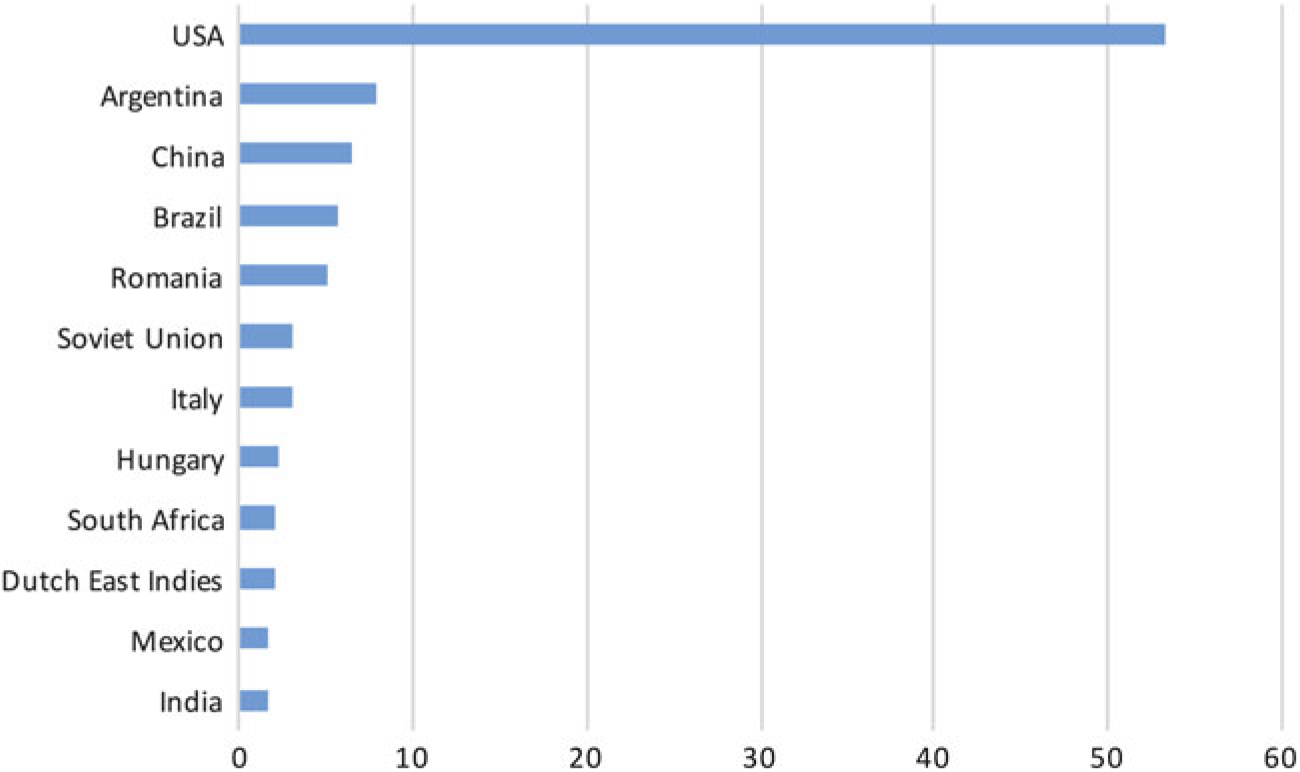
Maize originated in the Americas, and the rich diversity of varieties developed by indigenous groups ultimately enabled it to become the leading cereal crop in the USA when the country was founded, used for food, feed, and multiple other uses.Footnote 4 Over the twentieth century, with the rise of intensive livestock operations, demand for maize for feed use rose rapidly. The USA was (and still is) the dominant maize producer, with an over 50% share of the world’s maize crop between 1934 and 1938 (figure 2).
The twelve largest maize producers prior to the Second World War (million tons, 1934–1938). Source: W. S. Woytinsky and E. S. Woytinsky, World population and production: trends and outlook, New York: The Twentieth Century Fund, 1955, pp. 552–60.

In the early twentieth century, US public-sector breeding programmes, as well as many farmers and seed companies, bred open-pollinated maize varieties (OPVs) but with little impact on maize yields. The discovery of ‘hybrid vigour’ or heterosis in 1909–12 by Edward M. East at Harvard University’s Bussey Institution, working in collaboration with the Connecticut Agricultural Experiment Station, proved to be a turning point in the US maize economy.Footnote 5 The exploitation of hybrid vigour was unique at the time to maize, which, unlike most other major crops, is an open-pollinating crop with separate male and female flowers. This characteristic greatly facilitated controlled pollination needed for in-breeding parent lines over several cycles, and then crossing the inbreds to produce hybrids.Footnote 6 With the right combination of inbred parents, the yield gain was as much as 50% above the yield of the parental OPVs, but more commonly averaged 15–20%.Footnote 7 Notably, yield expression positively relates to the ‘genetic distance’ between parent lines, which depends, in turn, on access to diverse germplasm sources.Footnote 8
The discovery of ‘hybrid vigour’ launched a period of intensive investment in maize breeding and genetics in the USA, led by three of East’s students at Harvard. Donald F. Jones made a breakthrough in 1918 by creating double-cross hybrids, which greatly reduced the cost of seed production, and laid the basis for the commercialization of the technology.Footnote 9 Another former student, Rollins A. Emerson, headed the Department of Plant Breeding at Cornell University from 1914 to 1942. Under Emerson’s leadership, Cornell became the global leader in maize genetics through the Maize Genetics Cooperation Group in 1934, involving scientists from many countries.Footnote 10 Two scientists who had worked in Emerson’s laboratory were later to receive Nobel prizes for their genetics research.Footnote 11 The third of East’s students was Herbert K. Hayes, who did pioneering work on hybrid maize development before moving to the University of Minnesota in 1915, where he led plant breeding research and instruction until his retirement in 1952. Hayes was a leading proponent of cooperative crop improvement networks to accelerate breeding progress through collaboration among programmes within a region.Footnote 12
Meanwhile, Iowa State College built up its expertise in maize genetics and breeding by hiring students of Emerson from Cornell, who were important in shifting the centre for hybrid maize research to the Midwestern ‘Corn Belt’. Capitalizing on this capacity, the USDA launched a cooperative programme at Iowa State in 1925 to develop suitable hybrids for the ‘Corn Belt’ in collaboration with the land grant universities of the region. This programme was led by an Iowa State graduate, Merle T. Jenkins, who, after nearly a decade of intensive breeding effort, released the first widely successful hybrid in 1933, making Iowa the leading state in adoption of the new technology.Footnote 13 In a now classic study, the economist Zvi Grilliches documented the steady spread of hybrid adoption to other maize-producing states through adaptive breeding to develop hybrids for specific environmental needs.Footnote 14 Nearly complete adoption of hybrid maize in the USA was achieved by 1955.
A fundamental characteristic of hybrid maize is that, unlike OPVs, seed has to be purchased every year to maintain its yield advantage, thereby providing incentives to private seed producers. This stimulated the establishment of dozens of small- and medium-sized seed companies, which initially depended on hybrids developed by the public sector to build their business.Footnote 15 One of the first and ultimately most successful companies was Pioneer Hi-Bred Seed Company, founded by Henry A. Wallace in Iowa in 1926. Hybrid technology also enabled companies to protect their intellectual property through ‘trade secrets’ on the parentage of their hybrids, providing incentives for larger companies to invest in their own research capacity to develop proprietary hybrids. Accordingly, maize became the first crop to attract significant private investment in crop breeding. One of the first seed companies to build a professional research department was Funk Brothers Seed Co. in 1937, but the transition from public to private breeding in the USA took place over several decades up to the 1980s.Footnote 16
Quantifying the global diffusion of hybrid technology
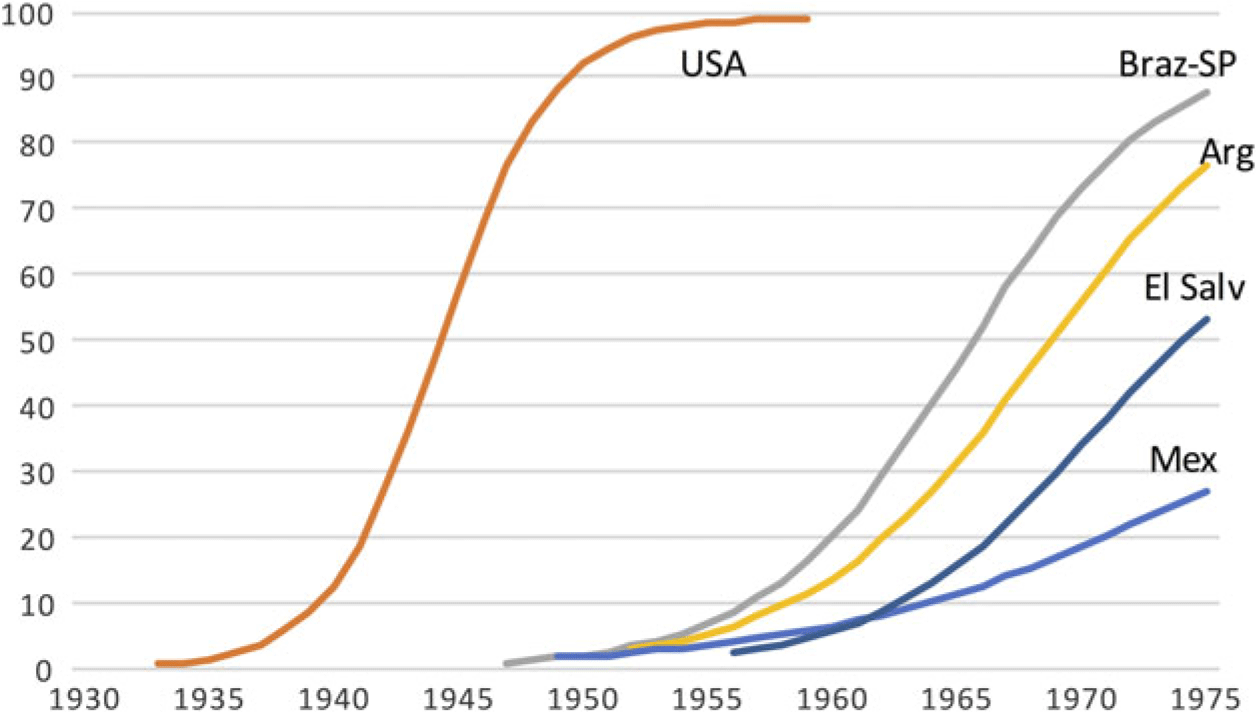
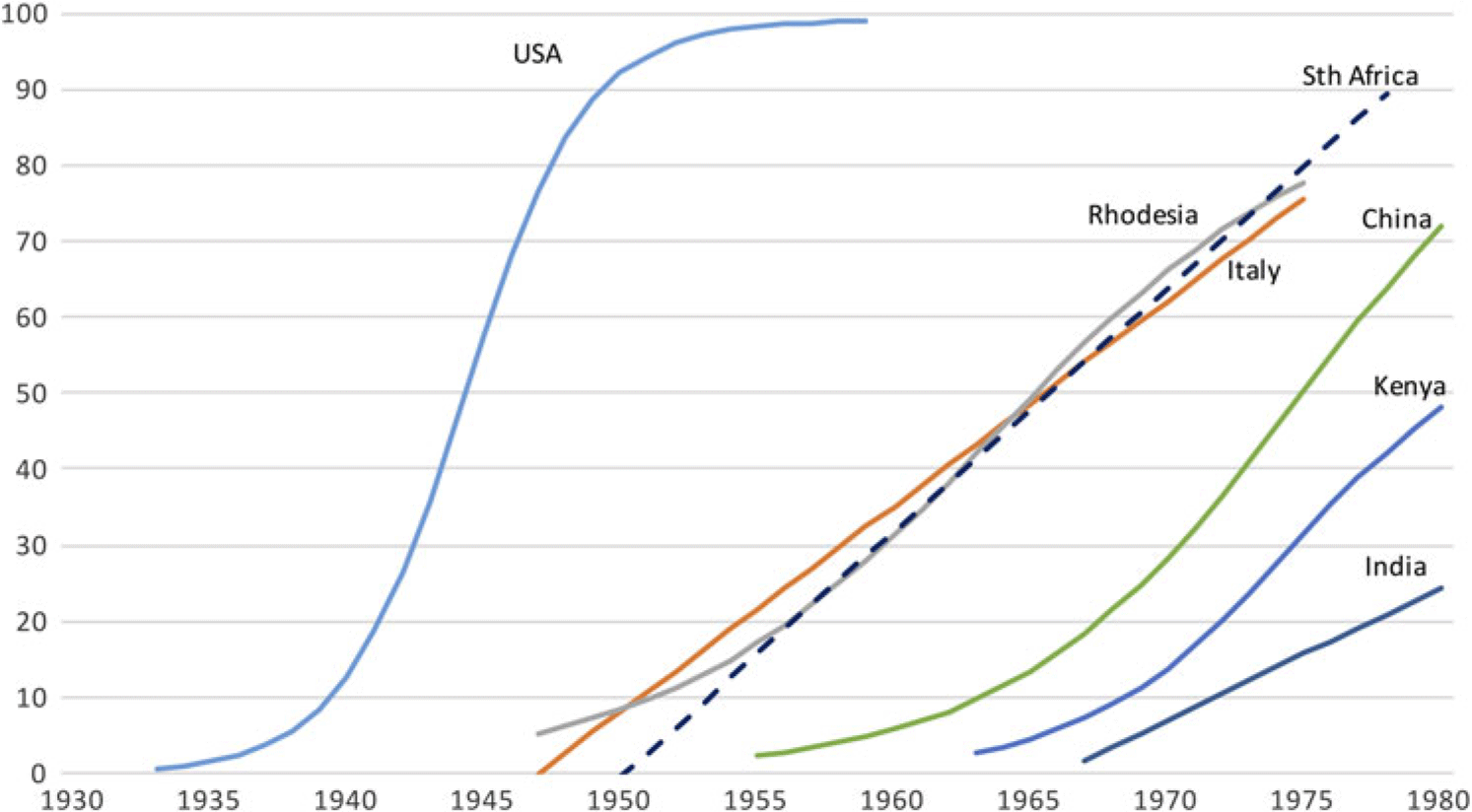
Extending the work of Grilliches globally, I use a variety of sources in figures 3 and 4 to construct the spread of hybrid maize technology outside the USA. The adoption of hybrid maize in a few countries has been tracked through surveys; in other cases, adoption can be estimated through seed sales, since hybrid seed must be purchased annually. Following Grilliches’ work, these estimates do not account for reuse (termed ‘recycling’) of hybrid seed by some farmers, which avoids the annual cost of purchasing seed, although with a significant drop in yield benefits.Footnote 17
Adoption of hybrid maize (% of total maize area) in Latin America in relation to the USA. Adoption in Mexico includes improved OPVs. Sources: Brazil (State of São Paulo): Ana C. Castro, ‘Crescimento da firma e diversificação produtiva: o caso de Agroceres (Growth of the firm and productive diversification: the case of Agroceres)’, PhD thesis, Universidade Estadual de Campinas, Brazil, 1988, p. 93; Argentina: D. Rossi, ‘Evolución de los cultivares de maíz utilizados en la Argentina’, Agromensajes de la Facultad, 8, 22, 2007, pp. 3–10; El Salvador: Thomas S. Walker, ‘Risk and adoption of hybrid maize in El Salvador’, Food Research Institute Studies, 18, 1, 1981, p. 64; Mexico: Dana G. Dalrymple, ‘New cereal varieties: wheat and corn in Mexico’, AID Spring Review, USDA and USAID, p. 9. Adoption data for 1974 from Wellhausen, ‘Recent developments’, p. 74.

Adoption of hybrid maize (% of total maize area) in China, India, Italy, Kenya, Rhodesia, and South Africa, in relation to the USA. Logistic adoption curves fitted as in figure 3, except for South Africa and Italy, where a linear adoption curve provided a better fit. Sources: Rhodesia: Bernard Kupfuma, ‘The payoffs to hybrid maize research and extension in Zimbabwe: an economic and institutional analysis’, MSc thesis, Michigan State University, 1996, p. 127; Italy: L. Fenaroli, ‘Technical problems of corn growing in Italy’, Euphytica, 7, 1958, pp. 228–36; China: Jing Xiong Li, ‘China’, in R. N. Wedderburn and C. de Leon, eds., Proceedings of the Second Asian Regional Maize Workshop, Mexico DF: CIMMYT, 1988, pp. 23–34; South Africa: H. O. Gevers, ‘Highlights of maize breeding in South Africa’, in Department of Agriculture and Water Supply Technical Communication, Proceedings of the Eighth South African Maize Breeding Symposium, 1988, p. 12; Kenya: Daniel D. Karanja, An economic and institutional analysis of maize research in Kenya, Food Security International Development Working Paper no. 54693, Michigan State University, Department of Agricultural, Food, and Resource Economics, 1996, p. 17; India: Ministry of Agriculture, Indian agriculture in brief, New Delhi: Government of India, annual.

Again following Grilliches, logistic adoption curves were estimated in ten countries with sufficient data.Footnote 18 What is notable about these curves is that the timing, speed, and final adoption level varied widely. In no case did adoption take off before the Second World War, but in Latin America 50% adoption was first achieved in the State of São Paulo in Brazil (the largest maize-producing state), though still with a twenty-year lag behind the USA. Other success stories of adoption in Latin America were Argentina and El Salvador. Owing to sparse data, an adoption curve was not estimated for Venezuela but it would be similar to that of Argentina.Footnote 19 In the rest of the world, 50% adoption was achieved first in Italy, and then in Southern Rhodesia and South Africa, again with a twenty-year lag behind the USA. Most other countries in Europe also achieved almost complete adoption of hybrids starting in the 1950s.Footnote 20 In the 1960s, China and Kenya similarly experienced widespread adoption.
In contrast, in many other countries hybrid maize made very modest progress, notably in Colombia, Mexico, and India, despite considerable investment in hybrid breeding (see figures 3 and 4). Adoption in other countries that launched hybrid maize programmes, such as the Philippines and Indonesia, is not shown in figure 4 owing to negligible levels of adoption, of under 5% of maize area.
A rough calculation based on estimated adoption levels in 1974 in the countries reviewed indicates that improved maize hybrids had been adopted on about 34 million hectares outside the USA (in addition to the 27 million hectares in the USA).Footnote 21 Notably, this area is comparable to the much better known adoption of semi-dwarf wheat varieties in the green revolution period, which reached 35 million hectares by 1977.Footnote 22 These estimates are supported by a global survey of cereal technology in 1965 just prior to the green revolution: ‘The success of agricultural scientists in developing new strains of plants has been most notable in the case of maize; the use of new hybrid varieties, which was confined to the United States for some years has now become widespread throughout the world.’Footnote 23
Towards a framework of understanding diffusion patterns
To explain this wide variation in the results of transferring hybrid maize across the world, I use a framework that analyses transfers at three levels: what was transferred; who were the major actors in the transfer process; and how did the institutional and market environment in the recipient country influence farmers’ demand for the technology.
Technological transfer is commonly classified as direct or material transfer, transfer of the skills and knowledge, and capacity transfer.Footnote 24 In agriculture, the direct transfer of biological technologies from one country to another is limited by heterogeneity in agro-climatic conditions, differences in pest and disease complexes, local grain preferences, and differences in socioeconomic and market contexts. For US technologies, direct transfer is most likely from the largely temperate growing environments of the USA to similar temperate areas of the world. However, maize is grown over a very wide range of environments, from 50 degrees latitude north and south of the equator to the tropics, and the transfer of US hybrids to the subtropics and tropics was highly constrained by physiological factors related to day length, temperatures, and disease incidence.Footnote 25 In addition, preferences for maize grain type vary from flint (hard) to dent (soft) and also in colour: the preferred maize for food is generally white, while maize fed to livestock is yellow. US maize was and still is nearly all yellow dent grain grown for feed.
Where direct transfer via the seed is not possible, the technology may be transferred through the specific skills and methods to develop locally adapted technology.Footnote 26 This so-called ‘design transfer’ is more costly and time-consuming, and more so for hybrid technology because of the complexities of the breeding process and the specific skills required for hybrid seed production.Footnote 27 Success also depends on access to diverse sources of parental germplasm, which in turn is provided by centuries of selection by small and often indigenous farmers. Given these special characteristics of hybrid maize, its initial transfer is expected to be closely tied to direct technical assistance or formal university training in the technology. This latter type of ‘capacity transfer’ requires investment in human and institutional capacity to develop a comprehensive breeding programme, and eventually local university programmes to train a country’s own scientists.
Various actors, both individual and institutional, may drive these transfers. The development of strong US university programmes provided one vehicle for capacity transfer through the training of maize geneticists and breeders that provided the core of breeding programmes in the US, as well as in many other countries. During his tenure at Minnesota, it is estimated that Hayes trained some seventy-seven plant breeders, a large number of them in maize.Footnote 28 Likewise, Emerson at Cornell mentored some forty graduate students, and during the period 1907–56 the plant breeding department at Cornell produced some seventy-seven foreign postgraduates. Given the pre-eminent role of Cornell in maize genetics, a high share of these students focused on maize.Footnote 29
The strong private-sector interest in hybrid maize provided another transfer pathway, through foreign investment by US seed companies. The potential for private-sector transfer was, however, tempered by risks in emerging economies and small markets, as well as the high upfront costs of establishing an overseas research capacity if direct transfer was not possible.Footnote 30 In addition, given Cold War rivalries around economic development ideologies, there was considerable political opposition in many countries to foreign investment in strategic industries such as the seed industry.
The outbreak of the Cold War also stimulated US government interest in technical assistance and foreign aid to agriculture as a weapon to fight hunger.Footnote 31 US foreign assistance programmes started with the Marshall Plan announced in 1947 for Europe, and, more generally, with President Truman’s Point Four programme in 1949 for assisting ‘the less developed world’. In the early years, these programmes depended largely on providing technical assistance, but some involved long-term development of local university capacity through partnerships with US universities.Footnote 32 The programmes went under a variety of names and acronyms, some of which were specific to countries, until 1961, when the United States Agency for International Development (USAID) was created. For simplicity, I refer to these foreign assistance programmes collectively as USFA (US Foreign Assistance), rather than the actual name used at the time for a specific country.
In addition, in the post-war period new players emerged to provide foreign assistance. The Rockefeller Foundation reoriented its programmes from Europe to Latin America and Asia, and built up a large programme in research on food crops in the tropics. Motivated by Malthusian perspectives on world food and population, and by the perceived threat of communism, this programme was closely aligned with US foreign policy interests. The United Nations Food and Agricultural Organization (FAO) was established in 1945 and was looking for ‘quick wins’ to establish its credentials. Since the FAO was based in Washington in the initial years, US science, especially the USDA (also headquartered in Washington), played a major role in staffing the FAO and in scientific collaboration. The FAO’s second director general was recruited from the USDA in 1948, and saw his mission as helping to ‘bring decades of experience from the USDA to the rest of the world’.Footnote 33
Finally, the success of any of these transfer pathways was highly dependent on the local institutional and market context for investment by the seed industry and by farmers themselves to express demand for the technology. Because hybrid maize requires annual seed purchases, farmers are more dependent on access to a reliable seed system than they are with other crops. Local private-sector investment in the seed industry in emerging economies was often constrained by a weak business environment, high risks, and lack of capacity in a specialized technology such as hybrid seed. In the absence of a dynamic private sector, seed must be supplied by the public sector, which could be subject to government failures, or by farmer cooperatives, which require well-organized farmers.
Incentives for investment in breeding and farmers’ demand for seed also depended on the market orientation of farming.Footnote 34 Maize was grown under widely varying social and economic conditions, from commercial farms supplying a growing feed industry, to small-scale farmers, who produced maize mainly for their subsistence. Prior to the green revolution, there was much debate and considerable doubt about whether small farmers in much of the developing world would be receptive to improved seed technology. The Nobel-prize-winning economist Gunnar Myrdal despaired that, in Asia, ‘cultivators are so many and so tradition bound’.Footnote 35 There was even more scepticism that small farmers could ‘be persuaded to adopt the practice of planting hybrid corn and obtaining new seed each year’.Footnote 36 In addition, the yield advantage of hybrid maize is best expressed when it is grown with complementary inputs such as fertilizers. In short, local institutional capacity for research and extension, the business climate for private investment, and farmers’ preferences and market orientation were all likely to strongly influence farmer demand and the outcomes of transfer efforts.
Major efforts at transferring hybrid maize technology, involving a diversity of actors, took place in dozens of countries across all regions. The following narratives illustrate how the interplay of the three dimensions of technology transfer combined in different ways to result in both successes and failures.
Latin America: building on indigenous innovation
In Latin America, maize was, and still is, the most important staple food in the tropical areas of the region. Argentina, Brazil, and Mexico were, respectively, the second, fourth, and eighth largest maize producers in the world, and Argentina dominated world export markets between 1934 and 1938.Footnote 37 Given the importance of the crop, and the region’s proximity to the USA, it is not surprising that the first efforts to transfer hybrid technology outside the USA took place in this region. As it was the original centre for domestication of maize, scientists could draw upon the rich diversity of maize types and associated knowledge evolved by indigenous farmers to fit their food preferences, methods of food preparation, and ceremonial needs, as described by Efraím Hernández Xolocotzi, an eminent Mexican ethnobotanist.Footnote 38
Argentina, as a major producer of temperate maize and the leading exporter, pioneered attempts to transfer the technology. In 1921, only three years after the discovery of a practical method for hybrid seed production in the USA, the Argentine Ministry of Agriculture hired an American breeder, who had studied with Emerson at Cornell University, to initiate a programme that started out by importing hybrids and inbreds obtained from the USDA.Footnote 39 However, Argentina grew an orange flint maize for its better storability to transport to distant markets in Europe, so US hybrids could not be directly used until they were converted to this grain type through a local breeding effort. Despite a promising beginning, the programme was interrupted by funding cuts in 1927, and was not resumed until an Argentinian geneticist, Salomon Horovitz, restarted the programme after his return from studies, also with Emerson at Cornell in 1932.Footnote 40 Again, funding and political conditions interrupted the programme, and Horovitz eventually emigrated to Venezuela, but not before his students had developed public hybrids by 1945.Footnote 41 One of those students, Antonio Merino, then studied with Hayes at Minnesota and was hired by Cargill, a large US agribusiness company, to set up a seed business in Argentina in 1947.Footnote 42 Cargill’s investments were modest until a law that had required pedigrees of all released varieties to be published was relaxed in 1959. With this new protection on intellectual property, Cargill and other private companies aggressively stepped up efforts, and adoption finally took off in the early 1960s (see figure 3).Footnote 43 Dominated by commercial farms and export markets, Argentina achieved almost complete adoption by 1980. However, owing to shortage of funds, political interruptions, and an unfavourable environment for private initiative, adoption was delayed twenty-five years after Iowa, despite Argentina being a pioneer in hybrid maize breeding.
The Brazilian programme, begun after Argentina’s but with much greater continuity in personnel and funding, enabled Brazil to become the second major country after the USA to widely adopt hybrid maize. Unlike Argentina, most maize in Brazil was grown in subtropical environments in the south-centre of the country, for both domestic food and feed markets. The first hybrid programme was started by a Brazilian breeder, Carlos A. Krug, in 1933, at the Instituto Agronómico Campinas in the State of São Paulo, immediately after he had completed his MSc at Cornell in 1932, again under Emerson. Krug ran a large and comprehensive programme for more than a decade, based on local Cateto germplasm evolved by farmers. By 1939 he had developed the first hybrid, and extensive testing showed that it increased yields by nearly 50%.Footnote 44 The State of São Paulo mounted a large subsidized public seed production and distribution system that was highly successful in promoting hybrid maize. Adoption by the mostly commercial farmers of the state reached 80% of maize area by the mid 1970s (see figure 3).Footnote 45
A second Brazilian programme was initiated in the neighbouring state of Minas Gerais by Antonio Secundino at the Universidade Rural in 1937. Secundino had toured the USA and spent a semester at Iowa State College, which would have included working with the USDA cooperative programme. By 1945 he had released the first hybrids and, to commercialize the seed, he began a small seed company, Agroceres. Shortly after, Nelson Rockefeller of the Rockefeller family (and independently of the Rockefeller Foundation) established the International Basic Economy Company (IBEC), a for-profit company with the objective of demonstrating how the private sector could promote economic development in Latin America. The first investment by IBEC was a joint venture with Secundino, known as Sementes Agroceres SA, to scale up the hybrid seed industry. IBEC’s decision to invest first in hybrid seed was very likely influenced by Nelson Rockefeller’s friendship with Henry A. Wallace, the founder of Pioneer Hi-Bred Seed Company, with whom he had collaborated closely on Latin American affairs during the Second World War, after Wallace had been elected Vice-President of the USA in 1940.Footnote 46 Sementes Agroceres went on to become Latin America’s largest seed company, and played a major role in the wide adoption of hybrid maize in Brazil, including in the State of São Paulo, where it eventually replaced the state seed programme.
The third major programme was initiated in Venezuela in 1939, when the Venezuelan Ministry of Agriculture hired another of Emerson’s graduates from Cornell, the American Derald G. Langham. Langham initially focused on testing USDA inbreds, and concluded that, with its tropical climate, ‘Venezuela should not import seeds from the USA to plant in the country’.Footnote 47 He launched a hybrid breeding programme, but, because his research covered many crops, and he had teaching duties in addition, progress was slow.Footnote 48 In fact, his lack of progress and disputes with the Venezuelan government and his colleagues led to critical reviews of his progress, including one by his fellow Cornellian, Horovitz, after he moved from Argentina to Venezuela in 1947.Footnote 49 Langham left in 1949, and Horovitz went on to become a major force in maize genetics and breeding in Venezuela. The first commercial hybrids were released in 1957, and Venezuela achieved one of the highest rates of adoption of hybrid maize in the region, covering 60% of the area by the 1970s.Footnote 50
The Rockefeller Foundation programme finally entered the history of diffusion of hybrid maize in 1943, starting in Mexico. That history has been told many times, not least by the Foundation itself, and only the outline is reproduced here.Footnote 51 Based partly on a casual conversation of the Foundation’s president with the US Vice-President elect, Henry A. Wallace, after he had attended the Mexican presidential inauguration and travelled extensively in the country in December 1940, the Foundation decided to explore opportunities for improving Mexican agriculture. Maize was naturally the priority crop because of its overriding importance in Mexican subsistence diets and indigenous cultures. The Foundation employed Paul G. Mangelsdorf, a leading maize geneticist from Harvard University and a student of East, as its adviser on maize, and hired Edwin Wellhausen, a maize scientist trained at Iowa State College, to lead its work in Mexico.Footnote 52
A hybrid programme had already been initiated by the Mexican government, but the Rockefeller Foundation, despite early intentions to collaborate, moved to set up its own breeding programmes in Mexico’s subtropical and tropical environments.Footnote 53 The Foundation programme initially assumed that smallholders would not adopt hybrid maize as it required annual seed purchases, and accordingly pursued a dual approach of developing both improved OPVs and hybrids.Footnote 54 However, the parastatal Comisión Nacional del Maíz, established in 1947 as a monopoly seed producer, strongly favoured hybrid seed, and this shifted the programmes sharply towards hybrids.Footnote 55 Even so, the programme modified standard hybrid breeding methods to produce ‘synthetics’ on the expectation that many farmers would not purchase seed annually. Seed from these synthetics could be selected and recycled by farmers to provide some advantage in yields (or other desirable traits), although this was less than for hybrids.Footnote 56
The success of the Mexican maize programme has been widely debated, and in any event was overshadowed by the dramatic breakthrough in wheat research in Mexico that led to the green revolution. Although maize yields increased, adoption of improved varieties (mainly hybrids) was still only about 10% of the maize area by 1966, more than two decades after initiating the programme (see figure 3), and this mainly by larger farmers in irrigated or higher potential areas.Footnote 57 Even the Rockefeller Foundation, in a book co-authored by Mangelsdorf, acknowledged this in 1967, when they concluded that ‘the great majority of Mexico’s small farmers have not yet gained much from the agricultural research because they have not yet applied it …. Such data as are available in Mexico indicate that the increased wealth produced by the improvement of agriculture in the past 20 years has gone largely to the upper income groups.’Footnote 58
Low adoption by small farmers in part reflected the lack of an efficient seed system, weak extension, and the strong bias of public policy to commercial farmers in irrigated north-west Mexico. More importantly, the Foundation’s breeding programme in many cases was not able to develop hybrids or varieties that performed better than local varieties evolved by farmers over centuries. For example, when the Foundation with much fanfare established the Plan Puebla programme to demonstrate how intensive extension, credit, fertilizer, and seed could raise yields of small farmers, the component to extend new varieties and hybrids was soon abandoned, owing to the lack of a yield advantage over farmers’ own varieties.Footnote 59
A second Foundation programme begun in Colombia in 1950 was modelled on the Mexican programme. The overall result was quite similar to Mexico, with very modest adoption on about 10% of the area, with most benefits captured by larger farmers in favoured areas.Footnote 60
Despite limited impact on the ground, the Rockefeller Foundation efforts in Latin America generated an important spin-off in the form of the collection and classification of tropical germplasm in the diverse centre of origin for maize which would have lasting value to global research. This diversity represented millennia of selection by indigenous farmers for adaption to specific agro-climatic niches and grain types suited to different uses.Footnote 61 In Mexico, the Foundation, together with the Mexican scientist Hernández Xolocotzi, invested much time and resources in collecting and classifying Mexican maize races developed by farmers. This resulted in the landmark publication Razas de maíz en México (Races of maize in Mexico), in 1951. This and later collections throughout Latin America would provide diverse germplasm resources for tropical breeding programmes around the world to enhance disease resistance and in-breeding vigour.Footnote 62 By the early 1950s, the Foundation was shipping seed from these collections to nineteen countries or colonies in all continents through informal personal networks, including many of the scientists featured in this history.Footnote 63
Another important spin-off of the Mexican programme was in El Salvador, where the self-taught maize breeder Jose Merino Argueta ‘had only a high school education, a shoestring budget and an innate ability to select promising lines’.Footnote 64 After training and accessing germplasm in the Mexican programme, he succeeded in developing a hybrid H-3 by 1963. Highly motivated, he forged strategic partnerships with a local private seed company to produce and market the seed, with a government extension effort to mount more than 18,000 demonstrations, and with a Catholic priest to establish credit cooperatives.Footnote 65Maize hybrid adoption took off rapidly from 1967, reaching 60% of the maize area in the country by 1974 (see figure 3). El Salvador became one of the first countries to demonstrate that smallholders would readily adopt well-adapted hybrids, if complementary institutional support was provided to supply seed and technical information to farmers.
Asia: a turning point in the hybrid era
Maize had long been grown in Asia mostly as a secondary food, after being introduced by Portuguese explorers and traders in the sixteenth century. By 1950, it was an important food crop in many upland areas of Asia, grown by small-scale farmers primarily for subsistence purposes. China was the world’s third largest maize producer prior to the Second World War. In the diverse food systems of India, however, maize, with only 3% of the crop area, ranked as only the fifth most important cereal.
As in South America, the fingerprints of graduates and professors from Cornell University and the University of Minnesota are evident almost everywhere in the Asian experience. Prior to the Second World War, Cornell had worked in agricultural programmes in China, but, although a hybrid maize programme was established, there is no record that it released commercial products.Footnote 66 More generally, after the communist government takeover in 1948, research was disrupted by revolutionary campaigns in the countryside and, as in the Soviet Union (discussed later), Lysenko's theories of plant breeding.Footnote 67
In the 1950s, as Lysenkoism waned, Li Jing Xiong (previously transcribed as Li Ching Hsiung), a Cornell-trained maize cytogeneticist at Beijing Agricultural University, quietly restarted a breeding programme at Dazhai Commune.Footnote 68 Meanwhile, in Henan in South Central China, Wu Shao Kui, a student of Hayes at the University of Minnesota before the war, was also a pioneer of hybrid breeding.Footnote 69 When political conditions stabilized in the early 1960s, both Li and Wu were able to quickly produce commercial hybrids for the largely temperate environments of China, based on US inbreds imported in the 1930s, as well as local germplasm.Footnote 70 In addition, Li invested in training a cadre of maize breeders from other research organizations, and in setting up a coordinated network among them. Combined with a ‘command and control’ system of seed production at the commune level, adoption of hybrid maize took off in the mid 1960s (see figure 4).Footnote 71 Adoption continued with the reforms in the late 1970s that returned farming to smallholders, and today nearly all maize in China is sown to hybrid seed. Li and Wu are widely recognized as the pioneers who made it happen.
While China was isolated from American scientists after the Second World War, the ‘free world’ countries of Southeast Asia, Indonesia, the Philippines, and Thailand were closely linked to American science, again at Cornell University. The first major hybrid programme in the region was started by Dioscoro L. Umali, when he returned to the University of the Philippines at Los Baños (UPLB) in 1949 after studying maize breeding at Cornell. Umali tested US inbreds; when they failed in the humid tropics, he turned to local germplasm. In 1952, Cornell University entered into a ‘capacity-building’ partnership with the UPLB, the first of this kind to be sponsored under the USFA Point 4 programme. To lead the programme, Cornell hired the pioneering hybrid-maize breeder Herbert Hayes, who had recently retired from forty-five years at the University of Minnesota, to join the programme. Hayes quickly turned to his former student in the Rockefeller maize programme in Mexico to obtain more adapted and diverse tropical germplasm from Latin America.Footnote 72 Even so, a major problem with direct transfer of this germplasm was the prevalence of downy mildew disease, which at the time was specific to Asia, and this became a focus of the UPLB programme. Although hybrids were developed, they ‘failed to make an impact upon the agricultural economy … primarily due to inadequate production and distribution of quality seeds’.Footnote 73 The UPLB–Cornell partnership did nevertheless build the premier postgraduate programme in plant breeding in the region.
In Indonesia, USFA financed a corn improvement project and hired a new Cornell graduate, Robert I. Jackson, who turned to Umali, his former classmate, who quickly shared his Philippine hybrids for testing in Indonesia, and accepted Indonesian postgraduate students into his UPLB programme.Footnote 74 Facing constraints on resources to mount a full hybrid programme, as well as on seed production, as in the Philippines, hybrid maize had little impact. However, the programme did release a moderately successful OPV, Tequisate Golden Yellow, developed from Cuban germplasm at the Tropical Research Center set up by Iowa State College in Guatemala in 1945, under the direction of Irving E. Melhus.Footnote 75 When Melhus moved from Guatemala to the Indonesian project, he quickly tested and released Tequisate.
India also established hybrid maize programmes from soon after independence. The emphasis on maize by both the government and foreign assistance programmes was surprising, given that maize ranked so low in food production. However, the success of hybrid maize in the US had captured the imagination of the scientific leaders of the newly independent country, who were looking for quick wins in their struggle to feed the nation.Footnote 76
In the cooler hill areas of northern India, US maize hybrids obtained from the USDA were imported and successfully tested in 1948.Footnote 77 On the basis of these early results, USFA facilitated the importation and testing of a full set of open pedigree hybrids from the USDA and funded a technology transfer programme based on seed production of US hybrids. This programme was initiated in 1955, with one American adviser posted to the Punjab seeing his role as scaling up seed production of US hybrids through entry of US private firms. This reflected his obvious frustration with Indian culture and red tape: ‘I am convinced that American corn germplasm can make larger contributions to India’s needed food and feed supplies than any other single agricultural project sponsored by the Indo-American Program …. About all that is needed is for more people to go to work, bury some red tape and get the job done.’Footnote 78
Since 1952, the University of Illinois had been supporting university development in India under USFA, including hybrid maize breeding at the Agricultural University, Pantnagar. After Robert Jugenheimer, a hybrid maize specialist at Illinois, reviewed the performance of private hybrids in 1956, and after India sent a representative to review the experience with hybrids in Europe, Jugenheimer approached Funk Brothers Seed Co. to enter the Indian market, but this was rejected by Funk after analysing the onerous conditions for foreign investment in India.Footnote 79With poor relations between the American adviser and his Indian collaborators, and the lack of US private sector interest in entering the Indian market, the USFA programme was closed.
The Rockefeller Foundation had been seeking to expand its operations to Asia since 1951, but it was not until 1957 that the Indian government agreed to a programme focusing on hybrid maize, building on the Foundation’s experience with that crop in Latin America.Footnote 80 The Foundation was optimistic that, by drawing on its hybrids from Latin America, it could make rapid progress. It observed that it took thirty years for the US to adopt hybrid maize, but ‘South Asia will accomplish the same result with high yielding corn in a far shorter time’.Footnote 81 Ernest W. Sprague, a graduate of Cornell, joined the programme in 1958, along with an Indian deputy, N. L Dhawan, a graduate of Minnesota.
By 1961, four hybrids had been released that included parentage from Central and South American varieties.Footnote 82 Since the Indian government’s effort to attract US private seed companies had failed, the Foundation supported a parastatal seed corporation, but noted that ‘marketing seed through the state … at subsidized prices, created a formidable disincentive for private sector entrepreneurs’.Footnote 83 It also quietly worked with a local entrepreneur, B. R. Bawale, to found Mahyco in 1964, which would go on to become one of the largest seed companies in India. Nonetheless, given the limited participation of private seed companies and the marginal and risky growing conditions in much of the maize area, the overall record of adoption of hybrids in India was modest, amounting to about 10% of area by 1970 (see figure 4). The more durable legacy may have been the demonstration of the value of a coordinated national research effort, the development of local graduate training in breeding, and the seed infrastructure put in place. All were critical foundations to the rapid take-off of the green revolution in rice and wheat in the mid 1960s.Footnote 84
Finally, in Thailand, a large agricultural development programme was supported by USFA, beginning in 1950, as part of US government aims to stop the spread of communism in the region.Footnote 85 Harry Love, recently retired as head of the Cornell plant breeding department, was hired to lead the crop improvement programme. The USFA programme did initiate breeding for hybrids, but Love imported the Tequisate OPV from Indonesia via his former Cornell student working in the USFA Indonesian maize project. Tequisate was found to be extremely well adapted to Thai conditions, as well as to the export market, and the results were spectacular. With its release under the local name Gotemara (from its Guatemalan origins), and a large extension and public seed programme, maize production in Thailand surged from 27,000 tons in 1950 to one million tons by 1965, 90% of it from Tequisate, through rapid area expansion and a doubling of maize yields.Footnote 86 Under a trade agreement signed with Japan in 1959, almost all Thai maize was exported to Japan, and Thailand quickly became the world’s fourth largest maize exporter.
The success of the Tequisate OPV in Thailand and the failure of hybrid programmes in Southeast Asia were to have major implications for future maize improvement programmes in the region and globally. In 1960, a Rockefeller Foundation team including Sprague based in India witnessed its success on a visit to Thailand.Footnote 87 This set in motion the Foundation’s Inter-Asian Corn Improvement Program, which emphasized the breeding of OPVs rather than hybrids. When Tequisate succumbed to a serious attack of downy mildew disease in the 1960s, the Thai research team at Kasestart University could draw upon the extensive work on developing resistance to the disease initiated in the Philippines nearly twenty years earlier. The resulting Suwan series of maize OPVs would prove to be the tropical world’s most successful varieties for the next two decades.Footnote 88
Europe: hybrid seed for post-war reconstruction
Before the Second World War, maize was an important food crop in south and south-eastern Europe, notably in Italy, Hungary, Romania, and Yugoslavia, with an emerging feed market throughout the continent.Footnote 89 Research on hybrid maize was initiated before the war in several countries, but there was no commercial adoption in any country before research was disrupted by the outbreak of hostilities. Most maize was produced under temperate conditions, so direct transfer of US hybrid technology provided an opportunity to address the urgency of food shortages in the post-war period. In 1946, the United Nations Relief and Reconstruction Administration (UNRRA) arranged to send the director of the main maize research institute in Bergamo, Italy, to the USA for eight months to study hybrid maize breeding, at Cornell University, the University of Minnesota, Iowa State College, and the USDA.Footnote 90 Soon after, the UNRRA was closed in the emerging Cold War politics, but its hybrid maize activities were transferred to the newly created FAO. The FAO in turn invited Merle T. Jenkins, the USDA’s head of maize improvement and architect of Iowa’s hybrid maize take-off, to Bergamo to conduct a training course in hybrid maize for scientists from nine European countries. Participants agreed to form a European hybrid maize network under the auspices of the FAO, which operated for more than a decade.Footnote 91
The European network initially focused on ‘intelligent transfer’ of US hybrids provided by Jenkins, who participated in nearly all the annual meetings of the network, along with other leading US maize breeders, notably Robert Jugenheimer at the University of Illinois.Footnote 92 Using the concept of ‘agro-climatic analogues’, Europe was divided into some sixteen maturity periods that informed the selection of which US hybrids would be tested where, across a wide range of latitudes from Sweden to Portugal.Footnote 93 Although the early focus was on direct transfer of US hybrid seed, European scientists quickly recognized the need to develop their own hybrids that were better adapted to local needs, such as resistance to the corn ear worm, and this was initiated through the European cooperative network using ‘uniform trials that were patterned after procedures followed in the US’.Footnote 94
Jenkins, who came to be regarded as the ‘father of hybrid corn’ in Italy and Europe more generally, continued to support the expansion of the FAO network to nineteen European countries and to six countries and colonial dependencies in North Africa and the Middle East, until 1958.Footnote 95 The network also facilitated numerous visits and training courses in the US: Jugenheimer recorded visits to the University of Illinois from more than sixty European scientists in the 1950s, most of whom were involved in the network.Footnote 96
Generous US financial support under the Marshall Plan provided a tail wind for rapid adoption of the hybrid technology. In Italy, the head of the USFA programme was so enthusiastic in his support that he came to be nicknamed ‘Hybrid Harry’.Footnote 97 Through US loans and subsidies, 10,000 tons of seed were directly imported from the USA, the largest commercial seed shipments ever.Footnote 98 In addition, the USA strongly encouraged American private companies to enter the seed market by guaranteeing them an attractive return on their investments. Funk Brothers was the first company to take up this offer, opening a local subsidiary in 1949.Footnote 99
By 1956, hybrid maize adoption based on direct transfer of US hybrids was well established in Europe, covering one-sixth of the area in the major producing countries in the FAO network, and contributing an estimated one million tons of additional grain.Footnote 100 Eventually, almost complete adoption was achieved in much of western Europe, and the range of maize area expanded northward through use of adapted hybrids from the northern USA and Canada. The programme was arguably the first large-scale organized cooperation among European countries in agricultural research, and the FAO counted it as an early success story.Footnote 101
Some of the eastern European countries participated in the early years of the FAO network, but dropped out in the emerging climate of Cold War politics. The only exception was Yugoslavia, which established a large maize breeding and training programme that was a relay point for many socialist countries.Footnote 102 The Soviet Union, under the influence of the geneticist T. Lysenko, specifically prohibited research on hybrids during the Stalin regime. After Nikita Khrushchev succeeded Stalin as First Secretary of the Communist Party in 1953, Lysenkoism waned, and Khrushchev launched a ‘corn crusade’ to provide feed for increased meat consumption, modelled on US agriculture.Footnote 103 Taking advantage of a thaw in the Cold War, private exchanges were organized with US universities and seed companies. Roswell Garst, a large Iowa seed producer and a tireless promoter of hybrid technology, working in partnership with Pioneer Hi-Bred, became the focal point of these exchanges, after he established a close personal relationship with Khrushchev.Footnote 104 In 1956, some 4,000 tons of hybrid seed were sent to the Soviet Union.Footnote 105 Motivated as much by diplomacy as profits, Garst also provided the parental lines and training in seed production to stimulate a Soviet seed industry. Although he viewed the crash project as a success, recent reviews of Soviet files describes how seed production was mired in the bureaucracy of a centrally planned system that failed ‘to properly account for various regions’ natural and economic peculiarities as well as farms’ material and technical capacities’.Footnote 106 Even so, the ‘corn crusade’ did produce enough seed to convert a ‘substantial percentage’ of maize plantings to hybrids, modestly increase yields, and expand the maize area northward.Footnote 107
Africa: colonial roots
In 1900 maize was not an important staple in Africa, but this began to change in eastern and southern Africa after the First World War, owing to losses to diseases and birds in local grains such as sorghum and millet, and commercialization for the growing mining and urban population.Footnote 108 After the Second World War, maize became the dominant staple, with consumption levels in many countries similar to Mexico and Central America. In the settler economies of eastern and southern Africa, maize was produced by both white commercial farmers and small-scale African farmers. In West Africa, in contrast, maize was earlier an important food for the slave trade, but remained a secondary staple.Footnote 109
The spread of hybrid maize technology to Africa was distinctive, in that it drew little on American-trained scientists, reflecting the fact that the region was under colonial rule until around 1960, or under minority rule by European settlers in South Africa and Southern Rhodesia. Despite this difference, the scientific establishment from the Americas still provided strategic inputs into the transfer of the technology to the region, with one major exception.
That exception was Southern Rhodesia, where Harry C. Arnold of the Salisbury Agricultural Experiment Station initiated a hybrid maize breeding programme in 1932 that experienced remarkable continuity, with only one change in leadership until 1969. By his own admission, Arnold learned about hybrid breeding methods by reading an article in a scientific journal, and by 1949 the programme was releasing its own hybrids.Footnote 110 It received strong political support from the roughly 5,000 white commercial farmers, and a Seed Maize Association of commercial farmers was highly effective in seed production and dissemination.Footnote 111 A major breakthrough was the release of the very successful hybrid SR52 in 1960, the world’s first single-cross commercial hybrid, with significantly higher yields than the standard double cross.Footnote 112 The political economy was strongly biased towards white commercial farmers, who occupied the most favoured lands, and initial impact on the roughly one million African smallholders was low. However, after the release in 1972 of shorter-maturing hybrids suited to the less-favoured areas where smallholders were concentrated, smallholder adoption took off, building on the seed infrastructure developed for the commercial sector.Footnote 113 Zimbabwe, as the territory was renamed in 1980, became one of the first countries after the USA where practically all the maize area was sown to hybrid maize (see figure 4), and the Seed Maize Association evolved into Seed Co, one of the largest seed companies in Africa.
Although South Africa was the world’s fourth largest maize exporter in 1930, and much of its area was temperate, the transfer of hybrid maize was initially slow and lacked continuity, coordination, and adequate resources.Footnote 114 In 1951 when adoption was still very low, the government-affiliated Maize Board invited the FAO to sponsor a visit by Merle Jenkins (the main technical expert for the FAO European maize network) to review the programme. Jenkins identified the needs for trained personnel, continuity of staff, and national coordination of efforts.Footnote 115 As a result of this visit, the Maize Board hired three American maize breeders to strengthen programme capacity.Footnote 116 The Americans imported a great deal of US germplasm and, although much was not well adapted, the adoption of hybrid maize did take off in the 1950s. The availability of public hybrids stimulated the aggressive entry of US and local private seed companies in the late 1950s, aided by policies favouring maize farming, and adoption reached 70% of maize area by 1970 (see figure 4).Footnote 117
In tropical Africa, maize research was stimulated by a devastating attack of maize rust disease (Puccinia polysora), which reached West Africa from the Americas in 1949, and quickly spread across Africa during the 1950s.Footnote 118 There was very little maize breeding work at the time outside southern Africa, but many colonial governments established programmes to combat the disease in the mid 1950s. The Kenyan programme was launched in 1955, initially catering to the interests of white commercial farmers. However, the political economy soon shifted sharply towards smallholders, under the 1956 Swynnerton Plan to combat growing civil unrest. A turning point was a small grant by the Rockefeller Foundation to enable the British maize breeder working for the colonial government, Michael Harrison, to visit the Rockefeller programmes in Mexico and Colombia in 1958.Footnote 119 This led to the release of the hybrid H611 in 1964, based on a cross of local material with germplasm that had been collected from farmers in Ecuador.Footnote 120 H611 was rapidly and widely adopted by Kenyan smallholders. A (then) private seed company, the Kenyan Seed Company, established by the commercial farmers, and a large-scale extension effort backed by the FAO were successful in stimulating smallholder adoption on over half the maize area by the 1970s (see figure 4).Footnote 121Kenya, like Zimbabwe, reinforced the El Salvador experience that, with appropriate hybrids and institutional support, smallholders would readily accept the technology.
Hybrid programmes were initiated elsewhere in tropical Africa with little success. In Nigeria, a West African Maize Rust Research Unit was set up at Ibadan under British colonial auspices in 1952 to combat the rust problem.Footnote 122 In the Gold Coast, soon to be Ghana, the first African-led breeding programme was established by a graduate in maize breeding from Minnesota, who released the first hybrids in the region in 1960 using germplasm from the Americas for rust resistance.Footnote 123 The USDA, with support from USFA, also attempted to replicate its European success by establishing a regional network in West Africa, bringing Francophone and Anglophone countries together for the first time for cooperative research.Footnote 124 But without the institutional support, such as the seed infrastructure developed for the settler economies of eastern and southern Africa, none of these programmes achieved any significant impact. However, a lasting benefit of the rust outbreak in West Africa was the initiation of the first maize research programmes, and the recognition of the value of incorporating germplasm from the Americas.
Conclusion
The transfer of hybrid maize technology was initiated prior to the Second World War and intensified in the immediate post-war period, reaching dozens of countries across all regions. As anticipated, the technology was most easily transferred to temperate areas in Europe, avoiding years of adaptive breeding. Direct transfer was also attempted for some subtropical environments such as northern India, with little success, owing to differences in local grain preferences and diseases. For much of the world, the technology was transferred via the skills and methods required to develop locally adapted hybrids.
A notable pattern in this history is the recurring appearance of a handful of scientists and institutions in the globalization of hybrid technology. Three universities – Minnesota, Iowa State, and especially Cornell – stand out in training large numbers of maize scientists, both US and foreign, who participated in the creation of scientific capacity around the world. National scientists of the countries themselves who had studied in the USA were the major vehicle for transfer; since many were embedded in local institutions over the long term, they generally achieved more success than technical assistance provided by American ‘experts’, who experienced frequent turnover. Most enduring were partnerships between American universities and local universities to build capacity in maize breeding, such as that between Cornell and the UPLB in the Philippines.
Many of the national scientists were also scientific leaders in their era. For example, Krug from Brazil and Horovitz from Argentina and Venezuela, who had been classmates at Cornell, went on to receive the coveted Agricultural Medal of the Organization of American States in 1962 and 1964, respectively. Some scientists such as Li and Wu in China were isolated from the global community on their return from US graduate studies, but made remarkable progress under difficult circumstances. The concentration of graduate training in hybrid maize in a small number of universities also facilitated informal personal networks to exchange materials and knowledge across countries and continents.
Multiple institutional actors explored a variety of pathways of combining science and investment in seed delivery systems to promote the adoption of hybrid maize. US foreign assistance was most successful when backed by strong scientific capacity, notably the USDA in Europe. However, outside actors were often less successful in making links to local seed and extension delivery. For example, scientists from the Rockefeller Foundation struggled to build an effective seed delivery system in all its major programmes. Despite the prominent role of seed companies in the US maize economy, these companies were slow to extend their global reach. Only in the 1960s, after the public sector had paved the way, did seed companies begin to invest in a network of overseas experimental stations to develop locally adapted materials.Footnote 125 Ironically, the major exception was the Garst/Pioneer Hi-Bred effort in the 1950s to transfer the technology to the Soviet Union and elsewhere in communist eastern Europe, independently of US government programmes and universities.
The impacts of these transfer efforts were often large, but varied widely across countries according to local institutional and economic context. Sustained investment in maize breeding, and stable staffing and funding over many years, is a recurring theme in explaining successful programmes. Another key factor explaining differences in adoption was the delivery system for hybrid seed. Many countries depended on quasi-public seed systems that achieved limited reach. However, there were exceptions, such as the state government of São Paulo in Brazil, which effectively supplied 30,000 tons of seed annually, and the Soviet Union, which used a centralized system to produce even larger quantities of seed, albeit with major logistical challenges. European countries and South Africa chose a path early on of working with private companies, both local and American. Other countries provided space for local private companies, resulting in major new players in the seed business such as Agroceres in Brazil, Mahyco in India, and Seed Co in Africa.
Farm size and market orientation also mattered in creating farmer demand for hybrid adoption. Where the majority of farms produced maize for the market and local institutions were well developed, farmers were able to achieve high levels of adoption more quickly, notably in Italy, Brazil, and Argentina. In countries where maize was the basic subsistence crop, such as in Mexico and Colombia, or in risky environments such as India, adoption was low and highly skewed to larger farms in higher potential areas. However, there were three countries, El Salvador, Kenya, and Southern Rhodesia (Zimbabwe), where hybrid maize was rapidly and widely adopted by smallholder farmers, largely for subsistence food use. In these countries, highly motivated scientists not only produced excellent hybrids, but also actively worked with a private seed company to deliver the product to farmers, and with agricultural extension systems to widely demonstrate the use of hybrids and fertilizer. Despite these successes, many enthusiasts of the potential for hybrid maize were disappointed with the inability to reach smallholder farmers. Late in his career, Wellhausen, the long-time leader of the Rockefeller Foundation maize programme, passionately argued for the ‘urgency of accelerating production on small farms’ by refocusing science on the needs of the bottom half of the world’s farmers, who had not yet been reached.Footnote 126
At the same time, small farmers were major contributors to maize breeding programmes around the world by providing highly diverse maize varietal types and races that they had evolved, including parental diversity, sources of resistance to maize diseases, and other traits. This was demonstrated by the Kenyan programme, which used an Ecuadorian local variety as a parent to develop a highly successful hybrid, and the Thai programme, which released an OPV derived from Cuban and Guatemalan heritage, and which established Thailand as a major maize exporter.
In contrast to the diverse germplasm sources employed, the narrow ‘intellectual pedigree’ of the main scientific actors in this history promoted an almost exclusive emphasis on hybrid maize over the alternative of improving OPVs. The success of OPVs in Thailand was a turning point that marked the end of the era of promoting hybrid technology for the tropics. When the Rockefeller Foundation’s Ernest Sprague moved from Thailand to head the emerging global programme for tropical and subtropical maize at CIMMYT, Mexico, in 1971, he refocused the global research effort on OPVs. In the twenty-first century, with stronger private seed industries, the pendulum has again swung back to hybrids to reap their yield advantage, even in Thailand. However, many still recognize a role for OPVs in unfavourable environments, especially the increasingly drought-prone areas of southern Africa where hybrids were originally adopted.Footnote 127
Derek Byerlee is an adjunct professor in the School of Foreign Service at Georgetown University. His recent research interests have included contemporary and historical experiences in large-scale farming and land-use change, and science and technology in tropical food production prior to the green revolution. His most recent book is The tropical oil crop revolution: food, feed, fuel and forests (Oxford University Press, 2017).