1. INTRODUCTION
Historical demographers using funeral or burial records must pay more attention to local burial practices. How and where the dead were interred is a subject increasingly studied by those interested in the material, social and cultural history of death and dying.Footnote 1 However, those interested in population history have been slow to appreciate the fact that burial practices can distort the recording of this most basic fact of human life.
It would, of course, be incorrect to assume that an English parish with a surviving burial register of good quality has a reliable record of all local deaths. The overall rate of under-registration of deaths in Anglican burial registers caused by religious non-conformity/non-observance was estimated long ago by Tony Wrigley and Roger Schofield. In sum, at the national level, they estimated that the number of burials in well-kept Anglican registers represented the number of deaths with 100 per cent accuracy until 1640, but that thereafter there was a slow rise in under-registration until the 1770s, and a dramatic acceleration in rates of under-registration until the third decade of the nineteenth century.Footnote 2 Although their estimates have been challenged, most focus has been on the effects of religious non-conformity and the under-registration of the very young as the most obvious sources of under-registration of deaths.Footnote 3 This article examines the movement of corpses postmortem, a subject that has been studied in detail only very rarely.Footnote 4 It is argued here, using evidence from Georgian London, that historical demographers need to revisit the effects of two inter-related phenomena: the effects of burial fees on interment practices and the ebb and flow of a very considerable ‘traffic in corpses’. By the eighteenth century burial space in London was at a premium and there was an active market in the provision of suitable, and affordable, burial grounds. This study will demonstrate that this ‘commodification’ of burial, driven partly by considerations of cost, had a major impact on interment practices. A key finding is that the total number of recorded burials in a parish in any one year may not depend solely on fluctuations in local mortality rates.
Studying this subject is far from straightforward. The only substantial published studies of the parochial traffic in corpses concern bodies that were imported into a parish from elsewhere. This is not surprising, since, as Keith Snell has pointed out, ‘the registration of burial occurred in the parish to which the corpse was removed’.Footnote 5 It is extremely rare for parish registers – or any source – to identify with any consistency those who died locally but were buried outside parochial boundaries.Footnote 6 Even though many parishes laid claim to fees for those who died locally but were buried in other parishes, it seems very likely that most individuals avoided such payments. There was, therefore, normally little effective recording of corpses exported outside a parish for interment. Even churchwardens' accounts, which sometimes list those charged fees as being ‘carried away’, record only a small proportion of the outward flow of corpses.Footnote 7
This article begins by describing the sources used and sets out the chronology of interment both in St Martin's, and also in a sample of neighbouring parishes. One of the main sources used, the sextons' books, are very unusual in recording exported ‘certificate’ and ‘arrears’ burials. Before 1767, burial books usually list exported burials as ‘arrears’; after that date the entries are identified as ‘certificate’ burials. The ‘traffic in corpses' revealed by this source is analysed in some detail and burial fees turn out to be of great importance in understanding local fluctuations in interment practices. St Anne, Soho (otherwise known as St Anne, Westminster), emerges as a veritable ‘clandestine burial centre’ which interred non-parishioners for profit on a huge scale for most of the eighteenth century. The article ends by speculating on the wider significance of the practices identified.
2. INTERMENT PRACTICES IN THE PARISH OF ST MARTIN IN THE FIELDS
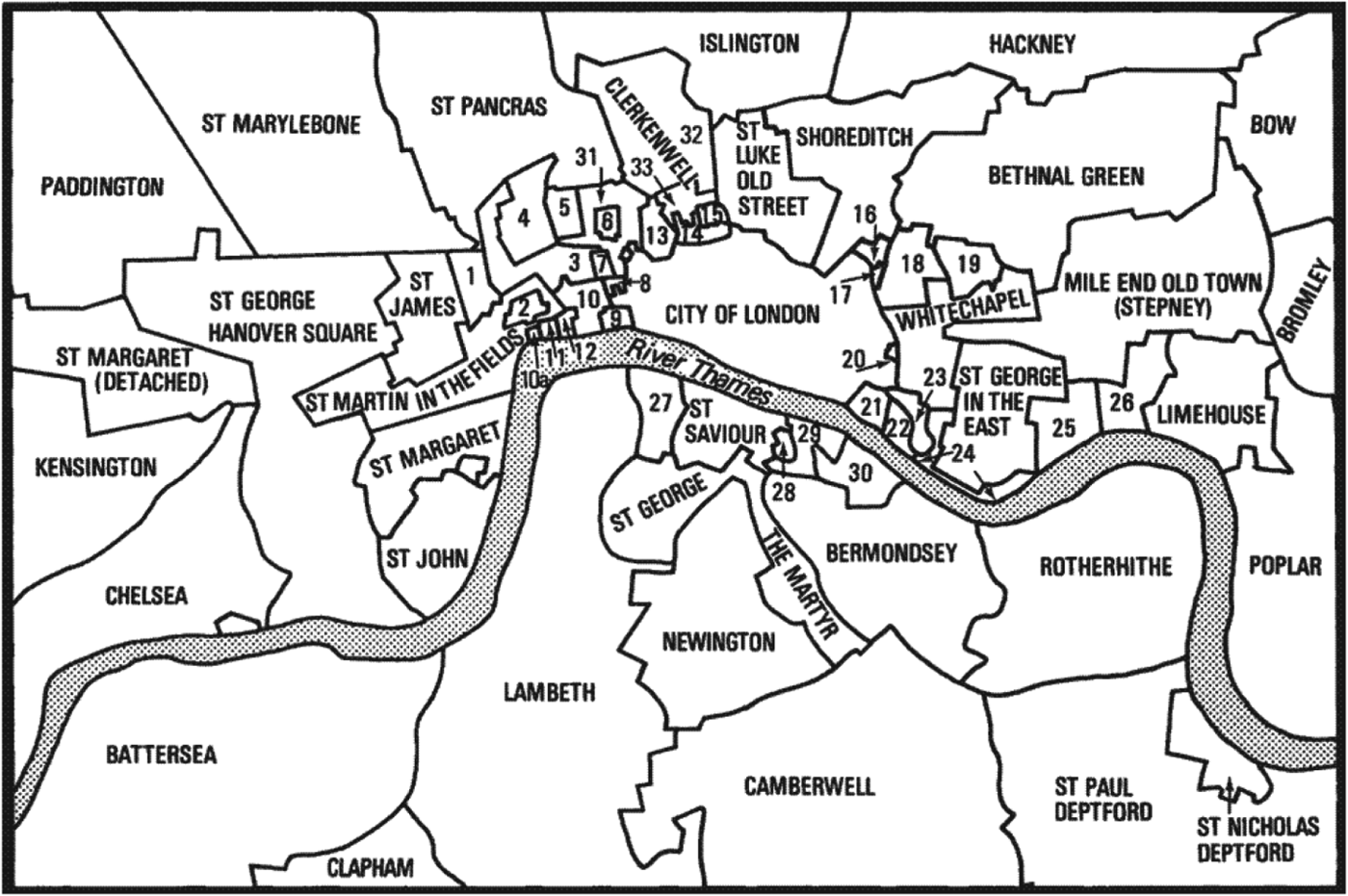
The ‘sextons’ books' of the parish of St Martin in the Fields survive in a virtually unbroken series between the years 1747 and 1825. Most of the books were originally chosen because they supply a (virtually) unique level of nominal data, including age at death, cause of death, residence and place and cost of burial for nearly 70,000 individuals.Footnote 8 The parish was a huge urban district containing some 25,000 to 30,000 inhabitants throughout the period in question, and was part of the burgeoning Georgian West End. This district of London in the eighteenth century was a place with a highly variegated economy, with large numbers of domestic servants and luxury trades serving its often wealthy and titled residents.Footnote 9 That said, there were also significant levels of deprivation, squalor and poverty, notably in parts of St Margaret's Westminster and St Giles in the Fields. All the West End parishes maintained large parish workhouses throughout the period and spent, in addition, huge sums of money on outdoor relief.Footnote 10 The geographical location of these London parishes is set out in Figure 1.
London parishes in the mid-eighteenth century. Key: 1, St Anne, Soho; 2, St Paul, Covent Garden; 3, St Giles in the Fields; 4, St George, Bloomsbury; 31, St Andrew, Holborn; 10 and 10a, St Clement Danes; 11, Precinct of the Savoy; 12, St Mary le Strand. Note that Chelsea, Kensington, Paddington, St Marylebone and St Pancras were outside the area covered by the London Bills of Mortality.

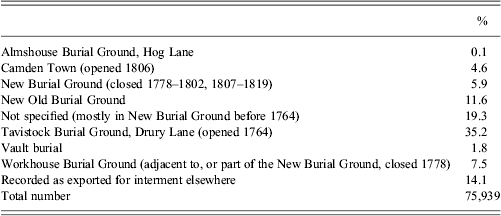
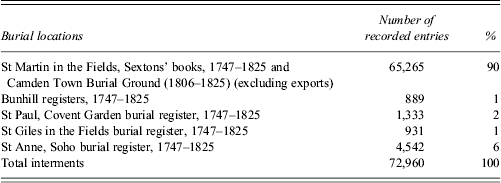
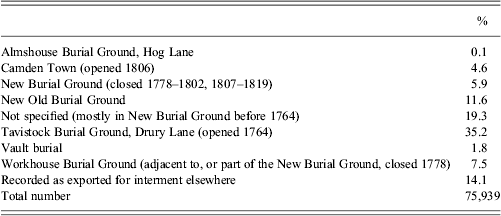
One of the main points made here is that the number of burials that took place in a parish can be affected by the nature of local interment practices. For this reason it is necessary to establish where those who died in the parish, or who were brought into the parish for burial, were actually interred. Table 1 sets out the broad picture, derived from a close analysis of the sextons' books, churchwardens' accounts and a separate register of interments at Camden Town.
Summary of burial locations in St Martin in the Fields, 1747–1825a
a These totals include all interments (including imports) and recorded exports. There is a gap in the sextons' books between June 1812 and October 1817. The percentage total is affected by rounding errors.
Sources: Sextons' books and burial books of St Martin's, City of Westminster Archives Centre, MS 419/233-244; 419/265-269; F2465, F2467, F2469. The Camden Town Registers are at 419/123.
Until 1764 most parishioners were buried in what was termed the ‘New Burial Ground’ on the west side of St Martin's Lane, on the same site as the parish workhouse. Most workhouse inmates were also buried there, in a specific part of the site. Table 1 assumes that all individuals buried from the workhouse without a given burial location in the sextons' books were interred at the workhouse ground before 1778.
The other main location for burials, before 1764, was in a more socially exclusive burial ground, or more properly grounds, adjacent to St Martin's parish church. This so-called ‘New Old Ground’ near the parish church included a substantial paved area – 900 or so burials in this ground thus included fees for moving the pavement. Throughout the period members of a social elite were buried in the church, in vaults, and a very small number, mostly almswomen, were buried in a small burial ground next to the parish almshouses in Hog Lane (located outside the parish in the parish of St Anne, Soho).Footnote 11
St Martin's, in common with many densely populated metropolitan parishes, was chronically short of burial space and this led to the purchase of an additional site in 1764 when the parish opened the new Tavistock Burial Ground in Drury Lane.Footnote 12 The Tavistock Burial Ground provided extra facilities for the bereaved. The new site made it easier to ‘memorialise’ the dead:
The parish officers of St. Martin's in the Fields have divided all their new burying ground by Drury Lane into lots, and numbered the same by figures affixed round the walls: they have also ordered a book to be kept, and the name of every person buried, with the lot or number of each mentioned therein. By this method every person may know the burying ground of his relations.Footnote 13
Once the new Drury Lane ground was up and running the ‘New Burial Ground’ at the workhouse site was reserved explicitly for the workhouse poor and relatives of those already interred there. Burials of the poor continued there until April 1778 after which their corpses were also interred at Drury Lane. Few burials took place at the New Burial Ground until the ground was reopened for short periods between 1803 and 1806. Burials began again on the site in 1819.Footnote 14 Despite, or perhaps because of, the popularity of its new facilities and also due to the volume of pauper burials that took place there from 1778, conditions at the Drury Lane ground deteriorated rapidly. After reviewing various alternatives, the parish purchased a new burial ground at Camden Town, which opened in 1806. From that date almost all pauper corpses were sent to Camden Town.Footnote 15
Like most urban burying grounds and locations, therefore, those of St Martin exhibited a cycle of use. As old grounds became full they were closed and new spaces were provided. Although the Drury Lane ground may initially have been a relatively attractive place to be interred, it very quickly filled up. Both it and the new Camden Town burial ground were said to be in a noxious state by 1842.Footnote 16
3. RECORDING THE TRAFFIC IN CORPSES IN GEORGIAN LONDON
Contemporaries in London were well aware of the existence of a considerable traffic in the dead. William Maitland counted large numbers of Londoners buried at Bunhill, other dissenting burial grounds, and in parishes lying just outside the area covered by the Bills of Mortality.Footnote 17 Similarly, Thomas Birch in 1759 pointed out that ‘great numbers are carried from parishes in town to be buried in the country’ and complained that a ‘distinct account of this matter ought to be kept in the several parishes, but seldom is kept with any exactness’.Footnote 18 Recording exported corpses was, in other words, usually neglected by parishes.
It was different with the interments of those imported into the parish from outside. Most such interments would have been recorded in parish registers. It is less common, however, to find registers that consistently identify such burials as ‘imported’. In fact, the parish register of St Martin in the Fields (unlike some others in the West End) does not usually identify burials imported from other places. The sextons' books, however, give residence at burial consistently over the entire period. For this reason it is possible to measure both the volume and chronology of this traffic. Since other information is given in the books (description of person (i.e. whether a man, woman, child or stillborn), age at death, address, burial fee, cause of death), this source enables us to make a detailed analysis of this usually hidden feature of burial practice in the past.
It is sensible to define the nature of an imported burial. The sextons' books give addresses, and each burial with the appellation ‘from’ is here treated as a burial import.Footnote 19 It was important to identify imported burials because the burials of non-parishioners might incur higher fees. It is conceivable, of course, that some of these individuals were already living in the parish as lodgers, recent arrivals or temporary visitors. The fact that imported corpses were allocated addresses in other parishes, however, suggests that most had indeed been living elsewhere at the time of their deaths and were brought into the parish postmortem.Footnote 20
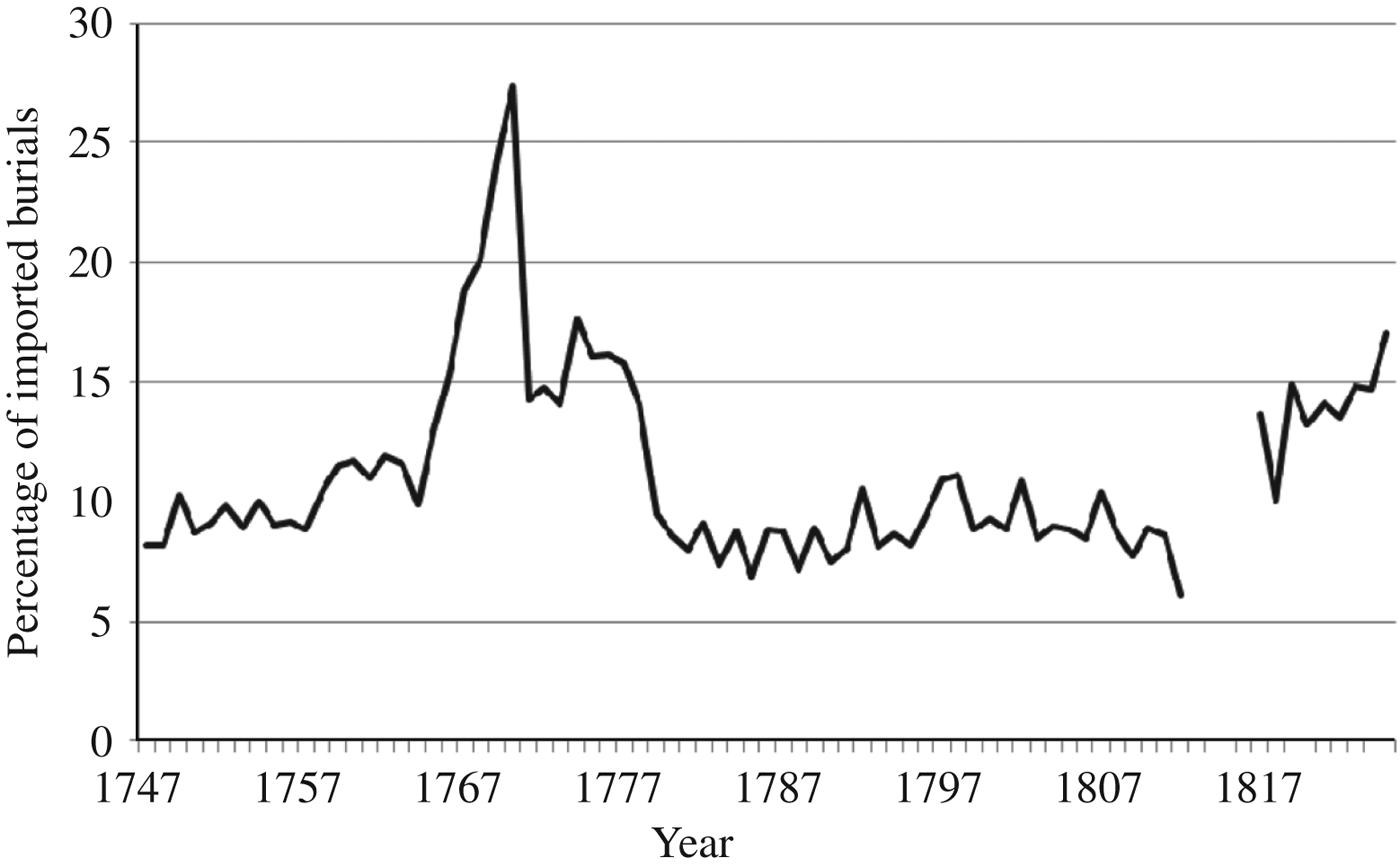
Figure 2 sets out the percentage of imported interments. These have been compared with the number of local interments only (that is, corpses known to have been exported have been excluded). For most of our period, roughly 1 in 10 of those buried in the parish died outside its boundaries. However, the proportion of imported burials was not constant. The opening of the new Tavistock Burial Ground at Drury Lane in 1764 coincided with a sharp peak in burial imports. From around 80 burials in 1764, imports surged to a peak of 333 in 1770, falling back thereafter. In 1769 and 1770 a quarter or more of all burials were imports. This suggests that the traffic in corpses was not merely a ‘structural’ feature of urban demography, where ‘structural’ is defined as postmortem movement caused by such things as prior family ties and adherence to place. There was also a dynamic element in such traffic that was responding to a short-term stimulus. The bereaved of other parishes, in other words, saw burial in the new Drury Lane ground of St Martin's as unusually attractive. This may have been because the new ground was regarded as more salubrious, a more ordered and convenient ‘landscape for the expression of grief’.Footnote 21 Just as likely, however, is that the fees charged at the new ground did not initially discriminate against non-parishioners, which encouraged heavier rates of interment. This issue is explored below.
Percentage of imported burials in St Martin in the Fields, 1747–1825 (omitting exported corpses).
Most imported corpses, unremarkably and entirely in line with Schofield's findings, came from the immediate locality.Footnote 22 Some 62 per cent of all imported corpses came from parishes sharing a boundary with St Martin's and large numbers came from other nearby parishes in the West End and urban Middlesex, notably from St Marylebone and St Pancras (see Figure 1). The biggest exporters of corpses to St Martin's were the neighbouring parishes of St Giles in the Fields (more than 1,300) and St Clement Danes (just under 1,000). The flow of corpses into the parish burying grounds in St Martin's, however, was more than matched by the transport of the dead out of the parish to other final resting places.
From the late seventeenth century, if not earlier, local registration practices included a recognition that many Londoners died in one parish but were buried in another.Footnote 23 The London Parish Clerks' Company operated a system of burial certification to ensure that the details of London's mobile corpses were returned correctly in the Bills of Mortality. If the system worked properly, the statistics of those buried outside their parish of residence would be returned by the clerks where they were interred – assuming that they were buried within the area covered by the Bills and in grounds that made returns to the Parish Clerks' Company. The ‘certificate system’ seems to have been put in place in the 1680s following an order made by the London Court of Aldermen. Throughout the eighteenth century:
VI … no Parish-Clerk do presume to Receive, or suffer any Corpse to be buried in the Parish of which he is Clerk, unless a Certificate be first obtained under the Hand of the Parish-Clerk where the Party died, testifying that the Corpse has been Viewed and Searched, pursuant to several Orders of the Lord-Mayor and Court of Aldermen from time to time, enjoining the same.
VII. That in such Certificate of the Burial of any Corpse, he shall therein Certify the Age and Disease of which the Person died.Footnote 24
This bureaucratic practice has left relatively few traces but fortunately the deaths of those issued certificates in St Martin's were recorded in the burial books used in this study. The vast bulk of both types of entry were charged only 1 s throughout the period.Footnote 25 Some were charged for the use of parish bells. This enables us to make some measure of the outflow of corpses from the parish. Unfortunately, such entries rarely supply the destination of the outgoing corpse. So, in addition to needing to know how common export of the dead was, it is also important to find out where the parish's exported dead were actually interred. Only by tracking down the mobile dead is it possible to test the comprehensiveness of the certificate system. It was difficult for parish officers to monitor the burials of all those dying in this huge urban parish. Recorded burial exports significantly undercount the true number.
The overall figures suggest a net outflow of bodies from the parish. Between June 1747 and 1825, some 7,516 corpses were imported into the parish. In the same period no fewer than 10,674 individuals were recorded as exported. Since many exported corpses escaped certification, the net outflow was perhaps considerably higher than this. It must follow from this that traffic in corpses could result in a net outflow or inflow of corpses. Imports and exports did not necessarily cancel each other out. The total number of recorded burials in any one parish, therefore, must, reflect the rate of postmortem imports and exports in addition to fluctuations in local mortality rates.
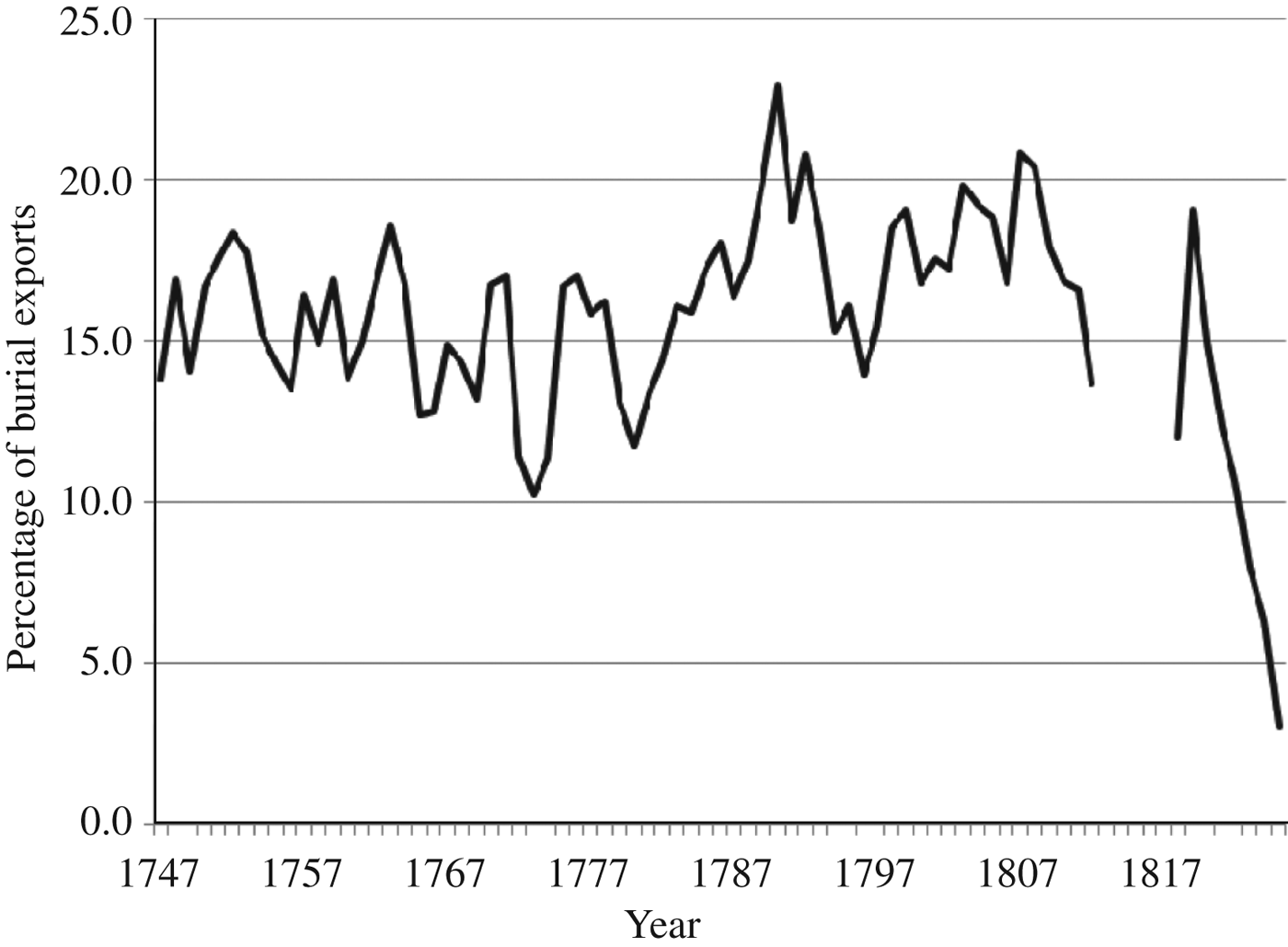
Figure 3 shows that between 10 and 20 per cent of individuals were exported from the parish for burial elsewhere for most of our period. Although exports did not exhibit a sharp peak of the sort seen in the imported burials (Figure 2), recorded exports increased to a modest peak between 1789 and 1792. The number of certificates seems to have declined sharply in the 1820s. Overall (excluding burials imported from elsewhere) at least 16 per cent of those dying in the parish were exported as ‘certificate’ burials between 1747 and 1825. Only a tiny number of such entries supply a destination.Footnote 26
Percentage of burial exports in St Martin in the Fields, 1747–1825 (omitting imported dead).
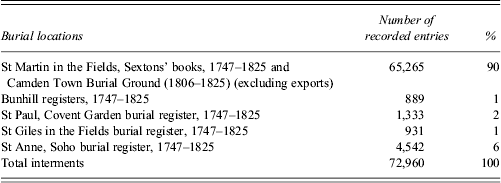
In order to investigate in detail the volume and destination of exported corpses, the burial registers of the neighbouring parishes of St Paul, Covent Garden, St Giles in the Fields and St Anne, Soho were searched for the interments of St Martin's residents, as were the surviving registers of the major London dissenting burial ground of Bunhill Fields. In total, this extremely time-consuming task unearthed no fewer than 7,695 individuals said to be from St Martin's who were interred in burial grounds at these four locations between 1747 and 1825. Table 2 summarises the total number of burials. Readers should note that the percentages calculated in Table 2 include individuals in the sextons' notebooks who were imported from other parishes. Even though Table 2 does not include the large neighbouring parishes of St James Westminster, St George Hanover Square and St Margaret Westminster it still reveals a substantial ‘traffic in corpses’.Footnote 27 Thousands of corpses from St Martin's were interred at these four sites. Notably, and to an unsuspected extent, St Anne, Soho, proved an exceptionally popular place of interment, a feature of West End interment practices that will be returned to later.
Numbers of interments recorded in St Martin's and of St Martin's inhabitants recorded in three of its neighbouring parishes and at the Bunhill burying ground, 1747–1825
Sources: Sextons' books and burial books of St Martin's, City of Westminster Archives Centre (COWAC), MS 419/233-244; 419/265-269; F2465, F2467, F2469. The Camden Town Registers are at 419/123; Bunhill, The National Archives, RG4/3980-97, 4288-90, 4633; St Paul, Covent Garden, COWAC, Burial Register 1739–1767 volume 4 mf 4; 1767–1796 volume 5 mf 5; 1797–1812 volume 6 mf 6; 1813–1827 volume 27 mf 27; St Giles in the Fields, COWAC, Burial Register, 1739–1762, reference no. 60.531 (St GI)/062, Microfilm X105/023; 1762–1788, reference no. 60.531 (St GI)/063, Microfilm X105/024; 1788–1815, reference no. 60.531 (St GI)/064, Microfilm X105/024; 1815–1826, reference no. 60.531 (St GI)/065, Microfilm X105/025; St Anne, Soho, COWAC, Burial Register 1 June 1744–30 September 1759 volume 42 mf 42; 1 October 1759–18 June 1775 volume 43 mf 43; 18 May 1817–16 April 1826 volume 46 mf 46; St Anne, COWAC, Burial Register 19 June 1775–31 December 1812 volume 44 mf 44; 3 January 1813–18 May 1817 volume 45 mf 45.
Religious dissent cannot have been a very significant motive behind the traffic in corpses in this West End parish. Only 1 in a 100 of those dying in St Martin's were interred at the dissenters' main extra-parochial burying ground at Bunhill Fields.Footnote 28 Most of these dissenters were the better off. Interment at Bunhill involved extra costs of transporting the corpse across London from the West End and the fees charged were relatively substantial.Footnote 29 There seems to have been a relatively large number of family groups buried at the site.Footnote 30
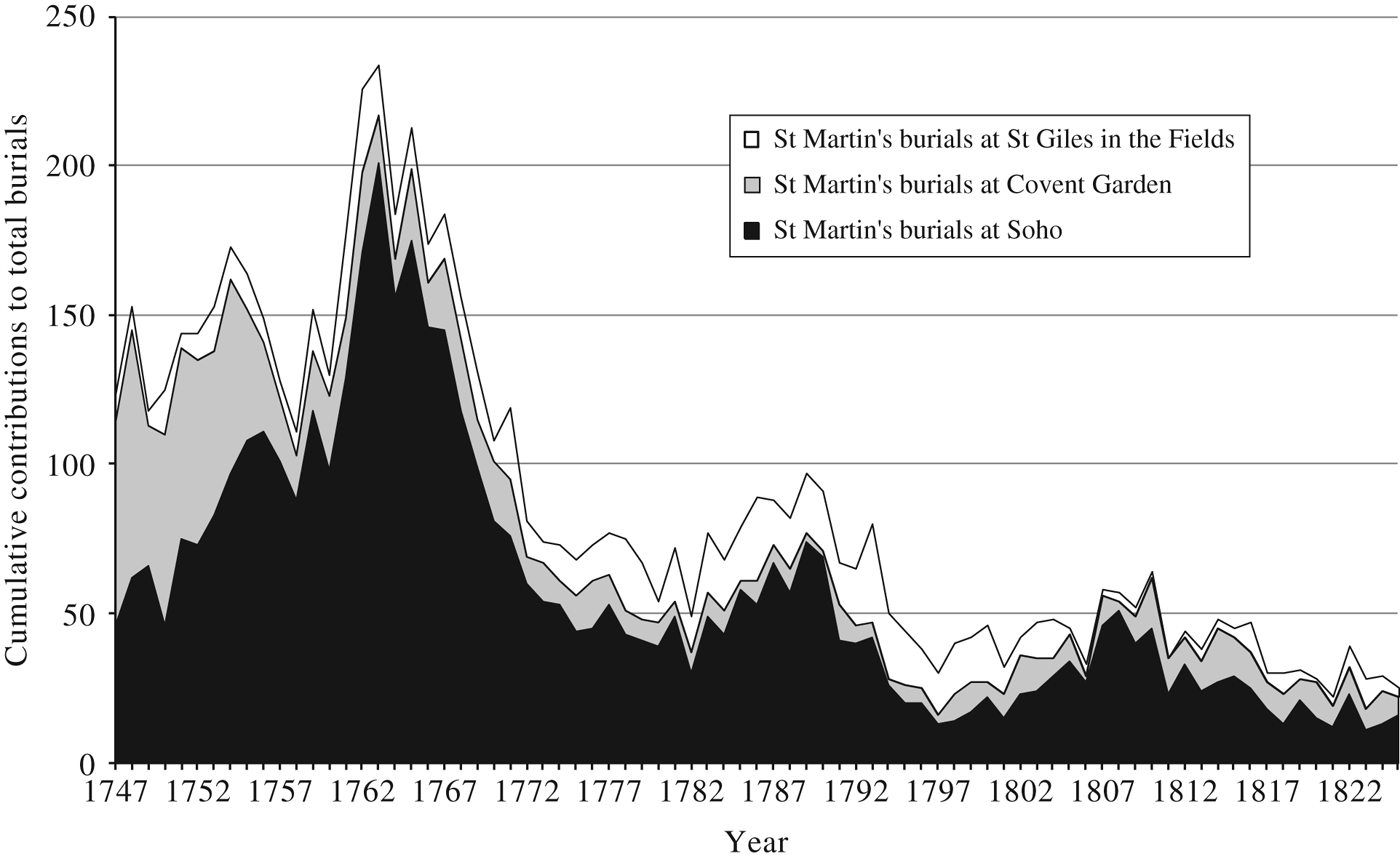
Figure 4 shows that corpses were not exported at a constant rate. As with imports, there was a surge in exported corpses to neighbouring parish burial grounds that peaked around 1764, coincident with the opening of the Drury Lane Burial Ground. Far more corpses from St Martin's were interred in these neighbouring parishes before 1770 than afterwards. These higher rates of burial export might well have been caused by local recognition that the parish burial grounds had become overstocked, since they seem to have declined rapidly after the new ground was opened. Figure 4 also shows that, of the three receiving parishes that distinguished imports consistently, Soho was by far the favoured final destination. This held throughout most of the period until the early 1790s. St Paul, Covent Garden, a relatively small parish surrounded by St Martin's (see Figure 1), was as popular as Soho for the first five years of the period.
Interments of known St Martin's residents found in the parish registers of three neighbouring parishes, 1747–1825 (cumulative contributions to total burials).
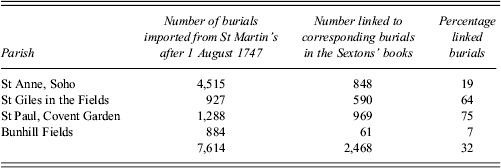
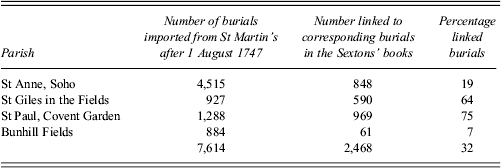
Since it is possible to link the known dead in St Martin's to the parish dead buried at Bunhill and in the three neighbouring parishes, one can test how complete a record of burial export the certificates are likely to be. It should be noted that there are only a tiny number of cases where a burial found in a neighbouring parish or Bunhill could be linked with any confidence to a ‘non-certified’ burial entry. All but a tiny number of external links were made to certified burials. The labourious exercise thus confirmed that the certificates (and ‘arrears’) do indeed relate to exported corpses. Table 3 sets out the results of this exercise. A secure nominal link required a coincidence of name and date.
Burials traced to interments recorded in Bunhill and three neighbouring parishes, 1747–1825
Sources: City of Westminster Archives Centre, St Anne, Soho Burial Register 1 June 1744–30 September 1759 volume 42 mf 42; 1 October 1759–18 June 1775 volume 43 mf 43; 18 May 1817–16 April 1826 volume 46 mf 46; St Anne, 19 June 1775–31 December 1812 volume 44 mf 44; 3 January 1813–18 May 1817 volume 45 mf 45; St Giles in the Fields Burial Register 1739–1762, reference no. 60.531 (St GI)/062, Microfilm X105/023; 1762–1788, reference no. 60.531 (St GI)/063, Microfilm X105/024; 1788–1815, reference no. 60.531 (St GI)/064, Microfilm X105/024; 1815–1826, reference no. 60.531 (St GI)/065, Microfilm X105/025; St Paul, Covent Garden Burial Register 1739–1767 volume 4 mf 4; 1767–1796 volume 5 mf 5; 1797–1812 volume 6 mf 6; 1813–1827 volume 27 mf 27. Sextons' books and burial books of St Martin's, City of Westminster Archives Centre, MS 419/233–244; 419/265–269; F2465, F2467, F2469; Bunhill, The National Archives, RG4/3980-97, 4288–90, 4633.
Clearly the certificate system did not ‘catch’ all exported burials, and must therefore underestimate the volume of exported corpses. Either certificates for some of these exported dead were not purchased at all, or their purchase was not recorded in the sextons' books. It should be remembered, of course, that certificates were only necessary if the dead person's interment was to be reported by a member of the Parish Clerks' Company. This probably explains why few dissenters interred at Bunhill paid for a burial certificate. As it happens, too, the majority of stranger interments at Soho were not returned by the parish clerk there either, and this probably explains why relatively few interments from St Martin's at Soho were certified. One can estimate that there were about 128 corpses a year exported from St Martin's without an accompanying certificate or arrears payment in these four burial grounds alone. Since Soho and Bunhill were probably special cases, the other higher linkage rates are probably more representative for other neighbouring parishes. One could thus argue that the existing certificated burials record at best 70 per cent of corpses exported to parishes within the London area, but omit most of those exported outside it, or those interred in non-parochial London locations outside the jurisdiction of London parish clerks. All this would suggest that significantly more than 15 per cent of those dying in St Martin's were interred outside the parish; however, an estimate of around 21 per cent or so might be more accurate.Footnote 31
These figures resemble uncannily closely a contemporary estimate of burial practices in ‘one of the largest and most populous parishes in Westminster’ reported by Birch in 1759. The figures Birch cited from a 10-year portion from his register showed that an average of 1,231 persons died each year in the unnamed parish, of which 261 were exported (21 per cent). This Westminster parish imported 124 bodies a year (20 of whom were ‘children of the parish out at nurse in the neighbourhood’) and buried 1,074, an import rate of 11.5 per cent.Footnote 32 Birch also commented on the observed differences between the detection rate of burial imports and exports:
Those, who are brought in to be buried, are carefully registered; those, who are carried out, are not so, Such are entered by themselves in the burial account, as come to the knowledge of those, whose business it is to attend to these matters: but of these, many are heard of but by accident, and some not at all.Footnote 33
The foregoing has already suggested that the traffic in corpses was dynamic. There were peaks and troughs in both exports and imports of bodies over time. This needs to be explained. Those who have studied this morbid subject before have usually put forward ‘structural’ motives. Familial ties are often said to explain burial outside the parish of death. Something like half of the imported corpses in Barming, Kent, had a previous connection with the parish.Footnote 34 This was certainly happening in St Martin's – one can sometimes observe family members imported from the same external parish and family vaults and tombs were erected throughout the period.
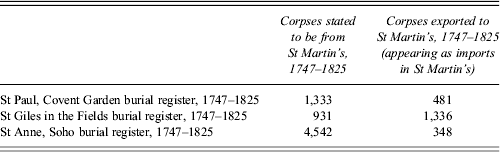
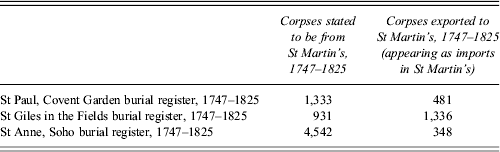
However, such explanations, although clearly part of the picture, do not explain the volume and direction of this movement. Nor, in particular, do they explain fluctuations in the traffic in corpses in London's West End. Family and kin ties to previous parishes are an important cause of the traffic in corpses, but such things hardly explain why, for example, some of this traffic was distinctly one sided. Thus over 4,500 inhabitants of St Martin's were interred at the smaller neighbouring parish of St Anne's, but relatively few of St Anne's residents chose to be interred at St Martin's (Table 4). St Anne's was about half the size of St Martin's; so family ties hardly explain this dramatic net import of corpses at Soho.
Comparison of traffic in corpses: exports and imports in St Martin's 1747–1825
Sources: City of Westminster Archives Centre, MS 419/233-244; 419/265-269; F2465, F2467, F2469. The Camden Town Registers are at 419/123; St Anne, Soho Burial Register 1 June 1744–30 September 1759 volume 42 mf 42; 1 October 1759–18 June 1775 volume 43 mf 43; 18 May 1817–16 April 1826 volume 46 mf 46; St Anne, 19 June 1775–31 December 1812 volume 44 mf 44; 3 January 1813–18 May 1817 volume 45 mf 45; St Giles in the Fields Burial Register 1739–1762, reference no. 60.531 (St GI)/062, Microfilm X105/023; 1762–1788, reference no. 60.531 (St GI)/063, Microfilm X105/024; 1788–1815, reference no. 60.531 (St GI)/064, Microfilm X105/024; 1815–1826, reference no. 60.531 (St GI)/065, Microfilm X105/025; St Paul, Covent Garden Burial Register 1739–1767 volume 4 mf 4; 1767–1796 volume 5 mf 5; 1797–1812 volume 6 mf 6; 1813–1827 volume 27 mf 27.
To understand the metropolitan traffic in corpses fully, it is important to understand that London interment had become, as Vanessa Harding has commented, commodified by the eighteenth century.Footnote 35 The traffic in corpses – both its volume and direction – was connected intimately to often quite small amounts of hard cash. It is now time to turn to the effect of burial fees on interment practices.
4. BURIAL FEES AND INTERMENT IN GEORGIAN LONDON
Fees charged by London parishes were occasionally a source of contention and sometimes dispute. Although nobody, in law, could be denied burial in their local churchyard, in practice burial fees were charged to all but those considered poor in all London parishes.Footnote 36 A useful table of the burial fees charged at St Martin's survives for 1724/5.Footnote 37 The table, despite its detail, does not include all items sometimes listed in the sextons' books.Footnote 38 That said, the table is useful since the sextons' books rarely itemise all the components of the fees charged.
The table reveals a great deal about burial charges. Fees were graded according to the type and size of individual buried. There was no official gender distinction. The table routinely laid out ‘man or woman’ or used the gender-neutral term ‘child’. However, fees charged differed by age. Those considered ‘children’ were charged lower fees throughout the schedule. Thus burying a ‘Man or Woman in the New Church Yard if Attended’ would cost 168 d in fees, whilst burying a ‘child’ in the same place with attendance would attract fees of only 78 d. The ages given in the sextons' books demonstrate that very few individuals over the age of 15 years were labelled as children.Footnote 39
Different fees were charged according to the relative prestige of local burial location, as was the norm in early modern England. The Chancel was the favoured, and most expensive, spot, followed by the Church or perhaps the ‘French chappel’ in Soho, or ‘in the Vault under the Tabernacle’.Footnote 40 Outside church walls, the most prestigious burial location was in the Old Church Yard or in the ‘Ground by the Church Court’ in the burial ground(s) collectively known as the ‘New Old Ground’. For the more humble the cheapest burial location was in the ‘New Church Yard’. Death brought no equality of commemoration. A man or woman buried in the ‘Old Church Yard’, even foregoing a stone, would have been charged fees totalling £1.40 but an adult, without ‘attendance’, would have been charged only £0.58 in the New Church Yard. Put another way, to bury an adult, a bricklayer at this period would have had to work for about nine days to afford prestigious Old Churchyard fees, but ‘only’ about four for a more modest burial in the New Church Yard.Footnote 41 The parish was clearly aware of the financial burden that fees represented to those faced by the loss of a family member. The table also set out a generic set of lower fees ‘for them that can't afford the fees above’ in the New Churchyard.Footnote 42 As was the norm in London, parish paupers (and a few favoured parish officials) were buried at parish expense.
The fees, as was the usual practice in London, penalised non-parishioners, but it is notable that St Martin's did this only to a relatively limited extent. London parishes usually charged all non-parishioners higher fees, most commonly a double fee.Footnote 43 St Martin's, however, only levied a higher charge due to the churchwardens on ‘one of another Parish’ for those interred ‘in the Vault under the Tabernacle’. This could imply fewer barriers to stranger burial. Lastly, the table of the burial fees shows that, as was commonplace in London, the parish attempted to levy fees on those exporting corpses. These fees on corpses ‘carried away’ were graded according to whether they were considered ‘chancel’, ‘church’ or ‘churchyard’ fees. In practice, it was only those charged for parish bells that usually appear as being ‘carried away’ in the churchwardens' accounts.
We need to know the local fee structure in order to explain some of the interment practices in the parish. To understand how fees might have affected interment, total costs should be compared with numbers buried. To my knowledge no historian has performed this sort of analysis before, but the results are striking. The analysis here will be restricted to the impact of local burial fees on the level of burial imports.
As the preceding discussion has established, analysis of burial costs must take into account burial location within the parish, age of the deceased and address since all these variables could affect the fees charged. All those buried at parish expense or excused burial fees need to be excluded from any analysis, as do those exported elsewhere. The measure used is average cost of burial, which will obviously vary somewhat according to age and possible extras such as bells; this will be offset by the large number of burials in the sample. Since the Tavistock Ground at Drury Lane was associated with a surge in burial imports, this micro-analysis will be restricted solely to burials stated to be in that ground.
Until 1770 (and against an explicit order of the local vestry) outsiders were interred in the Drury Lane ground at the same average cost as parishioners. In 1771, however, following a local policy decision by the parish vestry, the average fee charged jumped for outsiders. On average, outsiders burying children at Drury Lane were being charged around 5 s before 1771 (exactly the same average charge as parishioners) but thereafter the average fee increased sharply to around 8 s. Those outsiders burying adults were paying, on average, about a guinea (21 s) before 1771, and between 28 s to 30 s thereafter. The average fee charged before 1771 pretty much corresponded to the prescribed fees for the new ground.Footnote 44
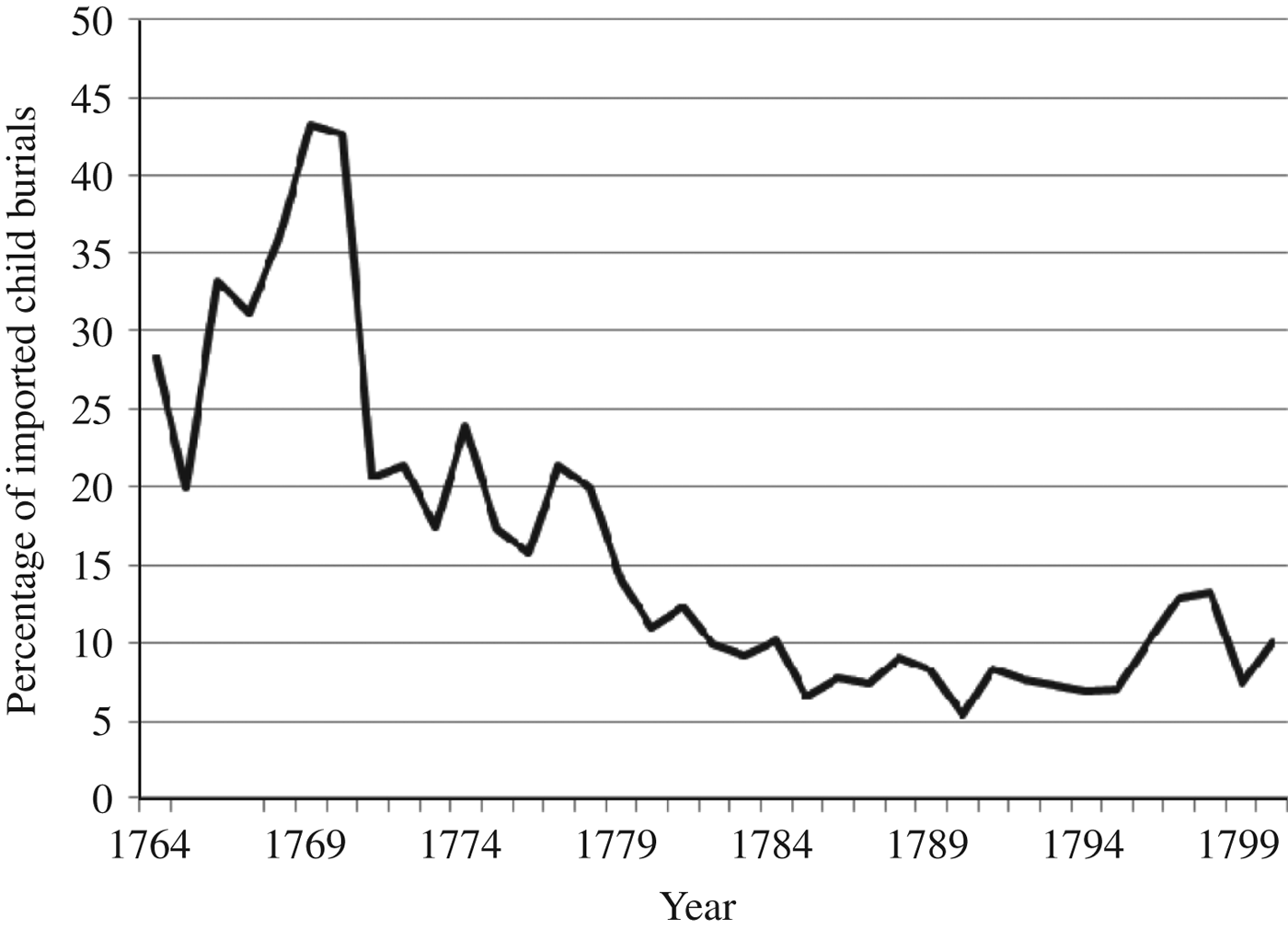
The fee hike had a striking effect on local interment practice. As soon as the fees for strangers were raised, the number and percentage of imports at the Drury Lane ground fell. This affected the volume of both adult and child burial imports, but was especially marked with stranger children, as Figure 5 reveals. Levying an additional average sum of around 3 s (a day's wages for a bricklayer at this time) on the burial of outsider children dramatically reduced the import of their corpses into the new Drury Lane ground. The number of imported children buried there fell from 219 in 1770 to only 61 in 1771.Footnote 45 Bereaved parents clearly preferred to make a relatively small saving rather than inter their children in what might have been seen as an otherwise attractive site. It must have been the case, therefore, that some families living outside the parish buried some of their children at the Drury Lane Burial Ground, but, after the fee hike, interred others elsewhere. The peak in burial imports seen in Figure 2 was thus mostly due to a flood of imported corpses into the new burial ground. Equally the fall in burial imports is explained by the imposition of higher burial fees for non-parishioners. This example thus suggests strongly that the relative levels of burial fees in a locality can explain changes in the number of interments in a parish. A relationship between burial fees and rate of interment was, in fact, found commonly in Georgian London (discussed below).
Percentage of imported child burials at Drury Lane Burial Ground, 1764–1800.
There is compelling evidence that burial fees had an impact on interment practices in London. Although such charges were only a small proportion of total funeral costs they were a significant burden for those of relatively modest means.Footnote 46 Varying interment strategies could produce significant financial savings for bereaved families. Dead children were left in London's churchyards, it was supposed at the time, simply to avoid the payment of burial fees.Footnote 47 Affordable burial space was a valuable commodity in Georgian London. It is clear that some parishes, or more specifically some parish officials, maximised fee income in archetypal capitalist fashion: literally piling corpses high and selling the ground cheap. Nowhere was this practice more blatant than in St Anne, Soho.
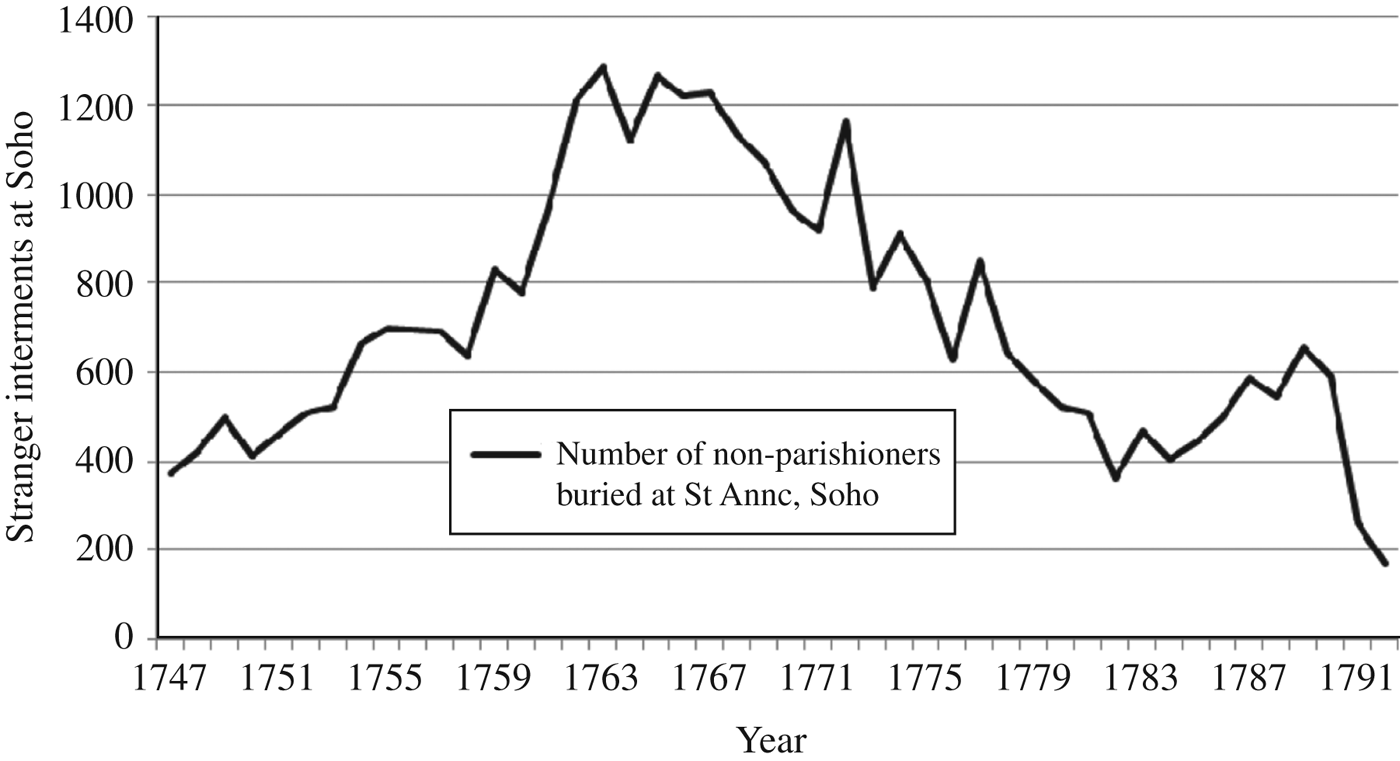
It has already been shown that the parish of St Anne, Soho, was a popular destination for St Martin's corpses. Since the parish register of St Anne's identified the interments of non-parishioners, it was a relatively simple matter to count each one between 1747 and 1792 (after this date the number of non-parishioners declined dramatically). It is an extraordinary fact that around 33,000 individuals were interred at St Anne's from outside the parish in that period. Numbers of interments at the parish increased steadily from 1750, peaking between 1761 and 1774, and then declining. Non-parishioner interments fell sharply after 1791. For most of this period ‘stranger’ interments greatly outnumbered those of parishioners (Figure 6).Footnote 48
Stranger interments at Soho, 1747–1792.
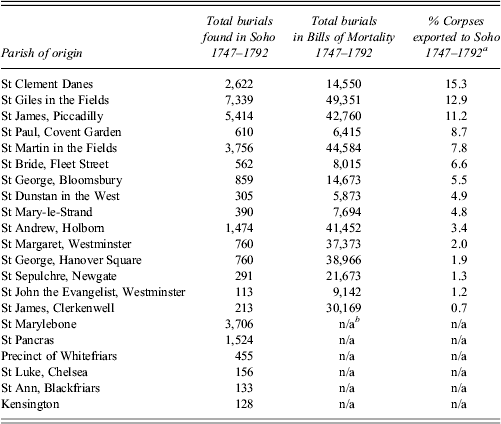
St Anne's was burying huge numbers of corpses from parishes in London's West End. Table 5 lists the parishes that together contributed 96 per cent of all ‘stranger’ burials at Soho. To measure the impact on the exporting parish, the table includes a column comparing the number of burials found at Soho with the number of burials returned by each parish in the Bills of Mortality in the same period, supplying in effect a ghastly crude ‘corpse export rate’. As was the case in St Martin's, neighbouring parishes commonly sent the greatest proportion of their dead to Soho. That said, the parish exporting most corpses to Soho pro rata was St Clement Danes which did not share a boundary with St Anne's. About a quarter of all those dying in St Clements were buried at Soho between 1759 and 1765. Only a detailed investigation of interment practices and local burial fees in neighbouring parishes would explain the observable variations in their ‘corpse export rate’ to Soho, or indeed anywhere else.
Parochial origins of specified non-parishioners buried at St Anne, Soho, 1747–1792
a Percentage calculated by adding Soho burials to totals reported in London Bills for each parish. b Not available.
Sources: Total burials for each parish were taken from the London Bills of Mortality as reported in John Marshall, Mortality in the Metropolis. For parish register of Soho, see City of Westminster Archives Centre, St Anne, Soho Burial Register 1 June 1744–30 September 1759 volume 42 mf 42; 1 October 1759–18 June 1775 volume 43 mf 43; 18 May 1817–16 April 1826 volume 46 mf 46; St Anne, 19 June 1775–31 December 1812 volume 44 mf 44.
The volume of the traffic in corpses at Soho has more than local implications. Few of these ‘stranger’ interments were returned in the Bills of Mortality by the parish clerk. Since exported bodies were not returned in the parish of death, this means that most of the 33,000 strangers buried at Soho were omitted entirely from the London Bills of Mortality. At its peak, this huge ‘clandestine burial centre’ was a (hitherto unsuspected) major cause of under-registration in the London Bills of Mortality.Footnote 49
The huge number of stranger burials at Soho represented a logistical challenge. In 1778 its vicar, Richard Hind, fell out with the local vestry over the crucial question as to who was actually responsible for conducting the burial service over ‘such persons as were neither Parishioners or Inhabitants of this Parish’. In the course of this dispute the vestry spent some time ‘in considering whether any and what method can be taken to prevent the Loss to which the parish would sustain by a discontinuance of such Burials’. The dispute ended in the departure of Hind. Stranger burials continued in Soho on a significant scale until 1791. In that year, the vestry took the opportunity presented by the need to appoint a new sexton, of ordering ‘that the Fees to be paid for the Burials of Non Parishioners (except in the Vault and Church) shall be doubled in future’. It is not clear why the parish took this decision – the most likely reason is that the available ground had become overstocked – but the doubling of burial fees at Soho coincided with a collapse of stranger burials there in 1791 (see Figure 6).Footnote 50
As it happens, Soho was not the only West End parish to inter strangers for profit. As noted above, a relatively large number of St Martin's corpses had been interred at St Paul Covent Garden in the 10 or so years after 1747 (see Figure 4).Footnote 51 Numbers from St Martin's interred at Covent Garden ran at about 60 per year until 1755, after which they declined steadily to about 20 a year by 1757. This decline was, just as at Soho, prompted by a fee hike, imposed because the Covent Garden burial ground had become full – the low fees charged had resulted in an influx of stranger corpses. In July 1755 a vestry was called ‘to consider of and Settle a proper table of Fees to be taken for burials of Foreigners or persons who are not Inhabitants of this parish’. Their order is worth quoting in full, since it is an excellent illustration of the relationship between fees, burial space and interment practice in this period:
The Inhabitants of this parish having observed that by the great number of burials of Strangers, the Ground of the Church Yard of this parish has increased and risen in many places to such a height, that at present it is not only become a Nusance to such Inhabitants as live in the Houses adjoining to it, but in a short time there will Scarcely be room for ye interment of the parishioners; And the Inhabitants having frequently complained to the Church Wardens and the other Gentlemen of ye Vestry of this grievance and prayed some redress, This Vestry have taken the same into consideration and are clearly convinced that the multiplicity of these burials have been owing to ye small Fees for many years past taken for the Ground and by the Church officers for such burials, Therefore for preventing the like Evils for the future, they have this day upon deliberate consideration settled a Table of Fees for all Burials in the Church and Church Yards, which the Churchwardens have signed, and have order'd the same to be hung up in the Vestry room for general perusal, inspection and observation.Footnote 52
5. CONCLUSION: THE DEMOGRAPHY OF THE MOBILE DEAD
A very considerable traffic in corpses existed in Georgian London. It has been demonstrated that the volume of this traffic in any one location is likely to have ebbed and flowed according to relative movements in local burial fees. Providing salubrious burial ground relatively cheaply could result in an influx of corpses from neighbouring parishes. Raising fees levied on stranger burials greatly reduced the inflow of corpses to any given burial ground. Opening a new burial ground could therefore cause a jump in the number of burials in a parish; raising burial fees in a ground could cause a fall. Some parishes, notably St Anne, Soho and, earlier in the century, St Paul Covent Garden, were interring strangers for profit in very large numbers at relatively low cost. Although burial fees were an important driver, however, they were clearly not the only motive behind postmortem movement. Ties to family burial plots or to previous residence, the salubriousness of local provision or multiple house ownership must explain a large number of such burials. Financial motives, however, provided the dynamic element.
The traffic in corpses poses significant challenges to historical demographers. It seems clear that, in the eighteenth and early nineteenth centuries, perhaps 20 per cent of those dying in St Martin's were interred outside the parish, and that around 10 per cent of those buried there were imported from elsewhere. The ‘corpse export rate’ in the West End, however, clearly varied over space as well as time. Local fluctuations in the number of burials reported for individual parishes in the London Bills of Mortality, therefore, must, as in St Martin's, sometimes have reflected changes in local interment practices rather than fluctuations in local mortality rates.Footnote 53 Only very detailed local analysis could tease out the effects at parish level. Some parishes, like St Martin's, were net exporters of corpses whilst others, such as St Anne's, were, for most of the eighteenth century, massive net importers. What is clear, too, is that the overall volume of the traffic in corpses has no clear chronology. Also, spatial variations in the ‘corpse export rate’ were not predictable. Use made by West End residents of the cheap Soho burying ground ranged from heavy to relatively light (see Table 5). Demographers studying urban parishes clearly need to factor in the mobile dead.Footnote 54
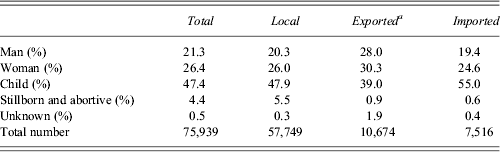
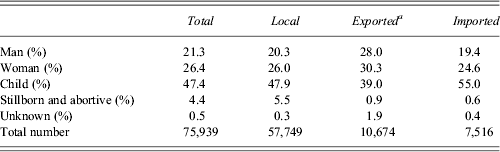
Statistics based on the descriptions in the burial books, broken down by the manner of interment, reveal something of the demographic characteristics of the mobile dead (Table 6). As Schofield found in Barming, ‘people of all ages were brought back for burial in the parish’.Footnote 55 In terms of the distribution by description, imported and local burials were similar, save for the virtually complete absence of stillborn children in the imported group. The surge in imports after the opening of the Drury Lane Burial Ground explains the greater percentage of imported children. Those exported were also rarely stillborn and were less likely to be children than imported or local burials. Those exported were also, however, more likely to lack descriptive information than the other two groups. The most marked difference was that those exported from the parish were more likely to be males (and to a lesser extent females) in the prime of life than were those buried locally. The traffic in corpses, therefore, could conceivably distort local estimates of the gender ratio at burial, just as it might affect estimates of lifetime mobility.Footnote 56
Descriptions at burial in St Martin in the Fields, 1747–1825
a The exported column does not total 100 per cent due to rounding errors.
Sources: Sextons' books and burial books of St Martin's, City of Westminster Archives Centre, MS 419/233-244; 419/265-269; F2465, F2467, F2469. The Camden Town Registers are at 419/123.
The demographic biases produced by the traffic in corpses are surely significant, if variable in effect. If children were sometimes buried in neighbouring parishes to save costs or for other reasons, this would affect family reconstitution exercises. This traffic in corpses may well be part of the explanation for the apparent absence of local burial records for children whose forenames were conferred on later siblings in the same parish register.Footnote 57 Investigation of local interment practices must surely, in future, play an important part in the care taken in selecting and testing registers to be reconstituted.Footnote 58
Most available evidence suggests that the traffic in corpses was widespread. Outside London figures for imported corpses suggest that the dead were particularly mobile at the end of the eighteenth century. Stuart Basten's work unearthed percentages of imported corpses in three Newcastle parishes comparable with those found at Barming in Kent in the same period – between 20 and 31 per cent of all burials – double the percentage of imports found in St Martin's.Footnote 59 London's West End and Newcastle might well have been exceptional, however, and some historians have come up with much lower estimates.Footnote 60 There is, moreover, much less evidence of a significant traffic in corpses in the seventeenth century, but that impression could be entirely due to the paucity of suitable sources. Harding found significant levels of extra-parochial burial amongst testators in the city of London in the sixteenth and seventeenth centuries.Footnote 61 However, the methodological challenges involved in quantifying such movement are considerable: even where parish registers do identify, for short periods, individual parishioners carried away for burial, it does not mean that they represent a complete record of burial exports.Footnote 62 That said, one might expect a lower volume of movement before 1700 given that interment then was less commercialised, there were far fewer extra-parochial burying grounds and, one suspects, although it would be a demanding exercise to establish, that there was greater identity with the parish.Footnote 63
Lastly, if the traffic in corpses increased in volume in the eighteenth century, it was merely a precursor of the nineteenth-century experience. As is well known, the demand for cheap salubrious interment in London was increasingly met by private entrepreneurs and enterprising non-conformist ministers in the early nineteenth century. The provision of attractive and affordable burial places became a growth industry as increasing numbers of Londoners chose to be buried privately rather than in local parochial grounds.Footnote 64
ACKNOWLEDGEMENTS
This paper derives from material collected as part of the Pauper Lives Project. The research was generously supported by a Wellcome Trust research grant (no. 081508) and by an Economic and Social Research Council (ESRC) research grant (no. RES-000-23-0250). Much of the data was collected by Dr John Black and Dr Peter Jones. For advice, comments and references, I would like to thank Romola Davenport, Elizabeth Hurren, Gill Newton, Peter Razzell, Ruth Richardson and Keith Snell. Three anonymous referees made helpful comments on an earlier – much longer – version of this paper.