INTRODUCTION
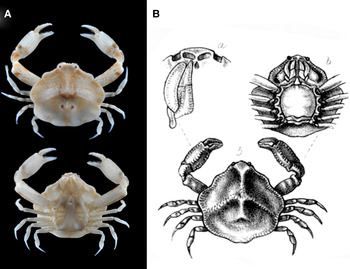
Bell (Reference Bell1855a: 434) first described Nursia abbreviata from an unknown locality, and no type locality was given by Bell (Reference Bell1855b: 366). Bell (Reference Bell1855c: 308, pl. 34, figure 5, 5a, 5b) provided an expanded diagnosis of the species and figured it for the first time. Nursia abbreviata was later listed as originating from the Indian Ocean by Bell (Reference Bell1855c: 308). As Bell (Reference Bell1855c: 308) listed only one specimen (a female) which was also figured in the same publication (Bell Reference Bell1855c: pl. 34, figure 5; see Figure 1B), this specimen is the de facto holotype (Articles 72.4.1. and 73.1 of the International Code of Zoological Nomenclature, hereafter the Code; ICZN, 1999: 76, 79) of the species and its type locality is the Indian Ocean (Article 76.1 of the Code; ICZN, 1999: 86). Lee & Low (Reference Lee and Low2013) recently discussed the correct literature citation for the name Nursia abbreviata.
(A) Paranursia abbreviata, male (carapace width × length: 6.8 × 6.1 mm) (ZRC 2012.1001), dorsal and ventral views; (B) Nursia abbreviata (after figure of female holotype from Bell (Reference Bell1855c: pl. 34, figure 5, 5a, 5b) (figure A photographed by A. Anker; figure B from Bell (Reference Bell1855c: pl. 34)).

Paranursia abbreviata has been collected from Singapore waters several times since the late 1980s, but surprisingly, the species has not been formally listed from the island. The present paper records the species from Singapore and discusses aspects of its taxonomy. Specimens examined are deposited in the Zoological Reference Collection (ZRC) of the Raffles Museum of Biodiversity Research (RMBR), National University of Singapore (NUS). Measurements, given in millimetres (mm), are of the greatest carapace width by length. The abbreviation G1 is used for the male first gonopod.
RESULTS
SYSTEMATICS
Family LEUCOSIIDAE Samouelle, 1819
Paranursia Serène & Soh, Reference Serène and Soh1976
Paranursia abbreviata (Bell, 1855)
(Figures 1 & 2)
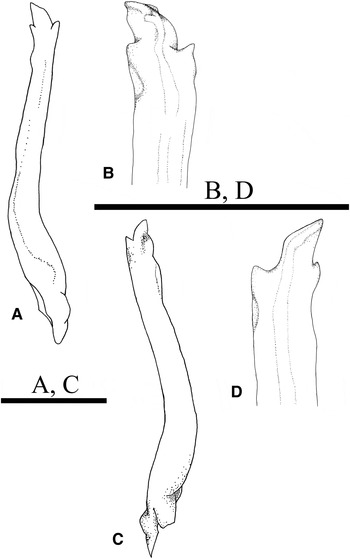
Paranursia abbreviata, male (ZRC 2012.1001), drawing of left G1: (A) ventral view; (B) ventral view of distal portion; (C) dorsal view; (D) dorsal view of distal portion. Scale bars: A–D, 1 mm.

MATERIALS EXAMINED
1 female (7.8 × 6.7 mm) (ZRC 1993.5344), Station 6, dredge 2, Kallang Basin, Singapore, coll. Reef Ecology Study Team, 4 June 1993; 1 female (9.9 × 8.3 mm) (ZRC 1990.11560), Kallang Basin, Singapore, coll. Reef Ecology Study Team, 23 February 1989; 1 male (7.5 × 6.7 mm) (ZRC 1999.0012), Changi Beach, Singapore, coll. P.K.L. Ng, 1 January 1999; 1 female (7.2 × 6.3 mm) (ZRC 2000.0116), off River Ponggol, Singapore, coll. B. Goh, 21 December 1999; 1 female (8.3 × 7.4 mm) (ZRC 2000.0115), off River Ponggol, Singapore, coll. B. Goh, 21 December 1999; 3 females (7.1 × 6.3 mm, 8.2 × 7.5 mm, 7.1 × 6.2 mm) (ZRC 2012.0734), Changi Beach near Changi Ferry Terminal, Singapore, coll. P.K.L. Ng et al., 5 July 2012; 1 male (6.8 × 6.1 mm) (ZRC 2012.1001), CMBS Station DW55, rectangular dredge, mouth of River Pasir Ris, 1°25.003′N 104°05.049′E, Singapore, coll. B. Richer de Forges et al., 22 October 2012.
DIAGNOSIS
Carapace flat and almost orbicular with front slightly projecting and entire. Margin of carapace granulated and waved, forming seven slight rounded prominences, exclusive of frontal region. Obtuse elevated line running down middle of carapace from frontal to cardiac region, crossed by granulated transverse line, commencing between anterior and posterior lobes of branchial region (Figure 1). G1 slender, with chitinous tip shaped like trident (Figure 2).
DISCUSSION
These specimens agree well with the diagnostic aspects of the carapace discussed above, especially the ‘obtuse elevated line’ (Bell, Reference Bell1855c: 308). Many of these specimens had previously been identified as ‘Nursia sp.’.
Nursia abbreviata Bell, 1855, was designated the type species of Paranursia Serène & Soh, Reference Serène and Soh1976, on account of its distinctive carapace sculpture and male gonopod morphology (Serène & Soh, Reference Serène and Soh1976: 9) (see also Davie, Reference Davie, Wells and Houston2002: 273; Ng et al., Reference Ng, Guinot and Davie2008: 92). The G1 illustrated by Serène & Soh (Reference Serène and Soh1976) was based on Stephensen's (Reference Stephensen1946) material from the Persian Gulf. However, this G1 structure seems to differ from those illustrated by Chhapgar (Reference Chhapgar1969) (from India), Dai & Yang (Reference Dai and Yang1991) (from China) and Chen & Sun (Reference Chen and Sun2002) (from China) for the species. The G1s illustrated by both Serène & Soh (Reference Serène and Soh1976) and Stephensen (Reference Stephensen1946) have a more rounded tip as compared to those figured by Chhapgar (Reference Chhapgar1969), Dai & Yang (Reference Dai and Yang1991) and Chen & Sun (Reference Chen and Sun2002). Serène & Soh (Reference Serène and Soh1976) described the tip of the G1 as ‘...apex multilobate with chitinous pieces’. The G1 of the Singapore specimen (Figure 2) closely resembles that described by Chhapgar (Reference Chhapgar1969), Dai & Yang (Reference Dai and Yang1991) and Chen & Sun (Reference Chen and Sun2002). Whether these differences are really species-specific will need to be established with studies of material from more areas. Chen & Sun (Reference Chen and Sun2002) mentioned that the material identified as P. abbreviata by Stephensen (Reference Stephensen1946) probably does not represent that species. However, as the holotype of P. abbreviata is a female, the identification of the current (Singapore) material with the true P. abbreviata cannot be ascertained without a revision and studies of more material from the Indian Ocean, especially since this area appears to have two forms.
Paranursia abbreviata (Bell, 1855) has previously been recorded from Australia (Hale, Reference Hale1928: 103; Poore, Reference Poore2004: 342), India and Pakistan (Pillai, Reference Pillai1951: 10; Chhapgar, Reference Chhapgar1969: 610), Hong Kong and Hainan Island, China (Dai & Yang, Reference Dai and Yang1991: 68; Chen & Sun, Reference Chen and Sun2002: 464), Persian Gulf (Stephensen, Reference Stephensen1946: 68), Phuket, Thailand (Ng & Davie, Reference Ng and Davie2002: 371) and Port Swettenham, now Port Klang, Malaysia (Ow Yang, Reference Ow Yang1963: 210). This present record extends the range to Singapore.
ACKNOWLEDGEMENTS
We thank Peter K.L. Ng (National University of Singapore) for the confirmation of our identification of Paranursia abbreviata specimens collected from Singapore; as well as Arthur Anker (National University of Singapore) for taking the photograph of Paranursia abbreviata (ZRC 2012.1001) specimen. One of the specimens was also collected by Bertrand Richer de Forges (Nouméa, New Caledonia) during the Comprehensive Marine Biodiversity Survey (CMBS) of Singapore organized by the National Parks Board of Singapore and the Tropical Marine Science Institute in 2012.