In a letter to Francesco Maria Piave of 12 April 1845, Verdi insists that the curtain must rise on Attila just as Friedrich Ludwig Zacharias Werner opens his romantic tragedy, Attila, König der Hunnen. Verdi specifies, ‘Aquileia in flames with a chorus of commoners and Huns. The people pray and the Huns threaten, etc.’. Footnote 1 Conspicuously absent from Werner's play, however, is the scene (No. 5, Foresto's Scena e Cavatina) that Verdi and his librettist Temistocle Solera added later to close their prologue: a fierce storm followed by a resplendent sunrise illuminating the Aquileians' new home on the lagoon, the future city of Venice. Footnote 2 Verdi conceived the sunrise early in his composition of Attila, and voiced concerns about staging to La Fenice impresario Alessandro Lanari in September of 1845: ‘What I really want to be sublime is the … birth of the city of Venice. Let the sunrise be particularly well done, since I intend to express it in the music.’Footnote 3 The proposed tableau and its anticipated premiere on 17 March would be a meaningful combination of history and myth for the Venetian audience: the legend of Attila and the founding of Venice, both celebrated during the annual Feast of the Annunciation on 25 March, an event, as Edward Muir observes, of ‘religious, perhaps even miraculous’ significance.Footnote 4
The sunrise also illuminates the entrance of the heroic Foresto, for whom Verdi crafted a traditional scena and aria.Footnote 5 The piece is more ambitious than its structure would suggest; it is grandiose in length and visually stunning, as the scene changes to the Rio-Alto and the homeless masses, led into their sanctuary-by-the-sea by a latter-day Moses, Foresto. The dual nature of the prologue thus rests upon oppositions of theme and character: Attila versus Foresto, conquerors versus conquered, bass versus tenor, and flaming destruction versus rebirth. Verdi even cloaked both sides of the conflict in opposing tonalities: F minor/C minor (Aquileia in flames) and C major (sunrise). Solera's beautifully detailed stage description reads as follows:
A mudflat in the Adriatic lagoons. Here and there stand a few huts supported by piles and connected with each other by long boards held up by boats. In the foreground, similarly raised, stands a stone altar dedicated to San Giacomo. In the distance there is a hut attached to a wooden shed, intended afterwards as the belfry of San Giacomo. The darkness is thinning out among stormy clouds: gradually a rosy light increases (until the end of the scene), when the sun's rays suddenly inundate everything, adorn the firmament of the most serene and limpid blue. Slow strokes of the bell greet the morning. Some Hermits come out of the huts and approach the altar.Footnote 6
Verdi's storm music follows conventions used by such composers as Rossini and Beethoven: fortissimo semiquaver chromatic scales and timpani rolls, gradually fading to ppp, out of which materialises a magnificent sunrise and a major key.Footnote 7 He begins with a solo flute call answered leggerissimo come colle sordine by first violins over a dominant pedal (G), and intensifies texturally and rhythmically from ppp to climax on C major in the fortissimo tutta forza instrumental and choral peroration, ‘Lode al creator!’ Foresto describes the new land as an ‘enchantment of sky and sea’,Footnote 8 and concludes his cabaletta (‘Dear homeland’) with a direct reference to Venice: ‘that newly arisen phoenix, will live again more proud and beautiful, the wonder of land and sea!’Footnote 9
Attila premiered to enthusiastic audiences and critics. The anonymous critic in the Gazzetta musicale di Milano praised the sunrise in detail, and Tommaso Locatelli, writing for the Gazzetta privilegiata di Venezia, called the scene ‘a magnificent instrumental piece, in which the awakening of nature in the morning was imitated with a wonderful strategy of sounds; it would not be possible to describe in words the profound impression produced from this kind of remarkably clever harmony, worthy of the greatest master.’Footnote 10 It is a watershed moment in Verdi's scenic imagination,Footnote 11 the marvellous effect of which was achieved by gas lighting, first introduced at La Fenice in 1833.Footnote 12 As Mercedes Viale-Ferrero points out, the sunrise was an ‘exemplary [model]’ of staging that Francesco Lucca was intent on promoting.Footnote 13 On 13 October 1847 – and surely to keep the opera alive before the public and capitalise on its success – Lucca printed set designer Giuseppe Bertoja's sketch of the scene, along with the ‘Pianta del Palco Scenico [stage plan]’ in his new house journal, L'Italia musicale: Giornale artistico-letterario. The illustration was accompanied by two articles, a description of the lighting technology – ‘Rio-alto o I primordi di Venezia. Descrizione della scena II dell’Opera Attila, quale offresi nella unita tavola', and an essay by Aurelio Bianchi-Giovini, ‘Storia: Attila e i primordi di Venezia’, outlining the history of Attila's exploits in Italy – his aborted plan to destroy Rome, and his sojourn in the Veneto.Footnote 14 According to Lucca's description, a transparent curtain provided a backdrop for the change from night to day, and lamps simulated the flickering embers of the decimated landscape.Footnote 15 A crescendo of light corresponded precisely to Verdi's scoring, as follows:
At the opening of the scene … only a few ice-blue coloured crystal lights are gradually turned on, while all the rest [of the stage] – wings, footlights and overhead lights – should be obscured as much as possible. After a minute and a half, at the sounding of the bell, the air starts to change, and at the same time the illumination from above begins and increases with the powerful glimmer of the sun. All of these changes must take place in the space of three minutes, at the end of which the curtain glows at the maximum degree of sunshine. The same means of illumination will be obtained gradually in the wings, beginning always from a distance, and climaxing with the footlights and the overhead lighting.Footnote 16
Verdi meets David (and Haydn) at dawn
The Attila sunrise became the object of much discussion in the contemporary press; critics frequently linked it to other works, and especially to Félicien David's LeDésert, Ode- Symphonie for speaker, solo tenor, male chorus and orchestra to a text by the Saint-Simonian Auguste Colin. Il Deserto (as it was known in Italy) played to packed houses in Milan in the spring of 1845 (just as Verdi was composing Alzira and discussing Attila with Piave, Lucca and La Fenice);Footnote 17 the Milanese loved especially the third part, which began with a ‘Lever du soleil’. It was a tough act to follow, and almost immediately after the premiere of Attila, there arose a ‘venticello’ that connected Verdi's sunrise to Le Désert and also Haydn's The Creation. The anonymous reviewer in the Gazzetta musicale di Milano noted the chatter, but was reluctant to denigrate Verdi's originality: ‘Some listeners wanted to discover in it [Verdi's sunrise] an imitation of the sunrise in David's Il Deserto . . . others recall Haydn … It is certain that the piece [Verdi's] is absolutely beautiful.’Footnote 18 The comparison of Verdi to both David and Haydn soon entered the literature on Attila, probably fixed in place by Abramo Basevi in his 1859 Studio sulle opere di Giuseppe Verdi.Footnote 19 Basevi, not a great admirer of Attila, declared Verdi's sunrise a generic catalogue of techniques used by other composers: a gradual crescendo that moves from darkness to light, from piano to forte, and from minor to major.
Verdi was familiar with Haydn's Creation from a very young age, having accompanied a performance of it at the Philharmonic Society in Milan in April 1834, as he noted in his purported autobiographical sketch.Footnote 20 He surely alluded to the architecture of Haydn's C minor to C major ‘Introduction’Footnote 21 in his Attila prologue, which also moves from chaos (minor) to light (major). But Haydn responded to the words, ‘Let there be Light, and there was Light’, with a subito fortissimo, as if to turn on the lights with the flick of a switch, hardly a gradually unfolding event. The more apt model would have been Uriel's recitative, ‘In splendour bright the sun and its rays now rise’ (no. 12),Footnote 22 which begins pianissimo and ascends in a grand orchestral crescendo to a brilliant fortissimo on the tonic D major.Footnote 23
Basevi preferred the sunrise in David's Le Désert to Verdi's, but also declared David's inferior to that of Haydn,Footnote 24 who was revered in Napoleonic-era Milan. That admiration was lodged in the public consciousness, as Virgilio Bernardoni has shown, by a series of contemporary theoretical tracts and compositional primers that included many examples from late eighteenth-century Viennese repertory, and Haydn in particular.Footnote 25 Most important of these (for my purposes) is Il maestro di composizione by Bonifazio Asioli (1769–1832), director of the Milan Conservatory from 1808 to 1814.Footnote 26 As Roberta Montemorra Marvin observes, Asioli's compositional tutorial is ‘one of the earliest, most significant, and most concise attempts in primo ottocento Italian theoretical writings to teach the principles governing the composition of dramatic music’; a likely and important source for Verdi's own knowledge of these techniques.Footnote 27 At the very least Asioli's treatise confirms that ‘sunrise’ composition was already important enough to warrant theoretical prescription. In article VI of Book 3, Asioli advises that the rising of the sun can be approximated musically through rhythmic acceleration, and increased texture and volume, as in the ‘sorgere del sole’ in Uriel's recitative from Haydn's Creation, excerpted in a music example and described as ending in a ‘concentrated light that inundates the vastness of the heavens’.Footnote 28
The David legacy
The modern literature on Verdi and Attila, however, marginalises Haydn's role in the sunrise debate, and contains a litany of references to David.Footnote 29 Verdi's sunrise has even appeared in the literature on David, notably in remarks by Ralph Locke: ‘[Solera] and Verdi followed David's example … by including an impressive sunrise in their opera Attila’.Footnote 30 But Solera himself did much to link Attila with Le Désert, and not only because he made the Italian translation for Lucca's piano-vocal score of the work (Il Deserto).Footnote 31 The librettist heard Le Désert at the Teatro Canobbiana on 20 June 1845, and praised it lavishly in a letter of 21 June to Escudier, who then published it (with Solera's permission) in his newspaper, La France musicale.Footnote 32 Solera waxed rapturous over the ‘Lever du soleil’, calling it:
A sublime inspiration … These are the stars that follow one after the other as twilight appears, the rosy hues of the dawn that visibly scatter themselves on the fresh cloth of the horizon, and the distant clouds that gild themselves under the reflections of the sun, which lets torrents of light escape from its vast sphere.Footnote 33
Not everyone was a believer in the Verdi–David connection, however. Critic ‘T’ (Vincenzo Torelli) in his review of the 26 December 1846 La Scala premiere of Attila spoke sceptically and sarcastically about the alleged relationship between the two works:
We have heard the accusation that Verdi had taken too much licence in imitating David: this is one of those criticisms without foundation that they throw into the air along with cigar fumes in the cafes: the [so-called] imitation would consist in Verdi's having begun piano and ascending to a forte: and Verdi – in order not to imitate David – would not have been able to depict the sunrise by descending from forte to piano.Footnote 34
Sunrise serenades: Verdi, Haydn, David and also Rossini
Verdi first became acquainted with David's ‘Ode’ when Marie Escudier visited him at his apartments, on either 5 or 12 May 1845 during his trip to Milan to supervise and promote performances of Le Désert. The composer was preparing to leave for Naples to assist in the premiere of Alzira,Footnote 35 but asked to see a score of David's new work. According to Escudier, Verdi reacted most favourably to it, exclaiming
Ah, what excellent judges the French are! I had expected to see heavy music, over-laden with notes; but instead I see a clear and straightforward instrumentation of the French school combined with the simple and poetic melodies of the Italian school. Please inform M. David that I would be delighted to express personally to him one day my admiration of his genius.Footnote 36
Verdi said nothing specific about the sunrise. His student, Emanuele Muzio, however, was ‘mad for Deserto’, and gushed in much detail over the sunrise in a letter to Antonio Barezzi of 21 June 1845;Footnote 37 he wrote again on 17 July 1845, calling the piece ‘truly original’, one that ‘made such an impression on me that I will never forget it’.Footnote 38
David built his sunrise on a generic model that Verdi would have recognised. It begins with pianissimo tremolos in muted violins, as a solo clarinet arpeggiates the tonic triad in a four-bar motto that passes throughout the orchestra, and leads to an A major tutti fortissimo at bar 31. At bar 13 David subtly expressed this gradual change in colour and dynamics by instructing each stand of violins to remove its mutes successively, one of the few specifics of the piece that Verdi actually recalls (in his indication, ‘come colle sordine’). A narrator (récit déclamé) describes the scene: ‘The tints of rosy dawn colour the floor of the heavens / the heavenly body suddenly radiates like a sonorous hymn and fills the desert with light and love’.Footnote 39 David's sunrise may have influenced several, perhaps even many, later works: it exudes the warmth and fluidity of the slow movement of Dvořák's New World Symphony, the grandeur of the introduction to Richard Strauss's Also Sprach Zarathustra (featuring yet another climax on C major), and the colourful crescendo of nature in Wagner's ‘Vorspiel’ to Das Rheingold. To the modern ear, however, Verdi does not sound like David.
Verdi compresses space, increases rhythmic activity, transforms his opening motif, and intensifies energy. David, with his gradually ascending theme, paints wider spaces (here a vast desert) that bring more readily to mind an earlier and quintessentially French work (by an Italian) that also simulates dawn breaking over a spectacular landscape: Rossini's grand, long-breathed sunrise in the finale of the fourth act of Guillaume Tell (1829), a glorious celebration of Swiss victory over Austrian rule. Rossini begins pianissimo with string tremolos and harp, while horns arpeggiate a melody taken up in turn by other instruments (and voices) and expanded to a tutta forza C major on the word ‘Liberté’.Footnote 40
As Muzio observed, Rossini's hymn to freedom-as-nature actually restricted performances of the complete Guillaume Tell in early nineteenth-century Italy.Footnote 41 Those restrictions were eventually lifted, and in the twentieth century the formerly provocative ‘liberty’ music became an aural and visual pop-culture icon. According to Cormac Newark, RAI (Radiotelevisione Italia) used an orchestral arrangement of Rossini's ‘Lever du soleil’ as its thematic entrata and sortita to accompany a video showing ‘swirling clouds that gradually cleared to reveal a transmitter giving off dynamic-looking pulses of light’.Footnote 42 That RAI retained the sound and light sequence in its programming for twenty years not only legitimised Rossini's ‘liberty’ sunrise, but positioned it among other operatic rallying cries (‘Va pensiero’ comes first to mind) of the early nineteenth century that continue to live in the Italian civic spirit.
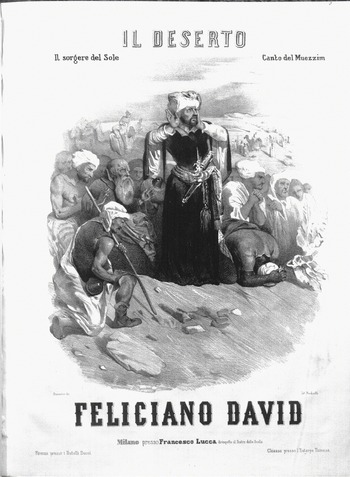
Such equations of nature, land, liberty and enlightenment are central to Attila as well as Guillaume Tell and Haydn's oratorio, but also to Le Désert, where musical images of a caravan moving across the desert romanticise community, freedom and the elements. The travellers survive a storm, sing a song of praise, a Hymn to the Night, and yet another song celebrating liberty.Footnote 43 Still more relevant, the wanderers express humility and reverence at a sunrise, the communal aspects of which are easy to see in one of three engravings (Fig. 1) Lucca included in his edition, ‘Il sorgere del Sole’: it is morning, a band of travellers faces East, some with heads bowed and others with eyes turned directly towards the rays of the rising sun, as the Muezzin calls for prayer.Footnote 44
‘Il sorgere del Sole/Canto del Muezzin’. Engraving from Félicien David, Il Deserto, vocal score (Milan, [1845]).

The composer's workshop at sunrise
Verdi actually composed sunrises into a cluster of works from 1845 to 1847: Alzira (Teatro San Carlo, Naples, 12 August 1845), Attila (Venice, La Fenice, 17 March 1846) and Jérusalem (Paris, Académie Royale de Musique, 22 November 1847 [revision of I Lombardi alla Prima Crociata, Milan, Teatro alla Scala, 1 February 1843]). Each of these sunrises explores dramatic topoi associated with dawn, and in the case of Attila, an ideal rooted not only in biblical and historical creation myths, but also in Enlightenment philosophies that iconicised the sun.Footnote 45 Together, Verdi's 1840s sunrises summarise his reaction to contemporary developments in theatre and music as well as open a keyhole into the young composer's workshop.
If any of these three operas was affected by immediate proximity to the fabulous Milanese debut of Le Désert, it was probably Alzira. For one thing, Muzio, in a letter of 17 July 1845 to Barezzi, makes a distinct connection between David's sunrise and Verdi's latest project: ‘The Signor Maestro is also composing a sunrise for the introduzione to Alzira, and told me just before his departure [for Naples on 20 June] that he's already thought about how to do it.’Footnote 46 According to Stefano Castelvecchi, ‘Verdi did not pen a note of the opera until 14 May, and around 26 May had at best just started writing or sketching’.Footnote 47 More important, by mid-summer Verdi had finished the opera, but had not yet orchestrated it.Footnote 48 The Alzira sunrise has rarely been linked to Le Désert in the Verdi literature, yet Peter Gradenwitz, in discussing the works of David, asserts that ‘It is hard to accept the thought that Giuseppe Verdi wrote the original prologue to his opera Alzira … without having heard Le Désert at its Milan performance in 1845’.Footnote 49 Gradenwitz (who never mentions Attila) is hardly mistaken about generic issues of scoring and dynamics, since the sunrise in Alzira follows the crescendo model, beginning on a dominant pedal (the key is G minor) over rolls in timpani and tamburo and tremolo violas, and adding instruments successively to a fortissimo orchestral tutti, where a male chorus cries its bloodlust (accento ferocissimo): ‘Muoja, muoja coverto d'insulti’ (Die, die, covered with insults).Footnote 50 The stage has thus been set for an execution, a distinctly tribal, if not joyous act: Otumbo, an American warrior, intends to kill Alvaro, the father of Gusmano.Footnote 51
Soon after Attila, Verdi would try his hand at yet another sunrise, this time at the end of the first scene of Jérusalem (1847). This sunrise is an aubade in the tradition of Romeo and Juliet, as lovers Gaston and Hélène, children of feuding families, meet just before dawn, while Isaure keeps watch. Gaston departs as the morning bell signals the Ave Maria, and a brief orchestral picture of the dawn begins ppp with a trill in first violins and a twitter in the flutes, and gradually crescendos over the course of thirty-four bars to a tutti fortissimo, again in C major.Footnote 52 It bears so striking a resemblance to the Attila sunrise that a charge of self-plagiarism might be justified.Footnote 53
Verdi ultimately abandoned such stock musico-theatrics and explored other ways of using nature to colour a scene. A good example is at the beginning of Act I of Simon Boccanegra, where a superb orchestral sunrise begins with twittering violins and flutes, grows in intensity, and leads seamlessly into Amelia's morning song, ‘Come in quest’ora bruna'. There is no designation in the score such as ‘sorgere del sole’, and neither the stage directions nor the production book (disposizione scenica) indicate any specifics about the lighting other than the descriptive, ‘Dawn is breaking’.Footnote 54 In a still-greater departure from youthful imitations, Verdi used grey light and a solo cello to mirror the sleepless and isolated Philip in his morning reverie, ‘Elle ne m’aime pas' in Act IV of Don Carlos.
Spectacular sunrises
Verdi's Attila sunrise was part of the enormous wave of ‘optical’ entertainments – all manner of lighting displays, including laterna magica, théâtre mécanique, shadow play and vue optique – that swept Europe from London to Paris to Venice in the late eighteenth and early nineteenth centuries.Footnote 55 History and nature were favourite subjects, and by the 1840s ‘moving’ sunrises were commonplace.Footnote 56 Sound became part of the spectacle by the end of the eighteenth century, and evidence of music composed specifically for the shows gradually appeared in the early nineteenth century. A good example, and almost exactly contemporary to Verdi's trio of operatic sunrises, is Ludwig Döbler's ‘dissolving views’ that were shown, beginning in 1843, at the Josephstädter Theater in Vienna and accompanied by short orchestral pieces by Anton Emil Titl (1809–82).Footnote 57 Titl's mandate was to capture the physical motion as well as the atmosphere of the tableaux, frequently employing, as Anno Mungen notes, topoi of Western classical music.Footnote 58 Döbler's repertory included a sunrise for which Titl composed an ‘Aurora’ that develops organically from pianissimo tremolos in the strings to a fortissimo orchestral tutti on D major.Footnote 59 What is special about Titl's ‘Aurora’ is that it is not special. It independently parallels Verdi, Rossini, David and every other composer who tried to fuse the physical world with art in a sprawling conversation about pictures, music, programmes, technology and nature that resounded ‘come un colpo di cannone’ in mid-nineteenth-century concert halls and opera houses.
Maurice Samuels observes that these early optical shows ‘fulfilled a need’ to make sense of the past by allowing viewers to immerse themselves in their own history made real in a ‘natural’ backdrop produced by lighting effects.Footnote 60 That need was particularly acute in primo ottocento Venice, according to nineteenth-century historian Pompeo G. Molmenti: ‘The people, to compensate themselves for political nonentity, drowned the thought of their lost liberties in the delight of public spectacles which served to display all the pomp of vast riches’.Footnote 61 Verdi and Solera idealised that past in a dazzling sunrise, iconic first and foremost of Venice itself, ‘La serenissima’.