Hurricane Sandy made landfall as a post-tropical cyclone in the New York City (NYC) area on October 29, 2012. In the United States, the storm left millions without power, was responsible for over 100 deaths, and damaged hundreds of thousands of homes. 1 In anticipation of the disaster, the New York City Department of Health and Mental Hygiene (DOHMH) activated its Incident Command System (ICS) on October 26, 2012. The ICS remained activated for 75 days, playing a key role in various organizational aspects of the citywide response to the storm. As part of its efforts, DOHMH monitored and responded to the significant impact on the primary care sector in hard-hit areas, including the Rockaway Peninsula (the “Rockaways”) in the NYC borough of Queens. The Rockaways was classified as a “Zone A” evacuation area, indicating a potential for flooding from any hurricane. Mayor Mike Bloomberg, via Executive Order, mandated that all residents of “Zone A” areas evacuate on October 28, 2012.Reference Gibbs and Holloway 2 Various “Zone A” health care facilities, including hospitals, were evacuated during and after the storm.Reference Gibbs and Holloway 2 In the Rockaways, the storm caused loss of electricity, disrupted public transportation, and damaged infrastructure. The Rockaways, home to 116,048 people, 3 is geographically isolated, containing both urban and suburban areas, and is designated as a Health Professional Shortage Area with a high proportion of low-income households.
DOHMH led and participated in various post-Sandy response and recovery efforts in the Rockaways, including a door-to-door effort in high-rise buildings to identify individuals who may have remained in their homes without power and heat and who may have needed assistance. Disasters can worsen existing issues in health care access, and Sandy caused damage to various health facilities.Reference Redlener and Reilly 4 The recovery effort also included contacting primary care sites and pharmacies. DOHMH contacted primary care sites known through internal databases and through information received from health-focused community-based organizations, which were also responding to Sandy in the Rockaways. To provide information on primary care availability to the public, DOHMH collected information about the location, operational status, and current hours of operation of all providers in the Rockaways. This information was then distributed to the public through numerous mechanisms including paper flyers, placement at warming and restoration centers, and sandwich boards. DOHMH also worked in coordination with the NYC Mayor’s Office and various organizations that had deployed mobile health clinics to the area to ensure primary care access points and inform affected residents about where to receive care. 5
Given the substantial impact of Sandy in the Rockaways and its residents, and DOHMH’s focused response in this region, this neighborhood provided an opportunity to study the impact of a major coastal storm on access to primary care. We sought to assess such disruptions and determine barriers to continuity of services during the recovery period. We conducted an in-person survey of all primary care provider sites that agreed to participate in our survey in the area to examine the extent of disruption to services that each faced. Understanding the storm’s impact on the operations of health care facilities will help us identify opportunities to address disaster-related disruptions in the primary care sector and develop recommendations to prepare for future natural disasters.
METHODS
Primary care sites were identified through a list of sites compiled using DOHMH databases and a commercial provider database for health care marketing. Sites included those contacted immediately after Sandy as well as sites identified through additional sources. We defined primary care to include internal medicine, general practice, family medicine, pediatrics, adolescent medicine, geriatrics, and obstetrics and gynecology. All sites were contacted via phone to enlist participants in our survey, which focused on Hurricane Sandy’s impact on primary care sites in the Rockaways and to determine what barriers they faced as a result. If the provider was interested in participating in the study, staff scheduled an in-person appointment to conduct the interview. Provider consent was obtained at the time of the study. The study was approved by the New York City Department of Health and Mental Hygiene Institutional Review Board (#13-095).
The survey consisted of 39 close-ended questions but not all questions were asked, depending on the skip pattern. The survey took approximately 10-15 minutes to complete. It covered topics related to practice characteristics (years in location, number of staff, number of hours and days a week open, panel size, insurance accepted, prestorm emergency plan), storm impact (physical issues experienced, relocation, poststorm needs, transportation barriers), and support and coordination (coordination with the primary care delivery system, government and other support received, use of electronic health record).
Six interviewers were trained to administer the surveys. Data were entered using Remark Office OMR 8 (Gravic, Inc, Malvern, PA). Upon scanning the surveys with Remark, invalid responses were checked and text field responses were entered manually. Descriptive frequencies were generated using SAS statistical software version 9.2 (SAS Institute, Cary, NC) and chi-square testing was used to compare select estimates.
RESULTS
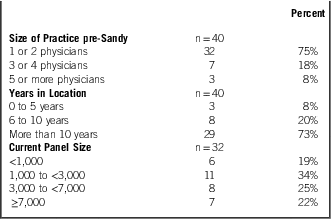
From March to May 2014, 40 out of 46 primary care sites consented to participate in the survey for a response rate of 87%. Details on participating sites are presented in Table 1. Nearly three-quarters (n=29/40) of the sites had been in their location for more than 10 years. Pre-Sandy, three-quarters (n=30) of primary care sites in the Rockaways were small practices (1-2 physicians). A minority (36%) reported having an electronic health record pre-Sandy. Panel size (number of patients who receive care at a practice location) varied from 100 patients to 16000 patients with a median of 3,000 patients. Nearly two-thirds (64%) of sites reported a drop in panel size post-Sandy, whereas 15% reported an increase.
Primary Care Site Characteristics (n=40)

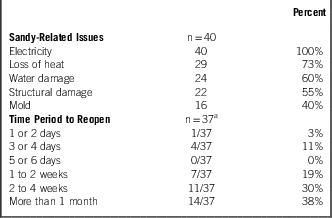
When asked about the direct impact and their experience with Hurricane Sandy, 95% (n=38) of sites reported that they had to temporarily close or relocate. Of these sites, 76% temporarily closed but did not relocate, and 23% relocated. Of those that temporarily relocated, 75% were relocated for more than 1 month. More than two-thirds (68%) were closed for more than 2 weeks and 38% took more than 1 month to reopen post-Sandy. Every practice experienced electrical problems, nearly three-fourths (73%) had loss of heat, 60% had water damage, over half (55%) had structural damage, and 40% had mold issues (Table 2 details Sandy’s impact on service provisions).
Direct Impact of Sandy

a 1 missing.
Approximately one-quarter (23%) of sites reported that they had a plan for continuity of services in the event of a disaster pre-Sandy (Table 1). Despite the impact of Sandy, fewer than half (43%) of primary care sites reported having a plan for continuity of services post-Sandy. This did not differ by size of practice (41% of 1-2 physician practices versus 50% or 3+ physician practices, P=.72). Over the course of the Sandy response, very few sites worked with mobile health clinics (n=1), restoration centers (n=2), community organizations (n=3), or received outside support from government agencies or nonprofit organizations (n=8). The majority (80%) did not report coordinating with other primary care stakeholders or receiving support from government agencies during the Sandy response.
DISCUSSION
We have reported our findings from a survey of primary care sites in the aftermath of a major natural disaster. Not much is known about how access to primary care is impacted after a hurricane even though personal health services and provision of health care when otherwise unavailable are accepted as essential public health services. 6 Our results show that 43% of sites in the Rockaways currently have a plan for continuity of services postdisaster, suggesting that many sites remain underprepared for a disaster of this magnitude. This implies the need for additional efforts from governmental agencies to spearhead planning and preparedness in this vital sector of the health care system.
Patient information can be lost due to damaged paper records from flooding. The use of electronic health records (EHRs) can help prevent loss of data and assist in the quick restoration of services, if electricity is available or providers have the ability to access records remotely. Sites should seek access to systems that allow them to access patient information remotely.
A large proportion of responding sites reported temporary closures or relocation for a month or longer after the hurricane. This may have had detrimental impacts on the population’s access to essential continuing care. For example, ensuring access to prescription medications during and after disasters is vitally important to the health of the populationReference Ochi, Hodgson and Landeg 7 as nearly half of the US population takes at least 1 prescription medication in any given month. 8 In areas of the Rockaways, which have a large proportion of low-income communities, this was critically important. Though our survey does not shed light on the impacts of provider closure on people’s access to drugs and care, it does suggest the importance of planning regarding continuity of care among primary care providers. For example, the number of emergency room visits for methadone treatment, medications, and dialysis—all potentially preventable if routine access to primary care can be maintained—peaked in the immediate aftermath of Sandy.Reference Lee, Smith and Carr 9 Due to the sudden nature of many disasters, individuals may not remember to take their prescriptions and or medications when evacuating, or medications may be compromised during the evacuation process. Lack of access to medications necessary for treatment of chronic conditions may have serious health consequences.Reference Caremeli, Eisenman and Blevins 10 Thus, maintaining access to primary care services postdisaster while accounting for dynamics in demand and supply due to evacuation, is critical for the management of a population’s health.
In the Rockaways, various organizations provided continuing access to primary care by deploying mobile health clinics (MHCs). On November 5, 2012, Mayor Bloomberg’s administration coordinated deployment of 6 MHCs staffed with primary care providers to deliver medical care and distribute prescription drugs at no cost to affected residents in Coney Island, Staten Island, and the Rockaways. 5 MHCs provide an alternative gateway into the health care system for individuals who may be medically disenfranchised, underserved, or uninsured. The provision of such mobile clinics is associated with both positive health outcomes as well as economic benefits.Reference Song, Hill and Bennet 11 MHCs can play an essential role during emergency relief efforts, particularly when rapidly deployed to otherwise inaccessible areas, and planning to ensure these resources are effectively used is essential.
Our survey had 2 main limitations. First, it was conducted 16-18 months post-Sandy, resulting in the possibility that some physicians and staff members may not have accurately recalled the specifics of Sandy’s impact. We were also unable to include sites that were permanently closed due to Sandy. However, by attempting to interview all sites active at the time in the Rockaways, our results provide insight into the challenges faced by the many small practices in an area serving a vulnerable population in need.
CONCLUSION
Sandy considerably impacted the primary care sector in the Rockaways. It caused operational issues, thus disrupting access to care for patients by forcing practice closure and relocation.
Since Sandy, numerous organizations and governmental agencies have examined how future disaster response efforts can be more effective, including those focused on the health care sector. In New York City, the DOHMH response in the Rockaways has led to the development of protocols for a coordinated response of MHCs to address primary and emerging health needs of residents in disaster-affected areas. Given the role that MHCs played in hard-hit areas post-Sandy, we found a need to develop an all-hazards and scalable approach to prepare for deficits in access to primary care and ensure timely deployment and coordination of health resources. Still, further efforts are needed. In the Rockaways, fewer than half of primary care sites have a plan for continuity of services in the event of a disaster, and the majority of sites did not coordinate with other primary care stakeholders or receive support from government agencies during the Sandy response. Whereas MHCs provide an opportunity to provide access to primary care as sites reestablish their services postdisaster, planning within and coordination between primary care sites is important to ensure that populations impacted by a disaster continue to have access to health care. Through the development of an agent-based model to address the impact of Sandy on the Rockaways,Reference Guclu, Kumar and Galloway 12 we found that the primary care access deficit increased after MHCs left the area after approximately 30 days. This suggests that coordination between governmental agencies and primary care sites regarding expected time period to reopen may help minimize primary care access deficits in a sustained manner. Greater emergency planning and response coordination is needed between providers and governmental agencies to minimize disruptions of access to primary care after a disaster.
Acknowledgments
Funded through the University of Pittsburgh Center for Public Health Practice by the Assistant Secretary for Preparedness and Response Project Number 1 HITEP130004-01-00. The opinions, results, findings, and or interpretations of data contained herein are solely the responsibility of the authors and do not represent the opinions, interpretation, or policy of the Assistant Secretary for Preparedness and Response, the University of Pittsburgh, the New York City Department of Health and Mental Hygiene, or the City of New York.
We thank Maryellen Tria, JD, MPH, and Jane Bedell, MD, of the New York City Department of Health and Mental Hygiene and Tina Batra Hershey, JD, MPH, and Elizabeth Van Nostrand, JD of the University of Pittsburgh Graduate School of Public Health. Ms Tria contributed to the development of the survey tool. Dr Bedell coordinated the DOHMH response in the Rockaways after Hurricane Sandy and her leadership inspired the development of our survey. Ms Hershey and Ms Van Nostrand assisted in drafting and editing the manuscript.