1 Introduction
A positive definite integral quadratic form
 $$ \begin{align*} f=f(x_1,x_2,\ldots,x_k)=\sum_{1\le i,j\le k}a_{ij}x_ix_j \quad (a_{ij}=a_{ji}\in {\mathbb Z}) \end{align*} $$
is called universal if it represents all positive integers. Lagrange’s four-square theorem states that the quaternary quadratic form
 $x^2+y^2+z^2+w^2$
is universal. Ramanujan [Reference Ramanujan15] found all diagonal quaternary universal quadratic forms. In 1993, Conway and Schneeberger announced the ‘15-Theorem’ which says that a (positive definite integral) quadratic form representing all positive integers up to 15 actually represents every positive integer. Bhargava [Reference Bhargava1] introduced an algorithm, called the escalation method, which yields the classification of universal quadratic forms (see also [Reference Conway4]). The escalation method shows that if an integral quadratic form f represents nine integers
 $1,2,3,5,6,7,10,14$
and 15, then f is universal. Kim et al. [Reference Kim, Kim and Oh10] generalised this result and proved that for any infinite set S of quadratic forms of bounded rank, there is a finite subset
 $S_0$
of S such that any (positive definite integral) quadratic form representing every form in
 $S_0$
represents all of S. Following [Reference Kim, Lee and Oh11], we call such a set
 $S_0$
an S-universality criterion set. An S-universality criterion set
 $S_0$
is called minimal if no proper subset
 $S^{\prime }_0$
of
 $S_0$
is an S-universality criterion set.
For an integer
 $m\ge 3$
, we define a polynomial
 $P_m(x)$
by
 $$ \begin{align*} P_m(x)=\frac{(m-2)x^2-(m-4)x}{2}. \end{align*} $$
An integer of the form
 $P_m(u)$
for some integer u is called a generalised m-gonal number. A polynomial of the form
 $$ \begin{align*} a_1P_m(x_1)+a_2P_m(x_2)+\cdots+a_kP_m(x_k) \end{align*} $$
with positive integers
 $a_1,a_2,\ldots ,a_k$
is called a sum of generalised m-gonal numbers or an m-gonal form. In [Reference Kane and Liu9], Kane and Liu proved that there is a constant
 $\gamma _m$
such that if a sum of generalised m-gonal numbers represents all positive integers up to
 $\gamma _m$
, then it represents all positive integers. By applying the escalation method to sums of generalised m-gonal numbers, they showed the existence of such a
 $\gamma _m$
and found an asymptotic upper bound of
 $\gamma _m$
in terms of m.
For each positive integer n, we define
 $\mathcal T(n)$
to be the set of all integers greater than or equal to n. An m-gonal form g is called tight
 $\mathcal T(n)$
-universal if the set of all nonzero integers represented by g is equal to
 $\mathcal T(n)$
. We introduce an algorithm giving all tight
 $\mathcal T(n)$
-universal m-gonal forms and provide some experimental results from the algorithm. In Section 2, some basic notation and terminology will be given. In Section 3, we introduce an algorithm which gives the classification of tight
 $\mathcal T(n)$
-universal m-gonal forms for each given pair
 $(m,n)$
. This algorithm is analogous to the escalation algorithm described by Bhargava and, when
 $n=1$
, it coincides with the algorithm for universal m-gonal forms in [Reference Kane and Liu9]. In Section 4, we provide some experimental results from the algorithm described in Section 3, including candidates for tight
 $\mathcal T(n)$
-universal m-gonal forms for
 $m=7,9,10$
and 11.
2 Preliminaries
For
 $k=1,2,3,\ldots ,$
we define a set
 $\mathcal {N}(k)$
to be the set of all vectors of positive integers with length k and coefficients in ascending order, that is,
 $$ \begin{align*} \mathcal{N}(k)=\{ \mathbf{a}=(a_1,a_2,\ldots,a_k)\in {\mathbb N}^k : a_1\le a_2\le \cdots \le a_k\}. \end{align*} $$
Put
 $\mathcal {N}=\bigcup _{k=1}^{\infty }\mathcal {N}(k)$
. For two vectors
 $\mathbf {a}\in \mathcal {N}(k)$
and
 $\mathbf {b}\in \mathcal {N}(s)$
with
 $k\le s$
, we write
 $$ \begin{align*} \mathbf{a}\preceq \mathbf{b}\quad (\mathbf{a} \prec \mathbf{b}) \end{align*} $$
if the sequence
 $(a_i)_{1\le i\le k}$
is a (proper) subsequence of
 $(b_j)_{1\le j\le s}$
, where
 $$ \begin{align*} \mathbf{a}=(a_1,a_2,\ldots,a_k)\quad \text{and}\quad \mathbf{b}=(b_1,b_2,\ldots,b_s). \end{align*} $$
Given a vector
 $\mathbf {a}\in \mathcal {N}(k)$
and a positive integer a, we define a vector
 $\mathbf {a}*a$
by
 $$ \begin{align*} \mathbf{a}*a=(a_1,a_2,\ldots,a_i,a,a_{i+1},a_{i+2},\ldots,a_k)\in \mathcal{N}(k+1), \end{align*} $$
where i is the maximum index satisfying
 $a_i\le a$
, that is,
 $\mathbf {a}*a$
is the vector in
 $\mathcal {N}(k+1)$
with coefficients
 $a_1,a_2,\ldots ,a_k$
and a. For
 $\mathbf {a}\in \mathcal {N}(k)$
and
 $\mathbf {b}=(b_1,b_2,\ldots ,b_s)\in \mathcal {N}(s)$
, we define
 $\mathbf {a}*\mathbf {b}$
to be the vector
 $$ \begin{align*} \mathbf{a}*b_1*b_2*\cdots*b_s \in \mathcal{N}(k+s). \end{align*} $$
We identify
 $\mathcal {N}(1)$
with
 ${\mathbb N}$
, so that, for example,
 $3*7*2*5$
denotes the vector
 $(2,3,5,7)\in \mathcal {N}(4)$
. Let S be a set of nonnegative integers containing 0 and 1 and let n be a positive integer. For a vector
 $\mathbf {a}=(a_1,a_2,\ldots ,a_k)\in \mathcal {N}(k)$
, we define
 $$ \begin{align*} R_S(\mathbf{a})=\{ a_1s_1+a_2s_2+\cdots+a_ks_k : s_i\in S\} \quad \text{and}\quad R^{\prime}_S(\mathbf{a})=R_S(\mathbf{a})-\{0\}. \end{align*} $$
Let
 $\mathcal {GP}_m$
be the set of generalised m-gonal numbers, that is,
 $$ \begin{align*} \mathcal{GP}_m=\{ P_m(u) : u\in {\mathbb Z} \}. \end{align*} $$
Then an m-gonal form
 $$ \begin{align*} a_1P_m(x_1)+a_2P_m(x_2)+\cdots+a_kP_m(x_k) \quad (a_1\le a_2\le \cdots \le a_k) \end{align*} $$
corresponds to the pair
 $(\mathcal {GP}_m,\mathbf {a})$
, where
 $\mathbf {a}=(a_1,a_2,\ldots ,a_k)\in \mathcal {N}(k)$
. A pair
 $(\mathcal {GP}_m,\mathbf {a})$
(
 $\mathbf {a}\in \mathcal {N}(k)$
) will also be called a k-ary m-gonal form. Let n be a positive integer. An m-gonal form
 $(\mathcal {GP}_m,\mathbf {a})$
is called
 $\mathcal T(n)$
-universal if
 $R^{\prime }_{\mathcal {GP}_m}(\mathbf {a})\supseteq \mathcal T(n)$
and tight
 $\mathcal T(n)$
-universal if
 $R^{\prime }_{\mathcal {GP}_m}(\mathbf {a})=\mathcal T(n)$
. A tight
 $\mathcal T(n)$
-universal m-gonal form
 $(\mathcal {GP}_m,\mathbf {a})$
is called new if
 $R^{\prime }_{\mathcal {GP}_m}(\mathbf {b})\subsetneq \mathcal T(n)$
for every vector
 $\mathbf {b}\in \mathcal {N}$
satisfying
 $\mathbf {b}\prec \mathbf {a}$
. When
 $n=1$
, we use the expression ‘universal’ along with ‘tight
 $\mathcal T(1)$
-universal’ to follow the convention.
Lemma 2.1. Let m be an integer greater than or equal to
 $3$
and n be a positive integer. Then there exists a vector
 $\mathbf {a}$
such that
 $R^{\prime }_{\mathcal {GP}_m}(\mathbf {a})=\mathcal T(n)$
.
Proof. Let
 $\mathbf {b}=(n,n,\ldots ,n)\in \mathcal {N}(m)$
be the vector of length m with every coefficient equal to n. By Fermat’s polygonal number theorem,
 $$ \begin{align*} R_{\mathcal{GP}_m}(\mathbf{b})=\{ nu : u\in {\mathbb Z}_{\ge 0} \}. \end{align*} $$
From this, one may easily deduce that
 $$ \begin{align*} R^{\prime}_{\mathcal{GP}_m}(\mathbf{b}*(n+1)*(n+2)*\cdots*(2n-1))=\mathcal T(n). \end{align*} $$
This completes the proof.
3 An algorithm for tight
 $\mathcal T(n)$
-universal sums of m-gonal numbers

We introduce an algorithm which gives all new tight
 $\mathcal T(n)$
-universal m-gonal forms. Let m be an integer
 $\ge 3$
and n be a positive integer. For
 $\mathbf {a}\in \mathcal {N}$
, we denote by
 $\Psi (\mathbf {a})$
the set of integers in
 $\mathcal T(n)$
which are not represented by the m-gonal form
 $(\mathcal {GP}_m,\mathbf {a})$
, that is,
 $$ \begin{align*} \Psi(\mathbf{a})=\Psi_{m,n}(\mathbf{a})=\mathcal T(n)-R^{\prime}_{\mathcal{GP}_m}(\mathbf{a}). \end{align*} $$
We define a function
 $\psi =\psi _{m,n} : \mathcal {N}\to \mathcal T(n)\cup \{ \infty \}$
by
 $$ \begin{align*} \psi(\mathbf{a})=\begin{cases}\min(\Psi(\mathbf{a}))&\text{if}\ \ \Psi(\mathbf{a})\neq \emptyset,\\ \infty&\text{otherwise.}\end{cases} \end{align*} $$
For a vector
 $\mathbf {a}$
with
 $\psi (\mathbf {a})<\infty $
, we define the set
 $\mathcal E(\mathbf {a})$
by
 $$ \begin{align*} \mathcal E(\mathbf{a})=\{ g\in {\mathbb Z} : n\le g\le \psi(\mathbf{a})-n\} \cup \{ \psi(\mathbf{a})\}. \end{align*} $$
Note that if
 $\psi (\mathbf {a})<2n$
, then
 $\mathcal E(\mathbf {a})=\{ \psi (\mathbf {a})\}$
. For
 $k=1,2,3,\ldots ,$
we define subsets
 $E(k),U(k),\mathit {NU}(k)$
and
 $A(k)$
of
 $\mathcal {N}(k)$
recursively as follows. Put
 $E(1)=\{(n)\}$
. Define
 $$ \begin{align*} U(k)=\{ \mathbf{a}\in E(k) : \psi(\mathbf{a})=\infty \}. \end{align*} $$
Let
 $\mathit {NU}(k)$
be the set of all vectors
 $\mathbf {a}$
in
 $U(k)$
such that
 $\mathbf {b}\not \in \bigcup _{i=1}^{k-1}U(i)$
for every
 $\mathbf {b}\in \mathcal {N}$
satisfying
 $\mathbf {b}\prec \mathbf {a}$
. Let
 $A(k)=E(k)-U(k)$
and
 $$ \begin{align*} E(k+1)=\bigcup_{\mathbf{a}\in A(k)}\{ \mathbf{a}*g : g\in \mathcal E(\mathbf{a})\}. \end{align*} $$
The algorithm terminates once
 $A(k)=\emptyset $
.
Theorem 3.1. With the notation given above, for a vector
 $\mathbf {a}\in \mathcal {N}(k)$
, a k-ary m-gonal form
 $(\mathcal {GP}_m,\mathbf {a})$
is new tight
 $\mathcal T(n)$
-universal if and only if
 $\mathbf {a}\in \mathit {NU}(k)$
.
Proof. The ‘if’ part is clear by construction. To prove the ‘only if’ part, let
 $\mathbf {a}\in \mathcal {N}(k)$
be a vector such that
 $(\mathcal {GP}_m,\mathbf {a})$
is tight
 $\mathcal T(n)$
-universal. Since
 $R^{\prime }_{\mathcal {GP}_m}(\mathbf {a})=\mathcal T(n)$
, it clearly follows that
 $a_{i_1}=n$
, where we put
 $i_1=1$
. Note that the set
 $R_{\mathcal {GP}_m}(a_{i_1})$
does not contain any positive integer less than n and it does contain 0 and all integers from n to
 ${\psi (a_{i_1})-1}$
. From this and
 $\psi (a_{i_1})\in \mathcal T(n)=R^{\prime }_{\mathcal {GP}_m}(\mathbf {a})$
, one may easily deduce that there must be an index
 $i_2$
different from
 $i_1$
such that
 $$ \begin{align*} a_{i_2}\in \mathcal E(a_{i_1})=\{ n,n+1,n+2,\ldots,\psi(a_{i_1})-n\} \cup \{\psi(a_{i_1})\}. \end{align*} $$
Thus
 $a_{i_1}*a_{i_2}\preceq \mathbf {a}$
, where
 $a_{i_1}*a_{i_2}\in E(2)$
. Note that
 $\psi (a_{i_1})\in R^{\prime }_{\mathcal {GP}_m}(a_{i_1}*a_{i_2})$
. Assume
 $R^{\prime }_{\mathcal {GP}_m}(a_{i_1}*a_{i_2})\subsetneq \mathcal T(n)$
so that
 $\psi (a_{i_1}*a_{i_2})<\infty $
. One may easily show that there should be an index
 $i_3$
different from both
 $i_1$
and
 $i_2$
such that
 $$ \begin{align*} a_{i_3}\in \mathcal E(a_{i_1}*a_{i_2})=\{ n,n+1,n+2,\ldots,\psi(a_{i_1}*a_{i_2})-n\} \cup \{ \psi(a_{i_1}*a_{i_2})\} \end{align*} $$
in a similar manner. We have
 $a_{i_1}*a_{i_2}*a_{i_3}\in E(3)$
by construction. Note that
 $$ \begin{align*} \psi(a_{i_1}*a_{i_2}*\cdots*a_{i_j})<\infty \end{align*} $$
for every
 $j=1,2,\ldots ,k-1$
since otherwise,
 $(\mathcal {GP}_m,\mathbf {a})$
cannot be new. Repeating this, we arrive at
 $$ \begin{align*} \mathbf{a}=a_{i_1}*a_{i_2}*\cdots*a_{i_k}\in E(k). \end{align*} $$
Since
 $(\mathcal {GP}_m,\mathbf {a})$
is new tight
 $\mathcal T(n)$
-universal, one may easily see that
 $\mathbf {a}\in \mathit {NU}(k)$
. This completes the proof.
Although the proof of the following lemma appeared in the proof of [Reference Kane and Liu9, Lemma 2.1], we provide it for completeness. For two positive integers d and r, we define a set
 $$ \begin{align*} \mathcal {AP}_{d,r}=\{dg+r : g\in {\mathbb N} \cup \{0\} \} \ (\subseteq {\mathbb N}). \end{align*} $$
Lemma 3.2. With the notation given above, there is a positive integer
 $l=l(m,n)$
depending on m and n such that
 $A(l)=\emptyset $
.
Proof. Let t be a positive integer greater than 4 and let
 $\mathbf {a}=(a_1,a_2,\ldots ,a_t)$
be a vector in
 $A(t)=E(t)-U(t)$
so that
 $\psi (\mathbf {a})<\infty $
. Note that, for any
 ${\mathbb Z}$
-lattice L of rank
 $\ge 4$
with
 $Q(\text {gen}(L))\subsetneq {\mathbb N}$
,
 $$ \begin{align*} {\mathbb N}-Q(\text{gen}(L))=\bigcup_{i=1}^{\nu^{\prime}_1} \mathcal {AP}_{d^{\prime}_i,r^{\prime}_i} \end{align*} $$
for some positive integers
 $\nu ^{\prime }_1,d^{\prime }_i$
and
 $r^{\prime }_i$
with
 $r^{\prime }_i<d^{\prime }_i$
by the results in [Reference O’Meara14]. From this and [Reference Chan, Oh, Chan and Schulze-Pillot3, Theorem 4.9] (see also [Reference Hsia, Kitaoka and Kneser5]), one may easily deduce that
 $$ \begin{align*} \mathcal T(n)-R^{\prime}_{\mathcal{GP}_m}(\mathbf{a})=\bigcup_{i=1}^{\nu_1} \mathcal {AP}_{d_i,r_i} \cup \{ e_1,e_2,\ldots,e_{\nu_2}\} \end{align*} $$
for some nonnegative integers
 $\nu _1,\nu _2$
not both 0 and some positive integers
 $d_i,r_i,e_j$
with
 $e_j\not \in \bigcup _{i=1}^{\nu _1} \mathcal {AP}_{d_i,r_i}$
for all
 $j=1,2,\ldots ,\nu _2$
. Suppose that
 $g_1$
is a positive integer with
 $n\le g_1\le \psi (\mathbf {a})-n$
or
 $g_1=\psi (\mathbf {a})$
so that
 $\mathbf {a}*g_1\in E(t+1)$
. If
 $$ \begin{align*} Q(\text{gen}(\langle a_1,a_2,\ldots,a_t\rangle))\subsetneq Q(\text{gen}(\langle a_1,a_2,\ldots,a_t,g_1\rangle)), \end{align*} $$
then
 $$ \begin{align*} \mathcal T(n)-R^{\prime}_{\mathcal{GP}_m}(\mathbf{a}*g_1)=\bigcup_{w=1}^{\nu_3} \mathcal {AP}_{d_{i_w},r_{i_w}} \cup \{ e^{\prime}_1,e^{\prime}_2,\ldots,e^{\prime}_{\nu_4}\}, \end{align*} $$
where
 $\nu _3$
is an integer with
 $$ \begin{align*} 0\le \nu_3<\nu_1,\quad (i_1,i_2,\ldots,i_{\nu_3})\prec (1,2,\ldots,\nu_1), \end{align*} $$
and
 $\nu _4$
is a nonnegative integer. When
 $$ \begin{align*} Q(\text{gen}(\langle a_1,a_2,\ldots,a_t\rangle))=Q(\text{gen}(\langle a_1,a_2,\ldots,a_t,g_1\rangle)), \end{align*} $$
it follows that
 $$ \begin{align*} \mathcal T(n)-R^{\prime}_{\mathcal{GP}_m}(\mathbf{a}*g_1)=\bigcup_{i=1}^{\nu_1} \mathcal {AP}_{d_i,r_i} \cup \{ e_{j_1},e_{j_2},\ldots,e_{j_{\nu_5}}\}, \end{align*} $$
where
 $\nu _5$
is a nonnegative integer less than
 $\nu _2$
and
 $(j_1,j_2,\ldots ,j_{\nu _5})\prec (1,2,\ldots ,\nu _2)$
.
Let
 $\mathbf {b}$
be a vector in
 $A(5)=E(5)-U(5)$
. From what we observed above, we may define a positive integer
 $w=w(\mathbf {b})$
to be the maximal positive integer w satisfying
 $$ \begin{align*} b*g_1*g_2*\cdots*g_i\in A(5+i)-U(5+i),\quad g_i\in \mathcal E(b*g_1*g_2*\cdots*g_{i-1}), \end{align*} $$
for every
 $i=1,2,\ldots ,w-1$
. Since the set
 $E(5)$
is finite by construction, we may take l as
 $$ \begin{align*} l=5+\max \{w(\mathbf{b}) : \mathbf{b}\in E(5)-U(5)\}. \end{align*} $$
This completes the proof.
We now introduce our main result which gives a natural generalisation of the Conway–Schneeberger 15-Theorem to the case of tight
 $\mathcal T(n)$
-universal m-gonal forms.
Theorem 3.3. With the notation given above, there is a finite set
 $CS(m,n)$
such that
 $R^{\prime }_{\mathcal {GP}_m}(\mathbf {a})=\mathcal T(n)$
if and only if
 $R^{\prime }_{\mathcal {GP}_m}(\mathbf {a})\cap \{1,2,\ldots ,n-1\}=\emptyset $
and
 $CS(m,n)\subset R^{\prime }_{\mathcal {GP}_m}(\mathbf {a})$
for any vector
 $\mathbf {a}\in \mathcal {N}$
.
Proof. Using Lemma 3.2, we take the smallest positive integer l satisfying
 $A(l)=\emptyset $
. Define a finite set
 $$ \begin{align*} CS(m,n)=\{n\} \cup \bigcup_{k=1}^{l-1}\{ \psi(\mathbf{a}) : \mathbf{a}\in A(k)\}. \end{align*} $$
Let
 $\mathbf {a}\in \mathcal {N}$
be a vector with
 $R^{\prime }_{\mathcal {GP}_m}(\mathbf {a})\cap \{1,2,\ldots ,n-1\}=\emptyset $
such that
 $R^{\prime }_{\mathcal {GP}_m}(\mathbf {a})\supset CS(m,n)$
. From the condition that
 $R^{\prime }_{\mathcal {GP}_m}(\mathbf {a})\supset CS(m,n)$
, one may easily see that there is a vector
 $\mathbf {b}\in \mathcal {N}$
with
 $\mathbf {b}\preceq \mathbf {a}$
such that
 $\mathbf {b}\in U(k)$
for some k less than or equal to
 $l$
. It follows that
 $$ \begin{align*} \mathcal T(n)=R^{\prime}_{\mathcal{GP}_m}(\mathbf{b})\subseteq R^{\prime}_{\mathcal{GP}_m}(\mathbf{a}). \end{align*} $$
This completes the proof.
Remark 3.4. In Theorem 3.3, the set
 $CS(m,n)$
is minimal in the sense that for any
 $g\in CS(m,n)$
, there is a vector
 $\mathbf {b}\in \mathcal {N}$
such that
 $R^{\prime }_{\mathcal {GP}_m}(\mathbf {b})=\mathcal T(n)-\{g\}$
. To see this, we take
 $\mathbf {b}=\mathbf {c}*\mathbf {d}$
, where
 $\psi (\mathbf {c})=g$
and
 $R^{\prime }_{\mathcal {GP}_m}(\mathbf {d})=\mathcal T(g+1)$
. The existence of such vectors
 $\mathbf {c}$
and
 $\mathbf {d}$
follows from the definition of the set
 $CS(m,n)$
and Lemma 2.1, respectively.
In the spirit of Remark 3.4 and [Reference Kim, Lee and Oh11], we may call the set
 $CS(m,n)$
a minimal tight
 $\mathcal T(n)$
-universality criterion set for m-gonal forms.
Proposition 3.5. Let m be an integer greater than or equal to
 $3$
and different from
 $5$
and let n be an integer greater than
 $1$
. With the notation given above:
-
(i)
$\{n,n+1,n+2,\ldots ,2n\} \subseteq CS(m,n)$
; -
(ii)
$E(k)=\{(n,n+1,n+2,\ldots ,n+k-1)\}$
for
$k=1,2,\ldots ,n$
; -
(iii)
$U(k)=\emptyset \ (\text {or equivalently},\ A(k)=E(k))$
for
$k=1,2,\ldots ,n$
; -
(iv)
$E(n+1)=\{(n,n,n+1,n+2,\ldots ,2n-1),(n,n+1,n+2,\ldots ,2n-1,2n)\}$
.


Proof. Note that
 $2\not \in \mathcal {GP}_m$
since
 $m\neq 5$
. For
 $i=1,2,\ldots ,n-1$
, one may easily show that
 $\psi (n)=n+1$
and
 $$ \begin{align*} \psi(n,n+1,n+2,\ldots,n+i)=n+i+1. \end{align*} $$
The proposition follows directly from this.
Remark 3.6. Proposition 3.5(i), (ii) and (iii) also hold for the case of pentagonal forms, that is, when
 $m=5$
. However, Proposition 3.5(iv) is no longer true when
 $m=5$
. In fact, since
 $2=P_5(-1)\in \mathcal {GP}_5$
, we have
 $$ \begin{align*} 2n\in R^{\prime}_{\mathcal{GP}_5}(n)\subset R^{\prime}_{\mathcal{GP}_5}(n,n+1,n+2,\ldots,2n-1), \end{align*} $$
and thus we would have
 $\psi (n,n+1,n+2,\ldots ,2n-1)>2n$
.
4 Some experimental results
We provide some experimental results based on the escalation algorithm for tight
 $\mathcal T(n)$
-universal m-gonal forms introduced in Section 3. We first note that, in practice, we use the set
 $$ \begin{align*} \Psi(\mathbf{a})=\Psi_{m,n}(\mathbf{a})=\{ u \in \mathcal T(n) : u\le 10^6 \}-R^{\prime}_{\mathcal{GP}_m}(\mathbf{a}) \end{align*} $$
instead of the original definition
 $\Psi (\mathbf {a})=\mathcal T(n)-R^{\prime }_{\mathcal {GP}_m}(\mathbf {a})$
in the algorithm so that
 $$ \begin{align*} \{ u\in {\mathbb N} : n\le u\le 10^6\} \subset R^{\prime}_{\mathcal{GP}_m}(\mathbf{a})\quad\mbox{for all } \mathbf{a}\in \bigcup_{k=1}^{\infty} U(k). \end{align*} $$
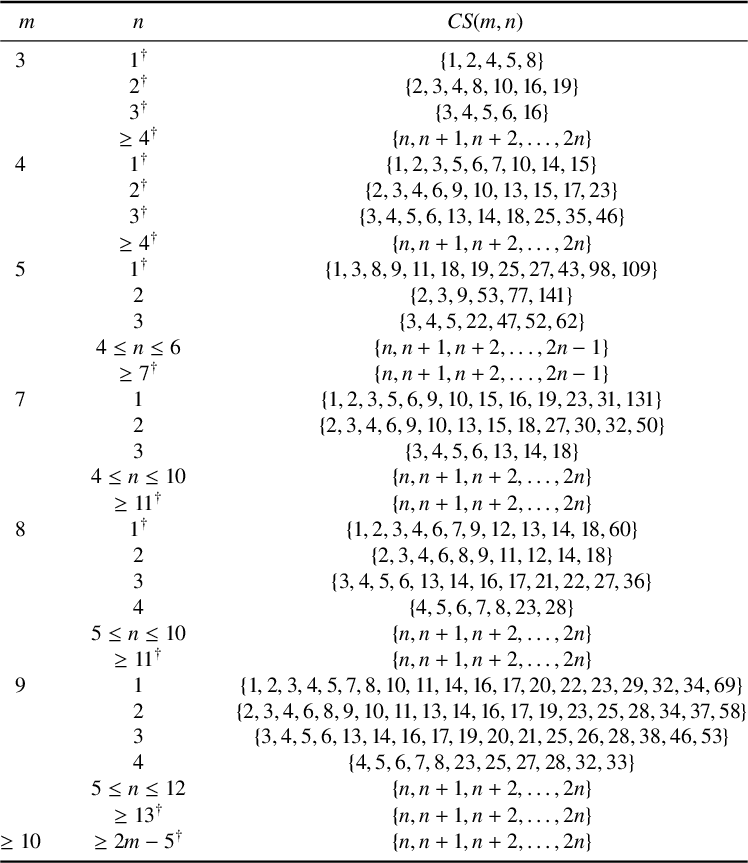
In Table 1, we give the sets
 $CS(m,n)$
for some pairs
 $(m,n)$
. In the table, the pair
 $(m,n)$
is marked with
 $\dagger $
when the tight
 $\mathcal T(n)$
-universal m-gonal forms are already completely classified so that the set
 $CS(m,n)$
in the table has been proved to be equal to the set
 $CS(m,n)$
in the algorithm in Section 3.
 $CS(m,n)$
for some pairs
 $(m,n)$
.

For the classification of tight
 $\mathcal T(n)$
-universal m-gonal forms, we refer the reader to [Reference Bhargava1] for
 $(m,n)=(4,1)$
, [Reference Bosma and Kane2] for
 $(m,n)=(3,1)$
, [Reference Ju and Oh8] for
 $(m,n)=(8,1)$
, [Reference Ju6] for
 $(m,n)=(5,1)$
, [Reference Kim and Oh13] for
 $m=4$
and
 $n\ge 2$
, and [Reference Kim12] for the others. The tight universal m-gonal forms are classified for
 $m=4,3$
, and tight
 $\mathcal T(n)$
-universal octagonal forms for all
 $n\ge 2$
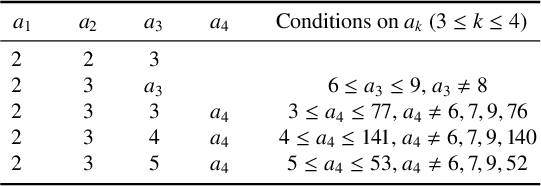
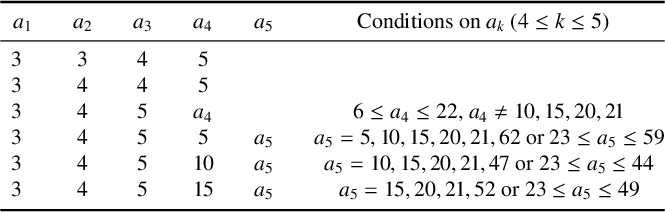
are treated in [Reference Ju and Kim7]. In this spirit, we provide the candidates for tight
 $\mathcal T(n)$
-universal pentagonal forms in the cases of
 $n=2,3$
in Tables 2 and 3, respectively. Note that there is exactly one candidate for tight
 $\mathcal T(n)$
-universal pentagonal forms for each
 $n=4,5,6$
, which is
 $(\mathcal {GP}_5,(n,n+1,n+2,\ldots ,2n-1))$
.
Candidates for new tight
 $\mathcal T(2)$
-universal pentagonal forms
 $(\mathcal {GP}_5,(a_1,a_2,\ldots ,a_k))$
.

Candidates for new tight
 $\mathcal T(3)$
-universal pentagonal forms
 $(\mathcal {GP}_5,(a_1,a_2,\ldots ,a_k))$
.

For any integer
 $m\ge 3$
and a positive integer n, we define
 $\gamma _{m,n}$
to be the maximum element in the set
 $CS(m,n)$
, as in the proof of Theorem 3.3. By Theorem 3.3, if an m-gonal form g does not represent any integer less than n and does represent all integers from n to
 $\gamma _{m,n}$
, then g is tight
 $\mathcal T(n)$
-universal. For
 $m=3,4,\ldots ,$
we define
 $$ \begin{align*} \gamma_m=\gamma_{m,1}=\max(C(m,1)). \end{align*} $$
Now we consider universal m-gonal forms. In Table 4,
 $\gamma _m$
is given for
 $3\le m\le 11$
and the proved cases are marked
 $\dagger $
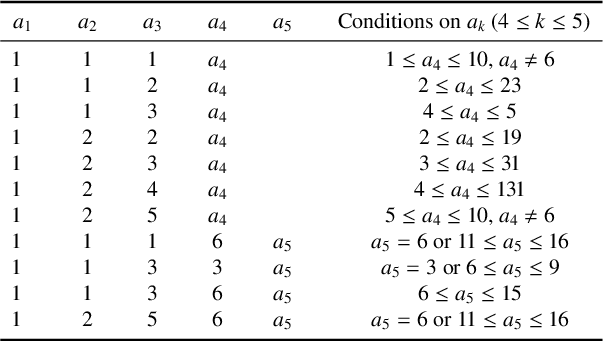
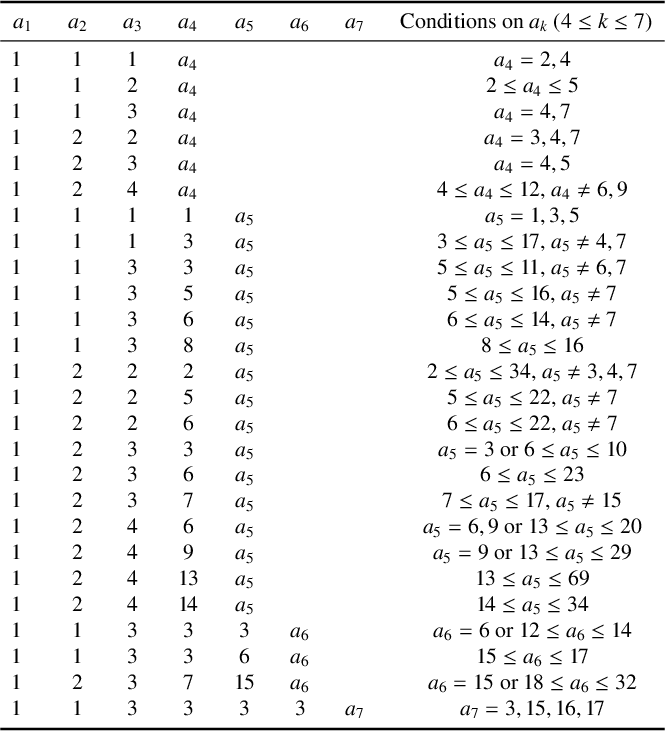
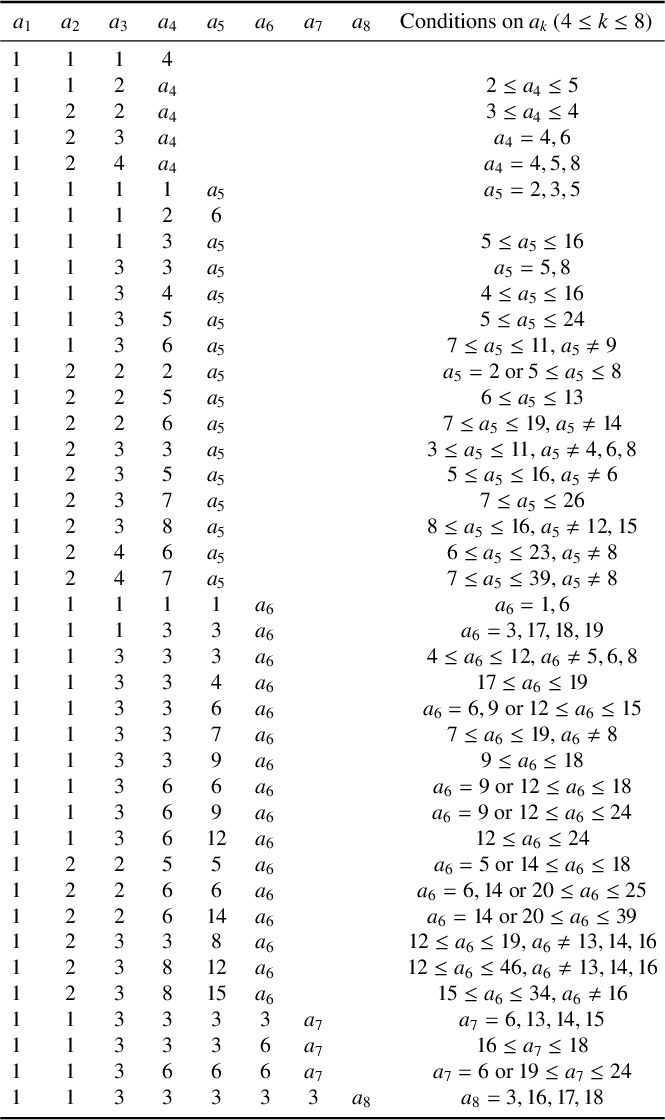
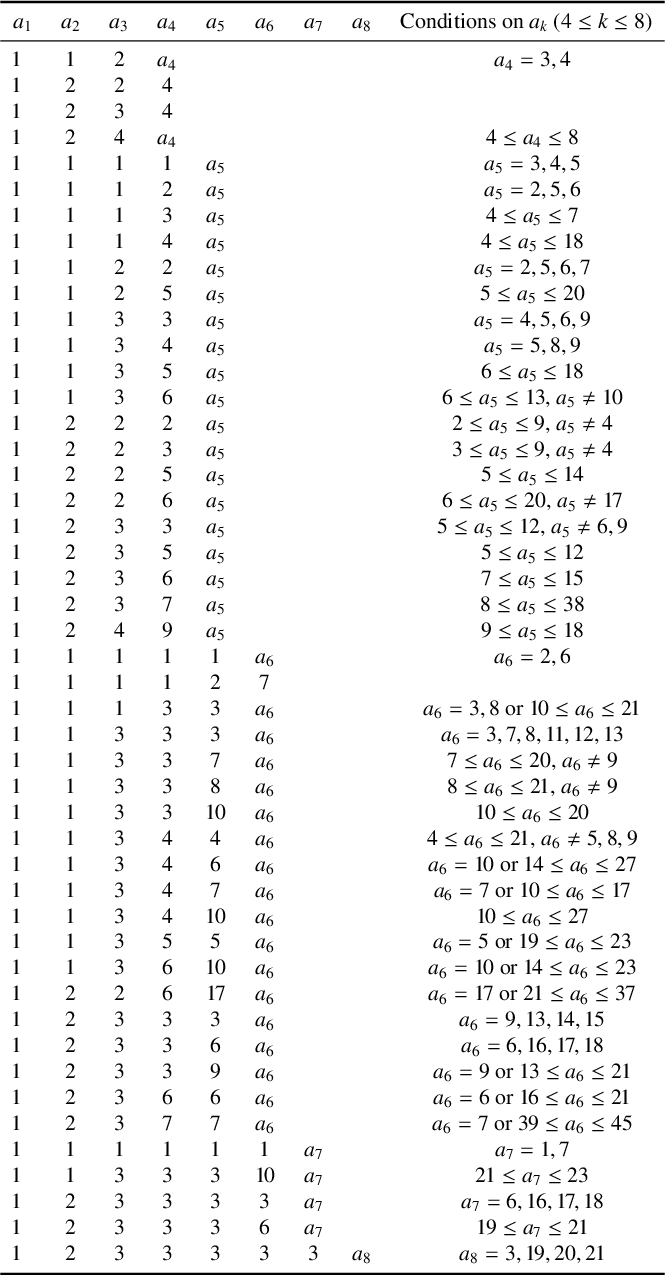
. We provide all candidates of new universal m-gonal forms, for
 $m=7,9,10,11$
, in Tables 5–8, since the universal m-gonal forms are of particular interest.
 $\gamma _m$
for
 $3\le m\le 11$
.

Candidates for new universal heptagonal forms
 $(\mathcal {GP}_7,(a_1,a_2,\ldots ,a_k))$
.

Candidates for new universal nonagonal forms
 $(\mathcal {GP}_9,(a_1,a_2,\ldots ,a_k))$
.

Candidates for new universal decagonal forms
 $(\mathcal {GP}_{10},(a_1,a_2,\ldots ,a_k))$
.

Candidates for new universal hendecagonal forms
 $(\mathcal {GP}_{11},(a_1,a_2,\ldots ,a_k))$
.