

The rondeau Fors seulement l'actente que je meure is one of Johannes Ockeghem's most popular secular works. The success this chanson enjoyed is evident not so much from the sum total of its sources (seven music manuscripts, less than the number for other chansons of his such as Ma bouche rit or D'ung aultre amer)Footnote 1 as above all from the high number of reappearances it makes, both in pieces by Ockeghem himself (who quotes it in a motet, Intemerata dei mater, and uses it as the basis for the rondeau Fors seulement contre ce qu'ay promys, and for the Missa Fors seulement) and by composers from one or more generations later, such as Jacob Obrecht, Pierre de La Rue, Antoine Brumel, Josquin des Prez, Matthaeus Pipelare, to mention just a few. As a result of this popularity Fors seulement has been at the forefront of musicologists' attention almost since the dawn of the discipline. Starting back in the second half of the nineteenth century with August Wilhelm Ambros, followed then by Otto Gombosi and Hellmuth Wolff, and later Helen Hewitt, Martin Picker, Paula Higgins, Clemens Goldberg, Richard Wexler, Fabrice Fitch, Jaap van Benthem, Christina Urchueguía and others in the course of the twentieth century, many scholars have studied it, out of interest both in the rondeau itself and in its reworkings.Footnote 2
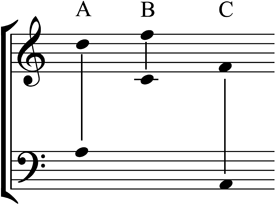
Apart from the substantial intertextuality to which it gave rise, Fors seulement (composed probably around 1460) stands out from Ockeghem's other secular compositions in one particular respect: it is the only three-voice work in which the two upper voices are both in a high register (for the moment I shall call them ‘voice A’ and ‘voice B’; their nomenclature and function will later be discussed in detail). Their melodic ranges are only slightly different, while standard practice in three-part chansons of the period entails more differentiated melodic ranges, with the superius pitched highest and the tenor in an intermediate position. Example 1 shows the ranges of the chanson's three voices.Footnote 3
The vocal ranges in Ockeghem's Fors seulement. In the Loire Valley chansonniers A=superius, B=tenor; in the later codices A=tenor, B=superius

Although for Ockeghem this disposition is an isolated instance, chansons with similar features are not uncommon among compositions dating from the second half of the fifteenth century, as I will discuss later. However, what is odd about Fors seulement is that its employment of two voices in a high register lies behind a curious feature in the transmission of the musical text: the sources differ in the way they establish the functions of the two upper voices. The copyists of the Loire Valley chansonniers (Nivelle, Laborde, Wolfenbüttel and Dijon), which are the oldest manuscripts, the closest to the author and probably the most authoritative, surprisingly assign the role of tenor to voice B, the highest, copying it at the top of the right-hand page, as is usual with the tenor of a chanson.Footnote 4 The copyists of the more recent codices, which are generally more peripheral to Ockeghem and his milieu (Chansonnier de Lorraine, Cappella Giulia and the Gesangbuch), bring the voices back to a more ‘standard’ order, arranging them according to pitch: voice B, the highest, is here the superius, while voice A, in fact the intermediate one, is given the position of tenor.Footnote 5
Which of the two voices is the superius and which the tenor? When deciding among the two possible options, musicologists have relied either on the standard disposition of voices in late-fifteenth-century song, or on the perspective afforded by the rondeau's reworkings.Footnote 6 Those who opt for the arrangement of the more recent sources, such as Hewitt and Picker among others, consider the mise en page of the Loire Valley chansonniers an oddity, if not an outright mistake.Footnote 7 Instead, they point out that voice A has a slightly lower range, and note its frequent stepwise descent, notably at the final cadence; since these features are among the grammatical functions of the tenor in fifteenth-century counterpoint, they consider voice A to fulfil that role, and consequently call voice B the superius, ‘regardless of its entering last – as the tenor usually does’ (Hewitt's words) and thus sidelining the evidence of the earliest sources, those closest to the composer.Footnote 8 Other scholars, such as Wexler and van Benthem, regard voice B as the tenor of the song instead, not only following the Loire Valley chansonniers, but also noting that the vast majority of the song's reworkings borrows voice B as the cantus firmus, as usually happens with the tenors of chansons.Footnote 9 Then there is Clemens Goldberg, who opts for a third solution, which emphasises what he considers the substantial interchangeability of the two high-pitched voices: he proposes calling them Superius I (my voice B) and Superius II (my voice A).Footnote 10
As my brief summary shows, when discussing this issue musicologists have focused almost exclusively on the music of Fors seulement, paying little attention to its words and to their possible relationship with the music. I believe, however, that considering the poetic text will throw a revelatory light not only on the uncertainties surrounding the song's upper voices, but also on the potential cultural meanings of the song itself. My aim in this article, therefore, is to address both the compositional features of Ockeghem's Fors seulement and its complex transmission from the point of view of the song's words. To this end I shall begin with an analysis of the chanson, followed by an examination of the manuscript tradition, especially the Loire Valley chansonniers. I will then concentrate on the poetic text, discussing its features, origins and context, and paying particular attention to the gender of its poetic voice. Afterwards I will examine the compositional devices employed by Ockeghem in setting these strongly gendered words, discussing them in connection with the peculiar textual transmission of the song. In conclusion, I will ponder the potential relevance of my interpretation for larger issues of musical gendering in fifteenth-century secular repertories.
A long rondeau
Fors seulement is differentiated from the rest of Ockeghem's secular output by a series of features. Apart from the use of two voices close in register and tessitura over a low contratenor, Fors seulement stands out from the composer's other chansons by reason of its length. The rondeau unfolds over seventy breves in tempus imperfectum diminutum: this length exceeds that of Ockeghem's other rondeaux and is probably the reason why in Nivelle and Wolfenbüttel Fors seulement is copied into two successive openings.Footnote 11
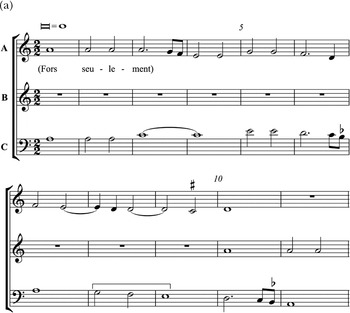
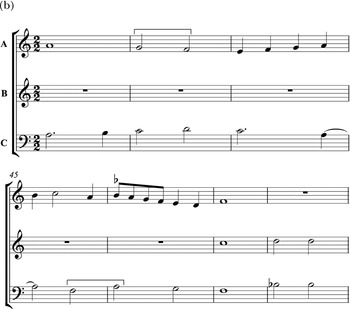
The rondeau's ‘long’ duration results from a feature of Ockeghem's setting. Fors seulement opens with a duet lasting for nine breves between voice A and the contratenor, in which voice A anticipates the beginning of the first phrase of voice B, which enters at bar 10 as the fifth in a cadence on D (see Example 2a). The second part, after the medial cadence, is structured in the same fashion: it too opens with a duet between voice A and the contratenor, voice B making its entry after five breves (see Example 2b).Footnote 12
Ockeghem, Fors seulement: (a) bb. 1–11 (duet between voice A and contratenor, with entry of voice B); (b) bb. 42–8 (duet between voice A and contratenor, with entry of voice B)
(a)

(b)

The opening duet of Fors seulement has a bipartite structure: the first section comprises the descending interval of a fourth, from a′ to e′ (bb. 1–4), which, assuming that the underlay of the text is as set out in Example 2a, would fall on the fourth syllable of the decasyllabic line. The stress here is rendered musically by a melodic-rhythmic element recurrent throughout the piece: the descending fourth with a dotted semibreve followed by two semiminims.Footnote 13 Among Ockeghem's secular works only two chansons have an incipit comparable to that of Fors seulement: Un aultre l'a and Baisiés moy. In Un aultre l'a the tenor takes up the opening of the superius a fifth lower, but it does so after the first hemistich and not at the resolution of a cadence, while in Baisiés moy the superius enters at the cadence concluding the initial duet – at an interval of a fifth from the resolution note, just as in Fors seulement – but here the first phrase is quoted in its entirety: this voice repeats, a fifth higher, the phrase sung by the tenor at the outset.
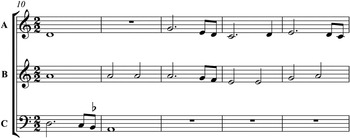
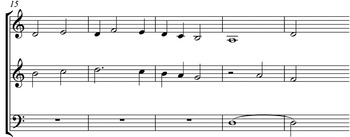
By contrast, the opening duet of Fors seulement does not offer in its entirety what will be heard in the voice that comes in last; rather, it functions as preparation for voice B's entry. In fact Fors seulement's initial duet between voice A and the contratenor sets forth only the first hemistich of the phrase subsequently sung by voice B, as if this were a ‘motto’. As we can see in Example 2a, from bar 5 on voice A's melodic space is gradually reduced: after this point the duet adds no new melodic material, but simply proceeds towards the cadence. The entry of voice B in bar 10, at the cadential resolution, repeats precisely, both in rhythm and pitch, what voice A had begun with. Yet instead of remaining confined within the restricted space of a cadential turn, voice B's phrase in the second hemistich acquires a melodic charge of its own: having repeated exactly the first nine notes of voice A, it soars up to d″, an octave above voice A's cadential note in bar 10 (see Example 3). That is to say, voice B takes possession of the opening motto, giving it a melodic elaboration: what is sung in bars 10–17 by voice B is thus the complete first phrase of the chanson. Therefore the entry of the third voice clarifies the introductory function of what we have heard up to this point: in a sense, it is only here that the rondeau proper begins.
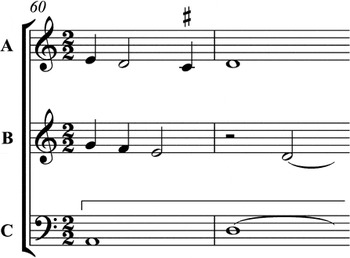
Ockeghem, Fors seulement, bb. 10–19


This ‘preparatory’ function of the opening duet is a distinctive feature also of the duet at the beginning of the rondeau's second section. Here too voice B comes in last at the interval of a fifth above the resolution of the contratenor at the cadence with voice A. Its phrase (an anticipation at the unison of voice A in bb. 49–53) reasserts the dactylic rhythm found in voice A at the beginning of the second section (bb. 42–3; see Example 2b above), thus recalling both the phrase at the chanson's opening and the ways in which that phrase is presented, that is, as an introductory duet with a cadence at which the third voice comes in at a fifth from the note of resolution.
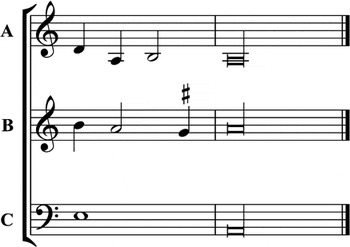
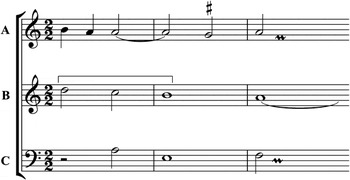
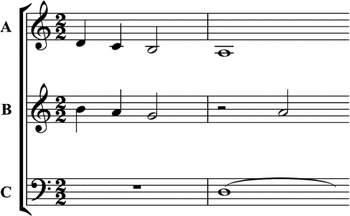
A further aspect of the chanson relevant to the aims of this study is the way in which the two upper voices operate at a cadence. As indicated above, this has been one of the chief arguments in support of the correctness of the layout in the later manuscripts (which treat voice A as the rondeau's tenor). In the closing cadence (bb. 69–70; see Example 4) voice B is positioned an octave higher than A, and exhibits an ascending movement towards the finalis (a typical superius motion), whereas the latter moves downward (typical tenor motion). This situation is reversed at the medial cadence (bb. 38–9; see Example 5): here it is instead voice B that has the typical tenor motion, while A's is of the type associated with the superius. Equally, in cadences less exposed than these a similar oscillation between the two upper voices can be seen. There are two pertinent instances in bars 17–18 and 60–1 (Examples 6 and 7). In both cases the two voices converge in a unison cadence (the first is without syncopation), and in both cases the resolving note is delayed in one of the voices thanks to a pause. So then, in bars 17–18 voice A is behaving melodically like a tenor (and B like a superius) at the descent to a, whereas in bars 60–1 the same voice behaves melodically like a superius (and B, conversely, like a tenor).
Ockeghem, Fors seulement, closing cadence, bb. 69–70

Ockeghem, Fors seulement, medial cadence, bb. 37–9

Ockeghem, Fors seulement, bb. 17–18

Ockeghem, Fors seulement, bb. 60–1

The names of the voices
Thus far I have avoided imposing a name on Fors seulement's two upper voices, and thus specifying their function. As mentioned, the evidence of the manuscripts is contradictory: the oldest codices surprisingly give the tenor's role to the piece's highest voice, while for the three most recent ones that function belongs to what is in fact the intermediate voice. So which is the tenor and which the superius in Fors seulement? And why do the Loire Valley chansonniers – manuscripts close to the area of production and consumption of the repertory that has been transmitted – all concur in giving this rondeau such an unusual vocal layout? A close examination of the sources, especially the Loire Valley chansonniers, reveals certain interesting features relevant to finding answers to these questions.
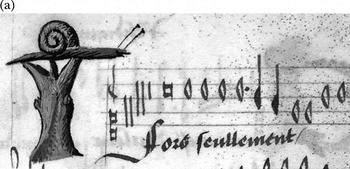
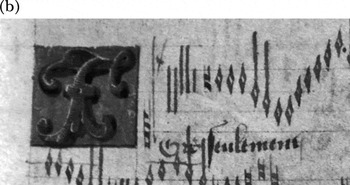
The Loire Valley chansonniers follow standard mise en page practice for three-part chansons: the superius occupies the verso of the folio (left-hand side of the opening), while the tenor and contratenor are on the recto of the following folio (right-hand side of the opening). These manuscripts specify the function for only two of the voices: the tenor and the contratenor.Footnote 14 These are the voices that on the whole are not accompanied by the poetic text, which is often indicated just by its incipit, preceded by a calligraphic or illuminated letter (‘T’ and ‘C’) followed by its respective rubric (‘enor’ and ‘ontratenor’). The superius, which has the poetic text written under the notes, has as its initial the first letter of that text. As pointed out above, the four chansonniers from the Loire Valley which have voice B as the tenor of Fors seulement all place this part in the position reserved for the tenor, at the top on the right, and with just the incipit of the poetic text (as is normal with the tenor), and write voice A at the top on the left with the complete poetic text (the norm with the superius). Two out of these four manuscripts, Wolfenbüttel and Laborde, label the tenor with the capital ‘T’, as is common.Footnote 15 However, there is something unusual here. In both cases the capital letter is not followed by the indication ‘enor’ for ‘tenor’ and then by the incipit of the poetic text, as normally occurs in these chansonniers. Both in Wolfenbüttel and Laborde the decorated initial is followed immediately by the poetic text's incipit, which in the case of Laborde lacks its correct initial letter. Whoever copied the text beneath the notes expected the miniaturist to insert a capital ‘F’ and so he wrote just ‘ors seulement’. In preparing the manuscript miniaturist and copyist were not in agreement as to who was responsible for which letter, given that in differing ways the decorated initial in the two chansonniers does not correspond to the text that follows. Thus, at the beginning of the tenor part in Wolfenbüttel we read ‘T Fors seulement’ and in Laborde ‘T Ors seulement’, as can be seen in Figure 1.Footnote 16
Opening of voice B in (a) Wolfenbüttel, fol. 44r; (b) Laborde, fol. 100r
(a)

(b)

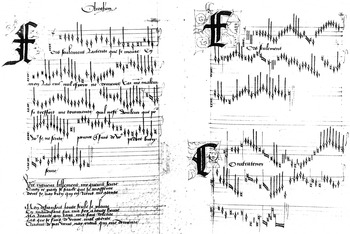
The Dijon Chansonnier presents another picture. The copyist is the same one who wrote out Fors seulement in Laborde, but by contrast with Laborde, Dijon shows no coordination problems between copyist and miniaturist.Footnote 17 In fact, in Dijon superius and tenor both have the initial ‘F’ followed by the incipit of the poetic text; the third voice has the initial ‘C’ followed by ‘ontratenor’. In this chansonnier all the rubrics correspond to their initial letters (see Figure 2).
Fors seulement in Dijon, fols. 28v–29r

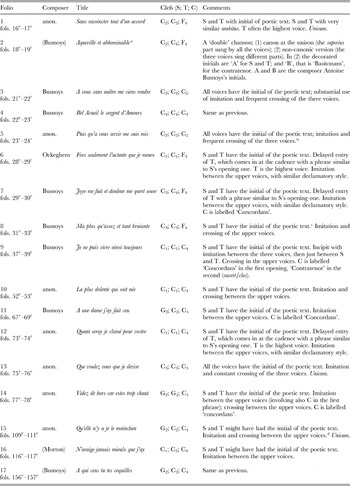
What are the possible reasons behind these deviations from the standard normally found in the manuscript tradition of three-part chansons? Why in Fors seulement has the Dijon copyist not made explicit the function of the voice written in the tenor position? After a close analysis of Dijon, I can state that the situation in Fors seulement is not some curious exception: in this manuscript there are various three-part chansons in which, as in Ockeghem's rondeau, the tenor and (sometimes also) the contratenor parts do not state the name of the voice. Table 1 lists all those cases of three-part chansons where the Dijon copyist has inserted the initial letters of the poetic text for the two upper voices or for all three. It shows how in the Dijon manuscript the copyist made coherent use of capital initial letters, and through them brought out certain compositional features of the chansons he was copying. In his edition of the manuscript Edward Barret emphasised that ‘in some chansons such as those for equal voices the copyist provided no voice names'.Footnote 18 I would add that the chansons in question also make use of imitation; in the case of Fors seulement the Dijon copyist even distinguishes by means of the initial letters which voices are most concerned with the exchange of melodic material: the two voices that are within the same range and are involved in imitation are precisely the two upper voices, those marked with the same initial.
Initial letters of poetic texts in three-part chansons in Dijon S=superius; T=tenor; C=contratenor. Where the composer's name is in parentheses, the attribution comes from another source.

a This and the two following pieces, A vous sans aultre and Je ne puis vivre ainsy tousjours, constitute the group of ‘Hacqueville Chansons’, so called because their texts conceal in various ways the name of their inspirer and dedicatee: Jacqueline d'Hacqueville. Concerning this, see P. Higgins, ‘Parisian Nobles, a Scottish Princess, and the Woman's Voice in Late Medieval Song’, Early Music History, 10 (1991), pp. 145–200.
b This chanson also occurs in Nivelle (fols. XVIv–XVIIr), where it is found copied with the same characteristics as in the Dijon version. The only notational difference is in the use of clefs: at the beginning of the penultimate system in the contratenor, where this voice reaches its lowest note, the Nivelle copyist switches temporarily from the C2 clef to the C3 clef, and then returns to the C2 clef before the end of the line.
c There has been a failure of coordination here between miniaturist and copyist: the tenor has the capital letter ‘M’, the initial of the poetic text, but written beneath the notes we find just the incipit (‘ma’). Only in the first opening of this virelai do the tenor and superius have the same initial; in the second the tenor has the label ‘Tenor’.
d The last three chansons in the table are found in that section of Dijon where the initials, whether illuminated or calligraphic, have not been inserted; consequently in the tenor the poetic text's incipit is lacking its first letter.
The mise en page typology seen in Dijon is a feature solely of this manuscript. The care and consistency with which the copyist identifies those chansons that have two high voices, or equal voices, and which use imitation between two or all three of the voices, is not something found in the other Loire Valley chansonniers.Footnote 19 A very apt example is seen in the rondeau Joye me fuit et douleur me quert seure by Antoine Busnoys (no. 7 in Table 1). The only other source among the Loire Valley chansonniers in which this chanson is found is Laborde. The copyist of the two manuscripts is the same as Dijon (at least for this part of Laborde), but in Laborde the initial letters of the upper voices are the standard ones for three-part chansons: ‘J’ for the superius, ‘T’ for the tenor (followed by the indication ‘enor’ and by the incipit of the poetic text).Footnote 20
Why was it so important for the Dijon copyist, or for readers, to have certain chansons in this manuscript such as Fors seulement, Joye me fuit and those listed in Table 1 distinguished from the other chansons for three voices by the omission of an indication of their function, in these two instances of the function of the tenor in particular? What is the copyist telling us by adopting this procedure? I would suggest that the Dijon copyist considered that these chansons were making a statement about the functions of the tenor and perhaps of the contratenor; more specifically, they interpreted the hierarchy and contrapuntal grammar of the voices in more flexible ways than those of a compositional tradition that assumed a clearer separation of vocal ranges and thus functions. So when in certain pieces the Dijon copyist does not specify the function of all or some of the voices, it is not because these functions no longer operate, but because he is aware of the different approach that they show vis-à-vis certain norms.
I shall discuss these questions further below; for now I return to Dijon and its mise en page, since it offers useful elements for a better understanding of the reasons behind the problematic transmission of Fors seulement. As the system of initial letters reveals, the copyist of this manuscript shows that he did not regard Fors seulement as an exception, but rather as a piece closely linked to a series of other compositions which in his view shared certain compositional features. It is precisely this awareness of the special character of the material he was copying that allows us to assess in a different light his decision (made also in the other Loire Valley chansonniers) to place the highest voice of Fors seulement in the tenor's position.Footnote 21 It is probable that this arrangement, rejected in later manuscripts and by some modern scholars, is not an error, nor is it the automatic repetition of an earlier erroneous text, but reveals a different understanding of the names of the voices, and consequently of their functions, in polyphonic composition.
This interpretation invites further questions, however. If this is the case, on what basis could the Dijon copyist and those of the other Loire Valley chansonniers regard the highest voice as the one best suited, if not to carry out the tenor's function, at least to occupy its place in their manuscripts? How do these manuscripts stand in relation to the composer? Is it possible that their layout could reflect a precise compositional choice on the part of Ockeghem himself? Moreover, why would Ockeghem conceive of a tenor part lying in a higher register than the superius? And finally, why was the Loire Valley chansonniers' mise en page rejected by the later sources? As I showed at the outset, in trying to find an answer to these questions, musicologists who have studied Fors seulement have – with one exception I shall consider shortly – focused almost exclusively on its music, paying little attention to its poetic text and the relationship between text, music and mise en page. Is is possible that the unusual voice disposition of Fors seulement and its troubled reception might have something to do with the characteristics of the poetic text?
Another lamenting woman
The poetic text of Ockeghem's rondeau is as follows:Footnote 22

This is a rondeau in decasyllables with the rhyme scheme aabba. The lyric voice is that of a suffering woman who calls on death because of her unhappiness in love. The alternation of long and short stanzas provides certain elements by which to clarify the reasons for this despair. Her suffering is caused by the harshness of a lover who is now absent and in whom the woman had put her trust (‘Ma leauté qui tant m'a fait dolente’); tormented by the unfeeling behaviour of her beloved, she can only grieve over her own betrayed loyalty (‘En maudisant sur ma foy a toute heure / Ma leauté …) and wait for death (‘Las, que je suis de vivre mal contente’, which echoes the first line ‘Fors seulement l'actente que je meure’).
The situation the rondeau describes is found in much other lyric poetry of the period: it suffices to glance through David Fallows's catalogue to realize how frequent laments are of unhappy lovers where a ‘woman speaks’ (his words).Footnote 23 In Western literature, the lament over loss and abandonment has been a characteristically female genre from its earliest origins. This is so not because it is solely women who experience unhappiness in love, of course, but because the long tradition of male power and culture has made abandonment and lament ‘existential conditions’, as it were, of being a woman.Footnote 24 Therefore, the theme of the woman loved and then abandoned, who waits for death as a liberation from unendurable suffering, arrives in fifteenth-century lyric poetry with a very long tradition behind it. This is the theme to which Ovid had dedicated the Heroides, a collection of poetic letters by abandoned female lovers. Here was a text which in antiquity and throughout the Middles Ages and beyond was read and used as a kind of encyclopedia of post-abandonment female trauma.Footnote 25 Through the heroines of mythology Ovid encompasses a vast case history of sorrowful situations which have abandoned women as their protagonists – for various reasons and with various outcomes. His heroines weep alone as they wait for death (Arianna), they opt for suicide (Phyllis, Dido), they wish misfortune on their faithless lover (Hypsipyle), they are bent on horrific revenge (Medea) and so on. Despite the variety of the stories and situations presented, certain topoi recur, with a few variations, in the majority of Ovid's letters. The chief ones are the loneliness of the abandoned woman, recrimination over the rupture on the man's part of the pact of fidelity which had set the seal on the once happy union of the two lovers, and the inability to find any justification for that rupture, which the woman sees not as the consequence of any wrong behaviour on her part, but as something inexplicable and due to the man's cruelty alone.Footnote 26
The text of Ockeghem's rondeau, like much contemporary literature on the theme of the abandoned woman, presents a situation comparable to that of the various Ovidian heroines in the Heroides. The unhappy lover in Fors seulement refers to an ill-directed and now accursed loyalty as being the cause of her sorrowful condition (line 11), thus implicitly alluding to a story of a love that has ended badly. As in Ovid, the protagonist sets up a fictive dialogue with the lover (in Ovid this is mediated through the device of writing a letter), but here she is in fact alone: thrice the protagonist addresses a ‘you’ who is not present (lines 4, 6, 13), given that in line 9 she declares ‘Mon desconfort toute seule je pleure’. The suffering isolates the sufferer, not because she is forced to be alone, physically abandoned in a desolate place (as is Arianna on the wild island of Naxos), but because (like Hypsipyle or Penelope, who are writing from palaces) she feels exposed to danger and surrounded by a hostile environment, and thus sundered from her own social context.Footnote 27
In Fors seulement, as in the Heroides, the protagonist's words reflect only the viewpoint of the woman. There is nothing that could refer to any reprehensible conduct on her part: in fact, common to both rondeau and the Heroides is the use of vocabulary specific to the female lament, words such as ‘foy’ and ‘leauté’ (lines 10–11) to describe the behaviour of the woman: morally, she is beyond reproach. As in Ovid, the unhappy woman-lover does not recognise the possibility that she may be in the wrong. According to the conventions of courtly love, she is incapable of wrongdoing: in order to be considered respectable, and therefore worthy to express her sorrow in the literary and social context of courtly love, the unhappy woman must be honest, that is, she must not attract the least suspicion of not having been true to her promises. One of the most important texts for the medieval love lyric, De amore by Andreas Capellanus, lays down that ‘there is nothing more shameful for a noble lady than to break promises, dash hopes and by her words deceive others. Such conduct behoves women who act like whores and in exchange for favours subvert the commands of Love, and for monetary gain bring dishonour upon his chivalry’.Footnote 28 By contrast, the man who does not hold true to his promises is treated very differently, since – this is still Capellanus writing – ‘[to deceive one's lover] is tolerated in men by custom and the privilege accorded to their sex, because of which it is in this world naturally permissible for men to do anything, even something reprehensible’.Footnote 29
All these elements, whether those shared with ancient literature on the theme of the abandoned woman or those more typical of medieval courtly poetry, are fundamental for the construction of Fors seulement as a feminine text, in which the protagonist's gender is the determining factor in how the enactment of sorrow is conducted. What is more, in this rondeau the defining of the protagonist's gender assumes special prominence, due to certain circumstances linked with the genesis of the poetic text, to which I will now turn.
The rondeau's origins
Although the Ovid of the Heroides served throughout the Western Middle Ages and beyond as one of the literary archetypes for the figure of the abandoned woman, there is one text with which Fors seulement establishes a closer link than with the classical model. As Paula Higgins has shown, the first line of the rondeau (‘Fors seulement l'actente que je meure’) is a verbatim quotation of one of the closing lines (line 182, the antepenultimate) of the Complainte by Alain Chartier (1380/90–1430).Footnote 30 This Complainte is a short poem Chartier wrote following the death of his lover, probably around the middle of the 1420s; it is one of his most popular works, judging by the thirty-seven fifteenth-century manuscripts through which it is transmitted.Footnote 31 Chartier was linked to the French royal court and consequently to numerous institutions in which Ockeghem was active a few decades after him.Footnote 32 It is significant in this context that Fors seulement is not the only Ockeghem chanson which draws on the Complainte. As Higgins has noted, the first line of the rondeau D'un aultre amer mon cuer s'abesseroit also paraphrases a line from this work: ‘Mais d'autre amer mon cuer s'abesseroit’ (line 72).Footnote 33
Moreover, Higgins has noted that in two of the Loire Valley chansonniers, Dijon and Laborde, as well as the contemporary poetic anthology P 1719, Fors seulement is coupled with Busnoys's rondeau Joye me fuit et douleur me quert seure, which is not only the lament of another abandoned woman, but is also modelled on Chartier's rondeau upon the death of his lady, Joye me fuit et Desespoir me chasse.Footnote 34 According to Higgins, the intertextual link between the rondeaux of Ockeghem and Busnoys (who was also active in French court circles between 1450 and the end of the 1460s)Footnote 35 should be seen as a further example of the mutual esteem and emulation between the two composers, beside the well-known cases of the motets In hydraulis and Ut heremita solus.Footnote 36
Since Higgins's discovery the intertextual links between Chartier's poem and Ockeghem's chanson have not been the object of further investigation, while studies on Fors seulement have concentrated above all on Ockeghem's music. As far as I am aware, only Jaap van Benthem has attempted to explain the musical peculiarities of the piece by reference to the feminine gender of the poetic voice. In his view, it is possible that the voice layout in the Loire Valley chansonniers, with the highest voice as the tenor, should be seen as the correct one, while that found in the later codices ‘obscure[s] the possible meaning of Ockeghem's notation: by its high range and cadential formulas the tenor underlines that the text expresses the feelings of a woman’.Footnote 37 Van Benthem's astute but all too brief remark raises several questions. It is of course perfectly plausible that a higher voice might be considered more suitable for expressing a woman's feelings. But why should Ockeghem have chosen to assign such feelings to the tenor rather than the superius, when it was precisely the superius that in the chansonniers of the time generally carried the text in the chansons? Moreover, there are many chansons whose text is a female lament but whose voice disposition is the common one. Within Ockeghem's secular output, there are at least four three-voice pieces in which ‘the text expresses the feelings of a woman’, to use van Benthem's words: D'ung aultre amer, Il ne m'en chault, La despourveue and Quand de vous seul. And yet, in all these songs the superius is the highest voice and the tenor the middle one. Might there be something more specific about the text of Fors seulement that could have impinged on Ockeghem's compositional choices, then? To answer this question it is now necessary to discuss in detail how the text of Ockeghem's rondeau derives from Chartier.
From the complainte to fors seulement
Chartier's Complainte is a poem of 184 lines divided into twelve stanzas of variable length, written following the death of the woman the poet loved. The text opens with an invective against Death (line 1: ‘Contre toy, Mort doloreuse et despite’), which takes up stanzas I and II, and proceeds to touch on a number of themes typical of the genre of lament, such as the impossibility of comfort (IV), the memory of the beloved's perfection (V), Fortune's cruelty towards the poet, Love who is guilty of having induced him to love and then deprived him of the love object (both VII), the poet's isolation from the world around him, from whose pleasures he no longer derives any enjoyment (X), and so on. The final two stanzas (lines 153–84) introduce certain new elements, which make them rhetorically effective as a conclusion.Footnote 38 From the indictment of death for its harshness and from the impossibility of consolation, Chartier passes here to the themes of bidding farewell to the joys of earthly life (lines 174–5: ‘Adieu, chançons que volentiers chantoye/Et joyeux diz ou je me delitoye’), and of the impatient wait for death, regarded now no longer as an enemy but as deliverer from pain, and as the only way to be reunited with the beloved in the afterlife (lines 167–8: ‘Et souhaite la mort tant seulement/Disant: “Mon cuer, porquoy ne se part y?”’; lines 182–3: ‘Fors seulement l'actente que je meure;/Et desire que briefment vieigne l'eure,/Qu'aprés ma mort en paradis la voye.’).
In addition to the incipit, the rondeau has further textual links with the Complainte. Higgins has shown that, in addition to the first verse, all the rhyme-words in -eure in Fors seulement are taken from Chartier's text: ‘meure’ (C line 182 – R line 1), ‘seure’ (C l. 177; R l. 5); (C l. ‘demeure’ (C l. 178 – R l. 2, 13), ‘pleure’ (C l. 176 – R l. 9), ‘(h)eure’ (C l. 183 – R l. 10), and the entire phrase ‘me/my queurt seure’ which ends line 177 of the Complainte and line 6 of the chanson.Footnote 39 Both the rhyme-words and the other quotations draw on the poem's last two stanzas, that is, that section of the Complainte where the poet speaks of waiting for death as comfort in his sorrow over the loss of his loved one.
Although the situation described in the two texts is in some respects analogous, the author of the rondeau is not simply offering in his new text a shorter version of Chartier's poem. There is one crucial difference: the lyric voice is now a woman's voice. This poet turned a famous and much admired text in which a man grieves into one where it is a woman who does the grieving. This shift concerns grammar and syntax, of course, but also, more significantly, a different attitude towards grief and death.
That we have here a reversal at once literal and symbolic of Chartier's text is revealed by the choice of an opening line for the rondeau: ‘Fors seulement l'actente que je meure’ is one of the Complainte's closing lines, but more than that, it is the last line in the poem that makes sense as it stands, the last that could be reused without modification as the opening line of a new text. In fact, if the intention had been to quote verbatim one of Chartier's closing lines at the beginning of a new composition, it would not have been possible to make use of the two succeeding lines, which start respectively with a conjunction and a pronoun (‘Et desire que briefment viegne l'eure,/Qu'aprés ma mort en paradis la voye’).Footnote 40 Once the choice has fallen on the only line in the Complainte's ending reusable as a beginning, the text of Fors seulement proceeds by literally going back not just to Chartier's text, but through it. This is a retrograde motion both literal and symbolic, since the rondeau's author draws on the language and imagery his model uses prior to the quoted line, and at the same time turns that language and imagery in the opposite direction, a feminine direction.
Although, as I have said, the final lines of the Complainte and Ockeghem's chanson do have a similar content, and in both poems an unhappy lover sees death as a relief from pain, in Chartier's Complainte the male ‘I’ employs a strident, almost combative tone nowhere to be found in the rondeau. As can be seen by comparing extracts from the rondeau and the Complainte, Chartier describes his physical struggle against life so that he may eventually die; on the contrary, the rondeau's woman waits for death with resignation.

In contrast with the male subject, the female one does not act: death can only reach her from outside; it cannot be something she herself achieves. While for Chartier it is life that is residing too long with the unhappy lover, for the woman in the rondeau the last remaining comfort is, rather, the hope of dying. Consequently, whereas in the Complainte verbs of action abound, the typical verbs in Fors seulement are those indicating a state: Chartier's ‘Je n'ay membre qu'a mourir ne labeure’ (line 168) becomes the rondeau's ‘Las, que je suis de vivre mal contente’ (line 15). Furthermore, a comparison of these two passages highlights the dual significance of ‘demeure’ – used as a noun in Chartier and a verb in the rondeau – which is the basis for the differing perspectives in which the two poetic ‘I's regard death and the cessation of suffering. The active stance of the man who has lost his lover is transformed into the passive position of the abandoned woman.Footnote 41
This differentiation of the rhetoric of grief emerges from other contemporary sets of texts that display a similar switch in the gender of the poetic voice. Most interesting is the case of the rondeau Comme femme desconfortée set to music by Gilles Binchois and two of its reworkings, where the opposite trajectory can be observed.Footnote 42 These are the two anonymous rondeaux entitled Comme ung homme desconforté: one reworks the text with Binchois's music (it is a unicum in the Chansonnier Cordiforme, which also contains Binchois's chanson-model),Footnote 43 the other is a parody just of the text, and can be found in the poetic anthology P 1719.Footnote 44 Like the Complainte, the two Comme ung homme desconforté rondeaux refer to pain caused by loss or by unrequited love, but not, however, to abandonment or a state of permanent suffering; they are therefore oriented towards action or the resolve to undertake action, not towards waiting, towards defiance rather than resignation. In these two versions of Comme ung homme desconforté the previously passive grief of the female figure takes on a forthright, even accusatory tone entirely lacking in the model, but instead typical of a text about male suffering such as the Complainte. Persistence in lamentation without hope is an expressive form that in Western cultures has traditionally been regarded as appropriate to women. It is therefore significant that the two Comme ung homme desconforté rondeaux originate as parodies of an earlier, feminine text. They bear witness to those changes which were culturally and ideologically necessary before they could be taken seriously as ‘laments’ uttered by men. The explicit intertextual connection serves to highlight the different rhetorical constructions of grief effected by the gender switch.Footnote 45
Such gender-based differences reflected and at the same time promoted the different roles and patterns of behaviour appropriate to women and men in late-medieval culture. This period witnessed the flourishing of an extensive debate seeking to define models of female behaviour. According to the historian Carla Casagrande, ‘it is hard to define precisely what women were doing [from the twelfth to the fifteenth centuries] that was so strange and so different from that of their counterparts of previous centuries’. She suggests, however, that the origins of this flowering of texts about and for women must be connected with social and cultural changes resulting from the process of urbanisation and the spread of a monetary economy.Footnote 46 The ‘new forms of power and culture [which] grew alongside the traditional models of lords and monks’, Casagrande continues, also resulted in changes in the lives of women. During this period texts on the subject of women had the aim of ‘constructing a feminine ethical model suitable for women living in an increasingly complex society which was arranging itself in new and different forms, and laying the foundations for structures of female care and education that were destined to last’.Footnote 47
In late-medieval Europe, then, it was necessary not merely to speak to and for women, but above all to control them.Footnote 48 Apart from the Scriptures and the Church Fathers, it was above all the writings of Aristotle, brought back to the fore by philosophers and commentators from the middle of the thirteenth century on, which provided a ‘scientific’ basis for texts about women or addressed to them in this politically, socially and culturally changed context.Footnote 49 On this point Casagrande reminds us that the Aristotelian commentators found in the Ethics and in the Politics numerous instances which assert the ‘natural’ inclination of men to command and take decisions, and of women to be submissive to that command and those decisions. The different virtues which, according to the philosopher, were proper to men (an effective and efficient use of power) and to women (the carrying out of orders) found their expression in the medieval texts’ insistence that women must practise humility, meekness and obedience.Footnote 50 The rules directed at women even went so far as to codify their body language. On this point Casagrande writes that ‘a series of rules, mostly from the monastic tradition, recommended that a woman's gestures should be neither agitated nor lively; her ultimate aim should be expressionless immobility’.Footnote 51 This gave rise to a problem if women had to move in public. In fact, the fourteenth-century Florentine intellectual Francesco da Barberino declared in his Reggimento e costumi di donna that if women go out for a walk when other people are present, they may do so ‘without looking around’ and on condition that they take ‘little steps of equal size’.Footnote 52 These texts are marking out the differences in male and female comportment, stressing the need to maintain women in a passive role, keeping them literally static – or in any case more static than men – in physical space just as in society.
In this context, it is revealing that, when telling stories of women who, for various reasons, took active roles in their lives, Giovanni Boccaccio and especially Christine de Pizan introduce them by mentioning a gender switch. In De mulieribus claris (1361–2) Boccaccio discusses Semiramis, Queen of Babylon, as a woman who, in order to rule successfully, started dressing as a man so that she might acquire an aptitude for action, supposedly typical of men.Footnote 53 Similarly, in the Livre de la Mutacion de Fortune (1403) Christine de Pizan tells of her position as a woman forced by her husband's death to take control of her own destiny.Footnote 54 At the end of the first section (lines 1159–1416) Christine recounts the events of her life allegorically: she describes how she is on a boat steered by her husband who, however, falls into the sea during a storm and drowns. The ship is now adrift, and Christine is immobilised by terror. At this point Fortune takes pity on her misfortune, endows her with a male appearance, and gives her the capacity to bring the ship under control: in order to allow her to change from being led to being a leader, Fortune turns Christine into a man.
In both Boccaccio and Pizan two women have become men out of necessity, and for this reason they have abandoned the condition of powerlessness characteristic of the gender to which they belong in order to take on the dynamism proper to their sartorially/corporeally assumed gender. This switch, real or fictional, involves a change of attire, and with this a change of habitus. Dressed as a man, Semiramis becomes a man, and as a man she fights and expands her empire;Footnote 55 the male metamorphosis allows Christine both to take the necessary step in her self-distancing from the traditional image of a widow frozen in desperation and, consequently, to abandon the expressive form of the lament, considered at that time befitting a woman in her situation.Footnote 56 Pizan's first work was in fact the Cent Ballades, which, significantly, begin with the Poemes de Veuvage, including the famous lament set by Binchois Dueil angoisseux (which again presents situations comparable to those in Fors seulement or Comme femme desconfortée).Footnote 57 The Mutacion de Fortune marks an important turning-point: fashioning herself as mistress – or perhaps I should say ‘master’ – of her own life, Christine is now in a position to justify both her attainment of a social role traditionally proper to the male and her self-distancing from feminine literary genres.Footnote 58
In the light of this context, the stance of the unhappy lover in the text of Fors seulement and her behaviour towards grief in comparison with the protagonist of Chartier's text emerge as a consequence of the fact that the poetic voice of the rondeau is female. But why fashion a female rondeau out of a male Complainte? Why spotlight the emotional changes effected by a gender switch? If the woman who waits and the man who acts are characteristic figures of Western culture, the fifteenth century witnessed the appearance of an authoritative alternative perspective on the role of women in culture and society. Notably, Pizan's works display a conscious definition of new feminine models, in contrast with the misogynistic attitude typical of writings about women in the final phase of the Middle Ages. If in the Mutacion de Fortune Christine must still become a man in order to become mistress of her own life, in her most famous text, Le Livre de la Cité des Dames (1405), she no longer describes women who become men, but on the contrary women able to act as women, going so far as to build a city, the city of women of the title.Footnote 59 Hers is a reaction against a traditionally negative view of women, as in Boccaccio's subtly misogynistic De mulieribus claris, where women who do not behave in a ‘womanly’ fashion such as Semiramis are destined for punishment.Footnote 60 In the Cité des Dames on the contrary, Pizan depicts ‘active’ women as positive models, not only turning on its head the traditional image of the woman confined to a subaltern, passive role, but at the same time putting forward a critique of the ethics of her time which wanted virtue to be a purely male prerogative.Footnote 61 To underline the distance separating it from Boccaccio and his tradition, the cornerstone of the Cité is significantly the story of Semiramis, in whom Pizan sees not the lustful harlot, but rather the ‘femme de moult grant vertu en fait de fort et vertueux courage’.Footnote 62
I would suggest that Pizan's works, which met with considerable fortune and debate over the course of the century, might help us understand some of the reasons behind the intertextual play of Fors seulement.Footnote 63 Emphatically unlike the women of La Cité, the lamenting lady of the rondeau returns to the traditionally female passive stance. The rondeau's explicit intertextual relationship with Chartier's Complainte, a famous text on male grief, serves the purpose of emphasising this rappel à l'ordre, repositioning its female poetic voice where tradition had always placed it. In a sense, this female rondeau, exhibiting its derivation from a pre-existing male text, re-enacts and reaffirms the biblical precedence – and therefore pre-eminence – of man over woman. In another sense, though, the intertextual condition of Fors seulement reaffirms the validity of traditional gender roles when it comes to grief, and thus implicitly restores the traditional gender hierarchy that Pizan's works had questioned.
The tenor: grammar and rhetoric
Did the origins and characteristic features of the text of Fors seulement, and specifically its gendered rhetoric of grief, have an impact on Ockeghem's music? And if so, how? As I have mentioned above, the Loire Valley chansonniers consider the highest voice of Fors seulement the tenor. These sources originated in a geographical and cultural context close to that in which the rondeau was composed and began to circulate: precisely for this reason, we are inclined to deem them especially trustworthy.Footnote 64 Why should copyists in the Loire Valley have considered such an unusual voice disposition in a chanson correct, never intervening to change it, for instance by positioning the voices on the page on the basis of their register, as happens instead in the later sources?
In order to answer this question, and better to understand the mise en page of Fors seulement in the Loire Valley chansonniers, it is useful to ponder the roles and functions of voices in a three-voice piece of the second half of the fifteenth century. Of particular interest here are Kevin Moll's studies of the links between the designation of voices, their traditional function, and the actual role played by them in fifteenth-century polyphony.Footnote 65 Following earlier studies, particularly those by Bernhard Meier, Moll has shown how in Franco-Flemish polyphony from Ockeghem's generation on, voice designations like superius, tenor and contratenor did not imply that one voice was bound to only one predetermined function.Footnote 66 In the initial decades of the century, the tenor was placed mostly at the bottom of the contrapuntal fabric, functioning as the referential voice for the upper parts. Later on, developments such as increased imitation encouraged a refashioning of voice functions: now such functions, in Moll's words, could be ‘objectified and parceled out among the various voice parts ad libitum’.Footnote 67 As an example of role redistribution Moll offers Busnoys's virelai Je ne puis vivre ainsi tousjours (no. 9 in Table 1) in which the contratenor becomes necessary not just because of the delayed entry of the tenor, or because it takes on the function of referential voice at the cadence (bb. 11–12), but also because its involvement is essential, given the use of pervading imitation between the three voices, especially in the first part of the chanson.Footnote 68 Furthermore, in the final cadence of Je ne puis vivre the superius assumes the tenor function (descending by one degree of the scale), while the tenor behaves like a ‘superius’ (going up one degree in bb. 26–7).
In seeking to understand the relationship between a voice's name, its role, its function and its position on the page, I wonder whether there may be factors beyond those suggested by the contrapuntal grammar which might help to define all these aspects. In other words, what is it exactly that makes a tenor the tenor in chansons from the second half of the fifteenth century? That is to say, what constitutes the ‘discourse’ of the tenor at the time of Fors seulement? And what do music theory and compositional practice of the time contribute to this discourse? I propose that we look beyond grammar, taking into consideration the rhetorical aspects of the discourse of the tenor.
As to the definition of the tenor's role in polyphonic composition, there is a long theoretical tradition traceable back to the very beginnings of polyphony. We can quote Johannes Grocheo, for instance, who wrote at the start of the fourteenth century that ‘the tenor is that part upon which all the others are based, like the parts of a house or a building upon their foundations’.Footnote 69 Closer to Fors seulement, this is echoed by Tinctoris in his music dictionary written for Beatrice of Aragon in the 1470s, where he states that ‘the tenor is the fundamentum relationis of a polyphonic composition’.Footnote 70 When Tinctoris was working on his Diffinitorium, however, the relationship between voice functions and designation in composition was more flexible, as I showed earlier. It is therefore significant that he reaffirms the pre-eminence of the tenor, even if its function could also have been given to other voices.
There is another passage in Tinctoris which helps us better to understand his theoretical position on the tenor's role in polyphony. In Book III, chapter 4 of the Proportionale musices, when discussing where the signs of proportion should be written, Tinctoris states that these should be marked in the voice or voices that are affected by proportions. He defines the voice in integer valor as ‘primaria’.Footnote 71 There follows a musical example for three voices in which the tenor, written in integer valor, is the lowest voice, while the superius and the contratenor are subject to proportions (O 3/1 and O 2/1 respectively). Straight after this we read that ‘the primary voice of the whole piece is the fundamentum relationis; this voice is made first and is considered by the other ones as the principal one. Most frequently, albeit not always, this is the tenor, so called as if it “held” the other voices in subjection to itself.’Footnote 72 Tinctoris is here referring to polyphonic composition understood as the successive adding of voices, a defining principle of pieces on a cantus prius factus (whether newly composed or drawn from the liturgical or secular repertory) right from the dawn of polyphony. Yet his observations do introduce a new point of some interest: the part ‘made first’ is ‘most frequently, albeit not always’ the tenor. In this way the theorist is telling us that the tenor is not always the voice ‘considered by the others as the principal one’. The passages that follow make this clearer still. The theorist speaks of cases where the part made first, which is therefore the ‘principal’ one, is not the tenor but is indeed the superius or the contratenor, and he gives two examples. In the first of these a tenor and a contratenor are added to the superius of the chanson Pour vous belle, and in the second a tenor and a superius are added to the contratenor of the rondeau attributed to Dufay, Le serviteur.
These passages from Tinctoris are evidence, then, that in the second half of the fifteenth century the tenor's discourse underwent an extension compared to earlier periods (Grocheo's, for instance). The tenor's hierarchical importance is understood by Tinctoris to be a feature of this part for the additional reason that it is the customary host voice for the cantus prius factus (a circumstance which could, if the need arose, cause the superius, or even indeed the contratenor, to be promoted to the rank of ‘pars primaria’). Even if in the second half of the fifteenth century the integration of parts in polyphonic music allowed a renegotiation of the functions of individual voices within pieces, it was the frequent presence in the tenor of an element ‘made first’ – whether a liturgical melody or one part from a polyphonic chanson – that was the basis for the confirmation of this voice's pre-eminence. As we have seen, even when in the second half of the fifteenth century the tenor function could contrapuntally speaking be given to other parts, the dignity of ‘fundamentum’ or principal part was nonetheless guaranteed to the tenor by virtue of its privileged rapport with the cantus firmus.
If we move from theory to compositional practice, for instance the masses and motets on a cantus firmus from the middle of the fifteenth century on, we observe not only that for the most part the tenor is the voice hosting the pre-existing material, but also that in these pieces the tenor cannot always fulfil the role of ‘fundamentum’, at least not in the traditional sense of the term. To take a representative example, I shall consider briefly the Missa Caput, generally regarded as the model for the cantus-firmus mass throughout the fifteenth century. As is well known, in the Kyrie of this mass the cantus firmus in the tenor primus enters after a long duet of twenty-one breves between the superius (not named as such) and the contratenor, following the resolution of a strong cadence.Footnote 73 Reinhard Strohm has related this presentational procedure to that of the mid-century ‘isorhythmic’ motets: the entry of the tenor after an introductory duet emphasises the difference between the sections where the cantus firmus is present and those where it is not.Footnote 74 This contrast between passages of reduced scoring without the cantus firmus and the ‘tutti’ which include the cantus firmus does indeed throw into relief the entry of the tenor; at the same time, though, it is responsible for a feature Moll describes, namely the relocation of the tenor function to other voices. In fact, in the introductory duets, when the tenor is silent, its function is taken on by another voice.Footnote 75 This does not so much mean that the tenor is downgraded from its status as principal voice; rather, its centrality is understood in a different way: here the tenor is heard as the ‘fundamentum’ for reasons that do not necessarily coincide with its contrapuntal function. What gives the tenor its pre-eminence, then, is the emphatic manner of its entry into the polyphonic complex, together with the way it is treated within the composition (generally with longer note values than those of the ‘free’ voices): the basis of the tenor's importance is not only its grammar, but also its rhetoric.
In the light of these considerations, the high tenor of Fors seulement in the Loire Valley chansonniers seems no longer an oddity or a mistake, but emerges instead as a potential example of the refashioning of voice functions described by Moll and of the discrepancy between the tenor's grammar and rhetoric just discussed. Because of the way it is introduced, this tenor makes its entrance as the tenor of the rondeau; yet because of its high register it is a tenor that appears dislocated from its usual range, in melodic territory that would normally belong to the superius.Footnote 76 With Fors seulement Ockeghem is therefore rethinking standard compositional patterns. There are other examples of such rethinking from the second half of the fifteenth century, such as the chansons in Dijon discussed above. Even so, Ockeghem's is a more radical intervention, since it involves the entire composition, not just portions of it; to the best of my knowledge, there is nothing comparable to Fors seulement in chansons of the time.Footnote 77 The distinctive feature of this rondeau, which makes it a singular case among similar compositions, and which gave rise to the problems in transmission that we have examined, is, then, precisely the surprising degree of disconnection between the tenor's rhetoric and its grammar.
A feminised tenor?
At this point we must ask why in Fors seulement Ockeghem would have deliberately subverted the traditional order of voice designation and function, and perhaps also of the positioning of voices on the page, by envisaging such an unusual tenor voice. My suggestion, by now obvious I hope, is that the answer to this question will emerge from an examination of both the music and the text, and especially of its origins and intertextual play.
Put simply, I want to argue that the gender switch that takes place in the text of Fors seulement is reflected in Ockeghem's music. As the change from the male poetic voice of Chartier's Complainte to the female one of the rondeau had demanded a different rhetoric of grief, when setting this text to music Ockeghem modified the traditional hierarchy and functions of the voices. Rather than taking a pre-existing ‘male’ piece and changing it, he altered a prevailing compositional feature of three-voice chansons of the time, moving the tenor to a high register and making it more like a superius than a standard tenor. The tenor of Fors seulement takes on the melodic weight of the chanson, since its phrases are spun out like those of a superius, and assumes a role that traditionally does not belong to it. The highest voice of Fors seulement thus combines characteristic features of both the tenor and the superius.
However, the fact that this tenor sounds like a superius does not mean that it has renounced its ‘tenor-ness’ entirely. On the contrary, Ockeghem compensated for the fact that this voice resides in the superius range by emphasising other features that promote its continuing identification as the tenor of the rondeau. To this end the composer chose not to model the ‘tenor-ness’ of this high voice on the tenors of other chansons: traditionally, in fact, the tenor's discourse in this type of composition did not insist on the pre-eminence of this voice. As a point of reference for his rondeau Ockeghem took instead the tenors of contemporary masses and motets, where, on the contrary, the tenor's discourse focuses on the role of this voice as a foundation, and on emphasising this role.Footnote 78 Most obviously, in Fors seulement he introduced the tenor in a spectacular fashion, almost as if it were the cantus firmus of a mass or motet, having it enter last, after the preparatory duet and strong cadence. As in cantus-firmus masses or motets of the time, in Fors seulement the tenor is enshrined by the ‘outer’ voices, and therefore framed as the ‘fundamentum relationis’, the most important part of the composition, which is of course the typical role of the tenor. Having modified the contrapuntal grammar of the tenor, Ockeghem counters this change with an emphatic display of its contrapuntal rhetoric.
I would suggest that this distinctive trait of the music of the rondeau can be interpreted in the light of the intertextual origin of its words, and specifically the gender switch of its poetic voice. As the female text of Fors seulement explicitly displays its intertextual relation with Chartier's male one, the song's highest voice, fusing typical features of both superius and tenor, reminds its listeners and readers that it is also the result of a transformation: it is a tenor, but dislocated. While the tenor acquires some traits of the superius, it also carefully spotlights its ‘tenor-ness’. In this way, the feminisation that has taken place is vividly foregrounded. In Fors seulement, then, we witness a double process of feminisation, textual and musical: the musical voice of the song, just like its poetic one, becomes feminine under our very eyes – and ears.
The mise en page of this song in the Loire Vallley chansonniers suggests awareness of this double process.Footnote 79 The high register of the tenor of Fors seulement would make this voice more appropriate for the function of superius, and yet no Loire Valley chansonnier changed its position on the page, nor did it place the text underneath it – not even the Dijon copyist, who was so attentive to the compositional features of the repertory of his manuscript. This shows that the copyists of these manuscripts did not consider the two upper voices of Fors seulement as a duet between two superius parts: even when they did not assign names to these voices (as in Dijon), they always place the uppermost voice in the tenor's slot.Footnote 80 For these early and authoritative sources this chanson's highest voice still looked and sounded closer to a proper tenor than to a superius – a feminised tenor, but still a tenor.
Proof of the fact that the composer himself regarded this high voice as the tenor of his chanson is to be found in two of his other works. Ockeghem borrowed the tenor of Fors seulement in the rondeau Fors seulement contre ce qu'ay promys. In the new chanson this voice lacks the initial rests, is transposed down a twelfth, and is called ‘contratenor’. The most important voice of the original composition is thus transformed into its opposite: from tenor to contra-tenor. What is of interest here, however, is that this transformation throws light on the function of this voice in its initial context: it is only because it is considered as the tenor of Fors seulement that its reversal into its symbolic as well as literal opposite in Fors seulement contre ce qu'ay promys acquires meaning. What is more, when Ockeghem reworked Fors seulement in the form of a five-voice mass, the tenor's arrival at the beginning of Kyrie I and II remains identical with that in the two sections of the chanson model: an introduction with reduced scoring and a strong cadence at the resolution of which the tenor comes in. The only difference is that in the mass the tenor returns to its normal register (it is an octave lower than in the chanson): apart from anything else, now that the poetic text is no longer involved, a dislocation away from its normal range would lack its rationale.Footnote 81
Once removed from the immediate geographical and cultural milieu of the poet, presumably, and certainly of the composer, the gendering of the tenor voice in Fors seulement might have stopped making sense, as the mise en page of the later manuscripts implies: in two of them the original poetic text is not even present, reduced to either its original incipit (in the Gesangbuch) or to a new one in Spanish (in Cappella Giulia).Footnote 82 This loss of meaning could explain why in all later manuscripts the upper voices were reshuffled on the page according to their actual range: their placement was normalised, with the tenor slot assigned to the intermediate voice.
And yet, the partial ‘tenor-ness’ of the original evidently troubled a few later copyists. The one responsible for the Chansonnier de Lorraine, for example, shifted it to the superius position, yet at the same time he did not remove the poetic text from what had become his tenor, almost as if he realised that this had originally been a superius.Footnote 83 More surprising still is the evidence of the last manuscript source for Fors seulement. In his Gesangbuch, dating from around 1515, the Sankt Gallen organist Fridolin Sicher did invert the two upper voices, putting the original superius in the tenor place. Yet, as Christina Urchueguía has noted, he indicated this voice with the capital ‘D’ for ‘discantus’ instead of a capital ‘T’ for ‘tenor’.Footnote 84 Evidently Sicher, a professional musician whose codex assembles the largest number of pieces based on Fors seulement, was not completely persuaded that this ‘middle’ voice was the tenor of the rondeau.Footnote 85
It was not just contemporary copyists who were troubled about the classification of the highest voice in Fors seulement. In more recent times both Gombosi and Strohm, in differing ways and with differing aims, in the end took the view that this voice, if not the ‘true’ tenor of the piece, was at least its ‘cantus firmus’. Gombosi in fact believed it was a pre-existing voice, borrowed from another composer, defining it as a probable ‘Lehngut’;Footnote 86 Strohm, in classifying the rondeau from a modal perspective, found instead that its most surprising feature was its ‘cantus firmus in the highest octave’.Footnote 87 In this sense there is no denying that the spectacular rhetoric of the tenor that Ockeghem deployed in his chanson has achieved at least some of the effect he hoped for.
Fors seulement in context
As we have seen, apart from Fors seulement, the Loire Valley chansonniers (Dijon especially) provide other cases where the traditional voice hierarchy is adapted (see Table 1). Among these the example of Joye me fuit is of particular interest for us. As I showed above, the texts of the two rondeaux are a feminine transformation of two texts by Chartier about male suffering; furthermore, these two pieces are transmitted as a pair in a number of manuscripts, both musical and literary, almost as if one text were replying to the other.Footnote 88 They also share certain similar musical features: delayed entry of the tenor preceded by a preparatory duet between superius and contratenor, passages with voice crossings, and imitation.Footnote 89 This is not of course the only example of a close link between pieces by Ockeghem and Busnoys (I mentioned earlier the motets In hydraulis and Ut heremita solus). Nonetheless the Fors seulement–Joye me fuit pair afford the opportunity for some further observations on the possible context of the genesis of the two pieces and on their significance.
If we compare Fors seulement with the rest of Ockeghem's secular output, it is noteworthy that stylistically this rondeau has little in common with the composer's other chansons, but it does, however, share many characteristics with those of Busnoys.Footnote 90 Table 1 shows that the composer most represented among the pieces in Dijon with two or three equal initials is indeed Busnoys (eight out of a total of seventeen): he is the composer who most frequently uses voices in similar registers and/or with pervading imitation, as is confirmed by the system of initials in this manuscript.Footnote 91 Strohm has stressed, significantly, that among the composers of his generation Busnoys is the one who, thanks to his frequent use of imitation, occasionally ‘abolish[s] the hierarchy of the voices in the three-part chanson’.Footnote 92 Apropos of this he further notes that Je ne puis vivre ainsi tousjours (one of Busnoys's pieces for Jacqueline d'Hacqueville) has, like Fors seulement, ‘the tenor in cantus position’ (it is transmitted in Dijon with the same initials for the two upper voices; see Table 1, no. 9).Footnote 93 Higgins has further highlighted not only how Busnoys, probably more than others of his time, was a composer ‘obsessively preoccupied with transgressing accepted boundaries … and flouting accepted rules and practices when it suited musical expression’, but also that this kind of creativity was displayed especially in the ‘d'Hacqueville chansons’, perhaps precisely because these were connected with a female subject.Footnote 94
Both Fors seulement and Joye me fuit call into question the traditional hierarchy of the voices in three-part chansons; in both the transformation of a male lament into a female one is accompanied by an intonation in which the tenor's function as the fundamentum relationis is renegotiated in new ways compared with those encompassed by traditional compositional practice, as is indicated by the use of the same initials for superius and tenor in Dijon. In view of the connection between Ockeghem and Busnoys, it seems likely that Fors seulement and Joye me fuit, both settings of texts derived from Chartier, were written as a kind of competition, in which, however, the younger composer was the model for the older one. My hypothesis, then, is that in view of the stylistic features listed above Fors seulement may be Ockeghem's reply to Busnoys's rondeau, and not vice versa – a reply in which Ockeghem displays an even more drastic use of those compositional devices typical of his colleague. In his experimental feminisation, textual and musical, of Chartier, Ockeghem in fact reaches levels of theatricality not found in Joye me fuit. From this point of view it is to be expected that Joye me fuit did not cause problems of transmission or of voice layout and designation comparable to those of Fors seulement; indeed, as I have already shown, when the Dijon copyist transcribed it in Laborde, he inserted it in the manner of a ‘standard’ chanson, without any mishaps involving illuminated initials and rubrics.Footnote 95
Because of their transmission, the origin of the texts they set, and above all because of the way their composers set them, Fors seulement and Joye me fuit may be seen as the fruit of a poetico-musical encounter between Busnoys and Ockeghem, played out in terms of their contrasting adaptations of two texts by Chartier, a poet held in great regard at the time in the milieux where these musicians operated. We know that poetic and poetico-musical competitions were common forms of social entertainment among the ruling classes of fifteenth-century France. We have evidence of this both in narrative literature of the time and in poetic manuscripts, which constitute a kind of written record of these pastimes: it is possible that these two rondeaux had their origin in this kind of context.Footnote 96
There is one other aspect raised by the analysis of Fors seulement, however, on which, in conclusion, I want to concentrate my attention. Fors seulement and Joye me fuit, together with some of the chansons in Table 1, and others in the Loire Valley chansonniers and other manuscripts of the time, distance themselves to varying degrees from the traditional hierarchy of the voices in polyphonic composition. Many of these cases involve a woman: some, such as the rondeau La plus dolente que soit neé (Table 1, no. 10), showcase a lamenting woman, as in Fors seulement and Joye me fuit; another example, Busnoys's virelai Je ne puis vivre ainsi tousjours (no. 9), features in the ouvert/clos both a reference to the ‘noble femme’ addressed in the text, and a male subject who weeps desperately, and therefore in typically feminine fashion (‘Des ieulx pleurant a chauldes larmes/Affin qu'ayés de moy merchy’).Footnote 97 The female voice, or the presence of the woman and the feminisation of a male subject, cause in both these cases, as in Fors seulement or Joye me fuit, an upward displacement of the tenor, which at times becomes the highest voice; in Je ne puis vivre this results in discrepancies in the sources as to the mise en page similar to those analysed in the case of Ockeghem's rondeau.Footnote 98
Something analogous also occurs in other chansons where the female subject is either not the only person to speak, or is not even present, being merely the addressee of a male discourse. This is the situation in, for example, Puis qu'a vous servir me suis mis (Table 1, no. 5), Ne me veilles ma chiere dame (Laborde, fols. 23v–25r), Ne pour cela que esloigner me fouldra (Laborde, fols. 40v–42r), in which the male talks to his beloved who is present but silent, and in Quant seray je clamé pur vostre (Table 1, no. 12), which is a dialogue between the male lover and his beloved. In these chansons the position of the woman is highlighted through the use of certain musical strategies and/or by the mise en page, and all of them present situations which to varying degrees recall the one analysed in Fors seulement. For example, in Quant seray je clamé the tenor, except for a few short passages, is the highest voice in the rondeau (in Dijon it lacks the poetic text) and it comes in only after an introductory duet between superius and contratenor very like the one in Fors seulement. When it makes its delayed entry, the tenor ‘replies’ to the plea of the superius: in this way the music mimics the dialogue in the text between lover and beloved; moreover, it is the tenor which, in a register higher than the superius, is identified with the voice of the woman ‘replying’ to the man-superius, who in the text is the first one to speak. Owing to the displacement of the tenor outside its customary register, as in Fors seulement, the two sources for Quant seray je clamé disagree on the positioning of the two upper voices: in Dijon the highest voice is located in the tenor's position, whereas in the manuscript Bologna Q16, in which it is no accident that the text is missing, this voice occupies instead the place for the superius.Footnote 99
In Puis qu'a vous servir me suis mis (Table 1, no. 5) there is frequent crossing between the parts, and the rondeau finishes with the superius in the lowest position of all, while the tenor is an octave higher, at a point where in the text the lover says to his beloved ‘ainsy que je m'y suis submis’. The act of submission in the text is conveyed musically through the submission of the superius (the voice with the poetic text) in respect of the other two voices, the tenor being in the highest position, symbolically the dominant position, just like the woman to whom the lover is making the gesture of submission.
In the Laborde virelai Ne me veilles ma chiere dame (an unicum) the text is a speech by a man to the lady. The poetic text is written underneath both the upper voices. The tenor is the highest voice (it always has the G2 clef) and there is frequent crossing with the superius, but at the final fermata (this chanson does not finish with a formal clausula) it is a sixth above the superius, whereas at the cadence at the end of the ouvert/clos it is in unison with it, though it has an ascending movement. As with Fors seulement the presence of a voice that is higher than usual has given rise to some perplexity as to the mise en page. On fol. 24r the tenor has ‘T e me veilles’, i.e. it has the illuminated initial ‘T’, which obviously is not what the copyist intended. The same thing is found at the ouvert/clos (fols. 24v–25r), where the tenor (fol. 25) through the same failure of coordination has ‘T ung dolente faictez’ instead of the correct ‘D ung dolente faictez’; two female figures are painted in the ‘T’ of fol. 25r.
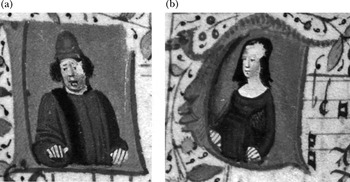
Finally, in the Laborde virelai Ne pur cela (also an unicum) we find what is perhaps the most intriguing case of all: throughout the stanza the tenor has the poetic text beneath the notes and it often crosses with the superius, so much so that in many passages it is the highest voice (it is significant that the clefs are C1 for the superius, C1/G2 for the tenor). This poetic text, like the preceding one, is also a speech addressed by a man to a woman: the historiated initial letter of the tenor in the first opening depicts a man and a woman perhaps engaged in a dialogue, seated facing one another (fol. 41r).Footnote 100 In the ouvert/clos, in the ‘L’ of the superius (fol. 41v; this is the initial letter of ‘Las que pourra faire mon pauvre oeil’) the man alone is depicted, turned towards the reader with his mouth open (clearly he is singing to the reader: see Figure 3a); while in the ‘T’ of the tenor (fol. 42r) a woman is shown with her gaze directed towards the man and her mouth closed, listening to what he is singing (see Figure 3b). At this point, where the tenor has an image of the lady with her mouth closed, the tenor is higher than the superius, and, significantly, it does not have the poetic text but just its incipit: also in this case the listening lady is made present through the interaction of music, image and mise en page.Footnote 101
(a) Laborde, fol. 41v; (b) Laborde, fol. 42r

Seen in relation to all these pieces from the Loire Valley chansonniers and other manuscripts linked to them (for instance the Mellon Chansonnier), Fors seulemnt is not a unique case: rather, it is one of a group of chansons whose composers intervene, to different extents and with different results, in the function of the voices, in their designation and perhaps also in their mise en page. These chansons help us to understand the stylistic and ideological context in which Ockeghem was operating, a context in which it was possible to intervene in standard compositional patterns in order to give voice to a gendered perspective. Yet they also help us to understand how exceptional Fors seulement is in this very context. Compared with the other pieces, Fors seulement emerges as a particularly bold and radical intervention in the area of voice function in polyphony. It is in this rondeau that the tenor's rhetoric is spectacularised, so to speak, and dislocated from its grammar for the entire duration of the piece, not just for part of it. As a consequence (and also because of the intertextual play with Chartier in the poetic text) there is no other case in which the female presence has such a profound effect on voice function and designation, and on the transmission of the musical text, as it does in this rondeau.Footnote 102
Gendering conventions
In conclusion, I would argue that Ockeghem's manipulation of contrapuntal conventions in order to give a musical voice to the female subject of the text of Fors seulement suggests not only the significant degree of flexibility with which such conventions could be approached by late-fifteenth-century composers, but also, and more interestingly, the gendered lens through which these conventions could be viewed. As the result of a long compositional and didactic tradition of counterpoint exclusively reserved to men, such conventions could themselves be assigned a gendered identity.Footnote 103 This identity, however, emerges as such only when it is manipulated: it is only Ockeghem's attempt to express a female perspective through a partial subversion of traditional contrapuntal behaviour that constructs such behaviour as male.
In the light of this conclusion, I would like to go back one last time to the case of Fors seulement, and call attention to the fact that the text and the music of the rondeau work in remarkably different ways in this respect. On the one hand, the rich cultural tradition to which the text of Fors seulement belongs already encompasses a typically feminine stance when it comes to grieving over the loss of a lover, of which the intertextual play makes full use in order to restore the standard gender hierarchy: in this sense, there is no manipulation of traditional conventions in the anonymous poet's interventions in Chartier's Complainte; on the contrary, conventions, literary as well as ideological, are reaffirmed. On the other hand, the same cannot be said of the musical tradition of three-voice chansons in the fifteenth century: there is no widely recognised feminine musical stance, not only for grieving, but for pretty much any human behaviour or feeling. Each time a composer wants to give musical voice to a woman, this composer must explore new ways of changing certain parameters, of intervening in certain aspects, of subverting conventional behaviours and expectations. When it comes to music – and, in the case of Fors seulement, almost against its text – the female perspective proves itself to be a force for change, and an opportunity to explore new positions and viewpoints, not just with regard to contrapuntal functions, but also to human behaviour and identity.