The first Spanish expedition to the Atures Rapids in 1584 described the islands as a “center of commerce” (Ojer Reference Ojer1966:52) where Indigenous groups from the Guianas, Llanos, and Amazonia gathered to trade (Zucchi and Gassón Reference Zucchi and Gassón2002:68). The strategic location of the Atures Rapids (hereafter, the Rapids) contributed to their prominence as a trading spot: they are the first natural barrier to navigation upriver, making them a mandatory stop. The Rapids have a rich fishing stock on a year-round basis, an important feature in a region in which fish are a key protein resource (Tapia Reference Tapia and del Rey Fajardo1966 [1715]:204–205). By the mid-sixteenth century, the exchanges described by Europeans were part of a transatlantic economy that included the trade of gunpowder, metal axes, knives, weapons, and poitos (Indigenous slaves; Perera Reference Perera2000:389). Given these circumstances and the limited archaeological fieldwork in the region, this article evaluates to what extent the Rapids were a center of production and a key place for the exchange of goods before the conquest.
Early written sources described a cultural mosaic in the Middle Orinoco area at the time of European contact (AD 1531–1585). Multiple Indigenous ethnolinguistic groups lived along the Orinoco between the Cuchivero River's mouth and the confluence of the Atabapo and Orinoco Rivers, including speakers of Arawak, Carib, Saliva, and independent languages (Aikenvald Reference Aikenvald2012:50–59; see Figure 1). The Adoles (or Atures) group lived on the Orinoco riverbank and islands, from the Apure River's mouth to the Rapids themselves (Rivero Reference Rivero1956 [1736]:42–43). After the first European expeditions, from the AD 1690s through around 1800, the distribution and composition of these ethnic communities were substantially affected by epidemics, slave raids (Morey Reference Morey1979), the establishment of Jesuit missions, and other expeditions seeking the fabled El Dorado riches (Useche Losada Reference Useche Losada1987). Some groups were forced to relocate to mission settlements, and others abandoned settled life for a mobile existence (Rey Fajardo Reference Rey Fajardo2007). The importance of the Rapids during the late seventeenth to eighteenth centuries is indicated by the founding of three mission towns in this area (Perera Reference Perera2003:189; Useche Losada Reference Useche Losada1987:62).
Map with the distribution of Indigenous groups and linguistic families in the Middle Orinoco for the sixteenth to early eighteenth centuries (Lozada-Mendieta Reference Lozada-Mendieta2020).

Long-distance exchange networks existed between multiple Indigenous groups of the Rapids and those in the Llanos, the northern Andes, the Guianas, and Trinidad (Arellano Reference Arellano Moreno1982:138). According to Morey (Reference Morey1975:556; Morey and Morey Reference Morey and Morey1975), a complex system of interaction involving marriage alliances, warfare, and trade existed, spurred by a desire for access to resources from different ecological settings, as well as to specialized manufactured goods (sensu Gregory Reference Gregory2015:1x–1xi, 20–21). Exchange was based on principles of reciprocity and complementarity (Perera Reference Perera2000:383), likely reflecting gift giving rather than a commodity economy (Gregory Reference Gregory2015:13). Arvelo-Jiménez and Biord (Reference Arvelo-Jiménez, Biord and Roosevelt1994) proposed that trading occurred among small, dispersed, and heterarchically organized groups from different ecological areas. This exchange strengthened political relations and reduced conflict over limited resources (Arvelo-Jiménez et al. Reference Arvelo-Jiménez, Morales Méndez and Castillo1989:150). Among the traded items were salt, clay, fish, turtle oil, canoes, hammocks, pottery, beads, curare, caraña (Euphorbia adinophylla), hunting dogs, and corí (Cavia sp.; Morey and Morey Reference Morey and Morey1975:332).
Although this model may accurately describe postcontact economic relations, it might not be applicable to precolonial times. The exchange networks documented in ethnohistoric records, when compared to archaeological reconstructions, do not follow the posited model by providing evidence for non-egalitarian and politically centralized societies, in which elites controlled the redistribution of agricultural surplus (i.e., staple finance) and the acquisition of prestige goods (i.e., prestige finance; Earle Reference Earle, Ericson and Earle1982; Gassón Reference Gassón2000:585–586, Reference Gassón, Gnecco and Langebaek2014:27–35; Johnson and Earle Reference Johnson and Earle2000:257–258). Indeed, hierarchical polities existed in the early years of contact between Spanish and Indigenous groups, such as the Caquetío (Arawak) in the Cojedes Llanos (Federman Reference Federman and Friede1958 [1557]). Thus, the initial model overemphasizes the egalitarian ethos of the economic exchange system, neglecting to consider the use of surpluses to reinforce political links between dissimilarly organized sociopolitical groups (Gassón Reference Gassón, Gnecco and Langebaek2014:25–27).
Historic and archaeological evidence throughout and beyond the Orinoco Basin has revealed the exchange of a wide range of prestige goods (e.g., green stones, tumbaga) of which quiripas or freshwater shell beads are notable (Boomert Reference Boomert1987; Scaramelli and Tarble de Scaramelli Reference Scaramelli, de Scaramelli, Funari and Senatore2015). Chiefly elites wore quiripas around their necks and arms as symbols of wealth and power (Gassón Reference Gassón2000:595, citing Fray Jacinto de Carvajal's 1648 text, Relación del descubrimiento del Río Apure). The beads were likely manufactured by specialists and traded mostly among hierarchical groups such as the Caquetío, Achagua, and Otomaco (Alvarado Reference Alvarado and Fajardo1966 [1767]:314–319). Quiripas are suggested to have functioned as a proto-currency with a standard exchange value, later adopted by the Spaniards (Briceño Iragorry Reference Briceño-Iragorry1928). However, their symbolic and exchange values before European colonization likely differed from that after the conquest, especially after glass beads (mostacillas) were introduced as currency (Gassón Reference Gassón, Cardenas-Arroyo and Langebaek1996:143, Reference Gassón2000:598). Other exotic items such as ceremonial pots, smoking pipes, and censers have been connected to funerary offerings and shamanic practices in the Lower Orinoco-Trinidad region (Boomert Reference Boomert2000:442–444), reflecting exchange circuits that did not necessarily involve the same groups or were not driven by ecological interdependence. Although the ethnohistorical record provides valuable insights into the extent and nature of Indigenous exchange, the time depth and characteristics of precolumbian trade practices remain obscure; a comparison with the archaeological data should improve our understanding of this trade.
Traces of Trade and Exchange in the Archaeological Record
Trade involves the interchange of material goods (Gregory Reference Gregory2015:1x–1xi, 20–21). In contrast, exchange refers to any form of interaction between individuals or social groups that involves the transfer of ideas and objects from one to another (Oka and Kusimba Reference Oka and Kusimba2008:339). This key difference derives from the distinction between commodity and gift-exchange economies. A commodity economy trades “socially desirable thing[s] with a use-value and an exchange value” (Gregory Reference Gregory2015:4, 7) where the things traded are alienable. By contrast, a gift economy entails an “exchange of inalienable things between persons who are in a state of reciprocal dependence” (Gregory Reference Gregory2015:13). Value in a gift economy is vested in people and in the network of social relations, and not in the things exchanged.
Trade is revealed through regular patterns, which are evidenced by the continued presence of nonlocal items in archaeological assemblages. However, in nonindustrialized societies it is difficult to differentiate between the two types of economies, because exchanges can be made both to cement social relations and to mobilize circumscribed resources under the control of political elites or centers (Hodder Reference Hodder, Ericson and Earle1982:200). The distinction between the two economies is based on the identification of the source and distribution of certain materials and the strength of the inferences that archaeologists can propose regarding the value and motivations underpinning transactions. Thus, one may ask whether an object was exchanged for its subsistence or prestige value and whether it was esteemed for its material properties, craftsmanship, symbolic character, or utility. One should also ask whether the use-meaning value was maintained or altered once the item changed hands (Dillian and White Reference Dillian, White, Dillian and White2010:10–11).
Archaeological evidence of trade in the Middle Orinoco region is provided primarily by the presence of rare pottery groups, beads, and roller stamps. Early written sources mention ceramic vessels as items of exchange; for example, pots that contained turtle oil made by the Otomaco were widely traded (Zucchi and Gassón Reference Zucchi and Gassón2002:70). However, archaeological evidence of imported trade pottery has been difficult to ascertain and define; the characterization of pottery relies principally on its scarcity and diagnostic temper differences (Lozada-Mendieta Reference Lozada-Mendieta2020:43–52).
Since the first excavations in the Middle Orinoco (Howard Reference Howard1943), the occupation sequence has remained subject to dispute because of the co-occurrence of multiple ceramic styles in common stratigraphic contexts throughout various periods (Boomert Reference Boomert2000:104; Lozada-Mendieta et al. Reference Lozada-Mendieta, Oliver and Riris2016). At the Ronquín site, where Howard (Reference Howard1943) first defined the region´s main ceramic groups, a minority “Z” ceramic group was interpreted to be a trade ware. Later, at the Corozal site, Roosevelt (Reference Roosevelt1990) interpreted various minority wares as products of interactions that resulted in the hybridization of different tempering ingredients and decorative techniques. This phenomenon was further explored by Zucchi and colleagues (Reference Zucchi, Tarble and Eduardo Vaz1984) at the Agüerito site, where the existence of a multiethnic community was suggested to explain the co-occurrence of different wares with similar vessel forms and mixed decorative techniques. The identification of local and exogenous pottery styles is therefore problematic in the study area, and these styles cannot confidently be associated with trade transactions.
Ceramic roller stamps have also been used as proxies for trade. They are portable, have a restricted distribution in late Arauquinoid sites, and bear stylistic similarities, suggesting a common origin (Tarble and Vaz Reference Tarble and Eduardo Vaz1986–1987:2). Roller stamps were almost certainly used for body painting or textile imprinting. They are found in archaeological sites from the Caura–Orinoco River confluence to the westernmost Llanos of Barinas (Novoa et al. Reference Novoa, Andueza, Tapia and Rodríguez1981:Figures 15, 17, 18; Zucchi Reference Zucchi1975:Figure 17). This distribution could be linked either to shared stylistic norms or the exchange of the stamps throughout this region. Although there is no ethnohistoric mention of the roller stamp trade, there are descriptions of stamped body painting used to mark identity, status, ethnic frontiers, and symbolic affiliations (Chaffanjon Reference Chaffanjon and Perera1986 [1889]:89, 97; Gumilla Reference Gumilla1944 [1741]:123).
Unlike colonial glass beads (Scaramelli and Tarble de Scaramelli Reference Scaramelli and de Scaramelli2005), quiripa beads have not been recorded in the Middle Orinoco. Contrary to the numerous shell ornaments from the north-central and Caribbean coast in Venezuela (Guzzo et al. Reference Guzzo Falci, Van Gijn, Magdalena Antczak, Antczak and Hofman2017) and the Tairona variscite beads (Acevedo et al. Reference Acevedo, Weber, Proenza, Garcia-Casco and Sáenz-Samper2021) found along the Caribbean, rare quiripa-like shell beads only appear in funerary contexts in the Venezuelan Andean and sub-Andean areas (Gassón Reference Gassón2000:586). There is no archaeological evidence for shell bead exchange up the Orinoco River, despite the mention of their trade in ethnohistorical records.
Given the ethnohistoric and ethnographic data that describe Orinoco Indigenous groups as multiethnic communities that practiced long-distance trade (Hornborg Reference Hornborg2005:591), archaeologists need to approach this complex scenario systematically. Analysis of roller stamps and beads, being portable objects, must go beyond their decorative motifs, relative chronology, or rareness. Research on their technology and morpho-stylistic characteristics will enhance our understanding of their production and distribution, thereby allowing a more accurate characterization of their use and meaning. The reconstruction of the chaîne opératoire, defined as the technological knowledge or “know-how” used by a specific group to transform raw material into a product (Dobres and Hoffman Reference Dobres and Hoffman1994), will reveal learned practices and technical choices (i.e., raw materials, fashioning gestures; Bril Reference Bril, Bril and Roux2002; Lemonnier Reference Lemonnier1986) that should help identify distinct areas of manufacturing and circulation. This reconstruction will allow us to differentiate locally produced versus imported goods and to better understand how beads and clay stamps fit in the local occupation sequence and their role in regional interaction in this area.
Recent Archaeological Investigations in the Atures Rapids
We conducted three field seasons of survey and excavations between 2015 and 2017 in the Rapids (Figure 2). The key site is on Picure Island, which yielded abundant evidence of precolumbian occupations. We also present results from the Rabo de Cochino site, located on an island 16 km downstream (Lozada-Mendieta Reference Lozada-Mendieta2020). These complementary records allow us to trace emerging patterns of exchange and interaction over several centuries. We focus on key material indices of these processes, specifically objects with an inferred aesthetic or prestige value, represented here by stone beads and ceramic roller stamps.
(A) locations of dated Late Holocene archaeological sites in the Upper Middle Orinoco: (B) northern Picure island, showing trench locations, rock mortars, metates, and the density of surface archaeology; (C) Rabo de Cochino's southwest barranca, with trenches A, B, and C and the extent of redeposited material indicated; (D) Atures Rapids area showing archaeological sites (red triangles) and rock art (yellow arrows; composite by Philip Riris and José Oliver).

Survey and Excavations at Picure and Rabo de Cochino Sites
We conducted a systematic surface survey on Picure Island (Figure 2B). Its northern end is covered by savanna, which burns seasonally, and is ringed by riparian gallery forest. Fires occurring shortly before we conducted fieldwork provided us with optimum surface visibility, allowing rapid identification of the largest concentrations of archaeological material. We sampled circular plots (radius: 2 m) that were randomly located in areas bearing surface deposits, recording diagnostic artifacts and the locations of mortars separately. The absence of artifacts from the colonial and early modern period is noteworthy, despite abundant downriver evidence of occupations in the colonial to republican era (Scaramelli Reference Scaramelli2005; Scaramelli and Tarble de Scaramelli Reference Scaramelli and de Scaramelli2005; Tarble de Scaramelli Reference Tarble de Scaramelli2006). On Rabo de Cochino, we conducted a survey on the western margin of the island, adjacent to an area previously excavated by Barse (Reference Barse1989). Here we encountered abundant archaeological material eroding from the sandy bluffs, which aided in the demarcation of the site's extent (Figure 2C). No prehispanic surface material was visible on top of the bluffs or inland.
The excavations aimed to document the time depth, extent, and nature of the activities that took place on both islands. We excavated five units (2 × 1 m) on Picure and three on the Rabo de Cochino by depositional context and by 5 cm arbitrary levels within contexts. On Picure (Figure 2B, D), we documented continuous deposits of cultural material throughout the excavated sequence. The primary units TU1 and TU4 each yielded dense deposits (nearly 7,000 artifacts/unit) when excavated to a depth of 61–65 cm below the surface (cmBS). The soil composition was uniform throughout but became more compact and darker toward the surface because of higher charcoal inclusions from the frequent burns. Artifact abundance also increased considerably toward the surface. High rates of ceramic breakage suggest a complex depositional history and potential soil reworking, as well as mechanical trampling.
On Rabo de Cochino we placed two main units (TU-A and TU-C) on the exposed profile of a sandy bluff (Figure 2C). Their cleaned profiles documented two distinct and discontinuous occupations. The youngest fluvial silt loam deposit varied in thickness between TU-A (~60 cm) and TU-C (~128 cm) but was almost entirely devoid of cultural material. In both units, below this loam deposit, we encountered a dark gray/brown and compacted soil with a high density of artifacts and charcoal inclusions. In TU-A this deposit ranged between 60 and 125 cmBS, whereas in TU-C it ranged between 128 and 210 cmBS. The basal stratum of silt loam, containing a low frequency of artifacts, was excavated to 190 cmBS in TU-A and 270 cmBS in TU-C without reaching cultural sterility. In TU-B, placed perpendicular to TU-A, we encountered an ephemeral older occupation below slumped riverbank deposits, embedded in the basal context. Features were recorded in situ in the densest layers of both main units. In TU-A, we excavated a basin-shaped, charcoal-rich feature (probably a hearth) that cut into older deposits. This feature was intruded by a posthole. In the analogous context in TU-C, detailed geoarchaeological analyses by Amaral (Reference Amaral2019) confirmed two juxtaposed paleosols, which are related to a living floor of a food-processing activity area with intact flat grinding stones (metates), handheld stones (manos), ceramic griddles (budares), and large fragments of ceramic vessels.
The recorded frequency of artifacts per unit of volume was an order of magnitude higher in the top archaeological layers, indicating that occupation intensified through time. Most finds were potsherds, followed by quartz artifacts. Organic remains and bones were very poorly preserved.
Dating the Occupation of Picure and Rabo de Cochino
Excavations and dates (33 AMS, nine thermoluminescence [TL], and three optically stimulated luminescence [OSL]) obtained in Picure and Rabo de Cochino (Lozada-Mendieta Reference Lozada-Mendieta2020) allowed us to reconstruct an occupational sequence for the Atures region (Figure 3). To establish the chrono-stratigraphic context for the beads and stamps, we used only charcoal-dated samples recorded close to the interfaces between depositional contexts to calculate dates for their onsets and terminations. For the region, there are 45 radiometric determinations (Supplemental Table 1) that scaffold our record of precolumbian activity on Picure and Rabo de Cochino within a wider chronological context. We explored the overall temporal distribution using composite kernel density estimates (CKDEs; Brown Reference Brown2017; McLaughlin Reference McLaughlin2019). Dates were calibrated with IntCal20 (Reimer et al. Reference Reimer, Austin, Bard, Bayliss, Blackwell, Ramsey and Butzin2020), and their probability distributions were not normalized. We combined dates if they fell within 100 years of one another to reduce oversampling and constructed our CKDE with a smoothed kernel bandwidth of 50 years.
Occupational sequence in three sites in the Atures Rapids area (Lozada-Mendieta Reference Lozada-Mendieta2020). (Color online)

Based on the dates and the distribution of ceramic, lithic, and bead materials, we propose two main occupation periods for both sites (Figure 3). In the early occupation period, Picure is the farthest known point upriver that featured the Saladoid-Barrancoid series ceramic complex and style designated as the Early Picure Complex (EPC; AD 310–620); the EPC is also present on Rabo de Cochino (100 BC–AD 400; Lozada-Mendieta Reference Lozada-Mendieta2020:325, 413), dated using TL, for which these dates are not calibrated. At both sites, the evidence suggests that EPC occupations were ephemeral and of low intensity, seemingly resulting from explorations upriver, in contrast to the larger and more stable Saladoid-Barrancoid settlements downriver (Roosevelt Reference Roosevelt, Wagner and Zucchi1978, Reference Roosevelt1990; Vargas Reference Vargas1981).
For reasons unknown, Picure and Rabo de Cochino ceased to be waystations or camp sites for approximately 500 years, until about AD 1000, when both sites were reoccupied, signaling the beginning of the late occupation period. It is associated with the Late Picure Complex (LPC; AD 1030–1480) and Late Rabo Cochino Complex (LRC; AD 1030–1440), each with its own local characteristics. Rabo de Cochino consisted of a larger settlement that was established in this area between AD 1000 and 1440, with mainly Arauquinoid ceramics. Although much of the pottery was locally produced and tempered with cauixí (sponge spicules; LRC-I), there were numerous nonlocal vessels with distinct inclusions and tempering (i.e., granite and fiber), manufacture, and decorative techniques (LRC-II). These other vessels, belonging to Valloid series and Nericagua-style ceramics, were of better quality, had improved wear resistance, and were included with the local suite of cooking wares. During this period ceramic roller stamps and stone beads first appear on Rabo de Cochino island (Lozada-Mendieta Reference Lozada-Mendieta2020:455–456).
The community at Picure was more varied, as shown by a techno-stylistic analysis of the LPC ceramic artifacts, which revealed practices of emulation, adaptation, and hybridization. Between AD 1030 and 1200 (LPC-I), Picure potters mainly prepared ceramics with a granitic paste typical of the Valloid series while also experimenting with other tempering techniques, plausibly resulting from encounters with potters producing sponge spicule (cauixí) and fiber-tempered (caraipé) ceramics (Lozada-Mendieta Reference Lozada-Mendieta2020:463). The technological changes in this initial LPC period suggest that a closer relationship with potters using different techniques resulted in shared knowledge of raw material procurement and paste preparation. It is not until between AD 1200 and 1400 (LPC-II) that it is possible to detect at least two different pottery-making groups on the island who shared stylistic or formal and decorative motifs, but not the same paste recipe (granite vs. sponge spicules) or production chain. During this period, roller stamps and beads first appeared on Picure. Finally, after AD 1400 (LPC-III), the consolidation of a multiethnic community is suggested based on the appearance of mixed recipes and grog tempering, the development of different fashioning techniques, and the shared adoption of new vessel forms. All these processes imply knowledge and motor skill transfers that were the result of regular encounters and shared learning (Lozada-Mendieta Reference Lozada-Mendieta2020:468–471).
Methods
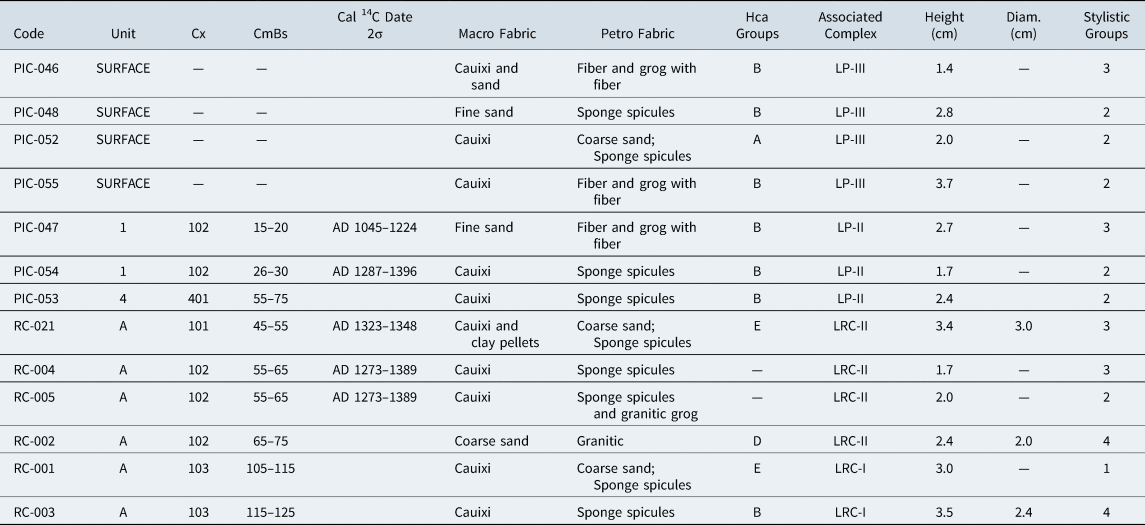
Thirteen ceramic roller stamps were classified in groups based on their paste. Seven stamps from Picure and six from Rabo de Cochino underwent further petrographic analysis, portable X-ray fluorescence spectroscopy (pXRF), and technical assessment of macro-scale traces to classify them and reconstruct their chaîne opératoire (Lozada-Mendieta Reference Lozada-Mendieta2020). All but one roller stamp (RC-003) were highly fragmented, preventing reliable diameter and height measurements (Table 1).
Roller Stamps by Excavation Provenance and Techno-Stylistic Classification.

Note: Late Picure II (LP-II): AD 1220–1400; Late Picure III (LP-III): AD 1400–1480; Late Rabo de Cochino I (LRC-I): AD 1030–1295; Late Rabo de Cochino II (LRC-II): AD 1300–1440.
Elemental concentrations obtained with pXRF were used to explore the chemical variability of the stamps (Supplemental Table 2). We chose nine elements (K, Sr, Zr, Ti, Fe, Rb, Nb, Ga, and Co) to generate a compositional variation matrix for each site. Logarithmic transformation of the raw data was performed to correct relative values (Aitchison Reference Aitchison1986; Baxter and Freestone Reference Baxter and Freestone2006) and to enable principal component analysis (PCA) and hierarchical cluster analysis (HCA).
Beads were recorded according to their metric dimensions and qualitative attributes (color, shape, condition, number of perforations, and stage of production; n = 94; Supplemental Table 3), including the raw material collected from Picure (n = 25). To assess production techniques (Groman-Yaroslavski and Mayer Reference Groman-Yaroslavski and Bar-Yosef Mayer2015), we selected a subsample containing a variety of shapes and raw materials for examination with scanning electron microscopy (SEM). To formally compare the physical characteristics, we applied multidimensional scaling (MDS) to the set of whole beads and pendants from Picure (n = 63), which included incomplete (nonperforated or roughed-out) beads. MDS reduces the dimensionality of the multivariate data to two dimensions, as determined by pairwise object similarity of the attributes. Using R package “vegan” (version 2.5–6; Oksanen et al. Reference Oksanen, Kindt, Legendre, O'Hara, Henry Stevens, Simpson, Solymos and Wagner2007), we standardized the data, generated a Euclidean dissimilarity matrix, and attempted 20 random starts to derive a stable stress value. The results were centered on 0 and had a principal components rotation applied.
Beads and Roller Stamps: Analysis and Results
Our excavations and radiocarbon summaries provide complementary information on the relative occupational intensity in the Atures region over time. They suggest that activity in and around the Rapids fluctuated: several periods of little growth were interspersed with phases of relatively quick growth, peaking around AD 1400 (Figure 4A). This trend is even more pronounced within the bead assemblage; nearly 80% of beads were found on the surface and the upper 30 cm of deposits on Picure Island (TU-1: AD 1200; TU-4: ~AD 1400). Similarly, our composite kernel density of regional radiocarbon dates (Figure 4B) captures a steadily increasing pattern of activity over the late precolumbian period (starting around AD 1206 and peaking around AD 1400, the LP and LRC complexes/periods). This upward radiocarbon trend correlates with the volume of archaeological material recovered in final precolumbian contexts, although we caution that excavated contexts with 14C dates from before AD 1000 or so are only documented in the Culebra (Riris et al. Reference Riris, Oliver and Lozada-Mendieta2018) and Pozo Azul (Barse Reference Barse1990) sites.
Summary of excavations, regional occupation, and bead analysis. (A) recorded intensity of deposition (left to right: TU-1 and TU-4 on Picure, TU-A on Rabo de Cochino) peaks in the century before the European conquest. Note the different Y-axes and depth levels; (B) CKDE of radiocarbon dates from Atures Rapids sites, with bootstrapped confidence interval, displaying a similar trend; (C) MDS with Euclidean distances on beads from Picure (composite by Philip Riris). (Color online)

Roller stamps from Picure were recovered from the surface (n = 4) and in two trenches from contexts dated around AD 1287–1396 to AD 1410–1447 2σ (n = 3; Table 1). At Rabo de Cochino, six stamps were recovered from Trench A, dating between AD 1030–1166 (n = 2) and AD 1323–1348 2σ (n = 3). Their appearance coincides with the radiocarbon upward trend from about AD 1000 to 1400, which marks the most intense occupation of the Atures region. Roller stamps have potentially earlier dates downriver, with 14C dates of cal AD 559–1045 and cal AD 821–1267 (Zucchi et al. Reference Zucchi, Tarble and Eduardo Vaz1984:174), although they remain more common between about AD 1000 and 1400 (Tarble and Vaz Reference Tarble and Eduardo Vaz1986–1987:2).
Roller Stamp Characterization
The characterization of roller stamps reveals potential new interaction dynamics in the study area. Picure's roller stamps were classified macroscopically into (1) Cauixí, (2) Cauixí and Sand, and (3) Fine Sand paste groups, the first two characterized as having freshwater sponge spicules and the last as having fine sand temper. Previous research in the area reported only cauixí roller stamps based on macroscopic examinations (Tarble and Vaz Reference Tarble and Eduardo Vaz1986–1987). Petrographic analyses confirmed the presence of sponge spicules in all but three stamps, which presented fiber and grog with fiber temper (Figure 5). This indicates the use of at least two different tempering techniques, possibly by two different potting groups.
Microphotographs in plane-polarized (PPL) and cross-polar (XP) of the roller stamps recovered at Picure and Rabo de Cochino sites (composite by Natalia Lozada-Mendieta).

Two of the fiber-tempered stamps were recovered from the surface, and the other came from TU-1 (Table 1) with an associated date of cal AD 1410–1447 2σ. This fiber paste recipe has only been reported in Picure and Culebra sites. It is grog-tempered with organic siliceous inclusions (xylem and phytoliths), which were added to a clay matrix with the same grog temper (Lozada-Mendieta Reference Lozada-Mendieta2020:145–146). Although dates associated with this paste recipe from Culebra site show it could date earlier upriver (AD 775–967 2σ), the Culebra fiber potsherd did not correspond to a roller stamp; hence the latter might have been introduced later, perhaps influenced by the cauixí-tempered stamps, which were already present in several sites downriver (Tarble and Vaz Reference Tarble and Eduardo Vaz1986–1987:18–19) and in Picure itself. As described for the LPC period, this island might have been the meeting point where cauixí stamps were seen by potters using fiber temper who decided to emulate that shape.
Rabo de Cochino roller stamps were all macroscopically classified as cauixí, except for one Coarse Sand fragment. Petrographic analyses confirm the presence of sponge spicules and naturally occurring granitic rock and derived mineral inclusions. Moreover, one of the sponge spicule-tempered roller stamps also showed medium to coarse-sized granitic grog temper, likely obtained from broken sherds of a granitic fabric vessel. Sponge spicule and granitic potsherds appear during the LRC period, before roller stamps, and correspond to two different technological traditions (Lozada-Mendieta Reference Lozada-Mendieta2020:455). Here, the rare granitic stamp could relate to interaction between two groups in this site or to mimicry by Valloid potters of local Arauquinoid potters.
These new results reveal a broader range of paste recipes for roller stamps, which had previously only been associated with the sponge spicule-tempered ceramics of the Arauquinoid series. Although the stamps made with fiber, granitic, and grog inclusions are rare, their manufacture can potentially be associated with local traditions, suggesting that circulation networks were not necessarily extensive. The manufacturing process for the predominantly cauixí roller stamps involved collecting and grinding the sponges and then mixing with the dried, cleaned clay (Lozada-Mendieta Reference Lozada-Mendieta2020:130–139). Siliceous-rich sponges usually adhere to tree branches found along flooded meadows in the margins of rivers or lagoons (Volkmer-Ribeiro and Viana Reference Volkmer-Ribeiro, Viana and Viana2009). This suggests that they were not procured directly in the strong currents of the Rapids, where the Picure site is located, but close to it, considering the floodplain is within 1 km of each site. Fiber tempering is not as well characterized because siliceous inclusions were not fully identified as part of the Gramineae family that was present on riverbanks and inland areas. Finally, granitic sherds do not present additional inclusions. Granitic-derived clays are ubiquitous along the riverbanks and were potentially locally sourced in both sites.
Grog tempering (Figure 6) is a newly identified technique that indicates experimentation by knowledgeable local potters. Fiber-tempered clay with equally tempered fiber grog in Picure suggests that potters knew that the broken vessel had fiber temper and added it intentionally. This is a cost-effective technique because it uses a readily available material with similar thermal expansion properties. It must have been preferred over other grog, as confirmed by the absence of any other type of grog in fiber sherds in all the excavated sites. In contrast, sponge spicule stamps with granitic grog follow a different principle. Given that this composition was found in only one potsherd, in addition to the roller stamp at the Rabo de Cochino site, this tempering practice could be considered opportunistic. Likewise, granitic grog in a sponge spicule sherd suggests that both cauixí and granitic potsherds were found together or in proximity, indicating shared refuse areas that coincided with the common distribution of both fabrics recorded on the island (Lozada-Mendieta et al. Reference Lozada-Mendieta, Oliver and Riris2016).
PPL microphotograph of fiber grog (left, a-PIC-047) and granitic grog (right, b-RC-005). Image width: 1.5 mm (composite by Natalia Lozada-Mendieta). (Color online)

All roller stamps from Picure site belonged to the same geochemical group, except for one sponge spicule-tempered stamp (Figure 7). Despite being tempered with either cauixí, fiber, or grog with fiber, all stamps but one were made with a similar clay, characterized by low concentrations of Fe (≈2.6), Zr (≈0.03), Nb (≈0.002), and K (≈0.77). The remaining sponge spicule stamp had higher Zr and K values, probably associated with a more weathered clay fraction and K-feldspars. Sherds from both geochemical groups presented few mineral inclusions, mainly coarse silt to fine sand grain-sized quartz, supporting an alluvial silty clay source derived from highly weathered granitic parent rocks on the banks of the Orinoco.
(Left) PCA and (right) HCA results of ceramics from (top) Picure and (bottom) Rabo de Cochino. Roller stamps are numbered inside the plot and highlighted in the dendrogram (composite by Natalia Lozada-Mendieta). (Color online)

Rabo de Cochino stamps belong primarily to three geochemical groups (Figure 7): only one of the cauixí stamps pertains to a different group, with high Ti values and low Fe. The granitic stamp constitutes a separate group based on having the highest concentrations of Fe (x̅ = 4.86092), K (x̅ = 2.44490), Rb (x̅ = 0.01825), and Sr (x̅ = 0.00746). K, Rb and Sr values are all related to K-feldspars, whereas Sr values are also linked to more carbonates and higher weathering (Degryse and Braekmans Reference Degryse, Braekmans, Holland and Turekian2014:195). Higher Fe values are related to ferric oxides in the clay fraction, corroborated by the strong red color of the base clay. The remaining cauixí stamps had slightly lower concentrations of Fe (x̅ = 4.41269), K (x̅ = 1.11022), and Rb (x̅ = 0.00895), based on the more common medium-coarse grain-sized quartz and feldspars. Rabo de Cochino's pXRF analysis confirmed the division between cauixí and granitic groups, but greater differences among the sponge spicule stamps suggest two different clay sources for their production. The sources could be several clay deposits exploited by the local Arauquinoid community that lived on the island or two different Arauquinoid communities producing these items for a wider network of exchange.
Based on these analyses of raw materials and paste preparation techniques, most of the stamps from both sites were made from local alluvial and sedimentary clay sources to which the potters added either sponge spicules, fiber, or grog. Only one stamp found at Rabo de Cochino was made with a granitic nontempered residual clay source, which also was potentially local. Although clay deposits are most likely to be found near excavated sites, tempering techniques and chemical characterization suggest they were used by different workshops with independent paste recipe preparations, supporting their classification as items of exchange.
All roller stamps shared the same modeling forming technique (Figure 8), which did not vary between sites or through time. Its continuous profile had horizontally oriented inclusions on the radial section, with no associated equidistant cracks or concavities and with an associated compression fold. There is no consistency in measurements because of high fragmentation (Table 1).
Modeling evidence in stamps (left, PIC-053; right, RC-001). See (left) compression fold and (right) radial section (photos by Natalia Lozada-Mendieta). (Color online)

Stamps were subdivided into four main groups based on decorative motifs (Tables 1 and 2). Picure samples belonged to two groups, which are also present in Rabo de Cochino with two additional types. Cauixí stamps belonged to all four groups, signaling their wide range of decorative motifs. Groups 2 and 4 were not exclusively related to a particular fabric, encompassing sponges, fiber, granitic, and mixed or grog-tempered fabrics. Although both sites share friable and incised stamps (Figure 5), there are certain particularities. In Rabo de Cochino, the granitic stamp exhibited imprecise parallel lines excisions, with narrower bands than similar cauixí stamps. Fiber with grog with fiber stamps from Picure were the only ones with punctuation.
Roller Stamp Stylistic Group Classification.

Source: Lozada-Mendieta Reference Lozada-Mendieta2020.
Based on our stylistic analysis, there is a tendency at both sites toward complicated designs executed with a less precise technique. Precise deep excisions were identified only in earlier stamps from Rabo de Cochino (AD 1000–1300). Picure's stamps displayed mostly linear imprecise incisions with complex geometrical designs in their earlier stage (AD 1200–1400); later stamps incorporated uneven punctuation (AD 1400–1480). This trend coincides with what Tarble and Vaz (Reference Tarble and Eduardo Vaz1986–1987:5, 23) described previously for stamps from other sites of the Middle Orinoco area. It could also be explained by the multiethnic scenario described for the LPC period (Lozada-Mendieta Reference Lozada-Mendieta2020:468).
Bead Analysis
No quiripas were detected in either site, probably due to preservation bias. The sample of lithic beads is overwhelmingly skewed toward recent deposition; 55 of the 63 whole beads (88.7%) that we analyzed in detail originated from the surface or the uppermost strata, which at Picure (Figure 4A) dates from the late thirteenth to fifteenth centuries. Similarly, the two pendants recorded on Rabo de Cochino, which were excluded from the statistical analysis, were retrieved from the youngest depositional contexts. Cylindrical beads form a large subgroup within our sample, broadly located toward the right of the scatterplot in Figure 4C, whereas others are less clearly clustered. Long cylindrical beads (pendants) toward the top left may also form another subgroup, albeit with relatively high internal variability. Overall, the MDS pattern in Figure 4C indicates that groups vary little by metric attributes. Similarly, bead morphology and raw material color do not appear to be associated to any one cluster.
Beads recorded in Picure bear strong resemblances to one another, with the most common morphology being thin, flat cylinders (discs) with a single hole (Figure 9). Similarly, the drilled and initiated holes have very similar dimensions (≤2 mm) despite variation in the faces intended to bear the holes (3–18 mm), which suggests their being mounted on strings with a consistent thickness. Except for a single bead manufactured on hyaline quartz, chert beads have a similar degree of polish and luster. Examining bead surfaces under high magnification typically reveals only a single, coarse stage of polishing or abrasion (Figure 9, top row), with a minority of beads also displaying a slightly finer but less systematically applied stage of polishing. We suggest that the relative uniformity of the metric, morphological, and aesthetic attributes of the beads indicates closely linked sequences of production. These fundamental similarities in the process of roughing out, abrading, and polishing the raw material could be adapted to the aims of the producer to create different morphologies (lenticular, circular, discoidal, cylindrical, teardrop).
Beads and pendants from Picure. Top row, left: SEM photo around the orifice of (right) bead/pendant #55 showing drilling and polishing striations (composite by Philip Riris and José Oliver). (Color online)

We interpret the beads as forming part of a single tradition of late precolumbian craft production centered on Picure, noting the quantity of unfinished beads characterized by a high consistency in form and appearance. The first archaeological reconnaissance in the Atures Rapids (Cruxent Reference Cruxent1950; Cruxent and Rouse Reference Cruxent and Rouse1958–1959:235–236) reported several “lenticular” and one circular basin on the granite outcrops on the north edge of Picure Island, as well as several more in other locations in the Rapids (Figure 2D). Our surveys relocated the workshop on Picure adjacent to several large panels of petroglyphs on its northern tip (Riris Reference Riris2017). The lenticular basins are likely axe polishers or grinders (Figure 10). However, it appears plausible that the circular basins identified by Cruxent (Reference Cruxent1950:Figure 5) on Cotúa Island (immediately north of Picure) were used for bead production. The broad striations visible under extreme magnification of the beads is consistent with the coarse grain of the polishing basins’ granitic substrate. Finally, the only beads recorded on Rabo de Cochino were finished or broken after completion, rather than during production. Picure is, thus far, the only precolumbian site in the region where the full production sequence of beads is represented in situ, alongside raw materials and likely means of abrading beads into their final shape. Together, this evidence indicates that Picure was a center of bead production.
Lenticular basins at Atures Rapids (composite by José Oliver). (Color online)

Discussion
The occupation of the Atures Rapids intensified around AD 1200, accompanied by the increased production of stone beads and a diversification of roller stamps. Both items date earlier downriver, but they appear about AD 1000 in Rabo de Cochino and about AD 1200 in Picure, suggesting that as groups were moving upriver and settling on these two sites, they also brought finished items and the knowledge to continue to produce them locally. Whereas beads were manufactured in Picure, ceramic roller stamps were common in both sites; they were most likely produced in several sites because they were nonstandardized, were sometimes made with different clay sources, had different paste compositions, and displayed various decorative motifs. Both beads and stamps might be engaged in different interaction spheres because their distribution between the two sites differed and might not have involved the same people.
Even though beads and stamps could be locally made, the stone, clay, and temper materials used for their production are ubiquitous, which means they could have been obtained from exchange with other communities along the river. In fact, this exchange is suggested by their different craftmanship and their use as adornments with decorative patterns related to ethnic identity or affiliations. The standardized production of beads might indicate a single production area, but their diversity of shapes might be associated with demand for certain forms stemming from individuals or certain communities and their use as individual and group markers.
Roller stamps are more varied than previously thought and do not belong only to the Arauquinoid series. The earliest stamps are made with cauixí and probably originated in the Middle Orinoco-Parguaza area; in contrast, the stamps from Rabo de Cochino and Picure exhibit local recipes and decoration techniques that exemplify how this shape was adapted and emulated by local groups in the Rapids. Granitic and fiber with grog with fiber fabrics are local paste recipes that preceded the cauixí cylindrical stamp shape. Local Valloid and fiber-tempering potters likely imitated the stamp using their own paste recipes and sometimes by altering decorative motifs, as shown by the idiosyncratic punctuation on fiber-tempered stamps.
Chemical and petrographic characterization also allowed us to explore other aspects of stamp production and regional circulation. Our analysis showed that production workshops involved different local potting groups. Raw materials were not necessarily exotic but were transformed by different specialists who sometimes used common clay deposits but with varied tempering and decorative techniques. Likewise, Arauquinoid cauixí stamps feature internal variability in clay, grog temper, and decoration, suggesting either that Arauquinoid potters exploited a wide variety of sources and techniques or that different communities with distinct practices produced cauixí stamps that were found at the Rabo de Cochino site.
The manufacturing and stylistic differences of stamps in both sites confirm that they were exchanged. Originating both on the islands and in nearby areas, stamps were produced from the interaction with Arauquinoid groups and their circulating stamps, inspiring locals to both mimic and transform them. Shared decorative techniques found in the fiber stamps from Picure and the granitic stamps from Rabo de Cochino could suggest that the imitation not only included the items but also the affiliation with Arauquinoid people from downriver. However, the innovative motifs in fiber and the cauixí tempered stamps at both sites suggest that local patterns were maintained and even claimed by the Arauquinoid outsiders themselves, as part of a more mixed environment during the LPC (AD 1400–1480) and LRC (AD 1400–1440) periods. Stamps could be used both to show alliances and boundaries between the groups that were settled or visited the area.
Regarding the beads, we hypothesize that wrist and ankle bracelets and necklaces produced in Picure were likely destined for local use, as part of the bodily accoutrement to identify gender, age, or group identity. Beads could be also earmarked for future exchange with guests and visitors to the island. The unique monumental rock art at Picure (Riris Reference Riris2017), as well as the unusually rich concentration of petroglyph iconography engraved on the Rapids, would provide the context for the intergroup exchange. One of the most distinctive petroglyph motifs (a face with spiral “ears”) on Picure is also found in a polychrome-painted, cauixí Arauquinoid open bowl, recovered from Rabo de Cochino surveys, indicating shared artistic conventions across different media (Riris and Oliver Reference Riris and Oliver2019).
This rock art, we argue, was significant not only for the residents of Picure and surrounding islands but also for a variety of mainland groups today. Each group has incorporated the personages and figures represented in rock art into their narratives relating to foundational mythological characters (Wajari for Piaroa or Kúwai among Arawak groups) who engaged in several mythical journeys along the Orinoco, bringing forth cultural knowledge and naming places of significance (Vidal Reference Vidal2000). One such place in the journey is the panel of monumental petroglyphs on Picure (Riris Reference Riris2017), where a Piaroa informant remarked on the icon of a flute player, indicating that a Warime ceremonial feast was conducted there by the “ancients,” as narrated in myths (Boglár Reference Boglár1978). Warime (like the Yurupari in the northwest Amazon), a feast where flutes are used, is still performed today at the start of the wet season, when the river water level rises and the Picure petroglyphs begin their journey into the underwater world (Mansutti Reference Mansutti Rodríguez2019).
We suggest that in LPC times (AD 1200–1500) Warime-like ceremonies and other feasts called for gatherings on Picure of both locals and guests (with rock art personages “participating”); these gatherings most likely presented the settings for trading and gift exchanges. Bodily decorative etiquette for such ceremonial events perhaps required acquiring beads, on offer for exchange at Picure, given their local manufacture and preeminence in the excavated materials. The greater formal variation of beads may correspond to locals’ and visitors’ demands, which would also account for nonstandardized roller stamps, likely produced in several sites. Assuming that these stamps are indicators of group or ethnic identity (in addition to gender, age, or status), the variety in design and technique could very well be accounted for by such ceremonial events, as locals and guests dressed for the occasion, with proper beads and paint-stamped body designs (perhaps also on guayucos, or cotton loincloths).
Feasts and ceremonies also provide opportunities for gift exchanges and to search for potential marriage partners, which may partially account for the shift from a multicultural community to a much more hybridized, integrated one from about AD 1400 onward on Picure. The same ceremonial context would also account for the various instances of emulation and adoption described in ceramic materials, including the roller stamps. This model does not exclude exchanges and interactions outside ceremonial contexts; that is, in gatherings to exclusively conduct economic transactions. Unfortunately, most potential items for trade are highly perishable materials that left no trace.
Conclusions
Archaeological fieldwork in the Middle Orinoco has offered partial, but compelling, answers to the questions raised here. First, nowhere in the Middle Orinoco region do we have any archaeological evidence to argue for hierarchical, politically centralized societies with a paramount chief as in the Western Llanos (Gassón Reference Gassón, Gnecco and Langebaek2014), where surplus redistribution and labor control are evident. As yet, there is no sign of warfare, a situation that could lead to temporary hierarchy, which militaristic structures tend to promote. Thus, one wonders what caused the approximately 400-year occupation hiatus in Picure and Rabo de Cochino: with its potentially sacred rock art connotations and prime locus for exchange and rich fishing, was this area territorially contested? If this pattern of long-term abandonment is confirmed at other sites, then this would be a large-scale phenomenon, which ended at the start of the first millennium of this era, accompanied by the arrival of Arauquinoid and Valloid ceramics.
Finally, the archaeological data do not support the Rapids attaining the characteristics of a center of “commerce” in the late precolonial period (about AD 1030–1500) as was later described by Berrío (quoted in Ojer Reference Ojer1966) and the Jesuits. As noted, this is quite probably because a great deal of the potential evidence of trade consisted of perishable materials. Archaeological research suggests that the late occupants of these islands practiced a gift economy, where they valued the social relations established through the reciprocal transaction. The apparent relative “invisibility” of salient exotic pottery and other artifacts, clearly coming from farther afield, may be because the same range of techno-stylistic wares was present in a large area along the river and possibly on the Colombian side, but further research is needed for future comparisons.
Acknowledgments
The fieldwork in Venezuela was made possible thanks to the Venezuelan Institute for Scientific Research (IVIC), Juan Carlos García, and collaborators in Puerto Ayacucho.
Funding Statement
This research was funded by a Leverhulme Trust Research Grant (RPG-2014-234) obtained by project PI and coauthor José R. Oliver.
Data Availability Statement
Data supporting the findings of this study are available in the article and its supplemental material.
Competing Interests
The authors declare none.
Supplemental Material
For supplemental material accompanying this article, visit https://doi.org/10.1017/laq.2022.73.
Supplemental Table 1. Radiometric Dates for the Middle Orinoco Region.
Supplemental Table 2. pXRF Concentrations per Elements for Picure (PIC-) and Rabo de Cochino (RC-) Sites.
Supplemental Table 3. Metric and Qualitative Data of Beads.