Introduction
Children usually acquire the syntax of their native language remarkably rapidly, without explicit instruction. The speed and apparent effortlessness of typical language acquisition has been treated as crucial evidence in debates between nativists and empiricists about the nature of language acquisition. Nativists view these qualities as evidence for the innateness of language; Crain and Pietroski claim, for example, that “adults (i.e. just about anyone above the age of four) know much more about language than they could plausibly have learned on the basis of their experience” (Reference Crain and Pietroski2001, p. 163). Indeed, early researchers on child language, noting the remarkable gains in language in toddlers, often claimed that, by the age of four years, syntax is more or less fully acquired in typically developing children. For example, McNeill stated that “grammatical speech does not begin before one-and-a-half years of age; yet as far as we can tell, the basic process is complete by three-and-one-half years” (Reference McNeill, Lyons and Wales1966, p. 15). However, although most children can talk in grammatical sentences by this age, the syntactic complexity of their utterances continues to increase for several years more (Loban, Reference Loban1976).
Syntactic constructions
Syntactic constructions are generally considered to be either simple or complex. A simple sentence consists of a single independent clause, which can be made up of a number of clausal elements such as subject, verb, object, adverbial, and complement (Quirk, Greenbaum, Leech, & Svartvik, Reference Quirk, Greenbaum, Leech and Svartvik1985) (as in the sentence The man (S) is running (V)). A complex sentence, on the other hand, contains more than one clause, linked in specific ways. This can be done through coordination (using connectors such as and or but; as in the sentence The girl likes cheese and the boy likes chocolate), or subordination, where there is a main clause in which a subordinate clause is embedded. There are three distinct types of subordinate clause; complement clauses, adverbial clauses, and relative clauses. In a complement clause, the embedded sentence serves as one of the arguments of the verb in the matrix clause (Quirk et al., Reference Quirk, Greenbaum, Leech and Svartvik1985). The complement clause can therefore be the subject, direct object, or indirect object of the main verb. For example, in the sentence He knew the girl was sad, the girl was sad is an object complement of the main clause. In contrast, adverbials serve to modify the main clause and are linked semantically, most commonly using temporal (e.g., when) or causal (e.g., because) connectives, as in the sentence He broke the car when he was playing.
Lastly, the relative clause postmodifies the noun or noun phrase in the main clause (as opposed to the full main clause, as is the case with adverbials). They are usually defined according to (a) the sentential position of the modified noun phrase and (b) the role of the relativised noun phrase in the embedded clause. For example, in the sentence She pushed the boy that fell, the modified noun phrase is the object of the main clause and the subject of the relative clause. Dependent clauses can also be finite or non-finite. In relation to complement clauses, we see this distinction in the sentences She notices that her watch is not there anymore, where the tense is marked (finite), in contrast to He can't see the bird steal her watch, where tense is unmarked (non-finite). Complex syntax in English is described in more detail in Diessel (Reference Diessel2004), Huddleston, Pullum, and Bauer (Reference Huddleston, Pullum and Bauer2002), and Quirk, Greenbaum, Leech, and Svartvik (Reference Quirk, Greenbaum, Leech and Svartvik1985).
Measures of syntactic complexity
In young children, the usual measure of syntactic complexity is mean length of utterance in morphemes (MLU). Since Brown's (Reference Brown1973) classic description of language development in three preschool children, it has been established that the mean length of a child's utterances can be used to predict their age with a good degree of accuracy, and that there is a strong correlation between MLU and the level of structural complexity of a young child's language (Miller & Chapman, Reference Miller and Chapman1981; Klee, Schaffer, May, Membrino, & Mougey, Reference Klee, Schaffer, May, Membrino and Mougey1989). However, as children grow older this relationship weakens, and age can no longer be accurately predicted from MLU after around 48 months of age (Klee & Fitzgerald, Reference Klee and Fitzgerald1985; Rondal, Ghiotto, Bredart, & Bachelet, Reference Rondal, Ghiotto, Bredart and Bachelet1987; Blake, Quartaro, & Onorati, Reference Blake, Quartaro and Onorati1993). Consequently, study of the development of MLU after four years of age has been relatively neglected.
There is, however, evidence of a continued increase in MLU with age, in both conversation and narration, continuing until adolescence (Loban, Reference Loban1976; Klecan-Aker & Hedrick, Reference Klecan-Aker and Hedrick1985; Scott, Reference Scott1988; Leadholm & Miller, Reference Leadholm and Miller1992; Scott & Stokes, Reference Scott and Stokes1995; Nippold, Hesketh, Duthie, & Mansfield, Reference Nippold, Hesketh, Duthie and Mansfield2005). Most studies of older children tend to use MLU in words (MLUw) rather than morphemes, once children reliably produce full sentences. The pattern of a steady increase in MLUw with age was also observed in normative data from the Expression, Reception, and Recall of Narrative Instrument (ERRNI; Bishop, Reference Bishop2004).
Utterance length alone is not an adequate index of syntactic complexity, because it is possible to produce longer utterances either by concatenating words and phrases, or by producing constructions with more complex hierarchical structure. For instance, The boy and girl rode along to the beach on their bikes contains a single main clause but is longer than When the boy went to the beach, he rode his bike, which has both main clause and adverbial clause. Sentences with more than one clause are distinguished using a number of measures including T-unit (‘terminable unit’, developed by Hunt, Reference Hunt1965), C-unit (‘communication unit’, developed by Loban, Reference Loban1976), and clausal density and clause packages, developed by Berman (Reference Berman, Slobin, Gerhardt, Kyratzis and Guo1996). Both T-unit and C-unit refer to any main clause with an attached subordinate clause. However, the latter can be without a main clause, as when answering a question. Clause packages integrate structural and pragmatic function, in that connectives such as and, so, and but are distinguished depending on whether they serve as grammatical connectives or pragmatic introductions to the utterance. Finally, clausal density, which is the mean number of clauses per utterance, also known as the index of subordination (e.g., Scott, Reference Scott1988; Guttierez-Clellen & Hofstetter, Reference Gutierrez-Clellen and Hofstetter1994; Scott & Stokes, Reference Scott and Stokes1995) is the measure of interest used in the current paper. On this measure, the second of the aforementioned example sentences would score higher than the first.
Although MLUw and clausal density are logically separable, previous studies have reported a strong positive correlation between them in natural discourse (Nippold, Reference Nippold2009; Nippold et al., Reference Nippold, Hesketh, Duthie and Mansfield2005; Nippold, Mansfield, & Billow, Reference Nippold, Mansfield and Billow2007). Datasets from Hunt (Reference Hunt1965), Klecan-Aker and Hedrick (Reference Klecan-Aker and Hedrick1985), and Loban (Reference Loban1976) showed an increase in clausal density with age, up to twelfth grade, in both conversation and narration, but it is not clear whether this measure is more sensitive to developmental change than MLUw.
As previously outlined, utterances differ not just in clausal complexity, but also in the type of clause structures. Where multi-clause utterances are used, these may vary in processing demands. A multi-clause utterance linked by coordination, e.g., He went to the park and rode his bike, is structurally simpler than an utterance in which subordination is used, where one element of a main clause is expanded into a full clause, creating a set of clauses in a hierarchical relationship. This is the case in clausal complements: She knew he was the man at the bus stop; adverbial clauses: He went to the park after he rode his bike; and relative clauses: The man who was by the beach gave her an ice-cream. In addition, in relation to adverbial clauses, research shows that young children have greater difficulty processing those in which the order of presentation is different from the order in which the events occurred (Clark, Reference Clark1971; French & Brown, Reference French and Brown1977; Trosborg, Reference Trosborg1982). For these reasons, we might anticipate that we will see some variability in the age at which particular clause constructions are observed in narrative samples.
Methodological differences
There have been a number of detailed studies on the understanding and production of syntactic constructions. However, there is significant variation in the methods and measures of complexity used, as well as the complexity of the constructions examined. Research focusing on the emergence of multi-clause utterances in very young children includes that by Diessel (Reference Diessel2004), who examined natural speech samples from children aged between 1;08 and 5;01. In addition, Givón (Reference Givón2009) examined the use of clausal complements in children up to three years, and relative clauses in children between 2;08 and 4;06, noting in particular how young children co-construct syntax with an adult interlocutor. Tyack and Gottsleben (Reference Tyack and Gottsleben1986) considered a similar age range using data from play situations and picture stimuli. Westerveld and colleagues examined the production of syntax in children from four to eleven years, using mean length of utterance in morphemes (MLU-M) as their syntactic measure (see Westerveld, Gillon, & Miller, Reference Westerveld, Gillon and Miller2004; Westerveld & Vidler, Reference Westerveld and Vidler2016). Berman and Slobin's (Reference Berman and Slobin1994a) detailed analyses of complex syntax in the ‘Frog Story’ project, included children from three to nine years, as well as an adult sample. Their study had a strong focus on cross-linguistic comparisons in relation to form and pragmatic function, and introduced the concept of ‘syntactic packaging’ as a measure of complexity. In an extension of this work, Berman and Nir-Sagiv (Reference Berman, Nir-Sagiv, Guo, Lieven, Budwig, Ervin-Tripp, Nakamura and Ozcaliskan2009) also used clause packages (clause package density) as the framework for analyses of written texts from school children (nine- to ten- and twelve- to thirteen-year-olds), adolescents, and adults, and reported an increase in density with age in all languages. Other studies focusing primarily on complex syntactic development in older children and adults (from 12–60 years), also show continued growth in the ability to use complex structures into adulthood (see Loban, Reference Loban1976; Verhoeven, Aparici, Cahana-Amitay, van Hell, Kriz, & Viguie-Simon, Reference Verhoeven, Aparici, Cahana-Amitay, van Hell, Kriz and Viguie-Simon2002; Nippold et al., Reference Nippold, Mansfield and Billow2007; Nippold, Cramond, & Hayward-Mayhew, Reference Nippold, Cramond and Hayward-Mayhew2013; Nippold, Frantz-Kaspar, Cramond, Kirk, Hayward-Mayhew, & MacKinnon, Reference Nippold, Frantz-Kaspar, Cramond, Kirk, Hayward-Mayhew and MacKinnon2014). However, given the different study designs and measures of complexity, it is not possible to map a continuous developmental trajectory throughout childhood on the same task. Therefore, these studies do not shed light on how older children adjust their use of complex structures, compared to younger children on the same task. Any attempt to form a comprehensive picture of development is therefore impeded by methodological variations between studies, as well as gaps in the ages of the participants for whom data was collected.
Task effects on syntactic complexity
An additional important factor affecting the production of complex syntax is the method of language sampling used. In a study of five- to eight-year-old children, Westerveld and Vidler (Reference Westerveld and Vidler2016) analysed spoken language samples, elicited using four different techniques; conversation, personal narrative, story retell, and exposition being administered with seven- to eight-year-olds only). Based on MLU-M, they reported that the story retell task yielded the most syntactically complex language for the five- to seven-year-olds, when compared to conversation and personal narrative, and the expository task generated the most syntactically complex language for the children between seven and eight years. Nippold et al. (Reference Nippold, Hesketh, Duthie and Mansfield2005) examined growth in syntactic complexity in school-aged children (aged 8 and 11 years), adolescents (aged 13 and 17 years) and adults (between the ages of 20–29 and 40–49) using two tasks: conversation and expository speech. They reported a growth in syntactic complexity into early adulthood, followed by stability in middle adulthood, but noted that all groups showed higher levels of syntactic complexity on the expository than the conversational task. In a subsequent study, Nippold and colleagues (Reference Nippold, Mansfield and Billow2007) administered a peer conflict resolution task to three of the groups who had participated in the previous study. Participants listened to a number of hypothetical conflicts between young people; they were then asked to retell them and to answer a series of questions in relation to the nature of the problem, how and why it should be handled a particular way, and what the eventual outcome might be. Participants’ production of syntax was again task dependent, and the authors concluded that the peer conflict resolution task was more effective than the previous expository task in eliciting complex syntax and revealing age-related growth.
Even within a narrative context, the specific task can affect syntactic complexity. Liles, Coelho, and Zalagens (Reference Liles, Coelho and Zalagens1989), for example, used two different techniques for eliciting a narrative, one of which required participants to tell a story from a series of pictures, and one of which required them to tell a story from a single painting. They found that the two elicitation techniques revealed significantly different performances from adults, not only in terms of the overall cohesion and structure of the narrative, but also in terms of syntactic complexity. Although more T-units were produced in story retelling, the use of subordinate clauses was greater in story generation. Using the same techniques, Coelho (Reference Coelho2002) also reported significantly different syntactic complexity in the narratives of adults on the two tasks.
When studying children, the choice of task is key. Conversational sampling has the advantage of being more natural, but a narrative task is more likely to elicit complex language and full sentences (Leadholm & Miller, Reference Leadholm and Miller1992; Wagner, Nettelbladt, Sahlén, & Nilholm, Reference Wagner, Nettelbladt, Sahlén and Nilholm2000; Thordardottir & Ellis Weismer, Reference Thordardottir and Ellis Weismer2002; Southwood & Russell, Reference Southwood and Russell2004; Westerveld et al., Reference Westerveld, Gillon and Miller2004). Westerveld et al. (Reference Westerveld, Gillon and Miller2004) investigated the effects of three elicitation contexts on four- to seven-year-old children's spoken language performance. They found that both story retell and personal event narratives yielded longer more complex sentences (as measured by MLU-M) than a conversational task. In addition, the story retell condition elicited a higher percentage of word-level errors than either of the other two elicitation techniques, suggesting that the narrative retell is a more linguistically challenging task. Other studies have also shown that measures of an individual's productive ability, such as MLU, or measures of syntactic complexity, are consistently and significantly higher in narrative samples than in conversational or free-play samples (see Nippold et al., Reference Nippold, Frantz-Kaspar, Cramond, Kirk, Hayward-Mayhew and MacKinnon2014). It has therefore been argued that narratives yield a measure of a child's “maximum behaviour”, not their “typical behaviour” (Southwood & Russell, Reference Southwood and Russell2004). That is, narratives give an idea of what a child is capable of, not what they typically do; conversation and free play usually consist of the exchange of mundane information, which does not necessitate the use of long utterances or complex syntax (Hesketh, Reference Hesketh2004). By contrast, the narrating of a story is a complex task; the narrator is required to establish and keep track of characters, describe episodes and relate them to an overall theme or plot, decide on the relevance of foreground and background information, and so on.
The current study
Here we examined the use of complex syntax from early school age (four years) through to adulthood. We used a narrative task that had been designed to be applicable to a wide age range and which was well suited for the examination of developmental change in syntactic complexity: the Expression, Reception, and Recall of Narrative Instrument (ERRNI; Bishop, Reference Bishop2004). The data considered here are based on a subset of transcripts from the standardisation sample that were subjected to syntactic analysis, with a specific focus on subordinate clauses.
This was essentially a descriptive rather than theoretical study. Our aim was to find out whether children from four years old used a full range of complex syntactic structures, or whether the longer utterances in older children arose because some types of clausal construction do not feature in the utterances of younger children (Scott, Reference Scott1988; Scott & Stokes, Reference Scott and Stokes1995). To address this question, we looked at how the use of different clause types changed with age, and evaluated developmental trends between four years and adulthood for a commonly used index of syntactic complexity – clausal density.
In addition, because each participant told the same narrative twice, once while looking at the pictures, and once, later and without prior warning, from memory, we could examine whether the different pragmatic demands of these two contexts affected children's use of syntax. We did not have clear predictions about this, but we anticipated that performance on the two tasks might differ, as they imposed different processing demands (direct description of visible pictures vs. reconstruction from memory).
Because there were two parallel forms of ERRNI (the ‘Beach Story’ and the ‘Fish Story’), and half the participants had been administered one form and half the other, we were also able to see how far syntactic complexity was influenced by specific narrative content. This question is relevant when narrative tasks are used for assessment of children's language: ideally, we want a measure that will give a similar index of syntactic complexity, regardless of specific semantic content. If story content does affect our measure, then we may need to devise specific narratives to be sure of eliciting a full range of syntactic structures.
Specific questions addressed by this study
The specific research questions addressed by this study were as follows:
1. Does the increase in MLUw (already documented in the full ERRNI standardisation data) adequately capture increases in syntactic complexity with age, or does a measure of clausal density provide further information?
2. Is syntactic complexity influenced by whether the story is told from a picture-book or from memory?
3. Does syntactic complexity differ depending on the specific story that is being narrated?
4. Are all defined clause types represented in children's narratives by four years of age, or are there some syntactic constructions that emerge only later in typical development?
Method
Participants
For the current syntactic analysis, a subset of 354 from the original cohort of 890 participants from the ERRNI standardisation exercise was selected. The original standardisation sample was selected from around the UK to give as close a match as possible to population norms on the basis of socioeconomic background, after excluding children who did not have English as a first language at home, and those identified as having special educational needs. The final sample was representative of the UK population as a whole (see Bishop, Reference Bishop2004, for more detail).
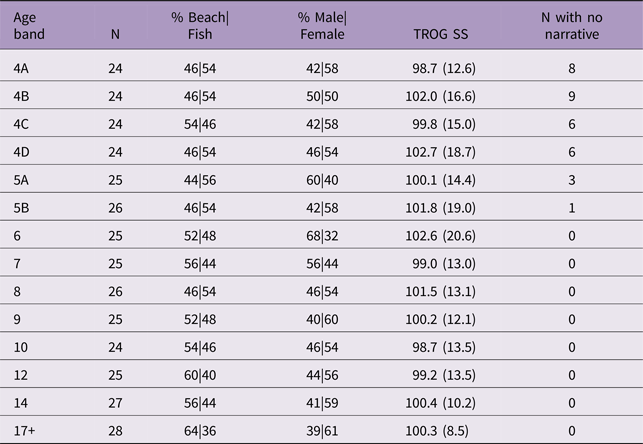
Age bands were defined as in the original ERRNI standardisation, which took into account the more rapid development seen in early years, followed by slower growth, and then a plateau in adulthood. In total there were 14 age groups. Children aged between four and five years were divided in to four age bands (4;0–4;02, 4;03–4;05, 4;06–4;08, and 4;09–4;11, referred to as 4A, 4B, 4C, and 4D) and those between five and six years were divided in to two age bands (5;0–5;05 and 5;06–5;11, referred to as 5A and 5B). Participants aged between six and nine years were divided into yearly age bands, and older participants were divided into broader age bands of 10 to 11 years, 12 to 13 years, and 14 to 16 years. Each of these is referred to by the youngest age in that band, i.e., 10, 12, and 14. The sample included participants aged from 17 to 64 years (mean age 35.4 years), who formed a single adult cohort. For the current paper, between 25 and 28 participants in each age band were selected, giving 354 narratives in total; cases were selected on the basis of background data, with the aim of ensuring that in each age cohort there were approximately equal numbers of males and females, approximately equal numbers given ‘Beach’ and ‘Fish’ stories, and the distribution of standard scores on a measure of receptive language, the Test for Reception of Grammar (TROG-2; Bishop, Reference Bishop2003) was in line with expectations for a typically developing sample (see Table 1), with mean scaled score around 100. Table 1 also shows the numbers of children who did not produce a narrative. These were children who labelled the individual pictures rather than telling a story; most of them were unable to recall anything after a delay. These cases are excluded from the syntactic analysis, as they did not complete the narrative task.
Participant Descriptives

Note. TROG scores given are mean (SD) scaled scores.
Testers
The testers who administered the ERRNI in the original standardisation exercise and transcribed the narratives (including the segmentation of the stories into utterances), were selected from training courses for speech and language therapy in the UK. Testers were given a demonstration of and training in the administration of ERRNI.
Narrative elicitation materials
Narratives were elicited using ERRNI (Bishop, Reference Bishop2004), which was developed as a clinical tool for assessing children's language development. There are two parallel forms: the ‘Fish Story’ and the ‘Beach Story’. Both stories have a narrative structure in which a protagonist has a false belief that is subsequently resolved. In the ‘Fish Story’, a boy goes to buy a new fish for his fish-tank, and meets some friends on the way home. One of the friends swaps the contents of his bag, so that he arrives home to find he has a doll rather than a fish. His mother phones his friends who come round and return the fish. In the ‘Beach Story’, a girl cycles off to the beach to meet her friend for a swim. While she is in the water, a bird flies off with her watch. The children search for her watch but cannot find it. On the way home, a friend's dog sees the bird with the watch, but the children do not realise this. They follow the dog and are led to the watch.
Narrative elicitation procedure
Full details of the administration and coding of ERRNI are given by Bishop (Reference Bishop2004), so only the main points are given here. The participant is first shown a warm-up picture showing a scene at a swimming pool and is asked to describe what is happening. This is not coded, but is simply used to encourage the person to produce narrative language. The participant then looks through the pictures corresponding to one of the ERRNI stories. After inspecting all the pictures, the participant is asked to view the pictures again, this time narrating the story. After a delay of 10–30 minutes, the participant is asked, without warning, to retell the story. For both initial story-telling and recall, the examiner is not permitted to ask leading questions about specific details of the story. If a child is reticent, or just describes one picture on a page, then the examiner is permitted to give non-specific prompts that are designed to elicit full utterances as responses, such as “What happened next?”, “Tell me a bit more”.
All narratives were recorded and transcribed by the person who administered the test. The full transcript was then converted to a cleaned transcript that omitted material that would not be included in syntactic analysis. The following types of utterance were omitted: false starts and self-corrections; immediate repetitions of an utterance using exactly the same words; incomplete utterances; general comments that were not part of the narrative and formed a complete utterance (e.g., “I don't want to do this any more”); and questions to the examiner that requested information (e.g., “What is that?”)
Identification of utterance boundaries
Identification of utterance boundaries is not always straightforward, and the way this is done can have a substantial impact on measures of MLUw. We used the criteria specified in the ERRNI manual, which are as follows.
Utterance boundaries were determined on purely syntactic criteria, ignoring prosodic cues. Grammatical segmentation is easier to apply consistently, and less ambiguous, than segmentation using intonational and prosodic cues (Scott & Stokes, Reference Scott and Stokes1995; Wong, Au, & Stokes, Reference Wong, Au and Stokes2004).
The general definition of an utterance was a main clause together with any dependent clauses. We treated main clauses linked by coordinating conjunctions such as and, so, and but as separate utterances (thus obeying the general rule of one main clause per utterance), unless the subject of the clause was omitted (i.e., elided) in the second utterance. Thus The girl picked up her bag/ and she cycled to the beach was treated as two utterances (divided at the /), whereas The girl picked up her bag and cycled to the beach was a single utterance. This rule for determining segmentation of conjoined utterances is consistent with the criteria for determining T-units (Hunt, Reference Hunt1965) and C-units (Loban, Reference Loban1976), which are typically used for segmenting discourse or narrative into units for analysis.
A specific coding rule was developed for reported speech. In general, reported speech acts as a dependent clause, and is part of a main clause with a verb such as say. Thus we treated utterances such as She said “do you want to come and find my watch with me?” as a single utterance. However, this approach to coding starts to be problematic if reported speech itself contains several main clauses that would meet our definition of an utterance. Although one could make a case for treating all sequences of reported speech as part of one utterance, regardless of the syntax, this would lead to remarkably long utterances that distort the MLUw. We therefore adopted the rule that a new utterance was started if the material in reported speech met our criteria for an utterance boundary. For example, utterance boundaries were placed where slashes are shown in the following sequence: His mum said “you must go and buy a fish/ Go to the pet shop in town and get one/ Be careful of the traffic/ Here is some money.”/.
Utterances that omitted obligatory elements of clause structure were treated as single utterances and not combined. For instance, a narrative in which clause subjects were omitted would be divided into utterances as follows: feeding his fish/ got his bag/ pointing at fish/ carrying a bag/.
In the transcript, spaces were used to define word boundaries. Bound morphemes (e.g., possessives, tense markers, and plurals) were not counted as words, but reduced auxiliary verbs and negatives were treated as separate words. Thus he can't see the bird was transcribed with a space between ca and n't to give six words, but he took the girl's watch was five words.
Classification of clauses
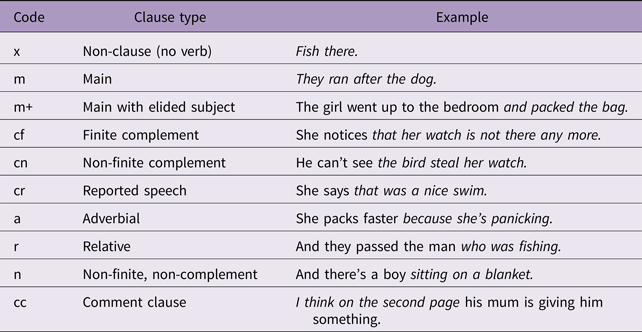
The original coding of ERRNI standardisation data did not include any syntactic analysis beyond identification of utterance boundaries. The system used for the current analysis was based on Burton-Roberts (Reference Burton Roberts1986). An Excel worksheet was created for each transcript, with a row for each clause, and one of the authors (PF, DM, or DB) coded the clause type according to the categories in Table 2, with difficult cases resolved by discussion between the authors. Each sample clause type is shown in italics in Table 2, with the clause to which it was attached.
Categories of Coded Clause Types

The basic type of clause is the main clause; the most syntactically simple utterance consists of a single main clause, such as The boy walks down the street or The girl puts her things in her bag. In our system of classification, clauses that consisted of a ‘go to + verb’ or ‘go + verb’ structure were also coded as main clauses. Examples of this type of utterance are: The boy goes and gets an ice-cream; Then they go and have a look; And he goes to go and get one; She goes to go and put everything back in her bag. The first instance of the verb go appears to have little semantic content in these contexts, as evidenced by its repetition in some sentences.
The code m+ was used for coordinate clauses, where two main clauses were joined by a coordinating conjunction, with the subject of the second clause omitted.
In addition to these clause types, there are various types of subordinate clause, which combine with main clauses to form syntactically complex utterances. Among such clauses, we classified three types of complement clauses. First, we coded finite complement clauses, in which the complement clause contains a tensed verb, as in the example She said [she was going to the shop]. By contrast, non-finite complement clauses were those complement clauses that contained an unmarked verb (i.e., one that is not marked for tense or number), as in the example She wanted [to go to the shop]. The third and final type of complement clause was ‘reported speech’ complement clauses. These were complement clauses that consisted of a direct quotation of one of the characters, as in the example She said [“I am going to the shop”]. These are like other finite complement clauses but were coded separately because they involve additional pragmatic demands, in that the speaker must put him or herself in the role of a fictitious person.
Adverbial clauses typically specify some locational or temporal information relating to the main clause, as below.
[While the boy was at the shop,] the girl swapped the things around.
The girl swapped the things around [while the boy was at the shop].
Adverbials can precede or follow the main clause that they modify, and our coding incorporated this information.
Relative clauses are used to qualify a noun phrase; to provide additional information about its referent. A relative clause can be introduced by the relativiser who or that, or have no relative pronoun at all; examples of each type are given below. We made no distinction between restrictive and non-restrictive relative clauses, which although semantically distinct are syntactically identical in terms of clausal structure (Quirk et al., Reference Quirk, Greenbaum, Leech and Svartvik1985).
The boy waved to the man [who was fishing].
The watch [that the girl had left on the beach] was gone.
The watch [[ø] the bird had stolen] was on the bench.
Non-finite non-complement clauses are not marked for tense or number, and the clauses themselves are not compulsory complement-like clauses. Examples are given below.
She gives him money to buy another fish.
He saw her swimming in the sea.
The final type of clause was the comment clause (Quirk et al., Reference Quirk, Greenbaum, Leech and Svartvik1985, pp. 1112–1118). We coded as comment clauses, clauses that served a pragmatic function, expressing the speaker's attitude towards the sentence, as in the examples below.
Unless I'm mistaken, that's a fish
I think he's picking up his bag
It looks like she has lost her watch
Note that asides consisting of entire utterances expressing a speaker's attitude or commenting on the task were excluded from the original transcription of the narrative. Comment clauses are included here because they are clauses integrated into the syntax of the narrative, although they are not part of narrative itself.
Measures of syntactic complexity
Mean length of utterance in words (MLUw) was computed by dividing the total number of words by the total number of utterances and is described in full in the ERRNI manual (Bishop, Reference Bishop2004). Utterances that contained more than 20% of unintelligible words were excluded.
A measure of clausal density was obtained by dividing the total number of clauses in a transcript by the total number of utterances, excluding incomplete or unintelligible utterances. Thus, for instance, if a child produced ten utterances with one clause, five with two clauses, and one with three clauses, the clausal density would be (10 + (5 × 2) + 3)/16 = 1.43. Note that, as described further below, some young children produced utterances that did not contain a main verb and were thus not full clauses, e.g., a fish. These were counted as utterances and included in the calculation of MLUw and clausal density, but assigned a clause count of zero. Thus, potentially, clausal density could be less than one: e.g., a child who produced five non-clausal utterances and five mono-clausal utterances would have a mean clausal density of 0.5.
We developed a script in R (R Core Team, 2013) to automate the analysis of the coded transcripts. This is available on the Open Science Framework <osf.io/fvyqh/>.
Results
MLUw in relation to clausal density
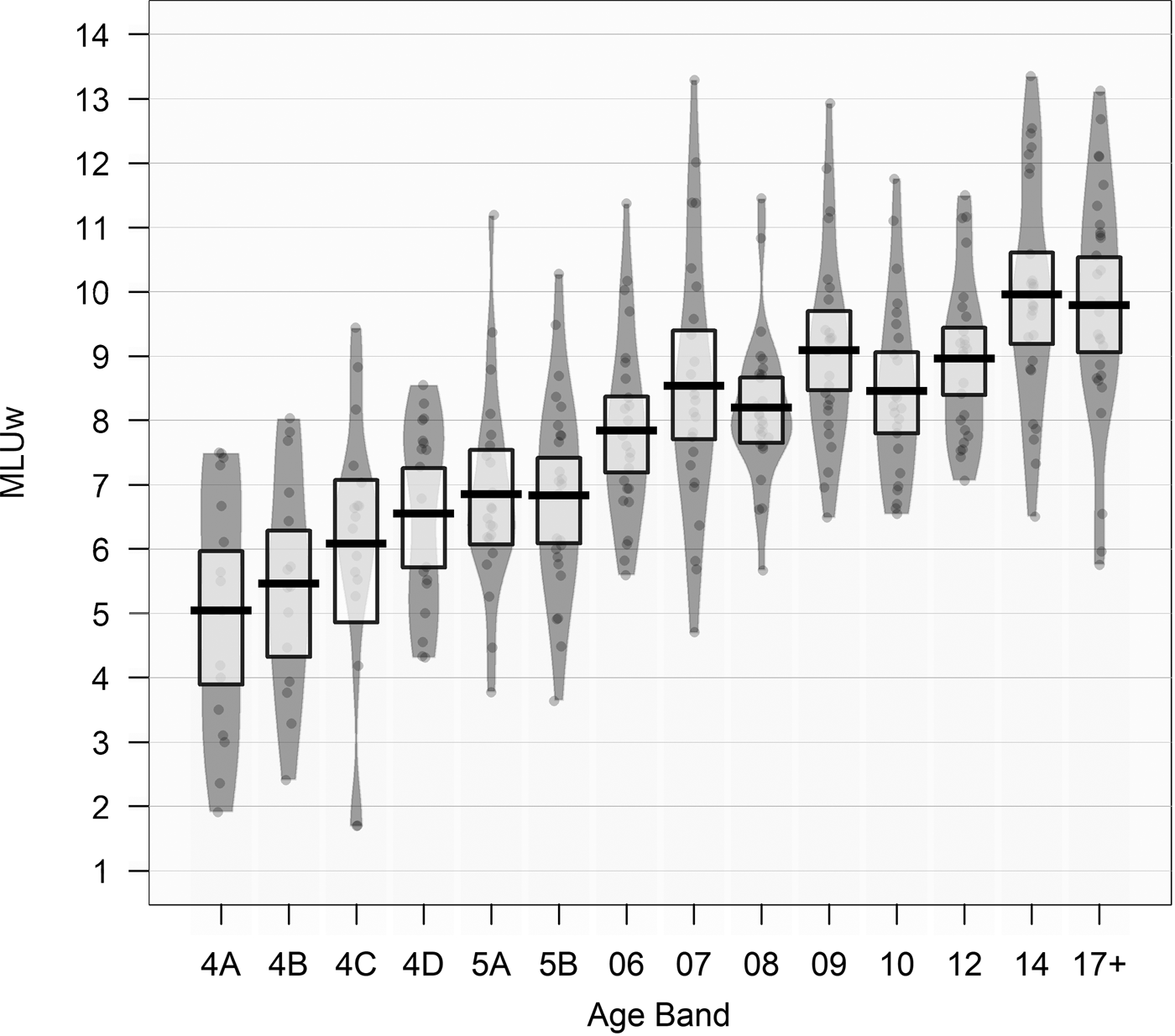
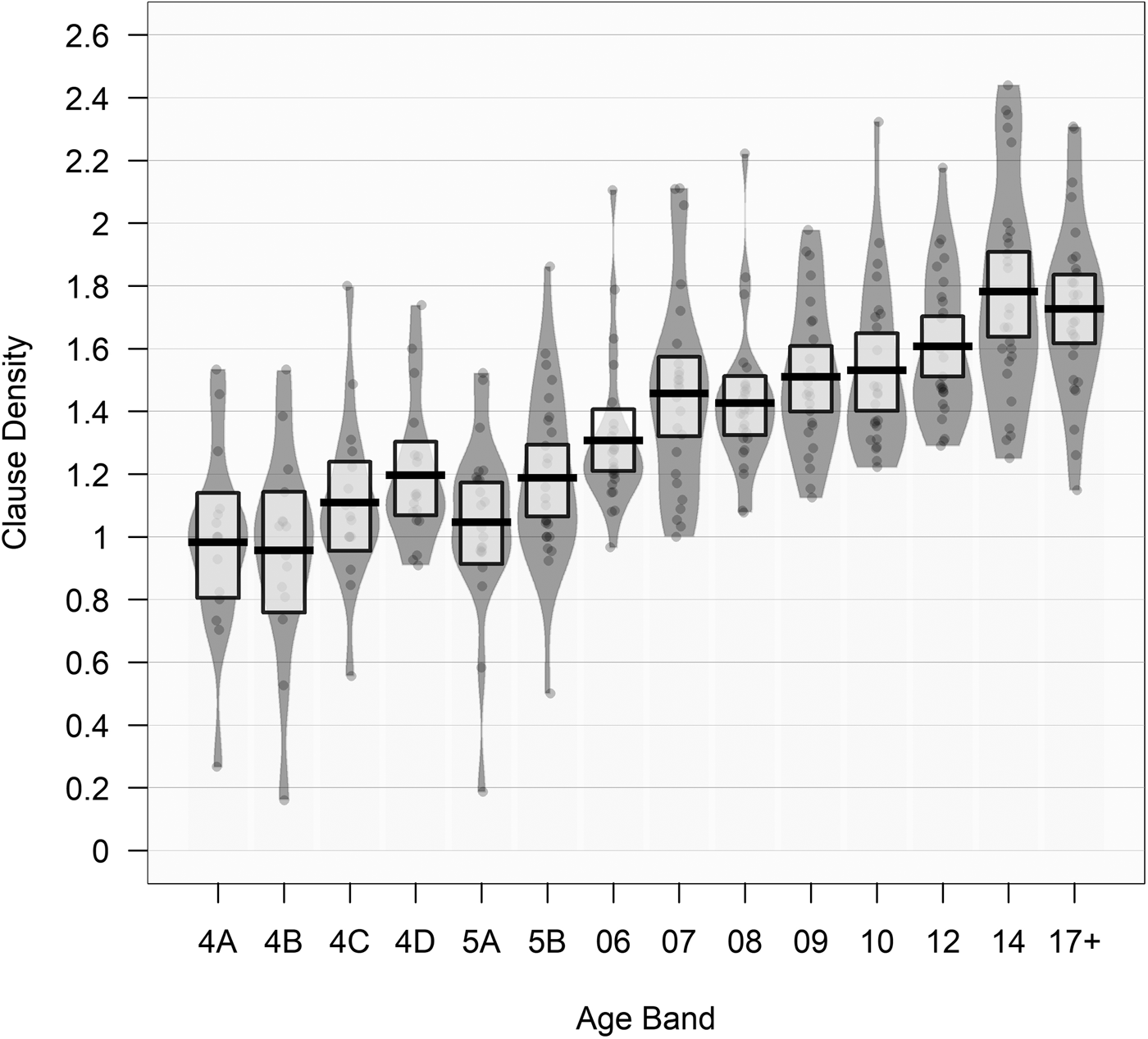
Figure 1 shows a plot of MLUw distribution by age band, and Figure 2 shows a similar plot of mean clausal density by age band. Both plots exclude children who were unable to produce a narrative or who produced less than ten utterances in total. We used pirate plots (Phillips, Reference Phillips2016), which provide an economical way of depicting raw data and inferential statistics.
MLU distribution for each age band.

Clausal density distribution for each age band.

We can see that both MLUw and mean clausal density show a steady increase with age band. Note that the age bands were defined in a non-linear fashion, with smaller ranges at younger ages to reflect the fact that more rapid development was anticipated in the youngest children. These age bands were used, rather than actual age, in subsequent regression analyses because they give better fit than raw age using a linear model.
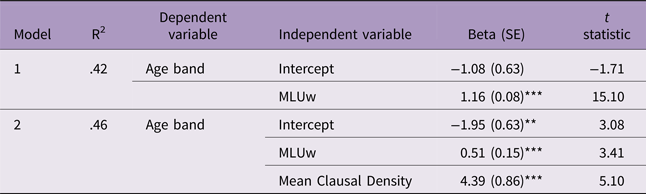
Clausal density and MLUw were highly inter-correlated, with Pearson r = .87 (n = 318, p < .001). To see whether clausal density gave further information about the development of syntactic complexity beyond that provided by MLUw, we performed a regression analysis to consider how far these two indices of grammatical complexity predicted age band (see Table 3). In Model 1, only MLUw was entered, and in Model 2, Mean Clausal Density was added. Mean Clausal Density accounted for significant additional variance over that accounted for by MLUw. Thus, increasing syntactic complexity with age reflects not just an increase in utterance length, but also the use of devices such as complementation and other types of subordination to express more complex ideas with the same number of words.
Regression Model for Prediction of Age Band from MLUw and Mean Clausal Density

Notes. Significance level: p < .01 **, p < .001 ***.
Tell versus recall
In order to investigate whether syntactic complexity was different when the story was narrated using the picture prompts or from memory, a repeated-measures ANCOVA was fitted to the data. Tell/recall was the within-subjects variable and age band the covariate. We were also interested in whether there was an interaction between the two. There was no significant difference in the clausal density of the utterances produced when stories were told using the picture prompts relative to when they were told from memory (F(1,316) = 0.051, p = .822) and there was no interaction with age band (F(1,316) = 0.935, p = .334).
Story narrated
Our third research question asked whether syntactic complexity differed depending on the story being narrated. In order to address the effect of story on clausal density, while controlling for age, an ANCOVA was carried out, with story as a between-subjects variable and age band the covariate. Clausal density was significantly influenced by the story being told (F(1,314) = 12.79, p = .0004). However, there was no interaction between age and story (F(1,314) = 2.08, p = .15).
Frequency of clause types at different ages
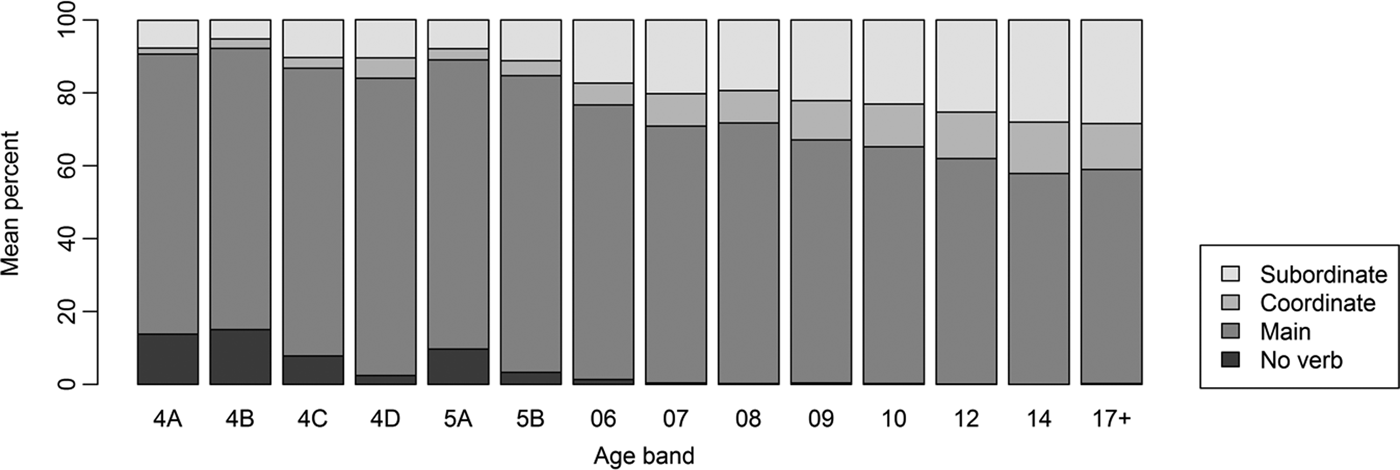
Our next aim was to consider whether all clause types were present in the narratives of four-year-old children, or whether some types did not emerge until later in development. Figure 3 shows the relative frequency of main, coordinate, and subordinate clauses in children's narratives in relation to age. These data are summed across the Tell and Recall narratives, and include both the ‘Beach’ and ‘Fish’ stories.
Mean percentage of clause types produced, by age band.

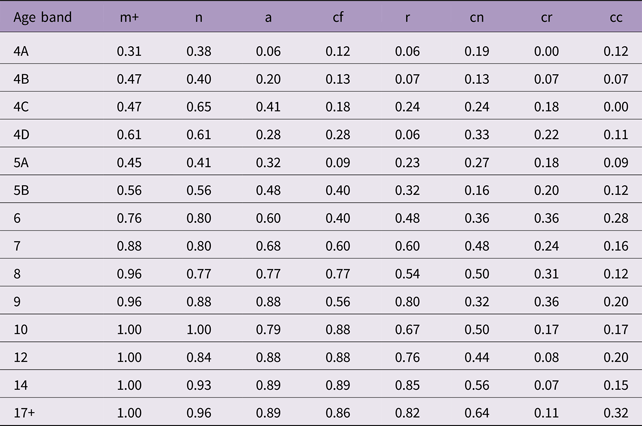
Detailed information on the mean frequency for each clause type by age band, also expressed as proportions of all utterances, is shown in Appendix 1 in the Supplementary Materials (available at <https://doi.org/10.1017/S0305000918000144>). These data do not, however, allow us to distinguish whether a relatively high mean for a clause type arises, because one or two children in the age band produced many instances, while others produced none, or because all children of that age tended to use that construction. Table 4 shows a complementary perspective on the data, namely the percentage of children in each age band who produced at least one example of a given clause type, with clause types ordered according to overall frequency.
Proportions of Individuals in Each Age Band Who Produced At Least One Example of a Given Clause Type

Notes. m+ = coordinate; n = non-finite, non-complement; a = adverbial; cf = finite complement; r = relative; cn = non-finite complement; cr = reported speech; cc = comment clause.
We can see from Figure 3 that the main clause is the most common type throughout the age range, with a gradual decrease in mono-clausal sentences produced from four years into adulthood. Between four and five years, main clauses make up an average of about 78% of all utterances produced, decreasing to a little over half of the utterances produced by the adult cohort. A coordinated main clause with an elided subject (m+) is the second most commonly produced clause type. In contrast to the main clause (the proportion of which gradually decreased from younger to older participants), the proportion of coordinated clauses gradually increased as children get older. By eight years, virtually all participants produced this clause type, compared to fewer than half the children five years and younger. Logically a decrease in main clause usage coincides with a gradual increase in the proportion of multi-clause utterances produced.
We can see from Table 4 that all clause types are present as young as four years; however, with the exception of non-finite subordinate (non-complement) clauses, multi-clause utterances are relatively rare in those between four and four-and-a-half years. We start to see a small increase in production of these utterances into the second half of the fourth year, and a more pronounced increase between six and seven years. This increase is particularly evident in the case of non-finite subordinate (non-complement) clauses, which are the type of complex sentence most commonly used in the narratives of all participants.
Relative clauses are particularly infrequent in the narratives of the younger children, averaging at 0.3% of all utterances in children between four and five years old (see Appendix 1), and produced by only 9.8% of children in this age range. Adverbials, as well as finite and non-finite complement clauses, are also infrequent, averaging less than 1% of all utterances produced in this age range. However, although infrequent, in contrast to the other subordinate clauses adverbials were produced by a greater proportion of children at this age (17.5%). In addition, while relative, adverbial, and complement clauses all showed an increase in usage from young children into adulthood, reported speech is used less frequently from about nine years onwards. Comment clauses are produced fairly infrequently throughout the age bands.
Detailed analyses of coordinate and subordinate clauses
Figure 3 gives a broad impression of how complex syntax is used over the course of development, but does not show how the different clause types are used. The data in Appendix 1 and Table 4 provide more detailed information, but do not show fine-grained developmental change.
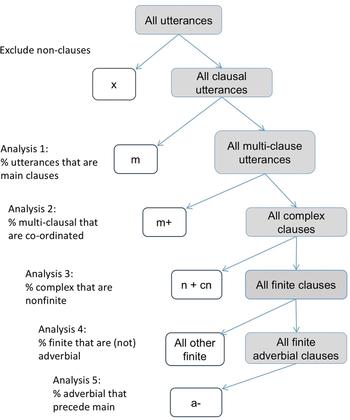
Analysis of these data is complicated by the fact that it is inevitable that, as the proportion of one type of clause goes up, other types will go down: ideally, we need an approach to analysis that involves independent comparisons. To provide a more detailed picture, we used a sequential approach, to examine the effect of age on the proportion of specific clause types within a group of clauses, focusing on increasingly specific distinctions as the analysis progressed. As previously, we used age band rather than age in years, to reflect the faster rate of change seen in younger children. An illustration of how the analysis was completed is shown in Figure 4.
Flowchart illustrating the sequential approach to the analysis of clauses.
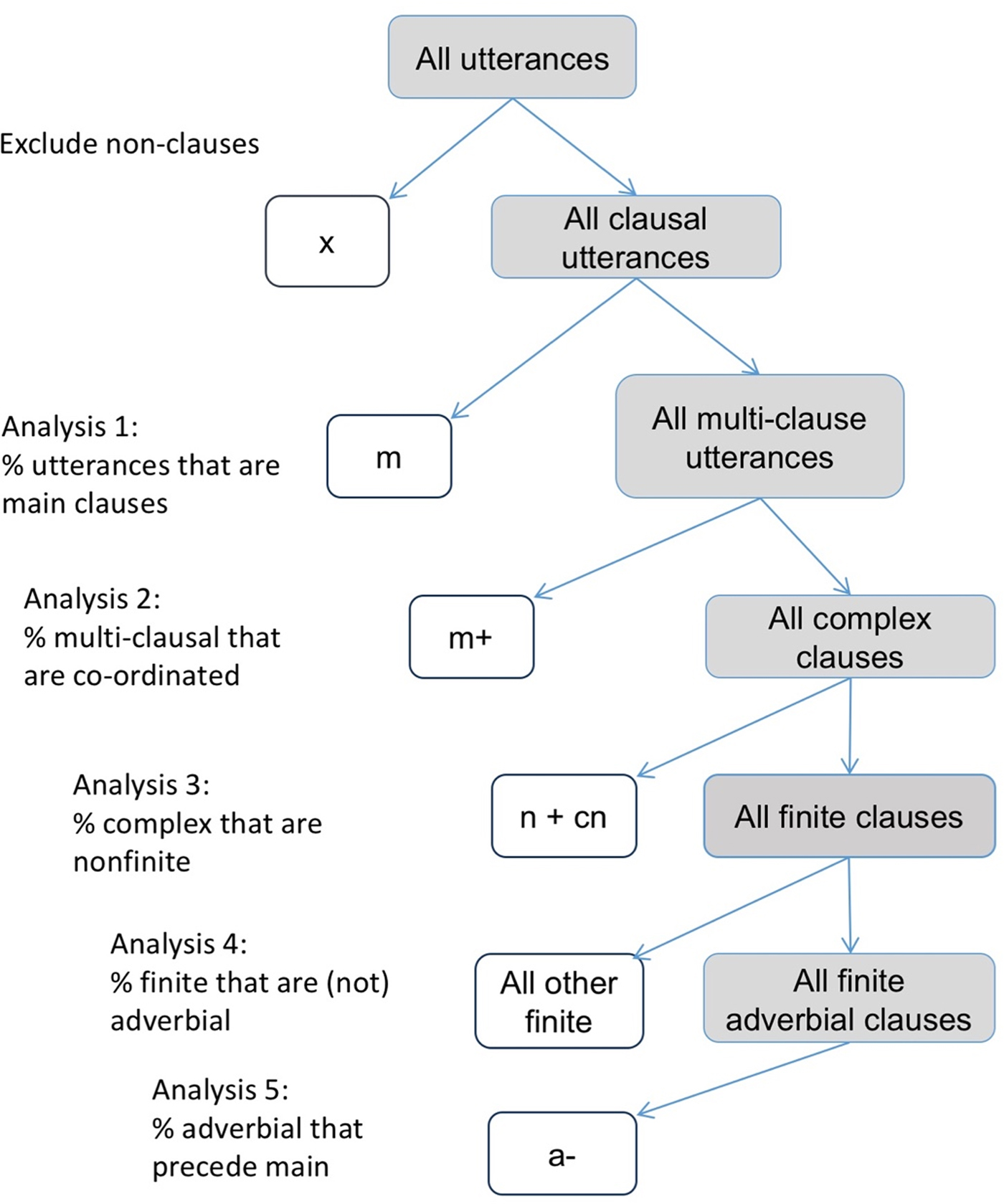
To estimate whether there were reliable age trends in clause usage, proportions of a given clause type were transformed using an empirical logit transform. Initially, poor model fit was obtained, and this was traced to the large number of zeroes in the data. Considerably better fit was obtained using a method of weighted least squares to deal with heteroscedasticity in the data, i.e., non-constant variance in the errors (Draper & Smith, Reference Draper and Smith1998).
Analysis 1: use of main clauses as a proportion of all utterances
More detailed information is available in Appendix 2 in the Supplementary Materials. The first analysis was completed on the use of mono-clausal (main clause) structures as a proportion of all clause types. Linear regression analysis showed that the proportion of mono-clausal utterances decreased significantly with age and the use of multi-clause structures increased accordingly. In the youngest age group, 90% of utterances were mono-clausal, falling to 59% in the adult group. Age accounted for 44% of the variance in main clause usage (r 2 = .43, F(1,316) = 234.3 p < .0001).
Analysis 2: use of coordinate clauses (m+) as a proportion of all multi-clausal utterances
The second regression analysis excluded the data on main clauses, and examined the extent to which complex sentences involved coordination rather than subordination. Around one-third of all complex utterances involved coordination, but age was not a significant predictor of coordinate clause usage, explaining a tiny fraction of the variance (r 2 = .001, F(1,316) = 0.37 p = .540). Thus, once children start to combine clauses, they used subordination as well as coordination.
The limited use of complex sentences by the youngest children meant that it was not feasible to analyse proportions of different clause types, so the remaining regression analyses focused only on narratives from those aged 6;00 and over. In addition, older cases with fewer than five complex sentences were excluded.
Analysis 3: non-finite clauses as a proportion of all subordinate clauses
The third analysis examined the use of non-finite clauses as a proportion of all subordinate clauses. These were fairly consistent at around one-third of all subordinate clauses, and the proportion did not change significantly with age (F(1,195) = 1.17, p = .280).
Analysis 4: adverbial clauses as a proportion of all finite clauses
The fourth analysis examined the use of adverbial clauses as a proportion of all finite clauses. Around one-third of finite clauses were adverbials, but there was no change in the proportion with age (r 2 = .001, F(1,195) = 0.43, p = .513).
Analysis 5: adverbial clauses preceding the main clause (a-) as a proportion of all adverbials
Our final analysis examined the effect of age on whether adverbial clauses were produced before or after the main clause. In the different age bands between 20% and 57% of adverbials preceded the main clause, but there was no age trend (r 2 was less than .001). Note that the proportions in this analysis are noisy because they are based on small numbers overall: many children produced only a handful of adverbial clauses.
Although age did not determine the placement of adverbial clauses, inspection of the utterances in which these occurred suggested an effect of semantic content. The adverbial tended to follow the main clause in clauses starting with because (92/93 instances), so (19/20 instances), until (13/13 instances), and where (46/46 instances). The adverbial tended to precede the main clause in clauses starting with when (190/282 instances), with a more even distribution for other temporals (after: 12/20 instances; as: 28/46 instances). We did not subject these data to statistical analysis; they should be interpreted cautiously and it should be noted that the counts are not independent (i.e., some children produced more than one instance of an adverb).
Discussion
In this study we examined complex syntax in the narrative data of children from four years through to adulthood. Our study is unique in that we report on continuous data from very young children to those from adults. This allows us to evaluate the developmental trend of complex syntactic growth on the same narrative task across a broad age range.
Does MLU fully capture growth in syntactic complexity?
It is well reported in the literature that, as speakers increase their use of subordinate clauses, T-units and C-units become longer (Loban, Reference Loban1976; Berman & Verhoeven, Reference Berman and Verhoeven2002; Nippold et al., Reference Nippold, Hesketh, Duthie and Mansfield2005), giving a strong positive correlation between clausal density and length of T-unit in language samples from school-aged children and adolescents.
It was therefore not surprising to see that both MLUw and clausal density increased with age: the question of interest was whether clausal density provides evidence of growth in complexity over and above that given by MLUw. Our results gave a clear affirmative: even after taking into account MLUw, a substantial proportion of the variance in age was accountable for in terms of clausal density. This reinforces the point that, as children's language develops, MLU alone does not reveal a comprehensive picture of syntactic knowledge. Our findings in relation to MLUw and clausal density between the ages of four and nine years are broadly similar to those documented in the ENNI (Edmonton Narrative Norms Instrument) reference database (Schneider, Dubé, & Hayward, Reference Schneider, Dubé and Hayward2005). In relation to MLUw, our results are a little lower for the four- to five-year-olds. This may be accounted for by differences in the mean age of the participants. In our sample, we divided the four- to five-year age range into four discrete age bands, and the five- to six-year range in to two age bands, thus ensuring an even age spread throughout the two age bands. In contrast, the ENNI database does not differentiate within the age bands.
Our findings in relation to middle childhood do not reveal any marked changes in MLUw, clausal density, or mean percentage of subordinate clauses used, between the ages of seven and twelve years. It may be the case that, unless given a task that obligates the use of complex syntax or where the structures are primed, children at this age will not tap into their full linguistic ability. A lack of striking changes in this age range may also explain why this age range has rarely been studied in isolation. Task differences may also account for our findings that our sample shows a maximum MLUw of 10 in comparison to other studies of narrative production reporting an MLUw of 13 (Nippold et al., Reference Nippold, Frantz-Kaspar, Cramond, Kirk, Hayward-Mayhew and MacKinnon2014). Our results showing continued syntactic growth between 12 and 14 years are not unexpected, and are in keeping with the fact that children's thought processes are becoming more abstract at this age (Byrnes, Reference Byrnes, Adams and Berzonsky2008). This increases the likelihood that they will need to use more complex sentence forms to achieve coherent self-expression. Use of subordinate clauses allows children to pack more information into fewer words, and to express themselves more efficiently than if they were limited to producing a string of simple sentences. Complex clauses also allow children to talk about complex ideas in a way that is simply impossible if only clause coordination is used. For example, consider the following complex sentence taken from our data: She goes upstairs to her bedroom to pack her stuff because her dad says she can go. As Berman and Slobin (Reference Berman, Slobin, Berman and Slobin1994b) noted, combining several clauses together not only conflates different phases of an event into an event complex, it also achieves emphasis of one event component (in the main clause) at the expense of others (in subordinate clauses). With increased syntactic competence comes efficiency in the communicative functionality of language, the ability to talk about temporal relationships, motivations, and causes, and the possibility of foregrounding specific information.
Telling vs. recalling a narrative
Because each participant told the same narrative twice (once with picture prompts and once from memory up to 30 minutes later), we could examine whether the different demands of these two contexts affected children's use of complex syntax. We had anticipated that these two tasks would lead to different language usage, but our results showed no significant differences in clausal density between the initial story-telling and recalling the story without picture prompts.
Our data suggest, instead, that there is an intimate relationship between syntactic encoding and recall, such that the more elaborated representation created by use of complex syntax is resistant to forgetting. It appears that when children generated their own story they encoded the sequence of events (within the constraints of their syntactic abilities) and formed a coherent representation of the narrative. This in turn facilitated a level of recall in keeping with their initial story-telling. The pattern shown in a proportion of our youngest cohort supports this account. We excluded from our analysis a number of children at four to five years who had difficulty generating a story from the pictures provided. These children did not produce even simple sentences, but simply labelled salient items in the pictures shown. When asked to recall the story they were unable to attempt the task. They had not encoded a story to begin with but had merely produced a fragmented list of items. On the other hand, children of the same age who did generate an initial narrative showed the ability to recall at a similar level. This lends support to the theory that the quality of recall is accounted for by the quality of encoding, which is in turn related to the ability to use complex syntax (Bishop & Donlan, Reference Bishop and Donlan2005).
Story-specific effects
Given that there were two parallel forms of ERRNI (the ‘Beach’ story and the ‘Fish’ story), we were able to see how far syntactic complexity was influenced by specific narrative content. Our results, showing that overall the ‘Beach’ story was more effective than the ‘Fish’ story in eliciting complex sentences, underscores the synergistic relationship between the features of the narrative produced and the design of the elicitation task. The influence of task demands has been highlighted by a number of researchers in recent years (Nippold et al., Reference Nippold, Hesketh, Duthie and Mansfield2005, Reference Nippold, Mansfield and Billow2007; Scott & Balthazar, Reference Scott and Balthazar2010). Nippold and colleagues have reported differences in the mean length of T-unit, as well as the number of complex sentences produced, between conversational, expository, and peer conflict resolution tasks across a number of age ranges. Our results suggest differences in both clausal density and clause types even between two similar narrative tasks. This highlights the need for well-tailored elicitation tools. It is important to realise how the narrative images will drive the structure of the language produced, and the grammatical features, as well as the verb and choice of argument structure. If the goal is to measure the upper limits of children's complex syntactic production, it is imperative that the elicitation procedure not only provides adequate opportunity to demonstrate the target skills, but also actively motivates the individual to produce them.
Nippold, Frantz-Kaspar, Cramond, Kirk, Hayward-Mayhew, and MacKinnon, (Reference Nippold, Frantz-Kaspar, Cramond, Kirk, Hayward-Mayhew and MacKinnon2015) reported on the successful use of fables in eliciting a high level of syntactic complexity among a group of 40 adolescents. They chose fables on the basis that, although they may appear superficially simple, they express meanings that are quite complex. In their study, it is noteworthy that the examiner first read the story to each participant before they were asked to retell it using picture prompts. Thus the participants did not have to generate a story from visual prompts alone. Although both the ‘Fish’ and ‘Beach’ stories were effective in eliciting complex syntax throughout the age range from six years to adulthood, designing the optimum narrative for a very young age is challenging. In addition, given that there were some children in our youngest cohort who merely labelled the salient items in the pictures and who could not attempt to formulate a story, it may be preferable to use a story retell technique (such as ‘The Bus Story’; Renfrew, Reference Renfrew1991) with children aged below six years.
Clause types
Our final aim was to find out whether the ERRNI data showed that children from four years used all the complex syntactic structures under examination, or whether some types of clausal construction are acquired at a later age. In keeping with previous literature (Diessel, Reference Diessel2004), our results showed that all clause types were produced by at least some children by four years of age, but there was wide individual variation.
Our detailed analysis of syntactic complexity shows that, from six years onwards, there is little change (within clause types) in the types of clauses produced in the ERRNI narrative tasks. The proportion of mono-clauses (coded as main clauses) gradually decreases with age, and there is a corresponding increase in the use of multi-clause utterances. However, although children produce more complex sentences as they get older, once the main clauses are accounted for, there were not striking changes in clause types with age. We had anticipated that coordination might predominate in younger children and subordination in older children, in line with Givón's (Reference Givón2009) suggestion that children acquire paratactic (chained) clauses before syntactic (embedded) clauses, but there was no evidence of this in these narrative samples.
We looked specifically at placement of the clause for adverbials, as this has been a topic of some debate in the experimental literature. It was clear from our informal observations of subordinators that the semantic content of what was talked about (temporal or causal) had a much stronger impact on adverbial clause placement than the child's age. Previous findings indicate that young children have a better understanding of temporal adverbial clauses (using connectives such as before and after) in which the order of mention is the same as the order of events (Clark, Reference Clark1971; French & Brown, Reference French and Brown1977; Trosborg, Reference Trosborg1982). However, recent findings by Blything, Davies, and Cain (Reference Blything, Davies and Cain2015) using an animation task indicate that, while the order of mention effect was evident for the connective before, it was not evident for sentences containing after. Our narrative data are in keeping with this finding, with children using the connective after fairly equally, preceding and following the main clause. This may be due to competing syntactic and semantic pressures. On the one hand, it has been proposed that syntactically the human processor prefers complex sentences with final adverbial clauses (Hawkins, Reference Hawkins1994). On the other hand, after clauses refer to an event that occurs before the one in the main clause, and so this could create a pressure for the adverbial to precede the main clause. Our findings also highlight how adverbial clauses fulfil different pragmatic functions in the context of a narrative. As outlined by previous authors (Chafe, Reference Chafe1984; Diessel, Reference Diessel2005; Givón, Reference Givón1990, pp. 846–7), sentences containing initial adverbial clauses tend to organise the flow of information and are often used to facilitate the transition between topics or narrative themes, whereas those that follow the main clause tend to provide new information or information about an additional thought. All uses of the connective before in our data followed the main clause. However, there were only four such instances, and so we cannot draw any firm conclusions.
In relation to causal adverbials, our data are in keeping with that previously reported (Ford, Reference Ford1993; Diessel, Reference Diessel2001, Reference Diessel2005) in that almost all uses of because clauses followed their associated main clause. Diessel argues that this is motivated by their pragmatic function, i.e., the fact that causal clauses are primarily used to support a statement that the listener may not believe or find persuasive.
Finally, it is noteworthy that a very small percentage of four- and five-year-olds produced relative clauses, and the number of relatives produced was very limited throughout the age ranges. This is in contrast to the naturalistic data analysed by Diessel (Reference Diessel2004) from the CHILDES database, where full bi-clausal relatives accounted for an average of 36.5% of these children's utterances. It is likely that a narrative task requiring children to generate a complete story without any verbal input is particularly difficult for children who are just four and five years old. This causes us to question the effectiveness of a narrative generation task in eliciting certain types of complex syntax at this young age. It also emphasises the point that, when trying to measure the upper limits of an individual's complex syntactic abilities, the elicitation procedure must not only provide adequate opportunity to demonstrate a range of complex syntactic skills, but must also obligate the individual to use them.
Supplementary Materials
For Supplementary Materials for this paper, please visit <https://doi.org/10.1017/S0305000918000144>.