Introduction
Prescription opioids are effective treatment for chronic and acute pain (Walwyn et al. Reference Walwyn, Miotto and Evans2010) and although most people use their medicines appropriately, recently, the non-medical use of prescription opioids has increased dramatically in the USA and other countries around the world (Haydon et al. Reference Haydon, Rehm, Fischer, Monga and Adlaf2005; Huang et al. Reference Huang, Dawson, Stinson, Hasin, Ruan, Saha, Smith, Goldstein and Grant2006; Kuehn, Reference Kuehn2007; Blanco et al. Reference Blanco, Alderson, Ogburn, Grant, Nunes, Hatzenbuehler and Sasin2007; Brands et al. Reference Brands, Paglia-Boak, Sproule, Leslie and Adlaf2010; Monheit, Reference Monheit2010). In 2008, past-year use of non-medical prescription opioids was second only to marijuana as the most frequently used illegal drugs in the USA according to the Substance Abuse and Mental Health Services Administration (SAMHSA, 2009). Estimates from wave 1 of the National Epidemiologic Study on Alcohol and Related Conditions (NESARC) indicate that approximately 4.1% of the US adult population met criteria for non-medical prescription opioid use in their lifetime and that nearly a third of the users met criteria for a prescription opioid-use disorder in their lifetime.
Prescription opioids are highly reinforcing and prolonged use can produce neurological changes and physiological dependence. Non-medical use of prescription opioids, which involves use without a prescription or in ways not recommended by a doctor (Huang et al. Reference Huang, Dawson, Stinson, Hasin, Ruan, Saha, Smith, Goldstein and Grant2006; Blanco et al. Reference Blanco, Alderson, Ogburn, Grant, Nunes, Hatzenbuehler and Sasin2007), is extremely dangerous and potentially fatal (Walwyn et al. Reference Walwyn, Miotto and Evans2010), representing a national public health concern of growing importance.
Non-medical users have an increased risk of developing a Diagnostic and Statistical Manual of Mental Disorders, 4th edition (DSM-IV) opioid-use disorder (Huang et al. Reference Huang, Dawson, Stinson, Hasin, Ruan, Saha, Smith, Goldstein and Grant2006; SAMHSA, 2010). To design effective prevention and treatment interventions to reduce non-medical use-related harm, research is needed to develop our knowledge of the determinants and consequences of non-medical prescription opioid use. Cross-sectionally ascertained samples have shown that mood and anxiety disorders are strongly associated with non-medical prescription opioid use and disorder (Sullivan et al. Reference Sullivan, Edlund, Steffick and Unützer2005; Huang et al. Reference Huang, Dawson, Stinson, Hasin, Ruan, Saha, Smith, Goldstein and Grant2006; Becker et al. Reference Becker, Sullivan, Tetrault, Desai and Fiellin2008; Tetrault et al. Reference Tetrault, Desai, Becker, Fiellin, Concato and Sullivan2008; Grella et al. Reference Grella, Karno, Warda, Niv and Moore2009), and may be particularly salient to our understanding of non-medical use. However, the etiological relevance and clinical implications of this association depend on the temporal sequence of the onset of these disorders. If pre-existing psychiatric disorders lead to non-medical use then prevention interventions focusing on individuals with mood and anxiety disorders may be necessary. Furthermore, careful screening and monitoring of non-medical use may be required among individuals with these disorders who are prescribed opiate medication for pain. If mood and anxiety disorders are a consequence of non-medical prescription opioid use, then interventions among non-medical prescription opioid users may require an additional mood/anxiety disorder prevention or treatment component. Causal hypotheses remain largely unexplored, as current knowledge of possible mechanisms of the linkage between mood and anxiety and opioid use is limited.
The association between mood/anxiety disorders and non-medical prescription opioid use can arise in one or more non-mutually exclusive ways: non-medical prescription opioid use leads to mood/anxiety disorders (‘precipitation’ hypothesis), mood/anxiety disorders lead to non-medical prescription opioid use (‘self-medication’ hypothesis), and/or a third factor influences vulnerability to both (‘shared vulnerability’). Additionally, these pathways may be operating in a bi-directional and synergistic way or only among certain subgroups. For example, one model (‘precipitation’) suggests that non-medical prescription opioid use could precipitate (i.e. lead to) mood and anxiety disorders. Specifically, behavioral and neural plasticity resulting from heavy drug use could trigger mood or anxiety disorders (Brady & Sinha, Reference Brady and Sinha2005). This may be particularly evident among individuals who develop DSM-IV opioid-use disorder due to non-medical use, since to develop a disorder their use of prescription opiates may be especially heavy. In support of this pathway, the DSM-IV includes diagnoses of substance (including prescription opioid)-induced mood anxiety disorders (APA, 1994). Thus in the precipitational model, non-medical prescription opioid use occurs before the onset of mood and anxiety disorders. In contrast, a second model (‘self-medication’) postulates that individuals with mood and anxiety disorders may use prescription opioids non-medically in order to temporarily relieve symptoms of anxiety and depression (Emrich et al. Reference Emrich, Vogt and Herz1982; Saitoh et al. Reference Saitoh, Kimura, Suzuki, Kawai, Nagase and Kamei2004). This pathway is grounded in a long history of basic science research demonstrating the anxiolytic and antidepressant properties of opioids (Emrich et al. Reference Emrich, Vogt and Herz1982; Weber & Emrich, Reference Weber and Emrich1988). As an extension of this, individuals with substantial pain may develop mood and anxiety disorders, and then engage in non-medical use of pain medication to relieve psychiatric symptoms, i.e. mood and anxiety disorders mediate the association between pain and non-medical use. In self-medication models, non-medical prescription opioid use occurs after mood and anxiety disorders.
A third model (‘shared vulnerability’), which does not require sequencing, is an underlying shared vulnerability, in which a third factor (e.g. genetic liability, environmental stressors) influences risk for both drug use/dependence and psychiatric disorders. This is supported by behavioral genetic studies (Krueger et al. Reference Krueger, McGue and Iacono2001; Young et al. Reference Young, Smolen, Corley, Krauter, DeFries, Crowley and Hewitt2002; Kendler et al. Reference Kendler, Prescott, Myers and Neale2003; Lyons et al. Reference Lyons, Hitsman, Xian, Panizzon, Jerskey, Santangelo, Grant, Rende, Eisen, Eaves and Tsuang2008). This model may explain the association between non-medical prescription opioid use and prescription opioid disorder with mood/anxiety disorders if underlying genetic factors influence both mood/anxiety disorders and non-medical prescription opioid use/prescription opioid disorder.
Previously, using diagnostic information obtained retrospectively among a large and nationally representative population based-sample, we found evidence for the existence of both precipitational and self-medication models as well as for an underlying shared vulnerability (Martins et al. Reference Martins, Keyes, Storr, Zhu and Chilcoat2009a). However, the sequence of non-medical prescription opioid use and mood and anxiety disorders can be better understood with longitudinal population-based data on incident and pre-existing use and diagnoses. Schepis & Hakes (Reference Schepis and Hakes2011) found evidence for the association between past-year non-medical prescription opioid use and incident bipolar disorder among NESARC respondents with past psychopathology, as well as between lifetime non-medical prescription opioid use and incident depressive, bipolar and anxiety disorder among those with no history of psychopathology. However, Schepis & Hakes (Reference Schepis and Hakes2011) did not examine the influence of psychopathology on non-medical opioid use and disorder, or the influence of opioid disorder due to non-medical use on psychopathology. The present study was designed to provide novel information on longitudinal associations between non-medical prescription opioid use and opioid disorder due to non-medical opioid use with mood/anxiety disorders using data from the two waves of NESARC data collected approximately 3 years apart. The NESARC is a large nationally representative epidemiologic study which includes prospective, reliable and valid information on drug use and psychiatric diagnoses, and therefore represents a unique opportunity to examine the evidence for the precipitation, self-medication and general vulnerability models. A precipitational pathway is supported if non-medical prescription opioid use and disorders due to this use at baseline predict incident mood/anxiety disorders at follow-up. A self-medication pathway is supported if mood/anxiety disorders at baseline predict incident non-medical prescription opioid use and disorders due to this use at follow-up. A general vulnerability model is supported if evidence is present for both pathways. Our aim is not to tease apart the pathways; rather, we provide the first demonstration of longitudinal incidence data in a population-based sample and provide evidence on the strength of the possibility of each model separately.
Method
Sample
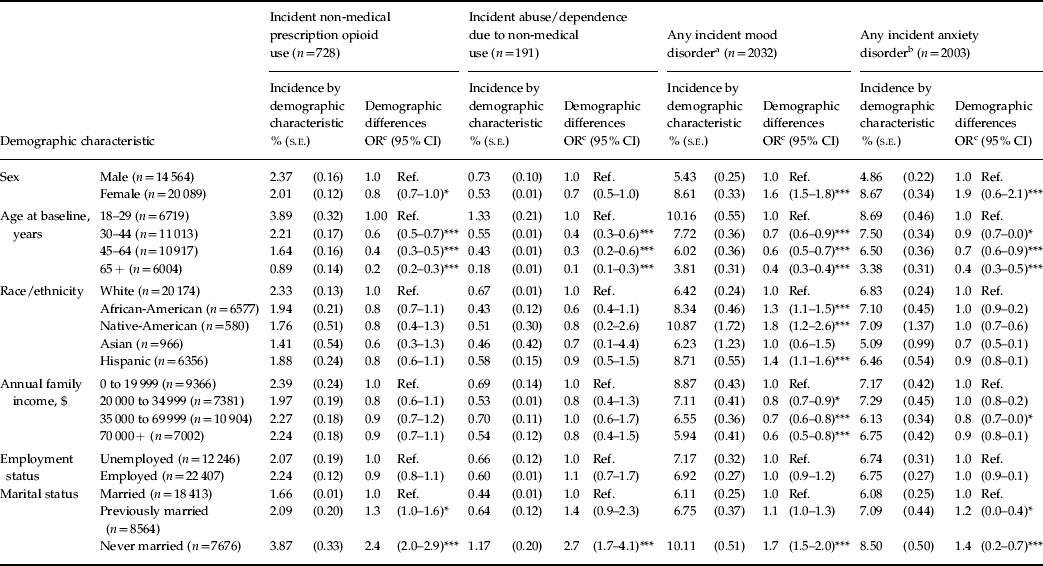
The NESARC is a longitudinal survey with its first wave of interviews fielded in 2001–2002 and second wave in 2004–2005. The target population was the civilian non-institutionalized population residing in households and group quarters, aged 18 years and older. Blacks, Hispanics and young adults (aged 18–24 years) were oversampled, with data adjusted for oversampling, household- and person-level non-response. The weighted data were then adjusted to represent the US civilian population based on the 2000 Census. Interviews were conducted face-to-face by extensively trained interviewers of the US Bureau of the Census. In 2001–2002 (wave 1 of the study), 43 093 individuals were assessed for a lifetime history of psychiatric disorders as well as other information (Grant et al. Reference Grant, Stinson, Dawson, Chou, Dufour, Compton, Pickering and Kaplan2004b). For wave 2 (Hatzenbuehler et al. Reference Hatzenbuehler, Keyes, Narrow, Grant and Hasin2008), conducted in 2004–2005, interviewers reinterviewed all possible eligible respondents from wave 1. Excluding respondents ineligible for the wave 2 interview because they were deceased (n=1403), deported, mentally or physically impaired (n=781) or on active duty in the armed forces throughout the follow-up period (n=950), the wave 2 response rate was 86.7%, with a cumulative response rate over the two surveys of 70.2%. Data were reweighted at wave 2 to account for differential loss to follow-up and to be representative of the target population. This analysis includes the 34 653 respondents who completed interviews at waves 1 and 2. The demographic characteristics of the eligible sample are provided in Table 1. All potential NESARC respondents were informed in writing about the nature of the survey, the statistical uses of the survey data, the voluntary aspect of their participation, and the federal laws that provide for the confidentiality of identifiable survey information. Respondents who gave consent were then interviewed. The research protocol, including informed consent procedures, was approved by the Census Bureau's review board and the US Office of Management and Budget.
Incident non-medical prescription opioid use, incident opioid disorder due to non-medical prescription opioid use, any incident mood disorder and any incident anxiety disorder in the overall sample (n=34 653) by selected demographic characteristics, NESARC wave 2 (incident data)

NESARC, National Epidemiologic Study on Alcohol and Related Conditions; s.e., standard error; OR, odds ratio; CI, confidence interval; Ref., reference.
a Any mood disorder includes DSM-IV primary major depressive disorder, bipolar I disorder, bipolar disorder and dysthymia.
b Any anxiety disorder includes primary panic disorder, social anxiety disorder and specific phobia and generalized anxiety disorder.
c Crude (unadjusted) OR.
* p<0.05, *** p<0.001.
Measures
The Alcohol Use Disorder and Associated Disabilities Interview Schedule (AUDADIS)-IV (Grant et al. Reference Grant, Dawson, Stinson, Chou, Kay and Pickering2003), a structured diagnostic interview, was administered to NESARC participants using computer-assisted software with built-in skip, logic and consistency checks. This instrument was specifically designed for experienced lay interviewers and was developed to advance measurement of substance use and mental disorders in large-scale surveys.
Non-medical prescription opioid use and opioid disorder due to non-medical use
Non-medical use of prescription opioids was defined to respondents as using a prescription opioid: ‘without a prescription, in greater amounts, more often, or longer than prescribed, or for a reason other than a doctor said you should use them’. After the initial probe item, the respondent was given an extensive list of examples of prescription opioids and asked if she/he used any of the prescription opioids on the list or similar drugs ‘non-medically’. If the response was positive, the respondent was asked to specify which prescription opioid she/he has used, when she/he had used it (lifetime, past year, since last interview) as well as asked about lifetime, past year and since last interview frequency of use (for the purpose of this study those that had used prescription opioids non-medically 12 or more times in their lifetime were classified as heavy users), and then the interviewer recorded the response. Over 30 symptom items are used by the AUDADIS to operationalize DSM-IV criteria to assess lifetime abuse and dependence according to DSM-IV criteria (Saitoh et al. Reference Saitoh, Kimura, Suzuki, Kawai, Nagase and Kamei2004). κ Values for the AUDADIS-IV diagnosis of lifetime non-medical prescription opioid use and disorder due to non-medical prescription opioid use in general population and clinical settings range from 0.59 for lifetime dependence to 0.66 for lifetime use (Grant et al. Reference Grant, Harford, Dawson, Chou and Pickering1995; Hasin et al. Reference Hasin, Carpenter, McCloud, Smith and Grant1997), indicating the test–retest reliability to be good to fair (Fleiss, Reference Fleiss1981; Byrt, Reference Byrt1996; Szklo & Javier-Nieto, Reference Szklo, Javier-Nieto, Sklo and Javier Nieto2004). It is important to note that wave 2 of the NESARC combines prescription opioids with cyclo-oxygenase-2 (Cox-2) inhibitors (which have no abuse potential) in a single question about the non-medical use of prescription pain medications, which could have partially inflated the incidence rate of prescription opioid use (but not disorder) in our study (Boyd & McCabe, Reference Boyd and McCabe2009). Due to this problem in wave 2 assessment we conducted sensitivity analyses that removed all incident non-medical users who did not endorse at least one non-medical opioid-use disorder question in wave 2 (the total no. of incident non-medical prescription opioid users decreased to 553). Odds ratios (ORs) in the sensitivity analyses were very similar to those in which we included all incident non-medical prescription opioid users (n=728), suggesting minimal/no bias due to the inclusion of Cox-2 inhibitor use in the list of non-medical prescription opioids in wave 2 of the NESARC (data not shown, available upon request).
Mood and anxiety disorders
Mood disorders included DSM-IV primary major depressive disorder (MDD), bipolar disorder, bipolar I disorder and dysthymia. Anxiety disorders included DSM-IV primary panic disorder, social anxiety disorder and specific phobia and generalized anxiety disorder (GAD). Diagnostic methods used in the AUDADIS-IV are described in detail elsewhere (Grant et al. Reference Grant, Stinson, Dawson, Chou, Dufour, Compton, Pickering and Kaplan2004b, Reference Grant, Hasin, Stinson, Dawson, Chou, Ruan and Huang2005; Hasin et al. Reference Hasin, Goodwin, Stinson and Grant2005). In DSM-IV, ‘primary’ excludes substance-induced disorders or those due to medical conditions; specific AUDADIS questions about the chronological relationship between intoxication or withdrawal and the full psychiatric syndrome implement DSM-IV criteria differentiating primary from substance-induced disorders. MDD diagnoses also ruled out bereavement. Test–retest reliability for AUDADIS-IV mood and anxiety diagnoses in general population and clinical settings was good to fair with κ agreement statistics ranging from 0.42 for social anxiety disorder to 0.64 for MDD (Hasin et al. Reference Hasin, Carpenter, McCloud, Smith and Grant1997; Canino et al. Reference Canino, Bravo, Ramirez, Febo, Rubio-Stipec, Fernandez and Hasin1999; Grant et al. Reference Grant, Dawson, Stinson, Chou, Kay and Pickering2003). For the purpose of this study, besides the specific disorder variables, we created a variable that combined all DSM-IV mood disorders that a respondent endorsed as well as a variable that combined all DSM-IV anxiety disorders that a respondent endorsed.
Other substance use, alcohol disorder and other drug-use disorder
The AUDADIS-IV assessed lifetime use of alcohol and other illegal drugs at wave 1 of the NESARC (e.g. marijuana, cocaine, heroin, hallucinogens, inhalants, and non-medical use of stimulants, sedatives and tranquilizers) with similar sets of questions as those described for non-medical prescription opioid use. For the purpose of this study we used data on alcohol and any other illegal drug use that occurred prior to baseline as two separate control variables (one for alcohol, one for all other illegal drugs) in the models in which non-medical use was the predictor of interest. Similarly, the AUDADIS-IV included extensive questions to operationalize DSM-IV criteria to assess lifetime alcohol-use disorders and other drug-use disorders (Saitoh et al. Reference Saitoh, Kimura, Suzuki, Kawai, Nagase and Kamei2004). For the purpose of this study we used baseline data on alcohol and other drug-use disorders into two separate control variables for the models in which opioid disorder due to non-medical use was the predictor of interest. AUDADIS-IV criteria and diagnoses for alcohol- and drug-use disorders have fair to excellent reliabilities (κ values 0.53–0.84) (Grant et al. Reference Grant, Harford, Dawson, Chou and Pickering1995; Hasin et al. Reference Hasin, Carpenter, McCloud, Smith and Grant1997).
Demographic correlates
We examined the following potential correlates of non-medical prescription opioid use and prescription opioid disorder due to non-medical opioid use for inclusion as control variables: sex, age, race/ethnicity, family income, employment status and marital status (see Table 1).
Incidence
Incidence was defined as new cases of non-medical opioid use or disorder due to non-medical opioid use among those with no history at wave 1 or new cases of psychiatric disorder among those with no history at wave 1 in the period comprised between NESARC wave 1 and wave 2 interviews (since last interview).
Statistical analysis
To examine the precipitational pathway, two sets of nested logistic regression analyses examined whether lifetime non-medical prescription opioid use and disorders due to this use predict incident mood/anxiety disorders (any mood or anxiety disorder and specific mood/anxiety disorders) at follow-up. First, demographics were included in the models as covariates. Second, to test whether these associations persisted independently of other substance-use and co-morbid mood/anxiety disorders, we controlled for baseline substance-use variables (with indicator variables representing other substance use) and baseline co-morbid mood/anxiety disorders (a binary variable representing baseline co-morbid mood/anxiety disorders, n varies by model, available upon request). In the models in which non-medical use was the predictor of interest, substance-use covariates included baseline lifetime alcohol (n=28 482, 83.4% of the baseline respondents) and other drug use (marijuana, cocaine, hallucinogens, inhalants, heroin, non-medical stimulants, non-medical sedatives and non-medical tranquilizers: n=7497, 22.5% of the baseline respondents). In the models in which the predictor of interest was disorders due to non-medical use we included baseline lifetime alcohol disorder (n=9937, 30.4% of the baseline respondents) and other drug-use disorder (n=3332, 10.1% of the baseline respondents) as covariates.
Similarly, two sets of nested logistic regression models were generated to address the self-medication pathway and determine whether mood/anxiety disorders at baseline predict incident non-medical prescription opioid use and disorders due to this use at follow-up. First, we controlled for demographics. Second, to test whether these associations persisted independent of co-morbid mood/anxiety disorders, a binary variable representing all other baseline lifetime mood/anxiety disorders (n varies by model, available upon request) was included. In addition, these models also controlled for baseline other substance-use disorders variables (described in detail in the former paragraph). Stata release 10.0 survey commands were used in all analyses to account for sample weighting and the complex survey design (StataCorp LP, USA).
Results
Incidence at wave 2 (Table 1)
Among the sample of 34 653, there were 728 (2.3%) incident non-medical prescription opioid users and 191 (0.6%) subjects who met criteria for opioid disorder (abuse and/or dependence) due to non-medical prescription opioid use in wave 2 of the NESARC. Males, those in the younger age group, and those never married or no longer married were more likely to initiate non-medical opioid use in the interval between wave 1 and wave 2. Respondents in the younger age group and those never married were more likely to meet criteria for an opioid disorder due to non-medical use in wave 2.
Additionally, there were 2032 (7.0%) respondents with incident mood disorders and 2003 (6.7%) respondents with incident anxiety disorders in wave 2 of the NESARC. Incident mood disorders at wave 2 were more likely to develop among females, those in the younger age group, African-Americans, Native Americans and Hispanics versus Whites, those with lower family income and those never married. Females, those in the younger age group, and those never married or no longer married were also more likely to have incident anxiety disorders at wave 2.
The precipitational pathway: does non-medical use precede mood/anxiety disorders? (Table 2)
Non-medical prescription opioid use
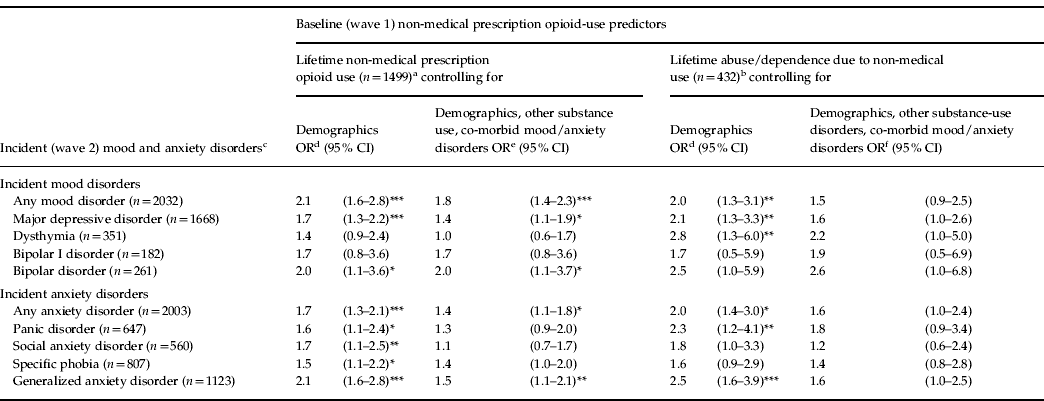
Baseline lifetime non-medical prescription opioid use was associated with the incidence of any mood disorder, MDD, bipolar disorder, and all anxiety disorders (any and specific), at follow-up in the models adjusted for demographics as well as in the models further adjusted for baseline lifetime other substance use, and baseline co-morbid lifetime mood/anxiety disorders (unadjusted models yielding similar results are available upon request). We ran sensitivity analyses to examine the precipitational pathway focusing on non-medical prescription opioid users that can be considered as heavy prescription opioid users (used prescription opioids non-medically at least 12 times in their lifetime) and findings were very similar to the ones obtained when we included all lifetime non-medical prescription opioid users.
Assessing the precipitational pathway: baseline lifetime non-medical prescription opioid use and abuse/dependence secondary non-medical use in NESARC wave 1 preceding incident mood/anxiety disorders in NESARC wave 2

NESARC, National Epidemiologic Study on Alcohol and Related Conditions; OR, odds ratio; CI, confidence interval.
a Reference is absence of lifetime non-medical prescription opioid use at baseline (wave 1).
b Reference is absence of lifetime abuse or dependence secondary to non-medical prescription opioid use at baseline (wave 1).
c In all analyses those with former mood/anxiety disorders were excluded (e.g. to investigate the association between baseline non-medical opioid use and incident major depressive disorder all respondents with major depressive disorder at baseline were excluded).
d Adjusted for baseline demographics (sex, age, race, and baseline family income, marital status, and employment status).
e Adjusted for baseline demographics, other substance use (alcohol, marijuana, cocaine, hallucinogens, inhalants, heroin, non-medical stimulant, sedative and tranquilizer use), co-morbid mood/anxiety disorders.
f Adjusted for baseline demographics and other substance-use disorders (alcohol, marijuana, cocaine, hallucinogens, inhalants, heroin, non-medical stimulant, sedative and tranquilizer use), co-morbid mood/anxiety disorders.
* p<0.05, ** p<0.01, *** p<0.001.
Non-medical opioid disorder due to non-medical use
Baseline lifetime non-medical opioid disorder due to non-medical prescription opioid use was associated with any mood disorder, any anxiety disorder, as well as with several incident mood disorders and anxiety disorders at follow-up when adjusted for demographics only. In the models further adjusted for baseline lifetime alcohol disorder and drug disorder, and baseline co-morbid lifetime mood/anxiety disorders, the associations were attenuated and none remained significantly associated with opioid disorder at follow-up.
The self-medication pathway: do mood/anxiety disorders precede non-medical use? (Table 3)
Non-medical prescription opioid use
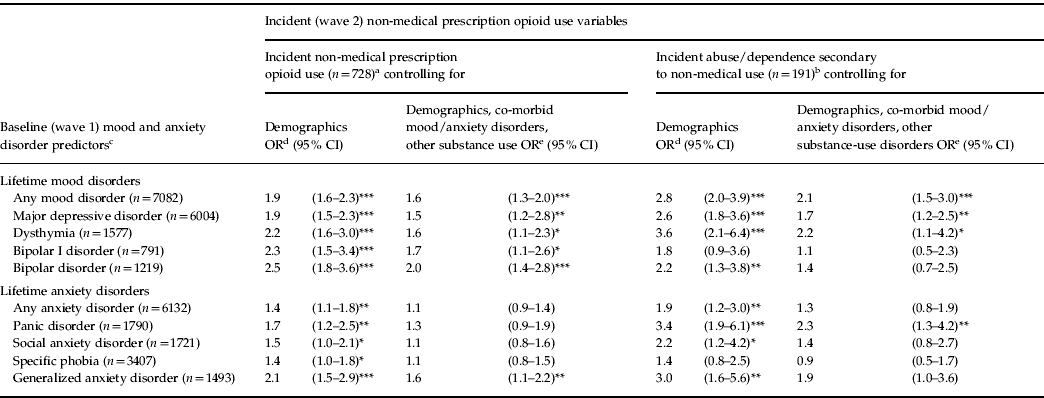
Almost all baseline lifetime mood/anxiety disorders (any and specific) were associated with incident non-medical prescription opioid use at follow-up in models adjusted for demographics. In the models further adjusted for other co-morbid baseline mood/anxiety disorders, and baseline substance use, all mood disorders (any and specific) and GAD [adjusted odds ratio (aOR) 1.5, 95% confidence interval (CI) 1.1–2.1] were associated with incident non-medical prescription opioid use at follow-up.
Assessing the self-medication pathway: baseline lifetime mood/anxiety disorders in NESARC wave 1 preceding non-medical prescription opioid use and abuse/dependence secondary non-medical use in NESARC wave 2

NESARC, National Epidemiologic Study on Alcohol and Related Conditions; OR, odds ratio; CI, confidence interval.
a Analyses conducted among those with no history of non-medical prescription opioid use at wave 1.
b Analyses conducted among those with no history of abuse or dependence secondary to non-medical prescription opioid use at wave 1.
c Reference is absence of specific mood/anxiety disorder.
d Adjusted for baseline demographics (sex, age, race, and baseline family income, marital status, and employment status).
e Adjusted for baseline demographics and other baseline lifetime mood/anxiety disorders, other substance use (prescription opioid use model)/substance-use disorders (prescription opioid disorder model).
* p<0.05, ** p<0.01, *** p<0.001.
Non-medical opioid disorder due to non-medical use
Adjusted for demographics, almost all (any and specific) baseline lifetime mood disorders and anxiety disorders were associated with incident opioid disorder due to non-medical prescription opioid use at follow-up. In the models further adjusted for other baseline mood/anxiety disorders, and baseline substance use, associations were attenuated but baseline lifetime any mood disorder (aOR 2.1, 95% CI 1.5–3.0), MDD (aOR 1.7, 95% CI 1.2–2.5), dysthymia (aOR 2.2, 95% CI 1.1–4.2) and panic disorder (aOR 2.3, 95% CI 1.3–4.2) remained associated with incident opioid disorder due to non-medical prescription opioid use at follow-up.
Discussion
We find evidence that supports all three postulated causal models linking mood/anxiety disorders and non-medical opioid use and disorder due to use and the use of incident data provides more assurance of the correct temporal sequencing. This study builds upon our prior cross-sectional study (Martins et al. Reference Martins, Keyes, Storr, Zhu and Chilcoat2009a) as well as on the study of Schepis & Hakes (Reference Schepis and Hakes2011) and provides further support for a strong relationship between mood/anxiety disorders and non-medical opioid use and disorder due to use. Previously, using survival analyses techniques with wave 1 data only we also found support for all three models; however, in that paper we only explored the associations of mood/anxiety disorders with non-medical use and dependence due to use (Martins et al. Reference Martins, Keyes, Storr, Zhu and Chilcoat2009a). By focusing on incident cases, evidence for a precipitational model pathway was found, as non-medical opioid use (but not disorder due to use) predicted mood/anxiety disorders, especially for respondents with non-medical use preceding any anxiety disorder, since in the other direction the association was non-significant. Previously, when analysing wave 1 data only, we also found evidence for a strong association between dependence due to use and subsequent GAD and bipolar I disorder, findings that were not corroborated in these incident analyses with disorder (abuse/dependence) (Martins et al. Reference Martins, Keyes, Storr, Zhu and Chilcoat2009a). By focusing on incident cases, evidence for a self-medication pathway was also found, as mood/anxiety disorders predicted incident non-medical opioid use and disorder, particularly for respondents with mood disorders such as dysthymia and bipolar I disorder preceding non-medical use, and any mood disorders, MDD, dysthymia and panic disorder predicting opioid disorder due to use, since in the other direction associations were non-significant. The previous study using only wave 1 data found evidence for a strong self-medication pathway between pre-existing bipolar I disorder and GAD and non-medical opioid dependence due to use (Martins et al. 2009a). Finally, the presence of a general shared vulnerability to both mood/anxiety disorders and non-medical prescription opioid use cannot be ruled out, since in several cases the magnitude of the associations had similar strength in both directions – from non-medical use/disorder due to use to mood/anxiety disorders and vice versa, a finding also found previously in the wave 1 data (Martins et al. Reference Martins, Keyes, Storr, Zhu and Chilcoat2009a).
The risk of incident anxiety disorders was increased among respondents with baseline non-medical opioid use after controlling for all covariates, providing support for a precipitational model in these cases. This is consistent with findings from the study of Schepis & Hakes (Reference Schepis and Hakes2011) that shows that the risk of incident anxiety disorders was increased among respondents with baseline non-medical opioid use without prior psychopathology. It should be noted that the increased risk for incident anxiety disorders was of similar magnitude for non-medical users and heavy non-medical users (sensitivity analyses, available upon request). Thus, using opioids (or even withdrawal from opioids) might precipitate anxiety disorders. This suggests that there is a subgroup of people particularly vulnerable to the future development of anxiety disorders, and so individuals using prescription opioids need to be closely monitored not only for the possibility of engaging in non-medical use, but also for the development of co-morbid psychiatric disorders. Increased risk of incident opioid disorder due to non-medical use occurred among respondents with baseline mood disorders, MDD, dysthymia and panic disorder, reinforcing the finding that respondents with mood disorders might use opioids non-medically to alleviate their mood symptoms. This again is consistent with findings from cross-sectional studies (Sullivan et al. Reference Sullivan, Edlund, Steffick and Unützer2005; Huang et al. Reference Huang, Dawson, Stinson, Hasin, Ruan, Saha, Smith, Goldstein and Grant2006; Becker et al. Reference Becker, Sullivan, Tetrault, Desai and Fiellin2008; Tetrault et al. Reference Tetrault, Desai, Becker, Fiellin, Concato and Sullivan2008; Grella et al. Reference Grella, Karno, Warda, Niv and Moore2009) and builds upon our previous study (Martins et al. Reference Martins, Keyes, Storr, Zhu and Chilcoat2009a) which provides support for a self-medication pathway between opioid disorder and mood/anxiety disorders. This is also consistent with findings from Robinson et al. (Reference Robinson, Sareen, Cox and Bolton2011) who show that self-medication in anxiety disorders confers substantial risk of incident substance-use disorders, however, in that study, the authors did not test for associations of baseline anxiety disorders specifically with incident prescription opioid disorder, nor adjusted for baseline other substance use. Thus, early identification and treatment of mood and anxiety disorders might reduce the risk for self-medication with prescription opioids and the risk of future development of an opioid disorder. Furthermore, an underlying shared vulnerability for non-medical prescription opioid use and mood/anxiety disorders could exist. Thus, family and twin studies are needed to disentangle the relationship between non-medical prescription opioid use/prescription opioid disorder with mood/anxiety disorders, since they could co-occur due to shared genetic or environmental risk factors, similar to what was found when examining the association between nicotine dependence and major depression (Martins et al. Reference Martins, Keyes, Storr, Zhu and Chilcoat2009a). It is important to bear in mind that as with other drug-use disorders, opioid disorder due to non-medical use is a genetically and phenotypically complex disorder (Compton et al. Reference Compton, Thomas, Conway and Colliver2005b). Moreover, the social environment in which population groups grow up certainly plays a role in the underlying general vulnerability for non-medical prescription opioid use/opioid disorder and mood/anxiety disorders; for example, McCabe et al. (Reference McCabe, Cranford, Boyd and Teter2007) have shown that, among college students, most of them use prescription opioids non-medically to self-medicate, followed by a smaller proportion that use them to ‘get high’ or to experiment with these drugs. In addition, studies have shown that the leading sources for obtaining prescription opioids for non-medical use are family and friends (McCabe et al. Reference McCabe, Cranford, Boyd and Teter2007; Martins et al. Reference Martins, Storr, Zhu and Chilcoat2009b).
Several study limitations merit mention. First, loss to follow-up might have introduced bias in the sample and, consequently, in the generalization of results. Furthermore, all information is based on self-report, as in all large-scale epidemiologic surveys. As such, the validity of these results is predicated on the accuracy of the information provided by respondents. However, studies have shown that the AUDADIS-IV has good reliability and validity (Grant et al. Reference Grant, Dawson, Stinson, Chou, Kay and Pickering2003, Reference Grant, Hasin, Stinson, Dawson, Chou, Ruan and Huang2005). The follow-up period between waves 1 and 2 of the NESARC is only approximately 3 years, and does not include any new cases that could occur in future years. Thus, the results of our study may underestimate the true magnitude of the associations between non-medical opioid use and incidence of psychiatric disorders. In addition, as acknowledged earlier, wave 2 of the NESARC combines prescription opioids with Cox-2 inhibitors (which have no abuse potential) in a single question about the non-medical use of prescription pain medications, which could have somewhat inflated the incidence rate of prescription opioid use (but not disorder) in our study (Boyd & McCabe, Reference Boyd and McCabe2009). However, the incidence of non-medical prescription opioid use in wave 2 of the NESARC is similar to rates obtained with data from the 2004 (2.9%) and 2005 (2.6%) National Surveys of Drug Use and Health (using recent-onset use as a proxy of incidence; SAMHSA, 2005, 2006) that asked specifically about non-medical prescription opioid use. In addition, the sensitivity analyses we conducted suggest that the incidence of non-medical prescription opioid use in wave 2 is not over-inflated. Further, we do not have information on whether non-medical opioid users initiate opioid use seeking euphoria (via medical prescription or not) or analgesia (via medical prescription or not) and where the first significant exposure occurred. Subtypes of opioid users may be unique in many aspects of co-morbidity and demographics. Future research specifically focusing on prescription opioid use and disorders may be able to provide more information on subtypes of opioid users in the general population. Another major limitation of the study seems to be the use of lifetime use and lifetime diagnosis at baseline, however, when we attempted to run similar models with past-year use diagnosis at baseline, the sample sizes were largely reduced and we did not have power to run the models. Last, to reduce the overall complexity, our results are based on a set of statistical models that only included a narrow set of covariates. Our models were not adjusted for the 10 personality disorders available in the NESARC dataset (Grant et al. Reference Grant, Hasin, Stinson, Dawson, Chou, Ruan and Pickering2004a). However, estimates from models that also adjusted for pain, family history and antisocial personality disorder were similar to the ones reported (data not shown, available upon request).
Despite limitations, the present study adds substantial information to the literature on non-medical prescription opioid use and prescription opioid disorder and psychopathology. Major strengths of the data include how the NESARC project was administered (national sampling frame and standardized questions) and the longitudinal character of the data (Grant et al. Reference Grant, Harford, Dawson, Chou and Pickering1995, Reference Grant, Dawson, Stinson, Chou, Kay and Pickering2003). The large sample size of the NESARC allows for statistical power to detect evidence for the hypothesized pathways of not only non-medical opioid use but also the less common condition of opioid disorder that had resulted from non-medical prescription opioid use with psychiatric disorders. Further, the AUDADIS-IV has documented reliability and validity in assessing drug-use disorders as well as psychiatric disorders.
In conclusion, this study provides support for a bi-directional pathway (self-medication and precipitational) between non-medical prescription opioid use/opioid disorder due to non-medical use and several mood/anxiety disorders. In addition, it does not rule out the existence of an underlying general vulnerability that could explain these associations. It is important for clinicians to investigate substance-induced mood/anxiety disorders when treating patients who use prescription opioids non-medically or have a prescription opioid disorder as well as to ask patients with mood/anxiety disorders about their drug-using behavior.
Acknowledgements
This research was supported by grants from the National Institute on Drug Abuse (R21 DA020667 to S.S.M.; R03 DA023434 to S.S.M.; K02 DA023200 to C.B.; R01 DA019606 to C.B.) and by the New York State Psychiatric Institute (C.B.). The authors thank Ms. Grace Lee for help in formatting the paper.
Declaration of Interest
None.