Introduction
Hurricane Harvey, one of the worst American natural disasters since Hurricane Katrina, decimated the city of Houston with over 1 trillion gallons of rainfall from August 26 to August 30, 2017. 1 Harris County, which encompasses Houston, reported 36 hurricane-related deaths 2 and over US $81.5 billion in economic losses. 3 Research on Harvey’s effects on emergency medicine, Reference Pines4 pediatrics, Reference Carroll and Frakt5 environmental health, Reference Horney, Casillas and Baker6 psychiatry, Reference Schwartz, Tuminello and Kerath7 and infectious disease Reference Marquez, Koy and Baker8 has been published to aid future natural disaster preparation. However, a research gap remains for natural disaster eye health, both for Hurricane Harvey and for ophthalmological literature as a whole.
In the United States, natural disaster eye health has been documented through case reports and case series. Sridhar et al. described 3 cases of neuro-ophthalmic fungal infections across separate hurricanes in the Florida area, Reference Sridhar, Lam, Pasol and Sternau9 Davies et al. reported 4 cases of rhino-orbital-cerebral mucormycosis following a record flood year in Colorado, Reference Davies, Smith, Hink and Durairaj10 and Jones documented the eye diseases treated at the Superdome shelter post-Hurricane Katrina. Reference Jones11 Most extensively, the US Centers for Disease Control and Prevention reported 88 conjunctivitis cases after Hurricane Georges in the US Virgin Islands, compared to only 3 cases in the previous month. 12
Internationally, Xiong et al. reported 138 cases of acute conjunctivitis in China after an earthquake-related insecticide accident. Reference Xiong, Lin and Xvi13 Bich et al. found a statistical increase in “pink eye,” psychological problems, hypertension, and dermatitis in flooded areas of Hanoi through a self-reported survey of Vietnamese households. Reference Bich, Quang and Ha14 Finally, Huang et al. noted no statistical change in flood-associated eye disease across 10 years of Taiwanese insurance claim data, though statistical increases in gastrointestinal tract and skin diseases were noted. Reference Huang, Wang and Wu15
Osaadon et al. provided one of the most comprehensive ocular natural disaster health studies, which documented the patient demographics and ocular morbidities seen at an Israeli field hospital after the 2010 Haiti earthquake, 2013 Philippines typhoon, and 2015 Nepal avalanche. In addition, ophthalmology-specific diagnoses were delineated and classified as disaster or non-disaster-related. Reference Osaadon, Tsumi and Pokroy16
Ophthalmology-specific public health crises have been previously analyzed, such as the global Fusarium keratitis outbreak. Reference Rao, Lam and Li17-Reference Epstein19 In a similar fashion, our study examines the ophthalmology-specific public health effects from a hurricane. The purpose of this study is threefold: (1) to characterize the ophthalmology consultations ordered at Houston’s largest county hospital immediately following Hurricane Harvey, (2) to statistically compare these consultations to those in a control group, and (3) to reduce the research gap in natural disaster-related eye health.
Methods
Data Collection
A retrospective chart review of electronic health records (EHRs) was performed at Ben Taub General Hospital (BTGH), a level 1 trauma center and Harris County’s main hospital, in Houston, Texas. This analysis was compliant under the Institutional Review Board (IRB), Declaration of Helsinki, and Health Insurance Portability and Accountability Act of 1996 (HIPAA).
The experimental, post-Harvey group (Group 2) included all patients who received an EHR-documented ophthalmology consultation from September to October 2017, the time period immediately following Hurricane Harvey. The control group (Group 1) consisted of all patients who received an EHR-documented ophthalmology consultation from September to October 2016, the same time period from 1 year before Hurricane Harvey. A 2-month window was chosen to maximize data inclusion, especially for longer onset diseases such as fungal infections, while minimizing the opportunity for non-hurricane confounders to affect data. An emergency department population was chosen (1) to measure hurricane-specific, organic consultations, rather than clinic appointments scheduled months in advance and (2) to maximize the available data, since the BTGH ophthalmology clinic was temporarily closed after Harvey, while the BTGH emergency department remained open during the entire aftermath.
Consultation volume, patient demographics and histories, and ophthalmology-related ICD10 diagnoses were collected. Insurance payers were classified as “Medicare,” “Medicaid,” “County-funded,” “Private,” or “None on record.” Order time was categorized as “Work hours” (8:00 AM–5:00 PM) or “After hours” (5:01 PM–7:59 AM). “Distance from Zip Code to Hospital” measured the miles from a patient’s listed home zip code to the BTGH zip code by using US Census Bureau Gazetteer data. 20 Patient ICD10 codes were categorized as “Extraocular,” “Intraocular,” “Infectious,” “Physiological,” or “Other.” ICD10 codes were further subcategorized as “Trauma-related” or “Non-trauma related” (Appendix).
Analytical Approach
R (The R Foundation, Vienna, Austria), an open-source programming language, was used for statistical analysis. Tableau Public (Tableau Software, Seattle, WA) was used to geographically display consultation data.
Categorical variables were analyzed with Fisher-exact tests and chi-square tests, determined by the presence of 5 or less or 6 or more entries per category, respectively. Numerical statistics were calculated with Mann-Whitney tests because the data were not normally distributed. Though each test is an independent variable, potential cross-over between patients with multiple ICD10 diagnoses was possible. Thus, since 14 separate statistical tests were performed, a Bonferroni correction Reference Armstrong21 was applied to calculate an adjusted α value of 0.004, rounded to the nearest thousandth.
Data points with unknown values were removed from their respective statistical analysis to ensure a fair comparison between groups. Thus, different variables had different sample sizes based on the available EHR information. For example, only 87 out of 114 Group 1 consultations contained a listed body mass index. For statistical comparison, only these 87 consultations were compared to corresponding 76 out of 91 post-Harvey consultations, vetted in an identical manner. The total number of ICD10 diagnoses exceeds the total number of ophthalmology consultations because multiple ophthalmology ICD10 codes were recorded for some of the consultations.
Results
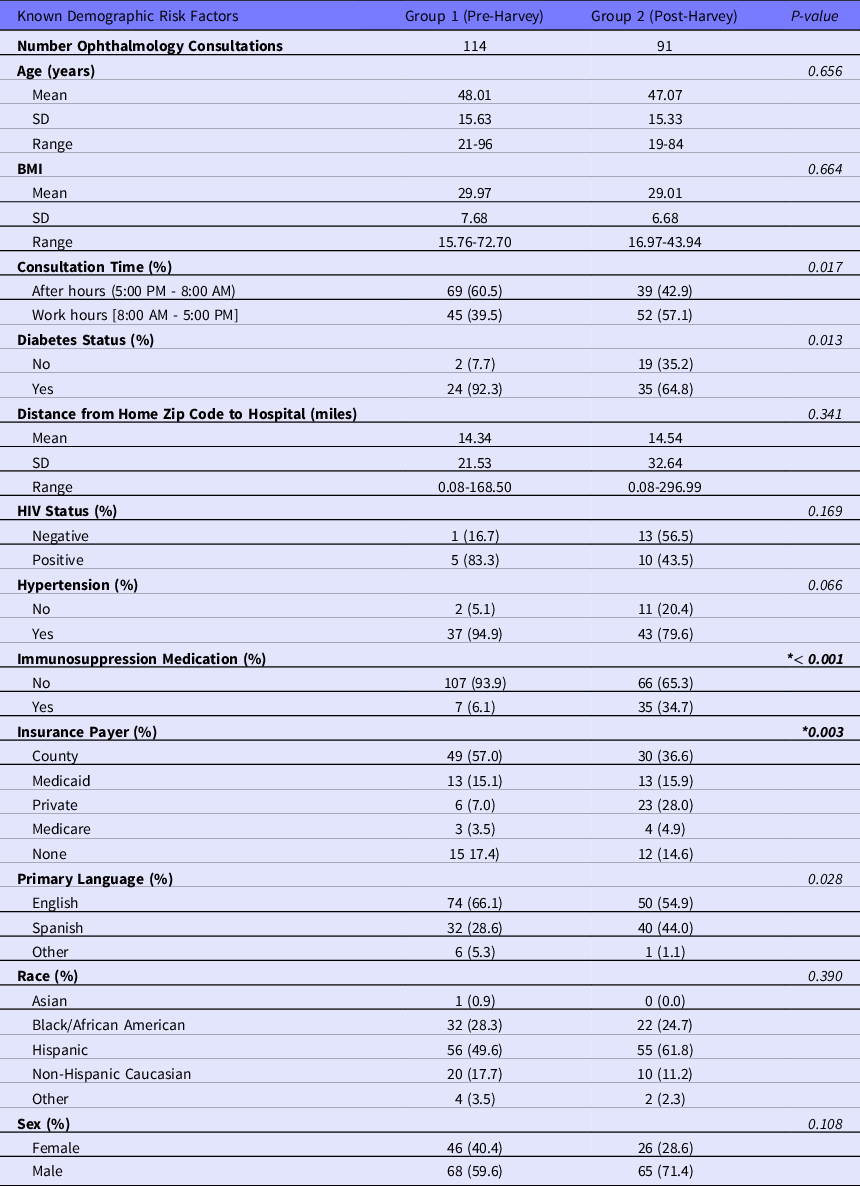
After Hurricane Harvey, the number of infectious ICD10 diagnoses increased from 8 to 22. In contrast, the volume of all other ICD10 ophthalmology diagnoses decreased after Hurricane Harvey (Table 1). The odds ratio for infectious ICD10 diagnosis and exposure to Hurricane Harvey was 4.43, with a 95% confidence interval of [1.894, 11.430]; in comparison, the odds ratio for trauma-related ICD10 diagnosis and exposure to Hurricane Harvey was 2.13 with a 95% confidence interval of [5.600, 15.100] (Table 2). The number of ophthalmology consultations decreased from 114 patient encounters in Group 1 (pre-Harvey) to 91 patient encounters in Group 2 (post-Harvey). Statistically significant proportion changes were found for Insurance Payer and Immunosuppression Medication (Table 3).
Diagnostic differences between Group 1 (pre-Harvey) and Group 2 (post-Harvey) ophthalmology consultations

Notes: *Statistically significant with α = 0.004 (Bonferroni correction).
ICD10 diagnosis odds for the post-Harvey group (exposed group) versus the pre-Harvey group (control group)

Notes: *Statistically significant.
Demographic risk factors for Group 1 (pre-Harvey) vs Group 2 (post-Harvey) ophthalmology consultations

Notes: *Statistically significant with α = 0.004 (Bonferroni correction).
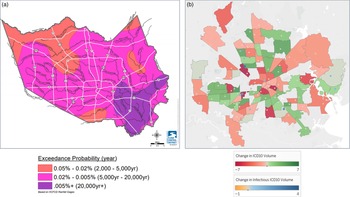
A zip code heat map was created to compare the changes in ICD10 diagnosis volume to the magnitude flooding in Harris County, as reported by the Harris County Flood Control District. Reference Lindner and Fitzgerald22 By zip code, an increase or decrease in total ICD10 diagnoses was indicated by a green or red, respectively. An increase or decrease in specifically Infectious ICD10 diagnoses was indicated by a yellow or blue dot, respectively. Flooding intensity increased in a Southeast direction, the distribution of overall ICD10 and infectious ICD10 changes appeared to be uncorrelated with flood levels (Figure 1).
Geographical analysis of Hurricane Harvey. A) Four-day peak rainfall levels in Harris County by historical probability (adapted from Harris County Flood Control District20); B) ICD10 documentation volume change in Group 2 (Post-Harvey) compared to Group 1 (Pre-Harvey).

Discussion
The differences between Group 1 and Group 2 are likely attributable to a combination of multiple factors. Regarding the decrease in ophthalmology consultation volume, physical, and emotional stressors Reference Jacob, Arnold and Hunleth23 may have encouraged Houstonians and volunteers to delay eye care, which may have been perceived by patients as lower priority Reference Taber, Leyva and Persoskie24 when compared to flooded homes or stranded family members. However, Pines et al. Reference Pines25 reported significant volume increases at Houston freestanding emergency departments during the 9 days after Harvey, with peak levels reaching 125% of the baseline. A similar volume spike was reported by Long Island emergency departments following Hurricane Sandy in 2012. Reference Kim, Schwartz and Hirsch26 Thus, accessibility may have also contributed to the decrease in volume at BTGH. Flooded streets may have reduced hospital accessibility in Houston, forcing Houstonians to instead visit closer, freestanding emergency departments. Accessibility issues may have also driven the rise in privately insured patient percentage and decline in county-insured and uninsured patient percentage. Residents who may have preferred a private hospital could have been forced to go to BTGH by transportation limitations. In contrast, county-insured and uninsured patients who may have relied on public transit could have been stranded without means of transportation to BTGH. However, it should be noted that our analysis did not find statistical differences in the distance from patient homes to BTGH, and our heat map did not appear to show correlation between flooding severity and patient volume. Further research is needed to clarify the weight of geography on natural disaster eye morbidity volume. Nevertheless, for future natural disaster preparation, geographic variables should be considered when forecasting ophthalmology case volume.
The proportional rise in patient consultations associated with immunosuppression medication is also likely multifactorial. Immunosuppression can increase susceptibility to infection, including the variety of fungal, viral, and bacterial diagnoses documented in Group 2. However, this surge may have also arisen from refill needs. After Hurricane Katrina, Jhung et al. reported that 68% of all evacuee prescriptions were for chronic medications. Reference Jhung, Shehab and Rohr-Allegrini27 Similar refill demand has been documented after Hurricanes Iniki, Reference Gnauck, Nufer and LaValley28 Wilma, Reference Taylor, Stokes and Bajuscak29 Andrew, Reference Gnauck, Nufer and LaValley28 and Ike, Reference Noe, Schnall and Wolkin30 although systematic review has concluded that medication replenishment needs vary by disaster. Reference Ochi, Hodgson and Landeg31 Given the similar medication uptrend observed in our ophthalmology consultation patients, ophthalmologists should be mindful of medication inventory when preparing for natural disasters, particularly for chronic eye diseases. In addition, public education may also improve disaster eye health. Heslin et al. reported that only 60.1%–81.9% of California residents carried a 2-week emergency supply of their chronic medications Reference Heslin, Gin and Afable32 ; thus, preemptive awareness and planning may reduce emergency medication needs.
Perhaps most notably, infectious eye diagnoses rose dramatically after Hurricane Harvey, increasing over 150% from 8 to 22, with an odds ratio of 4.43. In comparison, the odds ratio for traumatic eye diagnoses was 2.13. Previous literature has also described ocular infections after natural disasters. Reference Sridhar, Lam, Pasol and Sternau9,Reference Davies, Smith, Hink and Durairaj10,12,Reference Bich, Quang and Ha14,Reference Osaadon, Tsumi and Pokroy16 However, some authors have also reported increases in traumatic eye injuries following typhoons/hurricanes Reference Jones11,Reference Rotheray, Aitken and Goggins33 and other natural disasters such as earthquakes and avalanches. Reference Osaadon, Tsumi and Pokroy16 These discrepancies between infectious and traumatic morbidities may be correlated with the characteristics of specific natural disasters. While Hurricane Harvey was a true Category 4 hurricane, 3 the majority of its damage stemmed from flooding, rather than wind speed. It is possible that flooding may correlate more closely with infectious eye diseases, while high wind speeds may cause more eye trauma. Further research is needed, but consideration for the specific type of natural disaster and even the specific characteristics of a natural disaster category, such as hurricanes, may be helpful for eye health preparation.
To our knowledge, an analysis of natural disaster eye health with this depth and inclusivity has never been performed before in the English literature. Our study is unique in its combination of control group utilization, statistical analysis, and ophthalmology-specific data. Most importantly, our study provides guidance for natural disaster preparation in ophthalmology and lays the groundwork for reducing the research gap in natural disaster eye health.
As with any study, our analysis has limitations. Our methodology relied on EHR documentation for data inclusion; thus, only consultations recorded in the EHR system were analyzed. Difficulties with comprehensive case documentation have been noted in literature, Reference Wolf, Taylor and Placek34 even without hurricane-related disruptions. Therefore, realistically, our analysis is likely an underrepresentation of the full ophthalmology consultation data set. However, while our post-hurricane data may be underreported, we collected our control group data in an identical manner to ensure fair statistical comparison. Since the majority of our analysis was proportion-based, we remain confident that our statistical conclusions between groups are valid, although specific numbers may be variable. For future studies, prospective consultation recording, rather than retrospective review, may provide stronger data. While our analysis is one of the largest and most detailed studies of its kind, only 1 physical location (BTGH) was assessed, and the 2-month study duration may have limited the capture of indirect health consequences, particularly those related to postponed consultations, rescheduled appointments, and overall delayed care. BTGH is the main county hospital in Houston and one of the busiest trauma centers in the United States, but a larger location sample size and longer study period may strengthen the analysis of future studies. Finally, although a short time period between Harvey’s landfall and this analysis provides a swift conclusion and guidance, our analysis was focused on short-term, rather than long-term ocular morbidity. Future research may provide more insight into long-term natural disaster eye health by incorporating longitudinal models used by other medical specialties Reference Schwartz, Tuminello and Kerath35,Reference Horney, Casillas and Baker36 or analyzing longitudinal natural disaster databases such as the Hurricane Harvey Registry. Reference Miranda37 In addition to direct eye health effects, these future studies could also investigate indirect ophthalmological complications driven by social determinants of health and delayed care.
Conclusion
Although further research is warranted, public health disaster planners should consider weather-specific risks in terms of geography, infection, trauma, chronic comorbidities, and medication when preparing for the ophthalmological effects of a natural disaster. For hurricanes, in particular, the effects of flooding versus high wind may merit different ophthalmological precautions.
Conflict(s) of Interest
The authors declared no potential conflicts of interest with respect to the research, authorship, and/or publication of this paper.
Supplementary material
To view supplementary material for this article, please visit https://doi.org/10.1017/dmp.2020.470