


‘The potential of street foods for improving the food security and nutritional status of urban populations remains almost totally unexplored.’ (Draper, 1996)( Reference Draper 1 )
Globalization is affecting food systems around the world by means of urbanization, increasing incomes, foreign investment and market liberalization( Reference Levin, Ruel and Morris 2 ). Due to rapid urbanization taking place in many developing countries, street foods have become increasingly important as an income-generating strategy and as a fast and economical meal option. Since entry into the field is largely unregulated and does not cost much upfront investment, it has become an increasingly popular way for families, and specifically women, to earn a living( Reference Levin, Ruel and Morris 2 ).
Street foods have been defined as: ‘ready-to-eat foods and beverages prepared and/or sold by vendors and hawkers especially in streets and other similar places’( Reference Nago, Lachat and Huybregts 3 ). This includes foods sold within and around schools which are not from school canteens or restaurants. Mwangani et al. define street foods as: ‘ready-to-eat foods and beverages, processed or fresh, which are sold at stationary locations or by mobile vendors in streets and open places as opposed to stores and licensed establishments’( Reference Mwangi, den Hartog and Foeken 4 ). To differentiate street food vendors from formal sector food establishments, such as restaurants, a further qualification is added that street foods are sold on the street from ‘pushcarts or baskets or balance poles or from stalls or shops having fewer than four permanent walls’( Reference Tinker 5 ). In the present study we also included kiosks which did not include permanent walls.
Chakravarty and Canet( Reference Chakravarty and Canet 6 ) classified street food vending into three general groups. These include: (i) an operation where the vendor prepares food at home and brings it to the food stall to sell; (ii) foods prepared and sold at the food stall; and (iii) foods prepared in a cottage type of factory and brought to the stall for sale. Foods processed and packaged by industrial factories provide a further and usually more recently vended group of street foods (e.g. packets of crisps, candy, biscuits and soft drinks). Selling generally takes place at a fixed location. However, many vendors move around with their equipment and wares, frequenting places where consumers are concentrated such as bus terminals, stations and garages( Reference Chakravarty and Canet 6 ). Outdoor foods sold by vendors are either eaten on the spot or taken home.
Despite the fact that street foods have been sold for numerous decades and provide a source of income to many families, there is a dearth of data regarding the contribution of street foods to the nutritional value of the diet. It is essential for policy makers and nutrition educators to have a good understanding of the type and nutritional value of street foods since their consumption in many countries has become entrenched in habitual eating patterns and may influence the development of non-communicable diseases and other nutrition-related conditions in the population. This is especially important in terms of the increase in the prevalence of obesity in many developing countries, particularly the increase in children and adolescents( Reference Haslam and James 7 , Reference Lobstein, Baur and Uauy 8 ). The objective of the present review was hence to obtain street food surveys in the peer-reviewed literature that have documented the contribution of street foods to dietary intake and to determine the significance of street foods in the diet.
Methods
The review was undertaken to obtain and examine studies on street foods in developing countries that included data on the nutritional value of street foods.
Types of studies
To be eligible for inclusion in the review, studies had to:
-
1. describe the nutritional contribution of street foods to the diet in terms of (i) nutritional value of foods or (ii) types of food groups consumed;
-
2. study foods sold by vendors in developing countries (as defined by the World Bank)( 9 ); and
-
3. be published in peer-reviewed journals up to and including March 2012.
Information on the types of food items sold, frequency of street food consumption and association with socio-economic status (SES) is presented when available in the articles eligible for inclusion.
Studies were excluded when they:
-
1. were not in the peer-reviewed literature (e.g. reports and workshop proceedings);
-
2. focused on street foods consumed in developed countries;
-
3. focused on foods consumed in traditional venues such as restaurants and canteens;
-
4. included food items purchased from licensed fast-food outlets; and
-
5. included foods consumed by institutionalized adults.
Outcome measures
The purpose of the review was to elicit data on street foods and their contribution to the nutritional value of the diet. Nutritional data included any of the following: energy intake; percentage contribution to daily energy intake (%EI); macronutrient intake; micronutrient intake; dietary diversity; and food groups.
Types of participants
Studies that had a general population approach were included in the review.
Search strategy
The research team searched the electronic databases PubMed/MEDLINE, Web of Science, Cochrane Library, Proquest Health and Science Direct. The search term used in all databases was ‘street food’. This broad term ‘street food’ [All Fields] was used in an attempt to cover all articles on street foods due to the scarcity of peer-reviewed literature in this field. Manual searching of abstracts was then done to find those which included data on nutritional value of street foods.
Identification of relevant studies
Three reviewers (N.P.S., J.H. and Z.M.) independently assessed the retrieved titles (step 1) and abstracts of selected titles (step 2) by assessing the relevant articles for inclusion against the criteria described earlier. Full-text articles were obtained of those studies that were eligible for inclusion in the review based on the abstract. Data from studies that met the inclusion criteria and did not meet any exclusion criteria after reading the full article were extracted by one reviewer (N.P.S.) into structured summary tables (step 3) and checked by two reviewers (Z.M. and J.H.; step 4). Studies that were published as separate papers were included as being one study when the sample size, authors and geographic areas were the same.
Data synthesis
Each study was summarized and described with regard to: (i) the nutritional contribution of street foods to the diet in terms of %EI and/or percentage of the RDA of macro- or micronutrients provided; (ii) the types of food groups supplied by street foods; (iii) the frequency of street food consumption; (iv) the type of street foods consumed; and (iv) data on SES associated with street food intake. These data are presented in Tables 1–3.
Studies which met the inclusion criteria for the review

M, males; F, females; N/A, not applicable.
Results and discussion
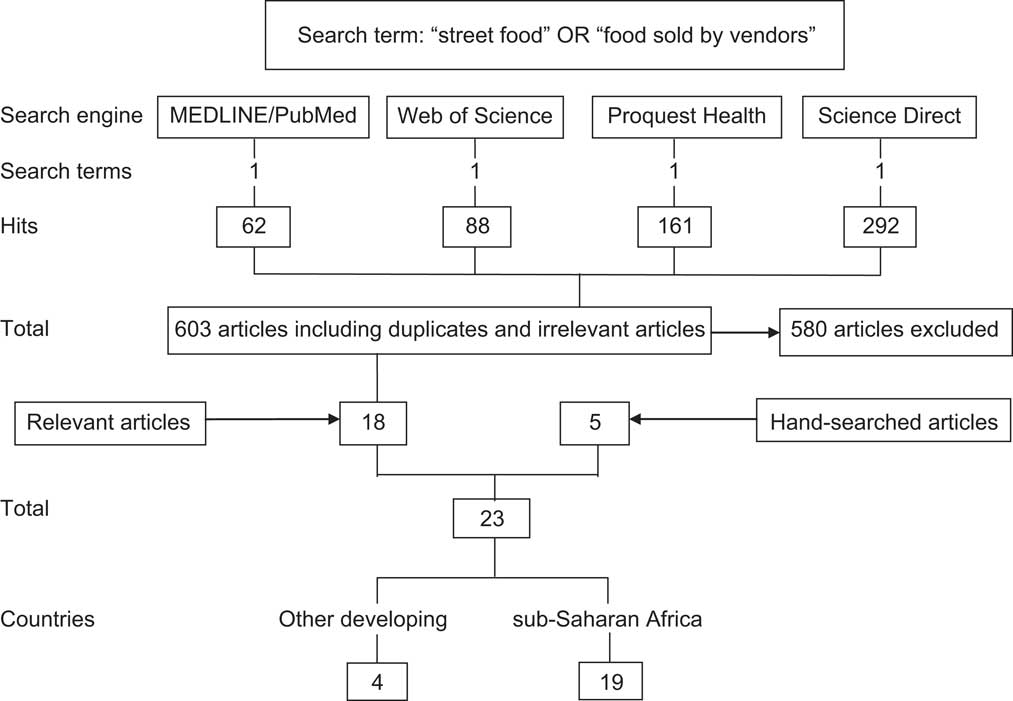
The search of peer-reviewed literature was undertaken in January–March 2012 according to the process described in Fig. 1. After removing studies which did not meet the inclusion criteria and duplicates, we were left with twenty-three studies. These were classified into nineteen studies from sub-Saharan Africa and four from other developing countries. All studies found were descriptive cross-sectional studies.
Number of studies retrieved during the screening process
Nutritional contribution of street foods
The majority of studies demonstrated that street foods contributed significantly to the diet of children and adults in developing countries, both in terms of energy, protein and micronutrient intakes and in terms of food groups consumed (Table 1)( Reference Nago, Lachat and Huybregts 3 , Reference Mwangi, den Hartog and Foeken 4 , Reference Chakravarty and Canet 6 , Reference Webb and Hyatt 10 – Reference Namugumya and Muyanja 29 ).
Energy and nutrient intakes
In terms of nutrient contributions from street foods, the highest contributions of street foods to daily energy intakes in adults were found in Abeokuta in Nigeria (50·3 %EI in males; 48·3 %EI in females)( Reference Oguntona, Razaq and Tolulope 13 ), Ougadougou in Burkino Faso (46 %EI)( Reference Becquey and Martin-Prevel 26 ), Nairobi in Kenya (27–36 %EI in males; 13–22 %EI in females)( Reference Van ‘t Riet, den Hartog and Mwangi 22 ), Uganda (22·4–25·6 % EI)( Reference Namugumya and Muyanja 29 ) and Bamako in Mali (18·3 %EI)( Reference Ag Bendech, Chauliac and Malvy 15 – Reference Ag Bendech, Chauliac and Gerbouin-Rerolle 17 ). In children, numerous studies including those in Cotonou in Benin (40 %EI)( Reference Nago, Lachat and Huybregts 3 ), Nairobi in Kenya (13·4–22·4 %EI)( Reference Van ‘t Riet, den Hartog and Mwangi 22 ), Port-au-Prince in Haiti (25 %EI)( Reference Webb and Hyatt 10 ), Bamako in Mali (18·3 %EI)( Reference Ag Bendech, Chauliac and Malvy 15 – Reference Ag Bendech, Chauliac and Gerbouin-Rerolle 17 ), Hyderabad in India (19 %E)( Reference Sujatha, Shatrugna and Narasimha 11 ) and rural areas of Kenya (13·5–20·8 %EI in males; 12·8–17·3 %EI in females)( Reference Gewa, Murphy and Neumann 25 ) have demonstrated the contribution of street foods to daily energy intake. Moreover, it is important to realize that the energy supplied by street foods usually serves as a replacement for home meals( Reference Chauliac, Bricas and Ategbo 30 ). Furthermore, it needs to be recognized that should the energy from street foods be added to that from regular meals taken at home there may be an increase in energy intake which in the long run will impact detrimentally on weight status.
In terms of protein intake there are fewer data available. In Haiti, street foods contributed 16 % of the protein RDA in secondary-school children( Reference Webb and Hyatt 10 ). In Nigerian adolescents, average daily protein intake (62 g) from street foods provided more than 50 % of the RDA( Reference Oguntona and Kanye 12 ). In Nigerian adults, street foods contributed 53·2 % of males’ and 50·7 % of females’ total daily protein intake( Reference Oguntona, Razaq and Tolulope 13 ). Similarly, in Nairobi, meals sold to workers provided more than 50 % of the RDA for protein( Reference Korir, Imungi and Muroki 14 ). A study in Mali found that street foods provided 41 %, 19 % and 9 % of daily protein intake in persons of high, middle and low SES, respectively( Reference Ag Bendech, Chauliac and Gerbouin-Rerolle 16 ); while a study in Uganda found that street foods contributed 38·6–44·9 % to daily total protein intake( Reference Namugumya and Muyanja 29 ). In Calcutta a typical street meal comprised 20–30 g of protein as measured by proximate analyses( Reference Chakravarty and Canet 6 ). Overall, the majority of studies suggest that street foods contribute significantly to the daily intake of protein, often as much as 50 % of the RDA.
Fewer data are available on fat and carbohydrates. In Cotonou, more than 40 % of fat and carbohydrates came from street foods( Reference Nago, Lachat and Huybregts 3 ). Daily fat intake from street foods was higher in the affluent group, 20–30 %, compared with 15 % in the low-SES group( Reference Nago, Lachat and Huybregts 3 ). In Nigerian adults street foods provided 37·9 % and 54·0 % of total daily intake of fat and carbohydrates, respectively( Reference Oguntona, Razaq and Tolulope 13 ). In Nigerian adolescents street foods provided 70·8 % and 24·8 % of total daily fat and carbohydrate intakes( Reference Oguntona and Kanye 12 ). In Burkina Faso, a study reported on the adequacy of women's diet. Findings were that ready-to-eat foods bought outside the home provided 52 % of daily fat intake and 72 % of sugar intake( Reference Becquey and Martin-Prevel 26 ). In adults in Uganda, street foods accounted for 70·1–93·4 % of daily energy intake and fat contributed 21·9–26·3 %EI( Reference Namugumya and Muyanja 29 ). In Calcutta, an average street food meal of 500 g comprised 12–15 g of fat( Reference Chakravarty and Canet 6 ). The data on fat and carbohydrate intakes are of some concern in terms of the high contribution of street foods to the total intakes of fat and sugar and their role in the development of obesity and non-communicable diseases.
A few studies have provided limited data on the intakes of micronutrients. Among adults in Abeokuta, street foods contributed 35·2 % of Fe intake, 46·2 % of Ca, 55·3 % of vitamin A, 57·3 % of vitamin C and 47·5 % of thiamine intake (total daily intakes)( Reference Oguntona, Razaq and Tolulope 13 ). In adolescents, street foods contributed 64 % of calcium intake, 50 % of Fe, 60 % of vitamin A, 5·5 % of thiamin and 5·5 % of vitamin C intake (total daily intakes)( Reference Oguntona and Kanye 12 ). However, a study in Bamako found that Ca (2·7–8·7 %) from street foods made only a small contribution while vitamin A from street foods made a large contribution (70–278 %)( Reference Ag Bendech, Chauliac and Malvy 15 – Reference Ag Bendech, Chauliac and Gerbouin-Rerolle 17 ). Few studies on street foods have actually analysed their nutrient content by proximate chemical analyses. Similarly, there is a dearth of information on the micronutrient content of street foods.
Despite not having nutrient intake data for saturated fat, trans-fat, sugar (mentioned by a few studies) and salt, there are sufficient data on the types of food and their preparation to realize that these nutrients are found in many popular items purchased from street vendors. Street foods such as candy, chocolates, soft drinks, sweetened tea, cookies and pastries, fried fish and meat, fried bread dough and doughnuts, and crisps are items having one or more of the following: high sugar, high saturated fat, high trans-fat and/or high salt (Table 2). Yet, it should be acknowledged that healthy food items are also sold by many vendors; the most common ones being fruit, legumes, dairy products and boiled vegetables. Certainly, health advocates should support and encourage the sale of such items.
Nutritional value of street foods, frequency of consumption and types of foods consumed

SF, street foods; %EI, percentage of energy intake.
In summary, energy intake from street foods in adults ranged from 13 %EI to 50 %EI and in children from 13 %EI to 40 %EI. Although the amounts differed from place to place, it should be borne in mind that even at the lowest values of the percentage of energy intake range, energy from street foods made a significant contribution to the diet. While the contribution of street foods to energy intake was reported frequently, much fewer data are available on macronutrients and micronutrients. The data available for Ca, Fe and micronutrients show that street foods tend to be high in Fe and vitamin A, but low in Ca and thiamin. No data were found on trans-fat, saturated fat and salt intakes.
Food groups
When discussing different food groups sold as street foods it needs to be recognized that urban dwellers have a more varied diet and consume more processed foods, animal protein and fats than rural dwellers( Reference Levin, Ruel and Morris 18 ). Urbanites also have greater access to processed foods and markets. Some studies presented findings on the types of food groups sold in street foods for different countries. In Haiti, for example, 146 different street foods were identified in Port-au-Prince of which cereals and grains accounted for 28·0 %, fruit for 18·5 %, and sugars and syrups for 16·4 %( Reference Webb and Hyatt 10 ). In Abeokuta, 50 % of meat and fish, 60 % of legumes and an estimated 42–66 % of all major food groups came from street foods( Reference Oguntona and Kanye 12 , Reference Oguntona, Razaq and Tolulope 13 ). In Nairobi, in low-SES areas, more than half (53 %) of the vendors sold foods of only one group( Reference Mwangi, den Hartog A and Mwadime 20 ). Overall 36 % sold only carbohydrate products in Kumba, Cameroon( Reference Acho-Chi 31 ). Furthermore, the type of foods sold differed from area to area. For example, both vendor-prepared foods and ready processed foods were sold in a low-income area in Tunisia, while in an industrial area many vendors also sold foods that needed no preparation( Reference Neffati, Ridha and Kolsteren 32 ).
Frequency of street food consumption
Frequency of street food consumption varied widely between countries and areas (Table 2). In Mali, for example, street foods were consumed on a daily basis( Reference Ag Bendech, Chauliac and Malvy 15 – Reference Ag Bendech, Chauliac and Gerbouin-Rerolle 17 ). Similarly, a study in Nigeria indicated that street foods provided more than 60 % of daily food intake( Reference Oguntona and Tella 19 ), while in urban Kenya the intake appeared to be less with 53–78 % of households consuming street foods at least once weekly( Reference Van ‘t Riet, den Hartog and Mwangi 21 , Reference Van ‘t Riet, den Hartog and Mwangi 22 ); however, street food consumption was high in rural areas of Kenya, with schoolchildren eating street foods about twice daily( Reference Gewa, Murphy and Neumann 25 ). A national study in South Africa reported that Africans were the most common consumers of street foods with 19 % consuming them at least twice weekly( Reference Steyn and Labadarios 27 , Reference Steyn, Labadarios and Nel 28 ).
Type of food sold on the streets
It may be impossible to calculate the number of different street foods sold globally. Table 2 provides some idea of the wide variety of street foods available in different countries. Not only do they differ from country to country, but also by city and by vendors themselves. It appears that the bulk of items are based on traditional and cultural foods although foods processed by large-scale manufacturers are also an important category of items sold, particularly with regard to snack foods such as candies, chocolates, biscuits and crisps. Generally, vendors sell more than one kind of product although some specialize in one type only, such as bread with different fillings( Reference Draper 1 ) or different soft drinks. Street foods can be grouped in various ways: by meal (with various constituents); by single food items or beverages; by level of processing; and by method of cooking (e.g. fried, boiled, baked, steamed or raw)( Reference Draper 1 ).
Association of socio-economic status with street food consumption
It appears that food vendors target their range of food items to the SES of the area and the income level of the consumers (Table 3). For example, vendors sold more foods from different food groups in the working class area (53 %EI) than in the slum area of Nairobi (43 %EI)( Reference Mwangi, den Hartog A and Mwadime 20 ). In Mali, 95·4 % of children ate street foods at least once daily( Reference Ag Bendech, Chauliac and Malvy 15 – Reference Ag Bendech, Chauliac and Gerbouin-Rerolle 17 ). The practice was highest in poorest and middle-SES groups( Reference Levin, Ruel and Morris 18 – Reference Mwangi, den Hartog A and Mwadime 20 ); however, expenditure on street foods was highest in middle- and high-SES areas( Reference Oguntona and Tella 19 ). A national study on street foods in South Africa( Reference Steyn and Labadarios 27 , Reference Steyn, Labadarios and Nel 28 ) indicated that moderate street food intake was highest in the middle SES category (29·7 %) and in the frequent eaters (at least twice weekly) it was 14·2 %. These data suggest that street foods are sold in all SES areas although the type of items may vary according to the disposable income of the consumers.
Association of street food consumption with socio-economic status
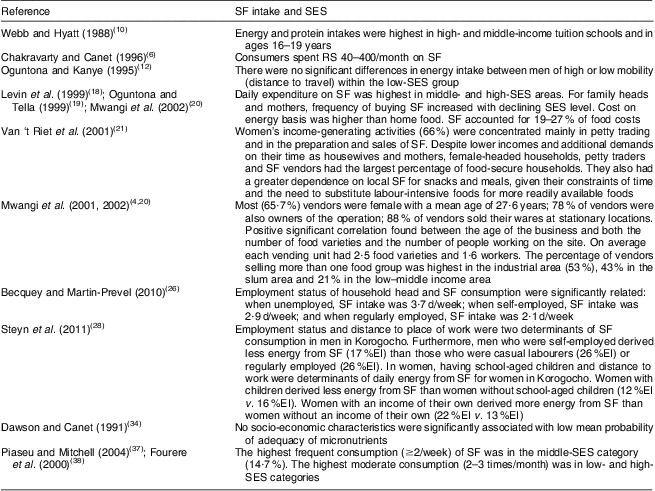
SF, street foods; SES, socio-economic status; %EI, percentage of energy intake.
Advantages of the street food trade
Street foods are usually economical, socially and culturally appropriate food items or meals. With many adults working long hours the use of street foods saves time in preparation of foods. Furthermore, street foods are usually available in small quantities and ingredients do not have to be purchased from the market for home food preparation. Fuel costs are generally high in developing countries and buying street foods saves not only on labour time but also on fuel costs. Furthermore, poor people often do not have adequate cooking facilities and space, hence purchasing ready-to-eat food is an advantage( Reference Mwangi, den Hartog and Foeken 4 , Reference Drabo, Toe and Savadogo 33 ).
Another important advantage of the street food trade is that of income generation. Many illiterate and unemployed people, frequently women, find this a simple way to earn some money with little capital investment required. According to Dawson and Canet( Reference Dawson and Canet 34 ), among lower-income groups in many developing countries 50–70 % of household earnings are spent on street foods. This also applies to schoolchildren, who may be given money to buy breakfast and/or lunch instead of being given cooked food or snacks( Reference Ag Bendech, Chauliac and Gerbouin-Rerolle 17 ). Hence street foods also potentially contribute significantly to the diet of schoolchildren. Because of their widespread use, Draper( Reference Draper 1 ) further recommends studying the feasibility of using street foods as vehicles for micronutrient fortification.
It appears that cooked foods (cuisines, in particular) have become tourist attractions in certain countries and are often hailed as being authentic and unique dimensions of culture, lifestyle and even heritage( Reference Henderson, Si Yun and Poon 35 ). For example, in a study in Singapore, 65 % of tourists agreed that street food centres had an appealing uniqueness and cultural significance( Reference Henderson, Si Yun and Poon 35 ). Moreover, 58 % of tourists indicated that street food centres/areas were their means of learning about Singapore heritage.
Negative connotations of the street food trade
Unfortunately the use of street foods has many negative connotations with regard to hygienic and safety issues, and in many countries this trade is not regulated, which means that bacterial contamination of such foods is of concern to many who buy these products. Numerous studies have documented these effects and certainly one would need to pay attention to addressing these issues before encouraging the sale of street foods( Reference Draper 1 ).
An important concern that requires cognition when discussing street foods in developing countries is the westernization of diet, which has led to increased intakes of saturated fat, trans-fat, sugar and salt( Reference Nago, Lachat and Huybregts 3 , Reference Macias, Pita and Basabe 36 ). Women studied in Burkina Faso( Reference Becquey and Martin-Prevel 26 ) showed some of these trends since food bought outside the home by them accounted for 52 % of fat intake and 72 % of sugar intake. In Tunisia more than 70 % of children studied used 75 % of their pocket money to buy street foods. Items bought most frequently were candy (27·2 %), pastries (23·9 %), sandwiches (23·9 %), sunflower seeds and peanuts (21·0 %), and either chocolate, pizza or cheese (20·0 %)( Reference Neffati, Ridha and Kolsteren 32 ). The largest proportion of money was spent on candy, pastries and sandwiches. The main motivation for buying street foods was to replace a meal at home. With the exception of peanuts and sunflower seeds, the other items did not reflect a traditional Tunisian diet and are typical examples of ‘western foods’.
Conclusions
Street foods contribute significantly to the diet of many living in developing countries. Furthermore, street foods are convenient, cheap, easily accessible and a source of income to many poor people who would otherwise not find employment. Health policy makers and educators should encourage and promote the sale of healthy, traditional street foods and ensure that regulation efforts are in place to prevent health problems arising. This may also include centres or areas where street foods are sold and which encourage tourists to sample local cuisine in a safe environment.
Acknowledgements
Sources of funding: The study was supported by the Human Sciences Research Council, Medical Research Council, Cape Peninsula University of Technology and the National Research Foundation. Conflicts of interest: None declared. Ethics: Ethical approval was not required. Authors’ contributions: N.P.S., Z.M. and J.H. undertook the literature search; Y.D.D., I.V., E.H., M.O., J.R. and P.J. provided expertise and writing inputs. Acknowledgements: The authors thank Laetitia Louw and Tsakani Mathebula for library assistance.



