Introduction
The lifetime prevalence of main eating disorders (EDs), i.e. anorexia nervosa (AN), bulimia nervosa (BN), and binge eating disorder (BED), has been estimated to be 8.4% (3.3–18.6%) for women and 2.2% (0.8–6.5%) for men (Galmiche, Déchelotte, Lambert, & Tavolacci, Reference Galmiche, Déchelotte, Lambert and Tavolacci2019). The prevalence of other specified feeding or eating disorders (OSFED) and unspecified feeding or eating disorders has been less extensively investigated although Allen, Byrne, Oddy, and Crosby (Reference Allen, Byrne, Oddy and Crosby2013) noted that these disorders account for 15–40% of all ED cases in adolescents. EDs confer significant cost both to the individual and to society (Le, Hay, & Mihalopoulos, Reference Le, Hay and Mihalopoulos2018) and AN has the highest mortality rate of any psychiatric illness (Arcelus, Mitchell, Wales, & Nielsen, Reference Arcelus, Mitchell, Wales and Nielsen2011). BED and OSFED account for the most ED cases and disability-adjusted life-years globally (Santomauro et al., Reference Santomauro, Melen, Mitchison, Vos, Whiteford and Ferrari2021). Furthermore, between 54% and 79% of people with AN, BN, or BED also meet criteria for one or more other mental health disorders (Allen et al., Reference Allen, Byrne, Oddy and Crosby2013; Udo & Grilo, Reference Udo and Grilo2019).
In the past, AN was thought to predominately affect girls growing up in affluent conditions (Bruch, Reference Bruch1978), contributing to the stereotype that EDs were exclusive to young white women from privileged socioeconomic backgrounds. It is now known that this stereotype is untrue. Nonetheless, this perspective has had implications for the classification of EDs in the literature (Mond, Hay, Rodgers, & Owen, Reference Mond, Hay, Rodgers and Owen2008), as well as for the development of research for the detection, treatment, and prevention of EDs (Harvey & Robinson, Reference Harvey and Robinson2003). Currently it is known that EDs are experienced across a range of sociodemographic groups; research has shown that men (Mitchison, Mond, Slewa-Younan, & Hay, Reference Mitchison, Mond, Slewa-Younan and Hay2013; Striegel, Bedrosian, Wang, & Schwartz, Reference Striegel, Bedrosian, Wang and Schwartz2012; Striegel-Moore et al., Reference Striegel-Moore, Rosselli, Perrin, DeBar, Wilson, May and Kraemer2009), middle-aged and older people (Gagne et al., Reference Gagne, Von Holle, Brownley, Runfola, Hofmeier, Branch and Bulik2012), and people from lower socioeconomic levels (Deleel, Hughes, Miller, Hipwell, & Theodore, Reference Deleel, Hughes, Miller, Hipwell and Theodore2009; Santana, Barros, Costa, & da Veiga, Reference Santana, Barros, Costa and da Veiga2017) experience EDs in substantial numbers.
Disordered eating behaviors (DEB) may occur in the absence of a formal ED diagnosis. DEB includes strict dieting or fasting, binge eating, or purging (e.g. with laxative and diuretic misuse and/or self-induced vomiting) (Parker & Harriger, Reference Parker and Harriger2020; Romano et al., Reference Romano, Heron, Amerson, Howard, MacIntyre and Mason2020; Santana et al., Reference Santana, Mitchison, Gonzalez-Chica, Touyz, Stocks, Appolinario and Hay2019b). Such behaviors are more common than full syndromes of EDs (Neumark-Sztainer, Wall, Larson, Eisenberg, & Loth, Reference Neumark-Sztainer, Wall, Larson, Eisenberg and Loth2011) and their frequency has increased considerably over the last years in different parts of the world (Chávez Hernández, Saucedo-Molina, Peña Irecta, & Unikel Santoncini, Reference Chávez Hernández, Saucedo-Molina, Peña Irecta and Unikel Santoncini2015; da Luz et al., Reference da Luz, Sainsbury, Mannan, Touyz, Mitchison and Hay2017; Juarascio et al., Reference Juarascio, Felton, Borges, Manasse, Murray and Lejuez2016; Nakai, Nin, & Noma, Reference Nakai, Nin and Noma2014; Neumark-Sztainer et al., Reference Neumark-Sztainer, Wall, Larson, Eisenberg and Loth2011; Santana et al., Reference Santana, Barros, Costa and da Veiga2017; White, Reynolds-Malear, & Cordero, Reference White, Reynolds-Malear and Cordero2011). In a recent study of the Australian general population, Mulders-Jones, Mitchison, Girosi, and Hay (Reference Mulders-Jones, Mitchison, Girosi and Hay2017) found that DEBs occurred at similar rates across all levels of income, education, and urbanicity. However, compared to working full-time, not working due to disability was associated with an increased risk of objective binge eating (OBE) and purging, and unemployment with an increased risk of objective and subjective binge eating. Furthermore, participants with a trade or certificate qualification were at a significantly increased risk of reporting strict dieting compared to participants without a tertiary qualification.
Whether the prevalence of DEBs among different sociodemographic groups is stable or has been increasing in recent years is an issue that is still unclear. Mitchison, Hay, Slewa-Younan, and Mond (Reference Mitchison, Hay, Slewa-Younan and Mond2014), in research with the Australian population over the period 1998–2008, noted that below-median annual household income was associated with a significantly greater rise in prevalence of binge eating, extreme dieting, and purging. Similar patterns were observed for men and extreme dieting and purging; and age in people over 45 years and purging. Understanding temporal changes in the prevalence of DEBs in the general population, as well as identify specific sociodemographic groups in which these changes may be occurring over time, is extremely important to improve the identification and treatment of these problems in the community. Past studies have found statistical differences in the DEBs prevalence across gender, age, educational level, work status, marital status, and area of residence groups in the Australian population (Mitchison et al., Reference Mitchison, Hay, Slewa-Younan and Mond2014; Mulders-Jones et al., Reference Mulders-Jones, Mitchison, Girosi and Hay2017). However, our study extends the investigation period of changes in the prevalence of DEB by accessing 20-year data from this population.
Therefore, this study will investigate for whom DEBs are most prevalent in the last two decades. The specific aim was to examine the rate of DEBs increase (OBE, strict dieting, and purging), between 1998 and 2017, across the demographic features of gender, age, educational level, work status, marital status, and area of residence.
Methods
Sampling procedures
The data included in this study were sourced from sequential cross-sectional Health Omnibus Surveys, which are conducted annually by Harrison Health Research under the auspices of the South Australian Health Commission. Researchers pay to include items in the survey. It comprises face-to-face interviews of a representative sample of the adult population in South Australia (Taylor, Dal Grande, & Wilson, Reference Taylor, Dal Grande and Wilson2006). Five surveys that assessed DEBs were conducted in the years 1998, 2008, 2009, 2016, and 2017.
In each survey year, metropolitan and rural ‘collector districts’ were selected based on a probability proportional to size sampling procedure according to the latest Australian Bureau of Statistics Census data. Ten houses within each district were chosen to conduct interviews in. The resident who had their birthday most recently, and who was 15 years or older, was interviewed. Up to six visits were made to each household. The samples were non-replacement. Pilot testing was conducted to ensure participant understanding and feasibility of the questions. Rates of response for each year were 70.0% (n = 3010) in 1998, 62.8% (n = 3034) in 2008, 59.3% (n = 3007) in 2009, 58.4% (n = 3047) in 2016, and 57.0% (n = 2977) in 2017. The most common reason for not participating was refusal.
Ethics
Adult participants provided verbal rather than written informed consent, due to the practicalities of carrying out a large-scale survey and the low-risk nature of the survey content. For minors (15–17-year-old) enrolled in the study, written consent was obtained from the participant's parent/guardian. The 1998–2009 surveys were approved by the research ethics committee of the Government of South Australia, Department of Health, and the 2016–2017 surveys were approved by the University of Adelaide Human Research Ethics Committee.
Measures
Sociodemographic and weight/height information
This included gender, age, highest educational attainment (still at school, left school, trade qualification, certificate, and bachelor), work status (work full/part time/student and home duties/unemployed/retired/other), marital status (married/living together and separated/divorced/widowed/never married) and area of residence (metropolitan and country). The Accessibility Remoteness Index of Australia or ARIA score was used in the adjusted analyses, as it is a more nuanced continuous measure compared to the dichotomous metropolitan v. country measure.
Participants were also asked their height and weight, from which body mass indexes (BMIs; kg/m2) were calculated and were classified according to the World Health Organization (1998) criteria: underweight = BMI < 18.5, normal weight = 18.5 ⩽ BMI < 25.0, overweight = 25.0 ⩽ BMI < 30.0, and obesity = BMI ⩾ 30.0. For adolescents BMI classification used was the extended international BMI cut-offs for thinness, overweight, and obesity (Cole & Lobstein, Reference Cole and Lobstein2012).
Disordered eating behaviors
Questions to ascertain the presence of these behaviors were based on the Eating Disorder Examination (EDE) (Fairburn & Cooper, Reference Fairburn, Cooper, Fairburn and Wilson1993), a structured interview used for ED diagnosis. Participants were asked whether they regularly (at least once per week over the past 3 months) engaged in (a) OBE (eating an objectively large amount of food with a sense of loss of control), (b) strict dieting/fasting (going on a very strict diet or fasting to control weight or shape), and (c) purging (use of laxatives, diuretics, or self-induced vomiting to control weight or shape). The specific wording of the questions about these behaviors has been previously published (Hay, Mond, Buttner, & Darby, Reference Hay, Mond, Buttner and Darby2008) and accords with their DSM-5 (APA, 2013) definitions.
Data analysis
Data from each survey were weighted based on the correspondent sampling process and reweighted to the population distribution in the most proximal Australian Census to the survey (e.g. 2006 Census for the 2008 survey). Descriptive statistics were generated for all demographic variables using SPSS software (version 24). Subsequently, we conducted χ2 tests-of-independence for categorical variables: gender (male and female), age groups (15–24, 25–44, and ⩾45 years), educational attainment (still at school, left school, trade qualification, certificate, and bachelor), work status (work full/part time/student and home duties/unemployed/retired/other), marital status (married/de facto and separated/divorced/widowed/never married), and area of residence (metropolitan and country). The χ2 tests were used to compare the prevalence of OBE, strict dieting/fasting, and purging between the three survey years. Given the number of statistical tests performed (there were 10), the reported p values were adjusted to take this into account using the conservative Bonferroni method (IBM, 2020). Analyses of variance were employed to compare differences between survey years for the continuous variable age (years). A series of multivariate binary logistic regressions were employed to examine the odds of reporting each of the DEBs within demographic sub-groups. Regressions were adjusted for variations in gender, age, educational attainment, work status, marital status, ARIA, and BMI. Firth's correction using penalized likelihood was used to deal with the inadequate number of cases of purging while performing logistic regression (Firth, Reference Firth1993). SAS version 9.4 was used to perform the analysis (SAS Institute Inc., 2013, Cary, NC, USA).
Results
Participant sociodemographic characteristics across survey years
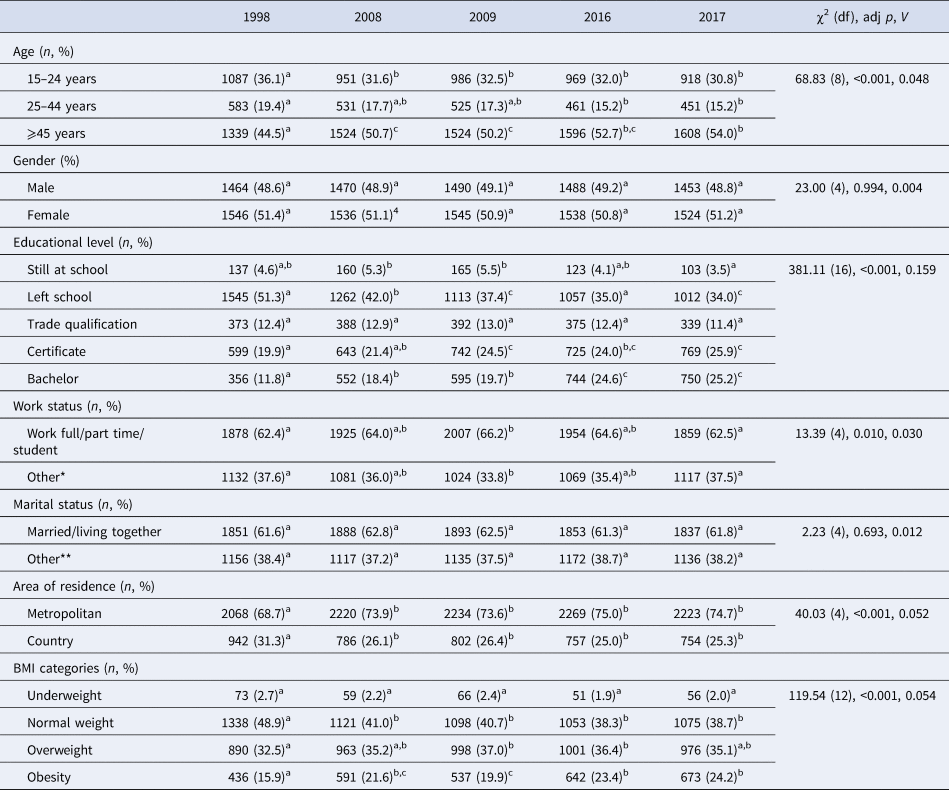
As shown in Table 1, mean age and BMI increased from the 1998 to the 2016/7 survey (p < 0.001). Around 51% of participants in all surveys were women. The educational level of participants increased significantly over the research years (p < 0.001) and work status also changed, namely the proportion of participants who were engaged primarily in home-based duties decreased from 17.1% in 1998 to 5.7% in 2016/7. Furthermore, in 1998, 68.7% of people lived in a metropolitan area while in 2016/7 this frequency had increased to 74.8% (p < 0.001) (Table 1). These demographic changes over the survey years are consistent with secular trends in the Australian and South Australian population over the same 20-year period (Australian Bureau of Statistics, 2020, 2021).
Sociodemographic features from adolescents and adults, Australia, in 1998, 2008/9, and 2016/7

BMI, body mass index.
*Other (home duties, unemployed, retired, other).
**Other (never married, separated, divorced, widowed).
Note. Superscript letters denote Bonferroni-adjusted pairwise differences.
Prevalence of eating disorder behaviors across time
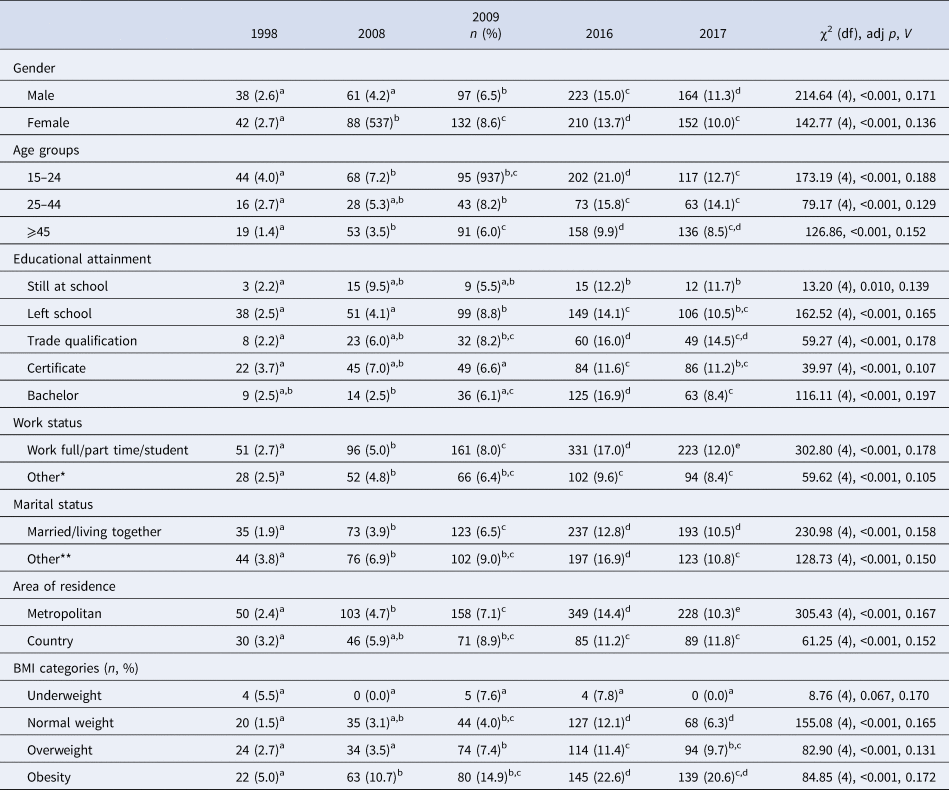
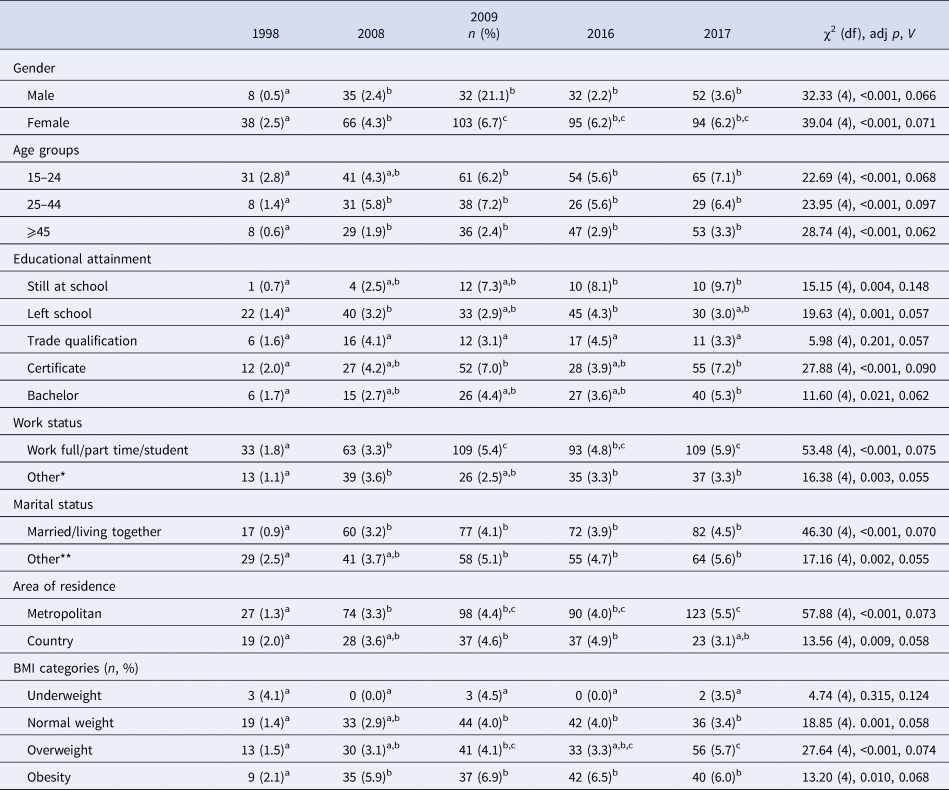
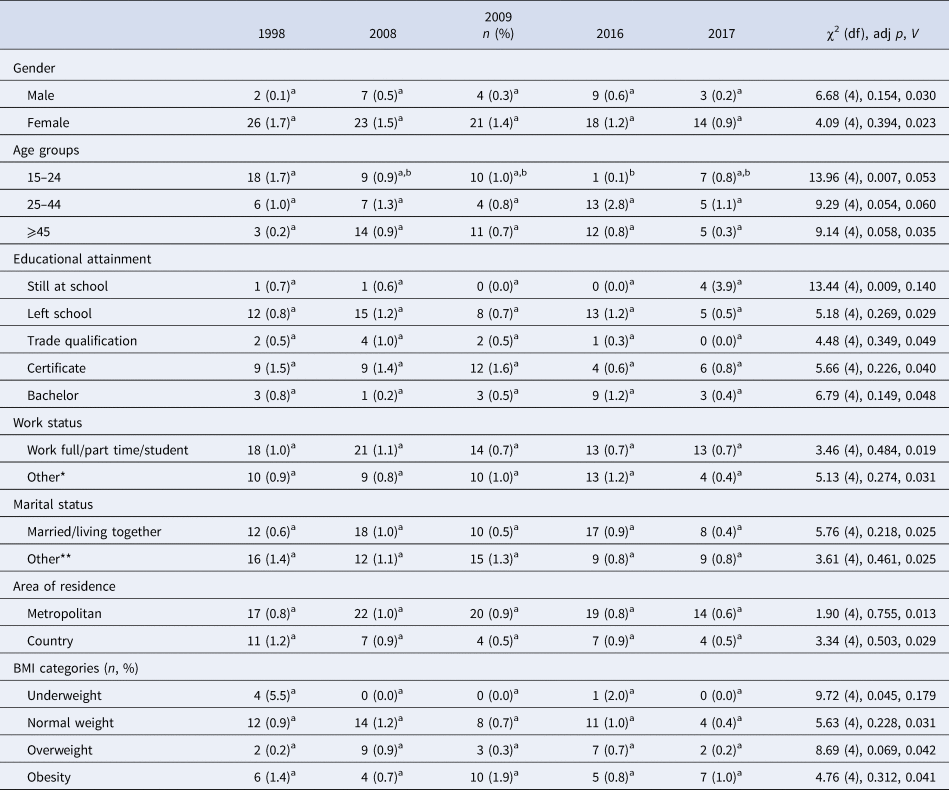
The overall prevalence rates for the ED behaviors are presented by year in Table 2. The prevalence rates for each behavior within demographic and BMI groups by year are presented in the next section of the Results below and in Tables 3 (binge eating), 4 (strict dieting/fasting), and 5 (purging). As seen in Table 2, the prevalence of OBE increased significantly between each time-point up until 2016, and then decreased from 2016 to 2017. Strict dieting/fasting increased from 1998 to 2008 to 2017; however, increases between 2008 and 2017 were less pronounced and did not reach statistical significance. The prevalence of purging did not change significantly over time (Table 2).
Prevalence of eating disorder behaviors in adolescents and adults, Australia, in 1998, 2008, 2009, 2016, and 2017

Note. *Objective binge eating frequency: once a week or more. Superscript letters that differ from each other indicate significant differences in prevalence between survey years on each behavior (no significant differences were found for purging prevalence between years), on Bonferroni-adjusted z-tests.
Relationships between sociodemographic features and objective binge eating in adolescents and adults, Australia, in 1998, 2008/9, and 2016/7

BMI, body mass index.
*Other (home duties, unemployed, retired, other).
**Other (never married, separated, divorced, widowed).
Fisher's exact test was used as opposed to χ2 tests when the expected cell counts <5.
Note. Superscript letters denote Bonferroni-adjusted pairwise differences.
Relationships between sociodemographic features and strict dieting/fasting in adolescents and adults, Australia, in 1998, 2008/9, and 2016/7

BMI, body mass index.
*Other (home duties, unemployed, retired, other).
**Other (never married, separated, divorced, widowed).
Fisher's exact test was used as opposed to χ2 tests when the expected cell counts <5.
Note. Superscript letters denote Bonferroni-adjusted pairwise differences.
Relationships between sociodemographic features and purging in adolescents and adults, Australia, in 1998, 2008/9, and 2016/7

BMI, body mass index.
*Other (home duties, unemployed, retired, other).
**Other (never married, separated, divorced, widowed).
Fisher's exact test was used as opposed to χ2 tests when the expected cell counts <5.
Note. Superscript letters denote Bonferroni-adjusted pairwise differences.
Changes in the sociodemographic distribution of objective binge eating over time
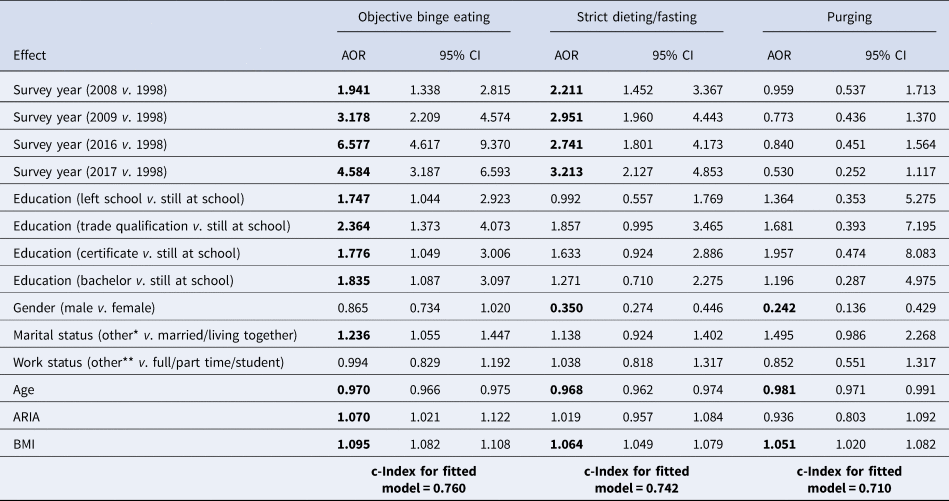
As can be seen in Tables 3 and 6, the c-index for the main effects model with OBE as the outcome was 76%. All survey years were associated with a significantly higher odds of OBE compared to 1998. In addition, lower age, higher ARIA score, higher BMI higher educational attainment, and not being in a married or de facto relationship were independently associated with greater adjusted odds for endorsing OBE. Gender and work status were not related to the odds of OBE. When interaction terms between survey years and the demographic variables were added to the model, model discrimination improved slightly (c-index = 76.7%); however, none of the individual interaction terms were significantly associated with the likelihood of OBE using Rao–Scott design adjusted likelihood ratio tests (see online Supplementary material for full details of the interaction models).
Main effect results from the multivariate logistic regression with objective binge eating, strict dieting/fasting, and purging as the outcomes

AOR, adjusted odds ratio; CI, confidence interval; ARIA, accessibility remoteness index of Australia; BMI, body mass percentile.
Significant effects are in bold format. *Other = separated/divorced/widowed/never married. **Other (home duties, unemployed, retired, other).
In the model for purging, Firth's correction based on penalized likelihood was used to adjust for inadequate number of cases for purging.
Changes in the sociodemographic distribution of strict dieting/fasting over time
As can be seen in Tables 4 and 6, the c-index for the main effects model with strict dieting/fasting as the outcome was 74.2%. The odds of reporting strict dieting/fasting was higher in all years compared to 1998. In addition, younger age, female gender, and higher BMI were also independently associated with greater adjusted odds for endorsing strict dieting/fasting. When interaction terms between survey year and the demographic variables were added to the model, model discrimination was slightly improved (c-index = 75.3%). Significant interactions were observed using Rao–Scott design adjusted likelihood ratio tests between work status and survey year and age and survey year. For those working full time/part time/student, as survey year increased the odds of dieting, fasting increased in reference to survey year 1998. The odds of dieting/fasting generally increased for age when the survey year also increased in reference to 1998 (see online Supplementary material for full details of the interaction models).
Changes in the sociodemographic distribution of purging over time
As can be seen in Tables 5 and 6, the c-index for the main effects model with purging as the outcome was 71.0%. The odds of reporting purging in 2008–2017 were no different to the odds in 1998. However, younger age, female gender, and higher BMI were independently associated with greater adjusted odds for endorsing purging. When interaction terms between survey year and the demographic variables (except for sex and education which couldn't be interacted with survey year due to collinearity problems) were added to the model, model discrimination slightly improved (c-index = 72.4%). Using Rao–Scott design adjusted likelihood ratio tests, significant interactions at 10% but not at 5% were observed between work status and survey year, showing that for those working full time/part time/student, as survey year increased the odds of purging first decreased and then increased for year 2017 (see online Supplementary material for full details of the interaction models).
Discussion
This study investigated the sociodemographic distribution of DEBs in a series of cross-sectional general population surveys from 1998 to 2017. The main findings were that OBE and fasting/strict dieting have both increased in prevalence the past 20 years in almost all sociodemographic strata of the Australian population investigated. In addition, younger age, higher remoteness (ARIA scores), higher BMI, higher educational attainment, and not being in a married or de facto relationship were independently associated with greater adjusted odds for endorsing OBE. Additionally, younger age, female gender, and higher BMI were also independently associated with greater adjusted odds for endorsing strict dieting/fasting.
With specific regards to OBE, men and women in 1998 and in 2016/7 had similar frequencies of this behavior. Even with the sevenfold increase in the prevalence of fasting/strict dieting in males and two and a half-fold increase among women, women still have a higher prevalence of binge eating (2017: 6.2% v. 3.6%). However, men are ‘catching up’. In this context several authors (Mitchison & Mond, Reference Mitchison and Mond2015; Murray et al., Reference Murray, Nagata, Griffiths, Calzo, Brown, Mitchison and Mond2017; Schaefer et al., Reference Schaefer, Smith, Leonard, Wetterneck, Smith, Farrell and Thompson2018) have reported the moderate frequencies of these behaviors among men and discussed that like women, men suffer from disturbances in DEBs and body image issues. The marginalization of males in ED research remains yet pervasive, and the clinical impact of this may be profound (Matsumoto & Rodgers, Reference Matsumoto and Rodgers2020). Additionally, men typically seek help for their ED late in the course of their illness, and even when they do seek treatment, the diagnosis is often missed by health professionals (Richardson & Paslakis, Reference Richardson and Paslakis2021).
Compared to older age groups, younger individuals continued to have a higher prevalence of DEBs over time. However, people over 45 years had a significant increase in binge eating and fasting/strict dieting between 1998 and 2016/7. Thus, older individuals are also vulnerable to DEBs. Similarly, when studying EDs in Portuguese women, Conceição, Gomes, Vaz, Pinto-Bastos, and Machado (Reference Conceição, Gomes, Vaz, Pinto-Bastos and Machado2017) reported a 3.2%-point prevalence among elderly (aged 65–94 years) women, comparable to that found in younger women. In addition, the authors point out that binge eating episodes were particularly prevalent among older adults (5.6%). Conceição et al. (Reference Conceição, Gomes, Vaz, Pinto-Bastos and Machado2017) argue that DEBs are increasing in older people, because they experience a wider discrepancy between body ideals promoted through the media, which they are still exposed to, compared to their actual bodies and the age-related changes that occur. An additional explanation for these findings is that older people who developed EDs in their teenage years in the 1980s are now aging. Thus, it is not necessarily the case that middle aged adults being suddenly more vulnerable to EDs. In particular, those who experienced a large increase in BN in the 1980s (Bushnell, Wells, Hornblow, Oakley-Browne, & Joyce, Reference Bushnell, Wells, Hornblow, Oakley-Browne and Joyce1990) are now in middle age.
Concerning area of residence, we found a divergence in the prevalence of binge eating and fasting/strict dieting among individuals residing in metropolitan and rural areas between the years of research. In 1998, the highest prevalence of DEBs was in people residing in rural areas. However, with the higher increase among individuals from metropolitan areas over the last 20 years, they presented higher prevalence of DEBs in 2016/7. Hay and Mitchison (Reference Hay and Mitchison2021), in a literature review, noted that in most studies urbanicity was not associated with ED. As research findings investigating relationships between EDs and area of residence are inconsistent, future studies on this association are needed to clarify the direction of the results found. Findings regarding marital status have also been inconsistent but suggested single status as a risk factor for an ED (Mitchison & Hay, Reference Mitchison and Hay2014) and further research is needed to investigate putative protective effects of having a life partner.
Regarding the temporal increase in DEBs, mainly binge eating and fasting/strict dieting, similar results have been noted in several studies: in Brazilian (Santana et al., Reference Santana, Barros, Costa and da Veiga2017), Mexican (Chávez Hernández et al., Reference Chávez Hernández, Saucedo-Molina, Peña Irecta and Unikel Santoncini2015), and North American adolescents (Juarascio et al., Reference Juarascio, Felton, Borges, Manasse, Murray and Lejuez2016; Neumark-Sztainer et al., Reference Neumark-Sztainer, Wall, Larson, Eisenberg and Loth2011); Japanese women (Nakai et al., Reference Nakai, Nin and Noma2014); and in North American adults of both sexes (White et al., Reference White, Reynolds-Malear and Cordero2011). In some of these studies (Nakai et al., Reference Nakai, Nin and Noma2014; Neumark-Sztainer et al., Reference Neumark-Sztainer, Wall, Larson, Eisenberg and Loth2011; Santana et al., Reference Santana, Barros, Costa and da Veiga2017) binge eating was the DEB that increased most markedly, as observed in the present study. In addition, binge eating was the only behavior that increased significantly for all population subsectors between 1998 and 2016/7. It is also important to note that young people aged 15–24 years had decreased purging between 1998 and 2016/7. A recent study investigating body image issues (Santana et al., Reference Santana, Mitchison, Griffiths, Appolinario, da Veiga, Touyz and Hay2019a) noted an increase in the prevalence of weight/shape overvaluation between 2005 and 2016. These findings would suggest that the drive for maintaining low weight has not reduced and so cannot account for these decreases. In this context of general DEB increase, it is also possible for young people using methods other than fasting/strict dieting to control their weight.
A limitation of this study is that same cohort was not assessed at each survey year, which would be important in confirming changes in DEBs over time within individuals, as opposed to within populations. In addition, there was a decreasing response rate over time consistent with findings observed in other survey-based studies (Abu Farha, Alzoubi, Khabour, & Mukattash, Reference Abu Farha, Alzoubi, Khabour and Mukattash2020; Arfken & Balon, Reference Arfken and Balon2011). While this may raise questions about the representativeness of the sample, this concern is somewhat attenuated by the similar demographic profiles across all surveys with any changes being in accordance with wider trends in the Australian population (Australian Bureau of Statistics, 2021). Further, only binary gender status was recorded and it is important to highlight the lack of information on race and ethnicity. Given this study's focus on sociodemographic characteristics, this is a significant omission that should be noted. We also need to point out the potential of a spurious result due to the low base rate of purging in our cohorts. Because of the small numbers of participants with purging, there was potential for reduced confidence in the results of the analyses using this variable. Specifically, in some years, purging was endorsed by 10 or fewer participants, leaving it more vulnerable to sampling variation. We used a special method to account for high sampling variability while performing logistic regression analysis, thus increasing the confidence in the results of the analyses. Finally, not conducting ongoing assessment of interrater reliability throughout the surveys was a limitation. However, it is also worth mentioning that strengths of this study include the use of a large representative community-based sample and a wide range of age groups and to our knowledge there are no other studies that have examined the relationship between DEBs and sociodemographic features over 20 years with such a population sample.
The major public health implications of this study are reflected in the increased prevalence of DEBs in various strata of society. The perception that EDs mainly affect young women from higher social classes is no longer tenable. The implications are very broad as they affect our diagnostic, etiological, and treatment models – which have all been largely based on research pertaining to a narrow demographic of people. For example, there is emerging research on specific theoretical models of the development of body image and EDs (Matsumoto & Rodgers, Reference Matsumoto and Rodgers2020), as well as assessment instruments with questions relevant to men (Schaefer et al., Reference Schaefer, Smith, Leonard, Wetterneck, Smith, Farrell and Thompson2018). It is recommended that future studies focus on the features and risk factors for EDs and DEBs in men and older individuals to help inform improved identification and also practice and clinical management of these diseases. Health promotion efforts that might reduce the negative health impact of the EDs are necessary in all sociodemographic groups.
Conclusion
OBE and fasting/strict dieting increased in diverse Australian population sociodemographic subsectors over the past 20 years. Those with increased risk for endorsing these DEBs were: women, younger people, people living in remote areas, people with higher BMI and higher educational attainment, and not being in a married or de facto relationship.
Supplementary material
The supplementary material for this article can be found at https://doi.org/10.1017/S0033291722001994
Data
The dataset used and analyzed during the current study is available from the corresponding author on reasonable request.
Financial support
Funding for the ED questions in the surveys was received from internal James Cook and Western Sydney University grants to Professor Phillipa Hay; Dr Mitchison is funded by an National Health and Medical Research Council (NHMRC) Early Career Fellowship (grant number: GNT1158276); Dr Santana is funded by the Coordenação de Aperfeiçoamento de Pessoal de Nível Superior – Brasil (CAPES); University of Sydney internal research funds of Professor Stephen Touyz; and Dr Scott Griffiths is funded by an NHMRC Early Career Fellowship and an NHMRC Emerging Leader 2 Fellowship (grant numbers: 1121538 and 193738). The 2017 survey was funded by an investigator-initiated Research grant IIR-AUS-001151, from Shire International GmbH Switzerland, now part of Takeda to Professor Touyz, University of Sydney; and unrestricted funds held by Professor Hay at Western Sydney University, School of Medicine.
Conflict of interest
Drs Deborah Mitchison and Scott Griffiths are members of the executive board of the Australian and New Zealand Academy for Eating Disorders (Scott: 2017–19; Deborah: 2017–current) and have received research grants from the NHMRC. Professor Jose Carlos Appolinario receives/has received research grants, consultancy fees, and advisory board fees from Shire Pharmaceuticals. He has prepared also an Educational Material about Binge Eating Disorder for Shire Pharmaceuticals. He receives/has received royalties/honoraria from Artmed Panamericana Editora. He also received a research grant from the Brazilian National Research Council (CNPq). Professor Gloria Valeria da Veiga received a research grant from the Brazilian National Research Council (CNPq) and Foundation Carlos Chagas Filho for Research Support of the State of Rio de Janeiro (FAPERJ). Professor Touyz is the Chair of the Takeda Virtual Clinical Advisory Committee on Binge Eating Disorders (BED). He has received honoraria for commissioned reports and public speaking engagements. ST has received research grant funding from Shire (now Takeda). He receives royalties from published material from Hogrefe and Huber, Taylor and Francis, and McGraw Hill. He is a member of the Technical Advisory Group for Eating Disorders established by the Commonwealth of Australia. ST is also a mental health advisor to the Commonwealth Department of Veteran Affairs. He is the cofounding Editor in Chief of the Journal of Eating Disorders and a member of the editorial board of Eating Disorder Reviews. Professor Hay receives/has received sessional fees and lecture fees from the Australian Medical Council, Therapeutic Guidelines publication, and HETI (New South Wales and the former NSW Institute of Psychiatry) and royalties/honoraria from Hogrefe and Huber, McGraw Hill Education, and Blackwell Scientific Publications, Biomed Central and PLoS Medicine and she has received research grants from the NHMRC and ARC. She is Chair of the National Eating Disorders Collaboration Steering Committee in Australia (2019–current) and was Member of the ICD-11 Working Group for Eating Disorders and was Chair Clinical Practice Guidelines Project Working Group (Eating Disorders) of RANZCP (2012–2015). She has prepared a report under contract for Takeda (formerly Shire) Pharmaceuticals in regards to Binge Eating Disorder (July 2017) and is a consultant to Takeda Pharmaceuticals. All views in this paper are her own. The other authors declare no conflicts of interest.
Ethical standards
Adult participants provided verbal rather than written informed consent, due to the practicalities of carrying out a large-scale survey and the low-risk nature of the survey content. For minors (15–17-year-olds) enrolled in the study, written consent was obtained from the participant's parent/guardian. The 1998–2009 surveys were approved by the research ethics committee of the Government of South Australia, Department of Health, and the 2016–2017 surveys were approved by the University of Adelaide Human Research Ethics Committee (H-097-2010).