Introduction
Cigarette smoking is a significant source of morbidity and mortality, and many public health and workplace efforts are focussed on promoting smoking cessation. A number of sociodemographic factors have been identified to be associated with successful quit rates, including age (>35 years), marital status, college education and white race (CDC, 2011; Lee & Kahende, Reference Lee and Kahende2007; Royce, Hymowitz, Corbett, Hartwell, & Orlandi, Reference Royce, Hymowitz, Corbett, Hartwell and Orlandi1993). Racial disparities in smoking-related diseases are well-documented, and rates of current smoking are higher amongst African-Americans compared to whites even though total cigarette use is lower amongst black smokers (Trinidad et al., Reference Trinidad, Xie, Fagan, Pulvers, Romero and Blanco2015). A number of studies have shown that African-Americans are less likely than whites to successfully quit smoking (Cokkinides, Halpern, Barbeau, Ward, & Thun, Reference Cokkinides, Halpern, Barbeau, Ward and Thun2008; King, Polednak, Bendel, Vilsaint, & Nahata, Reference King, Polednak, Bendel, Vilsaint and Nahata2004; Trinidad, Perez-Stable, White, Emery, & Messer, Reference Trinidad, Perez-Stable, White, Emery and Messer2011). These lower rates of smoking cessation amongst African-Americans may be due to decreased rates of nicotine replacement therapy use or because minority patients are less likely to be advised about smoking cessation (Fu et al., Reference Fu, Kodl, Joseph, Hatsukami, Johnson and Breslau2008; Lopez-Quintero, Crum, & Neumark, Reference Lopez-Quintero, Crum and Neumark2006; Reed & Burns, Reference Reed and Burns2008).
Although many barriers have been identified, several studies have shown that weight concerns associated with smoking cessation may deter patients from attempting to quit (Aubin, Berlin, Smadja, & West, Reference Aubin, Berlin, Smadja and West2009; Jeffery, Hennrikus, Lando, Murray, & Liu, Reference Jeffery, Hennrikus, Lando, Murray and Liu2000). African-Americans, particularly African-American women, are more likely to be overweight or obese but also less likely to accurately perceive their weight as being above ideal (Lee et al., Reference Lee, Harris, Catley, Shostrom, Choi and Mayo2005; Mama et al., Reference Mama, Quill, Fernandez-Esquer, Reese-Smith, Banda and Lee2011; May, Freedman, Sherry, & Blanck, Reference May, Freedman, Sherry and Blanck2013), suggesting that inaccurate weight perceptions may play a role in smoking patterns amongst African-Americans. General weight concerns, however, may actually be associated with higher smoking cessation rates (French & Jeffery, Reference French and Jeffery1995; French, Jeffery, Klesges, & Forster, Reference French, Jeffery, Klesges and Forster1995; Pisinger & Jorgensen, Reference Pisinger and Jorgensen2007), possibly reflecting greater overall health awareness. It is unclear whether racial differences in weight perception affect readiness to quit, smoking cessation efforts or both.
In this study, we used data from a cohort of current smokers to assess the relationship between weight perception and readiness to quit smoking. Additionally, we tested whether this relationship may vary according to race. We hypothesised that regardless of race, smokers who perceive themselves to be overweight may be more likely to be ready to quit smoking.
Methods
We used data collected from a cohort of current smokers who underwent routine health maintenance examinations as part of a corporate wellness programme conducted by EHE International, Inc. (EHE) between January 2008 and December 2010. EHE is a health organisation specialising in providing preventive health care free of charge for executives and employees who work for companies that offer EHE services as part of their corporate wellness programme. Companies differ in their policies regarding which levels of employees are eligible for EHE services but many companies offer the wellness programme to all levels of employees. The health maintenance exams for the wellness programmes took place at six EHE-owned centres and over 60 physician offices across the United States. The EHE database includes data for all workers who voluntarily participated in the corporate wellness programme during this time period. Participants were identified from EHE's database and were included in this study if they reported being current smokers at their visit. A standardised self-administered health questionnaire was given before the health maintenance examinations to collect demographic data including age, sex, race and marital status. The survey included validated items about smoking history, including age of initiation, number of years of smoking, average number of cigarettes smoked per/day, and current smoking status. Using this information, we calculated the number of pack-years smoked by each subject. Participants were asked about their readiness to quit on a scale from 0 (not ready) to 10 (most ready); those who answered >5 were classified as being ready to quit. Participants were also asked whether they were currently enrolled in a smoking cessation programme.
Body mass index (BMI) was calculated from measured height and weight and classified as normal (<25 kg/m2), overweight (25–29.9 kg/m2) or obese (>30 kg/m2) (WHO, 1995). Participants were also asked about what their ideal weight would be; using this data, we calculated their perceived ideal BMI. Based on the difference between perceived ideal and measured BMI, smokers’ weight perceptions were classified as being at their ideal weight, being somewhat above their ideal weight (actual BMI is 2–4 units above ideal BMI), and being far above their ideal weight (actual BMI >4 units above ideal BMI). A one unit change in BMI is equivalent to a change in weight of approximately 5–9 pounds (depending on one's height), so that a 2–4 unit change in BMI is approximately equivalent to a weight difference of 10–30 lbs.
Statistical Analyses
We evaluated differences in demographic variables, BMI and weight perception according to the dichotomous ‘readiness to quit’ variable using a chi-square test, t-test or Wilcoxon test, as appropriate. We then fitted a logistic regression model to evaluate factors associated with readiness to quit. The model included an interaction between weight perception and race given data suggesting cultural differences in weight perception (Dorsey, Eberhardt, & Ogden, Reference Dorsey, Eberhardt and Ogden2009; Langellier, Glik, Ortega, & Prelip, Reference Langellier, Glik, Orega and Prelip2015). Secondary analysis included fitting a multinomial model with readiness to quit classified as ‘not ready’ (responses 0–3), ‘somewhat ready’ (responses 4–6) and ‘ready to quit’ (responses >7). All analyses were conducted with SAS 9.3 (SAS Institute, Cary, NC) using two-sided p-values. The study was deemed exempt as non-human subjects research by the Institutional Review Board of the Icahn School of Medicine at Mount Sinai as it involved analyses of de-identified data previously collected for other purposes.
Results
We used data from the EHE database for participants with at least one baseline health maintenance exam and identified 2,837 participants who reported that they were currently smoking cigarettes. Six participants were excluded because they did not have data about current or ideal weight. The final cohort consisted of 2,831 participants.
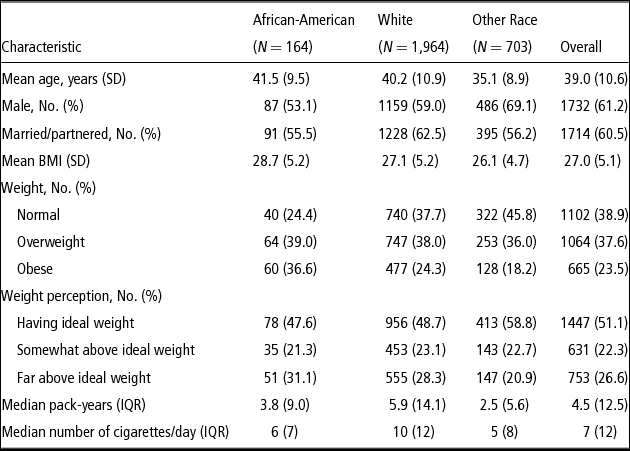
The mean age of the study cohort was 39+10 years; 61% were male; 61% married or living with a partner; and 69% white, 6% African-American, 14% Asian, 8% Hispanic and 3% of other race (Table 1). Overall, 23% of the participants were obese and 38% were overweight. More than half (51%) of the participants felt that they were at their ideal body weight, 22% perceived they were somewhat above their ideal weight and 27% felt that they were far above their ideal body weight. Median smoking pack-years was 4.5 (range 0.5–114). Overall, 2,158 (76%) reported they were ready to quit smoking but only 113 (4%) were currently enrolled or participating in a smoking cessation programme.
Participant characteristics

SD: standard deviation; IQR: interquartile range.
African-American smokers were more likely to be obese (36.6% vs. 24.3% for whites and 18.3% for those of other race, p < 0.001) and were also the most likely group to perceive themselves as being far above ideal weight (31.1% vs. 28.3% for whites and 20.9% for other race, p < 0.001). Compared with whites, African-Americans had fewer pack-years of smoking (median 3.8 vs. 5.9, p < 0.01).
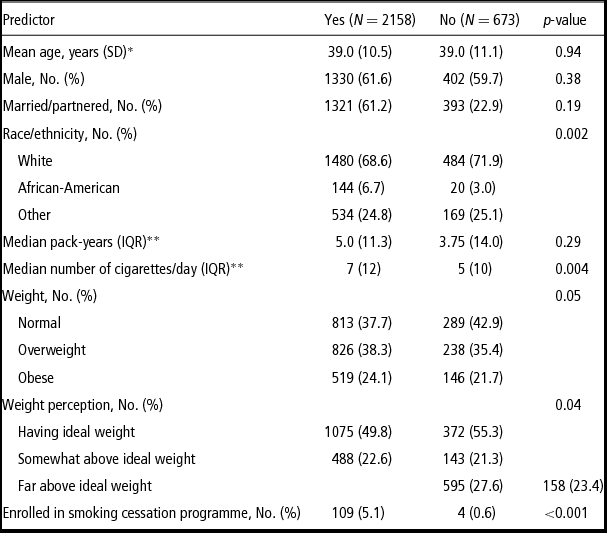
Unadjusted analyses showed that readiness to quit smoking was not significantly different by age, gender, marital status or measured BMI (p > 0.05 for all comparisons, Table 2). Compared with both whites and those of other races, African-Americans were the most likely to be ready to quit smoking (87.8% vs. 75.4% and 76.0%, respectively, p = 0.002). Amongst all participants, those who smoked more cigarettes (median number of cigarettes smoked per day 7 vs. 5, p < 0.01) were also more likely to be ready to quit. Lastly, those who perceived themselves to be far above or somewhat above their ideal weight were more likely to be ready to quit smoking (p = 0.04).
Unadjusted predictors of readiness to quit smoking

All comparisons were analysed by the chi-square test except as otherwise indicated. *analysed by t-test, **analysed by Wilcoxon rank sum test.
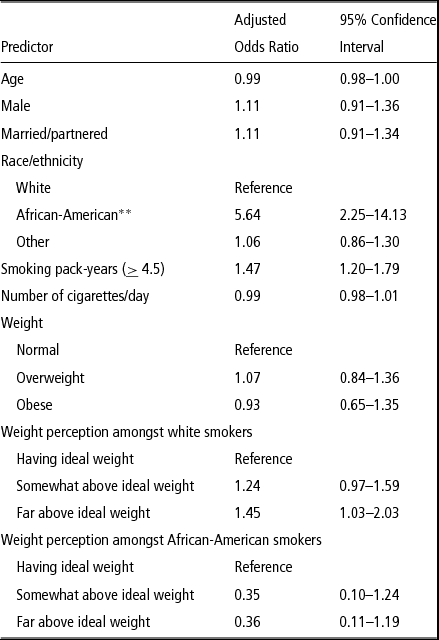
Logistic regression analysis adjusting for age, gender, race, marital status, pack-years smoked, number of cigarettes smoked per day, BMI and perceived weight showed that measured BMI was not significantly associated with readiness to quit (odds ratio [OR]: 1.07, 95% confidence interval [CI]: 0.84–1.36 and OR: 0.93, 95% CI: 0.65–1.35 for overweight and obese smokers compared to smokers with normal BMI, respectively). The interactions between black race and weight perception categories were statistically significant (p = 0.05 and p = 0.02 for perceiving being somewhat or far above ideal weight, respectively), suggesting that perception of increased weight had a different influence on readiness to quit in African-American compared to white smokers (Table 3). Amongst white smokers, compared with those who perceived being close to their ideal weight, those who perceived being somewhat above their ideal weight (OR: 1.24, 95% CI: 0.97–1.59) or far above their ideal weight (OR: 1.45, 95% CI: 1.03–2.03) were more likely to be ready to quit smoking. In contrast, African-Americans who perceived they were somewhat above (OR: 0.35, 95% CI: 0.10–1.24) or far above (OR: 0.36, 95% CI: 0.11–1.19) their ideal weight were not more likely to report being ready to quit smoking compared with African-Americans who perceived themselves to be within their ideal weight and in fact trended towards being less likely to be ready to quit smoking. African-American smokers who perceived being within ideal weight had 5.64 higher odds (95% CI: 2.25–14.13) to be ready to quit compared to white smokers who perceived being within ideal weight. There were no significant interactions between gender and race or gender and weight perception. Secondary analysis with a multinomial regression model found that results were similar to the logistic model described above.
Adjusted model for readiness to quit

**Amongst those who perceive being within ideal weight.
Discussion
Previous studies have shown that smokers’ concerns about weight gain after smoking cessation are associated with being less likely to want to quit smoking (Aubin et al., Reference Aubin, Berlin, Smadja and West2009; Jeffery et al., Reference Jeffery, Hennrikus, Lando, Murray and Liu2000). Moreover, racial differences in perceptions about ideal body weight and its relationship with health may influence the impact of weight on readiness to quit smoking amongst African-Americans. Our study showed that regardless of actual weight, the perception of being above one's ideal weight is associated with increased readiness to quit smoking amongst whites. However, this effect was not observed amongst African-Americans. These results suggest that weight awareness may be used to motivate white smokers to engage in cessation efforts but that different strategies may be more effective for African-American smokers.
Prior research has suggested that some smokers may be reluctant to quit smoking because they are concerned about subsequent weight gain (Levine, Bush, Magnusson, Cheng, & Chen, Reference Levine, Bush, Magnusson, Cheng and Chen2013; Pisinger & Jorgensen, Reference Pisinger and Jorgensen2007; Twardella et al., Reference Twardella, Loew, Rothenbacher, Stegmaier, Ziegler and Brenner2006; Weekley, Klesges, & Reylea, Reference Weekley, Klesges and Reylea1992). Those who already perceive themselves to be overweight may be even more reluctant to quit smoking due to fears of post-cessation weight gain. In particular, women are less likely to accept the possibility of weight gain after quitting smoking and are more concerned than men about post-cessation weight gain (Baha & Le Faou, Reference Baha and Le Faou2013; Levine et al., Reference Levine, Bush, Magnusson, Cheng and Chen2013; Pomerleau & Kurth, Reference Pomerleau and Kurth1996). Consequently, women smokers who perceive themselves as being above their ideal weight may be less likely to want to quit smoking. Our study contradicts these findings by suggesting that weight concerns, at least amongst white smokers, may be a motivation to discontinue smoking. Moreover, we did not find a relationship between gender and readiness to quit, nor did we observe an interaction between gender and weight perception with regards to readiness to quit. Potential reasons for our findings may be related to differences in the study populations and/or random sampling variability. Whilst we did not explore the factors mediating the relationship between weight and attitudes towards smoking cessation, it is possible that smokers who perceive themselves to be above their ideal weight are more health conscious overall and may recognise the combined detrimental effects of obesity and smoking on their health.
Consistent with prior studies, we also found that African-Americans were more likely to be ready to quit (Daza et al., Reference Daza, Cofta-Woerpel, Mazas, Fouladi, Cinciripini and Gritz2006; Rayens, Hahn, Fernander, & Okoli, Reference Rayens, Hahn, Fernander and Okoli2013). African-American smokers have also been found to be more confident they can successfully quit smoking, but despite this, they are less likely to be successful maintaining long-term smoking cessation (Cokkinides et al., Reference Cokkinides, Halpern, Barbeau, Ward and Thun2008; Fu et al., Reference Fu, Kodl, Joseph, Hatsukami, Johnson and Breslau2008; Houston, Scarinci, Person, & Greene, Reference Houston, Scarinci, Person and Greene2005; Trinidad et al., Reference Trinidad, Perez-Stable, White, Emery and Messer2011). African-Americans are less likely to use nicotine replacement therapy, possibly because they may not believe it to be effective (Hendricks et al., Reference Hendricks, Westmaas, Ta Park, Thorne, Wood and Baker2014; Ryan, Garrett-Mayer, Alberg, Cartmell, & Carpenter, Reference Ryan, Garrett-Mayer, Alberg, Cartmell and Carpenter2011). However, a recent Veterans Affairs smoking cessation trial found that quit rates for African-Americans can be higher than whites in a system with equivalent access to care and medications (Burgess et al., Reference Burgess, van Ryn, Noorbaloochi, Clothier, Taylor and Sherman2014). Thus, if smoking cessation services are targeted to reach minorities, African-Americans may be more successful at quitting, especially given their baseline greater motivation to quit.
We also showed that the influence of weight perception on readiness to quit is different for white vs. African-American smokers. Prior literature has found that compared to whites, African-Americans are less likely to perceive themselves as overweight, regardless of actual BMI, and are more likely to report higher ideal weights (Dorsey et al., Reference Dorsey, Eberhardt and Ogden2009; Langellier et al., Reference Langellier, Glik, Orega and Prelip2015; Maynard, Serdula, Galuska, Gillespie, & Mokdad, Reference Maynard, Serdula, Galuska, Gillespie and Mokdad2006; Squiers et al., Reference Squiers, Renaud, McCormack, Tzeng, Bann and Williams2014). Furthermore, in one study, African-American smokers who perceived themselves to be overweight were more likely to have depressive symptoms and greater stress whilst trying to lose weight (Lee et al., Reference Lee, Harris, Catley, Shostrom, Choi and Mayo2005). Consequently, African-American smokers who perceive being above their ideal weight may be more concerned about weight gain after smoking cessation and may be less ready to quit. These data suggest that perception of being overweight may be a less effective motivator to quit smoking amongst African-Americans.
This study was conducted with a cohort of workers taking part in a health evaluation programme. Workplace smoking cessation interventions have shown success in helping quit smoking (Cahill & Lancaster, Reference Cahill and Lancaster2014). Programmes that use individual counselling, pharmacotherapy or group therapy appear to be the most effective. King et al. found that African-American smokers demonstrate greater desire to quit and appear more interested in enrolling in a smoking cessation trial, yet actual enrolment was three times lower for African-Americans (King, Cao, Southard, & Matthews, Reference King, Cao, Southard and Matthews2011). African-Americans may experience more logistic barriers (such as transportation or childcare issues), have greater mistrust about formal smoking cessation programmes or using pharmacological therapy, or may be less knowledgeable about the risks of smoking (Fu et al., Reference Fu, Burgess, van Ryn, Hatsukami, Solomon and Joseph2007; Reimer, Gerrard, & Gibbons, Reference Reimer, Gerrard and Gibbons2010; Warren & Catona, Reference Warren and Catona2013). Thus, workplace interventions may be more effective at targeting minorities since these programmes often minimise some of the logistic barriers that can prevent smokers from enrolling in a cessation programme.
There are some limitations of our study. Our cohort consisted of individuals undergoing a voluntary health maintenance examination as part of a corporate wellness programme. Thus, our results may not be generalisable to the general population or to older individuals and may reflect workers who are more engaged in their health. In addition, a number of variables, such as nicotine dependence level, past smoking abstinence, educational attainment, type of occupation or employment level, that may affect smokers’ readiness to quit were not captured in the health examination survey so we were not able to include these factors in our analyses. Our dichotomisation of the outcome variable, readiness to quit, was somewhat arbitrary; however, analyses considering the outcome as a 3-level measure showed similar findings and suggest that the operationalisation of the outcome did not bias the results. Moreover, this outcome was based on a single item question that has not been validated as an assessment of readiness; due to the nature of the secondary data analysis, we were not able to use an existing tool to assess readiness. Future work should develop robust validated instruments to accurately assess smokers’ readiness to quit. Due to the cross-sectional nature of this study, we are unable to assess a causal relationship between weight perception and desire to quit smoking. Moreover, we did not have access to information about actual quit rates, nor about the types of smoking cessation services provided by the workplaces or about smokers’ reasons for not enrolling in smoking cessation programmes. Strengths of this study include a large, consecutive sample of current smokers, measured (rather than reported) weight and height, and data on participants’ weight perception.
In conclusion, we found that white smokers who perceive themselves to be above their ideal weight are more likely to be ready to quit smoking, a factor that may be used as motivator to engage them in cessation programmes. However, our findings suggest a different relationship between weight perception and smoking cessation readiness in African-Americans. Smoking cessation programmes should be aware of racial differences in the effects of weight perception on readiness to quit smoking to culturally tailor their interventions.
Acknowledgements
None.
Financial Support
This work was supported by the National Cancer Institute at the National Institutes of Health (JJL, grant number 1K07CA166462).
Conflict of Interest
TAR, AN, AR, SM and JPW receive financial compensation as an advisory board member for EHE International, the company providing the patient information that is being analysed in this study. EHE International did not play a role in the design of the study, analyses or interpretation of the data, in the decision to submit the manuscript for publication, or in the writing of the manuscript. JPW has received consulting honoraria from Merck, BMS and Quintiles, and was awarded a research grant from Sanofi pharmaceutical. JJL has no conflict of interest to declare.
Ethical Standards
Not applicable (this is a secondary data analysis).