1. Introduction
Two lines of argument seem to stand solidly without seeing eye to eye with each other about the current world order. Steven Pinker, the American psychologist, writes about the steady reduction in human violence in settling disputes among humankind (Pinker, Reference Pinker2012). John Mearsheimer, the American political scientist, writes about the structurally almost inevitable conflicts of interest between great powers in the early twenty-first century in his analysis of hegemonic competition between the United States and China (Mearsheimer, Reference Mearsheimer2005). It is not necessary to note that their arguments are made looking at conflicts of interest and use of violence from very different angles and time ranges. Yet their differences are stark and clear. Pinker says that the future is bright and shining due to the non-use of violence. Mearsheimer says that the future is dark and potentially devastating due to the consequences of the high tensions surrounding the conflicts of interest. The question posed at the outset is thus: Is the current era one of peace or war?
In this essay, under the common theme of enhancing multilateral institutions, I first take up the task of comparing globally the long-term trend of war occurrence and war-related deaths for the period 1938‒2014 and the short-term interactions between the state actors suffering from hyper-insecurity, Japan and China, as observed in 2012–2014 (Inoguchi, Reference Inoguchi2014c, Reference Inoguchi2014d). The following will inform you of the two contrasting pictures of East Asia and the world. Second, the large-scale data on multilateral institutions deposited in the United Nations System since 1945 enable me to see how humankind has accumulated multilateral agreements in such domains as labor, human rights, commerce and communications, intellectual property, peace and disarmament, and the environment (Le et al., Reference Le, Mikami and Inoguchi2014). By highlighting the best performing member countries of the United Nations in terms of initiating and sustaining various multilateral agreements by signing and ratifying them, I try to answer the question posed at the outset: Is the current era one of peace or war?
2. War occurrence and war-related deaths: 1938‒2014
Wars take place as humankind tries to settle disputes through violence. The Stockholm International Peace Research Institute (SIPRI) registers war occurrence and war-related deaths annually in its annual report (SIPRI, 2014). To view the relatively long-term trend of wars, I focus on war-related deaths during 1938 and 2014. These 76 years are divided into three periods: the Second World War period from 1938 to 1945, the Cold War period from 1945 to 1989, and the post-Cold War period from 1989 to 2014. The SIPRI's definition of war-related deaths does not include those killed in civil wars. Thus war-related deaths during the three periods are as follows:
War-related deaths in the three periods

Note: Stockholm International Peace Research Institute, Oxford University Press, 2014, Figures in the table calculated from the SIPRY Yearbook by the author.
These three figures may not come as a great surprise to many readers, but they will constitute a small surprise to some because, as far as these periods are concerned, they lend a modicum of credence to the assertion that humankind is getting less violent in settling disputes amongst themselves. A number of questions are bound to arise. Some might argue that the exclusion of civil wars in the definition of war-related deaths may have reduced the figures for recent war-related deaths. Indeed the reduction of wars among states may have coincided with the expansion of civil wars within states (Newman and DeRouen, Reference Edward and DeRouen2014; Bellamy, Reference Bellamy2012; Kaldor, Reference Kaldor2012). Good examples in the post-Cold War period are the Cambodian civil wars where large-scale massacres took place (1967–1975) and the Rwandan civil war where large-scale massacres also took place over a very short period of time (April–July, 1994). The figures of civil war-related deaths are often unclear and future efforts will improve our understanding of war-related deaths. Even restricting our eyes to inter-state wars, some may ask how some of the major wars from the Cold War period are placed in these figures, such as the Korean War (1950–1953) and the Vietnam War (1965–1973). Others may ask about the Gulf War (1991), the Afghan War (2001–2016), and the Iraq War (2003–2011). Although I am not trying to belittle the magnitude of inter-state and civil wars during the Cold War and post-Cold War periods, of utmost importance in figuring out the weight of war-related deaths is the fact that the Second World War was waged intensely over the relatively short time span of eight years, whereas the inter-state wars during the Cold War and post-Cold War periods took place intermittently and in a relatively isolated fashion. Seen this way, SIPRI's war-related death figures tell us that a macro-trend is that of less violence, that of resort to more peaceful settlement.
My next question is: Whereas the global macro-trend of war-related deaths points in the direction of less resort to arms, what about East Asia, which can be characterized as being still in the Cold War period in the sense that regimes of opposite ideologies ‒ communism and capitalism ‒ are alive and well: China, North Korea, Vietnam, Laos?
Here the work of Timo Kivimaki (Reference Kivimaki2014) serves the purpose. Kivimaki argues that East Asia (meaning Northeast and Southeast Asia) has experienced its long peace since 1980 until today. By long peace, he means the scanty war-related deaths in East Asia. East Asia experienced heavy wars in the past: the Korean War (1950–1953), the Vietnam War (1965–1973), and the Chinese‒Vietnamese war of 1979. In all these three wars, war-related deaths were of high magnitude. After the last of these wars, East Asia has registered zero war-deaths, if the strict definition of the exclusion of civil war-related deaths is applied.
I examine a few cases which may be easily overlooked. In 1988, China and Vietnam experienced naval skirmishes in the South China Sea. The figures of war-related deaths have not been made public by either the Chinese or Vietnamese governments. In 2001, China and the United States experienced air skirmishes above the Hainan islands. A Chinese fighter aircraft pilot, struggling to halt a US reconnaissance aircraft, crashed and was killed. If it is not considered a war-related death, the figure is zero. In 2010, a South Korean naval ship was sunk and 46 seamen killed. Although it is highly suspected that North Korea was responsible, the exclusion of civil war-related deaths means that in this instance the war-related figure is zero. From 2012 onwards, Chinese and Japanese skirmishes in the East China Sea and Chinese and Vietnamese skirmishes in the South China Sea have taken place. However, there were no apparent war-related deaths in either. If the 1988 Chinese‒Vietnamese naval skirmishes are to be excluded from calculating the long-term macro-trend because the figure is not available, the war-related deaths in this instance are zero. Thus examined, I argue that Kivimaki's East Asian long peace thesis augmented by Ueki/Mikami et al. (2014) is judged valid.
Seen this way, the global and regional macro-trend is pointing in the direction of less resort to violence.
3. Interactions with hyper-insecurity: China and Japan, 2012–2014
If the macro-trend is in the direction of less resort to arms on a global and regional scale, how do you interpret the Japan‒China interactions with hyper-insecurity and the resulting tensions in recent years (Weiss, Reference Weiss2014; Chung, Reference Chung2014)? The period I examine covers the year 2012 when Prime Minister Yoshihiko Noda declared the purchase by the Japanese state of three of the four islands of the Senkaku (Diaoyu) islands from private owners, and the year 2014 when Prime Minister Shinzo Abe and President Xi Jinping met in the Asia-Pacific Economic Cooperation meeting in Beijing in November after a long period of time without a meeting between the two leaders.
Befitting the year of the dragon, 2012, Xi Jinping and Shinzo Abe made their ascent to power, both calling for the rejuvenation of their respective countries. Xi Jinping made the assertion of the Middle Kingdom as a great power on a par with the United States, calling for a ‘new type of great power relations’ vis-à-vis each other. Shinzo Abe asserted that Japan should restore dignity as a sovereign state and enhance power by revitalizing the long-stagnated economy (Inoguchi, Reference Inoguchi2014a, Reference Inoguchi2014b).
Abe's predecessor, Yoshihiko Noda, had taken the less controversial decision on the Senkaku islands than that posed by Tokyo Governor Shintaro Ishihara. Instead of letting Ishihara purchase the islands through donations, Noda purchased the islands by nationalizing them. While Ishihara's method of obtaining them would have been worse, Noda's decision triggered a strong negative reaction from China. In November 2013, China announced an East China Sea Air Defense Identification Zone (ADIZ). It partly overlaps with Japan's and South Korea's existing ADIZ and includes the disputed islands. Japan and the United States were provoked and condemned China's action and reacted strongly to the tit-for-tat actions (Jacobson, Reference Jacobson2014). Amidst a flurry of criticisms directed against three successive Democratic prime ministers in 2009–2012, Noda called for a general election in December 2012. Abe won a resounding victory (Inoguchi, Reference Inoguchi2013).
Abe's platform consists of Abenomics and Abegeopolitics, meaning, respectively, the economic revitalization plan spearheaded by the quantitative easing of money and a proactive foreign policy. By proactive foreign policy, Abe means that not only the alliance with the United States needs to be empowered by constitutional revision but also ties with other states which may not have been paid much attention to in the past.
His proactive foreign policy resulted in a possibly unwitting complication and aggravation on 26 December 2013 (Endo, Reference Endo2014). This was the 100th anniversary of Mao Zedong's birthday. It is also the first anniversary of Prime Minister Shinzo Abe's return to power. Thus without any agreement between the two leaders, Xi Jinping paid a visit to the Mao Zedong Mausoleum in Tiananmen Square, while Shinzo Abe paid a visit to the Yasukuni Shrine where 2.5 million war dead and a number of class A war criminals are buried. Upon receiving the news from Tokyo about Abe's Yasukuni visit, Xi Jinping apparently ordered weibo and other instruments of communication to be restricted in order to prevent any anti-Japanese reports from being emitted (Endo, Reference Endo2014). Whatever the Chinese government action taken against Japan, it was surmised that some of the popular voices would accuse the Chinese government of being neither sufficiently anti-Japanese nor reacting fast enough, and that what started as anti-Japanese public opinion could metamorphose itself to anti-government and anti-party. As a matter of fact, unlike the previous 2012 (August), 2010, and 2005 anti-Japanese turmoils under Hu Qintao, nothing of that sort took place in China after 26 December 2013 under Xi Jinping. In 2013, Xi apparently did not mobilize anti-Japanese protests unlike Hu Qingtao in 2005 and 2010 (Weiss, Reference Weiss2014). The only incident reported in Japanese newspapers on 1 January 2014 was that a Chinese man took a balloon from Fujian toward the Senkaku islands, but on nearly drowning in its vicinity was rescued by the Japanese Coastal Guard and sent back to Fujian.
In January 2013, the Chinese Navy opened fire-controlled radar targeted at the Japanese Coast Guard and Navy. Jiefang Junbao, the Organ of China's People's Liberation Army (1 February 2013) carried an article penned by the Chinese Air Force. It reported the results of the Chinese Air Force's simulation in which the Chinese Air Force played against the United States Air Force combined with the Japanese Air Force. It brusquely reported that it ended with a complete Chinese defeat. Such a report was unusual and suggests that among the four services of the People's Liberation Army, the Air Force and the Navy were competing with each other, especially eyeing one of the two vice commander's positions which used to be held by the Army and the Navy. Hu Jintao's power seems to have coincided with the ascent of the Air Force, Xi Jinping's with the Navy's increasing self-assertion. The Air Force-penned article in February might have been intended to warn against the Navy's expected self-assertion with the rise of Xi Jinping.
China did not stop there, however. In January 2014, the Chinese Navy and auxiliary vessels including the fishing boats surrounded the Senkaku islands. Some of them started to use fire-control radar against Japanese vessels. Both the Chinese Navy and the Japanese Coast Guard along with the Japanese Navy became hyperactive.
Then in April 2014 the Navies of 22 countries, including China, were assembled at Qingdao, Shandong, China. On 22‒25 April 2014, the 14th Western Pacific Navies' Symposium was held. Agreement was reached among the 22 countries on the Code for Unplanned Encounters at Sea (CUES). Although CUES does not have binding power as normal international law, it is useful in the event of any unpredictable encounters. It coincided with the Chinese Navy's 65th anniversary events, including the multi-country naval exercise. The Japanese Navy had not been invited, and in response the US Navy decided not to participate in the naval exercise. The countries which participated were: Australia, Brunei, Cambodia, Canada, Chili, China, France, Indonesia, Japan, Korea, Malaysia, New Zealand, Papua New Guinea, Peru, the Philippines, Russia, Thailand, Singapore, the United States and Vietnam.
In June 2014, China started to construct oil-rigging infrastructure in the South China Sea. Vietnam tried to block it. China forced its construction despite all the criticisms it received from the rest of the world. In one and half months, China declared that the oil-rigging construction was complete. China created a city named Sansha city (Three Sands city) combining small islands in the South China Sea and constructed an air strip on one of them.
Throughout winter, spring, and summer 2014, China acted in a self-confident and self-assertive manner in the East and South China Sea. The Chinese Navy dared to use fire-control radar. China agreed to ban the use of fire-control radar in unpredicted circumstances. But its aggressive behavior has been repeated in the East and South China Seas. The Chinese Air Force maintains what is described as an unusual approach to Japanese and American military aircraft.
Two pronounced factors underlying the Chinese behavior are: first, that ‘many Chinese regard their government's diplomacy as “weak-kneed”’ and that therefore Chinese leaders are vulnerable to the popular view that ‘China (should) become less submissive and cease acquiescing to outsiders, especially Japan and the United States’ (Jacobson, Reference Jacobson2014). The Chinese diplomat, Wu Jianmin, conveys this in an interview with Asahi shimbun, calling for calm and rational diplomacy which would best serve China's interests (Furuya, Reference Furuya2014). Second, the fractured authority structure and decision making system enable various officials and interest groups to act relatively freely on the basis of their own interpretations of the directions or plans from above, which tend to be imprecise (Jacobson, Reference Jacobson2014; see also Ohara, Reference Ohara2015).
As autumn came, China activated its multilateral diplomacy. It presided at the Asia Pacific Economic Cooperation meeting in Beijing where in one of the photo sessions Xi Jinping in Chinese uniform was sandwiched between Barack Obama and Vladimir Putin. Xi Jinping proposed to build a multilateral monetary institution, the purpose of which is to help emerging economies achieve economic development. In the Group of 20 meeting in Rio de Janeiro, Xi Jinping proposed the setting up of a multilateral institution which is aimed at building an Asian infrastructure. China was also proactive in concluding bilateral free trade agreements: the China‒South Korea and China‒Australia bilateral free trade agreements were hailed to boost free trade when the World Free Trade Organization had not been functioning actively for long. As a small surprise, China and the United States reached agreement on climate change regarding reductions in carbon dioxide emissions, with numerical target figures attached. By ‘a small surprise’ I mean that China and the United States are two of the great powers which may sign but do not ratify many agreements, even long after their signatures. The United States, for instance, has not ratified the United Nations Conference on the Law of the Sea (UNCLOS).
It is important to note that China keeps its aggressive posture in the East and South China seas, whether it is about territorial claim, energy resources exploitation, construction of an air field, fishing, or coral extraction. What is sometimes hailed as the Chinese change of tones from aggressive and unilateral to pragmatic and multilateral in autumn 2014 may or may not signal its departure from an aggressive posture. It is of utmost importance to note that a multilateral agreement ensued after skirmishes between naval vessels and military aircraft however weak its binding power is in comparison to conventional multilateral treaties.
In summer and autumn 2014, Japan also started to do something about its bilateral relations with China. In July 2014, Former Prime Minister Yasuo Fukuda secretly met President Xi Jinping, with Prime Minister Shinzo Abe's prior approval. Japan's position has been that of not accepting a summit meeting if conditions are attached. China's position has been that of meeting with prior conditions satisfied before. Fukuda's mission and National Security Council Secretary General Shotaro Yachi's business meeting with his counterpart with regard to a joint statement consisting of some agreements to disagree and some technocratic concessions from both sides, especially in translating the English master statement into Japanese and Chinese statements with nuanced differences, allowed primarily to pass the test of the two leaders and domestic audiences. After all this, on 10 November 2014 at the APEC meeting in Beijing, the two leaders met each other and exchanged a few words. Xi Jinping acted ‘imperially’ as if the adversary was not a significant person, again being aware of domestic audiences. Shinzo Abe would have liked to talk more, but noting Xi's expression, this was not possible. Yet the meeting served the purposes of both sides. Both were mindful of the huge economic stakes associated with frozen bilateral relations. How quickly the Japan‒China reconciliation will be triggered by this and subsequent interactions is a moot question, however (Jacobson, Reference Jacobson2014). On 13 December 2014, Xi Jinping said that ‘China and Japan should set aside hatred and not allow the minority who led Japan to war affect relations now’ on the first national memorial day for the Nanking Massacre of 1937 (Japan Times, 2014). Intriguingly, this is almost along the lines of what the Allied Powers' Occupation Authority wanted for the defeated Japan: for the Japanese to repent, internal political stability, and economic growth (cf. Inoguchi, Reference Inoguchi, Koh and Hock2007). Entering into 2015, another evidence has appeared. The political scientist at Tsinhua University, Yan Xuetong (Reference Yan2015), published a lucid op-ed on 13 January 2015 in Huanqiu shibao (Global Times). He argues that given the tough opposition by the United States against the rise of China, China should change its policy emphasis from constructing the new type of great power relations with the United States to fostering friendly relations with neighboring countries which must face the reality that China is stronger than they are; China must choose to gain the support of those that wish to benefit from China's rise (Thomas, Reference Thomas2015).
4. Multilateral Institutions after 1945
In the preceding sections, I have taken first a macro-look at war occurrence and war-related deaths for the period between 1938 and 2014. I have noted that as far as the dramatic reduction in the number of war-related deaths in inter-state wars is concerned, the direction toward less resort to arms is clear and tangible. Then I have taken a close look at hyper-insecurity and unpredictable interactions between Japan and China during 2012 and 2014. I have noted that as far as the intermittently taken daring postures between the two neighbors and the consistently rigid and solid positions taken by both parties, uncertainty and unpredictability, not only about security relations between both governments, but also technological, financial, and economic transitions between business firms are almost inevitable. I have also noted that despite all this the strong structural desire on both sides to elevate their respective weight in the global economy and to improve their respective standing in the world arena have been pushing both to take initiatives toward multilateral institutional arrangements.
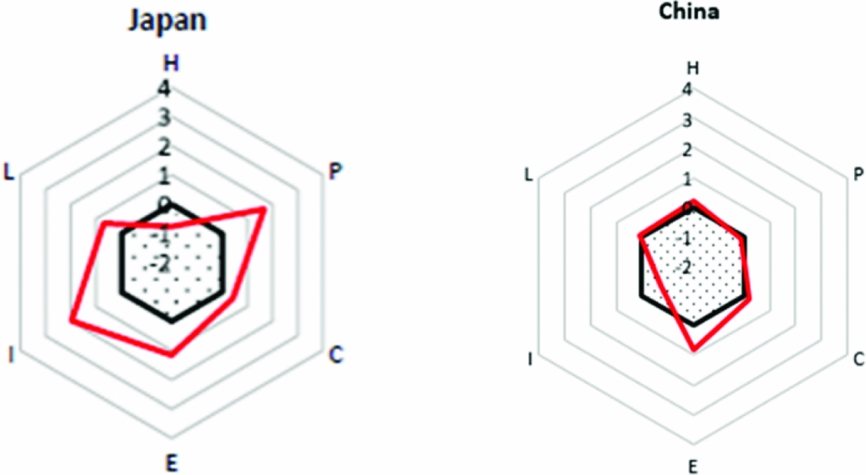
In this section, I take up multilateral institutions, their development since 1945, and ‘global leadership willingness’ as determined primarily by the difference between the year of promulgation to a multilateral agreement and the year of ratification thereto (Le et al., Reference Le, Mikami and Inoguchi2014). The reasoning is that the act of promulgation shows global leadership willingness and that the difference between promulgation and ratification shows global leadership hesitation or reluctance after promulgation. We have chosen 120 multilateral treaties deposited to the United Nations system since 1945. We have also shown each country's hexagonal profiles to show each country's strengths and weaknesses for six domains of human rights, trade and commerce and communications, peace and disarmament, the environment, intellectual property, and labor.
First of all, the macro-picture of accumulated multilateral institutions shows that many countries have been assiduous and forward-looking about expanding and improving the space and range of agreements among nations since 1945. Second, some nations are more equal than others. Some nations are more inclined to serve the people, the country, and mankind in terms of settling disputes and executing actions according to agreed norms and rules with professional spirit and competence.
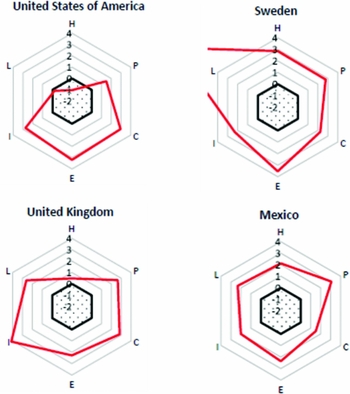
Since the measures we use are accumulated indicators since 1945, those newly independent countries tend to have shrunk hexagonal profiles rather than expansive hexagonal profiles. With the inherent bias of our indicators, I first look at those best performers in terms of high scores in many domains. The best performer is Sweden. It is an all-round actor in getting high scores in all the six domains. Next come the United Kingdom and Mexico. This fact is intriguing. But if their histories with the United States since 1945 are taken account, it may not be difficult to fathom, even if partially. After all the United Kingdom and Mexico are two of those countries who lost a big chunk of their possessions and territories to the United States well before 1945. It is of utmost importance to note that the United States rose to the position of global leadership since 1945 by shaping institutions and their norms and rules (Ikenberry, Reference Ikenberry2011). Adding to this development is the fact that they are both geographically close neighbors of the United States if the Atlantic Ocean is to be interpreted as a lake of a sort.
The natural question is: Why isn't the United States the best performer? Its hexagonal profile has serious drawbacks in the human rights and labor domains. Domestic oppositions to a number of multilateral treaties in these two domains in the United States mean that ratification is much more difficult than promulgation. One should recall that the United States Congress has constitutional rights to ratify or not those treaties signed by President. Also one might as well think that there is a division between world order shapers and supporters (Inoguchi, Reference Inoguchi1986). The former is the United States, while the United Kingdom and Mexico are vigorous supporters of multilateral institutional arrangements since 1945 if the Pacific Ocean is to be interpreted as a lake of a sort.
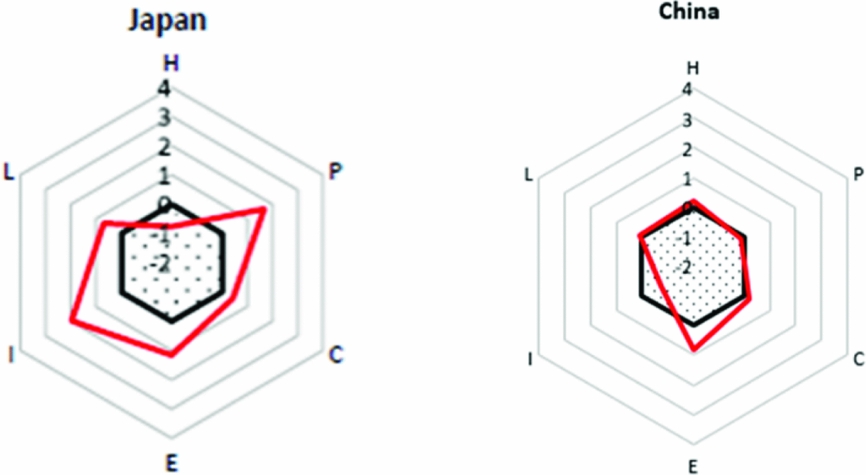
Our curiosity moves to Japan and China and their hexagonal profiles. Japan is placed among many OECD countries with a fairly balanced profile, albeit the domain of human rights is below the world average. Japan is historically similar to the United Kingdom and Mexico in that Japan lost possessions and territories to the United States and is geographically very close since 1945. Japan's performance in the domain of human rights is very similar to that of the United States. China's hexagonal profile is similar to newly independent states because China opened the country very late in 1978, and its accumulation of multilateral treaties is not so heavy. China's preference in the domain of intellectual property is below world average. China's entry into institutional building on its own initiative has been going on at least since autumn 2014. ‘All South China Sea disputants joined the AIIB (Asian Infrastructure Investment Bank); many are on the New Silk Roads; strengthened ties with US-friendly countries like South Korea, Thailand, and Myanmar; even resumed dialogue with Japan’ (Thomas, Reference Thomas2015).
5. Conclusion
The question has been posed at the outset: Is the current world in an era of war or in an era of peace? Having examined both the macro-trend of war-related deaths globally and regionally for the period between 1938 and 2014 and the micro-interactions between China and Japan for the period between 2012 and 2014, I was initially intrigued by the dramatic reduction in the number of war-related deaths globally and regionally and the extreme uncertainty and unpredictability about Chinese and Japanese moves in running their bilateral relations. A look at the 150 countries' hexagonal profiles in the fourth section has led me to understand the answer to the question as follows.
The current world is in an era of new normal. It is neither in an era of war normal nor in an era of peace normal. By new normal Etzioni (Reference Etizioni2014) means that both currents are flowing in a mingled and mixed fashion (cf. Galbraith, Reference Galbraith2014). As new technologies develop and human environments keep changing, individual rights and the common good must be calibrated to stake a good balance each time.
Hexagonal Profile in terms of Multilateral Institutions: The United States, Sweden, The United Kingdom and Mexico.

Hexagonal profiles of multilateral institutions: Japan and China.