Introduction
There is a high prevalence of children with established, multiple atherosclerosis-promoting cardiometabolic risk factors attributable to poor nutrition and physical activity. Reference Dykstra, Griffith, Renfrow, Mahon and Harber1–Reference Raghuveer, Hartz and Lubans3 These children are often referred to outpatient specialty clinics for management of risk factors, having failed primordial prevention. A single, unifying marker of cardiometabolic disease may be cardiorespiratory fitness, which measures the capacity of the circulatory and respiratory systems to bring oxygen, and thus energy, to skeletal muscles during physical activity. Reference Anderssen, Cooper and Riddoch4–Reference Ross, Blair and Arena6
In adults, cardiorespiratory fitness is a better predictor of cardiovascular and all-cause mortality than traditional cardiometabolic risk factors, such as cigarette smoking, hypertension, and high cholesterol. Reference Nauman, Nes and Lavie7 A high cardiorespiratory fitness in adults is associated with reduced risk of cardiovascular disease. Reference Nauman, Nes and Lavie7,Reference Lang, Prince and Merucci8 In adults, cardiorespiratory fitness is thus recognised as a “vital sign” due to its strong predictive value for cardiovascular-related morbidity and mortality. Reference Ross, Blair and Arena6,Reference Lang, Prince and Merucci8,Reference Laukkanen, Isiozor and Kunutsor9 Children and adolescents with high cardiorespiratory fitness are also less likely to have poor cardiometabolic health Reference Dykstra, Griffith, Renfrow, Mahon and Harber1,Reference Ortega, Ruiz, Castillo and Sjöström2,Reference Bailey, Boddy, Savory, Denton and Kerr5,Reference Mäestu, Harro, Veidebaum, Kurrikoff, Jürimäe and Mäestu10 and less likely to develop cardiometabolic diseases as adults. Reference Ruiz, Castro-Piñero and Artero11 Thus, it is also recommended that cardiorespiratory fitness be evaluated during a child’s annual physical, recognising its potential to identify risk for future cardiovascular disease. Reference Raghuveer, Hartz and Lubans3
There are many ways to assess cardiorespiratory fitness, the gold standard being cardiopulmonary exercise testing with treadmill or bicycle ergometry. Others include physical activity recall, submaximal tests such as running or walking tests or a 3-minute Step Test. Cardiopulmonary exercise testing is expensive and resource-intensive, requiring space, sophisticated equipment, and motivation from participants to maximally exert themselves, making the clinical application of these tests suboptimal for routine use. Reference Raghuveer, Hartz and Lubans3 Thus, there exists a gap to assess cardiorespiratory fitness quickly and with fewer resources in outpatient clinic settings. Submaximal test, such as the 3-minute Step Test, is one of the least resource and time-intensive cardiorespiratory fitness assessment approaches and could be more convenient to perform in an outpatient clinic setting, as it can be used in small spaces such as clinic rooms and can be performed relatively quickly.
Studies have established support for the reproducibility and validity of using a 3-minute Step Test to measure cardiorespiratory fitness in children; comparing 3-minute Step Test to VO2 max testing in children with strong correlations Reference Topp, Jacks and Moore12–Reference Hayes, Maldonado, Gossett, Shepherd, Mehta and Flesher14 and excellent reliability (ICC ≥ 0.92) for within day test-retest. Reference Hayes, Maldonado, Gossett, Shepherd, Mehta and Flesher14 The 3-minute Step Test also had stronger positive correlations to VO2 peak than other submaximal tests, such as the squat test. Reference Bruggeman, Vincent and Chi13 Researchers have used varied approaches to predict cardiorespiratory fitness using 3-minute Step Test metrics with linear regression techniques. Reference Topp, Jacks and Moore12,Reference Hayes, Maldonado, Gossett, Shepherd, Mehta and Flesher14 However, these measures are not clinically generalisable.
Testing Phase Duration of Phase
Pre-test ∼ 3-4 min
-
• Baseline heart rate is recorded after being seated for ≥2-min via pulse oximeter.
-
• After seated heart rate is recorded, the patient is asked to stand in front of the step until the heart rate plateaus, and the highest orthostatic (sit-to-stand) heart rate is recorded.
Exercise 3 min
-
• A metronome is started at a rate of 96 beats per minute, which corresponds with an alternating leg step (up-up-down-down) cadence of 24 steps per min.
-
• The patient is instructed to start stepping when they felt ready and in sync with the metronome.
-
• Once the patient starts stepping, the exercise physiologist starts the stopwatch.
-
• The patient steps up and down the 6-inch aerobic step for 3-min, maintaining cadence using the metronome and feedback from the exercise physiologist when necessary.
-
• The pulse oximeter is placed on the patient in the final 30-45 seconds of the 3-min, and the highest heart rate observed at the end of the test is recorded (peak heart rate).
Exercise Recovery 5 min
-
• Immediately following the 3-minute Step Test, the patient is asked to sit in a chair adjacent to the 6-inch step.
-
• Patient is instructed to remain seated and rest for 5-min.
-
• Heart rates are recorded in the final 10 s of each min of the 5-min of seated recovery.
The aim of our study was thus to determine if a standalone raw measure that is generalisable—percent of predicted peak heart rate attained (220-age in years) during the 3-minute Step Test could predict cardiometabolic and arterial health. Thus, in this study, we sought to establish the relationship between the 3-minute Step Test-derived percent of predicted peak heart rate (used as a measure of physiological work and cardiorespiratory fitness) and cardiometabolic and arterial health in children and adolescents. If such a relationship is robust, it would support the use of a 3-minute Step Test for screening as a quick/easy cardiorespiratory fitness assessment tool in clinics. A measure such as this could complement counselling, as it is objective compared to physical activity recall alone, which is the current standard, but subjective and prone to recall biases.
Materials and methods
Design and participants
This was a retrospective observational study of children and adolescents who presented to an outpatient paediatric Preventive Cardiology Clinic between October 2019 and June 2023. Referrals were through primary care providers for management and counselling of atherosclerosis-promoting/cardiometabolic risk factors. To be included in this analysis, they were aged between 9 and 19 years, having completed the 3-minute Step Test during their clinic visit, and with laboratory testing and arterial function completed at that time as well. Patients were excluded from the analysis if they were unable to adhere to the 3-minute Step Test protocol and/or unable to successfully complete the 3-minute Step Test.
The 3-minute Step Test
The 3-minute Step Test was administered by a trained exercise physiologist in a standard outpatient clinic room during the visit (protocol described below). Patients were provided with instructions and a demonstration of the 3-minute Step Test, followed by checks for understanding, prior to performing the test. Heart rates were assessed using a portable pulse oximeter (Covidien, PM10N) placed on the finger or thumb. An aerobic step platform (Sandinrayli, 910180; Fitvids, AROS68), comparable to an aerobic step used in a fitness facility or gym, was used. The step height was 6 inches and was not adjusted based on patient height.
Anthropometrics and serum cardiometabolic risk factors
All procedures took place in accordance with Preventive Cardiology Clinic visit procedures at one of the three Children’s Mercy locations. Standard clinical procedures have been described elsewhere Reference White, Anand, Qayum, Ibezim, Sherman and Raghuveer15 . Briefly, height was measured to the nearest 0.01 m using a wall-mounted stadiometer, and weight was assessed on a ScaleTronix digital scale to the nearest 0.1 kg. Waist circumference was measured within 2 cm above the iliac crest. Height, weight, and waist circumference were used to calculate other anthropometrics, including BMI and waist-to-height ratio. Sex and age-specific z-scores for body anthropometrics were calculated using previously published normative data Reference Kuczmarski, Ogden and Grummer-Strawn16,Reference Sharma, Metzger, Daymont, Hadjiyannakis and Rodd17 . Blood pressure was measured while seated with a GE ProCare 100–400 series (Milwaukee, WI, USA) oscillometric sphygmomanometer Reference Lee, Park and Shin18 .
A fasting serum panel consisting of key cardiometabolic risk factors that are more influenced by lifestyle- triglycerides, high-density lipoprotein cholesterol, alanine aminotransferase, haemoglobin a1c, and vitamin D was collected prior to the visit.
Arterial function/stiffness assessment with pulse wave velocity
Carotid-femoral pulse wave velocity was assessed using the SphygmoCor XCEL (AtCor Medical, Sydney, New South Wales, Australia) pulse wave velocity analyser. Assessments were performed by trained cardiac sonographers on patients who were resting in the supine position. Sonographers measured the arterial path length (the linear distance from the suprasternal notch to the location of the femoral artery in the groin) prior to assessment. This device recorded the carotid-femoral pulse wave velocity between the diastolic foot of the carotid waveform measured via applanation tonometry and the diastolic foot of the simultaneously recorded femoral pulse measured via oscillometric cuff. Pulse transit time, defined as the time from the foot of the carotid diastolic pulse wave to the foot of the femoral diastolic pulse, was recorded in milliseconds. The pulse wave velocity was determined by dividing the arterial path length by the pulse wave transit time using:
 $Velocity = {{Distance} \over {Time}}$
Reference values Reference Elmenhorst, Hulpke-Wette, Barta, Dalla Pozza, Springer and Oberhoffer19 were used to derive sex and height-specific z-scores for pulse wave velocity.
Statistical analysis
Data are described as frequencies and means with standard deviation or error as appropriate to the level of measurement. General linear models were used to look for relationships between percent-predicted peak heart rate and outcome variables. Height and significant changes in heart rate due to orthostatic changes (>30 beats per minute) were accounted for in the models. SAS Version 9.4 (SAS Institute Inc., Cary, NC) was used for all analyses.
Results
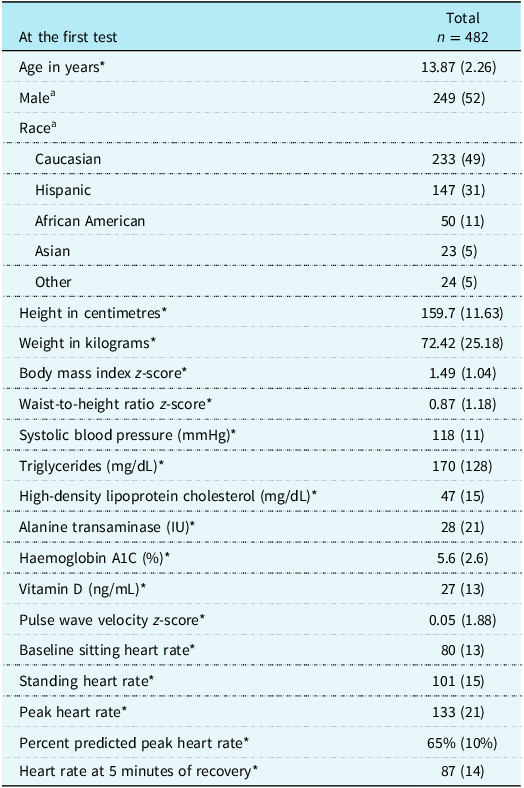
Demographic data from the 482 patients are shown in Table 1. The participants were 52% male and 49% White. The mean age was 13.87 ± 2.26 years. Body mass index z-score was 1.49 ± 1.04, and waist-to-height ratio z-score was 0.87 ± 1.18. Systolic blood pressure was 118 ± 11 mmHg. Cardiometabolic markers composite for the group included triglycerides of 170 ± 128 mg/dL, high-density lipoprotein cholesterol of 47 ± 15 mg/dL, alanine aminotransferase of 28 ± 21 IU, and haemoglobin A1c of 5.6 ± 2.6%, vitamin D level of 27 ± 13 ng/mL. Pulse wave velocity z-score was 0.05 ± 1.88.
3-minute Step Test—Resting heart rate was 80 ± 13 beats per minute while seated and 101 ± 15 beats per minute while standing. The mean peak heart rate achieved during the 3-minute Step Test was 133 ± 21 beats per minute, corresponding to 65 ± 10% of the predicted peak heart rate. Heart rate at 5-minute recovery was 87 ± 14 beats per minute. All baseline characteristics are listed in Table 1.
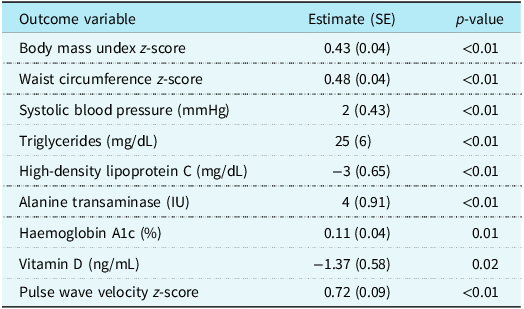
Children and adolescents achieving a lower percent predicted peak heart rate had more desirable cardiometabolic predictors: lower body mass index z-score, waist-to-height ratio z-score, systolic blood pressure, triglycerides, alanine aminotransferase, haemoglobin A1C, and higher high-density lipoprotein cholesterol and vitamin D. Children and adolescents achieving a lower percent predicted peak heart rate also had a lower pulse wave velocity z-score.
For every 10 percent increase in percent predicted peak heart rate achieved (controlled for orthostatic changes and height), there was an associated 0.43 (standard error 0.04) increase in body mass index z-score, 0.48 (standard error 0.04) increase in waist circumference z-score, 2 (standard error 0.43) mmHg increase in systolic blood pressure, 25 (standard error 6) mg/dL increase in triglycerides, a 4 (standard error 0.91) unit increase in alanine aminotransferase, a 0.11 (standard error 0.04)% increase in haemoglobin A1c, and a decrease of 3 (standard error 0.65) mg/dL in high-density lipoprotein cholesterol, and a decrease of 1.37 (standard error 0.58) ng/mL in vitamin D. For every 10 percent increase in percent predicted peak heart rate achieved, there was a 0.72 (standard error 0.09) increase in pulse wave velocity z-score (Table 2).
Baseline characteristics of patients

Variables marked with a superscript *are presented as the mean (standard deviation). Variables marked with superscript aare presented as a number (percentage).
Change in outcome variable for a 10% increase in percent predicted peak HR attained (controlled for orthostatic changes and height)

Discussion
In this study, we have made novel observations that a 3-minute Step Test-derived percent predicted peak heart rate, used as a measure of physiologic work and cardiorespiratory fitness, can effectively predict cardiometabolic and arterial health in children and adolescents who present for primary prevention/management of established lifestyle-mediated cardiometabolic risk factors. The unique aspect of this study is that an easily generalisable raw measure (percent predicted peak heart rate) was used as a measure of cardiorespiratory fitness. While previous reports have confirmed correlations of cardiorespiratory fitness as assessed with bicycle ergometry with cardiometabolic health in children, Reference Bailey, Boddy, Savory, Denton and Kerr5,Reference Mäestu, Harro, Veidebaum, Kurrikoff, Jürimäe and Mäestu10 this type of testing is expensive and thus not easily generalisable.
While we did not correlate these results to physical activity recall (as in, for example, minutes per week of reported moderate-to-vigorous physical activity), we believe that a supervised 3-minute Step Test is an objective measure of cardiorespiratory fitness as it is devoid of recall bias. The correlation of percent-predicted peak heart rate with multiple lifestyle-influenced cardiometabolic risk factors was definitive and persisted after adjusting for height and orthostatic heart rate status. Of note, the orthostatic heart rate changes provided us an additional opportunity to address hydration status and counsel regarding the quality of drinks consumed.
Studies in adults have supported the notion of cardiorespiratory fitness being a “vital sign” that would be of benefit to assess at every patient encounter due to its strong correlation with cardiovascular events. Reference Ross, Blair and Arena6,Reference Lang, Prince and Merucci8,Reference Laukkanen, Isiozor and Kunutsor9 And cardiorespiratory fitness assessment was better than traditional cardiometabolic risk factor monitoring in predicting cardiovascular events, including mortality in adults. Reference Nauman, Nes and Lavie7 There are fewer studies in children, but adolescents with high cardiorespiratory fitness were noted to be less likely to develop cardiometabolic diseases as adults. Reference Mäestu, Harro, Veidebaum, Kurrikoff, Jürimäe and Mäestu10,Reference Ruiz, Castro-Piñero and Artero11,Reference Mintjens, Menting, Daams, van Poppel, Roseboom and Gemke20 Due to the current high prevalence of lifestyle-influenced cardiometabolic risk factors in children, cardiorespiratory fitness evaluated during a child’s clinic visit may potentially better identify risk for premature cardiovascular disease than tracking multiple cardiometabolic risk factors. Reference Raghuveer, Hartz and Lubans3 While maximal exercise testing is the gold standard, the 3-minute Step Test, a quick and inexpensive method to objectively assess fitness in outpatient clinics in children may be a practical and meaningful adjunct to physical activity counselling.
In this report, which we believe is the first of its kind, we have established that an easily generalisable measure, percent predicted peak heart rate derived from a 3-minute Step Test, is a practical tool to quickly assess cardiorespiratory fitness and counsel children and families in busy outpatient clinic settings. We speculate that promotion of physical activity with focused physical activity prescriptions can be used as a strategy to optimise cardiometabolic risk factors and arterial health in children by utilising this unifying test.
Limitations
This was a retrospective chart analysis with associated limitations; however, the strength of the data lies in the large number of patients we were able to recruit. The testing was performed during a clinic visit as standard of care; thus, unrecognised, extraneous factors may have influenced the percent predicted peak heart rate attained; however, with the strong associations noted, this is unlikely. The lifestyle-influenced cardiometabolic variables were limited to those routinely collected in our preventive cardiology clinic and therefore do not represent an all-inclusive set of cardiometabolic risk factors. The study did not establish clinically meaningful cut-off values between the percent peak heart rate attained and risk factors due to the bias it would create based on the sample population. Despite these limitations, we believe that the data we present support that the 3-minute Step Test is a screening tool that trends linearly with lifestyle-influenced cardiometabolic risk factors.
Conclusions
A 3-minute Step Test-derived percent peak heart rate can be used effectively in outpatient clinic settings to objectively evaluate cardiorespiratory fitness and correlates strongly with cardiometabolic risk factors and arterial health in children and adolescents. Those who use less of their percent-predicted peak heart rate on the 3-minute Step Test have more optimal cardiometabolic risk factors and better arterial health. Exercise prescriptions to improve cardiorespiratory fitness may be an effective focus to improve overall cardiometabolic health and optimise arterial function. Longitudinal studies are recommended to investigate if this fitness measure does indeed improve with optimisation of cardiometabolic risk factors.
Acknowledgements
None.
Financial support
This research received no specific grant from any funding agency, commercial, or not-for-profit sectors.
Competing interests
None.