Introduction
According to the WHO definition, human cystic echinococcosis (CE) is a zoonotic disease caused by species complex centred on Echinococcus granulosus. The disease is widespread and cases among humans are recorded all over the world except for Antarctica (WHO, 2020). In high-endemic countries, the disease poses a serious medical and social problem and a challenge to the systems of public health.
According to a various literature sources, the disease most often affects the liver with the lungs being in second place, and these organ localizations are found in at least 90% of all cases (Eckert et al., Reference Eckert, Gemmell, Meslin and Pawlowski2001; Cöl et al., Reference Cöl, Cöl and Lafçi2003; Ahmadi and Hamidi, Reference Ahmadi and Hamidi2010). Often the course of the disease is without symptoms and if any are present these are not pathognomonic and depend on the affected organ (Eckert et al., Reference Eckert, Gemmell, Meslin and Pawlowski2001).
Among the member states of the European Union (EU), Bulgaria holds a leading position by the number of cases of CE among its population. Regardless of the steady trend of decreasing annual number of cases by 43.5% for the period 2008–2017 (i.e. from 386 in 2008 to 218 in 2017), the country is still with highest annual incidence of CE in the EU (EFSA and ECDC, 2018). Because of the obvious importance of the disease, and because it most often affects the liver and lungs we aimed to define the proportion of cases with different organ localization, the diagnostic and therapeutic approaches in such cases, and the outcome of them.
Patients and methods
Study design
The study is a retrospective analysis of cases of CE with extra-hepatopulmonary localization recorded for a 10-year period from January 2010 to December 2019. Cases involving the liver and/or lungs alone, or in combination with other affected organs were excluded from the study to determine the frequency of cases in which only other organs and systems of the human body were affected. Data from epidemiological survey cards of cases with CE registered in the country and containing medical information about the organ localization and number of hydatid cysts, the method of diagnosis and confirmation of disease, the therapeutic approach and clinical outcome were processed. According to the existing legislation in the country, each case of CE is subject to a mandatory notification and epidemiological investigation. At a local level, this is performed by the Regional Health Inspectorates (RHI) who every month sends the collected information to the National Center for Infectious and Parasitic Diseases (NCIPD), where it is analysed and on its grounds are prepared proposals to the Ministry of Health for improvement of disease surveillance and control.
Ethical standards
The current study is not part of a funded research project, and the data were collected by routine diagnostic activities and epidemiological investigations carried out under Bulgarian legislation. As the presented data are retrospective, de-identified and depersonalized an ethical approval and consent to participate were not applicable.
Statistical analysis
Some indicators such as median, min–max and percent have been identified.
Results
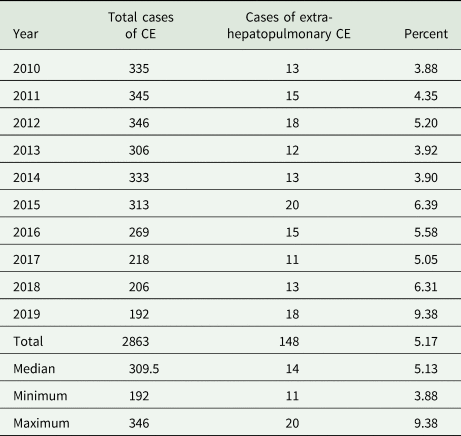
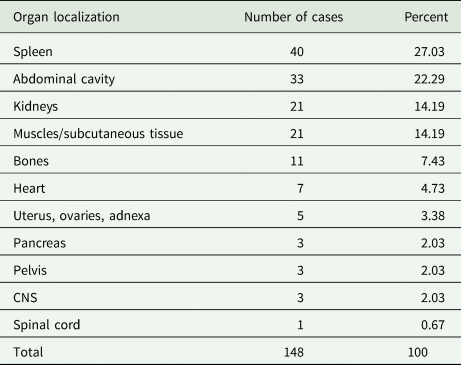
A total of 2863 cases of CE were registered in the country, of which 148 with organ localization other than liver and/or lung. The proportion of these cases is variable over the years, averaging 5.17% over the period (Table 1). The organ localization of hydatid disease is presented in Table 2.
Reported cases of extra-hepatopulmonary CE by year

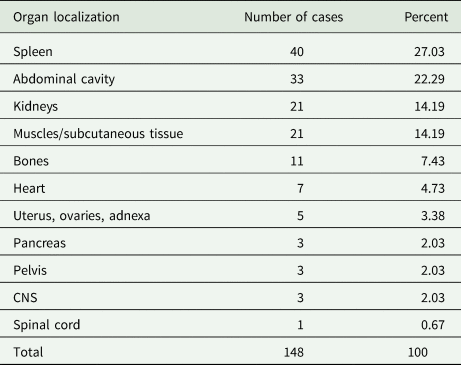
Organ involvement in the cases of extra-hepatopulmonary CE
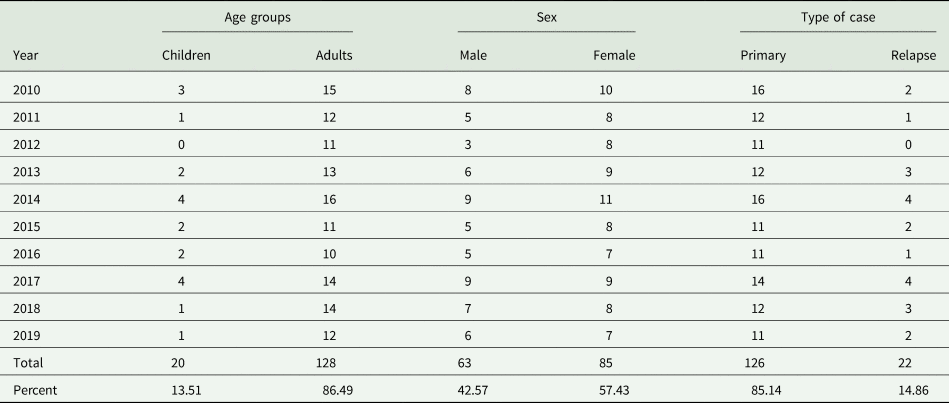
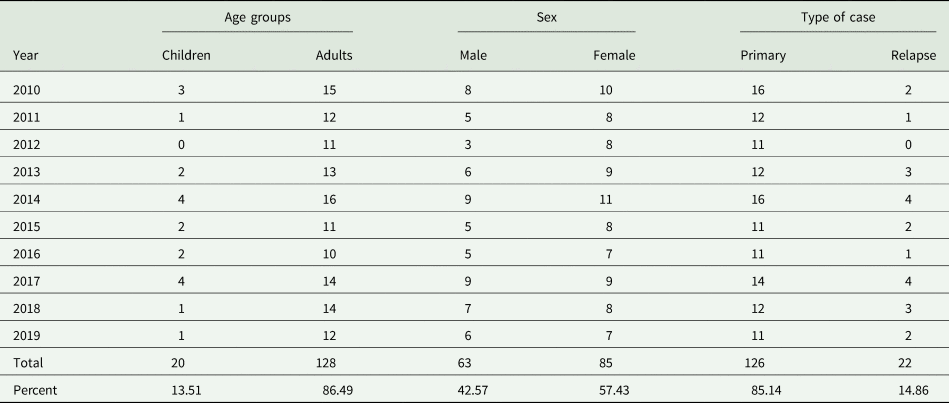
The distribution of cases by age, gender and type (primary or relapses) is presented in Table 3. Primary cases prevail among persons over 18 years of age and among females.
Reported cases of extra-hepatopulmonary CE by age, gender and type of case
Only in 9.46% of the cases (n = 14) the disease proceeded without clinical symptoms, as in six of the patients it was a recurrence found during the follow-up observation, and in eight of them it was diagnosed accidentally in imaging studies performed on another occasion. In the remaining 90.54% (n = 134) there were symptoms most often expressed as: heaviness, discomfort and dull pain in the affected organ (n = 86, 58.11%) and detection of swelling or tumour formation (n = 27, 18.24%).
Imaging methods [ultrasound, radiography, computerized tomography scan and magnetic resonance imaging (MRI)] were used in all patients with extra-hepatopulmonary CE. The diagnosis was confirmed by serological and histological methods. Both methods were used in 29.05% of the cases (n = 43), only serological methods in 8.11% (n = 12), and only by histological study were confirmed 62.84% of the cases (n = 93). In eight cases, the serological results were negative or borderline and diagnosis was confirmed histologically.
Regarding the therapeutic approach, 95.95% (n = 142) of the patients underwent surgical treatment, 3.38% (n = 5) underwent medical treatment and one patient (0.67%) was treated by a puncture–aspiration–injection–reaspiration (PAIR) technique. With exception of one case that ended with death caused by a spontaneous rupture of a hydatid cyst in the right atrium of the heart, in all other cases the outcome was favourable.
Discussion
Literature data on extra-hepatopulmonary echinococcosis are scarce and most are based on descriptions of clinical cases or small series of patients (Çakır et al., Reference Çakır, Balasar and Küçükkartallar2016). Studies based on larger groups of patients are relatively rare and are mostly from Turkey and Iran, where the disease is endemic (Cöl et al., Reference Cöl, Cöl and Lafçi2003; Ahmadi and Hamidi, Reference Ahmadi and Hamidi2010; Akcam et al., Reference Akcam, Ulku, Koltas, Izol, Bicer, Kilicbagir, Sakman, Poyrazoglu, Erman, Aridogan, Parsak, Inal and Iskiti2014; Çakır et al., Reference Çakır, Balasar and Küçükkartallar2016).
CE is one of the parasitic diseases of greatest medical importance in Bulgaria (Harizanov et al., Reference Harizanov, Rainova and Kaftandjiev2019). Several hundred cases are registered annually in the country. The relative proportion of patients with extra-hepatopulmonary echinococcosis is just over 5%, which is consistent with the literature (Eckert et al., Reference Eckert, Gemmell, Meslin and Pawlowski2001). The majority of patients with extra-hepatopulmonary localization of CE were persons over 18 years of age (86.49%). This can be explained by the slow, chronic course of the disease that in many cases started long time ago, i.e. the infection can occur in childhood but it can be diagnosed much later. The distribution by gender showed a predominance of female patients (n = 85, 57.43%) over those of males (n = 63, 42.57) and primary cases (n = 126, 85.14%) exceeded the cases of recurrence (n = 22, 14.86%). In 81.08% (n = 120) of the patients, the presence of a solitary hydatid cyst was detected, and in 18.92% (n = 28) two or more were diagnosed.
According to our study, most common is the spleen involvement: 1.4% from all reported cases of CE for the studied period and 27.03% from the cases with extra-hepatopulmonary localization. Regarding this organ localization, our data are similar to those of some authors (Eris et al., Reference Eris, Akbulut, Yildiz, Abuoglu, Odabasi, Ozkan, Atalay and Gunay2013; Belli et al., Reference Belli, Akbulut, Erbay and Koçer2014; Çakır et al., Reference Çakır, Balasar and Küçükkartallar2016; Bartın, Reference Bartın2019) and differ significantly from others (Akcam et al., Reference Akcam, Ulku, Koltas, Izol, Bicer, Kilicbagir, Sakman, Poyrazoglu, Erman, Aridogan, Parsak, Inal and Iskiti2014). In 92.5% of the cases with splenic localization the presence of a solitary hydatid cyst in the organ was found, and only in 7.5% (n = 3) the presence of two or more cysts was found. From the total of 40 patients with splenic hydatid cyst (SHC), only three of them (7.5%) had secondary SHC. In this respect, our data differ somewhat from those in the studies of Akbulut et al. (Reference Akbulut, Sogutcu and Eris2013).
The incidence of CE of the peritoneal cavity and retroperitoneal space varies from 6 to 16% according to various studies (Engin et al., Reference Engin, Acunaş, Rozanes and Acunaş2000; Akcam et al., Reference Akcam, Ulku, Koltas, Izol, Bicer, Kilicbagir, Sakman, Poyrazoglu, Erman, Aridogan, Parsak, Inal and Iskiti2014). Our data are for 22.2% involvement of the abdominal cavity (retroperitoneum and mesentery), and in these cases the percentage of multiple echinococcosis is much higher – 18.18% (n = 6).
Our study found that the frequency of kidney and muscle/subcutaneous tissue involvement was identical (14.19% each). All cases of renal echinococcosis were with unilateral involvement and had a solitary cyst in 90.48% of the patients (n = 19). Regarding CE affecting muscles and/or subcutaneous tissue, we found that the most common site of involvement is the cervical (n = 8), and gluteal and femoral regions (three cases, respectively). In this respect, our data differ greatly from those of the authors, according to whom muscle involvement alone is very rare (García-Alvarez et al., Reference García-Alvarez, Torcal and Salinas2002; Burgazli et al., Reference Burgazli, Ozdemir, Beken Ozdemir, Mericliler and Polat2013).
Other organs and systems are affected with a relatively lower frequency. It is noteworthy that the relative share of multiple echinococcosis is higher in bone involvement (54.55%, six out of 11 cases). We found that the spine was most often affected (n = 10), and more frequently the thoracic vertebrae (n = 7) were involved. Common to all of these cases was that they had symptoms with acute pain in the affected area, and in one of them spontaneous fracture of a thoracic vertebra occurred.
Cardiac involvement was found in 4.73% of all cases with extra-hepatopulmonary localization of CE, while in published studies the incidence of cardiac involvement ranged from 0.2 to 2% (Prousalidis et al., Reference Prousalidis, Tzardinoglou, Sgouradis, Katsohis and Aletras1998; Engin et al., Reference Engin, Acunaş, Rozanes and Acunaş2000; Ibn Elhadj et al., Reference Ibn Elhadj, Boukhris, Kammoun, Halima, Addad and Kachboura2014). In 42.86% of these cases the cysts were found in the pericardium (n = 3), and in the rest, echinococcal cysts were localized in the epicardium, right atrium, right and left ventricles.
Although the study covers a considerable period of time, the identified cases of CE involving the central (CNS) and peripheral nervous system (spinal cord) are relatively small, and their frequency is similar to that presented in the literature (Altinörs et al., Reference Altinörs, Bavbek, Caner and Erdogan2000; Engin et al., Reference Engin, Acunaş, Rozanes and Acunaş2000). In all patients the disease progressed with pronounced neurological symptoms (paraplegia, headache, vomiting, epileptiform seizures and paresthesia of the lower extremities).
Interestingly, in all three cases of pancreatic involvement, reported during the study period, the main clinical symptom was development of mechanical jaundice, one of most serious complications in pancreatic hydatid cyst disease. The frequency of PMS (2.03%) in the current study was similar to that described by other authors (Akbulut et al., Reference Akbulut, Yavuz, Sogutcu, Kaya, Hatipoglu, Senol and Demircan2014).
The diagnostic algorithm for extra-hepatopulmonary CE does not differ from that in liver or lung involvement. Imaging examinations play a major role, with more than half of the patients using more than one method. The primary imaging diagnosis includes ultrasound or radiography, depending on the nature of the patients' complaints, and subsequently some of them underwent additional computed tomography in the course of diagnostic clarification.
MRI was used only in cases where patients had neurological symptoms and suspected volume-occupying lesions in the brain and spinal cord. Confirmatory diagnosis most often was histological, which is probably due to the fact that over 95% of patients were treated surgically. However, 37.16% of patients were tested by serological methods. A negative or borderline result was observed in 14.55% (n = 8) of a total of 55 patients. In the diagnostic practice in Bulgaria, of all immunological techniques, enzyme-linked immunosorbent assay is most often used as a screening and western blot as a confirmatory test. Commercial kits are used according to the manufacturer's protocol. However, serological tests still play a complementary role to the imaging examinations in the diagnosis of CE. The relatively low sensitivity (up to 30% of false-negative results) of available commercial kits, especially in cases of extrahepatic localization of CE, makes serological results difficult for interpretation (Sarkari and Rezaei, Reference Sarkari and Rezaei2015). Akbulut et al. (Reference Akbulut, Yavuz, Sogutcu, Kaya, Hatipoglu, Senol and Demircan2014) reported that 15 of the 40 patients with pancreatic echinococcosis described in the literature had negative serological tests for CE.
In the patients included in our study, main therapeutic approach was the surgical removal of the hydatid cyst/cysts. This can be explained by the extra-hepatopulmonary localization of the disease and is in line with the currently established guidelines for treatment of the disease (Eckert et al., Reference Eckert, Gemmell, Meslin and Pawlowski2001). PAIR was administered to only one patient with solitary hydatid cyst of the kidney, and five individuals were treated with medications only, three of whom had recurrence and multiple involvement. The other two were inoperable due to concomitant pathology, which did not allow surgical intervention. According to the treatment algorithm of CE accepted in Bulgaria, each patient treated surgically or with PAIR is subject to a drug anti-relapse prophylaxis with albendazole, and the duration of the course is determined individually, according to severity of the disease (from 1 to more of 12 months). A decision on antiparasitic medical treatments given to patients before surgery or PAIR is made by the treating physician and lasts from 1 day to 1 week before the scheduled procedure, but this prophylaxis is not precisely regulated and does not cover all patients with CE. Because, recurrences are registered annually, this gives us reason to believe that not all patients treated for CE with invasive techniques are covered by anti-relapse drug prophylaxis.
For the period studied by us, except for one case that ended with death due to spontaneous rupture of an echinococcal cyst located in the right atrium, all others had a favourable outcome.
This study shows that the extra-hepatopulmonary localization of CE is not so rare, and in most cases it is a primary disease. In this aspect, clinicians should consider hydatidosis in the differential diagnosis when cystic formation(s) is found, regardless of the organ involved.
Author contribution
RH conceived and designed the study. IK and IR conducted data gathering. RH, IR and IK wrote the manuscript.
Conflict of interest
The authors declare that they have no conflict of interest.
Ethical standards
The current study is not part of a funded research project, and the data were collected by routine diagnostic activities and epidemiological investigations carried out under Bulgarian legislation. As the presented data are retrospective, de-identified and depersonalized an ethical approval and consent to participate were not applicable.