Background
Antibiotics are among the most frequently used pharmaceuticals today. Since the development of penicillin, antibiotic use in all parts of the health care system has contributed significantly to reducing the likelihood of dying from an infectious disease [World Health Organization (WHO), 2000]. However, consumption tends to deplete the efficacy of the antibiotic in combating bacterial infections because the bacteria develop resistance to the antibiotic (Levy, Reference Levy1992; Levy and Marshall, Reference Levy and Marshall2004). Accordingly, recent studies have found that use of broad-spectrum antimicrobials such as cephalosporins and fluoroquinolones influences the emergence and spread of resistant pathogens in hospital settings (Aldeyab et al., Reference Aldeyab, Monnet, Lopez-Lozano, Hughes, Scott, Kearney, Magee and McElnay2008, Reference Aldeyab, Harbarth, Vernaz, Kearney, Scott, Funston, Savage, Kelly, Aldiab and McElnay2009; Vernaz et al., Reference Vernaz, Sax, Pittet, Bonnabry, Schrenzel and Harbarth2008; Kaier et al., Reference Kaier, Hagist, Frank, Conrad and Meyer2009a, Reference Kaier, Frank, Hagist, Conrad and Meyer2009b). Interestingly, patents on many cephalosporins and fluoroquinolones have expired in the last two decades, and entry into the market of generics has resulted in massive price decreases in both the branded and generic version of the antibiotic. The question is whether the demand for antibiotics changes when prices drop.
Like most pharmaceuticals, antimicrobials are unusual in that the consumer of the product is typically not the person deciding which product to consume (Eisenberg, Reference Eisenberg2002). Physicians have wide choice in the drugs they prescribe. Over the past decades, more and more prescribing guidelines have emerged to assist physicians in their decision, including information about the prices of the different agents (Frank and Tacconelli, Reference Frank and Tacconelli2009).
The idea behind the paper presented here is that there are exogenous regulatory shocks like patent expiration and generic entry that lead to substantial changes in prices. The main question is whether these price changes are followed by changes in demand for the respective antimicrobial agent. Therefore, demand for antibiotic agents was analysed both in the ambulatory setting in Germany and in the setting of a single German teaching hospital.
Health insurance is mandatory in Germany. Patients are generally covered by statutory health insurance (SHI), and, as such, enjoy full coverage on in-hospital medication. Hospitals, on the other hand, have fixed reimbursement rates based on diagnosis-related groups (DRGs), a system implemented in January 2003, and the sole system by which recurrent expenditure is now financed in Acute Hospitals. Both in the ambulatory and the inpatient sector, benefits are provided as benefits-in-kind to patients covered by SHI, that is, nearly 90% of the German population. In the ambulatory sector, however, patients have to make a small co-payment (between €5 and €10) for every prescription. In Germany, ambulatory care physicians are generally self-employed, and the SHI reimburses fixed budgets for pharmaceuticals the size of which depends on the number and age of the patients. Pharmaceutical price regulation differs between the inpatient and the ambulatory sector. In both sectors, prices are determined by the manufacturer without any negotiations involving government agencies, direct price or profit controls. Hospitals, can however, negotiate prices with wholesalers or manufacturers (Busse and Riesberg, Reference Busse and Riesberg2004).
On the basis of German payment and reimbursement schemes, we assume that demand for antibiotics both in the ambulatory and in the hospital setting is only dependent on the physicians’ choice of antibiotic. In Germany, antibiotic treatment is not fully reimbursed; rather, it is covered by budgets that are determined by other factors (DRGs or ambulatory per-capita budgets for pharmaceuticals).
Physicians working in the ambulatory sector are generally self-employed, and the SHI reimburses fixed budgets for pharmaceuticals based on the number of patients and their age. According to this reimbursement system and the general assumption that self-employed ambulatory care physicians are influenced by pecuniary incentives, we may presume that in the outpatient sector a physician's decision to prescribe an antimicrobial is influenced by the incentive to prescribe an agent that is (1) cheap and (2) promises effective treatment in order to avoid short term re-examination of the patient. In the hospital setting, physicians are part of a team on a specific medical ward. However, the different medical wards are also given pecuniary incentives to reduce the costs incurred for treatment with antibiotics because wards are responsible for their own budgets and incomes are determined by DRGs.
Accordingly, we presume that a physician's decision to prescribe an antibiotic will be guided by financial incentives both in the outpatient and the inpatient sectors. We follow the hypothesis that antibiotic use may be treated as consumption of ordinary goods, suggesting a negative own-price elasticity of demand.
For the analysis presented here, data on annual SHI-related antibiotic consumption from 1991 through 2007 were consulted, while data on in-hospital antibiotic use at University Medical Center Freiburg (UMCF), a large teaching hospital in South-West Germany, were available on a monthly basis over an eight-year period (2000–2007). The focus of the analysis relies on the antimicrobial classes of cephalosporins and fluoroquinolones because (i) they were found to be responsible for the spread of resistance (Aldeyab et al., Reference Aldeyab, Monnet, Lopez-Lozano, Hughes, Scott, Kearney, Magee and McElnay2008, Reference Aldeyab, Harbarth, Vernaz, Kearney, Scott, Funston, Savage, Kelly, Aldiab and McElnay2009; Vernaz et al., Reference Vernaz, Sax, Pittet, Bonnabry, Schrenzel and Harbarth2008; Kaier et al., Reference Kaier, Hagist, Frank, Conrad and Meyer2009a, Reference Kaier, Frank, Hagist, Conrad and Meyer2009b), and (ii) several generic cephalosporins and fluoroquinolones have entered the German pharmaceutical market in recent years.
Methods
At UMCF, a 1600 bed tertiary care teaching hospital with ∼54,000 inpatient admissions annually, antibiotic agents are purchased centrally through the hospital pharmacy, which is able to negotiate prices directly with antibiotic suppliers. The price negotiated by the hospital pharmacy is generally much lower than that paid in the ambulatory sector, both before and after generic entry. Generic agents are regarded to be perfect substitutes for the existing branded version. Accordingly, the hospital pharmacy dispenses only one label of an agent for in-hospital use, either the generic or brand name, because it is able to purchase branded agents with discounts whenever a generic equivalent becomes available. In contrast, in the outpatient sector, substantial price differences exist between the brand name and generic versions of the same antibiotic.
The hospital pharmacy regularly informs physicians on the daily cost of medication in a frequently updated booklet of drugs. These estimated prices are also available in in-hospital guides to antibiotic therapy (Frank, Reference Frank2008; Frank and Tacconelli, Reference Frank and Tacconelli2009).
A number of structural reforms were introduced from 1993 aimed at curbing spending on pharmaceuticals in ambulatory care by setting global budgets on expenditure for physicians or the Physicians’ Associations. The Act on the Limitation of Pharmaceutical Expenditure passed in 2002 also obliges pharmacists to substitute with lower-priced preparations unless the physician explicitly opposes it (aut idem regulation; Busse and Riesberg, Reference Busse and Riesberg2004; Lisac et al., Reference Lisac, Reimers, Henke and Schlette2010).
In the analysis presented here, we focussed on whether demand for antibiotics is driven by decreasing prices when generic substitutes are available, and not on whether these substitutes are actually used because: (1) the price of branded agents decreases after patent expiration as hospital pharmacies are able to purchase branded agents with discounts when generics are available; and (2) limited budgets put physicians under pressure to prescribe the cheapest drugs available (1993–2001) or pharmacists are obliged to substitute expensive preparations with low-price generics (2002–until now).
Annual data on antibiotics prescribed on the German statutory health scheme are routinely collected for the ambulatory sector by the Scientific Institute of General Health Insurance (WIdO), Bonn, Germany, and were available from 1991 to 2007. At UMCF, monthly quantities and the prices of all antimicrobial drugs delivered to each hospitalisation unit were exported from the pharmacy accounting system. In both analyses (price elasticities in ambulatory care and in the hospital), antibiotic use was expressed in defined daily doses (DDD) following the definition of the WHO Anatomical Therapeutic Chemical index, in order to allow for a comparison of the different antimicrobial agents used. Prices were expressed in Euro (€) per DDD for each antimicrobial agent. Weighted averages of the prices were calculated for cases where different packaging sizes coexisted. All prices were consumer price index deflated (2005 = 1). The dates of entry of the generics into the German pharmaceuticals market were derived from data on drug approval.Footnote 1
In Germany, the rate at which antibiotics are used in ambulatory care settings falls within the lower third of European Union countries (de With et al., Reference de With, Schröder, Meyer, Nink, Hoffmann, Steib-Bauert, Kämmerer, Rueß, Daschner and Kern2004; Goossens et al., Reference Goossens, Ferech, Vander Stichele and Elseviers2005). Upper boundaries in regional variation in antibiotic use are still much lower than values for high-use countries like France, Spain and Portugal. Hospital antibiotic use appears to be in the range of that reported for other countries (de With et al., Reference de With, Schröder, Meyer, Nink, Hoffmann, Steib-Bauert, Kämmerer, Rueß, Daschner and Kern2004).
A simple time-series approach was carried out to explore price elasticities of demand for the different antimicrobial agents. Multivariate ordinary least squares regressions were computed with quantities of one agent as the dependent variable and the prices of the agent as independent variable. Furthermore, the effect of patent expiration was integrated into the analysis. In the present work, the focus was to determine whether the entry of competing generic agents into the German pharmaceutical market has changed demand for the antimicrobial agent as a whole. To evaluate the effect of market entry of generics, we created dummy variables, with 0 and 1 respectively representing pre-generic periods and periods with generics available on the market.
For in-hospital antibiotic use at UMCF, we generated data on overall morbidity during the study period. In Germany, the expected care workload per patient is classified according to ‘general nursing care’ categories (Zerbe and Heisterkamp, Reference Zerbe and Heisterkamp1995). According to this statistic, a series of the hospital-wide expected care workload, expressed in minutes of care per month, is available for the whole study period and was integrated in the analysis as an additional independent variable representing overall patient morbidity at UMCF.
In the hospital setting, the physician's choice of a specific antimicrobial agent qD,d is described as follows:
 $${\rm{\rDelta }}\log ({{q}_{D,d}})\, = \,{{\eta }_{D,d}}\, + \,{{\vartheta }_{D,d}}{{g}_{D,d}}\, + \,{{\xi }_{D,d}}{\rm{\rDelta }}\log ({{R}_D})\, + \,{{\delta }_{D,d}}{\rm{\rDelta }}\log {{p}_{D,d}}\, + \,{{\delta }_{m,d}}{\rm{\rDelta }}\log (m)$$
where D stands for the class of antibiotics with a varying number (d = 1, 2, 3, …, n) of antimicrobial agents, expressed in DDDs per 1000 patient days. The variable g represents the dummy variable market entry of the generics. Overall demand was not assumed to be constant, but to vary according to R, which reflects the total revenue of the respective class of antibiotics. The variable pD,d reflects the price of the explained variable and m represents the hospital-wide expected care workload.
As shown in equation (1), we have relied on a reduced form assuming that all explanatory variables are predetermined. Antibiotic suppliers are faced with a substantial degree of competition when generics are available. For ciprofloxacin, for instance, four suppliers of generics simultaneously entered the market in August 2001 when patent protection expired. Until summer 2003, a total of 10 pharmaceutical companies supplied ciprofloxacin on the German pharmaceutical market. Accordingly, the question of endogeneity, that is, the fact that suppliers are adjusting their pricing according to the demand for the specific antibiotic, may be rejected due to the high degree of competition in the market.
In the ambulatory sector, the physician's choice was formulated analogously to the hospital setting, with the small difference that no specific morbidity variable was used, and the absolute level of antibiotic consumption (not relative to the number of patients) was used as the dependent variable.
To obtain stationarity, first-order differencing was used for all input series except the dummy variables. The estimations were tested for multicolinearity (especially between RD and pD,d). The Akaike Information criterion and determination coefficient, the adjusted R 2, were estimated to inform about the goodness of fit of the different analyses. Robust standard errors were calculated using the heteroskedasticity and autocorrelation consistent Newey–West estimator. All the analyses were conducted using the Eviews statistical package (Eviews 5.0, QMS, Irvine, CA, USA).
In addition to the time-series models, which provide a single estimation output for the demand of every antimicrobial agent, panel analyses were carried out for entire classes of antimicrobial agents. Simple fixed-effects panel estimations were estimated using a fixed-effect specification with standard errors that are robust to serial correlation (Arellano, Reference Arellano1987). In the hospital setting, the panel estimations can be described as follows:
 $${{\rm{\rDelta }}\log ({{q}_{D,d}})\, = \,{{\eta }_{D,d}}\, + \,{{\vartheta }_D}{{g}_{D,d}}\, + \,{{\xi }_D}{\rm{\rDelta }}\log ({{R}_D})\, + \,{{\delta }_D}{\rm{\rDelta }}\log {{p}_{D,d}}\, + \,{{\delta }_m}{\rm{\rDelta }}\log (m)\eqno (2)$$
In the ambulatory sector, the estimations were run analogously to the hospital setting, with the above-mentioned difference that no specific morbidity variable was used, and the absolute level of antibiotic consumption was used as the dependent variable.
Results
In-hospital antibiotic use at UMCF (2000–2007)
At UMCF, both overall use of antibiotics and hospital-wide morbidity increased (p < 0.001) over the study period (January 2000 through October 2007. In 2003, the hospital reimbursement system in Germany was reformed and the DRG case-based lump sum system implemented. However, the change in the reimbursement system was not associated with a change in demand for antimicrobial agents.
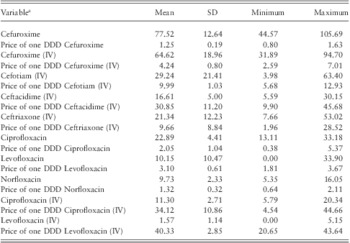
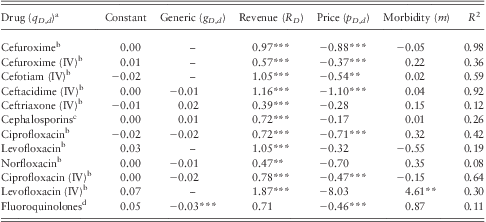
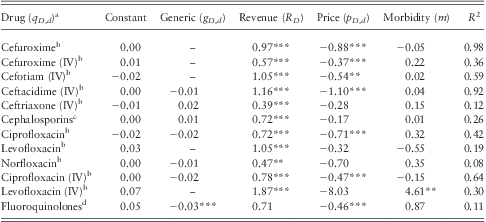
At UMCF, two second-generation cephalosporins were administered for oral application during the study period: cefuroxim-axetil and cefaclor (see Table 1). Generic preparations of the two antibiotics have been widely available on the German pharmaceutical market since 1999 (cefuroxim-axetil) and 1994 (cefaclor). In March 2003, the hospital pharmacy switched from purchasing the branded drug cefuroxim-axetil to purchasing a generic version, which resulted in a substantial decrease in the price per DDD. As shown in Table 2, demand for cefuroxim-axetil (oral application) showed a negative own-price elasticity. In contrast, no generic second-generation cephalosporins for parenteral application were available on the German pharmaceutical market. However, the prices of the two agents varied during the study period and our analysis shows that these varying prices also inversely affect demand for the antibiotic agents.
Characteristics of the different variables (University Medical Center Freiburg, monthly data from January 2001 to October 2007)

DDD = defined daily doses; CPI = consumer price index.
aAntibiotic use expressed in DDDs per 1000 patient days; prices expressed in CPI-deflated Euros (2005 = 1).
In-hospital own-price elasticities at University Medical Center Freiburg, Germany (January 2000–October 2007)
DDD = defined daily doses.
aAntibiotic use expressed in DDDs per 1000 patient days.
bTime-series regression according to the following estimation model:
 $$\[-->$<> {\rm{\rDelta }}\log ({{q}_{D,d}})\, = \,{{\eta }_{D,d}}\, + \,{{\vartheta }_{D,d}}{{g}_{D,d}}\, + \,{{\xi }_{D,d}}{\rm{\rDelta }}\log ({{R}_D})\, + \,{{\delta }_{D,d}}{\rm{\rDelta }}\log {{p}_{D,d}}\, + \,{{\delta }_{m,d}}{\rm{\rDelta }}\log (m) <$>
<!--\]$$
cPanel regression for all cephalosporins (rows 2–6) according to the following estimation model:
 $$\[-->$<> {\rm{\rDelta }}\log ({{q}_{D,d}})\, = \,{{\eta }_{D,d}}\, + \,{{\vartheta }_D}{{g}_{D,d}}\, + \,{{\xi }_D}{\rm{\rDelta }}\log ({{R}_D})\, + \,{{\delta }_D}{\rm{\rDelta }}\log {{p}_{D,d}}\, + \,{{\delta }_m}{\rm{\rDelta }}\log (m) <$>
<!--\]$$
dPanel regression for all fluoroquinolones (rows 8–12) according to the following estimation model:
 $$\[-->$<> \rDelta \log ({{q}_{D,d}})\, = \,{{\eta }_{D,d}}\, + \,{{\vartheta }_D}{{g}_{D,d}}\, + \,{{\xi }_D}\rDelta \log ({{R}_D})\, + \,{{\delta }_D}\rDelta \log {{p}_{D,d}}\, + \,{{\delta }_m}\rDelta \log (m) <$>
<!--\]$$
**Significant at the 5% level.
***Significant at the 1% level.
Three third-generation cephalosporins were in use at UMCF during the study period: cefotaxime, ceftazidime and ceftriaxone, all of which were available for parenteral application only. The two main agents, ceftazidime and ceftriaxone, faced entry of generics into the German market in January 2004 (ceftazidime) and July 2002 (ceftriaxone). This did not change the fact that the hospital pharmacy at UMCF continued to purchase the branded versions of the two agents but led to a delayed drop in the price of the branded agents. Entry of generics into the German pharmaceutical market showed no influence. As shown in Table 2, only use of ceftazidime corresponded to changes in the price that dropped from ∼€35 per DDD in 2003 to ∼€12 per DDD in 2007.
As shown in the seventh row of Table 2, the panel regression which includes all second- and third-generation cephalosporins confirms the above-mentioned results: there is some evidence for negative own-price elasticities in the entire class of antimicrobials; however, the statistical results are quite weak (statistically significant only at the 10% level).
During the study period, three oral fluoroquinolones were in use at UMCF: ciprofloxacin, levofloxacin, which was introduced to UMCF in March 2001 and norfloxacin. Generics were available for the main agent ciprofloxacin from the beginning of July 2001, which resulted in an immediate and substantial decrease in the price of ciprofloxacin, while the price of levofloxacin and norfloxacin remained mostly stable. As for third-generation cephalosporins, the hospital pharmacy at UMCF continued to purchase the branded version of ciprofloxacin over the whole study period. Demand for the three agents was correlated with the overall revenue generated from prescription of the class of antibiotic. Our analysis showed a negative own-price elasticity for ciprofloxacin, meaning that demand for ciprofloxacin increased due to the price of the antimicrobial agent decreasing (see Table 2). This is also true of demand for parenteral ciprofloxacin, which was confronted with entry into the German pharmaceutical market in September 2006 of generic ciprofloxacin. The price of parenteral ciprofloxacin decreased substantially from ∼€33 in September 2006 to ∼€6 in December 2006, while the price for levofloxacin was relatively stable. Again, only the branded version of ciprofloxacin was in use over the whole study period. As shown in the 13th row of Table 2, the panel regression that includes all fluoroquinolones confirms the above-mentioned results: there is evidence for negative own-price elasticities in the entire class of antimicrobials.
Outpatient antibiotic use in Germany (1991–2007)
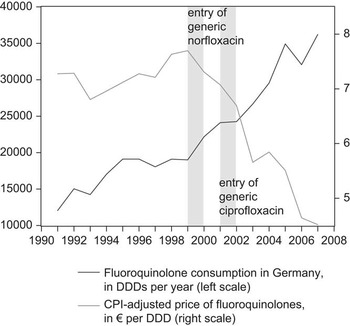
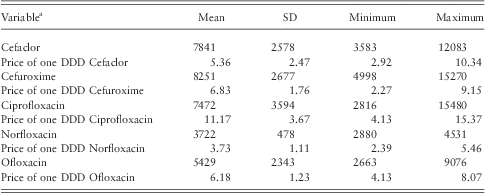
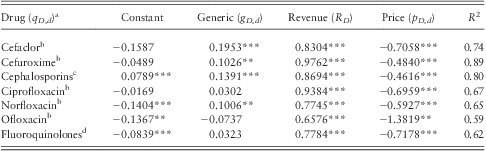
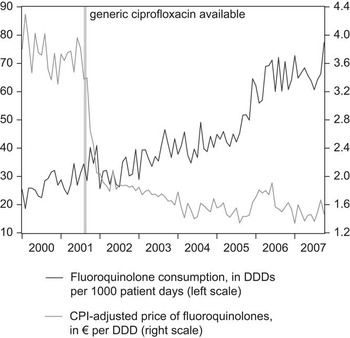
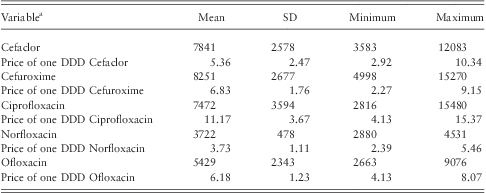
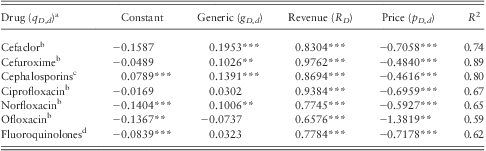
During the study period (1991–2007), outpatient mean antibiotic use was 279 522 DDDs and showed neither an increasing nor a decreasing trend. An average of only 17 008 DDDs of second-generation cephalosporins and 22 516 DDDs of fluoroquinolones were used annually, both of which showed an increasing trend over time (p < 0.001). Second-generation cephalosporin use was dominated by cefaclor and cefuroxim (see Table 3). Demand for these agents was influenced by entry of generics into the German market in March 1994 (ceftaclor) and November 1999 (cefuroxim). Fluoroquinolone use in Germany was dominated by ciprofloxacin, norfloxacin and ofloxacin. Later during the study period, the branded agents levofloxacin and moxifloxacin entered the German market in 1998 and 1999, respectively. However, in spite of the fact that new competing substances had become available, ciprofloxacin use nevertheless increased substantially because entry in August 2001 (see Figure 1) of generic competitors forced a drop in price. The same is true of norfloxacin, for which generics were available in Germany from February 1999, resulting in a price decrease (from €3.85 in 1998 to €2.47 in 2000) and subsequent demand increase (from 2879 DDDs in 1998 to 4214 DDDs in 2000). Generic ofloxacin was available from December 2000 resulting in the price of the antimicrobial agent falling in subsequent years (from €5.86 in 1999 to €4.02 in 2003).
Fluoroquinolone consumption in Germany (SHI-related prescriptions, 1991–2007). SHI = statutory health insurance; DDD = defined daily doses; CPI = consumer price index

Characteristics of the different variables (prescription according to the German statutory health insurance, annual data from 1991 to 2007)
DDD = defined daily doses; CPI = consumer price index.
aAntibiotic use expressed in DDDs; prices expressed in CPI-deflated Euros (2005 = 1).
As expected, in Germany, price has a negative and significant impact on outpatient antibiotic use. As shown in Table 4, all cephalosporins and fluoroquinolones showed significant own-price elasticities of demand, both in the time-series models and the panel regression models that analysed cephalosporins (see Table 4, row 4) and fluoroquinolones (see Table 4, row 8) separately.
Own-price elasticities for outpatient antibiotic use in Germany (1991–2007)
DDD = defined daily doses.
aAntibiotic use expressed in DDDs.
bTime-series regression according to the following estimation model:
 $$\[-->$<> {\rm{\rDelta }}\log ({{q}_{D,d}})\, = \,{{\eta }_{D,d}}\, + \,{{\vartheta }_{D,d}}{{g}_{D,d}}\, + \,{{\xi }_{D,d}}{\rm{\rDelta }}\log ({{R}_D})\, + \,{{\delta }_{D,d}}{\rm{\rDelta }}\log {{p}_{D,d}} <$>
<!--\]$$
cPanel regression for two cephalosporins (rows 2–3) according to the following estimation model:
 $$\[-->$<> {\rm{\rDelta }}\log ({{q}_{D,d}})\, = \,{{\eta }_{D,d}}\, + \,{{\vartheta }_D}{{g}_{D,d}}\, + \,{{\xi }_D}{\rm{\rDelta }}\log ({{R}_D})\, + \,{{\delta }_D}{\rm{\rDelta }}\log {{p}_{D,d}} <$>
<!--\]$$
dPanel regression for three fluoroquinolones (rows 4–6) according to the following estimation model:
 $$\[-->$<>{\rm{\rDelta }}\log ({{q}_{D,d}})\, = \,{{\eta }_{D,d}}\, + \,{{\vartheta }_D}{{g}_{D,d}}\, + \,{{\xi }_D}{\rm{\rDelta }}\log ({{R}_D})\, + \,{{\delta }_D}{\rm{\rDelta }}\log {{p}_{D,d}}<$>
<!--\]$$
**Significant at the 5% level.
***Significant at the 1% level.
Conclusion
The main aim of the present study was to estimate own-price elasticities of demand for some specific antimicrobial agents that, following patent expiration, have benefited from substantial price decreases. In the case of ciprofloxacin, for instance, in-hospital prices reduced to one-third within a few months after generic entry to the German pharmaceutical market.
According to our estimations, in-hospital demand for antibiotics was in some cases driven by prices that decreased for various reasons: the price of second-generation cephalosporins decreased over the study period, although generics were either already available beforehand (oral cefuroxim) or not at all (parenteral cefuroxim, parenteral cefotiam). However, generic third-generation cephalosporin preparations became available from July 2002 (ceftriaxone) and January 2004 (ceftazidime), whereupon prices dropped substantially, but only demand for ceftazidime showed to be price elastic. Prices for fluoroquinolones showed the strongest and most immediate price decrease upon availability of generics (Figure 2), and ciprofloxacin, the main agent, showed strong own-price effects.
Use of fluoroquinolones for oral application at University Medical Center Freiburg (2000–2007). DDD = defined daily doses; CPI = consumer price index

As anticipated, during the period investigated, price showed to have a stronger impact on outpatient antibiotic use in Germany. According to our estimates, all the cephalosporins and fluoroquinolones included in the analysis showed significant own-price elasticities of demand. This result is not surprising because, as already stated above, ambulatory care physicians are generally self-employed in Germany and the SHI reimburses fixed budgets for pharmaceuticals.
Own-price elasticities for outpatient antibiotic use have been calculated before in different countries: In Switzerland, for instance, own-price elasticities ranging from −0.561 to −0.66 were determined using data on outpatient antibiotic sales from 240 small areas over the course of one year (Filippini et al., Reference Filippini, Masiero and Moschetti2006, Reference Filippini, Masiero and Moschetti2008). In the United States, own-price elasticities of antibiotics were determined at −0.785 and −0.916 for compensated and uncompensated own-price effects, respectively (Baye et al., Reference Baye, Maness and Wiggins1997). Another study modelled the demand for cephalosporins as a multistage budgeting problem (Ellison et al., Reference Ellison, Cockburn, Griliches and Hausman1997). The unconditional own-price elasticities of demand for the drugs with best statistical fit are as follows. The branded version of cephalexin has an own-price elasticity of −0.38, while the own-price elasticity for the generic cephalexin is −1.04. The own-price elasticities of cephradine are −1.93 and −2.87 for the branded and generic versions, respectively. Note that these estimates are based on wholesale data, which do not distinguish between in-hospital and outpatient demand To our knowledge, detailed estimates of in-hospital own-price elasticities for antibiotics do not exist.
The present analysis shows that a decrease in price leads to an increase in demand for the specific agent. As shown in Tables 2 and 4, coefficients related to own-price elasticities range between −0.37 and −1.1 in the hospital setting and between −0.48 and −1.38 in the outpatient sector. The economic implications, however, differ for the in-hospital and ambulatory care sectors (Griliches and Cockburn, Reference Griliches and Cockburn1994; Ellison et al., Reference Ellison, Cockburn, Griliches and Hausman1997). Generally, price decreases after patent expiration implies savings from spending less money on antibiotics. However, in contrast to outpatient antibiotic use, where pharmaceutical spending makes up a substantial part of the cost of care, in-hospital price differences for the observed antibiotics are extremely low compared with the overall cost of hospitalisation. The price sensitivity of the demand for cephalosporins and fluoroquinolones appears all the more problematic because recent studies have shown hospital-wide correlations between the use of these antibiotic classes and various serious hospital-specific pathogens (Monnet et al., Reference Monnet, MacKenzie, Lopez-Lozano, Beyaert, Camacho, Wilson, Stuart and Gould2004; Aldeyab et al., Reference Aldeyab, Monnet, Lopez-Lozano, Hughes, Scott, Kearney, Magee and McElnay2008; Vernaz et al., Reference Vernaz, Sax, Pittet, Bonnabry, Schrenzel and Harbarth2008; Kaier et al., Reference Kaier, Hagist, Frank, Conrad and Meyer2009a, Reference Kaier, Frank, Hagist, Conrad and Meyer2009b). In detail, these studies have shown that consumption of the antimicrobial agents of cephalosporins and fluoroquinolones in hospital settings has a considerable impact on the hospital-wide incidences of methicillin-resistant Staphylococcus aureus (MRSA), extended-spectrum β-lactamase (ESBL) producing strains and Clostridium difficile-associated diarrhoea. Hospital-acquired infections caused by these pathogens impose a substantial financial burden on hospitals through exacerbation or prolongation of illness and subsequent in-hospital treatment (Paladino et al., Reference Paladino, Sunderlin, Price and Schentag2002; Cosgrove and Carmeli, Reference Cosgrove and Carmeli2003; Smith et al., Reference Smith, Yago, Millar and Coast2005, Reference Smith, Yago, Millar and Coast2006; Shorr, Reference Shorr2007; Kaier et al., Reference Kaier, Wilson, Chalkley, Davey, Suetens, Grundmann, de Kraker, Schumacher, Wolkewitz and Frank2008).
The estimated own-price elasticities of demand for some broad-spectrum antimicrobials indicate that there is a shift in prescribing behaviour towards the broad-spectrum antimicrobials that became cheaper. As it was shown that the use of such broad-spectrum antimicrobials promotes the spread of resistance (Monnet et al., Reference Monnet, MacKenzie, Lopez-Lozano, Beyaert, Camacho, Wilson, Stuart and Gould2004; Aldeyab et al., Reference Aldeyab, Monnet, Lopez-Lozano, Hughes, Scott, Kearney, Magee and McElnay2008; Vernaz et al., Reference Vernaz, Sax, Pittet, Bonnabry, Schrenzel and Harbarth2008; Kaier et al., Reference Kaier, Hagist, Frank, Conrad and Meyer2009a, Reference Kaier, Frank, Hagist, Conrad and Meyer2009b), the availability of generics may be seen critical. The present analysis, however, does not exclude the possibility that the price-related shift in prescribing behaviour might be (at least to some extent) a shift from one broad-spectrum antimicrobial to another.
Understanding antibiotic treatment practice is necessary to reduce misuse of antibiotics and the cost of antimicrobial resistance. Because we believe there are major differences in the hospital-wide distribution of information about prices, it would be interesting to verify our results regarding price-dependencies in in-hospital use of broad-spectrum antimicrobials by repeating the analysis in other hospitals.
Acknowledgements
We thank Deborah Lawrie-Blum and Christine Wilson for their help in preparing the manuscript as well as Elisabeth Meyer, Uwe Frank and Egid Strehl for their helpful comments. Furthermore, we would like to thank the whole Division of Infection Control at University Medical Center Freiburg with special thanks to Regina Babikir, Barbara Schroeren-Boersch and Armin Schuster for their efforts in data collection. Research by K.K. on the economic impacts of antibiotic resistance is currently supported by a grant from the Viamedica Foundation and the European Commission (Project IMPLEMENT, Project commissioned by the Executive Agency for Health and Consumers, Grant Agreement No. 20091107; www.eu-implement.info).