“Athlete’s heart” encompasses sets of morphological and functional characteristics of the heart, which develop over time under the influence of training.Reference Fagard 1 The increase in mass is a universal response of tissues that are exposed to increased exertion. It is interesting that these adaptive changes, which are typical for athlete’s heart, can be seen at an early age.Reference Maron, Douglas, Graham, Nishimura and Thompson 2 , Reference Maron and Zipes 3 Thus, such alterations were observed in 5-year-old children. Genetic factors have an impact on the increases in left ventricular mass under the influence of athletic training;Reference Maron, Araujo and Thompson 4 however, in physiological hypertrophy, there is no fibrosis or apoptosis, the structural integrity of myocytes is preserved, ATPase activity of myosin is increased, and myocardial contractility is improved.Reference Pelliccia, Fagard and Bjornstad 5 – Reference Sharma 7 Physiological hypertrophy, which is induced by physical exertion, in a functional sense leads to more efficient systolic and diastolic function of the heart, together with improved coronary circulation, and therefore it seems important to maintain regular physical activity in youth.Reference Maron 8
Echocardiographic assessment of cardiac pumping function and its morphology is essential from the standpoint of estimating adaptive cardiological mechanisms in terms of hypertrophy in individuals exposed to increased physical activity.Reference Maron 8 , Reference Malcolm, Burns, Mahoney and Lauer 9 Differential diagnosis between athlete’s heart and hypertrophic cardiomyopathy is a crucial clinical dilemma.Reference Maron 10 , Reference Venckunas and Mazutaitiene 11 As the syndrome of “athlete’s heart” encompasses enlargement and thickening of cardiac muscles, we set the following objectives:
-
∙ To determine the prevalence of left ventricular hypertrophy in children who are athletes.
-
∙ To illustrate the types of cardiac re-modelling – eccentric and concentric hypertrophy – in individuals with left ventricular hypertrophy.
-
∙ To differentiate between physiological and pathological hypertrophy as seen in many cardiac and non-cardiac diseases.
-
∙ To examine the time required for the development of athlete’s heart and the type and intensity of sports activities that induce such changes.
Material and methods
This prospective study was conducted in children’s sports clubs participating in amateur competitions in northern Kosovo (Kosovska Mitrovica, Gracanica) and Novi Pazar. Testing was conducted from February to June 2013 in the echocardiographic cabinet at the Children’s Clinic of the Medical Faculty in Kosovska Mitrovica.
Written informed consent was obtained from the parents of all patients, and the study was approved by the Institutional Ethics Committee. Our examinations of the patients conformed to good medical and laboratory practices and the recommendations of the Declaration of Helsinki on Biomedical Research Involving Human Subjects.
Criteria for inclusion to the study were as follows: male sex, aged between 12 and 18 years, active participation in sports for at least 2 years 5–7 times a week with no symptoms when under strain, a negative family medical history of sudden death before the age of 40, and normal results for clinical and laboratory blood tests. As the number of girls who play football, karate, or judo is small, females were not included in the present study because we thought that the sample size would not be adequate. Testing was conducted at the Children’s Clinic of the Medical Faculty in Kosovska Mitrovica.
The following basic anthropometric parameters were determined for all respondents: body height, weight, and body surface area. Body mass index was calculated according to the following formula:Reference Cole, Faith and Pietrobelli 12
 $$\eqalign{{\rm Body}\,{\rm mass}\,{\rm index}\, {\rm {\equals}}\,{\rm Body}\,{\rm weight}\,\left( {{\rm kg}} \right)/\cr \ \; {\rm \,\,Body}\,{\rm height}^{{\rm 2}} \,\left( {{\rm m}^{{\rm 2}} } \right)$$
Blood pressure was measured using a mercury sphygmomanometer immediately before the echocardiographic examination. The normal value was taken as the mean value for blood pressure, determined in three consecutive measurements at 10-minute intervals.
Hypertension was defined as blood pressure above the 95th percentile with respect to age, sex, and height.Reference Devereux 13 , Reference De Simone, Devereux and Daniels 14
Echocardiographic parameters
All respondents underwent the standard echocardiographic measurements according to the recommendations of the American Society of Echocardiography.Reference Devereux 13 The mean value was obtained for three to five consecutive cardiac cycles using Philips HD7 (Bothell, Washington, DC, United States of America, 2008) and Siemens Acuson Sequoia C512 ultrasound transducers (4–6 Mhz). Left ventricular mass was measured by two-dimensional, M-mode technique, according to criteria of the American Society of Echocardiography. Calculation of left ventricular mass in M-mode required the following measurements: diastolic diameter of the left ventricle, posterior wall thickness, and interventricular septum thickness.
For calculating left ventricular mass, we used Devereux and Reicheck’s formula, in line with the American Society of Echocardiography convention:Reference Devereux 13 , Reference De Simone, Devereux and Daniels 14
 $$\eqalign{ {\rm Left}\,{\rm ventricular}\,{\rm mass\colon\,}\,{\rm 0}{\rm .8}\,{\rm (1}{\rm .04}\,{\rm ([LVIDD{\plus}PWTD} \cr \qquad{\plus} {\rm IVSTD]3}{\minus}{\rm [LVIDD]}\,{\rm 3)){\plus}0}{\rm .6 g}$$
LVIDD is the left ventricular internal diameter in diastole; PWTD the posterior wall thickness in diastole; IVSTD the interventricular septum thickness in diastole.
Left ventricular hypertrophy is defined as a value of left ventricular mass above the 95th percentile in relation to age, sex, and height, for which we used the Muscatine Study.Reference Malcolm, Burns, Mahoney and Lauer 9
For assessment of left ventricular geometry, we calculated the relative posterior wall thickness (relative wall thickness) according to the following formula:
 $${\rm Relative}\,{\rm wall}\,{\rm thickness}\,{\rm {\equals}}\,({\rm IVSTD{\plus}PWTD}){\rm /LVDD}$$
Relative wall thickness <0.45 is normal.Reference Devereux 13 , Reference De Simone, Devereux and Daniels 14
Respondents who had increased values for left ventricular mass and relative posterior wall thickness were defined as having concentric hypertrophy. Those who had increased values of left ventricular mass and normal relative posterior wall thickness were defined as having asymmetric hypertrophic cardiomyopathy.
For the assessment of systolic function, we measured the ejection fraction, according to the following formula:
 $$\eqalign{{\rm Ejection}\,{\rm fraction}\,{\rm {\equals}}\,[({\rm LVDD})3{\minus}({\rm LVSD})\,3/\cr \quad({\rm LVDD})\,3]{\times}100\,\%\,$$
Normal values are in the range from 54 to 64%.
Diastolic flow of the mitral valve was determined using the conventional pulse Doppler on cross-sections of four cardiac cavities, where maximum speeds during the phase of rapid diastolic filling (E wave) and during atrial contraction (A wave) were measured. The E/A ratio was calculated for each respondent as a key parameter for the assessment of diastolic chamber function.Reference Devereux 13 , Reference Daniels, Meyer, Liang and Bove 15
Statistical analysis
All obtained data were systematised and analysed on a personal computer, using standard statistical procedures and specialised programmes. During the analysis, relevant parameters and characteristics were considered and defined through the research objectives and the assumed hypotheses. The following statistical methods were applied: Student’s t-test, χ2-test, correlation analysis, and regression/multi-variate analysis (stepwise).
The level of probability, p<0.05, which is necessary and sufficient for making relevant conclusions, was considered statistically significant.
Results
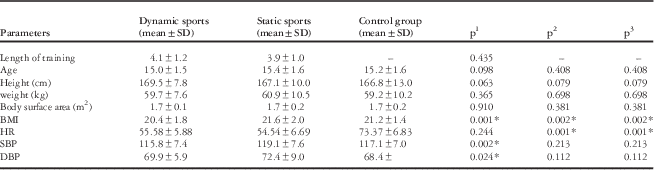
The present study included 100 teenagers taking part in dynamic sports such as football and basketball and 100 teenagers taking part in different static sports such as karate and judo. The control group (n=100) included healthy teenagers examined during regular systematic check-ups. They were not participating in any amateur competitive sports and had similar characteristics (sex, age, and body surface) as the other two groups. Average values for anthropometric parameters of each group are shown in Table 1. The mean age of the dynamic sports group was 15±1.5 years, of the static sports group 15.4±1.6 years, and the control group 15.2±1.6 years. Parameters such as age, height, and weight did not differ significantly either between the sports groups or in comparison with the control group. Body mass index was lower in the dynamic sports group compared with the static sports and control groups (Student’s t-test, p<0.05).
General and anthropometric characteristics of the studied groups.

BMI=body mass index; DBP=diastolic blood pressure; HR=heart rate; SBP=systolic blood pressure
1 Significant differences, dynamic versus static sports
2 Significant differences, dynamic sports versus control group
3 Significant differences, static sports versus control group
* Significant difference (p<0.05)
Heart rate was much higher in the control group compared with respondents in the dynamic and static sports groups (Student’s t-test, p<0.001), where the average values were similar.
The group of children engaged in static sports had significantly higher average systolic blood pressure and diastolic blood pressure when compared with the dynamic sports and control groups, respectively (Student’s t-test, p<0.05), but blood pressure – systolic and diastolic – did not exceed the 90th–95th percentile for age, sex, and height.
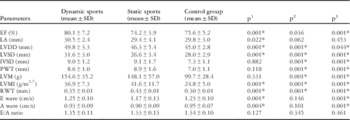
Table 2 shows the average values of the echocardiographic parameters for each group. The mean diameter of the left atrium (mm) was significantly higher in the dynamic sports group than in the static sports and control groups (p<0.05). The average diameter of the left ventricle in diastole (mm) was larger in the dynamic group when compared with the static group and the control group (p<0.05). Similarly, between-group differences were observed for left ventricular systolic diameter (mm), with the highest value in the dynamic sports group and the lowest in the control group.
Descriptive analysis of the echocardiographic parameters.
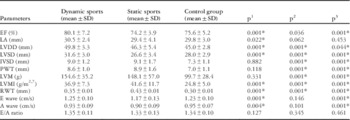
EF=ejection fraction; IVSD=interventricular septum in diastole; LA=left atrium; LVDD=left ventricular diameter in diastole; LVM=left ventricular mass; LVMI=left ventricular mass index; PWT=posterior wall thickness; RWT=relative wall thickness; E wave=E-peak early-diastolic velocity; A wave=A-peak late-diastolic velocity; LVSD=left ventricular in systolic diameter
1 Significant differences, dynamic versus static sports
2 Significant differences, dynamic sports versus control group
3 Significant differences, static sports versus control group
* Significant difference (p<0.05)
Average values of interventricular septum thickness (mm) and left ventricular posterior wall thickness (mm) did not differ significantly between respondents in the dynamic and static sports groups, but were significantly higher compared with the control group (Student’s t-test, p<0.001).
Left ventricular mass (g) was increased among the athletes and differed significantly from values of the control group. Although left ventricular mass was the highest in the dynamic sports group, the mean value did not differ significantly from that of the static sports group. As participants were teenagers of diverse height and age, left ventricular mass was indexed according to sex and height by m2,7. The average value of the left ventricular mass index (g/m2,7) was significantly higher among respondents in the static sports group compared with the dynamic sports and control groups, p<0.001.
Relying on the defined physiological limits proposed by Sharma et al,Reference Sharma 7 we compared the dimensions of the walls and cavity of the left ventricle during diastole in our respondents. In the dynamic sports group, two teenagers (2%) had interventricular septum or posterior wall thickness >11 (max value of the interventricular Septum 11.4, posterior wall thickness 11.2 mm), whereas 6% of the respondents had left ventricular diameter in diastole >52 mm (55 mm max value). In the static sports group, 3% of the respondents had interventricular septum and posterior wall thickness >11 (max value of the interventricular septum 11.8, posterior wall thickness 11.6), whereas 2% had left ventricular diameter in diastole >52 mm (53 mm maximum value). There were no respondents with wall thicknesses exceeding 12 or 14 mm, which Sharma et alReference Sharma 7 consider to be the limit of physiological hypertrophy. None of the patients in the control group had left ventricular wall thickness >11 mm.
The average relative posterior wall thickness was significantly higher in the static sports group in comparison with the dynamic and control groups, respectively (p<0.001).
Ejection fraction was within the normal range in all the studied groups. The average value for ejection fraction was considerably higher in the dynamic sports group and differed significantly from those of the static sports group (p<0.001) and the control group (p<0.001).
Diastolic flow analysis gave mean values for E wave, A wave, and E/A ratio. Both parameters had significantly higher average values in the dynamic sports group compared with the static sports and control groups (p<0.001). Respondents in the static sports group had the lowest average values for E wave and A wave, which differed significantly from control group data. The E/A ratios for both sports groups did not differ significantly from the mean value of the control group.
We also calculated the number of patients who had left ventricular mass values above the 95th percentile for age, sex, and height. In the dynamic sports group, 29% of the respondents had left ventricular mass index values above the 95th percentile, whereas 37% of the teenagers engaged in static sports had left ventricular mass above the 95th percentile. In the control group, only 2% of the respondents had left ventricular mass above the 95 percentile (χ2-test, p=0.009<0.05).
When there was left ventricular hypertrophy, in the dynamic sports group, cardiac re-modelling was eccentric with a very high probability (79.4% of cases, χ2-test, p<0.0001). In the static sports group, the incidence of both concentric and eccentric types of re-modelling was equally manifest (45.95 versus 54.05% of the cases, χ2-test, p<0.257>0.05) (Table 3).
Distribution of types of cardiac re-modelling by groups with left ventricular mass >95th percentile.

LVH=left ventricular hypertrophy
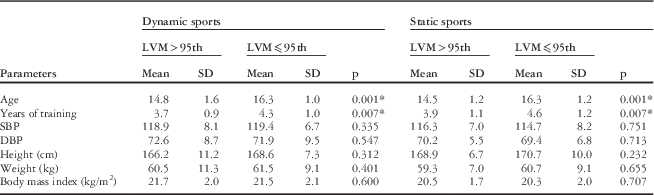
In further analyses, we compared the average values of the anamnestic–anthropometric parameters of the sports groups with mean values for left ventricular mass hypertrophy (Table 4). Significant differences were found in terms of age and length of training in both sports groups. All other parameters were similar, regardless of the phenomenon of hypertrophy. It was concluded that an average age of 14.5 to 14.8 years and average length of training from 3.7 to 3.9 years are threshold values, indicating that there is a significant probability for the onset of left ventricular mass hypertrophy for those engaged in both dynamic and static sports. Using receiver operating characteristic (ROC) analysis, it was confirmed that the cut-off value for left ventricular mass hypertrophy in our sample of teenagers was 3.8 years of training and an average age of 14.6 years, regardless of the type of sport.
Comparison of the anamnestic–anthropometric parameters of basic sports groups in relation to the occurrence of hypertrophy of the left ventricular mass.

LVM=left ventricular mass; DBP=diastolic blood pressure; SBP=systolic blood pressure
* Significant difference (p<0.05)
Discussion
Data on echocardiographic characteristics that define athlete’s heart are limited mainly to adults, with little information related to teenagers, who have the highest risk of sudden death due to hypertrophic cardiomyopathy.Reference Maron 8 , Reference Simsek, Tas and Degirmenci 16 , Reference Ayabakan, Akalin and Mengütay 17 Reference values for the dimensions of walls and hollow chambers were determined on the basis of findings in adult athletes and should not be explicitly applied to younger athletes who are less physically mature and exposed to a shorter period of intense training.Reference Maron, Douglas, Graham, Nishimura and Thompson 2 , Reference Maron 8 , Reference Malcolm, Burns, Mahoney and Lauer 9 , Reference Simsek, Tas and Degirmenci 16
By studying equivalent groups of teenagers, we found that left ventricular mass >95th percentile occurred in 29% of those engaged in dynamic sports and in 37% of those engaged in static sports such as judo and wrestling. The left ventricular mass index was significantly higher in patients engaged in static sports than in those participating in dynamic sports, although the mean value for left ventricular mass was the highest in the dynamic sports group. This might be explained by the lower body mass index of respondents from the dynamic sports group, because the basketball players were generally taller than the wrestlers and judokas – that is, judo practitioners.
An unexpected observation in our study was that the frequency of eccentric and concentric left ventricular re-modelling was equal (54.05 versus 45.95%) in the static sports group of respondents who had left ventricular mass >95th percentile. This differs from other studies where the incidence of concentric hypertrophy was significantly higher in athletes engaged in static sports. It is well known that the characteristic morphological adaptive changes for athlete’s heart differ according to different types of physical exercises. For continuous dynamic exercise characterised by rhythmic isotonic contractions of large muscle groups leading to visible movements in space, the muscles act as a pump returning blood to the heart. This burdens it greatly by the enhanced blood flow, and thus the most striking finding is increased cardiac volume with consequent augmentation in wall thickness. Unlike dynamic sports, static sports are characterised by extended isometric muscle contractions of high intensity, which results in significant elevation of mean arterial pressure, due to the pressure of contracted muscles on blood vessel walls. This burdens the heart by pressure within the circulatory system, with subsequent increased thickness of the heart walls, but is not accompanied by greater diameter of the heart chambers.Reference Maron 10 , Reference Venckunas and Mazutaitiene 11 , Reference Daniels, Meyer, Liang and Bove 15
Ajabakan et alReference Ayabakan, Akalin and Mengütay 17 examined 22 young swimmers aged 11.01±09 years, whose average length of training was 3.9 years, and found concentric left ventricular hypertrophy. This differs from the data for adult swimmers. The authors suggested that cardiac adaptation of young athletes may be different from that of adults.Reference Ayabakan, Akalin and Mengütay 17
Manolas et alReference Manolas, Pavlik, Banhegyi and Faludi 18 monitored the echocardiographic parameters of 23 athletes aged 9–20 years and a control group of their peers and observed that they altered depending on age. The increase in left ventricular mass was the highest among 11- to 12-year-old children, whereas augmentation of the left ventricular wall was prominent in those aged 13–14 years, and the greatest increase in left ventricular diameter occurred at 15–16 years of age.Reference Manolas, Pavlik, Banhegyi and Faludi 18
Our results can be partly explained by the aforementioned studies, and also because games such as basketball and football are highly dynamic and moderately static team sports, whereas judo and wrestling are moderately static and dynamically low.
Relative wall thickness is one of the most important parameters in sports cardiology for distinguishing between concentric and eccentric re-modelling. In our respondents, the relative wall thickness (in all groups) was within normal limits, which is another important diagnostic parameter differentiating between adaptative changes to physical exertion and hypertrophic cardiomyopathy as a pathological condition.Reference Zdravkovic, Perunicic and Krotin 19 – Reference Pagourelias, Efthimiadis and Kouidi 22
Many authors have studied ejection fraction in various kinds of sports. They found that the high values of ejection fraction were explained by left ventricular hypertrophy in power focussed-type athletes, whereas in the case of endurance-type athletes this was explained by the Frank–Starling law (23.7). In our study, we found that ejection fraction was preserved in all groups and was significantly improved in the dynamic sports group.
Diastolic function and the ability of the heart to be filled with blood generally remains unchanged in athletes when compared with the sedentary population. This is very important in distinguishing athlete’s heart from different pathological conditions, which are almost always manifested through disorders of these functions. The speed ratio of early and late filling of the left ventricle must be greater than unity (E/A ratio), and this has been proved to be the strongest independent predictor of overall functional capacity of the heart.Reference Krieg, Scharhag, Kindermann and Urhausen 23 – Reference Bernardo, Weeks, Pretorius and McMullen 25
Analysis of diastolic flow is given through the mean values for E wave, A wave, and E/A ratio. Through echocardiography, DevereuxReference Devereux 13 detected left ventricular diastolic dysfunction in patients with primary hypertrophic cardiomyopathy, but not in athletes. In our investigation, the mean values for E/A ratio were similar in the tested and control groups. Tissue Doppler can be used for the assessment of diastolic function and is certainly a superior method to Pulse Doppler. We suggest that examination with tissue Doppler and other modern imaging techniques such as strain rate test and MRI should be performed once there is proven left ventricular mass hypertrophy exceeding the physiological limits, whereas assessment of diastolic dysfunction with Tissue Doppler can be crucial for the diagnosis of hypertrophy.Reference Hernelahti, Heinonen, Karjalainen, Nylander and Borjesson 26 – Reference Kappus, Ranadiveb and Yanb 28
Conclusion
Echocardiographic parameters show that hypertrophy and cardiac re-modelling are present in teenagers who take part in sports. In this regard, our results indicate that left ventricular eccentric hypertrophy develops in response to both overload regimens. It is very important that health disorders in young athletes are detected at the beginning of their sports activities, because a large number of them may be exacerbated by the activity – some guarantee very poor sports results and some may lead to sudden death. There is no doubt that echocardiography is of great importance in differentiating between physiological and pathological hypertrophy, and thus may prevent sudden cardiac death in athletes. On the other hand, there are many limitations to its routine use, primarily because of the large number of athletes, the relatively low prevalence of sudden cardiac death, and the resulting cost–benefit ratio.