





Premenstrual dysphoric disorder (PMDD) is a mental condition characterised by affective symptoms, including depressed mood, irritability or anger, affective lability and anxiety, that emerge in the week(s) before menstruation. Reference Epperson, Steiner, Hartlage, Eriksson, Schmidt and Jones1 The cyclical nature of symptom onset and resolution implicates a key role for ovarian hormone fluctuations in PMDD pathogenesis, Reference Rubinow and Schmidt2 as supported by pharmacological studies. Reference Comasco, Kopp Kallner, Bixo, Hirschberg, Nyback and de Grauw3 Notably, irritability and anger can substantially disrupt social interactions and are among the most distressing symptoms, Reference Studer, Nilsson, Westman, Pedersen and Eriksson4 with PMDD impairing daily functioning and quality of life as well as increasing vulnerability to other reproductive disorders. Reference Schleimann-Jensen, Sundström-Poromaa, Meltzer-Brody, Eisenlohr-Moul, Papadopoulos and Skalkidou5
Premenstrual complaints, especially irritability or anger, are reduced by selective serotonin reuptake inhibitors (SSRIs), with symptom relief occurring within hours to days, enabling effective intermittent (i.e. luteal phase) treatment. Reference Landen, Erlandsson, Bengtsson, Andersch and Eriksson6–Reference Reilly, Wallman, Clark, Knox, Craig and Taylor8 This rapid efficacy underscores the role of serotonergic transmission in PMDD, Reference Landen, Erlandsson, Bengtsson, Andersch and Eriksson6 supported by findings of altered brain serotonergic function during the premenstrual phase. Reference Sacher, Zsido, Barth, Zientek, Rullmann and Luthardt9,Reference Jovanovic, Cerin, Karlsson, Lundberg, Halldin and Nordstrom10 Serotonin plays a central role in the regulation of social behaviour, emotional reactivity and aggression, particularly in contexts involving provocation or perceived threat. Reference da Cunha-Bang and Knudsen11 Interestingly, SSRIs are particularly effective in reducing premenstrual irritability, anger and mood lability, Reference Landen, Erlandsson, Bengtsson, Andersch and Eriksson6 which aligns with a substantial body of research implicating serotonin in the moderation of sex steroid-driven aggressive behaviours. Reference da Cunha-Bang and Knudsen11,Reference Takahashi, Quadros, de Almeida and Miczek12 However, it remains unclear whether SSRIs affect social–neural mechanisms in women with PMDD beyond self-reported irritability and anger.
In PMDD, reactive aggression worsens in the premenstrual phase as a response to increased irritability and anger. Reference Yen, Chen, Chang, Ko, Chen and Yen13,Reference Grondal, Naslund, Englund, Luke, Ask and Eriksson14 Reactive aggression is an emotional, impulsive response to threat, provocation or frustration. In this study, the Point Subtraction Aggression Paradigm (PSAP Reference Skibsted, Cunha-Bang, Carre, Hansen, Beliveau and Knudsen15 ) was used to assess reactive aggression. Unlike reaction-time tasks, PSAP permits continuous, voluntary responses while modelling interpersonal provocation and mirroring real-world decision-making, to explore the underlying neural mechanisms. Reference Skibsted, Cunha-Bang, Carre, Hansen, Beliveau and Knudsen15–Reference Gan, Preston-Campbell, Moeller, Steinberg, Lane and Maloney17 From a neural systems perspective, reactive aggression involves interactions between corticolimbic regions supporting emotion-generation and salience-detection areas (amygdala, insula) and prefrontal networks implicated in cognitive control and regulation (prefrontal cortex (PFC), orbitofrontal cortex, anterior cingulate cortex (ACC) Reference Bertsch, Florange and Herpertz18,Reference Coccaro, McCloskey, Fitzgerald and Phan19 ). In non-clinical samples subjected to PSAP, reactive aggressive behaviours also correlate with reactivity to provocations in these regions. Reference Skibsted, Cunha-Bang, Carre, Hansen, Beliveau and Knudsen15,Reference Gan, Preston-Campbell, Moeller, Steinberg, Lane and Maloney17 In women with PMDD performing PSAP, suppression of ovarian hormone levels, leading to symptom relief, Reference Comasco, Kopp Kallner, Bixo, Hirschberg, Nyback and de Grauw3 was associated with greater brain reactivity in the dorsal ACC and dorsomedial PFC. Reference Kaltsouni, Fisher, Dubol, Hustad, Lanzenberger and Frokjaer20 PSAP is sensitive to serotonin modulation because it detects reduced aggression during SSRI treatment Reference Cherek, Lane, Pietras and Steinberg21 and increased aggression following tryptophan depletion. Reference Marsh, Dougherty, Moeller, Swann and Spiga22 Whereas neuroimaging findings suggest altered activation of key regions involved in emotion-processing and regulation, Reference Dubol, Neill Epperson, Lanzenberger, Sundstrom-Poromaa and Comasco23–Reference Stiernman, Dubol, Comasco, Sundstrom-Poromaa, Boraxbekk and Johansson25 and heightened serotonergic uptake in PMDD, Reference Sacher, Zsido, Barth, Zientek, Rullmann and Luthardt9 the neural underpinnings of SSRI efficacy in PMDD remain unknown. Neuroactive steroid systems, including allopregnanolone-mediated GABAergic modulation, have been implicated in PMDD and may influence the rapid efficacy of SSRIs via interactions with serotonergic pathways. Reference Miller, Standeven, Morrow, Payne, Epperson and Hantsoo26–Reference Bixo, Stiernman and Backstrom28 Investigation of provocation-related neural responses may reveal whether symptom improvement coincides with modulation of corticolimbic circuits involved in reactive aggression. Accordingly, we hypothesised that escitalopram would reduce irritability, anger and self-reported aggressiveness in PMDD, and attenuate provocation-related neural activation in regions regulating reactive aggression. Therefore, the present randomised, double-blind, placebo-controlled, neuroimaging study aimed to investigate the impact of luteal-phase SSRI treatment on PMDD symptoms and the psychoneurobiological signatures of such treatment in relation to reactive aggression in PMDD.
Method
Participants
The study was conducted at Uppsala University Hospital, Sweden. Following recruitment through advertisements in local newspapers and social media, 131 women were assessed and 62 subsequently enrolled. Eligibility criteria included women aged 18–46 years and with regular menstrual cycles meeting DSM-5 criteria for PMDD. Reference Epperson, Steiner, Hartlage, Eriksson, Schmidt and Jones1 Exclusion criteria encompassed ongoing DSM-5 disorders assessed via the Mini International Neuropsychiatric Interview, Reference Sheehan, Lecrubier, Sheehan, Amorim, Janavs and Weiller29 past psychiatric hospitalisation, suicide attempts, recent psychotropic or hormonal medication use (≥3-month washout), severe medical conditions, pregnancy, breastfeeding or pregnancy planning. Past depressive or anxiety disorders were permitted.
Participants provided written informed consent. The authors assert that all procedures contributing to this work comply with the ethical standards of the relevant national and institutional committees on human experimentation, and with the Helsinki Declaration as revised in 2013. All procedures were approved by the Regional Ethical Review Board in Uppsala (no. DNR 2016/312) and the Swedish Medical Products Agency. The trial ‘Emotion, Serotonin and Premenstrual Dysphoric Disorder’ (EmSeP) was registered under EUDRA-CT 2016-001217-25, with the first participant being screened on 4 March 2017. The Consolidated Standards of Reporting Trials diagram is presented in Supplementary Fig. 1 and the neuroimaging substudy flowchart in Supplementary Fig. 2.
PMDD diagnosis
PMDD diagnosis was confirmed using the Daily Record of Severity of Problems (DRSP), Reference Endicott, Nee and Harrison30 via smartphone application for at least two menstrual cycles using a web-based, electronic, patient-reported outcome system (Nepule EDC, ePRO, for Windows; Hytton Technologies AB, Kista, Stockholm, Sweden; http://www.hytton.com). DRSP includes 21 items covering 11 PMDD symptoms (Supplementary Fig. 3), rated on a 6-point Likert scale, with menstrual bleeding reports. To ensure diagnostic validity, DRSP items were mapped onto the 11 DSM-5 PMDD symptom domains Reference Epperson, Steiner, Hartlage, Eriksson, Schmidt and Jones1 (Supplementary Fig. 3). PMDD was defined as a >50% increase in at least 5 symptom domains from the follicular phase (days 6–12) to the luteal (days −7 to −1), including at least 1 core affective symptom (depressed mood, anxiety, mood swings, irritability or anger). Symptoms had to be at least mild (mean luteal score >3.0) and minimal/absent in the follicular phase (mean follicular score <2.0). This stringent threshold, greater than the 30% commonly used in research and practice, ensures that all participants were above the disorder threshold Reference Halbreich, Backstrom, Eriksson, O’Brien, Calil and Ceskova31 and aims to capture clinically meaningful symptom fluctuation and clear symptom remission outside the luteal phase. Reference Halbreich, Backstrom, Eriksson, O’Brien, Calil and Ceskova31,Reference Eisenlohr-Moul, Girdler, Schmalenberger, Dawson, Surana and Johnson32
Study design
This double-blind, randomised controlled trial assigned patients with PMDD to either 20 mg/day escitalopram (SSRI) or placebo (1:1) for up to 15 days in the luteal phase (Fig. 1(a)). Randomisation used computer-generated permuted blocks of four, ensuring that treatment groups remained balanced throughout participant enrolment. Identical escitalopram (Escitalopram®, Lundbeck, Sweden) and placebo tablets were packaged and labelled without allocation information for study personnel and participants.
Study design. (a) This pharmaco-functional magnetic resonance imaging (MRI) study included three visits (screening, randomisation and follow-up visits. The timing of the three visits, in relation to a standardised menstrual cycle with schematic fluctuations of oestradiol and progesterone, is depicted. Following the screening visit, participants’ eligibility was assessed and daily symptom rating initiated using the Daily Record of Severity of Problems (DRSP). Following two menstrual cycles of DRSP ratings, premenstrual dysphoric disorder (PMDD) diagnosis was confirmed. The randomisation visit was planned to coincide with the symptomatic luteal phase, and consisted of a baseline examination including psychometric testing, blood sampling and the random assignment of PMDD patients to either 20 mg/day escitalopram or placebo, as part of a double-blind, randomised control trial (RCT) starting mid-cycle. The follow-up visit was scheduled to coincide with the luteal phase of the treatment cycle, and consisted of a functional MRI (fMRI) scan using the Point Subtraction Aggression Paradigm (PSAP), psychometric testing and blood sampling. (b) PSAP was implemented using E-prime®, magnetic resonance-compatible goggles and a three-button response unit. Participants could choose from three options: ‘earn’, ‘steal’ or ‘protect’, requiring 100 consecutive presses to earn 1 point, or 10 consecutive presses to either subtract (steal) 1 point from a virtual opponent (aggressive response (aggress)) or gain a brief protection period during which the participant’s points could not be stolen (protective response (protect)). Game status, including total score, press counts and the selected option, was visible to participants inside the scanner. Provocations (prov), in the form of stolen points, are depicted as a reduction of the total score by 1 point, surrounded by minus signs.

Fig. 1 Long description
Panel A: A timeline diagram depicting the study design for a pharmaco-functional magnetic resonance imaging study. The timeline includes three visits: screening, randomisation, and follow-up, each marked with specific icons. The timeline spans two menstrual cycles for PMDD diagnosis and one menstrual cycle for the pharmaco-fMRI study. Key components include screening visit, randomisation, follow-up and fMRI scan, DRSP, questionnaires, and RCT with Escitalopram versus placebo. Hormone fluctuations of Oestradiol and Progesterone are shown schematically. Panel B: A flowchart illustrating the Point Subtraction Aggression Paradigm. The flowchart shows the sequence of actions: Earn, Aggress, and Protect, with corresponding button presses and outcomes. The game status, including total score, press counts, and selected option, is visible to participants inside the MRI scanner. Provocations are depicted as reductions in the total score by 1 point, surrounded by red minus signs.
Following an initial screening for eligibility and clinical data collection, participants tracked symptoms via DRSP for two cycles to confirm PMDD. Eligible individuals underwent a baseline examination in the symptomatic luteal phase, determined by prior cycle tracking and confirmed by measurements of serum oestradiol and progesterone levels, quantified using liquid chromatography–tandem mass spectrometry by the Core Facility of Metabolomics, University of Bergen, Norway (see Supplementary material). Participants were randomised to either treatment and instructed to start treatment on day 14 of the next cycle while continuing daily DRSP ratings. Reflecting clinical practice where ovulation is not tracked, fixed luteal-phase dosing, as used in prior SSRI studies, does not account for inter-individual variability in ovulation timing. However, precise timing relative to ovulation does not appear to be crucial for the typical response observed in PMDD. Reference Landen, Erlandsson, Bengtsson, Andersch and Eriksson6,Reference Reilly, Wallman, Clark, Knox, Craig and Taylor8,Reference Yonkers, Kornstein, Gueorguieva, Merry, Van Steenburgh and Altemus33,Reference Steiner, Hirschberg, Bergeron, Holland, Gee and Van Erp34 A follow-up visit in the luteal phase of the treatment cycle included compliance checks, neuroimaging, psychometric assessments and blood sampling. The self-rated Revised Swedish Version of the Aggression Questionnaire (AQ-RSV) was used to measure aggression pre and post treatment by asking the subject to relate her response to the past 7 days.
Treatment outcomes
The primary treatment outcome was change in premenstrual DRSP total score from baseline. Secondary outcomes were changes in DRSP subscales reflecting particular DSM-5 core PMDD symptoms: (a) depressed mood (felt depressed, felt hopeless, felt worthless or guilty); (b) anxiety (felt anxious); (c) affective lability (had mood swings, was more sensitive or easily hurt); and (d) irritability or anger (felt angry or irritable, had conflicts with others), and the total score for AQ-RSV (aggressiveness).
The DRSP total score was calculated as the sum of the 21 DRSP items, Reference Endicott, Nee and Harrison30 averaged over the past 5 luteal days at baseline and follow-up. DRSP subscales were scored in analogy with the total DRSP score. Outcomes were analysed as absolute scores, percentage changes and treatment differences at follow-up.
Neuroimaging outcome
The neural response to aggression-related stimuli was captured by functional magnetic resonance imaging (fMRI) during PSAP. Participants chose between either: (a) earning 1 point following 100 presses; (b) subtracting 1 point from a virtual opponent following 10 presses (aggressive response); or (c) gaining a brief protection period following 10 presses (protective response Reference Geniole, MacDonell and McCormick16 (Fig. 1(b)). Importantly, participants were informed that selecting option (b) reduced the opponent’s score without increasing the participant’s own score. Game status was visible to participants in the scanner, and provocations (points subtracted from the participant by the virtual opponent) occurred every 6–60 s unless option (b) or (c) were selected, triggering a 60 s provocation-free period for the participant. However, participants were explicitly informed only about the protective effect of option (c). After receiving instructions, they completed a 1 min practice trial and then performed a 12 min PSAP session implemented in E-prime® v2.0 (Psychological Software Tools, Pittsburgh, Pennsylvania, USA; https://pstnet.com/products/e-prime-legacy-versions/). Behavioural outcomes included total points, number of provocation events and press counts per option. A PSAP aggression score was calculated as (1000 × number of option (b))/(total button presses × number of provocations Reference Skibsted, Cunha-Bang, Carre, Hansen, Beliveau and Knudsen15 ).
Structural (T1-weighted MPRAGE) and functional (T2*-weighted EPI) MRI was performed using a 3.0T Achieva dStream scanner (Philips Medical Systems, Best, The Netherlands) with a 32-channel head coil. Image preprocessing and first-level analysis were performed in Statistical Parametric Mapping (SPM, v12, for Windows, Wellcome Centre for Human Neuroimaging, University College London, London, UK; www.fil.ion.ucl.ac.uk/spm/software/spm12/) implemented in Matlab (Matlab R2022b, for Windows; MathWorks, Natick, Massachusetts, USA; https://se.mathworks.com/products/new_products/release2022b.html). Task conditions, including monetary, aggressive, protective responses, winning and stealing rewards and provocations, were modelled using the first 10 s of the monetary response (option (a)) as baseline, to limit confounding effects from reward processing. Reference Skibsted, Cunha-Bang, Carre, Hansen, Beliveau and Knudsen15 Second-level group analyses of the resulting single-subject contrast maps employed a region of interest (ROI) approach based on the previously described PSAP neural correlates. Reference Skibsted, Cunha-Bang, Carre, Hansen, Beliveau and Knudsen15 ROIs included the amygdala, striatum, ACC, insula and PFC. Further details are provided in the supplementary material.
Statistical analyses
Randomised controlled trial
Using an intention-to-treat approach, the primary analyses included all participants with sufficient data. Group allocation was revealed following data preprocessing. Changes in DRSP total score and subscales were compared between treatments using mixed-model analyses of variance (ANOVAs), with time as within-subject factor and treatment as fixed factor) and a treatment × time interaction. False discovery rate (FDR) correction was used to account for multiple testing (five tests). Post hoc Mann–Whitney U-tests (with Cohen’s d effect size) were used to compare follow-up DRSP scores. Analyses were performed in IBM SPSS Statistics, v.28.0.1.0 (for Windows, IBM corportation, Armonk, New York, USA; https://www.ibm.com/products/spss-statistics), with a significance threshold set at p < 0.05. No covariates were included in the models because no between-group differences were observed for demographic and clinical characteristics (Supplementary Tables 1 and 2).
PSAP behaviour and aggression
We used two-sample t-tests and Mann–Whitney U-tests to compare PSAP behavioural outcomes (total points, provocations received, press counts, aggression score). Changes in AQ-RSV scores were analysed via a mixed-model ANOVA (time as within-subject, treatment as fixed factor), with a treatment × time interaction. Post hoc comparisons were carried out using one-sided, two-sample and paired t-tests in SPSS. A mediation analysis (PROCESS Model 4, 5000 bootstraps) examined whether DRSP symptom irritability or anger mediated the treatment effect on AQ-RSV-assessed aggression (see supplementary material).
fMRI
Second-level fMRI analyses assessed task-related brain reactivity in the entire sample and treatment differences across the task conditions. One-sample t-tests were run within masks of the predefined ROIs, to define brain reactivity to provocations, aggressive response, protective response, stealing points and winning points. Condition-specific activations were visualised using a voxel-level threshold of p uncorrected < 0.001, with region-specific cluster extent thresholds of p FWE < 0.05 (family-wise error correction; see supplementary material). Differences in task-related brain activation extracted from significant clusters across conditions were examined between treatments (escitalopram versus placebo) using two-sample t-tests and Mann–Whitney U-tests in SPSS, with FDR correction. A mediation analysis (PROCESS Model 4, 5000 bootstraps) evaluated whether brain reactivity to the task conditions, within areas showing a significant treatment effect, mediated the treatment effect on DSRP symptom irritability or anger.
Results
Participants’ characteristics
In total, 62 women with PMDD were randomised to either escitalopram (n = 33) or placebo (n = 29) (Supplementary Fig. 1). One participant in the placebo group opted out of the study before receiving treatment. Six participants (four SSRI, two placebo) discontinued the treatment (drop-out rate 9.8%). Among these, two participants in the escitalopram group and one in the placebo group continued providing symptom ratings and were included in the analysis, following an intention-to-treat approach. Therefore, data from 31 women allocated to escitalopram and 27 women allocated to placebo were available for the primary outcome analyses. Treatment duration during the luteal phase averaged 10.4 ± 2.8 days (SSRI) and 10.1 ± 2.9 days (placebo), and did not correlate with symptom change (Supplementary Fig. 4). Reported side-effects included nausea, headache, dizziness and one case of worsened anxiety and depressed mood.
The demographic and clinical characteristics of the sample are summarised in Supplementary Table 1. Overall, participants were aged 34 ± 6 years (mean ± standard deviation), had a healthy body mass index (24.6 ± 4.4), an average cycle length of 28.5 ± 2.5 days and most were married/cohabiting, employed and well educated. The average self-reported duration of PMDD was 11 ± 7 years, with >75% having previously been treated for PMDD (primarily with antidepressants). Among those who had previously used antidepressants, 40% had terminated the treatment due to non-response and 49% due to side-effects. The treatment groups did not significantly differ in demographic, hormonal or clinical characteristics (Supplementary Tables 1 and 2, Supplementary Fig. 5).
Escitalopram efficacy and aggressiveness in PMDD
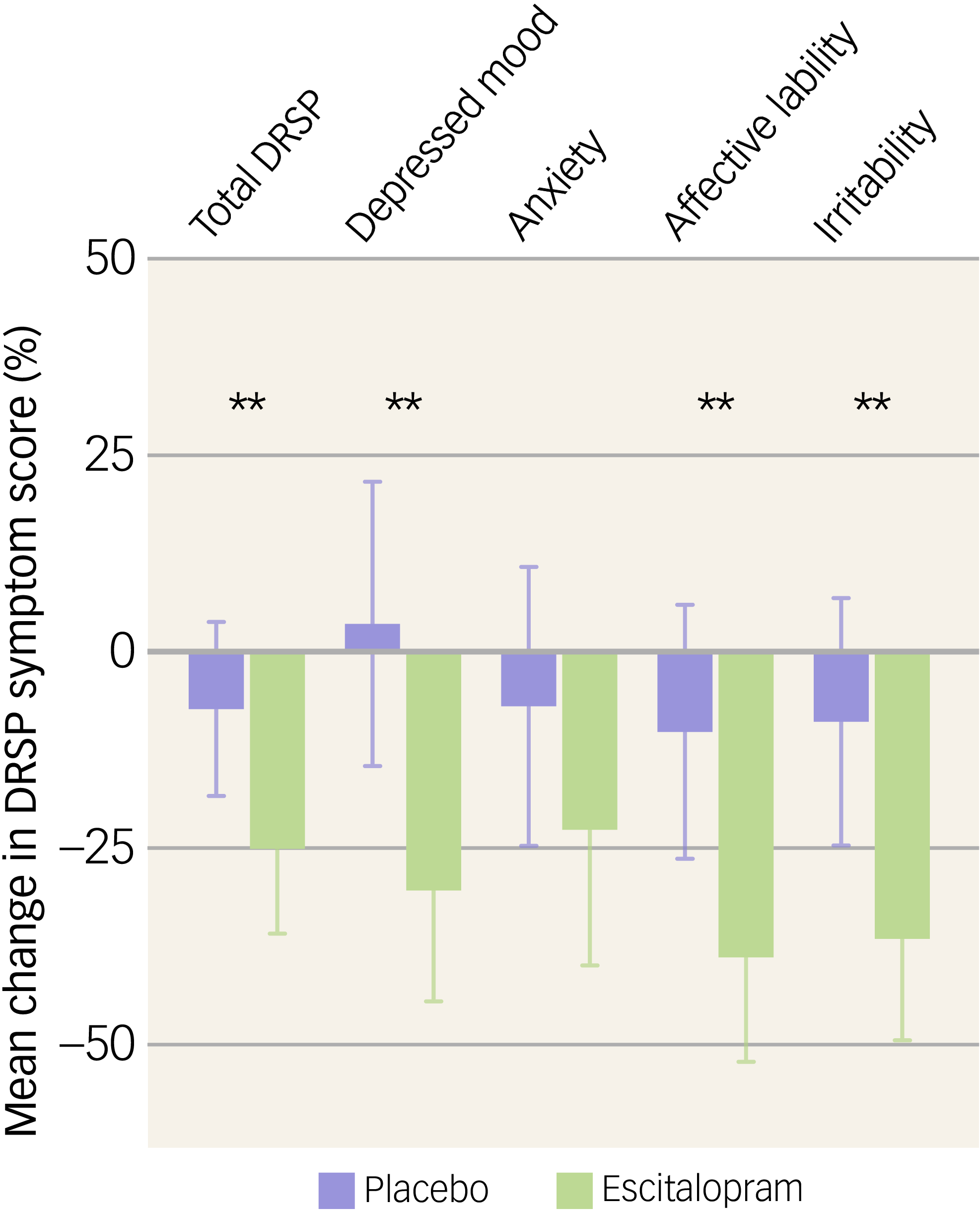
Significant treatment-by-time effects on DRSP scores were detected (Fig. 2, Supplementary Fig. 6, Supplementary Table 3), including total DRSP score (F = 7.30, p FDR = 0.009), DRSP depression score (F = 8.55, p FDR = 0.009), DRSP affective lability score (F = 7.79, p FDR = 0.009) and DRSP irritability or anger score (F = 9.69, p FDR = 0.009). At follow-up, significant group differences in these DRSP subscale scores further indicated that escitalopram was associated with greater symptom reduction (medium to large effect sizes, Supplementary Table 2).
Change in symptom severity from baseline in patients with premenstrual dysphoric disorder (PMDD) treated with escitalopram, compared with placebo (error bars 95% CI). The bar graph illustrates the percentage change in premenstrual Daily Record of Severity of Problems (DRSP) scores, averaged within the two treatment groups, for total DRSP score and DRSP scores corresponding to the four core affective symptoms of PMDD. Descriptive statistics (mean, standard deviation and range) are presented in Supplementary Table 3; the absolute change in DRSP scores is presented in Supplementary Table 3. **p FDR < 0.01 (group-by-time interaction effect).

Although the treatment-by-time effect on AQ-RSV scores was not significant (F = 2.35, p = 0.13), the escitalopram group had lower follow-up AQ-RSV scores (t = 1.87, p = 0.03, Cohen’s d = 0.55) and a significant reduction from baseline (t = −2.07, p = 0.02, Cohen’s d = −0.42), whereas placebo scores remained stable (t = −0.89, p = 0.19, Cohen’s d = −0.18) (Fig. 3(d)). In order to test whether the effect of treatment on AQ-RSV scores could be mediated by decrease in irritability or anger, we evaluated associations between AQ-RSV scores and DRSP irritability or anger scores; baseline and follow-up analyses revealed a positive association between DRSP irritability or anger and AQ-RSV scores (Fig. 3(e, f)). Mediation analysis (Fig. 3(g)) confirmed that irritability or anger mediated the treatment effect on aggressiveness (significant indirect effect [95% CI −11.48, −0.45], partially standardised indirect effect −0.32 [95% CI −0.77, −0.03]).
Point Subtraction Aggression Paradigm (PSAP) behaviour, aggression and irritability following treatment with escitalopram compared with placebo. (a) Task behaviour in terms of button presses (top) and frequency of option choice (bottom) are shown for each treatment group. Bars and dots illustrate the data range and median values, respectively. Pie charts illustrate the percentages of the choices in each group. (b) Average PSAP aggression scores (ratio of aggressive responses to provocations, adjusted for the total number of button presses) are shown for the two treatment groups. Bars and dots illustrate the data range and median values, respectively. (c) Scatterplot depicting the lack of association between PSAP aggression score and total score for Aggression Questionnaires – Revised Swedish Version (AQ-RSV) (aggression score) at follow-up. The trend lines for each treatment group are shown. (d) Line graph illustrating the change in total AQ-RSV score, from baseline to follow-up, in the two treatment groups. Participants treated with escitalopram showed a significant decrease in aggression, whereas the placebo group did not display any significant change. (e) Positive correlation between total AQ-RSV score and Daily Record of Severity of Problems (DRSP) irritability score, across all participants before treatment, is illustrated in the scatterplot. (f) Heatmap of the correlation matrix among PSAP aggression score, total AQ-RSV score at follow-up and DRSP irritability score at follow-up, showing a significant positive association between AQ-RSV aggression score and the severity of irritability, across all participants; correlation coefficients are shown in the cells above the diagonal, whereas the corresponding cells below the diagonal indicate statistical significance. (g) Results of a mediation model indicating that the effect of escitalopram versus placebo on aggression scores obtained from AQ-RSV is mediated by irritability levels assessed by DRSP. a, treatment effect on irritability; b, effect of irritability on aggression; c, treatment effect on aggression; c´, treatment effect on aggression after controlling for irritability; ab, indirect effect of treatment on aggression indicating mediation through irritability.

PSAP behavioural outcomes did not differ between groups (Fig. 3(a, b), Supplementary Table 4). PSAP aggression score did not correlate with follow-up self-rated aggression (AQ-RSV) scores (placebo, r = −0.15, p = 0.52; SSRI, ρ = −0.04, p = 0.87; Fig. 3(c)).
Effect of escitalopram on neural correlates of aggression
Valid fMRI data at follow-up were available for 37 participants (SSRI, n = 18; placebo, n = 19; Supplementary Fig. 2), with 3 excluded due to insufficient aggressive response (≤2). Menstrual cycle day at scanning did not differ between the two treatment groups (SSRI median (interquartile range (IQR)), day −4 (3); placebo median (IQR), day −4 (8); U = 197.5, p = 0.42). In terms of neural correlates of PSAP, provocations elicited significant brain activation within the bilateral PFC, ACC, insula, striatum and left amygdala; aggressive responses activated the bilateral PFC, ACC, right insula and striatum; and winning points activated the right PFC, bilateral insula and right striatum (Supplementary Fig. 7, Supplementary Table 5). No significant effects were observed for the ‘stealing’ or ‘protective’ responses.
The escitalopram group showed lower left anterior insula reactivity to provocations (i.e. points subtracted from the participant) than the placebo group (Fig. 4(a)), although this did not survive correction for multiple comparisons (Supplementary Table 6). Anterior insula reactivity correlated positively with follow-up DRSP irritability or anger scores (ρ = 0.39, p = 0.016; Fig. 4(b)), but not with AQ-RSV scores or PSAP aggressive behaviour (Supplementary Fig. 8). The mediation analysis did not support insula reactivity as a mediator of treatment effects on irritability or anger (coefficient −0.10, 95% CI [−0.60, 0.52]). Across the remaining ROIs, no treatment-related differences in reactivity to provocations were noted. We found no treatment differences during aggressive response or winning reward conditions (Supplementary Tables 7 and 8).
Effect of escitalopram on Point Subtraction Aggression Paradigm neural correlates. (a) Raincloud plot depicting the differential reactivity to provocation within the left anterior insula in the two treatment groups (left). The left insula cluster showing a group difference is illustrated on coronal, axial and sagittal brain slices (right; x = −32, y = 18, z = −4). The binary cluster image was exported from SPM12 and overlaid onto a standard Montral Neurological Institute template in MRIcroGL (v.1.2.20220720). (b) Scatterplot showing a positive relationship between brain reactivity to provocation within the left anterior insula and the follow-up DRSP irritability scores, across the two treatment groups (black fit line). For completeness, the green (grey in print version) and purple (blue in print version) subgroup fit lines are also displayed.

Fig. 4 Long description
Panel A: A raincloud plot shows the differential reactivity to provocation within the left anterior insula in two treatment groups, Placebo and Escitalopram. The horizontal axis labels the treatment groups, and the vertical axis measures the left insula cluster parameter estimates. The plot includes box plots, scatter points, and density distributions. The left insula cluster showing a group difference is illustrated on coronal, axial, and sagittal brain slices. Panel B: A scatterplot displays a positive relationship between brain reactivity to provocation within the left anterior insula and follow-up DRSP irritability scores across the two treatment groups. The horizontal axis measures irritability, and the vertical axis measures the left insula cluster parameter estimates. The scatterplot includes a black fit line representing the overall trend, with additional green and purple subgroup fit lines.
Discussion
The present pharmaco-neuroimaging study describes the efficacy of escitalopram in reducing PMDD mood symptoms, aggressiveness and neural correlates of reactive aggression in women with PMDD treated intermittently with escitalopram. Addressing a gap in prospective evidence within a contemporary clinical context, Reference Reilly, Wallman, Clark, Knox, Craig and Taylor8 the present randomised, placebo-controlled trial shows that escitalopram (20 mg/day for up to 15 luteal days) reduced total DRSP scores, with pronounced effects on core mood symptoms (irritability/anger, affect lability and depression) compared with placebo. These findings confirm that SSRIs primarily target PMDD mood symptoms Reference Landen, Erlandsson, Bengtsson, Andersch and Eriksson6–Reference Reilly, Wallman, Clark, Knox, Craig and Taylor8 and corroborate meta-analytic evidence indicating intermittent SSRI use in PMDD as effective as continuous administration, with the former offering advantages in terms of tolerability and adherence. Reference Reilly, Wallman, Clark, Knox, Craig and Taylor8 Similar to SSRI treatment in depression, where some symptoms overlap with side-effects, Reference Hieronymus, Lisinski, Eriksson and Ostergaard35 the escitalopram group also reported increased sleep disturbances and energy loss (Supplementary Fig. 6). This highlights the need to assess SSRI effects specifically on core PMDD symptoms. Consistent with the rapid clinical improvements observed in PMDD, Reference Landen, Erlandsson, Bengtsson, Andersch and Eriksson6–Reference Reilly, Wallman, Clark, Knox, Craig and Taylor8 these effects do not seem dependent on steady-state exposure, Reference Sacher, Zsido, Barth, Zientek, Rullmann and Luthardt9 nor on slower changes in receptor responsiveness or neural plasticity, but could reflect rapid modulation of serotonergic–affective circuits in a hormonally sensitive state, potentially involving neuroactive steroid systems. Reference Miller, Standeven, Morrow, Payne, Epperson and Hantsoo26–Reference Bixo, Stiernman and Backstrom28
We observed a significant reduction in self-reported aggressiveness following escitalopram treatment, as reflected by AQ-RSV scores, whereas no change was seen in the placebo group. Nevertheless, no treatment-by-time effect was found. A mediation analysis indicated that improvements in daily irritability or anger partly account for this effect (Fig. 3(g)). This finding, in line with the literature, Reference Landen, Erlandsson, Bengtsson, Andersch and Eriksson6,Reference da Cunha-Bang and Knudsen11,Reference Grondal, Naslund, Englund, Luke, Ask and Eriksson14 suggests irritability and anger as potential mediators of aggressiveness in PMDD following treatment with SSRI. On the other hand, no significant association was observed between irritability or anger and PSAP aggression scores, suggesting potential limitations in the sensitivity and ecological validity of PSAP in this population. Nevertheless, a comparable healthy-participant fMRI implementation reported similar options (b) and (c) responding, Reference Skibsted, Cunha-Bang, Carre, Hansen, Beliveau and Knudsen15 supporting interpretable task engagement in the present study. The absence of escitalopram effects on PSAP behaviour, consistent with recent works, Reference Grondal, Naslund, Englund, Luke, Ask and Eriksson14 may indicate that SSRIs primarily modulate affective experience, emotional appraisal and salience processing rather than instrumental aggressive responding. PSAP emphasises punitive responses to provocation, which may not capture more indirect or relational forms of aggression in PMDD. Given that PMDD is associated with impairments in social functioning and heightened reactivity during interpersonal conflict, Reference Westermark, Yang, Bertone-Johnson, Brann, Opatowski and Pedersen36 these findings contribute to our understanding of serotonin’s role in regulating irritability, affective responses and aggression during provoked social interactions.
The neuroimaging results should be interpreted with caution due to the exploratory nature of the study. Although the lower anterior insula reactivity to provocation in the escitalopram group was nominally significant, the direction of the effect aligns with prior research and can drive future hypothesis-driven work. The anterior insula plays a critical role in reactive aggression and processing of negative emotional states triggered by provocation, Reference Bertsch, Florange and Herpertz18,Reference Dambacher, Sack, Lobbestael, Arntz, Brugman and Schuhmann37 and serotonin exerts a modulatory role in aggression-related neurocircuitry, including insular activity. Reference da Cunha-Bang and Knudsen11 Disrupted serotonin function has been linked to heightened insula responses to emotional stimuli, Reference Bellani, Dusi, Yeh, Soares and Brambilla38 which may contribute to mood instability and reactive aggression in patients with PMDD. Neuroimaging studies show the involvement of the insula in altered emotional processing in PMDD, Reference Dubol, Neill Epperson, Lanzenberger, Sundstrom-Poromaa and Comasco23 including heightened insular reactivity to socially relevant stimuli and during response inhibition in the luteal phase, compared with controls, Reference Gingnell, Ahlstedt, Bannbers, Wikstrom, Sundstrom-Poromaa and Fredrikson39,Reference Bannbers, Gingnell, Engman, Morell, Comasco and Kask40 thus suggesting the insula as a potential target region of relevance to mental symptom improvement following SSRI treatment.
The present neuroimaging findings further align with research on reactive aggression and provocation during PSAP, implicating a network of regions involved in emotion processing and regulation (PFC, ACC, amygdala, insula and striatum Reference Skibsted, Cunha-Bang, Carre, Hansen, Beliveau and Knudsen15,Reference Gan, Preston-Campbell, Moeller, Steinberg, Lane and Maloney17 ). Lower insular activation may indicate serotonergic modulation of neural processing of social provocations, a relevant aspect given the social nature of the PSAP task. Together, these findings suggest that intermittent SSRI treatment in PMDD primarily targets mood-related and affective processes relevant to irritability and aggression, with more limited effects on task-based measures of aggressive behaviour.
Along the line of blunted top–down regulatory activation Reference Comasco, Hahn, Ganger, Gingnell, Bannbers and Oreland41 and heightened emotional processing Reference Stiernman, Dubol, Comasco, Sundstrom-Poromaa, Boraxbekk and Johansson25 in PMDD, Reference Dubol, Neill Epperson, Lanzenberger, Sundstrom-Poromaa and Comasco23 reduced insular reactivity following treatment with escitalopram points towards a downregulation of emotional processing and may be seen as complementary to the higher fronto-cortical activation observed following treatment with a selective progesterone receptor modulator. Reference Kaltsouni, Fisher, Dubol, Hustad, Lanzenberger and Frokjaer20 Indeed, progesterone antagonism has been associated with symptom amelioration and greater activation in top-down regulatory regions during aggressive responses, suggesting potential effects on cognitive regulation. Reference Comasco, Kopp Kallner, Bixo, Hirschberg, Nyback and de Grauw3,Reference Kaltsouni, Fisher, Dubol, Hustad, Lanzenberger and Frokjaer20 Importantly, the insula, ACC, PFC and amygdala form an interconnected network that integrates interoception, emotion regulation and cognitive control, enabling adaptive responses to stimuli that appear to be involved in PMDD pathophysiology, Reference Dubol, Neill Epperson, Lanzenberger, Sundstrom-Poromaa and Comasco23 and these are core components of the neural network underlying reactive aggression. Reference Bertsch, Florange and Herpertz18 Thus, our exploratory findings of reduced anterior insula involvement in response to provocations should be considered within the broader context of the role of this network in PMDD symptoms.
The present results should be interpreted in light of methodological considerations. Our study aligns with evidence of the rapid action of SSRIs in PMDD, Reference Eriksson, Ekman, Sinclair, Sorvik, Ysander and Mattson7,Reference Reilly, Wallman, Clark, Knox, Craig and Taylor8 because reduction in mood symptoms were observed following luteal-phase treatment, independently of treatment duration (Supplementary Fig. 4). An a priori power analysis (see supplementary material) indicated that around 60 participants were needed for detection of small-to-medium effects with 80% power in the randomised controlled trial, supporting the adequacy of our sample size for these analyses. The assessment of one single treatment cycle calls for investigation of long-term effects, including potential cumulative effects, tolerance, discontinuation and comparisons with continuous SSRI administration. Reference Reilly, Wallman, Clark, Knox, Craig and Taylor8 The neuroimaging sample was reduced due to participant drop-outs and technical exclusions, and thus the findings should be interpreted as exploratory. Post hoc power calculations (see supplementary material) confirmed that neuroimaging analyses were adequately powered to detect large effects, as found in the left insula. Our results further indicate that, despite significant mood improvements, behavioural measures of reactive aggression (as measured by PSAP) showed no differences between the groups following escitalopram treatment, consistent with prior studies on medical treatments for PMDD. Reference Grondal, Naslund, Englund, Luke, Ask and Eriksson14,Reference Kaltsouni, Fisher, Dubol, Hustad, Lanzenberger and Frokjaer20 PSAP, a widely used measure of reactive aggression, Reference Cherek, Lane, Pietras and Steinberg21 focuses on punishment responses, which may not fully reflect the subtler, indirect forms of aggression more common in patients with PMDD, particularly in relationships. Reference Hylan, Sundell and Judge42 Gendered expression of aggression, with women more likely to engage in indirect aggression, Reference Denson, O’Dean, Blake and Beames43 could also contribute to the lack of PSAP effects. Thus, gender- and disorder-specific tasks are warranted to better reflect the interpersonal dynamics and real-world impact of irritability, anger and aggression in patients with PMDD. Taken together, the dissociation between robust symptom improvement, limited behavioural effects and subtle neural modulation suggests that SSRIs primarily influence affective appraisal and emotional salience in PMDD, rather than directly altering aggressive action tendencies.
In summary, this pharmaco-neuroimaging study provides insights into the effects of intermittent SSRI treatment on PMDD symptoms, aggressiveness and aggression-related brain function. The results provide timely confirmation of escitalopram as an effective treatment for PMDD within a contemporary clinical context. Aggressiveness, which was positively associated with PMDD symptoms, diminished following treatment, with the reduction in irritability or anger partly mediating this association. Functional neuroimaging suggests that modulation of serotonergic function in PMDD is related to corticolimbic circuits involved in irritability or anger and interpersonal behaviour. These nominally significant neuroimaging findings are, however, exploratory and should therefore be interpreted as hypothesis-generating. The results underscore the need for interventions targeting irritability, anger and aggression in this population, and call for research leveraging psychobiological measures to parse heterogeneity in PMDD and support tailored, mechanism-based treatments.
Supplementary material
The supplementary material is available online at https://doi.org/10.1192/bjp.2026.10721
Data availability
The data-sets generated and analysed during the current study are available from the corresponding author on reasonable request; analytic code and study materials are likewise available on request to enable replication of the reported findings.
Acknowledgements
The authors thank Sara Nyback for her help with data collection. The authors also thank Ella Schleimann-Jensen and Elisavet Kaltsouni for their valuable support.
Author contributions
M.D.: data curation, formal analysis, visualisation, writing – original draft preparation, review and editing. M.G.: formal analysis, visualisation, writing – original draft preparation, review and editing. F.S.: data collection and curation, writing – review and editing. P.M.F.: methodology, writing – review and editing. V.G.F.: methodology, writing – review and editing. J.W.: conceptualisation, resources, writing – review and editing. E.E.: writing – review and editing. I.S.: conceptualisation, funding acquisition, supervision, writing – review and editing. E.C.: conceptualisation, funding acquisition, supervision, writing – original draft preparation, review and editing.
Funding
This study was funded by the Swedish Research Council (nos 2015-00495, 2016-01439, 2020-01801, 2021-03089), the Swedish Society of Medicine (nos SLS-573171, SLS-597211, SLS-789101) and the Swedish Brain Foundation (no. 2020-0255). Additionally, E.C. received funding from the Swedish Research EU FP7-People-Cofund (no. INCA 600398) and SciLifeLab. The study drug was supplied by Lundbeck, Sweden; however, that company had no further involvement in the study’s design, data collection, analysis, interpretation of findings or manuscript preparation.
Declaration of interest
E.C. is a member of the BJPsych editorial board and did not take part in the review or decision-making process of this paper. I.S. has occasionally served on advisory boards or as an invited speaker at scientific meetings for Asarina Pharma, Bayer Health Care, Gedeon Richter, Peptonics, Shire/Takeda, Sandoz and Lundbeck A/S. E.E. has served on advisory boards and/or received speaker’s honoraria and/or research grants from H Lundbeck and Janssen. V.G.F. has served as a lecturer for Lundbeck A/S, Janssen-Cilag, Gedeon-Richther and Ferring Pharmaceuticals within the past 3 years. All other authors declare no conflicts of interest.
Transparency declaration
The lead author and manuscript guarantor affirm that the manuscript is an honest, accurate and transparent account of the study being reported; that no important aspects of the study have been omitted; and that any discrepancies from the study as planned (and, if relevant, registered) have been explained. EU Clinical Trial Register (EudraCT) identifier: 2016-001217-25 Trial registry name: Emotion, Serotonin and Premenstrual Dysphoric Disorder (EmSeP) URL: https://www.clinicaltrialsregister.eu/ctr-search/search?query=2016-001217-25



 Open access


eLetters
No eLetters have been published for this article.