INTRODUCTION
The ocean quahog, Arctica islandica (Linnaeus, 1767), is a large long-lived suspension feeding infaunal bivalve mollusc found burrowed in the top 5 cm or deeper of sand and muddy substrates in the shelf seas of the North Atlantic, commonly at a water depth of 25 to 80 m (Mann & Wolf Reference Mann and Wolf1983). In Europe the species occupies a wide latitudinal range from the Bay of Biscay in the south (48°N), to Icelandic waters (66°N) and even as far north as of the southern coast of the Svalbard (76°N) in the Arctic Ocean (Dahlgren et al., Reference Butler, Scourse, Richardson, Wanamaker, Bryant, Dahlgren, Weinberg and Halanych2000), whilst on the eastern coast of North America it occupies a latitudinal range from Labrador to Cape Hatteras (Franz & Merrill, Reference Franz and Merrill1980).
The ocean quahog is of both commercial and academic interest. Commercially it is harvested in the USA, Canada and Iceland; conversely it is not a very marketable species in European waters and no commercial fisheries exist. Academically, however it is becoming an increasingly important species being utilized both as a high resolution marine palaeoclimate archive (Wanamaker et al., Reference Wanamaker, Heinemeier, Scourse, Richardson, Butler, Eiríksson and Knudsen2008; Butler et al., 2009) and a model organism for research about ageing (Strahl et al., Reference Strahl, Philipp, Brey, Broeg and Abele2007; Abele et al., Reference Abele, Strahl, Brey and Philipp2008). The species has recently piqued the interest of biogerontologists because it is not just the longest-lived bivalve, it is also the longest lived non-colonial animal known to science (Wanamaker et al., Reference Wanamaker, Heinemeier, Scourse, Richardson, Butler, Eiríksson and Knudsen2008). The known maximum life span potential (MLSP) for this clam continues to increase (Thompson et al., Reference Thompson, Jones and Deribelbis1980a; Jones, Reference Jones1983; Ropes, Reference Ropes1985; Schöne et al., Reference Schöne, Fiebig, Pfeiffer, Gleß, Hickson, Johnson, Dreyer and Oschmann2005; Scourse et al., Reference Scourse, Richardson, Forsythe, Harris, Heinemeier, Fraser, Briffa and Jones2006) and currently stands at 410 years (Wanamaker et al., Reference Wanamaker, Heinemeier, Scourse, Richardson, Butler, Eiríksson and Knudsen2008).
As a result of commercial and academic interest, research on the population characteristics of A. islandica has become increasingly important in the past two decades. Knowledge of the species population-structure, recruitment history, mortality rates, longevity and reproductive cycle has largely been obtained from those regions where the species is commercially harvested. For example the age of the species has been investigated for the Mid-Atlantic Bight population (Thompson et al., Reference Thompson, Jones and Deribelbis1980a, Reference Thompson, Jones and Ropesb; Kennish et al., Reference Kennish, Lutz, Dobarro and Fritz1994), near New York (Ropes et al., Reference Ropes, Murawski and Serchuk1984), eastern Canadian waters (Kilada et al., Reference Kilada, Campana and Roddick2007) and in Iceland (Steingrimsson & Thorarinsdóttir, Reference Steingrimsson and Thorarinsdóttir1995; Thorarinsdóttir & Steingrimsson, Reference Thorarinsdóttir and Steingrimsson2000; Kilada et al., Reference Kilada, Campana and Roddick2007) and the population-structure and seasonal reproductive cycle were described for the southern New England shelf (Mann, Reference Mann1982), New Jersey (Fritz, Reference Fritz1991; Kennish & Lutz, Reference Kennish and Lutz1995), Iceland (Thorarinsdóttir & Einarsson, Reference Thorarinsdóttir and Einarsson1996; Thorarinsdóttir & Johannesson, Reference Thorarinsdóttir and Johannesson1996; Thorarinsdóttir, Reference Thorarinsdóttir2000), the Baltic Sea (Zettler et al., Reference Zettler, Bönsch and Gosselck2001), Georges Bank (Lewis et al., Reference Lewis, Weinberg and Davis2001) and the northern North Sea (Witbaard & Bergman, Reference Witbaard and Bergman2003). Despite this wealth of knowledge there have been no investigations into the population structure of any Irish Sea populations.
For the clam to be effectively utilized as a model organism in research about ageing there is a pressing need to catalogue its life history traits throughout its latitudinal range. Understanding how longevity is associated with growth rate, maximum size, recruitment conditions and local environmental conditions will facilitate our understanding of ageing in this important species. It is also still to be ascertained what type of senescence this animal experiences (negligible as proposed by Finch (Reference Finch1990) or rather radically the negative as proposed by Vaupel et al. (Reference Vaupel, Baudisch, Döllinga, Roach and Gampe2004)). A way to document the type of senescence experienced is through in-depth demographic analysis of variations in mortality rate with age. However, before such work can be initiated there is a need to understand recruitment patterns in clam populations and their age-structure. Harding et al. (Reference Harding, King, Powell and Mann2008) documented decadal trends in age-structure and recruitment patterns of A. islandica from the Mid-Atlantic Bight in relation to water temperature and Butler et al. (2009) reported long periods with no recruitment for a population of A. islandica from Isle of Man waters.
Although A. islandica is currently not commercially exploited in UK waters, the continuing decline in traditional white fin fisheries and commercial shellfisheries could see the targeting of alternative species, which could feasibly include A. islandica. The species is abundant in the Irish Sea and North Sea (Witbaard, Reference Witbaard1996; Butler et al., 2009, respectively) and both these areas may support fisheries, as discussed by Witbaard & Bergman (Reference Witbaard and Bergman2003), but information on age composition, mortality, and growth rate would be required to estimate levels of sustainable harvest. Therefore growth rate investigations are warranted to indicate how much time is required to reach a certain marketable size (Urban, Reference Urban2000), and the relationship between size and age is essential to implement appropriate management strategies (Keller et al., Reference Keller, Del Piero and Longinelli2002). Knowledge of growth parameters is essential for understanding the biology and productivity of bivalves (Moura et al., Reference Moura, Gaspar and Monteiro2009). Studying vital rates (namely growth) is necessary for modelling population dynamics, which, in turn, is crucial to exploitation and management (Laudien et al., Reference Laudien, Brey and Arntz2003; Peharda et al., Reference Peharda, Richardson, Mladineo, Šestanović, Popović, Bolotin and Vrgoč2007) and to the recommendation of effective measures for the protection of the species (Katsanevakis, Reference Katsanevakis2007).
In this paper we describe the geographical distribution, density, growth rate, longevity, mortality and recruitment patterns of A. islandica in Belfast Lough, Northern Ireland, UK. We also compare growth characteristics and life history traits of this population with other analogous populations.
MATERIALS AND METHODS
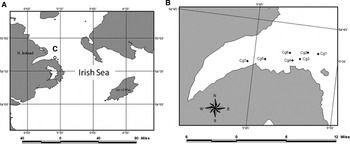
Belfast Lough (Figure 1A) is a fully marine inshore body of water which experiences annual seawater temperature ranges of between 6 and 15°C (Evans et al., Reference Evans, Hardman-Mountford, Hartnoll, Kennington, Mitchelson-Jacob, Shammon and Williams2003). Arctica islandica were collected from a site at 20–25 m depth at the mouth of Belfast Lough (54°42.10N 5°35.25W) (Figure 1A; Station C) in July and September 2008 and April 2010, using a customized rigid-toothed dredge, 1 m wide with a 25 mm mesh, deployed from the RV ‘Prince Madog’. The dredge is designed to equally sample all size-classes of A. islandica greater than 25 mm shell height. Potential dredge sites were surveyed using side-scan sonar prior to deployment in order to avoid obstacles. The presence of A. islandica at this location was initially identified during Northern Ireland scallop surveys which were confirmed by a previous visit by the RV ‘Prince Madog’ in 2005. The site was of specific interest due to the high population density (inferred due to the high capture rate previously reported compared with other sampled populations of A. islandica) and the large size-range of clams that had previously been obtained.
Location of Arctica islandica populations in Belfast Lough. (A) Sampling Station C, in the mouth of Belfast Lough; (B) location of grab sampling Stations (Cg1–Cg 7) in Belfast Lough for quantitative sampling of the Arctica islandica population. Cg2 was the site of dredge sampling.

To assess the spatial distribution of the population within Belfast Lough seven locations were identified (Figure 1B). The strategy was to initially dredge each location to assess the presence or absence of the species and if present to undertake quantitative a grab sampling protocol. Twenty Day grabs were undertaken, the protocol was to position the boat on the identified coordinates and perform five Day grabs with the drift of the boat providing random sampling, before the boat was repositioned and another five grabs undertaken until a total of twenty grabs were completed. All grab samples were sieved through a 2 mm sieve. To compare the ‘availability’ to the dredge of A. islandica during each visit we compared the capture rate of A. islandica by the dredge during each of the three visits. The sum of individuals captured during each visit was divided by the cumulative duration of the dredge tows to estimate the relative abundance of clams during each visit.
A total of 850 live A. islandica collected in the dredge tows were measured to determine the population size–frequency distribution. The shell height (maximum distance from umbo to the ventral margin) was measured to the nearest 0.01 mm with a digital Vernier calliper and a size–frequency distribution constructed. The relative number of clams in each size-class was used to calculate how many of each size-class should be aged; a random number generator was then used to select the shells for ageing from within each size-class. The age of 125 of these individuals obtained in July 2008 was determined. The flesh was removed and small pieces of gonad removed and inspected microscopically in squash preparations to determine clam gender and whether the animal was sexually mature.
The age and growth rate of A. islandica were determined from acetate peels of the sectioned shells (see Richardson, Reference Richardson2001). Clean, dry shells were embedded in resin and sectioned along the major growth axis using a diamond saw. The cut surface was ground on increasingly finer grades of wet and dry paper, polished and then etched for 5 minutes in 0.1M hydrochloric acid. Acetate peel replicas were prepared using the methodology described by Richardson (Reference Richardson1989) and Wanamaker et al. (Reference Wanamaker, Heinemeier, Scourse, Richardson, Butler, Eiríksson and Knudsen2008) and viewed in a transmitted light microscope. The ages of the 125 A. islandica were estimated by counting the number of clear annual growth lines present in the hinge region of acetate peels of the shell sections and the population age structure constructed. The Von Bertalanffy growth function (VBGF) (Lt = L∞ (1−e−k(t−t0))) was fitted to the shell length-at-age data, and the growth constant (K) and asymptotic maximum shell length (L∞) determined using the fisheries program Fishparm (Prager et al., Reference Prager, Saila and Recksick1987). Growth data estimated in this study were compared with data available from the literature for other A. islandica populations. With known dates of death and ages ascribed to each shell the year of settlement for the 125 A. islandica was then determined.
Instantaneous natural mortality rate (M) was estimated on the basis of age–frequency distributions (Ricker, Reference Ricker1975). As Station C is believed to have no history of commercial fishing it was assumed that total mortality (Z) was equivalent to natural mortality. Z was estimated by calculating the slope of the regression between the natural log of the frequency at age data. The analysis was restricted on the descending right limb of the age–frequency curve; we believe this is an artefact of size selectivity by the dredge. Longevity was also estimated from the catch curves. Longevity and mortality estimates were obtained from analysis of age frequencies based entirely on the 125 aged animals and from the clam ages estimated from length at age curve, using the VBGF, for the rest of the 850 live A. islandica collected.
Due to the non-linearity of the growth process, the comparison of growth amongst different organisms is often complex (Moura et al., Reference Moura, Gaspar and Monteiro2009). To overcome this problem, several growth performance indices have been used, namely, the overall growth performance (P) and the growth performance index phi-prime (φ′) (Pauly, Reference Pauly1979; Munro & Pauly, Reference Munro and Pauly1983). The overall growth performance P (P = log(K × L∞3)) and the phi-prime index (φ′) (φ′= log K + 2 x log L∞), were used as measures of growth performance and for comparing growth data obtained during the present study with that obtained from the literature.
RESULTS
Distribution and abundance
Dredge sampling for A. islandica at six additional locations around Station C and further into Belfast Lough confirmed that the population was restricted to Station C (grab site Cg2). Because no A. islandica were captured in the dredges at these other locations, grab sampling was only undertaken at Station C. The quantitative assessment of the A. islandica populations at Station C by the grab sampling demonstrated that the population density was 4.5 individuals m2.
Dredging was undertaken over three visits between 2008 and 2010. The relative abundance of A. islandica during the September 2008 visit (1.03 individuals.min−1) was significantly lower than during the other two months (2.21 individuals.min−1 and 2.61 individuals.min−1 for July 2008 and April 2010 respectively) (Mann–Whitney U-test; P = 0.05).
Growth
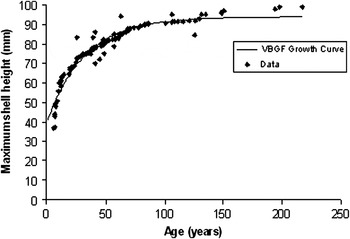
Counting the number of internal growth increments provided age estimates ranging between 6 and 217 years old. The population VBGF growth equation fitted using data from the annual internal growth increments provided an estimate asymptotic size (L∞) of 93.7 mm (±0.918 SE), a growth rate (K) of 0.03 yr−1 (±0.00197 SE) and t0 = –1.25 (Figure 2). The growth curve depicts a period of rapid growth until around 20 years when the growth rate continues to decline until around 80 years of age; from then on the species displays a low rate of indeterminate growth.
Variation in maximum shell height with age in 125 Arctica islandica. The growth curve was fitted using the Von Bertallanffy growth equation (Lt = 93.7mm (1−e−0.03(t–1.25))).

The gonad maturation state of the 125 clams whose age was determined indicated that the maximum size that the clams were immature was ~40 mm shell height and between 6 and 7 years old. Two other 7 year old A. islandica (>40 mm shell height) produced gametes indicating that they had attained sexual maturity, or were at least at the intermediate stage. Thus we assume that sexual maturity in clams from Belfast Lough occurs at ~40 mm shell height, i.e. around 7 years old.
Population structure
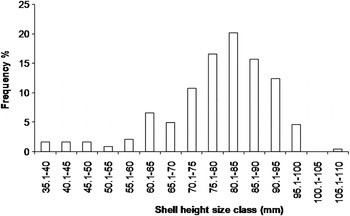
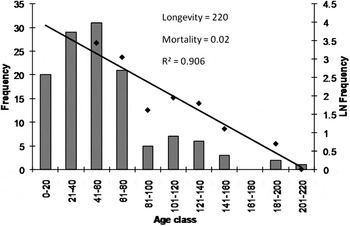
The size–frequency histogram for Belfast Lough (Figure 3) shows a unimodal peak in shell height at the 80.1–85 mm size-class, and declines steeply from there; the maximum shell height observed was 106.3 mm and was the only individual >100 mm shell height. There was also an observed absence of small individuals. However, the analysis of the age–frequency histogram (Figure 4) for Belfast Lough shows more of a bi-modal height distribution, with a clear peak in the 41–60 year age-class, and a much smaller secondary peak at the 101–120 year age-class. Over 15% of the total population had lived in excess of a century.
Size–frequency distribution of Arctica islandica (in 5 mm size-classes) collected in the dredge tows in Belfast Lough.

Age–frequency distribution for the Arctica islandica population at Station C, Belfast Lough. This graph is based on the 125 animals whose age was determined using sclerochronological techniques. Regression analysis of the natural log (LN) frequency data provides estimations of Longevity (the x axis intercept) and mortality (the slope).

Catch curve analysis from aged individuals provided mortality and longevity estimates of 0.02 and 220 years respectively (Figure 4). Age estimated from size using the parameters of the VBGF for the remaining 740 clams whose age had not been determined using shell sections produced a similar longevity estimate of 217, but a higher mortality rate of 0.04 (data not presented).
Due to the asymptotic growth nature displayed in longevous bivalves, shell size is a poor predictor of age. It was therefore decided that estimates of longevity and mortality were more reliable when based entirely on clams for which individual ages were accurately ascribed, rather than the ages of clams of known length whose ages had been estimated from the VBGF.
For example, two similar sized clam shells whose age had been estimated using growth lines and had shell heights of 85.3 and 90.8 mm, had estimated ages of 149 and 61 years respectively. This demonstrates how similar sized animals can be of vastly different ages and that size is an unreliable predictor of longevity.
Settlement
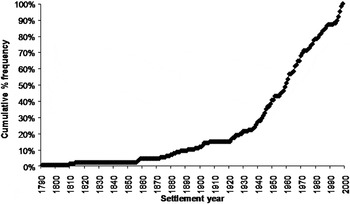
With a known date of death and accurate ages determined it was possible to ascribe an estimated date of settlement for the 125 individuals that had been aged and produce a curve reflecting cumulative settlement (Figure 5). Analysis of the curve suggests the A. islandica population at Belfast Lough has experienced almost continuous recruitment over the last 90 years, but with two significant gaps in recruitment, one 90–100 years ago and another 140–150 ago.
Cumulative frequency of the occurrence of successful settlement and recruitment into the population of Arctica islandica from Belfast Lough from 1790–1990.

DISCUSSION
Distribution and abundance
The A. islandica population at Belfast Lough appears to be restricted to a small area at the mouth of the Lough. Additional searches for specimens further into the Lough and into deeper waters found no evidence of a larger more widespread population and at Station C we report population densities of 4.5 individuals m−2. For the waters of the UK this is a relatively dense population, and only in the central Fladen Ground (northern North Sea), with an average density of 12 individuals m−2, comprising up to 75% of the total biomass, have higher densities been reported (De Wilde et al., Reference De Wilde, Berghuis and Kok1986). In fact, when the Station was re-sampled by Witbaard & Bergman (Reference Witbaard and Bergman2003) using a Triple-D dredge which accurately quantitatively samples the benthos they estimated local densities of up to 286 individuals (>10 mm) m−2 in the northern cluster.
The Belfast Lough population is probably near the southern limit of the population in the Irish Sea. The bottom waters in this region occasionally exceed 16°C (Evans et al., Reference Evans, Hardman-Mountford, Hartnoll, Kennington, Mitchelson-Jacob, Shammon and Williams2003) which has been reported as the upper limit for population survival (Merrill et al., Reference Merrill, Chamberlin, Ropes and Firth1969). Similarly in the southern North Sea Witbaard & Bergman (Reference Witbaard and Bergman2003) reported that the southern limit of A. islandica coincides with the southernmost limit of the summer stratified water mass where bottom water temperatures never exceed 16°C.
An interesting observation to arise from the present study is the significantly reduced dredge capture rate during the September 2008 sampling period. One of the only plausible reasons for the temporary significant reduction in the dredge capture rate we observed in September 2008 is that the population had undergone a synchronized burrowing period, and were less ‘available’ to the dredge. It was hypothesized that synchronous burrowing behaviour of the clams would reduce their availability to the dredge; therefore this data would provide preliminary evidence of when synchronous burrowing occurs in A. islandica populations in Belfast Lough. It is known that many species of burrowing bivalves display a seasonal pattern of burrowing behaviour (for example in Macoma balthica (Reading & McGrorty, Reference Reading and McGrorty1978) and Mya arenaria (Englund & Heino, Reference Englund and Heino1994). Although A. islandica is known to burrow, its burrowing behaviour has been reported as being unsynchronized (Taylor, Reference Taylor1976).
September is also the time when the growth increment in the shell is believed to form when shell growth ceases (Jones, Reference Jones1980). We hypothesize that some cue causes A. islandica to burrow into the sediment, lose contact with the sediment–surface water interface and therefore stop shell growth and form the annual growth line; this cue might be the maximum annual seawater temperature (Mann, Reference Mann1982), or breakdown of the thermocline leading to high organic matter and anoxic bottom waters (Mann, Reference Mann1982). Additionally, both Dunca et al. (Reference Dunca, Mutvei, Göransson, Mörth, Schöne, Whitehouse, Elfman and Baden2009), studying an A. islandica population from the west coast of Sweden, and Weidman et al. (Reference Weidman, Jones and Lohmann1994), studying a Georges Bank population, reported isotopic measurements that indicate that growth line formation occurs in the autumn when the seawater temperature has begun to decrease. Dunca et al. (Reference Dunca, Mutvei, Göransson, Mörth, Schöne, Whitehouse, Elfman and Baden2009) reported that the onset of shell growth began around the end of October and ceased (producing the annual growth line) the following year between August and September. Although these findings are preliminary and our work here requires repeating, it is one of the first reports of a seasonal change in population abundance of A. islandica associated with a synchornized burrowing in a bivalve population. The burrowing event possibly coincides with the timing of growth line formation. Support of the timing of this event comes from the experimental tanks at the Royal Netherlands Institute of Sea Research where burrowing in A. islandica has been investigated. Preliminary results suggest the largest proportion of animals buried deep in the sediment (with no siphons visible) at the end of summer (in the months of August and September) (Witbaard, personal communication, 2010).
Growth
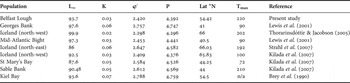
In the present study we report an L∞ value of 93.7 mm. This represents an intermediate value compared to other populations. Whereas in some areas higher L∞ values have been reported (e.g. 99.6 mm in north-west Iceland by Thorarinsdóttir & Jacobson, Reference Thorarinsdóttir and Jacobson2005), other research had documented values as low as 86 mm (north-east Iceland; Strahl et al., Reference Strahl, Philipp, Brey, Broeg and Abele2007) and 87.6 mm (St Mary's Bay, eastern Canada; Kilada et al., Reference Kilada, Campana and Roddick2007) (see Table 1). Our estimate of the VBGF K (0.03) is also an intermediate value; other population estimates of K have ranged between ~0.02 in north-west Iceland (Thorarinsdóttir & Jacobson, Reference Thorarinsdóttir and Jacobson2005) and 0.06 at Georges Bank (Lewis et al., Reference Lewis, Weinberg and Davis2001) and north-east Iceland (Strahl et al., Reference Strahl, Philipp, Brey, Broeg and Abele2007). The overall growth performance and the growth performance index calculated for the Belfast Lough A. islandica population are also similar to other estimates (Table 1). Perhaps surprisingly no significant relationship between the overall growth performance (P) and the growth performance index phi-prime (φ′) with either longevity or latitude was observed.
Von Bertalanffy growth parameters and other parameters by area for ocean quahogs from this study and published reports. Asymptotic shell length (L∞ mm), Von Bertalanffy growth constant (K yr−1), phi-prime (φ′), overall growth performance (P), latitude (Lat °N), estimate of population longevity (Tmax) and reference source.

Population structure
Analysis of the size-structure revealed that smaller clams were rare in the population. A similar situation has previously been observed amongst populations collected along the American east coast (Murawski et al., Reference Murawski, Ropes and Serchuk1982), north-west Iceland (Thorarinsdóttir & Einarsson, Reference Thorarinsdóttir and Einarsson1996) and the North Sea (Witbaard et al., Reference Witbaard, Duineveld and De Wilde1997). Murawski et al. (Reference Murawski, Ropes and Serchuk1982) suggested that skewed size–frequency distributions probably result from either irregular recruitment or low recruit survival. However, it has previously been reported by Thorarinsdóttir et al. (Reference Thorarinsdóttir, Jacobson, Ragnarsson, Garcia and Gunnarsson2010) that commercial A. islandica dredges are selective for larger sized animals and therefore the skewed size–frequency distribution may be an artefact of the sampling process.
Analysis of the age-composition of the catch demonstrated that the oldest animal caught was 217 years old; this corresponded well with our longevity estimate of 220 years from catch curve analysis. Additionally, an age estimate based on only 125 individuals should probably be considered an underestimate (Beukema, Reference Beukema1988). Nevertheless we have demonstrated that even at the southern limit of its distribution, and in relatively shallow waters of 25 m depth, that this species still exhibits an exceptional longevity in excess of 200 years.
The annual mortality rate for offshore populations of A. islandica is generally assumed to be 1–3% (NEFSC, 2004; Kilada et al., Reference Kilada, Campana and Roddick2007). Catch curve analysis provided a very similar estimate of 0.02 for the Belfast Lough population. For the actuarial definition of rates of senescence we really need a comprehensive understanding of age-related changes in mortality rate. Whilst this has ecological implications, a strong interest in the mortality rates of A. islandica comes from the biogerontological community, who are keen to accurately determine the type of senescence experienced by this unique clam species. Finch (Reference Finch2009) acknowledges the difficulty defining mortality rates at later ages in natural populations because of the small sample sizes, which are necessarily sacrificed for the observation of age. Whilst researchers such as Kilada et al. (Reference Kilada, Campana and Roddick2007) have used huge clam sample sizes (in excess of 300,000), their ages have necessarily been estimated from age/length keys and are unreliable and too coarse at advanced ages to permit accurate analysis of changes in age-related mortalities. A concerted effort to accurately age many more shells from a specific population is needed if we are to be able to determine age-related changes in mortality rates for this species.
Settlement
Harding et al. (Reference Harding, King, Powell and Mann2008) recently reported on decadal trends of successful recruitment into A. islandica populations off the east coast of America. In Belfast Lough we observed almost continuous recruitment into the population over the last 100 years, with two possible breaks in recruitment, one at 90–100 years ago and another 140–150 years ago. Harding et al. (Reference Harding, King, Powell and Mann2008) propose that observed recruitment patterns in ocean quahogs are strongly related to bottom water seawater temperature patterns. However, Seymour & Doncaster (Reference Seymour and Doncaster2007) theorized that density-dependence factors may be a determining factor for the exceptional longevity of A. islandica, predicting longer reproductive lifespan in response to severely limited recruitment opportunities (for example clam larvae may only be able to secure a foothold in suitable sediment where space is released by an adult death). Currently it is unclear what factors or suite of factors are driving recruitment in long-lived marine bivalves and whether gaps in recruitment represent failures in gamete production, larval settlement or juvenile survival.
CONCLUSIONS
We have documented the growth and population structure of an A. islandica population towards the southern limit of its distribution and have demonstrated that even at these southern latitudes the animal demonstrates exceptional longevity, in excess of two centuries. Parameters of the Von Bertalanffy growth formula and indices of growth are comparable to figures observed for mid-Atlantic and Icelandic populations. It is possible that we have detected a synchronized burrowing event which may be related to growth line formation.
ACKNOWLEDGEMENTS
The authors wish to thank the Captains and the crew of the RV ‘Prince Madog’ for their conscientious assistance in the collection of the Arctica islandica from Belfast Lough. Dr Jim Bennell kindly undertook the side scan sonar surveys of Belfast Lough prior to dredging for the clams. The work arose as a result of financial grant support from Research into AgeingTM Discipline Hoppers Award (grant number 319) and the BBSRC (BBH0205351). This paper is a contribution to the Climate Change Consortium for Wales (C3W).