



1. Introduction
In the cubical set model of homotopy type theory, and more generally in members of the classes of models considered by Gambino and Sattler, by Van den Berg and Frumin, and by Orton and Pitts, the most basic notion of identity is that of path type. In that construction, one uses exponentiation with an interval object
 $\mathbb{I}$
. Given an object
 $X$
, we call
 $X^{\mathbb{I}}$
the path type on
 $X$
and think of it as the collection of paths between two elements of
 $X$
. This can then be used to produce path objects for any fibration
 $X \to Y$
via the mapping path factorisation.
In order to interpret identity types in type theory as path types, it is necessary to show that the reflexivity (or ‘constant paths’) map
 $r^X \colon X \to X^{\mathbb{I}}$
is a trivial cofibration. In many natural examples however, it is difficult to show that this map is a trivial cofibration or even just a cofibration. For example, Bezem et al. (Reference Bezem, Coquand, Huber, Matthes and Schubert2014) gave a definition of path type, but did not show how to interpret identity types that strictly satisfy the
 $J$
-computation rule. In previous work Swan (Reference Swan2016), the author gave both an explanation for why this was difficult constructively as well as a solution. The explanation was that the definition of fibration used in the BCH model leads to an awfs where the trivial cofibrations always have pointwise decidable image. However, when
 $X$
is the nerve of a complete metric space, the map
 $r^X$
is essentially the inclusion of constant paths into the set of all paths in the usual topological sense. One then gives a Brouwerian counterexample to show that there is no constructive proof that such inclusions are pointwise decidable. The solution was to use a second, more elaborate construction to obtain identity types that do satisfy the
 $J$
-computation rule.
Of course, one way to prevent this Brouwerian counterexample from causing problems is to use a different definition of fibration for interpreting types. From an abstract point of view, this can be achieved by taking any monomorphism to be a cofibration, by definition. The reflexivity map
 $r^X \colon X \to X^{\mathbb{I}}$
is in general a (split) monomorphism and so a cofibration. From here, one can show that it is in fact a trivial cofibration and thereby use it to implement identity types. From a syntactic point of view, it can be achieved by adding so-called regularity or normality conditions to the definition of Kan operations, which state that composition along a degenerate open box is the identity. Indeed, at one point in the development of cubical type theory, Coquand and collaborators did use such a regularity condition. Although this was never published, it was in many ways very successful and did lead to a version of type theory where path types are identity types, with some higher inductive types and is believed to be consistent and have good computational properties. The only problem with this approach, as discovered by Dan Licata, is that it is completely unclear how to construct a universe satisfying univalence. See Licata (Reference Licata2015) for some informal discussion of this issue online.
The aim of this paper is to give a wide class of counterexamples that apply not just to one model but to a range of different categories with varying definitions of cofibration and thereby also varying definitions of fibration. We will look at a class of structures based on models of type theory in presheaves and in particular presheaf assemblies (for instance cubical assemblies as defined by Uemura (Reference Uemura, Dybjer, Santo and Pinto2019)). We develop two basic techniques.
-
(1) Using the assumption that path types are already identity types to show that certain maps have to be cofibrations.
-
(2) Using a univalent universe to show that certain cofibrations are pointwise stable under double negation.
We will then combine these to derive statements that are non-constructive and in realisability models outright false.
2. General Set Up
We work over a setting based on a definition due to Frumin and van den Berg (Reference Frumin and van den Berg2019), in turn based on a definition due to Gambino and Sattler (Reference Gambino and Sattler2017). We assume that the reader is already familiar with the notions used there such as left/right lifting problems, wfs’s and pushout products. The Van den Berg-Frumin definition can also be seen as a purely homotopical reformulation of the Orton-Pitts axioms (Orton and Pitts Reference Orton and Pitts2018). See for example Swan (Reference Swan2018a, Section 7.5.2) for a discussion of the precise relation between these two approaches. We weaken the Van den Berg-Frumin definition in a few ways. Most importantly, we weaken the requirement that the underlying category is a topos to locally cartesian closed category with finite colimits. This is necessary to even include presheaf assemblies as an example. We drop the requirement that cofibrations are classified by a single universal cofibration, which is the object
 $\mathtt {Cof}$
in the Orton-Pitts formulation, and
 $\Sigma$
in the the Van den Berg-Frumin formulation.
We also have no strictness condition (Orton and Pitts’ axiom
 $\mathtt {ax}_9$
), although there is an important point here. We will derive some statements very much related to strictness from the assumption that a univalent universe exists.
Essentially, we consider locally cartesian closed categories with a good notion of cofibration and interval object, where cofibrations are closed under pullback and finite union, and generating trivial cofibrations are given by the pushout product of a cofibration with an endpoint inclusion. Formally, we state this as follows.
Let
 $\mathbb{C}$
be a locally cartesian closed category with all finite colimits. Any such category is automatically regular and so supports an internal language of extensional type theory with propositional truncations (Awodey and Bauer Reference Awodey and Bauer2004; Maietti Reference Maietti2005). Furthermore, since any such category has pullback stable pushouts, the internal language also supports (set-truncated) pushouts as a higher inductive type.
We assume we are also given a class of monomorphisms whose elements we call cofibrations and an interval object
 $\delta _0, \delta _1 \colon 1 \to {\mathbb{I}}$
. We use these to define the following classes of maps.
Definition 1.
-
(1) We say a map is a trivial fibration if it has the right lifting property against every cofibration.
-
(2) We say a map is a fibration, if it has the right lifting property against
 $\delta _0 \hat {\times } m$
and
$\delta _1 \hat {\times } m$
for every cofibration
$m$
.
-
(3) We say an object
$X$
is fibrant if the unique map
$X \to 1$
is a fibration.
-
(4) We say an object
$X$
is cofibrant if the unique map
$0 \to X$
is a cofibration.
-
(5) We say a map is a trivial cofibration if it has the left lifting property against every fibration.


We assume throughout that all of the following conditions are satisfied.
-
(1) We assume that cofibrations are closed under pullback.
-
(2) We assume that cofibrations are closed under binary unions.
-
(3) We are given connections on
$\mathbb{I}$
as defined by Frumin and van den Berg (Reference Frumin and van den Berg2019). -
(4) We assume
$\delta _0$
and
$\delta _1$
are disjoint as subobjects of
$\mathbb{I}$
. -
(5) We assume that
$\delta _0$
and
$\delta _1$
are cofibrations. -
(6) We assume that every map factors as a cofibration followed by a trivial fibration.


Remark 2. By 1, 4 and 5, it follows that all objects
 $X$
are cofibrant, that is that all maps
 $0 \to X$
are cofibrations, by considering the following pullback diagram.

There are two main ways to satisfy the requirement that every map factors as a cofibration followed by a trivial fibration. One way is to assume that cofibrations form a dominance on
 $\mathbb{C}$
, which is the case if the remaining Orton-Pitts axioms are assumed (this is the approach taken by Van den Berg and Frumin). The other way is to assume cofibrations are the left class in a cofibrantly generated wfs, generated using a version of the small object argument. This could be an approach using external transfinite colimits, such as Garner’s small object argument (Garner Reference Garner2009), but could also be an internal version such as the one developed by the author (Swan Reference Swan2018b).
We require that path objects are, by definition, constructed using exponentiation with the interval, as defined below.
Definition 3.
Given any object
 $X$
, we define the path object on
 $X$
, to be the object
 $X^{\mathbb{I}}$
(which we will also denote
 $PX$
) together with the maps
 $r^X$
,
 $p^X_0$
and
 $p^X_1$
, where
 $r^X \colon X \to X^{\mathbb{I}}$
is the constant map, and
 $p_0^X, p_1^X \colon X^{\mathbb{I}} \to X^1 \cong X$
are given by composition with
 $\delta _0$
and
 $\delta _1$
, respectively.
The link between identity types in type theory and very good path objects is one of the key ideas in homotopy type theory. See for example the well known results of Gambino and Garner (Reference Gambino and Garner2008) or Awodey and Warren (Reference Awodey and Warren2009). In order for path types to be used as identity types along these lines, it is necessary for
 $r^X$
to be a trivial cofibration. We focus on the condition that
 $r^X$
is just a cofibration, which of course follows from the assumption that
 $r^X$
is a trivial cofibration.Footnote
1
Definition 4.
We say path types are identity types if for every fibrant object
 $X$
, the map
 $r^X$
is a cofibration.
Recall that
 $P$
can be extended to a fibred functor over
 $\operatorname {cod}$
as follows.
Given a map
 $f \colon X \to Y$
, we define
 $P(f)$
to be given by the pullback below.

When
 $f$
is clear from the context, we will also write
 $P(f)$
as
 $P_Y(X)$
. One can further define maps
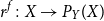 $r^f \colon X \to P_{Y}(X)$
,
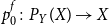 $p_0^f \colon P_Y(X) \to X$
and
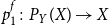 $p_1^f \colon P_Y(X) \to X$
to produce a factorisation of the diagonal map
 $\Delta \colon X \to X \times _Y X$
in the slice category
 $\mathbb{C}/Y$
.
Note that for
 $Y = 1$
,
 $P_Y(X)$
is just
 $P X$
.
For some of our results, including the main theorem, we will need a notion of propositional truncation. For this, we use the definitions below.
Definition 5.
We say
 $f \colon X \to Y$
is an hproposition if it is a fibration and the map
 $P_Y(X) \to X \times _Y X$
is a trivial fibration.
We state below what it means for
 $\mathbb{C}$
to have propositional truncation, although technically we will never require this to hold for
 $\mathbb{C}$
itself. Instead we will assume that small maps are closed under propositional truncation, in a sense that we will define later (Definition27).
Definition 6.
We say
 $\mathbb{C}$
has propositional truncation if every fibration
 $f \colon X \to Y$
factors as follows, where
 $g$
is an hproposition and
 $i$
has the left lifting property against every hproposition.

We note that the axioms suffice to check a few basic propositions.
Proposition 7. Every trivial cofibration is a cofibration.
Proof. We first check that cofibrations are closed under retracts. Suppose that
 $n \colon C \to D$
is a retract of a monomorphism
 $m \colon A \to B$
, as illustrated below.

One can show that when
 $m$
is a monomorphism, the left hand square above is a pullback. It follows that if
 $m$
is a cofibration, then
 $n$
is a pullback of
 $m$
and so also a cofibration.
Now by the retract argument, if a map has the left lifting property against all trivial fibrations, then it is a retract of a cofibration, and so a cofibration.
Hence to prove the proposition, it suffices to show that every generating trivial cofibration is a cofibration. That is, for every cofibration
 $m \colon A \to B$
, and for
 $i = 0, 1$
,
 $\delta _i \hat {\times } m$
is a cofibration. However, the pushout product
 $\delta _i \hat {\times } m$
can be viewed as a union of cofibrations into
 $B \times {\mathbb{I}}$
, and we assumed that cofibrations are closed under finite union.
Proposition 8. Every trivial fibration has a section.
Proof. This easily follows from the fact that every object is cofibrant (Remark2).
Recall Frumin and van den Berg (Reference Frumin and van den Berg2019, Section 3) that
 $\mathbb{I}$
can be used to define a notion of homotopy and so also homotopy equivalence. Moreover, we recall that we can further define the stronger, less well known notion of strong homotopy equivalence below.
Definition 9.
A strong homotopy equivalence is a morphism
 $f \colon X \to Y$
together with a homotopy inverse
 $g \colon Y \to X$
witnessed by homotopies
 $H : g f \sim 1_{X}$
and
 $f g \sim 1_{Y}$
making the following square commute.

Proposition 10.
A fibration
 $f \colon X \to Y$
between fibrant objects
 $X$
and
 $Y$
is a trivial fibration if and only if it is a strong homotopy equivalence.
Proof. See Frumin and van den Berg (Reference Frumin and van den Berg2019, Proposition 4.1)
Proposition 11. Every map between fibrant objects factors as a homotopy equivalence followed by a fibration.
Proof. See Frumin and van den Berg (Reference Frumin and van den Berg2019, Proposition 4.3).
Proposition 12. Dependent products preserve fibrations.
Proof. See Frumin and van den Berg (Reference Frumin and van den Berg2019, Proposition 4.5).Footnote 2
Proposition 13. Every object is a subobject of a fibrant object.
Proof. Given an object
 $X$
, we factorise the map
 $X \to 1$
as a cofibration followed by a trivial fibration, to get
 $X \to X' \to 1$
, where the map
 $X \to X'$
is a cofibration, and in particular, a monomorphism and the map
 $X' \to 1$
is a trivial fibration, and so in particular a fibration.
Proposition 14. Hpropositions are closed under arbitrary pullbacks.
Proof. This follows from the fact that path types, fibrations and trivial fibrations are closed under pullbacks.
Proposition 15.
If
 $f \colon X \to Y$
is an hproposition and has a section, then it is a homotopy equivalence as a map over
 $Y$
and a trivial fibration.
Proof. Let
 $s \colon Y \to X$
be a section of
 $f$
and let
 $t \colon X \times _Y X \to P_Y X$
be a section of the map
 $P_Y X \to X \times _Y X$
. In particular,
 $f \circ s$
is trivially homotopic to
 $1_{Y}$
. The map
 $h := t \circ \langle 1_{X}, s \circ f \rangle$
is a homotopy from
 $1_{X}$
to
 $s \circ f$
over
 $Y$
.
Furthermore, we can use
 $h$
to exhibit
 $f$
as a retract of the trivial fibration
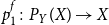 $p_1^f \colon P_Y(X) \to X$
, which shows it is also a trivial fibration.

Lemma 16.
Suppose we are given two monomorphisms
 $m_0 \colon A_0 \to B$
and
 $m_1 \colon A_1 \to B$
, with at least one of
 $m_0$
and
 $m_1$
a cofibration, and an hproposition
 $f \colon X \to B$
together with two maps
 $t_0$
and
 $t_1$
in the following commutative diagram.

Write the union of
 $m_0$
and
 $m_1$
as
 $m \colon A_0 \cup A_1 \to B$
.
Then there is a map
 $t \colon A_0 \cup A_1 \to X$
making the following diagram commute.

Proof. Without loss of generality say that
 $m_0$
is a cofibration.
First, observe that the result would be trivial if we knew that
 $t_0$
and
 $t_1$
agreed on
 $A_0 \cap A_1$
. We therefore aim to produce a new map
 $t_1'$
ensuring that
 $t_0$
and
 $t_1'$
agree on
 $A_0 \cap A_1$
.
If we pullback
 $f$
along
 $m_1$
, then the resulting map
 $m_1^\ast (f) \colon m_1^\ast (X) \to A_1$
is also an hproposition, and using
 $t_1$
, we can show it has a section. We deduce by Proposition15 that it is a trivial fibration. Furthermore, observe that the inclusion
 $\iota _1 \colon A_0 \cap A_1 \rightarrow A_1$
is a pullback of
 $m_0$
, and so a cofibration. We will define a lifting problem of
 $\iota _1$
against
 $m_1^\ast (f)$
. Let
 $\bar {t_0} \colon A_0 \cap A_1 \to m_1^\ast (X)$
be the pullback of
 $t_0$
along
 $m_1$
, so that if
 $\pi _0 \colon m_1^\ast (X) \to X$
is one of the projections in the pullback then
 $\pi _0 \circ \bar {t_0} = t_0 \circ \iota _0$
. Then, let
 $j$
be a diagonal filler in the following diagram.

We then define
 $t_1'$
to be
 $\pi _0 \circ j$
. One can then verify that
 $f \circ t_1' = m_1$
and
 $t_1' \circ \iota _1 = t_0 \circ \iota _0$
, and we can now easily define the required
 $t$
using the universal property of the union.
Proposition 17.
Let
 $X$
be an object of
 $\mathbb{C}$
. The following are equivalent.
-
(1) The map
$r^X \colon X \to X^{\mathbb{I}}$
is an isomorphism.
-
(2) The map
$r^X \colon X \to X^{\mathbb{I}}$
is a regular epimorphism.
-
(3) The statement ‘every function
${\mathbb{I}} \to X$
is constant’ holds in the internal language of
$\mathbb{C}$
.


Proof. Note that
 $r^X$
is a split monomorphism in any case (with retraction
 $X^{\delta _0}$
). It follows that 1 and 2 are equivalent.
Showing 2 and 3 are equivalent is straightforward.
Definition 18.
We say an object
 $X$
is discrete if one of the equivalent conditions in Proposition
17
holds.
Proposition 19.
Let
 $X$
be an inhabited object of
 $\mathbb{C}$
. The following are equivalent.
-
(1) The constant function map
$2 \to 2^X$
is an isomorphism.
-
(2) The constant function map
$2 \to 2^X$
is an epimorphism.
-
(3) The statement ‘all functions from
$X$
to
$2$
are constant holds in the internal language.
-
(4) (When
$\mathbb{C}$
has a subobject classifier) the following statement holds in the internal language if
$U$
and
$V$
are disjoint subobjects of
$X$
such that
$X = U \cup V$
, then either
$X = U$
or
$X = V$
’.


Definition 20.
We say an inhabited object
 $X$
is connected if one of the equivalent conditions in Proposition
19
holds.
Proposition 21.
-
(1) If
$X$
has decidable equality and the interval is connected, then
$X$
is discrete.
-
(2) If
$X$
is discrete and
$Y$
is any object, then
$X^Y$
is discrete.
-
(3) If
$X$
is discrete and
$m \colon Z \rightarrowtail X$
is a subobject, then
$Z$
is discrete.
-
(4) If
$\mathbb{C}$
is a category of presheaves over a category
$\mathcal{C}$
, the interval is representable and
$\mathcal{C}$
has finite products then every constant presheaf is discrete. In particular
$2$
is discrete and so the interval is connected.
-
(5) Every map between discrete objects is a fibration.


Proof. 4 was already observed by Uemura (Reference Uemura, Dybjer, Santo and Pinto2019, Proposition 16). The rest are straightforward.
Finally, we recall the following notions of
 $\neg \neg$
-stability, density and separation.
Definition 22.
Let
 $m \colon X \rightarrow Y$
be a monomorphism in a category
 $\mathbb{C}$
. We say
 $m$
is
 $\neg \neg$
-stable if the following statement holds in the internal language of
 $\mathbb{C}$
.
 \begin{equation*} \forall y \in Y, \; \neg \neg (\exists x \in X, m(x) = y) \,\rightarrow \, (\exists x \in X, m(x) = y) \end{equation*}
We say
 $m$
is
 $\neg \neg$
-dense if the following statement holds in the internal language.
 \begin{equation*} \forall y \in Y, \; \neg \neg (\exists x \in X, m(x) = y) \end{equation*}
We say an object
 $X$
is
 $\neg \neg$
-separated if the diagonal map
 $X \to X \times X$
is
 $\neg \neg$
-stable, or equivalently, if the following statement holds in the internal language.
 \begin{equation*} \forall x, y \in X, \; \neg \neg (x = y) \,\rightarrow \, x = y \end{equation*}
Suppose
 $\mathbb{C}$
is a category of internal presheaves over an internal category
 $\mathcal{C}$
in a locally cartesian closed category
 $\mathbb{E}$
. We say a monomorphism
 $m$
in
 $\mathbb{C}$
is pointwise
 $\neg \neg$
-stable if the underlying map in
 $\mathbb{E}/\operatorname {Ob}(\mathcal{C})$
is
 $\neg \neg$
-stable, or equivalently if the following statement holds in the internal language of
 $\mathbb{E}$
: for every object
 $c$
of
 $\mathcal{C}$
,
 $m_c$
is
 $\neg \neg$
-stable. We similarly define pointwise
 $\neg \neg$
-dense and pointwise
 $\neg \neg$
-separated.
3. Cofibrations when Path Types are Identity Types
In this section, we will use the assumption that path types are identity types to show that certain maps are cofibrations.
Lemma 23.
Suppose that
 $\mathbb{I}$
is connected. Suppose that
 $\mathbb{C}$
possesses a natural number object
 $\mathbb{N}$
. Suppose that path types are identity types. Then, the map
 $1 \to 2^{\mathbb{N}}$
given by
 $\lambda x.\lambda n.0$
is a cofibration.
Proof. First, note that
 $\mathbb{I}$
is not necessarily fibrant, but we can embed it in a fibrant object
 $\tilde {\mathbb{I}}$
using Proposition13. Write
 $\iota$
for the inclusion
 ${\mathbb{I}} \to \tilde {\mathbb{I}}$
.
Since
 $\mathbb{I}$
is connected,
 $\mathbb{N}$
is fibrant by Proposition21. Since dependent products preserve fibrations,
 $\tilde {\mathbb{I}}^{\mathbb{N}}$
is also fibrant. Hence by the assumption that path types are identity types,
 $r^{\tilde {\mathbb{I}}^{\mathbb{N}}}$
is a cofibration. We will show that the map
 $1 \to 2^{\mathbb{N}}$
is a cofibration by exhibiting it as a pullback of
 $r^{\tilde {\mathbb{I}}^{\mathbb{N}}}$
.
We define the map
 $e \colon 2^{\mathbb{N}} \to (\tilde {\mathbb{I}}^{\mathbb{N}})^{\mathbb{I}}$
as below.
 \begin{align*} e(\alpha )(i)(n) = \begin{cases} \iota (0) & \alpha (n) = 0 \\ \iota (i) & \alpha (n) = 1 \end{cases} \end{align*}
To check that
 $\lambda x.\lambda n.0$
is a pullback of
 $r^{\tilde {\mathbb{I}}^{\mathbb{N}}}$
along
 $e$
, it suffices to show, in the internal logic of
 $\mathbb{C}$
, that for all
 $\alpha \in 2^{\mathbb{N}}$
,
 $\alpha = \lambda n.0$
if and only if
 $e(\alpha )$
lies in the image of
 $r^{\tilde {\mathbb{I}}^{\mathbb{N}}}$
, which is the case if and only if
 $e(\alpha )$
is constant as a function
 ${\mathbb{I}} \to \tilde {\mathbb{I}}^{\mathbb{N}}$
.
It is easy to check that
 $e(\lambda n.0)$
is constant. Hence, we just show the converse, that if
 $e(\alpha )$
is constant then for all
 $n \in \mathbb{N}$
,
 $\alpha (n) = 0$
.
So suppose that
 $\alpha \in 2^{\mathbb{N}}$
and
 $e(\alpha )$
is constant. Let
 $n$
be an element of
 $\mathbb{N}$
. We know that
 $\alpha (n) = 0$
or
 $\alpha (n) = 1$
, so to show that
 $\alpha (n) = 0$
it suffices to show that
 $\alpha (n) \neq 1$
. Suppose that
 $\alpha (n) = 1$
. Since
 $e(\alpha )$
is constant, for all
 $i, i' \in {\mathbb{I}}$
we have
 $e(\alpha )(i)(n) = e(\alpha )(i')(n)$
, and so
 $\iota (i) = \iota (i')$
. In particular, applying this to the endpoints
 $0$
and
 $1$
, we have
 $\iota (0) = \iota (1)$
and so
 $0 = 1$
since
 $\iota$
is monic. But then we get a contradiction by the disjointness of the endpoints. We have now shown
 $\alpha (n) \neq 1$
, and so
 $\alpha (n) = 0$
. This applies for arbitrary
 $n$
, and so
 $\alpha = \lambda n.0$
.
We next show that if we have exact quotients then we can in fact show that all monomorphisms are cofibrations. This doesn’t apply in presheaf assemblies, but does work for the usual definition of presheaves and in fact for any
 $\Pi$
-pretopos.
Theorem 24.
Suppose that
 $\mathbb{C}$
is a
 $\Pi$
-pretopos (i.e.
 $\mathbb{C}$
has exact quotients) and path types are identity types. Then any monomorphism is a cofibration.
Proof. Let
 $m \colon A \to B$
be any monomorphism. We need to show it is a cofibration.
Working in the internal logic of
 $\mathbb{C}$
, we define an equivalence relation on
 ${\mathbb{I}} \times B$
. Given
 $(i, b)$
and
 $(i', b')$
in
 ${\mathbb{I}} \times B$
, we set
 $(i, b) \sim (i', b')$
if
 $b = b'$
and either
 $i = i'$
or
 $m^{-1}(\{b\})$
is inhabited. It is straightforward to verify that this is an equivalence relation.
By Proposition13 there exists a fibrant object
 $X$
such that
 ${\mathbb{I}} \times B / {\sim }$
is a subobject of
 $X$
. Say
 $\iota \colon {\mathbb{I}} \times B / {\sim } \to X$
is the subobject inclusion.
We define
 $e \colon B \to X^{\mathbb{I}}$
to be the map that sends each
 $b \in B$
to
 $\lambda i.\iota ([(i, b)])$
.
Now, still reasoning internally in
 $\mathbb{C}$
, we show that for each
 $b \in B$
,
 $m^{-1}(\{b\})$
is inhabited if and only if
 $e(b)$
lies in the image of
 $r^X$
.
Suppose first that
 $m^{-1}(\{b\})$
is inhabited. Then for any
 $i, i' \in {\mathbb{I}}$
, we have
 $[(i, b)] = [(i', b)]$
. Hence,
 $e(b) = \lambda i.\iota ([(i, b)])$
is a constant function, and so lies in the image of
 $r^X$
.
Conversely, suppose that
 $e(b) = \lambda i.\iota ([(i, b)])$
lies in the image of
 $r^X$
. Then it is a constant function, and in particular, we have
 $\iota ([(0, b)]) = \iota ([(1, b)])$
, where
 $0$
and
 $1$
are the images of
 $\delta _0$
and
 $\delta _1$
, respectively. Since
 $\iota$
is monic, we deduce
 $[(0, b)] = [(1, b)]$
. Since quotients are exact, we now have
 $(0, b) \sim (1, b)$
, and so either
 $0 = 1$
, or
 $m^{-1}(\{b\})$
is inhabited. But we assumed the endpoints are disjoint and so we do have that
 $m^{-1}(\{b\})$
is inhabited as required.
Since
 $r^X$
is monic, we can now deduce that
 $e$
fits into a pullback diagram as below.

This witnesses
 $m$
as a pullback of the cofibration
 $r^X$
, and so
 $m$
is itself a cofibration, as required.
4. Cofibrations and Univalent Universes
We specialise to the case where
 $\mathbb{C}$
is a category of internal presheaves. That is, we fix a locally cartesian closed category
 $\mathbb{E}$
with all finite colimits and an internal category
 $\mathcal{C}$
in
 $\mathbb{E}$
. We then take
 $\mathbb{C}$
to be the category of internal presheaves over
 $\mathcal{C}$
. We will follow the convention that
 $\mathbb{C}$
is non-trivial, in the sense that
 $\mathcal{C}$
has at least one object.
Definition 25.
Suppose we are given a map
 $\mathrm{El} \colon \tilde {U} \to U$
. We say a map
 $f \colon X \to Y$
is
 $U$
-small if it is a pullback of
 $\mathrm{El}$
along a map
 $g \colon Y \to U$
. We will refer to such a
 $g$
as a classifying map for
 $f$
.
Definition 26.
We say
 $\mathrm{El} \colon \tilde {U} \to U$
is a universe if the following hold.
-
(1) Every isomorphism is
$U$
-small.
-
(2)
$U$
-Small maps are closed under composition.
-
(3)
$U$
-Small maps are closed under dependent product.
-
(4)
$U$
-Small maps are closed under pairwise coproduct. Explicitly, if
$X \to Y$
and
$X' \to Y$
are
$U$
-small, then so is
$X + X' \to Y$
. -
(5)
$U$
-Small maps are closed under mapping path spaces. Explicitly, if
$f \colon X \to Y$
is
$U$
-small, then so is the map
$P(f) \to X \times _{Y} X$
.



We say a universe
 $\mathrm{El} \colon \tilde {U} \to U$
is a homotopical universe if in addition to the above, we have the following.
-
(1)
$\mathrm{El}$
is a fibration (or equivalently every
$U$
-small map is a fibration).
-
(2)
$U$
is fibrant.


Definition 27.
We say a homotopical universe
 $U$
is closed under propositional truncation if every
 $U$
-small fibration
 $f$
factors as a map with the left lifting property against all hpropositions followed by a
 $U$
-small hproposition.
We will often view
 $\mathrm{El} \colon \tilde {U} \to U$
as a family of types
 $\mathrm{El}(x)$
indexed by the elements
 $x$
of
 $U$
.
Note that using path objects and dependent products, we can translate one of the definitions of equivalence from type theory (Univalent Foundations Program 2013, Chapter 4) into the formulation we are using here. We write
 $\operatorname {Equiv}(X, Y)$
for the object of equivalences from
 $X$
to
 $Y$
. Observe that for any of the usual definitions, it is straightforward to show that every isomorphism is an equivalence. We use
 $\operatorname {Equiv}(X, Y)$
to define univalence as follows.
Definition 28.
We say a homotopical universe
 $\mathrm{El} \colon \tilde {U} \to U$
is univalent if the first projection
 $\Sigma _{X : U} \Sigma _{Y : U} \operatorname {Equiv}(X, Y) \to U$
is a trivial fibration.
Remark 29. In any case
 $\Sigma _{X : U} \Sigma _{Y : U} \operatorname {Equiv}(X, Y) \to U$
is a fibration by our other conditions. Hence by Proposition 10, it is a trivial fibration if and only if the statement that it is contractible holds in the model. This is equivalent to the univalence axiom holding in the model.
Definition 30.
We fix a map
 $u \colon 1 \to U$
such that the following is a pullback, and refer to it as the unit type.

When
 $\mathbb{C}$
is a category of (possibly internal) presheaves over a category
 $\mathcal{C}$
, we use the following notation. Since
 $u$
is a global section of the presheaf
 $U$
, we can think of it as a choice of elements
 $u(c)$
for each object
 $c$
in the category
 $\mathcal{C}$
.
We clearly have the following proposition.
Proposition 31.
Suppose that
 $f \colon X \to Y$
is a pullback of
 $\mathrm{El} \colon \tilde {U} \to U$
along a map of the form
 $u \circ !_Y$
, where
 $!_Y$
is the unique map
 $Y \to 1$
. Then
 $f$
is an isomorphism.
We will also need the following observations.
Proposition 32.
Let
 $U$
be a homotopical universe. Suppose that
 $m \colon A \to B$
is a cofibration,
 $A$
and
 $B$
are both
 $U$
-small objects and
 $B$
is discrete. Then
 $m$
is a small fibration and furthermore an hproposition.
Proof. We first note that since
 $B$
is discrete, the subobject
 $A$
must be too. Since
 $m$
is a map between discrete objects it is a fibration by Proposition21. However, we still need to show that it is a small fibration. We first replace
 $A$
with the mapping path space, which we view as a small fibration
 $A' \to B$
. Explicitly, we can define
 $A'$
as a type internally in type theory with the following definition (where the equality is implemented using path types).
 \begin{equation*} A'(b) := \Sigma _{a : A} m(a) = b \end{equation*}
This gives a well defined small fibration since
 $B$
and
 $A$
are small types, and universes are closed under path types. We now note that since
 $B$
is discrete, we in fact have an isomorphism
 $A' \cong A$
, and so
 $m$
is a small fibration as required.
Lemma 33.
Let
 $U$
be a homotopical universe closed under propositional truncation. Suppose that
 $m_i \colon A_i \to B$
are cofibrations,
 $A_i$
and
 $B$
are
 $U$
-small objects and
 $B$
is discrete (but
 $A_0 \cup A_1$
is not necessarily small). By Proposition
32
, a
 $U$
-small propositional truncation
 $\| A_0 + A_1 \|$
exists. Then,
 $A_{0} \cup A_{1}$
and
 $\|A_{0} + A_{1}\|$
are logically equivalent over
 $B$
, that is we have maps
 $A_0 \cup A_1 \to \| A_0 + A_1 \|$
and
 $\| A_0 + A_1 \| \to A_0 \cup A_1$
forming commutative triangles in the following diagram.

Proof. We first construct the map
 $A_0 \cup A_1 \to \| A_0 + A_1 \|$
.
We clearly have maps
 $t_i$
for
 $i = 0,1$
in the following commutative diagram.

Since
 $\| A_0 + A_1 \|$
is an hproposition and each
 $m_i$
is a cofibration, we can apply Lemma 16 to get the required map
 $A_0 \cup A_1 \to \| A_0 + A_1 \|$
.
We next construct the map
 $\| A_0 + A_1 \| \to A_0 \cup A_1$
. Since
 $m \colon A_0 \cup A_1 \to B$
is a map between discrete objects, it is a fibration, albeit not necessarily small. Since it is a monomorphism and a fibration, it is an hproposition. Hence, we can obtain the required map as a filler in the following lifting problem.

We will now see the first key lemma of this section. We will later give another lemma that avoids the rather strong assumption of
 $\neg \neg$
-separation, but this one is simpler and therefore easier to understand and is already useful in presheaf assemblies where all objects are pointwise
 $\neg \neg$
-separated.
Lemma 34.
Let
 $\mathbb{C}$
be a category of internal presheaves in a locally cartesian closed category
 $\mathbb{E}$
with finite colimits. Suppose we are given a univalent universe
 $\mathrm{El} \colon \tilde {U} \to U$
and a cofibration
 $m \colon A \to B$
satisfying the following conditions.
-
(1)
$U$
is pointwise
$\neg \neg$
-separated.
-
(2)
$A$
is logically equivalent to a
$U$
-small hproposition over
$B$
. That is, we have a small hproposition
$f : C \to B$
and maps forming commutative triangles in the diagram below.


Then,
 $m$
is pointwise
 $\neg \neg$
-stable as a subobject of
 $B$
.
Proof. Write
 $f : C \to B$
for the hproposition logically equivalent to
 $m$
and let
 $\gamma \colon B \to U$
be a classifying map for
 $f$
.
Since
 $U$
is univalent, the map
 $\pi _X \colon \Sigma _{X : U} \Sigma _{Y : U} \operatorname {Equiv}(X, Y) \to U$
is a trivial fibration. We will aim to define a lifting problem of
 $m$
against
 $\pi _X$
, as illustrated below.

We take the bottom map
 $B \to U$
to be
 $\gamma$
.
The next step is to construct the top map
 $\alpha$
of the lifting problem. This amounts to finding maps
 $\xi , \zeta \colon A \to U$
together with an equivalence
 $e$
over
 $A$
between
 $\xi ^{\ast }(\tilde {U})$
and
 $\zeta ^{\ast }(\tilde {U})$
. We are forced to take
 $\xi$
to be
 $\gamma \circ m$
for the lifting problem to be a commutative square.
We define
 $\zeta$
to be
 $u \circ !_{A}$
where we recall that
 $u : 1 \to U$
is the unit.
Now unfolding these values for
 $\xi$
and
 $\zeta$
, it remains to construct a homotopy equivalence between
 $m^{\ast }(C)$
and
 $A$
over
 $A$
. Using the map
 $A \to C$
over
 $B$
,
 $m^{\ast }(f)$
has a section just by the universal property of the pullback. It is an hproposition by Proposition14. Hence, it is a homotopy equivalence over
 $A$
by Proposition15.
So we do have a well defined map
 $\alpha \colon A \to \Sigma _{X : U} \Sigma _{Y : U} \operatorname {Equiv}(X, Y)$
such that
 $\pi _X \circ \alpha = \gamma$
and
 $\pi _Y \circ \alpha = u \circ !_{A}$
. Let
 $j$
be a diagonal filler as in (1). We will write
 $Y$
for the pullback of
 $\tilde {U}$
along
 $\pi _{Y} \circ j$
.
We now use all of this to show
 $m$
is pointwise
 $\neg \neg$
-stable. We recall that we are working in a category of presheaves over a category
 $\mathbb{E}$
and switch to the internal logic of
 $\mathbb{E}$
. Let
 $c$
be an object of
 $\mathcal{C}$
and let
 $b \in B(c)$
. Suppose that
 $m_c^{-1}(b)$
is not empty. We need to show that it is inhabited.
Note that if
 $m_c^{-1}(b)$
was inhabited, then the upper triangle in the lifting diagram would imply that
 $\pi _Y(j_c(b)) = u(c)$
. We can therefore deduce that
 $\pi _Y(j_c(b))$
is not not equal to
 $u(c)$
. However, we can now apply the fact that
 $U$
is pointwise
 $\neg \neg$
-separated to show that in fact
 $\pi _Y(j_c(b))$
is equal to
 $u(c)$
. Furthermore, for all
 $\sigma \colon c' \to c$
in
 $\mathcal{C}$
, we have that
 $m_{c'}^{-1}(B(\sigma )(b))$
is not empty, and so we similarly can show that
 $\pi _Y(j_{c'}(B(\sigma )(b)))$
is equal to
 $u_{c'}(B(\sigma )(b))$
. Therefore, if
 $\bar {b} \colon \mathbf{y} c \to B$
is the map corresponding to
 $b$
under Yoneda, then the composition
 $\pi _Y \circ j \circ \bar {b}$
factors through the unit type
 $u \colon 1 \to U$
. Hence, the pullback of
 $Y$
along
 $\bar {b}$
is an isomorphism. Furthermore, we can pullback the equivalence to obtain an equivalence between
 $\bar {b}^\ast (Y)$
and
 $\bar {b}^\ast (C)$
. We deduce that
 $\bar {b}^\ast (C)$
has a section. This gives us an element of
 $C(c)$
in the fibre of
 $b$
.
Finally, applying the map
 $C \to A$
from the logical equivalence gives us an element of
 $A (c)$
in the fibre of
 $b$
as required.
We will now aim towards another, more powerful result, which allows us to replace the assumption that
 $U$
is
 $\neg \neg$
-separated with a much weaker (but more complicated) requirement. We will make a mild further assumption that the universe contains ‘contractibility representations in a sense that we will define below.
Definition 35.
Let
 $V$
be a universe in
 $\mathbb{E}$
. A weakly
 $\neg \neg$
-stable unit is a unit
 $u \colon 1 \to V$
such that the following holds in the internal logic of
 $\mathbb{E}$
.
-
(1)
$\mathrm{El}(u)$
has exactly one element.
-
(2) For all
$x \in V$
, if
$\neg \neg (x = u)$
, then
$\mathrm{El}(x)$
has at most one element.


A key idea is that although the definition of weakly
 $\neg \neg$
-stable unit still sounds a little strong when working in intuitionistic logic, it does hold in constructive set theory, using the axiom of extensionality. An earlier version of this idea is mentioned by Orton and Pitts (Reference Orton and Pitts2018, Remark 8.7).
Lemma 36.
Work over
 $\mathbf{CZF}$
, take
 $\mathbb{E}$
to be the category of sets, and
 $V$
to be an inaccessible set. Then
 $V$
has a weakly
 $\neg \neg$
-stable unit.
Proof. By extensionality, there is a unique empty set, which we denote
 $\emptyset$
as usual. We take
 $z$
to be the small set
 $\{\emptyset \}$
(which is the usual implementation of the terminal object in
 $\mathbf{Set}$
anyway). Suppose that
 $x$
is a (small) set and that the double negation of
 $x = z$
holds. Now let
 $y$
be any element of
 $x$
. Suppose that
 $y$
contains an element
 $w$
. Then
 $y \neq \emptyset$
, and so
 $y \notin z$
. Hence,
 $x \neq z$
, contradicting the double negation of
 $x = z$
. But we have now shown that every element
 $y$
of
 $x$
is empty, and so
 $x$
is a subset of
 $\{\emptyset \}$
. We can now deduce that
 $x$
has at most one element, as required.
We note furthermore that there is another example of a weakly
 $\neg \neg$
-stable unit in the effective topos or more generally any realisability topos. Streicher (Reference Streicher, Crosilla and Schuster2005, Section 3) has observed that one can construct universes in realisability toposes using ideas developed by Awodey et al. (Reference Awodey, Butz, Simpson and Streicher2014), as follows.
Assuming the existence of an inaccessible ordinal
 $\kappa$
, one can obtain a set sized version of McCarty’s model of
 $\mathbf{IZF}$
(McCarty Reference McCarty1984) by truncating the definition of
 $V(\mathcal{A})$
at level
 $\kappa$
. Streicher then makes this into an object
 $\mathbf{Mc}(\mathcal{A})$
of the realisability topos using the same equality relation as in McCarty’s model of
 $\mathbf{IZF}$
to obtain a universe.
Lemma 37.
For any pca
 $\mathcal{A}$
, the universe
 $\mathbf{Mc}(\mathcal{A})$
defined above possesses a weakly
 $\neg \neg$
-stable unit.
Proof. Since
 $V_\kappa (\mathcal{A})$
is a model of set theory, we can carry out exactly the same argument as in Lemma 36 internally in the model. Since the definition of the equality relation for the universe in the topos is defined the same as in McCarty’s model of set theory, it follows that we do get a weakly
 $\neg \neg$
-stable unit in the topos.
As before, we will exploit the fact that we are working in a category of presheaves.
Definition 38.
Let
 $U$
be a universe in
 $\mathbb{C}$
. We say a pointwise weakly
 $\neg \neg$
-stable unit is a map
 $u \colon 1 \to U$
with the following property. In the internal logic of
 $\mathbb{E}$
we have that for every
 $c \in \mathcal{C}$
and every
 $x \in U(c)$
, if
 $\neg \neg x = u(c)$
then
 $\mathrm{El}(c, x)$
has at most one element.
Definition 39.
If
 $\mathbb{E}$
has a universe
 $V$
, recall that we can define the Hofmann-Streicher universe
 $V_{\mathcal{C}}$
in
 $\mathbb{C}$
as follows. Given an object
 $c$
of
 $\mathcal{C}$
, we take
 $(V_{\mathcal{C}})_c$
to be the collection of ‘small presheaves’ on the category
 $\int _c \mathbf{y} c$
, as defined by Hofmann and Streicher (Reference Hofmann and Streicher1997). The action of morphisms is defined via composition. Defining this internally in
 $\mathbb{E}$
takes a little care, but this has been done by Uemura (
Reference Uemura, Dybjer, Santo and Pinto
2019
, Section 4.1).
Definition 40.
Let
 $V$
be a universe in
 $\mathbb{E}$
. A homotopical Hofmann-Streicher universe on
 $V$
is a homotopical universe
 $U$
together with a map
 $i \colon U \to V_{\mathcal{C}}$
with the following property. Let
 $\chi \colon Y \to V_{\mathcal{C}}$
be any map. Then
 $\chi$
factors through
 $i$
if and only if the pullback of
 $\mathrm{El}$
along
 $\chi$
is a fibration.
Remark 41. Uemura (Reference Uemura, Dybjer, Santo and Pinto2019) used techniques developed by Licata et al. (Reference Licata, Orton, Pitts, Spitters and Kirchner2018) to extend a Hofmann-Streicher universe in cubical assemblies to a homotopical Hofmann-Streicher universe.
Lemma 42.
Suppose that
 $V$
has a weakly
 $\neg \neg$
-stable unit and
 $U$
is a homotopical Hofmann-Streicher universe on
 $V$
. Then
 $U$
has a pointwise weakly
 $\neg \neg$
-stable unit.
Proof. Suppose that
 $u \colon 1 \to V$
is a weakly
 $\neg \neg$
-stable unit in
 $V$
. First note that
 $V_{\mathcal{C}}$
has a pointwise weakly
 $\neg \neg$
-stable unit
 $u' \colon 1 \to V_{\mathcal{C}}$
defined as follows. In the internal logic of
 $\mathcal{E}$
, we need to define a map
 $1 \to V_{\mathcal{C}}(c)$
for each object
 $c$
of
 $\mathcal{C}$
. An element of
 $V_{\mathcal{C}}(c)$
consists first of a map
 $\Sigma _{d \in \mathcal{C}} \hom (d, c) \to V$
. We define each such map to be constantly equal to
 $u$
. We take the action on morphisms to be the identity everywhere.
Next, note that the identity on
 $1$
is an isomorphism and so a fibration, and so
 $u'$
does factor through
 $i \colon U \to V_{\mathcal{C}}$
to give a map
 $u'' \colon 1 \to U$
.
We finally need to check that
 $u''$
is pointwise weakly
 $\neg \neg$
-stable. That is, we need to show, in the internal logic of
 $\mathbb{E}$
, that for all
 $c \in \mathcal{C}$
and every
 $x \in U(c)$
, if
 $\neg \neg x = u''(c)$
then
 $\mathrm{El}(x)$
has at most one element. First, note that if
 $\neg \neg x = u''(c)$
, then also
 $\neg \neg i(x) = u'(c)$
. It follows that for every
 $d \in \mathcal{C}$
, and every
 $f \colon d \to c$
, we have
 $\neg \neg i(x)(d, f) = u$
. In particular, we have
 $\neg \neg i(x)(c, 1_c) = u$
. Hence,
 $\mathrm{El}(i(x)(c, 1_c))$
has at most one element. But this is precisely the definition of
 $\mathrm{El}(i(x))(c)$
.
Definition 43.
Let
 $f \colon X \to Y$
be a map. We say a contractibility representation for
 $f$
is a small fibration
 $g \colon Z \to Y$
that has a section
 $z_0 \colon Y \to Z$
, together with a logical equivalence between
 $X$
and
 $\operatorname {IsContr}(Z)$
over
 $Y$
, as illustrated below, where
 $\operatorname {IsContr} (Z)$
is the result of interpreting the statement that
 $Z$
is contractible using path types and dependent products in the usual way.

Remark 44. One can construct contractibility representations for fibrations working internally in homotopy type theory under reasonable conditions about the existence of higher inductive types. For example, given an hproposition
 $X$
, one can show using univalence that if the suspension
 $\operatorname {Susp}(X)$
exists then it is a contractibility representation of
 $X$
. Alternatively one can also use set quotients together with univalence.
Lemma 45.
Suppose that
 $\mathbb{C}$
is a category of presheaves over an internal category
 $\mathcal{C}$
in
 $\mathbb{E}$
and that all of the following hold.
-
(1)
$\mathbb{C}$
has a univalent universe
$U$
. -
(2)
$U$
has a pointwise weakly
$\neg \neg$
-stable unit.


Suppose that
 $m \colon A \to B$
is a cofibration that has a contractibility representation. Then,
 $m$
is pointwise
 $\neg \neg$
-stable.
Proof. Let
 $m : A \to B$
be a cofibration with a contractibility representation witnessed by a
 $U$
-small fibration
 $g \colon D \to B$
with a section
 $d_{0} \colon B \to D$
such that
 $A$
is logically equivalent to
 $\operatorname {IsContr}(D)$
over
 $B$
. Let
 $\beta \colon B \to U$
be a classifying map for
 $g$
.
As in the proof of Lemma 34, we define a map
 $\alpha \colon A \to \Sigma _{X : U} \Sigma _{Y : U} \operatorname {Equiv}(X, Y)$
that we will use along with
 $\beta$
to define a lifting problem.
Given
 $a \in A$
, we need to define small types
 $X(a)$
and
 $Y(a)$
, together with an equivalence
 $e$
between them. As before, we are forced to take
 $X(a)$
to be
 $\beta (m(a))$
in order for the square to commute. We take
 $Y(a)$
to be the pointwise weakly
 $\neg \neg$
-stable unit.
To complete the upper horizontal map in our lifting problem, we now need to construct an equivalence between
 $m^\ast (D)$
and the unit type over
 $A$
. Using the logical equivalence between
 $A$
and
 $\operatorname {IsContr}(D)$
, pulled back along
 $m$
, we have a section of
 $\operatorname {IsContr}(m^{\ast }(D)) \to A$
and so
 $m^{\ast }(D)$
is contractible over
 $A$
. Since any two contractible types are equivalent we deduce that
 $m^{\ast }(D)$
is equivalent to the unit type over
 $A$
.
Now since
 $m$
is a cofibration by assumption, we have a diagonal filler
 $j$
in the diagram below.

We take
 $y \colon B \to U$
to be the composition of
 $j$
with the projection to the
 $Y$
component. We will write
 $Y$
for the pullback of
 $\mathrm{El}$
along
 $y$
.
We now recall that we are working in a category of internal presheaves and switch to the internal logic of
 $\mathbb{E}$
. Let
 $c$
be an object of
 $\mathcal{C}$
and let
 $b \in B(c)$
. We will deduce that
 $m_c^{-1}(\{b\})$
is inhabited from its double negation. As before, note that if
 $m_c^{-1}(\{b\})$
is inhabited, then the upper triangle of (2) implies that
 $y_c(b)$
is equal to
 $u(c)$
for all
 $c \in \mathcal{C}$
. Hence, if
 $m^{-1}(\{b\})$
is not not inhabited, then
 $y_c(b)$
is not not equal to
 $u(c)$
. Since
 $u(c)$
is weakly
 $\neg \neg$
-stable, we deduce that if
 $m_c^{-1}(\{b\})$
is not not inhabited then
 $Y(c, b)$
has at most one element for every
 $c \in \mathcal{C}$
. Hence, by the same argument as in Lemma 34 the pullback of
 $Y$
along the map
 $\bar {b} \colon \mathbf{y} c \to B$
is an hproposition. Since the pullback of
 $D$
along
 $\bar {b}$
is equivalent to the pullback of
 $Y$
over
 $\mathbf{y} c$
, it is also an hproposition. By pulling back
 $d_{0}$
,
 $\bar {b}^{\ast }(D)$
has a section. Putting these together give us a section of
 $\bar {b}^{\ast }(\operatorname {IsContr}(D))$
and so a section of the logically equivalent
 $\bar {b}^{\ast }(A)$
, witnessing that
 $m_c^{-1}(\{b\})$
is inhabited.
5. The Counterexamples
We now give the counterexamples. We first show that it is impossible to take identity types to be path types in certain models of univalent type theory in presheaf assemblies. We assume that the reader is familiar with standard definitions and results in realisability. See for example van Oosten (Reference van Oosten2008) for a good introduction. Recall that the lesser limited principle of omniscience is defined as follows.
Definition 46.
The lesser limited principle of omniscience (
 $\mathbf{LLPO}$
) states that if
 $\alpha \colon \mathbb{N} \to 2$
is a binary sequence such that
 $\alpha (n) = 1$
for at most one
 $n$
, then either
 $\alpha (2n) = 0$
for all
 $n$
, or
 $\alpha (2n + 1) = 0$
for all
 $n$
.
Lemma 47. Suppose the following.
-
(1)
$\mathbb{E}$
is a locally cartesian closed category with finite colimits.
-
(2)
$\mathbb{C}$
is a category of internal presheaves in
$\mathbb{E}$
. -
(3)
$\mathbb{C}$
possesses a class of cofibrations and an interval satisfying our general conditions.
-
(4) The interval object
$\mathbb{I}$
in
$\mathbb{C}$
is connected.
-
(5)
$\mathbb{C}$
has a univalent universe
$U$
, satisfying the following
-
a.
$\mathbb{N}$
is
$U$
-small
-
b.
$U$
is closed under propositional truncation.
-
c.
$U$
is pointwise
$\neg \neg$
-separated.
-
-
(6) Path types are identity types.


Then
 $\mathbf{LLPO}$
holds in the internal logic of
 $\mathbb{E}$
.
Proof. We aim to apply Lemmas 23 and 34.
We define
 $B$
to consist of those
 $\alpha (n)$
in
 $2^{\mathbb{N}}$
such that
 $\alpha (n) = 1$
at most once. Note that
 $\Delta$
preserves exponentials, limits, colimits and the natural number object. Hence,
 $\Delta B$
is also a subobject of
 $2^{\mathbb{N}}$
in
 $\mathbb{C}$
and so discrete.
We define two subobjects
 $A_0$
and
 $A_1$
of
 $B$
as below.
 \begin{align*} A_0 &:= \{ \alpha \in B \;|\; \forall n \in \mathbb{N},\, \alpha (2n) = 0 \} \\ A_1 &:= \{ \alpha \in B \;|\; \forall n \in \mathbb{N},\, \alpha (2n + 1) = 0 \} \end{align*}
Observe that
 $\Delta (A_0)$
and
 $\Delta (A_1)$
can both be written as pullbacks of the constant map
 $1 \to 2^{\mathbb{N}}$
, which is a cofibration by Lemma 23, and so the inclusions are both cofibrations.
We check that
 $\Delta (B)$
,
 $\Delta (A_0)$
and
 $\Delta (A_1)$
are small. Since small maps are closed under dependent products, composition and path types, we can implement the types below as small fibrant objects, where equality is interpreted using path types.
 \begin{align*} B' &:= \Sigma _{\alpha : 2^{\mathbb{N}}} \, \Pi _{n, m : \mathbb{N}}\, \alpha (n) = 1 \,\times \, \alpha (m) = 1 \;\to \; n = m \\ A_0' &:= \Sigma _{\alpha : B'} \, \Pi _{n : \mathbb{N}} \, \alpha (2n) = 0 \\ A_1' &:= \Sigma _{\alpha : B'} \, \Pi _{n : \mathbb{N}} \, \alpha (2n + 1) = 0 \end{align*}
Since all objects involved are discrete, the same definition applies whether we interpret these types ‘extensionally’ (i.e. using the internal language of
 $\mathbb{C}$
in the usual way) or ‘intensionally’ (i.e. using the homotopical structure, and in particular path types for the equalities). Furthermore, as we observed earlier
 $\Delta$
preserves limits, exponentials and the natural number object, and so we see that
 $\Delta (B)$
,
 $\Delta (A_0)$
and
 $\Delta (A_1)$
are respectively isomorphic to
 $B'$
,
 $A_0'$
and
 $A_1'$
, and therefore small.
We define
 $A$
to be the union of
 $A_0$
and
 $A_1$
, with
 $m$
the inclusion
 $A \hookrightarrow B$
. Since
 $\Delta$
preserves unions and cofibrations are closed under unions,
 $\Delta (m)$
is a cofibration. Furthermore, by Lemma 33
 $\Delta (A)$
is logically equivalent to
 $\| \Delta (A_{0}) + \Delta (A_{1}) \|$
, which is
 $U$
-small by the assumption that
 $U$
is closed under propositional truncation.
We can therefore apply Lemma 34 to show that
 $m$
is
 $\neg \neg$
-stable. However one can check that
 $A$
is
 $\neg \neg$
-dense in
 $B$
, and that
 $\mathbf{LLPO}$
precisely states that every element of
 $B$
belongs to
 $A$
. It follows that
 $\mathbf{LLPO}$
holds in
 $\mathbb{E}$
.
Theorem 48.
Let
 $\mathbb{C}$
be a category of presheaf assemblies over either of the pca’s
 $\mathcal{K}_1$
or
 $\mathcal{K}_2$
. Assume the axiom of excluded middle in the meta theory. Then it is impossible to satisfy all of the following conditions.
-
(1)
$\mathbb{C}$
possesses a class of cofibrations and an interval satisfying our general conditions.
-
(2) There is a univalent universe containing
$\mathbb{N}$
and closed under propositional truncation.
-
(3) The interval object
$\mathbb{I}$
in
$\mathbb{C}$
is connected.
-
(4) Path types are identity types.


Proof. It is well known that in categories of assemblies every object is
 $\neg \neg$
-separated, as long as we assume excluded middle in the meta theory (see e.g. van Oosten (Reference van Oosten2008, Section 3.1) or Streicher (Reference Streicher2018)). Hence, any object in a category of internal presheaves over assemblies is pointwise
 $\neg \neg$
-separated. In particular this applies to any universe. It is also well known that
 $\mathbf{LLPO}$
fails in assemblies over
 $\mathcal{K}_1$
and over
 $\mathcal{K}_2$
. For example, Richman (Reference Richman1990, Theorem 5) proved that in the presence of countable choice a weak form of
 $\mathbf{LLPO}$
is not consistent with Church’s thesis. However, both Church’s thesis and countable choice hold in assemblies. A similar argument applies in function realisability (i.e. realisability over
 $\mathcal{K}_2$
) by getting a contradiction from continuous choice rather than Church’s thesis; see for example the proof of Rathjen and Swan (Reference Rathjen and Swan2020, Corollary 7.23).
We apply Lemma 47.
We now turn to examples based on exact categories, specifically ordinary presheaves and internal presheaves in realisability toposes.
Theorem 49.
We work over
 $\mathbf{IZF}$
.
Suppose that the following hold.
-
(1) We are given a small category
$\mathcal{C}$
with finite products.
-
(2) The category of presheaves
$\mathbf{Set}^{{\mathcal{C}}^{\mathrm{op}}}$
has a class of cofibrations and an interval satisfying our general conditions.
-
(3) The interval is representable.
-
(4)
$\mathbf{Set}^{{\mathcal{C}}^{\mathrm{op}}}$
possesses a univalent Hofmann-Streicher universe
$U$
on an inaccessible set containing every subset of
$\{0\}$
. -
(5)
$U$
has contractibility representations for all small hpropositions.
-
(6) Path types are identity types.


Then we deduce the law of excluded middle.
Proof. By Lemma 36, any inaccessible set
 $V$
has a weakly
 $\neg \neg$
-stable unit. We deduce by Lemma 42 that any homotopical universe on
 $V$
has a pointwise weakly
 $\neg \neg$
-stable unit. Now if
 $m$
is the inclusion of a subobject of
 $\{0\}$
then it is a map between two small sets
 $m \colon A \hookrightarrow B$
with
 $A \subseteq \{0\}$
and
 $B = \{0\}$
. Since the interval is representable,
 $\Delta (A)$
and
 $\Delta (B)$
are both discrete and so fibrant. By Theorem24,
 $\Delta (m)$
is a cofibration. Since
 $A$
and
 $B$
are small sets, it follows that
 $\Delta (A)$
and
 $\Delta (B)$
are
 $U$
-small. Hence,
 $m$
is a small hproposition by Proposition32. Hence, it has a contractibility representation. Hence,
 $\Delta (m)$
is pointwise
 $\neg \neg$
-stable by Lemma 45, and so
 $m$
is
 $\neg \neg$
-stable.
We have shown that arbitrary subsets of
 $\{0\}$
are
 $\neg \neg$
-stable, and so deduce the law of excluded middle.
We now consider internal categories in realisability toposes. We first note that realisability toposes are never Boolean (except for the trivial case).
Lemma 50.
Suppose that
 $\mathcal{A}$
contains two distinct elements
 $x \neq y$
(we say
 $\mathcal{A}$
is non-trivial). Then,
 $\mathbf{RT}(\mathcal{A})$
is not a Boolean topos.
Proof. We need to show that
 $\top \colon 1 \to 2$
is not a subobject classifier, so it suffices to find a monomorphism that is not a pullback of
 $1 \to 2$
. We take this monomorphism to be the canonical map
 $2 \to \nabla 2$
.
Since
 $\mathcal{A}$
is non-trivial we have
 $\underline {0} \neq \underline {1}$
, by a similar proof to van Oosten (Reference van Oosten2008, Proposition 1.3.1, part iii). Therefore, all maps from
 $\nabla 2$
to
 $2$
are constant, and clearly, the map
 $2 \to \nabla 2$
is not the pullback along either of the constant maps.
Theorem 51.
There is no category
 $\mathbb{C}$
satisfying all of the following conditions.
-
(1)
$\mathbb{C}$
is a category of internal presheaves over an internal category
$\mathcal{C}$
in a realisability topos
$\mathbf{RT}(\mathcal{A})$
where
$\mathcal{A}$
is non-trivial.
-
(2)
$\mathcal{C}$
has finite products.
-
(3)
$\mathbb{C}$
has a class of cofibrations and interval object satisfying our general conditions.
-
(4) The interval object is representable.
-
(5)
$\mathbb{C}$
has a univalent homotopical Hofmann-Streicher universe
$U$
on a McCarty universe
$\mathbf{Mc}(\mathcal{A})$
. -
(6) The inaccessible used in the construction of
$\mathbf{Mc}(\mathcal{A})$
contains the power set of
$\{0\}$
. -
(7)
$U$
has contractibility representations of all small hpropositions.
-
(8) Path types are identity types.


Proof. By Lemma 37, any McCarty universe
 $\mathbf{Mc}(\mathcal{A})$
has a weakly
 $\neg \neg$
-stable unit. Hence, any homotopical Hofmann-Streicher universe on
 $\mathbf{Mc}(\mathcal{A})$
has a pointwise weakly
 $\neg \neg$
-stable unit by Lemma 42.
Suppose we are given a monomorphism
 $m \colon A \rightarrowtail B$
in
 $\mathbf{RT}(\mathcal{A})$
where
 $A$
and
 $B$
are
 $\mathbf{Mc}(\mathcal{A})$
-small. Since the interval is representable,
 $\Delta (A)$
and
 $\Delta (B)$
are discrete and so
 $U$
-small. By Theorem24
 $\Delta (m)$
is a cofibration, and so a
 $U$
-small hproposition by Proposition32. We deduce by Lemma 45 that any such
 $m$
is
 $\neg \neg$
-stable.
However, we can show directly from the definition of McCarty universe that
 $\Omega$
is
 $\mathbf{Mc}(\mathcal{A})$
-small using the corresponding assumption on the inaccessible used to construct it. Hence, the subobject classifier
 $1 \to \Omega$
is
 $\neg \neg$
-stable, showing that the law of excluded middle holds in
 $\mathbf{RT}(\mathcal{A})$
, contradicting Lemma 50.
We observe that all of the results for internal presheaves apply in particular to the degenerate case where the internal category is trivial. In this case, for instance, pointwise
 $\neg \neg$
-separated is the same as
 $\neg \neg$
-separated, whereas in general it is usually weaker. Also note that in this case, the Hofmann-Streicher universe on
 $V$
is
 $V$
itself. We will apply this to two realisability toposes in particular: the effective topos and the Kleene-Vesley topos. These were studied from a homotopical point of view respectively by Frumin and van den Berg (Reference Frumin and van den Berg2019) and the author (Swan Reference Swan2018b, Section 8.2). In both cases, our argument depends only on the choice of interval object and is independent of the choice of cofibrations, as long as they satisfy our general conditions. In particular for these results, we don’t need to assume path types are identity types.
Recall (Frumin and van den Berg Reference Frumin and van den Berg2019) that we can define an interval object in the effective topos on
 $\nabla 2$
, the uniform object with
 $2$
elements.
Theorem 52. Suppose the effective topos is constructed in a metatheory with the law of excluded middle.
Suppose we are given a class of cofibrations in the effective topos, that together with the interval object
 $\nabla 2$
satisfies our general conditions. Then, there is no univalent homotopical universe
 $U$
containing
 $\mathbb{N}$
and satisfying either of the following.
-
(1)
$U$
is
$\neg \neg$
-separated and closed under propositional truncation.
-
(2)
$U$
is a McCarty universe and all subobjects of
$2^{\mathbb{N}}$
have contractibility representations in
$U$
.


Proof. Note that any map
 $1 \to 2^{\mathbb{N}}$
can be viewed as a pullback of an endpoint inclusion
 $1 \to \nabla 2$
using classical logic in the metatheory, and so it is a cofibration. Furthermore, one can show directly that
 $\nabla 2$
is connected.
Given a
 $\neg \neg$
-separated universe, we use the same argument as in Theorem48.
Given instead a McCarty universe, we replace the use of Lemma 34 with Lemma 45 using the contractibility representation of the monomorphisms
 $A \hookrightarrow B$
appearing in Lemma 47 and using Lemma 37 for the weakly
 $\neg \neg$
-stable unit.
We recall that countably based
 $T_0$
-spaces embed into the function realisability topos, as shown by Bauer (Reference Bauer2002). The subcategory
 $\mathcal{KV}$
consists of maps that are both computable and continuous, and hence, one can view the usual topological interval as an interval object in
 $\mathcal{KV}$
. It is straightforward to find a connection structure for the interval using the usual topological definitions. It is currently unclear what the best choice of cofibration for
 $\mathcal{KV}$
is, but the theorem below applies in any case, as long as our general conditions are satisfied. We note that there is at least one non-trivial example given by taking all monomorphisms to be cofibrations.
Theorem 53.
Suppose we are given a class of cofibrations in the Kleene-Vesley topos, that together with the topological interval object
 $[0, 1]$
satisfies our general conditions. Then there is no univalent universe
 $U$
containing
 $\mathbb{N}$
and satisfying either of the following conditions.
-
(1)
$U$
is
$\neg \neg$
-separated and closed under propositional truncation.
-
(2)
$U$
is a McCarty universe and all subobjects of
$2^{\mathbb{N}}$
have contractibility representations in
$U$
.


Proof. We first show that the map
 $1 \to 2^{\mathbb{N}}$
defined to be constantly
 $\lambda n.0$
can be viewed as a pullback of the endpoint inclusion
 $\delta _0 \colon 1 \to [0, 1]$
. We define a continuous map
 $h \colon 2^{\mathbb{N}} \to [0, 1]$
by taking
 $h(\alpha )$
to be
 $\Sigma _{n = 0}^\infty \,2^{-\alpha (n)}$
. This is evidently computable, and so does define a map in
 $\mathcal{KV}$
, and it is straightforward to check that
 $\lambda n.0$
is the pullback of
 $\delta _0$
along
 $h$
. It follows that any such map is a cofibration.
We then use the same argument as in Theorem52 together with the observation that
 $\mathbf{LLPO}$
fails in
 $\mathcal{KV}$
.
Both of the above results are specific to McCarty universes and
 $\neg \neg$
-separated universes. This of course leaves open the possibility of constructing univalent universes in a completely different way. One such possibility is to find a constructive version of the definition by Shulman (Reference Shulman2015, Section 3).
6. Cofibrations in Homotopy Type Theory
Although technically the results so far are specific to Orton-Pitts models of type theory, they illustrate ideas that might turn out to be more widely applicable. In particular, the use of
 $\neg \neg$
-separation in presheaf assemblies matches up well with definitional equality in type theory. In assemblies, the
 $\neg \neg$
-stable propositions are those that are ‘free of computational information’. That is, we don’t need to be told a particular realiser to show they are realised; we can guess a realiser uniformly and if they are true then the realiser works. Meanwhile, equality in the underlying category is used to implement definitional equality in type theory. This is something that should be ‘free of computational information’, in the sense that we don’t need a proof term to exist to show two terms are definitionally equal. We are (or perhaps should be) able to work out whether two terms are equal or not just by looking at the terms themselves without being given any extra computational information.
We will use this idea to show that there is a purely type theoretic version of the construction used in Lemma 34. We will use this to give interesting proofs of some minor results regarding the syntactic category of homotopy type theory. This also suggests that in future work it may be possible to obtain a syntactic version of the main theorem (as will be discussed further in the conclusion).
We work over homotopy type theory as defined in Univalent Foundations Program (2013). Recall that we can use the syntax of type theory to define a category that is referred to as the syntactic category or classifying category. As shown by Lumsdaine (Reference Lumsdaine2011), building on the results of Gambino and Garner (Reference Gambino and Garner2008), one can define a notion of cofibration in the syntactic category of type theory, and in the presence of suitable higher inductive types one in fact gets a model structure. We define display maps to be maps of the form
 $\Gamma .X \to \Gamma$
. We then define trivial cofibrations to be maps with the left lifting property against display maps and cofibrations to be maps with the left lifting property against those display maps
 $\Gamma .X \to \Gamma$
where there is a term witnessing that
 $X$
is contractible.
Following the notation in Univalent Foundations Program (2013), we write
 $U$
for the universe of small types and
 $\ast$
for the unique element of the unit type
 $1 : U$
. We will follow the convention of using the half adjoint definition of equivalence. Hence, a term witnessing the equivalence is a tuple containing maps in both directions as components (in addition to the terms witnessing that the maps are mutually inverse and the half adjoint coherence term).
In order to state the results that follow, we define the notion of canonical map in the syntactic category type theory.
Definition 54.
We say a map
 $\sigma \colon \Delta \to \Gamma$
in the syntactic category is canonical if for every map
 $\tau \colon \Xi \to \Gamma$
we can effectively decide whether or not there exists a map
 $\mu$
in the diagram below.

Moreover, if
 $\mu$
exists then it is unique and we can find it effectively.
Proposition 55.
If
 $\sigma \colon \Delta \to \Gamma$
is canonical then it is a monomorphism.
Proof. This follows from the uniqueness condition in the definition of canonical.
We now give our syntactic version of Lemma 34.
Lemma 56.
Let
 $m \colon \Gamma .A \to \Gamma .B$
be a cofibration over
 $\Gamma$
. Then there is a type
 $\Gamma , y : B \vdash D$
and a term
 $\Gamma , y : B, d : D \vdash r : \| \Sigma _{x : A} m = y \|$
such that
 \begin{align} \Gamma , x : A &\vdash D[y/m] \equiv 1 \end{align}
 \begin{align} \Gamma , x : A &\vdash r[y/m][d/\ast ] \equiv |(x, \mathtt {refl}_{m})| \end{align}
Proof. Write
 $C$
for the type
 $\|\Sigma _{x : A} m = y \|$
. Then, we have the valid judgement
 $y : B \vdash C(y) : U$
. Note that if we reindex along
 $m$
, we get the type
 $x : A \vdash C[y/m] : U$
. In any case,
 $C$
is an hproposition, and in context
 $x : A$
we can clearly construct an inhabitant
 $| (x, \mathtt {refl}_{m}) |$
of
 $C[y/m]$
. Hence, in context
 $x : A$
,
 $C[y/m]$
is contractible and so we can construct a term witnessing that
 $C[y/m]$
is equivalent to the unit type
 $1 : U$
. We take the component witnessing the map
 $1 \to C[y/m]$
to be
 $\lambda z.(x, \mathtt {refl}_{m})$
. We omit writing out the other components of the equivalence.
Since
 $m$
is a cofibration by assumption, we can deduce by univalence that there is a type
 $D$
with
 $\Gamma , y : B \vdash D : U$
together with a term witnessing that
 $D$
is equivalent to
 $C$
in context
 $\Gamma , y : B$
. Explicitly, we use a diagonal filler in the lifting problem below.

We take
 $r$
to be the component of the equivalence witnessing the map
 $D \to C$
and drop the other parts of the equivalence. The required definitional equalities then follow from the upper triangle of the diagram.
Lemma 57.
Suppose that we are given types
 $A$
and
 $B$
in a context
 $\Gamma$
and a cofibration
 $\Gamma , x : A \vdash m : B$
. Suppose that the truncation map
 $(\Gamma , y : B, \Sigma _{x : A} m = y) \to (\Gamma , y : B, \| \Sigma _{x : A} m = y \|)$
is canonical and that we have decidable type checking. Then the map
 $(1_\Gamma , m) \colon \Gamma .A \to \Gamma .B$
is canonical.
Proof. Suppose we are given a map
 $\tau \colon \Xi \to \Gamma .B$
. Note that we can split up
 $\tau$
as
 $(\sigma , b)$
where
 $\sigma \colon \Xi \to \Gamma$
and
 $\Xi \vdash b : B[\sigma ]$
.
Let
 $r$
be as in the statement of Lemma 56. We first use decidable type checking to decide whether the following judgement is valid.
 \begin{equation*} \Xi \vdash r[\sigma ][y/b][d/\ast ] : \| \Sigma _{x : A} m[\sigma ] = b \| \end{equation*}
If it is not valid we say there is no such term
 $a$
satisfying the condition. If it is valid, we continue.
Now using the assumption that the truncation map is canonical, we can effectively decide whether or not there exists a term
 $c$
satisfying the following.
 \begin{align*} \Xi &\vdash c : \Sigma _{x : A} m[\sigma ] = b \\ \Xi &\vdash r[\sigma ][y/b][d/\ast ] \equiv |c| \end{align*}
If the check returns false we say there is no such term
 $a$
satisfying the condition. If it is valid, then we can effectively find such a term
 $c$
, and we continue.
We next use type checking to decide if the following judgement is valid.
 \begin{equation*} \Xi \vdash c \equiv (\pi _0 c, \mathtt {refl}_{m[\sigma ][x/\pi _0 c]}) \end{equation*}
If so, then we have found a suitable term taking
 $a := \pi _0 c$
, otherwise we say there is no such term.
We now need to show that the term
 $a$
is unique and that if any of the three checks above returns false then there really is no such term
 $a$
. It suffices for both to show that if
 $a$
is any such term then all the checks above return true, and that for any such term
 $c$
we have
 $\Xi \vdash a \equiv \pi _0 c$
. So, let
 $a$
be any term such that
 $\Xi \vdash a : A$
and
 $\Xi \vdash m[\sigma ][x/a] \equiv b$
.
Substituting
 $a$
for
 $x$
in the two judgements given by Lemma 56 gives the following.
 \begin{align*} \Xi &\vdash D[\sigma ][y/b] \equiv 1 \\ \Xi &\vdash r[\sigma ][y/b][d/\ast ] \equiv |(a, \mathtt {refl}_{b})| \end{align*}
The first judgement implies that
 $\ast$
is a term of type
 $D[\sigma ][y/b]$
, which implies that the first type check succeeds. The second judgement implies that the second check succeeds with
 $c := (a, \mathtt {refl}_{b})$
and that moreover any such
 $c$
is of this form up to definitional equality.
We will now use the lemma to prove a couple of minor results about canonical maps. In each case, the result itself isn’t so interesting so much as that we can prove them without using strong normalisation, or something similar.
The first result is analogous to the kind of construction that was very useful when we were working semantically. Unfortunately, it is currently unclear if there are any new non-trivial examples of applications when working syntactically. However, we do have the minor observation that coproduct inclusions are monic, in the sense that if
 $\Gamma \vdash a, a' : A$
and
 $\Gamma \vdash \mathtt {inl}(a) \equiv \mathtt {inl}(a') : A + B$
then
 $\Gamma \vdash a \equiv a' : A$
.
Theorem 58.
Suppose that we have decidable type checking. Suppose that
 $A$
and
 $B$
are types in context
 $\Gamma$
,
 $m$
is a term
 $\Gamma , x : A \vdash m : B$
, that we are given a term witnessing that
 $m$
is an embedding and that
 $(1_\Gamma , m) \colon \Gamma .A \to \Gamma .B$
is a cofibration. Then
 $(1_\Gamma , m)$
is canonical.
Proof. Since
 $m$
is an embedding, by definition the type
 $\Sigma _{x : A}\,m = y$
is an hproposition in context
 $\Gamma , y : B$
. It easily follows that the truncation map
 $\Gamma .B.\Sigma _{x : A}\,m = y \to \Gamma .B.\|\Sigma _{x : A}\,m = y\|$
has a retraction and hence is canonical. We can now apply Lemma 57.
In particular, if
 $=_{X}$
is an identity type on a closed type
 $X$
, we can apply this with
 $A := X$
,
 $B := \Sigma _{x, x' : X} x =_{X} x'$
and
 $m := \mathtt {refl}$
to show that
 $\mathtt {refl}$
is canonical.
Theorem 59.
Suppose that for all closed types
 $A$
and
 $B$
and maps between singleton contexts
 $m \colon (A) \to (B)$
, the truncation map
 $(y : B, \Sigma _{x : A} m = y) \to (y : B, \| \Sigma _{x : A} m = y \|)$
is canonical, and that we have decidable type checking.
Then for any closed types
 $A$
and
 $B$
, any cofibration
 $m \colon (A) \to (B)$
is canonical.
Proof. This is a special case of Lemma 57 where we take
 $\Gamma$
to be empty.
Similar results can be obtained from a well known theorem by Kraus et al. (Reference Kraus, Escardó, Coquand and Altenkirch2017, Section 8.4). By a similar (but easier) argument to Lemma 57, one can use Kraus’ result to show that if
 $A$
is an inhabited transitive type and decidable type checking holds, then the truncation map
 $\Gamma .A \to \Gamma .\|A\|$
is canonical. It is straightforward to check that truncation maps are cofibrations, but it is also an instance of a general principle by Lumsdaine (Reference Lumsdaine2011), stating that point constructors of higher inductive types are always cofibrations.
In fact the proof Kraus used applies not just to truncation maps, but to any cofibration, as long as the domain satisfies the requirement of having terms witnessing it is transitive and inhabited. Hence, a cofibration
 $m \colon \Gamma .A \to \Gamma .B$
is canonical whenever
 $A$
is transitive and inhabited, and in fact, it follows that a cofibration is monic whenever
 $A$
is transitive (but not necessarily inhabited). For example, when
 $A$
is transitive and
 $R$
is a binary relation on
 $A$
, the set quotient map
 $A \to A/R$
is always monic (but obviously not always ‘homotopy monic).
7. Conclusion
7.1 Towards a proof that path types are not identity types
The results here and in particular Section 6 suggest that similar results might hold in general in type theory with univalence. Roughly speaking, I expect that in any type theory with a notion of path type that behaves similar to an exponential, it is impossible to simultaneously satisfy all three of the following requirements.
-
(1) Path types are definitionally isomorphic to identity types.
-
(2) Univalence and all the higher inductive types defined in Univalent Foundations Program (2013) are derivable.
-
(3) The type theory has good computational properties such as strong normalisation, decidable type checking and canonicity.
Unfortunately, even formulating this statement precisely is a difficult task. For example, to even give a good definition of what a type theory is in general remains an area of active research. For this reason, this doesn’t deserve to be called a ‘conjecture’; sometimes the term ‘hypothesis’ is used for such statements.
To be clear, even if the hypothesis is correct, it allows for consistent type theories where any two of the three conditions are satisfied.
For example, cubical type theory (Cohen et al. Reference Cohen, Coquand, Huber, Mörtberg and Uustalu2018) would be an example of a type theory satisfying 2 and 3. Huber (Reference Huber2018) showed that cubical type theory does satisfy canonicity and suggests that the technique could be extended to also show the other good computational properties hold. Later, Sterling and Angiuli (Reference Sterling and Angiuli2021) proved normalisation for another variant of cubical type theory.
Earlier versions of cubical type theory that feature the regularity condition are likely examples of theories satisfying 1 and 3.
One approach to obtaining a theory satisfying conditions 1 and 2 is to build on work by Isaev (Reference Isaev2018). This contained a definition of a type theory
 $\mathrm{coe}_1 + \sigma + \mathrm{Path} + \mathrm{wUA}$
, with a built in notion of path type and coercion where coercion satisfies a computation rule denoted
 $\sigma$
, akin to regularity, that allows one to implement identity types as path types. It also satisfies a weak (but computationally meaningful) version of univalence, denoted
 $\mathrm{wUA}$
. However, no claim is made regarding decidability of type checking, canonicity or strong normalisation.
7.2 Towards a proof that path types are identity types
Although the aim of this paper was towards finding counterexamples, we note that the hypothesis in the previous section remains just a hypothesis and so could easily be false.
In particular, for each of the three examples satisfying only two of the conditions, there is the possibility that the hypothesis can be falsified by showing that in fact the third remaining condition does hold. Namely, one could show that the hypothesis is false through any of the following.
-
(1) Showing that cubical type theory can be extended with extra computational rules that allow us to use path types as identity types, while retaining its good computational properties.
-
(2) Showing that in fact it is possible to construct a univalent universe in cubical type theory with a regularity axiom.
-
(3) Showing that Isaev’s
$\mathrm{coe}_1 + \sigma + \mathrm{Path} + \mathrm{wUA}$
does have decidable type checking, strong normalisation and canonicity, and moreover, this remains true if it is extended with a universe satisfying full univalence and with higher inductive types.

Acknowledgements
I’m grateful for useful discussions and suggestions relating to this topic from Benno van den Berg, Martijn den Besten, Thierry Coquand, Nicola Gambino, Simon Huber, Peter Lumsdaine, Ian Orton, Andy Pitts, Christian Sattler and Taichi Uemura. I’m also grateful to the anonymous referee for many useful suggestions, which greatly improved the paper.



