




No CrossRef data available.
Article contents
Prospective and retrospective components in the memory for actions to be performed in patients with severe closed-head injury
Published online by Cambridge University Press: 01 September 2004
Abstract
This study investigated the basic mechanisms of the impairment of memory for actions to be performed in a group of 16 chronic survivors of severe closed-head injury (CHI). The experimental paradigm allowed discrimination between the deficit in spontaneously remembering the intention at the appropriate moment (prospective component of the task) and the deficit in remembering the specific actions to perform (retrospective component). The experimental procedure also contrasted a condition in which the time expiration was marked by the ringing of a timer (event-based condition) and one in which the time expiration was not marked by any event and the patient had to monitor the passing of time and completely self-activate the recall of the intention (time-based condition). Two other experimental manipulations were concerned with the duration of the delay interval from the examiner's instructions to the time expiration (10 vs. 45 min) and the fact that the three actions to be performed could be functionally related or not. With respect to a group of 16 normal controls, the patients with CHI were impaired in both the prospective and retrospective components of the memory for actions. Although an impairment of episodic memory is a plausible explanation for the poor retrieval of specific actions to perform, it is unlikely that this deficit played a major role in the CHI patients' reduced accuracy in spontaneously recalling the intention when the event occurred or the time expired. Instead, reduced frequency and less strategic utilization of time monitoring and/or self-reminding likely played a significant role in this sense. (JINS, 2004, 10, 679–688.)
Information
- Type
- Research Article
- Information
- Journal of the International Neuropsychological Society , Volume 10 , Issue 5 , September 2004 , pp. 679 - 688
- Copyright
- 2004 The International Neuropsychological Society
INTRODUCTION
Prospective memory is the ability to effectively comply with a previously programmed action at the appropriate moment. In recent years, increasing interest has been shown in the normal functioning of this form of memory in healthy individuals and in the mechanisms that underlie its impairment in patients with brain damage (Bisiacchi & Sgaramella, 1992; Brandimonte et al., 1996; Brandimonte & Passolunghi, 1994; Burgess & Shallice, 1997; Einstein & McDaniel, 1990; Huppert & Beardsall, 1993).
It is generally held that the process leading to the actual putting into action of previously established intentions is articulated into two distinct components: one, more properly prospective, allows remembering the intention to carry out a certain action at the appropriate moment; the other, more typically retrospective, allows recalling the specific actions one wanted to carry out and subsequently remembering having already performed them (Kvavilashvili, 1987).
Although recollection of the specific actions to carry out (retrospective component) is likely mediated by the same episodic memory system also responsible for the memorization of previous experiences, a variety of cognitive processes are presumably involved in the correct functioning of the prospective component (Burgess & Shallice, 1997; Guynn et al., 1998; Kvavilashvili, 1987; Marsh et al., 1998). First of all, the same episodic memory system that stores the specific actions to carry out is also involved in storing the associative link between the occurrence of a precise event and the intention to perform some action. Moreover, once the memory representation for the intended action is formed, for the entire course of the retention interval between establishment of the intention and occurrence of the event, the individual needs to engage in periodic self-reminding to strengthen the memory trace and keep its activation level high (Einstein & McDaniel, 1990; Einstein et al., 1995; Ellis, 1996; Kvavilashvili, 1987).
Attention is a second cognitive faculty commonly assumed to play a role in prospective memory. The contribution of attention to prospective memory likely varies as a function of contextual support to remember the intended action. In particular, when participants have to carry out a certain action at an established time (time-based prospective memory task), at some interval they must monitor the passing of time and self-activate the performance of the action at the appropriate moment. However, if the right moment is marked by the occurrence of a precise event (event-based prospective memory task), this will constitute a sort of “cue” facilitating recollection of the intention, i.e., an environmental support requiring less voluntary control and less attentional resource allocation than that necessary in the time-based condition (Brandimonte & Passolunghi, 1994; Kvavilashvili, 1987; Marsh et al., 1998; Otani et al., 1997).
Two other facets of cognition generally assumed to affect an individual's compliance with his own intended actions are the executive system and personal motivation. The executive control of behavior is likely involved in prospective memory in supporting the effective planning of daily activities and in re-defining priorities of scheduled actions when some external event modifies programmed plans (Burgess & Shallice, 1997; Marsh et al., 1998). Finally, the personal relevance of objectives involved in the intended action clearly affects the probability of an individual actually performing the action (Kvavilashvili, 1987; Marsh et al., 1998).
Although the high prevalence of prospective memory disorders in chronic survivors of severe closed-head injury (CHI) is well documented (Burgess & Shallice, 1997; Cockburn, 1996; Groot et al., 2002; Kinsella et al., 1996; Shum et al., 1999), the mechanisms underlying this deficit are poorly specified. In particular, the experimental paradigms used in the above-mentioned studies consistently failed to discriminate between the relative contribution of prospective and retrospective components in the genesis of the deficit. This investigative limit makes it particularly difficult to interpret the frequently reported association between poor performance on episodic and prospective memory tasks (Burgess & Shallice, 1997; Cockburn, 1996; Groot et al., 2002). Indeed, an episodic memory deficit could affect compliance with the intended action because of difficulty in remembering the specific actions to carry out (retrospective component of the task) or because of a loss of the associative link between the target event and the intention (prospective component) or both. Another controversial issue is the actual role of attentional and executive dysfunction in the genesis of prospective memory failures in patients with CHI. Indeed, better performance on event-based than on time-based prospective memory tasks (indicative of particular difficulty in monitoring the passing of time and self-initiating the intended action) has been reported by some authors (Groot et al., 2002) but not by others (Shum et al., 1999). Analogously, a significant association between performance on prospective memory and executive tests has been found in some studies (Groot et al., 2002) but not in others (Cockburn, 1996).
The aim of the present study was to explore the prospective and retrospective components of the deficit in remembering to carry out intended actions in a group of chronic survivors of severe CHI. The experimental procedure was constructed ad hoc with two major objectives. The first was that the procedure had to allow for the separate evaluation of efficiency in the spontaneous recollection of the intention (prospective component of the task) and accuracy in the recollection of the specific actions to carry out (retrospective component of the task).
The second objective was that the procedure had to permit investigation of a series of variables potentially able to influence the efficiency of one or both of the above-mentioned components. In particular, first, the retention interval between the examiner's instructions to carry out a particular action and the occurrence of the target event prompting the execution of the intended action was varied to investigate the forgetting rate of the prospective and retrospective components as a function of time. To the extent that episodic memory participates in the recall of both the associative link between the target event and the intended action and the specific actions to carry out, it was expected that performance on both the retrospective and prospective components of the task would be negatively influenced by longer delays between instructions and test. Second, the environmental support for remembering the intention (prospective component) was varied so that in one condition (time-based) it was completely absent and in another condition (event-based) it was represented by the ringing of a timer. This experimental manipulation was intended to evaluate the hypothesis that the prospective memory deficit in post-traumatic patients is particularly severe in an experimental condition, such as the time-based task, characterized by reduced environmental support and, therefore, particularly challenging in terms of the executive and attentional capacities involved (Groot et al., 2002). On the assumption that time monitoring is a behavioral manifestation of the capacity to periodically refresh the memory trace for the intended action (Einstein et al., 1995; Shum et al., 1999), the frequency and temporal distribution of time checks during the delay intervals of the time-based condition were also recorded. Third, in view of the positive role generally played by inter-item associative links (e.g., semantic) in facilitating recollection in episodic memory tests, the functional link between the actions to perform was varied to evaluate whether the availability of such a link would facilitate performance on the retrospective component of the task.
METHODS
Research Participants
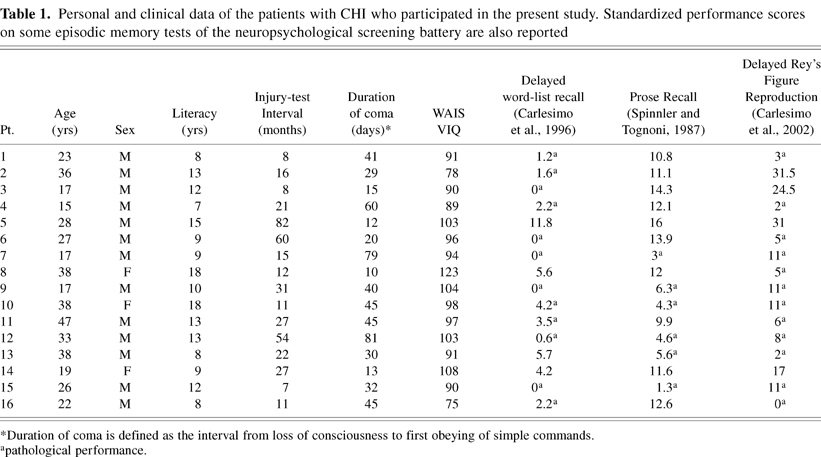
Participants included 16 consecutive chronic survivors of severe CHI (M/F: 13/3), between 15 and 47 years of age (average 27.4; SD 9.6) and with 11.4 years (SD 3.5) average schooling, attending the Physical and Cognitive Rehabilitation Program at Santa Lucia Hospital in Rome. Sixteen normal controls (NCs), matched for gender, age and education to patients of the CHI group, also participated in the study. The individuals with CHI had suffered a head trauma at least 6 months earlier (Glasgow Coma Scale at hospital admission consistently < 8). All patients had recovered from a period of coma ranging from 5 to 90 days and were out of the following post-traumatic amnesia period. We excluded patients from the experimental sample if they had a history of alcohol or drug abuse, psychiatric or neurological symptoms preceding the head trauma, a coma duration of less than 3 days, and if they were unable to attend the experimental procedures because their language, motor, or attentional deficits were too severe. Personal and clinical data as well as performance scores on some episodic memory tests of the neuropsychological screening battery of the patients of the CHI group are summarized in Table 1.
Personal and clinical data of the patients with CHI who participated in the present study. Standardized performance scores on some episodic memory tests of the neuropsychological screening battery are also reported

Experimental Task
Material
The experimental material consisted of eight triplets of actions that the patient was required to perform at the occurrence of the target event or at the expiration of the established time. In four of the triplets, the actions to be performed had a functional link (e.g., “Take the paper in the drawer, put it in the printer and select the print command on the computer”). In the remaining four triplets, the actions were functionally unrelated (e.g., “Switch on the light, turn off the PC and sign the roll”).
The inter-current tasks the patients engaged in during the delay intervals of the prospective memory task consisted of letter or abstract symbol barrage exercises and a number of computer-based vigilance tests, which involved the recording of reaction times to visual stimuli.
Procedure
At the beginning of each session, the examiner instructed the participant to perform three different actions after 10 min had elapsed. If the patient claimed he did not understand what he was supposed to do, the examiner repeated the instructions to be sure the patient understood them. Immediately afterwards, the participant performed the inter-current tasks. In one experimental condition (time-based condition), the examiner did not add any other instructions; therefore, the expiration of the delay interval (10 min) was not marked in any way. Although a wall clock was positioned so that it was quite visible to the patient, the examiner did not make any reference to the possible benefit from consulting it or a wristwatch for the purpose of time monitoring. In a second condition (event-based condition), the examiner informed the patient that the end of the 10 min would be marked by the ringing of a timer. When the 10 min were up (both in the time-based and event-based conditions), the examiner noted the actions carried out spontaneously by the individual. There was a 2-min tolerance limit before and after time expiration during which the individual could initiate the prospective task. If the patient still did not show that he remembered having to carry out some action 2 min after the time had expired, he was reminded by the examiner, “Do you remember that at this point you were supposed to do something?” In the case of an affirmative response, the examiner recorded the number of actions carried out correctly, regardless of whether or not the patient followed the order indicated by the examiner for performing the three actions. In this way, it was possible to separately measure the prospective memory components (spontaneous initiative to carry out some action) and the retrospective memory components (remembering the specific actions to be carried out, even in the absence of spontaneous evocation of the intention). Thus, the examiner instructed the patient to perform three other actions after another 45 min. The instructions, the type of intervening task and, finally, the testing procedure at the end of the 45-min interval were the same as those already described for the first 10-min interval and in the four sessions.
Across patients, the order of experimental conditions (time-based or event-based) and of the actions to be performed (functionally related or unrelated) was completely randomized. However, within the same experimental session the order of delay intervals (first 10 min then 45 min) remained fixed.
In summary, the experimental design included two different dependent variables (spontaneous recall of the intention to perform some action and recollection of the specific actions to be performed) and three within-subject factors, each comprising two levels. We predicted that the first factor, represented by the retention interval (10 vs. 45 min), would influence both the prospective and the retrospective component of the memory task. We also predicted that the second factor, represented by the target event associated with the execution of the actions (time-based vs. event-based), would influence the prospective but not the retrospective component of the task. Finally, it was expected that the third factor, represented by the existence or not of a functional link between the three actions to be carried out, would influence the retrospective but not the prospective component of the performance.
Statistical Analysis
Data distribution in both prospective and retrospective memory tasks as well as the number of time monitoring was generally skewed so the data were unsuitable for parametric statistical analyses. For this reason, non-parametric tests were consistently used for both between-subject (Mann-Whitney U test) and within-subject (sign and Friedman tests) comparisons. The Spearman rank order correlation was used to assess the relationship between dependent variables. Moreover, due to the relatively small sample size and the potentially high number of statistical contrasts and interactions, in the data analysis we arbitrarily set different probability levels for assessing the significance of results that supported or not a priori hypotheses (p < .05 and p < .01, respectively). We did not perform a priori a power analysis to define the appropriate sample size. However, we calculated a posteriori the standardized effect sizes (d). This statistic, d = (mean difference)/SD, could be compared (for the sake of interpretation) with the conventional Cohen's references (0.2 = small, 0.5 = medium, 0.8 = large). In terms of correlations, these values correspond respectively to 0.1, 0.3 and 0.5 (1%, 9% and 25% of explained variance).
RESULTS
Prospective Memory
Generally, the patients did not have difficulty in understanding the examiner's instructions. They had to be repeated in response to patients' requests in only two cases.
Table 2 reports the percentages of accuracy of patients with CHI and of NCs in spontaneously performing the prospective task in the various experimental conditions.
Percentage of accuracy in spontaneously performing the prospective memory task as a function of the different experimental conditions in the CHI and NC groups

Our prediction in this case was that the NCs' accuracy in spontaneously performing the prospective task would significantly exceed that of the CHI patients. As for within-subject contrasts, a ceiling effect in the performance accuracy of the NCs in most of the experimental conditions (see Table 2) prevented us from further analyzing their data. In the CHI group, instead, we predicted higher accuracy in the event-based than in the time-based condition and following the short rather than the long time interval. Finally, we did not expect any effect of the functional link between actions in the triplet on performance level in the prospective task.
The first prediction was supported by data analysis. Indeed, on average the NCs were much more accurate than the individuals with CHI in spontaneously initiating the prospective intention (92.1% vs. 42.6%; Mann-Whitney U test: z = 4.59, p < .001; d = 1.56).
As expected, the presence/absence of a functional link between the actions to carry out did not influence recall of the intention in the group of patients with CHI (39% vs. 45% respectively; sign test: z = .95, p = n.s.; number of non-ties = 10; d = .35). For this reason, in the subsequent comparisons the accuracy level in the recall of intentions was collapsed across functionally related and unrelated conditions. Also in this case supporting the predictions of the study, a Friedman ANOVA contrasting accuracy of recall in the time- and event-based conditions (.87 vs. 2.03, respectively) documented a significant difference [χ2(1,N = 15) = 3.78, p < .05]. Instead, contrary to expectations, accuracy in recalling the intention did not differ in the two retention intervals [1.25 vs. 2.15 at the 10-min and 45-min intervals, respectively; χ2(1,N = 15) = 3.00, p > .05]. In the time-based condition, accuracy was even significantly higher at the 45-min than at the 10-min interval [56% vs. 12.5% respectively; χ2(1,N = 15) = 7.36, p < .01].
Time Monitoring and Its Relationship to Prospective Memory
To evaluate the frequency and temporal distribution of active time monitoring, the examiner recorded the number of times the participants checked the time on their own watches or on the wall clock during the retention interval of the time-based condition. In all four retention intervals, the healthy controls checked the time an average of 13.3 times (SD 2.3), about twice as often as the patients with CHI (6.4; SD 7.3). The difference in time monitorings was significant both at the 10-min (5.4 and 1.2 respectively; Mann-Whitney U test: z = 4.28, p < .001; d = 1.53) and at the 45-min (8.9 and 5.4 respectively; z = 3.01, p < .001; d = .69) retention interval.
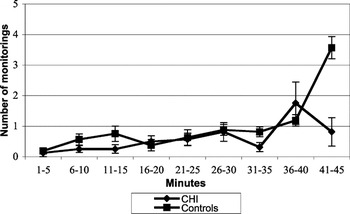
To investigate the strategic varying of the frequency of monitoring as a function of the passing of time, the number of each participant's checks were fractionated into five 2-min sub-periods during the 10-min retention intervals and into nine 5-min sub-periods during the 45-min retention intervals. As can be seen in Figure 1, while the average number of monitorings of the NC group during the final 4 min of the interval was significantly higher than during the first 6 min (1.90 vs. .54 respectively; sign test: z = 3.10, p < .01; number of non-ties = 15; d = 1.24), the same was not true for the CHI group, which on average made a similar number of monitorings throughout the interval (.20 vs. .31; z = .75, p = n.s.; number of non-ties = 7; d = .22). A partially similar picture emerged in the 45-min retention intervals (Figure 2). Also in this case, while NCs checked the time much more frequently during the final 10 min of the interval than during the preceding 35 min (.60 vs. 2.37, respectively; z = 3.75, p < .01; number of non-ties = 16; d = 1.61), in the CHI group the increase in the average number of monitorings passing from the first 35 min to the final 10 minutes of the delay interval did not approach the level of statistical significance (.40 vs. 1.28; z = 1.34, p = n.s.; number of non-ties = 14; d = .43).

Average number of time monitorings exhibited by patients with CHI and normal controls during the five 2-min sub-periods of the 10-min delay interval of the time-based condition.

Average number of time monitorings exhibited by patients with CHI and normal controls during the nine 5-min sub-periods of the 45-min delay interval of the time-based condition.
The number of time monitorings significantly predicted accuracy in complying with the prospective task. Indeed, the patients with CHI monitored the passing of time much more frequently during the delay intervals which ended with the spontaneous recall of the prospective intention (M = 2.3; SD = 2.5) than during the intervals resulting in a failure to recall the intention (M = 0.6; SD = 1.4; sign test: z = 2.85, p < .01; number of non-ties = 10; d = 1.09).
Retrospective Memory
Accuracy in remembering the retrospective component of the task was measured after partialling out the prospective memory deficit. Therefore, in the absence of any spontaneous initiative to perform the prospective task, the examiner questioned the patient about the specific actions to carry out. Table 3 reports the number of actions correctly remembered by the patients with CHI and the NCs in the various conditions of the experimental task.
Mean (and SDs) of actions correctly performed (spontaneously or after the examiner's remark) in the various experimental conditions of the prospective memory task by CHI and normal control groups

Also in this case, we expected lower accuracy in the CHI than in the NC group for the between-subject contrasts. Moreover, we predicted an effect of the delay interval (i.e., lower accuracy at the long than at the short interval) and of the functional relationship between actions (i.e., higher accuracy for the functionally related than the unrelated triplets) on accuracy in recalling the actions. Moreover, based on previous data in the literature suggesting reduced efficiency of individuals with CHI in taking advantage of semantic relationships between data on a memory list (Levin & Goldstein, 1986) and increased forgetting from episodic memory as a function of the delay interval (Carlesimo et al., 1997), we predicted a differential effect of these variables on the patients in the CHI and NC groups. Finally, we did not expect that the contextual support for remembering the intention (i.e., time- vs. event-based) would have any effect on remembering the specific actions to carry out.
Overall, the patients in the CHI group recalled an average of 12.7 actions, which is remarkably lower than the control group's average (21.7; Mann-Whitney U test: z = 4.65, p < .001; d = 1.59). For the whole sample (both patients with CHI and NCs), performance was not affected either by the nature of the contextual support to remember the intention or by the presence of a functional link between actions to be remembered in the triplet. Indeed, a comparable average number of actions was remembered in the event-based and time-based prospective tasks (8.8 and 8.4 respectively; sign test: z = 1.2, p = n.s.; number of non-ties = 25; d = .22) and in the functionally related and unrelated triplets (8.7 and 8.5; z = 1.02, p = n.s.; number of non-ties = 24; d = .08). The expected advantage in recalling functionally related over unrelated triplets of actions was not reliable either in the NC or in the CHI group (+0.16 and +0.22, respectively). In the overall group, the duration of the delay interval did not affect performance. The specific actions to carry out were remembered only slightly better following the 10-min than the 45-min retention intervals (9.0 and 8.1 respectively; z = 1.3, p = n.s.; number of non-ties = 28; d = .39). However, there was a discrepancy between the two groups regarding the amount of performance decline passing from the short to the long delay interval condition. Although the average decline in performance was substantial in the CHI group (−1.6) and actually approached significance (z = 1.8, p < .10; number of non-ties = 16; d = .65), the same was not true for the NC group whose recall was practically the same following the 10-min and the 45-min interval (−0.2; z = .29, p = n.s.; number of non-ties = 12; d = .10).
Relationship Between Prospective and Retrospective Memory
As indicated above, the correct functioning of prospective memory requires the interaction of episodic memory processes (necessary for remembering both the functional link between event and intention and the specific actions to carry out) and extra-memory abilities (executive, attentional, and motivational processes involved in time monitoring, periodic self-reminding, and attentional shifting from the action taking place to the action to perform, etc.). For this reason, Burgess and Shallice (1997) hypothesized that although it is possible to observe patients with prospective memory disorders and with normal retrospective memory, the opposite dissociation is not theoretically possible, i.e., patients with anterograde amnesia should also invariably present a deficit in prospective memory.
To investigate the role of episodic memory processes in performance on the prospective component of the experimental task, we calculated the correlation coefficients in the CHI group between the number of intentions spontaneously recalled and the number of actions correctly remembered (whether spontaneously or after the examiner's reminder). Spearman's rho was .39 (p = .13) in the time-based condition and .41 (p = .11) in the event-based condition. In all experimental conditions (time-based and event-based), the correlation coefficient between the number of intentions and actions correctly recalled was .48. This corresponded to a fairly large percentage (23%) of explained variance even though it only approached significance (p = .06) due to the relatively small sample size. Correlations between the number of intentions spontaneously recalled and the performance scores on the episodic memory tests of the screening battery (delayed word-list recall; prose recall and delayed reproduction of Rey's complex figure, see Table 1) were also measured. In no case did the correlation coefficients approach significance (Spearman's rho ranging from .07 to .24, p = n.s.). It is worthy of note that the number of actions correctly recalled (retrospective component of the task) was, instead, significantly associated with performance on the Delayed word-list recall test (rho = .54, p = .03).
The role of episodic memory in prospectively remembering the intention was then evaluated by analyzing performance scores of individual patients with CHI in the search for possible dissociations between performance on the prospective and retrospective components of the task. For this purpose, we classified the patients with CHI based on whether their performance in spontaneously remembering the intention or remembering the specific actions to carry out fell above or below the sample median (3.5 and 13.0 in the two tasks, respectively). The hypothesis that prospective and retrospective memory disorders are invariably associated, together with Burgess and Shallice's proposal (1997) that a prospective memory disorder can occur without a retrospective memory deficit but that the reverse (i.e., a retrospective without a prospective memory impairment) cannot occur, predict an unequal distribution of cases in the cells of a contingency table. Inconsistent with both of these hypotheses, the distribution of patients in the cells was reasonably homogeneous, with 5 patients scoring above the median on both tests, 5 patients scoring below the median on both tests, 3 patients scoring above the median on the prospective task but below the median on the retrospective task, and 3 patients scoring the opposite [index of agreement = 62.6, Cohen's κ = 0.25, p = n.s.].
In 2 of the 6 patients who showed a dissociation in the experimental task between accuracy in spontaneously initiating the intention and effectively remembering the specific actions to carry out, the discrepancy in the functioning of prospective and retrospective memory was particularly impressive. As shown in Table 1, 15 of the 16 patients with CHI in the present study performed pathologically on at least 1 of the 3 episodic memory tests of the neuropsychological screening battery, thus demonstrating a more or less pronounced retrospective memory disorder. However, in contrast to Burgess and Shallice's (1997) prediction, at least one of these 15 patients presented a good level of prospective memory. This patient (No. 15 in Table 1) performed pathologically on all 3 episodic memory tests of the screening battery and remembered only 50% of the actions to carry out in the experimental procedure. However, he was 88% accurate in spontaneously recalling the prospective intention, i.e., more accurate than all of the other patients with CHI and only slightly less accurate than the normal individuals. The reverse dissociation, i.e. good retrospective memory and deficient prospective memory, was exhibited by the only patient of our sample whose performances were in the normal range on all three episodic memory tests of the screening battery (Patient 5). This patient spontaneously remembered having to carry out some action in only 62% of the cases. However, when solicited by the examiner about which actions he had to carry out, his accuracy in the retrospective component of the experimental test was 85% (normal participants' range: 79–100%).
DISCUSSION
The results of the present study document a deficit in patients with CHI in both components of a prospective memory task, namely, spontaneously initiating performance of the prospective intention and remembering the specific actions to be performed.
The retrospective memory deficit is probably an expression of the more general impairment of episodic memory that generally affects patients with CHI (Brooks et al., 1987; Carlesimo et al., 1997; Levin & Goldstein, 1986). As support for this claim, the number of actions recalled by the patients in the CHI group on the experimental task (either spontaneously or after the examiner's reminder) correlated positively with performance on an episodic memory test of the neuropsychological screening battery. Our data are inconclusive regarding the basic mechanisms of the retrospective memory deficit in these patients. On one side, there is the suggestion of an accelerated forgetting rate in the post-traumatic patients compared to the individuals in the NC group. Indeed, while the normal individuals' performance was unaffected by the length of the delay interval, in the CHI patients the decline in accuracy passing from the 10-min to the 45-min interval approached significance. On the other side, the presence of a functional link between the actions to carry out did not facilitate retrieval either in the patients with CHI or in the control participants. Perhaps this link (possibly too weak) was not encoded by the participants and was therefore not used to help retrieval. It is also possible that although the participants encoded the link they used alternative encoding/recall strategies (for example, they may have mentally formed a visual representation of the sequence of actions to carry out; Burgess & Shallice, 1997) that were more effective in the specific experimental situation.
As previously discussed, many cognitive operations are probably involved in the correct functioning of the prospective component of the memory for actions to be performed. As a consequence, a variety of deficits may be at the base of its functional impairment. First, let us consider the hypothesis that the prospective deficit exhibited by patients with CHI is an expression of the episodic memory impairment which makes less effective the encoding and/or retaining in memory of the functional link between the occurrence of the event (or the expiration of the established time) and the intention to carry out some action. Consistent with this hypothesis, Burgess and Shallice (1997), Groot et al. (2002) and, limited to the event-based condition, Cockburn (1996), reported significant correlations between performance scores on the prospective and episodic memory tests in their samples of patients with brain damage. However, the interpretation of these data is somewhat complicated by the fact that the experimental procedures used by these authors did not permit determining whether the poor performance on the prospective task was due to a deficit in remembering the intention or to a deficit in remembering the specific actions to carry out. As a consequence, we cannot be sure that the significant correlation between episodic memory scores and performance on the prospective task was actually due to the defective contribution of episodic memory processes to the spontaneous recall of the intention (prospective component of the task) and not the result of an impairment in remembering the specific actions to be performed (retrospective component of the task).
In the present study, the prospective and retrospective components of the memory for actions to be performed were measured separately, thus allowing for a more adequate evaluation of the role played by the episodic memory processes also in the spontaneous recall of the intention. Overall, our results document a low level of association between the performance of patients with CHI on episodic memory tasks and their ability to spontaneously remember the intention in the experimental task. First, the correlation coefficients between performance levels in the prospective and retrospective components of the experimental task approached but did not reach the level of statistical significance. Second, the number of intentions spontaneously recalled by the patients with CHI in the experimental task did not show any correlation with their performance scores on the episodic memory tests of the neuropsychological screening battery. Finally, an analysis of each participant's individual performances revealed a chance level of association in the CHI group between performance on the prospective and retrospective components of the experimental task. The lack of association between the ability to spontaneously remember a prospective intention and efficiency in remembering previously acquired information was particularly impressive in two patients with CHI. The performance pattern exhibited by the first patient, who had normal retrospective memory associated with a severe prospective memory disorder (a performance profile similar to that exhibited by the 3 patients with frontal damage reported by Shallice & Burgess, 1991), confirms the possibility that extra-memory cognitive deficits may be responsible for reduced compliance in the execution of prospective tasks. Instead, the second patient's performance profile (severe retrospective memory deficit with almost completely preserved prospective memory) shows that the episodic memory load involved in maintaining the link between event and intention to perform some action is so small that it can be satisfied even by a patient with a substantial episodic memory disorder.
If the main cause of the poor compliance of CHI patients with the prospective intention is not memory loss of the link between event (or time expiration) and intention, then the problem likely resides in their inability to keep this memory representation active so that it can be readily accessed when the event occurs or the time expires. Initial support for this hypothesis comes from the CHI patients' higher accuracy in spontaneously recalling the intention in the event-based than in the time-based condition (for analogous results in post-traumatic patients, see Groot et al., 2002). Probably, the ringing of the timer, acting as a sort of cue facilitating access to the intended action, at least partially circumvented the CHI patients' difficulty in keeping the prospective intention active for fulfillment at the appropriate moment. Instead, in the time-based condition the lack of contextual support requires the patient to periodically engage in self-reminding and time monitoring during the retention interval to keep memory for the prospective intention active and not to miss the critical temporal window for the fulfillment of the intention (Ellis, 1996; Guynn et al., 1998).
The analysis of the frequency and temporal distribution of time monitoring during the delay intervals of the time-based trials provides a more direct confirmation of the hypothesis that prospective memory failures in patients with CHI are due to difficulty in keeping the memory of the intention active. Indeed, time checking likely contributes to effective compliance with the intended action in at least two different ways: first, by monitoring the passing of time so as not to miss the critical temporal window for intention fulfillment; second, by providing the opportunity for periodical self-reminding of the intention. As a matter of fact, the patients with CHI showed reduced frequency of time monitoring compared to the control participants and they lacked a strategic increase in monitoring as the expiration of the time approached. Moreover, in the CHI group the frequency and temporal distribution of time checks predicted accuracy in complying with the prospective intention. Indeed, in this group the number of time monitorings was much higher during the delay intervals that preceded the spontaneous recall of the intention than during the delay intervals that ended in failure to recall the prospective intention.
In conclusion, we report data suggesting the role of memory and extra-memory deficits in the poor prospective remembering of patients with CHI. As noted above, although an impairment of episodic memory is a plausible explanation of poor retrieval of specific actions to perform, it is unlikely that this deficit plays a major role in the reduced accuracy of these patients to spontaneously recall the intention at the occurrence of the event or at the expiration of the time. Instead, reduced frequency and less strategic utilization of time monitoring and/or self-reminding likely play a significant role in this sense.
A dysfunction of the control system that allows for a divided and flexible distribution of attention may have contributed to the ineffective reliance of patients with CHI on those strategic behaviors which permit strengthening and keeping active the memory trace for the prospective intention. Periodically self-reminding the intention as well as checking the time requires that the individual allocate attentional resources to the preparation of the prospective task while involved in the execution of the inter-current activity. Therefore, the low number of time monitorings (and possibly of self-remindings) could be an index of the reduced flexibility of the attentional system of these patients to manage two simultaneous tasks. A dysfunction of the executive system may also have contributed to the reduced efficiency of patients with CHI in time monitoring and/or self-reminding activity during the retention interval of the prospective tasks. The executive system is likely involved in planning the strategic behavior consisting of periodic self-reminding and time monitoring as well as the strategic increase of time monitoring at the approach of the time expiration of the prospective task. Also, the executive system is likely involved in the decision to shift from the inter-current to the prospective memory task at the occurrence of the event or at the time expiration. Finally, the possibility that motivational factors contribute to the reduced compliance of patients with CHI to the prospective memory task should also be considered. As previously noted, the inter-current tasks were presented to the patients as part of the rehabilitation of attentional processes. Perhaps this made the patients with CHI feel that the inter-current task had priority and also made them deliberately decide to allocate more attentional resources to this task than to fulfillment of the prospective memory task. Instead, the normal individuals may have considered the two tasks equally important and thus may have allocated proportionately more attentional resources to remembering the prospective intention than the patients with CHI.
Previous neuropsychological assessment of patients with focal brain damage (Burgess, 2000) as well as functional neuroimaging (Burgess et al., 2003) and event-related potentials investigation in healthy individuals (Leynes et al., 2003) have emphasized the role of frontal circuits in prospective memory. In particular, the rostral frontal cortex (Brodmann area 10 both in its medial and lateral aspects) likely plays a crucial role in the genesis and retention of prospective intentions (Burgess et al., 2003). It may be speculated that the severe deficit of prospective memory in patients with severe CHI is related to the very consistent sufferance of frontal polar regions due to both contusive lesions and deafferentation from diffuse axonal injury. Indeed, a relationship between strategic sequence planning and prospective memory impairment and radiologically documented frontal lobe lesions in post-traumatic patients has recently been reported (Fortin et al., 2002).
The relative role played by memory, attentional, executive, and motivational factors in the genesis of poor prospective memory in patients with CHI is largely conjectural. Due to the heterogeneous patterns of cognitive impairment suffered by patients with CHI, memory and extra-memory deficits presumably play different roles in individual patients, thus making integrated evaluative approaches necessary to take into account all possible determinants of the prospective memory disorder. The availability of experimentally grounded cognitive models as well as of reliable evaluative instruments is also of primary importance for the management of these patients. Indeed, the difficulty in spontaneously complying with intended actions is frequently one of the primary targets of the cognitive rehabilitation of patients with CHI. The development of neuropsychological tools able to elucidate the cognitive components critically involved in the poor prospective remembering of individual patients is a necessary step for planning sound interventions.
ACKNOWLEDGMENTS
This research has been financially supported by funds of the Italian Ministry of Health RC 02.A. No portion of this paper has been previously presented anywhere. We are grateful to Patrizio Pasqualetti for his invaluable support in the statistical analysis of data. We also thank four anonymous reviewers for very helpful comments on an earlier version of this manuscript.
References
REFERENCES
Bisiacchi, P.S. &
Sgaramella, T.M.
(1992).
La memoria prospettica negli anziani [Prospective memory in
the elderly].
Psicologia e società. Rivista di Psicologia Sociale,
17,
77–84.Google Scholar
Bisiacchi, P.S.,
Sgaramella, T.M., &
Zettin, M.
(1995).
Memoria prospettica nel trauma cranico: meccanismi di
pianificazione e controllo. In
M. Zettin &
R. Rago (Eds.),
Trauma cranico. Conseguenze neuropsicologiche e
comportamentali (pp.
92–107).
Turin, Italy:
Bollati Boringhieri.
Brandimonte, M.A.,
Einstein, G.O., &
McDaniel, M.A.
(1996).
Prospective memory: Theory and applications.
Hillsdale, N.J.:
Erlbaum.
Brandimonte, M.A. &
Passolunghi, M.C.
(1994).
The effect of cue-familiarity, cue distinctiveness, and retention
interval on prospective remembering.
Quarterly Journal of Experimental Psychology,
47A,
565–587.CrossRefGoogle Scholar
Brooks, N.,
McKinlay, W.,
Simington, C.,
Beattie, A., &
Campsie, L.
(1987).
Return to work within the first seven years of severe head injury.
Brain Injury,
1,
5–19.CrossRefGoogle Scholar
Burgess, P.W.
(2000).
Strategy application disorder: The role of the frontal lobes in
human multitasking.
Psychological Research,
63,
279–88.CrossRefGoogle Scholar
Burgess, P.W.,
Scott, S.K, &
Frith, C.D.
(2003).
The role of the rostral frontal cortex (area 10) in prospective
memory: A lateral versus medial dissociation.
Neuropsychologia,
41,
906–918.CrossRefGoogle Scholar
Burgess, P.W. &
Shallice, T.
(1997).
The relationship between prospective and retrospective memory:
Neuropsychological evidence. In
M.A. Conway (Ed.),
Cognitive models of memory (pp.
247–272).
Hove, UK:
Psychology Press.
Carlesimo, G.A.,
Buccione, I.,
Fadda, L.,
Graceffa, A.,
Mauri, M.,
Lorusso, S.,
Bevilacqua, G., &
Caltagirone, C.
(2002).
Standardizzazione di due test di memoria: Breve Racconto e Figura
di Rey. [Standardization of two memory tests: Short story and
Rey's Figure].
Nuova Rivista di Neurologia,
12,
1–13.Google Scholar
Carlesimo, G.A.,
Caltagirone, C.,
Gainotti, G. and
the group for the standardization of the Mental Deterioration
Battery.
(1996).
The Mental Deterioration Battery: Normative data, diagnostic
reliability and qualitative analyses of cognitive impairment.
European Neurology,
36,
378–384.CrossRefGoogle Scholar
Carlesimo, G.A.,
Sabbadini, M.,
Loasses, A., &
Caltagirone, C.
(1997).
Forgetting from long-term memory in severe closed-head injury
patients: Effect of retrieval conditions and semantic
organization.
Cortex,
33,
131–142.CrossRefGoogle Scholar
Cockburn, J.
(1996).
Failure of prospective memory after acquired brain damage:
Preliminary investigation and suggestions for future directions.
Journal of Clinical and Experimental Psychology,
18,
304–309.Google Scholar
Einstein, G.O. &
McDaniel, M.A.
(1990).
Normal aging and prospective memory.
Journal of Experimental Psychology: Learning, Memory, and
Cognition,
16,
717–726.CrossRefGoogle Scholar
Einstein, G.O.,
McDaniel, M.A.,
Richardson, S.L.,
Guynn, M.J., &
Cunfer, A.R.
(1995).
Aging and prospective memory: Examining the influence of
self-initiated retrieval.
Journal of Experimental Psychology: Learning, Memory, and
Cognition,
21,
996–1007.Google Scholar
Ellis, J.A.
(1996).
Prospective memory or the realization of delayed intentions: A
conceptual framework for research. In
M.A. Brandimonte,
G.O. Einstein, &
M.A. McDaniel (Eds.),
Prospective Memory: Theory and applications (pp.
1–22).
Hillsdale, NJ:
Erlbaum.
Fortin, S.,
Godbout, L., &
Braun, C.M.
(2002).
Strategic sequence planning and prospective memory impairments in
frontally lesioned head trauma patients performing activities of daily
living.
Brain and Cognition,
48,
361–365.Google Scholar
Groot, Y.C.,
Wilson, B.A.,
Evans, J., &
Watson P.
(2002).
Prospective memory functioning in people with and without brain
injury.
Journal of the International Neuropsychological Society,
8,
645–654.Google Scholar
Guynn, M.J.,
McDaniel, M.A., &
Einstein, G.O.
(1998).
Prospective memory: When reminders fail.
Memory and Cognition,
26,
287–298.CrossRefGoogle Scholar
Huppert, F.A. &
Beardsall, L.
(1993).
Prospective memory impairment as an early indicator of dementia.
Journal of Clinical and Experimental Neuropsychology,
15,
805–821.CrossRefGoogle Scholar
Kinsella, G.,
Murtagh, D.,
Landry, A.,
Homfray, K.,
Hammond, M.,
O'Beirne, L.,
Dwyer, L.,
Lamont, M., &
Ponsford, J.
(1996).
Everyday memory following traumatic brain injury.
Brain Injury,
10,
499–507.CrossRefGoogle Scholar
Kvavilashvili, L.
(1987).
Remembering intention as a distinct form of memory.
British Journal of Psychology,
78,
507–518.CrossRefGoogle Scholar
Levin, H.S. &
Goldstein, F.C.
(1986).
Organization of verbal memory after severe closed-head injury.
Journal of Clinical and Experimental Neuropsychology,
8,
643–656.CrossRefGoogle Scholar
Leynes, P.A.,
Marsh, R.L.,
Hicks, J.L.,
Allen, J.D., &
Mayhorn, C.B.
(2003).
Investigating the encoding and retrieval of intentions with
event-related potentials.
Consciousness and Cognition,
12,
1–18.Google Scholar
Marsh, R.L.,
Hicks, J.L., &
Landau, J.D.
(1998).
An investigation of everyday prospective memory.
Memory & Cognition,
26,
633–643.CrossRefGoogle Scholar
Otani, H.,
Landau, J.D.,
Libkuman, T.M.,
St. Louis, P.,
Kazen, J.K., &
Throne, G.W.
(1997).
Prospective memory and divided attention.
Memory,
5,
343–360.CrossRefGoogle Scholar
Shallice, T. &
Burgess, P.W.
(1991).
Deficits in strategy application following frontal lobe damage in
man.
Brain,
114,
727–741.CrossRefGoogle Scholar
Shum, D.,
Valentine, M., &
Cutmore, T.
(1999).
Performance of individuals with severe long-term traumatic brain
injury on time-, event-, and activity-based prospective memory
tasks.
Journal of Clinical and Experimental Neuropsychology,
21,
49–58.CrossRefGoogle Scholar
Spinnler, H. &
Tognoni, P.
(1987).
Standardizzazione e taratura italiana di test neuropsicologici.
[Standardization and Italian normative data of neuropsychological
tests].
Italian Journal of Neurological Sciences
(Suppl. 6),
44–46.Google Scholar
Personal and clinical data of the patients with CHI who participated in the present study. Standardized performance scores on some episodic memory tests of the neuropsychological screening battery are also reported

Percentage of accuracy in spontaneously performing the prospective memory task as a function of the different experimental conditions in the CHI and NC groups

Average number of time monitorings exhibited by patients with CHI and normal controls during the five 2-min sub-periods of the 10-min delay interval of the time-based condition.
Average number of time monitorings exhibited by patients with CHI and normal controls during the nine 5-min sub-periods of the 45-min delay interval of the time-based condition.

Mean (and SDs) of actions correctly performed (spontaneously or after the examiner's remark) in the various experimental conditions of the prospective memory task by CHI and normal control groups
 You have
Access
- 39
- Cited by