Introduction
From a comparative perspective, there is much to admire about the Nordic economies and their societies more broadly. Even the weekly news magazine, The Economist, not known for its support of large social spending programmes and an active state, recently referred to the Nordic ‘super model’ (The Economist, 2013). The Nordic countries are associated with a range of desirableFootnote 1 outcomes such as high employment rates, equality, low poverty rates, peaceful industrial relations and generous and comprehensive welfare states. Thus, internationally they are often hailed as examples from which to learn. Yet to argue that the Nordic countries have been successful on many accounts does not imply the absence of weak spots. Rather, continued success will also depend on the capacity for critical self-assessment and innovation in order to adapt economic and social policies to changing demographic and economic circumstances. This article offers a contribution in this regard as it scrutinises one criticism that is frequently launched against Nordic welfare states.
It is often assumed that the Nordic economic and social model creates exclusionary mechanisms with respect to vulnerable groups, such as the low-skilled, persons with disabilities and other groups, whose work capacity or productivity potential employers perceive as uncertain. The reason for this, the argument goes, is that high wages, especially at the bottom end of the earnings distribution, contribute to the squeezing out of less attractive workers, while generous social transfers may create negative incentive effects on the supply side. In the comparative political economy literature, such views are associated with pleas for fiscal austerity through cuts in social spending and monetaristist economic ideas (for overviews, see Hall, Reference Hall1993; Pierson, Reference Pierson2001). Jessop (Reference Jessop2002), in fact, argues that we are seeing a turn to a new kind of state, the ‘Schumpeterian competition state’. Right-wing economists have played a particularly important role in pushing this approach within international organisations, such as the IMF and the OECD, as well as at the national level. Vito Tanzi (Reference Tanzi2002), former Fiscal Affairs Director at the IMF, and professor Hans-Werner Sinn (Reference Sinn1999), one of Germany's most influential and most cited economists, are just two examples in this regard. In the Nordic context, such views are exemplified by the Norwegian economics professor and former Minister of Labour for the Conservative party (Høyre), Viktor Norman. Some years ago, he asserted that the Norwegian model produces a ‘harsh separation into winners and losers’ (Norman, Reference Norman2011).
The aim of this article is to explore to what extent these assumptions and arguments hold empirically, by examining how the Nordic countries compare to the rest of Europe with regard to labour market integration of selected vulnerable groups. Relying mainly on international data sources (in particular Eurostat and the OECD), we investigate how the Nordic welfare states do in this area compared to other rich democracies that take different approaches to social protection and have more unequal earnings distributions. We look in particular at persons with disabilities and migrants, two groups that generally face a higher-than-average risk of labour market exclusion. When hiring, employers face imperfect information. In the case of migrants, there may be concerns that cultural and linguistic differences could lead to a ‘lack-of-fit’ at the workplace or organisation (Halvorsen and Hvinden, Reference Halvorsen and Hvinden2015). As regards disabled persons, there may be considerable uncertainty on the part of employers about whether impairments represent an obstacle to work capacity and productivity (Vedeler, Reference Vedeler2014). There are, thus, good reasons to examine the situation of these two groups in particular.
To anticipate our findings, we show that the picture is much more mixed than the conventional arguments suggest. The performance of the Nordic countries is not systematically worse than other models of capitalism. Despite the theoretical claims to the contrary, a little like a bumblebee, the Nordic model still performs quite well overall. However, we find considerable internal variation that calls for an explanation. This is in line with much of the recent research on the Nordic welfare regime (see various chapters in Kvist et al., Reference Kvist, Fritzell, Hvinden and Kangas2012).
The article is organised in three further sections. First, we offer a brief discussion of the scholarly debate concerning the relationship between minimum wages, the wage distribution in an economy and employment levels. Then we turn to the available data. We analyse how the Nordic countries compare to the rest of Europe while also paying attention to intra-Nordic variation. Finally, we discuss the empirical findings in light of the theoretical expectations. We end by highlighting some important tasks for future research.
Obstacles to employment of vulnerable groups
The Nordic countries are not classified as a category of their own within the ‘varieties of capitalism’ approach (most notably Hall and Soskice, Reference Hall and Soskice2001) as they are in the welfare state research tradition (for a useful overview, see Arts and Gelissen, Reference Arts and Gelissen2002). Yet, also from a comparative political economy perspective, the Nordic countries enjoy certain characteristics which make them in some ways distinct from other clusters. A key trait of the Nordic model is the combination of active social and economic policies. It supports the equalisation of life chances by ensuring free access to education, promoting participation in paid work for the whole adult population (including women) and, finally, by offering a comprehensive system of social protection. The Nordic social or welfare model is combined with economic and industrial policies oriented towards competitiveness and efficiency (Pontusson, Reference Pontusson2005; Johansson and Hvinden, Reference Johansson, Hvinden, Hvinden and Johansson2007). To this end, economy-wide coordinated wage setting through collective agreements has long been a key feature of Nordic industrial relations.
As a result, one has come to associate the Nordic political economies with relatively small income differentials and good employment standards. Thus, it probably comes as no surprise that the Nordic countries experience lower poverty rates among the employed population than most other European countries (Eldring and Alsos, Reference Eldring and Alsos2012; Hussain et al., Reference Hussain, Kangas, Kvist, Kvist, Fritzell, Hvinden and Kangas2012; Spannagel, Reference Spannagel2013). Most observers consider these outcomes as positive traits of the Nordic political economies. However, as noted above, there are concerns that the success of the ‘Nordic model’ comes at a price. More specifically, the worry is that the way Nordic political economies function is not equally advantageous for all social groups. Especially with regard to the creation of employment opportunities for less profitable or less attractive workers, there are reasons to fear that the Nordic political economies are less successful.
A number of theoretically distinct, but in practice largely inter-connected, pressures lead us to expect that certain social groups are particularly disadvantaged in Nordic labour markets. These problems should be particularly apparent when comparing the Nordic countries with political economies that are associated with leaner welfare states and more wage inequality. Liberal market economies, such as Ireland and the United Kingdom, represent examples of the latter. We shall highlight in brief four of these arguments. First, a compressed wage structure implies that at the bottom end of the earnings distribution wages are high and there are relatively few working poor. The flipside is that it might make potential employers more reluctant to hire certain types of workers. The concern is that their productivity will be too low to make up for the relatively high labour costs. The associated logic is similar to that of introducing a statutory wage floor in a market economy. When the lowest wages go up, conventional economic theory predicts that the number of low-skill and low-productivity jobs in the economy will be reduced (for example, Card and Krueger, Reference Card and Krueger1994; Barth and Moene, Reference Barth and Moene2012).
Second, it is commonly assumed that the generosity of social transfers affects labour supply. Generous benefits may reduce individual incentives to work, leading in turn, to economic inefficiencies (see for example, Lindbeck et al., Reference Lindbeck, Nyberg and Weibull1999; Lusynian and Bonato, Reference Lusynian and Bonato2007). Since the Nordic welfare states offer comprehensive and relatively generous social benefits, one would expect the supply side to be more vulnerable to moral hazard problems than in countries offering a more limited degree of social protection (Markussen, Reference Markussen2007). Some individuals may prefer to live on unemployment, sickness or disability benefits if the choice is between benefits or taking up (or continuing in) a low-paid job. The opportunity cost of not working is lower with a generous and accessible social protection system. Note, however, that if the lowest wages are lifted, through either wage compression or a minimum statutory wage floor, we should, ceteris paribus, also expect that more people would seek paid work.
Third, for the high wage levels in the Nordic countries to be sustainable in the face of international competition, many businesses choose to specialise in more advanced technologies and products that demand highly qualified workers. Activities that can be performed more cheaply elsewhere, are either transferred abroad or dropped completely (Andersen et al., Reference Andersen, Holmström, Honkapohja, Korkman, Söderström and Vartiainen2007; Hvinden, Reference Hvinden and Böss2010). In addition, the spread of multinational firms and the increased movement of workers have to some extent made it more difficult to go down the traditional corporatist route characterised by peaceful and constructive relations between business and labour and founded on highly centralised collective bargaining (Einhorn and Logue, Reference Einhorn and Logue2004). Again, these aspects speak against high employment rates of groups whose productive potential is (perceived as) uncertain.
Fourth, and linked to the other sources of pressure, Iversen and Wren (Reference Iversen and Wren1998) have forcefully argued that post-industrial service economies face a trilemma, or three-way choice, between employment, wage equality and budgetary control. In the Nordic countries, highly centralised and solidaristic bargaining may in the past have contributed to economy-wide wage restraint that stimulated investments in high-productivity activities, an argument advanced by Moene and Wallerstein (Reference Moene and Wallerstein1997, Reference Moene and Wallerstein2005). However, according to Iversen and Wren, this is no longer possible (for a similar argument, see Lindquist, Reference Lindquist2005). The shift from economies driven by the production of manufactured goods to economies dominated by the service sector has produced a trade-off for governments. They can achieve two but not three of the goals simultaneously.Footnote 2 Extending this line of reasoning, one may argue that tight budgetary control and spending review are the order of the day. In the current era of globalisation and a protracted world economic crisis, governments effectively have only a two-way choice between employment and wage equality (for hardline views on public spending and the role of government, see Tanzi and Schuknecht, Reference Tanzi and Schuknecht1997; Tanzi, Reference Tanzi2002).
All of the above claims make sense theoretically and deserve serious consideration. Even if an assessment of the empirical validity and relative weight of each of them is beyond the reach of a single article, as a whole they provide a powerful case. They all point to potentially exclusionary mechanisms that may be inherent in the Nordic model. In short, we should expect the Nordic countries to struggle in the case of labour market integration of the low-skilled and other vulnerable groups. However, the extent to which this is true is ultimately an empirical question. In fact, for policymaking purposes, the relevant question is whether these fears fit with observable, real-world outcomes. Such insights should be used to advance our knowledge about what kind of policies might facilitate the inclusion of persons at the margins of modern labour markets.
The present article offers a contribution in this regard by examining the labour market performance of two specific vulnerable groups, persons with disabilities and immigrants, relative to the majority population. Barth and Moene (Reference Barth and Moene2012) have carried out a similar exercise, but empirically they focused on labour market integration of individuals with low levels of education and on vulnerable age groups. Therefore, by exploring similar relationships, but for a different set of vulnerable groups, this article complements previous comparative research on income differentials and employment.
Among scholars who have assessed the expected trade-off between employment and income inequalities, the jury is still out. Opinions differ as to whether a statutory minimum wage reduces the demand for labour (Dickens et al., Reference Dickens, Machin and Manning1999; Bauer et al., Reference Bauer, Kluve, Schaffner and Schmidt2008; Schmitt and Rosnick, Reference Schmitt and Rosnick2011; Low Pay Commission, 2013; Neumark et al., Reference Neumark, Salas and Wascher2013), as well as in relation to the effects of compressed earnings structures for employment (for contrasting views, see Howell and Hubler, Reference Howell, Hubler and Howell2005; Lindquist, Reference Lindquist2005). To further complicate the picture, some economists suggest that there is a hump-shaped relationship between centralisation of wage-setting and employment performance. This implies that it is generally better to have a highly centralised, or alternatively a highly decentralised wage bargaining system, rather than taking a middle position (Calmfors et al., Reference Calmfors, Drifill, Honkapohja and Giavazzi1988; Freeman and Nickell, Reference Freeman and Nickell1988). While the former is associated with a compressed earnings structure, a decentralised wage bargaining system typically corresponds to more substantial differences between the highest and lowest wages.
Wage structure and employment of vulnerable groups: an empirical overview
In this section, we examine the extent to which the Nordic countries struggle to integrate vulnerable groups into the labour market as theory suggests. Based on OECD and Eurostat data, we compare the Nordic countries with other advanced democracies that take different approaches to social protection and have more unequal earnings distributions. The advantage of these cross-sectional data is that they are harmonised and available for a large number of rich countries. Many of the indicators are updated yearly making it possible to follow developments over time. However, missing observations are more frequent as we go back in time. Moreover, labour market data shedding light on outcomes for the two selected vulnerable groups, migrants and persons with disabilities, are not always readily available and are sometimes of uncertain quality. Especially in the case of disability, the comparability of data is made difficult by the fact that no standard definition of disability exists. Consequently, data are not gathered in a consistent way from one survey to the other.Footnote 3
Below we combine several measures of wage dispersion with information about employment outcomes of the two vulnerable groups, individuals with migrant backgrounds and individuals with disabilities. The purpose here is to provide a descriptive picture, which can give further indication of whether vulnerable groups are the ‘losers of equality.’
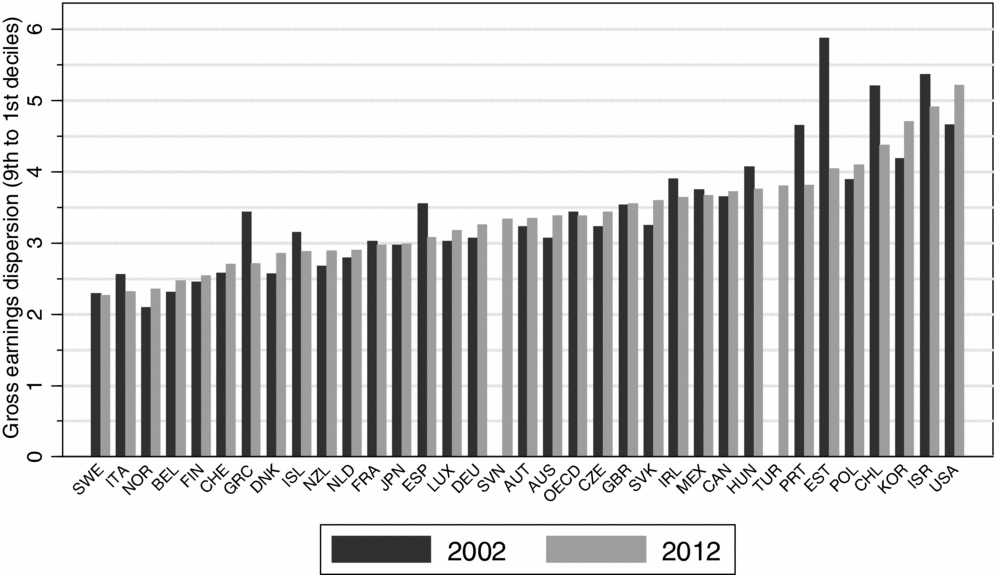
Figure 1 simply ranks most of the OECD countries according to the dispersion of gross earnings in 2012. As a measure of wage dispersion, we use the ratio of the ninth to first deciles based on gross earnings. Subject to data availability, the figure also shows the values recorded in 2002. As expected, the Nordic countries appear among the most compressed earnings distributions, all situated in the bottom quarter of the ranking.Footnote 4 Especially in Denmark and Norway there has been a pronounced increase in the earnings gap between the top and bottom deciles. Nevertheless, since earnings inequalities have increased in many countries, the relative position of the Nordic countries compared to the rest of the OECD has not changed much. Not surprisingly, the United States represents the other extreme. Experiencing a noticeable increase in wage inequality over the previous decade, the United States looks set to keep this position.
Earnings inequalities in the OECD

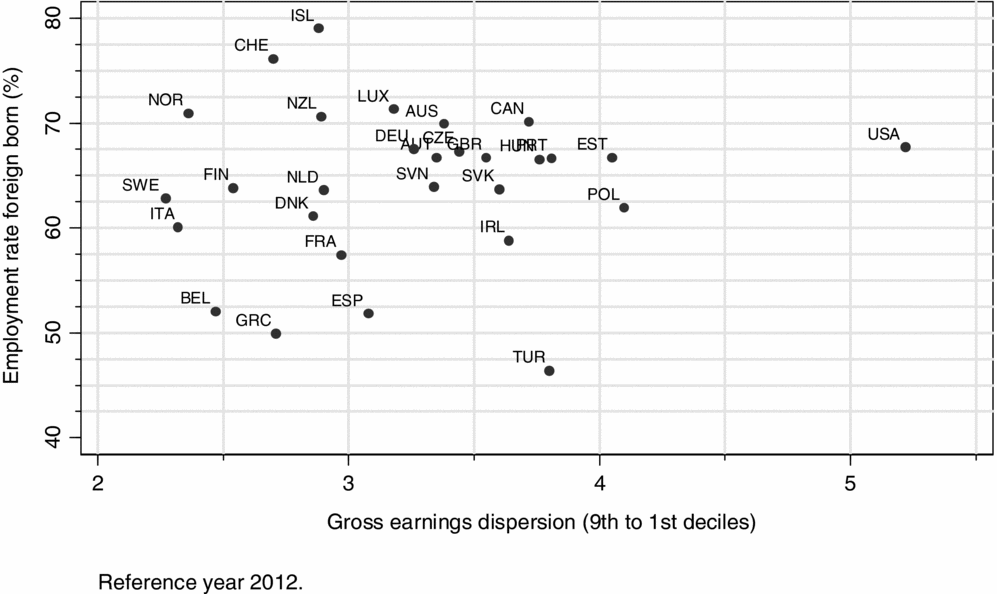
Figure 2 plots the earnings decile ratio for 2010 (as in Figure 1) against the employment rate of foreign-born individuals. What stands out is the absence of a significant relationship between the two indicators. In line with the theoretical expectations, some of the liberal market economies, such as Canada and the United States, are among the better performers when it comes to employment of foreign-born. However, some countries with a compressed earnings distribution, Norway being the clearest example, do just as well or better than most of the more liberal market countries. A liberal economy such as Ireland performs rather poorly, as does Belgium, which has among the most compressed wage structures.
Wage dispersion and employment of migrants
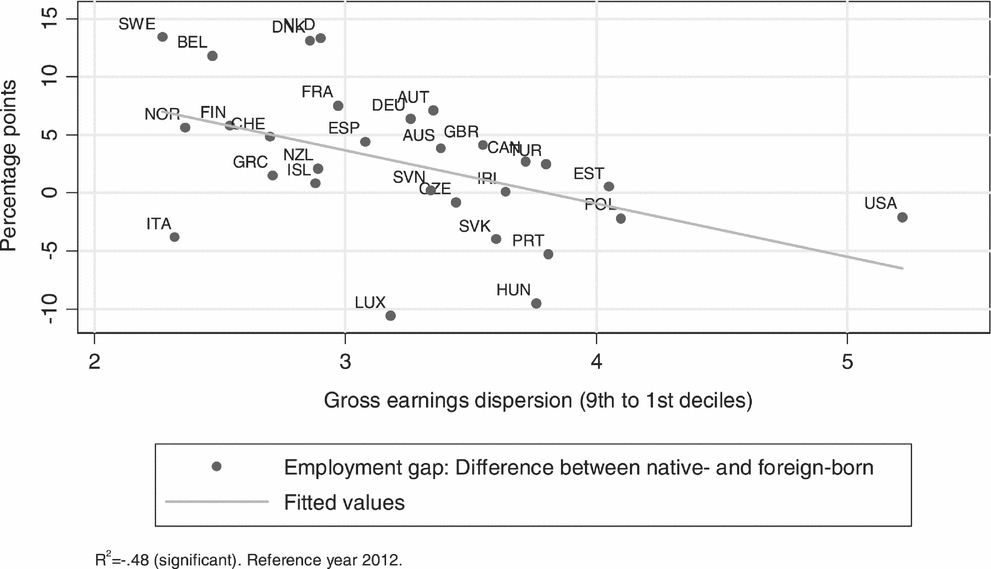
There are several ways to explore these relationships. A different picture emerges if we look at the employment gap, measured as the percentage point difference in the employment rate of native- and foreign-born individuals respectively. This is arguably a more useful indicator for our purposes since it captures whether foreign-born individuals are actually more vulnerable than native-born. The results are displayed in Figure 3. The data demonstrate that migrants do tend to have poorer employment outcomes than the native population in countries with compressed earnings. While having relatively low levels of wage dispersion, the Nordic countries have among the largest employment gaps if we compare the native-born with the migrant population. Norway, which had among the highest employment rates of foreign-born persons, emerges as an average performer when we look at the gap in employment between the two groups. Along with the Nordic countries, we note that Belgium and the Netherlands, which are often found to be similar to the Nordic countries with regard to income inequality and comprehensive welfare states, display employment gaps similar to the levels found in Northern Europe. With a correlation coefficient of −0.48, the negative relationship between the size of the employment gap and the degree of earnings dispersion is quite strong and statistically significant.Footnote 5
Gap in employment between native- and foreign-born by earnings dispersion
Although the noted relationship is striking, we caution against making inferences about causality. Instead, we refer to a tendency that should be explored further to uncover potential underlying mechanisms. Our simple bivariate analysis says nothing about potential intervening variables. For instance, it would be interesting to investigate whether the relationship may, at least in part, be driven by systematic differences in anti−discrimination legislation and affirmative action policies related to hiring processes (for an overview of policy instruments see OECD, 2013). In addition, supply-side factors, such as cross-country differences in the qualifications and skills of the migrant population, are likely to influence aggregate employment levels.
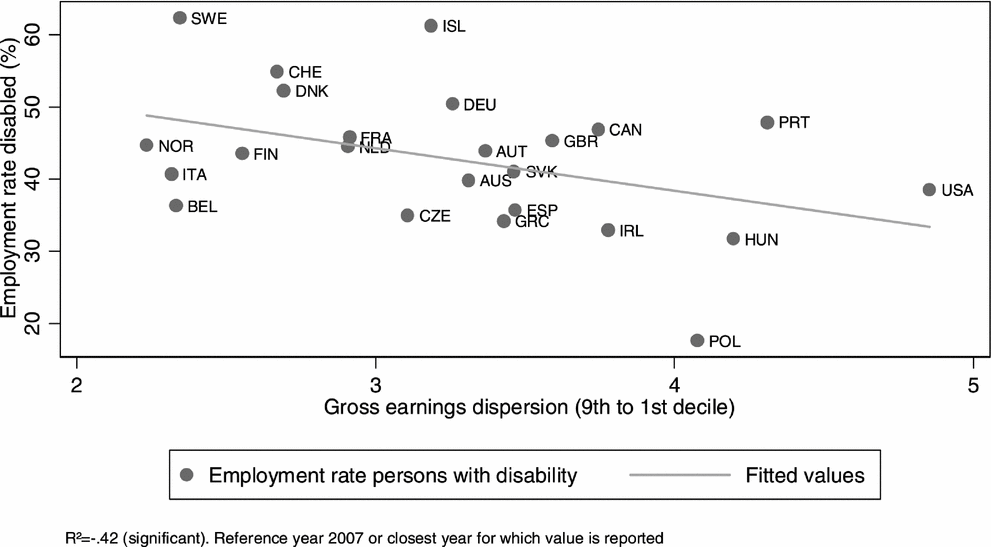
When we instead look at persons with disabilities (see for example, Hvinden, Reference Hvinden and Greve2013), a different picture emerges compared to the one we reported for foreign-born individuals. We used data compiled by the OECD in the 2000s (OECD, 2010). One observation that stands out is that employment rates generally appear lower for this group compared with migrants (Figure 4). However, it should be noted that the employment data are not directly comparable since the year of reference is not the same for both groups. We return below to a comparison of employment outcomes of the two groups across Europe. Furthermore, contrary to the theoretical expectations, there is a modest, statistically significant,Footnote 6 negative relationship between earnings dispersion and the employment level of persons with disabilities. That is, countries with more compressed earnings tend to have a higher share of persons with disabilities in employment than countries with a high degree of wage dispersion.
Employment of persons with disabilities by earnings dispersion
As far as individual country results are concerned, Sweden and Iceland emerge as the two countries most successful at integrating persons with disabilities into the labour market. In contrast, we recall that the Sweden was found to perform somewhat below average with regard to foreign-born people (Figure 2). Also, Denmark performs quite well when it comes to the employment of persons with disabilities. Then there is a notable gap down to Norway and Finland, the two remaining members of the Nordic group. Belgium, which has a degree of earnings compression on a par with Norway and Sweden, does rather poorly for both groups under consideration, again suggesting that there are other intervening or more important factors, which this simple bivariate analysis is not able to pick up.
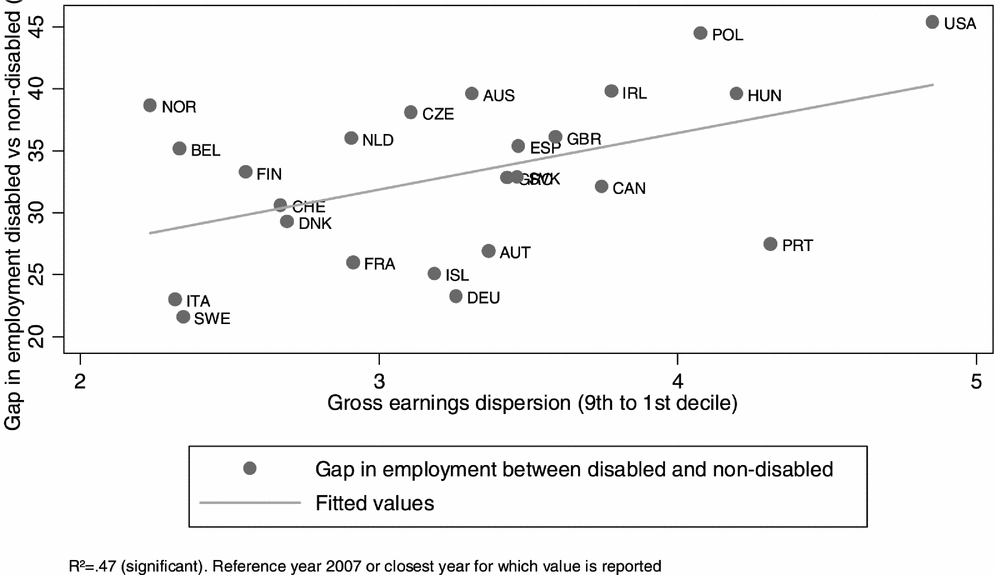
We repeat for persons with disabilities the same exercise as we carried out with regard to the employment of migrants. That is, we consider earnings dispersion in relation to the employment gap (measured in percentage points) between the non-disabled and the disabled population. The results presented in Figure 5 suggest that earnings dispersion is associated with a higher risk of labour market marginalisation of persons with disability compared with the majority population. The United States is the most extreme case in this regard. In fact, the difference in employment between the majority and the disabled population is a staggering 45 percentage points, which is the largest gap recorded in our country sample. This contrasts with the finding that foreign-born individuals in the United States do not face a higher risk than native persons of not being in employment. Sweden and Italy are positioned at the other end of the spectrum, in terms of wage compression and with regard to the employment differential between persons with and without disability. Norway stands as a notable contrast to its Nordic neighbour since, despite highly compressed wages, employment of disabled persons lags well behind the non-disabled population.
Employment gap between non-disabled and disabled by earnings dispersion
We recall that, in the case of migrants, we found a slightly different ranking of countries, and the emergence of a statistically significant relationship when moving from employment rates to a comparison of the gap in employment between the majority population and migrants. With regard to persons with disabilities, the change of measurement does not alter the picture in the same way. Rather, since the slope is now positive and still statistically significant,Footnote 7 we are given further support, whatever the underlying reason(s) may be, for the existence of an empirical tendency that countries with more compressed wages are better at integrating disabled individuals. That is, with a correlation coefficient of 0.47, the relationship is far from perfect, but it is large enough to call for further explanatory efforts. Even if these data are not able to uncover the mechanisms underlying the observed relationship, the findings weaken the theoretical propositions about the exclusionary nature of Nordic political economies.
In terms of potential explanatory factors, one may ask whether aspects of employment protection legislation, such as dismissal rules, play a role, and if so in which way. There is some literature that suggests that dismissal rules may be important, but it is not evident whether, overall, a higher degree of strictness promotes or hinders persons with reduced work capacity. For employed persons experiencing long-term illness and/or having their work capacity reduced, strict dismissal rules may help them maintain their attachment to the labour market (ISSA, 2002). However, the logic of flexicurity suggests that such institutional arrangements make employers more cautious or risk-averse when hiring, making it more difficult for disabled persons to find employment in the first place (Greve, Reference Greve2009).
More generally, comparing the results in Figures 2 and 3 with those in Figures 4 and 5, we observe that the United Kingdom and Canada, which are liberal market economies with a more moderate degree of wage inequality than the United States, achieve a higher share of employment of persons with disabilities than do the Americans. Conversely, Australia stands as the liberal market economy with the smallest degree of earnings dispersion. Yet, the achievement in terms of employment of disabled people is not particularly impressive (albeit not as poor as for the United States). Our data also suggest that the Nordic countries differ a great deal in their outcomes. Iceland boasts high employment rates for both migrants and the disabled. This is perhaps not surprising given that Iceland typically features on top when countries are ranked according to the employment rate of the total population. Denmark achieves average results with regard to both population groups and with regard to the different indicators examined. In Finland, persons born abroad face a rather high risk of exclusion, and the same can be said about disabled individuals.
Among the ‘Nordic five’, arguably the most interesting comparison is that between Norway and Sweden. While Norway does clearly better with regard to the employment opportunities of migrants, the relationship is reversed when we look at persons with disabilities. Both countries have highly compressed wage structures. Thus, there are reasons to question whether a compressed earnings structure per se actually generates ‘squeezing-out’ pressures on less productive workers as argued by theory. A final observation in the light of the discussion above, is that our data do not strengthen the hypothesis that there is a hump-shaped relationship between earnings structure and employment. Countries that display a moderate degree of wage compression do not perform systematically worse than countries located towards the extremes of the earnings distribution continuum.
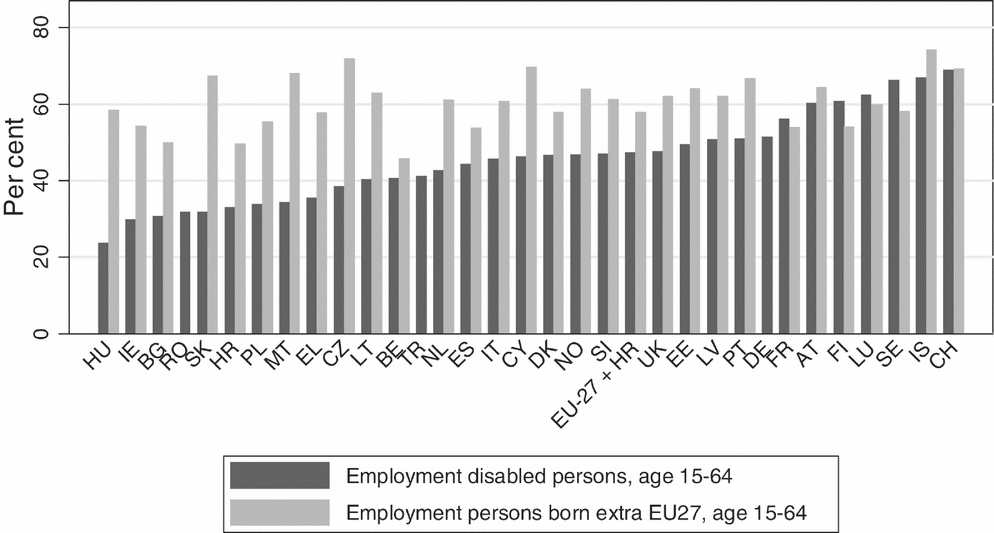
Unfortunately, comparative data tracking the labour market situation of persons with disabilities are not readily available. Thus, the reported employment rates for foreign-born and disabled persons could not be compared directly. In an effort to obtain a more reliable cross-national comparison of the labour market situation of the two groups, we combine data from the European Union labour force survey (LFS) ad hoc module 2011 on employment of disabled personsFootnote 8 with regular LFS data on employment of foreign workers, also from 2011. Since immigrants from Africa and Asia are likely to be more vulnerable to labour market exclusion than migrants from EU countries, we use the employment rate for persons born outside not only the reporting country but also outside Europe (following the example of Causa and Jean, Reference Causa and Jean2007).
Although Figure 6 shows a static picture, we can make several observations. In particular, countries that, comparatively speaking, are among the best performers when it comes to labour market integration of persons with disabilities, do not necessarily rank equally at the top when we turn to the employment of non-native workers. Even though the OECD and Eurostat data are not directly comparable due to different methodologies and reference years, data from both sources support the latter conclusion. In particular, some of the Mediterranean countries, most notably Portugal, Cyprus, Greece and Spain, do clearly better than the Nordic countries. It is not within the scope of the present article to explain these differences, but the data nonetheless remind us that we should not take for granted that the Nordic countries are always forerunners. Moreover, the Nordic countries vary considerably with regard to the employment prospects of disabled persons. On the one hand, Denmark records an employment rate just below the EU-28 average. Similarly, the Norwegian performance appears rather mediocre.Footnote 9 On the other hand, Finland, Iceland and Sweden belong among the few countries that boast an overall employment rate above 60 per cent for disabled persons.
Employment of vulnerable groups: migrants and persons with disability in 2011
Some caveats
There are a number of limitations to the descriptive analysis presented in this article. The aggregate data above mask the fact that both vulnerable groups examined are characterised by a high degree of heterogeneity. For example, in the case of migrants it surely makes a difference whether you arrive from a country in which the education system is poorly developed, the skills you can offer do not match the demand in the labour market you try to enter, and/or your culture and language are very different to the host country. Consequently, among migrants from Africa and Asia, employment rates and also wage levels vary according to the region of origin of the migrants (Adsera and Chiswick, Reference Adsera and Chiswick2004). Such differences are not picked up by the data presented in this article. To provide an assessment of countries’ actual ability to integrate migrants in the domestic labour market, one should ideally control for differences in migration policy. Countries with stricter immigration laws are likely to admit a smaller share of unskilled individuals, making it easier for such countries to achieve a high employment rate for the migrant population.
Furthermore, the tradition of measuring unemployment and employment levels in the work force goes back several decades (see Card, Reference Card2011), Indeed, such indicators belong to the standard output from a range of public statistics agencies both nationally and internationally. Even so, the task of studying these differences cross-nationally is made more difficult by variation in methodologies. There is a continued need to improve access to harmonised data that can give us a more nuanced and reliable picture about migrants’ situation (see for example, Causa and Jean, Reference Causa and Jean2007).
An even stronger note of caution is warranted when assessing the labour market situation of disabled persons. Empirically oriented researchers are inevitably faced with several sources of uncertainty and are advised to proceed with care. This becomes even more evident for anyone intending to carry out comparative research in this area. As Molden and Tøssebro (Reference Molden and Tøssebro2011) point out in a careful investigation into the consequences of employing different existing operational measurements of disability, a consensus on how to define disability is lacking on the theoretical as well as practical level.
One major reason for the lack of a standard measure of disability is that while a person's gender and age can usually be established objectively from administrative registers, it is less clear-cut whether (and to what degree) an individual has a disability or impairment. Information about persons’ disability status derives from population surveys, based on screening and self-reporting in interviews and questionnaires. The results are sensitive to respondents’ interpretation of the question(s) and their willingness to self-identify as disabled. Notably, Molden and Tøssebro (Reference Molden and Tøssebro2011: 353) report that employment rates, the degree of disability and the distribution of different types of impairment, are particularly sensitive to the operationalisation of disability. Even when efforts are made to employ the same survey design and questions across countries, such as in the EU LFS ad hoc modules on employment of disabled people, comparability is weakened by variation in the meaning of key terms across different languages.
All of the above considerations should be kept in mind when comparing the employment results of marginalised groups across countries. The point is that data cannot always be taken at face value and should be interpreted judiciously. Nonetheless, conditional on due recognition of uncertain data quality and potential weaknesses, we submit that exercises like the ones carried out in this article are worthwhile. They contribute to pushing the research agenda forward, stimulating efforts to improve prove methodological tools and data availability as well as theoretical and empirical knowledge.
Concluding remarks
Overall, what conclusions can we draw from the empirical findings, and where should we go from here? We have demonstrated that the empirical picture is much more mixed than the theory leads us to expect. Exploring employment outcomes across the OECD for two vulnerable groups (migrants and persons with disabilities), we found no unequivocal indication that their labour market opportunities are poorer in the Nordic countries. On the one hand, the employment level of migrants is lagging further behind that of the native population in countries with more compressed wages. On the other hand, the opposite seems to be true when it comes to persons with disabilities. In countries with compressed wages, persons with disabilities have employment rates closer to those of non-disabled individuals than in countries where wages are more unequal. These contrasting results suggest that there are different mechanisms at work for the two groups. Moreover, the data revealed considerable variation in employment rates across the Nordic countries.
Thus, as a whole the empirical results do not lend support to the various theoretical arguments suggesting that small earnings differentials hamper the employment chances of population groups situated at the margins of the labour market. This is good news if one believes that income equality and social equality more broadly are generally a good thing (see, for example, Kvist et al., Reference Kvist, Fritzell, Hvinden and Kangas2012: ch.1). For example, one important side effect of having relatively high wages at the lower end of the income distribution is that the Nordic countries record the lowest rates of in-work poverty. This phenomenon has become a particularly pronounced problem in Anglo-Saxon and Southern welfare states (Hussain et al., Reference Hussain, Kangas, Kvist, Kvist, Fritzell, Hvinden and Kangas2012).
Our findings are largely in agreement with Barth and Moene (Reference Barth and Moene2012), who used slightly older data and focused on a different set of vulnerable groups (young and old workers and low-skilled individuals). In explaining why the compressed earnings structures in the Nordic countries are not detrimental to employment of groups with traditionally a high risk of marginalisation, they emphasise almost exclusively differences in wage bargaining systems as the key causal mechanism. While their arguments seem plausible, we would leave the door open for a more multi-dimensional explanation.
More specifically, we know that there are substantial differences in how governments address the challenge of labour market inclusion of persons at risk of exclusion. Thus, we need to look more systematically at how different policy ideas and instruments (redistributory and regulatory) matter in affecting outcomes. In recent years, several authors have pointed to the increasing relevance of regulatory instruments that seek explicitly to protect specific vulnerable groups from discrimination and enhance their employment chances (for example, OECD, 2013; Halvorsen and Hvinden, Reference Halvorsen and Hvinden2014).
Aiming to offer a more conclusive analysis than we have offered in this article, a number of (not mutually exclusive) avenues may be pursued. The analysis should arguably be expanded to include data on unemployment. When thinking about issues of social citizenship and opportunities to participate, it is relevant to know to what degree individuals who want to be active in the labour market are actually allowed to do so. Measures of unemployment, perhaps more so than employment rates, can help us ascertain how countries do in this regard.
Developments over time are another aspect that would be worth pursuing. The data presented in this article have been cross-sectional and have only provided static snapshots. Ideally, a next step should examine changes in earnings distribution in relation to changes in employment rates to see whether this might give us results that point more clearly in one direction. In practice, due to serious problems relating to availability as well as comparability of data, it is probably not possible to carry out such an analysis going several years back. For reasons highlighted above, the data that concern persons with disabilities especially suffer from too many gaps and are of uncertain quality, even in the Nordic countries, which are known to have very high quality micro-level data. Therefore, from a methodological point of view, a main conclusion is that there is much to be gained from easier access to high-quality harmonised cross-national data collected at regular intervals. At present comparative assessments are hampered by data that are at best uncertain, and to which access is too cumbersome. Few comparative research projects have the resources to collect and harmonise data on their own.
Finally, a study with sufficient resources available would also try to dig deeper into the factors producing a given earnings distribution, such as the wage bargaining system. Such insights should be linked to the efforts made by the welfare state through, for instance, active labour market programmes targeted at particular vulnerable groups. To enable the inclusion of in-depth institutional information of both the industrial relations system and the welfare state (including social regulations) within the same comparative study, we would welcome cross-country analyses with a relatively small number of carefully selected cases. Such analyses would supplement large-n comparative studies of aggregate data from international sources like the OECD and Eurostat.
Acknowledgements
We thank the anonymous reviewers for helpful comments. We are grateful to REASSESS (Nordic Centre of Excellence in Welfare Research) and the TREfF project (Research Council of Norway, grant no. 199836) for their financial support. The authors have contributed in equal measures to this article and are listed alphabetically.