Implications
We investigate how differences in dairy farmers’ motivations to animal welfare are associated with the economic outcome of the farm. We found that motivational factors based on productivity and profitability concerns were statistically significantly positively associated with economic outcome, and that motivational factors based more on aspects such as ethics, animal rights and legitimacy of the production were not significantly associated with the economic outcome. Findings are interesting for policy as they suggest that farmers’ economic incentives for engagement in various private quality assurance standards, which generally focus on ethics, animal rights and legitimacy, may need to be strengthened.
Introduction
Since the inclusion of farm animal welfare (FAW) requirements within European livestock production in the 1980s, the concept of animal welfare has evolved from an ‘almost exclusive consideration of the animal towards a multidimensional concept, which at present has strong, obvious socio-economic implications’ (Averós et al., Reference Averós, Aparicio, Ferrari, Guy, Hubbard, Schmid, Ilieski and Spoolder2013, p. 787). Studies performed over the past 15 years indicate that FAW is considered a major concern in society (e.g. Verbeke and Viaene, Reference Verbeke and Viaene2000; Dockès and Kling-Eveillard, Reference Dockès and Kling-Eveillard2006; Borgen and Skarstad, Reference Borgen and Skarstad2007; Kling-Eveillard et al., Reference Kling-Eveillard, Dockes and Souquet2007; Mayfield et al., Reference Mayfield, Bennett, Tranter and Wooldridge2007; Kielland et al., Reference Kielland, Skjerve, Østerås and Zanella2010; Lagerkvist and Hess, Reference Lagerkvist and Hess2011; Franz et al., Reference Franz, Deimel and Spiller2012; de Jonge and van Trijp, Reference de Jonge and van Trijp2013). Within the European Union, FAW standards are regulated by minimum requirement regulations specified by the European Commission, in laws specific to individual member states and in private product certification schemes.
A number of studies have examined farmers’ view of FAW (e.g. Te Velde et al., Reference Te Velde, Aarts and Van Woerkum2002; Dockès and Kling-Eveillard, Reference Dockès and Kling-Eveillard2006; Bock and van Huik, Reference Bock, Prutzer, Kling Eveillard and Dockes2007; Kauppinen et al., Reference Kauppinen, Vesala and Valros2012). In a synthesis of these studies, Hansson and Lagerkvist concluded that farmers view FAW as being related to the following aspects: ‘animal health, physiological needs of the animals, natural behavior of the animals, living environment of the animals, humane and ethical treatment of the animals, and the farmer’s own wellbeing and knowledge’ (Reference Hansson and Lagerkvist2014, p. 54). Previous studies have also described the decision framework including values and goals within which farmers’ make decisions related to FAW (e.g. Lagerkvist et al., Reference Lagerkvist, Hansson, Hess and Hoffman2011; Gocsik et al., Reference Gocsik, Saatkamp, de Lauwere and Oude Lansink2014). In this respect, Hansson and Lagerkvist (Reference Hansson and Lagerkvist2016) found that among the 10 most important motivational factors for working with FAW, only two could be classified as referring to profitability and productivity. Instead, the most salient motivational factors were related to farmers feeling personal happiness from knowing that their animals are well kept; to preventing disease, pain and injury among the animals and treating them quickly if needed; and to the business being profitable enough so that conditions for the animals could be further improved. Values of existence type in FAW have also been found to (negatively) affect farmers’ acceptance of hypothetical FAW programme (Schreiner and Hess, Reference Schreiner and Hess2017).
It is reasonable to expect that decision making motivated by different ideas of FAW leads to different types of measures being taken on the farm and consequently that these are associated with the economic outcome for the farm in different ways. This means that there should be a relationship between the nature of FAW aspects realised by farmers and the economic outcome for their farms. This relationship is currently not well understood, but insights regarding it would help clarify whether farmers motivated by different types of FAW dimensions can achieve similar economic results or whether certain FAW dimensions can only be achieved at the expense of the economic outcome for the farm.
Previous literature has addressed the relationship between FAW and farm economic results in various ways. In an empirical study of farmers’ attitudes to FAW, Bock and Van Huik concluded that ‘the most important barrier to participating in specific animal welfare schemes was farmers’ distrust in the economic advantages of doing so’ (Reference Bock, Prutzer, Kling Eveillard and Dockes2007, p. 936). They also found that farmers distrusted consumers’ willingness to pay for animal-friendly production. In a study of stockkeeper personality traits and attitudes, Hanna et al. (Reference Hanna, Sneddon and Beattie2009) observed a low correlation between farmers’ attitudes to FAW and dairy cow productivity. However, other empirical studies have revealed that positive attitudes to FAW can influence how animals are handled, housed and managed on the farm, all of which can impact on farm productivity and ultimately performance. For instance, Waiblinger et al. (Reference Waiblinger, Menke and Coleman2002) and Kauppinen et al. (Reference Kauppinen, Vesala and Valros2012) found that positive attitudes to FAW can lead to early recognition of welfare problems on the farm and hence immediate actions, which can influence farm productivity, whereas negative attitudes to FAW may limit farm productivity (Breuer et al., Reference Breuer, Hemsworth, Barnett, Matthews and Coleman2000; Hemsworth et al., Reference Hemsworth, Coleman, Barnett, Borg and Dowling2002). According to Lagerkvist et al. (Reference Lagerkvist, Hansson, Hess and Hoffman2011), improved FAW can result in healthier animals and improved productivity, thereby indirectly affecting the costs of production, for example, by reducing the costs of veterinary treatments, discarded milk and meat, etc.
This study differs from previous research on the relationship between FAW and the farm economic results in one fundamental aspect, namely that when examining aspects which are potentially associated with farm economic outcome it considers how farmers’ motivation in relation to a set of use- and non-use values in FAW are associated with the economic outcome for the farm. This is done using the characterisation of use- and non-use FAW values developed by McInerney (Reference McInerney2004) and Lagerkvist et al. (Reference Lagerkvist, Hansson, Hess and Hoffman2011) to examine how FAW values held by the dairy herd manager are related to the contribution margin from each farm’s dairy production. This study makes three novel contributions. First, to our knowledge, no previous study has tested whether and how use and non-use values are associated with the farm economic outcome. In the definition of use values (McInerney, Reference McInerney2004) this effect is assumed, as use values relate to values derived from the use of livestock in the production processes. Non-use values, however, may relate to the economic outcome, but no previous study has examined whether farmers’ consideration of such values is actually associated with the farm economic performance. Second, non-use values are typically the focus in private quality assurance standards regarding FAW. Therefore, from a practical point of view, the present analysis is useful for developing farmers’ engagement in FAW. Third, the analysis is useful for policy making and for farmers who would benefit from understanding possible trade-offs between farmers’ motivation to FAW-related actions and the economic outcome at the farm.
Material and methods
Conceptual framework
In order to conceptually describe farmers’ motivations to work with FAW, we build on the framework of use and non-use values introduced by McInerney (Reference McInerney2004) and detailed by Lagerkvist et al. (Reference Lagerkvist, Hansson, Hess and Hoffman2011) and which recognises that farmers may obtain economic value in terms of these two types from working with their livestock. In particular, use values in FAW arise from farmers’ direct use of their livestock in the production process, for instance, in order to: maximise their productivity (e.g. production of milk); increase farm profitability; assure farm survival; adjust their production to market prices; have a better workplace; have healthier animals; and/or create time for other activities (Hansson and Lagerkvist, Reference Hansson and Lagerkvist2016). Thus, use values arise from concerns about farm productivity and profitability and in order to achieve other business goals that are not related to the well-being of the animals for its own sake. The motivation for providing FAW is similar to that of maintaining any other production factor on the farm. Non-use values in FAW refer to any other economic value the farmer finds in FAW and explain why farmers provide FAW beyond the level attributable to concerns related to achieving use values. In particular, Lagerkvist et al. explains that ‘the concept of non-use value FAW values refers to the value that the producer derives from economic goods related to the well-being of the livestock, independent of any use, present or future, that the producer might make of the animals’ (Reference Lagerkvist, Hansson, Hess and Hoffman2011, p. 486). They also state that non-use FAW values are ‘generally differentiated from use values, which the producers derive from direct use of the livestock through the production process’ (Lagerkvist et al., 2011, p. 486). Lagerkvist et al. (Reference Lagerkvist, Hansson, Hess and Hoffman2011) and Hansson and Lagerkvist (Reference Hansson and Lagerkvist2016) extended the notation of non-use values in FAW by categorising them into five distinct theoretical types: existence, pure, bequest and option values, and value derived from paternalistic altruism. Accordingly, non-use FAW values may arise from: (1) farmers’ feeling of satisfaction about their animals’ well-being, their desire to provide animals with fresh water, a proper diet and comfortable resting areas and their desire to prevent injuries and pain among animals, etc. (existence value); (2) farmers’ interest in FAW, even though it is too costly to take ‘better’ care of their animals (pure non-use value); (3) farmers’ desire to preserve farm animals (and their products) for the use of future generations (bequest value); (4) providing consumers with the opportunity to choose products from farms with good FAW practices (option value); and (5) farmers feeling proud that their animals’ good welfare is recognised by industry, retailers and consumers (paternalistic altruism) (Lagerkvist et al., Reference Lagerkvist, Hansson, Hess and Hoffman2011; Hansson and Lagerkvist, Reference Hansson and Lagerkvist2016).
Thus, farmers’ decision making with respect to FAW can be considered to be driven by economic values of use and/or non-use types, or a combination of these. From a human behaviour perspective, we further suggest that farmers’ provision of FAW can be determined from farmers’ perceptions and preferences regarding use and non-use values in FAW (Lagerkvist et al., Reference Lagerkvist, Hansson, Hess and Hoffman2011; Hansson and Lagerkvist, Reference Hansson and Lagerkvist2014). Human behaviours and decisions are determined from goals (Atkinson and Birch, Reference Atkinson and Birch1970; Gollwitzer and Bargh, Reference Gollwitzer and Bargh1996). Goals are instrumental to motivation, with the degree of motivation derived from each specific goal depending on the subjective utility derived from that goal (Kopetz et al., Reference Kopetz, Kruglanski, Arens, Etkin and Johnson2012). As farmers’ FAW-related actions can be expected to be driven by the perceived economic value in FAW and because motivation drives action, economic value in FAW can be considered a motivational construct (Hansson and Lagerkvist, Reference Hansson and Lagerkvist2016), with the various use and non-use values representing different dimensions of this motivational construct. The use and non-use values are viewed as desirable outcomes which motivate farmers’ actions. Each dimension of the motivational construct is associated with measurable motivational attributes, as detailed above. Furthermore, because the economic outcome of any business is determined by the strategic and operational decisions taken by the business manager, farmers’ preferences for use and non-use values, via their effect on action, can be expected to be associated with the economic outcome for the farm.
Data
For this study, Swedish Farm Economic Survey (FES) data for 2009–11 were obtained from the Swedish Board of Agriculture. Farm Economic Survey collects full income statements (revenues and costs), balance sheets (assets and liabilities) and some additional information, for example, number of hours worked on the farm, and the sample is stratified to cover farms from different size groups and geographical locations. Farm Economic Survey is maintained by Statistics Sweden on behalf of the Swedish Board of Agriculture, with the primary purpose of meeting Sweden’s obligations within the European Farm Accounting Data Network. In particular, the study sample consisted of dairy farmers who operated the dairy farms in the FES listings that received at least 50% of their total farm revenue between 2009 and 2011 from milk production, and could thereby be considered specialists in dairy production. These farms would thus be relatively dependent on their dairy production and dairy cow welfare would be a significant issue for the participating farmers.
A structured questionnaire was designed for this study and used to collect data on FAW motivational construct dimensions from dairy farmers as key informants. These data were matched with the FES data in order to evaluate the associations between those FAW motivational construct dimensions and the economic outcome for farms. Due to the confidentiality agreement and to ensure respondent anonymity, data collection was conducted by the Swedish Board of Agriculture on behalf of the research group, which only obtained anonymous data. Data collection took place between March and May 2014. Among a total of 357 dairy farmers identified in the FES, after two reminders a total of 126 responses were obtained, 106 of which were usable (response rate ~30%). However, after removing irrelevant cases from the original population (e.g. farms that no longer produced milk or had such a small dairy herd that they were obviously about to exit dairy production), the effective response rate was ~32% (i.e. 106/336).
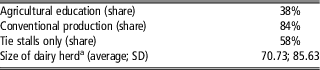
Descriptive statistics for the responding farms (Table 1) revealed that 38% of the respondents had an agricultural degree or diploma, 84% had conventional dairy production and 58% housed their dairy cows in tie stalls. The average herd size was 70.73 cows.
Descriptive statistics on the study sample of Swedish dairy farms

a Compared with the full population of Swedish dairy farmers, where the average herd size in 2014 was 78 cows (Statistics Sweden 2015). This difference was not statistically significant.
Measures
Use and non-use farm animal welfare values
The scale used for measuring farmers’ FAW motivational construct dimensions was adopted from Hansson and Lagerkvist (Reference Hansson and Lagerkvist2016). This scale consists of a set of 27 individual motivational attributes in FAW and is expected to cover the whole motivational construct, including its use and non-use parts. A list of all specific motivational attributes and specification about how they relate to the motivational construct dimensions is provided in the Supplementary Material (Table S1). To mitigate the effect of order bias, we prepared 10 versions of the questionnaire in which the order of the statements regarding use and non-use FAW values differed randomly. The questionnaires were then distributed randomly among the respondents.
We asked respondents to indicate the degree to which they perceived the specific motivational attributes as an important driving force to improve FAW in their dairy production. In particular, we used the constant-sum approach, and asked the farmers to divide the set of 100 points between the motivational attributes by giving the most points to the most important attribute and the least points to the least important attribute. At the same time, we asked the respondents to indicate with an x the (possible) unimportant motivational attributes. Although possibly being cognitively demanding, this procedure has clear advantages above other rating methods such as the Likert scale, by preventing respondents from claiming that everything is very important. However, as some farmers erroneously distributed slightly less or slightly more than 100 points, we standardised the points given to each individual motivational attribute so that each motivational attribute for each respondent received a proportion of all points distributed by each respondent. This figure was multiplied by 100 to obtain a percentage value.
Following this, each motivational attribute was assigned to a motivational construct dimension, based on the theoretical understanding about the six dimensions of the economic value construct in FAW (i.e. use values, pure non-use values, existence value, bequest value, option value and paternalistic altruism) (Lagerkvist et al., Reference Lagerkvist, Hansson, Hess and Hoffman2011), please see Supplementary Material (Table S1) for details about what attributes were mapped onto what motivational construct dimension. Summed scales were calculated for each of these motivational construct dimensions. Each such summed scale was normalised by dividing the sum by the number of items used to capture that particular motivational construct dimension. Motivational attributes indicated as unimportant received a zero. In this way, measures of the motivational construct dimensions were obtained. Using the decision criterion developed by Jarvis et al. (Reference Jarvis, MacKenzie and Podsakoff2003), a formative relationship between the motivational construct dimensions and their attributes was considered.
Economic outcome
Using detailed farm-level accounting data, we calculated the contribution margin from each farm’s dairy production for the years 2009–11. This was defined as revenue from milk and revenue associated with the calf and culling of dairy cows minus costs associated with buying pregnant heifers, feed, litter, veterinary services, artificial insemination and insurance. In order to take differences in contribution margin due to size of the dairy enterprise into consideration and to avoid inadvertently measuring farm size instead of economic outcome, the contribution margin was divided by the sum of the revenue from milk and the revenue associated with the calf and culling of dairy cows. This was taken as a measure of the contribution margin ratio (e.g. Anthony et al., Reference Anthony, Govindarajan, Frank, Hartmann and Nilsson2014) of dairy production on each farm. The average contribution margin ratio (ACMR) for 3 years was calculated and taken as an indicator of economic performance of the dairy enterprise on the farm. For the entire sample, the average ACMR was 0.63 (SD: 0.12; range: 0.34 to 0.92). The distribution of the ACMR was approximately normal according to the skewness/kurtosis tests for normality (P=0.879; indicating that the null hypothesis of normal distribution cannot be rejected).
Statistical procedures to relate motivational construct dimensions to economic outcome
A linear regression model was used to test how the motivational construct dimensions affected ACMR. Due to apparent problems with multicollinearity in the linear regression model, this approach was complemented with a step-wise regression method, where the impacts of the use values and the non-use values could be sequentially evaluated separately. Using this approach, we were able to evaluate whether the model fit was significantly improved by step-wise addition of information about: (i) the use value motivational construct and (ii) the non-use values motivational constructs. All statistical procedures were implemented using the STATA 15 Software (StataCorp., 2017).
Results
Descriptive statistics on the motivational construct dimension
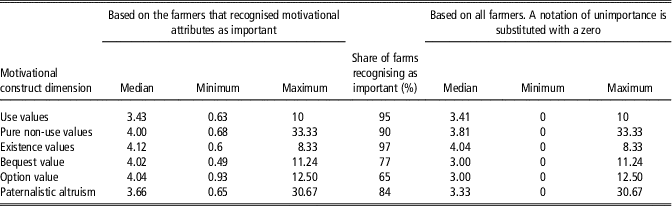
Descriptive statistics on the summed scales accounting for each motivational construct dimension are presented in Table 2, where the median values can be interpreted as the median value of points (out of 100 points) given to each of the individual motivational attributes in each motivational construct dimension. Descriptive statistics were calculated based only on those farmers who rated the motivational construct dimension in question as important, and also based on all farmers where a notation of unimportance was substituted with a zero. As indicated in Table 2, the existence non-use value category appeared the most important construct dimension. Interestingly, the use value appeared among the less important motivational construct dimensions. A Wilcoxon signed-rank test (not shown; based on all farmers) suggested that the importance assigned to the use value dimension was significantly lower than the importance assigned to the pure non-use value dimension and the existence value dimension, significantly higher than the importance assigned to the option value category, but not significantly different from the importance assigned to the bequest value category or paternalistic altruism value dimension. This suggests that the pure non-use values and the existence values are the most important motivational constructs dimensions in work with respect to FAW performed by the farmers in the sample.
Descriptive statistics on the motivational categories

The figures are normalised with respect to the number of motivational attributes in each motivational dimension.
Correlations between the motivational construct dimensions and the farm economic outcome
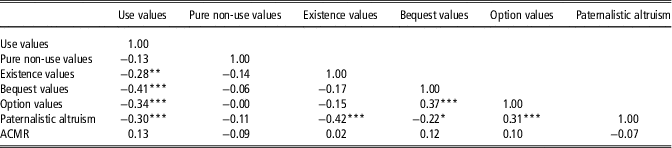
Table 3 shows Spearman’s correlation coefficients among the different motivational construct dimensions and between the motivational construct dimensions and the ACMR. All five types of non-use value dimensions were negatively (and most significantly so) correlated with the use values, suggesting that farmers view those motivational construct dimensions as being in conflict. Furthermore, among motivational construct dimensions of the non-use type there appeared to be some values that were in conflict with each other; paternalistic altruism was significantly negatively correlated with existence values and bequest values. However, option values were positively correlated with both bequest values and paternalistic altruism, suggesting that those values are perceived as being related to each other. None of the motivational construct dimensions was found to be significantly correlated with the indicator of economic performance, suggesting that at this stage these are unrelated to the ACMR.
Correlation coefficients (Spearman) among the motivational construct dimensions and between the motivational construct dimensions and the 3-year average contribution margin ratio (ACMR) in dairy production

*P<0.10, **P<0.05, ***P<0.01.
Regression analyses
In order to test the associations between the motivational construct dimensions and the ACMR of the dairy enterprise on the study farms, the summed and normalised scales accounting for each motivational construct dimension were regressed on the ACMR. Indicators accounting for production orientation in terms of conventional or organic production and for type of housing system were used as control variables in the regression analysis, as those variables are also likely to significantly affect the economic performance.
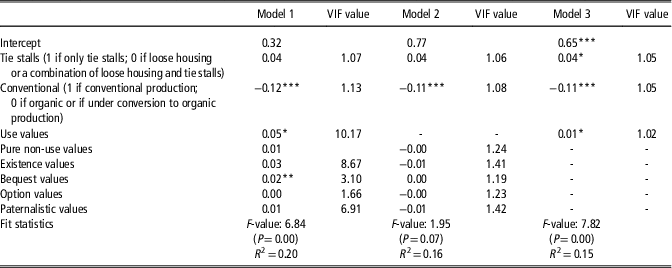
Model 1 in Table 4 shows regression results for the initial model estimated. As the motivational construct dimensions were highly and significantly correlated on several occasions (see Table 3), multicollinearity was a problem in interpretation of the regression coefficients, as confirmed by the variance inflation factor (VIF) values (see Table 4, Model 1). In order to account for this, the independent variable with the highest VIF value (the variable accounting for use values) was removed from the model and it was re-run. The results are presented as Model 2 in Table 4. A new estimation of the VIF values suggested no problems related to multicollinearity. In order to evaluate the impact of the use value motivational construct dimensions, the model was re-estimated, this time including this variable and the control variables only (Model 3 in Table 4).
Regression results for Models 1 to 3, associations between motivational construct dimensions and the 3-year average contribution margin ratio in dairy production

VIF=variance inflation factor.
Statistical inference in Models 1 and 3 is based on robust standard error, as the Breusch–Pagan/Cook–Weisberg test significantly indicated presence of heteroscedasticity in those models (P=0.05 and 0.09, respectively).
*P<0.1, **P<0.05, ***P<0.01.
Taken together, the results reported in Table 4 indicate that the use value motivational dimension was significantly and positively associated with the ACMR of the dairy enterprise on the study farms. Among the non-use value motivational construct dimensions, only the variable accounting for bequest values was significantly associated with the ACMR, and only in Model 1. As expected, the results suggested that the non-use motivational constructs were largely unrelated to the economic performance of the dairy enterprise on the farms.
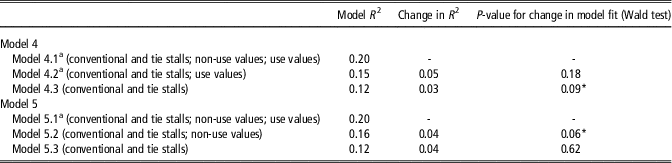
Because of the apparent multicollinearity in Model 1, a step-wise regression method was also applied to evaluate the potentially significant associations between the use value motivational construct dimensions and the ACMR, and also between the non-use value motivational construct dimensions and the ACMR, while keeping the control variables constant. The results are presented in Table 5. In Model 4, the most general model (Model 4.1) consisting of the intercept and the two control variables (conventional farming and tie stalls), and variables accounting for the use value and non-use value motivational construct dimensions was first estimated. Following this, Model 4.2, where the variables accounting for the non-use value motivational construct dimensions had been removed, was estimated. In a third step, Model 4.3 was estimated, where also the variable accounting for the use value construct dimension had been removed.
Step-wise regression results, associations between motivational construct dimensions and the 3-year average contribution margin ratio in dairy production

The Ramsey RESET test (Ramsey, Reference Ramsey1969), for omitted variables for the general Models (4.1 and 5.1) yielded a P-value of 0.445, thus supporting the null hypothesis of no omitted variables in terms of non-linear combinations of the explanatory variables. The test was implemented by the ovtest function in the STATA software (StataCorp., 2017).
a Statistical inference based on robust standard error, as the Breusch–Pagan/Cook–Weisberg test significantly indicated presence of heteroscedasticity in those models.
*Significant at P<0.10.
The Wald test (P=0.18) supported that model fit would not be significantly reduced by not including the non-use value motivational construct dimension (Model 4.2 compared with Model 4.1), thus suggesting that no model improvement could be achieved from including variables accounting for non-use value motivational construct dimensions in the regression model. However, the same test (P=0.09) rejected the hypothesis that model fit would not be significantly reduced by not including the variable accounting for the use value construct dimension (Model 4.3 compared with Model 4.2), thus suggesting that the use value motivational construct dimension is associated with the ACMR.
In order to evaluate whether the order in which the use and non-use value motivational construct dimensions were removed from the model had any effect on the conclusions, the procedure outlined above was repeated. However, this time the variable accounting for the use value motivational construct dimension was removed from the model before the variables accounting for the non-use value motivational dimensions were removed. Thus, in Model 5.1, the base model from Model 4.1 was estimated in a first step. Following that, Model 5.2 was estimated, where the variable accounting for the use value motivational construct dimension had been removed. In the next step Model 5.3, where also the variables accounting for the non-use value motivational construct dimensions had been remove, was estimated.
The Wald test (P=0.06) supported that model fit would be significantly reduced by not including the use value motivational construct dimension (Model 5.2 compared with Model 5.2), thus suggesting that model improvement could be achieved by including the variable accounting for the use value motivational construct dimension in the regression model. However, the Wald test (P=0.62) supported that model fit would not be significantly reduced by not including the non-use value motivational construct dimensions (Model 5.3 compared with Model 5.2), suggesting that inclusion of the non-use value motivational construct dimensions did not improve the explanation of the economic performance of the dairy enterprise on the farms.
As confirmation, Models 4 and 5 both suggested that significant model improvement could be achieved by including the variable accounting for the use value motivational construct dimension in the regression model, and that this was independent of the order in which this variable was included in the model. However, both models also suggested that no significant model improvement could be achieved from including the non-use value motivational construct dimensions in the regression model. Thus, the non-use value motivational construct dimensions appeared to be unrelated to the ACMR of the dairy enterprise on the study farms.
In order to evaluate the sensitivity of the results due to including both organic and conventional farms in the regression analyses, Models 4 and 5 were re-run with only conventional farms included (the number of organic farms were too few to meaningfully include alone in the regression analyses; the dummy variable ‘Conventional’ was excluded in the analyses). Findings (not shown) lend support for identical conclusions except for the change in model fit when estimating Model 5.2, which was not statistically significant.
Discussion
Based on information from a sample of Swedish dairy farmers, this study explored how FAW motivational factors in terms of use and/or non-use values were associated with the economic outcome for farms. The link between farmers’ motivation to work with FAW and the economic performance of their dairy enterprise was thereby evaluated. Use values in FAW refer to economic value derived from the use of animals in the production processes. Non-use values refer to economic values in FAW that are obtained from good animal welfare, irrespective of the use the farmer may derive from the animal, at present or in the future.
Taken together, our findings suggest that the motivational construct dimension of use value type is significantly and positively related to the economic performance of the dairy enterprise on farms, measured in terms of ACMR, and that the motivational construct dimensions of non-use value type are relatively unrelated to this measure of economic performance. A notable exception to this pattern for motivational construct dimensions of non-use value type is the bequest value type, which according to Model 1 appears positively related to the ACMR. Overall, our findings confirm the definition of use values provided by McInerney (Reference McInerney2004) as being related to values derived from the use of livestock in the production processes. Our findings thus indicate that farmers who are motivated by use values in FAW succeed in running their dairy operations in a more profitable way.
The statistically non-significant findings related to the non-use motivational construct dimensions suggest that the actions taken on the farm based on those motivational construct dimensions are of a type that has a neutral association in total with the economic outcome. Thus, non-use values appear not to be associated with the economic outcome for the farm, at least not in the short-term. It is important to point out that our findings indicate that motivation by non-use values is unrelated to the economic outcome, which means that focussing on such values does not appear to reduce the economic performance of dairy enterprises. This is interesting because if farmers who are more motivated by the non-use values in FAW also run farms with higher levels of FAW, our findings may indicate that higher levels of FAW are unrelated to economic performance. Reasons for this may be that the increased costs that higher levels of FAW may imply are offset by other economic benefits in terms of reduced production costs and/or increased revenue. However, we did not attempt to link the dimensions of economic value in FAW to the actual levels of FAW on the farms, and this relationship needs to be confirmed in future studies. It should also be noted that motivation by non-use values may have visible effects on the farm economic outcome only in the long run, for instance, by possibly contributing to healthier animals and/or increased the legitimacy of dairy production in society, but such effects were not captured in this study given the short time span covered by the data (2009–11).
The findings presented here are of value for policy formulation. In discussions about FAW and related standards implemented on farms, a good starting point would be the farmer, their decision making and the motivational factors underlying this decision making. Despite the important role of actors such as consumers, veterinarians and members of various pressure groups in the debate about FAW, it is farmers who make the actual decisions with regard to FAW (Franz et al., Reference Franz, Deimel and Spiller2012; Kauppinen et al., Reference Kauppinen, Vesala and Valros2012). It is also farmers who may directly benefit or suffer economically from FAW measures undertaken on farms. Various FAW-related schemes and measures are often promoted to farmers as a way to improve farm performance, but it is not certain that those schemes and activities actually lead to enhanced profitability (Bock and Van Huik, Reference Bock, Prutzer, Kling Eveillard and Dockes2007). The results presented here suggest how different dimensions in the economic value construct in FAW, which directs FAW-related action, may be associated with the economic outcome for the dairy enterprise on farms. In this respect, from a policy point of view it is interesting to note that different motivations to FAW actually affected the economic outcome, that is farmers with different approaches to FAW achieved different economic outcomes for their farms.
Furthermore, for the development of private quality assurance standards, our findings suggest that farmers’ economic incentives for participating in such activities may need to be strengthened in order to make them more attractive and incentivising, because, at current, a focus on non-use values generally not appear associated with more favourable economic outcomes.
Limitations of this study should be acknowledged. First, due to time lags in preparation of FES, the information obtained from the questionnaires had to be supplemented with information about an economic situation at an earlier point in time, that is, the economic outcome had to be explained using questionnaire-based data collected at a later stage in time. However, we consider this a minor issue because it can be considered highly unlikely that the farmers changed their motivational profile over only a few years. Thus, it is likely that the farmers participating in this study were motivated by the same type of economic value in FAW at the time their economic results were measured as they were at the time of the questionnaire. Second, the possibility to generalise the findings to livestock farmers other than dairy farmers must be considered limited. Bock et al. (Reference Bock, Prutzer, Kling Eveillard and Dockes2007) concluded that the human–animal relationship depends on the type of species kept by the farmer and the purpose of keeping them. It is plausible to assume that the human–animal relationship also affects farmers’ views on FAW for that particular species and thus their motivation to work with FAW. Thus, in future research the type of study conducted here needs to be repeated for farms with other types of livestock operations if we are to fully understand how the FAW motivational construct dimensions are associated with economic performance.
Acknowledgement
This study was funded by the Swedish Research Council Formas, Grant No: 2011-254 which is gratefully acknowledged.
Declaration of interest
None.
Ethics statement
None.
Software and data repository resources
None.
Supplementary material
To view supplementary material for this article, please visit https://doi.org/10.1017/S175173111700372X