Introduction
Arthoniaceae is a medium-sized family of lichenized, lichenicolous and saprobic species with a worldwide distribution. Arthonia is the largest genus in the family and one of the five largest genera containing lichen-forming fungi (Lücking et al. Reference Lücking, Hodkinson and Leavitt2017). The genus is considered to be heterogeneous (e.g. Tehler Reference Tehler1990; Grube Reference Grube1998, Reference Grube2001, Reference Grube2007; Sundin & Tehler Reference Sundin and Tehler1998) and was recovered as polyphyletic in recent molecular studies (Ertz & Tehler Reference Ertz and Tehler2011; Frisch et al. Reference Frisch, Thor, Ertz and Grube2014; Van den Broeck & Ertz Reference Van den Broeck and Ertz2016). Consequently, some species groups were recently transferred to new or resurrected genera (e.g. Grube Reference Grube2001; Frisch et al. Reference Frisch, Thor, Ertz and Grube2014, Reference Frisch, Ohmura, Ertz and Thor2015).
During fieldwork in February and September 2016 in Great Britain, an unknown Arthonia species was found on old Quercus trees. This discovery was in the framework of a systematic lichen survey of the exceptionally lichen-rich old-growth pasture woodland of Horner Combe (Somerset) for the National Trust, the charity owning this area. During fieldwork in 2014 and 2015 in Poland, an unknown sterile sorediate species of Arthoniales was collected in the old-growth Białowieża Forest. Morphological analyses and DNA sequences obtained from these specimens revealed that they represent new species of Arthoniaceae. The present study aims to describe these new species and to determine their phylogenetic position within the Arthoniaceae. Schismatomma niveum D. Hawksw. & P. James, a sterile sorediate lichen morphologically somewhat similar to the new species from Poland, was also sequenced in order to determine its phylogenetic position.
Materials and Methods
Voucher specimens are deposited in the herbaria BR, KTC, UGDA and the private herbarium of N. A. Sanderson. The external morphology was studied and measured using an Olympus SZX12 stereomicroscope. Macroscopic photographs were taken using a Keyence VHX-5000 digital microscope and a VH-Z20R/W/T lens. Hand-cut sections of ascomata and thallus were mounted in water, a solution of 5% potassium hydroxide (K) or in Lugol’s iodine solution (1% I2) with (K/I) or without (I) pretreatment with K, and studied using an Olympus BX51 compound microscope. Calcium oxalate crystals were identified by applying 10% sulphuric acid to the microscopic preparations of thallus and ascomata. Measurements refer to dimensions in water. Photomicrographs were prepared using an Olympus BX51 compound microscope fitted with an Olympus ColorViewI digital camera. Colour reactions of the thallus were studied using 5% potassium hydroxide solution (K), common household bleach (C), 5% aqueous potassium hydroxide followed by common household bleach (KC), para-phenylenediamine (PD) and long-wave UV light (366 nm). Lichen secondary metabolites were identified using thin-layer chromatography (TLC) in A, B and C solvents (Orange et al. Reference Orange, James and White2001). The extracts from Herpothallon rubrocinctum (Ehrenb.) Aptroot et al. and Enterographa crassa (DC.) Fée were used as controls for confluentic and 2’-O-methylperlatolic acids.
Type specimens examined for comparison: 1) Arthonia pruinosella Nyl., in Hasse, Lich. South. California: 16 (1898); USA, California, Santa Monica, Agricultural Experiment Station, on Cordia cordata in cultivation, Nov. 1897, H. E. Hasse 607 (H-NYL 5796—lectotype!, designated here) (the note “lectotype of Arthonia pruinosella Nyl. selected by R. Sundin Reference Sundin1999” is stuck to the specimen, but the lectotypification does not seem to be published; A. pruinosella is therefore lectotypified here); 2) Arthonia ochrolutea Nyl., in Willey, Syn. Gen. Arthonia: 4 (1890); Cuba, C. Wright (H-NYL 5455—holotype!).
Molecular techniques
Well-preserved and freshly collected specimens lacking any visible symptoms of fungal infection were used for sequencing. Hand-cut sections of the apothecia or a few soredia were used for direct PCR as described in Ertz et al. (Reference Ertz, Tehler, Irestedt, Frisch, Thor and van den Boom2015). Amplification reactions were prepared for a 50 µl final volume containing 5 µl 10× DreamTaq Buffer (Thermo Scientific; www.thermoscientific.com/onebio), 1·25 µl of each of the 20 µM primers, 5 µl of 2·5 mg ml−1 bovine serum albumin (Thermo Scientific #B14), 4 µl of 2·5 mM each dNTPs (Thermo Scientific), 1·25 U DreamTaq DNA polymerase (Thermo Scientific) and the lichen material. A targeted fragment of c. 0·8 kb of the mtSSU rDNA was amplified using primers mrSSU1 and mrSSU3R (Zoller et al. Reference Zoller, Scheidegger and Sperisen1999). The yield of the PCRs was verified by running the products on a 1% agarose gel using ethidium bromide. Both strands were sequenced by Macrogen® using amplification primers. Sequence fragments were assembled with Sequencher v.5.3 (Gene Codes Corporation, Ann Arbor, Michigan). Sequences were subjected to ‘Megablast’ searches to verify their closest relatives and to detect potential contaminations.
Taxon selection and phylogenetic analyses
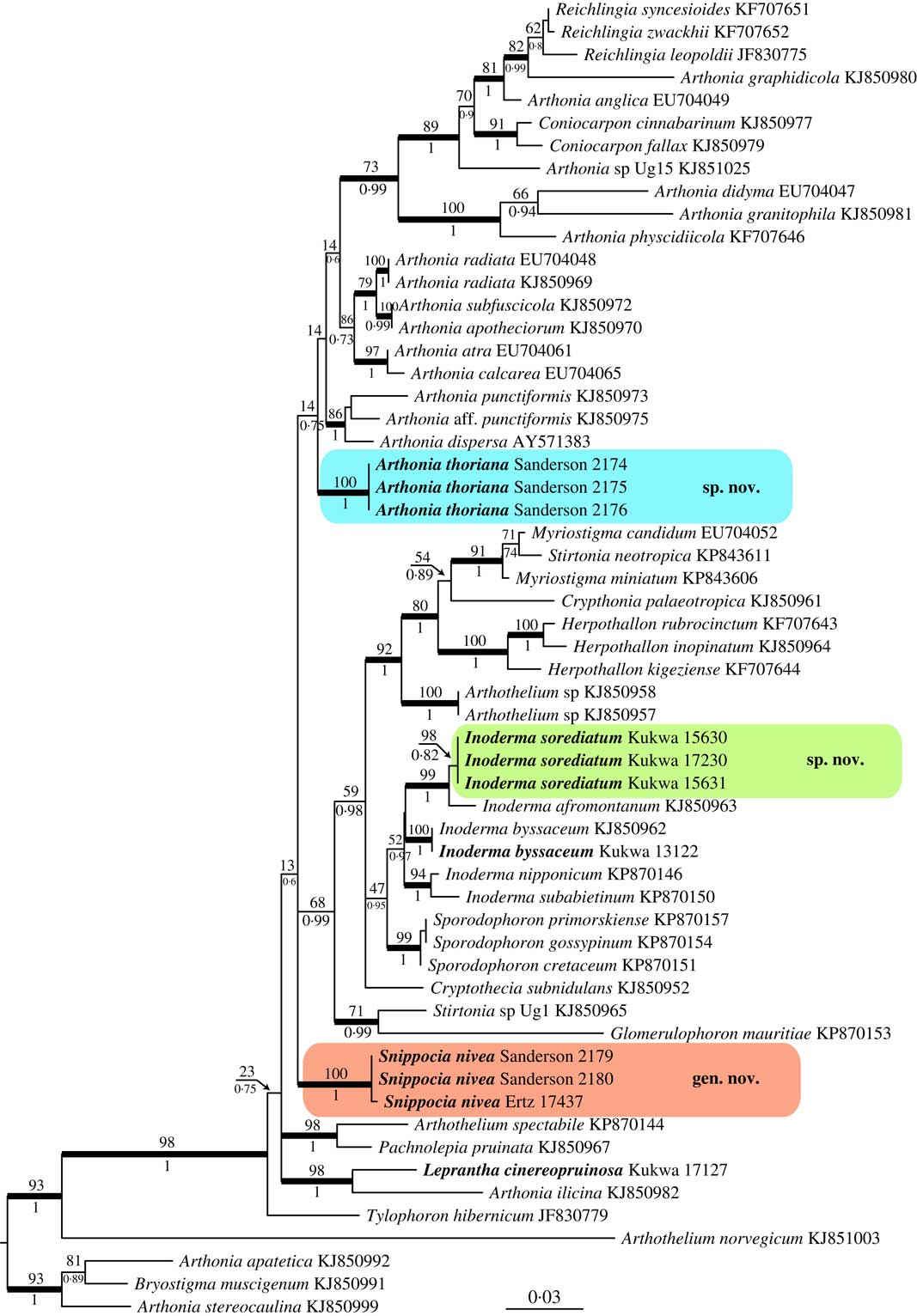
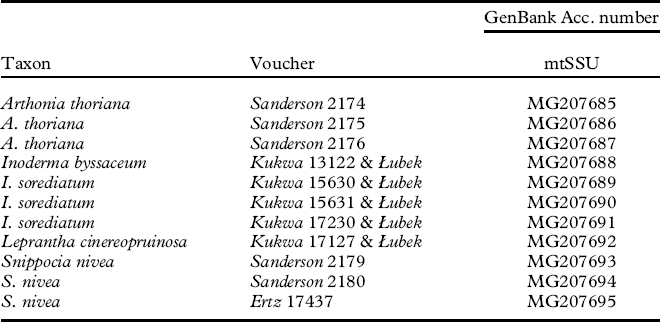
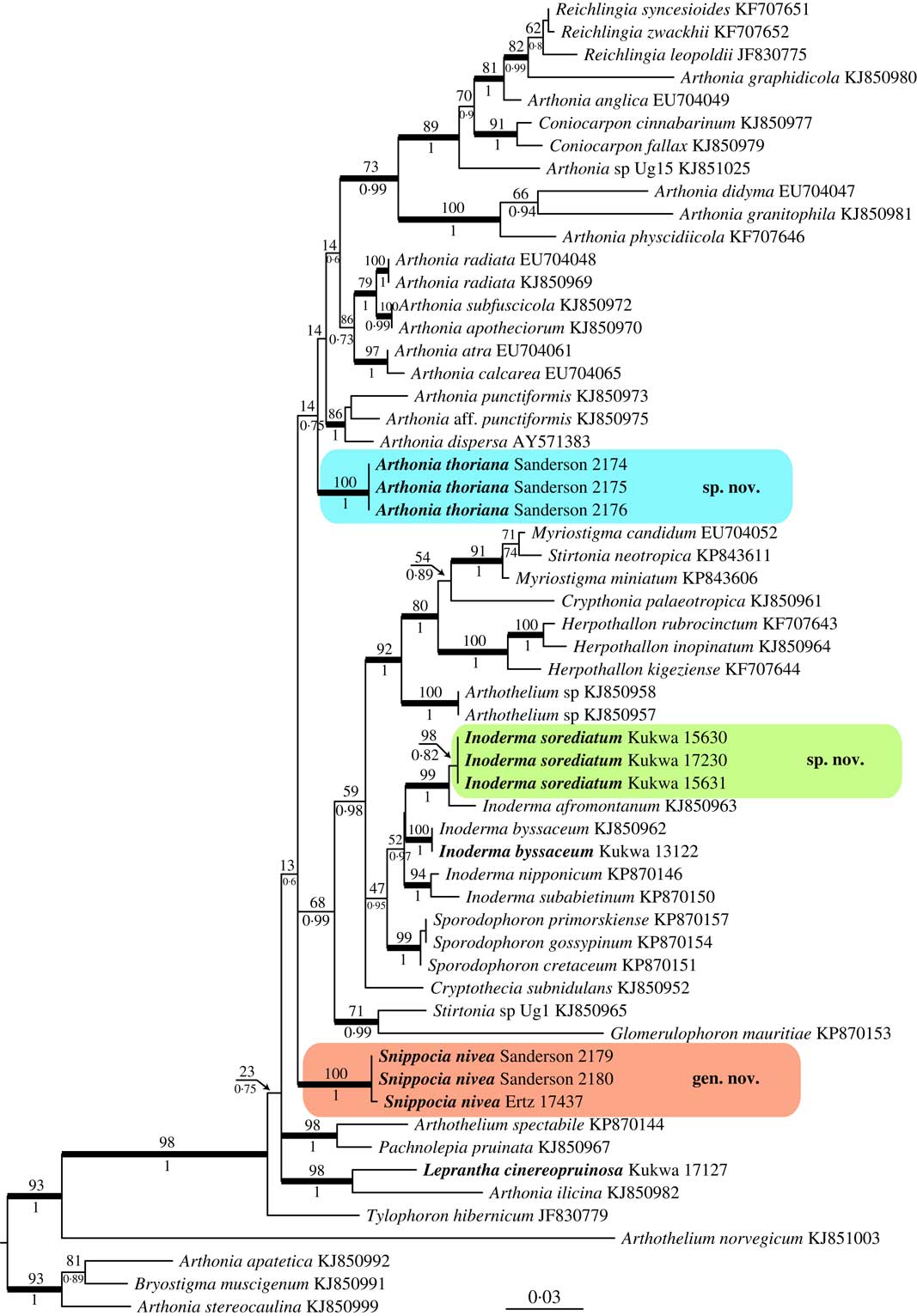
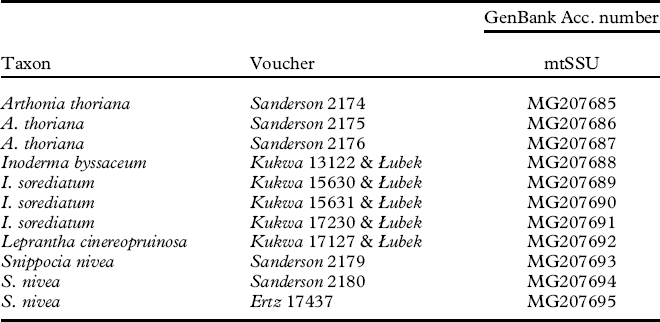
Eleven new mtSSU sequences from five species were obtained for this study (Table 1) and their closest relatives based on ‘Megablast’ searches were retrieved from GenBank. Members of the Arthoniaceae s. str. as circumscribed by Frisch et al. (Reference Frisch, Thor, Ertz and Grube2014), and for which the mtSSU was available, were selected. We were not able to amplify the RPB2 for Arthonia thoriana and therefore based our phylogenetic analyses only on the mtSSU gene. In total, 47 sequences were retrieved from GenBank for the phylogenetic analyses (Fig. 1). Three species of the Bryostigma clade as defined by Frisch et al. (Reference Frisch, Thor, Ertz and Grube2014), viz. Arthonia apatetica (A. Massal.) Th. Fr., A. stereocaulina (Ohlert) R. Sant. and Bryostigma muscigenum (Th. Fr.) Frisch & G. Thor, were chosen as outgroup. The sequences were aligned using MAFFT v.6.814b (Katoh et al. Reference Katoh, Misawa, Kuma and Miyata2002) within Geneious and improved manually using Mesquite 3.04 (Maddison & Maddison Reference Maddison and Maddison2015). Terminal ends of sequences and ambiguously aligned regions were delimited manually and excluded from the dataset.
Phylogenetic relationships among Arthoniaceae based on a dataset of 55 samples of mtSSU sequences that resulted from a RAxML analysis. Maximum likelihood bootstrap values are shown above internal branches, and posterior probabilities obtained from a Bayesian analysis are shown below internal branches. Internal branches, considered strongly supported by both analyses, are represented by thicker lines. Newly sequenced samples are in bold, shaded areas indicate new taxa. In colour online.
Species names, voucher specimens and GenBank Accession numbers for the specimens included in the phylogenetic inference depicted in Fig. 1 and for which sequences were generated in this study
Bayesian analyses were carried out on the dataset using the Metropolis-coupled Markov chain Monte Carlo (MCMCMC) method in MrBayes v.3.2.6 (Huelsenbeck & Ronquist Reference Huelsenbeck and Ronquist2001; Ronquist & Huelsenbeck Reference Ronquist and Huelsenbeck2003) on the CIPRES web portal (Miller et al. Reference Miller, Pfeiffer and Schwartz2010). Best-fit evolutionary models were estimated using the Akaike Information Criterion (AIC; Akaike Reference Akaike1973) as implemented in jModelTest 2 v.2.1.6 (Darriba et al. Reference Darriba, Taboada, Doallo and Posada2012) and the GTR+I+G model was selected. Two parallel MCMCMC runs were performed, each using four independent chains and 80 million generations, sampling trees every 1000th generation. Tracer v.1.6 (Rambaut & Drummond Reference Rambaut and Drummond2007) was used to ensure that stationarity was reached by plotting the log-likelihood values of the sample points against generation time. Convergence between runs was also verified using the PSRF (Potential Scale Reduction Factor), where all values were equal to 1·000 or 1·001. Posterior probabilities (PP) were determined by calculating a majority-rule consensus tree generated from the 120002 post-burn-in trees of the 160002 trees sampled by the two MCMCMC runs using the sumt option of MrBayes. In addition, a maximum likelihood (ML) analysis was performed using RAxML-HPC2 v.8.2.10 (Stamatakis Reference Stamatakis2014) with 1000 ML bootstrap iterations (ML-BS) and the GTRGAMMA model.
The RAxML tree did not contradict the Bayesian tree topology for the strongly supported branches. Therefore, only the RAxML tree is shown with bootstrap support values added above the internal branches and posterior probabilities of the Bayesian analysis added below the internal branches (Fig. 1). ML-BS≥70 and PP≥95 were considered to be significant. Phylogenetic trees were visualized using FigTree v.1.4.2 (Rambaut Reference Rambaut2012).
Results
The mtSSU dataset consisted of 58 specimens and 587 unambiguously aligned sites. In our phylogenetic tree (Fig. 1), Arthothelium norvegicum Coppins & Tønsberg is the sister taxon to the rest of Arthoniaceae s. str., a strongly supported group including our newly sequenced specimens. In Frisch et al. (Reference Frisch, Thor, Ertz and Grube2014), the remainder of the Arthoniaceae is divided into the Arthonioid and Cryptothecioid subclades but these subclades are not recovered here. This is probably due to the poorly resolved backbone of the tree using the sole mtSSU gene, while the tree of Frisch et al. (Reference Frisch, Thor, Ertz and Grube2014) was based on three genes. Inoderma sorediatum forms a clade together with I. afromontanum and this relationship is strongly supported. Arthonia thoriana clusters near the core group of Arthonia (= A. radiata (Pers.) Ach. and relatives) but this relationship is not supported. Arthonia cinereopruinosa is placed as the sister taxon to A. ilicina and the genus Leprantha is therefore resurrected. Schismatomma niveum has an isolated phylogenetic position within the Arthoniaceae s. str. and is described below as the new genus Snippocia.
Taxonomy
Arthonia thoriana Ertz & Sanderson sp. nov.
MycoBank No.: MB 822981
Taxon belonging to the Arthoniaceae and characterized by a non-lichenized white thallus, pallid brown, white pruinose ascomata 0·12–0·30 mm diam., richly anastomosing paraphysoids and (1–2–)3-septate ascospores 9–12×3·0–3·5 µm.
Type: Great Britain, England, V.C. 5, Somerset, Horner Combe, Cloutsham Ball, Grid Ref. SS89748 43912, ancient Quercus in pasture woodland, on craggy dry bark on ancient Quercus pollard, 8 September 2016, N. A. Sanderson 2176 (BR—holotype!; E—isotype!).
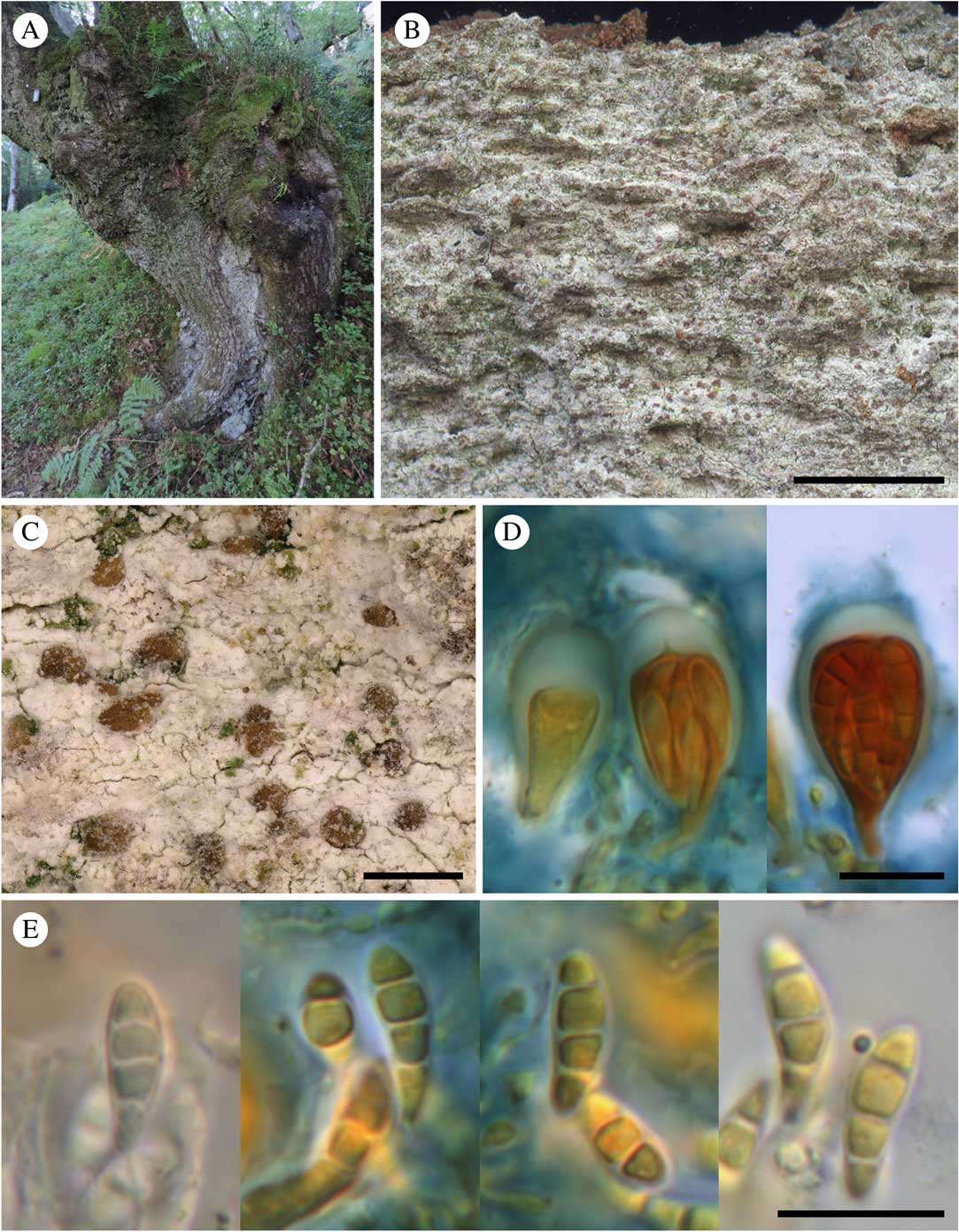
Arthonia thoriana (holotype). A, habitat, ancient pasture woodland, Horner Combe, Great Britain, found in abundance in a mosaic with Inoderma subabietinum on ancient low cut pollarded Quercus petraea high up on a steep slope, sample Sanderson 2176 collected from white streak; B & C, thallus with apothecia; D, asci in KI; E, ascospores (left hand plate in H2O, the rest in KI). Scales: B=0·5 cm; C=500 µm; D & E=10 µm. In colour online.
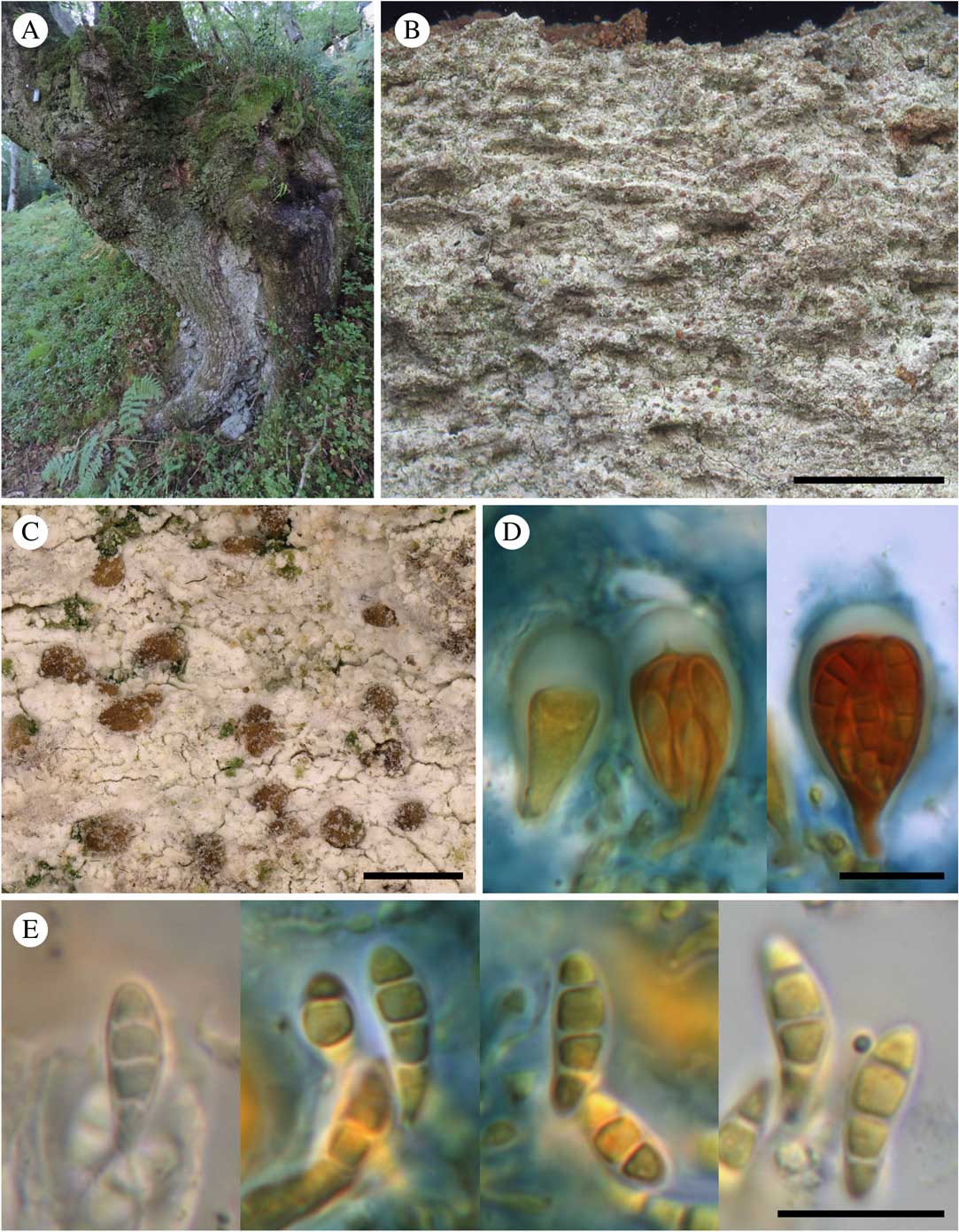
Thallus up to 3 cm diam., up to 60 µm thick, white, cracked, scurfy in places, non-lichenized despite the frequent presence of large colonies of free-living green unicellular algae with rectangular cells 3–5×3 µm.
Apothecia scattered, abundant, solitary, rarely 2–3 contiguous, sessile, rounded, emarginate, 0·12–0·30 mm diam.; disc plane to convex, pallid brown, with a thin layer of white pruina covering at least some parts of the surface. Excipulum inconspicuous. Hymenium hyaline to very pale brown, 35–45 µm. Epihymenium up to 5 µm thick, brown, K+ becoming greyish, covered by crystals of calcium oxalate. Paraphysoids abundant, richly anastomosing, 1 µm thick, not or slightly enlarged at the apex, up to 1·5(–2·0) µm. Subhymenium hyaline to pale brown, 10–22 µm thick. Asci 8-spored but sometimes with one or two spores remaining immature, pyriform, with a distinct short stipe, (22–)23–30(–35)×10–13 µm, wall slightly or distinctly thickened at the apex, 3–6 µm thick, with or without a distinct ocular chamber. Ascospores ±clavate, hyaline, (1–2–)3-septate, (8–)9–12×3·0–3·5(–4·0) µm, without gelatinous sheath.
Pycnidia not seen.
Chemistry. Thallus surface K−, C−, PD−, UV−; hymenium I+ dark red with small parts I+ persistently dark blue, KI+ blue; ascus wall I− and KI− (KI blue ring structure not observed), but with a thin I+ orange layer on its surface. TLC revealed one terpenoid similar to zeorin but with an Rf slightly higher in solvent C (specimens Sanderson 2174, 2176 tested).
Etymology. This new species is dedicated to Göran Thor for his outstanding work on the taxonomy of the Arthoniaceae.
Distribution and ecology. Known only from Great Britain in Horner Combe, Somerset (elevation of 110–180 m), where it was found on ten trees. All were old Quercus petraea in grazed pasture woodlands; most were in relatively open woodland but a couple of trees were being shaded by young Ilex aquifolium. The new species was clearly most vigorous on better lit trees. The species was confined to dry bark on the undersides of leaning old trees, both maiden trees (3) and low cut pollards (7). Closely associated species included Chaenotheca trichialis (Ach.) Hellb., Chrysothrix candelaris (L.) J. R. Laundon, Inoderma subabietinum (Coppins & P. James) Ertz & Frisch and Dendrographa decolorans (Turner & Borrer) Ertz & Tehler, with Opegrapha xerica Torrente & Egea and Cresponea premnea (Ach.) Egea & Torrente found nearby in the same habitat. Other species of conservation interest found on dry bark of old oaks on the slopes included Arthonia anombrophila Coppins & P. James, A. arthonioides (Ach.) A. L. Sm., Chaenothecopsis cf. savonica (Räsänen) Tibell parasitic on Lecanactis abietina (Ehrh. ex Ach.) Körb., Calicium lenticulare Ach., Schismatomma umbrinum (Coppins & P. James) P. M. Jørg. & Tønsberg and Syncesia myrticola (Fée) Tehler (sorediate morph).
Horner Combe consists of c. 325 ha of woodland which is unenclosed from a larger area of grazed moorland above, the whole complex being within the Dunkery & Horner Woods National Nature Reserve, owned and managed by the National Trust. It is located in a deep, west to east flowing valley with steep sides in a wet oceanic climate. The woodland is grazed by sheep, cattle and Exmoor ponies owned by adjacent tenant farmers, and by wild red deer. It is the last large Exmoor woodland that remains unfenced and open to the moorland above. Cannell (Reference Cannell2005) demonstrated that in the medieval to the early modern period, all the large Exmoor woods were unfenced from the moor and that wood production was secondary to their value as sheltered grazing. From the late 18th century the importance of wood production, especially coppiced oak, increased and most woods were enclosed and managed more intensively, with old-growth pasture woodland eliminated. Horner Combe was an exception and has always remained open to grazing, but management was intensified. In the 19th century most of the south-facing slopes were converted to intensive oak coppice but large areas of old-growth pasture woodland survived on both north-facing slopes and the fertile valley bottoms. The surviving old pasture woodlands have long been known to support an exceptionally rich epiphytic lichen assemblage (Wolseley & O’Dare Reference Wolseley and O’Dare1989). In 2012 and 2016 the second author was contracted to carry out a systematic survey of the woods to update the existing inventory for the reserve management (Sanderson Reference Sanderson2017). There was an emphasis on covering the older woodlands on steep slopes which had not been fully explored previously. These included significant areas of old-growth woodland with frequent ancient oaks where Arthonia thoriana was found.
Notes. The new species does not seem to be lichenized despite the presence of a white thallus. The green algal cells present in and on the thallus do not seem to be closely associated with the mycobiont, as can be seen in typical lichens, and it is unclear if their presence might be essential for this species. Therefore, we consider Arthonia thoriana as being a non-lichenized species, as can be found in several species of Arthonia sect. Arthonia as defined by Sundin (Reference Sundin1999). Following the identification key to the species of Arthonia sect. Arthonia in Europe, northern Africa and North America by Sundin (Reference Sundin1999), A. thoriana keys out to A. pruinosella. This latter species differs by having circular to lirellate ascomata with a black disc, an olivaceous brown epihymenium, larger (c. 2–3 µm) and less branched-anastomosing paraphysoids, asci with a KI+ blue ring-like structure without distinct stipe and larger ascospores (10–)12–15(–16)×4–5 µm (Sundin Reference Sundin1999; Grube Reference Grube2007). Following the identification key to the species of Arthonia from Great Britain and Ireland (Coppins & Aptroot Reference Coppins and Aptroot2009), A. thoriana keys out to A. punctiformis Ach. which differs notably by much larger and non-pruinose ascomata (0·2–1·4×0·1–0·4 mm) and larger ascospores (13–23×5–7 µm). Other Arthonia species with white pruinose ascomata, a pale hypothecium and pluriseptate ascospores have larger ascomata and ascospores (Redinger Reference Redinger1938; Poelt Reference Poelt1969; Clauzade & Roux Reference Clauzade and Roux1985). Arthonia helvola (Nyl.) Nyl. and A. incarnata Kullh. ex Almq. are lichenized and have more reddish (for A. helvola), larger ascomata and mainly 2-septate ascospores with an enlarged upper cell (Fink Reference Fink1935; Redinger Reference Redinger1938; Poelt Reference Poelt1969; Sundin & Tehler Reference Sundin and Tehler1998; Wirth et al. Reference Wirth, Hauck and Schultz2013; Frisch et al. Reference Frisch, Thor, Moon and Ohmura2017). Following the identification key to the species of Arthonia of the United States (Fink Reference Fink1935), A. ochrolutea Nyl. appears to be the closest species but differs notably in the UV+ orange thallus, elongated, larger ascomata (c. 0·5–1·0 mm long) with a flat, pale yellow disc, and larger ascospores (15–19×4·5–5·5 µm according to our observation of the type specimen; 10·0–15·5×3–4 µm according to Fink (Reference Fink1935)); the species is treated as a synonym of A. antillarum Nyl. by Zahlbruckner (Reference Zahlbruckner1922). No lichenicolous Arthonia species appears to have ascomata and ascospores similar to the new species (e.g. Clauzade et al. Reference Clauzade, Diederich and Roux1989).
The new species is not very noticeable in the field and the thin, white cracked thallus appears sterile unless examined closely. The apothecia are small and pallid brown and covered by a thin layer of white pruina; they can be spotted only on close examination and are easily overlooked, which might explain why the species has not been recorded until now.
Additional specimens examined. Great Britain: England: V.C. 5, South Somerset, Horner Combe, Parsons Wood, Grid Ref. SS89710 44142, old-growth pasture woodland, on craggy dry bark on ancient Quercus pollard, 2016, Sanderson 2127 (hb. Sanderson); ibid., Cloutsham Ball, Grid Ref. SS89730 43868, 2016, Sanderson 2174 (hb. Sanderson); ibid., Grid Ref. SS89730 43886, Sanderson 2175 (hb. Sanderson).
Inoderma sorediatum Ertz, Łubek & Kukwa sp. nov.
MycoBank No.: MB 822982
Species of Inoderma characterized within the genus by an entirely sorediate thallus containing confluentic and 2′-O-methylperlatolic acids as thallus compounds.
Type: Poland, Równina Bielska, Białowieża Forest, Białowieża National Park, forest section no 256, Pino-Quercetum, ATPOL grid square Cg-55, on Quercus robur, 17 August 2015, M. Kukwa 17230 & A. Łubek (UGDA—holotype!; BR, KTC—isotypes!).
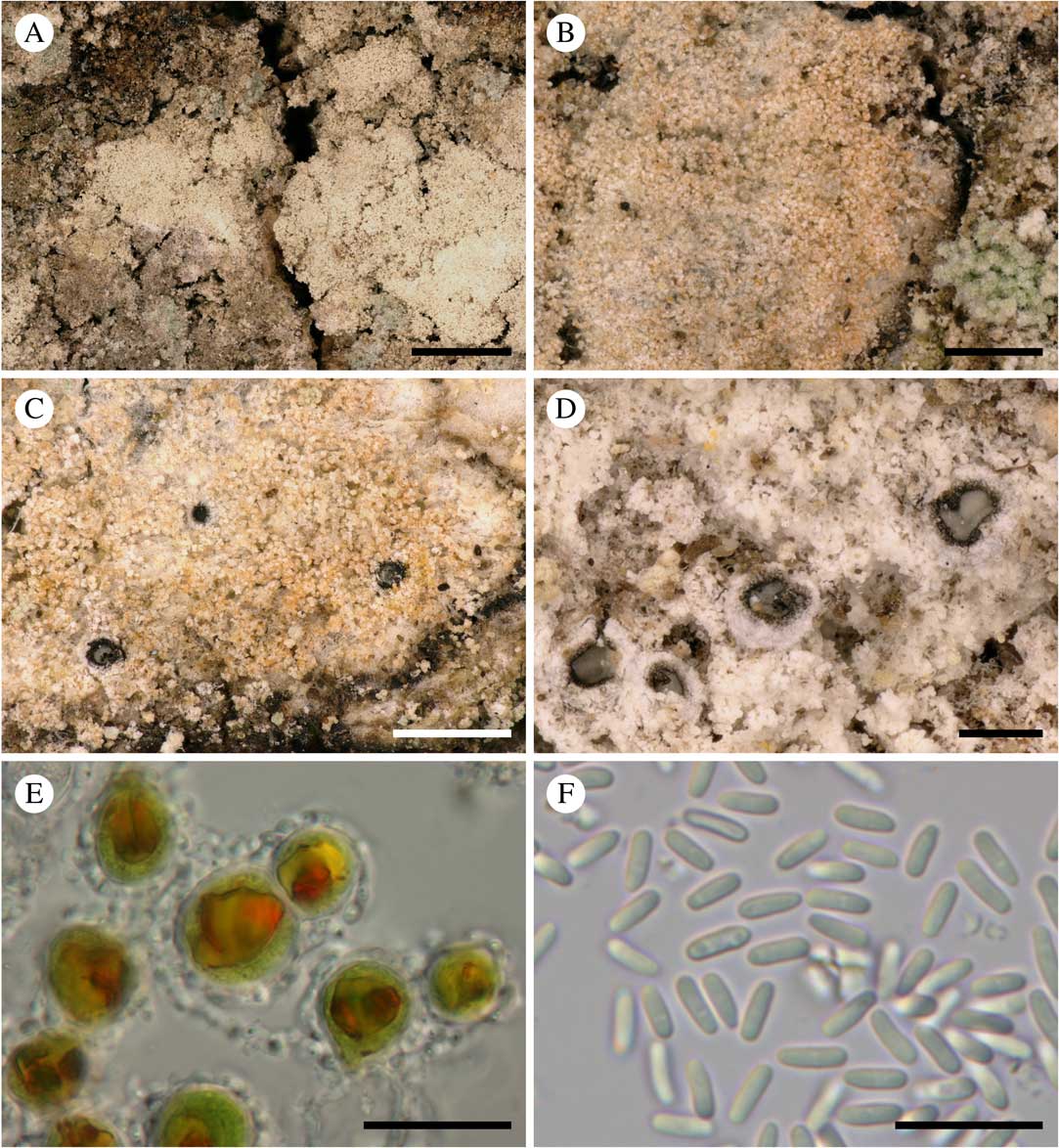
Inoderma sorediatum. A, thallus, herbarium specimen having lost its pinkish colour (Kukwa 15630 & Łubek); B & C, fresh thallus with pinkish tinge (Kukwa 17230 & Łubek), C with pycnidia; D, pycnidia (Kukwa 15631 & Łubek); E, soredia in K showing the trentepohlioid cells (Kukwa 17230 & Łubek); F, conidia. Scales: A=2 mm; B & C=0·5 mm; D=250 µm; E=20 µm; F=10 µm. In colour online.
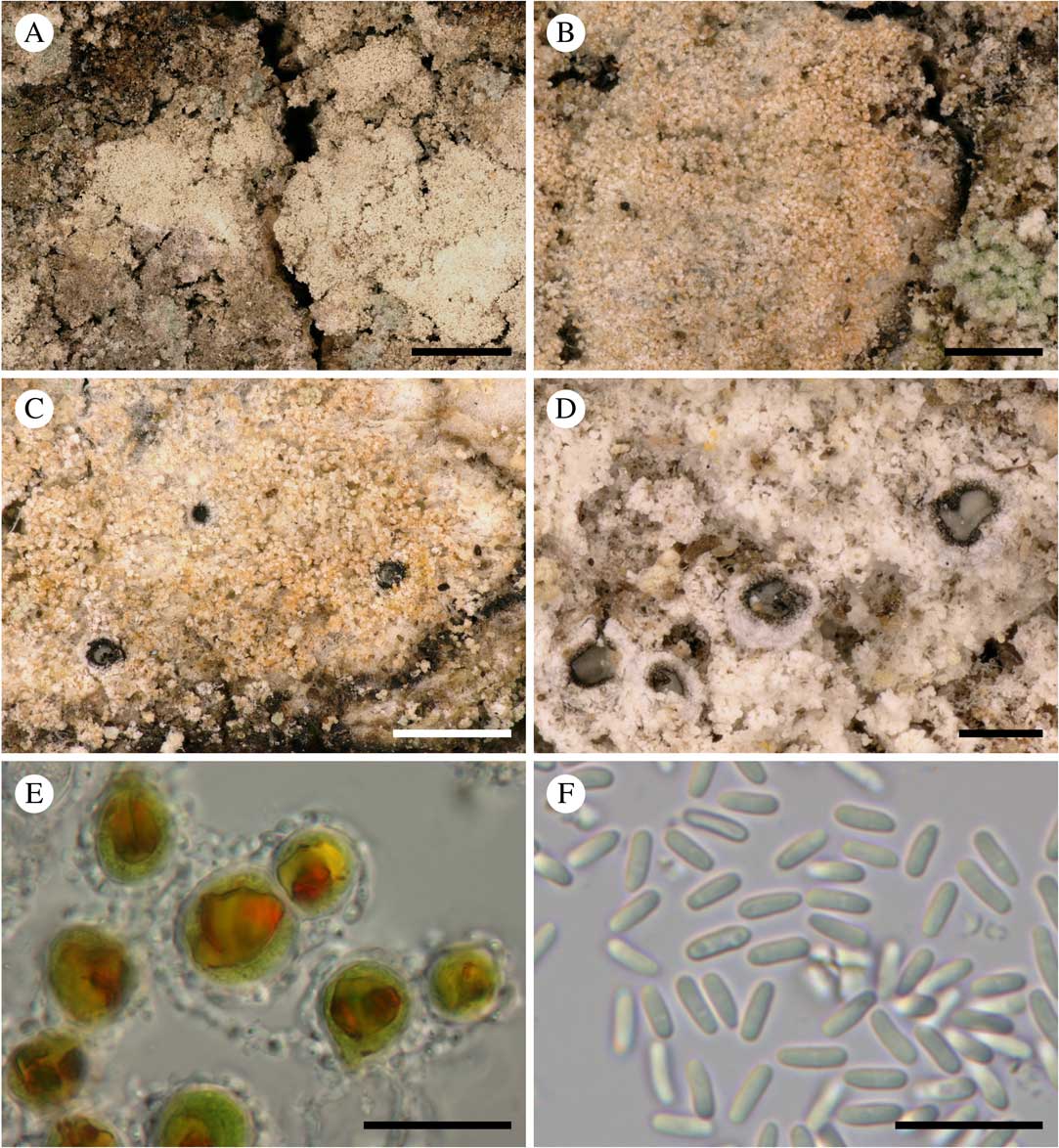
Thallus crustose, c. 1–2 cm diam., up to 0·5(–1·0) mm thick, pinkish when fresh, becoming white to pale yellowish in the herbarium, entirely sorediate, sometimes with free hyphae at the edge of the thallus, crystals of calcium oxalate absent. Soredia (18–)20–35(–40) µm diam., forming individual or short chains of photobiont cells incompletely surrounded by hyaline hyphae 2 µm diam., without projecting hyphae; no crystals visible on the hyphae in polarized light. Photobiont trentepohlioid, containing orange pigments refracting in polarized light, visible as individual globose cells, 10–17(–21) µm diam. or in short chains of 2–6 cells, with individual elliptical to rectangular algal cells 12–16×6–9 µm.
Ascomata unknown.
Pycnidia rare, 170–280 µm, similar to those of I. byssaceum; pycnidial wall dark brown, K+ slightly olivaceous. Conidia bacilliform, 3·5–5·0×1·1–1·3 µm.
Chemistry. Thallus surface K+ pale yellowish green, C−, PD−, UV+ cream to brownish (without fluorescence); hyphae I−, KI−. TLC revealed the production of confluentic and 2′-O-methylperlatolic acids (seven specimens tested).
Etymology. The specific epithet refers to the sorediate thallus.
Distribution and ecology. So far known only from the Białowieża National Park (the most well-preserved part of Białowieża Forest) in the lowland area of north-eastern Poland, where it inhabits trees in various types of forest.
The new species was found in deep bark crevices of living or dead Quercus robur (10 specimens) and on the bark of a dead Fraxinus excelsior (1 specimen), always on large trees and up to c. 0·5 m above ground level. Closely associated species included Chaenotheca chrysocephala (Ach.) Th. Fr., Chaenothecopsis cf. savonica (in specimen Kukwa 15630), Chrysothrix candelaris, Lepraria spp., Opegrapha vermicellifera (J. Kunze) J. R. Laundon and Reichlingia leopoldii Diederich & Scheid.
Notes. Inoderma sorediatum is a sorediate crustose lichen for which ascomata are unknown. Our molecular data place the species within the genus Inoderma (Fig. 1), a placement that is further corroborated by the pycnidial and conidial types, and by the chemistry. The new species is the only sorediate member of the genus and also the only one to contain both confluentic and 2′-O-methylperlatolic acids (Frisch et al. Reference Frisch, Ohmura, Ertz and Thor2015).
The only other member of the genus Inoderma present in the Białowieża Forest is I. byssaceum (Weigel) Gray, which differs from our new species by a whitish to pale fawn, non-sorediate thallus (but sometimes patchily granulose, the granules being large photobiont cells) that is largely endoperidermal, and by a different chemistry (unknown substance present) (Frisch et al. Reference Frisch, Ohmura, Ertz and Thor2015). The possibility that the new species could represent a sorediate morph of the often fertile I. byssaceum was investigated by the sequencing of one specimen of the latter. This Polish sample was found to have an mtSSU sequence identical to the Japanese specimen of that species (viz. KJ850962, the only specimen of I. byssaceum for which an mtSSU sequence is available on GenBank), leaving no doubt that our sorediate material represents a different species from the phylogenetically distantly related I. byssaceum (Fig. 1).
According to our phylogenetic tree, the closest relative of I. sorediatum is I. afromontanum Frisch & G. Thor which differs from our new species by the absence of confluentic acid, a thallus that is thinner, pale olivaceous grey and scurfy to minutely granular (but never sorediate), by its occurrence in tropical montane rainforests and by the mtSSU sequence having 8 different nucleotides (2 of them were in excluded ambiguous regions of the mtSSU alignment) (Frisch et al. Reference Frisch, Ohmura, Ertz and Thor2015).
Snippocia nivea (=Schismatomma niveum) is morphologically similar in its sorediate thallus that is pale pink when fresh; however, that species has a Pd+ orange-yellow thallus containing psoromic and 2-O-demethylpsoromic acids (James Reference James1971) and a different phylogenetic position within the Arthoniaceae (Fig. 1).
An unidentified lichenicolous species of Chaenothecopsis with sessile ascomata, ±dark brown aeruginose head and dark brown, 1-septate ascospores with a rugulose surface, 6–8×2–3 µm, is present on Inoderma sorediatum (specimen Kukwa 15629). It might represent C. subparoica (Nyl.) Tibell but that species is known only from Haematomma ochroleucum (Neck.) J. R. Laundon, or C. retinens (Nyl.) Tibell which is known on Inoderma byssaceum and Sporodophoron cretaceum (Hue) Ertz & Frisch but has a reddish head in squash preparations (Giavarini & Coppins Reference Giavarini and Coppins2009; Lawrey & Diederich Reference Lawrey and Diederich2017). This material needs further study.
Additional specimens examined. Poland: Równina Bielska: Białowieża National Park, forest section no 256, Carici elongatae-Alnetum, on Quercus robur, 2014, Kukwa 14361 & Łubek (KTC, UGDA); ibid., Circaeo-Alnetum, on bark of snag (Fraxinus excelsior), 2014, Kukwa 13046 & Łubek (KTC, UGDA); ibid., Pino-Quercetum, on bark of snag (Quercus robur), 2015, Kukwa 17560 & Łubek (KTC, UGDA); ibid., Querco-Piceetum, on Quercus robur, 2015, Kukwa 17646 & Łubek (KTC, UGDA); ibid., Tilio-Carpinetum, on Quercus robur, 2014, Kukwa 12958, 12993 & Łubek (KTC, UGDA); ibid., on Quercus robur, 2014, Kukwa 14356 & Łubek (KTC, UGDA); ibid., on Quercus robur, 2015, Kukwa 15629 (with lichenicolous Chaenothecopsis), 15630, 15631 & Łubek (BR, UGDA).
Material of Inoderma byssaceum sequenced. Poland: Równina Bielska: Białowieża National Park, forest section no 256, Circeo-Alnetum, on bark of fallen Fraxinus excelsior, 2014, Kukwa 13122 & Łubek (BR, KTC, UGDA).
Snippocia Ertz, Kukwa & Sanderson gen. nov.
MycoBank No.: MB 822983
An unusual member of the family Arthoniaceae characterized by having an isolated phylogenetic position (Fig. 1), a persistently sterile, sorediate thallus and by the production of psoromic and 2-O-demethylpsoromic acids.
Type species: Snippocia nivea (D. Hawksw. & P. James) Ertz & Sanderson.
Etymology. Named after Brian Coppins (Snippoc in reverse order) for his outstanding work in lichenology.
Snippocia nivea (D. Hawksw. & P. James) Ertz & Sanderson comb. nov.
MycoBank No.: MB 822984
Schismatomma niveum D. Hawksw. & P. James, Lichenologist 5: 145 (1971); type: not seen.
Description: see James (Reference James1971) and Wolseley & Hawksworth (Reference Wolseley and Hawksworth2009).
Notes. Schismatomma niveum is a sterile sorediate species that was described from the New Forest (James Reference James1971). Two specimens collected at the type locality and one specimen collected in Brittany (France) were sequenced and place the species in Arthoniaceae s. str. (Fig. 1). As the species cannot stay in the genus Schismatomma, which belongs in the Roccellaceae, a new combination in the genus Arthonia s. lat. was first investigated. However, because of the existence of Arthonia nivea Willey, a new name for S. niveum should be introduced in Arthonia. The species does not belong to Arthonia s. str. (type species: A. radiata) and it can be expected that S. niveum will be excluded from that genus again in the near future in the course of ongoing taxonomic work on the Arthoniaceae. In this case the epithet “niveum” will be available, making the introduction of a new name for the species appear unnecessary and ill-advised. Arthonia cinereopruinosa Schaer. is the type of the generic name Leprantha Dufour ex Körb. (see Sundin et al. Reference Sundin, Thor and Frisch2012) in Arthoniaceae that might be related to Schismatomma niveum because they share similar chemistry in having psoromic acid (e.g. Coppins & James Reference Coppins and James1978: 186; Sundin & Tehler Reference Sundin and Tehler1998). In order to verify whether S. niveum could be placed in the genus Leprantha, one specimen of A. cinereopruinosa was sequenced and found to be unrelated to S. niveum; instead A. cinereopruinosa groups with A. ilicina with strong support (Fig. 1). In order to avoid the introduction of a ‘temporary’ name for Schismatomma niveum, we prefer to place the species in its own genus.
Sequenced specimens of Snippocia nivea: France: Brittany: Dept. du Finistère, Huelgoat, sentier de la Grotte d’Artus, 170 m, 48°35'12''N, 3°44'10''W, tronc de Quercus en forêt, 2012, Ertz 17437 (BR).—Great Britain: England: V.C. 11, New Forest, Busketts Wood, Eaves Hill, Grid Ref. SU30936 11370, pasture woodland, on acid bark of old Quercus robur, 2016, Sanderson 2179 (hb. Sanderson); ibid., Grid Ref. SU30733 11210, on acid bark of old Fagus, Sanderson 2180 (hb. Sanderson).
Sequenced specimen of Leprantha cinereopruinosa: Poland: Równina Bielska: Białowieża Forest, Białowieża National Park, forest section no 256, Pino-Quercetum, on Quercus robur, 2015, Kukwa 17127 & Łubek (BR).
Discussion
Forests with long historical continuity and old trees are well known to harbour rich lichen diversity (e.g. Rose Reference Rose1976; Cieśliński & Tobolewski Reference Cieśliński and Tobolewski1988; Faliński & Mułenko Reference Faliński and Mułenko1997; Marmor et al. Reference Marmor, Tõrra, Saag and Randlane2011; Wolseley et al. Reference Wolseley, Sanderson, Thüs, Carpenter and Eggleton2017). Many species are used as indicators of woodland ecological continuity (e.g. Rose Reference Rose1976; Wolseley & O’Dare Reference Wolseley and O’Dare1990; Diederich Reference Diederich1991; Motiejūnaitė et al. Reference Motiejūnaitė, Czyżewska and Cieśliński2004). Surveys carried out recently in the well-known Białowieża Forest in Poland and in an old-growth woodland pasture in southern England yielded two new species of Arthoniaceae that further support the high value of such forests for the conservation of biodiversity. Now that these species are described and illustrated, new localities are likely to be discovered and might be of high priority for biodiversity action plans. Arthonia thoriana is a rather inconspicuous species and as such might have been easily overlooked and because Inoderma sorediatum is a sterile lichen that might have been misidentified or neglected by lichenologists, further research is needed to find out whether these species are more widespread. However, according to our detailed field observations in the Białowieża Forest and in Horner Combe, it is unlikely that they will be found outside well-preserved old-growth forests.
Phylogenetic studies are beginning to elucidate generic relationships in the Arthoniaceae but, despite important progress in recent years (e.g. Ertz & Tehler Reference Ertz and Tehler2011; Frisch et al. Reference Frisch, Thor, Ertz and Grube2014, Reference Frisch, Ohmura, Ertz and Thor2015), too few molecular data are currently available to reallocate most of the species into well-defined monophyletic genera. However, our molecular data could clarify the generic affiliation of Inoderma sorediatum, the new sorediate and sterile species found in the Białowieża Forest. Inoderma is a genus recently resurrected for a small group of species with elevated, white pruinose pycnidia, immersed to adnate white pruinose apothecia and a weakly gelatinized hymenium (Frisch et al. Reference Frisch, Ohmura, Ertz and Thor2015). Moreover, our phylogenetic tree (Fig. 1) reveals a geographically disjunct lineage of the European I. sorediatum with I. afromontanum, a species confined to tropical montane forests of East Africa (Frisch et al. Reference Frisch, Ohmura, Ertz and Thor2015). Further study is needed to check if the species has a wider distribution.
The generic affiliation of Arthonia thoriana needs further investigation. In our phylogenetic tree, the species is rather closely related to the core group of Arthonia (generic type: A. radiata) but this is not supported. Our phylogenetic tree also proves that Schismatomma niveum does not belong to Schismatomma in Roccellaceae but is a member of Arthoniaceae s. str. Because the species has an isolated phylogenetic position within the Arthoniaceae, it is placed in its own new genus, Snippocia. The genus Leprantha is resurrected for its type species (L. cinereopruinosa) which also produces psoromic acid. This taxon appears to be related to Arthonia ilicina but the generic affiliation of the latter species deserves further study when more data are available.
We wish to warmly thank Cyrille Gerstmans, Myriam Dehaan and Wim Baert (Meise) for their help with the molecular work and other technical parts of the manuscript, and Emilia Ossowska (Gdańsk) for help with thin-layer chromatography. This research was supported with funding from the Polish-Norwegian Research Programme operated by the National Centre for Research and Development under the Norwegian Financial Mechanism 2009–2014 (Project Contract No Pol-Nor/196829/87/2013).