The Rome Statute establishing the International Criminal Court (ICC) entered into force on 1 July 2002 after being ratified by sixty states. Today, 123 countries are states parties to the ICC. The establishment of the ICC represented an important step forward in international justice and accountability for human rights abuses; it created a permanent international body charged with prosecuting genocide, crimes against humanity, and war crimes when domestic justice systems are unwilling or unable to do so. As the first permanent, international court with such jurisdiction, the ICC ushered in a new era in the protection of human rights.
While the court's contributions to international justice are clear, its impact on the pursuit of peace is less certain. A central debate for legal scholars and political scientists studying the ICC centers on whether the court can simultaneously promote peace and justice. This peace-versus-justice debate is crucial, given that the ICC has initiated examinations and investigations into several ongoing conflicts, including those in Darfur, Mali, and Uganda, among others. The court's demonstrated willingness to intervene in ongoing wars necessitates a critical examination of how it affects the ability of combatants to achieve lasting peace.
Existing research on the court's impact on peace is limited in three ways. First, it lacks broad theoretical consensus. Some argue that seeking justice promotes peace by deterring future atrocities,Footnote 1 while others argue that the pursuit of justice undermines peace in the near and long term.Footnote 2 At the extreme, one commentator warns that “the quest for justice for yesterday's victims of atrocities should not be pursued in such a manner that it makes today's living the dead of tomorrow.”Footnote 3
Second, little empirical work has addressed the ICC's impact on conflict termination. Only one existing study, to my knowledge, directly examines how the ICC affects prospects for civil conflict settlement.Footnote 4 While a small number of other studies address related issues, such as how the ICC influences autocrats’ tenuresFootnote 5 or states’ human rights practices,Footnote 6 we simply do not know with certainty whether the ICC promotes conflict settlement or makes wars more difficult to end.
Third, the limited empirical work that does exist focuses primarily on ICC ratification rather than active involvement by the ICC as the variable of theoretical interest.Footnote 7 While understanding ratification's impact is important, the ICC's influence on the trajectory of civil wars is arguably greater when the court is actually engaged in an investigation or legal proceedings in the warring state. Focusing on ratification, therefore, tells only part of the story of the ICC's impact, ignoring what is likely to be the court's most influential role. Only recently have scholars begun to examine the impact of ICC actions and investigations, though none focus on the court's impact on conflict termination.Footnote 8
To address these limitations in existing research, I examine the impact of active ICC involvement on conflict termination, seeking to answer whether the ICC's pursuit of justice facilitates civil conflict termination or has the perverse effect of prolonging conflict, making peace more difficult to achieve. To answer this question, I focus on rebel and state leaders’ incentives to avoid punishment during and after civil war. Criminal prosecution at the ICC represents a potential source of punishment that leaders hope to avoid. Once the ICC becomes actively involved in a conflict, leaders’ incentives may favor conflict continuation as a way to avoid capture, extradition, and trial. Importantly, this effect is likely conditional upon the threat of domestic punishment. As the risk of punishment at home increases, the conflict-prolonging impact of ICC involvement is expected to decrease.
I test these expectations on a data set of civil conflict dyads between 2002 and 2013. Statistical results provide strong support for my expectations: ICC involvement significantly decreases the likelihood of conflict termination, particularly when the threat of domestic punishment is low. These results are robust to a variety of additional tests, including alternative specifications of key variables and tests to address potential selection effects and endogeneity. Overall, the findings indicate that when risks of domestic punishment are low the ICC's pursuit of justice undermines peace by threatening leaders’ political survival and personal freedom.
As one of the first analyses to examine ICC involvement rather than ratification, this article expands our understanding of the ICC's role in international politics. It qualifies existing research finding that ratification facilitates conflict termination and improves states’ human rights practices,Footnote 9 while complementing research demonstrating that the court can impede the peaceful surrender of autocrats and has little effect on their behavior.Footnote 10 It also contributes to an emerging understanding that the ICC's impact is complex and frequently conditional by exploring the interaction between domestic and international punishment.Footnote 11
The article also contributes to burgeoning research on the role of leaders in civil conflict, identifying a source of punishment—ICC prosecution—that previous analyses have not examined.Footnote 12 In addition, this project makes an important data contribution by generating an original data set on all instances of active involvement by the ICC. It addresses potential selection and endogeneity issues both theoretically and empirically, and in so doing, provides evidence to suggest that leaders are not likely deterred from engaging in conflict by the risk of future ICC prosecution, and that ICC involvement is not endogenous to the difficulty of conflict. Finally, this paper has important policy implications for the court, suggesting that it should carefully weigh the potential conflict-exacerbating effects of investigation before becoming involved in ongoing conflict situations.
Literature Review
On 17 July 1998, 120 states voted in favor of the Rome Statute establishing the International Criminal Court. This vote represented a watershed in the evolution of international justice because the ICC is the first permanent body of its kind and has unprecedented powers to pursue even sitting heads of state. In 2002, the Rome Statute entered into force after being ratified by sixty countries.Footnote 13 Since then, the court has become an active player in international justice, with current investigations in nine countries, preliminary examinations in twelve others, and cases pending or completed against thirty-one individuals.Footnote 14
Given the court's institutional novelty and important role in international politics, it has garnered significant attention from legal scholars and political scientists alike. Existing research primarily addresses the development of the Rome StatuteFootnote 15 and its ratification in light of the fact that accepting ICC jurisdiction entails significant sovereignty costs.Footnote 16
Relatively fewer studies address the court's effectiveness or its impact on peace and conflict. Furthermore, what little work has been done has proven to be inconclusive. Theoretical work in the law literature, for example, is divided on whether the ICC can simultaneously facilitate peace and justice. Some legal scholars argue that international prosecution facilitates peace by deterring future atrocities,Footnote 17 while others conclude that the court has limited deterrent capabilities.Footnote 18 Still others claim that the ICC's pursuit of justice may actually come at the price of peace,Footnote 19 particularly given the Rome Statute's purposeful ambiguity regarding the recognition of amnesty-for-peace deals.Footnote 20
Existing empirical research has also proven to be inconclusive regarding the ICC's impact. Some scholars identify benefits from ratification, showing that it facilitates peace in some warring statesFootnote 21 and improves human rights practices.Footnote 22 However, others identify negative or null effects, finding that ratification prolongs some dictatorial regimes,Footnote 23 and that international tribunals have no significant effect on postconflict respect for human rights.Footnote 24 Emerging research on the court's actions rather than ratification is similarly inconclusive. Research by Jo and Simmons finds that the court's involvement can reduce atrocities under certain conditions, while studies by Broache and Hillebrecht show that the court's impact on state and rebel behavior varies.Footnote 25
Thus, existing research on the ICC lacks clear consensus. The only existing study to directly examine the ICC's impact on conflict termination focuses exclusively on ratification rather than active involvement by the court and therefore cannot fully explain the ICC's impact on peace.Footnote 26 This is an important omission from the literature because the effect of active involvement likely differs from that of ratification. While ratification promotes peace in war-torn states, active ICC involvement can undermine conflict termination by increasing leaders’ expectations of punishment. In line with recent studies showing that the court's impact is conditional, I further argue that the ICC's impact is conditional upon a leader's risk of domestic punishment.Footnote 27
Theory
Rebel and state leaders are assumed to be rational, self-interested actors who prefer to avoid punishment, including loss of political power and more severe sanctions.Footnote 28 That leaders seek to maintain political power is well established in the international relations literature.Footnote 29 Political power grants state leaders tremendous influence over state resources and domestic and foreign policy. The same is true for rebels: leadership grants the individual control over the group's resources, provides a platform to shape demands, and carries with it the potential for state-level power should the group achieve victory.Footnote 30
Equally pertinent in the context of civil war is the assumption that leaders want to avoid more severe forms of punishment, such as exile, assassination, and prosecution. Loss of political office is just one relatively mild consequence of failed policies.Footnote 31 As rational actors, leaders are expected to take the threat of many forms of punishment into consideration when making strategic decisions during conflict.Footnote 32 International criminal prosecution via the ICC is one potential source of punishment that, under certain conditions, influences leaders’ willingness and ability to terminate their conflicts.
ICC Involvement and the Risk of Punishment
Theories of criminal deterrence in the economics and criminology literatures identify three determinants of punishment's impact: its certainty, severity, and celerity.Footnote 33 Certainty refers to the probability that the individual is punished, severity deals with the nature of the punishment, and celerity refers to the immediacy of that punishment. Recent research suggests that certainty and, to a lesser extent, celerity are key to punishment's effectiveness.Footnote 34
This research provides insights into why ICC involvement is likely to affect leader behavior: punishment in the form of international criminal prosecution becomes both more certain and more immediate once the ICC is actively involved in a situation. The increased immediacy of punishment is straightforward: referring a situation to the court can be a lengthy process, so once an examination or investigation is under way, punishment becomes a much less remote possibility.
The certainty of punishment also increases as a result of ICC involvement. Prior to the court initiating an examination, leaders have few cues to help them predict whether the court will prosecute. First, the court lacks the resources necessary to investigate the majority of crimes falling under its jurisdiction. It has received several thousand communications pursuant to Article 15, but has moved to the investigation stage in only a handful of cases because of the vast monetary resources and personnel hours required.Footnote 35 Thus, initiating a conflict or committing atrocities may not significantly increase the certainty of prosecution.Footnote 36 Second, the ICC's jurisdiction is potentially quite broad: the court can initiate preliminary examinations based upon state referral, UN Security Council (UNSC) resolution, or its proprio motu authority (Article 15), which allows the Office of the Prosecutor (OTP) to initiate investigations on its own initiative.Footnote 37 Importantly, this means that ICC prosecution is not limited to individuals from ratifier states, and the most obvious indicator of future prosecution—ratification of the Rome Statute—is only weakly linked to the certainty of punishment.
On the other hand, once the OTP initiates an examination or investigation, the certainty of punishment increases. Of the nine situations that have proceeded to the investigation stage, all but one have resulted in arrest warrants. Further, in only three cases has the court begun an examination and decided not to proceed to investigation. Thus, when the court becomes actively involved in a situation, leaders will be much more certain of the ICC's intent to prosecute.
The Conflict-Exacerbating Effect of ICC Involvement
How do the increased certainty and celerity of punishment resulting from ICC involvement influence leaders’ war-termination decisions? Ending the conflict and associated human rights abuses, which once may have seemed a viable strategy to avoid ICC attention, is no longer an effective way to prevent prosecution since the court will not simply end an ongoing examination/investigation because the killing stops. Instead, leaders facing ICC prosecution may view continuing the conflict in the hope of avoiding punishment as their best option.Footnote 38 To understand why this is the case, consider the ways in which civil wars commonly end and how ICC involvement alters incentives for each outcome.
First, ICC involvement reduces the possibilities for peaceful settlement.Footnote 39 The OTP focuses its prosecutions on high-ranking officials, the very individuals whose cooperation is essential for securing settlement deals.Footnote 40 By threatening key leaders’ personal and political fortunes, ICC prosecution makes it more difficult for these individuals to make credible commitments to peace. Specifically, it undermines settlement by making the process of negotiating more difficult and the terms of settlement less favorable for peace.
ICC involvement complicates negotiations because leaders facing possible prosecution have incentives to stay entrenched in strongholds and avoid direct contact with their opponents and other outsiders who might act as the court's enforcers. This is because leaving secure bases to attend negotiations increases the risk of capture and transfer to the Hague. Domestic opponents may use the court as a way to punish an adversary when they lack the will or resources to prosecute themselvesFootnote 41 or when domestic punishment options are limited.Footnote 42 Therefore, ICC involvement incentivizes leaders to avoid negotiations because attending talks increases their vulnerability to capture and prosecution.
In Uganda, for example, Joseph Kony failed to show up to the signing of the Juba Peace Accords in April 2008, at least in part out of fear that he would be taken into custody at the Hague should he attend the signing ceremony.Footnote 43 The ICC case remained a stumbling block throughout negotiations between the Ugandan government and the Lord's Resistance Army (LRA), with Kony repeatedly insisting that ICC charges be dropped as a precondition for settlement.Footnote 44 Similarly, the “threat of prosecution by the international tribunal in the Hague made it practically impossible for NATO to reach an early deal with Milosevic, thereby lengthening the war and the suffering in the Balkans in the summer of 1999.”Footnote 45 In both cases, leaders’ fear of international prosecution undermined their ability to commit to peace, which hindered settlement attempts and extended conflict.Footnote 46
ICC involvement also undermines leaders’ ability to credibly commit by making the terms of settlement less favorable for peace. Specifically, it takes amnesty off the table.Footnote 47 Settlement offers that include amnesties can facilitate settlement by ensuring that key leaders avoid jail time (or worse) for their crimes. The Rome Statute, however, is silent when it comes to domestic amnesties and other transitional justice mechanisms.Footnote 48 While some legal scholars argue that there are certain routes by which the court could recognize amnesty-for-peace deals,Footnote 49 others more rigidly interpret the Rome Statute, arguing that the ICC is unlikely to recognize such deals, particularly if they pardon elites.Footnote 50
In practice, the OTP appears to have settled on a strict interpretation of the Rome Statute. OTP statements in response to Uganda's President Yoweri Museveni's amnesty offer to top LRA leadership in 2006, for example, indicate that the court would not have withdrawn charges had the amnesty deal gone through.Footnote 51 More recently, the chief prosecutor's position on domestic amnesties complicated the Colombian peace process. Speaking in Bogota in November 2013, Moreno Ocampo (first prosecutor of the ICC) stated “the agreements that were possible with the M-19 (guerrillas demobilized in 1991) and offered to the FARC in Caguan (failed attempt at peace between 1998 and 2002) are not legally possible today.”Footnote 52
This suggests that leaders facing ICC charges cannot expect the court to honor domestic amnesties included in settlement deals. Importantly, this affects both state and rebel leaders: state leaders who might have stepped down and rebels who might have given up the fight will be less likely to do so knowing that the court does not respect domestic amnesty. As a result, both rebel and state leaders will be less willing to commit to peace deals that they would have otherwise accepted, and conflict will drag on.
In addition to altering incentives for settlement, ICC involvement influences leaders’ incentives for victory. Because the court cannot execute warrants itself, it depends upon state parties to arrest and surrender wanted persons. Sovereignty norms, however, provide some protection to sitting state leaders: while venturing outside sovereign borders puts state leaders at risk, remaining entrenched at home leaves them relatively secure against ICC prosecution. As Goldsmith and Krasner note, “the Milosevics, Mullah Omars, and Pol Pots of the world … tend to hide behind national borders, where they are hard to reach.”Footnote 53 Further, domestic actors often lack the ability to remove a sitting leader who enjoys the protection of the state's security apparatus.Footnote 54 Therefore, holding state-level power renders a leader relatively secure against ICC prosecution.Footnote 55 Along these lines, Sudan's Omar Al Bashir cancelled plans to step down from power in 2009, reversing course after the ICC issued an arrest warrant for the embattled Sudanese president.Footnote 56 Bashir's decision to stay in power was likely motivated by fear that stepping down would allow his political opponents to turn him over to the ICC for prosecution.
The fact that holding state power is the most secure position for leaders wanted by the court has implications for rebel and state incentives for victory. First, it generates strong incentives for rebel leaders to try to win the war quickly because they are less likely to be turned over to the ICC if they can take control of the government. On the other hand, state leaders’ resolve will be largely unaffected by ICC involvement. As long as the state leader can avoid losing power, his risk of ICC prosecution remains relatively unchanged whether he achieves victory or the war continues since he enjoys the protection of sovereignty norms either way. As a result, rebels will fight harder while the state is likely to put forth a similar amount of effort to win. This makes state victory, in particular, less likely because increased effort by the rebels will help them stave off defeat. While rebel victory may be slightly more likely given increased rebel resolve, the power differential between state and rebel forces (rebels are weaker than the state 95 percent of the time) ensures that rebel victory remains a remote possibility, despite increased rebel effort. Overall, therefore, ICC involvement is expected to decrease the likelihood of military victory, relative to the conflict's continuation.Footnote 57
Finally, ICC involvement has implications for the likelihood of low activity outcomes as well. Low activity termination occurs when fighting diminishes in frequency and intensity so that the conflict becomes inactive without formal agreement or a clear victor. As discussed earlier, when the ICC gets involved, rebels have incentives to fight harder to try to take the state and gain the protection that state-level power provides. Importantly, this results in more intense fighting, which reduces the likelihood that conflict ends through low activity. ICC involvement also motivates leaders to maintain an environment of violence and insecurity to ensure that the OTP cannot build a strong case against them. The OTP's efforts to investigate will be hampered when the country is unsafe because investigators will be unable to collect evidence on the ground. Thus, prolonging conflict is an effective way for leaders to undermine the OTP's ability to collect sufficient evidence to start a case.
Ultimately, ICC involvement prolongs civil war by threatening the political survival and personal freedom of state and rebel leaders. At-risk leaders will avoid negotiations and settlements that leave them vulnerable to prosecution, while increased incentives for victory will lengthen conflict by helping rebels avoid defeat and prolonging active fighting.
H1
Active ICC involvement decreases the likelihood of civil conflict termination.
The Impact of Domestic Punishment
The ICC is only one source of punishment likely to have an impact on leaders’ conflict-termination decisions. Domestic punishment risk also affects leaders’ strategic decision making during conflict.Footnote 58 Importantly, the impact of international punishment is not independent of domestic punishment. Rather, the risk of domestic punishment is likely to condition the relationship between ICC involvement and conflict termination.
Specifically, if leaders fear domestic more than ICC punishment, ICC involvement may have little impact on conflict termination since leaders will be preoccupied with the domestic threat while discounting the international one. The question, then, is when will leaders fear domestic more than ICC punishment? Domestic prosecution is often more severe than ICC prosecution because the ICC does not use the death penalty, has relatively short prison sentences, and ensures due process and the rights of the accused. Abdullah Al-Senussi, a colonel in the Libyan Armed Forces during the 2011 civil war, actually appealed the ICC's decision to allow Libyan courts to try him instead of the ICC.Footnote 59 Thus, if domestic and ICC punishment are equally likely, leaders may fear domestic prosecution more, and ICC involvement will have little impact on conflict termination.Footnote 60
However, domestic punishment is not always equally or more certain than ICC prosecution. A rebel or state leader who believes he could avoid domestic punishment if the war ended today but knows prosecution at the ICC would proceed will weigh the international threat more heavily than the domestic threat. The certainty of domestic punishment, therefore, is key to understanding ICC involvement's impact. When domestic punishment is unlikely, ICC involvement will affect leaders’ incentives to end their conflicts, significantly decreasing the probability of termination. When domestic punishment is probable, on the other hand, leaders will be preoccupied with this more severe threat, and ICC investigations will have little impact on their strategic decision making.
H2
As the risk of domestic punishment increases, the impact of ICC involvement on conflict duration decreases.
Research Design
I test the hypotheses using data on all state-rebel dyads experiencing civil conflict between 2002 (the year the ICC came into force) and 2013, as determined by the Non-State Actor (NSA) data set.Footnote 61 The unit of analysis in the data set is the conflict dyad-year. The data include 552 yearly observations across 150 dyads in forty-eight countries.
Response Variable
The dependent variable is coded 1 in the year a conflict ends and 0 for all ongoing conflict years. One hundred conflict episodes terminate in the data (18 percent of observations). Conflicts range in duration from one to fifty years, with an average of ten years in the data. As I discussed earlier, conflicts can end in one of three ways: settlement, victory, or low activity. While I expect ICC involvement to exert a similar impact on all three, I run a robustness check using war outcome as the dependent variable to test this expectation. Outcome is coded 0 for ongoing war years, 1 when conflict ends through a settlement, 2 when conflict ends with victory, and 3 when conflict ends as a result of low activity.Footnote 62
ICC Involvement
The key independent variable, ICC involvement, includes activities ranging from preliminary examination to investigation, trial, verdict, and sentencing. Preliminary examinations involve determinations of subject-matter jurisdiction and admissibility, while the investigation stage involves the probing of alleged violations of international law, issuing warrants, hearings, and trials. A conflict dyad is coded 1 for ICC involvement if (1) the ICC is engaged in an examination/investigation in the country or (2) at least one combatant is implicated in an ongoing examination/investigation.Footnote 63 ICC involvement is coded 1 in the year an examination or investigation begins and every subsequent year until involvement ends. One hundred and thirty-four (24%) observations spanning forty-five dyads are coded 1. Coding notes for all dyads experiencing ICC involvement are provided in Table N of the online appendix.
All dyads in a country experiencing ICC involvement are coded 1 because the court investigates entire situations, not specific individuals or groups. Therefore, ICC involvement is likely to have an impact on the behavior of both governments and rebels, and to affect all ongoing conflicts in a country. However, the results are not dependent upon this coding decision. As a robustness check, I recode this variable to capture dyad-specific ICC involvement, such that only dyads in which at least one of the combatant groups is clearly implicated receive a 1. For example, both the LRA and the Alliance of Democratic Forces (ADF) have actively fought Uganda since 2002. The ICC's investigation, however, has focused on the LRA only. Therefore, only the LRA-government dyad is coded 1 in this robustness check. This alternative variable receives a 1 in 103 observations (19%).
In a second robustness check, I recode ICC involvement as a continuous variable capturing the extent of ICC involvement in the country. This test helps account for the possibility that initial ICC actions are less threatening to leaders than later-stage involvement because punishment becomes more certain and imminent as cases progress. This variable is coded 0 if the ICC is not involved, with 1 added for each additional action the court takes, including initiating an examination or investigation, issuing a warrant, holding hearings, and trials. The variable ranges from 0 to 14, with the natural log used in the analysis.
Domestic Punishment Threat
To test for the conditional impact of ICC involvement, I interact ICC involvement with a measure of the expectation of domestic punishment drawn from the transitional justice literature. Specifically, Nalepa demonstrates that domestic opposition groups with “skeletons in their closets” are less likely to pursue justice against former state leaders because doing so would bring their own crimes to light, increasing their own risk of punishment.Footnote 64 Promises to forego domestic punishment, therefore, are credible only when the state and opposition are equally culpable for human rights abuses. In the civil war context, this suggests that if the state and rebel group are equally culpable, both are insulated against domestic prosecution. If, on the other hand, only one side in the conflict has committed abuses against the civilian population, domestic punishment is more certain.
Nalepa and Powell operationalize this concept using data on civilian deaths perpetrated by the opposition.Footnote 65 I modify their measure to incorporate not just the opposition's skeletons, but also the state's. This is necessary because Nalepa and Powell assume a guilty government leaving power. During civil war, however, combatant guilt for civilian abuses varies and the outcome of conflict is uncertain: the state might prevail and dominate postconflict justice, or the rebels may win, deciding whether to institute postconflict justice themselves. Therefore, I create a measure that accounts for the relative culpability of the two sides. If neither side has committed atrocities, the risk of domestic punishment for either side is relatively low. Similarly, if both sides have committed significant abuses, the risk of domestic punishment remains low because any justice process instituted to hold leaders on the losing side accountable might implicate the war's winners. Only when one side has committed substantially more atrocities than its opponent will the risk of domestic punishment increase, making leaders of the more culpable side fear domestic punishment should they lose the war.
I expect ICC involvement's impact on conflict duration to be greatest when there is little disparity in civilians killed by rebel and state forces. Under these conditions, domestic prosecution is unlikely, and the certainty of ICC prosecution will exceed that of internal punishment. As the disparity in civilian deaths caused by each side in the conflict increases, on the other hand, the risk of domestic punishment increases, and the impact of ICC involvement diminishes.
To capture this empirically, I use data from the UCDP One-Sided Violence Data set, which provides a yearly count of civilians killed by governments and rebel groups, 1989–2013.Footnote 66 The disparity in civilian deaths variable is the difference in civilian deaths perpetrated by rebels and the state in a given year.Footnote 67 The resulting measure equals 0 when government and rebel forces have killed the same number of civilians and increases as the disparity between state-killed and rebel-killed civilians increases. The variable ranges from 0 to 2,593 with a mean of 112. I use the natural log to account for the variable's skewed distribution.
As a robustness check, I reran the analysis using an alternative measure of the certainty of domestic punishment derived from the civil war literature. Research shows that leaders who bear responsibility for the war (for example, leaders in power at war's start and those who share political/familial connections with the first leader) are more likely to be punished than nonresponsible leaders. Leader responsibility, therefore, increases the certainty of domestic punishments ranging from loss of political power to death.Footnote 68 This is a useful alternative measure because it captures the risk of a wide range of legal and extra-legal punishments, beyond domestic prosecution. Using data from Prorok, I create a dummy variable coded 1 if both leaders in a dyad-year are responsible, 0 otherwise. I then interact this variable with ICC involvement, with the expectation that ICC involvement will have a greater impact on conflict duration when nonresponsible leaders hold power because their risk of domestic punishment is lower.
Control Variables
Several additional variables are included in the analysis to control for factors known to influence conflict termination and that may also affect the likelihood of ICC involvement. First, I control for whether or not the state has ratified the Rome Statute since ratification has been shown to facilitate termination.Footnote 69 Additionally, ratification may increase the probability of ICC involvement because ratifiers have accepted the court's jurisdiction. ICC ratification is coded 1 in the year a country ratifies the Rome Statue and in all subsequent years. Data on ratification come from the ICC website.Footnote 70
Second, I control for the number of active conflict dyads in the country. Research shows that a larger number of combatants facilitates settlement for individual dyads, if not for the conflict as a whole.Footnote 71 Thus, I expect increasing the number of active conflict dyads to increase the likelihood of termination. The number of conflict dyads in a country year ranges from one to eight, with an average of 2.7. The natural log is used in the analysis.Footnote 72
I also control for whether the state is a mixed regime. Research shows that mixed regimes fight longer wars than democracies and autocracies.Footnote 73 They also have worse human rights records,Footnote 74 which may increase the likelihood of ICC involvement. States are coded as mixed regimes if their Polity 2 scores fall between -6 and 6.Footnote 75 In addition, I control for population size. Civil wars last longer in more populous countries,Footnote 76 while ICC involvement may be less likely as a result of the difficulty of investigating. Population data come from the World Bank. The natural log is used to account for population's skewed distribution.
I also control for third-party military intervention. Specifically, I include a dummy variable, balanced intervention, coded 1 if both sides receive military support from third-party states in a given year.Footnote 77 I expect balanced intervention to decrease the likelihood of termination because it offsets deficiencies in relative strength and increases the number of actors whose interests must be satisfied to reach settlement.Footnote 78 This variable is created based on information from the NSA data set.Footnote 79 I also control for whether or not the rebels control territory. Rebel territorial control is expected to increase conflict duration since it provides rebels greater protection from government reach, allowing them to avoid defeat.Footnote 80 This variable, from the NSA data set, is coded 1 if the rebels control territory, 0 otherwise.
I also control for the relative strength of combatants which has been shown to influence the duration of war,Footnote 81 and could affect ICC involvement if states are more willing to refer a situation when facing strong opponents. This variable is coded 1 if the rebels are at parity with or stronger than the government, 0 otherwise. Data are derived from the NSA data set. Additionally, I control for whether the rebels have a legal political wing. Rebels with legal political wings fight shorter wars because they are more easily accommodated and negotiated with.Footnote 82 This variable, coded 1 if the rebels have a legal political wing, comes from the NSA data set.
I include a dummy variable coded 1 if the conflict is in Africa. Some studies find that African wars last longer and are more difficult for governments to win.Footnote 83 However, these studies use country-level rather than dyad-level data, and focus on the Cold War period when proxy wars may have produced unique dynamics. I therefore do not have a strong theoretical reason to believe African conflicts will last significantly longer in the current data. However, it remains important to control for Africa because ICC involvement is most common in African countries, so failure to include this control could result in spurious findings.Footnote 84 Finally, I include a counter and cubic polynomials of time since conflict onset to account for duration dependence in the probability of termination.Footnote 85 Descriptive statistics for all controls are included in Table A in the online appendix.
Results and Discussion
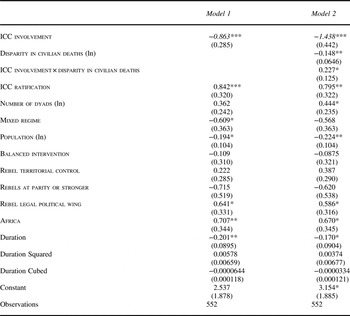
Models 1 and 2 in Table 1 test H1 and H2, respectively. Because of the binary nature of the dependent variable, logistic regression is used.Footnote 86 All empirical tests use robust standard errors clustered on the conflict dyad to account for nonindependence across observations within a dyad.
Logit Results for Civil War Termination

Note: Standard errors in parentheses, clustered on dyad. *p < .10; **p < .05; ***p < .01.
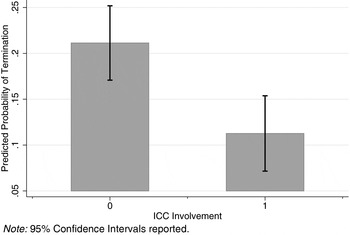
As expected, ICC involvement significantly decreases the likelihood of conflict termination in Model 1, thereby lengthening war. Figure 1 demonstrates that this effect is sizeable: the predicted probability of termination without ICC involvement is 21 percent, but drops to 11 percent when the ICC is involved, a 47 percent decrease in the likelihood of termination. Model 2 tests the conditional hypothesis. ICC involvement is again negative, as is the civilian deaths disparity, while the interaction term is positive. Because this is a nonlinear model with an interaction, I turn to first differences and predicted probabilities to determine the significance and substantive impact of ICC involvement, conditional on the threat of domestic punishment.Footnote 87
Predicted Probability of Termination, Model 1

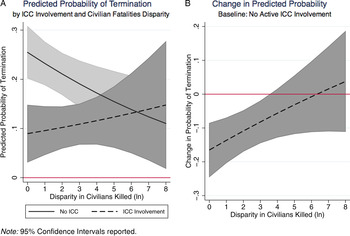
Figure 2 presents these post-estimation results graphically. Panel A presents the predicted probability of termination with ICC involvement versus without as the disparity in civilian deaths increases along the x-axis. Panel B presents the change in predicted probabilities when moving from no ICC to active ICC involvement as civilian deaths disparity grows.Footnote 88 As Panel A demonstrates, when the disparity in civilian deaths is 0, there is a 25 percent probability of termination if the ICC is not involved versus just a 9 percent probability if the ICC is involved. As expected, this gap shrinks as the civilian deaths disparity (the risk of domestic punishment) increases: when the difference in civilians killed reaches about 650 (logged value of 6.5), the predicted probability of termination for all conflicts, regardless of ICC involvement, is 13.5 percent.
Predicted Probability of Termination, Model 2

The first differences in panel B aid in interpreting ICC involvement's statistical significance. As this figure demonstrates, ICC involvement significantly decreases the likelihood of conflict termination when the disparity in civilian deaths is small. As expected, ICC involvement's impact decreases as the domestic punishment risk increases, and once the logged civilian deaths disparity reaches about 4 (a difference of 55 deaths), ICC involvement is no longer significant. While this may seem like a relatively small difference in deaths caused, it captures many cases in which there is a qualitative difference in the combatants’ behavior: one combatant does not kill any civilians while the other does. Further, two-thirds of observations have a disparity less than 55. Thus ICC involvement significantly affects a large proportion of conflicts in the data set.Footnote 89
As expected, these results indicate that the ICC's impact is conditional. When the risk of domestic punishment is high as a result of a large disparity in government and rebel-caused civilian deaths, ICC involvement does not significantly prolong conflict because leaders are preoccupied with the domestic threat. However, when rebel and state leaders are less fearful of domestic punishment because both sides have either exercised restraint or are equally guilty of atrocities, ICC involvement significantly increases conflict duration.
Results for the control variables also generally confirm expectations. As hypothesized, mixed regimes, larger populations, balanced interventions, and stronger rebel forces are all associated with longer wars, though the latter two are not statistically significant. Also as predicted, increasing the number of active conflict dyads increases the likelihood of termination (significant in Model 2), as does the presence of a legal rebel political wing. Rebel territorial control is insignificant in both models, while Africa is associated with shorter conflicts, contrary to findings in existing literature. This inconsistency likely arises from the fact that previous studies rely on different time periods and country-level rather than dyad-level data. First differences for all control variables are presented in Table B in the supplement.
Finally, ICC ratification significantly increases the likelihood of termination, as expected. This result confirms findings in existing research and is important for an overall evaluation of the court's impact on peace: the ICC deters conflict and hastens termination among ratifiers, while simultaneously extending wars by pursuing examinations and investigations that threaten the security of at-risk leaders. These results highlight the complexity of the ICC's impact. States can use ratification as a way of signaling their commitment to peace, and the accompanying latent risk of ICC prosecution has no ill effects on termination. A more active role for the court, however, is often unsolicited, unaccepted by at least one combatant, and involves an active threat of prosecution that has the deleterious effect of extending war.
Robustness Checks
Several additional empirical tests confirm the robustness of the main findings. First, to ensure that ICC involvement's impact is consistent across conflict outcomes, Table C in the supplement presents a multinomial logit model using war outcome as the dependent variable. As expected, ICC involvement decreases the likelihood of settlement, victory, and low activity, relative to continuation. This effect is significant for settlement and low activity, but not for victory.Footnote 90 Importantly, there is no significant difference in ICC involvement's impact on settlement versus the other two outcomes, which supports the decision to combine all three in the main analysis.
Second, Table D and Figure A in the supplement present results using alternative measures of ICC involvement. Models 1 and 2 measure ICC involvement at the dyad level, while Models 3 and 4 use the continuous measure. Models 5 and 6 use an alternative country-level coding that uses only the first criterion discussed earlier to code ICC involvement. As these results demonstrate, the findings remain consistent across all alternative measures.
Third, Table E in the online appendix uses alternative measures of domestic punishment risk. Model 1 uses the cumulative disparity in civilians killed since the ICC came into force (or since conflict start, if later), rather than the yearly disparity. Model 2 uses the leader responsibility measure discussed earlier. Model 3 uses a dummy variable coded 1 if one side kills at least twice as many civilians as the other, and Model 4 uses the ratio of civilian deaths (higher/lower). First differences presented in Figure B demonstrate that these alternative measures produce results consistent with the main analysis.
Fourth, I address potential selection bias. Upon initiating war, leaders may have already taken into account the possibility of ICC prosecution, meaning those who fight have failed to be deterred, and a selection effect may bias the empirical results. I do not expect this to be the case. Because the court lacks the resources necessary to investigate the majority of crimes falling under its jurisdiction, I expect leaders to largely discount the possibility of ICC punishment when deciding whether to wage war.
To confirm that nonrandom selection is not an issue, I run two additional empirical tests. First, I run a Heckman selection model in which the selection equation predicts conflict incidence and the outcome equation predicts termination. The results, presented in Table F and Figure C in the online supplement, demonstrate two things. First, nonrandom selection does not appear to bias the results; the rho parameter accounting for the correlation in the error terms is not significant in either model. Second, ICC involvement remains a significant, negative predictor of conflict termination, confirming the main results and indicating that selection is not a serious issue. The analysis is limited, however, because conflict incidence is measured at the country level. This means the outcome equation must also be a country-level analysis, and for any country with more than one concurrent conflict, only one observation is included.
Because of this limitation, I conduct a second empirical test to address selection bias. Specifically, I take advantage of variation in the timing of conflict onset: some wars in the sample began before the ICC came into force in 2002, while others began after 2002, when the ICC was an existing institution with the ability to investigate situations. This is useful for assessing selection bias because leaders could not have anticipated future ICC involvement at the time they initiated conflict if their wars began before the ICC existed. Therefore, any deterrent effect of possible future ICC action could not have been selected out at onset. If the ICC's negative impact is more pronounced in cases beginning post-2002, selection effects may bias the results. Table G in the supplement tests this by interacting ICC involvement with a dummy variable coded 1 for conflicts beginning after the Rome Statute entered into force. Post-estimation results in Figure D (in the online appendix) show that the effects of ICC involvement are statistically indistinguishable in the pre and post-ICC subsamples, providing additional evidence that nonrandom selection does not bias the results.
Endogeneity
Finally, I address the potential endogeneity of ICC involvement. If the ICC is most likely to become involved in the hardest cases—those least likely to end—then the observed impact of ICC involvement may be spurious. That is, ICC involvement may not be causally related to conflict duration; the court may simply investigate cases that are already most likely to drag on because of other, unobserved factors. Statistically speaking, omitted variables may be correlated with ICC involvement and the error term.
Theoretically, there are strong reasons to believe that the ICC does not select cases that are most likely to drag on, and thus that the main results are not biased in favor of a significant finding. This is because the Rome Statute grants the OTP significant discretion with regard to situation selection.Footnote 91 That discretion, along with the fact that the court can examine only a small fraction of situations referred to it, means that the OTP must select from among many situations, and the final selection is often shaped by pragmatism rather than the severity of a situation. In particular, the OTP has incentives to pursue cases when it anticipates the support of states parties and other powerful states, and to avoid initiating or advancing investigations when those states’ interests are overtly threatened.Footnote 92 This is because third-party support is key to the ICC's legitimacy: an institution like the court “can act with authority and success only to the extent that its actions are seen as legitimate by at least a strong majority of its members.”Footnote 93 Maximizing legitimacy through strategic case selection therefore helps the ICC maintain its institutional viability.Footnote 94
Empirically, both Smith-Blundell and Durbin-Wu-Hausman tests fail to reject the null hypothesis that ICC involvement is exogenous (supplement Table J). I further confirm this conclusion with two additional empirical analyses. First, I run a robustness check in which additional controls are added to the model. As noted earlier, endogeneity may bias results if omitted variables are correlated with both the error term and ICC involvement. Controlling for factors likely to affect both termination and ICC involvement reduces the risk of bias. The controls included in the main analysis were selected with an eye toward addressing this issue, but some potentially relevant controls are omitted because of missing data. Therefore, Table K in the supplement adds three additional controls—state repression, democracy, and effective judiciary.Footnote 95 Repression might increase the likelihood of ICC involvement and lengthen civil war, while democracy and effective judiciaries may help states settle conflicts while also reducing the likelihood of ICC involvement resulting from the court's adherence to the complementarity principle. Results in Table K show that ICC involvement remains robust to the inclusion of these additional controls.
Second, I run two-stage least squares (2SLS) models with instruments for ICC involvement to rule out bias from endogeneity. For 2SLS to produce consistent, unbiased estimates, the instruments must be (1) highly correlated with the endogenous regressor (strong instrument criterion) and (2) uncorrelated with the error term (exclusion restriction criterion).Footnote 96 Identifying instruments that satisfy both criteria can be difficult. However, by focusing on the court's incentives for involvement discussed earlier, I am able to identify three plausible instruments that capture the likelihood of third-party support and therefore the probability of ICC involvement. These include: (1) civil war state's affinity with the permanent five members of the Security Council (P5), (2) civil war state's affinity with neighboring states, and (3) number of neighboring states that have ratified the Rome Statute. These instruments are discussed conceptually, and then I present diagnostic tests to ensure their validity.
First, P5 affinity is a strong instrument for ICC involvement because it captures the influence of the P5's relationships with potential ICC targets. The court has incentives to avoid situations where it expects little P5 support because powerful state support signals to the broader international community the legitimacy of the court's actions.Footnote 97 P5 support, in turn, is most likely when these states have either very high or very low affinity with the civil war state: P5 states will support investigations targeting rebels when they have strong affinity with the government and will support investigations of government officials when affinity with the targeted state is low.Footnote 98 Conversely, the court will anticipate little support when a potential target state shares moderate affinity with P5 states since the P5 have less at stake in these cases. I measure P5 affinity with ideal point distance data from Bailey and colleagues, which uses UN General Assembly votes to calculate dyadic foreign policy preference similarity.Footnote 99 I code extreme affinity for states whose ideal point distance from a P5 state is in the bottom or top twenty-fifth percentile of this measure. I then calculate the percentage of P5 states that the warring country has extreme affinity with. The resulting variable ranges from 0 to 1, with higher values indicating more instances of extreme affinity and a greater likelihood of ICC involvement.
The second instrument, contiguous affinity, captures the civil war state's affinity with its neighbors. The logic for this instrument is similar to that for P5 affinity: just as P5 support is essential to the court, neighboring state support is key because it legitimates the court's involvement.Footnote 100 Support is expected when neighboring states share either very high or very low affinity with the civil war state: neighbors sharing close relations with the government are likely to support investigations of rebels, while neighbors with poor relations are likely to support investigations of state officials. Thus, the likelihood of ICC involvement increases as extreme affinity with neighbors increases. This variable is created using the same ideal point data and procedure as before. It ranges between 0 and 1 with higher values indicating a higher percentage of contiguous states with extreme affinity with the warring country.
The third instrument, contiguous ratifiers, measures the number of neighboring states that have ratified the Rome Statute. The more surrounding states that have ratified, the more the court can expect regional support to legitimize its investigation. This is because ratifiers have signaled their acceptance of the court's rules and norms by engaging in costly ratification.Footnote 101 Thus, the likelihood of ICC involvement is expected to increase as the number of contiguous ratifiers increases. Empirically, contiguous ratifiers measures the number of states contiguous to the civil war state that have ratified the Rome Statute.Footnote 102
In addition to being strong predictors of ICC involvement, these variables are plausibly unrelated to conflict termination. Both P5 and contiguous affinity capture political closeness without relying on measures of direct military support. I control for military intervention in the analysis, furthermore, ensuring that the affinity measures do not indirectly influence termination via military support.Footnote 103 In addition, controlling for domestic ICC ratification ensures that contiguous ratifiers does not indirectly affect duration by increasing the likelihood of domestic ratification. Importantly, none of the instruments is a significant predictor of conflict termination in a bivariate analysis (P5 Affinity: β = −0.86, S.E. = 0.94; Contiguous Affinity: β = −0.23, S.E. = 0.47; Contiguous Ratifiers: β = −0.008, S.E. = 0.053).Footnote 104
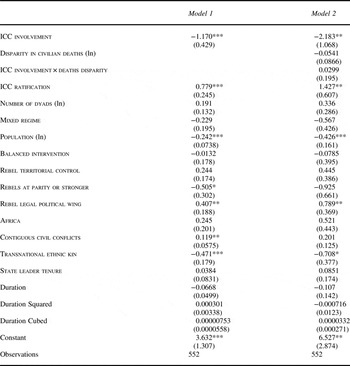
To further ensure that the instruments are not indirectly related to conflict termination, I control for four additional factors in the 2SLS analysis. Including these controls ensures that the instruments are unrelated to the error term, thus satisfying the exclusion restriction criterion. Additional controls include: the number of contiguous civil wars, the presence of transnational ethnic kin, state leader tenure, and mediation. By controlling for contiguous conflicts and ethnic linkages, I account for the key mechanisms linking external factors to conflict onset and duration.Footnote 105 This ensures that contiguous ratifiers does not indirectly affect duration by making war less likely in neighboring states and that contiguous affinity does not indirectly influence duration via cross-border ethnic linkages. I account for state leader tenure to ensure that contiguous ratifiers does not indirectly influence termination by affecting leaders’ willingness to step down from power.Footnote 106 Finally, I control for third-party mediation, ensuring that the instruments do not indirectly influence conflict duration by affecting the likelihood of mediation. This control is not included in the main 2SLS results because it is available only through 2009, but results including mediation are consistent with those presented in Table 2 (see supplement Table M).
2SLS Results

Notes: Stage 1 results suppressed. Instruments for Active ICC Involvement: P5 Affinity, Contiguous Affinity, and Contiguous Ratifiers. Instruments for Interaction Term: ICC-fitted-values × Civilian Death Disparity. Model 1: IV Probit. Model 2: Logit with bootstrapped standard errors in parentheses, clustered on dyad, based on 100 iterations, seed = 2. *p < .10; **p < .05; ***p < .01.
Finally, I assess the strength and validity of these instruments using diagnostic tests. I test the strong instrument criterion using an F-test. The general rule of thumb is that the F-statistic should be greater than 10.Footnote 107 The F-statistic in this analysis is 16.155, indicating that these are strong instruments for ICC involvement. Second, to assess the exclusion restriction criterion, I report the Hansen J-statistic.Footnote 108 This tests the overidentifying restriction when the analysis includes more instruments than endogenous regressors. The null hypothesis is that the excluded instruments are uncorrelated with the error term. Rejecting the null, therefore, casts doubt on the instruments’ validity. Here, the test statistic is 2.145 with a p value of 0.342. I therefore cannot reject the null that the instruments are valid, which further supports their use.
Having identified appropriate instruments for ICC involvement, I now present the 2SLS analysis. In the first stage, I regress ICC involvement on all other explanatory variables from the original model (X) plus the three exogenous instruments (Z), calculating the resulting fitted values (ŶICC).Footnote 109 In stage 2, I use ŶICC plus X to predict termination. Some additional complications arise in testing Model 2 because the endogenous variable is part of an interaction term. Specifically, because the linear projection of the interaction is not the same as the interaction of the linear projection, it is inappropriate to use the interaction of the instrumented variable in the second stage.Footnote 110 Therefore, I follow Wooldridge's recommendation, using the interaction of the fitted values (ŶICC*Civilian Deaths Disparity) as an instrument for the interaction term (ICC Involvement*Civilian Deaths Disparity).Footnote 111 First, I estimate the first-stage model described earlier, generating fitted values ŶICC. Next, I estimate another first-stage model in which I regress the interaction term (ICC Involvement*Civilian Deaths Disparity) on X plus ŶICC*Civilian Deaths Disparity, calculating fitted values ŶICC*CIVDEATHS. Finally, I run the second-stage equation, inserting ŶICC and ŶICC*CIVDEATHS as regressors in place of the endogenous variable and its interaction term.
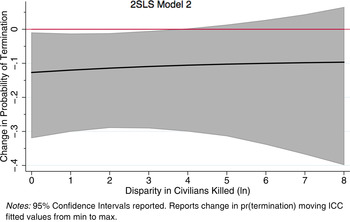
The results of both 2SLS models appear in Table 2.Footnote 112 As the results demonstrate, the effect of ICC involvement remains negative and significant, even after instrumenting for ICC involvement. Figure 3 confirms this result for Model 2 by graphing the first differences when moving ŶICC from minimum to maximum values as the civilian deaths disparity increases. As Figure 3 shows, ICC involvement significantly reduces the probability of termination when the civilian deaths disparity is low, but its impact diminishes and becomes insignificant as the disparity increases. This result, consistent with that from the main analysis, indicates that even after accounting for the potential endogeneity of ICC involvement using instrumental variables, the empirical results remain robust.
Change in Predicted Probability of Termination

Conclusion
Since the birth of the ICC in 2002, scholars and policy-makers have debated the court's role in the pursuit of justice, and how that pursuit affects prospects for peace in warring states. I argue that active involvement by the ICC in ongoing civil conflicts, under certain conditions, decreases prospects for peace by threatening leaders with international prosecution. This effect is conditional upon the risk of domestic punishment: as the threat of domestic punishment increases, the conflict-exacerbating effects of ICC involvement decrease.
Empirical tests provide strong support for this theoretical argument. ICC involvement significantly reduces the likelihood of conflict termination when the risk of domestic punishment is low. Its impact diminishes, becoming insignificant, as the domestic punishment risk increases. These results are consistent across a variety of robustness checks, including alternative specifications of the dependent and key independent variables, tests to address selection bias, and models addressing potential endogeneity issues.
This study advances the literatures on the ICC and civil conflict in several ways. As one of the first empirical studies to examine the impact of ICC involvement rather than ICC ratification, and the first on ICC involvement to study conflict termination, this study contributes important insights to the nascent body of literature on the ICC's impact, particularly on its ability to facilitate peace while pursuing justice. The conditional impact of ICC involvement identified here also adds to growing evidence suggesting the court's impact often depends upon factors within a country. Additionally, these findings demonstrate that the court's broader influence is complex and multifaceted: ICC ratification improves prospects for peace in warring states, while active involvement by the court has the opposite impact. The ICC, therefore, is not universally benign or entirely harmful, and scholars must examine all avenues through which the ICC affects states’ behavior to fully understand its overall impact on peace. My findings also contribute to the civil conflict literature. They add to an emerging body of research on leaders’ impact on conflict behavior, and identify a novel source of punishment—international prosecution—that influences leaders’ strategic calculations during civil war.
Finally, while the ICC's primary mandate is the pursuit of justice, the results indicate that its broader effects on the process of conflict termination must be taken into account by policy-makers and the court itself. In particular, the fact that ICC involvement can prolong conflict has important implications for how the court pursues investigations in ongoing conflict situations in the future. It may be in the best interest of peace, for example, for the ICC to investigate and pursue arrests and trials only after a settlement has been reached. This is particularly true because the court's most detrimental impact comes when conditions for successful settlement improve domestically (that is, as the domestic punishment risk diminishes), suggesting that the court is doing harm in the very settings where successful settlement may otherwise have been possible. The court appears to recognize, at least to some extent, how influential it can be. It recently issued a statement aimed at reassuring LRA rank-and-file that they would not be killed or tortured by the ICC if they chose to lay down arms.Footnote 113 Further self-reflection by the court is warranted, given the influence it has not only on rank-and-file, but on leaders’ strategic calculations and the interplay between peace and justice in international politics.
Supplementary Material
Supplementary material for this article is available at https://doi.org/10.1017/S0020818317000078.