Introduction
This article presents the results of a rigorous methodology applied to the study of the acoustics of the Ħal Saflieni Hypogeum on Malta, using acoustic testing practices. It uses scientific evidence to assess the validity of different assertions about the acoustic effects present within the site. The Hypogeum is an early example of a monument that features an extreme and highly noticeable acoustic ecology. Acoustic study of this UNESCO World Heritage Site affords an understanding of relationships between the site's historical ritual use and its architecture. Previous acoustical studies have lacked technical rigour, and results have been somewhat uncertain or speculative. This article presents a systematic methodology for the study of the acoustics of the Hypogeum, providing a model that could be readily adopted at other archaeological sites. It does not aim to prove the intentionality of sound use, or that a specific sonic activity, type of voice or instrument was used in the Hypogeum. It does, however, accurately characterise (using the archaeological rather than acoustics sense of the term) the acoustic ecology of this remarkable site, and explores what such information might suggest.
In addition to examining the veracity of previous studies, the research presented here considers the affordances of the acoustics of the space in relation to both past ritual activities and the culture of the people involved. This project places itself within the fields of music archaeology (International Study Group on Music Archaeology n.d.), sound archaeology (Till Reference Till2014) and archaeoacoustics (Scarre & Lawson Reference Scarre and Lawson2006). A bibliography and archaeoacoustics methods document are available at the Acoustics and Music of British Prehistory Research Network (n.d.).
The Hypogeum
The Ħal Saflieni Hypogeum is a prehistoric communal burial site. It is unusual for this period in that it is carved 10m into rock using basic tools (Mifsud et al. Reference Mifsud, Mifsud, Ventura, Mifsud and Savona1999: 209) to create a complex of interconnecting chambers on three levels: upper (3600–3300 BC), middle (3300–3000 BC) and lower (3150–2500 BC) (Trump Reference Trump1996). The smaller Santa Luċija hypogeum on Malta and the Xaghra Stone Circle on nearby Gozo are similar in form. It is linked to other above-ground Maltese temple sites by architectural features such as pillars and arches, suggesting ritual use rather than simple mortuary deposition. Circular and spiral decoration is also present, in particular in the small ‘Oracle Chamber’ at the centre of the monument.
Zammit (Reference Zammit1910) suggests—as a very approximate estimate—that the bones of a minimum of 6000 to 7000 people were found during initial excavations, mixed together with animal bones. The Hypogeum was a collective tomb, or at least a bone depository, and the floors were covered with earth and bone. The uppermost level consists of a large hollow with burial chambers around the sides, which was probably exposed to the sky originally; excavations in the early 1990s indicated that a monumental structure marked the entrance.
Previous observations
Various authors suggest that the architecture of the Hypogeum produces acoustic effects: modifying amplitude, producing different effects for men and women, creating resonances at particular frequencies, affecting sound duration (reverberation), creating a deep sound (low frequency resonances) and transmitting sound through the space. Pace (Reference Pace2004), Mifsud et al. (Reference Mifsud, Mifsud, Ventura, Mifsud and Savona1999) and Stroud (Reference Stroud and Eneix2014) provide useful introductions to the Hypogeum and its acoustics. Music and audio software developers Audioease B.V. carried out a technical investigation in 2007, but the results are now only available as a preset in their Altiverb commercial reverberation software, designed to allow one to reproduce the acoustics of the Hypogeum in a digital recording studio. A more recent acoustical survey failed due to technical problems, and, as Heritage Malta archaeologist Stroud (Reference Stroud and Eneix2014: 43) states, “unfortunately we have always fallen short of obtaining definite conclusions about the acoustic properties of the site”.
Various sources have made assertions about the Hypogeum and its acoustics. Coppens (n.d.) suggests that it has “perfect” acoustics and asks whether this is coincidental. Griffiths (Reference Griffiths1920: 465) writes that a word spoken in the Oracle Chamber is “magnified a hundredfold and is audible throughout the entire structure”. UNESCO (n.d.) describes a niche that echoes when someone speaks into it, discounting intentional design but suggesting acoustics possibly featured in rituals. Devereux and Jahn (Reference Devereux and Jahn1996) also discuss the niche, and more recently Devereux (Reference Devereux2009: 226) describes the “remarkable resonance qualities” of the space, adding that the acoustics would have been notable to its creators and users. Others report “a deep echoing sound” (Evans Reference Evans1971: 50); “a powerful reverberation to a deep voice” (Trump Reference Trump2000: 70); and that “a man's deep voice [. . .] reverberates in a most peculiar manner” (Agius Reference Agius1966: 18). Mifsud et al. (Reference Mifsud, Mifsud, Ventura, Mifsud and Savona1999: 218–19) relate a number of accounts addressing sound. The early excavator, Zammit (Reference Zammit1925: 18–19), describes low notes spoken or sung near the niche resounding and vibrating, and reports that voices are magnified and transmitted through the space. Walter (Reference Walter1940: 272) describes how speech could be heard throughout the space, as though the whole space were vibrating, but with only low sounds radiated widely. Skeates (Reference Skeates2008: 213) discusses the significance of sound in Maltese monumental culture, and “the extraordinary resonance and echoes of the ‘Oracle Chamber’ in the Hal Saflieni Hypogeum”. As Stoddart (Reference Stoddart, Bruno and Wilson2002: 182) observes,
a low-pitched voice achieves a high degree of resonance [. . .] The full effect of a restricted entrance, a series of interlinked resonating chambers, and smoke-filled partial darkness would have been impressive in terms of controlling the mind and, thus restricted, specialist knowledge.
Debertolis et al. (Reference Debertolis, Coimbra and Eneix2014: 63–64) published the results of an acoustic study of the Hypogeum, although it was somewhat limited technically. They suggest nonetheless that voices are amplified and deepened when the speaker is close to a niche in the wall of the Oracle Chamber; that both volume and duration are increased; and that bass or baritone voices have the greatest effect. Their results suggest that a male human voice (singing ‘ooh’) stimulates the resonance of the structure at two frequencies (114Hz and 68–70Hz), whereas a female voice created no resonance; a horn or conch shell had little effect; a friction drum produced a small amount of resonance; and a hoop drum created strong resonance at 114Hz. Use of some of these musical instruments is evident on Malta in archaeological contexts and within folk cultures (Borg Cardona Reference Borg Cardona and Eneix2014). The authors conclude that either a male voice, praying or singing, or a percussion instrument can stimulate “resonance” (Debertolis et al. Reference Debertolis, Coimbra and Eneix2014: 77).
This research is problematic for a number of reasons. The methodology uses voice and musical instruments, so the results are not repeatable as the source signal is indeterminate and restricted in amplitude and frequency. The study does, however, provide evidence that some frequencies are more resonant in the space, that the reverberation time is long and that different sound sources produce different effects. Our own research, presented here, was carried out on the same day as that of Debertolis et al. (Reference Debertolis, Coimbra and Eneix2014), immediately after their tests were concluded.
Problems of studying the Hypogeum
A detailed study of the acoustics of the Hypogeum presents a number of challenges. In order to control temperature and humidity, both the number of people admitted and the duration of access is limited. The site is also extensive—perhaps 500m2—with a number of levels and chambers, and acoustic effects vary greatly across the space. The present study therefore focused on sound inside and outside the Oracle Chamber.
Changes made to the site over time have affected the acoustics. Little is known of the original form of the monument, or of its condition when it was discovered, as the excavation records have been lost (Stroud Reference Stroud and Eneix2014); no accurate dating is available. When first uncovered, the burial chamber contained soil and bones (Mifsud et al. Reference Mifsud, Mifsud, Ventura, Mifsud and Savona1999: 211). These have been removed, and a metal walkway now protects the floor within the chamber. The entrance has been significantly remodelled—the upper level, once open to the air, is now housed within a visitor centre—and the site itself has been built upon and around; conditions above ground are significantly different to those in the prehistoric period. Given that much of the archaeological context is therefore missing, any interpretative conclusions drawn are limited.
Noise of various types also affects acoustic tests, including water drops, and sounds of people and traffic can be heard in the space.
Methodology
Archaeoacoustic studies require a customised methodology for an on-site yet forensic study, rather than one designed for buildings acoustics, health and safety, or conventional acoustics (Murphy Reference Murphy2006; Till Reference Till2014). In response to the various restrictions and conditions at the Hypogeum, the following simple, robust and portable methodology was designed. A sine signal that swept from 20Hz to 20000Hz was generated by a laptop using Apple Logic Pro Impulse Response Utility software. The resulting acoustic response of the space was captured and used to calculate (deconvolve) the impulse response present. The resulting ‘acoustic fingerprint’ describes the behaviour present for specific source (loudspeaker) and receiver (microphone) positions. The source signal was played through a B&O Beolit loudspeaker that had been characterised in an anechoic chamber. This highly portable loudspeaker balances directionality and frequency response. Two DPA 4006 omnidirectional microphones were used as receivers, balancing a flat frequency response with the robustness of a recording studio microphone.
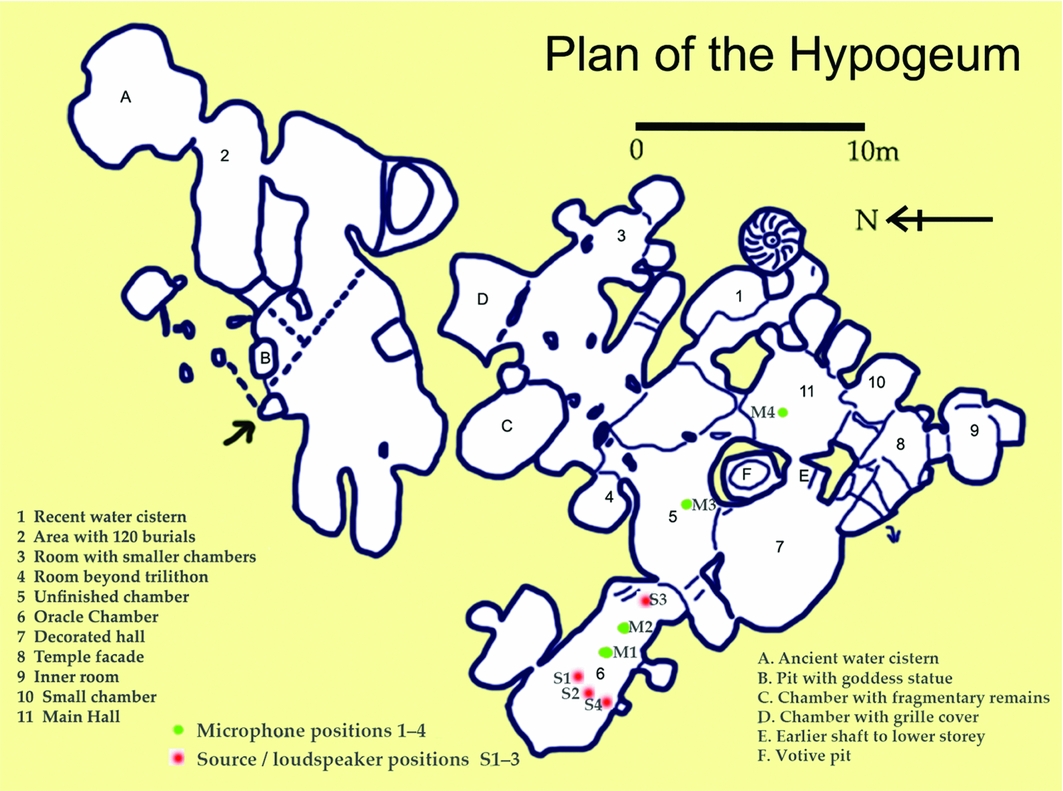
Measurements were taken at various source and receiver positions, with particular attention paid to the small niche in the Oracle Chamber. The source (loudspeaker) was positioned approximately 0.5m, 1m and 2m away from the niche (positions S4, S2 and S1 respectively in Figure 1), and at the entrance to the Oracle Chamber, about 6m from the niche (position S3), to test whether proximity to the niche produces stronger acoustic results. Receiver (microphone) positions were selected in order to explore the transmission of sound through the space. Two receiver positions were used in the Oracle Chamber, 2m and 3m from the niche (M1 and M2 in Figure 1). Additional receiver positions were tested in the main chamber near the Temple Façade (M3) and, farthest away, in the Main Hall about 15m from the niche (M4). Impulse Responses (IRs) were generated for different combinations of these source and receiver positions.
Plan of the Ħal-Saflieni Hypogeum.

A number of acoustic metrics were calculated using three software packages: Odeon (n.d.), Sonic Visualizer (n.d.) and Audacity (n.d.). Metrics calculated included reverberation time (RT) for ranges of 30dB and 20dB (T30 and T20), early decay time (EDT), definition of speech (D50), directness (C7), syllable intelligibility (C50) and musical clarity (C80), with results for a range of frequencies. Single results were calculated for speech intelligibility (STI); loudness (SPL); articulation loss of consonants (ALcons); and bass ratio or amount of low frequency (BR(SPL)). The software was used to produce sonograms and other visual representations of the frequency responses in order to identify individual frequencies with strong resonance.
Reverberation is the most powerful and most obvious effect present in the Hypogeum. EDT is representative of perceived reverberance (Bradley Reference Bradley2010: 2), especially in a specific receiver position. RT (T20) “is related to the physical properties of the auditorium” (British Standards Institution 2009: 15). Both RT and EDT were calculated in different octaves to explore frequency ranges.
British Standard BS EN ISO 3382-1 (British Standards Institution 2009: 12) stipulates engineering criteria for use in practical settings, and describes acoustic parameters for performance spaces. It specifies typical ranges and just noticeable difference (JND) values. Although the Hypogeum is not a performance space in the sense of a concert hall, it was designed for ritual rather than functional use, thus these performance-based acoustical metrics are relevant.
Acoustic analysis
Griffiths (Reference Griffiths1920: 465) suggested that sound is amplified in the Hypogeum. To test this, loudness metric SPL(A) was calculated and weighted for the human ear for source position S1, with the loudspeaker 2m from the niche in the Oracle Chamber. The results show that sound does in fact become louder farther from the source, with a total increase of seven times the JND (see Table S2 in online supplementary material). Sound in an open field usually becomes quieter the farther it travels. For the 10m distance tested, a 50 per cent decrease in loudness would be expected in open conditions—perhaps 12dB—rather than the increase measured within the monument. Griffiths (Reference Griffiths1920) is correct in principle that sound made inside the Oracle Chamber is amplified and magnified when heard elsewhere on the same level of the Hypogeum.
It has been suggested that sounds made close to a niche in the wall of the Oracle Chamber are particularly amplified. SPL(A) was calculated for three source positions, representing the source moving closer to the niche, from S3 to S1 and S4. This was repeated for two microphone positions (see Table S3). Volume at both receiver positions increases as the niche is approached, but then diminishes, suggesting resonance in the space, probably at a low frequency, creating a standing wave and patterns of maximum and minimum amplitude. Moving the sound source closer to or farther away from the wall of the Oracle Chamber changes the amplitude of this resonant frequency. At position S2, the source was temporarily pointed away from the niche but towards the receiver, yet the SPL(A) decreased by 5dB. Pointing the source towards the niche does seem to make the sound louder, although this may be the effect of the wall rather than the niche. Additional exploration is needed to investigate this effect further.
Articulation loss of consonants results are presented in Table S5. This metric assesses how well consonants are understood, as discussed by Ahnert and Schmidt (n.d.: 22), who provide values ranging from ‘poor’ to ‘ideal’ (Table S6). The Hypogeum was determined to have an ALcons value of less than 20—‘worthless intelligibility’—for all receiver positions except source and microphone position M1 (where source and receiver are very close). Although sound from the Oracle Chamber is transmitted throughout the Hypogeum by the acoustics present, for speech the result is largely incomprehensible. Ritual sound-making, singing or other musical activity would better exploit the acoustic effects of the Oracle Chamber.
Debertolis et al. (Reference Debertolis, Coimbra and Eneix2014: 77) and others suggest that male, rather than female, voices are likely to have been used to stimulate acoustic effects present in the Hypogeum. Low frequency amplification, through reverberant resonance, is certainly present and powerful, but different effects are present in other frequency ranges. Speech Transmission Index (STI) metrics indicate how well speech is transmitted acoustically, providing one objective measure for a gendered reading of the space (see Table S4). The largest difference between STI(Female) and STI(Male) was 0.03, below the JND of 0.05; male and female speech are thus equally clear and intelligible. Low frequency sounds will create different effects to high frequencies, whether male or female. Speech transmission was confirmed to be ‘bad’ or ‘poor’ unless the listener is standing immediately next to the person speaking; low frequencies (rather than male voices) create long reverberation.
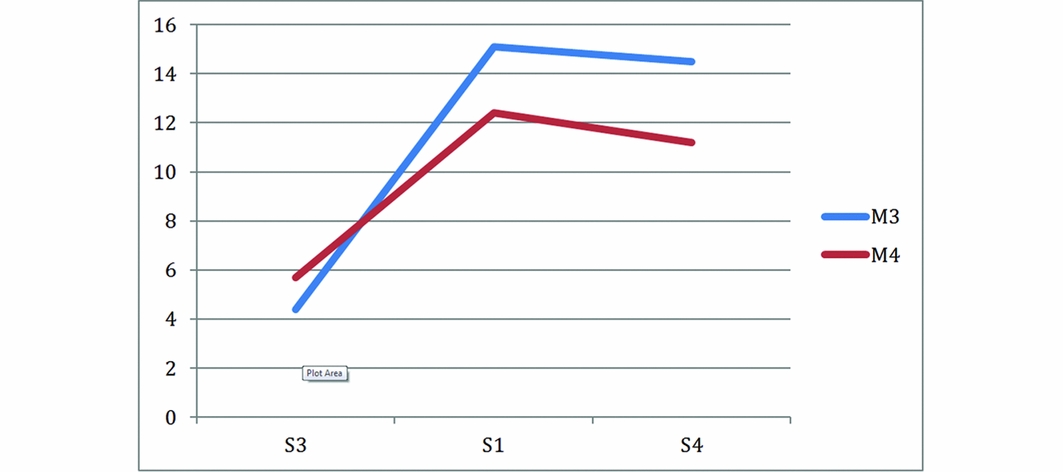
Bass ratio (BR) describes reverberation time at low frequencies. For music, the standard desirable BR is 1.0–1.3; for speech it should be 0.9–1.0 (Ahnert & Schmidt n.d.: 16). BR results are presented for various microphone positions (Table S7) and source positions (Figure 2). With both the source and receiver in the Oracle Chamber, BR was between 4 and 6; with the receiver outside the Chamber it was much higher, measuring between 15 (M3) and 12 (M4). Some attenuation of high frequencies is expected with distance, but such dominance of bass frequencies is extreme. With a static receiver placed outside the Oracle Chamber (M3 and M4), bass frequencies become louder as the source is moved closer to the Oracle Chamber niche.
Bass ratio for microphone positions M3 and M4 with various source positions.

The low frequency reverberation recorded is far greater than that present in, for example, stone circles, concert halls or cathedrals (Till Reference Till2011), in natural spaces such as caves featuring Palaeolithic motifs (Till Reference Till2014), or in larger caves in which the author has carried out acoustic studies: for example, Arcy-sur-Cure and Isturitz (France) and Hohle Fels (Germany).
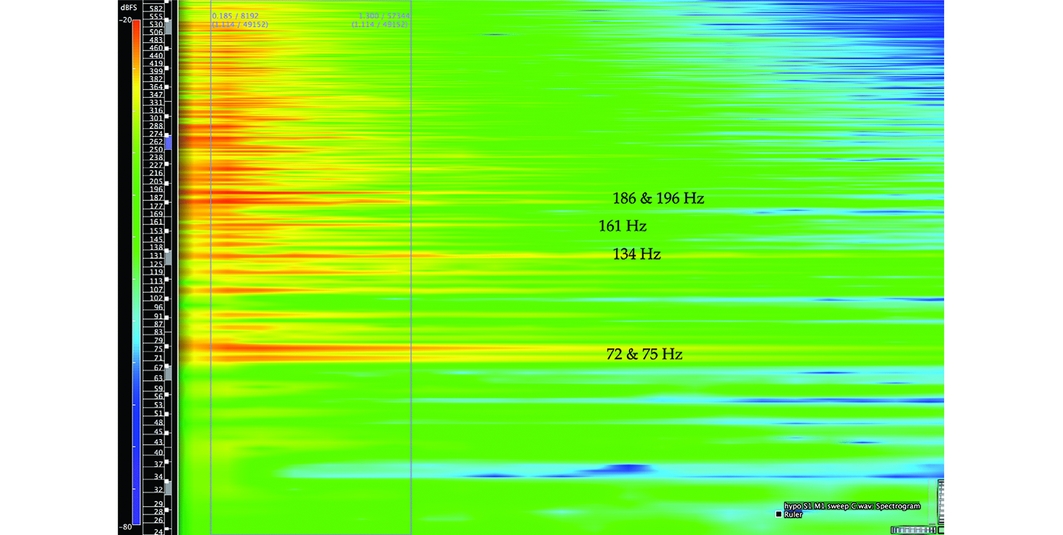
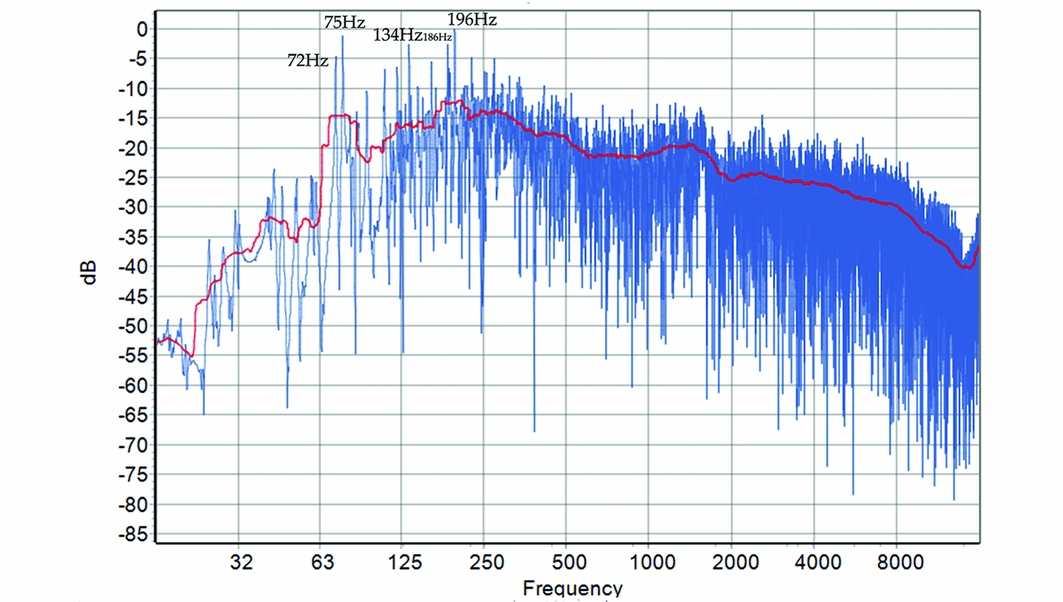
The software was used to display the frequency response of the impulse responses captured in the space. A sonogram (Figure 3) shows the frequency response in the Oracle Chamber, indicating how long individual frequencies sustain, along with their relative amplitudes. Colour is used to represent increasing amplitude of a particular frequency (red highest, blue lowest), with time in seconds on the x-axis and frequency in hertz on the y-axis. Resonance of many individual frequencies is shown in Figure 3; frequencies with longer sustain are indicated numerically. Two such frequencies, 72Hz and 75Hz, combine to produce a powerful low frequency resonance. Other resonant frequencies include 134Hz, 161Hz, 186Hz and 196Hz. The resonances produced are dependent on source and receiver position. Figures 4 and 5 show the frequency response of the same impulse response.
Sonic Visualizer sonogram of the Oracle Room impulse response—S1 M1.

Odeon-generated frequency spectrum—S1 M1.

Audacity-generated frequency spectrum—S1 M1.

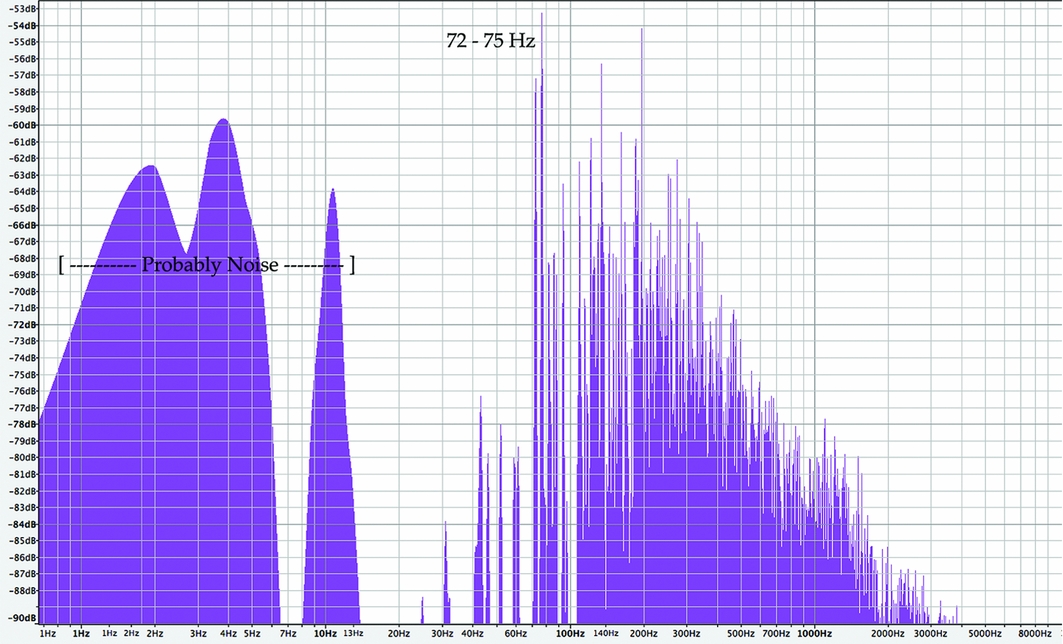
Some frequency content is indicated below 20Hz in Figure 5, but this may be due to noise, FFT windowing (for low frequencies the granular size of the audio analysis applied may approach the order of magnitude of the wavelength considered), loudspeaker and microphone non-linearity, or system artefacts. Investigating such infrasonic response would require more specialist equipment.
Figure 6 displays reverberation time (RT) at different octaves and demonstrates the low frequency effects present. The reverberation tail is indicated by volume level (SPL) decreasing over time (seconds) in different frequency ranges. SPL (loudness) levels are substantially raised and sustained below 125Hz.
Reverberation time (seconds) at different frequencies/octaves—S1 M1.

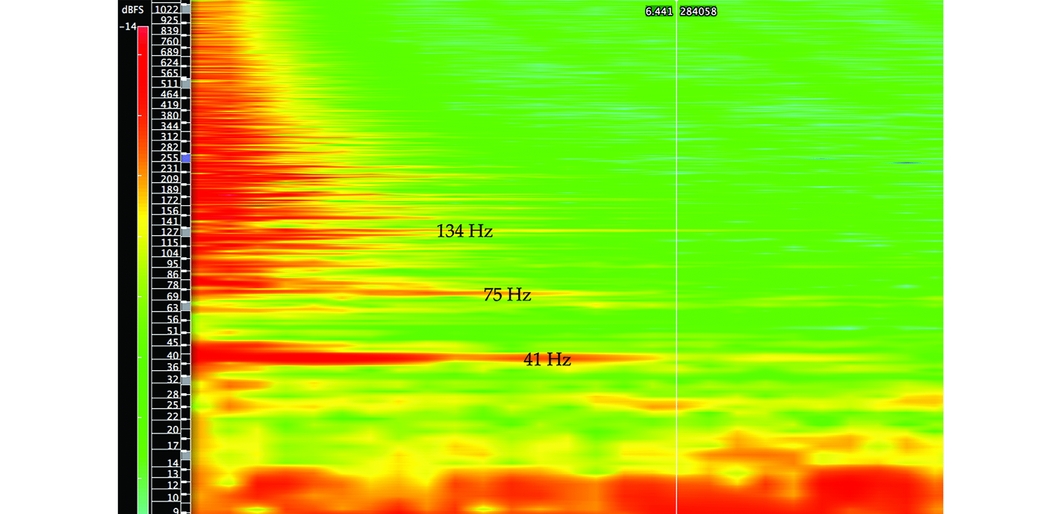
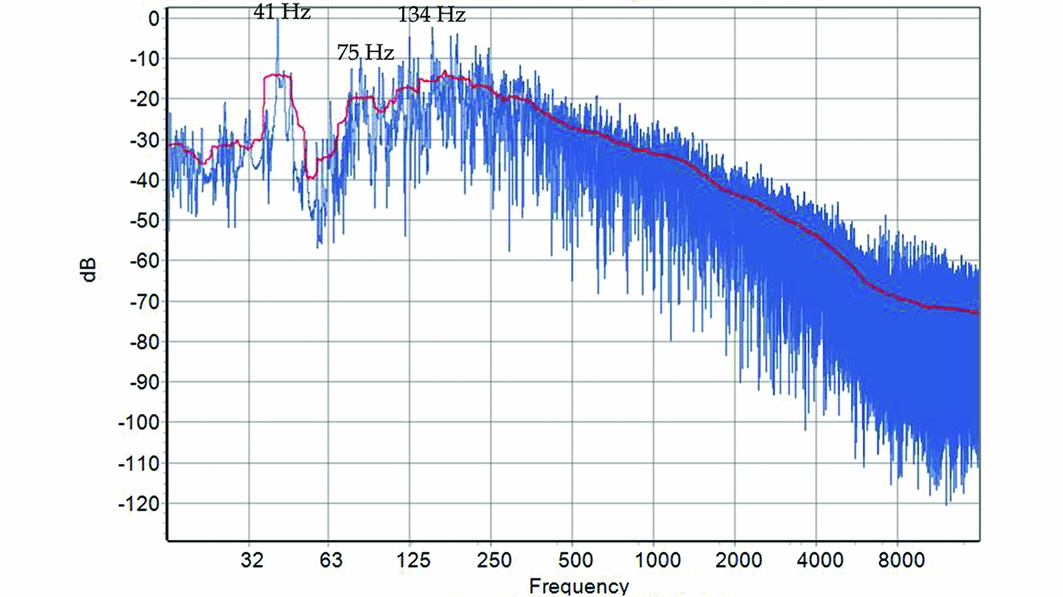
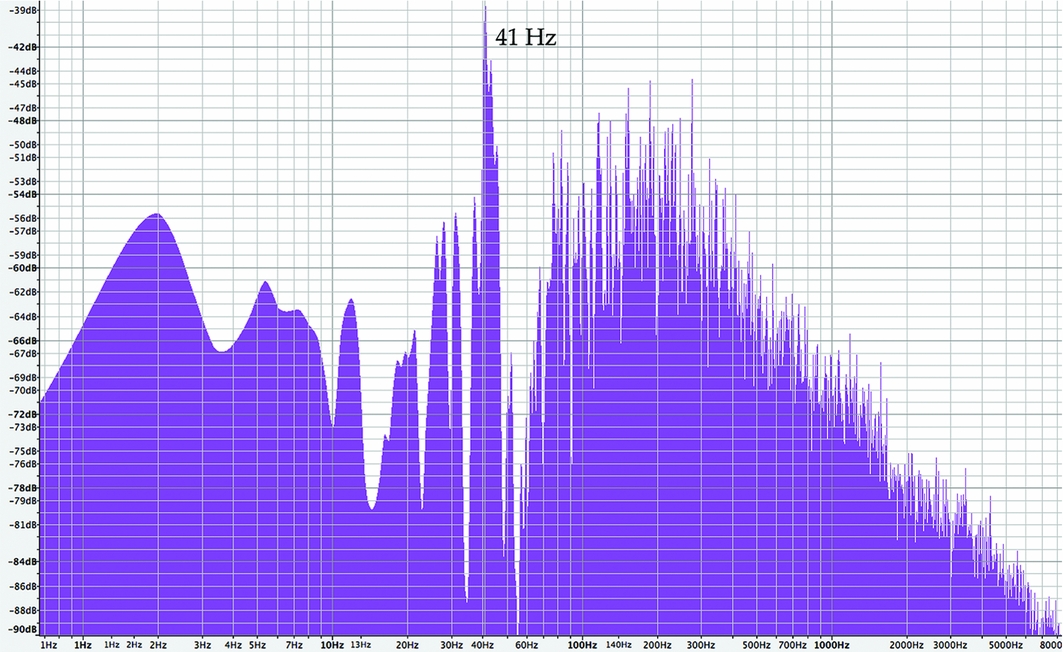
Figures 7, 8 and 9 show the frequency response with the source inside the Oracle Chamber (S1) and the receiver placed outside (M4), exploring how sound is transmitted in the space. A resonant frequency at 41Hz has the greatest amplitude and duration. There are indications of further resonances below 41Hz, at around 26Hz, well below the range of a human voice. Very few loudspeakers are linear or produce much energy below 30Hz, and these low resonances may, as a result, be stronger than shown.
Sonic Visualizer sonogram impulse response—S1 M4.

Odeon-generated frequency spectrum—S1 M4.

Audacity-generated frequency spectrum—S1 M4.

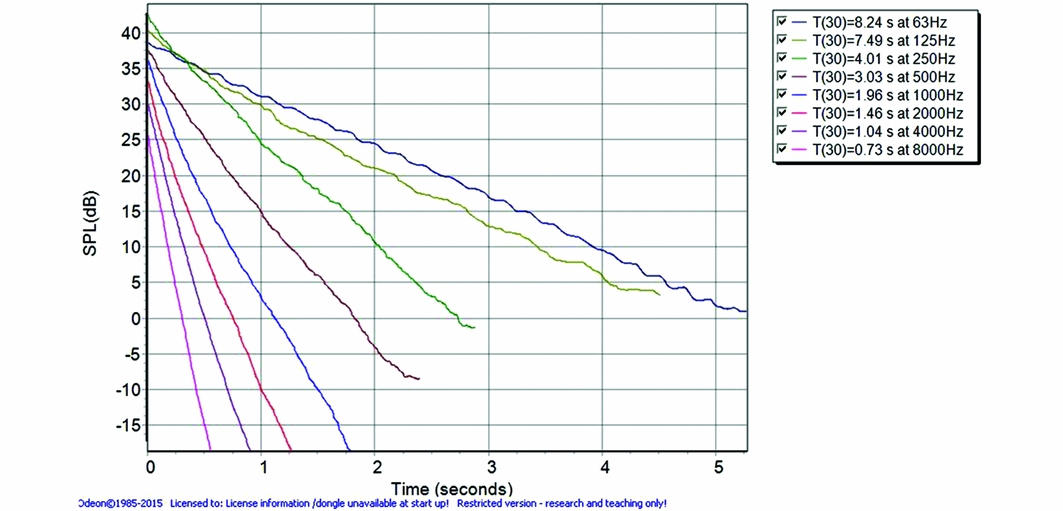
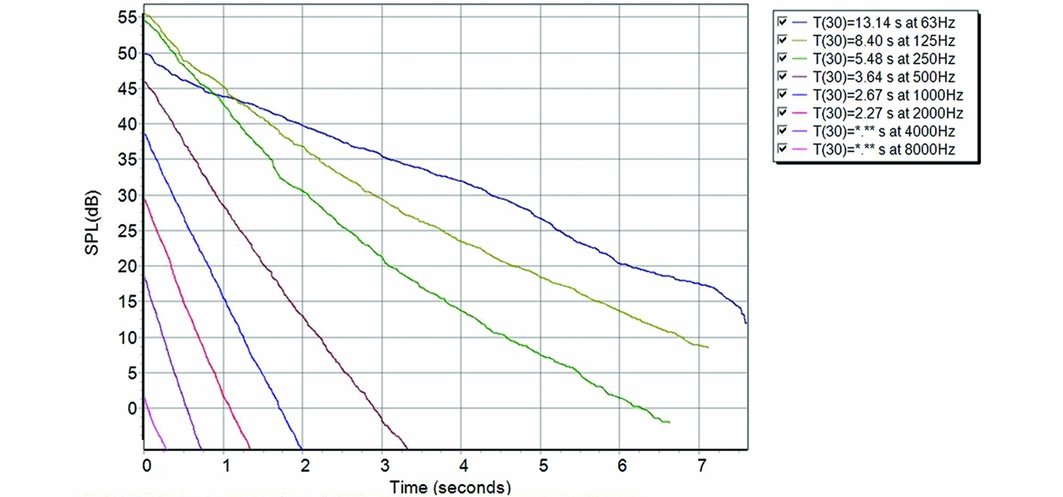
Figure 10 shows reverberation at different frequency ranges/octaves, with reverberation time over 13 seconds at 63Hz—50 per cent longer than when measured inside the Oracle Chamber. Table S5 displays a range of acoustic metrics for this measurement position (S1 M4; see also Figure 10). Early decay time (EDT) is within the usual range (for 500–1000Hz), but is very high at low frequencies. This is the case to a greater degree for T20, which, as discussed above, better represents the reverberation throughout the Hypogeum.
Reverberation time (T30) at different frequencies/octaves—S1 M4.

D50 (definition) is well below the normal range at frequencies below 4000Hz. Target ranges for clarity metrics are given by Ahnert and Schmidt (n.d.), as indicated in Table S9. The sensation of directness and nearness of a musical sound source is described by C7. The results are low, suggesting some sense of directness that is somewhat confused; a sound that seems far away may in fact be closer than imagined. Results for clarity of speech, C50, tell us that one would not understand 80 per cent of syllables. Clarity of music, C80, is a measure of transparency of musical structures, time and register clarity, usually calculated as an average of the results for 500, 1000 and 2000Hz respectively. The averaged result for the Hypogeum is −3.2, similar to that in many large, reverberant concert halls. This would be considered appropriate for romantic music, and more so for sacred music, reflecting a tradition of reverberant spaces such as churches.
Results
Although limited access means that results are available for only a few measurement positions, this study has illustrated the complex acoustics present in the Hypogeum. Reverberation time in the space is up to 16 seconds at low frequencies (63Hz); resonant frequencies are varied, with a number of lower frequencies resonating most strongly; and low, male, bass voices singing could stimulate some, but not all, of the resonances present. Such resonance is perhaps too strong to be musically useful in a conventional context, but provides a striking effect. There is little difference in the effect on male and female voices in terms of speech intelligibility; speech is generally hard to understand in the space, and is unintelligible beyond very close proximity. Music that is rhythmic or has multiple components becomes similarly confused. Female singing voices would provide the best balance of musicality, resonance and clarity, with low frequencies being enhanced by reverberation. Singing in long syllables would be effective, and one might speculate that slow chanting would be enhanced by the space. Low voices would be amplified, but also confused. Clarity results for speech C50 and music C80 suggest that speech would not be understood, but support for music would be similar to that recommended for contemporary concert halls or for sacred music, except that low frequency effects are somewhat extreme. Complex acoustic effects are indeed present, but the suggested emphasis on the use of male voices is not wholly borne out.
Inside the Oracle Chamber, only those in very close proximity would be able to understand prophetic utterances. A lack of clarity may have added an air of mystery and power, changing sounds into something dark, clouded and otherworldly. A cantor or precentor, a ritual singer, performing from this space would be heard—if not understood—throughout the Hypogeum, supporting the ideas of Iegor Reznikoff (Reference Reznikoff and Eneix2014). Recordings of Reznikoff singing both in the Hypogeum and (for comparison) in Isturitz Cave can be found in the online supplementary material. It would be difficult for listeners to identify the location of the singer. A male voice would generate powerful resonances; a female voice would have better articulated consonants, enhanced vowels and be musically more fine, clear and defined. Previous male-focused interpretations may be the result of male authors testing male voices.
The primary resonances of the Oracle Chamber are 41, 72 and 76Hz, somewhat different to those reported by Debertolis et al. (Reference Debertolis, Coimbra and Eneix2014), who could not stimulate frequencies below 70Hz. The 41Hz resonance could perhaps be stimulated by a large drum, grinding stones, wind or thunder.
It appears that the Main Hall (S4) has a resonance that is lower in frequency and more powerful than those of the Oracle Chamber (S1), challenging the previous focus on the Oracle Chamber. This result requires further exploration using a wide range of source and receiver positions.
Powerful bass resonances are a dramatic acoustic feature of the Hypogeum, in some cases being ten times that usually considered desirable. Acoustic coupling of different areas of the monument allows resonances in the Oracle Chamber to stimulate powerful sympathetic vibrations in other, larger spaces. Smooth walls, low ceilings and the enclosed space create very powerful acoustic effects, as there are few absorbent surfaces to reduce vibrations. Although the presence of soil and bones may have reduced the power of such effects in the past, it is unlikely that they would have removed them altogether. This could be explored using digital modelling.
Proximity to the niche exaggerates some effects, but variations are unpredictable and results are inconsistent. Other positions have not been adequately explored to confirm that this location is more significant than any other. Both the niche and its associated red patterns of decoration may have been created to mark the position as being of particular acoustic interest (Devereux Reference Devereux2009), or may have simply related to the presence of a statue (Zammit Reference Zammit1910: 110). The acoustic effects at the niche are often produced near walls, due to boundary interference and nodal effects, and source positions next to other walls may cause similar effects.
Sound in the Oracle Chamber is amplified outside the chamber, becoming approximately 50 per cent louder, depending on variable reverberation in the spaces outside and on receiver or listener position. Calibrated tests of amplitude throughout the space could potentially map the loudness effects present. Study of sound in the different levels of the monument would be of particular interest, especially in the lowest level, about which little has been written, and to which access is most restricted.
Discussion
Bradley (Reference Bradley1993: 48, cit. Turnbull Reference Turnbull2002: 131) discusses the Hypogeum, alongside other Maltese temples above ground, as a series of screens, suggesting that these “monuments may offer a sequence of experiences to some people and exclude others completely”. Turnbull (Reference Turnbull2002: 133) suggests that differentiated access from the world outside with progressively restricted movement through doorways and oracle holes controlled transmission of knowledge between small ‘inside’ and larger ‘outside’ groups. Our results reflect this stratification of access to ritual layers, with sound being disguised and transformed as it travels in to and out of the centre of the space. Such a performative understanding of Maltese temples reflects a post-processual interaction of scientific and landscape approaches to archaeology, demonstrating how, through sound-making, the body brings a monument to life.
The acoustic metrics illustrate how sound can performatively embody cognition. The small, elaborately decorated Oracle Chamber is the heart of the monument. Sound generated within the chamber activates low frequencies elsewhere, transmitting a sense of ritual activity to those outside while perhaps keeping the detail of the performance restricted to those inside. The clarity of the sound reduces with distance from the source, creating a sense of displacement in the sonic landscape and transforming the journey into the ‘otherworld’ of underground ritual life. According to Grima (Reference Grima, Nash and Townsend2016: 210), the Hypogeum “was utilised beyond structural properties to create a potent multi-sensory experience”, becoming a “cosmological gateway through the boundaries of the underworld, into the realm of the dead” (Grima Reference Grima, Nash and Townsend2016: 212).
Skeates (Reference Skeates2008) notes the contrast between the rough texture of the first floor walls and the smooth surface of those on the second level, which includes the Oracle Chamber. This may reflect the status of this level, but the smoothness also enhances the acoustics, reducing diffusion and increasing reflection, resonance and reverberation. Skeates (Reference Skeates2008: 222–24) also describes possible rituals, exploring the journey from life to death and beyond:
They would have made and heard sounds that reverberated through those underground spaces: communicating in the dark with the sound of their breathing, footsteps, whispers, announcements, chants, and ceremonial instruments.
The sounds experienced change with movement through the Hypogeum, different areas affording different acoustic effects. These modulating sounds offer “architectural approaches to the performance of space” (Turnbull Reference Turnbull2002: 134), configuring the oral and aural space. Acoustics depend upon the shape and material of a structure, thus sound provides a performative representation of its materiality, and offers opportunities for analysis and quantification, as well as phenomenological experience. Sound archaeology, or archaeoacoustics, combines discursive, material and performative accounts of a given space, addressing embodiment, spatiality and knowledge. Skeates (Reference Skeates2008: 208) rightly points out the danger that “an emphasis on the senses and perceptions entails a loss of critical awareness and encourages self-indulgent speculation”, but acoustic analysis provides technological objectivity while also embracing a visceral sonic engagement. This study illustrates the value of such a sound-based approach and its potential to contribute to archaeological context.
If Maltese temples were indeed “ʻtheatres of knowledge’ in which the Neolithic Maltese knowledge traditions were performed” (Turnbull Reference Turnbull2002: 137), then the acoustic ecology of the Hypogeum makes it a unique space, and one in which sound played a significant role.
Conclusions
The Ħal Saflieni Hypogeum is an important prehistoric archaeological site, and so is different to any contemporary structure, yet despite reports since its discovery that highlighted its sonic context, its acoustic ecology had not been explored systematically. This study has demonstrated the potential of such analysis and suggests a model methodology that could be applied in other archaeological contexts.
Despite very limited access, an extremely useful body of information was generated. The results indicate that, for the people who created the Hypogeum, the acoustics must have had particular significance and ritual power. As with many sites that developed in an oral/aural culture, sound was a significant aspect of its character.
A number of suggestions for future work within the monument have already been made. In addition, a digital acoustic modelling study could overcome access limitations, evaluate the effect of the presence of soil and bones, and would allow comparisons with results for Maltese temples above ground that have similar architectural features. Future research should also include a comparative study of the development of ritual acoustics in human culture, from caves to temples.
Acknowledgements
Access to the Hypogeum was facilitated by Heritage Malta, with the kind assistance of The OTS Foundation (www.OTSF.org), in particular with the help of Linda Eneix. This research took place with the support of the Culture Programme of the European Union, and the European Music Archaeology Project.
Supplementary material
To view supplementary material for this article, please visit https://doi.org/10.15184/aqy.2016.258