Introduction
Head and neck cancer (HNC) is the sixth most common cause of death by cancer worldwide, including approximately 10% of all malignant tumors (McGuire, Reference McGuire2016). In 2012, 700,000 new cases of HNC were estimated worldwide (Ferlay et al., Reference Ferlay, Soerjomataram, Dikshit, Eser, Mathers, Rebelo, Parkin, Forman and Bray2015). Therapeutic management is often considered to be very aggressive, involving surgery, radiotherapy, and chemotherapy (Zhuang et al., Reference Zhuang, Wu, Li and Zhang2014).
In developing countries such as Brazil, in some cases, there is delayed diagnosis resulting in advanced stages of the disease (Felippu et al., Reference Felippu, Freire, de Arruda Silva, Guimarães and Dedivitis2016), leading to deformities and mutilations due to the involvement of topographic structures related to swallowing, speaking, and breathing (Murphy et al., Reference Murphy, Ridner, Wells and Dietrich2007). These deformities and complications may lead to significant decreases in the patient's quality of life (QoL) and impairments in social interactions (Argerakis, Reference Argerakis1990; Zhuang et al., Reference Zhuang, Wu, Li and Zhang2014), increasing the perceptions of stigma and shame (Lebel et al., Reference Lebel, Castonguay, Mackness, Irish, Bezjak and Devins2013).
Shame is defined as a sense of disgrace or humiliation that may generate a desire to cover oneself or hide to escape, and stigma is a state of social disapproval that results from a spoiled identity or disfigurement (Kissane et al., Reference Kissane, Patel, Baser, Bell, Farberov, Ostroff, Singh, Kraus and Shah2013). Some types of cancer (e.g. HNC) are more likely to be associated with fear, shame, and stigma (Chapple et al., Reference Chapple, Ziebland and McPherson2004; Lebel et al., Reference Lebel, Castonguay, Mackness, Irish, Bezjak and Devins2013; Threader & McCormack, Reference Threader and McCormack2016) due to the mutilating surgical procedures or functional and/or esthetical deformations. These negative emotions have been associated with worse outcomes in these patients such as social and mental health problems (Chapple et al., Reference Chapple, Ziebland and McPherson2004; Kissane et al., Reference Kissane, Patel, Baser, Bell, Farberov, Ostroff, Singh, Kraus and Shah2013; Rahzani et al., Reference Rahzani, Taleghani and Nikbakht Nasrabadi2009).
In this context, it is important to recognize and measure these constructs in research and in clinical practice. The Shame and Stigma Scale (SSS) was initially developed to fulfill this gap, measuring shame and stigma constructs in patients with HNC. The original scale was first developed in English and showed adequate psychometric properties (Kissane et al., Reference Kissane, Patel, Baser, Bell, Farberov, Ostroff, Singh, Kraus and Shah2013). However, the use of this scale is still scarce in developing countries in which these problems are considered worse. In order to understand the impact of shame and stigma in the Brazilian culture, the SSS has been recently translated and adapted for use in Brazil (Pirola et al., Reference Pirola, Paiva, Barroso, Kissane, Serrano and Paiva2017). The aim of this study was to explore this recently translated scale, evaluating the psychometric properties of the Brazilian version of the SSS (SSS-Br) in a sample of patients with HNC.
Methods
Type of Study
This is a validation study carried out at the Odontology department of Barretos Cancer Hospital (BCH) between July 2016 and March 2017. The BCH is a non-profit hospital, dedicated exclusively to cancer care, which is referenced in research and treatment in oncology in Latin America (“Scimago Institutions Rankings, Hospital de Câncer de Barretos,” n.d.).
This study was approved by the BCH Research Ethics Committee (approval number 914/2015). All of the patients interviewed participated voluntarily and signed an informed consent form.
Eligibility Criteria
Patients over 18 years old who knew about their HNC diagnosis were included. Patients with skin cancer in the head and neck regions with tumor activity or functional and/or esthetic complications resulting from oncological treatment were also included. Patients with neuropsychological problems that could impair the interpretation of the scale were excluded, as were patients who did not speak Brazilian Portuguese. Neuropsychological problems were identified through evaluations of the medical records or the investigator's perception.
Sample size estimation
Convergent analysis - based on the Pearson correlation test, r = 0.60, β = 20%, α = 5%, null hypothesis of r = 0.4, minimum sample size of 112 patients.
Test-retest analysis - expected CCI = 0.85, lower limit of the confidence interval = 0.70, β = 10%, α = 5%, minimum sample size of 58 patients.
Data Collection
Patients were recruited consecutively at the HCB outpatient Odontology department. The interviews were conducted in a private room, with only the interviewer present with the patient. Information collection was performed through face-to-face interviews with the patients and also through searches into the clinical records (tumor localization, date of diagnosis, information about making the prosthetics, among other search terms). Considering the low education levels of most participants, all of the instruments were applied by the interviewer or completed with the help of the interviewer.
Instrument to Validate (SSS-Br)
This is a 20-item scale, originally divided into four domains, including “shame and appearance,” “stigma,” “regret,” and “social” and developed for the evaluation of patients with HNC. The score is calculated through a Likert-like scale, with scores from 0 to 4 points. Each score of the four domains, in addition to the global scale, is calculated by means of one constant: 100/[4 (number of items in the scale)]. The score range for each domain may vary from 0 to 100 points, as the number of points in the global scale. Items 1, 4, 7, and 20 must be analyzed with the reverse scale (Kissane et al., Reference Kissane, Patel, Baser, Bell, Farberov, Ostroff, Singh, Kraus and Shah2013).
Instruments used for validation
Functional Assessment of Cancer Therapy – General – version 4 (FACT-G version 4) and the Head and Neck supplement – version 4 (FACT-H&N version 4)
The general instrument consists of 27 items, divided into four domains, for a total of 27 items (Brady et al., Reference Brady, Cella, Mo, Bonomi, Tulsky, Lloyd, Deasy, Cobleigh and Shiomoto1997; Cella et al., Reference Cella, Tulsky, Gray, Sarafian, Linn, Bonomim, Yellen, Winicour and Brannon1993). In a validation study in Brazil, the Cronbach's alpha presented a global internal consistency index of 0.91 (Pereira & Santos, Reference Pereira and Santos2011; Sawada, Reference Sawada2002). The FACT-H&N, with 12 items, is considered to be supplement to the FACT-G and was developed to evaluate patients with HNC at either the acute or advanced stage of treatment (Cella et al., Reference Cella, Tulsky, Gray, Sarafian, Linn, Bonomim, Yellen, Winicour and Brannon1993). The global Cronbach's alpha in a validation study in Brazil was 0.95 (Sawada, Reference Sawada2002). Together, the instruments contain up to 39 items.
University of Washington Quality of Life Questionnaire (UW-QOL)
The UW-QOL includes 12 domains, evaluated through single items, including pain, appearance, activity, leisure, swallowing, chewing, speaking, shoulder, tasting, saliva, mood, and anxiety. The scores range from 0 to 100, with 100 representing complete satisfaction concerning the domain in question and 0 representing complete dissatisfaction. In a validation study conducted in Brazil, the Cronbach's alpha reached a global mean of 0.74 (Vartanian et al., Reference Vartanian, Carvalho, Yueh, Furia, Toyota, Weymuller and Kowalski2006, Reference Vartanian, Carvalho, Furia, Castro, Rocha, Sinitcovisky, Toyota, Kowalski, Federico and Kowalski2007).
Psychometric properties evaluated
Internal Consistency
Internal consistency was measured through the Cronbach's alpha. Values between 0.70 and 0.95 were considered acceptable (Terwee et al., Reference Terwee, Bot, de Boer, van der Windt, Knol, Dekker, Bouter and de Vet2007).
Test-retest reproducibility
The SSS-Br test-retest reproducibility was determined through calculation of the intra-class correlation coefficient (ICC); values ≥ 0.70 were considered adequate (Terwee et al., Reference Terwee, Bot, de Boer, van der Windt, Knol, Dekker, Bouter and de Vet2007). Retesting in our study occurred 7 to 15 days after the first evaluation, following the methodology of previous studies (Picon et al., Reference Picon, Gauer, Hirakata, Haggstram, Beidel, Tuner and Manfro2005).
Convergent validity
The SSS-Br scores were correlated with the scores of other instruments that measure similar constructs. The Spearman correlation test was used for the correlation analyses. Clinically significant correlation coefficients were adopted if greater than 0.40 (Fayers & Machin, Reference Fayers and Machin2007), which was expected in regard to correlation.
Responsiveness analysis (clinical change detection)
With the aim to detect whether the SSS-Br is capable of detecting clinical change, responsiveness analysis was performed. A total of 38 patients interviewed before making the buccal-maxillofacial or palatal obturator prosthetics were invited to a new interview after production and use of the prosthetics. In the second evaluation, patients answered only the SSS-Br and a protocol to evaluate clinical change. For each SSS-Br domain, the patient's global impression (“better,” “about the same,” or “worse”) was assessed at the second evaluation as the external criterion (anchor-based method) (Norman et al., Reference Norman, Sridhar, Guyatt and Walter2001).
A p-value <0.05 was considered to be statistically significant. The statistical software Statistical Package for the Social Sciences (SPSS, v. 21; SPSS Inc, Chicago, IL) was used for the statistical analyses.
Results
A total of 129 potential candidates for the study were identified. Among these, one was excluded because he/she was considered to be cognitively incapable of answering the questionnaires, and six refused to participate in the study. Therefore, the final sample comprised 122 research participants.
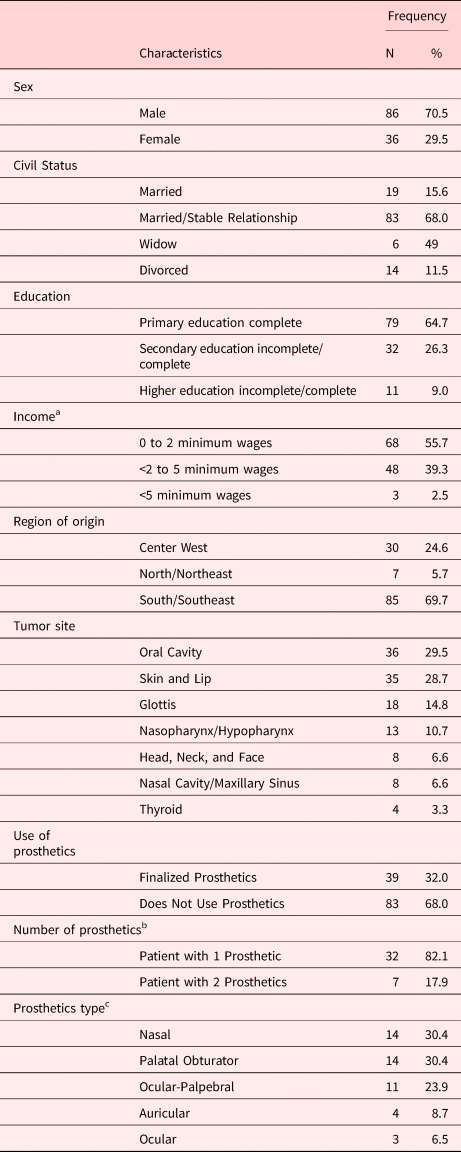
The mean age was 58.3 years (standard deviation [SD] = 11.4). The majority were men (70.5%, n = 86), married (68%, n = 83), earning ≤2 Brazilian minimum wages (55.7%, n = 68), and with primary education only (64.7%, n = 79). Most of the patients interviewed had as the primary tumor located in the oral cavity (29.5%, n = 36), followed by skin and lip. Of the patients interviewed, 39 (32.0%) used buccal-maxillofacial prosthetics and/or a palatal obturator (Table 1). From the total of 244 items to be answered, 13 were not completed. Therefore, the overall index of absent answers for the scale was 0.5% (13/2, 440).
Sociodemographic characterization of the patients included in the SSS validation process
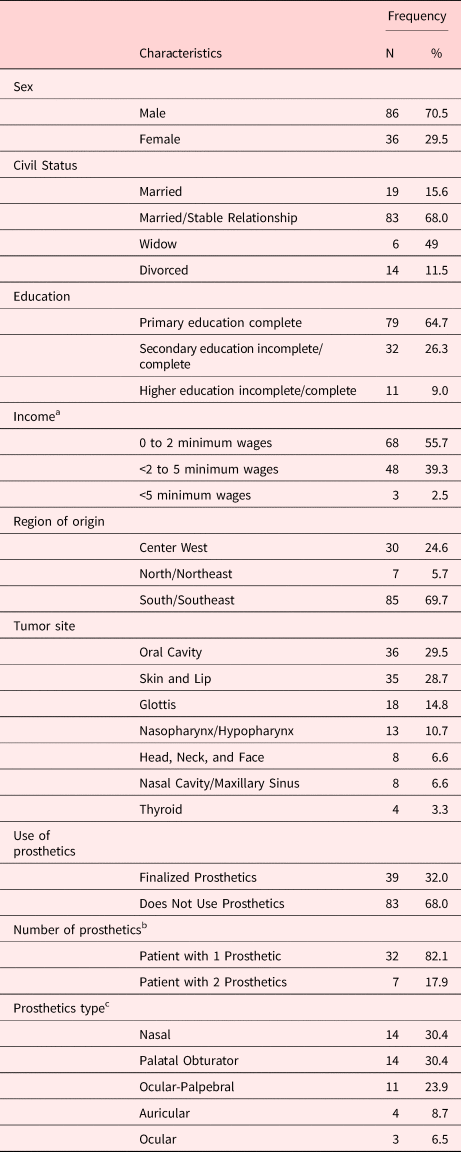
a Categorized in minimum wages in Brazil in effect at the time of data collection.
b Frequency table considering the total of 39 patients who use buccal-maxillofacial and/or palatal obturator prosthetics.
c Frequency table considering the total of 46 prosthetics.
Internal Consistency
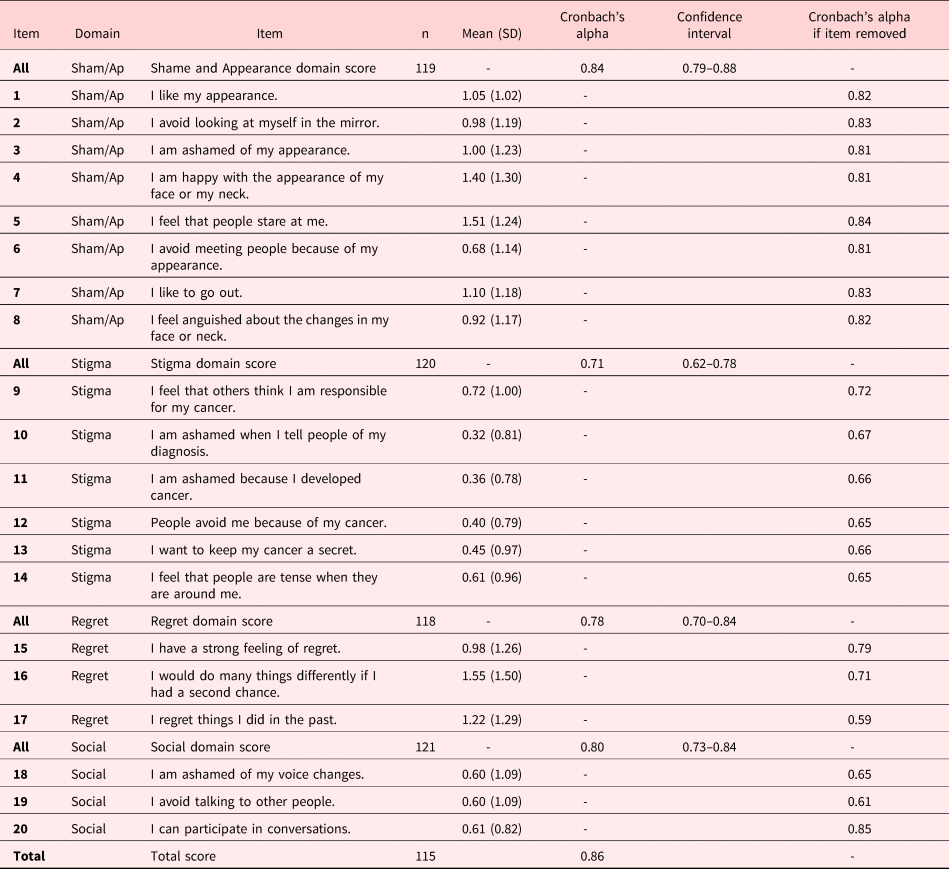
The Cronbach's alpha coefficient of the global scale was 0.86; for the domains, the Cronbach's alpha ranged from 0.71 to 0.84. The Cronbach's alpha analysis with item exclusion showed that none of the items occasionally interfered with the measured values in a negative manner (Table 2).
Mean, median, standard deviation, minimum and maximum values, Cronbach's alpha of the domains, and Cronbach's alpha of the domains if the item is removed from the SSS

Sham/Ap: shame with appearance. Regret: regret. Items 1, 4, 7, and 20 present the means, standard deviations, and quartiles according to the scores gathered in the scale. For evaluation of the Cronbach's alpha of the scale, reverse scoring data were used according to the original scale.
Test-retest reliability
Sixty-eight of the participants (55.7%) answered the SSS a second time, in 12 (SD = 5.6) days after the first evaluation. The values of test-retest were as follows: Shame and appearance (CCI = 0.93, 95% CI, 0.88–0.96, p < 0.001), Stigma (CCI = 0.90, 95% CI, 0.82–0.94, p < 0.001), Regret (CCI = 0.53, 95% CI, 0.19–0.73, p < 0.001), Social (CCI = 0.96, 95% CI, 0.93–0.97, p < 0.001), and Global Scale (CCI = 0.92, 95% CI, 0.86–0.95, p < 0.001).
Responsiveness
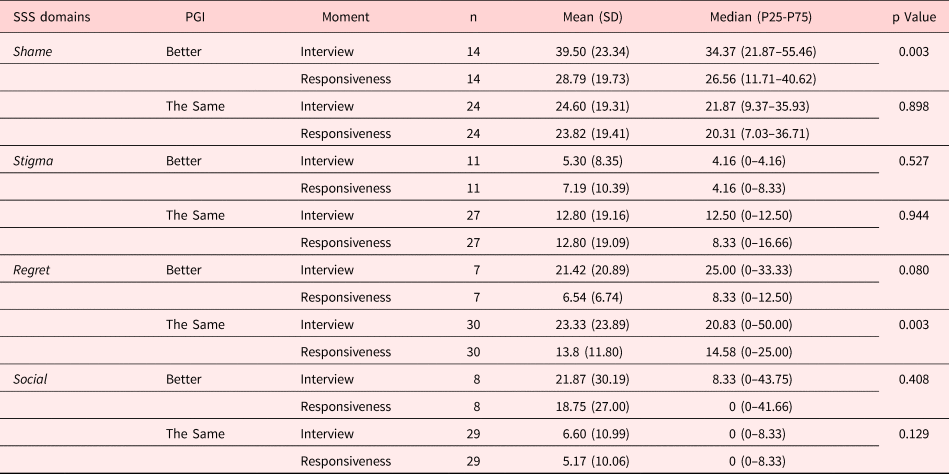
A total of 38 patients were interviewed before and after the production of buccal-maxillofacial prosthetics; the mean time between the first evaluation and the responsiveness assessment was 40.1 (SD = 18.1) days. The domains “Shame and Appearance” (p = 0.005) and “Regret” (p = 0.001) decreased their scores significantly between the first and the second evaluations (Supplementary Table). When the anchor-based method was used, compared with the first evaluation (without prosthetics), the difference between the groups was statistically significant (p = 0.003) when the patients reported they were feeling better in regard to shame. Regarding the patients who reported feeling the same between the two interviews, the “Regret” domain showed a statistically significant difference between the groups (p = 0.003). In the other domains and in the global scale, there were no significant differences between the groups. These data are described in Table 3.
Differences in SSS domain scores according to different patient's global impressions (responsiveness analysis)
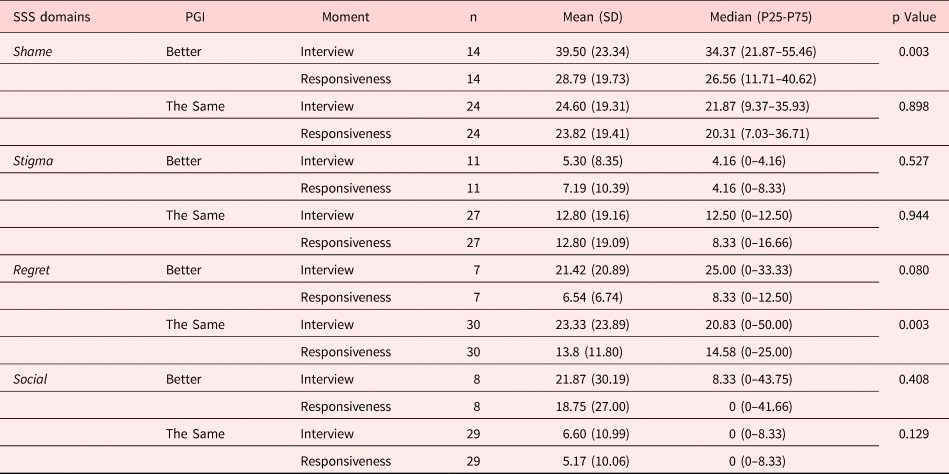
PGI = Patient's Global Impression
Convergent validity
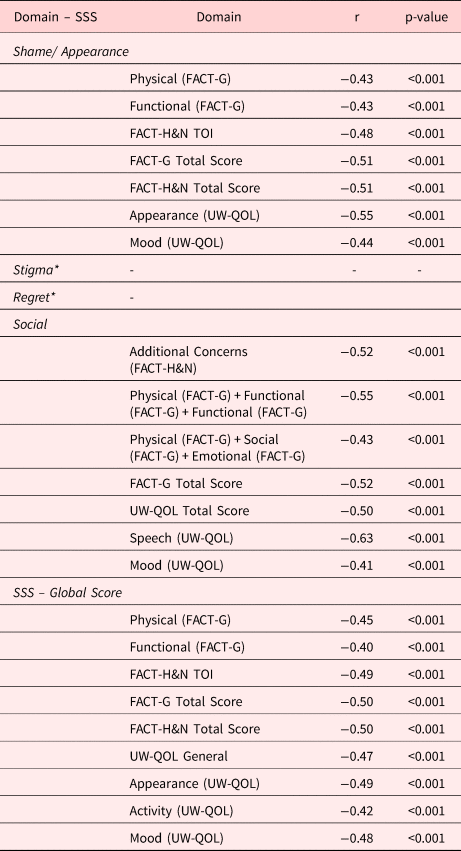
A total of 14 domains of the scales used were correlated with the SSS, and nine were correlated with the global SSS score. The Stigma and Regret domains did not show any correlations. The correlations ranged from -0.55 to -0.40 (Table 4).
Correlations found between the instruments used and the SSS-Br scores (convergent analysis)
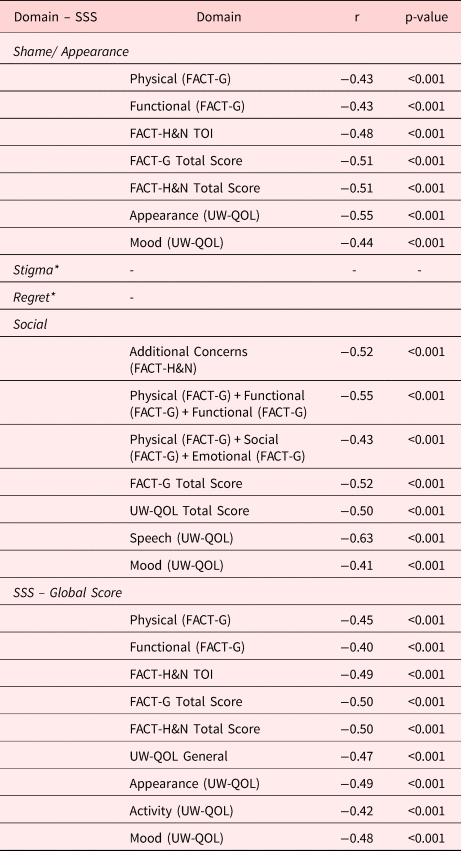
*The Stigma and Regret domains did not show any correlations
Discussion
In this study, we evaluated the psychometric properties of the SSS. Using classic psychometric parameters for this validation (Fayers & Machin, Reference Fayers and Machin2007; Terwee et al., Reference Terwee, Bot, de Boer, van der Windt, Knol, Dekker, Bouter and de Vet2007), we determined that the Brazilian Portuguese version of the SSS may be considered a valid and reliable instrument for the evaluation of Brazilian patients with HNC as discussed below.
First, the internal consistency ranged from 0.71 to 0.84 for the domains and 0.85 for the global scale. These results are in line with the original validation which found an internal consistency ranging from 0.78 to 0.92 for the domains and 0.92 for the global scale (Kissane et al., Reference Kissane, Patel, Baser, Bell, Farberov, Ostroff, Singh, Kraus and Shah2013). Thus, SSS-Br showed appropriate internal consistency, indicating that the domain items were measuring the same construct and suggesting that the patients had a good understanding of the scale.
Second, the test-retest procedure resulted in ICCs above 0.70 (0.92 for the global scale and 0.90 to 0.96 for the other domains), with the exception of the “Regret” domain, which presented an ICC of 0.53. The ICC is expected to present values similar to those in the previous interview; once the period of time between the interviews is not very short so that the patients do not recall the answers, and not very long so that there are no major changes related to the construct being evaluated (Terwee et al., Reference Terwee, Bot, de Boer, van der Windt, Knol, Dekker, Bouter and de Vet2007). In our opinion, this low ICC could be explained in the following ways: Some items included in this domain include statements that may be interpreted in a broad manner by the patients, such as “I have a strong feeling of regret,” “I would do many things differently if given a second chance,” and “I feel sorry about things I have done in the past.” In addition, the patient's emotional state at the time of the interview may influence the perception of regret. Despite the fact that the instructions of the scale guide the patients so that they answer each of the items based on their sensations over the past seven days, there is a potential for bias in the feelings that the patient may have at the time of answering the questions in the instrument. Although some authors report that an ICC may be satisfactory above 0.40 (Fleiss, Reference Fleiss1986; Fregnani et al., Reference Fregnani, Fregnani, Dias de Oliveira Latorre and de Almeida2013), it should be noted that the “Regret” domain needs to be evaluated further in future studies, since this is the first study to carry out a test-retest procedure and to detect this low ICC. In the original scale validation study, no reproducibility analysis was performed (Kissane et al., Reference Kissane, Patel, Baser, Bell, Farberov, Ostroff, Singh, Kraus and Shah2013), which makes comparisons of the same domains in different populations not possible.
Third, responsiveness was used as a method to evaluate the sensitivity of the scale to measure clinical changes (Fayers & Machin, Reference Fayers and Machin2007). Responsiveness was evaluated after patients started using buccal-maxillofacial prosthetics and/or a palatal obturator. Of the four SSS-Br domains, two of them, “Shame and Appearance” and “Regret,” presented statistically significant changes. Patients were invited to answer a clinical evaluation form according to their perception, in which they answered if their quality of life had improved, worsened, or remain unchanged for each of the SSS domains. Only one patient reported feeling worse in the “Regret” and “Social” domains, making the comparison impossible. Regarding patients who reported feeling better, there was a statistically significant difference (p = 0.003) between the two moments in the “Shame” domain. For the groups of patients who reported feeling the same between the two moments, the “Regret” domain showed a statistically significant difference (p = 0.003), but there were no differences for the other domains. These results provide further clinical evidence of the applicability and suitability of this scale in the clinical practice and research.
Finally, in the convergent validation of the construct, eight correlations were initially expected, but five correlations were found. The “Shame/Appearance” domain was correlated with the “Appearance” domain of UW-QOL (r = −0.55), and the Social domain presented correlations with “FACT H&N” (r = −0.52) and the “Speech” domain of the UW-QOL (r = −0.63). Although three correlations that were initially proposed were not confirmed, the SSS domains were correlated in total with 14 domains of the scales used. One correlation did not reach r >0.4, but the data were superior to r >0.3. A larger correlation coefficient indicated better convergent/divergent validity of the instrument being tested. However, values greater than 0.3 are considered acceptable (Fayers & Machin, Reference Fayers and Machin2007). In the results presented by Kissane et al. (Reference Kissane, Patel, Baser, Bell, Farberov, Ostroff, Singh, Kraus and Shah2013) in the original scale, the global SSS score was correlated with the global scores of the FACT-G and the FACT-H&N, as occurred in the validation process in this study.
Limitations of the Study
This study has some limitations. First, this is a single-center study, i.e., it is not possible to accurately conclude that the SSS-Br is valid all over Brazil. However, the HCB is considered an excellent site for the validation of health instruments since it accepts patients from all regions of Brazil and includes individuals with low education levels. Although it is likely that an instrument validated in a population with low social-cultural-educational conditions is adequate when used in a population with high social-cultural-educational levels, the opposite may not be true. Second, the sample size was small, particularly regarding the responsiveness analysis. The manufacture of buccal-maxillofacial prostheses is performed infrequently in BCH, thus a subsequent study for this analysis should be multicentric or require a much longer period for data collection. Despite this sample size, we still found differences before and after the procedures.
Conclusion
The Portuguese (Brazil) version of the SSS is reliable and presents acceptable psychometric properties. Its use may help in the identification of symptoms such as Shame, Stigma, and Regret in patients with HNC. Consequently, the medical and/or multidisciplinary team may be able to outline measures, treatment, and potential complications in a broad manner. Future SSS validation studies are welcome in other developing countries in order to make cancer health providers aware of these negative feelings in their HNC patients.
Supplementary material
To view supplementary materials for this article, please visit https://doi.org/10.1017/S1478951519000488
Acknowledgments
William Eduardo Pirola received support from the Barretos Cancer Hospital Internal Scholarship (IEP/2015).