1. Field Recordings of Former South London Windmills
I have dozens of field recordings of cities. Not specific sounds, like a braking car or the emptying of a bottle bank, but blank-grey pools of cities murmuring. I often listen to them, trying to understand. Does summer sounds different from winter? Does Barcelona have a different key from London? They are riddles. But beyond details (Barcelona has more parakeets; London has louder buses), they all sound the same. In fact, they can sound incredibly boring. They are occasionally stupefying and without intent. A million cars seem to go nowhere. They're also immersive and bottomless. There's no clue to how they end (and there was no introduction to start with). The recordings fade in and fade out, like some pop songs do, suggesting they in fact go on forever; the band never stops playing. An endless pop song is meaningless. It just grinds on. So does the city. Droning. Paradoxically, this can be very attractive, wholly enigmatic, and, as John Cage noted, boredom ad infinitum gets interesting after a while. On occasion these recordings allow for what CREED researchers Jean Francois-Augoyard and Henry Torgue call ‘sharawadji’: ‘a sound motif or a complex soundscape of inexplicable beauty … (that) is the sublime of the everyday, the invisible but present exception of the ordinary’ (Augoyard Reference Augoyard2006: 117).
My work often starts with these field recordings, and attempts to find meaning in them through the ‘extra-musical’; in the historical, memorial and semiotic networks that sound exists within.Footnote 1 I often use pop music to complement my pieces, as it is as concise and wilfully manipulative of memory and semiotics as the soundscapes are evasive. Previous works include a score written from/for one minute of sound recorded on a street corner in Barcelona, a CD of three-minute ‘singles’ made from the sounds of an abandoned tower block, and an immersive audio-guide for a small Icelandic town that walks listeners through the connections between the local herring industry and the music of Harry Belafonte.Footnote 2
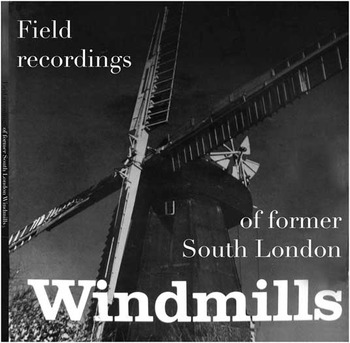
A project made in 2010, Field Recordings of Former South London Windmills, was a continuation of my work with city soundscapes, exploring their relationship to an imagined past, as well as an investigation into the problematic idea of ‘sound in-itself’ (Figure 1). By recording absent buildings I was questioning the premise that sound has a core essence and suggesting sound exists in a third space between reality and imagination. By recording absence I was also listening for the ‘sharawadji’ through negation as, noted by Lyotard, ‘modern aesthetics is an aesthetics of the sublime, though a nostalgic one. It allows the unpresentable to be put forward only as the missing contents’ (Lyotard Reference Lyotard1984: 81).
An image from the installation Field Recordings of Former South London Windmills.

The core of the presented piece was a series of contemporary field recordings made at the locations of the ex-windmills. These were presented as an LP record, the centrepiece of an installation where audiences can listen to the individual tracks and view images of the mills taken from various London municipal archives. The work is also available as a CD and has been displayed in various forms including a slide show of the windmills with the corresponding recordings.
My choice of windmills was due to the strong evocation of history, fantasy and mystery that they engender. They are memory objects; nostalgic, even memento mori. I was also struck by the use of a windmill in a 1930s Anti-Noise League periodical; the windmill was appropriated as a symbol of rural peace, implicitly positioned in opposition to an urban noise which is slowly killing the quiet.Footnote 3 The windmill was presented as containing an essence of silence and tranquillity. By focusing on urban windmills, at least urban ex-windmills, I aimed to utilise this apparent sonic and geographic essence of the windmill and use it to explore listeners’ experiences of the urban sound-world.
Part of my motivation for Field Recordings of Former South London Windmills was to make field recordings of banal London streets fizz with evocations of windmills. Yet I also want to present the soundscape as it is; the blank-grey sprawl. I did not suggest these recordings contained windmills; either as ghosts or windmill-shaped absences in sound. The piece was not a ‘psycho-phonographic’Footnote 4 colonisation of these locations, but I did make the claim that by making an association between history and the contemporary sound-world, the moment of audition may sound with windmills.Footnote 5 Indeed, a number of listeners thought they could hear the whirring of windmills within the recordings, amidst the rattling trains or the whistle of the breeze.
The work explored three key issues related to sound and listening: firstly, the notion of ‘sound-in-itself’; secondly, a questioning of essentialism within field recording and phonography; and, thirdly, the central role of the auditory imagination in our sensation of sound.
Any sound is a hub, a space where a million fluttering arguments intersect and agree, in the ear or mind of the listener (for a moment), to give their causes a name: ‘bird song’, ‘traffic jam’ or ‘pop song’. These sounds exist outside themselves. A traffic jam is not just a vibration of molecules; it's a sign, a marker, evidence for something else. In its absence it might represent the past, as it is it might represent failure, or progress. To some it's noise;Footnote 6 to others it's silence.Footnote 7
A sound can fizz and pop with everything it isn't. A pop song fizzes with the gestures of its singer, with the louche pose of the guitar player. Cathedral bells fizz with God. Sirens pop with fear. A pop song is a series of mimicries and quotations, like a text – as Barthes (Reference Barthes1977) noted – and it's the listener who creates a context where these quotations become meaningful constructs. So the meaning of sound, that which makes the sound sound, exists as much in the body/mind matrix of the listener, as in the sound-in-itself. I suggest our movement through listening – through sensation, association and on – is where sound occurs.
The notion of sound having meaning without reference to anything but the sound itself is challenged in Seth Kim-Cohen's book, In The Blink of an Ear (Reference Kim-Cohen2009).Footnote 8 He argues powerfully for a movement away from this view of ‘sound-in-itself’, which he views as a modernist hangover, analogous to the attitudes towards paint and colour within Abstract Expressionism. In the visual arts this reductionism was subsequently superseded by conceptualism and postmodernism, which highlighted the complex network of relationships around an artwork which give it meaning. Kim-Cohen argues that a similar progression has not occurred in sound arts, with sound still shying away from analysis, claiming some inherent essence and hindering awareness of a potential conceptualist space within the medium.
Kim-Cohen's arguments are persuasive, and clarify for me a number of ontological problems I have had with field recordings and their representational claims. He could be criticised for willing into existence, especially with his iconoclastic phrase ‘non-cochlear sound art’,Footnote 9 a slippery and paradoxical world of sound art that no one actually listens to. Occasionally his sound-outside-itself slips the body entirely and becomes text in its most lifeless state. Also, a simple binary of ‘sound-in-itself’ sound art opposed to conceptual ‘non-cochlear’ sound art overlooks the complexity of sensory modalities. The implicit suggestion that conceptual understanding is non-sensate is problematic, but that is a debate for another essay.
Kim-Cohen does mark out the beginnings of new lexicon to deal with sound art that allows the conceptual into sound art practice. For this I find his work quite liberating. Sound art sometimes uses sound-in-itself as a licence to be silent on everything but the noise it makesFootnote 10.
The perspective of sound containing within itself everything it needs to be understood is a form of essentialism. It suggests that each sound has a primordial core that is unchanging; moreover, it proposes each audition of that sound to be of the same sound, the consequence being that we all hear the same thing. A recording made of a bird is always that bird, as if it has been captured and is then released through the speaker each time it is played. This perspective encourages a particular way of listening; it is trusting and resists transformation. My work with windmills attempts to play with this by proposing a field recording – which I suggest is an essentialist proposition – that contains elements that are patently not present, elements that exist entirely in the imagination of the listener, so making it divergent and relative. So the piece moves the focus from the sound itself to our audition of that sound; from sounding to listening.
The essentialising of sound is a paradigmatic position in a number of soundscape artworks. For example, Annea Lockwood's A Sound Map of the Hudson River (Reference Lockwood1993) succeeds as a representation of a river only if the listener agrees with Lockwood in her proposal that an entire river can be represented as sound, and that the sound of the river somehow contains the essential nature of a river.Footnote 11
When we listen to the work through hi-fi speakers in London or Paris or Addis Ababa, we ask, ‘Where is the river exactly? And what part of a river are we hearing?’ We also hear the gurgling, whooshing, running and babbling of the tracks and make associations with taps, toilets and pouring tea. Our subjective experience of this river is thus unknown to Lockwood, and the essential character of the Hudson River becomes problematic. Perhaps, if we have visited the river, the piece becomes more meaningful, our own memory of the river, our own inner-river, according with hers. But this would still be an imagined river, created out of an electromagnetic recording, her artistic technique and our faith in the fact of this inner-river sounding like A Sound Map of the Hudson River. When I listen I may project my own recollections of other rivers into Lockwood's representation, creating my own composite Hudson River.
Listening to A Sound Map of the Hudson River is a pleasurable aesthetic experience. It features a range of frequencies that dance in and out of the mix, and the sequencing presents variety, some sense of narrative and compositional moments of release and tension, but to what extent its claim to represent a river is true is debatable. My experience of listening moves between memories of rivers, the visceral rush of imagined water, and my own interior voices debating the meaning of the piece. I veer between a listening that accepts the essence of the Hudson River, and a listening that mistrusts and transforms the sound into something else entirely. Perhaps Lockwood's piece sits more powerfully in the realm of conceptual art than acoustic-ecology-informed sound practice. It's a huge question mark above sound-in-itself. Could we classify it as ‘non-cochlear’? Of course, this is not Lockwood's intention. As we noted, she hears the river. What if my audience hears windmills?
The issue of the auditory imagination is central to the Field Recordings of… project. Any sound, recorded or otherwise, exists in a number of places: it exists next to a river as a oscillatory movement of air molecules; it exists as the perceived sensation of a sound in a fisherman's ear; it exists as data on a tape or CD called A Sound Map of the Hudson River; it also exists as a silent sound in the head of the listener. When one listens to music, the same parts of the brain are excited as when imagining music (Levitin Reference Levitin2008). When imagining music those parts of the brain associated with memory are also triggered. Memory is part of sound. For example, we understand and enjoy music because we remember its structures; we recognise what went before and we know what comes next (Barthes Reference Barthes1985). Otherwise it's just one sound after another, without intent. It becomes noise.Footnote 12
Don Ihde's Auditory Imagination (Reference Ihde2007) suggests a conscious effort to imagine and listen to music, and at the same time creates a third music, existing somewhere between imagination and ‘real’ sound. Ihde calls these a ‘copresent polyphony of auditory experience of the perceptual and imaginative modalities’ (Reference Ihde2007: 127). Ihde's phenomological approach, foreshadowed by Charles Pierce's ‘thirdness’, uncovers a space in the reception of an artwork, an overlay of the ungraspable ‘real’ with the endless internalities linked to memory, sensation, imagination and so on. I suggest that sound is this ‘copresent polyphony’. It is this movement through listening, from outside to inside, from object to subject, where sound is created.
Q: If a tree falls down in a forest and there's no one there to hear it, does it still make a noise?
A: If it's the same tree as the one you're talking about then yes, as when you asked your question, I imagined it falling, and I heard a sound.
So, to conclude, Field Recordings of South London Windmills allows the possibility of a conceptual sound art and also allows the auditory imagination a more central role in the creation of our sound-world. Whilst encouraged by a number of Kim-Cohen's ideas I equally don't suggest a reductive binary of ‘sound-in-itself’ vs. ‘non-cochlear’ sound practice. For me, the intellectual and imaginative aspect of listening, the hearing of the windmills, is as part of the phenomenological experience of listening as the feeling of bass in your chest, or the tingle in the back of the neck caused by high-frequency sine-tones. Our sound-worlds are not passive experiences of sonic essences, but constantly reconstructed compositions of mind and body combined.
Is it at this juncture, in the spaces between memory and the present, the object and the subject, ‘sound-in-itself’ and the ‘non-cochlear’ that we can return to the ‘sharawadji’. For me, in the role of artist, this richness of sonic sensation is where the sublime becomes re-incorporated into the sonic artwork. Listening constantly moves us between subjectivities, and I hope my work allows for these different ways of listening, and the possibility of hearing the sublime in the everyday. No mean feat, of course, and something I'm only beginning to explore.
The Field Recordings of Former… project is ongoing, with planned sequels including Field Recordings of Former London Asylums and Field Recordings of Former Sites of Conflict and Rebellion, and I have developed other methods of testing the essence of a field recording, including creating a cover version of a field recording; an exact copy made only with my body. Such projects will undoubtedly explore these various approaches to listening, drawing out the deeper potential for ambiguity, imaginary sound and conceptual approaches within the field recording.