Recent evidence suggests a strong link between environmental design and patient and healthcare worker (HCW) safety.Reference Ulrich 2 The evidence linking environmental design and safety is growing, but it is often overshadowed by an emphasis on people, technology, and process design. One critically important way that environmental design has been shown to influence patient safety is through reducing the risk of hospital-acquired infections.Reference Jiang 3 , Reference Oren, Haddad, Finkelstein and Rowe 4 Evidence suggests that infections are reduced when the physical design accommodates single-patient rooms instead of multibed roomsReference Drinka, Krause, Nest, Goodman and Gravenstein 5 – Reference Passweg, Rowlings and Atkinson 7 and when the layout of a room affords easy access to important equipment, such as hand sanitizer and handwashing sinks.Reference Bischoff, Reynolds, Sessler, Edmond and Wenzel 8 , Reference Creedon 9 A recent study focusing on the design of personal protective equipment (PPE) and contamination risk also revealed that the environment in which people remove equipment can have a substantial effect on safety.Reference Herlihey 1 This study builds on the previous research of Herlihey et alReference Herlihey 1 by specifically examining the effect of environmental design on doffing safety when removing PPE in a healthcare environment.
Personal protective equipment refers to items of clothing or equipment (eg, mask, apron, gloves, etc.) that aim to protect the user from injury or infection. When used appropriately, PPE is an effective tool for protecting HCWs from disease transmission. Training in donning (putting on) and doffing (removing) PPE can hone technical skills and reduce risk, and several guidelines describe how to safely don and doff various PPE items. 10 , 11 However, safe donning and doffing practices do not provide 100% protection from injury or infection. In a recent study, Herlihey et alReference Herlihey 1 used a human-factors approach to evaluate the design of various PPE items with representative users in typical Canadian healthcare environments. While PPE design was the focus of the study, testing within the environment in which donning and doffing revealed several issues unrelated to PPE that had substantial impacts on doffing safety. The layout of the environment increased contamination risk in several unforeseen ways. First, primary HCWs threw potentially contaminated equipment and moved essential supplies to inconsistent locations. Also, primary HCWs were observed moving hand sanitizer from a storage shelf to the sink, and subsequent primary HCWs were unable to locate these supplies.
The findings of Herlihey et alReference Herlihey 1 highlight the often-unrecognized role of the environment in determining user safety. While step-by-step guidelines exist describing how to don and doff PPE, 10 , 11 limited evidence and principles are available on how best to design the environment in which the PPE will be used. In this formative study, we designed, built, and tested a doffing station containing several features intended to overcome the environmental issues identified in a previous study. The results highlight the effect of the environment on doffing PPE safely and the importance of iteratively testing and modifying the design of doffing areas to improve safety.
METHODS
This study was conducted between February and April 2015 in a series of 3-day workshops on the management of patients with Ebola virus disease (EVD). The workshops were hosted by Sunnybrook Health Sciences Center in partnership with and funded by the Ontario Ministry of Health and Long-Term Care. A mixed-methods approach was used that included human-factors usability testingReference Salvendy 12 and qualitative questionnaire responses. Usability testing is an observational technique in which end users perform representative tasks in a semirealistic simulated environment while being observed by human-factors experts. The goal of usability testing is to assess the appropriateness and ease of use of a system.Reference Salvendy 12 Through usability testing, it is possible to objectively identify how features of an environment affect safety. Questionnaire responses were collected to elicit feedback from the participants and to obtain subjective data on the design features. Because this study investigated quality improvement measures, we did not seek approval from a research ethics board. Nonetheless, all participants signed a consent form prior to participating.
Participants
An opportunity sample of 72 participants from across Ontario, Canada, took part in the study. Participants were representative of potential users of PPE for the management of a patient with EVD: infectious disease and occupational health workers (43%), nurses (31.9%), paramedics (16.7%), physicians (4.2%), and others, including an environmental service provider.
Participants were predominantly female (70.8%) and were aged between 45 and 54 years old (mean, 47.2). Only 2 participants (2.8%) had <1 year of experience in their current role; most participants had>10 years of experience (65.3%). Experience with PPE ranged from inexperienced (2.8%) to somewhat experienced (23.6%), experienced (54.2%), and very experienced (19.4%).
Participants worked in pairs consisting of a “primary HCW” (ie, the person doffing the equipment) and a “secondary HCW” (ie, an assistant to provide direction during the doffing process).
Testing Environment
A testing site comprising a patient room and a connecting anteroom was constructed for testing purposes. Figure 1 contains images of the setup inside the patient room and anteroom. This testing space was designed to test the environmental failures identified by Herlihey et alReference Herlihey 1 in a previous study.
Top row: Doffing area inside patient room shown with the door to the anteroom closed (top left) and open (top right). Bottom row: Views of the doffing areas inside the anteroom shown from within the “clean” green area of the anteroom (bottom left), and from the “dirty” red area at the doorway from the patient room to the anteroom (bottom right). Red, yellow, and green lines of tape correspond to the different zones going from “dirty” (red) to “clean” (green).

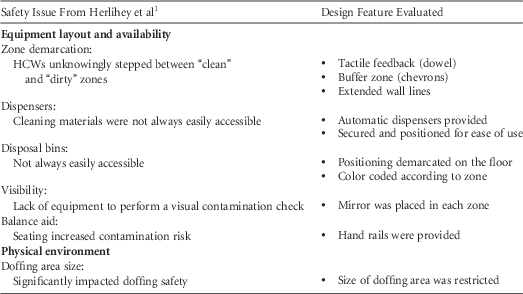
The environmental design features that were tested as part of this study are outlined in Table 1. For a more detailed description of the design features and considerations, see the Supplementary Materials.
Overview of Design Features Added to the Doffing Environment for Evaluation

Procedure
Each trial included 2 HCWs: 1 acted as the primary HCW (the person doffing PPE) and 1 acted as the secondary HCW (the person providing direction and assistance to the primary HCW). Prior to each usability trial, participants were given a brief orientation that included a description of the doffing zones and the intention of the hand rails (because these design features were likely new to some participants). Chocolate pudding was then applied to the primary HCW’s PPE to replicate infectious bodily fluid transferred to the PPE.
Participants were asked to follow their own institutional doffing protocol within the constraints of the new doffing area. A human-factors specialist with extensive usability testing experience independently observed, recorded, and documented actions and dialogue.
At the end of each usability trial, participants completed a questionnaire. The questionnaire contained 17 questions and collected demographic information in addition to subjective ratings of the various design features tested. For the subjective ratings, participants were required to rate each design feature according to its usefulness: “useful,” “not useful,” or “didn’t notice.” Sessions lasted approximately 20 minutes. A thematic analysis was used to analyze subjective participant feedback and the observational data collected during the trials.
RESULTS
An analysis of our objective observational findings in addition to the subjective participant ratings revealed similar trends regarding usability: while some design features worked well, others required further modification. Below, we describe the results from the participant questionnaire followed by the observational findings.
Subjective Responses
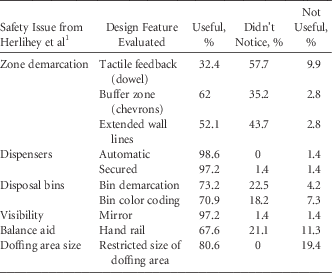
Subjective participant responses are shown in Table 2. Most design features were predominantly deemed “useful.” Almost all participants (97.2%) reported that the inclusion of mirrors was useful; 98.6% indicated that automatic dispensers were useful; and 97.2% indicated that the dispensers being secured to the walls was useful. Participant feedback regarding restricting the doffing area was predominantly positive; 80.6% of participants noted that they had sufficient space to doff their equipment within the demarcation zones. Several of those who thought the space was too small commented that this was likely a result of their coveralls taking up a large amount of space. One participant noted that the restricted space used was actually larger than the space currently available at their institution.
Subjective Participant Ratings of Design Features

In contrast, more than half of the participants (57.7%) reported that they did not notice the presence of dowels to provide tactile feedback, and a similar percentage of participants (43.7%) also did not notice the extended all lines used to increase zone visibility.
Almost all participants (97.2%) found mirrors to be useful, with many noting that they intended to include this piece of equipment within their own doffing area once they returned to their institution.
Because many of our participants had completed their own “in-house” doffing training with some form of seat (eg, chair, stool, or, in larger areas, a bench), our decision to include hand rails was likely the most controversial of our design features. Nonetheless, most participants found the hand rails provided to be useful (68%). Those who did not find the hand rail useful commented that they, or their colleagues, would prefer a seat or felt safer using a seat.
Observations
Zone demarcation prevented participants (but not equipment) from crossing into “dirtier” zones
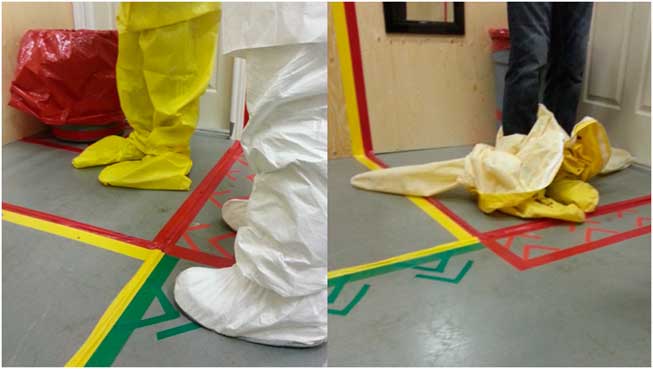
Observational data revealed that participants acting as primary HCWs did not incorrectly cross the demarcation lines into a cleaner zone or even into the buffer zone. Although participants acting in the role of secondary HCW unknowingly stepped within the buffer zone to help the primary HCW (Figure 2, left), none actually crossed into the dirty/red zone. Although it was not corroborated by subjective participant feedback, this finding suggests that the zone demarcation design features acted as a sufficient visual aid to reduce inappropriate crossing between clean and dirty zones.
Left: Secondary stands within buffer zone (rectangular area containing chevrons) when assisting the primary HCW. Right: Potentially contaminated equipment crosses over into “caution” and buffer zones.

However, in several instances, potentially contaminated equipment fell within the buffer and within the caution/yellow zones (Figure 2, right), which, depending on the level of contamination, poses a potential cross-contamination risk.
Secured dispensers were easy to access and were used in a consistent manner
Participants were able to successfully interact with the secured dispensers, with 1 exception: the automatic sensor was not activated for 1 participant whose PPE ensemble included black nitrile gloves.
Color-coded bins did not prevent dirty bins from being moved to cleaner locations
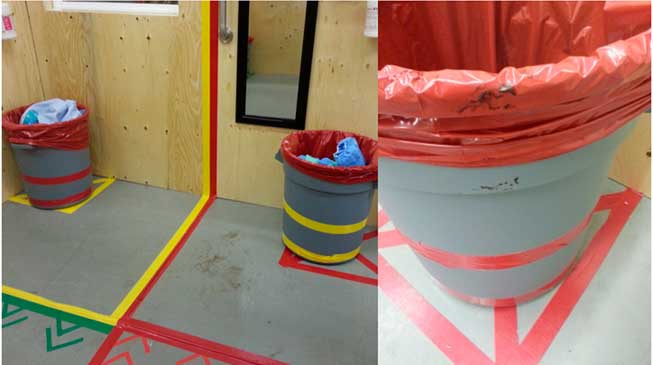
While most participants noted that color-coded bins were useful (70.9%), observational data revealed that as disposal bins started to fill up, HCWs began to move the bins around to make room for PPE (Figure 3, left). Thus, contaminated equipment was moved to a “cleaner” zone.
Left: Color-coded bins were moved between different zones (red = “dirty”, yellow = “caution”, and green = “clean”). Right: Bins became contaminated as HCWs brushed up against them during doffing

Contamination spread from PPE to disposal bins
Moving bins around was particularly problematic because some HCWs brushed up against the bin and spread contamination (Figure 3, right). Thus, markings taped to the ground to create a perimeter around the bins did not increase attention to the perimeter as expected.
Bin demarcation ensured that bins were positioned in safe locations
Although color coding did not prevent bins from being moved around, providing a specific location helped to ensure that when moved, bins were placed in a safe position (ie, away from the transition lines between zones to prevent dirty items falling into cleaner areas).
Mirrors were used for multiple actions during doffing
Observations revealed that mirrors were used for multiple actions during doffing when HCWs reached for the coverall zipper underneath the chin and when inspecting the PPE for gross contamination prior to doffing. Our setup included a mirror in every zone (ie, within the patient room and within the dirty, caution, and clean zones). This measure was intended to ensure that HCWs had a mirror available to them at all points during the doffing procedure; it also provided our participants with several different viewing angles for inspecting their PPE.
Hand rails offered sufficient balance support, but placement complicated shoe-cover removal
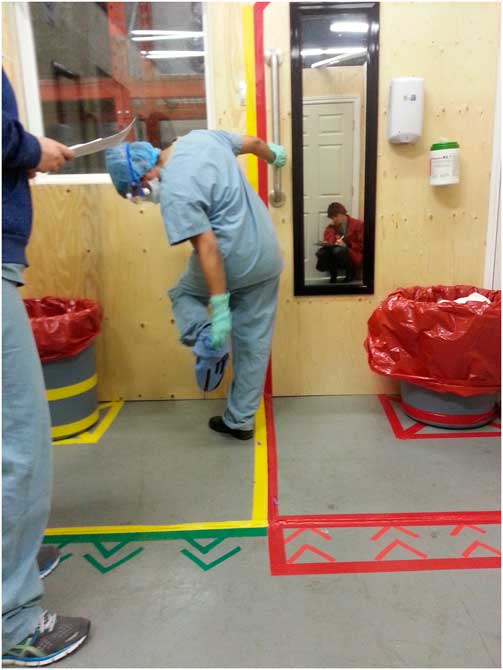
Observations of those using the hand rail revealed that the rail provided sufficient balance support when doffing shoe coverings. However, observation revealed that shoe covers needed to be removed in a specific way to ensure full, safe use of the rail. Figure 4 shows a primary HCW doffing the left shoe covering last. In doing so, to maintain a grip on the rail, his left foot crossed into the caution zone. In the setup used here, HCWs should ideally doff the left shoe coverings first.
Primary HCW using hand rail to doff shoe coverings.

Restricting the doffing area limited the spread of contamination
Our setup included a large anteroom space divided into smaller zones to restrict movement of the HCW during the doffing process to control the potential spread of contamination. These smaller zones successfully restricted the movement of the HCWs, and contamination did not spread beyond the dirty zone.
Inclusion of windows was not sufficient for communication
We included a window to enable the secondary HCW to see into the patient room to facilitate communication with the primary HCW as needed during the initial doffing steps. While the inclusion of a window is likely better than no window at all (eg, visual line of sight), communication between the primary and secondary HCWs remained difficult.
DISCUSSION
This study clearly demonstrates the importance of environmental design in patient and HCW safety. While some of the design features improved doffing safety (eg, restricting the doffing space), some did not achieve their intended effects (eg, perimeter around disposal bins), and others caused additional unforeseen safety issues (eg, hand rails). Importantly, our results highlight the significance of iteratively testing design decisions with representative users to get a clear idea of their impact on safety before implementing them.
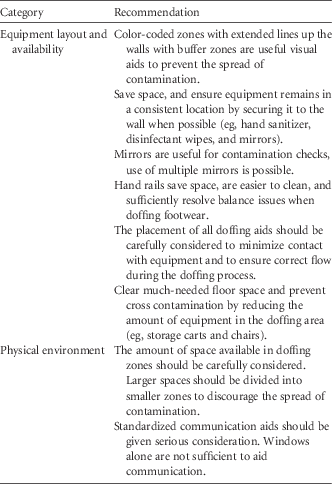
Based on our findings, we can make several recommendations with regard to designing environments for safe doffing. These findings are presented in Table 3.
Design Recommendations

We offer 2 design suggestions that build on our observations, but these suggestions should not be implemented without proper testing:
Preventing contaminated equipment from falling into “clean” zones
Despite our attempts to increase zone visibility, potentially contaminated PPE still fell into cleaner zones during the doffing process. Rather than increasing the size of the doffing zone, the selection of PPE, particularly the footprint it requires to be doffed safely, should be assessed. Alternatively, including a buffer zone between the dirty and caution areas could prevent contaminated material from landing in the cleaner zone. If space is an issue, it may be possible to further reduce the size of the caution (yellow) zone. Because very little equipment is doffed in the caution zone, it may not be necessary for all zones to be the same size used here.
Preventing bins from being moved between zones
One way to overcome bins being moved between zones would be to use different sized bins in each zone according to the amount of PPE to be doffed in that zone. Larger bins could be placed in the dirty zone and a smaller bin in the caution zone for the removal of smaller items such as face masks. This would discourage HCWs from swapping bins and would encourage emptying the bin in the dirty zone sooner. However, the underlying reason for moving the bins around was that they tended to fill up quickly. Thus, regardless of the size of bins used, it is imperative that effective disposal procedures are put in place to ensure that bins do not overflow.
The human-factors methodology is a clear strength of this study. Rigorous design evaluations with representative users conducting representative tasks are imperative for revealing system design issues for the purposes of mitigation prior to implementation. However, as with any testing of this nature, no immediate threat or risk to the participants was imminent; therefore, some participants may have behaved differently. Additionally, while it is important to consider how the environment may contribute to healthcare safety, it should not be considered in isolation. Environmental design interacts with several other factors, including organization culture, tasks and processes, and tools and technology.
Future research should continue to build on the growing literature examining the impact of the environment on healthcare safety. While it may not be possible to design a doffing environment that suits all hospital situations, it may be possible, through human-factors testing, to determine design principles that can be adjusted to match a particular setting and perception of risk. Promoting environmental design principles will support safe doffing of PPE for HCWs.
ACKNOWLEDGMENTS
Financial support: This project was sponsored by the Ontario Ministry of Health and Long-Term Care.
Potential conflicts of interest: All authors report no conflicts of interest relevant to this article.
SUPPLEMENTARY MATERIALS
To view supplementary material for this article, please visit https://doi.org/10.1017/ice.2017.68.