Introduction
The clinical course and outcomes of bipolar disorder are highly individually variables. The long-term outcomes of bipolar disorder range from lasting remission to chronic disabling mood symptoms (Judd et al., Reference Judd, Akiskal, Schettler, Endicott, Maser, Solomon, Leon, Rice and Keller2002, Reference Judd, Akiskal, Schettler, Coryell, Endicott, Maser, Solomon, Leon and Keller2003; Goldberg and Harrow, Reference Goldberg and Harrow2011; Tundo et al., Reference Tundo, Musetti, Benedetti, Massimetti, Pergentini, Cambiali and Dell'Osso2018). Many cases require repeated hospital admissions, which account for a substantial portion of the healthcare cost associated with bipolar disorder (Das Gupta and Guest, Reference Das Gupta and Guest2002; Hong et al., Reference Hong, Reed, Novick, Haro, Windmeijer and Knapp2010; Hidalgo-Mazzei et al., Reference Hidalgo-Mazzei, Undurraga, Reinares, Bonnin, Saez, Mur, Nieto and Vieta2015). The care needs of individuals with bipolar disorder vary. Specialized care can reduce the need for readmissions and lead to increased satisfaction and savings in overall healthcare expenses (Kessing et al., Reference Kessing, Hansen, Hvenegaard, Christensen, Dam, Gluud and Wetterslev2013). It would be advantageous to predict long-term outcomes so that specialized care can be directed to those with a greater likelihood of long-term adverse outcomes and readmissions.
Our ability to predict long-term outcomes is limited. Bipolar disorder is classified into type I and type II based on the peak severity of the activated episodes (Jung, Reference Jung, Adler and Hull1903; Dunner et al., Reference Dunner, Gershon and Goodwin1976; American Psychiatric Association, 2013). However, the distinction between bipolar I and II disorders has limited utility in predicting outcomes (Judd et al., Reference Judd, Akiskal, Schettler, Endicott, Leon, Solomon, Coryell, Maser and Keller2005; Pallaskorpi et al., Reference Pallaskorpi, Suominen, Ketokivi, Mantere, Arvilommi, Valtonen, Leppamaki and Isometsa2015; Murru et al., Reference Murru, Pacchiarotti, Verdolini, Reinares, Torrent, Geoffroy, Bellivier, Llorca, Vieta and Samalin2017). Bipolar I and II disorders are associated with similar degrees of psychosocial impairment and disability (Judd et al., Reference Judd, Akiskal, Schettler, Endicott, Leon, Solomon, Coryell, Maser and Keller2005). Several studies suggested that long-term outcomes may be driven by aspects of clinical course that are relatively independent of the distinction between bipolar I and II disorders, including the cumulative burden of depressive episodes and depressive symptoms, predominant manic polarity, and residual depressive symptoms (Judd et al., Reference Judd, Akiskal, Schettler, Endicott, Leon, Solomon, Coryell, Maser and Keller2005; Murru et al., Reference Murru, Pacchiarotti, Verdolini, Reinares, Torrent, Geoffroy, Bellivier, Llorca, Vieta and Samalin2017). However, we do not know whether a typology of clinical course prospectively predicts long-term outcomes relevant to public health and clinical care planning.
Five years ago, we used an 18 months intensive follow-up to establish a typology of clinical course over a medium-term period in a representative sample of 176 individuals with bipolar disorder (Uher et al., Reference Uher, Mantere, Suominen and Isometsa2013). Based on nine clinical course characteristics (proportion of time depressed, severity of depression, persistence of depression, proportion of time manic, severity of manic symptoms, persistence of manic symptoms, mixed symptoms, transitions from depression to mania, and transition from mania to depression), we identified two common course types in bipolar disorders: an episodic bipolar course type and a depressive type, which jointly account for 80% of cases of bipolar disorder; the remaining 20% of cases included smaller groups with less usual course types, including prolonged hypomanias and mixed episodes (Uher et al., Reference Uher, Mantere, Suominen and Isometsa2013). The present study aims to establish the predictive validity of clinical course in the first 18 months for long-term outcomes in a 5-year follow-up of the same cohort of individuals with bipolar disorder. Specifically, we test the hypothesis that the course characteristics and/or classes predict total time ill and hospital admissions over a subsequent follow-up period. We also hypothesize that course characteristics and/or classes will predict long-term outcomes even after accounting for the bipolar types I v. II distinction.
Method
Study outline
We test the validity of clinical course characteristics in predicting the long-term outcomes of bipolar disorder, using non-overlapping sequential periods of follow-up of the Jorvi Bipolar Study (JoBS). JoBS is a prospective study that aims to determine the long-term course and outcomes of bipolar disorder. In 2002 and 2003, the authors enrolled 191 cases of bipolar I and II disorders identified through screening 1630 patients of the Jorvi Hospital Psychiatric Unit, which provides psychiatric services to a catchment area of 261 116 inhabitants (Mantere et al., Reference Mantere, Suominen, Leppamaki, Valtonen, Arvilommi and Isometsa2004). The cases of bipolar disorder were based on screening of all outpatients and inpatients, who received psychiatric services between 1 January 2002 and 28 February 2003 (Isometsa et al., Reference Isometsa, Suominen, Mantere, Valtonen, Leppamaki, Pippingskold and Arvilommi2003). The positive screen or clinical suspicion of bipolar disorder was followed by in-person diagnostic interviews to confirm or rule out the diagnosis of bipolar disorder (First et al., Reference First, Spitzer, Gibbon and Williams2002). The resulting sample included both previously diagnosed and undiagnosed cases, of whom the majority (n = 106; 55%) were currently in a depressive phase. At study entry, the participants were on average in their fifth major mood episode and only 32 participants (17%) were enrolled in their first lifetime episode (Mantere et al., Reference Mantere, Suominen, Leppamaki, Valtonen, Arvilommi and Isometsa2004). This cohort of patients was followed-up after 6 months, 18 months, and 5 years using the Life Chart method adapted from the Longitudinal Interval Follow-up Evaluation (LIFE) (Keller et al., Reference Keller, Lavori, Friedman, Nielsen, Endicott, Donald-Scott and Andreasen1987) and review of clinical notes to determine and date mood episodes and sub-syndromal symptoms over the follow-up (Mantere et al., Reference Mantere, Suominen, Valtonen, Arvilommi, Leppamaki, Melartin and Isometsa2008; Pallaskorpi et al., Reference Pallaskorpi, Suominen, Ketokivi, Mantere, Arvilommi, Valtonen, Leppamaki and Isometsa2015). Treatment was naturalistically monitored and 70% of participants were receiving pharmacological maintenance treatment with mood stabilizers or antipsychotics (Arvilommi et al., Reference Arvilommi, Suominen, Mantere, Leppamaki, Valtonen and Isometsa2010). For the present study, we use two non-overlapping follow-up periods: period 1 starts at the baseline and ends with the 18-month follow-up visit; period 2 starts after the 18 months follow-up visit and ends with the 5-year follow-up visit. In 2013, we reported on course characteristics and established a typology of clinical course based on follow-up period 1 extending up to 18 months (Uher et al., Reference Uher, Mantere, Suominen and Isometsa2013). In the present study, we use the clinical course characteristics from period 1 to predict long-term outcomes in period 2 (Fig. 1). The study procedures were approved by the Ethics Committee of Helsinki and Uusimaa Healthcare District. The authors assert that all procedures contributing to this work comply with the Helsinki Declaration of 1975, as revised in 2008.
Study design. Note: * The total number of participants interviewed at 5 years was 112 (Pallaskorpi et al., Reference Pallaskorpi, Suominen, Ketokivi, Mantere, Arvilommi, Valtonen, Leppamaki and Isometsa2015). The sample for the present study is 111 because one individual who participated in 5-year follow-up but not in the 6- or 18-month follow-up was not included in the present study.

Participants
To ensure adequate and independent measurements of both predictors and outcome, we only include JoBS participants who have provided adequate data for both 18-month and 5-year follow-ups (Fig. 1). The resulting sample of 111 adults with bipolar disorder is described in Table 1. The included participants were on average older and more likely to be male, but they did not differ in terms of bipolar disorder type and clinical characteristics from those who have not completed the long-term follow-ups (Table 1). An average participant provided data for 2020 days (5.5 years) of follow-up, including 536 days (1.5 years) in period 1 and 1484 days (4.0 years) in period 2. Although the second period was planned to last 3.5 years by design, the actual length of follow-up was on average six months longer, resulting in a total of 224 164 person-days (614 person-years) of follow-up.
Sample description

Assessments
The diagnosis of bipolar disorder was established with the Structured Clinical Interview for DSM-IV disorders (First et al., Reference First, Spitzer, Gibbon and Williams2002) administered by a psychiatrist. The course characteristics and outcomes were measured using the Life Chart methodology which dates the beginning and end of each mood state based on a detailed interview with a psychiatrist and clinical notes (Mantere et al., Reference Mantere, Suominen, Valtonen, Arvilommi, Leppamaki, Melartin and Isometsa2008; Pallaskorpi et al., Reference Pallaskorpi, Suominen, Ketokivi, Mantere, Arvilommi, Valtonen, Leppamaki and Isometsa2015). The Life Chart method, adapted from an earlier LIFE (Keller et al., Reference Keller, Lavori, Friedman, Nielsen, Endicott, Donald-Scott and Andreasen1987), uses DSM-IV criteria to define major depressive, hypomanic, manic and mixed episodes, sub-syndromal depressive and hypomanic symptoms and euthymia. Detailed descriptions of the assessment procedures are available in previous publications (Mantere et al., Reference Mantere, Suominen, Leppamaki, Valtonen, Arvilommi and Isometsa2004, Reference Mantere, Suominen, Valtonen, Arvilommi, Leppamaki, Melartin and Isometsa2008; Pallaskorpi et al., Reference Pallaskorpi, Suominen, Ketokivi, Mantere, Arvilommi, Valtonen, Leppamaki and Isometsa2015).
Course characteristics in the first 18-month follow-up period
When the 18-month follow-up of JoBS was completed, we examined the clinical course of bipolar disorder using the Life Chart data available up to that point (Uher et al., Reference Uher, Mantere, Suominen and Isometsa2013). We proposed a description of the clinical course with nine-dimensional course characteristics: proportion of time depressed (including time in major depressive episodes as well as time with sub-syndromal depressive symptoms), severity of depression (average severity of symptoms/episodes during time depressed), persistence of depression (correlation of depressive symptoms between time-points 8-week apart), proportion of time manic (including time in manic episodes, hypomanic episodes as well as time with sub-syndromal manic symptoms), severity of manic symptoms (average severity of symptoms/episodes during time manic), persistence of mania (correlation of manic symptoms between time-points 8 weeks apart), mixed symptoms (correlation of depressive and manic symptoms at the same time point), transitions from depression to mania (correlation of depressive symptoms with manic symptoms 8 weeks later) and transitions from mania to depression (correlation of manic symptoms with depressive symptoms 8 weeks later). We used these characteristics to group individuals up to nine course types, including two common types, episodic-bipolar type and depressive type that account for 80% of individuals (Uher et al., Reference Uher, Mantere, Suominen and Isometsa2013). The typology of clinical course was established for 176 JoBS participants, including 160 who completed the 18-month follow-up as well as additional 16 participants with adequate information from the 6-month follow-up and clinical notes. A detailed description of the course characteristics and typology is available in our previous publication (Uher et al., Reference Uher, Mantere, Suominen and Isometsa2013).
Outcome measures
We defined outcomes strictly based on information from the second follow-up period (between 18 months and 5-year follow-up assessments) that did not overlap with the period from which we obtained information on predictors. We selected outcome measures based on their relevance to psychosocial functioning and healthcare cost. The primary outcome measure was time ill, defined as the proportion of time spent with any mood symptoms (depressive or manic, syndromal or sub-syndromal) over the second follow-up period. Time ill corresponds to the cumulative morbidity over the follow-up period and is strongly linked to functional and occupational outcomes (Judd et al., Reference Judd, Akiskal, Schettler, Endicott, Leon, Solomon, Coryell, Maser and Keller2005; Grande et al., Reference Grande, Goikolea, de, Gonzalez-Pinto, Montes, Saiz-Ruiz, Prieto and Vieta2013; Arvilommi et al., Reference Arvilommi, Suominen, Mantere, Valtonen, Leppamaki and Isometsa2015; Forte et al., Reference Forte, Baldessarini, Tondo, Vazquez, Pompili and Girardi2015). Time ill is defined as a proportion of time over the second follow-up period and it ranges from 0 to 1. The secondary outcome measures were hospital admissions over the second follow-up period, an unambiguous marker of severity that can be measured with high accuracy and checked against hospital records. Hospital admissions are closely related to total healthcare cost (Das Gupta and Guest, Reference Das Gupta and Guest2002; Hong et al., Reference Hong, Reed, Novick, Haro, Windmeijer and Knapp2010; Grande et al., Reference Grande, Goikolea, de, Gonzalez-Pinto, Montes, Saiz-Ruiz, Prieto and Vieta2013; Kessing et al., Reference Kessing, Hansen, Hvenegaard, Christensen, Dam, Gluud and Wetterslev2013; Forte et al., Reference Forte, Baldessarini, Tondo, Vazquez, Pompili and Girardi2015; Hidalgo-Mazzei et al., Reference Hidalgo-Mazzei, Undurraga, Reinares, Bonnin, Saez, Mur, Nieto and Vieta2015).
Statistical analyses
After examining the distribution of outcomes, we tested the hypotheses using regression models corresponding to the distribution of each outcome variable. First, we tested the effect of each predictor on its own in an unadjusted regression model. Second, we tested the unique effect of each predictor in an adjusted model that included age, sex and type of bipolar disorder (I or II) as covariates. Time ill is a proportion variable that ranges from 0 to 1, where both 0 and 1 values are valid and present in the dataset. Therefore, we tested the effects of predictors on time ill in tobit regression models that are suitable for bounded variables with valid endpoints (Austin et al., Reference Austin, Escobar and Kopec2000; Twisk and Rijmen, Reference Twisk and Rijmen2009). The number of hospital admissions in follow-up period 2 followed an approximately binomial distribution with progressively smaller numbers of individuals with a higher number of admissions. Since data on more than two admissions were sparse, we collapsed admissions into a three-level ordinal variable (0 = no admission; 1 = one admission, 2 = two or more admissions) and we used ordered logistic regression to test the effect of predictors on the probability of hospital admissions. For each hypothesis, we tested 11 predictors of interest (nine-dimensional course characteristics and two latent classes). Since we expect multiple course characteristics to contribute to the prediction and the statistical power of testing is limited by the moderate sample size, we discuss all results with significant prediction at a nominal level (p < 0.05). To account for multiple testing, we also report which predictors remained significant after applying Bonferroni's correction for the number of predictors (corrected p value threshold = 0.05/11 = 0.0045). For comparison, we also report the results with bipolar disorder type (I or II) as a predictor. To quantify the predictive power of models with different types and numbers of predictors, we approximate the explained proportion of variance in outcome using with McFadden's pseudo R-square (Long, Reference Long2014).
Results
Clinical course and completion of the 5-year follow-up
Of the 176 participants for whom we previously established the course typology based on the first 18 months follow-up, 111 (63%) completed the 5-year follow-up. To test whether the finally included sample is representative of the entire group in terms of clinical course, we tested whether the course characteristics were related to the likelihood of completing the 5-year follow-up. We found that neither the nine-dimensional course characteristics nor membership of the major course classes was associated with the completion of the long-term follow-up (all p > 0.05).
Clinical course and total time with mood symptoms
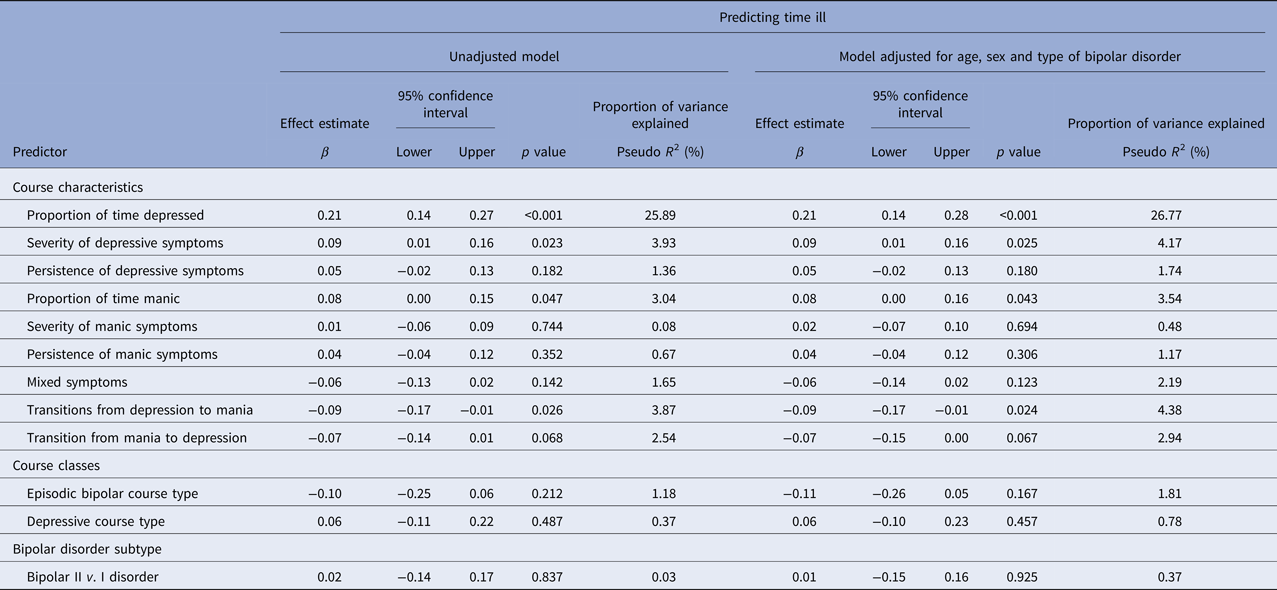
Over the second follow-up period, the participants spent on average 47.2% of the time with significant mood symptoms. The proportion of time ill was similar in participants with bipolar I disorder (45.8%) and in those with bipolar II disorder (48.7%). Four of the nine-dimensional course characteristics from follow-up period 1 predicted the total time ill during follow-up period 2 with a nominal statistical significance (p < 0.05; Table 2). The proportion of time depressed was the strongest predictor: each standard deviation in time depressed was associated with an additional 21% of time spent with mood symptoms, explaining 26% of the variance in total time with mood symptoms over the second follow-up period. The severity of depressive symptoms and time manic also predicted a greater proportion of time ill. The tendency for switching from depression to mania in the first follow-up period was associated with time, time ill over follow-up period 2. All four associations between course characteristics and time with mood symptoms remained nominally statistically significant after adjusting for age, sex, and type of bipolar disorder (Table 2). The proportion of time depressed remained a significant predictor of time ill after correction for multiple testing. Course classes or types of bipolar disorder were not significantly associated with time ill over follow-up period 2 (Table 2). Since a number of course characteristics were significantly linked with time ill, we constructed a full prediction model as a multiple tobit regression including all course characteristics that were identified in univariate models as nominally significant predictors. This full predictive model included time depressed, time manic, depression severity, depression-to-mania switching, age and sex and it explained 33% of the variance in time with depressive symptoms. The values predicted from the full predictive model correlated (r = 0.56, p < 0.0001) with the values observed on the actual 5-year follow-up (Fig. 2).
Long-term outcome prediction model. On the x-axis, we plot the prediction of time ill from the full multivariate tobit regression model that included the proportion of time with depressive symptoms, the proportion of time with manic symptoms, depression severity, depression-to-mania switching, age, and sex. On the y-axis, we plot the actual prospectively observed time ill, defined as the proportion of time with any mood symptoms over follow-up period 2. The solid black line represents the best linear fit reflecting the correlation between the predicted and observed values with its 95% confidence interval in dashed lines.

Prediction of time ill in the second follow-up period

Clinical course and hospital admissions
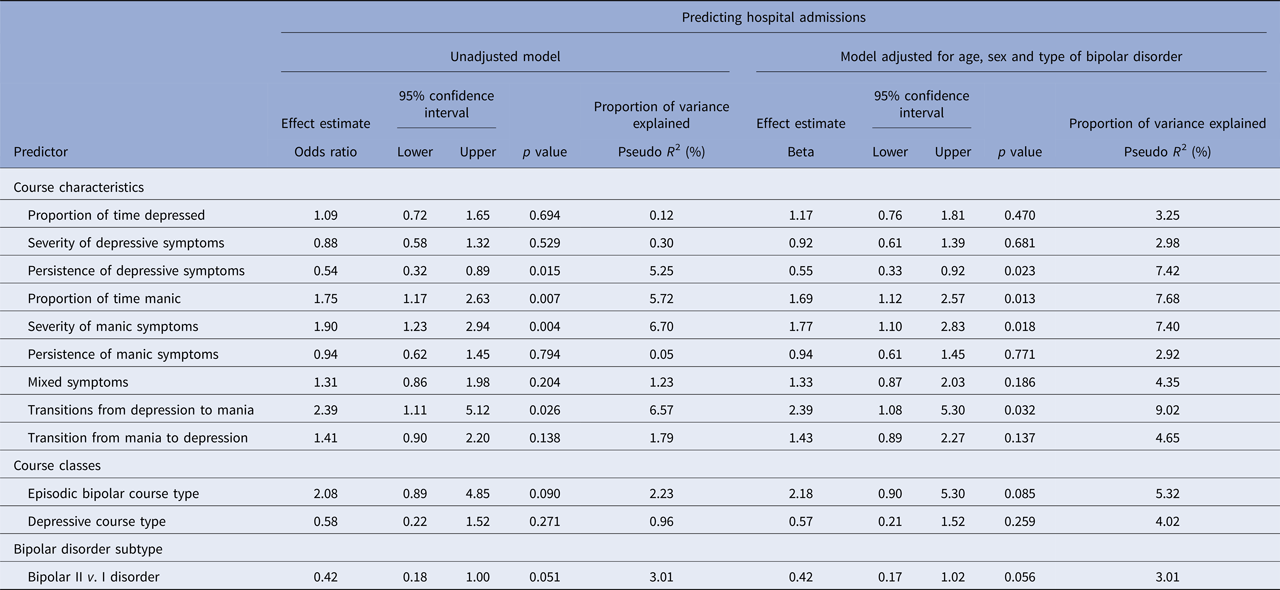
Between the 18 months and 5 years follow-ups, 31 (28%) of the 111 participants were admitted to psychiatric hospitals and 16 (14%) individuals were admitted more than once. Of the 59 participants with bipolar I disorder, 21 (36%) were admitted, including 11 (19%) admitted more than once. Of the 52 participants with bipolar II disorder, 10 (19%) were admitted, including 5 (10%) admitted more than once. Although the rate of admission was numerically higher in those with bipolar I disorder, the difference was not statistically significant (c2[2] = 3.69, p = 0.158). Four of the nine-dimensional course characteristics from follow-up period 1 predicted admissions during follow-up period 2 with a nominal statistical significance (p < 0.05; Table 3). The proportion of time manic, the severity of manic symptoms and depression-to-mania switching during the first 18 months predicted higher rates of hospital admissions with standardized odds ratios between 1.75 and 2.39 and each explained between 5 and 7% of the variance in who gets admitted (Table 3). The persistence of depressive symptoms was associated with a lower admission rate (Table 3). All four predictive associations remained significant after controlling for age, sex, and type of bipolar disorder (Table 3). The association between severity of manic symptoms and admissions remained significant after correction for multiple testing. Course classes or types of bipolar disorder were not significantly associated with admissions; although there was a non-significant trend for more admissions in individuals with bipolar I disorder (Table 2). A full prediction model including the proportion of time with manic symptoms, manic symptom severity, depression-to-mania switching, age, sex and type of bipolar disorder explained 18% of the variance in who gets admitted.
Prediction of hospital admissions

Discussion
In a long-term follow-up of a representative sample of individuals with bipolar I and II disorders, we found that the dimensional characteristics of the medium-term clinical course predict long-term outcomes that are relevant to social role functioning and long-term care planning. A clinical course dominated by depressive symptoms predicts more time ill. A clinical course characterized by manic episodes predicts hospital admissions. These differential associations with long-term outcomes suggest that course characteristics can facilitate care planning for individuals with bipolar disorder.
The strongest predictive relationship was between the proportion of time depressed, including both depressive episodes and sub-syndromal depressive symptoms, during the initial 18 months and the total time ill with any mood symptoms over the subsequent four years. This finding is consistent with the prior knowledge that the clinical course of bipolar I and II disorders is dominated by depressive symptoms (Judd et al., Reference Judd, Akiskal, Schettler, Endicott, Maser, Solomon, Leon, Rice and Keller2002, Reference Judd, Akiskal, Schettler, Coryell, Endicott, Maser, Solomon, Leon and Keller2003). However, the strength of this prediction over non-overlapping sequential follow-up periods testifies to the strong continuity of clinical course of bipolar disorder and underlines the predictive potential of clinical course characterization. This prediction has implications for public service planning because the total time ill with any mood symptoms is linked to role functioning and occupational outcomes in bipolar disorder (Judd et al., Reference Judd, Akiskal, Schettler, Endicott, Leon, Solomon, Coryell, Maser and Keller2005; Grande et al., Reference Grande, Goikolea, de, Gonzalez-Pinto, Montes, Saiz-Ruiz, Prieto and Vieta2013; Arvilommi et al., Reference Arvilommi, Suominen, Mantere, Valtonen, Leppamaki and Isometsa2015; Forte et al., Reference Forte, Baldessarini, Tondo, Vazquez, Pompili and Girardi2015).
The severity of manic symptoms, reflecting a propensity to full-blown manic episodes during the initial 18 months, was the strongest predictor of hospital admission. Although full manic episodes distinguish bipolar I disorder from bipolar II disorder, the dimensional severity of manic symptoms predicted hospital admissions better than the type of bipolar disorder and the prediction remained significant after controlling for the type of bipolar disorder. This finding suggests that a dimensional measure of manic symptom severity over a follow-up period is a better indicator for inpatient services planning than a categorical type of bipolar disorder. This prediction has major implications for health-care planning because hospital admissions account for a substantial proportion of healthcare cost associated with bipolar disorder across countries (Das Gupta and Guest, Reference Das Gupta and Guest2002; Hong et al., Reference Hong, Reed, Novick, Haro, Windmeijer and Knapp2010; Kessing et al., Reference Kessing, Hansen, Hvenegaard, Christensen, Dam, Gluud and Wetterslev2013; Hidalgo-Mazzei et al., Reference Hidalgo-Mazzei, Undurraga, Reinares, Bonnin, Saez, Mur, Nieto and Vieta2015).
In addition to the relationships of the proportion of time with depressive symptoms and mania severity with time ill and hospital admission, additional specific features of clinical course emerged as important predictors of long-term outcomes. Most notably, the propensity to switch from depression directly to mania without an intervening period of euthymia was associated with the lower proportion of time ill and a greater likelihood of hospital admission. To our knowledge, this is a novel finding that has not been described in the previous literature. If replicated, depression-to-mania switching may be a useful feature that may indicate a specialized treatment approach to minimize the risk of such transitions and reduce the need for hospital admissions (Kessing et al., Reference Kessing, Hansen, Hvenegaard, Christensen, Dam, Gluud and Wetterslev2013). A previous life chart study and meta-analysis suggested that individuals with depression-to-mania switching may respond less well to mood stabilization with lithium (Koukopoulos and Sani, Reference Koukopoulos and Sani2014). Future research may examine the efficacy of other mood stabilizers in patients with a tendency to switch from depression to mania.
The dimensional course characteristics have proven to be stronger predictors of outcomes than a categorical typology that groups individuals into classes based on the course characteristics (Uher et al., Reference Uher, Mantere, Suominen and Isometsa2013) or categorical distinction between bipolar I and II disorders. The finding that bipolar I v. II disorder distinction did not significantly predict long-term outcomes is generally consistent with the previous literature (Judd et al., Reference Judd, Akiskal, Schettler, Endicott, Leon, Solomon, Coryell, Maser and Keller2005; Murru et al., Reference Murru, Pacchiarotti, Verdolini, Reinares, Torrent, Geoffroy, Bellivier, Llorca, Vieta and Samalin2017). The finding that the categorical course classes do not significantly predicted important outcomes may reflect an inherent limitation of categorical typology that substantially reduced the amount of information contained in dimensional indicators and weakens the predictive value of constructs (Prisciandaro and Roberts, Reference Prisciandaro and Roberts2009). The lack of predictive validity of the two major classes from our previous investigation (Uher et al., Reference Uher, Mantere, Suominen and Isometsa2013) may reflect the fact that the typology was driven by the presence of manic episodes (which was not strongly predictive of total time ill) more than the burden of depressive symptoms (which was the strongest predictor of total time ill). The relatively poor predictive performance of course classes suggests that continuous course descriptors may have greater utility in research, clinical applications, and service planning. In the classification of mental disorders, the predictive course characteristics may be reflected in multi-level course specifiers rather than distinct types.
There is a great variability in the frequency of mood episodes and the question arises how long we need to follow-up a patient to learn about their clinical course. Our present results suggest that one year and a half of follow-up was sufficient to establish a predictive characterisation of course. Although a longer follow-up may provide more refined information, the strength of the predictive relationships suggests that after one-to-two years, we can reasonably estimate the prognosis for at least the next four years. Moreover, the information can be established retrospectively, with a combination of an interview and clinical notes review (Mantere et al., Reference Mantere, Suominen, Valtonen, Arvilommi, Leppamaki, Melartin and Isometsa2008). The information on the clinical course can be applied in service planning and care pathways. For example, a moderately intensive follow-up for the first 1-to-2 years can help direct individuals with bipolar disorder to the appropriate care pathways. While those with a greater burden of depressive symptoms may benefit from treatment focused on bipolar depression and functional rehabilitation, those with a greater propensity to manic episodes may need to focus on pro-active monitoring and relapse prevention to reduce the need for hospital admissions (Kessing et al., Reference Kessing, Hansen, Hvenegaard, Christensen, Dam, Gluud and Wetterslev2013).
The present results are likely to generalize to clinical populations as they are based on a detailed long-term prospective follow-up of a representative sample of individuals with bipolar disorder from a defined catchment area. The JoBS sample is unique in that it was recruited to represent all current patients within a catchment area and it was not ascertained based on clinical presentation with mania. Consequently, the proportion of individuals with recent manic episodes and those with bipolar I disorder may be lower than in other clinically ascertained samples and the results may not be directly comparable. In addition, four limitations should be kept in mind when interpreting and applying these findings. First, although the initial sample was representative of patients in a catchment area, over one-third of the sample was lost to follow-up. The participants who completed the 5-year follow-up were similar in terms of clinical course, bipolar type, and co-morbid diagnoses, but they differed on several demographic characteristics from those lost during follow-up. Consequently, the present results may be less generalizable to younger individuals and women, who were less likely to complete the study and remain in follow-up. Second, our present analyses are limited to two outcomes (total time ill and hospital admissions). We focused on these outcomes as they are highly relevant to the societal and healthcare cost associated with bipolar disorder. However, it is possible that different results may be obtained if additional outcomes were included (Arvilommi et al., Reference Arvilommi, Suominen, Mantere, Valtonen, Leppamaki and Isometsa2015). Third, treatment could have affected the course of illness during follow-up. The naturalistic character of the JoBS study does not allow distinguishing treatment effects from confounding by indication (Arvilommi et al., Reference Arvilommi, Suominen, Mantere, Leppamaki, Valtonen and Isometsa2010). Fourth, the sample size of individuals who completed the long-term follow-ups limits the statistical power of our analyses. We were unable to examine the effects of relatively uncommon course characteristics and we may not have detected the full range of predictors, some of which may not have reached statistical significance threshold due to limited power. We hope that the present results will stimulate future research that will complement the present study in terms of sample size and retention of younger participants and women.
We conclude that the dimensional descriptors of clinical course, including duration of depression, severity of mania and tendency to switch from depression to mania are likely more useful prognostic indicators than the established classification of bipolar I and II disorders. A classification that uses these course characteristics as specifiers may enhance service planning and stimulate clinical research on treatment approaches tailored to clinical course.
Acknowledgements
This JoBS study was supported by grants from the Jalmari and Rauha Ahokas Foundation, Finnish Psychiatric Association, Helsinki City Department of Social Services and Healthcare, and Helsinki University Hospital. The work leading to this publication has been supported by the Canada Research Chairs Program (award number 231397), the Canadian Institutes of Health Research (grant reference numbers 124976, 142738, and 148394), the Nova Scotia Health Research Foundation (grant nos. 275319, 1716, and 353892) and the Dalhousie Medical Research Foundation.
Conflict of interest
None.