


Advances in statistical analyses used to interpret radiometric data are beginning to have a substantial impact on the archaeology of eastern North America (e.g., Barrier Reference Barrier2017; Birch et al. Reference Birch, Crann and Pilon2016a; Cobb et al. Reference Cobb, Krus and Steadman2015; Cook et al. Reference Cook, Comstock, Martin, Burks, Church and French2015; Krus Reference Krus2016; Krus et al. Reference Krus, Cook and Hamilton2015; McNutt et al. Reference McNutt, Franklin and Henry2012; Monaghan et al. Reference Monaghan, Schilling, Krus and Peebles2013; Pluckhahn et al. Reference Pluckhahn, Thompson and Cherkinsky2015; Rick and Waselkov Reference Rick and Waselkov2015; Schilling Reference Schilling2013; Thompson et al. Reference Thompson, Pluckhahn, Das and Andrus2015; Turck and Thompson Reference Turck and Thompson2016). The ability to formally incorporate knowledge about the archaeological record into the analysis of radiometric dates within a Bayesian framework has facilitated the construction of detailed community and regional histories through which the timing, pace, and tempo of social and cultural change can be precisely tracked at resolutions not previously accessible. Beyond advances in temporal resolution, however, Bayesian interpretive frameworks also provide opportunities to evaluate legacy radiocarbon data and to formally interrogate extant chronological narratives. Because these chronologies often underwrite, and even constitute, our interpretations of major social, political, and cultural phenomena, and especially temporalities of critical changes, their constant reevaluation should be encouraged. To these ends, this article employs a case study concerning the development of sociopolitical complexity across the southern Appalachian region of the southeastern United States to show how exercises in Bayesian chronological modeling can be used to evaluate the underlying assumptions that guide our culture-historic frameworks. In particular, this study highlights procedures to 1) formally evaluate the quality and chronological influence of legacy radiocarbon datasets and 2) explore the assumptions guiding the construction of culture-historic sequences, with special attention to the role of these assumptions in interpreting temporalities of social, political, and economic transformations encoded in the archaeological record.
Of particular interest here is the development of sociopolitical complexity across northern Georgia, especially in regard to the emergence of Etowah (9BR1; Figure 1) as a major regional manifestation of Mississippian culture, practice, and tradition. The emergence of Etowah as a significant center for social, political, religious, and economic practice is associated with a number of critical societal transformations across the US Southeast. These include the centralization of political authority and the establishment of sociopolitical hierarchies, the development of socioeconomic inequalities, the production of a large-scale political economy underwritten by intensified maize agriculture, and the adoption of new religious and iconographic traditions. At roughly 30 hectares in areal extent, the community that emerged at Etowah represented a completely new form of society, as preceding settlements rarely exceeded two or three hectares in size. Our current understanding of these critical social changes is intimately tied to an extant culture-historic framework based primarily on a regional ceramic sequence and a legacy dataset of radiocarbon dates. In this article, Bayesian statistical methods are employed to evaluate both the assumptions inherent in the extant ceramic sequence and the quality of the legacy radiocarbon dataset. This is accomplished by building and comparing a number of alternative historical frameworks in regard to how well each framework articulates with the available radiocarbon data. By doing so, I propose a number of working hypotheses concerning the timing and temporality of major sociopolitical developments across southern Appalachia and explore the substantive implications of each alternative chronological framework.
Map of northern Georgia showing sites yielding radiocarbon data used in this study.

BAYESIAN CHRONOLOGICAL MODELING
Theory and Foundations
Simply put, Bayesian statistics allow us to “analyze new data we have collected about a problem in the context of our existing experiences and knowledge about that problem” (Bayliss Reference Bayliss2007:75). By doing so, we can “arrive at a new understanding of the problem which incorporates existing understandings about the problem and our new data” (Bayliss Reference Bayliss2007:75). Bayesian statistics are uniquely situated for the analysis of radiocarbon data because of their exclusive focus on probabilities. As extensive overviews can be found elsewhere (e.g., Bayliss Reference Bayliss2007; Bronk Ramsey Reference Bronk Ramsey2009a; Buck et al. Reference Buck, Cavanagh and Litton1996; Whittle et al. Reference Whittle, Healy and Bayliss2011), only a brief introduction is provided here. As Bayliss (Reference Bayliss2007:76) explains, the results of “scientific dating are always interpreted contextually” and Bayesian statistics “provide an explicit, quantitative method which can combine raw dates with other prior information included in a model to produce formal statistical date estimates which combine both sets of evidence.” For the case study presented here, radiocarbon determinations represent likelihoods; culture-historic frameworks and a number of alternative assumptions are used to define prior beliefs about the radiocarbon data; and the results of the Bayesian models (temporal ranges for the ceramic sequence of northwestern Georgia) are the posterior beliefs.
Adopted by researchers for use in archaeological applications over two decades ago (e.g., Buck et al. Reference Buck, Kenworthy, Litton and Smith1991, Reference Buck, Litton and Smith1992, Reference Buck, Litton and Scott1994, Reference Buck, Cavanagh and Litton1996; Christen Reference Christen1994; Christen and Litton Reference Christen and Litton1995; Christen et al. Reference Christen, Clymo and Litton1995), Bayes' theorem can be expressed mathematically as follows:
 $$\begin{equation*}
p\left( {t{\rm{|}}y} \right) \propto p\left( {y{\rm{|}}t} \right)p\left( t \right)
\end{equation*}$$
where t represents a set of parameters, y represents observations or measurements, p(y|t) is the likelihood, and p(t|y) is the posterior probability, or the probability of a given parameter set given the measurements and the priors (Bronk Ramsey Reference Bronk Ramsey2009a:338). This is expressed in a simpler manner by Bayliss (Reference Bayliss2007:76) and reads as follows:
 $$\begin{equation*}
\frac{{P(data|parameters)}}{{P\left( {data} \right)}} \times P\left( {parameters} \right) = P(posterior|data)
\end{equation*}$$
where the likelihood is determined by the probability of the data or observations given the set parameters and is proportional to the probability of the parameters themselves. The combination of these two—observations/measurements and prior information or beliefs—is where the value of Bayesian statistical methods lies, especially in regard to interpreting radiocarbon data.
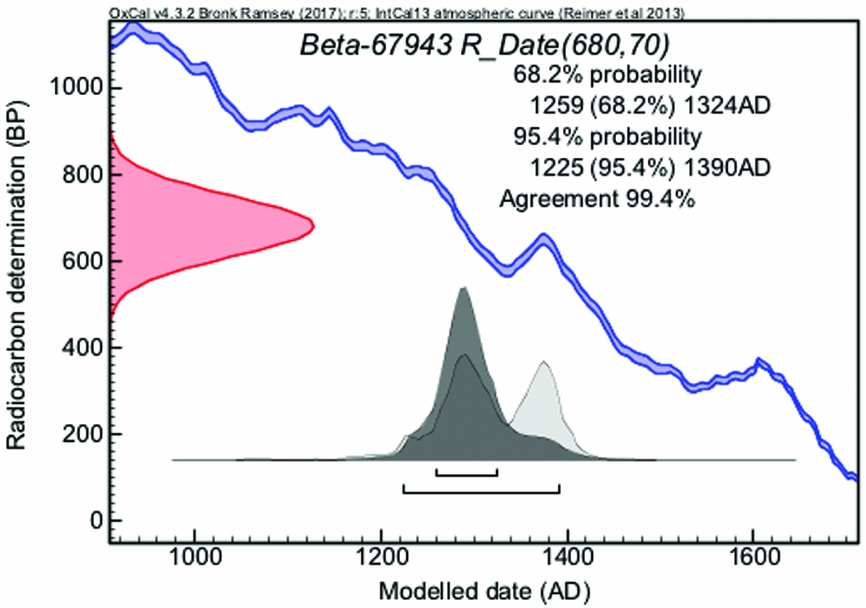
The applicability of Bayesian analyses to the interpretation of radiocarbon data stems from the fact that calibrated radiocarbon dates are probability distributions. Because levels of atmospheric 14C have not remained constant through time, the use of calibration is necessary for the interpretation of radiocarbon ages as calendrical dates. The calibration curve used today to calibrate radiocarbon dates is based primarily on variation in the abundance of 14C through time as measured from tree rings and marine corals (Blockley and Housley Reference Blockley and Housley2009; Reimer et al. Reference Reimer, Bard, Bayliss, Beck, Blackwell, Ramsey, Grootes, Guilderson, Haflidason, Hajdas, Hatté, Heaton, Hoffmann, Hogg, Hughen, Kaiser, Kromer, Manning, Niu, Reimer, Richards, Scott, Southon, Staff, Turney and van derPlicht2013; Scott and Reimer Reference Scott and Reimer2009). The resulting calibrated dates are probability distributions that represent the likelihood of actual values along the calibration curve. Thus, assessment of calibrated dates alone will likely lead to interpretations that overestimate both start and end dates of the activities or phenomena in question, as the resulting probabilities include both the actual values as well as statistical scatter around these values (Bayliss Reference Bayliss2009). Since dates derived from radiocarbon ages represent probabilities, these probability distributions can be refined and constrained through formalizing a priori knowledge in order to reassess the probabilistic distributions of radiocarbon ages on the calibration curve (Figure 2).
An example plot showing both a calibrated date (light gray) and the modeled probability distribution for the same sample after inclusion in a Bayesian model in which parameters were implemented that constrained this distribution (dark gray).
Arguably the strongest prior information we have as archaeologists are the stratigraphic, depositional environments from which radiocarbon data are recovered (e.g., Aldana Reference Aldana2015; Bachand Reference Bachand2008; Bronk Ramsey Reference Bronk Ramsey2000, Reference Bronk Ramsey2009a; Kennett et al. Reference Kennett, Culleton, Dexter, Mensing and Thomas2014; Krus Reference Krus2016; Monaghan et al. Reference Monaghan, Schilling, Krus and Peebles2013; Overholtzer Reference Overholtzer2015; Pluckhahn et al. Reference Pluckhahn, Thompson and Cherkinsky2015; Schilling Reference Schilling2013; Steier and Rom Reference Steier and Rom2000; Thompson et al. Reference Thompson, Marquardt, Cherkinsky, Thompson, Walker, Newsom and Savarese2016; Whittle and Bayliss Reference Whittle and Bayliss2007). More general priors, including culture-historic frameworks, ceramic sequences, and settlement patterns among many others, can also be employed as prior beliefs (e.g., Alberti Reference Alberti2013; Boaretto et al. Reference Boaretto, Jull, Gilboa and Sharon2005; Buck et al. Reference Buck, Cavanagh and Litton1996; Greco and Otero Reference Greco and Otero2015; Greco and Palamarczuk Reference Greco and Palamarczuk2014; Manning et al. Reference Manning, Ramsey, Kutschera, Higham, Kromer, Steier and Wild2006; Mazar and Bronk Ramsey Reference Mazar and Ramsey2008; Needham et al. Reference Needham, Ramsey, Coombs, Cartwright and Pettitt1998; Raczky and Siklósi Reference Raczky and Siklósi2013; Regev et al. Reference Regev, de Miroshedji, Greenberg, Braun, Greenhut and Boaretto2012; Turck and Thompson Reference Turck and Thompson2016). When using more generalized prior information, as is the case for this study, the assumptions employed may serve as working hypotheses upon which an analysis is based (Bronk Ramsey Reference Bronk Ramsey2009a:348). In this case, the ceramic sequence and culture-history for northern Georgia described below provide a working hypothesis about the ordering of ceramic assemblages across the region.
Terminology
One of the simplest parameters to impose on a group of measurements (radiocarbon dates) is their inclusion in a phase . A phase is an unordered group of radiocarbon determinations. When dates are grouped in a phase, it is assumed that all dates within the group are equally likely to occur anywhere between the start and end boundaries of the phase. No information concerning the order of dates is assumed. For the grouping of dates into a phase to serve as an informative parameter (sensu Bayliss Reference Bayliss2007), it must be given start and end boundaries . The use of particular kinds of boundaries defines how measurements are distributed within the phase. The distributional parameters imposed by particular types of boundaries provide another set of informative parameters that will produce variation in model outputs. As such, there are multiple types of boundaries that may be implemented within a Bayesian model. Whereas the use of default boundaries assumes a uniform distribution of observations within a phase, sigma boundaries can be used to define normally distributed observations. Sigma boundaries issue the parameters that there are no definite start or end events (Figure 3; Bronk Ramsey Reference Bronk Ramsey2009a). When applied to a model evaluating regional ceramic sequences, the use of sigma boundaries might represent the assumption that transitions between the use of different ceramic traditions are characterized by an increase in one particular type that overlaps with a decrease in the use of another ceramic type. This would contrast with the use of default boundaries that assume a definite start and end date for particular ceramic traditions, not necessarily allowing for the overlap between successive practices.
Schematic illustration showing the difference between the use of the simple “boundary” and “sigma boundary” commands to define the distribution of observations between the start and end events of a phase in a Bayesian model.

Models can also be built by including multiple phases within a model and defining the relationships between those phases. One such model is an overlapping model . An overlapping model assumes no ordering of phases and allows the potential for start and end boundaries of each phase to overlap with one another. In the absence of definitively stratified assemblages, an overlapping model imposes the least amount of assumptions concerning the temporal ordering of phases. This stands in contrast to both sequential models and contiguous models that explicitly define the temporal relationships between phases. A sequential model assumes that one phase, or group of dates, starts after a preceding phase ends, but no assumptions are made about the amount of time in between the end of one phase and the start of the next. A contiguous model, on the other hand, assumes that phases are temporally contiguous, with no gaps between phases. A more thorough discussion of the mathematical expressions underlying each of these multiphase models is presented by Bronk Ramsey (Reference Bronk Ramsey2009a:348).
The last concepts relevant to the current study that need to be defined are outliers and outlier models . A full review of the kinds of outliers and outlier models that may be applied in Bayesian analyses for archaeological applications can be found in Bronk Ramsey (Reference Bronk Ramsey2009b). The specific type of outliers considered here are charcoal outliers. Many extant radiocarbon determinations have been derived from wood and wood charcoal samples, leading to the possibility of “old wood” effects. That is, because trees are generally long-lived species, the radiocarbon determinations associated with charcoal samples may represent a portion in the life span of the tree that does not correspond to the felling of the tree itself (exceptions may include samples of bark, outer rings, or twigs). To deal with this we can identify all dates on wood and wood charcoal as outliers and incorporate an outlier model into our Bayesian interpretive frameworks. When a date is identified as an outlier and no outlier model is specified, it is completely removed from consideration in a model. When specific parameters concerning the treatment of outliers are specified (the specification of an “outlier model”), outliers have a probability assigned to them. The procedures used here for charcoal outliers are outlined in full detail in Bronk Ramsey (Reference Bronk Ramsey2009b). In this study, when outlier models are used, each charcoal measurement is given a 100% probability of being an outlier. With an outlier model applied, radiocarbon determinations characterized as outliers are downweighted in the model in accordance with how consistent the determination is with all available information (including other determinations and model parameters; Bronk Ramsey Reference Bronk Ramsey2009b:356). The model output is thus affected by the downweighting of particular charcoal determinations based on the modeled fit of each outlier date.
Choices related to model construction, including choices concerning boundaries, phase models, and outliers, can be correlated directly to assumptions about our datasets, about the state of the archaeological record, and about past social processes. As such, combinations of different parameters, or assumptions, can be assembled as multiple working and alternative hypotheses in the evaluation of radiocarbon data. For instance, the use of simple boundaries, the implementation of a contiguous model, and a disregard for the effects of charcoal dates all represent assumptions embedded in the culture-historic framework presented below. In a way, this kind of model serves as a null hypothesis whereas the implementation of different assumptions in a number of alternative models may serve as alternative hypotheses concerning the characteristics of the ceramic sequence and cultural chronology of northwestern Georgia.
EVALUATING CHRONOLOGICAL MODELS FOR NORTHWESTERN GEORGIA
Across the southeastern United States, the period between AD 600 and 1600 generally represents the end of the Late Woodland period and the Emergent, Early, Middle, and Late Mississippian cultural periods. These broad cultural periods are manifest locally across northwestern Georgia as the Napier, Woodstock, Etowah, Wilbanks, and Lamar phases (Table 1). The Woodstock phase is defined by a densely populated landscape of frequently interacting groups (Birch et al. Reference Birch, Lulewicz and Rowe2016b; Cobb and Garrow Reference Cobb and Garrow1996; Little Reference Little1999). Overall, the Woodstock phase represents an increase in settled villages and the first endeavor into new forms of agricultural subsistence. It has been suggested that it is during the Woodstock period that we first find evidence for the appearance of distinct settlement clusters and the emergence of discrete political entities across the region (Markin Reference Markin2007, Reference Markin, Gougeon and Meyers2015).
Extant Regional Chronology Based on Ceramic Sequences.

Source: Adapted from King Reference King2003 and Markin Reference Markin2007
Following the Woodstock phase is the Etowah phase. King (Reference King2003) argues that the Etowah phase represents the first occupation of the Etowah site, one of the most significant manifestations of Mississippian culture across the US Southeast. While the extent of occupation at this time was modest, King (Reference King2001, Reference King2003) posits, based on evidence for feasting and communal activities possibly related to the first stages of mound construction, that new social institutions began to emerge that were corporate in orientation, emphasizing cooperation and group solidarity (sensu Blanton et al. Reference Blanton, Kowalewski, Peregrine and Feinman1996).
From AD 1200–1250, it is hypothesized, using ceramic evidence (Rudolph and Hally Reference Rudolph and Hally1985; Stephenson et al. Reference Stephenson, King and Snow1996), that the Etowah River valley of northwestern Georgia was abandoned (Cobb and King Reference Cobb and King2005; King Reference King2001, Reference King2003). Based on this argument, Cobb and King (Reference Cobb and King2005) have described cycles of abandonment as critical mechanisms of social and cultural change at Etowah. Following this abandonment episode, the Wilbanks phase represents the apex of Etowah's Mississippian cultural expression. During this phase, it is likely that strategies of social and political organization shifted from a corporate orientation to a network-based orientation (sensu Blanton et al. Reference Blanton, Kowalewski, Peregrine and Feinman1996) within which social inequalities and political hierarchies were made explicit through the control of widely shared ideologies and elaborate religious practices (King Reference King2003). It is during this phase that the bulk of mound construction was completed, large-scale population aggregation at Etowah occurred, construction began on the ditch and palisade complex, and the extent of Etowah's influence throughout the region was at its height. At the end of the Wilbanks phase, at approximately AD 1375, Etowah underwent a rapid and violent abandonment (King Reference King2003:78).
The social history briefly summarized above is rooted in a long history of regional and site-based ceramic analyses and sequencing (Caldwell Reference Caldwell2011; Hally and Langford Reference Hally and Langford1988; Hally and Rudolph Reference Hally and Rudolph1986; Kelly and Larson Reference Kelly and Larson1957; King Reference King1997, Reference King2001, Reference King2003; Ledbetter et al. Reference Ledbetter, Wood, Wood, Ethridge and Braley1987; Markin Reference Markin2007; Markin and Knight Reference Markin and James Knight2015; Rudolph and Hally Reference Rudolph and Hally1985; Sears Reference Sears1958a, Reference Sears1958b; Stephenson et al. Reference Stephenson, King and Snow1996; Wauchope Reference Wauchope1948, Reference Wauchope1950, Reference Wauchope1966). While a wide range of ceramic attribute variation exists across northwestern Georgia between AD 600 and 1600, including variations in temper types, surface treatments, vessel forms and construction, and decorative traditions, most attention has been paid to variations in the execution and content of complicated stamped designs (Figure 4). Complicated stamping on the exterior of vessels was accomplished by carving a design into a wooden paddle and impressing it onto formed vessels. Given the long, continuous occupational history of the region, and thus the long history of the complicated stamping tradition (Birch et al. Reference Birch, Lulewicz and Rowe2016b), along with the conspicuous nature of the stamped designs themselves, complicated stamped pottery, and especially the presence, absence, and frequencies of particular motifs or styles, has played a primary role in the construction of the extant northwestern Georgia chronology. Thus, the models constructed here employ broad classes of complicated stamping traditions that are primarily based on the execution of the stamped design and the general assortment of motifs present that are argued to be temporally related. It is also important to note that more often than not, assemblages have been assigned to culture-historic periods based on the predominant ceramic style present, with little consideration of co-occurring styles.
Complicated stamped designs found throughout northern Georgia often used as markers for temporal affiliation: a) Napier Complicated Stamped (Late Woodland), b) Napier Complicated Stamped (Late Woodland), c) Woodstock Complicated Stamped, d) Etowah Complicated Stamped, e) Etowah Complicated Stamped, f) Wilbanks Complicated Stamped, g) Wilbanks Complicated Stamped, and h) Lamar Complicated Stamped.

Data
Of the 71 radiocarbon dates available for the study area and the ceramic sequence in question, 67 were utilized for the Bayesian analyses presented below. All 71 radiocarbon determinations and associated information are presented in Supplemental Table 1. Two dates were excluded for lack of any provenience information beyond the site level. One date was excluded as an anomalous determination as it deviated significantly from two other dates associated with the same archaeological feature. A fourth date was excluded that had been determined from unidentified marine shell, which poses problems related to proper calibration. In addition to the Woodstock-Etowah-Wilbanks sequence, an earlier Late Woodland phase and a later Lamar phase were also included in the model to bracket the sequence in question. Dated materials include unidentified charcoal, burnt cane, soot from sherds, maize, and unidentified wood. Error ranges for determinations span between ±40 and ±250 and were published between 1959 and 2012. As such, the dataset used here is highly variable in terms of the quality of samples included. The models presented below, in addition to evaluating the assumptions built into the cultural chronology, are also designed to formally assess the effects of varying sample qualities on the construction of temporal frameworks, especially the effects of sample material and the degree of measured error associated with each determination.
Culture-Historic Assumptions
The parameters built into the first two models were derived directly from the assumptions apparent in the culture-historic framework. The first model organizes phases into a sequential multiphase model, whereby a definite temporal sequence is imposed on phases, but the gaps between phases are undefined. The second model imposes a contiguous multiphase model within which a temporal sequence is imposed and the boundaries between phases must abut one another. For this second model, however, the boundary between the Etowah and Wilbanks phases was treated as sequential, as the extant chronology proposes an abandonment episode between these two phases. When contiguous models are referred to below, the Etowah and Wilbanks phases remain an exception and are defined by a sequential relationship. All of the OxCal code used to run each of the Bayesian models presented in this article is provided as supplemental material. This code includes radiocarbon determinations employed and the model structure used to interpret them. Code can be copied directly from supplemental material as is and pasted into OxCal to access model structures and results. Full plots of modeled dates are not presented here as models as large as the ones used in this study are difficult to read and evaluate in published form. Modeled boundaries, however, will be presented to compare the temporal ranges for each phase determined by different models. All analyses were conducted in OxCal v. 4.3 (Bronk Ramsey Reference Bronk Ramsey2009a) using the IntCal13 calibration curve (Reimer et al. Reference Reimer, Bard, Bayliss, Beck, Blackwell, Ramsey, Grootes, Guilderson, Haflidason, Hajdas, Hatté, Heaton, Hoffmann, Hogg, Hughen, Kaiser, Kromer, Manning, Niu, Reimer, Richards, Scott, Southon, Staff, Turney and van derPlicht2013).
Each Bayesian model is accompanied by indices that relay information about the overall fit or agreement of radiocarbon determinations and the implemented model parameters. In general, an Amodel and Aoverall must exceed 60 for a model to be regarded as having good overall agreement. Values below 60 indicate poor agreement between the chosen parameters and the radiocarbon data employed, and the model is usually rejected as a valid interpretation of the data (Bronk Ramsey Reference Bronk Ramsey2009a). Each model built strictly from culture-historic assumptions, and using all extant radiocarbon determinations traditionally used to define temporal ranges, exhibits poor model agreements (Supplemental Code 1 and 2). The model implementing a sequential structure is defined by an Amodel of 2.4 and an Aoverall of 3. Similarly, the model employing a contiguous structure has an Amodel of just 2.6 and an Aoverall of only 3.4. By using the same parameters and assumptions employed by the extant culture-historic framework, and the same radiocarbon data often cited to temporally contextualize this framework, a Bayesian model with an acceptable overall agreement cannot be built. The new models presented below iteratively employ a number of alternative assumptions about both the extant framework itself and the radiocarbon data utilized to understand the degree to which different aspects of the data and culture-historic assumptions are inconsistent with one another.
New Chronological Models
The simplest alternative assumption to employ is that radiocarbon determinations with high ranges of error are unreliable. While arbitrary, the next models employ an error range cutoff of ±150 years (Supplemental Code 3 and 4). That is, any radiocarbon determination with a measured error of ±150 years or more was excluded. The model structures are identical to the two models presented above, with one model defined by a sequential structure and the other by a contiguous structure. The only difference is the exclusion of radiocarbon dates with extreme ranges of error. Neither model excluding dates with extreme ranges of error exhibited acceptable model agreement, with Amodels of 5.7 and 5.3 and Aoveralls of only 6.9 and 6.2, far from the acceptable agreement index of 60. Thus, within the structural parameters provided by the culture-historic framework, the quality of measured radiocarbon determinations does not have a significantly negative effect on the temporal model as the exclusion of poor quality dates does not substantially improve modeled results.
While the quality of the radiocarbon measurement itself does not seem to have a significant effect on modeled results, the sample material on which determinations were derived may be negatively affecting model agreements. In particular, old wood effects from the inclusion of a large number of charcoal dates may be contributing to the poor agreement between radiocarbon determinations and the model parameters. To evaluate these effects, a charcoal outlier model was applied and dates derived from charcoal were identified as outliers. Detailed parameters used for the charcoal outlier models, and the structure of these models, are provided in the associated code (Supplemental Code 5 and 6). Unlike the previous two models, all dates were included in the two models employing a charcoal outlier model. A sequential multiphase model and a contiguous multiphase model were once again employed to keep constant the types of boundaries and temporal sequence assumed by the culture-historic framework. The only altered assumption is that charcoal dates may be potentially older than the ceramic materials with which they are associated due to old wood effects. Both models exhibit much higher overall agreement than previous models. While the sequential model still shows unacceptable agreement, with an Amodel of 57.5 and an Aoverall of 54.3, the model defined by a contiguous structure, where phases directly abut one another in time, showed acceptable agreement with an Amodel of 68.1 and an Aoverall of 67.2. The agreement for both models incorporating charcoal outlier models increases significantly when radiocarbon determinations with ranges of error of 150 or higher are removed from the analyses (Supplemental Code 7 and 8). When these dates are removed and charcoal outliers are identified, the sequential model has an Amodel of 72.1 and an Aoverall of 71.7, while the contiguous model continues to exhibit a higher agreement with an Amodel of 86.3 and an Aoverall of 86.4.
Finally, a model was constructed that challenges almost all of the assumptions derived from the extant culture-historic framework (Supplemental Code 9). Instead of imposing a defined order of phases, this model implements an overlapping model structure that does not assume a temporal sequence of phases. Considering the regional scope of the ceramic datasets used to construct the extant sequence, and the lack of discrete stratified deposits outside of the Etowah site alone, the use of an overlapping structure is justified in that it does not impose a temporal order that is not apparent in the archaeological record as currently understood. To be clear, the overlapping model does not force phases to overlap. The structure merely provides the potential for phases to overlap with one another. If in reality these ceramic phases do succeed one another in a defined temporal order, and if this sequence is reflected in the available radiocarbon determinations, this order should be output by the Bayesian model even when parameters specifying an order are not defined. In addition to the use of an overlapping model, sigma boundaries were used in place of default boundaries. The use of sigma boundaries, as discussed above, bypasses the output of definitive start and end dates and assumes that the dates within a phase are distributed in a normal distribution through time, especially as ceramic styles or traditions come into use, reach a maximum popularity of use, and fall back out of style. Given the results of the previous models, dates with extreme ranges of error were excluded and a charcoal outlier model was also applied to account for the uncertainty introduced by charcoal dates. An Amodel of 98.2 and an Aoverall of 97.4 indicate a high agreement between the radiocarbon determinations and the model parameters.
As a check on the validity of the imposed alternative parameters, each phase was also modeled individually (Supplemental Code 10–14). These individual phase models also used charcoal outlier models, sigma boundaries, and excluded dates with ranges of over 150 years. The only parameter excluded was the assumption that these phases relate to each other either as temporally contemporaneous with or successive from one another. This parameter was excluded by not defining the relationships between these individual phases as is the case when implementing sequential, contiguous, and overlapping models. Each of these models exhibits agreement values that range between 93 and 104. In addition, as discussed below, each individual model corroborates the temporal ranges for each phase produced by the alternative model defined by an overlapping structure.
COMPARING ALTERNATIVE HISTORIES
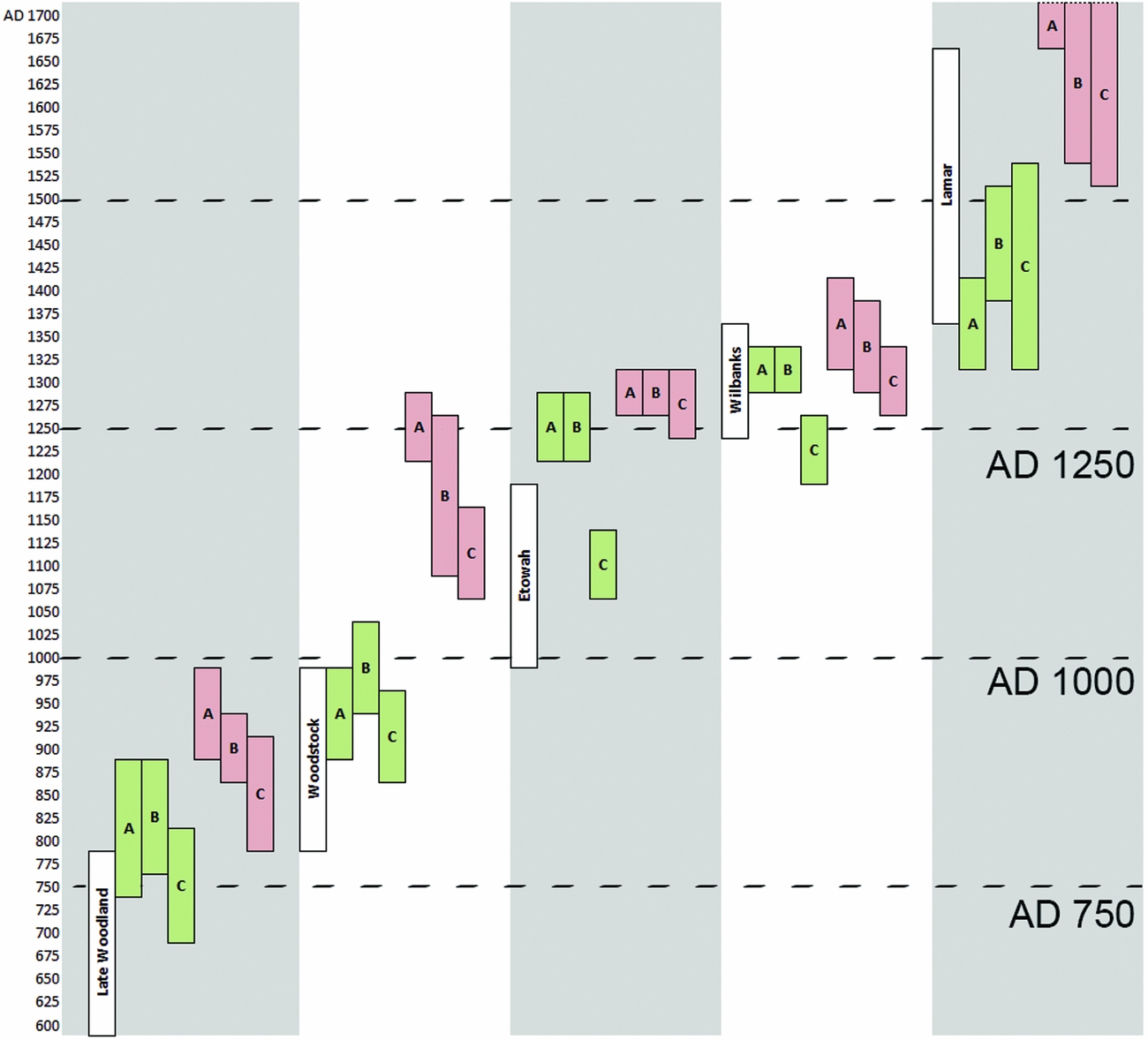
Three new ceramic timelines have been produced that exhibit good overall agreement when evaluated within a Bayesian interpretive framework. These new chronologies, along with the extant culture-historic chronology, are presented in Table 2 and Figures 5 and 6. The following sections discuss the substantive implications of each alternative model for interpreting the major social, political, and economic transformations that took place across northern Georgia during the first millennium AD concomitant with the rise of Etowah as a major sociopolitical entity.
Temporal Ranges for Ceramic Phases Determined from Three New Bayesian Chronological Models Compared to the Extant Culture-Historic Framework.

Plots showing modeled start and end boundaries for ceramic phases as determined by each of the three new Bayesian chronological models.
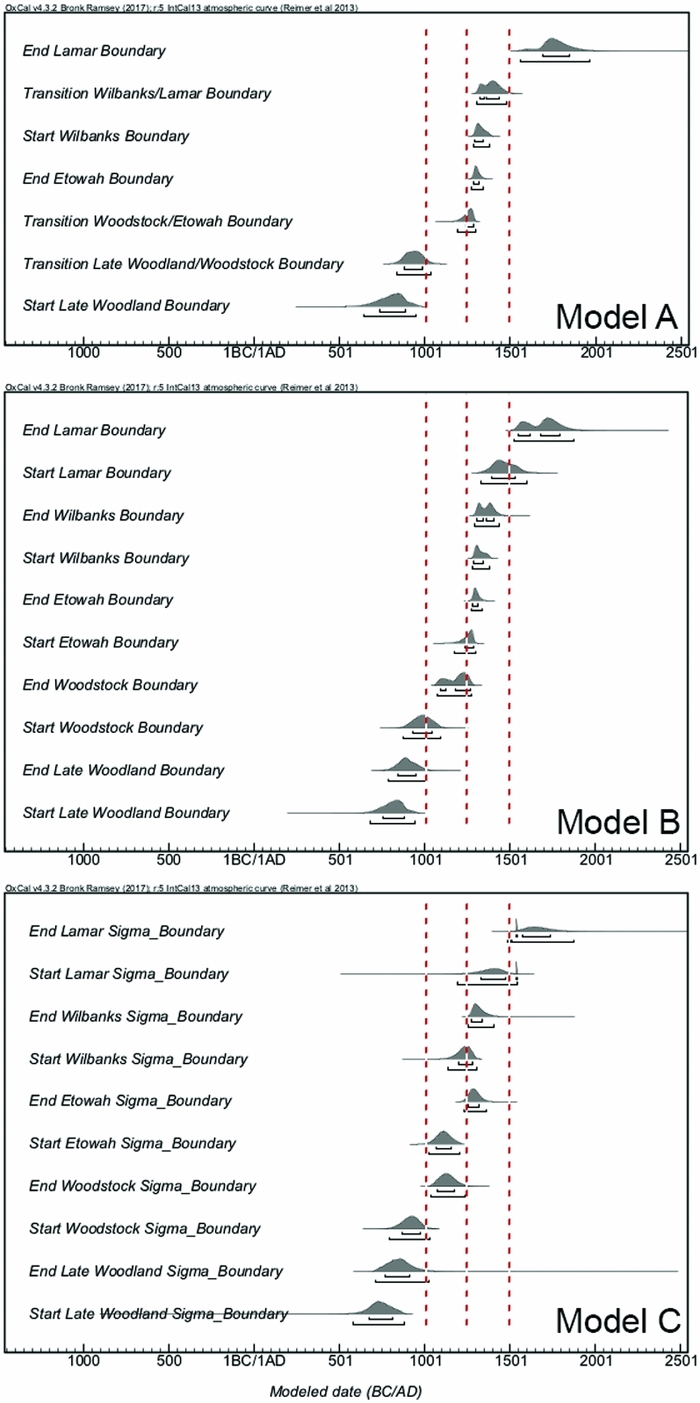
Schematic comparison of the start and end boundaries for ceramic phases determined by each of the three new Bayesian chronological models (A, B, and C) and the extant culture-historic framework. Modeled start boundaries are represented by green bars, and modeled end boundaries are represented by red bars. The overall spans for phases suggested by the extant culture-historic framework are presented as white bars.
Model A
Model A uses a charcoal outlier model, implements default boundaries for the starts and ends of phases, and organizes phases in a contiguous model except for the threshold between the Etowah and Wilbanks phases in which a sequential relationship is imposed. This multiphase arrangement matches the extant culture-history in that each phase begins just as the preceding phase ends except in the case of the Etowah/Wilbanks transition, at which point an abandonment episode has been hypothesized (Cobb and King Reference Cobb and King2005; King Reference King2003). This model is represented by Supplemental Code 6. The results of this model also match those represented by Supplemental Code 8, which is identical except that dates with error ranges of 150 years or over were excluded. This model pushes all starting and ending boundaries for cultural phases forward in time except for the transition between the Wilbanks and Lamar phases. Both the Late Woodland and Woodstock phases have the potential to start at least 80–200 years later than previously estimated in the extant culture chronology. While the extant chronology proposes a transition between Woodstock and Etowah style ceramics at circa AD 1000, Model A suggests that this transition may not take place until about 250 years later, in the range of cal AD 1240–1285. This places the beginning of the Etowah phase about 250 years later and pushes the end of the phase to cal AD 1285–1320, 85–120 years after the AD 1200 date proposed in the extant chronology.
As for the placement of the Wilbanks phase, within which the bulk of mound construction, population aggregation, and intensification of elite exchange networks is supposed to have taken place, it is estimated to have started in the range of cal AD 1295–1345, 45–95 years later than previously proposed. Given the results of Model A, it is likely that the end of the Etowah phase and the beginning of the Wilbanks phase overlapped significantly. This stands in contrast to the extant chronology, which proposes a 50-year gap between the two phases. This abandonment and reoccupation episode has been cited as the mechanism by which social and political traditions were disarticulated and rearticulated in novel ways (Cobb and King Reference Cobb and King2005). If Model A is accepted, then a new mechanism for social change would need to be proposed, one that takes into account the unbroken, contiguous sequence of ceramic traditions. The span of the Wilbanks phase is also called into question by the results of Model A. While the extant chronology suggests a 125-year span for the phase, the maximum span suggested by the modeled boundaries is 140 years. While a 125-year span is still plausible, the Bayesian model presented here raises the possibility for a much shorter span, one as short as 25 years. The Etowah phase may have lasted much shorter than the previously estimated 200 years with a maximum potential span of 80 years and a minimum length of less than 45 years. Comparing the potential spans for the Etowah and Wilbanks phases, questions might be raised about the stability of the political systems that may have characterized these two time periods. While it is argued that the Etowah phase was characterized by corporate sociopolitical strategies (sensu Blanton et al. Reference Blanton, Kowalewski, Peregrine and Feinman1996), extant narratives pose that during the Wilbanks phase, this strategy shifted toward one emphasizing network strategies. As such, a hypothesis may be posed that, in this case, corporate strategies may not have been overtly stable, giving way to longer-lived network strategies as corporate groups were deemphasized in favor of growing socioeconomic inequalities and the emergence of an elite class. In contrast, if the Wilbanks phase actually spans much less time, the alternative may be hypothesized, that network political strategies were generally much less stable than those rooted in corporate relationships. Each of these hypotheses has the potential to be tested with archaeological data and future research.
Model B
Model B uses a charcoal outlier model and default boundaries (e.g., Figure 3), does not include dates with error ranges of 150 years or more, and imposes sequential relationships between all phases. Unlike the contiguous phases of Model A, Model B does not assume that phases directly abut one another. Rather, Model B allows for gaps to emerge between the end and start boundaries of sequential phases. Nonetheless, it is imposed that one phase must follow another, and the two phases may not significantly overlap, similar to the structural parameters of Model A. Like Model A, compared to the extant chronology, Model B assigns later beginning and ending boundaries to all phases. Because contiguous relationships between phases were not imposed, the start boundary for the Woodstock phase is pushed even later in time than it is in Model A, to cal AD 930–1045, even less consistent with the extant culture-historic framework by an additional 130 to 245 years. On the other hand, the ending boundary for the Woodstock phase, cal AD 1095–1270, is significantly earlier than the end boundaries proposed by Model A. While the minimum span for the Woodstock phase as modeled by Model A would be about 240 years, the minimum span presented by Model B is significantly reduced to a potential 50 years.
The start of the Etowah phase is consistent with the modeled dates presented by Model A at cal AD 1235–1290. Once again, the start date of Etowah is at least 230 years later than the AD 1000 date proposed by the extant chronology. While the start of the Wilbanks phase remains the same as presented in Model A, the end boundary for the Wilbanks phase is moved slightly earlier to cal AD 1300–1385. This is significant in that there is now an overlap between the end boundary of the Etowah phase and the end boundary for the Wilbanks phase. While not a substantial overlap (about 15 years), this indicates the possibility that Wilbanks and Etowah ceramics may have been produced, utilized, or discarded contemporaneously. While the start of the Wilbanks phase is undoubtedly later than the start of the Etowah phase, the use of Wilbanks ceramics may have overlapped with the latter half of the Etowah phase. Thus, Model B might be used to produce a number of hypotheses about contemporaneous ceramic traditions, the conservative nature of local practices, resistance in the face of critical social changes, or even the interactions of local populations with those moving into the region (bringing their own ceramic traditions). Each of these potential research trajectories could make use of renewed multisited excavations across the region, excavations specifically targeting stratified deposits spanning the temporal threshold of the Etowah and Wilbanks phases, or simply a new suite of radiocarbon dates specifically aimed at achieving higher precision in regard to the transition between the two phases. All of these potential projects, including those discussed above and those to be discussed below, would benefit from a proper, regional assemblage-based frequency seriation resulting in formal battleship curves of ceramic types. These results could then be used to inform a round of new Bayesian models based on patterns in these seriations.
Model C
Model C deviates the most from the extant chronology in terms of the parameters included in the model. For Model C, determinations exhibiting error ranges of 150 years or more were excluded, a charcoal outlier model was applied, sigma boundaries were implemented that assume the normal distribution of observations throughout the span of a phase (e.g., Figure 3), and an overlapping multiphase model was employed that assumed nothing about the ordering of phases and allowed for potential overlap, or not, between any of the phases included in the model. Model C is represented by Supplemental Code 9. While the assumptions built into the architecture of Model C contrast most significantly with the extant chronology compared to Models A and B, the results of Model C, in general, deviate the least of all three models from the extant chronology. While Models A and B estimate the start date of the Late Woodland phase to fall between about 140 and 285 years later than the extant chronology, Model C models the start boundary of the Late Woodland phase to be in the range of cal AD 675–815, just 75–215 years later than previously proposed. This same pattern is true for both the Woodstock and Etowah phases, with modeled start and end boundaries between only 55 and 175 years later than the extant narrative. The start boundary for the Wilbanks phase generally matches the extant chronology, while the end boundaries for the phase are estimated to be between 35 and 100 years earlier than the current chronology.
Although no order was imposed on the phases, the results of Model C maintain the expected ordering of phases from the Late Woodland phase through the Lamar phase. Some of the patterns exhibited in Model B, however, are made even clearer by Model C, especially in regard to the relationship between the Etowah and Wilbanks phases. In Model C, the Etowah phase is estimated to end in the range of cal AD 1255–1320, while the Wilbanks phase is modeled to start in the range of cal AD 1200–1280. Given the start boundary of the Etowah phase, at circa AD 1065–1155, if Model C is accepted, the two phases, or the use of both Etowah and Wilbanks ceramics, must overlap substantially. In fact, the boundary for the end of the Etowah phase and that of the Wilbanks phase are almost identical. This may indicate, like Model B, that Wilbanks ceramics began to come into use in northwestern Georgia while Etowah ceramics were still used. In fact, the two traditions may have been in use contemporaneously for up to 100 years, ending at roughly the same time, as early as about AD 1275 or as late as about AD 1320. Either way, the chronological framework suggested by Model C, especially in regard to the ambiguous social relationships producing the patterns inherent in the new model, has major implications for understanding the transformation of southern Appalachian societies. In particular, the mechanisms responsible for the transformation of social, political, and economic relationships across the region can be called into question in the context of the results produced by Model C. In considering these results, what becomes clear is that the landscape within which socioeconomic inequalities and politico-religious hierarchies developed seems to have been characterized by much more complex socio-relational histories than previously hypothesized.
At a much larger scale, the results of each of the three models presented above also speak to the timing and temporality of the movement of Mississippian practices and traditions across the Southeast more broadly. While Model C situates the start of the Etowah phase roughly coeval with the height of Cahokia at about AD 1050, Models A and B place the beginning of the Etowah phase nearly 200 years later. If we continue to accept that the introduction of Mississippian practices generally lines up with the production of Etowah stamped pottery across northern Georgia, then Models A and B would suggest a significant correlation between the decline of Cahokia and the eventual introduction of Mississippian traditions into the southern Appalachian region. While beyond the scope of this article, new radiocarbon dates, and chronological modeling efforts that span much larger regions than we traditionally consider, could be used to evaluate a number of scenarios related to the continental-scale spread of these new practices.
CONCLUDING THOUGHTS
The case study presented here should serve as justification for renewed research into the development of sociopolitical complexity across the southern Appalachian region of the southeastern United States between the twelfth and fourteenth centuries AD. The alternative chronological frameworks introduced above provide ample fodder for the formulation of new hypotheses that concern the timing, temporality, and nature of critical social changes across northwestern Georgia and the Mississippian world. It is clear that the radiocarbon datasets traditionally used to determine the temporality of such issues has had a significant effect on extant narratives. Through the use of Bayesian chronological modeling, it has been revealed that both charcoal samples and samples dated during the earliest decades of radiocarbon dating with large ranges of laboratory error have led to the overestimation of overall phase spans and starting dates. At the extreme end, the models above decrease the spans of some phases by up to 150 years and locate them more recently in time by up to 250 years! As mentioned, the sociopolitical and cultural chronology for northwestern Georgia, and for many other regions relying on similar datasets, would undoubtedly benefit from large-scale AMS dating programs with the goal of acquiring higher quality dates with low ranges of error on short-lived species. Such projects may not even require extensive field projects, as many such sample materials can be found archived from the last century's worth of North American archaeology. That said, some of the most informative parameters that can be built into Bayesian models are those based on stratigraphic context. As such, the models constructed in this study may also serve as a basis and pilot study for renewed field projects targeting a wider range of sites and deeply stratified deposits. The case study presented here has been effective in evaluating legacy radiocarbon datasets and extant narratives precisely because the Bayesian models presented above are based on the same assumptions and data that have long been used to justify the extant culture-history. For every archaeological dataset encountered, we inevitably consult prior information about that dataset, either formally or informally, when offering interpretations. The treatment and interpretation of radiocarbon data should be no different, as Bayesian analyses offer a formal avenue for the articulation of radiocarbon data with other archaeological information.
Acknowledgments
I would like to thank Jennifer Birch and Victor Thompson for comments on an earlier draft of this manuscript. I would also like to thank Brandon Ritchison for thoughtful conversation that spurred many of the ideas presented here. Finally, I thank four anonymous reviewers whose comments were highly constructive and contributed greatly to the improvement of this manuscript. No permits were required for this work.
Data Availability Statement
All data used for the current study are included in the manuscript and include all radiocarbon determinations. Detailed model results and the code used to produce the Bayesian models are provided as supplementary materials.
Supplemental Materials
Supplemental materials are linked to the online version of the manuscript, accessible via the SAA member login at https://doi.org/10.1017/aap.2017.29.
Supplemental Table 1. Radiocarbon Data Used in This Study.
Supplemental Code 1–14.



