Bolivian military officers throughout the twentieth century urged troops to embrace “the sacred mission that the patria [nation, motherland] imposes on her good sons to prepare militarily for war during times of peace.”Footnote 1 Yet when they adopted European models of conscription, Bolivian generals and politicians faced a multiethnic and multilingual population in a loosely controlled territory that lacked the basic infrastructure of the modern state they envisioned. The military barracks, they had hoped, would help form workers who spoke Spanish, willingly obeyed authorities, and felt duty-bound to dedicate themselves to protecting and unifying the patria. But the realities of a weak state in a thinly populated territory meant that despite official emphasis on armed training, Bolivian conscripts spent at least as much time building roads, harvesting, and serving as domestic servants as they did preparing for armed conflict. However, the impact of a disastrous war, social revolution, and ideological shifts made once invisible nonmartial labors a central part of not only the experience but also the mission of military service.
A diverse and divided society, Bolivia is characterized by pervasive racism based on powerful social, cultural, and ethnic hierarchies. The barracks were one of the few places where men from across these barriers met in search of the military-service booklets needed to work in the formal sector or conduct official transactions. Thus, entering the barracks was an experience shared by generations of Bolivian men who hailed from indigenous communities, the working classes, and the urban poor. In order to understand the trajectory of Bolivian society, we must take military conscription into account, both in how it was imagined by Creole elites and in the multiplicity of ways it was experienced by conscripts. Soldiers' labor was fundamental to both.
Before looking at this labor, however, it is important to understand the paramount role of the military in the history of twentieth-century Bolivia. Despite attempts to create a professional army under civilian control in the early decades of the century, individual officers maneuvered in favor of political parties and personal interest, troops were stationed in urban areas to influence politics, and coup plots proliferated.Footnote 2 Fought by drafted and impressed soldiers from all over Bolivia, the disastrous Chaco War with Paraguay (1932–1935) produced widespread discontent and a series of military presidencies that led to a far-ranging revolution in 1952. While the new administration initially considered abolishing the military, the institution regained its prominent role over the next twelve years as US aid flooded in and the government faced factionalism, economic problems, and labor unrest. By the 1964 elections, the leader of the 1952 Revolution had a military vice-presidential candidate who overthrew him five months later. With only brief interruptions, military officers would occupy the presidential palace for the next seventeen years.
However, we know very little about the Bolivian military outside of its role in politics. Scholarship has focused on tactical details, leaders' actions, and periods of military rule. These works tend to treat soldiers as warm bodies following orders rather than understanding the military as constructed through its relationship with conscripts. Although a few scholars have studied the rank-and-file troops as subjects of state engagement, very little is known about soldiers' daily lives and labors.Footnote 3 As the field of labor history has repeatedly shown, the bottom-up exploration of work routines and relations of authority present in the workplace often provides broader insights into politics and society.
To make sense of the diversity of conscripts' labors, I define all activities they performed under superiors' orders as labor. I distinguish, however, between martial and nonmartial labor. Martial labor consists of armed tasks directly related to maintaining internal order and defending the national territory, including fighting international wars, repressing internal unrest, protecting state installations, patrolling borders, and the training necessary to prepare for these tasks. Most narratives of martial labor concentrate on the Chaco War, the 1967 pursuit of guerrillas led by Che Guevara, and the suppression of strikes and uprisings. Full of heroes and victims, these works slight more quotidian aspects of martial labor, such as weapons training, physical training, and the guarding of borders, arsenals, government installations, and barracks.
A focus on martial labor alone, however, offers a woefully incomplete picture of Bolivian conscripts' experience and serves to conceal the wide array of tasks they performed in uniform under the label of patriotic service. Serving both martial and nonmartial ends, conscripts' nonmartial labors included preparing land for colonization; populating border regions; ranching; planting trees; logging forests; building and repairing roads, barracks, airports, ports, wells, dams, embankments, irrigation channels, public pools, schools, hospitals, and stadiums; manufacturing items; growing foodstuffs and export products; cooking; washing; cleaning; teaching literacy skills; taking censuses; processing property titles; serving as domestic servants in officers' homes; extorting low prices from townspeople; and even following orders to steal goods. These nonmartial labors included both physical and intellectual tasks that ranged from the dangerous to the banal, some of which were legal and others illegal but sanctioned by officers. The Bolivian military clearly served both martial and nonmartial ends.
Despite patriotic rhetoric, the structure of military labor reinforced social hierarchies in which certain groups gave orders and others performed strenuous and sometimes servile work. Corruption and arbitrary implementation meant that soldiers performed martial and nonmartial labor in service not only of national defense and infrastructure but also to benefit private interests and individual officers. Additionally, the tasks assigned to individual conscripts often coincided with racist hierarchies based on markers such as command of Spanish, place of residence, and level of education.Footnote 4 Those who fell toward the indigenous end of the spectrum disproportionally performed nonmartial labor of the more abject sort.
This article offers a brief overview of the history of conscription in twentieth-century Bolivia, descriptions of soldiers' martial and nonmartial labors, and an analysis of the military's evolving constitutional mission and self-representations. I have drawn on a range of sources produced by and for the Bolivian military, such as conscription records, internal regulations, soldiers' testimony in military-justice proceedings, and official correspondence. Sources external to the military include petitions to other governmental offices, congressional debates, articles and memoirs written by officers and journalists, and the observations of US military attachés. These records reveal how hidden dimensions of military service reinforced social hierarchies and contributed to state formation. The first section examines the budgetary and administrative barriers that led to the widespread use of troops for nonmartial tasks before 1932. The second section details post-Chaco War shifts in the military's constitutional mission and the corresponding changes in how officers, politicians, and journalists portrayed soldiers' martial and nonmartial labor. The final section treats the impact of the 1952 Revolution and the subsequent shift to military dictatorship, arguing that the emphasis on nonmartial labor spanned changes in administrations and traditional political divides. While conscripts' tasks changed little across the twentieth century, the visibility of and discourse about their work shifted decisively. Embracing nonmartial labor as an expression of developmentalist nationalism, military officers constructed a rationale for expanding the role of their institution in Bolivian society.
The Logic of Nonmartial Labor in the Pre-Chaco Army
In nineteenth-century Bolivia, soldiers were volunteers or victims of forcible recruitment, and the conscription of tribute-paying Indians was prohibited, at least officially.Footnote 5 With war against Chile looming in 1875, Bolivia first declared that all male residents owed military service to the patria.Footnote 6 However, the state did little to implement this law. Bolivia barely mustered nine thousand men to defend its coast in the War of the Pacific (1879–1884) and effectively pulled out in the war's first year.Footnote 7 After this defeat, Conservative administrations took the initial steps to transform the military into a modern bureaucratic institution. As part of this process, the army banished rabonas (female camp followers) in 1888 and replaced them with institutionalized meal service.Footnote 8 When Liberals took power after a civil war in 1899, their efforts to professionalize the military included a series of conscription laws, establishing institutions, and bringing in French (1905–1909) and German (1911–1914) military missions.Footnote 9
The constitution in force at the time set forth a purely martial mission for the armed forces: “the conservation of order” and the “defense of independence and national integrity.”Footnote 10 Having recently ceded territory to Brazil (1867 and 1903) and Chile (1884, treaty in 1904), legislators emphasized that the purpose of conscription was to protect “our threatened borders” by ensuring that the entire male population had military training.Footnote 11 Bolivian lawmakers hoped military service would both form a nation and protect it from external and internal threats. Officers declared that Bolivia would be “great, strong, and invincible” only when she could see “a soldier in each of her sons” who would know “how to die for the patria.”Footnote 12
According to this early and idealized vision of military service, conscripts would learn how to march in formation, use weapons, and guard installations. They would become physically and mentally prepared to fulfill their duties as citizen-soldiers by following a regimented exercise program and listening to superiors explain military theory and civic obligations. Before being discharged, they would participate in war games to gain the battlefield experience that would prepare them to defend Bolivia.Footnote 13 This vision of military service was a martial one that understood national strength in terms of the army's size; its goal was to make men into disciplined soldiers loyal to a national-level patria.
This effort to create a unified nation-state faced a formidable challenge in the demographic picture painted by the 1900 census, which categorized over fifty percent of the population as indigenous even while substantially undercounting this group.Footnote 14 Conservative administrations had only recently attempted to abolish colonial institutions such as tribute and corporate land ownership after a silver boom in the late nineteenth century provided a new source of income. Like their Conservative predecessors, the Liberals, who took power in 1899, saw the so-called Indian problem as Bolivia's principal challenge and began enacting policies to eliminate this obstacle to achieving their ideas about modernization. As part of a positivist project for national improvement through social hygiene, military service was one face of these attempts to incorporate the indigenous population. However, divisions among Creole elites as to whether assimilation or segregation should be Bolivia's path to modernity resulted in schizophrenic and unevenly implemented policies. And daily practice in the barracks was as slow to conform to the new laws as the state was to fund its decrees.
Rank-and-file troops entered the army under the obligatory military-service law passed by Liberals in 1907. This law required all Bolivian men to register at eighteen and present for service at nineteen; those chosen by lottery would serve for two years while the rest would receive three months of military training.Footnote 15 However, practical matters of finance and administration kept the military so small that this obligation did not initially affect many men.Footnote 16 Although its population was around two million, Bolivia fielded an army of only two to eight thousand conscripts from 1907 to 1932.Footnote 17 Many men thus avoided serving by means of the lottery, exemptions, evasion, and the protection of patrons. Despite claims to equal treatment, the structure of conscription disproportionally funneled indigenous men into the barracks through demands for precise documentation and limits on the service of educated men.
Although Liberals claimed to want a professional military that did not participate in politics, the repression of rural uprisings was a common form of martial labor during the first decades of the twentieth century. Landlords and mine owners often called on government officials to employ the state's repressive apparatus to threaten their tenants, workers, and neighbors. Conscripts thus marched into indigenous communities and rural properties at least forty times between 1912 and 1925 in just the department of La Paz.Footnote 18 As described by Captain Samuel Alcoreza, soldiers' repressive labor was arduous and unrewarding, sometimes involving “a full night's trek through paths full of water and mud, in which the troops have suffered the indescribable” in order to arrest “defenseless Indians who were sleeping” in their homes.Footnote 19 And army units ended mining strikes: peacefully in 1919, and bloodily in what became known as the 1923 Uncía Massacre.Footnote 20 Far from the ideal of convincing workers in the mines and fields to identify with a national-level patria, this martial labor reinforced social hierarchies and supported private capital.
Soldiers who hailed from rural and mining communities were also the most likely to spend their military service colonizing the frontier and constructing the nation's basic infrastructure. The sparse population of border regions had already led to several territorial losses, so after ceding yet more land to Brazil in the 1903 Acre War, officers and legislators agreed that they could prevent future dismemberment only by colonizing Bolivia's territory.Footnote 21 The government thus began sending military conscripts to act as expeditionary forces and construct border posts.Footnote 22 Because the state had little infrastructure in these regions and no towns to provide garrisons or provision the troops, these soldiers had to be self-sufficient.
The earliest evidence of soldiers' nonmartial labor thus comes from accounts of frontier units in the 1910s and 1920s. One officer explained that a soldier in these garrisons did “rough work” and had to be “a farmer and also a bricklayer, woodcutter, and boat builder.” They therefore received military training only in the mornings so afternoons could be spent on “farming and other work.”Footnote 23 These conscripts were as likely to hunt monkeys, plant manioc, or cut swathes in the jungle as they were to stand guard, march, or clean their weapons.Footnote 24 Closely connected to this frontier initiative was the use of military laborers to dig roads between these regions and population centers. Under the command of General Federico Román, sapper units opened roads throughout the eastern part of the country.Footnote 25 Despite their manual quality, these labors were linked to national defense: Populating the frontier and connecting Bolivia's disparate regions would secure borders, achieve food security, and facilitate the transportation of resources to internal and external markets. Although the daily labor of sappers and frontier soldiers was distinctly nonmartial, this work fell to the armed forces for strategic reasons.
The diverse labors of frontier units opened up the possibility of using urban soldiers for similar tasks even if they lacked a logical link to national defense. As it became acceptable for uniformed labor to build national highways, it was less of a conceptual leap to ask soldiers to repair urban roads. If soldiers on the frontier were planting seeds, why couldn't more centrally located units become self-sufficient or be deployed in the harvest if there was a shortage of local workers? If soldiers in border units were building their own barracks, why not use urban soldiers to build schools? Military labor provided an attractive way for the state to establish a minimal presence throughout the territory and to build and maintain infrastructure at low cost. The obligatory nature of military service allowed the state to furnish itself with an almost-free labor pool compelled by law to work. Although the government had to invest funds in order to pursue deserters and recruit, discipline, transport, house, and feed its troops, it paid conscripts only cents a day. The very term used to describe these wages—socorros (literally “aid”)—indicates they were seen not as remuneration for labor but rather as an allowance provided by a benevolent state.
Conscripts stationed in population centers thus performed manual labor on public-works projects like wells, embankments, schools, hospitals, and stadiums. For example, in 1913, when the telegraphs director could not find workers in Pelechuco (La Paz) to install lines due to fears of an Indian uprising, he called on military labor to finish the job.Footnote 26 And Technical Battalion soldiers stationed in Guaqui (La Paz) reported spending their days excavating stones, building irrigation channels, leveling land, and carrying water in 1921.Footnote 27
Although the military's constitutional mission remained purely martial in the 1920s, officers' discourse about conscription had begun to change subtly to reflect soldiers' nonmartial work. Like their predecessors at the turn of the century, officers in the 1920s were extolling the virtues of obligatory military service to remake Bolivians in a new mold. They claimed conscription was incorporating “the indigenous element into civilization” and forming men who returned to their homes “completely transformed.” Yet a new element also appeared. This same officer added that indigenous soldiers were learning “respect and subordination to their superiors” and the “civic duties of compliance with authorities and perseverance in work.”Footnote 28 Layered atop the idea of unifying the populace through the barracks, ideas about military service in the 1920s invoked an authoritarian fantasy of transforming unruly Indians into disciplined workers.
Soldiers in units primarily devoted to manual labor tended to be less educated, more indigenous, and less likely to speak Spanish. For example, a 1921 conscript assigned to the above-referenced Technical Battalion expressed his wish for companions who were “more intelligent and better educated than the Indians who make up the majority” of the unit.Footnote 29 And General Gonzalo Jáuregui asserted that seventy percent of the Loa and Campero Regiments in 1926 were “Quechua and Aymara Indians,” noting that Aymaras from Carangas (Oruro) and Omasuyos (La Paz) predominated.Footnote 30
Soldiers had been performing nonmartial tasks for several decades when the price of tin dropped in 1926 and some international debts came due.Footnote 31 Prior to this crisis, the minister of war had sometimes hired civilian contractors to build barracks and had even warned that the use of soldiers for manual labor “might be detrimental to military instruction.”Footnote 32 However, in the face of increasing deficits, he issued orders in 1931 that soldiers repair their own barracks “in order to economize for the national treasury.”Footnote 33
Nonmartial labors thus intensified in the late 1920s and early 1930s: In 1927, the Colorados Infantry Regiment was carving out a new access road to the Miraflores section of La Paz.Footnote 34 Soldiers in the Juana Azurduy Infantry Regiment hewed a road between Sucre and the Chaco the following year, using dynamite to break apart solid rock. Observers described soldiers “inclined over horrifying abysses, levering apart the rocks with their crowbars, placing quarried blocks from considerable heights.”Footnote 35 Conscripts in 1931 report being ordered to make 2,500 mud bricks per week and to spend several days “cleaning, channeling, and clearing” the river embankment of the minister of war's private residence.Footnote 36 That same year the Revista Militar reported that the Bagé Engineering Regiment's labors had produced “almost all the local progress in Cobija,” where soldiers had built urban roads and bridges, cleaned cemeteries, erected a stadium, installed street lighting, and constructed public works to collect, channel, and distribute drinking water.Footnote 37
Although these labors resembled those of their civilian peers, soldiers who made oral, written, or physical attempts to better their working conditions were usually deemed mutineers, arrested, and judicially processed. Thus “mutinies” that resemble strikes dot the military history of twentieth-century Bolivia; some soldiers even used the language of work stoppage to express their demands and defend their actions. In 1906, for example, conscripts abandoned Puerto Heath on the Peruvian border, citing “excessive work,” having served double the promised tour, and their complaint that “our Patria pays us poorly.”Footnote 38 Various groups of conscripts in the 1920s were formally accused of mutiny for collectively requesting promotions, petitioning that a specific commander remain in the regiment, and objecting to, in their words, “working like donkeys” or doing “excessive work, day and night.”Footnote 39
Conscripts' labor experiences, even during this early period of obligatory military service, were thus far more diverse than the martial activities cited in the Constitution. The dissonance between martial vision and nonmartial experience sometimes became a subject of debate from below as soldiers invoked official rhetoric of what military labor should do (defend the patria) in their written complaints and oral statements during military-justice proceedings. In a striking 1931 case of adopting official rhetoric to make demands, a group of seventeen soldiers from the Colorados Regiment sent a letter to the division commander to complain about superiors who “imposed forced labor upon us” and made “us complete work that does not correspond to military service, like making mud bricks.”Footnote 40 Military labor thus became an arena of contestation as the gap between theory and practice opened a space for dissent.
Turning to Nonmartial Labor in the Aftermath of Military Defeat
A semi-arid region sparsely populated by lowland indigenous groups, the Chaco had long been claimed by both Bolivia and Paraguay. The dispute came to a head when Paraguay invited Mennonite immigrants to settle the region in the late 1920s. A 1928 flare-up brought mass mobilization on both sides but was quickly quelled through diplomatic means. When Bolivian president Daniel Salamanca faced popular mobilization and a hostile Congress, however, he turned to the Chaco to strengthen his political position. Escalation became inevitable as Salamanca gave increasingly aggressive speeches, increased the military's budget, and sent troops to establish outposts in previously unpenetrated regions. Skirmishes became a full-scale war in July 1932.Footnote 41
Salamanca was sure that Bolivia's victory would be swift. Its German-trained standing army of 7,267 soldiers seemed far better prepared for war than Paraguay's 4,100 French-trained troops.Footnote 42 But after Bolivian forces suffered a crushing defeat at Boquerón (September 1932), General Hans Kundt was recalled from Germany to take control of the floundering offensive. This change in command did not, however, translate into victory on the battlefield, and Bolivia continued to cede ground. Despite having mobilized 77,000 soldiers, Bolivia's army was reduced to a demoralized contingent of 15,000 by the end of 1933. Kundt was soon ousted, and Salamanca faced renewed opposition in La Paz.Footnote 43 As Paraguayan troops approached the heart of Bolivian territory in November 1934, army leaders arrested Salamanca and forced him to resign. The nations signed a peace agreement in June 1935.
Given the undeveloped status of the Chaco frontier, the military had to devote substantial attention to infrastructure projects while fighting. In a wartime context, these nonmartial labors were clearly linked to national defense; without them, there would have been neither roads to bring mobilized soldiers to the front nor hospitals to care for the wounded. Reservist Juan Laime testified that when his combat unit was in Villa Montes, “all of us bricklayers were chosen to occupy ourselves with work on the new hospital, for which I was entrusted with making mud bricks.”Footnote 44 And when asked about his role in the war, indigenous soldier Florencio Vazquez distinguished his labors from the martial ones of other soldiers, remembering having worked “with tools” on roads to get “foodstuffs to those who were fighting.”Footnote 45
Over the course of the war, Bolivia mobilized 250,000 men, thirty-four percent of whom died, deserted, or fell prisoner. As Herbert Klein points out, given its small population, these losses were on par with those suffered by European nations in the First World War.Footnote 46 One of the bloodiest conflicts in South America, this war left an indelible scar on the memory of Bolivians, meant yet another territorial loss, and led to a questioning of traditional political structures. Coups in 1936 and 1943 brought to power reformist governments led by junior military officers, who advocated something they called “military socialism.” Like their contemporaries in other parts of Latin America, these leaders were influenced by European fascist movements and worked to mold the population through a strong state.Footnote 47
In the face of territorial loss, useless death, and mounting war debt, the traditional military emerged from the war disgraced and denounced as a parasite on the nation. Yet it was still one of few options available to fulfill new leaders' plans for a prosperous and unified Bolivia. The sense that the military had profoundly failed at its martial tasks therefore led to an official expansion of its mission to include cooperation “in work on roads, communications, and colonization.”Footnote 48 During debate over this clause in the 1938 Constitution, legislators declared the value of this work to be “indisputable” and agreed these labors could be done “without compromising in any way” the mission of preparing for war. They hoped emphasizing these tasks would repair the institution's image. “It is necessary to change,” stated one representative, “the impression of the people that the Army only consumes and does not produce.”Footnote 49 A 1939 measure then created farms on state land with the goal of agricultural self-sufficiency for military forces.Footnote 50 These laws were premised on the conviction that the military could redeem itself through nonmartial tasks that would literally build Bolivia. Soldiers' nonmartial labor thus gained prominence in the aftermath of a disastrous war, both in official discourse and in practice. The La Paz newspaper El Diario emphasized the promise of using military labor in infrastructure projects, publishing photographs of soldiers moving earth with their shovels and arguing that their sweat and toil would “surely bring economic expansion to the country.”Footnote 51
As a series of Left- and Right-leaning military men seized control of the government, the army steadily grew to as many as twenty thousand conscripts per year.Footnote 52 The increase in troops meant that many more indigenous men were serving; in many rural and mining communities, military service became a rite of passage men needed to complete before they could marry and hold leadership positions.Footnote 53 Like their pre-Chaco peers, however, indigenous men were more likely to perform manual labor than participate in armed training. Typical of soldiers sent to 1940s sapper units was conscript Pedro Ayadiri Ohari, a twenty-two-year-old agricultural laborer from Pocoata in the mining region of Potosí. Described in military records as a mostly illiterate Quechua speaker who understood “a little” Spanish, Ayadiri served eight months as a sapper.Footnote 54 US military attachés visiting these units in the 1940s confirmed this trend, reporting that the “enlisted men are Indians with very slight knowledge of Spanish” who “live under very primitive conditions.”Footnote 55 Even conscripts assigned to urban regiments faced labor discrimination, as superiors often gave military training to the better educated and used the rest as manual laborers. For example, the commanders of a company garrisoned near La Paz explained that they picked “the soldiers least capable of carrying out individual training” to use as “a special group of workers.” They classified at least one of these workers as an “uncommunicative indigenous soldier” who did not speak Spanish and was “illiterate and very slow in his mental activity.”Footnote 56
In the post-Chaco War period, military authorities assigned conscripts to more than seventy different units named for types of manual labor (Agricultural, Colonization, Hydraulic, Engineering, Railroad, Sapper) rather than for programs of military training (Infantry, Artillery, Cavalry).Footnote 57 However, all types of units performed nonmartial labor: In 1941, a sapper unit carved roads into the steep hillsides surrounding La Paz, and the famed Colorados Infantry Regiment hacked out an eighteen-kilometer stretch between Corocoro and Ballivián.Footnote 58 As part of his duties in the Loa Infantry Regiment, 1946 conscript Edwin Silvetti Baldivieso received dynamite along with orders to “make the hill that was on the runway disappear.” He began work at 8:30 and had set off twelve rounds, when, around 12:45, he heard “someone calling” right before the “dynamite exploded in my hand.”Footnote 59 In 1948, over one thousand conscripts worked on the construction of a new general barracks in La Paz.Footnote 60 The same year, conscript Rafael Montero of the Colorados Infantry Regiment described the seventeen months he had spent building a school in Sucre as: “treading on mud, making bricks, putting stone over stone.”Footnote 61
Like their predecessors before the war, soldiers in the 1940s also completed agricultural tasks. Those stationed in the country's thinly populated northeast, for example, spent part of each day raising crops for their own consumption.Footnote 62 Given strategic needs during the Second World War, conscripts were ordered to “engage in food production” in the region bordering Brazil so locals could devote themselves to producing rubber for the Allies. The same period provides evidence of military labor benefitting private individuals. For example, six soldiers under the orders of Captain Hugo Antezana in Aiquile (Cochabamba) claimed to have spent three days on the property of Isa de Romero dekernelling corn, peeling coffee, and rounding up cattle. Several soldiers noted this was not the first time their labor had served private interests: “Each time that Dr. Loma said to him why don't you lend me your soldiers to do work on my irrigation ditches, he would send us.”Footnote 63
More strikingly, other conscripts, like Diego Bernal, Daniel Bernal, and Cayetano Pacajes, followed orders to commit crimes. Testifying at their noncommissioned officers' (NCOs) indictment in 1942, they described being awoken by Sergeant Valencia and Corporal Zapata, who “in an authoritarian manner ordered us to get out of bed . . . and go out barefoot to carry corrugated-metal sheets from the barracks to a house across the street.” Although they had participated in this robbery of government materials, the military tribunal found no fault with their actions since “these indigenous” soldiers “had acted out of fear.”Footnote 64 For some conscripts, threatening or even committing acts of violence to force locals to sell foodstuffs and supplies at far below market value was a quotidian task. Soldiers serving in Curahuara de Carangas (Oruro), for example, received orders in 1946 from Lieutenant H. Guzmán to pay no more than twenty bolivianos per lamb despite the fact that “in no area have such prices been seen.”Footnote 65
Following a tradition that dated back at least to the 1920s, officers in the post-Chaco War period benefited from the nonmartial labor of conscript “assistants.” Internal regulations limited their work to “the washing of garments, the cleaning and training of horses”; mandated that officers pay assistants a defined monthly salary; and insisted that soldiers were not “domestics,” were not to provide childcare, and could not be obligated to serve as assistants.Footnote 66 In practice, however, limits on assistants' duties were quite blurry. In 1945, for example, one of soldier Enrique Beltrán's responsibilities was to drive around Colonel Arturo Armijo's wife.Footnote 67 And 1948 conscript Víctor Gutierrez routinely spent part of his day in Colonel Ricardo Ríos's house, “cleaning his rooms.”Footnote 68 Other conscripts reported sleeping in officers' homes, serving them meals, and carrying their bedding.Footnote 69 At least one officer made all his soldiers into domestic servants, requiring them to cook, serve, wash, and perform for parties he hosted; to pursue a favorite servant who had run away; and even to “wash his feet and also those of his little daughter.”Footnote 70 Taking on work that would otherwise be performed by family members or paid servants, these conscript “assistants” allowed officers to maintain the lifestyle of a higher social class.
Soldiers' martial labor of internal repression, training, and guard duty was similar to that of the pre-Chaco War period. Their military training consisted of classroom instruction on the theory of combat and weapons use, practical training in the same, and physical-fitness programs that emphasized endurance and precise obedience to orders. Although most soldiers stood guard at some point during military service, their labor differed depending on the commander and regiment. Some guards had two-hour shifts while others served a twenty-four-hour duty day. Some sentinels set up their cots and slept by the main entrance. Others were expected to actively patrol the installation as a roaming armed guard. Long periods of boredom could be punctuated by a moment of panic, such as when conscript Miguel Fuentes, during the course of a twenty-four-hour shift in 1937, shot alleged Chaco deserter Gregorio Mérida as, at least according to Fuentes, he attempted to sneak across the border from Argentina.Footnote 71
These martial labors often supported existing power structures, especially during periods of right-wing military rule (1939–1943, 1946–1952). Troops regularly suppressed rural and mining strikes, most famously at Catavi (1943), Ayopaya (1947), and Siglo XX (1949). General Enrique Peñaranda's administration (1940–1943) demonstrated overt support for the mining companies by garrisoning 250 conscripts at the Catavi mine and 550 at Uncía to quell labor unrest.Footnote 72 An officer's 1949 campaign diary offers some sense of these repressive labors: As approximately eight hundred miners advanced on them, conscripts positioned their heavy machine guns and “called on the masses to halt, receiving petards of dynamite as a response.”Footnote 73 Conscripts thus labored as strike breakers, agriculturalists, builders, robbers, extortionists, and domestic servants in service not only of the patria but also of their officers, NCOs, and private capital.
Although these labors differed little from those performed before and during the war, nonmartial labor was becoming increasingly legible within the institution and, in fact, offered it a new path forward during a period of upheaval. Influenced by international ideologies and their own experiences in the Chaco War, the opinions of many junior officers about the institution and its relationship with conscripts began to shift. These changes burst onto the national stage during reformist military administrations led by Colonel David Toro (1936–1937), Major Germán Busch (1937–1939), and Colonel Gualberto Villarroel (1943–1946).
The 1942 and 1946 writings of two officers in the Revista Militar reflected new ideas about the transformation of conscripts that was being sought through military service. Colonel D. Arturo Arévalo defined officers' duty as to “mold in conscripts the national soul” so they would be “a useful element for work and social harmony.”Footnote 74 And Lieutenant Guillermo García emphasized officers' responsibility “to mold men not only fit to defend the Patria but who are also efficient citizens, who, upon changing their uniforms for civilian or professional clothes, take up the peaceful weapons of work, cementing our nationality upon the indestructible bases of order and culture.”Footnote 75 Like early-twentieth-century officers, they imbued military service with the power to create a unified nation. But instead of using explicitly civilizing terms to depict the transformation of abject and barbarous Indians, they used the language of nationalist modernization to describe their efforts to form workers and Bolivians in the barracks.
However, officers still drove this process; authority and notions of racialized hierarchy had not disappeared. Indeed, García's praise of “order” and “culture” implied that conscripts' communities lacked precisely these characteristics. The difference in García's formulation was that ex-conscripts were capable of taking up the “weapons of work” and “cementing the nationality.” In many ways, this nationalist project paralleled the Villarroel administration's 1945 sponsorship of the first National Indigenous Congress, which brought more than 1,500 indigenous delegates, many of whom were Chaco veterans, to the national capital of La Paz.Footnote 76 These reformist military officers aimed to instill a national identity that would eventually override other identifications, but they publicly sought indigenous allies. Like García and Arévalo, state agents at the congress constantly reiterated the redemptive power of work; Villarroel had even insisted that “human value can be measured only by work.”Footnote 77 In the aftermath of the Chaco War, work had emerged as a credible terrain in which all Bolivians could come together discursively. Officers like Villarroel in the Presidential Palace and García in the barracks aimed to form Bolivians who understood their labor in the mines, fields, and building Bolivia as directly contributing to national interests.
“In One Hand a Weapon and in the Other a Tool”: The Embrace of Nonmartial Labor
The Revolutionary Nationalist Movement (MNR), a middle-class party that sought to represent workers and peasants, formed in the aftermath of the Chaco War and briefly participated in the 1943–1946 Villarroel administration. After a mob lynched Villarroel in 1946, a series of conservative governments reestablished control. A 1949 coup attempt by the MNR was unsuccessful, but its exiled candidate, Victor Paz Estenssoro, emerged victorious in the 1951 election. The president's subsequent installation of a military ruler to prevent Paz from taking office eventually led to an armed insurrection on April 9, 1952. Supported by the police, the MNR seized control of government installations. After three days of combat, army units defending the previous administration collapsed in the face of the popular mobilization of workers, miners, and townspeople. By August 1953, the new administration had nationalized the largest tin mines; expanded suffrage to explicitly include women, Indians, and illiterates; and decreed radical agrarian reform. Often called “reluctant revolutionaries,” the MNR was internally divided between factions that advocated limited reform and those that wanted to dismantle the old system in favor of more radical social change.Footnote 78
Widely viewed as a tool of the oligarchy and oppressor of the people, the army was substantially weakened by the events of April and faced significant rivals in newly formed peasant and worker militias. The MNR dismissed at least a hundred officers and cut troop levels to 5,000.Footnote 79 Yet it did not abolish the military, instead choosing to “configure an Army in its image,” to quote the words of President Víctor Paz.Footnote 80 MNR leaders thus constructed a discursive contrast between the “old oligarchic army” and the “new productive army.” Many troops were immediately discharged while others were reassigned to nonmartial labor on infrastructure projects. Conscript Oscar Rocabado, for example, began his military service in January 1952, immediately prior to the revolution. He received military training and passed individual review during his first four months of service, but after the events of April he was assigned to Camp Mochará (near Tupiza, Potosí) to work on airport construction. With his fellow conscripts, he loaded mud bricks, gravel, sand, and barrels of water onto trucks and transported them to a construction site about a mile away. Rocabado noted that they lived in isolation and infrequently left the camp. Even on Sundays, he reported, “despite the fact that we were off-duty, we did not go anywhere” because it was too far to walk to the nearest village.Footnote 81
In keeping with the new emphasis on productive activities, the MNR's minister of defense revised the text of conscripts' ritually intoned oath. The previous formula, set in 1924 and printed in each conscript's military-service booklet, emphasized duty to country, martial labor, and obedience to commands: “Swear before God and the Patria to defend your flag even to the sacrifice of your life, never to abandon those who command you during war, and to apply yourself to superiors' orders.”Footnote 82 The 1953 text retained elements of obedience and defense but put considerably more emphasis on nationalism and labor: “Swear before the Patria and the National Revolution, with the idea that from now on our ranks are devoted to the sacred feeling of nationalism, as much to work for the material and spiritual prosperity of Bolivia as to defend her from internal enemies and from those beyond her borders. Soldiers: SUBORDINATION AND PERSEVERANCE!”Footnote 83 Work and defense were balanced in this version; the nationalism invoked was sacred; and repeated emphasis on following orders had been reduced to the single word “subordination.” Hierarchy and authority had not disappeared, but in asserting soldiers' devotion to revolutionary nationalism, the portrayal of the military's relationship with its conscripts became, on the surface, less authoritarian.
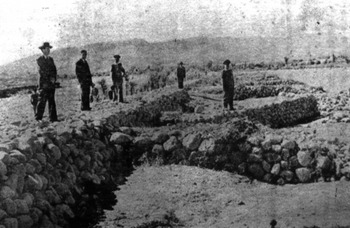
The MNR rewrote the constitution and laws to highlight the military's mission to “cooperate in the country's economic promotion” through a combination of military training and the “productive labor” of agriculture, ranching, industry, construction, and colonization.Footnote 84 In keeping with this emphasis, the government proudly publicized the military's nonmartial accomplishments: The president bragged that military labor had dug 219 wells in 1953; a 1956 pamphlet chronicled a highland soldier's work in a lowland colonization unit; and a 1958 documentary film entitled “The Peace Offensive” positively depicted military laborers to the general public.Footnote 85 Newspapers and the military magazine regularly published images of soldiers' manual labors. In Figure 1, officers and civilians show off the levees constructed by soldiers on the San Jerónimo farm.Footnote 86 In another such image, conscripts pose with a bulldozer on the bare Altiplano; the caption describes the heroic efforts of the “Revolution's Army” to forge a highway.Footnote 87 Units named for productive activities proliferated and even infantry, cavalry, and artillery regiments dedicated their labor to these tasks: In 1954, fifty percent of the Colorados Regiment spent their days working on the highway between Tarapacaya and Potosí; the Eighth Infantry Regiment was repairing La Paz's urban roads; the Eguino Cavalry Regiment was growing foodstuffs behind their barracks; and the Camacho Artillery Regiment was cultivating peas, beans, quinoa, barley, and potatoes on forty-three hectares.Footnote 88 Between 1955 and 1961, successive cohorts of conscripts in a single army unit built sixty-one kilometers of roads, fifty-five bridges, and seventy drainage systems.Footnote 89
Levees built by soldiers for the San Jerónimo farm, 1952. Reprinted from Revista Militar 178–182 (1952): 90

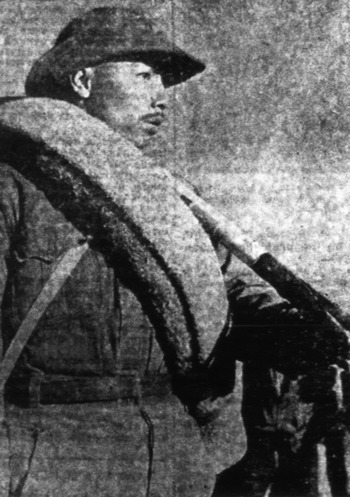
The number of conscripts assigned to colonization work increased after the Revolution as the MNR mandated that battalions aid in its push to develop lowland regions. According to newspaper reports, soldiers like the one pictured in Figure 2 were “replacing the rifle with the spade to dedicate themselves to agricultural work in the scorching earth of Santa Cruz.”Footnote 90 Like their predecessors in the 1920s, these conscripts received reduced military training to devote their time to nonmartial labor. Between 1955 and 1957, 3,600 conscripts traveled to the lowlands to prepare land for settlement; by 1962, they had cleared over 11,800 hectares.Footnote 91
Colonization battalion solider with “a spade at his shoulder,” 1958. Reprinted from La Nación, August 15, 1958, 6.

Legal reforms under the MNR officially sanctioned the use of military conscripts for commercial operations and as contract laborers for private companies.Footnote 92 Hired-out soldiers did the same labor as those on military farms, but rather than saving the state money, they brought it income. Reformers hoped that codifying this long-standing practice would limit opportunities for corruption and ensure that the profits from this labor did more than just augment officers' salaries. As early as 1954, the revolutionary government's official newspaper was bragging of the Vergara Artillery Group's help with the cotton harvest at Finca Menonah in Roboré and at the La Algodonera farm in Santa Cruz.Footnote 93 And film clips from the 1960s show conscripts cutting sugarcane, loading it onto carts, and feeding it into a pressing machine.Footnote 94
All of these manual labor tasks had been performed by conscripts prior to the Revolution, but the discourse surrounding this labor had profoundly changed. In stark contrast to the martial emphasis that allowed some pre-Chaco War conscripts to object to nonmartial assignments, the MNR glorified this work. It sought not only the labor of conscripts hailing from rural areas and the mines but also their political support. How conscripts might perceive their quotidian labor for the patria mattered in ways that it had not before 1952. While still emphasizing the need to defend frontier regions and the savings for state coffers, politicians and officers began to depict underdevelopment as a battle that the country needed to win, thus expanding the list of threats against which Bolivia needed protection. Their argument that national defense must be achieved through economic development not only responded to the specific situation faced by the MNR in the 1950s but also echoed voices emerging throughout Latin America.Footnote 95 Phrases that militarized development labor abound after 1952, popping up in military-magazine articles, presidential addresses, speeches to soldiers, and even laws. Military labor would “save our Patria from economic chaos”; the army must wage “the peaceful and edifying battles of national economic emancipation” in which victory was a road bulldozed or a farm mechanized.Footnote 96 The most enthusiastic proponents went so far as to insist that building roads would allow Bolivia to “impose its hegemony on the continent.”Footnote 97
This discourse not only imbued nonmartial labor with a higher purpose, it also attempted to mobilize conscripts as actors invested in Bolivia's future and gave the military as an institution a new and popular mission. These changes were clear and profound. But the “Revolution's Army” was also characterized by many continuities from the pre-1952 and even pre-Chaco army. Although the MNR advocated workers' rights, its leaders still saw military service as teaching “discipline in work” and observed “the significant evolution that it produces in the peasant who enters the barracks.”Footnote 98 The MNR's attempt to form a revolutionary peasantry was primarily characterized by land-reform efforts, but the barracks would also be a key site of identity transformation. However, the allocation of labor assignments continued along racial lines. Indigenous soldier Juan Acarapi Mamani, for example, spent his days laboring with a “group of soldiers charged with making tiles for the Regiment” rather than participating in military training with the other conscripts in the Castrillo Infantry Regiment.Footnote 99
Growing steadily in size and prestige after its very existence had been threatened in 1952, the military regained a prominent role in the mid- to late 1950s. In the face of regime factionalism and economic crisis, the administrations of Hernán Siles (1956–1960) and Víctor Paz (1960–1964) relied increasingly on US aid and advisors. Military assistance to combat potential counterinsurgency flooded in after the Cuban Revolution, and a new term for nonmartial productive labor was introduced: Civic Action. US leaders conceived of Civic Action as fighting communism by both contributing to “economic and social development” and improving “the standing of military forces with the population.”Footnote 100 Higher standards of living would increase resistance to communist propaganda, and the military's involvement in these activities would guarantee local support against internal and external subversion. After a definitive break with the left wing of his party in 1963, President Paz was left with few supporters and accepted General René Barrientos as his vice-presidential candidate in 1964; Barrientos would form part of the junta that overthrew him a few months later.
Like their predecessors in the MNR, military administrations under Barrientos (1964–1969), Ovando (1969–1970), Torres (1970–1971), and Banzer (1971–1978) continued to emphasize the military's productive contribution to the nation. In 1967, President Barrientos declared: “The Bolivian soldier carries in one hand a weapon and in the other a tool, [has] one foot in the barracks and the other in the field of economic development.” “Disorder and chaos,” he warned, were “fatal enemies of the Patria,” so each conscript must become “a permanent sentry, a lookout, who guarantees the dynamic process of development.”Footnote 101 Films and photographs from the era routinely depict uniformed soldiers mixing cement, operating well-drilling equipment, and roofing schools.Footnote 102 And newspapers bragged of the “quota of blood” paid by “the selfless members of the armed forces who work for the progress of the Patria.”Footnote 103
These administrations also increasingly called on the armed forces to end labor disputes, sending troops into the mines in 1964, 1965, 1967, and 1974. Newspapers printed photographs of soldiers loading bazookas, occupying the mines, and training machine guns on union buildings. Conscripts' repressive labors prior to 1952 had served private interests by intimidating workers demanding better pay, safer conditions, or the release of prisoners. However, the state faced similar demands from nationalized mines after accepting the International Monetary Fund's stabilization plan that ended subsidies, held down wages, and maintained a single exchange rate.Footnote 104 In the face of this conundrum, officers aggressively invoked the military's right to power based on its self-definition as the guardian and ultimate expression of Bolivian nationalism. In a statement to the press during the 1974 strike at Uncía, the commander of the Second Division argued that anyone who resisted was, by definition, an extremist since “the Bolivian people never feel dissatisfied but rather very happy when a military unit holds watch to ensure order, tranquility, and the integrity of the citizenry.”Footnote 105
Despite assertions as to the legitimacy of the military's guardian role, the use of conscripts for repressive labor complicated the idea of citizen-soldiers by forcing individuals to choose between local and national loyalties, just as it had for Captain Alcoreza's troops in 1915, when they were deployed in service of the landlords against sleeping Indians. For the conscripts engaged in this martial labor, orders to repress miners might mean turning weapons on friends or even family members. A particularly poignant example can be seen in anthropologist June Nash's oral history of miner Juan Rojas. Although he had himself experienced military repression, Rojas insisted that his son complete military service, even threatening to bring him back to the barracks “like a child” if he deserted. However, when his son mentioned that he might be ordered to attack miners with machine guns, forcing them to work “with guns at their throats,” Juan responded that he must remain loyal to the miners and “liquidate the officials that command [him] to fire.”Footnote 106 Although this was likely empty bravado, the military experience was a conflicted one for many conscripts.
Nonmartial assignments could also complicate the idea of the military as the epitome of nationalism. The 1967 example of the Manchego Assault Regiment is particularly striking. After intense training with US Green Berets, soldiers from this unit captured Che Guevara. President Barrientos descended upon La Higuera to personally congratulate the troops, promising them an early discharge in reward for their efforts. Yet, after spending months pursuing the remaining guerrillas, the Manchego unit returned to their barracks in Guabirá (Santa Cruz). As retired general Gary Prado Salmón writes: “After having been covered with glory for their performance at ‘La Higuera,’ the soldiers suddenly realized that the presidential promise of discharge would not be fulfilled, and that, on the contrary, they were destined to cut sugarcane on private property for the benefit of their superiors.” So they captured the garrison's armaments, made prisoners out of their officers, and shot at the warplanes sent to scare them into surrender. The authorities quickly capitulated, promising to honorably discharge the mutineers within sixty days.Footnote 107
In some ways, the Manchego mutineers were not dissimilar to their counterparts in the early twentieth century, who had complained about the nature and conditions of their labor. Despite the efforts of the MNR and military administrations to celebrate development labor, conscripts still understood it to be fundamentally different from martial labor. But unlike the 1931 Colorados conscripts who had complained about making mud bricks, the Manchego soldiers never faced a military tribunal even though they had, in fact, mutinied. The hiring out of conscripts as agricultural day laborers was common and legal, but these soldiers, due to their well-publicized martial accomplishments, could take advantage of an institutional fear of embarrassment to avoid reprisals.
Conclusion
Throughout the twentieth century, soldiers' martial and nonmartial labors defended Bolivia's borders, developed the nation, maintained the military, and benefited individuals and private companies. The diversity of soldiers' labor originated with the creation of frontier units, the state's financial needs, and officers' taking advantage of military hierarchy. After the Chaco War, however, political and military leaders used nonmartial labor to justify their portrayal of the military as essential to the patria's integrity. The use of military labor for development was not solely a practical matter of finances but also a discursive project of nation building and on-the-job training for the nation's future laborers. In the words of President Paz, conscripts would “serve the Patria” by “building the new Bolivia.”Footnote 108 Not only would their labor literally build their country's roads and schools, their experience in the barracks would also instill an identification with Bolivia and a desire to work, both in and out of uniform, for the greatness of the patria.
And, in some ways, it worked. Impressment gangs had long ago disappeared, and the military could rely on community norms and a more effective state to supply it with conscripts. In fact, the president of the state-owned Bolivian Development Corporation may have been exaggerating only slightly when he declared in 1957 that military service was “fulfilled in an almost religious manner.”Footnote 109 However, budget shortfalls, political upheaval, corrupt officers, and conscript resistance still meant that military barracks were sites of conflict and negotiation. Dominant ideas about the correlation between “ethnicity” and ability meant that many indigenous conscripts continued to do the most menial of labors. And there were always officers who mistreated their soldiers or sought to hire out conscripts' labor for personal gain, as happened with Captain Antezana in 1946 and the Manchego Regiment in 1968.
Although official representations of military service had expanded to include far more than armed defense, officers had always presented this duty as a sacred one. The image of conscripts willingly serving the patria was so integral to the perpetuation of compulsory military service that, in at least one case, it became more important than insisting upon strict enforcement of authority over soldiers. In 1974, the commander of a unit garrisoned in Cochabamba denied press reports that his soldiers had mutinied, claiming that the incident was only conscripts complaining about “not having been discharged on the anticipated date.” He added an assurance that they would “be discharged with all honors . . . because they took part in fulfilling the sacred duty to which the Patria has called them.”Footnote 110 Far from being mutineers, he portrayed these soldiers as having honorably fulfilled the terms of their contract laboring for the patria.