INTRODUCTION
Formal burial grounds appear in the Balkans toward the end of the sixth millennium bc. In the following centuries, the practice of concentrating the burials of ancestors intensifies, leading to the appearance of multiple, usually small, cemeteries associated with nearby settlements. The western Black Sea coastal area is the only region in the Balkans and Carpathian Basin with a continuous history of cemetery usage from the late sixth millennium bc onwards (viz, in the Hamangia groupFootnote 1). In this sense, the emergence of the Varna cemeteryFootnote 2 in the middle of the fifth millennium bc Footnote 3 is no surprise. The full publication of the site is forthcoming, but various aspects of the cemetery are already in the public domain, such as the contents of the richest graves, the accelerator mass spectrometry (AMS) dates and isotopic analyses of diet.Footnote 4 As yet, little aDNA analysis has been conducted on the Varna cemetery population, with just three individuals studied, and one providing evidence for a ‘steppe’ ancestry.Footnote 5
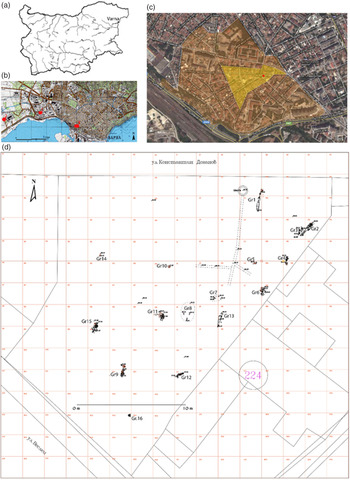
The largest part of the Varna cemetery was excavated in the period 1972–91, with a total of 315 burials/burial groups being unearthed (fig 1). Analysis of the AMS dates from different zones of the cemetery show that burials started in several zones, continuing for the full duration of the cemetery. The form of burial varied from extended to crouched inhumation and a form of burial termed ‘cenotaph’ graves, in which the grave goods were laid out as if a body was present but it was in fact absent. While most of the richest graves were cenotaphs, the richest grave of all – Grave 43 – was an extended inhumation.
a) location of Varna city on the map of Bulgaria; b) location of the three Varna Copper Age cemeteries – 1: Varna i, 2: Varna 2, and 3: Varna 3; c) protected (in yellow) and secure (in brown) zones of the Varna 3 cemetery showing the excavation area in 2017 (marked with a red dot); d) plan of the investigated area with excavated graves.

The significance of the Varna cemetery for Balkan and European prehistory can hardly be overestimated. Ever since its discovery in 1972, numerous publications have tried to explain the appearance of this mortuary supernova, in often contradictory terms – from the apex of social evolution (eg state formationFootnote 6) to emanating from a fishing village, underpinned by strictly hierarchicalFootnote 7 or egalitarianFootnote 8 or heterarchicalFootnote 9 social formations. A huge interpretative challenge is posed by the quantity and diversity of grave goods; more than 3,000 golden objects weighing almost 6kg, more than 160 copper objects, 230+ flint objects, 16,000+ Dentalium objects, 1,600+ Spondylus objects, 90+ stone objects and hundreds of carnelian, serpentinite and lignite ornaments, as well as ornate pottery and some unique bone artefacts from exotic species, have been recovered.Footnote 10 The Varna cemetery epitomises the achievements of human development in the mid-fifth millennium cal bc, such as the utilisation of novel technologies and the ability to maintain and control a vast exchange network, resulting in a massive concentration of social power, materialised in rich graves, some with previously unparalleled quantities of gold objects. As surprising as its sudden rise and florescence is the fact that the cemetery has left no lasting legacy.
In 1976, an earlier grave group (the Varna 2 cemetery) dated by one radiocarbon date to the Middle Copper Age (4910–4720 cal bc; 95% probability; OxA-X-2414-52, 5934 ± 33 bp Footnote 11) was discovered c 2km (1.2 miles) to the west of the cemetery. Only three graves were excavated, as the remaining area was destroyed by construction work. Excavation of a third group of graves – Varna 3 – took place in 2017. The aim of this paper is twofold: to establish the chronology of the Varna 3 cemetery, and to determine the duration and tempo of burial at the site.
THE VARNA 3 CEMETERY
In 1949, an unknown number of Late Copper Age graves was destroyed during drainage works in the southern part of the city of Varna. In 1996 the construction of a building in the same general area destroyed a rich grave, and some of its copper grave goods, as well as the flint and obsidian blades, were given to the Varna Archaeological Museum. The area lies c 2.5km (1.6 miles) to the east-southeast of Varna i, and since 2015 has been protected by law. In December 2017, construction work in the area, preceded by the obligatory archaeological investigation, led to the discovery of sixteen new graves,Footnote 12 one containing grave goods dating to the Late Hellenistic period (second–first centuries bc), the ten inhumations discussed here and five cenotaphs, similar to the Varna i cenotaphs and dated to the Copper Age (fig 1). The newly discovered graves lie 60m to the east of that destroyed in 1996 and, together with those destroyed in 1949, suggest that we are dealing with a much larger burial ground – ascertaining the extent, spatial and chronological character of which is an ongoing project as the area is heavily urbanised allowing only occasional archaeological observations.
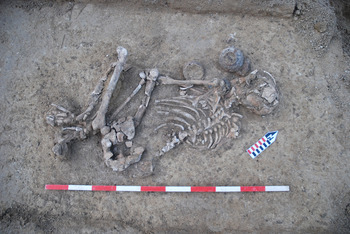
Ten of the prehistoric graves have skeletal remains (two graves were destroyed by a mid-twentieth-century water pipe canal, and it is possible that the remains in Grave 16 derive from two separate individuals). The dominant burial position is crouched on the right side (fig 2), with only two extended skeletons present. Usually, the head is placed to the north-east; just two burials have their heads to the south (Graves 3 and 4).
Grave 15 from the Varna 3 cemetery.

Of this small sample, more than half of the individuals are female. Ages vary between twenty and thirty years old, but there are also two older individuals around sixty years of age (Graves 3 and 6) and two children (Grave 4 and the remains of one of the individuals in Grave 16).
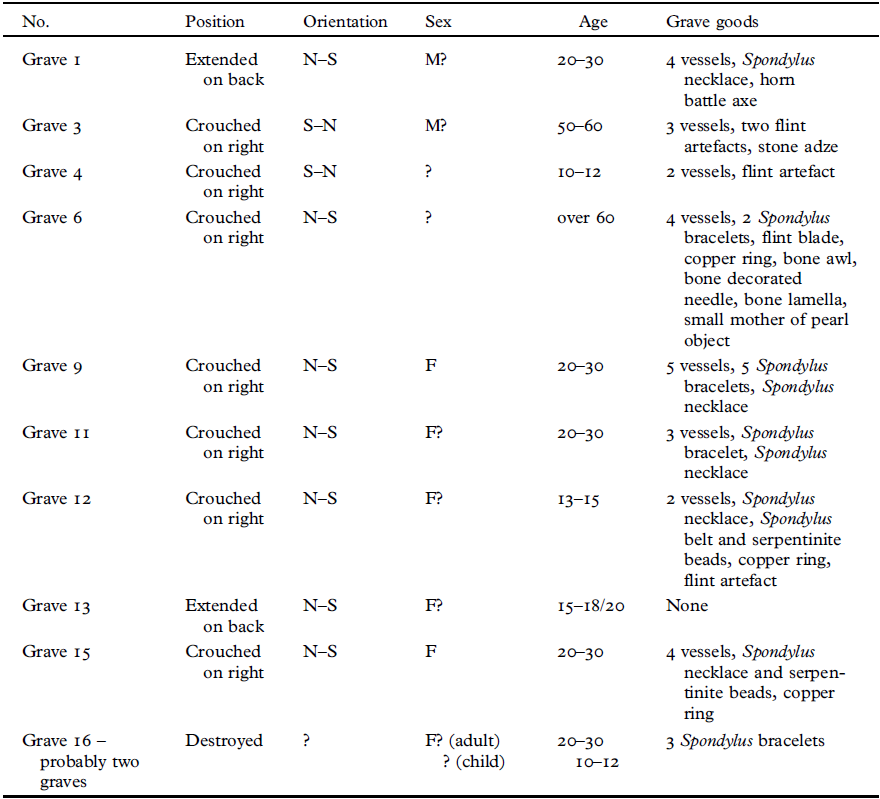
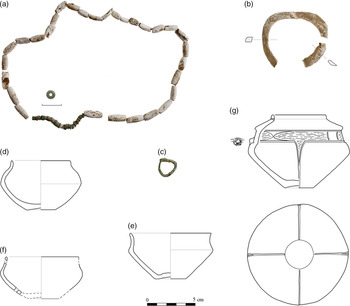
Most of the graves have a standard inventory of several badly fired vessels placed near or behind the head, a copper ring, Spondylus bracelets and a necklace made of Spondylus and serpentine beads (table 1, fig 3). An obligatory part of the burial rite was the placing of a small vessel near the wrist, which results in the vessel being located near the mouth of the buried person. Exceptionally, Grave 13 is without grave goods. Among the rest of the graves, two have single vessels (Graves 5 and 10) and three have scattered ornaments and ceramic vessels (table 1).
Burial data from Varna 3. Graves not included here are: Grave 2 from the Hellenistic period and Graves 5, 7, 8, 10 and 14 that are cenotaphs.

Finds from Grave 15 from Varna 3. a: necklace of serpentinite and Spondylus beads; b: Spondylus bracelet; c: copper ring; d–g: ceramic vessels.

AIMS AND SAMPLING STRATEGY FOR RADIOCARBON DATING
The previous rounds of radiocarbon dating undertaken for the Varna i cemetery had a complex sampling strategy that addressed issues such as bone preservation, spatial representativity and the types of grave goods deposited.Footnote 13 The new discovery of a spatially discrete group of burials provided a unique opportunity for a different and very important dating programme. Accepting that this is a small mortuary sample, the dating of all ten surviving inhumations would reveal the temporal pattern of a group of spatially related burials – something that the previous dating programmes did not address. In addition, it would establish the duration of deposition in this part of the site, determining whether it was before, after or contemporary with the main cemetery. The aim of this paper is to establish the chronology of the excavated part of the Varna 3 cemetery and the duration and tempo of burials in this area. Further dietary and chronological modelling and discussion of the implications of these results for the overall dating and character of the Varna i cemetery will be the subject of a future publication.Footnote 14
METHODS AND RESULTS
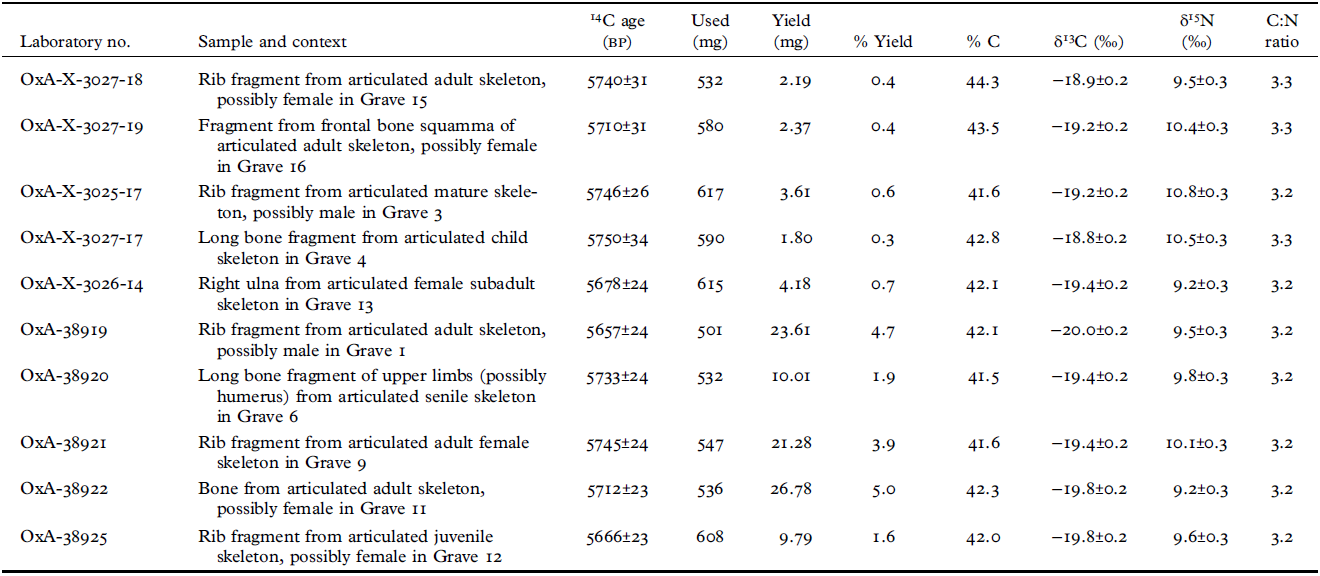
Samples from ten skeletons were dated at the Oxford Radiocarbon Accelerator Unit in 2019. Each bone was gelatinised and ultrafiltered,Footnote 15 and then combusted, graphitised and dated by AMS.Footnote 16 The results, which are conventional radiocarbon ages,Footnote 17 are listed in table 2. They have been corrected for fractionation using δ13C values measured by AMS. These values can include an element of fractionation introduced during the preparation and measurement of the samples in addition to the natural isotopic composition of the sample, and so they are not suitable for dietary analysis and are not reported. For this reason, δ13C and δ15N values were obtained by an isotope ratio mass spectrometer (IRMS) attached directly to the CN analyser used to combust the samples to carbon dioxide.Footnote 18 These isotopic ratios, along with details of the collagen yield and carbon and nitrogen content of the samples are provided in table 2.
Radiocarbon dates and associated quality assurance data from Varna 3.

As with the previous dating programmes, the current set of radiocarbon measurements was analysed within a Bayesian framework.Footnote 19 This approach provides an explicit, probabilistic method for combining different sorts of evidence to estimate the dates of events that happened in the past and for quantifying the uncertainties of these estimates. It allows us to account for the relationships between samples during the calibration process. At Varna 3, for example, the radiocarbon dates sample the period of use of a group of graves, which are treated as not unrelated (as would be assumed by calibrating each individually). The formal modelling was performed using the program OxCal v4.3.Footnote 20 We present a model for the chronology of the Varna 3 burials, which adopts the approach used for the preferred model (model 4) presented recently for the Varna i cemetery.Footnote 21 Thus we employ the general outlier model,Footnote 22 mixed-source calibration for determinations on human bone that have δ13C values more enriched than −19.6‰,Footnote 23 and fully terrestrial calibration for measurements from the other human bones.Footnote 24
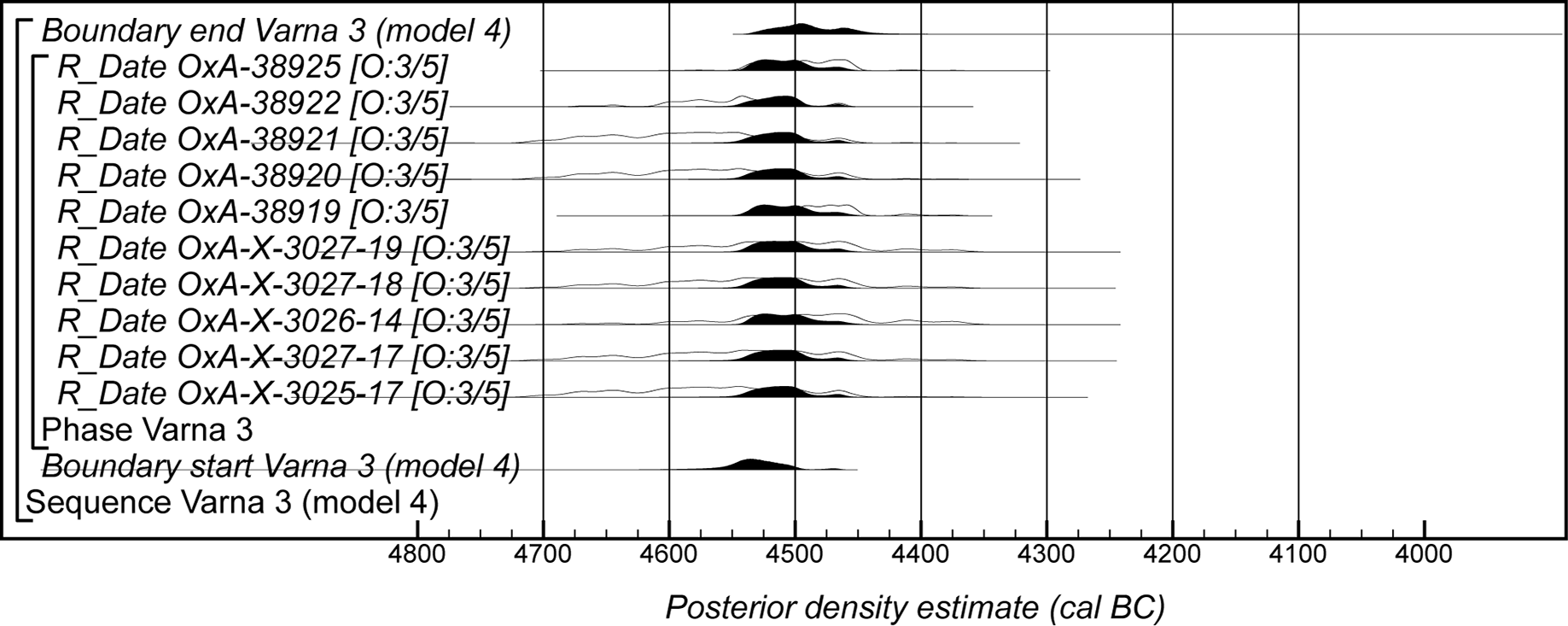
The model for Varna 3 is shown in fig 4.Footnote 25 It suggests that the first burial in this area took place in 4590–4490 cal bc (93% probability; start Varna 3 (model 4); fig 4) or 4480−4460 cal bc (2% probability), probably in 4550–4500 cal bc (68% probability). The last burial occurred in 4535–4440 cal bc (95% probability; end Varna 3 (model 4); fig 4), probably in 4525–4475 cal bc (57% probability) or 4470−4455 cal bc (11% probability). The use of this area thus occurred over a period of 1–125 years (95% probability; use Varna 3 (model 4); fig 5), probably over a period of 1–55 years (68% probability).
Probability distributions of dates from Varna 3 (model 4). Each distribution represents the relative probability that an event occurs at a particular time. For each of the dates, two distributions have been plotted: one in outline, which is the simple radiocarbon calibration, and a solid one, based on the wiggle-match sequence. Distributions other than those relating to particular samples correspond to aspects of the model. For example, the distribution ‘start Varna 3 (model 4)’ is the estimated date when the first burial at Varna 3 was made. The large square brackets down the left-hand side along with the OxCal keywords and the description of the sapwood estimates in the text defines the overall model exactly.

Probability distribution for the duration of burial at Varna 3, derived from the model defined in fig 4.

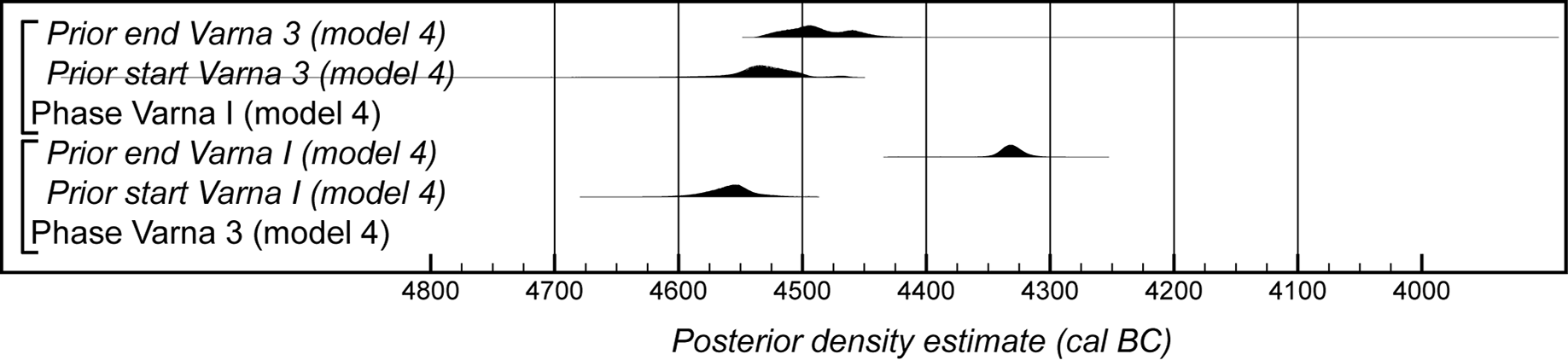
These date estimates can be compared with those for the Varna i cemetery calculated using the same approach, including the use of updated calibration data.Footnote 26 We have also slightly modified the model previously published for Varna i by including six additional radiocarbon dates from the Klaus-Tschira-AMS laboratory, Mannheim, Germany (MAMS).Footnote 27 For MAMS-15095, we have used a mixed-source calibration based on the δ13C value of OxA-13685 (a replicate measurement on the same skeleton), for the measurements on the other human bone we have used a fully terrestrial calibration, and for the two measurements on Dentalium shells we have used a ΔR value for the eastern Mediterranean of −51±50 bp.Footnote 28 Only two dates have posterior outlier probabilities greater than 10 per cent in this model (Poz-71452, O: 18 and OxA-X-2256-47, O: 13), which is in line with statistical expectation. This revised model suggests that the Varna i cemetery began in 4605–4520 cal bc (95% probability; start Varna i (model 4); fig 6), probably in 4580–4540 cal bc (68% probability), and that it ended in 4360–4300 cal bc (95% probability; end Varna i (model 4); fig 6), probably in 4345–4320 cal bc (68% probability). The burial ground would have been used for a period of 170–280 years (95% probability; use Varna i (model 4); distribution not shown), probably over a period of 205–250 years (68% probability).
Probability distributions of key parameters for burial at Varna i and Varna 3, derived from the models defined by the CQL2 code provided as supplementary information.

Fig 6 shows the estimated dates for the start and end of burial at Varna i and Varna 3 following the modelling approach preferred in the previous analysis. Burial at Varna i began before that at Varna 3 (84% probable), and certainly continued after burial at Varna 3 had ended (100% probable). The use of Varna 3 was probably confined to within the first few generations of use of the Varna i cemetery.
Turning to the tempo of burials at Varna i and 3, the ideal requisite data combines the size of the burial ground, the proportion of the site excavated and the Bayesian models for the maximum and minimum durations of the cemetery. While the Bayesian models are complete, the size of each of the burial areas remains to be determined by future investigation. The analysis developed here varies the proportion of excavated graves and makes the assumption that the rate of burial in each cemetery remains constant for that cemetery.
The results of these analyses are based upon an algorithm for estimating the density of burials:
1. Total burials/ Proportion of excavated cemetery) = z
2. Maximum burial density (z/ maximum duration in years) = a
3. Minimum burial density (z/ minimum duration in years) = b
4. Estimate of burial density (a − b)/2 + b
5. Error (a − b)/4
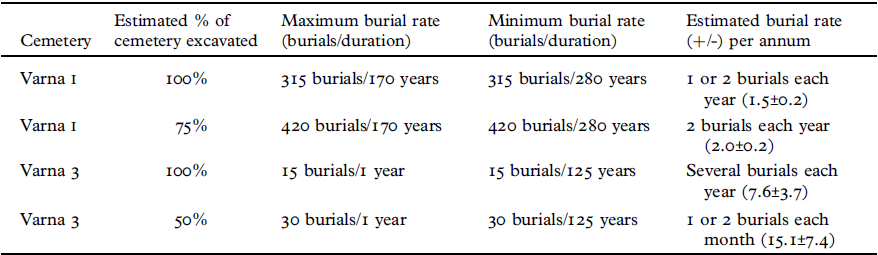
This algorithm was used to estimate burial densities for Varna i as 100 per cent and 75 per cent excavated (the latter as proposed by Slavchev),Footnote 29 while the Varna 3 cemetery was modelled as being 100 per cent and 50 per cent excavated. The results are presented in table 3. Using the medians of the estimated durations of each cemetery (226 years for Varna i and 45 years for Varna 3), and the same proportions of excavation, we again estimate one or two burials each year on average for Varna i, with the estimated burial rate at Varna 3 falling to one burial every eighteen months to three years.
Estimated rate of burials at Varna i and Varna 3.

Burials at Varna i were regular events averaging one or two in a calendar year, while the estimated rate of burial at Varna 3 is clearly very sensitive to the duration of the cemetery. Contrasting the shortest duration of use (one year for Varna 3 at 50 per cent excavated area) with the longest duration of use (280 years in Varna i at 100 per cent excavated area) means the pace of burial at Varna 3 could have exceeded that of Varna i by a factor of thirty. Although the radiocarbon measurements on the ten dated skeletons are not statistically consistent (T′ = 17.6, T′(5%) = 16.9, ν = 9Footnote 30), taking the potential variation in diet into account in the calibration methodology (see above) means that they are compatible with a single year of burial (Acomb: 162.6, An: 22.4, n: 10). Alternatively, the use of Varna 3 over perhaps two generations is consistent with its use as the burial place of an extended household, with the burials discovered in 1949 and 1996 perhaps relating to other households.
On the whole, we do not regard the Varna 3 cemetery to have been the result of a rapid episode (eg the result of famine or disease). The presence of cenotaphs, the careful treatment of the bodies and the deposition of grave goods are consistent with the burial rite in Varna i and suggests a normative burial rite rather than a rapid disposal of corpses. The limited duration of Varna 3 therefore raises the possibility that the Varna mortuary zone included multiple plots that were used by the members of extended households. Although each plot may not have endured for as long as the mortuary zone as a whole, this practice of burial in separate plots persisted throughout the period that Varna i was in use. It is not currently clear whether the high-status focus of the Varna i cemetery endured for the entire duration of the mortuary zone, or whether it was restricted to a few generations.
The most likely reason for the different duration of the burial groups is that the cemeteries drew their membership from social groups of different sizes; a smaller group size for Varna 3, perhaps akin to an extended household, and a much larger social group for Varna i, drawn from regional lineages, or perhaps even extending to inter-regional communities. It is equally likely that the rules governing acceptance into the Varna i cemetery were far looser and inclusive than those for Varna 3, which were perhaps restricted to members of a specific community. It is unlikely that the population burying at Varna i changed their preferred burial location to Varna 3 before returning to the larger cemetery, since the AMS dates showed direct contemporaneity between the two burial places.
DISCUSSION
All available evidence collected so far – burial position, range of grave goods and radiocarbon dating – suggest that the newly discovered graves form an integral part of the wider Copper Age mortuary zone at Varna. Varna 3 contains the burials of men, women and children and thus could represent an extended household or a local lineage (although small children are absent).
The invaluable new information presented here concerns the duration of use of a spatially defined area and the tempo of burials. The use span of the newly excavated area fits well with the overall Varna chronology starting at 4605–4520 cal bc and ending 4360–4300 cal bc (95% probability) with a duration of 170–280 years (95% probability). It appears that burial in the new area started slightly later and ended earlier than in Varna i and lasted for a shorter period. The short period of use of the new area is confirmed by the uniformity of the grave goods and the restricted variability in burial position. What is clear for the first time is the duration of burial practices in a small area of the overall Varna mortuary zone. In the Varna 3 area, the tempo of burial was somewhat slower than in Varna i; however, the rate of burial is strongly dependent on both the duration of the burial practices and the proportion of the cemetery excavated. Tentatively, then, we suggest that the mortuary zone had multi-focal activities where consequent burials were performed in certain areas according to affiliation with the already buried, rather than a steady organic growth whereby the cemetery expanded once space in certain areas was exhausted. Whether there were such affiliations, and what such affiliations may have been, is a matter of future research. For the purposes of this study, it is clear that the newly excavated area was abandoned earlier than the rest of the cemetery, and not for lack of space.
In the wider context of the mid-fifth millennium cal bc in the Balkans and Hungary, there is an increase in the differentiation of social space, with a growth in not only the number of cemeteries but also the attachment of several different cemeteries to one and the same settlement (eg Sultana-Malu Roşu in Romania, with three cemeteriesFootnote 31). Moreover, in the Late Neolithic Lengyel context in Western Hungary, sites such as AlsónyékFootnote 32 revealed the division of the overall settlement zone into areas with houses and distinct intra-mural mortuary zones, reinforcing the idea of greater spatial diversification. The idea of more complex statements about identities made in increasingly diverse spatial ways is a fitting description for the Varna mortuary zone.
CONCLUSIONS
The excavation of further Late Copper Age burials on the plateau above the Varna lakes provided the opportunity to examine the chronology of all ten inhumations from a small Varna 3 mortuary area, which also contained five cenotaph burials. Bayesian modelling of the ten new AMS dates showed that burials at Varna 3 began c 4590–4490 cal bc and ended c 4535–4440 cal bc , with the most probable duration being forty-five years. This makes Varna 3 coeval with the earlier part of the Varna i cemetery, starting perhaps as little as twenty-five years later than the first burials there but ending in the middle of the use-life of Varna i. The modes of burial and grave goods in Varna 3 fit well with the middle-ranking graves of the Varna i cemetery, without any of the spectacular gold offerings. The estimated tempo of burials at the two mortuary foci shows that burials were more frequent at Varna i, with one or two burials per annum, than at Varna 3, with burials every eighteen months to three years. It is suggested that the Varna i cemetery drew on a much larger, regional if not inter-regional, pool of living populations than Varna 3, which may be considered more as the burial ground of a smaller group constituting a local lineage.
ACKNOWLEDGEMENTS
These analyses were funded by research grants from the Society of Antiquaries of London and the Prehistoric Society; we are very grateful to both bodies.
SUPPLEMENTARY MATERIAL
To view supplementary material for this article, please visit https://doi.org/10.1017/S0003581521000032.
ABBREVIATIONS AND BIBLIOGRAPHY
Abbreviations
- aDNA
-
ancient deoxyribonucleic acid
- AMS
-
accelerator mass spectrometry
- C
-
carbon
- IRMS
-
isotope ratio mass spectrometer
- MAMS
-
Klaus-Tschira-AMS laboratory, Mannheim, Germany
- N
-
nitrogen