Introduction
Auditory verbal hallucinations (AVHs) have been part of the tapestry of human experience for many millennia. Despite recent advances in our understanding of the phenomenology of voice-hearing, the cognitive mechanisms behind AVHs remain in debate. One popular contemporary cognitive account is that AVHs result from the misattribution of the voice-hearer's own inner speech to another (Frith et al. Reference Frith, Rees and Friston1999; Seal et al. Reference Seal, Aleman and McGuire2004; Jones & Fernyhough, Reference Jones and Fernyhough2007a, Reference Jones and Fernyhoughb). On this view, AVHs, like other ‘loss of boundary’ experiences, reflect a failure to monitor the intentional instigation of actions. In the case of AVHs the act in question is inner self-talk. The inner-speech account is thus consistent with definitions of inner speech as ‘thinking in words’ (McGuire et al. Reference McGuire, Silbersweig, Wright, Murray, David, Frackowiak and Frith1995, p. 596) or ‘verbal thought’ (Vygotsky, Reference Vygotsky1987) and the dominant philosophical view that thinking, in general, as distinct from imagery, is the act of using language to talk to oneself internally (see, for example, Wiley, Reference Wiley2006). Other theories of AVHs take a different view of the cognitive causes of the experience. For example, Waters et al. (Reference Waters, Badcock, Michie and Maybery2006) have argued that AVHs result from a combined failure to inhibit and to correctly source a wide range of mental events including irrelevant memories and involuntary intrusive ruminations.
Inner speech in patients with schizophrenia who experience AVHs (Sz-AVHs) has been the subject of much neuroimaging research, with evidence of differences in neural activation between Sz-AVHs and healthy non-voice-hearing controls when participants image inner speech, particularly other people speaking (see Jones & Fernyhough, Reference Jones and Fernyhough2007a, for a review). Studies have also investigated how inner speech in Sz-AVHs may come to be experienced as alien, with evidence emerging of externalizing attributional biases specific to Sz-AVHs (Allen et al. Reference Allen, Freeman, Johns and McGuire2006). Despite these advances, there remains a significant blind spot in research into inner speech in those with AVHs. Specifically, there remains very little literature on the everyday experience of inner speech in Sz-AVHs, and how, if at all, it may differ from the corresponding experiences of healthy individuals who do not experience AVHs.
What little is known about the phenomenology of inner speech in schizophrenia can be surmised from the work of Hurlburt (Reference Hurlburt1990). Hurlburt asked four individuals with schizophrenia to reflect upon and describe their inner world at random intervals, as signalled by a beeper. As part of this task patients reported on their inner speech. Of the four patients surveyed, only two experienced AVHs. One reported AVHs that were ‘occasionally dimly present’ (p. 157), whereas another ‘frequently heard voices … which she understood to be the voices of beings she called gods’. The former patient frequently reported inner verbal experiences ‘entirely similar to those given by non-schizophrenic subjects’ (p. 191), whereas the latter, who frequently heard second- and third-person AVHs, reported inner speech as being in her own voice with the same vocal characteristics as if she were speaking aloud. These findings are limited by the small clinical sample and the lack of a systematic examination of the properties of inner speech in Sz-AVHs and psychiatrically healthy individuals.
The present study aimed to redress these limitations by using a semi-structured interview to examine the phenomenological qualities of inner speech in a larger sample of Sz-AVHs and a control sample of healthy non-voice-hearing adults. We were particularly interested in addressing questions that follow from the inner-speech theory of AVHs, particularly those surrounding the quantity, form and pragmatics of inner speech. We also sought for the first time to examine concordance between inner-speech and voice-hearing experiences in Sz-AVHs.
Following Lysaker & Lysaker (Reference Lysaker and Lysaker2005), who proposed less inner speech in Sz-AVHs than in the general population, as a result of hallucinatory voices interrupting the regular flow of inner speech, we first hypothesized that less inner speech would be reported by Sz-AVHs than controls. An associated hypothesis was that the frequency of inner speech in Sz-AVHs would correlate negatively with the frequency of their AVHs. With regard to the form of inner speech, Fernyhough (Reference Fernyhough2004) uses Vygotskian ideas to distinguish between expanded inner speech (in which the internally conducted dialogue retains the give-and-take structure of external dialogue, and is conducted in syntactically complete utterances) and condensed inner speech (in which dialogic utterances are abbreviated into a fragmentary, condensed series of verbal images or words and phrases). On this view, AVHs result when condensed inner speech is re-expanded under conditions of stress and cognitive challenge, with the resulting dialogue subsequently misattributed to external voices. We thus hypothesized that Sz-AVHs should report less expanded inner speech than healthy controls, and should hence be less likely to report thinking in complete sentences.
With regard to the pragmatics of AVHs, we focused on the terms of address used by voices to refer to the patients, and whether similar terms of address also occur in inner speech. If inner speech is the origin of all AVHs, including voices commenting and voices conversing, there should be consistency between the use of second-person (‘you’) and third-person (‘he/she’) pronouns (when referring to self) in inner speech and the frequency of second-person and third-person AVHs. We thus hypothesized that patients who report voices commenting should also report using ‘you’ to refer to self in inner speech, whereas patients who report voices conversing should also report using ‘he/she’ to refer to self in inner speech. Finally, we expected concordance between the phenomenological qualities of Sz-AVHs' voices (e.g. vocal characteristics such as perceived gender, whether they were in the second or third person, and their form, speed and volume) and their inner speech. For example, if Sz-AVHs' voices predominantly addressed them as ‘you’ we expected that in their inner speech such individuals would also predominantly address themselves as ‘you’.
Method
Participants
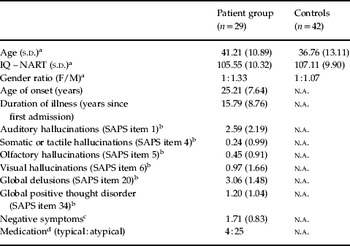
Twenty-nine clinical participants (15 male, 14 male) with a DSM-IV diagnosis of schizophrenia or schizo-affective disorder who reported the experience of hearing voices were recruited from out-patient clinics of the Sydney South West Area Health Service (SWAHS), with the assistance of the SWAHS Schizophrenia Research Unit, and from the Volunteer Research Register administered by the Schizophrenia Research Institute of Australia (www.schizophreniaresearch.org.au). All patients were on stable doses of antipsychotic medication. The exclusion criteria were prominent thought disorder, current substance abuse, known mental retardation, and presence of a clinically significant head injury. Clinical demographics are reported in Table 1.
Demographics for patients with AVHs, and controls

AVHs, Auditory verbal hallucinations; NART, National Adult Reading Test; SAPS/SANS, Scales for the Assessment of Positive/Negative Symptoms; s.d., standard deviation; n.a., not applicable.
a Patients and control groups did not differ significantly on this variable.
b Mean score according to SAPS category.
c Mean of global SANS scores for alogia, anhedonia, inappropriate affect, avolition and affective flattening.
d Chlorpromazine equivalents were not available for all medications.
Forty-two healthy controls (24 male, 18 female) matched to the clinical participants on age, sex and IQ, and assessed using the National Adult Reading Test (NART; Nelson & Willison, Reference Nelson and Willison1991), were recruited from the general community (see Table 1).
All participants were Australian-born and had good English skills, and more than 8 years of formal education. All participants gave informed consent and the study was approved by the local research ethics committees.
Materials and procedure
Severity of the patients' current symptoms was assessed on the day of testing using the Scales for the Assessment of Positive and Negative Symptoms (SAPS/SANS; Andreasen, Reference Andreasen1984a, Reference Andreasenb). To probe the properties of participants' inner speech and the voices of the patients, we followed the work of Leudar et al. (Reference Leudar, Thomas, McNally and Glinski1997), as well as Nayani & David (Reference Nayani and David1996), and developed a semi-structured ‘Voices and Inner Speech Interview’ to test our study hypotheses (available on request). Structured questions were posed initially with follow-up clarification if required. The participants' verbatim responses to the questions, which were posed alongside the response options, were used to code their responses.
The first half of the interview dealt with the properties of any AVHs experienced by the participants, and the second half dealt with participants' inner-speech experiences. The questions used in the first half were based in large part on Nayani & David's (Reference Nayani and David1996) interview; we asked about the number of voices, their frequency, the type of utterances (a few words, a few sentences, or on and on continuously for a while), the perceived gender, age, accent and class of the voices, and the speed and volume of the voices, as well as the identity of voices and their intelligibility (i.e. understandable or garbled). We also asked some new questions about terms of address. If patients confirmed the presence of voices commenting when asked, ‘Does it feel like each voice is talking directly to you? Or is it more like you're just hearing words that aren't necessarily meant directly for you?’, they were then asked of these voices, ‘Do the voice(s) ever call you by name?’, ‘Do the voice(s) use the word ‘you’ when they are talking directly to you?' Similarly, the patients who reported voices conversing were asked whether the voices used the patients' first name or ‘he/she’ when referring to them in conversation.
The second half of the interview was entirely new. The questions were structured similarly to the questions about voices in the first half. We introduced the second half as follows: ‘Now I'd like to ask you some questions about what it's like when you're thinking about things in your mind, like when you're thinking through a problem for example.’ If a participant reported AVHs, we then added, ‘I don't mean your voices now. That's different. What we're talking about now is what it's like when you're just thinking things over.’ We then went on to ask more specific questions as shown in Tables 2 and 3.
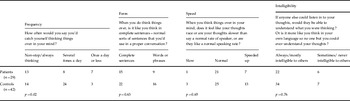
Frequency, speed, intelligibility, and form of inner speech

When columns do not sum to the total number of participants in each group this is due to ‘unsure’ response.
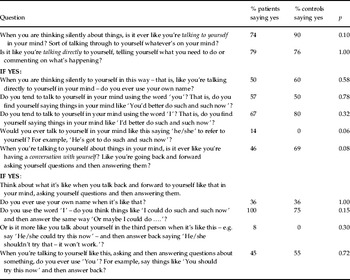
Aspects of talking to oneself in inner speech

Results
AVHs in patients
Of the 29 patients, 12 experienced hearing their voices daily, seven weekly and the remaining 10 less frequently. Of the 26 Sz-AVHs who reported voices commenting, 16 reported the voices using their first name and 15 reported the voices using ‘you’. Of the 14 who reported voices conversing, eight heard their own name being discussed and eight heard ‘he/she’ being used to refer to them in conversation between the voices.
Frequency and other characteristics of inner speech in Sz-AVHs and controls
All participants could reflect upon at least some aspects of their inner-speech experiences and reported no difficulties with understanding the questions listed in Tables 2 and 3. We did not collect confidence ratings for each response because this would have lengthened the interview considerably and would have disrupted the introspection of the participants. Of further note, the patients reported no difficulties with distinguishing between their inner-speech and their voice-hearing experiences. Comparisons between Sz-AVHs and the non-voice-hearing controls were analyzed using Fisher's exact probability test.
Frequency
No participants (patients or controls) rated the frequency of thinking things over in their mind as ‘rarely happens’ (only one patient answered ‘unsure’). The frequency differed significantly between Sz-AVHs and healthy controls. Although the controls predominantly reported inner speech several times a day, the patients were more varied, being more likely to report both non-stop/always thinking and infrequent levels of thinking things over than the controls. Further analysis was performed to investigate whether the results differed in the patients who heard five or more voices (14) and the results remained equally variable and not different from the controls.
Form
There were no group differences in reported form of inner speech. Both Sz-AVHs and controls were most likely to report thinking in full sentences. Of the 14 Sz-AVHs who heard five or more voices, five reported thinking in the form of words/phrases and five reported thinking in complete sentences.
Other characteristics
Sz-AVHs and controls did not differ in reported speed of inner speech (slow, normal rate, speeded up) with both groups more likely to report thoughts at a normal speaking rate. Most participants, patient or control, considered their inner thoughts mostly or always intelligible to others.
The pragmatics of inner speech in Sz-AVHs and controls
Table 3 summarizes percentages of patients and controls who reported inner speech as if talking to oneself, and usage of own name and various pronouns (‘I’, ‘you’ and ‘he/she’) when addressing self in inner speech.
In response to the first question, ‘When you are thinking silently about things, is it ever like you're talking to yourself in your mind’, there was a trend (p=0.10) towards Sz-AVHs saying ‘no’ more often than controls. In response to the follow-up question, ‘Is it like you're talking directly to yourself, telling yourself what you need to do or commenting on what's happening?’, there was no group difference, with the majority of both groups (79% patients, 76% controls) answering in the affirmative. The different results for the two questions may reflect less ambiguity in the follow-up question. Participants who reported that they did experience inner speech as talking directly to themselves were then asked a series of questions on the form of references to self. There were no differences between Sz-AVHs and controls in the tendency to use their own name (approximately half of each group reported doing this) or in the tendency to use the pronoun ‘you’ (used by about half of each group) or ‘I’ (used by about two-thirds of each group). The use of ‘he/she’ to refer to self when talking to oneself in inner speech was not reported at all by controls, and by only three Sz-AVHs.
The next questions probed the dialogic nature of inner speech. Participants were asked ‘When you're talking to yourself about things in your mind, is it ever like you're having a conversation with yourself? Like you're going back and forward asking yourself questions and then answering them?’ There was a trend (p=0.08) for controls (69%) to be more likely to answer in the affirmative to this question than Sz-AVHs (46%). The 12 patients and 29 controls who answered in the affirmative were then probed further on the properties of this internal conversation. No significant differences were found between Sz-AVHs and controls in the frequency with which inner speech took the form of conversation (the most frequent answer in both groups being ‘sometimes’), or the tendency to use ‘you’ (about half of each group using this) or ‘he/she’ (with all but one patient denying any use of ‘he/she’) in such internal conversation. All Sz-AVHs reported using ‘I’ in their internal conversation, as did the majority of controls.
Concordances between inner speech and AVHs in patients
The hypothesized negative association between frequency of inner speech and frequency of voices in Sz-AVHs was not found; the non-parametric correlation (having excluded one patient with an ‘unsure’ response) was non-significant (τ=0.12, n.s.). We also examined correlations between frequency of inner speech and other symptom ratings in patients and all results were non-significant.
With regard to the concordances of speed, volume and intelligibility of patients' inner speech with voices, all correlation results were non-significant (p's>0.05). With regard to the concordances concerning vocal characteristics of inner speech and voices, only 11/29 patients and 12/49 healthy controls reported inner speech that sometimes had the sound quality of a voice. That so few participants reported any inner speech with vocal characteristics ruled out our consideration of concordance in this regard between the Sz-AVHs' inner speech and their voices.
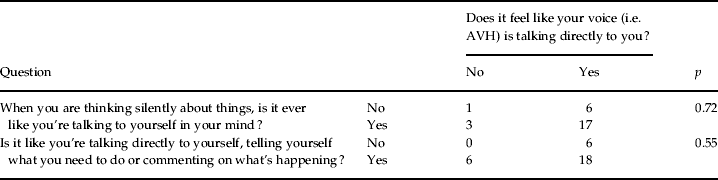
Table 4 shows the relationship between the tendency for Sz-AVHs to experience their AVHs as talking to them directly and their tendency to talk directly to themselves in their own thoughts. There was no association between these two variables.
Self-directed inner speech and AVH properties in patients

AVH, Auditory verbal hallucination.
There was also no relationship between Sz-AVHs' use of their own name in self-directed inner speech (e.g. ‘John, take the garbage out now’) and their name being heard in second-person AVHs. Similarly, there was no relationship between Sz-AVHs' use of second-person pronouns in their self-directed inner speech (e.g. ‘You should move the milk’) and their tendency to hear second-person voices addressing them in a similar way (e.g. ‘You should take the bread’).
We also found no association between the tendency for Sz-AVHs to hear voices conversing and their tendency to experience inner speech as having a conversation with oneself (p>0.05). We also examined the relationship between the patients' use of personal names in dialogic inner speech and their tendency to hear voices using their names in conversation about them and there was again no relationship. Of the three Sz-AVHs who reported using ‘he/she’ to refer to self in inner speech, only one also reported third-person AVHs.
A number of further analyses were performed on the patient data. First, when the inner speech of Sz-AVHs who reported their voices once a week or more was compared to that of Sz-AVHs who heard their voices less frequently, no significant differences on any of the previously discussed properties of inner speech were found. Second, inner speech was compared between Sz-AVHs who only experienced voices commenting and Sz-AVHs who experienced voices conversing (either alone or in combination with voices commenting), as well as comparing both groups to the controls. No group differences concerning any properties of inner speech as discussed above were found, and the relationships between the phenomenological characteristics of voices and inner speech within both patient groups were again non-significant. As Fernyhough (Reference Fernyhough2004) suggests that AVHs result when condensed inner speech is re-expanded under conditions of stress and cognitive challenge, we focused on the 16 Sz-AVHs who reported their voices as more likely when feeling stressed or negative and compared these to the 13 patients who did not (and also the healthy controls). The patient groups differed on only one variable: Sz-AVHs who reported AVHs that were not associated with feeling stressed or negative were more likely to report using ‘you’ in inner speech (p<0.05).
Power analyses
As no discernable differences between the inner speech reported by Sz-AVHs and healthy controls were found, we report on power analyses. The smallest effect size that each of the analyses shown in Table 2 could detect (at β=0.80) was approximately w=0.35, which is a medium effect size (Clark-Carter, Reference Clark-Carter1997). The analyses performed in Table 3 were able (at β=0.80) to detect effect sizes of between w=0.35 and w=0.45, which would be considered medium to large. As the number of participants in Table 4 was smaller, as dictated by responses to earlier questions, these analyses only had the ability (at β=0.80) to detect an effect size of w=0.51, which is a large effect size.
Discussion
This study set out to address a number of questions about the quantity, form and pragmatics of inner speech in Sz-AVHs and healthy controls, as well as the concordance between the phenomenological qualities of Sz-AVHs' voices and their inner speech. Before discussing the results concerning our specific hypotheses, we note that all but one participant (a patient) reported some frequency of inner speech.
Our first hypothesis was that inner speech would be less frequent in Sz-AVHs than in controls. We found little evidence consistent with this. Although controls predominantly reported thinking things over in their mind as occurring several times a day, patients were more varied; proportionally more patients than controls reported inner speech that was non-stop/always-thinking and proportionally more patients reported infrequent levels of inner speech (once a day or less). We found no effects on frequency when patients who heard many voices were compared to those who did not. Thus the present data offer little support for the hypothesis of Lysaker & Lysaker (Reference Lysaker and Lysaker2005) that patients with AVHs should experience less inner speech than controls.
We also found no evidence that thinking in complete sentences would be less likely in Sz-AVHs. Approximately 60% of both Sz-AVHs and healthy controls reported thinking in complete sentences, with no group differences. Similarly, no differences existed between the two groups in terms of other characteristics of inner speech, such as intelligibility, speed and the pragmatics of inner speech. We did, however, find a non-significant trend towards fewer patients with AVHs than controls reporting dialogic inner speech (i.e. inner speech as a back-and-forth conversation).
In terms of the relationship between the inner speech and the voices of Sz-AVHs, we found no evidence of a negative association between frequency of inner speech and frequency of voices. We had also hypothesized concordance between the phenomenological qualities of Sz-AVHs' voices and their inner speech. By contrast, we found no relationship between the speed, volume and intelligibility of patients' inner speech and their voices. Concordances between the vocal characteristics of inner speech and Sz-AVHs' voices could not be examined because the majority of such individuals (in line with controls) reported inner speech being more like words in the head than a voice in the head.
Furthermore, we found no relationship between the tendency for Sz-AVHs to experience their AVHs as talking to them directly and their tendency to talk directly to themselves in their own thoughts. Similarly, there was no relationship between the tendency for Sz-AVHs to hear voices conversing and their tendency to experience thinking as having a conversation with oneself. There were also no concordances between the usage of personal names, second-person or third-person pronouns in inner speech and the frequency with which similar terms of address were used by voices.
A number of caveats need to be acknowledged about the above findings. First, there is a history of questioning the reliability and validity of data obtained from introspection (Nisbett & Wilson, Reference Nisbett and Wilson1977). However, the conscious nature of verbal thought makes it plausible that such an experience can be reliably reported. Moreover, Hurlburt & Heavey (Reference Hurlburt and Heavey2001) argue that concerns about introspection ought not to lead us to dismiss the approach altogether; rather we ought to improve techniques as with the experience-sampling methods of Hurlburt (Reference Hurlburt1990). We hence recommend future studies using such alternate techniques. A further potential problem was that some of the analyses performed only had the power to detect medium to large effects. That said, if all AVHs arise as misattributed inner speech, we would expect such effects to be considerable. Nevertheless, we would call for replication of our findings in larger samples of Sz-AVHs.
It might also be argued that the incidence of thought disorder might have affected the reliability of patients' reporting. However, our sample had very low levels of thought disorder, and patients were recruited with the need for coherent thought reporting in mind. Another potential problem is that patients with very frequent AVHs may have had problems in distinguishing between their own thoughts and their AVHs. However, if this were to be the case we would have expected patients with more frequent AVHs to report their inner speech to be more similar to their AVHs than patients with less frequent AVHs. This pattern was not found, consistent with our observations that patients had no difficulties with distinguishing between their inner-speech and their voice-hearing experiences.
Several further findings, beyond those specific to our study hypotheses, are also worthy of discussion. Because all but one of our Sz-AVHs reported some frequency of inner speech, the question arises as to when a patient's inner speech remains experienced as such and when it becomes misattributed to an external source. There was no evidence in our study that the mood or affect associated with hearing voices might explain this. Unlike one of the patients studied by Hurlburt (Reference Hurlburt1990), as referred to in the introduction, few participants reported their inner speech with any vocal characteristics. This was alongside: (a) 23 of the 29 Sz-AVHs being able to identify the gender of their voices; (b) only six patients reporting voices that were always the same gender as themselves; and (c) 14 Sz-AVHs reporting being able to identify who was speaking to them. A comprehensive inner-speech theory of AVHs would need to account for the origin of vocal characteristics concerning gender and identity of voices. A further complication for any comprehensive inner-speech account of AVHs is that 20 of our patients reported answering their voices (hence acknowledging their ownership and agency related to their responses to the voices). Even more challenging for an inner-speech account of AVHs, 12 of these patients reported answering their voices in their own thoughts and not out loud.
The non-significant trend (commented upon earlier) towards fewer Sz-AVHs than controls reporting dialogic inner speech might be taken to offer some support for an inner-speech account of voices conversing. However, our findings concerning the use of third-person pronouns in inner speech are counter to this view; most participants, patient or control, denied using ‘he/she’ to refer to self in dialogic inner speech. Indeed, only three patients, of whom only one reported third-person voices, reported using ‘he/she’ to refer to self in inner speech, whether this took the form of dialogic conversation or talking to oneself. This occurred despite 14 of the Sz-AVHs reporting hearing voices conversing about them, eight of whom also reported that their voices used third-person pronouns when discussing them. By contrast, the use of personal names and first-person and second-person pronouns was fairly common in inner speech. Nevertheless, there were no relationship between the patients' use of such terms in their inner speech and the use of similar terms of address by the patients' voices.
In conclusion, the present study is the first to systematically investigate the phenomenological qualities of verbal thought in Sz-AVHs and non-voice-hearing healthy adults. It is also the first to examine concordances between inner-speech and voice-hearing experiences in Sz-AVHs. We found no discernable differences between the verbal thought reported by Sz-AVHs and healthy controls. Such a finding is compatible with the inner-speech theory of AVHs, which predicts that the self-monitoring of inner speech is defective, but that inner speech per se need not be unusual. However, if inner speech, conceived as the act of internal self-talk, is the raw material of all AVHs, then there should be similarities between the phenomenological characteristics of patients' verbal thought and their AVHs. We found no evidence to support this prediction.
Our findings also highlight several issues that need to be addressed by proponents of an inner-speech theory of AVHs. These include that: Sz-AVHs and non-voice-hearing healthy adults rarely report inner speech as having vocal characteristics; Sz-AVHs often answer their voices in their own mind, thus raising questions as to why they do not also misattribute authorship of these internal responses to the voices; and third-person pronouns are rarely reported in verbal thought. The latter finding seems particularly problematic for an inner-speech account of voices conversing.
Based on our findings, a unitary inner-speech theory of all AVHs seems unlikely. Perhaps inner speech is just one of many forms of internal event (including verbal memories, for example) that can be misattributed externally to cause AVHs. In future work, we aim to focus more specifically on evaluating an inner-speech account of voices commenting. To better evaluate such an account, we aim to collect more substantial normative data concerning the phenomenological qualities of inner speech using questionnaires, as well as using experience sampling techniques to elicit richer qualitative data concerning such experiences in the healthy population.
Acknowledgements
We thank Vince Polito for his assistance with data coding and Catherine Udy for research assistance. We also thank Associate Professor Philip B. Ward, Director of the Schizophrenia Research Unit, Sydney South West Area Health Services, for his ongoing provision of infrastructure support, the Schizophrenia Research Institute for assistance with participant recruitment and Professor Max Coltheart, Macquarie Centre for Cognitive Science, for helpful comments on earlier drafts of this paper. Simon R. Jones is supported by an Economic and Social Research Council and Medical Research Council Interdisciplinary Research Studentship.
Declaration of Interest
None.