Over the past two decades, the arterial switch operation has become the procedure of choice for repair of transposition in neonates and young infants, with excellent early and mid-term outcomes.1–5 In contrast to the atrial switch operations, such as the Senning and Mustard procedures, which produce physiologic correction of the abnormal circulatory patterns, the arterial switch operation produces anatomic correction, and thus, usually avoids the described long-term complications of systemic ventricular atrioventricular valvar regurgitation, arrhythmias, and ventricular failure.
Nevertheless, there are several factors that are of potential concern in patients who have undergone an arterial switch operation. The operative procedure involves transecting the native pulmonary trunk and aorta above their respective sinutubular junctions, connecting the ascending aorta to the root of the native pulmonary trunk, which becomes the neo-aorta, and the pulmonary trunk to the native aortic root, which becomes the new conduit to the pulmonary arteries, as well as transferring the coronary arteries from the native aortic root to the neo-aortic root. Thus, the native pulmonary valve and root assume the roles of the systemic arterial valve and root. The aortic and pulmonary valves are macroscopically indistinguishable at birth.6, 7 Due to higher shear forces and tensile stress found in the systemic circulatory system, the aortic valve develops more collagen and elastin fibres by adulthood.6–9 Any degree of aortic regurgitation is considered abnormal, while physiologic pulmonary regurgitation is a common echocardiographic finding in normal children.10, 11 These differences between the normal aortic and pulmonary valves may impose an undue burden on the pulmonary valve when placed in the aortic position, making it susceptible to deterioration over time.
It has been reported that the neo-aortic orifice and root are significantly larger than the normal values for the aorta during the first few years after the arterial switch operation, while the neo-aortic anastomosis is similar in size to the normal sinutubular junction.12–15 It has also been observed that the neo-aortic root is less distensible than the normal aortic root,16 and that a relatively high percentage of patients have some degree of neo-aortic regurgitation after the arterial switch operation.13, 17–19 Given the importance of the entire aortic root complex in normal valvar function and ventriculoarterial coupling, these anatomic and functional alterations may have implications for long-term durability of the neo-aortic valve, and functional outcome in this population.
The purpose of our study, therefore, was to assess the prevalence and progression of neo-aortic root dilation and valvar regurgitation, and to identify risk factors for progressive dilation and regurgitation occurring during childhood and adolescence after the arterial switch operation.
Materials and methods
Selection of patients
This study was a single center retrospective case series. The institutional review board at The Children's Hospital of Philadelphia approved the study. From the database of the Cardiac Center at The Children's Hospital of Philadelphia, we identified all patients who met each of the following criterions: underwent an arterial switch operation for repair of the transposition or double outlet right ventricle between 1984 and 1997, were followed at our institution for a minimum of 4 years after the arterial switch operation, and had at least two postoperative echocardiograms with sufficient images for the necessary measurements (described below). Chart review was performed to describe the cohort of patients and to identify potential risk factors for progressive dilation of the new aortic root and/or neo-arterial valvar regurgitation.
Echocardiographic measurements
Echocardiograms were performed using Hewlett-Packard (Andover, MA) or Acuson (Mountainview, CA) echocardiographic systems with appropriate phased-array transducers for the size of the patient and recorded on half-inch videocassette tape. All available echocardiographic studies were reviewed with measurements made using a Kodak off-line analysis system by two concurrent observers (DLK, SFM) or a single observer (RN), with 10% of random studies being reviewed by a senior echocardiographer (MSC).
Anatomy of neo-aortic structures: Echocardiographic assessment included measurements of the diameter of the basal attachments of the leaflets of the neo-aortic valve, the root at mid-sinusal level, and the sinutubular junction, made in the subcostal left anterior oblique view, or parasternal long-axis view if subcostal imaging was suboptimal. Cross-sectional measurements were made during three consecutive cardiac cycles, and the average was recorded. The diameter at the level of the hinge points of the leaflets was measured in mid-systole, the root at the widest point in the sinuses of Valsalva, and the sinutubular junction where a change in calibre of the neo-aorta was seen (Fig. 1).

Figure 1. Measurements of the neo-aortic valve and root. Parasternal long axis echocardiographic image showing the left ventricular outflow tract. The basal measurement was performed at the hinge points of the valvar leaflets in mid-systole. The mid-sinusal measurement was performed at the widest point in the sinuses of Valsalva. The sinutubular junction was measured where the change in caliber of the neo-aorta was noted. See text for details.
Figure 1. Abbreviations: LA: left atrium; LV: left ventricle; AO: aorta.
Assessment of neo-aortic valvar regurgitation: Neo-aortic regurgitation was graded utilizing the quantitative criterions for children delineated by Jenkins et al.17 The width of the colour jet of regurgitation was measured at the level of the valve with zero millimetres taken to reflect no regurgitation, from 1 to 4 millimetres trivial to mild regurgitation, from 4 to 6 millimetres moderate, and greater than 6 millimetres severe regurgitation. Moderate or severe regurgitation was confirmed by holodiastolic reversal of flow in the descending aorta.
Statistical analysis
Raw dimensions, and Z-scores of the raw dimensions, were normally distributed and summary statistics were expressed as mean plus, minus standard deviation. The raw dimensions for the new aortic valve were normalized to body-surface area and converted to Z-scores based on measurements of the aortic valve in normal position as Z-score equal to the mean normal measurement minus the measured value for the neo-aortic valve divided by the mean square error. Regression equations for normal mean value calculation, and normal distributions for Z-score calculation (mean-square error), were obtained from the VMI Medical: Echocardiogram VACS echocardiography system. Dunbar-Masterson et al.20 have previously described that children who have undergone the arterial switch operation for transposition grow at the 54th percentile for height and at the 59th percentile for weight. For those patients where a body-surface area was not available at the time of the echocardiogram, but a weight was available or could be extrapolated from the child's other weight data, body-surface area in squared metres was calculated as representing weight in kilograms plus 4 divided by 30. For patients without a weight available, the 50th percentile for age was used to calculate body-surface area as described above. Weights were not available for only 5% of the raw data points. We did not compare the raw measurements for the neo-aortic valve to normal measurements relating to the pulmonary valve.
A mixed effect linear regression model was applied to explore the relationship between raw and Z-score dimensions and time due to the nature of the repeated measurements in the study.
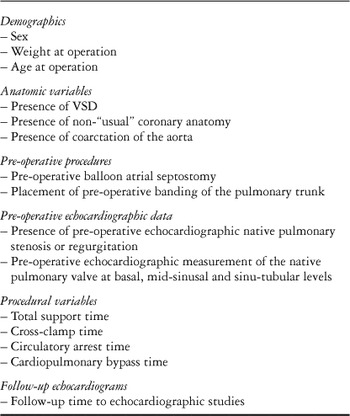
Progressive dilation was defined as an increase in the Z-score for the root of greater than or equal to 2.5 (top quartile) between the first and most-recent follow-up echocardiograms. A patient with progressive regurgitation was defined as a patient who had an increase of at least one grade of neo-aortic valve regurgitation between the first and most recent follow-up. Variables evaluated as potential risk factors for progressive root dilation or neo-aortic valve regurgitation included demographic data, anatomic variables, pre-operative procedures, procedural variables, and follow-up time (Table 1). The analysis to determine risk factors for progressive dilation and regurgitation utilized a logistic regression model. A p-value less than 0.05 was considered significant in the statistical analysis. Linear regression was utilized to calculate inter-observer variability between the senior echocardiographer and the two sets of echocardiogram reviewers.
Table 1. Variables assessed as potential predictors of neo-aortic root dilation and regurgitation.

Results
Demographics
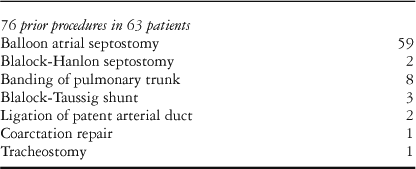
We found 82 patients who met the criterions for inclusion. Their median age at the time of the arterial switch operation was 5 days, ranging from 1 day to 5 years. There was a male predominance, with 54 males to 28 females. Of the patients, 52 (63%) had transposition with an intact ventricular septum, while 30 (37%) had transposition with a ventricular septal defect or double outlet right ventricle. The ventricular septal defects were conoventricular in 14, malalignment in 10, and muscular in 6. Coarctation of the aorta was present in eight patients (9.7%). The arterial switch operation was the first surgical procedure in 73 patients (89%). Including balloon atrial septostomy, 76 prior procedures were performed in 63 patients (Table 2).
Table 2. Procedures prior to the arterial switch operation.

The median follow-up time was 8.8 years, with a range of 4.1 to 16.4 years. The total follow-up time was 773.3 patient-years. The median number of follow-up echocardiograms was 4 with a maximum of 10. All 82 patients had adequate serial exams to assess neo-aortic valvar regurgitation, with 76 having images of sufficient quality to assess the size of the neo-aortic root.
In 6 patients, late re-intervention was needed after the arterial switch operation for re-coarctation, involving placement of a homograft patch for augmentation in 3, balloon dilation angioplasty in 2, and subclavian flap repair in the other. An additional 2 patients had re-intervention for supra-valvar neo-aortic stenosis, and 1 patient had a myomectomy for sub-aortic obstruction.
Surgical description
All patients had transection of the aorta above the commissural attachments of the aortic valve and transection of the pulmonary artery at its bifurcation. The pulmonary artery was brought anterior to the aorta with a Lecompte manoeuvre. Coronary buttons were excised with a button of aortic wall and mobilized and reimplanted into a medially based incision in the posterior great vessel. The posterior great artery in which the coronaries had been anastomosed was sutured to the ascending aorta. The defects in the anterior great vessel from which the coronaries had been excised were filled in with a pantaloon shaped patch of pulmonary homograft. The pulmonary bifurcation was anastomosed to the anterior great artery.
There were 6 patients with transposition of the great arteries with anterior malalignment ventricular septal defect with coarctation of the aorta. Four out of the six patients also had ascending aorta hypoplasia with significant aorta to native pulmonary valve size discrepancy, which required homograft patch augmentation of the proximal aorta at the time of the anastomosis of the aorta to the native pulmonary valve to provide the best possible size match between the aorta and the native pulmonary valve. Patients with posterior malalignment ventricular septal defect that were deemed suitable for the arterial switch procedure instead of the Rastelli procedure had direct anatomosis of the aorta to the native pulmonary valve without modification. Anterior and posterior malalignment ventricular septal defect were closed with Dacron patch, while muscular ventricular septal defects were primarily suture closed or closed with Dacron patch.
Dimensions of the neo-aortic root at its base, mid-sinusal level, and the sinutubular junction
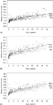
The linear regression models to assess inter-observer variability between the senior echocardiographer and the two sets of observers for the measurements revealed values that varied from 0.90–0.94, indicating good agreement between the echocardiographic reviewers. The measurements are shown graphically in Figure 2(a)–(c). Normal measurements at the 5th, 50th, and 95th percentile were derived from the values found in Feigenbaum.21

Figure 2. Measurements over time. (a) Measurement at the basal level over time; (b) Measurement at mid-sinusal level over time; (c). The sinutubular junction measured over time. For all three figures, the dashed lines show the 5th, 50th, and 95th percentile for age. Cm: centimetres.
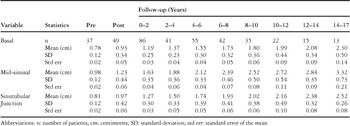
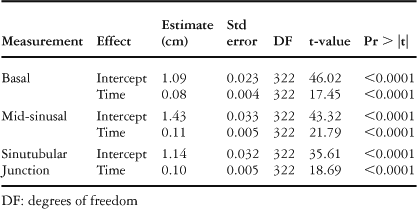
For all three measurements, the majority of the data points sit above the mean value for the normal aortic valve (dotted line), and the mean value of the data is increasing over time (solid line). Table 3 delineates the measurements by follow-up period. Using a mixed effect linear regression model with time as a random effect, the diameter at the level of the basal hinge points increased 0.08 centimetres per year, the mid-sinusal level increased 0.11 centimetres per year, and the sinutubular junction increased 0.10 centimetres per year (Table 4). The random effect variable time was statistically significant for all three models (p less than 0.0001).
Table 3. Descriptive analysis of raw measurements at the preoperative, initial postoperative and serial follow-up.

Table 4. Parameter estimates of mixed effect linear regression models with time as random effect. It delineates the effect of time on the measurement of each variable per year. The data shows that the basal measurement increases by 0.08 cm/yr, the mid-sinusal measurement by 0.11 cm/yr, and the sinutubular junction by 0.10 cm/yr. The variable time was statistically significant for all three models (p < 0.0001).

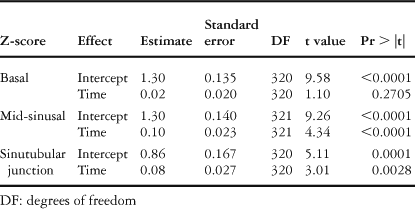
To determine whether the increase was out of proportion to somatic growth, the measurements were converted to Z-scores based on body-surface area at the time of the echocardiogram. The Z-scores for all three measurements are shown graphically in Figure 3. For all three, the mean Z-score increases over time, and in the case of the measurements at basal and mid-sinusal level, ultimately rises above a Z-score of 2. For all 3 measurements, there is a significant increase from the pre-operative to post-operative measurement, and then a steady increase throughout the periodsof follow-up. Figure 4 illustrates the percentage of patients with root Z-score greater than 2.0 by time from operation. Since the follow-up time is variable among patients, the number of patients in each follow-up period varies year by year. One year after arterial switch operation, 49 of the children (35%) have root Z-score greater than 2.0, and by 5 years after arterial switch operation, 32 of the children (55%) have root Z-score greater than 2.0. The mixed effect analysis shows that for the measurements at sinutubular and mid-sinusal levels there is a statistically significant increase in Z-score per year. The Z-score for the mid-sinusal level increases by 0.10 per year [p less than 0.001], that for the sinutubular junction by 0.08 per year [p less than 0.003], while the measurement at the basal attachment of the leaflets shows appropriate growth, at 0.02 per year [p = NS] (Table 5).

Figure 3. Z-Score of the measurements at the basal and mid-sinusal levels and the sinutubular junction after the arterial switch operation. Pre: Pre-operative measurement; Post: Post-operative measurement; ASO: arterial switch operation.

Figure 4. Percentage of Patients with Z-score for the root greater than 2.0. Total number of patients in each follow-up bin (by year) is noted with the number of patients in each annual bin with a root Z-score greater than 2.0. Pre: Pre-operative measurement; Post: Post-operative measurement.
Table 5. Parameter estimates of mixed effect linear regression models with time as random effect. It delineates the effect of time on the Z-score for each variable per year. The data shows that the scores for the mid-sinusal and sinutubular measurements increase significantly each year, while the Z-score for the basal measurement shows appropriate growth.

Neo-aortic regurgitation
Of the 82 patients in the cohort, 69 had neo-aortic valve regurgitation at most recent follow-up. Of these 69 patients, it was severe in one, moderate in 3, trivial to mild in 66, while the remaining 12 had no regurgitation at their most recent follow-up. In all four patients with moderate or greater insufficiency the neo-aortic valve regurgitation was central and was caused by lack of coaptation. In the 66 patients with trivial-mild neo-aortic insufficiency, 35 had central insufficiency from lack of coaptation, 28 had eccentric insufficiency, and 3 had leaflet distortion due to unequal cusp size. The patient with severe neo-aortic valve regurgitation underwent replacement of the valve at 11 years of age. Serial assessment after the arterial switch operation from the first follow-up echocardiogram to the most recent revealed an increase of 2 grades of regurgitation in 2 patients (2.5%), an increase of 1 grade in 36 patients (43.9%), and no increase in 44 patients (53.6%). Of the overall cohort, therefore, 46.4% had progressive regurgitation of the neo-aortic valve during the period of study.
Risk factor analysis
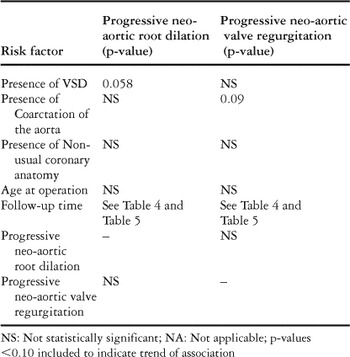
No risk factors could be identified that predicted root dilation, though there was a trend towards an association with the presence of ventricular septal defect (p equals to 0.058). Similarly, no risk factors could be identified for progressive neo-aortic valve regurgitation, though there was a trend toward association with the presence of pre-operative coarctation (p equals to 0.09). Of note, our analysis did not show an association between progressive root dilation and neo-aortic regurgitation. Risk factor analysis for both neo-aortic root dilation and neo-aortic valve regurgitation is summarized in Table 6.
Table 6. Risk factors for progressive root dilation and progressive neo-aortic valve regurgitation

Discussion
Our study shows that the neo-aortic root dilates out of proportion to normal somatic growth in children and adolescents after the arterial switch operation, and this dilation is progressive (Fig. 3). In addition, the vast majority of children after the arterial switch operation have at least mild neo-aortic valvar regurgitation, which is progressive in about half of the patients. At the current length of follow-up, we did not show an association between root dilation and neo-aortic valve regurgitation.
The aortic root is a dynamic structure that serves a critical function in the maintenance of valvar function and ventriculo-arterial coupling. The distensibility of the root, especially at the level of the sinutubular junction, allows for geometric alterations that help to minimize fatigue stresses on the leaflets and the energy expended in the flow of blood from the ventricle into the arterial network.22 These alterations comprise circumferential, longitudinal, shear, and torsional deformations that occur asymmetrically and in all phases of the cardiac cycle.23 Murakami et al.16 observed that the neo-aortic root in transposition is less distensible than the normal aortic root. Dilation of the aortic root can lead to significant increases in regional stresses and strains on the leaflets of the aortic valve,24 possibly leading to both failure of the leaflets and regurgitation of the valve. The combination of impaired distensibility and dilation of the neo-aortic root may result in a mechanically challenged system, in which increased stress on the valvar leaflets and sub-optimal energy transfer may ultimately facilitate deterioration of valvar function.
It has been shown that the pulmonary valvar leaflets and the pulmonary root are mechanically capable of tolerating pressures equal to or in excess of those that occur in the aortic position following the Ross procedure.25 It has also been demonstrated that the structural changes in the medial connective tissue of the pulmonary trunk that normally accompany decreasing pulmonary arterial pressure in the infant do not occur if pressure in the native pulmonary trunk remains high,26 as is the case in patients undergoing an arterial switch operation in the neonatal period. Our study, however, suggests insidious deterioration of the neo-aortic valve function over time.
Similar to other reports, our study showed that growth of the root is out of proportion to normal growth.12–15 The most concerning finding is that there does not seem to be a levelling off of the dilation during the follow-up period. In contrast, Hutter et al.,19 who followed a cohort of patients for a median of 8.7 years after arterial switch operation, showed that although the Z-scores for the various parts of the root increased during the first year after arterial switch operation, the diameters at the basal and mid-sinusal levels appeared to normalize thereafter. They found continued, albeit minimal, dilation of the sinutubular junction over time. Schwartz et al.15 also showed progressive neo-aortic root dilation up to 10 years follow-up in a cohort of 355 patients with a median follow-up of 5.0 years after arterial switch operation. No significant change was seen after 10 years follow-up.
Our analysis for risk factors associated with dilation revealed a trend toward association with the presence of ventricular septal defect. Hourihan et al.12 showed that neonates with transposition and ventricular septal defect had a native pulmonary valve and root that was significantly larger than in normal neonatal controls, and also than in neonates with transposition with intact ventricular septum. A possible mechanism linking the larger preoperative measurements of the neo-aorta, and its dilation over time in those patients with transposition with ventricular septal defect, could be that the larger native pulmonary root could destabilize the junction with the arterial trunk after the arterial switch operation and closure of the ventricular septal defect. Schwartz et al.15 also found that severe neoaortic root dilation (Z-scores 8.0) was associated with ventricular septal defect closure at the time of the arterial switch operation.
Pulmonary artery band placement before and left ventricular outflow tract obstruction after the arterial switch operation increase the afterload that the native pulmonary valve experiences before and after the arterial switch operation and may increase the risk of neo-aortic root dilation. In our cohort neither of these factors were predictors of root dilation after the arterial switch operation. Alternatively, Schwartz et al. have found that pulmonary artery band prior to the arterial switch operation has been associated with root dilation.12, 15, 17 This difference is likely due to the fact that a smaller number of patients in our cohort had pulmonary artery band placement before and left ventricular outflow tract obstruction after arterial switch operation relative to the Children's Hospital Boston cohort, thus making it more difficult to see differences between those patients with a significant Z-score root change (greater than 2.5) and those without.
Our data shows that there is progressive regurgitation across the neo-aortic valve after the arterial switch operation over time. This is similar to data reported by Imamura et al.,27 Yoshizumi et al,28 and Schwartz et al.,15 but is in contrast to Losay et al.,18 who noted a lower incidence of neo-aortic valve regurgitation over time with a similar period of follow-up. We found that there was a trend toward association with the presence of coarctation and neo-aortic valve regurgitation, which was also noted by Losay et al.18 In patients with transposition and an anterior malalignment ventricular septal defect and coarctation of the aorta, there is increased size of the pulmonary valve and root. These increased native dimensions, coupled with a smaller than normal preoperative native aortic valve, may lead to discrepancy between root and trunk after the arterial switch operation, and there may be less distensibility at the distal reconstruction, or residual obstruction leading to increased afterload. Despite the prevalence and progression of neo-aortic valve regurgitation after the arterial switch operation, it proved necessary to replace the new aortic valve in only one patient in our series. Other investigators have similarly noted a low incidence of valvar replacement after the arterial switch operation.2, 4, 15, 18
As this was a retrospective case series and the patients that fit the criterions for analysis are a sample of a larger cohort of patients who underwent the arterial switch operation, selection bias may be present. The number of follow-up echocardiograms, and the follow-up time, varied within the cohort. This may limit the analysis of factors indicating the risk for progressive dilation of the root and neo-aortic valvar regurgitation, but should minimally effect the serial measurements, since we used a mixed effect linear regression model with time as a random effect. Operative notes contained variable details to allow determination of intra-operative factors that may influence dilation or neo-aortic regurgitation. Use of medications, and/or systemic hypertension, may have affected the serial echocardiographic measurements or the development of progressive dilation or neo-aortic valve regurgitation. This data was not obtained for this analysis.
In conclusion, there is an abnormal progressive increase in the size of the neo-aortic root and sinutubular junction after the arterial switch operation, with the largest and most concerning increase noted at mid-sinusal level. In addition, the majority of patients in our study have at least mild neo-aortic valvar regurgitation, with progression in nearly half of the patients. Both of these findings are similar to those noted to affect the neo-aortic root following the first stage of reconstruction for hypoplastic left heart syndrome and the Ross procedure.29–31 The long-term function of the neo-aortic valvar complex remains unknown. In addition, it is not yet known whether the neo-aortic valve will fail with increasing age, as afterload and the risk of atherosclerosis increases. Our study, nonetheless, raises concerns of the adequate long-term function of the neo-aortic valve after the arterial switch operation into adult life.
Acknowledgements
We acknowledge the work of William I. Norwood, who operated on many of the patients in this series. We would like to thank the staff of the echocardiography laboratory, as well as the medical, nursing, respiratory and support staff of the Cardiac Center at the Children's Hospital of Philadelphia for their help in the care of these patients and with data collection; and Xianqun Luan for his assistance with the statistical analysis.