Introduction
The ‘everyday state’, from the point of view of existing literature relating to Pakistan, remains very much taken-for-granted, and hence an overlooked aspect of people's lives there. The concept, which has come to be increasingly deployed by anthropologists, geographers, historians and political scientists in relation to other parts of the world, as yet remains largely unexplored from a Pakistani point of view.Footnote 1 Focussing on the state has usually involved explaining why Pakistan came into existence in the first place—how the new state was created—and then why authoritarian trends rather than democratic political processes came to be so closely associated with it over subsequent years—why, in effect, particular interests captured control of the state apparatus.Footnote 2 There has been relatively little concern with what the state in Pakistan at the ordinary everyday level has meant to its citizens.
The Challenge
Pakistan, like its neighbour India, faced huge challenges in making the transition from colonial rule to independence in the years following 1947. But unlike India, where the responsibilities of the post-colonial state vis-à-vis those of the people were articulated fairly swiftly and at substantial length in its 1950 constitution, it took far longer to work out the same basic political coordinates for Pakistan. It was not until 1956 that Pakistan's first constitution appeared, and even then it barely survived two years before the ‘rules of engagement’ were re-drawn by the military. As a result, during the late 1940s and 1950s, the Pakistani state lacked much of the authority associated (rightly or wrongly) with its Nehruvian counterpart, a situation not helped by the fact that its newly-created citizens were still coming to terms with the impact on their identity that independence combined with partition had produced.Footnote 3 Under these circumstances, it is perhaps not surprising that little is known about what the state meant to people, and it might well be assumed that it represented something that was remote in terms of their immediate lives. Yet, as work on the relationship between society and the state in India has emphasized, such assumptions underestimate the extent to which social forces penetrated the state-system and so blurred the boundaries between them in practice.Footnote 4 Indeed, it could be argued that getting away from approaching the immediate past in a ‘top down’ fashion—using localized practices to throw light on the workings of a translocal institutionFootnote 5 —necessitates the use of different kinds of methodologies that link more closely to other social science disciplines than those ‘traditionally’ deployed by historians. As Fuller and Harriss have suggested in relation to India, for instance, the ethnographic methods associated with anthropology can serve historians well, particularly when the time frames under consideration involve relatively recent developments.Footnote 6
Accessing the routine, albeit pressing, concerns of Pakistanis during their state's early years, however, poses difficulties thanks to the paucity of accessible primary material. One set of historical sources that are available to those interested in finding out more about the daily interactions between state and society during this period are the letters written to contemporary newspapers. In them members of the general public outlined their expectations of, made demands on, and frequently aired their frustrations with the state, its actions and those who represented it in the years following independence. As Gupta has argued, newspapers are ‘cultural texts that give us important clues to the political culture of the period’.Footnote 7 According to a more contemporary analysis of the content of Pakistani newspapers, ‘Letters to the Editor’ constitute precisely the ‘opinion page of the ordinary reader. . .with views ranging] from grandiose thoughts about the destiny of the country to complaints about the everyday problems of the ordinary people’.Footnote 8 Through them, we can access ordinary voices from the past. While any selection of letters that is actually chosen for inclusion by a newspaper cannot be regarded as ‘random’, since any such publications possess agendas of their own to which correspondents’ letters may contribute, revealing insights can still be drawn from the airings of the views of ordinary citizens into their contemporary priorities and concerns, even when possible distortions are taken into account. Accordingly, this paper draws on a sample of this correspondence on the letter pages of Dawn (a national English-language newspaper published in Karachi) during the early 1950s in order to explore the views of these ordinary citizens (from the perspective of Karachi and, to a lesser degree, the province of Sindh) as they grappled with problems of housing, transport, food rationing, water shortages, and what they often termed ‘graft’, that is corruption, usually involving government officials and members of the general public.
Before turning to what these letters reveal in terms of ‘the discursive construction of the state in public culture’,Footnote 9 however, it is necessary to emphasize that, in the early 1950s, Pakistan remained very much a nation-in-the-making. As mentioned above, the physical contours of the state may have been established but the Constituent Assembly (the acting National Assembly), and its various sub-committees, were still debating the basic contents of the constitution that had yet to be finalised.Footnote 10 In addition, millions of refugees had still not been properly ‘rehabilitated’. Nor had the country's economy recovered from the disruptions triggered by partition. Not all parts of Pakistan, however, were affected to the same degree. Compared with the Punjab, the province of Sindh, along with what had become the new Federal Capital of Karachi (in 1948), continued to be more acutely affected by periodic influxes of large numbers of migrants from India as well as from other parts of Pakistan. Sindh's provincial ministry, which had been based in Karachi, had relocated inland, at least in part, to the city of Hyderabad with all the various administrative upheavals that this involved, while the federal Pakistani authorities now shared, and vied for, space in the capital with its local municipal corporation. Karachi was itself massively swollen in terms of population, and did not possess sufficient buildings to accommodate fully either the new bureaucracy or the migrants themselves. The result was that space was commandeered for official purposes, large numbers of people in effect squatted in property that had been ‘evacuated’ by departing non-Muslims, and many others were still living in temporary shelters in vacant public spaces, parks and on footpaths of the city. Similar processes were at work elsewhere in urban Sindh, to a lesser degree, with the situation in places such as Hyderabad and Sukkur mirroring that of Karachi in many ways.Footnote 11
Local resources, therefore, remained severely stretched. Not surprisingly, this state of affairs produced persistent disquiet in relation to how well, or (alternatively) how badly, the new administrative apparatus (whether at federal, provincial, district or municipal level) and its officials (highly placed or lower level) were addressing the needs of its citizenship. In the absence of a political framework that might have allowed ordinary Pakistanis on a regular basis to air their grievances, or to sanction those who ruled them, there was tangible frustration that the authorities repeatedly sought to defuse through appeals to peoples’ patriotic sentiment and promises of future improvements, if the nation (rather than the state) as a whole ‘pulled together’.
It is against this backdrop that the concerns of the people who wrote letters to Dawn need to be placed. Dawn, as an English-language newspaper that projected itself as a ‘national’ publication while closely identifying with the ‘refugee cause’, could not really claim to represent the views of a representative cross-section of the people who were now living in what had become Pakistan. Its readership, simply by virtue of being able to read its content, hardly comprised ‘ordinary’ Pakistanis, and so it could be argued that Dawn projected the voices of a ‘nationalist’ elite, which, while not necessarily defined along straightforward class lines, belonged in the main to people with relatively ‘privileged’ backgrounds (whether in terms of access to an English-style education or to particular kinds of employment).Footnote 12 Yet, to a great extent, despite these inherent biases, its editors regarded themselves as ‘defenders of the nation’ as a whole, as they interpreted the intentions of Muhammad Ali Jinnah (who had established the newspaper in Delhi prior to partition). Dawn's editorial line could, therefore, as easily criticize as support the government of the day, depending on the latter's stance on a particular matter. This often turned out to be the case when it came to matters affecting refugees, thus suggesting a tension between the newspaper's stated aims and its actual day-to-day concerns. While generally supportive of the new establishment (whether in the shape of the federal authorities or their provincial counterparts), Dawn operated as a proverbial thorn in its side when circumstances, from its editor's point of view, so dictated or warranted.
Looking at Dawn's letters over a discrete period—five or so years after the creation of Pakistan—reveals unmistakeable patterns in relation to the main issues of concern articulated by their writers. The most enduring topic of complaint centred on accommodation—there was persistent dissatisfaction with the ways in which the local authorities were handling the issue of rehabilitating, that is re-housing, those who had migrated from what was now India whether in 1947 itself or later on. There were, not surprisingly perhaps, variations on this theme: sometimes the authorities were not doing enough, sometimes they were doing too much, and correspondents frequently closed their letters with requests for persons more highly placed within the bureaucracy to intervene and sort out whatever particular mess had been identified. As in the parts of India affected by the upheavals of partition, there was considerable competition and uncertainty connected with evacuee property, that is, property associated with people who had migrated and whose status had become ambiguous. To those who lost out in what was a fierce competition for allotments (and not surprisingly, they tended to be those who wrote to the newspaper), the decisions of rehabilitation department officials regarding how evacuee property was allocated could appear arbitrary at best, and corrupt at worst. There was little apparent confidence in the ability, or readiness, of lower level state employees to deal with these matters satisfactorily, or even fairly. One correspondent, whose letter of December 1951 highlighted some of the issues concerned, complained in the following manner about the degree to which corrupt practices had become commonplace in Karachi:
I would like to bring to the notice of the authorities concerned a glaring instance in which deserving refugees are being uprooted and sacrificed at the altar of favouritism and the high handedness of resourceful people. Such cases are not very uncommon and are eating [away at] the social life like canker and are as a matter of fact defeating the very purpose of refugee rehabilitation. The support which such people receive makes them bold enough to defy the law, the principles of equity, justice and fair play are of course the last to be counted.Footnote 13
This anonymous letter-writer then went on to outline in some detail irregularities involved in the allotting of a plot of land that, he claimed, had been reassigned to a wealthy recent arrival from Meerut (in UP) with ‘good connections’ in the Public Works Department. The fact that large numbers of migrants continued to arrive in Karachi throughout the early 1950s meant that the practical problems and challenges associated with their rehabilitation dragged on throughout this decade, and constituted a great deal of the criticism that was launched by frustrated citizens in the direction of the state, whether at its central representatives in federally-administered Karachi or at local provincial or municipal officials.Footnote 14 Personal connections at the disposal of those with the necessary social capitalFootnote 15 were usually credited with making a noticeable difference to individual experiences of resettlement and rehabilitation. At the same time, the state's handling of evacuee property was closely scrutinised. As Zamindar has shown, in relation to Karachi during this period, refugee interest groups were quick to exploit any suspicion that the authorities might be turning a blind eye to possible abuses, and used the courts to highlight where and how they alleged that the system was manipulated in favour of those with connections in the right places.Footnote 16
The evident failure of the authorities to improve the living conditions of many of the refugees in Karachi likewise drew persistent criticism. By the early 1950s, there was clearly a widespread expectation that the so-called refugee colonies that had emerged in the province's urban centres in the late 1940s—often starting life as haphazard groupings of small ramshackle huts with virtually non-existent water and sewerage arrangements—would have been significantly upgraded in terms of facilities as well as regularised insofar as their official status was concerned. But, as the following (anonymous) letter dated January 1952 indicated, when the authorities did eventually get round to acting, it was commonly believed that their intervention threatened to undo much of the progress that the refugees had themselves made, leading to high degrees of frustration on the part of the latter.Footnote 17 In this particular case, the complaint centred on a lengthy dispute over the official status of a particular housing society in Karachi:
I would like to bring to the attention of the Central Government and Rehabilitation Department regarding their belated action in issuing ejectment [sic] notices to residents of the full-fledged and well-established Khudadad Colony. I do not understand what these officials were doing when this colony—in 1948—began to form its root [sic] on this vacant land which has now been allotted to another housing society. Of course the refugees who are occupying this land and settled down here did so with the permission of the then District Magistrate. Now after a lapse of over three years, when the Colony has become a first rate Colony of Karachi, having well-built pucca houses numbering nearly 700, accommodating over 10,000 individuals of moderate means, the Government wants to demolish the houses and dislodge the residents. In case the ill-advised and totally unjustified action of demolishing the houses is carried out, it will be the most unfortunate incident without any precedent.Footnote 18
Not all contemporary observers, however, believed that the blame lay entirely with the authorities. A 1953 American embassy report on Karachi's major colonies attributed at least some of the problems encountered by refugees to their own outlook, noting a degree of apathy amongst them, which, according to its author, had origins that lay in the ‘resigned acceptance of government indifference’ of pre-Partition days. At the same time, the report dismissed the efforts of the Ministry of Refugees and Rehabilitation as ‘puny’, and noted the irony of the apparent refusal of rehabilitation officials to ‘pamper’ the refugees given the fact that in Karachi and other provincial urban centres many of the same officials had received priority treatment in terms of housing following their own arrival from India.Footnote 19
The second set of grievances that dominated the letter columns of Dawn during this period revolved around the quality of the public services provided by those responsible for the various municipalities of the province as well as that of Karachi. These ranged from the question of public transport (not a petty issue in a city growing as fast as Karachi was, with a workforce that increasingly lived far from places of employment now that large numbers of refugees were being ‘cleared’ from the city centre to live in what were then its outer fringes) to those of sanitary issues and access to all-important but all-too-rare open public spaces. The following letter thus provides insights into the way in which the authorities handled the business of expanding transport facilities, albeit through the somewhat jaundiced eye of someone who definitely regarded themselves as having suffered in the process:
Strange are the ways of the Provincial Transport Authority [PTA] in granting permits for plying buses in the Federal Capital. I along with hundred others had applied for one such permit in March ’51. For ten months nothing was known about the fate of our applications in spite of our visiting the PTA office every week for enquiries. Suddenly on 10 Dec a note from the Secretary of the PTA was received with instructions to produce a completely ready carriage for inspection on Dec 14 (morning). This note bore the date of Dec 5, and on enquiries it was found out that most of the applicants had received the same note. May I enquire from the Secretary who on earth could produce a ready-made carriage within four days. This note amounted to me to be nothing more than a rejection of my application. It would have been better if our Secretary had written saying that our application had been rejected. But the worst part of it was when on Dec 14 (morning) some of the people, very few in numbers, turned up with ready-made buses. Nobody could believe that these were made within four days. These privileged persons perhaps were given this information that they should keep their carriages ready much before the notices were issued. This is indeed the way rehabilitation is going to be made with the help of the people.Footnote 20
Likewise, the local authorities, in the shape of the Karachi Municipality, came in for their fair share of criticism for the way that the Municipality made its decisions. Take, for instance, the question of the city's bus routes:
While allotting the routes to new buses, the transport committee has changed its outlook. Their motto or criterion is greatest good to the smallest number or greatest loss to the greatest number. To implement this they have allotted best routes to worst buses and worst routes to best buses. . .they have not cared for the good of the public which is the real contributor of buses. Our interests and outlook has been ignored.Footnote 21
And it was not just who it was who acquired the permits to run bus services that rankled with readers of Dawn. As another letter, dated April 1952, highlighted, there was considerable public disquiet over the patently inadequate provision of bus services:
Sufficient time has elapsed since the Sind government took over the transport system of certain routes in Karachi and Sind. With the control going into government hands, hopes ran high that many modern conveniences of road transport will now be comfortable. Suffice it to say that far [from] being cheap no facilities whatsoever have been afforded to [the] public travelling by the government buses. . .I request the Sind government authorities to see that their transport system is run on the best possible lines. Fare and baggage charges should be reasonable, waiting rooms provided and only tip-top buses to be run.Footnote 22
Sanitary matters in over-crowded communities proved to be an especially sensitive topic. As one correspondent writing to the newspaper from Upper Sindh pointed out, sanitary arrangements in the city of Sukkur (that contained large numbers of refugee migrants) had deteriorated markedly:
[There are] [n]o drainage arrangements in Maulvi Abdullah Lane, opposite Nishat Cinema Sukkur, with the result that filthy water accumulates in soaked pits, dug by people in front of their houses. This causes a very bad odour on [the] one hand and creates poisonous germs of cholera and malaria on the other. The Municipality also makes dirty water of neighbouring streets flow into this lane, which has doubled the pangs of the poor residents. . .[T]he Administrator of Sukkur Municipality [has been] approached many a time in deputation in this connection and a number of petitions were also submitted to him to make the necessary arrangements for [an improved] drainage system . . . no heed has been paid.Footnote 23
Another correspondent, this time complaining in vivid fashion about the state of Jacob Lines (a neighbourhood in Karachi where many government servants themselves lived), highlighted the daily challenge of living in such unclean surroundings:
Permit me to bring to notice of authorities of Karachi Cantonment and the Central Government the deplorable insanitary conditions prevailing in Jacob Lines. The huts and tent[s] of refugees have encircled the government quarters situated in the rear part of this colony like the web of a spider. On account of this congestion of huts, even a rickshaw cannot pass through at most places. This is resulting in enormous inconvenience and trouble to the government servants who deserve special attention of the authorities concerned. Their family members have to alight down from taxis and victorias [horse-drawn carriages] etc at the main road in order to reach their residence on foot as the passage is almost blocked. Besides the huts have no means of disposal of human excretion. Heaps of it are seen lying around the quarters, emitting stench and breeding mosquitoes and other infecting worms. At certain places big pits have been dug out for the storage of filthy water outside the huts. The passers-by usually slip into these pits in darkness. To crown all, some people are allowed to keep milch cattle for business purposes even in this congested area. Recently a buffalo went wild and proved a source of terror and damage to the inhabitants, and had to be shot down to death. It is evident that all these irregularities are going on unchecked by the authorities concerned. We do not press for complete eradiation [sic] of huts and tents of refugees from this place. But the government can make arrangements for maintaining sanitary conditions. They can be persuaded to shift their huts and tents to spacious places in or behind Jacob Lines or to some other suitable site. The cattle keepers (whether government servants or refugees) can also be directed not to keep their cattle outside or near the government quarters.Footnote 24
As far as the provision of other sorely-needed public facilities was concerned, the following examples reflect the tone of the correspondence on these matters. A letter in March 1952 commented on the sorry provision of public conveniences in the city:
There have been many complaints against the Municipal Corporation with regard to the insanitary condition of Karachi but with little result. The Corporation authorities do not perhaps like to do anything. After a long time and after repeated public request, the city was provided with some urinals at certain important points in the city, but that was, in my opinion, a sheer waste of money. These urinals have become a nuisance. A glance at these urinals with urine flowing all around will convince one that they are of no use until proper arrangements are made to clean them a few times during the day. The present condition indicates that they are seldom attended by the Municipal Health staff. Surprise checks by the senior peoples and effective action against defaulters can only improve the matter.Footnote 25
Similar dissatisfaction with the authorities’ failure to act appropriately can be detected in this following letter regarding access to other kinds of public facilities. As its female writer complained:
Burns Garden is for the enjoyment of the public of Karachi. Since the day it was thrown open to the public some thirty years ago a portion of it was earmarked for the exclusive use of women-folk and was called the Ladies Park. Now some persons have somehow managed to get the Ladies Park allotted to themselves and have built private houses and are living there. They do not allow the women of Karachi to enter the place and claim to be the exclusive owners of the place. [Will] the authorities concerned look into this.Footnote 26
Equally, as underlined in another letter published in February 1952, persuading the authorities to look into a matter could prove a highly frustrating experience:
In May last year I presented to Karachi Municipal Corporation [KMC] a petition praying for the construction of a pucca lighted road and bridge on the Lyari bed and constructing a wall round the graveyard in Lalukhet. I was told that the matter will be looked into and everything possible will be done. The KMC gave no reply for a long time. I therefore again called to enquire what action had been taken on my petition. I was sent with written instructions to the Land Manager, who is the official responsible for dealing with the matter and to whom I learnt my petition had been transferred. I went there but received no encouragement I was even told that thousands of such petitions were received daily from the public and that I should not expect a reply. I could neither succeed in having my petition traced nor knowing its disposal. I tried to impress upon the authorities the importance of the matter but to no avail. I have again addressed the KMC for an appropriate action in the matter. I hope that the higher authorities will take practical steps to meet the public demands.Footnote 27
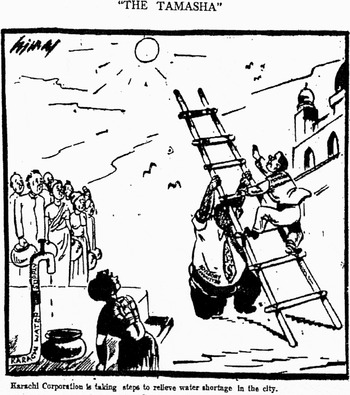
The third issue that moved large numbers of correspondents to write to Dawn during this period were particular crises that proved very disruptive to daily life, such as the acute water supply problems that gripped Karachi during March to May 1952 (see Figure 1).
‘The Tamasha’: Karachi Corporation is taking steps to relieve the water shortage in the city, Dawn, 26 April 1952, p. 5: standpipe caption reads ‘KARACHI WATER SUPPLY’, caption on the shirt of the man holding the ladder reads ‘ADVISORY COMMITTEE’, and caption on the shirt of the man climbing the ladder reads ‘MUNICIPAL CORPORATION’.

As well as the ongoing food rationing caused by nationwide shortages. In both cases, readers of the newspaper sought to draw attention to the apparent unwillingness (at least in their view) of the local authorities to deal with their problems sympathetically, and they questioned the role of officials in the relevant departments. Hence this appeal that appeared in April 1952:
I wish to draw the attention of the authorities concerned to the deplorable state of affairs of the Municipal Corporation in connection with the water supply to the inhabitants of Pir Ellahi Bux Colony. As all know, prior to taking up the responsibility and management of water supply to the Colony by the Municipal Corporation this work had been done by private individuals. So long [as] this work [was] being done by these private individuals, there was not a single complaint against them for any sort. But the Municipal Corporation under the tall talk of supplying the water regularly at a nominal rate and thus relieving the inhabitants from the clutches of private individuals who were charging two annas per mashak [volume of water] took the management into their own hands. Since the Municipal Corporation has taken over the responsibilities in their hands not a single drop of water is found in the Colony for days together. Little children run from one door to other requesting to give them a tumbler of water to quench their thirst but nobody could help them. The Management and Staff of the Colony was appraised of these state of affairs but it seems it fell on deaf ears. The Staff and Bahishti [suppliers of water] showed their irresponsible attitude and laugh at us.
Like many other indignant letters written at this time, this one ended with a request to Dawn's Editor to ‘kindly move the authorities to ensure that such trouble is removed’.Footnote 28
Correspondence focussing on the problem of food shortages ranged from the polite to the insistent. In February 1952, at a time when there was an increase in the rationing of food stuffs, and consequently much discussion of the authorities’ inability to deal effectively with the twin (supposedly contributing) evils of smuggling and black-marketeering, a self-styled ‘housewife’ from Karachi pointed out that:
During [the] past few days it has become painfully clear that our Food Minister [Abdus Sattar PirzadaFootnote 29] is not bearing his responsibilities as it should be. We who were a surplus nation in food grains and were proud of this achievement have been reduced to a sorry state overnight. Our Food Minister has suggested that we should eat more rice but does he realise that rice is more expensive than wheat besides having less nutritional value? Many of us who have large families to support rely on just one earning member. Our hopes of an appreciable reduction in food prices are not mere rosy dreams. May we request the Food Ministry to awaken from its slumber and launch an immediate and vigorous drive against smugglers and black-marketeers?Footnote 30
Similarly, an indignant-sounding correspondent from Sukkur took the authorities to task when it came to putting a halt to black-marketeering:
Responsibility for the black-market in food grains in Sind should also be shared by the Provincial Civil Supplies department. They do not properly plan the procurement and distribution of food grains. They have no proper staff in the districts to enforce control orders. Their instructions to the district authorities are always incomplete with loopholes for [the] black-market to flourish. In my opinion, the Department needs a complete overhauling.Footnote 31
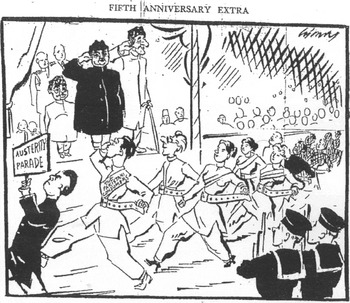
By September 1952, with austerity officially the order of the day (see Figure 2) frustration at the food situation had intensified further as this example demonstrated:
Thanks for your today bold editorial on food but you should have demanded the removal of (1) the Food Minister against whom so many and so loud complaints have appeared in the Press and also placed before the Government. No democracy harbours a Minister once he is openly charged. If you agree, please demand his removal immediately. The nation demands it. His own record requires it and above all the country's interests urge it. [You should also have demanded] (2) the removal of certain Food Ministry officials against whom your own Gujarati Edition and other vernacular Press has been crying hoarse for last so many months. It is said that they are hand in glove with city's Ration Depot Holders and other crooks in hushing up serious food crimes and yet nobody seems to do anything. May I also request our Chief Commissioner, AT Naqvi to get Karachi's Rationing Department detached from the Central Food Ministry and improve its internal tone and administration?Footnote 32
Fifth Anniversary Extra: Austerity Parade, Dawn, 14 August, 1952, p. 5: placard slogan reads ‘AUSTERITY PARADE’, while the sash on the marcher taking the salute reads ‘THE PAKISTANI CONSUMERS’.

As this letter indicates, the final area of concern, and again criticism, that emerges particularly strongly from Dawn's letter pages during this period relates to the persistent abuse of bureaucratic power. Whether in the form of bribery, corruption or nepotism, ordinary Pakistanis found themselves coming face to face on a daily basis with what they frequently termed ‘graft’. The problem had not escaped the attention of the higher authorities: indeed, reports of corrupt officers being apprehended frequently appeared in the press. In January 1953, while exhorting public servants in Sindh to ‘make it really hot for him [sic] who defies the law of the land’, Sindh's Governor Din Mohammad (who had recently suspended the provincial government) warned that should such miscreants disregard his direction and persist ‘in their traditional depredations. . .they [would] receive no quarter’. The Governor, delivering his warning in a Pakistan Radio broadcast, emphasized that, at what was a sensitive time in the evolution of the administration, civil servants were effectively ‘on trial’ and, if they were to achieve success, then they had to develop the virtues of honesty, efficiency, devotion to duty, courtesy to their fellow beings, and loyalty to the state. No pains, Din Muhammad insisted, would be spared to rid the body-politic of all its existing ailments.Footnote 33 All the same, as letters to Dawn indicated, the problem diminished the authority of those who represented the state in its day-to-day dealings with the general public:
A certain clerk in the Rehabilitation Department, Golimar Section dared to change the entries in the official register of plots to suit his purpose by over writing his own name obliterating original possessors’ names and by assigning a wrong number to the plots . . . and finally taking possession of the same forcibly, although the original possessors had pucca compound walls around the plots for the last 4 years when perhaps there was no trace of this clerk in Karachi. When a hue and cry was raised by the oppressed persons the higher authorities issued the necessary Stay Orders. Such clerks bring the administrative machinery into disrepute and need to be dealt with sternly.Footnote 34
A similar argument was put forward by a correspondent from Hyderabad, who drew attention to the widespread dissatisfaction that existed with regard to government officials in general and the (notoriously ineffective) Anti-Corruption department in particular. As his letter suggested, the all-too-common abuse of bureaucratic privileges was undermining public confidence to the extent that the department concerned had lost much, if not all, of its credibility:
If investigations were to be made, instances would be made available where reports have been made to the Anti-Corruption staff and officials have been caught with Government property in their houses, or documents and bills for materials and stores supplied by local contractors at absurd prices and labour registers with false entries have been seized, but these cases have eventually been suppressed by official pressure and the informants have been victimised and hounded out of their jobs in the Government after having been declared dangerous subjects in departmental circulars. It is time that privileges for officers and subordinates of Gazetted rank be abolished. The Government should establish without any delay Tribunals of unofficial persons who are considered honest and impartial in their sense of Justice. . .and the whereabouts of the Tribunals should be advertised from time to time if the Government are really out to stop graft and corruption at this stage. The views of the public who are interested in the administration of justice may help in the campaign against corruption and graft if pushed with vigour.Footnote 35
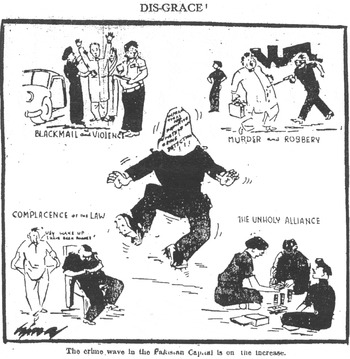
It was not only the suspect activities of civil servants, whether high or low, in government departments that generated criticism. There was also the attitude of others who worked for the state towards those whom they were supposed to be serving. As the ‘Citizen’ in the last letter included here pointed out in relation to the police force (and as Figure 3 also suggests) these particular representatives of the new state still had a long way to go in terms of how well they were perceived to be treating the general public:
The police in the Federal Capital have not changed their mentality. They still think themselves the minions of the old British Government instead of considering themselves as public servants. Whenever a citizen, however respectable he may be, visits the police station to lodge a complaint, the Police Inspector down to the constable pay scant regard to him and instead of giving any hearing to him behave with him most rudely. Corruption, favouritism, and ills of drinking and debauchery are the order of the day in their rank and file. Will the authorities concerned look into the matter and try to better the organisation.Footnote 36
‘Dis-Grace’Footnote 37: The crime wave in the Pakistan Capital is on the increase, Dawn, [spring] 1952, p. 5: reading clockwise from top left ‘BLACKMAIL and VIOLENCE’; ‘MURDER and ROBBERY’; ‘IMPRACTICAL PREVENTIVE METHOD OF CRIME DETECTION’; ‘THE UNHOLY ALLIANCE’; ‘COMPLACENCE of the LAW—HEY WAKE UP I HAVE BEEN MUGGED’.

Such letters as these to Dawn, taken en masse, undoubtedly present a dramatic picture of the concerns of Pakistanis who were living through what were difficult times in the years following independence and partition, and for much of this time lacking an effective political voice. The extent to which the reality of Pakistan—certainly from the perspective of Karachi and Sindh—was failing to live up to the expectations that had been raised by its creation was palpable, and not helped by the restricted democratic processes at work here. No national elections took place during this period, and while occasional provincial polls were conducted, those in Sindh (postponed a number of times until they finally took place in May 1953) were tarred (as elsewhere) by accusations of vote-rigging and other electoral misdemeanours.Footnote 38 Unlike neighbouring Punjab, where refugee representatives acquired seats in the Provincial Assembly, taking the place of non-Muslim members who had left for India, the Sindh Legislative Assembly did not make the same space available for refugee interests. The city of Karachi simply lacked representation, whether for refugees or earlier residents, at both the local and higher level throughout most of this period. So, while the level of patriotic exhortation may have still been high, with the emphasis on Pakistan's new citizens looking beyond their perhaps difficult immediate personal circumstances and working to improve the overall condition of the nation (Dawn's editorial stance, for instance, remained firmly ‘nationalist’ throughout this period), what these letter writers in their different ways communicated was a clear sense of ordinary Pakistanis expecting more from the new state on a day-to-day level than it, at this stage in its political or economic development, was able to deliver. Citizens of a new country, won (as they saw it) at the expense of great effort and suffering, they considered themselves to be entitled to better treatment than they were receiving at the hands of the state's representatives.
Indeed, it was the apparent contradiction between what ‘Pakistan’ had seemed to promise at its creation and the realities that it was now delivering which formed a major recurrent theme whenever the shortcomings of the new state were discussed. While the lack of a constitution and debates on the place of Islam occupied column space, and worried letter-writing correspondents, many of the key questions of the time were more mundane, if no less pressing. At their core lay a desire within civil society to hold the state accountable for its failings to address people's everyday needs.Footnote 39 Life, in the opinion of many of those who wrote to Dawn during this period, was supposed to be better than it had been before independence but, for most, it seemed that little had really changed in tangible terms. And, as a May 1952 editorial in Dawn reminded its readers, this longer-term perspective was all-important when it came to understanding what went into the making of citizenship at the everyday level of people's encounters with the state:
It is fashionable to decry the long period of foreign rule as the source of endless administrative abuses. The trouble is in fact much older and has followed from the temper traditionally associated with authority. True it is that the generality of the foreign rulers of this subcontinent felt themselves to be under no obligation or compulsion to be well-behaved towards the subject people; nor did they consider it necessary to require their subordinate functionaries to be courteous towards the general public coming in daily touch with them. But now that the old distance between ruler and ruled—maintained by racial arrogance, social segregation and official haughtiness—has been eliminated, a new and more human spirit among the country's public servants is to be expected. The change for the better can be sensed, but it cannot establish itself as long as unwholesome legacies are allowed to persist. It is absolutely necessary that all Government departments, and particularly those coming in daily contact with the common people, should make courtesy the rule. . .Observation of courtesy is essential if a favourable atmosphere for the elimination of inefficiency and corruption from the service is to be created.Footnote 40